For decades, the top political issue for many U.S. Catholics has been abortion. But, a recent article in “The Atlantic” argues that the focus has shifted to opposing the Trump administration’s harsh immigration policies and enforcement. Pope Leo, the first American to head the Catholic Church, has criticized and rebuffed Trump’s policies, statements and acts of war as contrary to church teaching and Christian values. We’ll talk about political tensions U.S. Catholics are grappling with and how that relates to our broader political system.
Division Grows Among U.S. Catholics Over Trump Policies
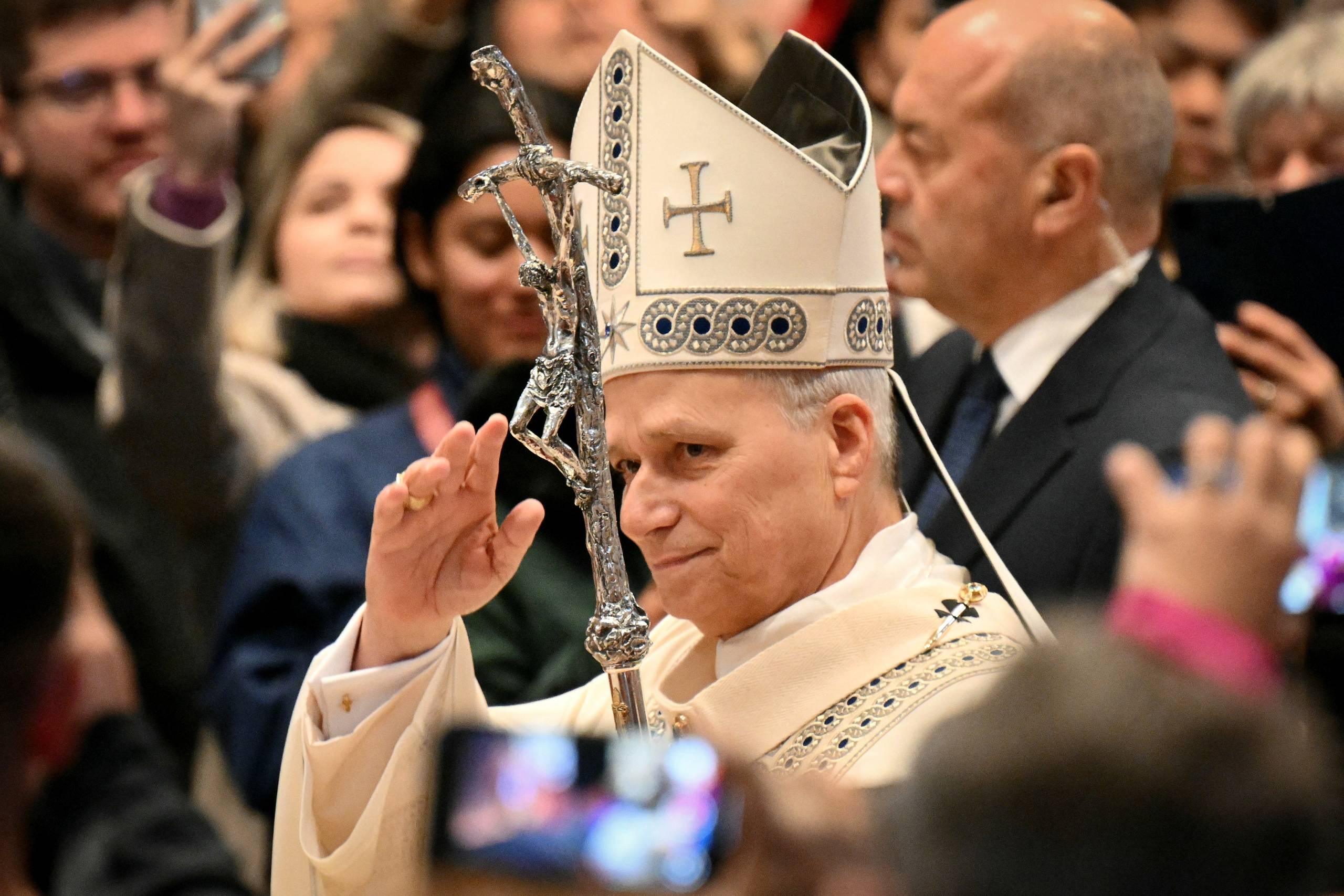
Pope Leo XIV. (Photo by Alberto PIZZOLI / AFP via Getty Images)
This partial transcript was computer-generated. While our team has reviewed it, there may be errors.
Alexis Madrigal: Welcome to Forum. I’m Alexis Madrigal. This morning, we’re talking about the fascinating situation among U.S. Catholics. In the wake of the Dobbs decision, abortion has become a more muted political issue. Meanwhile, the Trump administration’s immigration policies, among other things, have caused consternation among an increasingly Latino American Catholic population. And that was before Pope Leo, the first American pope, began to criticize the Trump administration’s positions, and President Trump called the pope weak on crime.
Here to discuss, we’ve got Francis X. Rocca. He’s a contributing writer at The Atlantic and also the Vatican editor at EWTN News. Welcome, Francis.
Francis X. Rocca: Glad to be here. Thank you very much.
Alexis Madrigal: Yeah, great to have you. We also have Amirah Orozco, who’s a theologian, research assistant, and doctoral candidate at the University of Notre Dame. Welcome.
Amirah Orozco: Great. Thanks for having me.
Alexis Madrigal: And we have Dónal Godfrey, university chaplain at the University of San Francisco. Welcome.
Dónal Godfrey: Thank you. Good morning.
Alexis Madrigal: So we have to start this morning with this long and typically kind of rambling post on Truth Social by the president about Pope Leo. And just so we all have it on the table, for those who haven’t read it or seen news about it, I’m just going to read the first part of it here.
This is President Trump posting on Truth Social. It says: “Pope Leo is weak on crime and terrible for foreign policy. He talks about fear of the Trump administration, but doesn’t mention the fear that the Catholic Church and all other Christian organizations had during COVID, when they were arresting priests, ministers, and everybody else for holding church services, even when going outside and being ten and even twenty feet apart. I like his brother Louis much better than I like him because Louis is all MAGA. He gets it, and Leo doesn’t.”
I mean, Francis, let’s come to you from the perspective of the Vatican and from outside the U.S. What does this kind of rhetoric from an American president even mean or look like? Like, he’s the pope, so why or even how could he be weak on crime?
Francis X. Rocca: Yeah, I think he seemed to be reaching for some of his tropes that he uses in debates with and attacks on other politicians. The “weak on crime” line — I think, as you suggested, if you try to connect the dots, he’s referring to migration, I guess, indirectly. But I think the Vatican, I mean, they’re used to this from Trump.
Remember, if you go back to two thousand sixteen, Trump wasn’t president yet. He was still a candidate, but he criticized the pope. He said he was a political pawn of Mexico on the immigration issue, a very political person. And then Pope Francis fired back and said a man who talks about deporting people and building walls is not Christian.
But then they met the following year, and they more or less tended to get along. So I wouldn’t rule out some sort of gesture. The difference, of course, is that in this case, we don’t have only migration. We also have a war that they very strongly disagree about. And also Leo has shown that he’s really going to keep going, and he said that today on the plane as he was leaving Rome. He said, “I’m going to keep talking about this.”
Alexis Madrigal: Yeah, yeah. Amirah, what Pope Leo said — again, quoting here — is: “I have no fear of the Trump administration or speaking out loudly of the message of the gospel, which is what I believe I’m here to do. I will continue to speak out loudly against war, looking to promote peace, promoting dialogue and multilateral relationships among the states to look for just solutions to problems. Too many people are suffering in the world today. Too many innocent people are being killed, and I think someone has to stand up and say there’s a better way.”
How do you read his statements, theologically or kind of within the political context of our time?
Amirah Orozco: Yeah, I mean, I think what Pope Leo is doing — and I think something else he also said there — is that to understand his words on the same level as Donald Trump’s is really to misunderstand what he’s saying.
He’s staying within his own terms. He’s not a politician. He’s talking about the gospel, and the gospel is not an apolitical message. The fact that the gospel says something to us about how we should be in communication with one another matters, but it’s not political in the same way that Donald Trump is political. And I think that’s true of the president of the United States in general.
Pope Leo is not — it was just interesting to think that Donald Trump is using the moment to attack Joe Biden. Pope Leo is not pro–Joe Biden. Pope Leo is just anti-war and pro-life, and that means that he’s going to critique any politician for whom that’s not true.
Alexis Madrigal: You know, Father Godfrey, how do these things land in the congregation that you’re serving? And just as someone who’s trying to think through his role in the church, how do you deal with these comments?
Dónal Godfrey: One of the things I’m thinking about — I thought back to the war in Iraq, actually, when George W. Bush and Pope John Paul II were involved, and the pope sent an envoy, a friend of George W. Bush, to plead for us not to go into war. Those were very different circumstances because we had a lot of preparation. We were told things that we found out later were not true.
I remember joining the protest with hundreds of thousands of people on the streets of San Francisco. We were somewhat marginalized, I think, in the national media. Most people, and most Catholics, were in favor of the war at the beginning then.
I think this is a little different this time. I think Catholics are less inclined to go along with the war in this situation, but Catholics are divided, like every other group in society. However, in San Francisco, among the people I meet, there’s a strong feeling against the war, and also among Catholics they are being influenced by Leo increasingly, I think, in terms of listening to him.
Alexis Madrigal: You know, Francis, you have been kind of tracking and thinking about some of these political shifts among U.S. Catholics. Do you think it’s driven by the war? Do you think it’s driven by immigration? Is it driven by Donald Trump’s attacks on the pope or Pope Leo’s positions? How are you reading it?
Francis X. Rocca: Well, I honestly think that it was a question of approving of Trump. There was a poll, I think published yesterday, that said that a majority of U.S. Catholics right now do not approve of Trump’s performance as president, including his handling of the war.
I don’t know that it takes Pope Leo to tell them that. It’s hard to know. In the mid-fall, there was a poll that said that a majority of Catholics supported Trump’s migration and deportation policy. And that was already clearly contrary to what the pope and U.S. officials were saying.
So it’s hard to see a direct effect, but I think over time it could certainly change minds.
Alexis Madrigal: And so what do you think is happening for U.S. Catholics politically? Do you think it’s sort of the broader movement or the demographics of Catholics in the U.S. changing? What do you think is going on?
Francis X. Rocca: Well, we’ll have to see if it does change. In the midterms — Trump did win a majority of Catholics in twenty twenty four. Will he again?
I think we’re in a shifting moment. It could just be that the war is not going well. So I would want to wait and see if there’s a longer-term shift. He does seem to have a certain amount of support.
Obviously, it depends on particular groups within that. For example, I think Hispanic Catholics do not approve, by and large, of his immigration policy. Not terribly surprising.
Alexis Madrigal: Yeah. Amirah, maybe you can talk a little bit about the history of ideological divides within the church, thinking specifically about more liberal or conservative factions.
Amirah Orozco: Well, I mean, it’s something that I think any listener who’s Catholic will understand about the Catholic Church: it’s not new to have a Catholic Church that’s divided on very central issues having to do with national politics.
Abortion is, of course, one that receives a lot of attention. But during the twentieth century, Catholics were, in many regards, considered people who couldn’t be politicians.
The election of John F. Kennedy wasn’t something we can look at from this perspective and think was sort of normal. It was actually a really big deal, the fact that a Catholic could be elected president of the United States.
So the idea that Catholics would be divided, and that people would be divided on how they view Catholics, is not new.
I also want to touch on the growing Latino population in the Catholic Church. That’s just true, factually and demographically. And yet the bishops didn’t really speak out against Donald Trump until much later.
So I don’t think what we’re seeing here is a direct correlation between what Catholics think and what bishops and popes are thinking. What we’re seeing is when the president acts in a way that is directly an affront to the gospel message, the bishops and the pope will speak out on that.
Alexis Madrigal: Father Godfrey, how do you deal with the president’s sort of social media presence around some of these things? Specifically, we’re thinking of the president posting an AI-generated image of himself seemingly as Jesus.
Dónal Godfrey: It’s horrible. To see an image like that deeply offends me personally as a person of Christian faith.
I don’t know that I have words to address it. I’d rather not give it too much attention, but obviously, if you’re the leader of the most powerful country in the world, you get attention.
This morning I went to the BBC, and I saw they had a video of our president speaking, about to get on a plane, about what he’d said earlier about Pope Leo. He was saying, “We don’t like this pope. He’s soft on crime. He’s liberal.”
Then we went to Leo on the plane, and he was very measured and said, “I don’t want to get into a debate.”
The contrast was so great.
And then I saw those images, and they’re not new, and it’s just deeply offensive.
Of course, some of it comes from — I don’t know that Trump is really a person of faith at all — but some of the people in the administration are. Like Pete Hegseth is definitely a person whose faith is deep, but it’s a form of Christian nationalism. It’s not really a form of Christianity, in my opinion.
I think we have to acknowledge that and own that.
I mean, it’s shocking, but I’m not surprised anymore.
Alexis Madrigal: We’re talking about the political tensions that U.S. Catholics are grappling with. We’re joined by Dónal Godfrey, university chaplain at the University of San Francisco, Francis Rocca, a contributing writer at The Atlantic, and Amirah Orozco, a theologian and doctoral candidate at the University of Notre Dame.
We’re going to get you into the conversation in the next segment. The number’s eight six six seven three three six seven eight six. Forum at KQED dot org.
I’m Alexis Madrigal. Stay tuned.