This partial transcript was computer-generated. While our team has reviewed it, there may be errors.
Alexis Madrigal: Welcome to Forum. I’m Alexis Madrigal.
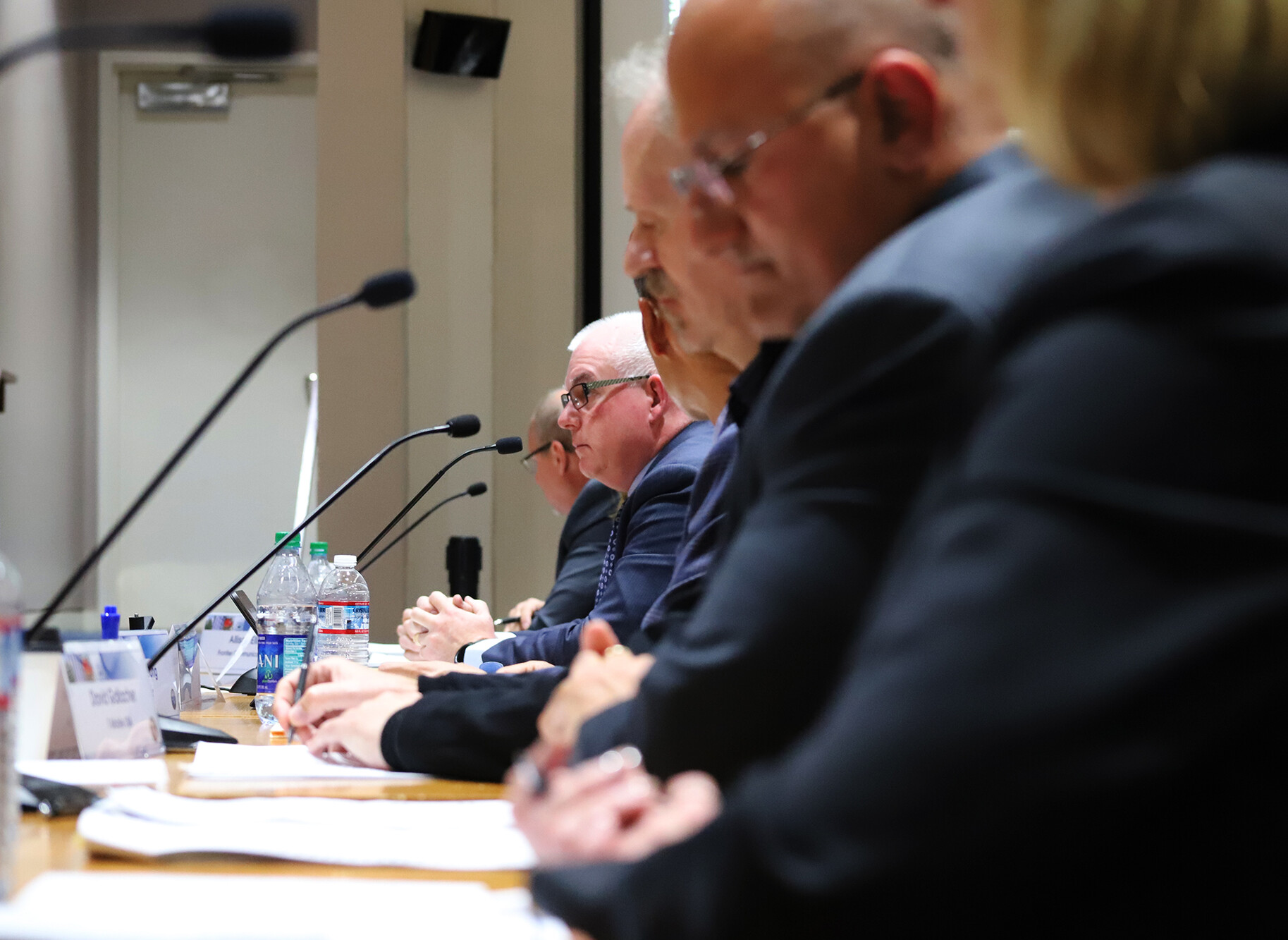
You may or may not remember Prop E, which was on the 2024 ballot. It was one of two dueling measures that aimed to cut back on the number of city commissions—of which there are around 150.
Here to tell us what may or may not result from the Commission Streamlining Task Force, we’re joined first by reporters Jonah Owen Lamb, senior reporter at the San Francisco Standard. Welcome.
Jonah Owen Lamb: How’s it going?
Alexis Madrigal: And we’ve got Io Yeh Gilman, a reporter at Mission Local. Welcome, Io.
Io Yeh Gilman: Thanks for having me.
Alexis Madrigal: Okay, Jonah—we’re talking about these San Francisco commissions. I’ve always wondered: why are there so many?
Jonah Owen Lamb: I think the layers of commissions have built up over many years. You need to think of San Francisco a bit like New York, right? It has this long history, and every time a problem has arisen—or sometimes when someone wanted to deflect a problem—a new body has been created to deal with it: the Police Commission, the Planning Commission, and others.
Over time, these things have just grown and grown. The Human Rights Commission is another example—it was created in 1964 to deal with discrimination, and it still exists. So now here we are, with lots of commissions. Many people would say they’re redundant or unnecessary, or don’t really do anything at all. That’s kind of how we got here. It’s a truncated version of the history.
Alexis Madrigal: Sure. I mean, how unusual is San Francisco in this?
Jonah Owen Lamb: I think it’s unusual. It likely has more commissions than almost any comparable city. According to the commission report, San Francisco may have more than any city in America—unless there’s some small city out there with 200 or something.
But again, older cities accumulate these layers over time—like sediment. That can be good and bad. We don’t usually think of bureaucracy as a good thing, but sometimes it slows down bad progress. Progress isn’t always good. So I think it’s important not to frame this as automatically good or bad.
Alexis Madrigal: Yeah. When I think of commissions, I think of that era of deep public participation—maybe the 1970s—when people realized that the levers of power should be accessible to a broader range of citizens. I don’t necessarily think of that as a bad idea at all.
But clearly, voters were a little concerned about this. Right? Io, you’ve been reporting on the Commission Streamlining Task Force for a while now. Let’s go back to how this all got started. We had Prop D versus Prop E—so remind people what those propositions were pushing for and who was supporting them.
Io Yeh Gilman: Yeah. Prop D was put on the ballot by TogetherSF, a political group funded largely by Silicon Valley wealth—people like Michael Moritz and groups like Neighbors for a Better San Francisco.
It would have capped the number of San Francisco commissions at 65. A lot of money went into that campaign—around $9.5 million. But some people opposed it because they felt the number 65 was arbitrary, and that these commissions provide important venues for public participation.
So a competing measure, Prop E, was put on the ballot by the Board of Supervisors, led by then-president Aaron Peskin. Instead of setting a cap, it created a process for reviewing commissions one by one. Specifically, it created the Commission Streamlining Task Force to evaluate each commission and decide what should be done with it.
Alexis Madrigal: One argument—Jonah, I’ll come back to you—is that commissions often don’t have much real power. Nationally, we see bodies that provide input but aren’t actual decision-makers.
Do we have a sense in San Francisco of which commissions are more like window dressing—or stepping stones for political careers—and which actually have real authority?
Jonah Owen Lamb: Starting with the powerful ones, the Police Commission is probably the best example. It’s the one I know best because I cover criminal justice. It can hire and fire the police chief and is responsible for defining officer discipline. It also creates policy.
That said, its power has been reduced somewhat by a proposition passed a couple of years ago, backed by London Breed, which gave the police chief veto power over policies. So it’s already lost some authority.
Still, it’s influential. Four members are appointed by the mayor and three by the Board of Supervisors, so the mayor has significant control over the agenda.
Another powerful body is the Planning Commission. It determines what gets built, when, and how. Critics say it slows housing development—for example, a single person can delay or block large housing projects.
Then there are intermediate bodies like the Ethics Commission. It doesn’t have a lot of direct decision-making power, but it can place measures on the ballot—often anti-corruption measures that have been successful with voters. It also works to ensure government transparency.
As for truly powerless bodies, nothing immediately comes to mind—but Io might have an example.
Alexis Madrigal: Yeah, maybe some hyperlocal or more symbolic ones?
Io Yeh Gilman: Yeah. One example is the Sweatfree Procurement Advisory Group. As “advisory” suggests, it didn’t have binding decision-making power. It was a group focused on ensuring San Francisco followed its sweatfree ordinance—meaning city-purchased goods, like uniforms, weren’t made in sweatshops.
Last summer, Board President Rafael Mandelman proposed legislation that would have eliminated the group as part of a broader package. Members pushed back and ultimately saved it.
Alexis Madrigal: That might be a preview of what’s happening now. The Commission Streamlining Task Force gets created under Prop E. They start researching and meeting—and then what happens? They release recommendations, right?
Io Yeh Gilman: Yes. They released recommendations along with some proposed legislation to implement them.
Alexis Madrigal: And what were those recommendations?
Io Yeh Gilman: Broadly, they proposed reducing the number of commissions from about 150 to around 87. Many of the eliminations were inactive bodies—commissions that weren’t meeting, or that oversaw departments that no longer exist.
But the more controversial recommendations involved commissions that would remain. The task force suggested changing their structure or altering how they function.
Jonah Owen Lamb: And the big-picture result, I think, is a concentration of power in the mayor’s office, with less civilian oversight. It’s hard to imagine the mayor being able to pay as much attention to these issues as the commissions do, let alone make detailed decisions on them.
When I read the report, I thought: many of these commissions were created for good reasons. Voters gave them authority. And now the task force is applying a kind of one-size-fits-all approach—emphasizing efficiency and transparency.
But efficiency for whom? And transparency, in my view, may actually be reduced.
Alexis Madrigal: We’re talking about San Francisco’s many boards and commissions, and the task force trying to streamline them. We’ve been speaking with Jonah Owen Lamb of the San Francisco Standard and Io Yeh Gilman, reporter at Mission Local.
We’ll take your calls—866-733-6786. Maybe you’ve served on a commission. We’ll be back with more right after the break.