This partial transcript was computer-generated. While our team has reviewed it, there may be errors.
Alexis Madrigal: Welcome to Forum. I’m Alexis Madrigal. The Electronic Frontier Foundation defined my idea of San Francisco and the internet when I was a kid. The very second issue of Wired magazine had three “cypherpunks” on the cover holding an American flag. This was the internet that drew me in. Who were these people?
At a time when tech has come to be associated with big business and big money, Cindy Cohn’s new book traces a different arc through tech history—one that places a different set of characters at the center. Yes, those stringy-haired coders, but also brilliant lawyers, many of them women, who foresaw at least some of the dangers to liberty lurking in the internet’s technical possibilities and did their best to head them off.
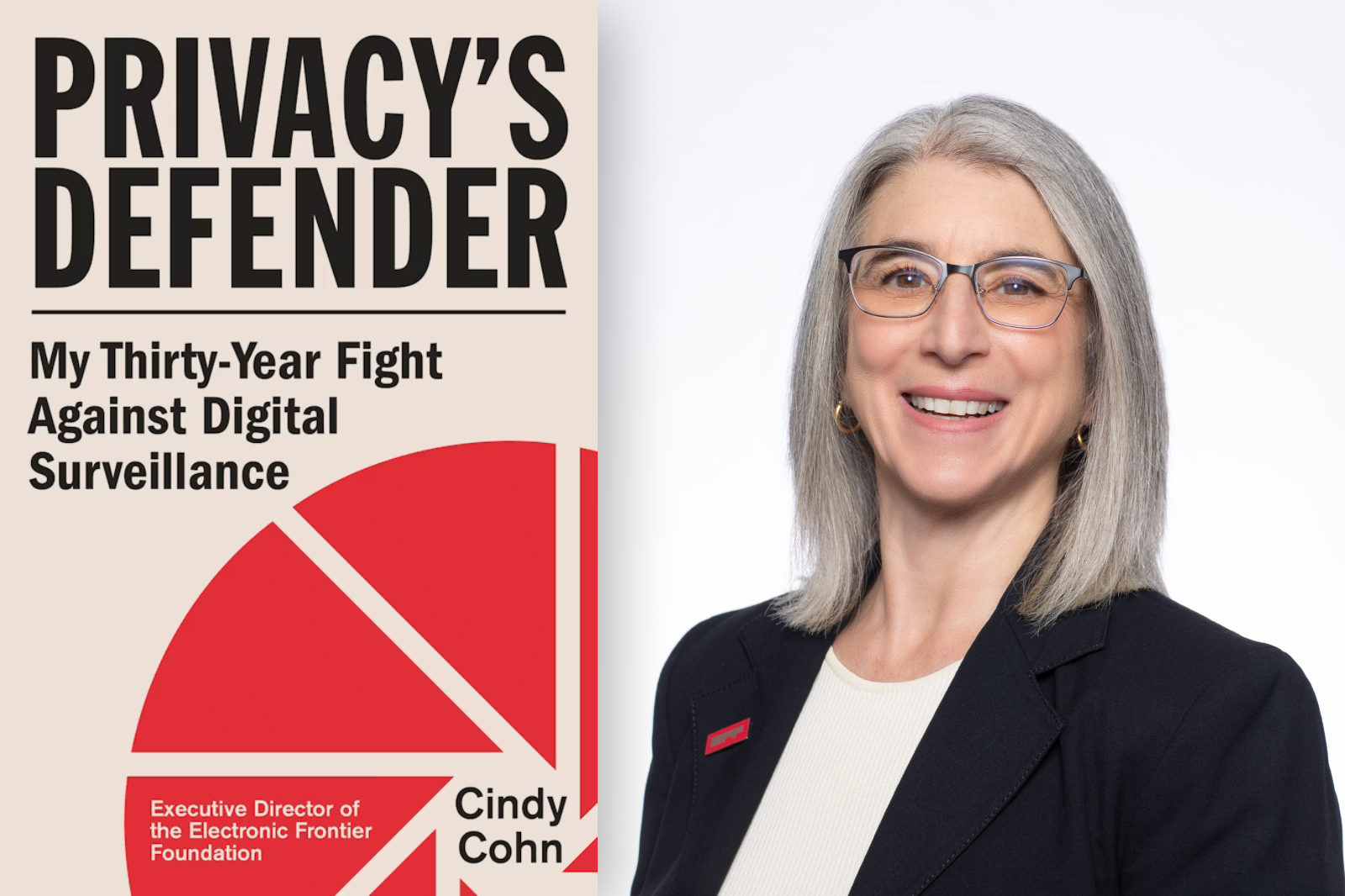
Cindy Cohn is the longtime executive director of the EFF, stepping down this year, and her new book is Privacy’s Defender: My Thirty-Year Fight Against Digital Surveillance. Welcome.
Cindy Cohn: Thank you. Thank you so much for that kind introduction.
Alexis Madrigal: Well, take me back to that San Francisco of the ’90s. This is what birthed EFF, and it also launched your lawyering career.
Cindy Cohn: Yeah. I mean, I kind of stumbled into it. I moved to San Francisco in the ’90s, and quite literally, a bunch of these hackers showed up at a party at my house in the Haight. I started dating one of them, and another one of them was John Gilmore, who was one of the three founders of the EFF—one of the guys on the cover.
I’m not revealing anything—if you opened up the cover, you saw a picture of who they were. And these guys were already—this is before the World Wide Web—they were already online and living their lives without distance, being able to have ongoing conversations with people very, very far away, working together in ways that now are normal, but didn’t seem like—
Alexis Madrigal: Like they were living in the future, in some sense.
Cindy Cohn: It really felt like that. And after we became friends, at one point John helped found the EFF, and he called me up one day and said, “We want to do a lawsuit.” He said, “I’ve got this math PhD student at UC Berkeley who wrote a computer program, and he wants to publish it on the internet. And if he does that, he’ll go to jail as an arms dealer.”
And I said, “Well, what does it do? Does it blow things up?” And he said, “No. It keeps things secret.” And I said, “This is interesting. Let me talk to my law firm and see if I can take the case.”
Alexis Madrigal: That’s so interesting. In your book, you describe that case—Bernstein—which, you know, is the last line of the first paragraph of your Wikipedia entry, obviously a big deal. Why was Bernstein such a big deal? The way you describe it there sounds intriguing, but was it necessarily earth-shattering?
Cindy Cohn: Well, I think you have to do a thought experiment about what the internet might have been like if we’d never gotten security or privacy online. The thing we were fighting over in the Bernstein case—the math PhD student, Dan Bernstein—was whether the rest of us were going to have access to strong encryption, cryptography.
And it turns out that encryption is the key to both privacy and security over digital networks. So you have to think: what if we didn’t have any privacy or security online? Now, we don’t have enough—
Alexis Madrigal: Yeah, I was about to say—what I might be pinging for people is this idea that we don’t have—I mean, I feel like we hear that many times in modern discourse—that we do not have privacy, that we are constantly surveilled. But what I’m hearing is: it could have been worse.
Cindy Cohn: Exactly. I think that’s right. I mean, if you use Signal, or Apple iMessage, or WhatsApp, you get end-to-end encryption. If you lose your phone, you don’t lose everything that’s on your phone—that’s because phones will auto-encrypt. That’s why you have to put in a password or use your face to open it.
If we didn’t have access to strong encryption, we wouldn’t have devices that encrypt the way they do now. And the internet itself wouldn’t be secure. There’s a lot that happens under the hood—like if you type in the name of your bank, you can be fairly confident you’re going to your bank and not someone who’s hijacked that communication.
Alexis Madrigal: It’s because of the “S” at the end—HTTPS.
Cindy Cohn: Exactly—of HTTPS. And EFF has an ongoing role in helping make sure that kind of infrastructure works, through a group called Let’s Encrypt.
So we are not anywhere near where we need to be for security and privacy. But when we started, you couldn’t put strong encryption into pretty much anything. You needed a government license, and you didn’t get that license if the encryption was powerful. We wouldn’t be where we are now.
That doesn’t mean we’re done—we still have a long way to go—but it’s foundational. Some people can see it, and some can’t in their day-to-day lives, but it’s there.
Alexis Madrigal: I want to zoom out for a minute and ask something quite basic. I feel like you’re making points around it, but let’s put it directly: how do you define privacy in this context, and why is it important?
Cindy Cohn: I think about privacy a little differently than the popular way. Some people think of it like the Harry Potter cloak of invisibility that you throw over your head when you’re doing something you don’t want people to see. It does do that, but that’s not why it’s important to me.
I think of privacy as a check on power. It’s a way for people with less power to have some protection against those with more power.
You can think about the circles of your life. My colleague Eva Galperin works with domestic violence victims whose abusers put malware on their devices to keep control over them. These people literally need privacy to protect their physical safety.
We’ve also worked with LGBTQ youth and others who don’t fit in where they live—in their families or communities. They need privacy to build community and find safety. That’s why a lot of people came to San Francisco back in the day, but the internet made that kind of connection possible without having to move.
And then you go all the way out to governments. We have a secret ballot in the United States because it helps less powerful people vote freely, without coercion. That’s how political organizing works, too. The public face comes later—real organizing requires a zone of privacy.
That’s why I think it’s baked into the Constitution and our laws, and why it’s a fundamental human right. If we want to govern ourselves, we need it. One of the first things authoritarian governments do is ramp up surveillance and reduce privacy—because they understand that reducing privacy helps them keep power.
Alexis Madrigal: Yeah. I also sort of knew this dimly—that the so-called Founding Fathers encrypted their messages to each other because, of course, they were the less powerful party organizing in that context. That made some of the constitutional protections make more sense to me.
Cindy Cohn: Yeah, absolutely. Jefferson was in Paris, Adams was in London, and Madison and the rest were in the United States. Jefferson actually created a physical cipher—you can see it if you go to Virginia.
But yes, they all sent encrypted messages. Otherwise, how would they have planned anything without the British finding out?
It’s also reflected in early legal principles. The Fourth Amendment protects against general warrants—what were called writs of assistance—with the idea that to search our “papers,” you need individualized suspicion. You can’t just search everyone en masse.
Alexis Madrigal: We’re talking with Cindy Cohn, who’s stepping down from her position as executive director of the Electronic Frontier Foundation—though not retiring, just moving on to new fights. Her new book is Privacy’s Defender: My Thirty-Year Fight Against Digital Surveillance.
We’d love to hear from you—your biggest concerns about digital privacy, turning points in the internet, or maybe an experience that opened your eyes to these issues. You can give us a call at 866-733-6786. That’s 866-733-6786. You can also email [email protected].
I’m Alexis Madrigal. Stay tuned.