This partial transcript was computer-generated. While our team has reviewed it, there may be errors.
Grace Won: Welcome to Forum. I’m Grace Won, in for Alexis Madrigal. If you ask someone to name a famous Bay Area woman, they might offer up former House Speaker Nancy Pelosi, perhaps Petaluma’s Winona Ryder, or maybe authors Amy Tan or Maya Angelou. And very likely, they might tell you about Oakland’s own gold medal–winning figure skater, Alysa Liu. These are women whose life stories have been told in print, TV, and film.
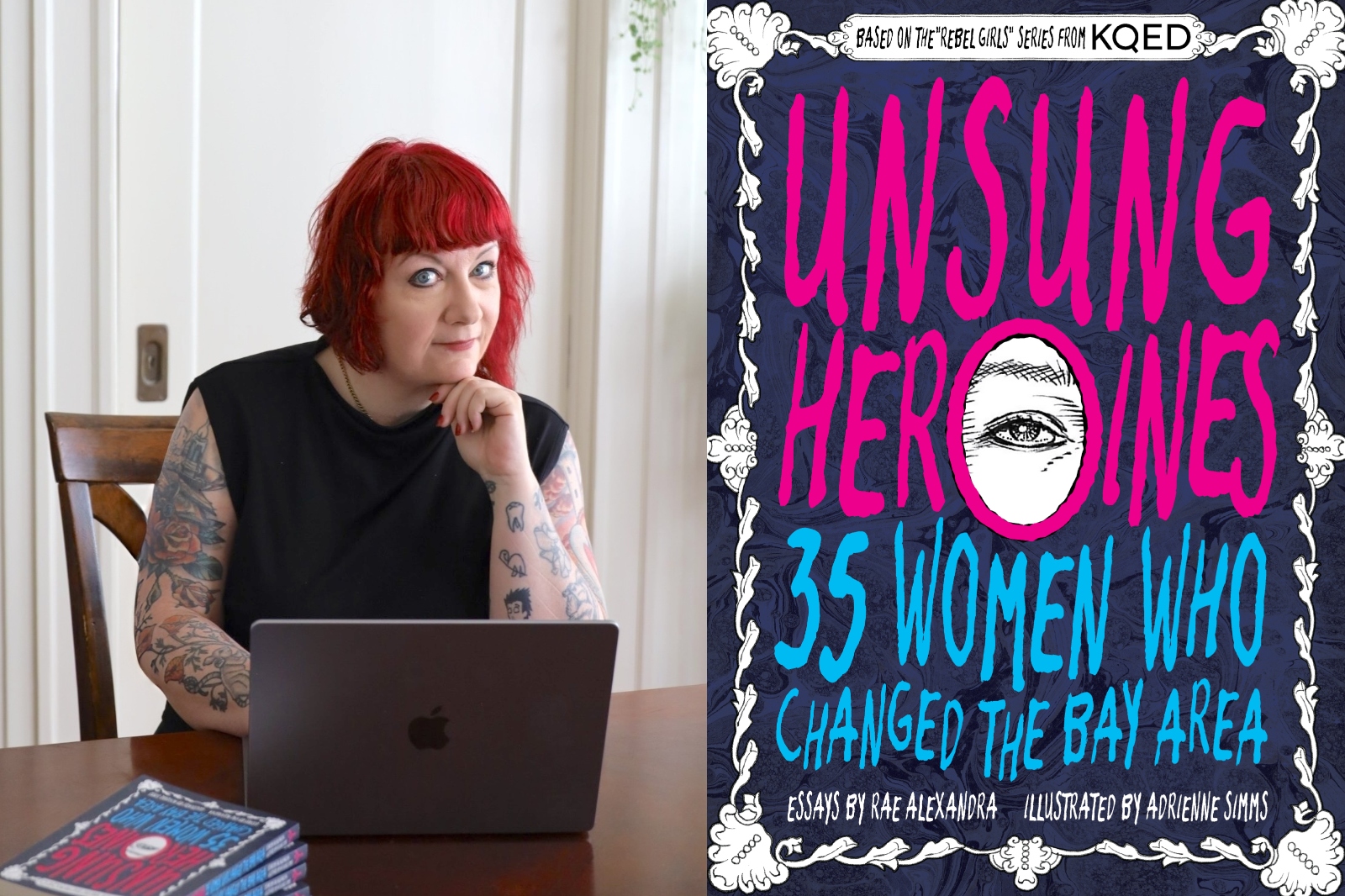
But most people probably wouldn’t name-drop activist Myra Virginia Simmons or nurse Pat McGinnis, who ran a clinic for women recovering from illegal abortions. But thanks to KQED’s Rae Alexandra, the stories of these women are being told. Her new book is Unsung Heroines: Thirty-Five Women Who Changed the Bay Area. It’s punchy and, like Rae herself, a little punk. She’s here today to tell us all about it. Welcome to Forum, Rae.
Rae Alexandra: Good morning, Grace.
Grace Won: Well, you began investigating women’s history out of sheer frustration. What was happening?
Rae Alexandra: This started in 2018. At the time, I’d always been a music writer, a pop culture writer, and somebody went around San Francisco and counted the statues—how many were men and how many were women. And of 87 statues, you could count the women on one hand. That made me angry—talk about punchy. So I decided to write five essays for Women’s History Month that year just to prove that there were amazing women from Northern California who’d not been honored. Then it became an obsession. And seven years later, there were 55 women, and now there’s a book.
Grace Won: Well, I like how you once said, “I was complaining about it constantly and even talking to people on uni about it all the time.”
Rae Alexandra: I was sat in Mission Bar next to this poor man, and I was just endlessly complaining about this. And he just kept saying, “Well, you know, San Francisco’s a Gold Rush town. Maybe there weren’t women here. Maybe they just didn’t get here till later.” And just in my gut, I knew it wasn’t right.
Grace Won: You’re like, “Wrong answer.”
Rae Alexandra: Yeah. No, that can’t be right. And so I stopped doing the usual thing that I wrote about and became a history writer, which was a learning curve—going from Beyoncé to that. But it paid off in the end.
Grace Won: Well, the way the book is organized is you have little vignettes about 35 women, and they range from, as I said in the introduction, activists to health care workers and beyond. It spans from the 19th century to the 21st century.
And I wanted to start with some women involved in cooking, because we often think—or are told—that the kitchen is a woman’s place, and yet there are so few professional women chefs, or not as many as we think there should be. You begin early in the book with a woman who was the second Black woman to write a cookbook: Abby Fisher. Tell us a little bit about her story.
Rae Alexandra: So Abby Fisher grew up enslaved on a plantation in South Carolina. From the time she could see over the stove, she was in the kitchen, so she learned absolutely everything there is to know about Southern cooking.
When she and her family moved to California, people in the Bay Area had never had anything like her food, so she was an instant hit. She and her husband had a pickles and preserves company that won multiple prestigious awards, so she became well known very quickly.
Then she was approached by the Women’s Cooperative Printing Office, which used to be in downtown San Francisco. They said, “Why don’t you write a cookbook? We’d love to hear your recipes.” And she, of course, had never learned to read or write. So they got creative—they brought in nine volunteers, and she basically dictated the cookbook to them, and they transcribed it. That’s how they got around it. And that book is still in print today.
Grace Won: And I think it’s called—what is it called?
Rae Alexandra: What Mrs. Fisher Knows About Old Southern Cooking.
Grace Won: I mean, it’s pretty awesome. And because she dictated the book, and a lot of the recipes were Southern and unfamiliar to these West Coast volunteers, there are some pretty funny typos in it.
Rae Alexandra: And I love the fact that they still haven’t been corrected. My favorite one—because no one knew what succotash was—is that it’s written as “circuit hash.” Jambalaya is listed as “jumbelaya,” and mayonnaise is listed as “Milanese sauce.”
Grace Won: I mean, that does make mayo sound a little better—fancier.
Rae Alexandra: Very fancy.
Grace Won: Another aspect of that cookbook that’s interesting is it really elucidates how enslaved people used remedies and food to help cure ailments and take care of others.
Rae Alexandra: It’s a remarkable document for that. There are multiple recipes—she was raising kids on a plantation—and for her to come up with these remedies, like how to help your children when they have a fever or a stomach upset, using only ingredients from the kitchen and what she had access to, is really amazing.
Grace Won: Yeah, I thought her recipe for blackberry syrup for dysentery—I’m like, I would just put that in a cocktail and be very happy.
Rae Alexandra: The pie recipes in this book really do sound delicious. I’m not a cook myself, but if I was, I’d have given them a go.
Grace Won: Absolutely. Well, we’re talking about unsung heroines of the Bay Area with Rae Alexandra. She’s a staff writer with KQED’s Arts and Culture Desk, and her new book is Unsung Heroines: Thirty-Five Women Who Changed the Bay Area.
And we’d love to hear from you. Who is an unsung heroine whose story you think should be told? Is it your mom, a friend, a colleague? Who’s a woman—historical or contemporary—that you admire? Tell us why.
You can give us a call now at 866-733-6786. That’s 866-733-6786. You can email your comments and questions to [email protected] or find us on social media—Bluesky, Instagram—we’re @kqedforum. And there’s always our Discord community, so please write in.
Another woman in the cooking frame is Elena Zelayeta, and I think she might be responsible for one of the first restaurant pop-ups in the early 20th century. Tell us a little bit about her.
Rae Alexandra: Elena had been a secretary until the Great Depression, but she lost her job. Her husband, who was a structural engineer, also lost his job. So she came up with the idea of turning their North Beach apartment into a restaurant.
The food was so popular so quickly that they ended up with people standing in the stairwell all night, every night. She worked from 5 a.m. to midnight, and she popularized Mexican food in the Bay Area.
Grace Won: And she wrote a lot of cookbooks too, right?
Rae Alexandra: She did. She opened the restaurant in 1930, and within the first few years, she’d written her first cookbook—and it sold half a million copies. Which, given that during the Depression there was so much hostility toward Mexican immigrants because of the job shortage, speaks to how delicious her food must have been.
Grace Won: It must have been. She’s like the precursor to the Mission’s Tamale Lady, really.
Rae Alexandra: Oh, 100 percent. Yeah—Virginia.
Grace Won: Yeah. And didn’t she have a TV show as well at some point?
Rae Alexandra: She did. The apartment restaurant eventually turned into a brick-and-mortar restaurant in Union Square, inside the King George Hotel. Then in 1934, she suddenly went blind, so she had to close the restaurant. The other chefs working for her weren’t as popular.
When she finally recovered, she went back to teaching in schools for the blind. Then in 1944, she was so well known that KGO-TV, which was brand new in San Francisco, gave her her own television show. She did that with her son, and it was called Fun to Eat with Elena.
This was a very basic setup—for example, when producers wanted her to turn toward a different camera, they tugged on strings attached to her ankles because they couldn’t think of another way to communicate with her. So this woman was incredibly resilient.
Grace Won: I mean, she’s blind, she’s cooking as a blind person with her son, and she has a TV show. It sounds like a Netflix drama.
Rae Alexandra: It’s really wild. I think a lot of women in this book deserve Netflix dramas.
Grace Won: It would be awesome if they could get that. So having investigated these stories, did it change how you felt about these women?
Rae Alexandra: It changed how I felt about this entire region—and the history of it as we know it.
Grace Won: Well, we’re going to hear more from Rae Alexandra, whose new book is Unsung Heroines: Thirty-Five Women Who Changed the Bay Area. And we want to hear from you. Who’s an unsung heroine in your life? Is it your mom, a friend, a colleague, a sister, an aunt? Who is a woman—historical or contemporary—who you admire, and why?
Call us at 866-733-6786. That’s 866-733-6786. Or email [email protected].
A listener on Bluesky writes, “Dianne Feinstein was one of the greatest politicians ever.”
I’m Grace Won, in for Alexis Madrigal. More after the break.