This partial transcript was computer-generated. While our team has reviewed it, there may be errors.
Alexis Madrigal: Welcome to Forum. I’m Alexis Madrigal.
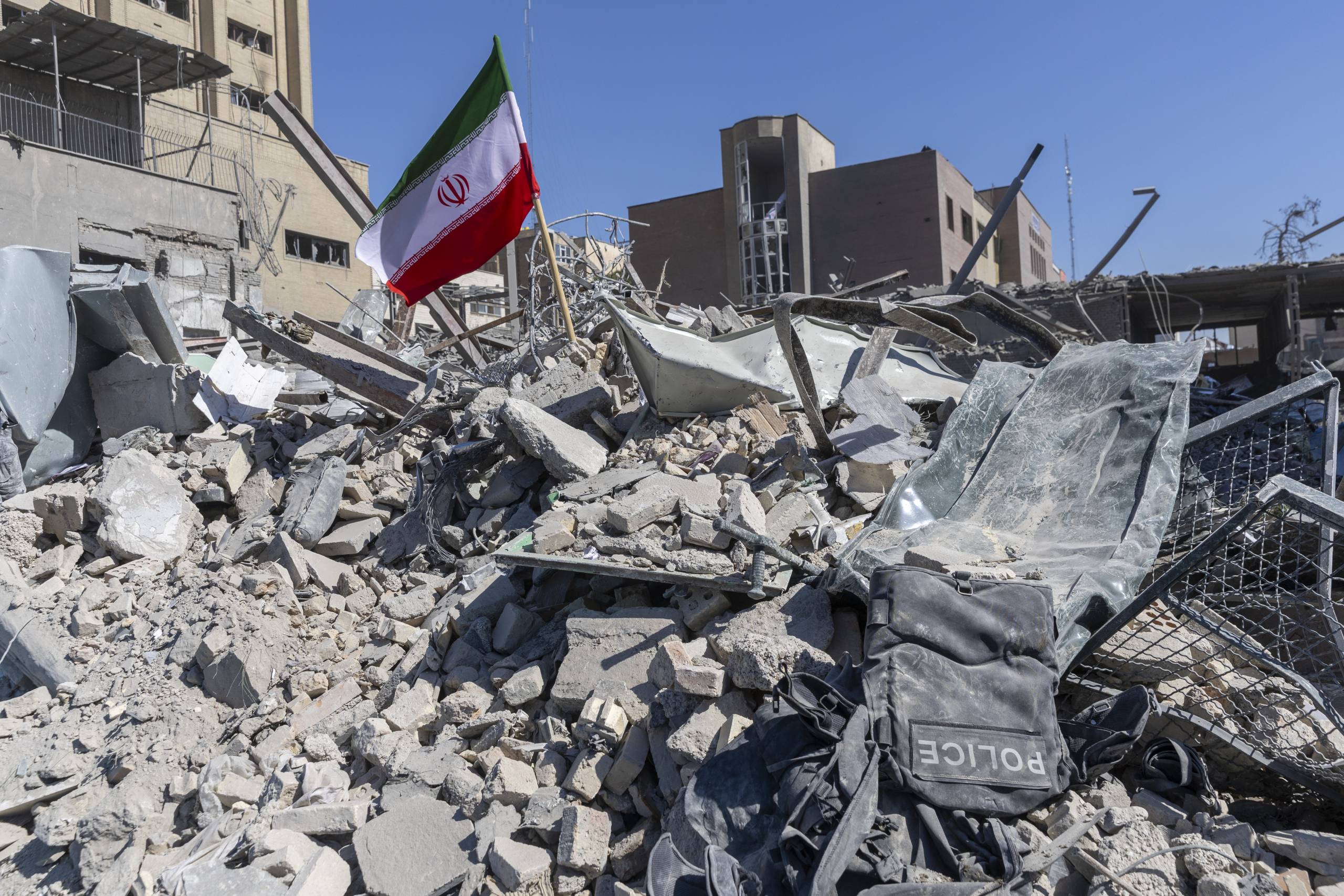
The war with Iran began with the brute force of the American and Israeli militaries. The U.S. military says it has executed more than 5,000 strikes so far, which is more than in entire years of the Iraq War. That is to say, we spend a lot of money on our weapons, and those have been unleashed.
But wars do not have only one side, and this particular one probably has a dozen. We’re going to talk about how the entire Middle East has been pulled into this conflict and how its repercussions could hit home here in the U.S.
We’re joined by Mona Yacoubian, director and senior adviser of the Middle East Program at the Center for Strategic and International Studies. Welcome, Mona.
Mona Yacoubian: Thank you so much. A pleasure to be with you.
Alexis Madrigal: Great to have you. We’re also joined by Dalia Dassa Kaye, a senior fellow at the UCLA Burkle Center for International Relations. She’s the author of the book Enduring Hostility: The Making of America’s Iran Policy. Welcome, Dalia.
Dalia Dassa Kaye: Great to be with you. Thanks.
Alexis Madrigal: And we’re also going to start with Nabih Bulos, Middle East bureau chief with the Los Angeles Times. Nabih joins us from Beirut. Welcome.
Nabih Bulos: Thank you. How are you?
Alexis Madrigal: Good. Nabih, just tell us what it’s like in Beirut. There have been strikes by the Israeli military. What is life like there right now?
Nabih Bulos: Well, it should be said this is not the first time this has happened. We had a recent conflagration with Israel in 2024. Beirut, unfortunately, because of a long acquaintance with war, has fallen back into a kind of habit that all places eventually develop—where the war is localized in certain neighborhoods, but in other parts of town things can seem almost normal.
The fact of the matter is that even now, the suburbs where Hezbollah dominates—areas that have been the main target of the Israeli air force over the last few days—have received warnings of a new round of attacks. But where I am, in the Christian quarter of the capital, things are quite calm.
Yes, traffic is subdued and people are worried, but shops remain open and life continues.
Alexis Madrigal: Why has Lebanon been such a major focus in this conflict with Iran?
Nabih Bulos: Well, the fact of the matter is that Lebanon—or more accurately Hezbollah, which is a Lebanese Shiite militant group—used to be the crown jewel of Iran’s proxies, or allied groups.
Iran has long nurtured factions in various countries, and Hezbollah has been the top one. It has had a longstanding conflict with Israel. After October 7, Hezbollah intervened in support of Hamas, and that escalated into a full-fledged war later on when Israel launched an invasion of Lebanon.
There was a ceasefire back in November of 2024, but since then Israel has essentially violated that ceasefire every day and maintained a presence on Lebanese territory. Finally, when Khamenei was killed, Hezbollah decided to enter the fray once more, saying it was in vengeance for Khamenei and also to avenge what it called fifteen months of repeated Israeli ceasefire violations.
Alexis Madrigal: Tell us a little bit about the relationship Hezbollah has with the Lebanese government at this point. All these wars must have taken their toll on Hezbollah’s military capabilities.
Nabih Bulos: It’s worth noting that Hezbollah actually has a presence in Lebanon’s government. This is a group that entered parliament in 2008, and for a while it had the largest bloc within parliament. Its politicians and MPs have been known to be quite hardworking and effective.
That said, many believe Hezbollah’s political wing has worked to undermine the Lebanese state so it can continue acting as a state within a state.
So although Hezbollah is technically part of the government, there is antagonism from various quarters. The current cabinet has been among the most antagonistic toward Hezbollah.
In fact, Hezbollah’s military activities were outlawed by the Lebanese government after the most recent escalation. At the same time, there has been a move to disarm the group.
This is the main source of tension now. The public version of the ceasefire suggested Hezbollah would disarm in southern Lebanon, but the government is now saying the group must disarm everywhere in the country. That, of course, is complicated.
Alexis Madrigal: In trying to think this through, how would the Lebanese government even de-escalate? How does diplomacy work when the government is caught between Hezbollah, Israel, and the United States?
Nabih Bulos: The issue is that Hezbollah says it will not give up its weapons as long as Israel maintains a presence on Lebanese territory. And Israel insists it will maintain a presence as long as Hezbollah remains armed.
So it’s a catch-22.
Over the last fifteen months of the ceasefire, Hezbollah admittedly did not fire a single shot, even as Israel continued attacks almost daily on southern Lebanon and other parts of the country. Israel said this was to stop Hezbollah from reconstituting itself.
But it’s difficult for Hezbollah to justify giving up arms when its entire raison d’être is fighting Israel and liberating Lebanese territory.
The government is caught in the middle because it cannot disarm Hezbollah by force. Quite frankly, the Lebanese army is not strong enough. And attempting to do so could spark a civil war, with Lebanese soldiers fighting fellow citizens. That could create a much larger conflagration.
Alexis Madrigal: How intense is the bombing campaign? Members of the Israeli government have threatened to bomb southern Lebanon with the same force directed at Gaza. Is that actually happening?
Nabih Bulos: Over the last fifteen months, that did happen in parts of southern Lebanon. If you look at the five-kilometer strip along the border, there isn’t a single house standing. Border villages have essentially been razed.
What we’re seeing now is a continuation of that policy. In some areas, Israeli forces go in and destroy every building in a village or town.
In Dahieh, near Beirut, we haven’t seen that yet. But the endgame is still unclear, and we don’t know when this war will stop.
Alexis Madrigal: Mona Yacoubian, as we think about what’s happening in Lebanon, what paths do you see for escalation or de-escalation?
Mona Yacoubian: Lebanon now constitutes a second front in the war between Israel and Iran. At the moment it is Israel engaging Hezbollah in Lebanon, but the broader conflict with Iran is clearly connected.
What we’re watching could produce what I call exponential escalation. Hezbollah launched rocket and drone strikes against Israel last week. That prompted a massive Israeli response, which we’re continuing to watch unfold.
At the same time, it increased pressure on the Lebanese government to disarm Hezbollah. As Nabih noted, that could provoke civil strife or even civil war in Lebanon.
That would be escalation emerging indirectly from the Iran conflict but rooted in Lebanon’s internal tensions. Unfortunately, there are many such potential flashpoints across the Middle East.
Alexis Madrigal: Nabih Bulos, what are Lebanese government officials saying about their plan right now?
Nabih Bulos: The plan at this point is unclear. There have been attempts to de-escalate, but the issue is not really with the Lebanese government—it is with Hezbollah.
As far as I’ve heard, communication between the government and Hezbollah has nearly stopped. The government’s main interlocutor with Hezbollah is reportedly quite angry with the group.
It was also a surprise. Before the war with Iran began, Lebanese officials said they had assurances from Hezbollah that it would stay out of the conflict. Those assurances were repeated the night Khamenei was declared dead.
But then Hezbollah escalated, which prompted a massive Israeli response—around 80 aircraft attacking hundreds of targets and killing, so far, about 500 people.
Hezbollah claims that response proves Israel had already planned such an attack and says its own actions were preemptive. That has been their justification for entering the war.
Alexis Madrigal: Mona, if the Iran war ended tomorrow, what happens in Lebanon?
Mona Yacoubian: Unfortunately, we could still see continuing conflict in Lebanon.
After October 7, 2023, Hezbollah initiated strikes against Israel that led to more than a year of war between the two sides. The underlying drivers of that conflict have not been resolved, as Nabih explained.
There’s also an unintended consequence worth noting. When Israel decimated Hezbollah leadership and forces throughout 2024, it actually made Hezbollah more dependent on Iran.
With so many Hezbollah fighters killed, more Islamic Revolutionary Guard Corps elements moved into Lebanon and began playing a larger role. So in a sense, the current Hezbollah is more directly controlled by Iran than before.
Alexis Madrigal: We’ve been talking with Mona Yacoubian, director and senior adviser of the Middle East Program at the Center for Strategic and International Studies. Nabih Bulos joined us from Beirut, where he serves as Middle East bureau chief for the Los Angeles Times.
Thank you so much, Nabih.
Nabih Bulos: Thank you.
Alexis Madrigal: After the break, we’re going to talk with Dalia Dassa Kaye, senior fellow at the UCLA Burkle Center for International Relations.
I’m Alexis Madrigal. Stay tuned.