This partial transcript was computer-generated. While our team has reviewed it, there may be errors.
Alexis Madrigal: Welcome to Forum. I’m Alexis Madrigal. I don’t have too many journalistic regrets, but one of them is that I never got a chance to interview Betty Reid Soskin. Soskin became nationally famous as a park ranger at the Rosie the Riveter Museum in Richmond, but I first encountered her through her blog. Yes—she was a prolific blogger beginning in 2003.
I actually just learned that she went to an Al Gore internet conference in Silicon Valley, which is one way she got tipped off to the internet. This was a person who adapted to her times, but also shaped them. She died late last year and recently had a memorial at the theater at the Kaiser Auditorium. We wanted to recognize her this morning here on Forum, too, as a Bay Area legend.
We’re joined by her son, Bob Reid—musician and activist. Thank you so much, Bob.
Bob Reid: Great to be here.
Alexis Madrigal: We’re also joined by Kelli English, a program manager at the National Park Service. She was Betty Reid Soskin’s supervisor at the Rosie the Riveter/World War II Home Front National Historical Park. Thank you so much for joining us.
Kelli English: Thanks for having us.
Alexis Madrigal: Bob, just before we get into hearing your mother’s voice—because she came on Forum several times over the years—what was she like? If she were sitting here in this chair, what would we think about Betty Reid Soskin?
Bob Reid: My mother would have been different people at different times in her life. She changed every decade—kind of wiped her slate clean and reinvented herself. So she would have said something appropriate, something she had thought out very carefully, and it would have been worth hearing.
Alexis Madrigal: Yeah. Let’s listen to her. She witnessed a ton of history. She worked on the home front during World War II, which we’re going to hear about, but she was also present in Washington, D.C., for Barack Obama’s inauguration.
So from the archives, here’s Betty Reid Soskin talking about that moment in 2015 with Michael Krasny.
Betty Reid Soskin (clip): I think I’m more aware, now in my nineties, of being an evolving person in an evolving nation than I could have been at seventy-five. That’s what I’m impressed with now—that I have seen so much change.
I’m aware that every generation has to recreate democracy in its time. But on January 20th, 2009, I’m a seated guest of George Miller on the Capitol Mall, with a picture of my great-grandmother, who was born in 1846 into slavery and was enslaved until she was nineteen—freed by the Emancipation Proclamation.
And that’s an amazing thing, because my grandmother lived to be 102, which means that when she died—since I was born in 1921—I was a grown woman, married with children, twenty-seven years old, when my enslaved ancestor died.
And I’m sitting there with a picture in my pocket watching the inauguration of the first African American president, in the shadow of the Lincoln Memorial, whose life was contemporary with the life of my great-grandmother. That’s how fast the time goes.
Alexis Madrigal: Wow. That was Betty Reid Soskin in 2015, in her nineties at that time, talking with Michael Krasny.
Kelli English, you know, she contained history. She was history. Bob Reid, clearly there are some good longevity genes in the family. But Kelli, tell me what it was like having someone who could embody this history while also teaching it to people.
Kelli English: Oh my gosh, it was incredible—an amazing phenomenon to have her. She really was a phenomenon. She was both a gifted storyteller, as you just heard, as well as a living primary source.
You know, she used to joke sometimes that she had outlived all the people whose memories did not align with her own—which we laughed about, but we also really utilized at the park.
There’s a lot of history in those World War II years, and there’s certainly the dominant narrative of Rosie the Riveter.
Alexis Madrigal: Everyone came together.
Kelli English: Yes—everyone came together. But everyone was having a different experience, even as they were coming together. And I think that’s what she really emphasized: that you had the main Rosie the Riveter “We Can Do It” narrative, but that was really just the experience of certain folks.
There were many other people in society who participated in the war effort but had stories of their own—sometimes experiences that seemed to almost contradict each other. Betty taught us that we could hold and tell all those stories at the same time.
Alexis Madrigal: Right. Bob, tell us a little bit about her life and how your family thinks about her. Since she reinvented herself every decade, it’s a little bit difficult. But why don’t we start with your childhood—where you were born?
Bob Reid: One of my earliest memories was living in the duplex on Sacramento Street, where the train went down the middle of the street—the train my mother talked about, with workers coming from the South and ending up on that train going to Richmond.
She would read to me from A. A. Milne’s books. I remember sitting there and having my mother read “Spring Morning,” a wonderful poem. And she sang to me. I’m seeing a picture right now.
Alexis Madrigal: It’s amazing, too. For those who don’t know, that building housed Reid’s Records, right?
Bob Reid: Mm-hmm.
Alexis Madrigal: And the building is still there, although the record store is not. It was right on this line where all these people were coming up from the South, and she writes about it in her memoir—having you there on Sacramento Street too.
Why don’t we talk a little bit about how her life ended, or this period of time near the end, and then we’ll go back into the middle?
Bob Reid: Her life ending took a long time. It took quite a while for her to finally give up the ghost because she had strong genes. Her heart was working—everything was working.
About a year before she died, she kind of decided she didn’t really want to be here anymore and was seeking ways she might be able to exit sooner than her body was allowing her to. But she wound up living another year, hoping to see an election come out better than it did.
She lived by birthdays. My sister had her birthday, and then my mother would say, “Okay, that’s it—no more birthdays.”
And when she finally went, she had a condition that took her into the hospital. We joked about it because she said, “They don’t know what to do with me.”
Alexis Madrigal: She’s invincible.
Bob Reid: These people are here to keep people alive, and that is not my goal. And she said, “Don’t let the chaplain come anywhere near me,” because she was a devout atheist.
Alexis Madrigal: What has it been like to do these public memorials for your mother and have people from these different areas of her life come out and tell you about her—celebrate her? What has that been like for you?
Bob Reid: It’s awkward, because she was my mother. I don’t know about your mother, but my mother was someone I wanted to make sure I was not like. I spent most of my life trying not to be her.
When I was young, I was Mel Reid’s son, then I was Betty Reid’s son. Then I left for many years, and for a while she was Bob Reid’s mother. Then this Park Service thing happened, and everywhere I went, I was Betty Reid’s son again.
Kelli English: Sorry, Bob.
Alexis Madrigal: Yeah, right. What an incredible arc to it all.
Kelli English, did you anticipate—when she was hired—because she was already quite old when she became a ranger?
Kelli English: Right. To be clear, I did not hire her.
Alexis Madrigal: Okay—Wendy Parsons.
Kelli English: Yes. She was in her eighties—around 2007 or so. Most people don’t necessarily plan in their eighties to take on an entirely new career and become a park ranger, but she specifically did that in order to tell her story.
She was working for a state assemblywoman at the time the park was being conceived and planned, and she got involved in the planning. She shared her experience on the World War II home front, and she wanted to keep telling that story. The park wanted her to keep telling it as well.
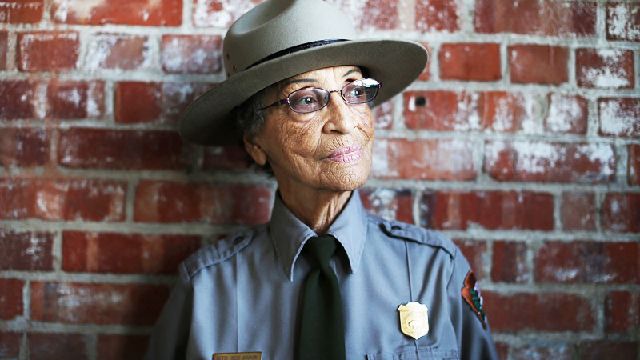
So she opted to put on the uniform and became a park ranger at about the age of eighty-five.
Alexis Madrigal: What was her experience on the home front?
Kelli English: She was not actually someone who worked in a shipyard. She used to say she never saw a ship being built. But there were many different types of home front jobs.
She worked as a file clerk for the auxiliary of what was at the time the segregated Boilermakers union. Back in 1942, only white men could really be part of the union. Even white women—and certainly anyone who was not white—were not allowed to officially be part of it.
So they had these auxiliary organizations for people working with the union but not in the union. She worked as a clerk in that segregated union office.
Alexis Madrigal: Even that gives you some texture. It’s easy to think of the Kaiser Shipyards or the Oakland dry docks, but there were so many other jobs along the waterfront too.
Kelli English: Oh yeah. There were about two dozen different defense industries in the Bay Area at that time. She used to joke that she was “filing address cards for democracy.”
But in all seriousness, that was the amazing part about the World War II home front effort. You had kids, women—everyone who couldn’t go to war was on the home front doing something: collecting stockings, recycling nylon, all kinds of activities. Everyone was pulling together, trying to help us “outproduce the enemy.”
We had troops overseas fighting the war, but we needed to produce the weapons, supplies, and equipment to support them. Our ability to do that as a country really helped turn the tide of the war.
Alexis Madrigal: We’re talking about Betty Reid Soskin, the nation’s oldest park ranger. She died at the age of 104. We’re joined by her son, Bob Reid, and by Kelli English, a program manager at the National Park Service and Betty Reid Soskin’s supervisor.