This partial transcript was computer-generated. While our team has reviewed it, there may be errors.
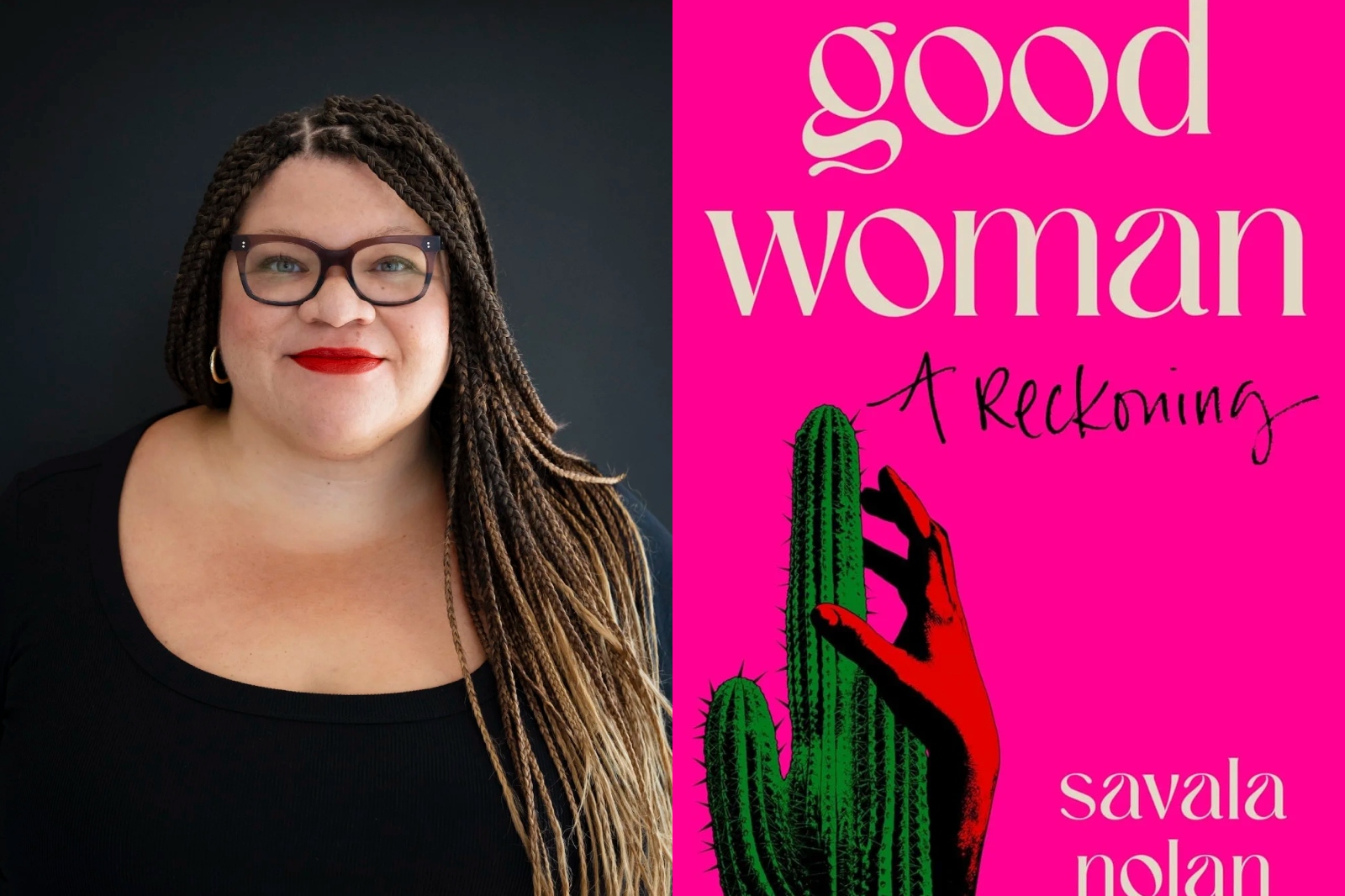
Alexis Madrigal: Welcome to Forum. I’m Alexis Madrigal. Savala Nolan’s new book of essays grapples with almost everything: patriarchy, God, bodies, Thomas Jefferson, violence, the sweetness of love, divorce, slave-owning ancestors, paying for sex, linear time. This is a mind alive to the possibilities both within and in conversation with her own experiences of the world. She’s thinking it through and pushing toward a more radical freedom—for Black women, for all women, for everyone. She joins us here in the studio. Welcome back, Savala.
Savala Nolan: Oh, thank you, Alexis. It’s such a thrill to be here, especially on publication day.
Alexis Madrigal: Yes. The new book is out today. It’s Good Woman: A Reckoning. Let’s talk about this reckoning right off the bat. Your résumé: writer, attorney who worked at the Obama White House, leads a social justice center at UC Berkeley Law School. This really sounds like the résumé of someone who has been “good,” and also someone for whom things have worked out in measurable ways. So what do you need to reckon with here?
Savala Nolan: Thank you. Before I answer that, thank you for mentioning it was the Obama White House. That is a very important detail to me.
Yeah, I have certainly checked a lot of the boxes that come with aiming to be “good” in this life. I would add to that list getting married—having a man choose me and propose to me—having a child and being family-oriented, doing a fair amount of caretaking for other people in my family, just sort of being a caretaker in general in the spaces that I’m in.
I think in this culture—maybe it’s not true in every culture—but in this culture women are expected to be good. And the theory that we’re sold is that if we’re good enough, we’ll have a happy life. And goodness means particular things. Being a good woman is different from being a good man. Being a good woman means being malleable, agreeable, helpful, male-centered, quiet, in control of the size and shape of your body, and content not to have much political control.
And the bargain I came to realize in my forties—as so many women do—is… can I swear on this show?
Alexis Madrigal: No. Thanks for asking, though.
Savala Nolan: The bargain is a bill of goods. Because a woman can be all of those things. She can be appealing in the ways that this culture wants her to be appealing and achieve success on the terms of the culture, and realize at a certain point in her life: Oh, being good has not made me happy and whole. It’s made me compliant. It’s given me some version of acceptance, right? But I am missing in this. There’s some element of my core that is not fulfilled by this.
In my experience, a lot of women have this reckoning in their forties—late thirties, early fifties. I don’t know if you’ve seen this election: the long forties, the thousand-yard stare of perimenopause. They start to look around them and survey the amount of self-abnegation, self-sacrifice, caretaking, silencing, swallowing, stifling that they’ve done—and they can’t take it anymore. Yeah. And that’s where the reckoning comes in.
Alexis Madrigal: Yeah. So it’s interesting because you’re describing this set of external markers and societal things, and then there’s the reckoning with the interiority of the person who’s producing these surface effects. I assume that writing—after having been a lawyer and working at the law school—is a way back into yourself, into finding that interiority?
Savala Nolan: Yeah. I mean, I don’t write like a lawyer when I’m writing a book. The writing that I do would not be welcome in a courtroom where it’s “just the facts, ma’am.” A judge doesn’t want passion. They don’t want your body in the brief. They want something a little more crisp and decoupled.
Alexis Madrigal: Tidy.
Savala Nolan: Yes. Tidy. They want from the neck up.
That said, I find a legal home for my writing in critical race theory—hope I can say that on the air.
Alexis Madrigal: You can. If you need to.
Savala Nolan: And for those who don’t know, critical race theory is simply the idea that race and law have a relationship, and that relationship is worth studying. That’s the whole bag, right?
Then it comes with different tools, questions, inquiries—ways of studying the relationship between race and law. One of those ways is called counternarrative. Counternarrative is the practice of telling your story when you’re someone who is marginalized, on the theory that your story is often left out of the normative side of things, like the law, but that it should have value.
So when I tell my story as a woman, as a Black woman, as a fat woman, as a person who’s been sexually assaulted—all of these aspects of who I am that sort of shunt me a little bit to the side—I do think of it actually as legal writing in its own way.
It’s not what I would do for a client, but it’s what I do for myself to know what I think, to meet my ghosts—as Terry Tempest Williams said—and to become present in my own life and in my own thinking.
Alexis Madrigal: So what has this reckoning felt like?
Savala Nolan: Well, the first thing that comes to mind is: fantastic.
Alexis Madrigal: That’s good.
Savala Nolan: Yeah, it’s really good. But I’m sort of on the other side of it, you could say. A reckoning is a process, so by definition there’s an ongoing unfolding. I wouldn’t say I have reckoned and now I’m cured of patriarchy and misogyny. Not at all. It’s an ongoing thing.
But where I am now—as someone who left a marriage that was stifling by the end, good at the beginning, bad at the end; as someone who no longer diets and no longer performs womanhood through body shame and body modification; as someone who talks about what happened that night twenty years ago as sexual assault as opposed to just a weird night—what I am now able to experience at a much deeper level is being a woman in ways that are unmodified and unmediated.
It’s like a more feral, authentic sense of who I am because I don’t have this thick layer of compliance rooted in misogyny governing all my decisions.
So where I am now is really great, because I’m experiencing my womanhood—and I love being a woman—in a way that is not mediated so heavily by patriarchy and misogyny.
At the beginning, I wouldn’t have described it as great. I would have described it as terrifying. If you’re someone who, like many women and like me, viewed marriage as the ultimate seal of approval in the culture, leaving a marriage and becoming a single woman in your forties is a little bit terrifying. Not just because you’re losing your partner and the life you thought you would have, but you’re losing a certain amount of cachet and normativity and legibility in the culture.
Realizing, “Oh, I can’t diet anymore, so I’m not going to be skinny because I can’t do that—that’s not me. My body is fat. That is how my body is.” That’s terrifying in this culture. Saying no—just saying no—is hard as a woman. Respecting your hunger for food, for sex, for reproductive rights, for political power—all of that is scary and difficult.
So at the end, yes, I feel rooted in a level of freedom and liberation that is fun and joyful and authentic. It’s not perfect—the weather is still the weather. But at the beginning, it would not be fair of me if I didn’t acknowledge that the beginning of a reckoning can feel pretty rocky.
Alexis Madrigal: We’re talking with Savala Nolan about her new book, Good Woman: A Reckoning. She’s executive director of the Thelton E. Henderson Center for Social Justice at Berkeley Law.
We want to hear from you. What does being a “good woman” mean to you? Maybe you’ve stopped trying to be a “good woman.” You can give us a call. The number is 866-733-6786. The email is [email protected]. You can find us on social media—BlueSky, Instagram, Discord, etcetera.
There’s a discussion flowing in the culture right now about heteropessimism—about the relationships between men and women—and many women opting out of dating and romance, or at least radically pairing back their expectations for this part of life. Do you think this work is part of that discussion or has something to say to it, or do you feel like that’s something happening over there?
Savala Nolan: I think they’re in conversation to the extent that heteropessimism is just another way of saying women having higher standards for the men that they get into relationships with and for how they themselves want to show up.
If a woman insists on being able to bring her entire self—the full range of human experience—into a relationship with a man, and she wants him to do the same thing, and that’s not happening either because he won’t accept that version of her or he doesn’t know how to bring his full range of humanity, which I think is part of the criticisms of heteropessimism, then yeah—that is absolutely what I’m talking about.
I’m not anti-love. I’m not anti-man. I’m not anti-marriage at all. I’m not anti-relationship in any way. But I do think in this culture, in romantic spheres, women are expected to give up a lot and to do a lot.
Now men, I’m sure, have their own version of that. But I think it’s a little different when we’re talking about caretaking and the amount of emotional labor that women provide in relationships, and the amount of self-silencing. Like The Little Mermaid, right? She literally gives up her voice in order to get her man.
Alexis Madrigal: The first time you watch that after having kids—at least for me—I was sort of like, you know what? Let’s not watch this.
Savala Nolan: This is not the lesson I want anyone to take about this world.
Alexis Madrigal: Yeah, right. Exactly. Just rewind to the weird Caribbean crab singing.
We’re talking with Savala Nolan about her new book, Good Woman: A Reckoning. We’re going to take your calls too about what being a “good woman” means to you, whether you’ve stopped trying to be a “good woman.” 866-733-6786.
Also, next week—Tuesday, March 10—Savala is going to be at Book Passage at the Ferry Building at 5:30, so you can check her out there. We’ll be back with more right after the break.