This partial transcript was computer-generated. While our team has reviewed it, there may be errors.
Alexis Madrigal: Welcome to Forum. I’m Alexis Madrigal.
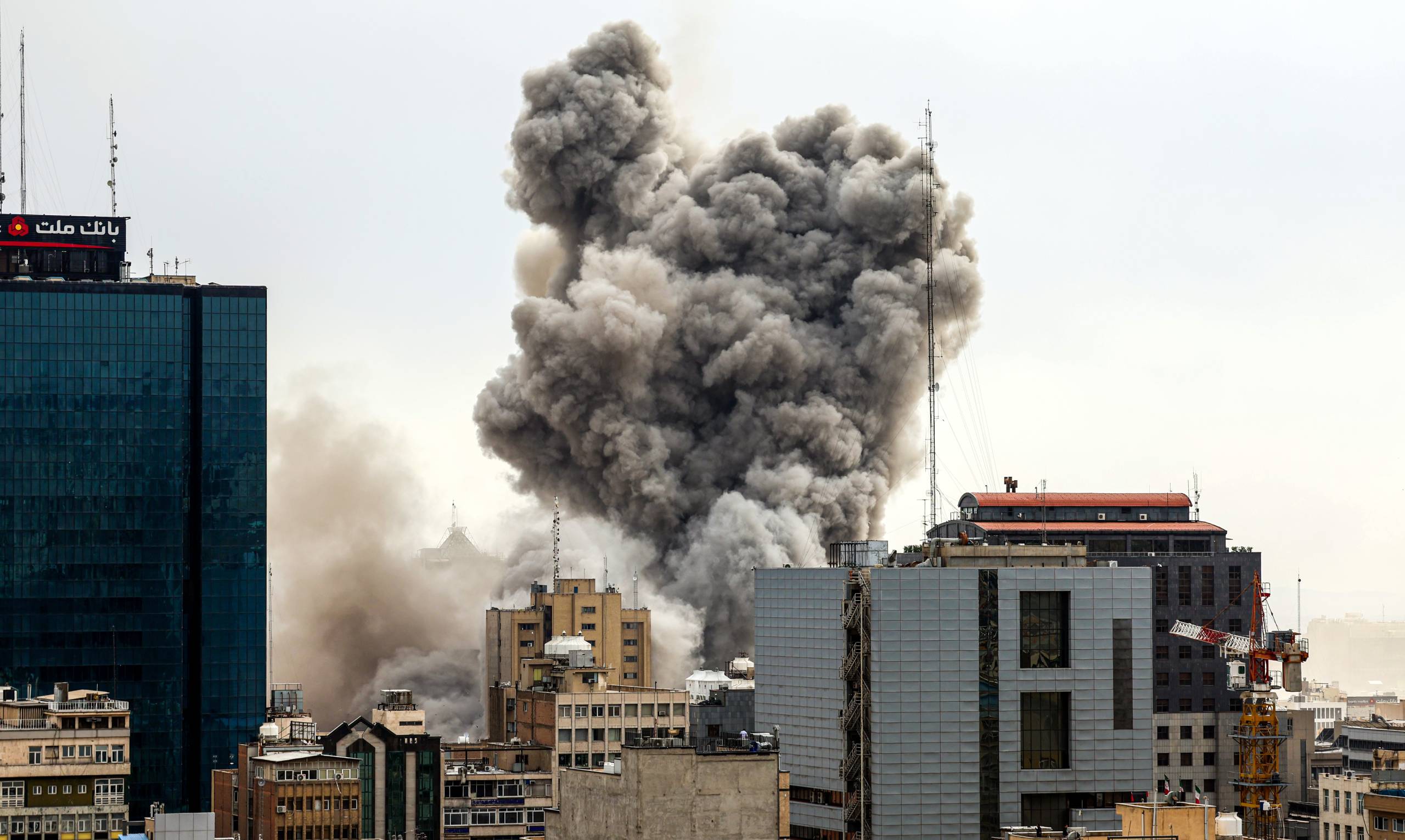
Well, we’re in a hot war with Iran. The United States has taken out another country’s leader. American power has not been so baldly exercised and so free from restraint in many years. But what happens now? The Iranian response has targeted Israel, Arab countries, and U.S. bases. The government there has not collapsed. What’s even going on?
We’ve got three experts here to help us figure things out.
Robin Wright is a contributing writer at The New Yorker. Her most recent piece for the magazine is “Iran’s Regime Is Unsustainable.” Welcome, Robin.
Robin Wright: Great to be with you.
Alexis Madrigal: We also have Sahar Razavi, an associate professor in the Department of Political Science and director of the Iranian and Middle Eastern Studies Center at Cal State Sacramento. Thanks for joining us.
Sahar Razavi: Thanks for having me on.
Alexis Madrigal: And we have Nate Swanson, director of the Iran Strategy Project at the Atlantic Council. Thanks for joining us, Nate.
Nate Swanson: Thank you for having me.
Alexis Madrigal: Nate, let’s start with you. Give us the basics of the scope of this moment. We’ve got the bombing, we’ve got retaliatory attacks—line it up for us.
Nate Swanson: Thanks. Look, this is a moment with really no precedent. For the last thirty-seven years, we’ve had continuity of rule inside Iran. So to see Ali Khamenei die is a moment that will transform the future of the Middle East one way or the other.
What happened was that President Trump and Israel decided to initiate a war that is unique and different from anything we’ve seen before. It’s a war with a nation of ninety-three million people, with no imminent threat to the United States, no real legal justification offered to Congress, and no clear explanation to the American people.
In response, we’ve seen what you might call operational brilliance from the United States and Israel. They have conducted hundreds of strikes and apparently taken out almost fifty members of Iran’s top leadership.
That leads to a mixed reaction. As you said in your opening, this creates a new opportunity. Khamenei’s death will be welcomed by many Americans and, I’m sure, by the vast majority of Iranians. But we also have serious questions about what comes next.
The objectives coming from President Trump have shifted, and there are very real questions about whether taking this moment will ultimately make things better or worse.
Alexis Madrigal: Robin, what do you think the United States is trying to do here?
Robin Wright: I wish I knew.
President Trump this morning again talked about his goals: eliminating Iran’s nuclear program, ensuring that it isn’t supporting extremist groups in the region, and destroying its missile program and navy. Some of that has already been accomplished. A number of naval ships have been sunk, and clearly the supreme leader and several key military leaders have been killed.
It’s striking that, so far, the only proxy or ally in the Middle East that has participated in this war is Hezbollah in Lebanon, and not during the first two days of the conflict. Israel has already responded by attacking Beirut.
But this is a very complex war, and the aftermath will be equally complex. None of us really understands politically what the administration is attempting. The president has talked about regime change while also saying he’s willing to talk with the Iranian government about diplomacy and concluding a nuclear deal.
I think the three of us would probably agree that there are about ninety-two or ninety-three million people in Iran. While there are many young Nelson Mandelas, there’s no equivalent of the African National Congress that challenged apartheid in South Africa. The idea that people will rise with one united voice under a single leadership—like what happened in 1979 after fourteen months of uprising—is quite unlikely.
So, once again, as we saw in Iraq and Afghanistan, there is a danger of being drawn into a prolonged presence or some form of intervention in Iran, whether military or otherwise.
That’s why many of us worry about what exactly we are engaged in and how costly it might become, especially when Americans are already worried about the cost of living in their own lives—just as many Iranians have protested the rising cost of daily life in their country.
I doubt this will make President Trump any more popular than he was before this war.
Alexis Madrigal: Sahar, what are you hearing from people you know in Iran, if you’ve been able to get in contact with them? What’s the reaction been?
Sahar Razavi: My contact with people inside Iran has been intermittent and sporadic because the internet has been shut down again. Phone lines are only working for outgoing calls, not incoming ones.
So reports from Iran are inconsistent. But what I have heard is that people are scared of the bombing.
Of course, as the others have mentioned, Iran is a large and populous country with many different and diverse opinions. I would take any claims about a united voice with a grain of salt.
That said, many Iranians are happy that Khamenei is gone, but they are not united about what that means or what will come next. The Islamic Republic has been facing a legitimacy crisis for quite some time. Aside from a small base of supporters, the vast majority of Iranians have wanted fundamental changes to the system.
Khamenei, as the leader of that system, being gone is a relief for many people. But there are also those who would have preferred that he be brought before a court and forced to face the families of his victims—so that there would be some form of accountability rather than an assassination carried out by a foreign power.
There is now a mass bombing campaign not only in Tehran but in other places as well. People in my close circle who have been able to contact loved ones in Iran tell me that they are scared, but they are okay for now.
Alexis Madrigal: Nate, how should we think about the Iranian response so far? Where are we in that response? Are we near the peak of retaliation, or is this the beginning of a much wider conflict?
Nate Swanson: From my perspective, we have to be humble and say we really don’t know.
For the first time, Iran is facing an existential threat that it hasn’t really faced since perhaps the beginning of the Iran-Iraq War. So in some ways we are seeing what could be the worst-case scenario.
Iran is lashing out not only at the United States and Israel, but also at its neighbors—countries that have spent the last several months trying to de-escalate the situation. They’re targeting energy infrastructure as well as civilian areas.
This is partly the kind of doomsday scenario many analysts have imagined, though it’s not there yet. So far, U.S., Israeli, and Gulf defense systems have intercepted many of these attacks. But it could get worse.
Ultimately, this becomes a numbers game between Iranian missiles and interceptor systems. We’ve already seen four American deaths, and those numbers could rise. It’s unclear how long this situation can continue at this intensity. The risks are very real and very scary.
Alexis Madrigal: Robin Wright, one listener asks: is there a realistic threat of retaliation in the mainland United States, whether through conventional warfare, cyberwarfare, or terrorism?
Robin Wright: Cyber is certainly a good question. Iran has previously launched cyberattacks against U.S. businesses and, at one point, parts of the American power grid.
Those capabilities may have been diminished, and it’s possible that the United States is using its own cyber tools behind the scenes to degrade Iran’s military or cyber capacity.
There is always the question of sleeper cells, though I don’t know how significant that threat is. The FBI has been quite diligent about monitoring those risks. There are also the dangers of lone-wolf actors—people sympathetic to Iran but not directly directed by it.
In the Persian Gulf, the United States has been somewhat surprised by the scope of Iran’s response. Iran has targeted oil infrastructure, civilian areas, and military facilities across the Gulf—and reportedly as far away as Cyprus in the Mediterranean.
At some point, this becomes a numbers game: how many missiles Iran has and how long it can sustain this militarily. There’s also the question of American munitions. The United States has been supplying NATO and Ukraine in their war against Russia, and now it is engaged in its own conflict.
The president said today that this war could last four or five weeks. And as he told Jake Tapper just a couple of hours ago, “the big wave has yet to come.”
So we may not yet have seen the full scope of what’s ahead.
Alexis Madrigal: We’re talking about the escalating war involving the United States, Israel, and Iran. Our guests are Robin Wright, a contributing writer at The New Yorker; Sahar Razavi, professor at Cal State Sacramento and director of the Iranian and Middle Eastern Studies Center; and Nate Swanson, director of the Iran Strategy Project at the Atlantic Council.