This partial transcript was computer-generated. While our team has reviewed it, there may be errors.
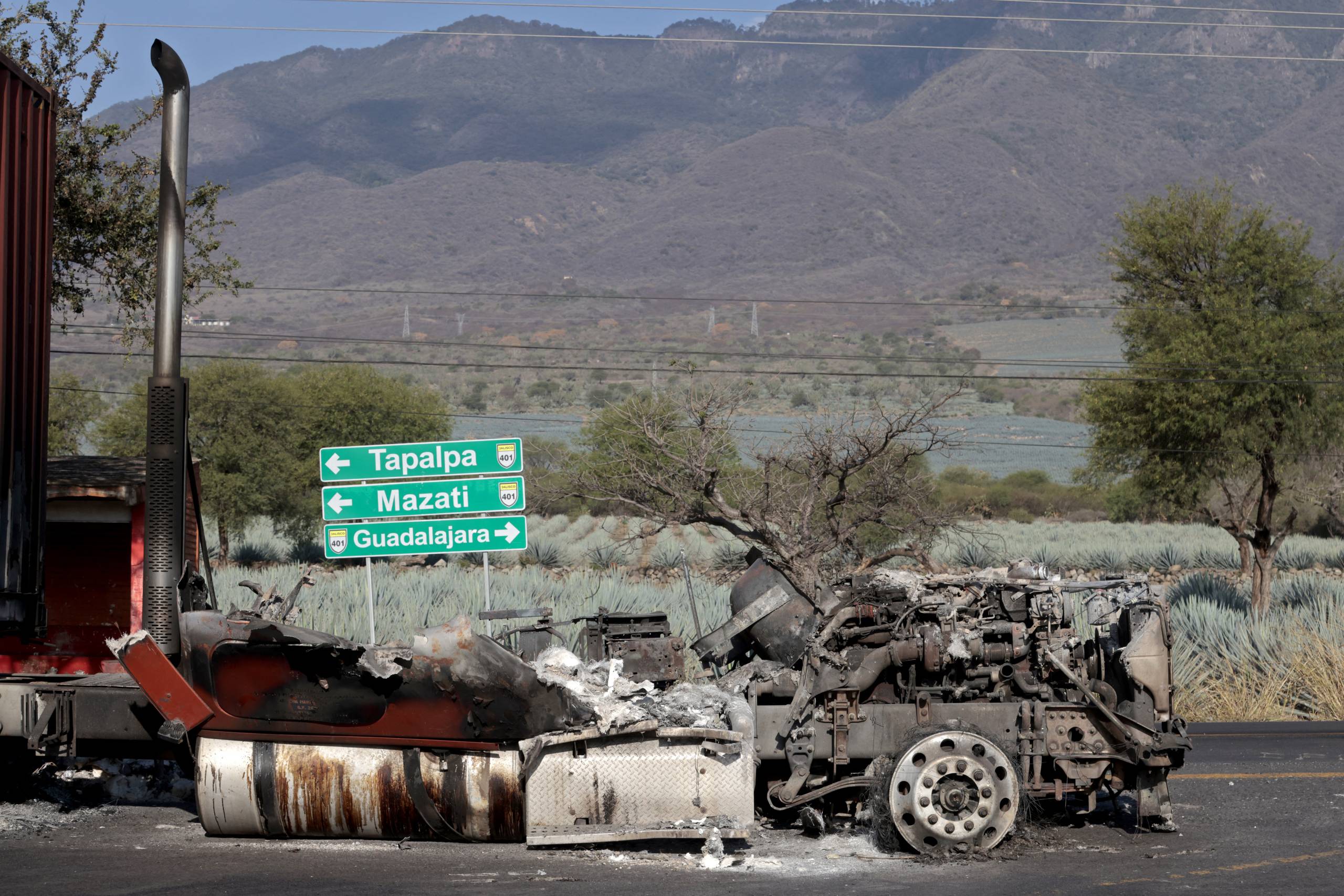
Alexis Madrigal: Welcome to Forum. I’m Alexis Madrigal. There’s a simple way to look at the killing of Nemesio Oseguera Cervantes, the nominal leader of the cartel Jalisco Nueva Generación. He was a guy wanted by the U.S. and Mexican governments. They got intelligence on where he was, and they sent in an operation to capture him, which led to a battle that killed him. That set members of his criminal organization to take to the streets, wreaking havoc, creating chaos in more than 20 Mexican states. And in some sense, this is what happened over the last week.
But, of course, there are many more forces at play: an increasingly bombastic American foreign policy, including extrajudicial killings of people in boats; the longtime hegemonic relationship the U.S. has had with Mexico; the complex dynamics inside Mexico about who should control the drug trade and the money that accompanies it — including not just drug traffickers, but politicians, the military, and others. And overlaid on all of that is the massive wave of violence that has engulfed Mexico since the presidency of Felipe Calderón in the late aughts, which matches the equally massive public health crisis that American drug use entails, with fentanyl and methamphetamine killing tens of thousands of Americans and debilitating many more each year.
Here to talk about both the immediate situation with El Mencho and this much broader context, we’re joined by Oswaldo Zavala. He’s a professor of Latin American culture at the City University of New York Graduate Center, CUNY, and the College of Staten Island. And he’s the author of the book Drug Cartels Do Not Exist: Narco-Trafficking in U.S. and Mexican Culture. Welcome, Oswaldo.
Oswaldo Zavala: Thank you. Happy to be here.
Alexis Madrigal: We’re also joined by Cecilia Farfán-Méndez, who’s head of the North American Observatory at the Global Initiative Against Transnational Organized Crime. She has also testified before Congress on these issues and others. Welcome, Cecilia.
Cecilia Farfán-Méndez: Hi. Thank you for having me.
Alexis Madrigal: Cecilia, let’s start with you. Let’s just start with what happened, as far as we know. Walk us through, as you were watching these events play out from Sunday to today — what have you seen?
Cecilia Farfán-Méndez: So as you were pointing out in the introduction, essentially what unfolded was an operation led mostly by the Mexican army to capture El Mencho. And in the process, according to the information that the Mexican army has produced, he was injured and then died from those injuries while being transferred to an army base.
What ensued, as you pointed out, were significant violent events — important to underscore, mostly targeted at state authorities. And since then, there have been other events of violence in Mexico. It’s important to underscore that it’s going to take some time to untangle which of these events are actually linked to the death of El Mencho and which ones are not necessarily connected to that and may be more opportunistic behavior by other criminal actors in the country.
Alexis Madrigal: And that’s just to show their own power? Or because there’s a chance to sow chaos? Why do those things?
Cecilia Farfán-Méndez: I think this type of arrest — and the violence and chaos that follow — generate uncertainty. It provides a good opportunity for opportunistic behavior from criminals in the sense that you can present yourself as belonging to Jalisco Nueva Generación, which is the organization that allegedly was led by El Mencho, and sort of get what you can out of that uncertainty. Potential victims are not going to try to discern whether or not you actually belong to that group in a moment where there is violence in other parts of the country.
Alexis Madrigal: What role do we think the U.S. played in, I don’t know, forcing this to happen or requesting this to happen? I’m not sure which word to use without putting too much spin on it.
Cecilia Farfán-Méndez: I think there are two levels to this. As you mentioned, El Mencho was wanted also in the U.S. There was an indictment against him there, not only in Mexico. And of course there was the post by the U.S. press secretary welcoming the fact that El Mencho had been killed.
We know that the Trump administration — the first one and the second one — have traditionally put pressure on Mexico to deal with these issues. But I’d like to nuance this a little bit more. On the one hand, it’s important to keep in mind that it’s in Mexico’s own interest to weaken and preclude criminal activities in the country. So we shouldn’t interpret every action simply as pressure from the U.S., because arguably it is also in the interest of Mexican citizens to reduce these levels of criminality.
The other thing I would add — where I think it’s important to keep in mind how the U.S. plays a role — has to do with firearms trafficking and the firepower we saw displayed on Sunday. Of course, this is not directed by the government, but as we have a conversation about the events unfolding in Mexico, this necessarily leads to a conversation about how these criminal groups are able to access firearms and ammunition. And that leads to a conversation about the need for bilateral engagement on this issue.
Alexis Madrigal: Right. Just to make the point a little finer: Drugs might come north, but massive amounts of American firearms go south, which is where these drug trafficking organizations get their weaponry.
Cecilia Farfán-Méndez: Exactly.
Alexis Madrigal: Oswaldo, one of the things I immediately started thinking about when I saw this killing is that we’ve seen this before — really over the last 15 years — these killings of supposed cartel leaders. And yet if you look at violence in Mexico or drug use in the United States, any metric you might look at, it doesn’t seem like things have gotten better.
Oswaldo Zavala: Not at all. And to the contrary, I think this operation shows how the pressure from Washington to Mexico has succeeded in continuing this punitive militarization that usually affects people in the poorest and most vulnerable sectors of Mexican society.
It’s tremendously worrisome that, in the end, what seems to have prevailed is this very violent militarization policy that has the only evident effect of causing more violence across the nation while doing very little to interrupt the flow of drugs.
Alexis Madrigal: One of the things I found myself thinking about, especially given that Claudia Sheinbaum and her predecessor, President López Obrador, hadn’t really pursued this policy to the extent that some previous Mexican administrations had — let’s say the U.S. did give them targeting information on this guy, a known wanted criminal in both countries. What kind of position does that put President Sheinbaum in? To say we’re going to or we’re not going to do this? What do you think, Oswaldo?
Oswaldo Zavala: As you mentioned before, we’ve seen this narrative before. We seem to be trapped in this endless loop of catching a criminal portrayed as a major mastermind controlling a transnational empire with reach in over a hundred countries and monopolizing the drug flow into the U.S., and so on.
Yet each time one of these traffickers is captured or killed, nothing seems to happen to the drug market in the U.S. What becomes evident is that most of these traffickers do not really stand up to the myth created around them.
There was a necessary question during the López Obrador and Sheinbaum governments about rethinking the drug war as a failed policy, in the sense that it does very little to stem the flow of drugs. Instead, it causes major violence and horror for Mexican society.
Rightly so, and winning with that mandate, President López Obrador attempted to rethink militarization. Unfortunately, despite the slogan “hugs, not bullets” being promoted as part of his security policy, his government — and now President Sheinbaum’s as well — has resorted to continuity in militarization and military actions. I do not see how any of this is going to render a different outcome other than the violence we have already seen.
Alexis Madrigal: Cecilia, what do you think? Did President Sheinbaum and her administration have other options in this case?
Cecilia Farfán-Méndez: I agree with Oswaldo in the assessment, and we have very robust evidence showing that this type of decapitation policy does not end the drug trade. If the objective is to reduce overdose deaths in the U.S. and limit the activities of criminal groups, we know for a fact that this type of policy does not get us there.
I do think it’s important to keep in mind that President Sheinbaum came into office at a time when the U.S. government was expressing a lot of frustration with Mexico over fentanyl. I think it has been right for her administration not to frame fentanyl as a U.S.-only problem, but to show that Mexico — as its neighbor and main trading partner — cares about it as well. Especially because Mexico is also asking the U.S. to care about firearms trafficking and to keep that on the bilateral security agenda.
Going forward, because we know this type of operation only breeds more violence in Mexico, we don’t want to see responses to public safety concerns that are heavily militarized. There is a very important policy question there: When are we going to see a functional criminal justice system that can answer these challenges without the need for a display of firepower like we saw on Sunday?
Alexis Madrigal: We’re talking about the recent killing of Nemesio Oseguera Cervantes, known as El Mencho, and what it means for Mexico and the United States. We’re talking with Cecilia Farfán-Méndez of the Global Initiative Against Transnational Organized Crime. We’re also joined by Oswaldo Zavala, professor of Latin American culture at the CUNY Graduate Center and the College of Staten Island.
Of course, we’d love to hear from you. There were all kinds of repercussions in Mexico from this operation. Were you or your family members in Jalisco impacted by the recent violence in Mexico following the killing of El Mencho? You can give us a call at 866-733-6786 or email [email protected].
I’m Alexis Madrigal. Stay tuned.