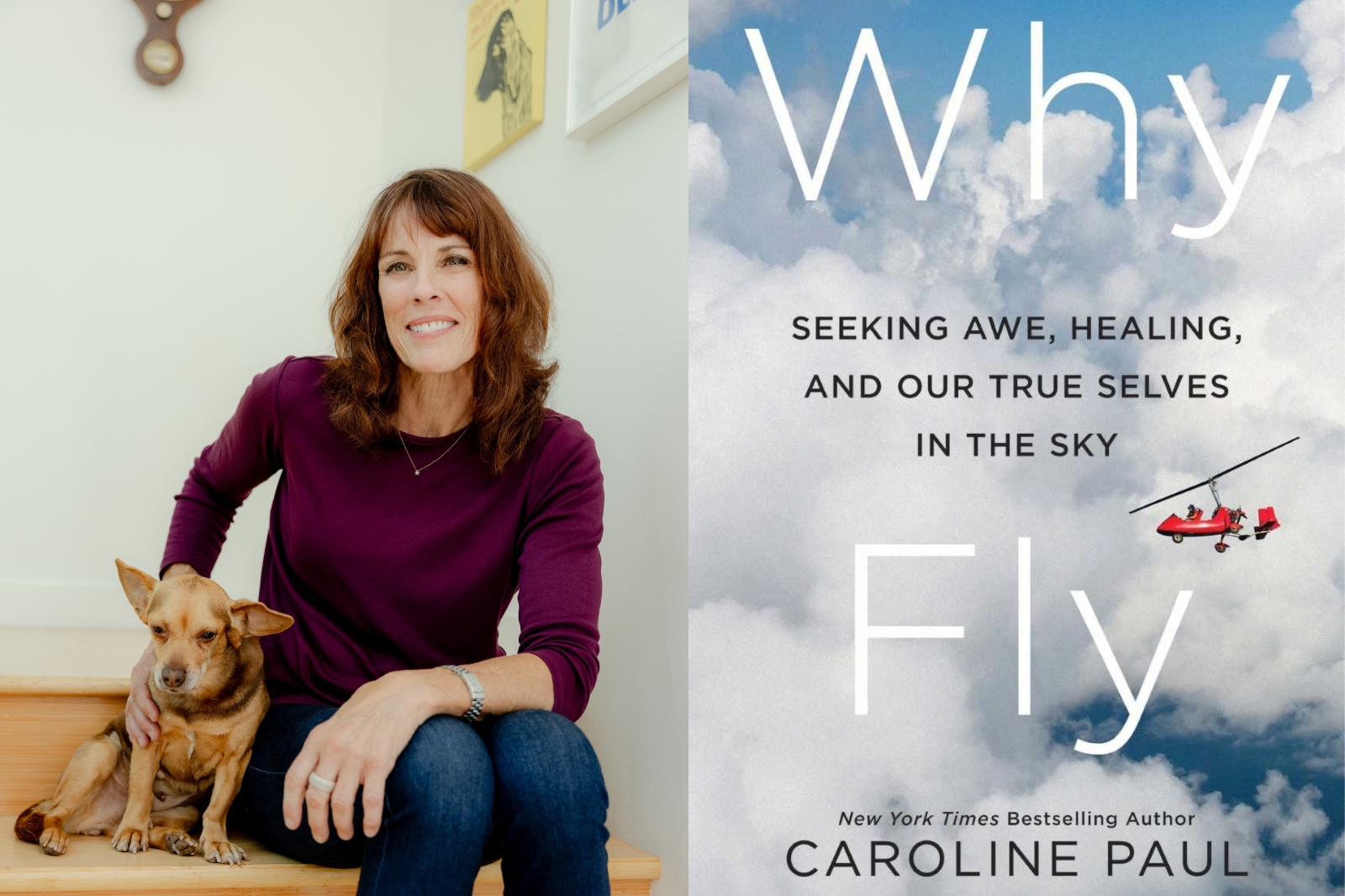
Alexis Madrigal: Welcome to Forum. I’m Alexis Madrigal. I flew a plane once. I mean, I didn’t take off or land, but journalist James Fallows and I flew up and over Appalachia for a magazine piece we were working on. After we’d seen the coal mines we’d gone up to shoot video of, we headed back toward Washington, D.C., and he let me take the controls for just a few minutes while he checked on a few things.
I’d say it was thrilling. It’s the feel of the plane in the air — or rather, on the air — because it actually felt like we were riding on top of it rather than moving through it. But that was a relatively tame experience of flying compared to Caroline Paul’s. I returned to it over and over as I read her book, which is a love letter to the operations and history of aviation and also to the feelings of the aviator.
The book is Why Fly? Seeking Awe, Healing, and Our True Selves in the Sky, and she joins us here this morning. Welcome.
Caroline Paul: I’m so happy to be here, Alexis.
Alexis Madrigal: So the plane that I flew was kind of like an Audi. It had leather seats, you know, screens and things. It was very nice inside. The whole plane has a parachute. This is not what you do.
Caroline Paul: No. My aircraft is like flying a bicycle.
Alexis Madrigal: Wow.
Caroline Paul: In particular, I fly a gyrocopter throughout the book, which is in the category of experimental — not quite as scary as that sounds.
Alexis Madrigal: It sounds pretty scary. I just want you to know.
Caroline Paul: Yeah. Well, it’s open cockpit. A gyrocopter basically looks like a tiny helicopter, but with a little human dangling from what looks more like a go-kart.
Alexis Madrigal: Oh my God. So what does it actually look like flying around? Is it bigger than the table we’re sitting at? How big is it?
Caroline Paul: It’s about that size — the body of it, the fuselage.
Alexis Madrigal: So really not much bigger than a motorcycle?
Caroline Paul: Not much bigger. I have a two-seater, but usually I just put bags in the back.
Alexis Madrigal: And when you say open cockpit, you mean literally there’s no windshield or anything?
Caroline Paul: Yeah. I like to fly like a bird. Like many of the people who tried to fly before we actually had planes that were safe, there were people who watched birds and wanted to fly like a bird. And I’m that person.
Alexis Madrigal: Wow. Have you flown other kinds of planes?
Caroline Paul: I started flying when I was around 20, and I learned, like most people, in a Cessna.
Alexis Madrigal: That’s just a standard small propeller plane.
Caroline Paul: Yeah. It’s like a two-seater or a four-seater. But I actually felt, like you did, that it was like driving a car — just the view was slightly different. So I quickly went to more open flight. In fact, I went to the most open flight: paragliders.
Alexis Madrigal: Oh my gosh. So paragliders — there’s a wing, and you’re kind of dangling, and you jump off a mountain?
Caroline Paul: Yeah. The wing is made of sailcloth, which doesn’t look like it flies until it inflates. And you jump off a mountain.
Alexis Madrigal: Oh my gosh. Why do you do all this stuff?
Caroline Paul: I think when I was young, I did it for the adventure and the adrenaline.
Alexis Madrigal: Yeah.
Caroline Paul: But as I’ve gotten older, that doesn’t interest me as much. It’s more about getting a perspective on the world. And honestly, I was not obsessed with flight for most of my flying career. I flew Cessnas. I flew paragliders. Then I went to hang gliders that had motors on them. It was great — it offered adventure — but it wasn’t until I got into a gyrocopter that I became obsessed with flight.
Alexis Madrigal: Why is that? How does it feel different?
Caroline Paul: Actually, I think it was more the time of my life. I was 58, and my long-term marriage was descending. I think I was looking for something that would most thoroughly distract me. At first, that’s what I wanted. A gyrocopter takes so much concentration and, honestly, a little bit of nerve. So it served that purpose right away.
But very quickly, I realized it was offering me much more.
Alexis Madrigal: Like what?
Caroline Paul: When you start learning something new, you’re learning how to gain control of something. And this was during a time when everything in my earthbound life felt out of control.
But there’s also an element of surrender when you take to the air. Not in the sense of, “Oh my gosh, I hope I survive this flight.” That’s not what flying is like for me. But there’s a sense that anything can happen, and you’re so tiny up there — especially in an open cockpit.
So it was that perfect mix of being in control and thoroughly distracted — because flying is very absorbing — but also realizing I’m tiny, and not everything is something I can master. And that’s okay.
Alexis Madrigal: Let’s have you read a little passage describing being up in the gyrocopter.
Caroline Paul: I had long thought that my dominant sensation when I flew was adrenaline. I was once genuinely thrilled to be head-butted by inversion boundaries, jabbed by turbulence, and left-hooked by rising thermals. This chaos was common for the large, light experimental wings I flew, and so I chalked it up to proof of adventure, proof of flying.
But as I got older, I realized that I was no longer eager — or even indifferent — to getting thrown about. I began to avoid the tightened jaw and sweat down the neck. Instead, I exulted over the blue-yellow tint of a winter day. I marveled at the tule elk looking like strewn paper clips accidentally dropped on a carpet of green. I went into boring detail about a coyote who stopped mid-stride, head cocked to the chuckling, whining, rumbling sound above, calculating whether it was a threat and concluding that it was not.
My interests were the wild mane of trees that passed under my feet, the ropey freeways, the prissy squares of suburban houses laid out on a grid. This being California, those houses are soon destroyed by wildfire, leaving only lonely cul-de-sacs and bereft chimneys. It would take months, even years, before the white dots of cement trucks would appear and the yellow of plywood walls would shine in the sun.
But nearby, a meadow quickly came to iridescent green life. Stupefied by its resilience, I would circle, stare, circle, stare, feel my own blooming heart. I lacked words. I was all exhale. This was my own overview effect, more mundanely explained as being in awe.
Alexis Madrigal: We’re talking with pilot and writer Caroline Paul about her new book, Why Fly? Seeking Awe, Healing, and Our True Selves in the Sky. That sounds pretty amazing — flying over Northern California and seeing a version of the landscape, even wilderness, that other people just don’t.
Caroline Paul: They’ve actually studied this overview effect I mentioned, with astronauts. They’ve found a profound shift that happens when you see Earth from space. Space is technically 62 miles up — not how far I fly. But I write about the overview effect and what science has found: feelings of connection and compassion that arise. I wondered, is it possible to get that in lower-level flight? And yes, it is. Essentially, the overview effect is awe.
Alexis Madrigal: Do you have a favorite altitude because of how it positions you relative to the landscape?
Caroline Paul: I do — actually, really low. But flying low is more dangerous because you have less time to make decisions.
Alexis Madrigal: How low is really low? Like buzzing-the-tower low?
Caroline Paul: The gyrocopter is an aircraft that flies low and slow. We can fly as slow as 40 miles per hour — very slow airspeed. The gyrocopter doesn’t stall. Most aircraft have to fly above a certain speed or they fall out of the sky. I think sometimes, when you’re flying faster, you miss what’s going on below. Gyrocopters can fly very, very slow and therefore very, very low.
Alexis Madrigal: That’s cool. James Fallows, who I mentioned earlier, once said 2,000 or 3,000 feet was his favorite altitude because you never get tired of seeing how geography, geology, cities, rivers, bays, mountains — how it all fits together. You can see why a city is where it is, because there’s a river there.
Caroline Paul: And more than that — you can see how the Earth itself has moved. I did a long flight from Seattle back to California. As I came over Mount Shasta, I could see the Central Valley before me. It suddenly became obvious why it was once an inland sea in a way I never noticed when driving it. You could see the Coast Range and the Sierra Nevada bounding it. You could see where glaciers moved through and where huge lakes once were. You can only tell that from a certain altitude.
Alexis Madrigal: On the ground, you’re just as insignificant but unable to grasp the larger pattern.
Caroline Paul: Exactly. I never really liked that drive along Interstate 5. But flying it gave me a brand-new appreciation of subduction, erosion — all these processes that had never occurred to me.
Alexis Madrigal: We’re talking with pilot and writer Caroline Paul about her new book, Why Fly? Seeking Awe, Healing, and Our True Selves in the Sky.
Maybe you’re a pilot. Why do you do it? How does it feel? Or maybe you take risks in your life that other people think are irrational. How do you think about risk in the world and in your own life?
You can give us a call at 866-733-6786 — that’s 866-733-6786. The email is [email protected]. You can find us on social media — BlueSky, Instagram, Discord — we’re @KQEDForum everywhere.
I’m Alexis Madrigal. Stay tuned.