This partial transcript was computer-generated. While our team has reviewed it, there may be errors.
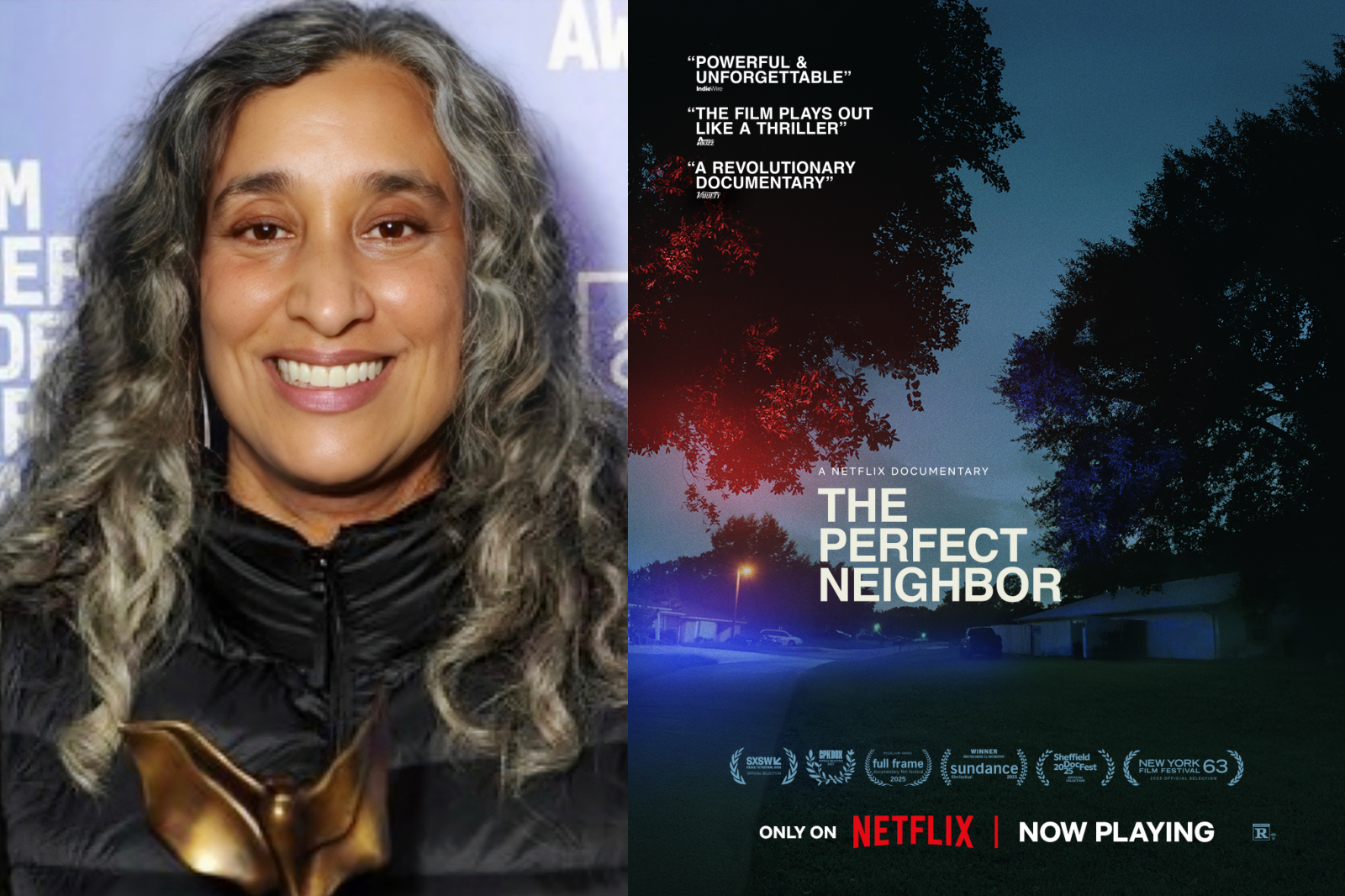
Alexis Madrigal: Welcome to Forum. I’m Alexis Madrigal. It’s hard to describe how excruciating it is to watch Geeta Gandbhir’s Oscar-nominated documentary The Perfect Neighbor. We know from the first minute what’s going to happen: someone will be shot. But the film is not in a hurry to get to that moment.
Instead, we get a slice of Florida life — a multiracial community not divided by the things you might expect, but by a dispute between a crabby older neighbor and a block full of kids and their parents. The tragedy that will rock the neighborhood only becomes more painful minute by minute as you get to know the various personalities, a process that occurs through the body-camera footage of sheriffs who are called out to the area again and again.
This is a film that could not have been made before the last half-decade of ubiquitous video footage, and it is one of the most memorable and unusual films I’ve seen in a long, long time.
Gandbhir is also the director of The Devil Is Busy, a documentary short about an abortion clinic in Atlanta, its indefatigable staff, and the people who protest it. Welcome to Forum, Geeta.
Geeta Gandbhir: Thank you so much for having me.
Alexis Madrigal: For folks who haven’t seen this film on Netflix, where it’s been a huge hit, can you describe the situation? It’s not really a spoiler — just what happens in The Perfect Neighbor?
Geeta Gandbhir: Sure. As you mentioned, it takes place in Ocala, Florida. On one hand, you have this beautiful, multiracial, intergenerational community that lives together with a really strong social network. They raise children together. The kids play in the streets and in neighbors’ yards. They play football and basketball. It’s kind of like a little slice of the American dream, because you see neighbors caring for each other, claiming all the kids as theirs, really functioning as one big extended family. It feels like the best of us.
Alongside that, you have — as you mentioned — the crabby neighbor on the block, a woman named Susan Lorincz, who repeatedly calls the police again and again and complains about the children: the noise they’re making, that they’re trespassing onto her property. She rents, but still feels entitled to control the space. She repeatedly calls the police and tries to weaponize them against this community and the children.
The situation, like a boiling pot of water, just escalates and escalates and escalates, and it ends in a terrible tragedy.
Alexis Madrigal: Let’s listen to a cut from the film. You’ll hear voices of neighborhood kids, police officers, and this neighbor, Susan.
The Perfect Neighbor (clip):
Kids: We’re kids. Kids do this every day. Is she calling the police?
Police: Well, you’re acting like a bunch of kids.
Kids: Yeah. We are kids. Duh.
Police: I know. That’s why we’re not worried about it.
Susan: His mother literally attacked me, picked up the signs, and threw them at me. I literally don’t do anything over here. I’m quiet. I expect my neighbors to be respectful.
Police: Okay. Thanks. All right. I apologize if that happened as well. She’s not coming to the door?
Police: She did. I just talked to her.
Police: We were going to explain to her that there doesn’t need to be a call for service every time a kid plays in the road or in the yard.
Police: Apparently they’ve been stomping her signs and running past her windows, screaming, ding-dong ditching her, knocking on her door.
Police: There does come a point where you have to accept that you live with a bunch of kids. She’s also the only one that ever calls.
Alexis Madrigal: That was a cut from the documentary film The Perfect Neighbor, which is nominated for a 2026 Academy Award. Geeta, what was your connection to the kids in this neighborhood?
Geeta Gandbhir: Essentially, the reason we got involved in this case — and the reason we made this film — is because Ajike Owens was a family friend. Interestingly, the house that Ajike lived in had previously been lived in by my sister-in-law — really my cousin-in-law, but culturally we don’t differentiate. We’re very close.
Alexis Madrigal: Maybe just cousin.
Geeta Gandbhir: Exactly. That’s how we see each other. She lived in the house before Ajike moved in, and her children played in the street with the other kids there. When she left, she offered the place to Ajike and said, “This is a dream location. The neighbors, the kids — your children will have so many people to play with. There’s just such a great community here.”
So Ajike took the apartment, and Susan moved in around the same time. Unfortunately for my family, this story was a bit personal because there was that connection to Ajike.
Alexis Madrigal: Given that, one can imagine an entirely different documentary — a traditional format where you interview the family and talk to everyone involved. But that’s not how this film is built.
Geeta Gandbhir: No, and that was very purposeful. When Ajike was murdered, my husband — Nikon Kwantu, who’s also a producer — and my team at Message Pictures, Alisa Payne and Sam Pollard, sprang into action. We got a distress call from my sister-in-law, and we were immediately on the ground trying to support the family, help with the kids, and also keep the story alive in the media.
There wasn’t national news coverage. There wasn’t much coverage at all, frankly. Unfortunately, because gun violence is so common, stories like Ajike’s are often brushed under the rug or seen as routine. We knew that without media pressure, it might not get the attention it deserved.
Also, Susan was not arrested immediately. It took about four or five days because police had to conduct a Stand Your Ground investigation. We were worried. We have the case of Trayvon Martin preceding this and other cases in Florida where Stand Your Ground came into play. We were worried there might not be justice for Ajike.
Two months later, we received the body-camera footage. Susan was eventually arrested, and the footage came from the family’s lawyers, Benjamin Crump and Anthony Thomas, who had used the Freedom of Information Act to obtain it. They asked us to review it to see if there was something useful for media or even for the case. When we saw those thirty hours of footage, that’s when we realized there could be a film here.
Alexis Madrigal: What did you do? It just comes on a hard drive, and you start laying it out?
Geeta Gandbhir: It actually came on a thumb drive — very innocuous. It was in a jumble of folders. Police function almost like a multicamera film production: multiple officers on scene at a time, cameras turning on and off at different moments. There were at least two officers on scene each time they came, and the night of the murder there were about fifteen.
We had to figure out the chronology of all these files. I used to be an editor, so I spent about two weeks stringing all the material out, synchronizing it, and putting it in chronological order. There were 911 calls, detective interviews, dash-cam footage, body-cam footage, Ring camera footage. We eventually also got some cellphone footage that Susan shot.
Seeing all of that, we realized we were witnessing something we never see when these crimes occur: what the community was like before. The police didn’t intentionally capture it — they were just responding to calls — but usually we only see the aftermath, the grieving family, and we have to recreate what their lives were like. Here, we could actually witness it. You become part of the community. You become a neighbor.
That felt very powerful to us. We wanted to use the body-camera footage to humanize the neighborhood and the people in it. Often, when people of color are victims of crime, they are criminalized afterward. Their children are adultified, even though they’re victims. In this footage, it is undeniable what this community was like.
Alexis Madrigal: One of the interesting things is that the means of humanization is police body-camera footage, which is normally used for almost the opposite purpose.
Geeta Gandbhir: Exactly. My own bias — and I think many people of color share this — is that body-camera footage is often used to criminalize or surveil us. Police often come into our neighborhoods like an invading army and do harm. They’ve also learned to work around body cameras, even though they’re meant to record accountability. They might shout things like “stop resisting” when the camera is on, for example.
But the ironic thing is that when we made this film — it premiered at Sundance in 2025 as a small independent film — we hoped it might work itself out of relevance. Instead, we see today, with what’s happening in Minnesota and with ICE in our communities, how important body-camera footage and documentation are, whether from bystanders, cellphones, or law enforcement themselves.
Right now, truth is something people in power feel very comfortable distorting. So even though body cameras are a double-edged sword, we need them.
Alexis Madrigal: We’re talking with Geeta Gandbhir, documentary director. We’re discussing the film The Perfect Neighbor, which is nominated for the 2026 Academy Awards. She also directed Katrina: Come Hell and High Water, Eyes on the Prize, and Black and Missing.