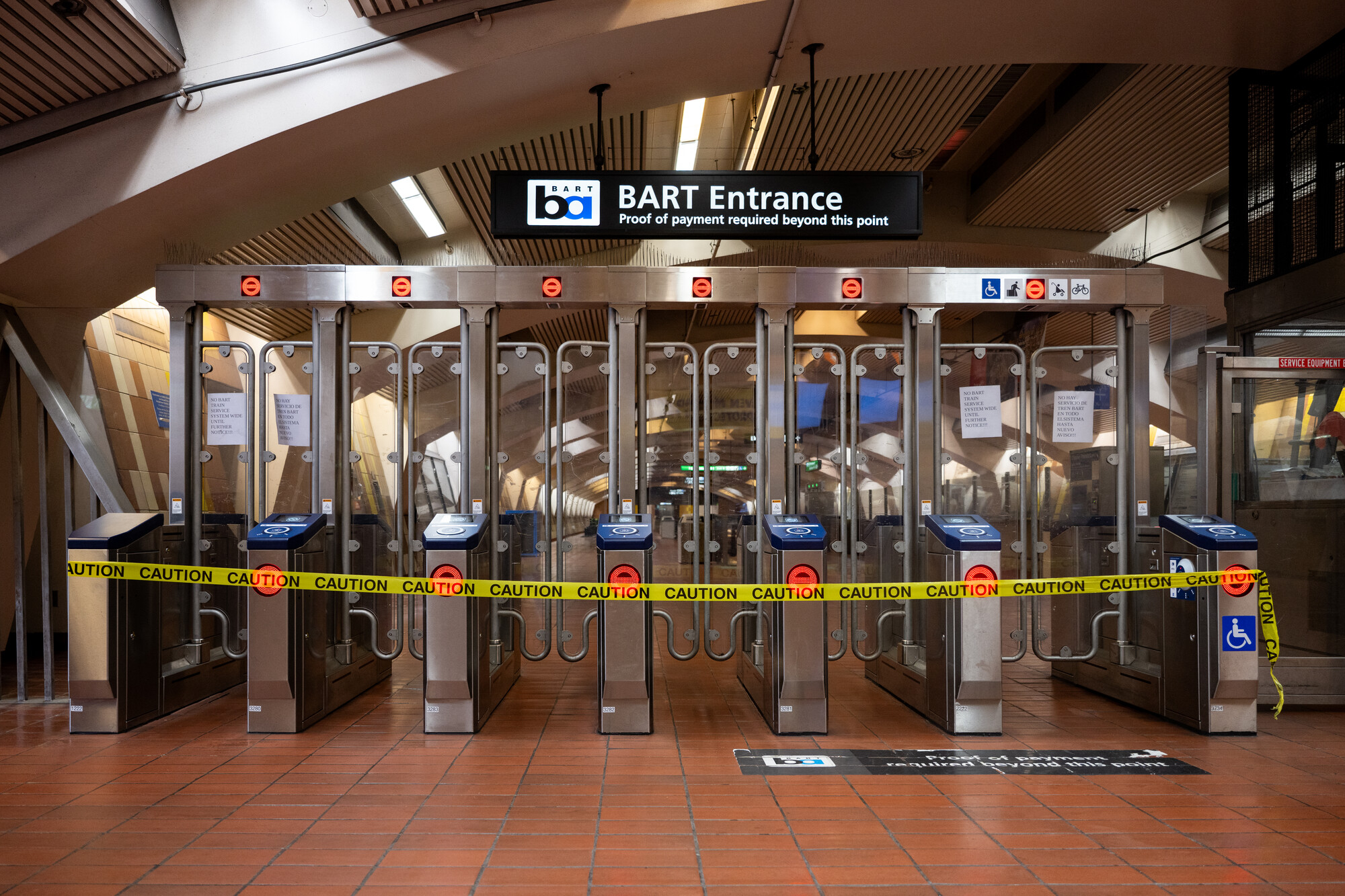
Alexis Madrigal: Welcome to Forum. I’m Alexis Madrigal. The story of how BART got into a financial crisis is really very simple. BART was built to deliver commuters to downtown San Francisco, and it did this admirably well—recovering 71 percent of its operating budget just from fares in the years before the pandemic, one of the highest rates in the world.
Then the pandemic hit. Workers still have not returned to downtown San Francisco in their previous numbers, and it seems as likely as not that they never will. So now the system is in a terrible bind, running a massive deficit, with almost no hope that there will be a boom in ridership anytime soon.
The agency now has its hopes pinned on a November ballot measure that would deliver over $300 million per year, according to BART, mostly closing its deficit. Today, we talk about the various scenarios for service, what the ballot measure might not fix, and dig into the BART budget.
We’re joined first by Robert Powers, general manager of BART. Welcome, Bob.
Robert Powers: Thank you for having me, Alexis.
Alexis Madrigal: Yeah, thanks for joining us. So let’s talk about this budget deficit. Is it really just the ridership, as I described, or are there other factors we haven’t included?
Robert Powers: I think your synopsis—a bit of history on how we got here—is accurate. The pandemic and remote work are major factors. I would just add that we are starting to see a few more folks returning to the office, and some movement in remote work policies, with major companies shifting to one or two remote days per week. Our ridership has been steadily increasing, just not at a dramatic pace.
Alexis Madrigal: Yeah. I follow these ridership numbers really closely—probably embarrassingly closely. I kept expecting that one day the line would just shoot up. But instead, it’s never really done that. I think we’re at 42 percent of pre-pandemic ridership, and it’s just been inching up.
Is there some event or moment that you feel could bend that line more quickly? San Francisco has this AI boom going—shouldn’t there be people riding in?
Robert Powers: It’s difficult. We’re in a position where many jobs in the Bay Area can be done remotely, and that complicates the math.
Alexis Madrigal: Mm-hmm.
Robert Powers: But I would say this: as people get out there and experience what I call the “new BART,” I think more people are coming back and riding. You’re right—the number of people riding BART is similar to pre-COVID levels. But the number of trips they take has changed. Instead of five days a week, they’re riding one or two days a week, and that’s the challenge we face.
Alexis Madrigal: So before we talk about the budgetary side of that challenge, is this a moment when BART needs to reimagine itself—regardless of what happens with this tax measure—because we don’t have the same hub-and-spoke model we once did? Things have changed.
Robert Powers: Every day, I focus on how BART can improve the customer and rider experience and let our “new BART” lead the way. That means three things: safety and security, on-time performance, and cleanliness. I think we’ve done an excellent job delivering on those, and that’s helping drive ridership. If we stay focused there, I think that will lead to good outcomes.
Alexis Madrigal: Okay, let’s talk about how you’re funding the agency right now. Ridership hasn’t fully come back. The state and, under the previous administration, the federal government were helping transit agencies. How are you piecing things together before this measure?
Robert Powers: We’re at—or very near—the end of the federal assistance we received during COVID. There were three allotments of federal help dedicated to operations while ridership was down. We’ll deplete all of those resources this fiscal year, and that’s what’s driving this $300 million deficit going forward.
Alexis Madrigal: As I understand it from BART documents, the deficit is closer to $400 million. The sales tax would generate more than $300 million. What else will close the gap?
Robert Powers: Over the last couple of years, we’ve been looking for efficiencies. One example is the decision to run shorter trains. That has several benefits, but at the core, it saves about $8 million a year in energy costs. It also reduces maintenance, cleaning, and some safety and security needs.
Those kinds of changes add up. We’ve reduced non-labor budgets and peak-period service. There’s no single element that will balance the budget—it’s a series of efficiencies we’re working toward.
Alexis Madrigal: When I was looking at the budget, a couple of things stood out. One is pension liabilities, which are a big chunk of the budget. The other is police spending. You mentioned safety as a major focus. Will either of those be part of negotiations going forward?
Robert Powers: On policing, safety and security are fundamental to public transit. Our policing helps get people out of their cars and onto trains. Fifty percent of our police department are walking trains and platforms in stations. We still have vacancies at the sworn officer level, but I think we’re doing a good job. We’re trying to hold down overtime costs as we move forward.
We’ve also been partnering with labor on how we balance BART’s budget. It has to be a collaboration and a partnership.
Alexis Madrigal: And what about pensions? Decisions in the past seem to have created significant costs now for retiree benefits.
Robert Powers: Right now, we’re continuing to defer retiree health contributions. But at some point, we still have to make those contributions, and they become more expensive the longer we wait. For now, though, we’re continuing to defer them.
Alexis Madrigal: Let’s talk about the so-called doomsday scenario if the sales tax initiative doesn’t pass. What would happen in those different scenarios?
Robert Powers: We took this issue to the BART board in a workshop. In November, there are two potential outcomes. If the measure fails, things get complicated—and difficult—pretty quickly.
We would move from five lines to three-line service, with two trains an hour—30-minute headways—and we would close at 9 p.m. That would be about a 63 percent reduction in train hours. We’d also need to increase fares and parking fees by about 30 percent.
With those service reductions would come additional savings from labor and layoffs, among other changes. Without a dedicated revenue stream, everything has to remain on the table.
It was an emotional discussion with the BART board, given how integral BART is to the region—regional connectivity, mobility, the environment, sustainability, and the economy. BART underpins all those discussions. It’s my responsibility as general manager to have a plan for either scenario.
Alexis Madrigal: We’re also going to talk with Melissa Hernandez, president of the BART board of directors and former mayor of Dublin, after the break.
Right now, we’ve got Bob Powers, general manager of BART, and we want to hear from you. How would BART’s plans to cut service affect you if it cannot get more funding? Are you willing to pay more to ride BART? How are you thinking about this?
You can give us a call: 866-733-6786. That’s 866-733-6786. The email is [email protected]. You can find us on social media—Blue Sky, Instagram, Discord—or KQED Forum.
I’m Alexis Madrigal. Stay tuned for more right after the break.