This partial transcript was computer-generated. While our team has reviewed it, there may be errors.
Scott Shafer: This is Forum. I’m Scott Shafer, in for Mina Kim. Since Donald Trump broke onto the political scene in 2015, the United States has seen a surge in white supremacist and neo-Nazi hate groups.
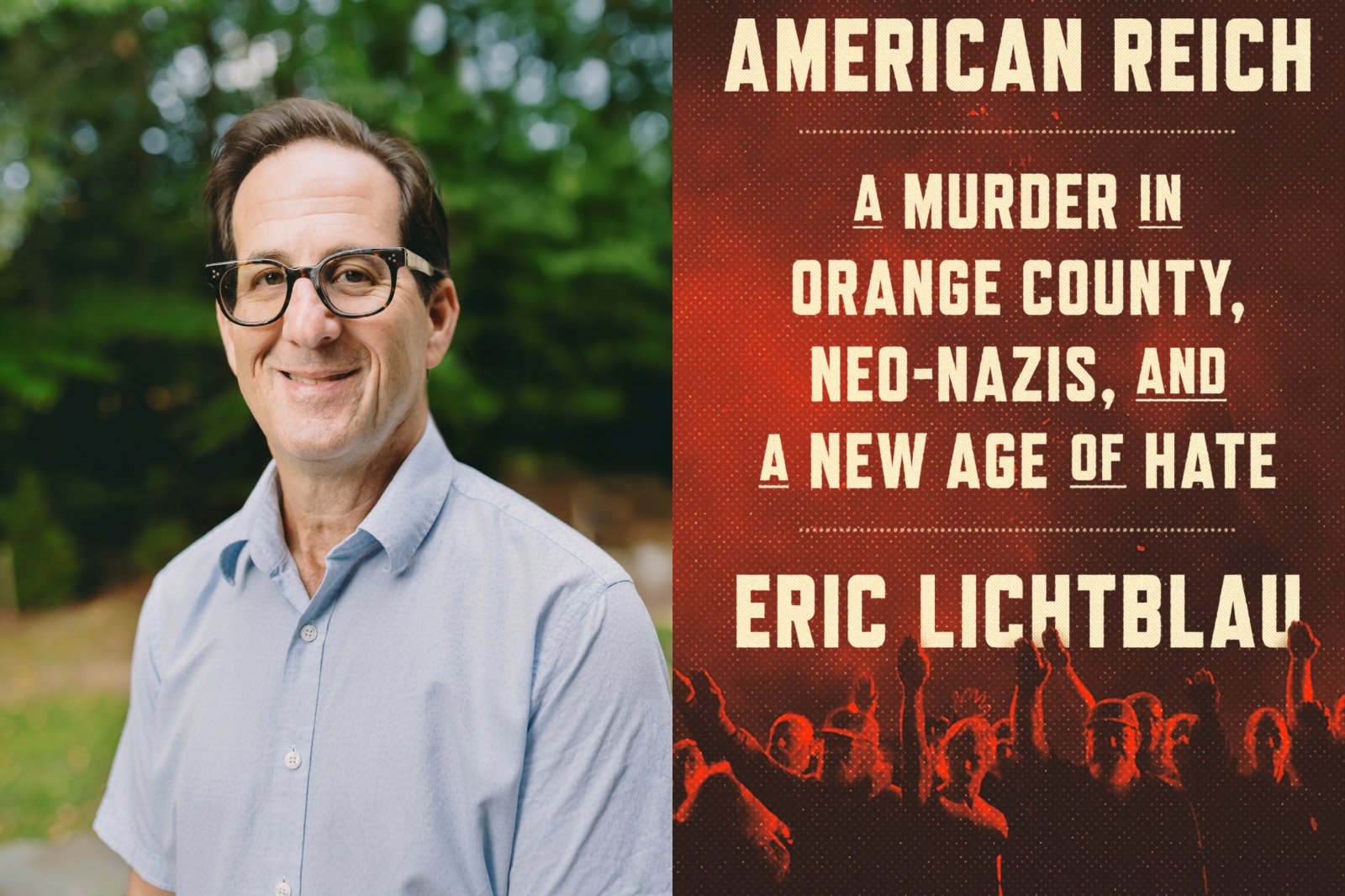
Our guest today, investigative journalist Eric Lichtblau, uses the 2018 murder of a gay Jewish college student by a neo-Nazi in Orange County to explore the rise of white Christian nationalism there. He digs into how Trump’s attacks on immigrants, pardons of the January 6 rioters, and use of racist memes—including one he posted recently about the Obamas—have fueled and emboldened right-wing extremism in California and across the country.
His new book is titled American Reich: Murder in Orange County, Neo-Nazis, and a New Age of Hate. Eric Lichtblau, welcome to Forum.
Eric Lichtblau: Thanks for having me, Scott.
Scott Shafer: This is your fourth book. One of them was a bestseller, The Nazis Next Door, which explores how, after World War II, the U.S. became a refuge for former Nazis. You started American Reich in 2020 during the pandemic. What drew you to Orange County for this investigation?
Eric Lichtblau: I was looking for a place that might surprise people because of its racism and the surge in hate crimes. We often think of the Deep South as the base for that, understandably. But Orange County has a deep-seated culture of racism going back to the Ku Klux Klan and its influence in places like Anaheim, dating to the early 1900s.
That continued through the John Birch Society and Orange County’s reputation as the “Orange Curtain,” well into this century. That’s only begun to change very recently, with Democrats taking over congressional seats just a few years ago. That shift has led to a backlash—a violent backlash—from white supremacists, resulting in a disturbing wave of attacks in Orange County.
We’ve seen the emergence of groups like Rise Above Movement and Atomwaffen. These groups have shown a willingness to carry out attacks in many forms in Orange County. In many ways, it’s an extreme version of what we’re seeing across the country.
Scott Shafer: I want to get into some of those groups in a minute. But the book starts as the story of two young men with a tragic connection: the victim, a college student named Blaze Bernstein, and his killer, Sam Woodward, a former high school classmate who became a white supremacist. So tell us first—who was Blaze? What was he like?
Eric Lichtblau: Blaze was a very artsy kid who attended a magnet arts school in Santa Ana. He didn’t come out as gay until college and was still exploring his sexual orientation in high school. He was Jewish, deeply into poetry, writing, and theater, and was especially focused on writing.
Another student at the school was Samuel Woodward, who was almost the antithesis of Blaze. He was a loner, into gaming, didn’t have many friends, and didn’t really want to be there. His mother thought he might flourish and come out of his shell at the school. His father, however, didn’t want him there at all—mainly because he disliked gay people. It was an LGBTQ-friendly school, and his father feared Sam might “become gay.” He actually said that to him.
Sam was outwardly homophobic and began expressing hatred toward gay people and minorities more broadly while at the school. This was the beginning of his radicalization. He later kept what he called a diary of hate against many groups, especially gay people and Jews.
Scott Shafer: How did these two kids even know each other? They seem like unlikely friends—if they were friends at all.
Eric Lichtblau: They were acquaintances at best. They barely nodded to each other in the hallways. They shared some classes but ran in completely different circles. They didn’t reconnect until years later.
By then, Sam had dropped out of college after a semester in Santa Barbara. He was using drugs, trying to find himself, working at a children’s party supply store, and immersing himself in neo-Nazi ideology. He attended a hate camp in Texas and joined Atomwaffen.
Scott Shafer: Which means “atomic bomb” in German.
Eric Lichtblau: Exactly. Meanwhile, Blaze was attending an Ivy League school—Penn in Philadelphia—and was considering medical school. He was a sophomore when Sam reached out to him online.
At that point, Sam was frequenting many online platforms, sometimes pretending to be gay. He wrote in his journal that he enjoyed catfishing young men—making them think he was gay, then outing or frightening them, and sometimes even meeting them in person. Evidence presented at trial showed that he did this.
Scott Shafer: Sometimes the most outwardly homophobic people are struggling with internal conflicts themselves. Did you get any sense of that with Sam?
Eric Lichtblau: That was a theory raised by the defense—that he might have been a self-hating gay man. There was some evidence to support that, but we may never know the truth. His father feared that possibility and repeatedly warned him against it. Sam’s journal makes clear that he did not want to be gay and that he hated gay people intensely. Whatever his internal struggles were, his outward hatred was unmistakable.
Scott Shafer: These two are on completely different life paths. And yet they come together in December, when Blaze is home from college. What prompted Sam to reach out again, and how did Blaze respond, given Sam’s history?
Eric Lichtblau: This was actually the second attempt. Sam had contacted Blaze about six months earlier, and Blaze brushed him off. But Sam tried again. Blaze was intrigued—here was this “bad boy” from high school, known for homophobia and Confederate imagery, suddenly reaching out.
Sam had done things like using the Confederate flag in school projects and doodling Nazi imagery in his assignments. Everyone knew who he was. So when Sam messaged Blaze on Instagram, Blaze was curious. The first time, nothing came of it. The second time, they agreed to meet in person, tragically.
It was during Christmas break. They went to a park near Blaze’s old elementary school—Wood Park, a quiet, scenic place with soccer fields. Blaze never came home.
Scott Shafer: Explain what happened when they met. Blaze seemed almost excited by the interaction.
Eric Lichtblau: He texted friends, saying, “You won’t believe who reached out to me.” He wasn’t sure what to make of it—whether it was flirtation, curiosity, or something else. There was a sense of drama, even intrigue.
Sam picked him up, and Blaze went with him. His parents didn’t even know he’d left. The next day, they realized something was wrong when he didn’t show up for a dentist appointment.
Scott Shafer: Describe the murder, if you would. It was especially brutal.
Eric Lichtblau: Blaze was stabbed more than 20 times—nearly 30—and buried in a shallow grave during heavy rain. Sam then concocted a weak cover story as the search began. Celebrities became involved in the search because Kobe Bryant attended the same church as Sam’s family, which was deeply religious.
Scott Shafer: Eric, I need to stop you there—we’re coming up on a break. We’ll continue our conversation after a short break. You’re listening to Forum. We’ll be right back.