This partial transcript was computer-generated. While our team has reviewed it, there may be errors.
Alexis Madrigal: Welcome to Forum. I’m Alexis Madrigal. There have been a bunch of teacher strikes over the last few years — West Contra Costa, Oakland, others around the state — but it’s been literally decades since the last teacher strike in San Francisco. Up first this morning, we’ve got San Francisco Chronicle K–12 education reporter Jill Tucker with us to catch us up on how we got to this point. Welcome, Jill.
Jill Tucker: Thanks. Nice to be here.
Alexis Madrigal: So, okay — where are we? How long have they been bargaining? What’s going on?
Jill Tucker: Yes. So, the San Francisco Unified School District and the teachers union have been bargaining for almost a year. They’ve gone through all of the steps of bargaining, from impasse to a mediator to fact-finding. And now they are at the very, very last step and on the brink of a strike, waiting today for the fact-finding report.
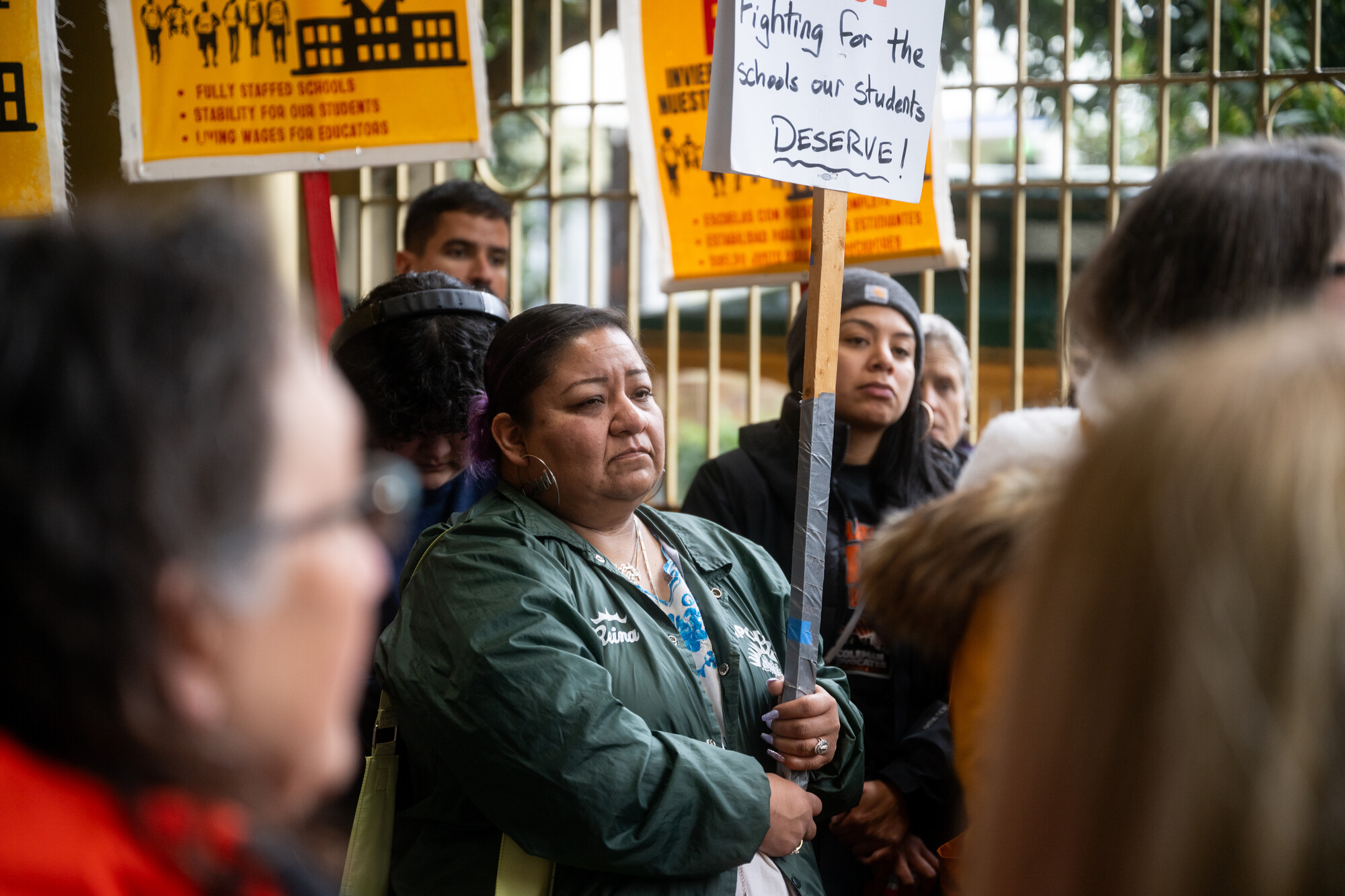
Once that report comes out — which is expected today — that is the final moment when the union and the district can come to terms. And at that point, the union, which has already voted overwhelmingly to strike, can set a date for a strike. They typically have to give 48 hours’ notice. So if that happens, we could see a strike as soon as Monday.
Alexis Madrigal: This fact-finding report — will it change anything, you think? What will be in there?
Jill Tucker: So the fact-finding report is based on the two sides coming together with a neutral third party and presenting their perspective on the budget and their perspective on what they believe to be a realistic contract — based on salary, benefits, all of the compensation, whether that’s class size or sabbaticals or health care plans.
And then the fact-finder goes back and looks at all the information and provides recommendations for a contract based on the issues that are still outstanding. Both sides can either accept those recommendations or ignore them. So it’s supposed to give something of a common ground, or at least a neutral third party’s perspective on the information that was presented to them.
But both sides can ignore it. It really has no holding power. It’s basically advice.
Alexis Madrigal: Okay. Jill Tucker, K–12 education reporter with the San Francisco Chronicle, here with us. I want to add in our first other voice here. Maria Su is superintendent of San Francisco Unified School District. Welcome, Maria.
Maria Su: Thank you. Thank you so much for having me.
Alexis Madrigal: Thanks for joining us, Superintendent. So from your perspective, what are the sticking points in this negotiation?
Maria Su: Well, first, I just want to say that we don’t want to strike. I just want to be clear — we don’t want to strike. We want to work with our educators and get to a resolution. I firmly believe we are really close.
We know that the number-one priority we’re hearing from our educators is the very expensive cost of health care, particularly family health care. And last Friday, in our fact-finding meeting, we were able to come up with a really creative solution to fully cover family health benefits.
Alexis Madrigal: What is that creative solution?
Maria Su: Well, we were using — these are very technical terms — restricted funds that are restricted to pay for salaries and for benefits. So we’re using funds that are designated for this type of expenditure.
Alexis Madrigal: How is that different from what you were doing before?
Maria Su: We were using what are called unrestricted sources. In a school district, we have different types of funds that pay for staff. And we know that you can’t use one-time funds to pay for ongoing expenses — and, of course, staff is an ongoing expense.
In this particular situation, we’re looking at all different types of sources because we do want to close the deal.
Alexis Madrigal: Yeah.
Maria Su: We are really close. I don’t want to strike, and we’re trying to be creative and meet our educators where they are so that we can get to a resolution.
Alexis Madrigal: So what is the financial state of the district right now? For those who are following loosely but not closely, you’ve got the state doing oversight. What does that mean for you in terms of this negotiation?
Maria Su: Well, a year ago, the district was placed under a certification called a negative certification. What that means is that we do not have enough funding to cover our current-year expenses plus the next two years of expenses.
And just for our listeners to understand, 85 percent of our budget pays for staff. So it’s really, really difficult when we’re talking about trying to close a huge budget deficit.
However, last year, we were able to close the deficit. We actually closed a $114 million deficit without having to lay off any of our teachers, because we recognize how important it is to have a qualified educator in every single classroom.
Alexis Madrigal: How were you able to do that?
Maria Su: We had a number of different strategies. One of our largest strategies was to offer an early retirement package. We said thank you so much to all of our employees who have worked for many years in the district, and we said, if you are thinking about retirement in the next couple of years, perhaps you would want to retire now to help us.
And we did. We got a number of people who said, yes, I’m ready to retire, and I will retire.
We also got to the $114 million in cuts through contract negotiations. We were able to either close some contracts or renegotiate the terms of those contracts. We also got there through operational efficiencies. I had to reduce central office from hundreds of people down to a much smaller number.
Alexis Madrigal: Mm-hmm.
Maria Su: But again, we did that without laying off our educators, because we know that the primary goal — the reason for a school district’s existence — is to educate our students. We want to go back to basics and make sure our students learn reading, math, and writing.
That’s why it’s so important for me to offer fully funded family health benefits to our educators.
Alexis Madrigal: We’re talking about San Francisco teachers authorizing a strike, which could begin as early as next week, in the ongoing negotiations. We’ve got Maria Su, superintendent with San Francisco Unified School District, with us.
Of course, we want to hear from you. You can give us a call at 866-733-6786. You’re a parent, you’re a teacher, you’re a student — give us a call. 866-733-6786. You can email [email protected]. On social media — BlueSky, Instagram, Discord — we’re @KQEDForum there as well.
You know, the district currently has this rainy-day fund. I think it has $111 million, and you may have a better number than that. Why not use it in this instance? Can it not be used?
Maria Su: So we created a special fund — again, technical — called Fund 17. And yes, you can call it a rainy-day fund. Essentially, it’s a set-aside that can be used for emergencies.
A great example was just what happened a couple of months ago, when we heard that the federal government was going to reduce or cut funding for SNAP programs, which are food subsidies for children and families. The city was able to use its reserve to make sure those benefits continued for our most vulnerable residents.
The same could be said here. These are special emergency funds that can be used in moments of emergency. Just a couple of days ago, we had a swarm of earthquakes. God forbid, if we have an earthquake and something terrible happens to one of our schools, we need to be able to tap into some form of funding to meet the needs of our students.
Alexis Madrigal: Yeah.
Maria Su: I will also say that our monthly payroll is $69 million. So $111 million in emergency funds would only cover about a month and a half of payroll.
Alexis Madrigal: Mm-hmm. Let’s get some listener comments to you. Andrea writes, “It seems like the district is assuming our educators will go on strike and not doing anything to stop it. It sounds like the district never gave the union any written proposals. As a parent of two kids at Sunnyside Elementary, I’m asking you to give the teachers not only an offer, but a good offer. These people help raise our children.”
And I’ve heard this from several different places, Superintendent — that there haven’t been written offers of some of these things, official offers to the union.
Maria Su: Well, this is the nature of bargaining. We have shared our creative solutions around fully funding family health benefits, which, by the way, would add anywhere from $1,000 up to $1,600 of cash back into the pockets of our amazing educators.
We did share ideas around augmenting salaries for hard-to-staff special education paraprofessionals, because these are positions that are really difficult to fill. We’ve agreed that we will provide additional incentives to bring on these staff.
We’ve also shared that we would like to offer a 6 percent salary increase over the next three years.
So we have shared. And mind you, we have spent the last 11 months in conversation. Through those 11 months, we have already agreed on a number of items. These are just the last few things we need to get back to the table and figure out.
Alexis Madrigal: Stay with us — Superintendent Maria Su with San Francisco Unified, and Jill Tucker, K–12 education reporter with the San Francisco Chronicle. We’re going to try to get to a couple of calls right after the break.
The number is 866-733-6786. The email is [email protected]. I’m Alexis Madrigal. Stay tuned.