This partial transcript was computer-generated. While our team has reviewed it, there may be errors.
Grace Won: Welcome to Forum. I’m Grace Won, in for Mina Kim. New York Times food columnist and cookbook author Yewande Komolafe has been a comforting presence in my kitchen for years. She introduced me to jollof rice. Like her, I believe shortbread is a perfect cookie. And her gochujang chicken and vegetable sheet-pan recipe—which has over ten thousand five-star reviews—well, that one is a banger.
For Komolafe, the kitchen has always been a place of meditation, study, and refuge. But after she suffered a severe illness that resulted in the loss of her legs and fingers, she found that the greatest distance she had ever traveled was back to her kitchen. She recounts this journey in a recent New York Times piece, and she joins us now. Welcome to Forum, Yewande.
Yewande Komolafe: Thank you so much, Grace. It’s really nice to be here.
Grace Won: We’re so happy to have you. And before we talk about what brought you to the hospital, since you’re a food writer, I think we need to start with food. In particular, there’s this cake from Radio Bakery in Brooklyn that a friend brought you while you were recovering in the hospital. You mention it in your piece. What was it about that cake that stood out for you? Was it the cake itself, or the person who brought it?
Yewande Komolafe: Oh, it was a lot of things about the cake. I should say that I am a full cake person. Just like I love shortbread, I love cake—and desserts with just a few ingredients that can completely explode when I taste them.
That cake was one of the first sweet things I was able to ingest, chew, and swallow. And it was incredible—an explosion of different notes of brown butter, the crumbly texture, the way the sugar was caramelized on the outside. There was crunch, there was softness—it was everything about that cake.
Grace Won: I think that’s what makes you such a great food writer—the way you describe food. You call it “an exquisite balance of sweet and savory with a crunchy exterior and pillowy softness.” I could literally taste the cake, and I wanted a slice after I read that.
Two months after your cookbook My Everyday Lagos was published to great acclaim, you found yourself in the hospital. What brought you there?
Yewande Komolafe: I’m someone who has always lived with physical limitations, and I’m also very impulsive. I love to travel. Once my book came out and I could travel again, my family and I went to Paris. My husband, our girls—we had an incredible time.
When we came back, though, between the travel and the stress, we all got sick. I didn’t test at the time, but when I finally got to the hospital, I tested positive for influenza A.
Because I understand my body’s limitations and the need to balance stress with rest, I tried to recover—hydration, rest, all the things you do to get better. But eventually I realized I couldn’t just tough it out, and that’s when I went to the hospital.
Grace Won: You also live with sickle cell anemia, which you talk about in your piece. Did that factor into the severity of your illness?
Yewande Komolafe: I think it did. It’s something I’ve dealt with my whole life, something I’ve known since I was born. I’ve come to understand my body well enough to know I have to constantly create balance for myself.
Grace Won: You end up in the hospital, and you go into a coma for about six weeks. When did you realize—when did you wake up and understand that you were in the hospital?
Yewande Komolafe: Honestly, I have no memory of it at all. I only know what happened because of our family rituals—what we always do when I get sick or when the kids get sick. I ended up in the hospital, but I don’t remember any of it.
Grace Won: When you did wake up, you were later told that you would lose your legs and your fingers. But you never lost faith that you would return to the kitchen. How did you hold onto that?
Yewande Komolafe: I understand that I am not my body. I’ve come to know that even though my spirit is passionate and creative, the limitations of my body don’t define me. I see myself as both spirit and body—and my spirit is untethered. My body exists in this world with varying abilities, but that’s not the sum of who I am.
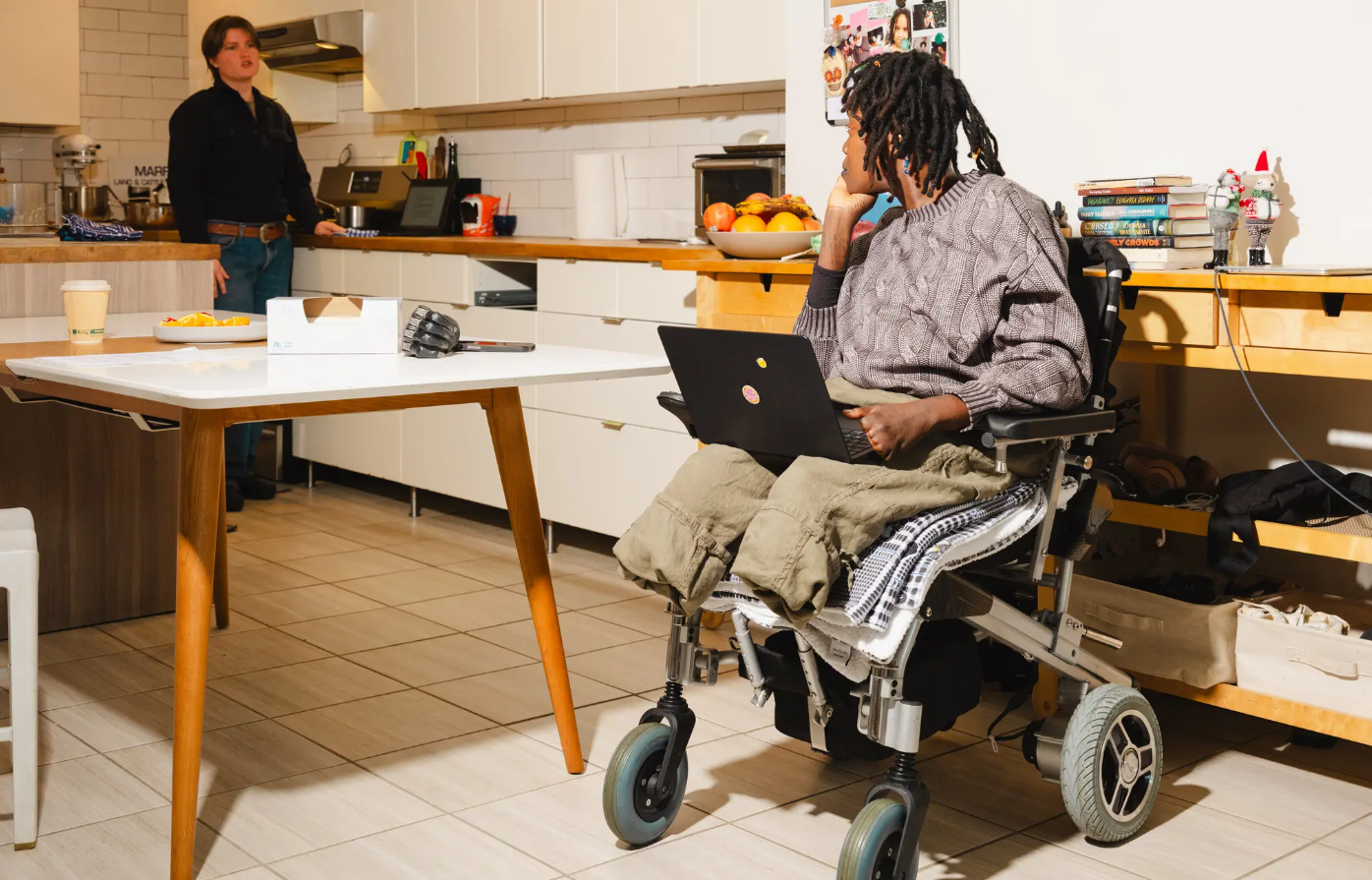
Grace Won: Now you’ve gone from being a solo practitioner in the kitchen to using an electric wheelchair and prosthetic hands. The kitchen has always been a refuge for you. Is it still the same place now?
Yewande Komolafe: It is—it’s just changed. When I woke up from the coma and was told everything, I also woke up very hungry.
Grace Won: I think we can all relate to that.
Yewande Komolafe: As soon as I could eat, I asked my friends to bring me food from everywhere. I craved flavor. I craved chewing, crunching. I craved really spicy food. I craved everything familiar to me.
To me, food is not a place. It’s the act of making, the act of sharing, the act of instructing. It just happens that the kitchen is where most of that occurs. So my kitchen hasn’t changed—though I have. Now there are more people in it, people acting as my hands and legs, bringing a pot down so I can see what’s happening.
My kitchen has become an act of collaboration. We do it together.
Grace Won: I got the sense from your piece that you could make a party anywhere. One of my favorite moments is when you had your husband set up an iPad so you could decide exactly what you were going to eat in your hospital room—because there was no way this food writer was eating cafeteria food.
Yewande Komolafe: That is so true. To the hospital’s credit, they did try to feed me. But I’m a cook and a food writer, and the taste just wasn’t hitting.
Grace Won: Oh, yes.
Yewande Komolafe: It just didn’t taste right. So I started using my iPad to order amatriciana, Indian food, Nigerian food—whatever I could.
Grace Won: I felt sad imagining you eating a sad ham sandwich, and then realized—oh no, she did not do that. She got herself pepper stew with red palm oil.
Yewande Komolafe: Exactly. I instantly turned to what was familiar. That’s such a human thing—to seek comfort when you need it. Food was my source of comfort.
Grace Won: I think everyone can relate to that. We’re all nodding along. We’re talking with New York Times columnist, video host, and recipe developer Yewande Komolafe, author of the James Beard–nominated cookbook My Everyday Lagos. In 2024, following a severe illness, Komolafe became a multiple amputee. Last year, she returned to the kitchen and her career as a food writer.
We’d love to hear from you. How is the kitchen a refuge for you, and what recipe has comforted you during dark or difficult times?
Yewande, before we go to a break, I have to ask: what does it feel like to have a recipe with ten thousand five-star reviews?
Yewande Komolafe: I told my editor yesterday that my brain does not compute that. When I write a recipe, it’s this instinct to create, to bring something to life in a tactile way. Once it leaves me, I don’t read the comments. I don’t read what people think. It feels like a liberation once the recipe leaves my body.
Grace Won: Well, as someone who always reads the comments on the cooking app, I can tell you—you’re considered a goddess of the kitchen.
Yewande Komolafe: That is a heavy crown to carry.