This partial transcript was computer-generated. While our team has reviewed it, there may be errors.
Alexis Madrigal: Welcome to Forum. I’m Alexis Madrigal.
The United States is acting more and more like a petrostate. Because of our massive gas reserves — not to mention our enormous oil and gas industry — the U.S. has not moved nearly as quickly as some nations to change our energy mix and move away from fossil fuels. This is despite the undeniable reality that climate change, caused by human beings burning fossil fuels, is deranging the atmosphere and will cause continued global warming and sea level rise.
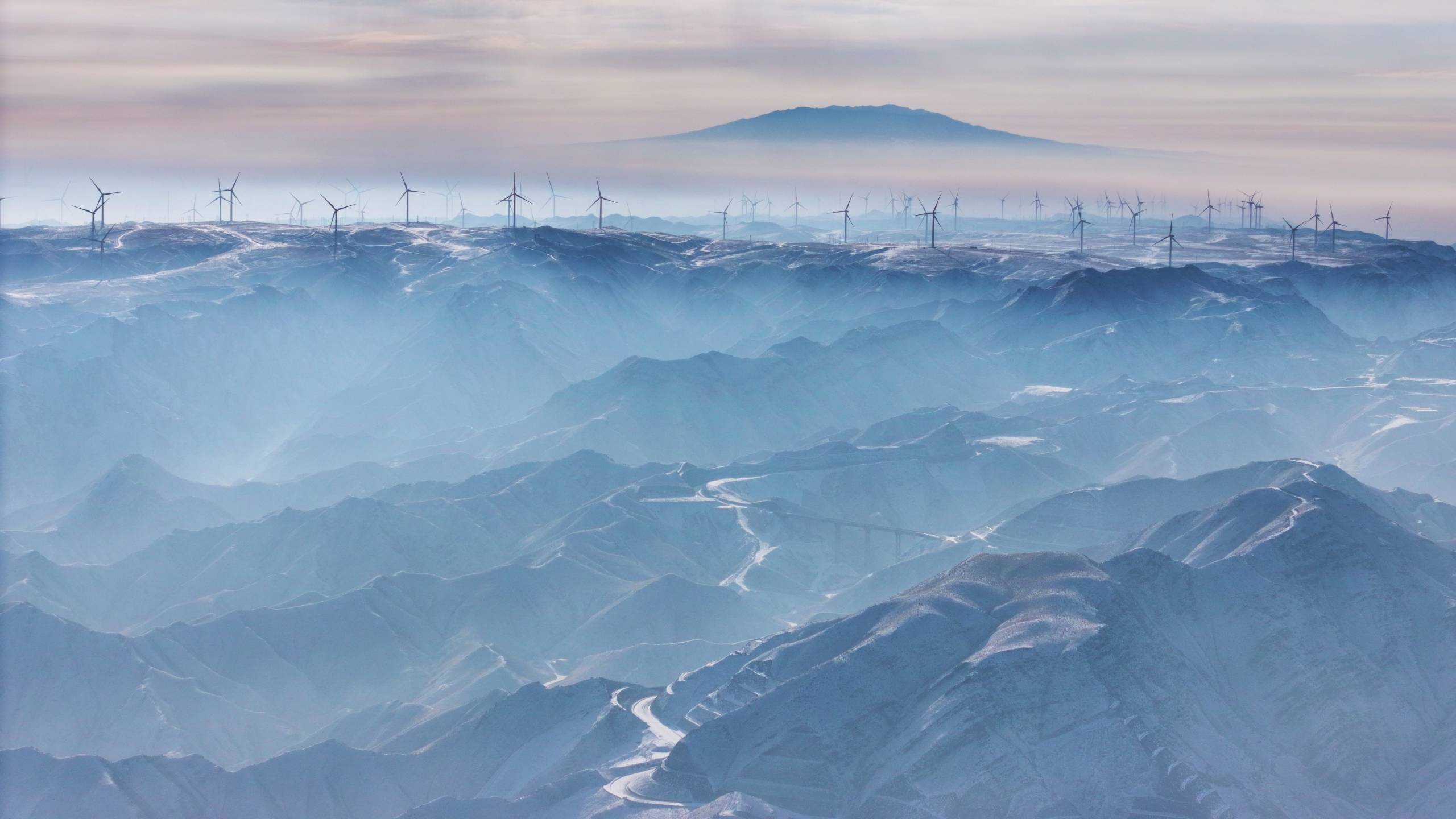
China, which rose as an industrial power through massive coal use, has begun deploying an almost unbelievable number of solar panels and wind turbines. Right now, both countries get roughly the same amount of their power from renewables. But unless something changes very quickly, the U.S. will lag far behind by the end of the Trump administration.
Here to talk about all of this, we’re joined by Jeremy Wallace, professor of China studies at the Johns Hopkins School of Advanced International Studies. Wallace writes the China Lab newsletter, and his most recent article for Wired is titled “China’s Renewable Energy Revolution Is a Huge Mess That Might Save the World.” Thanks for joining us.
Jeremy Wallace: Thanks so much for having me.
Alexis Madrigal: We’re also joined by Mark Jacobson, professor of civil and environmental engineering at Stanford and author of Still No Miracles Needed: How Today’s Technology Can Save Our Climate and Clean Our Air. Thanks for being here.
Mark Jacobson: Yeah, thanks for having me, Alexis.
Alexis Madrigal: So Jeremy, I’ve been following this stuff for almost 20 years now. And even so, your article includes some genuinely shocking facts about the level of progress, deployment, and industrial capacity China has when it comes to wind and solar power. Can you give people a sense of the scale and how it’s developed over the past few years?
Jeremy Wallace: Sure — I can try. It’s a complicated story, and the numbers get huge and hard to keep track of.
To start, think about the electricity grids in China and the United States. The U.S. has a grid of about 1,300 gigawatts total. China’s grid is roughly three times that size — about 3,700 gigawatts, or 3.7 terawatts. Every year, China adds a lot of new generating capacity to keep up with growing demand: more air conditioning, data centers, and industrial facilities across the country.
Over the past few years, China has been adding renewables at an enormous scale. As you mentioned, Alexis, most of the world’s renewables are manufactured in China — and the major market for that production is domestic.
Last year, China deployed about 350 gigawatts of new solar power. If you think of a gigawatt as roughly the size of a nuclear power plant, that’s a lot. They also added about 100 gigawatts of wind. Altogether, China added about as much renewable capacity as the rest of the world combined.
Alexis Madrigal: Gosh. Here’s the stat that really got me — and I’m quoting you from your article. In 2024, the total installed electricity capacity of the entire planet — coal, gas, hydro, nuclear, and renewables — was about 10 terawatts. And the Chinese solar supply chain can now produce one terawatt of panels every year. That is wild.
And it’s not just one company. It’s an entire ecosystem — a massive supply chain spread across the country, competing with itself and with international manufacturers.
Jeremy Wallace: That’s right. To be clear, that’s nameplate capacity — not all factories are running all the time. One of the big issues with this intense competition is that prices are so low that manufacturers are struggling to make money.
They’re not running at full capacity, 24/7, in part because they’re not sure there’s enough demand to absorb all that production — even though these panels might help save the world.
Alexis Madrigal: There’s something almost poetic here. Back in the 1950s, Atomic Energy Commission chairman Lewis Strauss famously said nuclear power would become “too cheap to meter.” What you describe in your Wired article suggests that renewable energy — thanks largely to China — is actually getting close to that point.
Jeremy Wallace: It’s almost more than that. It’s starting to disrupt the grid systems we have. Not in a purely negative way — in many ways, it’s hopeful — but it does complicate things.
Solar panels have become so cheap that the cost structure is shifting. Traditionally, the most expensive part of a solar panel was polysilicon, which is very energy-intensive to produce. But Chinese producers have become so efficient that polysilicon costs have plummeted.
Now the biggest cost driver is silver, which is used in most solar panels. If you’ve been following silver prices lately, you’ll see that silver has overtaken polysilicon as the main cost component. It’s this “side” material that’s now driving prices.
Alexis Madrigal: For folks listening, it’s worth looking up a chart of silver prices.
Mark, let’s turn to you. I first reported on your work back in 2009, when you published a paper arguing that 100 percent renewable energy was possible — at a time when that was far from mainstream thinking. How do you assess the last 15 years? Faster progress than you expected, or slower?
Mark Jacobson: Globally, it’s actually starting to ramp up faster. In the United States, though, it’s still pretty slow.
Just to add to the China story: last year alone, China built more electricity capacity from wind, water, and solar than all the nuclear reactors ever built in human history — combined.
At their current pace, if China electrifies transportation, buildings, and industry and continues deploying renewables, they could reach 100 percent renewable energy across all sectors by about 2051. The U.S., meanwhile, would reach that point roughly 100 years later — around 2148. India is on a similar timeline.
China accounts for about 35 percent of global energy use and emissions, so their transition really matters. And they’re exporting almost as much renewable capacity as they’re installing domestically, which is helping the rest of the world transition too.
The bad news is that some countries — including the U.S. — are moving slowly. But there are bright spots. South Dakota produced about 120 percent of its electricity demand last year from wind, hydro, and solar. There are now a dozen states producing between 50 and 120 percent of their electricity demand from renewables in the power sector alone.
That said, we still need to transition transportation, buildings, and industry — not just electricity — and that’s where we have a long way to go.
Alexis Madrigal: What’s interesting is that many of those states are in the middle of the country — and many are deeply red states. What do you make of the politics of renewable energy in the U.S., given that?
Mark Jacobson: It’s a great question. Iowa produces almost 80 percent of its electricity from wind. Montana has a huge share of renewables. Kansas, Oklahoma, and Texas are rapidly expanding their renewable capacity as well.
The Great Plains are basically the Saudi Arabia of wind. There’s enormous potential to export that power across the country.
We also have massive offshore wind potential on both coasts, though that’s being stifled right now. And beyond wind and solar, the U.S. has geothermal energy — particularly enhanced geothermal systems.
Enhanced geothermal provides constant, baseload power, similar to nuclear, but without the risks. You drill deep — three to eight kilometers — where temperatures are high enough to generate steam. It’s now a commercial technology, deployable quickly, with far fewer safety concerns.
It can replace nuclear entirely. It’s faster, cheaper, safer, and uses very little land.
Alexis Madrigal: Deployment speed has always been one of your big critiques of nuclear power.
Mark Jacobson: Exactly. If you want to solve climate change, air pollution, and energy security, you have to deploy clean energy quickly.
Wind, solar, and batteries excel at that. Enhanced geothermal does too — without the meltdown risk, weapons proliferation risk, radioactive waste, or uranium mining hazards of nuclear power.
It’s ideal for data centers, which are consuming more and more electricity. Another solution is combining wind, solar, and batteries. And in California, electricity demand actually declined by nearly 2 percent last year.
Alexis Madrigal: We’ve been talking about China’s role in renewable energy and what it means for the U.S., with Mark Jacobson of Stanford and Jeremy Wallace of Johns Hopkins.
We’ll be back with more right after the break.