This partial transcript is computer-generated. While our team has reviewed it, there may be errors.
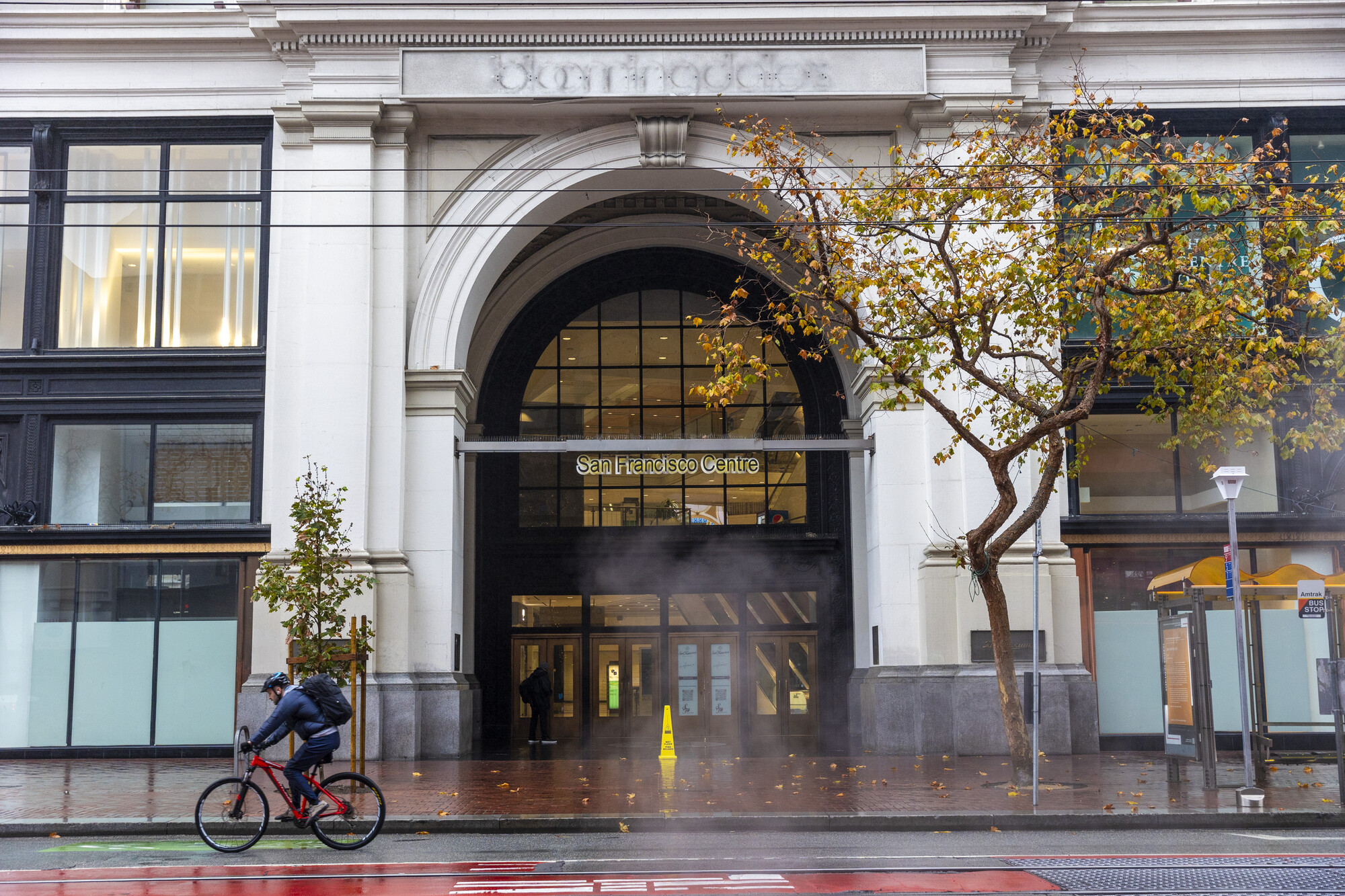
Alexis Madrigal: Welcome to Forum. I’m Alexis Madrigal. With any fall, there has to be a bottom, right? Well, when it comes to San Francisco retail, maybe we’ve reached it. Over the weekend, San Francisco Centre—formerly known as the Westfield Mall—closed.
The massive 1.2-million-square-foot shopping mall sits right on Market Street and leaves a huge hole in the urban fabric. Before the pandemic, more than 200 businesses operated out of the mall. It is, of course, only the latest hit for downtown, which had its trajectory permanently altered by COVID.
While the rest of San Francisco has been on a major upswing—both in vibes and in statistics—downtown remains deep in a funk. So today, we’re talking with people who have been reporting on and working toward efforts to reimagine the city’s core commercial district. What could be done?
We’ve got J.K. Dineen, a reporter with the San Francisco Chronicle. Welcome.
J.K. Dineen: Thank you for having me.
Alexis Madrigal: We’ve also got Laura Crescimano, cofounder and principal of SiteLab Urban Studio. Welcome.
Laura Crescimano: Morning.
Alexis Madrigal: And we’ve got Lisa Huang, design director at Gensler, an architecture and design firm. Welcome.
Lisa Huang: I’m excited to be here.
Alexis Madrigal: J.K., let’s start with you. There was a time when San Francisco Centre was a real centerpiece, right? It opened in ’88 and then reopened in 2006. I think you were there.
J.K. Dineen: Yeah, I was.
Alexis Madrigal: What was it like? Take us back.
J.K. Dineen: Okay, so there was an aerial artist who rappelled from the top of the dome. There was a cheerleading squad chanting, “Shop at Bloomies.” There were bands.
The reason I was there is that my kids were toddlers, and their favorite band—the Sippy Cups—was playing. They’re in college now, so that tells you how long ago it was.
And I think the manager of one of the stores—maybe Bloomingdale’s—said they were selling about $100,000 worth of merchandise an hour that day. Maria Shriver was there. Gavin Newsom was there. Dianne Feinstein was there. It was considered a rebirth of this historic, legacy property.
Alexis Madrigal: So that’s 20 years ago. I have memories from the 2010s of it still being a thriving, fun place. Was the foundation eroding even before COVID, or was it really going full speed and then just splatting into the pandemic?
J.K. Dineen: It was definitely eroding. If you look at Stonestown, which I like to compare it to, Stonestown had an advantage in that its big department stores closed before COVID. Nordstrom closed in 2017. Macy’s closed maybe in 2018.
So they were already backfilling those spaces with Whole Foods, Target, a new nine-screen cinema, and a sports basement. In a way, the department stores at San Francisco Centre just held on too long. By the time they closed, they were already seriously weakened—and then the pandemic came.
Their clientele was downtown workers, business travelers, conventioneers, and leisure travelers.
Alexis Madrigal: Every single thing that got wiped out during the pandemic.
J.K. Dineen: Exactly. None of those people were around. It was just a ghost town.
Alexis Madrigal: Oh man. All right, Lisa—talk to us about the property itself. You’ve done some work understanding it. I didn’t realize it’s kind of a hodgepodge of older buildings.
Lisa Huang: Yeah, it’s composed of three buildings. The first is the historic Emporium building, which was built in the late 1800s and was really important to the city as a middle-class shopping destination and gathering place.
Alexis Madrigal: You would’ve gotten one of those old-school San Francisco postcards with the Emporium on it.
Lisa Huang: Oh, absolutely. And it’s such a great image—the bandstand, the café in the middle of the dome, really activating it compared to what it looks like now.
Then there’s the Nordstrom building, which was combined with San Francisco Centre in the ’80s. And then there’s Bloomingdale’s, which is odd because it’s basically just the bottom four floors. The top is still part of the Emporium building.
Alexis Madrigal: So what can you do with that? Is it a net positive or negative that it’s multiple buildings?
Lisa Huang: For me, it’s really exciting. You can take a series of buildings and figure out how to internally pull them together into a cohesive experience.
It’s interesting to think about how it connects from Market to Mission and starts to take on qualities of Union Square and Yerba Buena. Because it’s a through-block building, there’s an opportunity to open it up and make it more civic in some way.
Alexis Madrigal: I was looking at a list of the biggest malls that closed across the country, and it’s like: demolished, demolished, demolished. Are we starting over?
Lisa Huang: I hope not. Because of the embodied carbon alone, we don’t necessarily want to do that. And the Emporium building—the Market Street frontage—survived the earthquake. It has real historical significance.
The fact that the dome was relocated is also amazing. There are things we could cut into the building. For example, in the Nordstrom building, let’s get rid of the metal bars that make it feel intimidating. Bring in natural light. Increase accessibility, light, maybe even air—make it interesting again.
Alexis Madrigal: Laura, let’s talk about the mall’s different life phases. It had a grocery store, a movie theater, offices for SF State—that mix made sense 20 years ago. If you imagine a mix now, what makes sense?
Laura Crescimano: I definitely agree it needs to be a mix. It’s enormous—1.2 to 1.5 million square feet, almost four acres. You wouldn’t normally do just one thing with a site that large.
I don’t think there’s a single solution. Carving it up makes sense. I’d love to see portions preserved—especially the rotunda and historic elements. But malls are designed so you traverse long distances to pass as many stores as possible. That makes them hard to break into smaller, more distinct domains.
We’ve talked about events under the rotunda, bringing back the band shell idea—but right now, it’s a whole journey just to get there. So I think it doesn’t have to operate as one singular whole.
Downtowns need more than office and retail. We’ve learned that lesson the hard way. What are the experiential opportunities? Downtown should be a destination—not just for tourists, but for Bay Area residents and even workers as tourists. Immersive experiences, Instagrammable moments, recreation, learning—those are things that drive traffic.
Alexis Madrigal: Union Square also has all these empty storefronts. You’re at the cable car turnaround and it’s nothing, nothing, nothing—and then Pop Mart. It’s very strange. How does San Francisco Centre fit into that? Can it be planned together?
Laura Crescimano: It has to be. It’s such a central, vital corner. In 2019, there were conversations about expanding sidewalks at the cable car turnaround because there wasn’t enough room for people. Now we have a substantial vacancy.
Pop Mart is filling in. There are interim uses. We’re working with Field Operations and the Union Square Alliance on a lantern-lighting project—a large, chandelier-like art installation.
You really have to think from Moscone to Union Square: the Fourth Street corridor, Yerba Buena Lane, Yerba Buena Gardens, the mall itself. I started SiteLab working on the Fifth and Mission project where the Chronicle building is—another four-acre site with offices, housing, historic preservation, plazas, and alleyways.
Next door to San Francisco Centre is the Fifth and Mission garage, a massive underutilized structure that SFMTA is studying. From a long-term perspective, we should think big, not small.
Alexis Madrigal: It really does start to feel like an opportunity, in a strange way.
We’re talking about what could be done with the now-shuttered San Francisco Centre mall—still known to many as the Westfield. We’re joined by Laura Crescimano of SiteLab Urban Studio, Lisa Huang of Gensler, and J.K. Dineen of the San Francisco Chronicle.
We want to hear from you. What do you want to see in the San Francisco Centre? What are your memories of shopping or hanging out there? Call 866-733-6786 or email [email protected].
Here’s a quick memory. Caio writes: “In middle school, my friends and I would take Muni to the mall, formerly known as Westfield, to skateboard, window shop, and eat fast food. I remember there being a ‘secret’ rooftop terrace on the ninth floor that we’d take the elevator to after running from the mall’s security guards. The view was somehow not that good.”
I’ll be back with more. Stay tuned.