This partial transcript is computer-generated. While our team has reviewed it, there may be errors.
Alexis Madrigal: Welcome to Forum. I’m Alexis Madrigal.
No matter how we try to discuss Donald Trump’s recent effort to acquire Greenland, it pales in comparison to the crudeness and rudeness of how the president himself talks and posts about the situation. At the World Economic Forum in Davos, Switzerland, in front of world political and business leaders — let’s just listen to thirty seconds of his speech.
Donald Trump (clip): I’m helping Europe. I’m helping NATO. And I — and I’ve — until the last few days, when I told them about Iceland, they loved me. They called me daddy, right? The last time, a very smart man said, “He’s our daddy. He’s running it.” I was like, running it. I went from running it to being a terrible human being. But now what I’m asking for is a piece of ice, cold and poorly located, that can play a vital role in world peace and world protection. It’s a very small ask.
Alexis Madrigal: You probably noticed that he called Greenland Iceland there. And Trump went on wheedling, meandering, threatening. He lied about obvious things — saying, for example, that China sells, quote, “windmills” to, quote, “stupid people,” but that he didn’t see any windmills in China. In fact, China is the number one country in the world for wind installations, with about twice as much capacity as all of Europe combined.
But let’s not get too distracted by all that — at least not entirely. Let’s introduce our panel to help us understand what’s going on with Greenland and Trump’s foreign policy. We’ve got Jeffrey Gettleman, global international correspondent with The New York Times. Welcome.
Jeffrey Gettleman: Hey. Glad to be here.
Alexis Madrigal: We’ve also got Eliot Cohen, Arleigh Burke Chair in Strategy at the Center for Strategic and International Studies in Washington, D.C. His most recent piece in The Atlantic is titled How to Understand Trump’s Obsession With Greenland. Welcome.
Eliot Cohen: Good to be with you.
Alexis Madrigal: Jeff, it’s been a wild, eventful thirty-six hours. The organizers of Davos probably have never been happier with the amount of news they’ve generated. Bring us up to speed. Where is Trump right now with regard to Greenland?
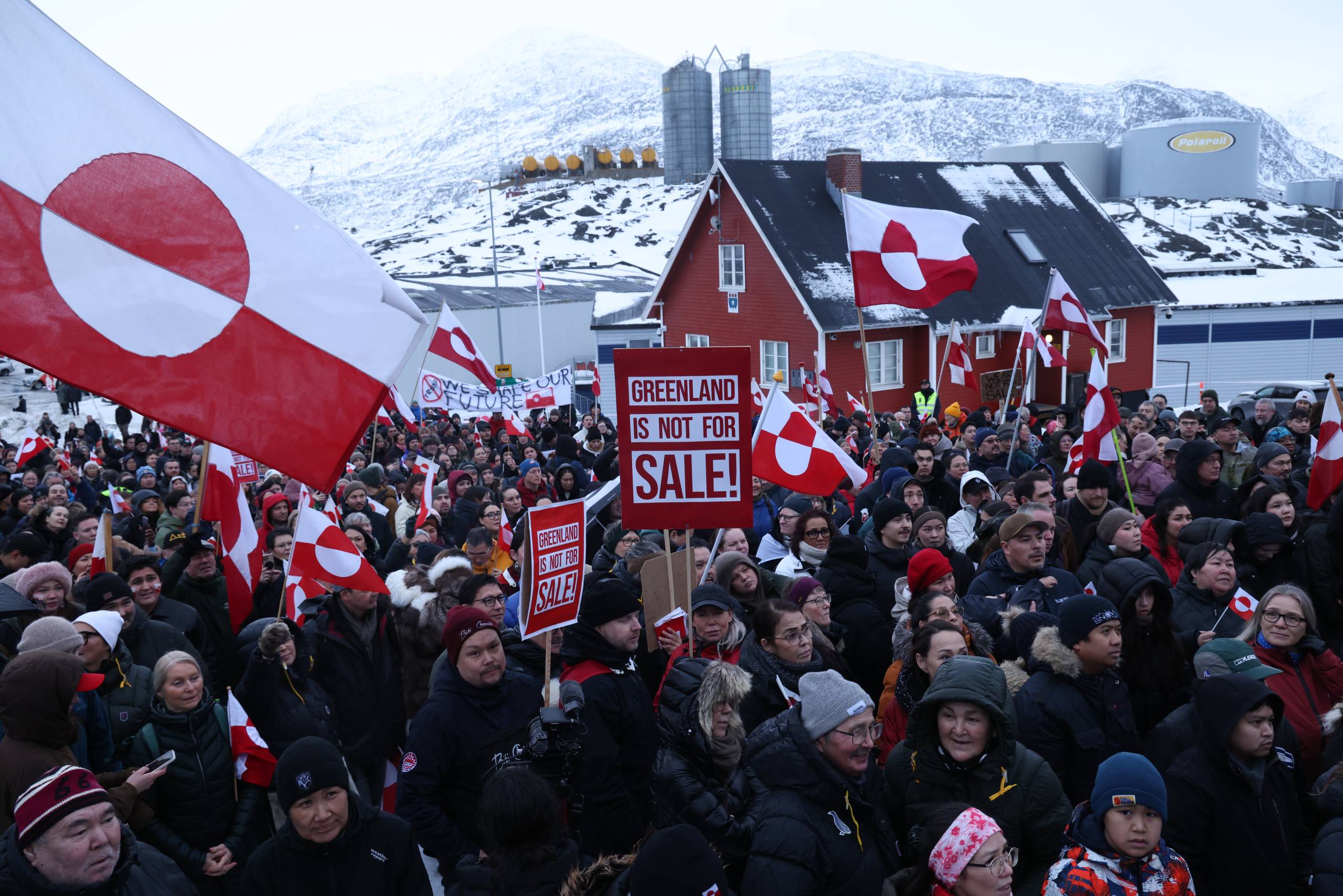
Jeffrey Gettleman: I see this as a major shift in the story. I’ve been covering Greenland for the past year. I’ve been there several times. And it all started last year, almost at this very time in January, when Trump — as he was beginning his second term — announced that he wanted to get Greenland.
It seemed like it came out of nowhere, but he had brought this up briefly in his first term. Denmark said, “No. We’re not interested in shifting our sovereignty to the United States,” because Greenland is an autonomous territory of Denmark. It’s been part of Denmark for three hundred years. Trump dropped it back then.
But he really brought it up with a vengeance last year, and over the past year, his threats and intensity have been growing. He threatened to take it one way or another. He said, “I’m going to do something on Greenland whether they like it or not.”
Just a few days ago, he sent a message to the president of Norway saying, “Because I didn’t win the Nobel Peace Prize, I’m no longer interested in peace, and I need to get Greenland.”
So that was the backdrop to yesterday. He shows up in Davos. He’s about to give this big speech. Everybody’s curious what he’s going to say about Greenland, NATO, Europe, and the rest of the world. And he announces that he’s no longer interested in using force and that they’re going to have negotiations over Greenland. But then —
Alexis Madrigal: Did you buy that? I mean, there were so many — it was sort of like, “not going to use force as long as everything…” It just felt very —
Jeffrey Gettleman: I did buy it, because I’ve been covering this very closely. I was just in Greenland a few days ago, and he had been walking things back a little bit. If you really looked closely at his comments, he had started stepping away from the threat of using force.
Last week, a reporter asked him about it at the White House, and he said, “I didn’t say I’d use force. You said I’d use force. I never said that.” So he was signaling that he was looking for another solution.
The big news came late last night, when he announced, “We’ve worked out a deal with NATO, and we’re going to have this new arrangement for Greenland and the Arctic.”
Alexis Madrigal: And the basics of what it looks like?
Jeffrey Gettleman: That’s what we’re all trying to figure out. But according to NATO officials my colleagues at The New York Times have spoken to, the possible compromise is this: Denmark and Greenland would cede sovereignty where existing U.S. bases — and future bases — are located. The U.S. would have sovereign control over those bases.
There’s a similar situation in Cyprus, where the British have air bases that are considered British territory.
Alexis Madrigal: Or Guantánamo?
Jeffrey Gettleman: Maybe, although Guantánamo is leased, I think. There are variations in these arrangements. But the idea was that this was a compromise — an off-ramp — a way to give President Trump something along the lines of what he wanted in his grand plan for Arctic security, without a cataclysmic showdown where the United States threatened to take Greenland by force.
The thinking was that if the U.S. really tried to do that, NATO would not step in. Faced with a choice between keeping NATO intact, staying involved in Ukraine, and preserving Denmark’s sovereignty over Greenland, NATO would not break apart over Greenland.
So we avoided that. And now we’re left with confusion: What exactly was agreed to? What does this mean for Greenland, for Denmark, for the Arctic? It’s hard to tell.
Trump has also floated grand ideas before — like turning Gaza into the Riviera of the Middle East — and then they kind of disappear.
Alexis Madrigal: Mhmm. Eliot Cohen — we have this short-term step down in escalation. People across Europe, in particular, seem relieved. But we did threaten to use military force. We went down that road, even if we came back. So what now?
Eliot Cohen: Well, look — I wouldn’t say “we.” I’d say Trump. He really is such an outlier compared to any other president we’ve ever had. He’s totally out of the norm.
Trump has an extraordinary sense of vanity and narcissism, which leads him to threaten things that nobody else would ever consider. That’s also his negotiation style, going back a long time.
He has done real damage to the U.S.–European relationship. But it’s also important to put that damage in context. The relationship was bound to get scratchier no matter what, because it has had underlying tensions for a long time.
In some ways, that was the point of Prime Minister Mark Carney’s speech — pointing out that some of the illusions we were living with were, in fact, illusions.
As for where this ends up, I think it ends as a big nothing burger. The Danes have always been willing to offer more U.S. bases in Greenland. It’s not uncommon for a base to have qualities of sovereignty. Embassies, after all, are sovereign national territory.
This will simmer down until there’s a next thing — and given Trump being Trump, there will be a next thing.
Alexis Madrigal: Yeah. Go ahead.
Jeffrey Gettleman: To me, the most interesting question is what changed Trump’s direction. It’s almost like he made a U-turn.
A lot of people we’ve spoken with think it was the stock market. In the last few days, the market began to slide because of concerns about what the Greenland crisis could do to U.S.–European relations, trade tariffs, and trade wars.
Some people believe Trump’s inner circle was watching the market fall and decided they needed a new strategy. At that moment, NATO officials came up with this compromise to upgrade the U.S. footprint in Greenland.
But as Eliot said — and as I’ve written — there are already agreements in place that give the U.S. essentially carte blanche in Greenland.
Alexis Madrigal: Dating back to the ’50s, right?
Jeffrey Gettleman: Actually, even earlier — back to World War II. When the Nazis occupied Denmark, Greenland was vulnerable. The U.S. feared Germany would build air bases there and use them to attack North America. Denmark couldn’t protect Greenland, so the U.S. stepped in, sent thousands of troops, built airfields, and cleared out Nazi outposts.
After the war, the U.S. and Denmark reached an agreement giving the U.S. responsibility for Greenland’s defense. The U.S. could build bases, station troops, and control air and sea access. Jurisdiction on those bases was American — similar to the embassy example.
So this talk of a compromise feels like putting a nice face on access the U.S. already had. What changed wasn’t the strategic reality — it was something inside Trump’s decision-making circle. And that’s what we’ll likely learn more about in the coming days.
Alexis Madrigal: Yeah. In some future Washington tell-all, I’m sure. We’ll get back to this in just a second.
We’re talking about Trump’s efforts to acquire Greenland for the United States and what it means for foreign policy and global peace. I’m joined by Jeffrey Gettleman of The New York Times and Eliot Cohen of the Center for Strategic and International Studies.
I’m Alexis Madrigal. Stay tuned for more right after the break.