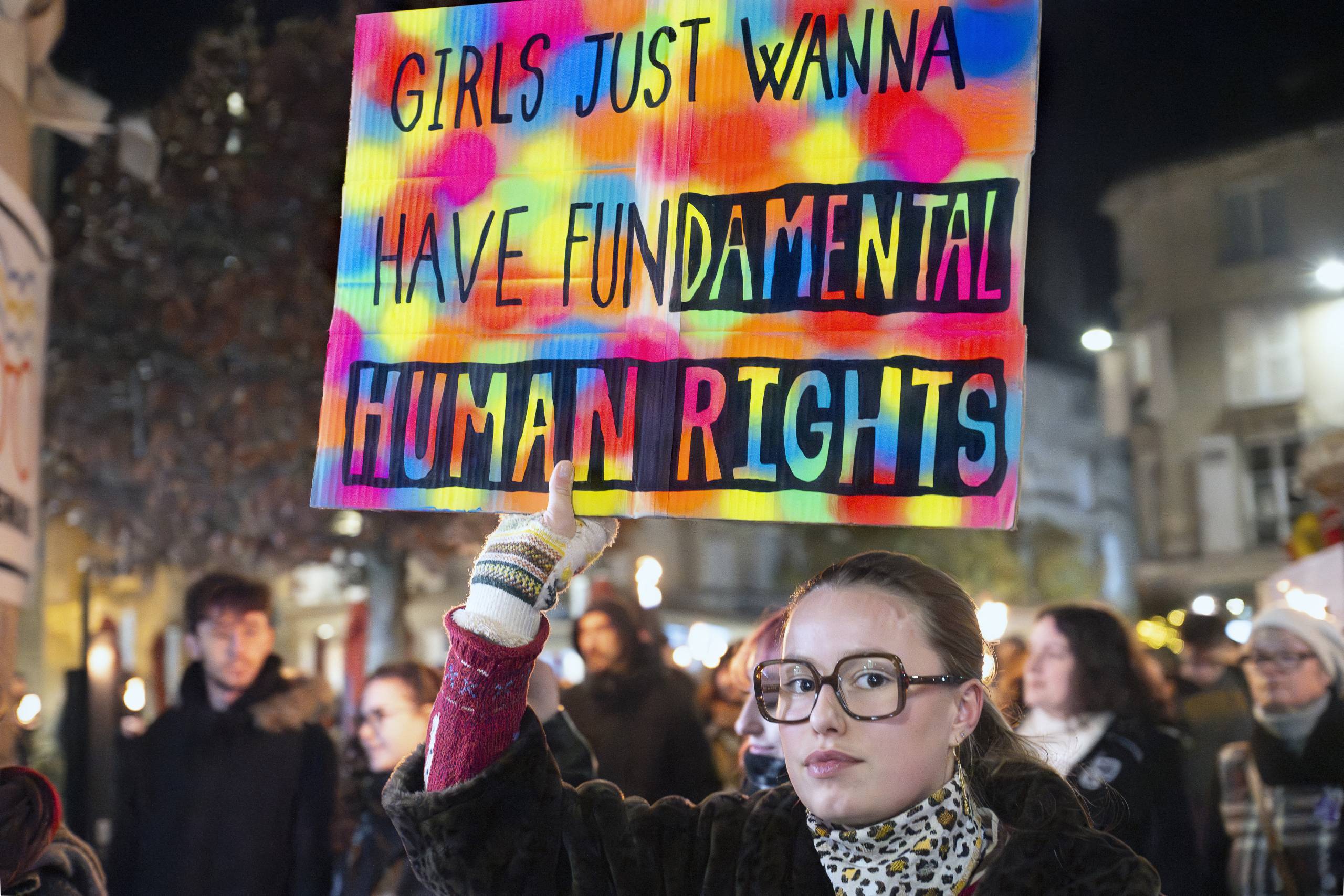
This partial transcript was computer-generated. While our team has reviewed it, there may be errors.
Alexis Madrigal: Welcome to Forum. I’m Alexis Madrigal. I have, for better or worse, been a man my whole life, and I’ve spent a lot of time with other men — in literal locker rooms, on teams, and in sports bars. That is to say, I’ve been places where men are talking to other men. And yet these days, the misogyny in the public sphere shocks and horrifies me.
I’ve never heard any man in my life say, in real life, anything like the things we’re hearing out of the manosphere, or even from the president and the people around him. And that’s translating into policies and legal rulings that were unthinkable in my young adulthood.
This is not to say that things have been good for women before this, or that the gender roles and scripts in society have been working for women. But holy hell — it feels like some dark things have been unleashed in our culture and in our politics.
And here to discuss what’s going on and where it came from, we have an all-star panel. We’re joined by Roxane Gay, scholar and author. Her books include Difficult Women, Hunger, and Bad Feminist. Thanks for joining us.
Roxane Gay: Thank you so much for having me, Alexis.
Alexis Madrigal: We’re also joined by Irin Carmon, who’s a senior correspondent at New York Magazine, and the author of Unbearable: Five Women and the Perils of Pregnancy in America. Welcome.
Irin Carmon: Hi, Alexis.
Alexis Madrigal: Hi. And we’ve got Savala Nolan, executive director of the Felton E. Henderson Center for Social Justice at Berkeley Law, author of Don’t Let It Get You Down: Essays on Race, Gender, and the Body. She’s also got a book coming out next year, Good Woman: A Reckoning. Welcome.
Savala Nolan: Thanks, Alexis. It’s great to be here.
Alexis Madrigal: So, Roxane, maybe we can just start with a big question that’s been knocking around in my head: are things worse now on the misogyny score, or is the misogyny that was always there just kind of out in the open now?
Roxane Gay: The ambient misogyny that has always been there is just louder now because we have more access to it — by way of social media, twenty-four-hour news, et cetera. But while things are not as bad as they once were, they’re pretty close.
Legislatively, we’ve lost so much ground with the overturning of Roe v. Wade. And there just doesn’t seem to be any kind of pushback, particularly when the commander in chief calls a reporter “little piggy” and none of her colleagues come to her rescue. Nobody in the moment. And I think we all would love to believe that, in the moment, we would do the right thing. I get what happens there.
But to see no one coming forward and saying, “This is wrong. You can’t talk to people like that” — things are grim. When you consider that, you know, fifty years ago women couldn’t really bank on their own, yes, things are better than they once were. But I don’t think we should be using the past as a rubric.
Alexis Madrigal: Right. Yeah. Irin, is it just Trump? Is Trump the change?
Irin Carmon: I think Trump has normalized bringing it out in the open and making people think it’s a majority opinion. I agree with Roxane that the misogyny is real — it’s not just virtual — and it’s being enacted at the highest levels through policy and rhetoric.
But I also often think back to the early 1980s backlash to social justice, including feminism and racial equality, and the limited moves that were made in the ’60s and ’70s. Obviously, before there was Erika Kirk or Ballerina Farm, there was Phyllis Schlafly. We’ve been here before.
What’s different, I think, is the speed. Our changing media environment and how manipulable it is. We used to have gatekeepers of acceptable speech. There were negative externalities to that — marginalized people didn’t always have access — but it also kind of kept a lid on things.
I remember, as a feminist blogger a dozen years ago, reading incel and manosphere posts and just wanting to step away from my computer. Now I simply cannot escape them. That’s a choice being made by people like Elon Musk — to flood us with that.
I do not think the majority of people believe women shouldn’t be able to vote, or that Black women should be fired en masse from the workplace. I think a fringe is exploiting algorithmic access and base desires to make people think it’s the majority.
Alexis Madrigal: Savala, I wanted you to pick up on something Roxane was saying — that history shouldn’t be the guide. If things were bad in the past, and things are better now, that doesn’t mean things are great. So where would you look for a North Star?
Savala Nolan: I completely agree with everything Irin and Roxane said. From a legal perspective, there’s always been a pretty hardcore commitment to male supremacy in this country, with an almost medieval flavor. Men could legally beat their wives through the ’70s and rape them in some states into the ’90s. This is living memory.
The question of a North Star is difficult because women in this country have never lived as full and equal citizens. We’ve never been viewed politically, economically, or socially as fully autonomous human beings, separate from our relationships to men. Quite the contrary — we’ve been subsumed into normative male desire as it shows up in law, culture, and economics.
So the question is difficult, but also exciting. We can’t look to the past — we literally haven’t seen it. What’s interesting about this moment is that, yes, there’s a cohort of women deeply involved in MAGA who don’t mind or don’t see the misogyny. You don’t have to be at the top of the hierarchy to agree with the hierarchy.
But there’s also a powerful — and I think larger — cohort of women and girls becoming more female-centric. Not misandry. Not doing back to men what’s being done to us. But imagining their lives from a more female-centered place. I sense among my students, friends, and family a deeper interest in womanism than I’ve ever seen before.
Alexis Madrigal: Before we plunge into the depths of the manosphere, Roxane, I wanted to give you a chance to follow up. Are there people or movements — Combahee River Collective, for example — who might offer a way out of this?
Roxane Gay: Men are going to have to provide their own way out of this. This is a man problem. Men listen to and respect other men. Men need to hold each other accountable.
The idea that feminism or Black feminism needs to show the way — we’ve been showing the way for more than a century. The Combahee River Collective, Audre Lorde, James Baldwin — they’ve all given us tools. We just choose not to use them.
It’s always interesting when this question comes up, because it assumes there’s no map. There is a map. People just don’t want to follow it because it doesn’t suit their desire for power and control.
Alexis Madrigal: We’re talking about the rise in misogyny — how to think about it and what can be done. We’re joined by Roxane Gay, Savala Nolan, and Irin Carmon. And we want to invite you into the conversation. How have you seen attitudes toward women change over time? Do you think misogyny has become more normalized?
You can call us at 866-733-6786. That’s 866-733-6786. Email us at [email protected]. You can also find us on social media — Bluesky, Instagram, and Discord.
Irin, can you talk about how you see the relationship between this cultural world and the legal and political worlds you cover?
Irin Carmon: I think we’re living in a split screen. Legislatively and politically — and online — it’s never been uglier. But every time I step away from my computer and do reporting on the ground, I see something else.
I see people defending their neighbors, helping pregnant people access abortion care — whether through pills or travel — and supporting people who want to stay pregnant. This is as immediate as the work gets. And it reminds me that not everyone is like what we see online.
Yes, it’s bleak — especially for trans people being violently punished by the state for challenging rigid gender norms. But I think they want us to feel helpless. And there have always been people with the imagination to build a better reality on the ground. I don’t want to lose sight of that.
Alexis Madrigal: We’ll be back with more after the break. I’m Alexis Madrigal. This is Forum. Stay tuned.