This partial transcript was computer-generated. While our team has reviewed it, there may be errors.
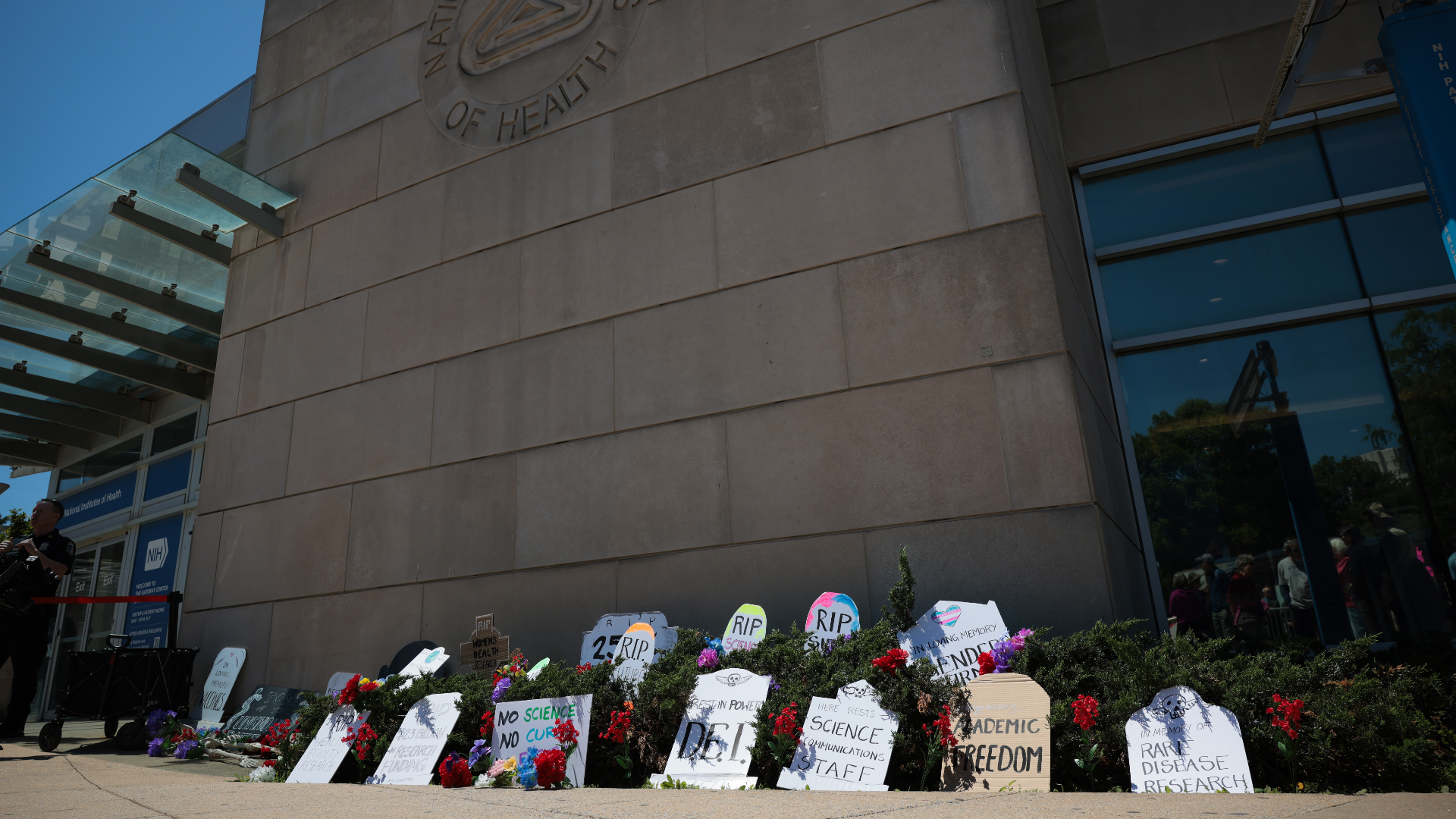
Alexis Madrigal: Welcome to Forum. I’m Alexis Madrigal. Earlier this year, journalists were all over the story about funding cuts and freezes in our nation’s medical research infrastructure. The word that actually went into a lot of headlines was “devastating.” But there’s a lot going on — so much news, so many changes to everything — and the narrative about what has happened to research funding has largely fallen off the front pages.
Today, we’re going to talk with a journalist who’s still reporting on what’s happening. Then we’re going to bring in a trio of University of California researchers who’ve been affected by all the chaos.
We’re joined first by Megan Molteni, who’s a science writer at STAT News. Her latest article is titled, “Trump Has ‘Shaken the Hell Out of the Eighty-Year Research Pact Between the Government and Universities.’ What Now?” Welcome, Megan.
Megan Molteni: Thanks, Alexis.
Alexis Madrigal: So just catch people up. People probably saw these headlines — devastating funding cuts at NIH. This was back in February. But maybe they haven’t followed, you know, step by step what’s happened. Just walk us through quickly what happened this year.
Megan Molteni: Absolutely. There’s a lot to go through, so we may not cover it all. But the impacts sort of fall into a couple of buckets. There were terminations to a large number of grants starting in February. We’re talking about billions of dollars of research.
Those terminations fell into a few different areas that were not in alignment with the administration’s political agenda. So we were looking at grants related to HIV/AIDS research, gender and sex and transgender health research, vaccine research, and a few other areas.
A number of those grants were restored through the courts — federal judges ruled those cuts unlawful, and the NIH had to restore them. But there’s a bigger picture those terminations don’t really capture, and that’s the way a variety of actions the administration has taken against the NIH have really broken this trust that has underlain the last eighty years of scientific innovation and research at America’s universities.
These actions include large-scale layoffs at NIH that have impacted the ability of the institutes to hold peer-review sessions to award new grants. There’s been a real slowdown there. That slowdown includes policies implemented over the summer from the Office of Management and Budget at the White House — this is Russell Vought’s office — that directed NIH to move to what’s called an “up-front” or multi-year funding model.
The way this was rolled out — very quickly and abruptly — meant that NIH was able to award fewer new grants in 2025, in addition to some of the cuts we’ve already seen.
Alexis Madrigal: What did the administration say its rationale was for all these changes at NIH, given that the United States has been a leader in medical research all around the world for decades?
Megan Molteni: Well, I think in some ways what we’re actually seeing is less a cohesive policy agenda about how we do science in America and more the weaponization of NIH funds in the culture war the administration is waging against institutions of higher education.
NIH is the largest funder of biomedical research in the world. They have a $48 billion budget; $38 billion of that goes outside its walls — often to America’s universities and medical research centers.
It’s really been used by the administration as a way to exert leverage over elite institutions that it sees as having run afoul — either due to so-called “woke leftist ideology” or accusations of mishandling antisemitism on campus. So many policy experts we’ve spoken to this year see what’s happened at NIH — and its relationship with academic partners — as collateral damage in that culture war.
Alexis Madrigal: Yeah. I remember — we’re going to bring in a professor in just a second who studies the thymus at UC Merced. It’s like, why was he collateral damage in this? Before we get there, though: the NIH — this actually surprised me, and listeners may not know this — did manage to allocate its full budget by the end of the year. Despite the cuts and chaos, they got all of the grant money supposedly out the door by the end of September. That sounds like good news. There’s got to be a catch, though.
Megan Molteni: Right. So that goes back to how they were able to get the money out despite losing a lot of grant management specialists — staff who push the money out the door — while also dealing with a backlog of applications due to slowdowns and pauses early in the year.
They shifted to this multi-year funding model. Historically, NIH funded awards annually. A researcher might get a five-year grant, but the money arrives year by year after a progress report. A multi-year funding award moves all of that funding up front — a big lump sum at the beginning.
There’s nothing inherently wrong with that model; it gives researchers flexibility. But the devil’s in the details of how you roll it out. If you push to a multi-year model without increasing the budget or phasing it in over, say, ten years, then the result is fewer researchers receiving funding because you’re giving larger chunks of money at once while the pot stays the same size.
The result is hyper-competitiveness. We expect that to continue in 2026 and beyond. Where you might have had a one-in-ten chance of getting an NIH grant, now it might be one in twenty-five or one in thirty. That really changes the calculus for researchers — how much time and effort to spend on a proposal, what the odds are — and it’s impacting morale across U.S. biomedical research.
Alexis Madrigal: One imagines the corona of any culture-war-related topic will be avoided entirely. Anything that seems like it might touch that — why would a researcher who already has, you know, a four percent chance of getting a grant try to study those things?
Megan Molteni: Yeah. Absolutely.
Alexis Madrigal: Let’s bring in some other voices here. We want to hear from you, listeners. We know we have a lot of researchers who listen to the show. Maybe you’ve been affected by the changes and cuts at NIH — the chaos. Tell us about your experience. Maybe you’re part of a medical trial — we know some of those were disrupted. What are your concerns?
You can give us a call. The number is 866-733-6786. That’s 866-733-6786. The email is [email protected].
Let’s bring in Joel Spencer, associate professor of bioengineering at UC Merced. His lab uses NIH funding to study the thymus, with implications for cancer treatment and aging. Thanks for joining us, Joel.
Joel Spencer: Yeah. Thanks for having me, Alexis.
Alexis Madrigal: So how did all this hit you? How did this affect your particular lab?
Joel Spencer: That’s a great question. There have been multiple impacts. Some are very real, and others are psychological — the uncertainty. But I’ll first give an example of the immediate impact.
One way that we do our science is in a training environment. While we’re studying the thymus — which, for listeners who don’t know, is an important immune organ that sits just above your heart, under your sternum — we also train scientists. We train the next generation of scientists, engineers, and leaders.
Part of our funding for that training comes from what’s called a training grant from NIH. Those were abruptly stopped mid-stream. That left us scrambling. It left my students — whose livelihoods depend on that funding — suddenly without support, with no clear picture of what comes next.
These training programs take four to six years for a PhD. You’ve already moved somewhere and built your life there. Suddenly losing funding can be extremely disruptive — and that’s what we saw.
Alexis Madrigal: What about the actual grant funding you would have otherwise gotten? I know in your career much of your work has been funded by the federal government, because we want to invest in people like you to do this research.
Joel Spencer: Yes. So our current main funding comes from NIH to study the thymus. And to get one of these grants, as Megan alluded to earlier, it takes many tries — maybe one in ten grants you submit gets funded. We’re constantly thinking about writing new grants.
Once you submit a grant — which can take months or even years to develop — it gets reviewed, then goes through a funding decision, and finally, maybe a year later, you get the funding to do the work. It’s a long process from submission to award, so we’re always moving forward.
But when the brakes were put on at NIH, it really impacted that whole process. I was unable to submit grants; I thought, what’s the point? They’re not being reviewed. Study sections — the groups of scientists who review grants — were put on hold. So submitting a grant essentially meant it would go nowhere.
We put the brakes on submissions. Now that some of this has restarted, it’s extremely competitive. So yes, we’re currently funded, but our future work — the things we’re learning now that we need more funding to pursue — is extremely competitive and uncertain.
Alexis Madrigal: We’re talking about the impact of chaos and funding cuts on America’s medical research field. We’re joined by Megan Molteni, a science writer at STAT News. If you want to read her whole article, including data, it’s titled “Trump Has Shaken the Hell Out of the Eighty-Year Research Pact Between the Government and Universities. What Now?”
We’re also joined by Joel Spencer, associate professor of bioengineering at UC Merced. As we’ve noted, his lab studies the thymus with implications for cancer treatment and aging.
We’re taking your calls too. Maybe you’re part of a medical trial. Maybe you’re a researcher. Maybe you’re a staffer affected by all of this at one of our research universities.
The number is 866-733-6786. The email is [email protected]. And on social media — Bluesky, Instagram, Discord — we’re KQED Forum.
I’m Alexis Madrigal. Stay tuned.