This partial transcript was computer-generated. While our team has reviewed it, there may be errors.
Alexis Madrigal: Welcome to Forum. I’m Alexis Madrigal. The possibility of this show really begins more than 40 years ago. That’s when Sony introduced the Walkman to the United States — which brought truly portable audio to the masses. And from that point forward, if you wanted to, you could create a private audio world: listening to INXS on the bus, or meditation in the doctor’s office, or death metal while you garden.
But what was once an occasional thing — something only for your commute or a way to pass time on a run — has become ubiquitous. Some of us are listening to podcasts, music, audiobooks, and whatever else basically at all times. The AirPods make it easy. The content is endless. Our ears are now filled.
My twelve-year-old asked me this past week why anyone would choose to do anything without listening to a podcast at the same time. Given my job and what we see everywhere, it’s a tough one to answer — but we’re taking it on today.
We’re joined by Jenny Odell, artist and critic, author of How to Do Nothing: Resisting the Attention Economy, as well as Saving Time: Discovering a Life Beyond the Clock. Welcome, Jenny.
Jenny Odell: Thanks so much for having me.
Alexis Madrigal: Always nice to talk with you. We’re also joined by Gloria Mark, professor emerita of informatics at UC Irvine, author of Attention Span and the Substack The Future of Attention. Welcome.
Gloria Mark: Nice to be here.
Alexis Madrigal: So Jenny, let’s just talk about what it’s like to have this private audio world overlaid on public space. What’s a moment for you that really captures that?
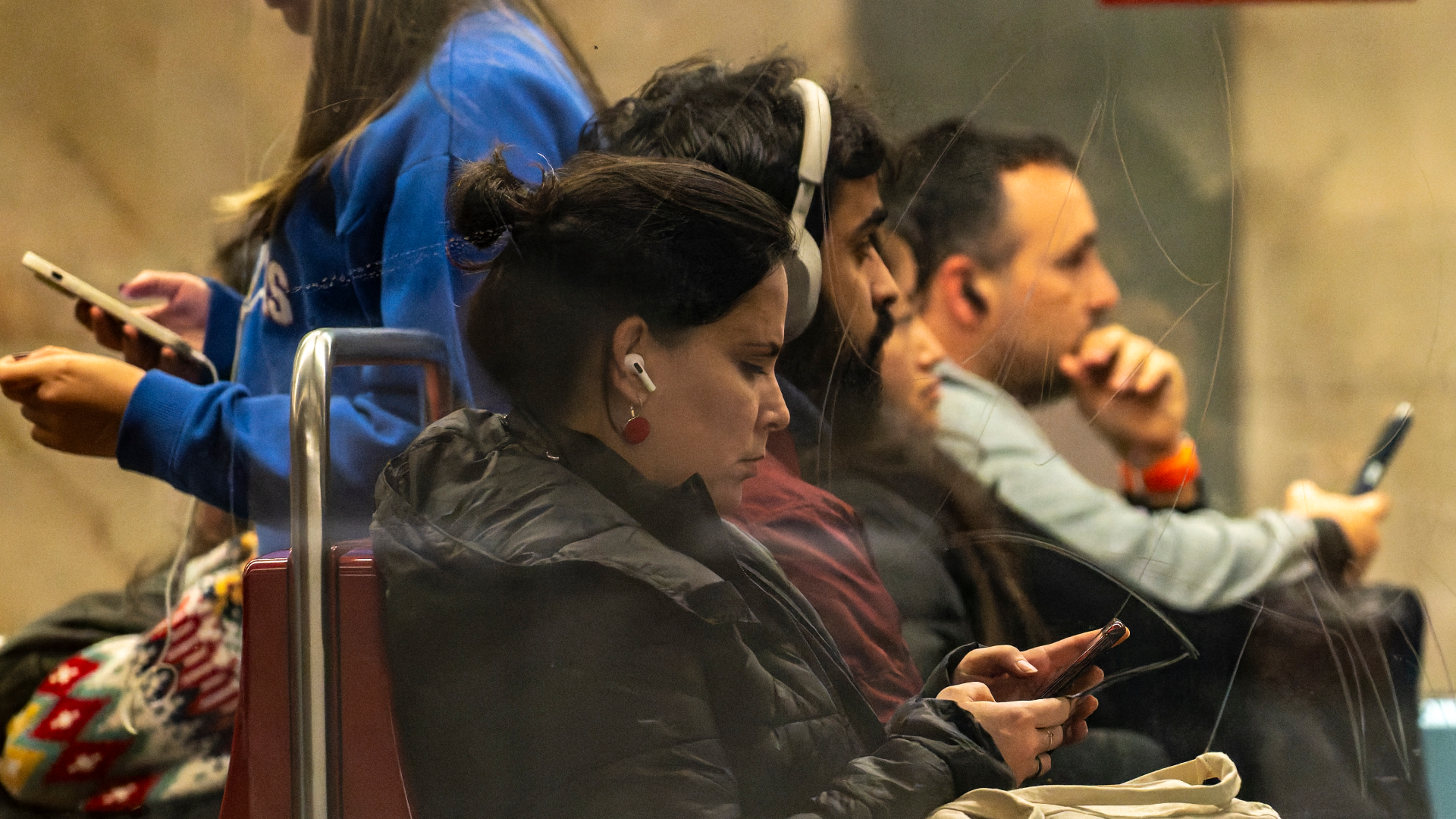
Jenny Odell: I mean, I take the bus a lot. Depending on the circumstances, I will or will not be wearing AirPods. And I’m really struck by the difference in how my environment feels — how my attention feels. If I am wearing them, I feel more self-involved. If I’m not wearing them, I’m much more aware of people getting on and off the bus, where we are, and how bumpy the road is. Just kind of who I am, where I am, and who’s around me.
Alexis Madrigal: Yeah — it feels to me like when you can kind of make your eyes fuzz a little bit? It almost seems like when you have AirPods in, that’s what it does for the whole environment.
Jenny Odell: Yes. And I think also — I mean, we think of this as an auditory thing, and it is — but something I was noticing even this morning is that when you hear other things, you look at them. So it’s not just about sound. Right? You hear things, and then you pay attention to them, and you look at them, and you have other sensory experiences. It may start with sound, but it really extends to other parts of our attention as well.
Alexis Madrigal: Gloria, this makes a lot of sense to me — what Jenny’s saying. Our brains are more of an integrative whole than it might seem when we talk about breaking things up by the senses.
Gloria Mark: Yeah, that’s right. When we’re wearing headphones, we’re not really fully present in the external environment. We tend to be in our own inner worlds. But we’re also multitasking, which means we’re shifting our attention back and forth between the external world and our internal world. Our attention is outward-facing and inward-facing, and we keep switching.
But we’re also sending a signal to other people to not bother us — leave us alone, let us be. If I see someone with headphones on, I’m not gonna go up and ask them something. I’m not gonna ask for directions. I’m not gonna say hello, because they’re creating this wall, this bulwark.
Alexis Madrigal: Right — around them. It requires this sort of, “Excuse me, sir?” as opposed to an easier entry into some kind of interaction. Jenny, this is also one of the things people like about AirPods or headphones, right? I think of a certain kind of young person who constantly has not just AirPods but big over-ear cans on.
Jenny Odell: Yeah. And I mean, I’m not here to judge. I make the decision myself — am I gonna be one way or another today? And actually, just this morning, I was admiring someone. It’s really cold right now, and I saw someone going to work who was so bundled up and so put together, and they had these giant headphones on. And I was like, man, that person is prepared for their commute. I had to admire it.
So yeah — I think the thing that gives me pause is when it becomes such a habit that you’re not making that decision. And I’ve caught myself doing that. I’m walking into BART and I’m already putting the AirPods in, and I never actually decided to do that.
Alexis Madrigal: Gloria, it also seems like in a time of stress, people want the distraction. They don’t want to — what we used to call — be alone with their thoughts.
Gloria Mark: Yeah, I think that’s right. It’s a way to create a protective environment. In this crazy, stressed world, it’s a way to create our own reality. We can filter out stimuli from the environment around us. It’s a way to assert control. We have this private, mediated space. We’re isolated from our physical surroundings. It’s protective. We’re changing an unfamiliar environment into something that’s known — something we can control. We can choose what we want to listen to.
Alexis Madrigal: Jenny, I want to come back to you on what we don’t hear when we’ve constantly got AirPods in. I recently made a decision that on long runs, I would take out the headphones. And on this last one, I found myself in the redwood grove of Strawberry Canyon, up above the Cal stadium. The trail was already quiet — no one else out, early morning — but when I hit the redwoods, the quality of the silence was so present. I thought: Oh my god, this is what real quiet sounds like? Given the amount of noise pollution and random buzzing and hissing around us, you almost never encounter what would have been the state of things for most of human history.
Jenny Odell: Yeah, right. It’s sort of a novelty at this point — you have to go pretty far out of your way to find it. For a long time that really bothered me, because I was always looking for it. I really appreciate situations like that.
At some point — it might have been in the Oakland Rose Garden, where I spent a lot of time — I kind of came to appreciate a different…I don’t want to call it quiet; I don’t know the word for it. There’s an openness where there are a lot of sounds. And I actually have an art project called Rose Garden Radio, where you can tune in and it’s just ambient recordings I made of the Rose Garden. You hear people talking in different languages, children, people working out, birds, maintenance sounds. When you think about it like that, it’s quite full. People think of silence as empty. What I was hearing isn’t silence, but it feels more open and spacious.
When I take even really good headphones off, the thing that floods in is space. It feels like you’re in a bigger space. Maybe you’re looking out further and noticing things further away from you.
I live in a city — I’m almost never going to encounter that beautiful silence. When I do, I appreciate it. But I’ve come to appreciate this other thing that feels adjacent to quiet, but isn’t really quiet.
Alexis Madrigal: Gloria, when we’re talking about multitasking, aren’t we always multitasking in this sense? As Jenny says, it’s not like we’re in a chamber of silence. We’re in a world where sounds are being made all around us. Is there a difference in what happens to your attention listening to that ambient world versus listening to media — and let’s say specifically words?
Gloria Mark: Yes. This is what Mark Berman, a psychologist at the University of Chicago, calls “soft fascination” when we pay attention to nature. We’re much more relaxed. We let the sounds guide where our attention goes. As opposed to when we’re listening to something — the podcast, the music — that’s determining where our attention is directed.
And we should be more focused, although often we’re not, because there are different ways of listening. There’s instrumental listening — very purposeful, very selective. And there’s ritualized listening — something in the background. If it’s a podcast, we’re only halfway paying attention. Sometimes we have to go back and replay something because we didn’t catch it. It’s become so ritualized. So we’re kind of neither in the external environment nor really listening to the podcast.
Alexis Madrigal: We’re talking about what it means that many of us are wearing headphones — listening to music and especially audio — during virtually all parts of the day and night. We’re joined by Gloria Mark, professor emerita at UC Irvine, author of Attention Span and the Substack The Future of Attention. And of course we’ve got Jenny Odell, author of How to Do Nothing and Saving Time.
We want to invite you into this conversation: Do you feel the need to use audio to get through certain tasks — walking the dog, working out, folding laundry? When do you wear headphones? When don’t you? How do you think about this in public and private space?