This partial transcript was computer-generated. While our team has reviewed it, there may be errors.
Grace Won: Welcome to Forum. I’m Grace Won, in for Mina Kim.
How powerful should a president be? That’s the question at the heart of the Supreme Court’s new docket. This term, the court will weigh in on everything from Trump’s right to levy tariffs to his right to fire whomever he pleases. Also in play: transgender rights, campaign finance, and a case that could gut the seminal Voting Rights Act.
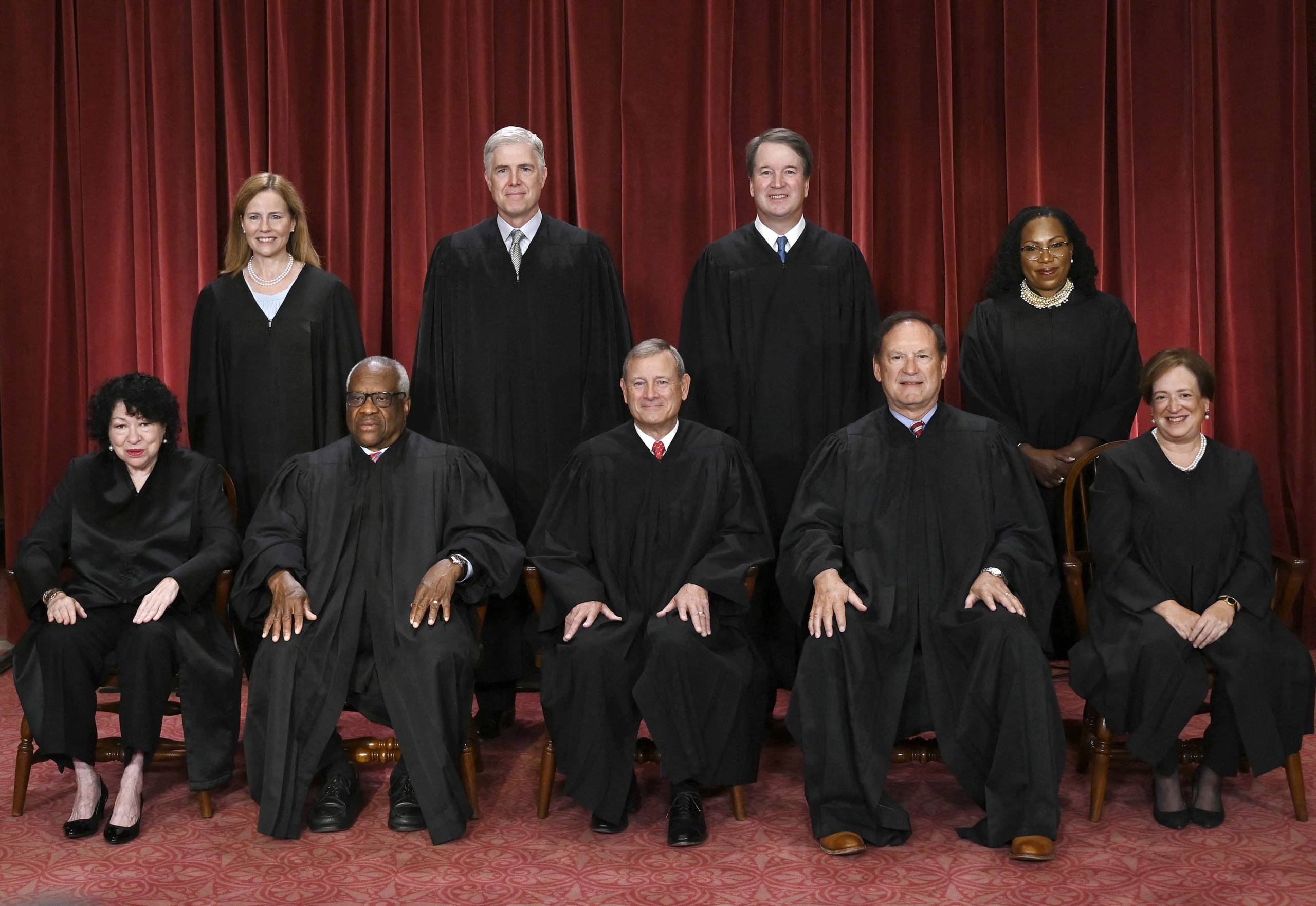
Public opinion of the court is on a downward trend. The question is, will the court’s conservative-leaning justices be able to maintain the nation’s trust? And how will these cases impact us?
Here to help sort it all out this morning, we have Mark Joseph Stern, a senior writer for Slate and cohost of the Amicus podcast. Welcome, Mark.
Mark Joseph Stern: Thank you so much for having me on.
Grace Won: And we’ve got Olatunde Johnson. She’s a law professor at Columbia Law School who holds the Ruth Bader Ginsburg Chair. Welcome, Olatunde.
Olatunde Johnson: Thank you. Thanks for having me.
Grace Won: And we have Melissa Murray, a law professor at NYU School of Law and cohost of the podcast Strict Scrutiny. Welcome, Melissa.
Melissa Murray: Thanks for having me.
Grace Won: Melissa, I wanted to start with you. The court’s new term started this Monday, but in many ways it’s felt like the court never stopped working. Throughout the summer, the court kept issuing rulings on what’s called the “shadow docket,” the court’s emergency docket. Can you tell us what the court was working on and what some of those rulings were?
Melissa Murray: Yes, Grace, you’re exactly right. The court’s work hasn’t stopped — it’s been a constant flood of decisions, even after the formal term ended in June.
Most of this activity has involved emergency appeals dealing with actions the Trump administration has taken since taking office in January 2025. It’s almost fair to call the shadow docket not just the emergency docket, but really the “Trump docket.”
What’s concerning is that the court has been issuing administrative stays — essentially stopping lower courts from stopping the Trump administration — and doing so with very little explanation. These orders defy the usual purpose of administrative stays, which is to return matters to the status quo ante. But in many cases, that status quo is long gone.
For example, in one case involving the Department of Education, the court’s order allowed the administration to continue dismantling it — far from restoring the previous state of affairs. So the court has been taking aggressive actions, often in line with this administration, and doing so without the kind of transparency that typically characterizes its work on the merits docket.
Grace Won: Mark, what does the court’s work on the shadow docket tell us about how it views presidential power — and Trump’s presidential power in particular?
Mark Joseph Stern: It tells us that the Supreme Court strongly supports Trump’s claims of presidential power in almost all cases. There are a few exceptions, but most of the time, as Melissa noted, the court rushes to halt lower-court decisions that limit Trump’s authority over things like purges of the civil service, destruction of federal agencies, firing of agency leaders, and the impoundment of billions in congressional funds.
In all of those cases, the court has effectively allowed Trump to break the law — to violate statutes — while embracing a very broad conception of presidential authority under the Constitution. Over and over again, after four years of striking down President Joe Biden’s policies, the Supreme Court has now been rushing to ensure that Trump can accomplish almost anything he wants without a federal court standing in the way.
Grace Won: Olati, at the end of the last official term, the court issued a sweeping opinion about presidential immunity. Does that tie into how the court views the scope of presidential authority?
Olatunde Johnson: Certainly. President Trump’s return to office has created a sea change in how we think about executive power. Many people now understand the concept of the “unitary executive” — the idea that the president not only holds immense power but also has authority over agencies we used to think of as independent.
In some of these recent cases, the Supreme Court’s shadow docket has gone along with the president’s removal of agency heads. At the end of the last two terms, the court issued not just the immunity decisions but others that made it easier for presidents to challenge or remove agency leaders.
You can really see this with cases involving the National Labor Relations Board. The court, interestingly, did not step in to reverse Trump’s firing of Lisa Cook from the Federal Reserve — a district court found that firing illegal and the justices let that stand. But in other instances, the court sided with Trump’s removals.
There’s also a major case this term about whether the president can fire a commissioner of the Federal Trade Commission, Ann Marie Slaughter. That case will test whether a nearly 90-year-old precedent still stands — and whether agencies will remain independent or be fully subject to presidential control.
Grace Won: Melissa, I want to pick up on what Olati said — the court didn’t allow Trump to fire Lisa Cook from the Fed but has allowed the firings of other agency heads. Why the carve-out for the Federal Reserve? Is it under a different statute, or is something else going on?
Melissa Murray: It’s a great question, Grace. It is under a different statute, but not necessarily governed by different principles than the NLRB or the FTC.
In the FTC case, which involves Commissioner Rebecca Slaughter, the court allowed her firing to stand. The only explanation most court watchers can point to is that the justices somehow see the Federal Reserve as exceptional — perhaps because all of them have retirement accounts that are affected by the Fed’s policies.
There’s also precedent for this. In earlier cases about agency structure, the court signaled that the Federal Reserve occupies a special status. Justice Kagan even mentioned this idea in a dissent in Wilcox v. NLRB, where she criticized the notion that the Fed is unique while other agencies are “fair game.”
Grace Won: It’s fascinating. Mark, you’ve also said that justices are real people too — they have retirement accounts! How might that influence how they think about the law?
Mark Joseph Stern: I completely agree with Melissa. Some justices are probably looking at their own accounts — or their 529s for their kids and grandkids — and thinking, “Maybe we don’t want total presidential control over the Federal Reserve.”
History supports that caution. When Richard Nixon exerted undue influence over the Fed, it led straight into stagflation. Since then, it’s been a bedrock principle — in both policy and law — that presidents shouldn’t use their position to pressure the Fed’s board.
The justices know this. They’re students of history — some more than others — and they understand what could happen if Trump were allowed to remove a Fed governor on dubious grounds and replace her with a loyalist.
A few months ago, in the Wilcox decision, the majority suggested that the Fed is “different” from other agencies — but without explaining why. That almost sounded like a bat signal to lawyers across the country: “Find us a reason to say the Fed is different.” I suspect by January, when this new case is heard, they’ll have those arguments ready — enough for the court to save face and declare the Fed unique, while still letting Trump fire everyone else.
Grace Won: Melissa, on this topic of executive authority — earlier this week, the president’s top adviser, Stephen Miller, told CNN that the president has “plenary power.” What does that mean, and might the Supreme Court agree?
Melissa Murray: “Plenary power” refers to total or absolute authority. Miller was talking about the president’s supposed ability to deploy National Guard troops to U.S. cities for domestic operations.
But in fact, the president does not have plenary authority in this area. Under the Posse Comitatus Act, the president cannot deploy federalized troops to enforce domestic law. There is limited authority under Title 10, Section 12406, to deploy the National Guard — but only in cases of invasion, rebellion, or when the president cannot otherwise enforce federal law.
So Miller’s claim was essentially magical thinking — an attempt to conjure a sweeping power that doesn’t exist. Whether the Supreme Court would endorse that idea is another question entirely.
Grace Won: We’re talking about how the Supreme Court may support or constrain the Trump agenda. We’re joined by Melissa Murray, law professor at NYU and cohost of Strict Scrutiny; Mark Joseph Stern, senior writer for Slate and cohost of the Amicus podcast; and Olatunde Johnson, Columbia Law School professor who holds the Ruth Bader Ginsburg Chair.
We’d love to hear from you. What are your questions about the Supreme Court’s new term? Has your confidence or trust in the court changed over time? What would it take to restore it?
Email us at [email protected], find us on Discord, Bluesky, Facebook, Instagram, or Threads at KQEDForum — or give us a call at 866-733-6786.
There’s more Forum after this break. I’m Grace Won, in for Mina Kim.