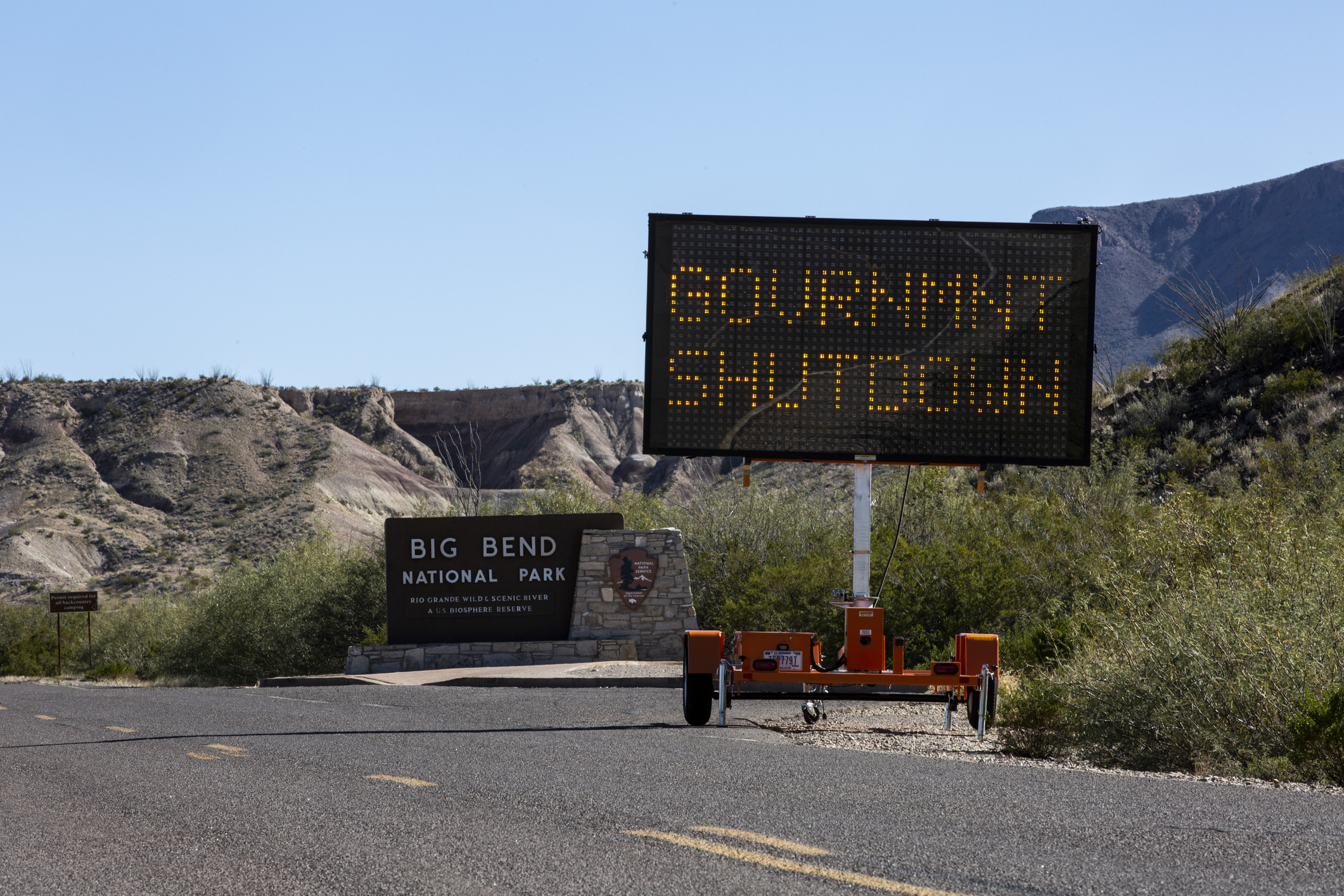
The government has shut down and President Trump is withholding dedicated funds to blue states, demanding universities sign a pact to get federal funding and cracking down on free speech. We bring together a panel of reporters to sort through what is happening in Washington and discuss the ways the Trump administration is throwing out the playbook and creating new, and sometimes unlawful, norms.
This partial transcript was computer-generated. While our team has reviewed it, there may be errors.
Alexis Madrigal: Welcome to Forum. I’m Alexis Madrigal. First up, we’re talking about the ongoing government shutdown. We’ve got three seasoned political reporters and commentators with us to help sort through the tumult of these last few days.
Molly Ball is a former political correspondent for The Wall Street Journal and author of the biography Pelosi. Philip Bump is a political commentator, former national columnist at The Washington Post, and author of The Aftermath: The Last Days of the Baby Boom and the Future of Power in America. And Domenico Montanaro is senior political editor and correspondent at NPR.
So first, Molly, I want you to just walk us through. You’ve seen previous shutdowns — how do these negotiations look to you?
Molly Ball: Kind of nonexistent at this point. And that’s what’s really striking. Usually, when the government shuts down — and even to be uttering the sentence, “usually when the government shuts down” is itself a mark of how normalized this situation has become — but normally, a shutdown is something that everybody wants to avoid. There’s a frantic scramble to try to head it off at the last minute.
Both parties, even if they’re cynically trying to create this outcome, at least want to create the impression that they’re trying as hard as they can not to. Instead, this has felt like we sort of sleepwalked into a shutdown. The writing was on the wall for weeks before we hit the deadline, and there was very little good-faith effort on either side to get us out of it.
Even now, there doesn’t seem to be much urgency in Washington. There are going to be some show votes in the Senate today that could potentially shake something loose, but there’s very little relationship or trust between Democrats and Republicans on Capitol Hill. And that’s part of the reason for this shutdown.
Right now, there’s very little negotiating happening to make it stop.
Alexis Madrigal: Philip Bump, I was thinking about how shutdowns have become normalized, like Molly was saying. When did this start to happen? When did it just become sort of the way the government works now, which is how it feels to me?
Philip Bump: Yeah. We haven’t actually seen that many shutdowns, so each one is unique in its own way. Although I think this one is unique even among unique ones.
The most famous shutdown within our lifetimes was the one during Bill Clinton’s presidency. That attracted a lot of attention, there was a lot of back and forth, and a lot of analysis of what the electoral effects were. But as American politics became more polarized, particularly starting about fifteen years ago, Republicans began to use the budget as a cudgel against a Democratic president. That became a pattern.
We saw a dramatic shutdown in 2013, when Republicans tried to block the Affordable Care Act — Obamacare — by pushing for a government shutdown in hopes of restricting funding. We saw shutdowns during Donald Trump’s first administration, when he himself rejected a funding bill because he wanted money for the wall.
So yes, there’s been a series of shutdowns, but it correlates directly to the increased use of the budget as a partisan tool — a negotiating point and a point of pressure. Usually it’s Republicans using it against Democrats. What makes this case somewhat unique is that Democrats allowed this to happen, which they’ve avoided in the past under Republican presidents.
Alexis Madrigal: So what is it Democrats say they’re trying to protect here?
Philip Bump: Their argument is that they want to preserve funding. Again, it comes back to health care. They want to avoid increases in costs for people on the Affordable Care Act, to ease the expected rise in out-of-pocket costs. They argue Republicans aren’t coming to the table.
So in that sense, it’s almost a mirror image of 2013, again centered on health care. But for Democrats it’s also a broader fight. Their base wants to see them resist the administration, and this is a way they can demonstrate that.
Alexis Madrigal: Let’s listen to Speaker Mike Johnson. This was Sunday on NBC’s Meet the Press.
Mike Johnson: In a situation like this, where Senate Democrats have decided to turn the keys to the kingdom over to the White House, they have to make tough decisions. Russ Vought runs the Office of Management and Budget. He now has to look at all of the federal government — recognizing that funding streams have been turned off — and determine what are essential programs, policies, and personnel. That’s not a job he relishes, but he’s being required to do it by Chuck Schumer.
Alexis Madrigal: That was Speaker Mike Johnson on NBC’s Meet the Press. Domenico, isn’t this actually a job Russ Vought relishes? Wasn’t he the guy at OMB helping to implement cuts, involved in Project 2025 and its vision of a much smaller federal government?
Domenico Montanaro: Oh yeah, for sure. I think Russ Vought does relish this. He was the lead author of Project 2025, about how to make government smaller.
This is mostly a threat. There aren’t really new powers granted to the executive branch during a shutdown. The government has to decide who’s essential and who’s not, but that’s about it. There’s nothing new that allows them to suddenly fire people instead of furloughing them. Traditionally, people are furloughed, not randomly laid off — and then they get back pay, because eventually the government has to function.
So really, this is Republicans saying to Democrats: we know you like government, and if you don’t negotiate with us — or if you don’t fold — we’ll do all these things you think are bad, and blame it on you.
Molly Ball: That’s also a problem for Republicans. On the one hand, congressional leadership wants to blame Democrats for the shutdown. And it’s true — Democrats’ votes were needed to keep the government open. In the past, they’ve argued the other party had a responsibility not to make unrelated demands, particularly on health care.
But at the same time, you have the administration — especially the president — saying they like shutdowns, that it’s an opportunity to do things they want to do to the executive branch. That creates a split message. Some Republicans worry it undercuts their claim that Democrats are to blame.
Polling shows more people blame Republicans for the shutdown than Democrats. And if the president is out there talking about how great shutdowns are, Republicans risk squandering their political capital.
Alexis Madrigal: Domenico, I feel like I end up asking this question a lot. But is it even legal to lay off all these people?
Domenico Montanaro: We’ll see. The Supreme Court is back this week with a docket full of cases about things Trump has tried to do. Ultimately, whether it’s legal will be decided by the courts. Until then, the executive branch can do what it wants — until the courts say it can’t.
Alexis Madrigal: Philip, a listener on Bluesky writes: ACA premium subsidies were put in place in March 2021. The pandemic emergency was declared over in April 2023. Subsidies are set to expire this December. Democrats want to make them permanent. Why are they willing to die on this hill?
Philip Bump: There are two ways to look at that. First, the Affordable Care Act is a signature piece of Democratic legislation. Few sweeping changes led by Democrats have survived the past several decades. The ACA has. It’s something Democrats are deeply invested in defending. And yes, people would feel real pain if out-of-pocket costs suddenly spiked.
Second, politically, there are some allies who argue Democrats should just let the subsidies lapse — because the pain would land at Republicans’ feet. From the beginning, Democrats argued the ACA would be politically durable once people relied on it. So some say: let it lapse, let people feel the costs, and let Republicans take the blame.
But fundamentally, Democrats don’t want people to face those costs, especially for this legislation.
Alexis Madrigal: We’re talking about the government shutdown and the political battle that underlies it. Our guests are Philip Bump, political commentator and former Washington Post columnist; Molly Ball, former Wall Street Journal political correspondent and author of Pelosi; and Domenico Montanaro, senior political editor at NPR.
We’d love to hear from you if you’ve been impacted by this government shutdown — and what advice you might have for Democrats. You can give us a call at 866-733-6786 or email [email protected]. I’m Alexis Madrigal. Stay tuned.