This partial transcript was computer-generated. While our team has reviewed it, there may be errors.
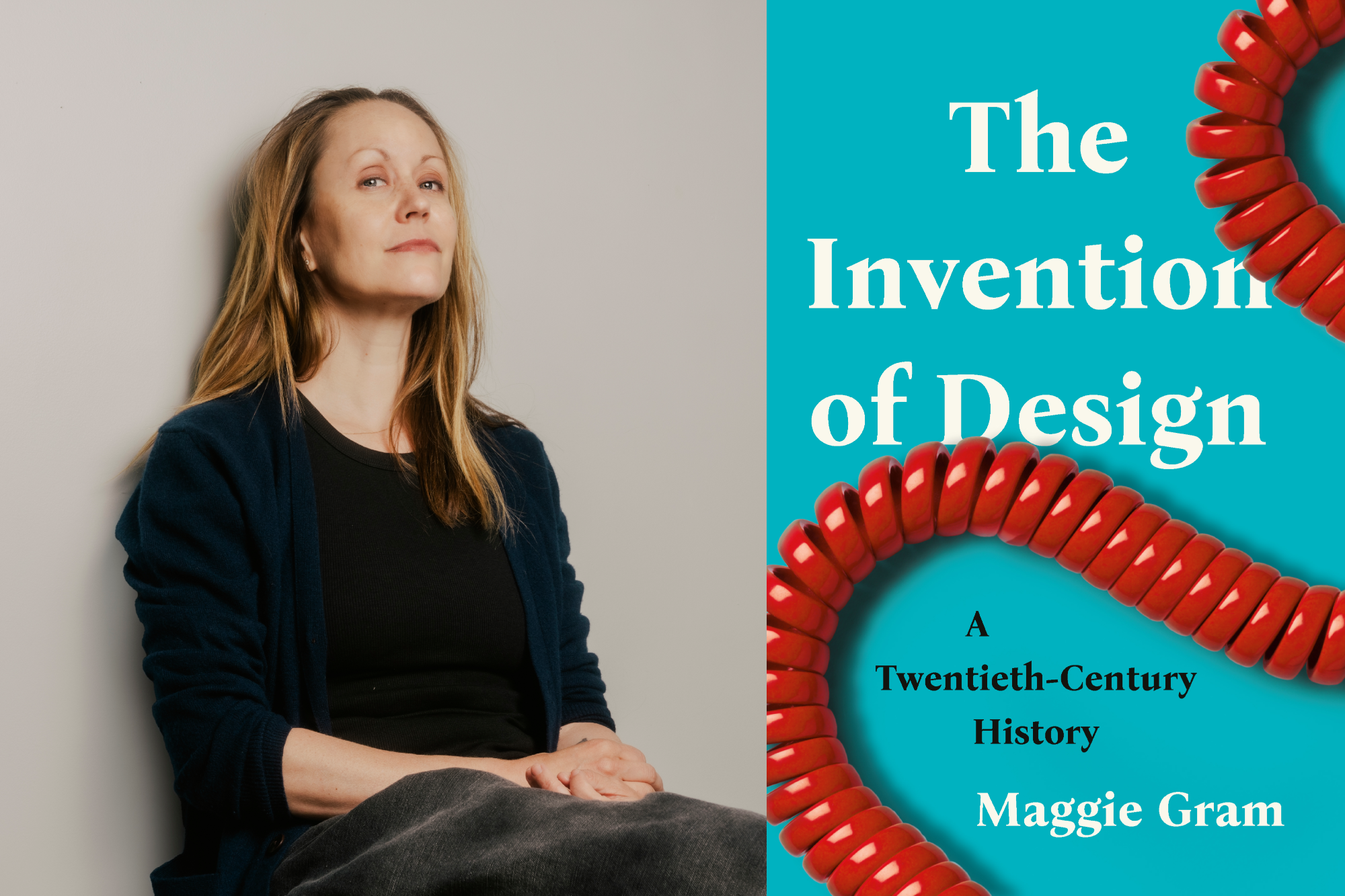
Alexis Madrigal: Welcome to Forum. I’m Alexis Madrigal. I knew I would be interested in Maggie Gram’s new book, The Invention of Design: A Twentieth-Century History. Growing up in the Bay Area in the 2010s, design was everywhere. My wife worked in various capacities around the field. I have friends who were or are considered designers. The big technology story of the last twenty years is Apple’s new design for the phone. My life felt littered with Post-it notes that came to symbolize the Stanford d.school approach to problem solving.
At the same time, the products and thinkers of the mid-century surged in popularity all around me. Mid-century furniture adorned homes. Ray and Charles Eames were celebrated. Design Within Reach grew and shrank in San Francisco — a furniture store that IPO’d — and it was also against the DWR in SoMa that I saw my first homeless encampment back during the Great Recession.
So I knew all these observations and life events should be filed under the heading “design stuff,” but I didn’t have a theory of why I had lived in such design-y times. Maggie Gram’s new book, The Invention of Design, is the decoder I didn’t know I’d been waiting for. Thank you so much for joining us and for this book, Maggie.
Maggie Gram: Alexis, thank you so much for having me. It’s great to be here.
Alexis Madrigal: So you begin by making clear that your book is not a catalog of cool stuff that’s been designed. You call that a “dead catalog,” not interesting to you. So when you talk about design, what are you talking about?
Maggie Gram: I’m interested in the idea of design. What are we really talking about when we say “design”? When we group together making beautiful furniture, making things work better, design thinking from the d.school, experience design — what are all these things relative to one another? What do they have in common?
There are aspects of the history of design that I do find interesting — and I love an Eames chair as much as the next person — but I’m really most interested in the idea of design itself and what that idea has come to mean in our culture.
Alexis Madrigal: And for you, what is that idea? If you had to say “design is the what,” what would you say?
Maggie Gram: The only way I know how to answer that with confidence is historically. Over the course of the twentieth century, in the U.S. and in other dominant countries of the time, design has meant making things beautiful, making them work better, creating modes of problem solving, designing experiences, making things human-centered, and cultivating a way of thinking.
Alexis Madrigal: Mhmm.
Maggie Gram: And now design is this freighted amalgam of all those concepts.
Alexis Madrigal: Yeah, yeah. One of the things that’s so brilliant about your book is how it shows that the concept we’ve inherited has layers — mechanics from each of those meanings you just described. Let’s take one of them as an example, because people see it a lot. Where does mid-century design — as we call it — fit into this overall complex of ideas?
Maggie Gram: For sure. When we think about mid-century design, we often think about design modernism.
Alexis Madrigal: Mid-century modern — as the Facebook Marketplace search goes.
Maggie Gram: That’s right. Modernism, or design modernism, arose from the intersection of making things beautiful and making things functional. There’s a long history of people with or without artistic training trying to make consumer objects aesthetically attractive. That accelerated during the second Industrial Revolution, when many artists were brought into industry to help differentiate products manufacturers were trying to sell.
By the early twentieth century in Europe, there was a movement to bring function back into the discourse about making things. Le Corbusier famously argued that a house is a “machine for living in” — as functional as it is aesthetic.
Alexis Madrigal: Mhmm.
Maggie Gram: I’ll put my cards on the table: although I’ve studied modernism in various capacities, I find the word itself overwhelming. The set of concepts around modernism is really hard to define, even historically, because they came from such different places. But they came together into something recognizable: simple but aesthetically satisfying chairs, flat roofs, distinctive windows, piloti holding up buildings. Modernism itself became a discourse, and modern design became a recognizable thing.
Alexis Madrigal: That’s the piece of it people can touch and shop for. But then there’s the turn that comes out of that, leading to this modern moment — the idea of design as problem solving. To me, that’s a non-obvious turn. But as your book shows, it grew naturally out of what designers thought they were doing.
Maggie Gram: Mhmm, mhmm. Some designers were already framing their work this way. I write about Paul Rand, the graphic designer.
Alexis Madrigal: UPS logo, IBM.
Maggie Gram: Yes. From the very beginning, Rand described design as problem solving. He believed a design solved a problem, and therefore there was one right design, one right answer.
But what really precipitated the integration of problem solving into design discourse in the U.S. was the Cold War. The U.S. government poured massive funding into basic scientific research that might enable future dominance. That funding allowed people like Herbert Simon, whom I write about in the book, to study human problem solving so he could program computers to reproduce it. He called that process “design.”
That ethos brought problem solving and design together — a very objectivist, scientifically minded, Cold War-era moment.
Alexis Madrigal: Fascinating. You’re almost more likely to encounter Herbert Simon in the early history of AI, so seeing him in this story was surprising.
Maggie Gram: And yet it’s the same story. Trying to reproduce human problem solving led to early AI.
Alexis Madrigal: Absolutely. So interesting.
We’re talking about the history of design — not just the stuff you might buy, but its broader sense as a field shaping logos, city governments, and problem solving. We’re joined by Maggie Gram, author of the new book The Invention of Design: A Twentieth-Century History. Gram is a writer, cultural historian, and designer who leads an experience design team at Google.
We want to hear from you. Maybe you’ve worked in this field. Maybe you’ve been put through a design thinking process at work. What was that like? Give us a call: 866-733-6786. That’s 866-733-6786. You can also email [email protected] or find us on BlueSky, Instagram, or @KQEDForum.
Alexis Madrigal: One of the things people here will find especially interesting is how much the Bay Area is threaded through this story, in particular through Silicon Valley. At first, one vector for this is Xerox PARC, which people may know as deeply important to the history of personal computing. How do you locate it in this matrix of design ideas?
Maggie Gram: Xerox PARC was exceptional in some ways because Xerox itself was so dominant at the time that it could devote enormous resources to creating new knowledge independent of immediate commercialization. That’s what PARC was. It was intentionally set up far from Xerox headquarters on the East Coast so that people working there had autonomy and space to think and experiment.
What got me especially interested is that Xerox PARC was one of the first places to bring anthropologists into the design process. I write about Lucy Suchman, an anthropologist I came to deeply admire while working on this book.
Alexis Madrigal: She’s a hero of the book.
Maggie Gram: Exactly. She had big ideas about studying power, but she was also a pragmatist. She believed the best way to do that was to go inside the black box — to become part of a corporation. And she did.
Alexis Madrigal: That’s such a good teaser. Hold on — I don’t want you to go too far, because we’re coming up on a break. We’ll come back to her story. For those who don’t know, PARC — the Palo Alto Research Center — is famous for pioneering the graphical user interface and the computer mouse. These were big innovations.
We’re joined by Maggie Gram, talking about the promise and peril of design thinking. Give us a call at 866-733-6786 or email [email protected]. I’m Alexis Madrigal. More Forum right after the break.