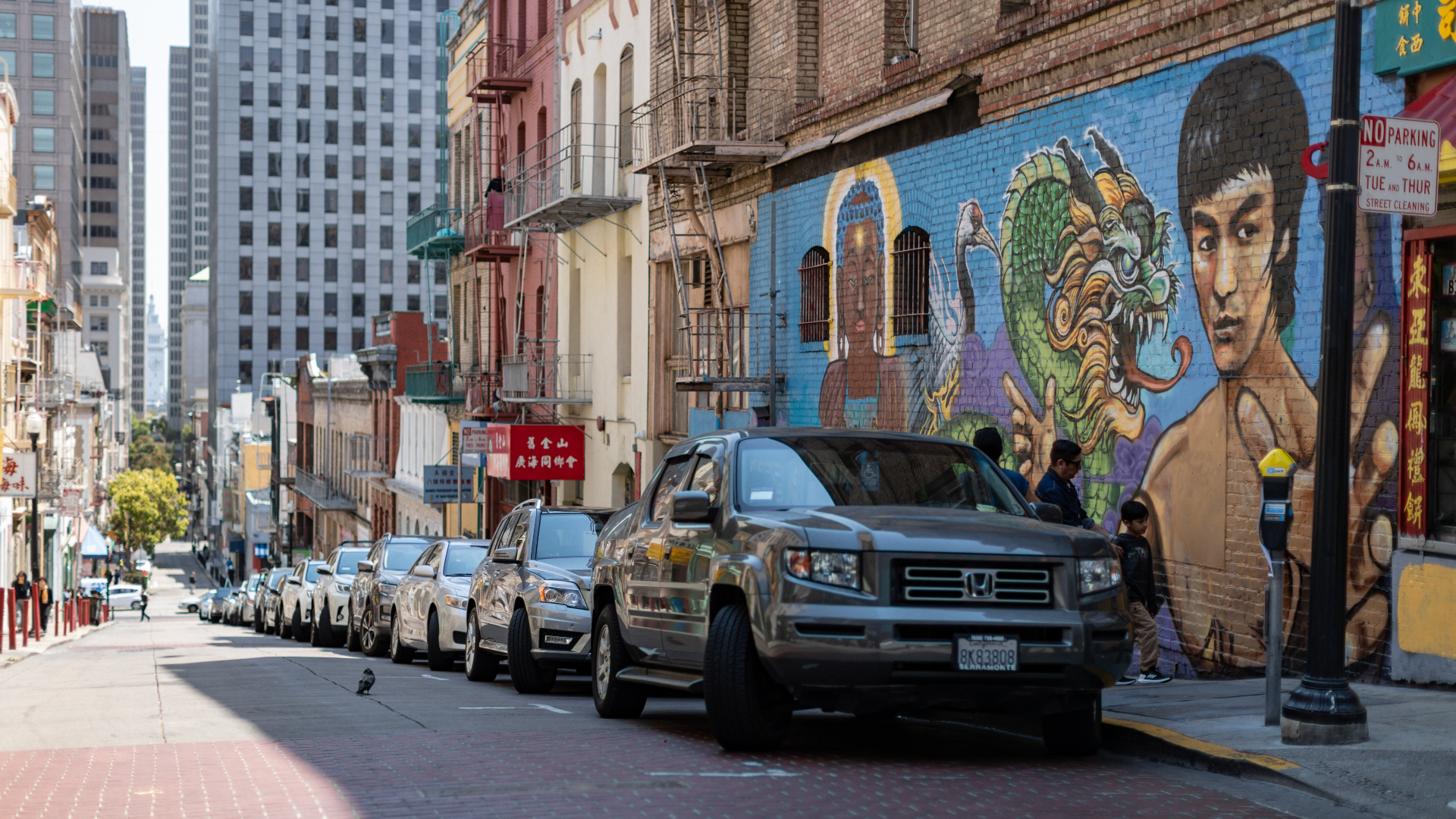
This partial transcript was computer-generated. While our team has reviewed it, there may be errors.
Alexis Madrigal: Welcome to Forum. I’m Alexis Madrigal. Jeff Chang’s new book, Water, Mirror, Echo, is a once-in-a-lifetime endeavor. Working from Bruce Lee’s diaries, letters, and other archival materials, as well as newly translated documents from Hong Kong and much other research, Chang builds a careful portrait of a man and his times — in contrast to the more mythological treatments his fans are prone to give him.
The book is meaty, and it’s as rich for Bruce Lee stalwarts as it is for people like, admittedly, myself, who have a more passing knowledge of the martial artist and actor. Jeff Chang, of course, is also the author of many other books, including Can’t Stop, Won’t Stop: A History of the Hip Hop Generation. And Jeff Chang joins us in the studio this morning. Welcome.
Jeff Chang: It’s great to see you. It’s great to be here.
Alexis Madrigal: Yeah, great to have you. Let’s talk a little bit about the title of the book — Water, Mirror, Echo. Why that title?
Jeff Chang: Of course, Bruce’s most famous line is, “Be like water, my friend.” In the process of going through his papers and notes, there’s a book called The Tao of Jeet Kune Do. In it were the original lines he had copied from a Chinese philosophy book when he was young, probably eighteen, nineteen, or twenty. The full lines are: “Moving, be like water. Still, be like a mirror. Respond like an echo.”
That just knocked me out. You know when you read something and then have to put the book down and walk around for twenty minutes? It was like that. And as I went through his notes, I could verify that he came back to these three lines throughout his life.
It became a way to structure the story — to think about his life and how to tell it. But also, because Bruce died so prematurely, he was able to inculcate this idea of being like water, being adaptable, being elusive in a fight. He never got to really experience what it would mean to be still like a mirror or to respond like an echo. That happens after his life. He becomes a mirror for millions of people around the world, across multiple generations. And his words continue to echo today.
Alexis Madrigal: That’s beautiful. Let’s talk about Bruce Lee. We can claim him as a native San Franciscan. He’s born in San Francisco in 1940. Why were his parents in San Francisco then?
Jeff Chang: His parents had come to raise money for the Chinese nationalists to defend China against Japanese imperialism and the war raging across China in the 1930s. They were also thinking about what it would mean if Hong Kong got invaded.
Bruce’s dad was a very famous comedian in Cantonese opera. During times of war, people aren’t going to entertainment, so they were offered a chance to come to San Francisco and then tour the U.S. While they were here, his mom got pregnant. Bruce was born in the Chinese Hospital in 1940.
Alexis Madrigal: Wow. That’s a huge deal. Opera in Chinatown at that time was a massive part of Chinese life in America.
Jeff Chang: Yes, and the other important part is that because he’s born in the U.S., he is a U.S. citizen — birthright citizenship. Under today’s debased language around immigration, he’d be called an “anchor baby.” Later in his life, he joked to the press, “Maybe my dad had me in the U.S. by design, or maybe it was just an accident. We’ll never know.”
I don’t think his parents intended to have another kid. The Chinese Exclusion Act was still in place. Bruce wouldn’t have been able to go anywhere outside of Chinatown. Even when his parents came in, they had to go through Angel Island and endure humiliations. So it’s very unlikely they were trying to move to the U.S. But that American citizenship becomes really important later in his life.
Alexis Madrigal: But he’s not raised here, right? They’re just on tour. He ends up back in Hong Kong and enters into a brutal situation.
Jeff Chang: Yes, he’s a war child. The Japanese invade Hong Kong on December 8, around the same time as Pearl Harbor. Suddenly Hong Kong is thrown into war and starvation. His father had to work for bags of rice. Bruce nearly starved to death. Many of his young peers and babies around him were dying.
It’s hard to imagine, when you see Bruce so yoked and invulnerable, that he almost starved to death.
Alexis Madrigal: And the postwar period in Hong Kong is also wild. It doesn’t just return to peace and tranquility. There are waves of migrants, and as you describe in the book, a lot of street fighting.
Jeff Chang: Yes. When I looked into it, I thought, “Wow, this sounds a lot like the Bronx in the 1960s and ’70s.”
Alexis Madrigal: From your work on hip hop.
Jeff Chang: Exactly. The Chinese Civil War ends in 1949, the communists come into power, and refugees pour into Hong Kong — overwhelmingly young people. There’s no housing, the British colonial administration doesn’t care, so they set up shanties and tin huts on hillsides. Fires break out all the time.
Alexis Madrigal: Really is the Bronx is burning.
Jeff Chang: It is. And in the middle of all this, kids study different kung fu styles, form cliques, and an elaborate fight culture develops. Bruce loved that. He had kind of a bloodlust and studied Wing Chun. He’d get into fights with students of other schools — Choy Li Fut, Eagle Claw, and others.
Fast forward to the 1960s when kung fu movies explode out of Hong Kong: these are the kids who grew up in this culture, now putting on costumes and doing it in front of a camera.
Alexis Madrigal: Pretending it’s a long time ago, as opposed to yesterday.
Jeff Chang: Exactly — “Is your style better than my style? We’ll find out.” That was the culture.
Alexis Madrigal: That was such a revelation to me — that there was a material basis for kung fu movies. Just wild. We’re talking with writer Jeff Chang about his new book, Water, Mirror, Echo. It’s about Bruce Lee — film star, martial arts expert, and icon — and how he helped make Asian America.
Jeff Chang is the author of many other books, including Can’t Stop, Won’t Stop: A History of the Hip Hop Generation, Who We Be, and We Gon’ Be Alright.
We want to hear from you. How has Bruce Lee influenced or impacted your life? Maybe you knew Bruce Lee in Oakland or ran into him in San Francisco. Do you have a Bruce Lee story to share? Give us a call at 866-733-6786. That’s 866-733-6786. You can also email [email protected].
Real quick, Jeff — did you feel an enormous responsibility writing this book? Taking on Bruce Lee feels so tough.
Jeff Chang: I did. A friend of mine who made the movie Be Water reminded me: for the public, Bruce Lee’s life and the Lee family’s lives are a spectacle. But for the family, these are flesh-and-blood people — a father who’s gone, a brother who’s gone.
So I did feel a deep responsibility to represent that truth.
Alexis Madrigal: We’ll be back with more from Jeff Chang right after the break.