This partial transcript was computer-generated. While our team has reviewed it, there may be errors.
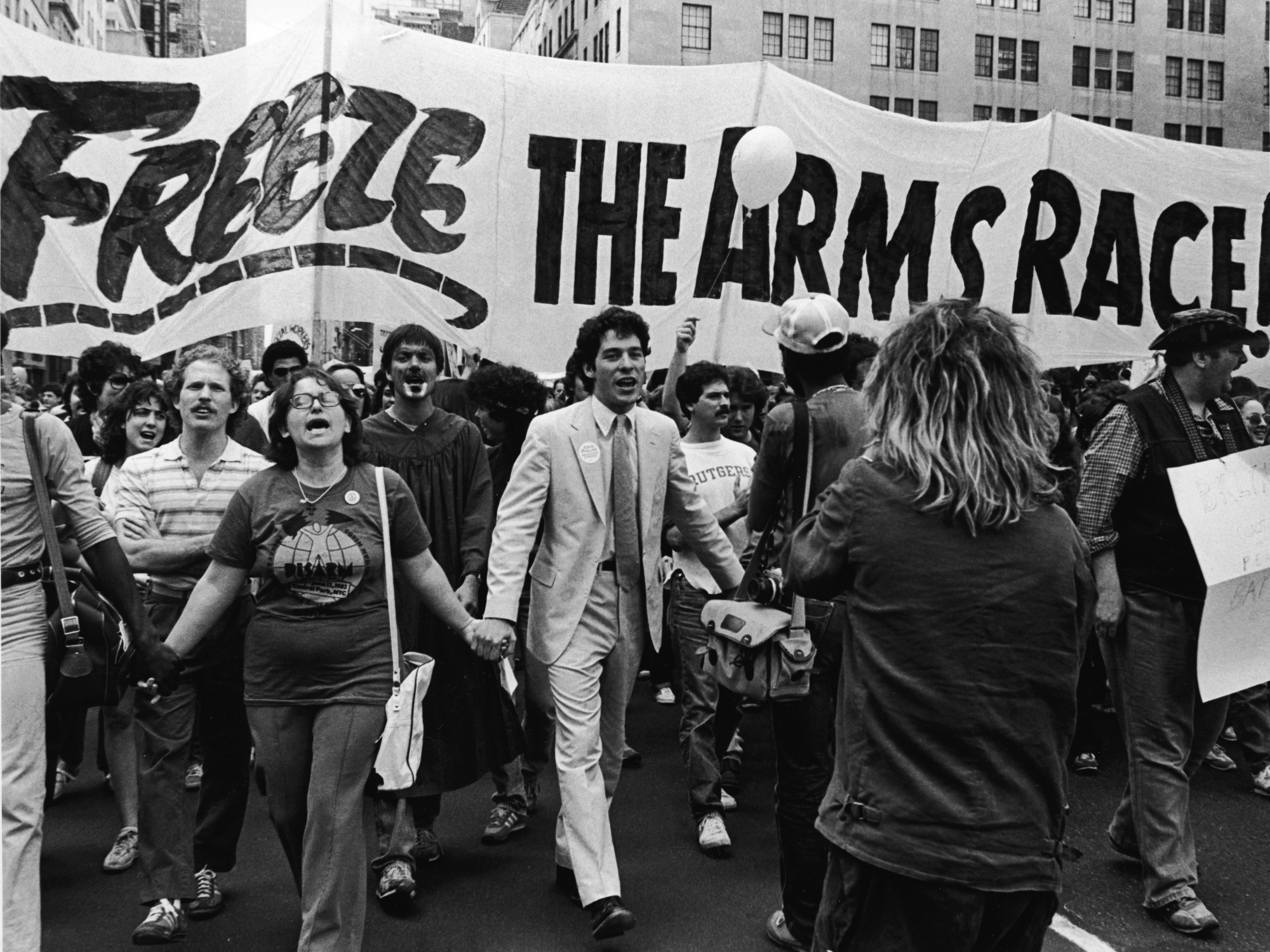
Alexis Madrigal: Welcome to Forum. I’m Alexis Madrigal. The anti-nuclear movement of the 1960s to 1980s was one of the largest protest movements of all time, with a million protesters marching in New York to demand an end to nuclear weapons. It was a continuation of, and also an evolution of, the antiwar efforts around Vietnam, and it did have a significant effect on global politics.
What it did not do was stop the development and manufacture of more nuclear weapons. And so now, especially in the United States and Russia, there are huge nuclear stockpiles, and we’re still living with the possibility of a globe-altering disaster. Have we just normalized the risk of nuclear war?
Here to discuss, we have Rivka Galchen, who is a staff writer at The New Yorker. Her latest essay for the magazine is “Why Don’t We Take Nuclear Weapons Seriously?” Welcome.
Rivka Galchen: Thanks for having me, Alexis.
Alexis Madrigal: So Rivka, in this piece you argue that essentially, we just got used to the idea of nuclear war. Like, it seems impossible that it could happen—and yet it could.
Rivka Galchen: I even wonder: on the one hand, we got used to it, and on the other hand, we maybe don’t really know how bad it is. They’ve done all sorts of surveys and research, and people are kind of wrong about how much destructive power we have. As insane as it feels to say, people think these weapons are only going to kill twenty thousand people. That’s not actually what they’re going to do. They’re going to kill millions of people. And there are so many follow-ups.
So even though, on the one hand, I feel like we’ve normalized it, I also feel like, as a society, we don’t even really understand where we are now.
Alexis Madrigal: Like it’s almost too scary to contemplate.
Rivka Galchen: Too scary, and too— I mean, it’s a scale problem. What size is the universe? How many grains of sand are there? Those aren’t things our brains are good at.
Alexis Madrigal: Yeah, the problem of big numbers. What about other fears that might have supplanted nuclear weapons? I’m thinking: it became unimaginable that we’d have a massive nuclear exchange, but very imaginable that we’d continue to burn fossil fuels until we created a deranged and dangerous climate.
Rivka Galchen: Absolutely. It’s closer to our faces. It’s literally our environment every day. So it makes so much sense. And I’m happy there’s a lot of awareness—though of course not as much as we’d like—around global warming.
I think that must be part of it. There’s a limited attention span, and where is it going to go? But there’s also the thing about fashions. Like in the most recent election, I barely heard the environment get mentioned.
Alexis Madrigal: Right.
Rivka Galchen: And we still care about it a lot, but it just wasn’t, as they say, trending.
Alexis Madrigal: Yeah. But it’s interesting, because for a lot of young people I talk to, the existential dread of their childhood is not the mushroom cloud—it’s the superstorm or other climate-related crisis.
Rivka Galchen: Yeah, and I think that’s appropriate. It deserves a hundred and seventy-five percent of everyone on the planet’s attention. And like you said, it’s also about our childhoods.
I remember vividly as a child, worrying about nuclear war was tied in with pop culture. It was a song by Sting, or an episode of a sitcom you just watched. It was really present. And then, in my childhood, we were also talking about the ozone all the time. We don’t talk about it anymore because we kind of addressed it.
Alexis Madrigal: Mhmm.
Rivka Galchen: And I think for a lot of people of my generation, less so for people older and younger, there was this illusion that it was one of those problems that must have been addressed—just like the ozone.
Alexis Madrigal: Yeah. Ozone, acid rain—worked it out. Nuclear weapons, must be.
Rivka Galchen: Must be checked off the list as well.
Alexis Madrigal: Were you able to pin down when the movement and the conversation around nuclear weapons changed?
Rivka Galchen: I talked to a lot of wonderful experts, and there’s this thing when you report a piece: every smart person you talk to is devoting their life to thinking about it. That’s wonderful. And of course there’s not a magic date.
But the sense was that the Cold War ended. That was a great thing, and there was a tremendous amount of disarmament—the number of weapons went down by tens of thousands. That was a great thing. Now, of course, we’re building more, but we never fell short of having enough to destroy the planet many times over.
I think that was a moment where we saw the arrow turning. It makes sense that we’d kind of have that in our body notebook: oh yeah, that turned around.
Alexis Madrigal: Mhmm, mhmm. It’s interesting too because—reading your article, doing introspection on myself—why don’t I worry about this more? Part of it is that they haven’t been used, right? Since World War II. So there’s this sense that maybe they can’t be, or won’t be, or that whatever regime is in place is actually pretty effective.
Rivka Galchen: And there must be some truth to that. It’s kind of astonishing that we’ve gone 80 years without a deliberate or accidental launch of a nuclear weapon. Both are things people worry about a lot, and should. So on some level, there are aspects of how this is managed that are working.
Most heads of nations don’t want to die, and that’s been useful. The sense that if one launches something, one’s also committing suicide—that’s been helpful, even if it’s not sufficient.
Alexis Madrigal: Do you think, in part—and we’ll get to the rebuilding of these stockpiles—that’s been driven by fading memories of the World War II generation, of the horrors of Hiroshima and Nagasaki?
Rivka Galchen: It must be. There’ve been a lot of important efforts to keep that memory alive. But it’s not in the lived experience of most people alive today. And not just Hiroshima and Nagasaki, but the whole decade that followed, when many people around the globe went to bed worried about nuclear destruction. It was just a very different apocalypse in everyone’s mind.
Alexis Madrigal: And every time I consider the number of mistakes that have been made—you catalog some in the story—there were many times where nuclear war could have begun.
Rivka Galchen: It’s quite shocking. One of the most unsettling but fascinating conversations I had was with Scott Sagan, author of The Limits of Safety. You go through your education, you learn about the Cuban Missile Crisis, and it’s almost a wonderful story—it goes so well, it has a witty turn. But there are so many other crises like that we don’t really know about.
And then there are even further levels. Sagan told me when he researched his book, he found near-catastrophic events that even scholars don’t really know about because they were even better shuffled away.
Alexis Madrigal: Oh jeez. We’re talking with Rivka Galchen, staff writer at The New Yorker. Her latest essay for the magazine is Why Don’t We Take Nuclear Weapons Seriously?
We’d love to hear from you. How has the way you think about nuclear weapons and nuclear risk changed over the years? Maybe you were part of the very large anti-nuke movement. Have you continued your activism?
The number is 866-733-6786. Forum at kqed.org. I’m Alexis Madrigal. Stay tuned.