This partial transcript was computer-generated. While our team has reviewed it, there may be errors.
Alexis Madrigal: Welcome to Forum. So Dan Brekke, our guest this morning, is a legendary journalist here at KQED and beyond. He’s been in the news and information business for four decades, and he’s retiring next month. Being an old-school news hound, it would not please him for us to do a big soft-focus show on his career. Nonetheless, he’s a reporter’s reporter, a huge store of institutional and metropolitan knowledge, and we’re gonna miss him terribly.
Welcome to Forum, Dan.
Dan Brekke: Wow.
Alexis Madrigal: Sorry. But it really is at moments like this where experience and having seen some things are most valuable. And we’re gonna talk about transit shortly. But first I wanted some advice from you — someone who has spent his life filtering information, assessing the quality and reliability of rumors and sources.
Right now, after Charlie Kirk, the right-wing commentator, was killed at an appearance in Utah, the information environment — media and social media — seems disastrously cacophonous and angry. So for people out there trying to figure out what the hell is going on, what are your reporter’s tips for sorting good information from bad, keeping a level head, finding the facts?
Dan Brekke: Well, you know, that’s a really tough one. And I’ll say right up front, I’m not sure I’m up to the task. One of your producers, Judy Campbell, brought this subject up yesterday. And one of the things I told her was that I go back to my first two weeks in a newsroom, which were in May 1972. I was eighteen years old. And on May fifteenth, George Wallace was shot.
George Wallace — I’m not sure how many people in the audience remember him. People my age do. I assume you do, Alexis. He was running for the presidency, for the Democratic nomination. And he was a white supremacist, pretty much an acknowledged racist, really appealing to what I would characterize as the worst of the American character.
He had a campaign event in Maryland, suburban Washington. Somebody in the crowd made their way up to him while he was shaking hands and shot him. And the thing was, you always want to know — and this is really true in the Charlie Kirk case — you want to know what the motivation is. You want a coherent explanation for why these things happen and why this particular thing happened.
I remember thinking that as I watched this newsroom swing into action to respond to a really tragic event — one with deep historical import. The assumption you might have made about Wallace’s would-be assassin was that he was motivated by distaste or hatred for what Wallace stood for: segregation. He was an unreconstructed segregationist.
But it turned out that wasn’t true. The would-be assassin, Arthur Bremer, was just a guy with a gun who wanted to prove something maybe to himself and get in the news. We’ve seen that many times over the years.
So coming back to Charlie Kirk and how to sift things out: I think I would start by accepting the fact that there is often a real lack of coherence to these things. Don’t judge, don’t give in to your prejudices, expectations, or assumptions about the world. Don’t assume the worst. Try to let the evidence play out. Very, very hard to do. But that’s kind of where I am.
Alexis Madrigal: No, I think that’s right. Time is one of those essential components of reporting that no one wants to have to take — especially in this day and age, with twenty-four-seven coverage on television and, of course, twenty-four-seven coverage by everybody on social media. Such a good point.
Okay, hard pivot. Let’s go to transit and transportation. We have a lot going on with Bay Area transit right now. When the pandemic hit, ridership collapsed, and we’ve just been digging out of that hole ever since.
Dan Brekke: That’s right. The pandemic wrecked the business model for these agencies that we depend on to take us from here to there. It’s strange to think of them as having business models, but most of the systems we depend on — BART, Muni, AC Transit, Caltrain, and dozens of others in the Bay Area — started out as private companies with a business model.
That model really depended, to a large extent, on transit fares — on the people who ride. That was especially true in the case of Caltrain and BART. So when ridership collapsed, they had their business model wrecked. They immediately faced the choice of slashing service or begging for money.
Alexis Madrigal: Desperate measures.
Dan Brekke: Desperate measures. And the federal and state governments came through to a large extent. Billions came into the Bay Area to support public transit — essentially emergency funding since 2020. But now we’re at the end of that. Everybody knew this day would come. The de rigueur term was “the fiscal cliff.” Well, we’re there now. And the conversation about what happens next has become especially fraught.
Alexis Madrigal: Just to set the context for people, how different is BART in terms of how much it depended on fares compared to the great transit systems of the East Coast? Do we rely more on fares, less on fares?
Dan Brekke: I wish I could give you a great answer. I don’t know, for instance, what the New York MTA’s bottom line looks like. But across the board, transit agencies depend to greater or lesser extents on public subsidies — in other words, taxes.
In the case of BART, they had what they called farebox recovery of about 60 to 70 percent. That meant fares paid 60 to 70 percent of their day-to-day operating costs. Contrast that with VTA in the South Bay, which has about a 10 percent farebox recovery — heavily subsidized.
So BART was subsidized to about 30 or 40 percent, with that money coming mostly from sales taxes in the BART counties — San Francisco, Alameda, and Contra Costa. Caltrain, which I mentioned before, had about 70 to 75 percent farebox recovery. Everyone else falls somewhere in between.
Alexis Madrigal: So that’s the chronic issue or structural setup here. We’ve also had some acute crisis moments, like last Friday. If you’re a commuter, you probably know this happened: BART shut down entirely for basically the entire morning. Do we know what happened there yet?
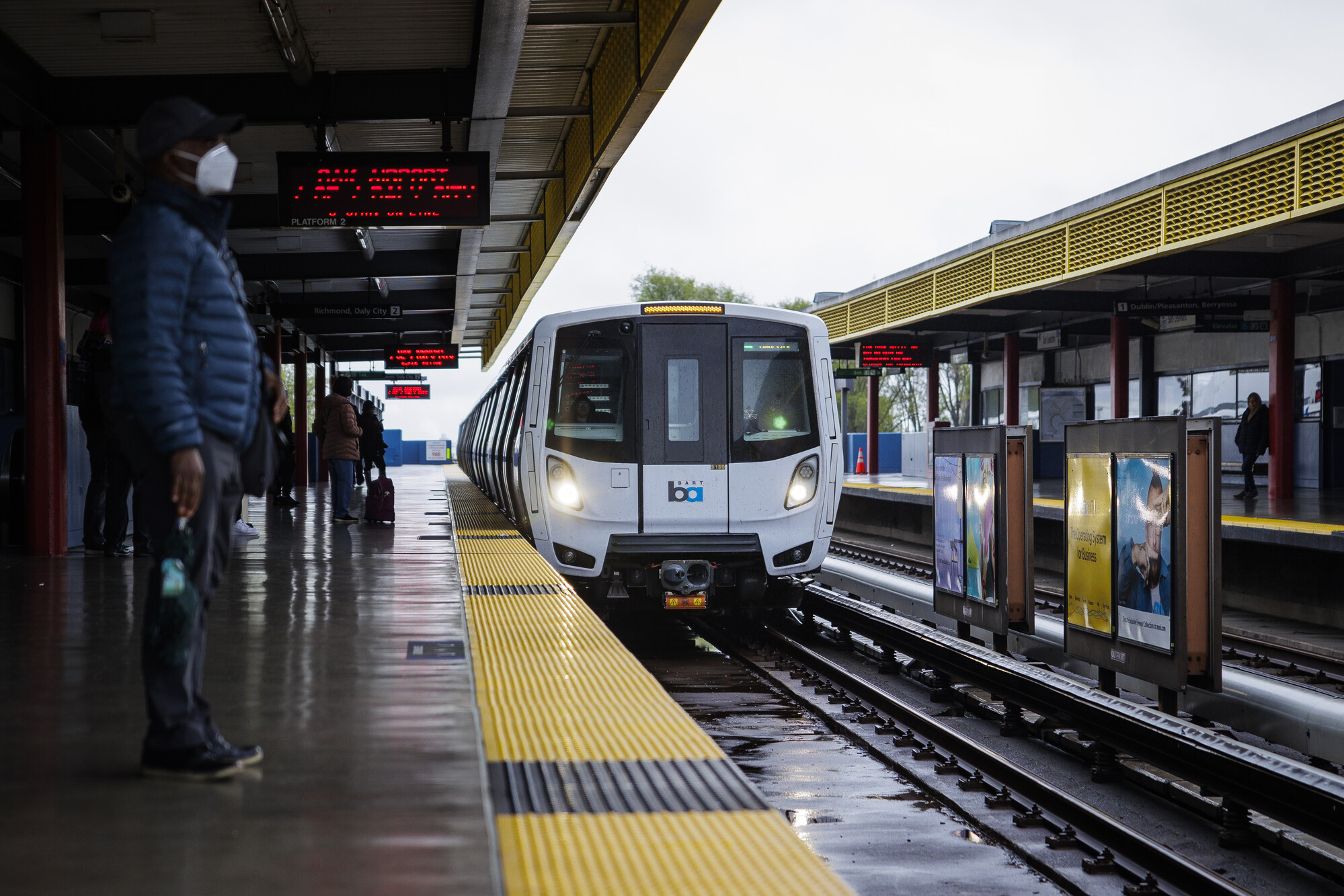
Dan Brekke: They’re in the midst of a long-term upgrade project for their train control system. They’ve been going station by station, making hardware and software installations. The simple layman’s explanation — which, being a simple layman, is all I can give you — is that something went wrong in the installation. Their computer systems essentially got flooded with false traffic and had to shut down.
Now, the BART board is meeting right now. If you go to YouTube, the BART board meeting is streaming, and they’re supposed to get an explanation. I saw what the presentation from management to the board was going to be this morning, and it was not very illuminating.
But as you point out, on Friday morning — look, it’s unacceptable. It shouldn’t be acceptable to simply not be able to open a service that so many people depend on.
Alexis Madrigal: Yeah.
Dan Brekke: And this is not the first time this year that’s happened. So people have a real need, and they deserve accountability.
Alexis Madrigal: Real answers, yeah. We’re talking about Bay Area transit woes with Dan Brekke. We want to hear from you. Were you a public transit rider and you’re not anymore? Give us a call at 866-733-6786. Email [email protected].
I’m Alexis Madrigal. Stay tuned.