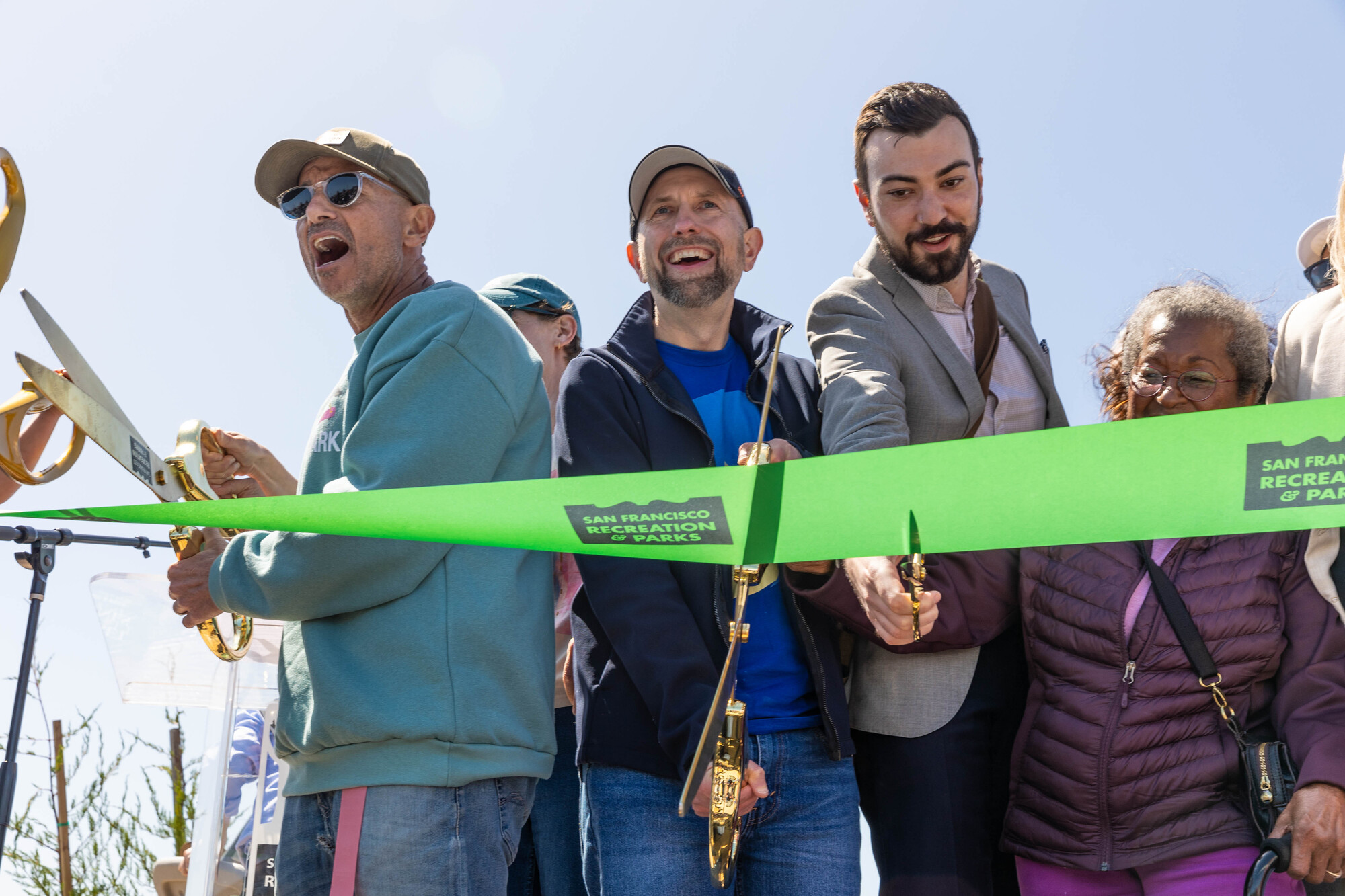
This partial transcript was computer generated. While our team has reviewed it, there may be errors.
Alexis Madrigal: Welcome to Forum. I’m Alexis Madrigal. Hoo boy, I spent some time yesterday reading stories, comments, and social media posts about the closing of the Great Highway and the opening of Sunset Dunes Park. Honestly, it’s one of the nastiest, angriest realms of local politics I’ve ever seen. Everyone seems wildly, almost unbelievably angry about every single thing that’s happened along the way — and every side is like that.
So for those of us who are not in District Four, not in the Sunset District, maybe not even in San Francisco, we’re gonna lay down a solid foundation for what happened out there and the whole infrastructure of anger that seems to exist. Then we’ll wade into the mess.
We’re joined this morning by Sydney Johnson, KQED reporter. Thanks so much for joining us.
Sydney Johnson: Thanks for having me.
Alexis Madrigal: We’re also joined by Joe Eskenazi, managing editor and columnist at Mission Local. Welcome back, Joe.
Joe Eskenazi: Thank you. Thank you very much.
Alexis Madrigal: And we’ve got Jason McDaniel, professor of political science at SF State. Welcome.
Jason McDaniel: Thank you for having me.
Alexis Madrigal: Alright, Sydney, tell us about the neighborhood. Tell us about District Four. What’s happening out there?
Sydney Johnson: Yeah. For folks who don’t live in San Francisco, District Four is one of the districts adjacent to Ocean Beach on the far west side of San Francisco. Unlike downtown or Nob Hill, with their big skyscraper apartment buildings, the west side is a quiet residential area with lots of single-family homes.
It has one of the city’s most dense Chinese American populations outside of Chinatown. It’s really where a lot of families live — young families, but also families with young adults who might be home from college or moving back home as they figure out next steps in life. There are lots of small businesses, and it’s known as a quiet but also very politically organized part of the city.
When I covered the mayoral race last year, the west side voting bloc was definitely something politicians thought a lot about because it has this reputation as a sleeping giant. It’s a quiet, foggy, family-oriented part of the city — but if you upset them, they’ll come out fighting.
Alexis Madrigal: Yeah. Talk a little bit about the Great Highway. I mean, this is just this stretch of road, and it feels like during COVID — pre-COVID, during, and now — it was a place that was changing a lot.
Sydney Johnson: Mhmm. You could go back even further to the days of Playland to see how this two-mile stretch of the Great Highway, just adjacent to the beach, has long been a place of change.
Fast forward to 2020, the city decided to close off a stretch of the highway for a couple of days a week, like a slow street, to allow for social distancing. There were other parts of the city where they did this too. A lot of people enjoyed it — people showed up on bikes, there were little pop-ups, art installations. That sparked a movement to make the closure permanent.
Obviously, that was controversial from the start. It’s a historic road and one of the main thoroughfares on the west side. But one of the main arguments for creating a beachside park was also that this road is literally eroding — it’s falling into the ocean. The lower portion of the Great Highway is already closed because of that. Proponents and environmentalists argued the city was going to need to face that reality and update the road at some point no matter what.
The city actually got a large grant to convert this stretch into a park. And since then, for about five years, it’s been back and forth politically — on ballot measures and in local meetings — about whether or not the park should exist.
Alexis Madrigal: Yeah. And Joe Eskenazi, the form this took to actually make it happen was Measure K. Tell us about it.
Joe Eskenazi: A clutch of supervisors, led by Joel Engardio, placed Measure K on the ballot at the last moment in 2024. Measure K would make the closure permanent. It passed — and it wasn’t particularly close, winning almost 55 percent of the vote citywide.
But rarely will you see a more divided electoral map. In Joel Engardio’s own district, close to 64 percent of people voted against it. In the three precincts that had provided his margin of victory in 2022, about 77 percent of people voted against it. That’s his home district — his base.
It’s never good for a supervisor to get on the wrong side of two-thirds to three-quarters of their voters, especially in their own precincts.
Alexis Madrigal: Why did he do it then?
Joe Eskenazi: I think Joel Engardio genuinely believes in this park. But let’s be frank: Prop K was also placed on the ballot as a way to attract urbanist voters to support London Breed. That didn’t work. The down-ballot effects have been disastrous.
We can argue about the merits of the park — I take my kids there, it’s great not to worry about them getting run over. Twenty years from now, this might be like arguing against taking lead out of gasoline. But as a political tool, it was a disaster, and it has ruptured the moderate movement in San Francisco.
Alexis Madrigal: So explain more for people who aren’t San Francisco politics junkies. You’re saying Measure K was meant to goad “urbanists” into voting for London Breed?
Joe Eskenazi: Yes. It accomplished that, but it was also meant to differentiate Breed from her rivals. Daniel Lurie wasn’t in favor of Prop K. London Breed was. Mark Farrell wasn’t. Aaron Peskin wasn’t either. So it was a differentiator.
But while Prop K passed, that support didn’t trickle down to London Breed.
Alexis Madrigal: Yeah. Interesting.
Joe Eskenazi: And the down-ballot effects have been disastrous for those who put it on the ballot. It probably helped Connie Chan win reelection, and now it stands a very good chance of costing Joel Engardio his job.
Alexis Madrigal: Jason McDaniel, talk to us about Engardio himself and how he won his election. This was a very tight race with the incumbent, right?
Jason McDaniel: Yeah. Joel Engardio was someone I didn’t give much of a chance to, because he had lost several times before — kind of a perennial candidate. He won a very close race, I think with about 50.5 percent of the vote, just a few hundred votes separating him from the incumbent Gordon Mar.
He was able to convince the district that Mar was out of step ideologically, that the city was moving away from progressives. There had been recalls and issues, especially around law and order. That environment allowed Engardio to win.
After his election, he did a good job of establishing a brand — earnest, straightforward, optimistic, wanting to do things for the district. I think Joel believed in Measure K, but it was a misjudgment. He misjudged how deeply people in his district would feel betrayed.
Alexis Madrigal: Sydney, talk to me about the practical consequences. When I read why people oppose this, they talk about traffic being pushed onto Sunset streets, making it harder to get from the Sunset to the Richmond. There’s always mention of “the merchants,” but who actually are they?
Sydney Johnson: A couple of things. One, the traffic argument is definitely one I’ve heard a lot. People are pissed off they lost a road they used for commuting or errands. Studies show the changes in commute times are minimal — maybe a 10-minute ride becomes 15 or 20 minutes. But if that’s your daily commute and it doubles, that feels significant.
For folks who like feeling insulated in their community, that change feels imposed on them rather than chosen.
On the business side, opinions are mixed. Some business owners say sales are down, others say they’ve gotten more attention — sometimes there are pop-ups or food trucks at Sunset Dunes Park that bring business.
But what’s significant is that Engardio started and really backed the Sunset Night Market. It was massive and exciting — food, performances, vendors. It was a success. But now, a lot of merchants have pulled out and don’t want Engardio to be part of the next plan.
Alexis Madrigal: Wow. Fascinating.
We’re talking about San Francisco politics and the potential recall of Supervisor Joel Engardio in District Four. We’re joined by Sydney Johnson, KQED reporter; Joe Eskenazi, managing editor and columnist at Mission Local; and SF State’s Jason McDaniel.
Of course, we want to hear from you. What do you think of the recall? Call us at 866-733-6786. Email [email protected]. I’m Alexis Madrigal. Stay tuned.