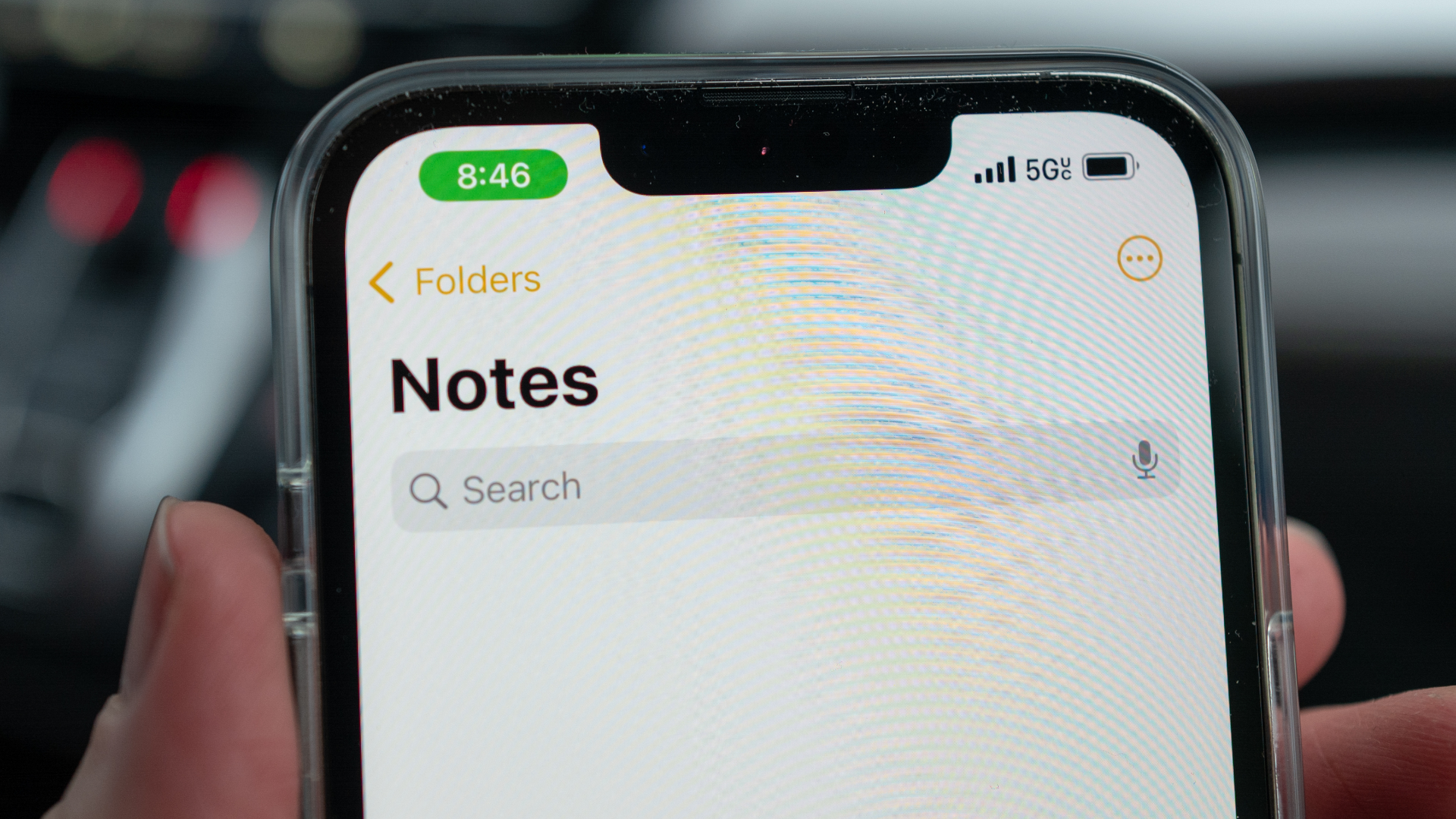
The notes app on your phone can be a repository of the quotidian aspects of life – a grocery list or reminder about a doctor’s appointment. But these notes can also be revealing, intimate and beautiful. It might contain a cache of private thoughts and feelings – the fragmented summary of a bad dream, the first line of a poem, or ideas for how to propose to your partner. This juxtaposition of the mundane with the meaningful is one reason artist Rel Robinson felt compelled to put together the new collection, “iPhone Notes,” which gathers the ephemera captured in the notes app of local artists and writers. We talk about how the notes app can be a reflection of self, and we invite you to share your notes.
The Mundane and the Meaningful Moments Found in the Notes App of Your Phone
(Gado via Getty Images)
This partial transcript was computer-generated. While our team has reviewed it, there may be errors.
Alexis Madrigal: Welcome to Forum. I’m Alexis Madrigal. You’re reading through the new book iPhone Notes, compiled by artist Rel Robinson. I was struck time and again by how the jagged shards of life that get flaked off during any old day get filed away into the Notes app on our phones — and there, something happens to them. The new context tumbles them into something beautiful, or haunting, or funny.
It’s not that the poems we write on our phones cannot be good poems sometimes, but that the poetry which emerges from the process of living can be made of any string of words, not just the ones we intentionally laid down syllable by syllable. So today, we’re talking notes in your phone. We’re talking about the unusual and fascinating little book iPhone Notes, and you’re going to write in or call in with the notes from your phone. Give us some of those scraps of your life. You can start sending them to [email protected].
We’re joined this morning by three artists: Rel Robinson, artist and writer, editor of this collection. Welcome.
Rel Robinson: Thank you. Thank you for having me.
Alexis Madrigal: We’re also joined by Forum favorite Brontez Purnell, poet, author of 100 Boyfriends, as well as the memoir Ten Bridges I’ve Burnt. Welcome back, Brontez.
Brontez Purnell: Hey. How you doing?
Alexis Madrigal: And we’re also joined by Rita Bullwinkel, author of Belly Up and Headshot, which was a finalist for the Pulitzer Prize.
Rita Bullwinkel: Delighted to be here.
Alexis Madrigal: Yeah. So, Rel, you created this collection gathered from local artists and writers, but how do you use your Notes app?
Rel Robinson: Oh, god. How do I not use my Notes app? You know, going through them the other day, I think one of the most recent notes I made was things I had found in my own Google search history before I deleted it. I’ve always sort of been an inadvertent archivist, and I think that’s kind of how the book came to be. You know, I have everything from my grocery list to my wedding vows — which I wrote in my iPhone notes.
Alexis Madrigal: And they’re all mixed in there.
Rel Robinson: Yeah. They’re very democratized in form.
Alexis Madrigal: Yeah. Well, and everybody has access to this. Right? I mean, everybody can use the Notes app on their phone for whatever they want. There are no rules to it.
Rel Robinson: Yeah. Absolutely. I think what attracts me the most about the Notes app as a sort of form or medium is the tension that exists. It could be seen as sort of a repository for where all good ideas go to die. But also, going through my own personal archive, I can trace back the origin of a lot of my bodies of work. And, yeah, I see it as—there’s something almost erotic or exhibitionist about, as the editor of the book, going into other people’s private spaces. Because the nature of the Notes app is that you never really know who it’s for. I guess, ostensibly, those notes are for your future self. And you wonder — where will they end up?
Rita Bullwinkel: God only knows.
Alexis Madrigal: Wait. Wait. They didn’t let you actually look at their app, did they?
Rel Robinson: No.
Alexis Madrigal: That would have been intimate.
Rel Robinson: I wish.
Alexis Madrigal: Hand your phone over and let someone go through your notes. Would you ever do it?
Rel Robinson: You know, it’s funny. I was thinking, what would be more mortifying: publishing all of my iPhone notes or all of my screenshots? I really don’t know. They both horrify me.
Brontez Purnell: I would give you full access to my screenshots. That’s how much I trust you.
Rita Bullwinkel: I would too.
Rel Robinson: Oh my god. Wow. Okay. Well, May the Record Show: forthcoming publication of Screenshots. Volume One.
Alexis Madrigal: Projects.
Rel Robinson: Yeah. That was actually the other book I put out, alongside the iPhone Notes book — a monograph of the painter Robert Falco’s screenshots. And I think they both occupy the same psychic space in someone’s practice: part unfinished essay, part poem, part note to self.
Brontez Purnell: Mhmm.
Rel Robinson: And I think that’s a theme that follows throughout the book. You know, the book has six contributors, and that motif sort of runs through everyone’s contributions.
Alexis Madrigal: Yeah. Rita, you are a novelist. And when Rel first came to you to talk about contributing, did you think that you were a heavy user of the Notes app?
Rita Bullwinkel: No. Originally, I was like, “Oh, Rel, this sounds great, but I don’t really use my Notes app.” And then I checked my phone. In fact, I do use it.
Alexis Madrigal: Four thousand notes.
Rita Bullwinkel: Yeah. In fact, I do use it. And I don’t think of it as being a big part of my creative process for the art I make, which is primarily books. But there are things in there that I’m circling in the books I’m working on that rear their heads in the Notes app.
But I feel like, Rel, with this book, you did such an extraordinary job editing this collection. There’s such narrative movement in the book. I feel like I gave you raw material, and you shaped it into a really pleasurable, propulsive, funny reading experience.
Rel Robinson: Wow. That’s so flattering. Thank you. I mean, I like to think so as well. It’s interesting because I have this publishing practice through my artist editions publication, Conventional Projects. This is actually the first book I’ve put out. I mostly work with artists doing small-scale limited edition art objects.
In my own studio practice, I work with images in a really editorial fashion. So the technical parameters for everyone’s contributions were that they had to fit in the context of a single screenshot. As I was editing, I saw it more like editing a series of images, almost like concrete poems in an Aram Saroyan style.
So I was really sensitive to the shapes of everyone’s screenshots, which varied because they were made on different model iPhones — a very small detail. But the length, the keywords, the layout all mattered. I thought of it as image poetics in a way.
So it’s interesting to hear from a novelist that there is a narrative flow. Because even now, as I look through the book materially, I’m finding unexpected correlations between people’s contributions that I didn’t see previously.
Alexis Madrigal: Brontez, did you have a favorite — your own or somebody else’s — where it really got at what the Notes app could be?
Brontez Purnell: I totally dog-eared it, but I left it at my house and forgot it. But I think what I enjoyed about the book was its cohesiveness. I was a dance nerd, and one time I spent $150 on the notebooks of Martha Graham because I thought I’d learn something. But in it, she’s just like, “Elektra has anger,” and random fragments.
Reading through this, I felt like everyone’s notes had that quality — but with a strange cohesiveness. It’s wild how we coexist with this piece of machinery where we record either our most frivolous thoughts or some of our darkest ones.
And I was surprised at how much writing I had in there from 2017.
Alexis Madrigal: I agree. And you had some of the most polished pieces. You’d really been working on things in there.
Brontez Purnell: Yeah. Totally. At some point I abandoned handwriting and typewriters because they hurt my hand. The touchscreen is easier — the velocity with which you hit it just makes it simpler.
Alexis Madrigal: I also loved some of the small ones. This one is in uppercase font, and it just says: “Slowly lowering newspaper to reveal your face.” Somebody was like, I need to capture this moment.
Also, in some of the other little notes — this one’s from Laura Mathis: “Fourth grade sleepover at Rebecca’s, catching frogs, making up fake names in case strangers stop us on a walk. Two men in a car leaning out window. Grandfather kills rattlesnake with shovel. I’m haunted by that still.”
What about you, Rel? Do you want to read a couple that stick out to you?
Rel Robinson: Oh, yeah. Wow. I love so many of Brontez’. There are several by the poet and curator Sofia Pell, who is based in Los Angeles now but has deep Bay Area roots. Most of her contributions are from the last couple of years. And we met in art school in probably 2017.
Alexis Madrigal: I know. You’re looking.
Rel Robinson: Sorry. I’m looking. I’ll read a few in sequence. These are from 2024, and then one from 2019:
“Hundreds of men were still staring.”
“Joan Jett spit.”
“I’m always leaving the bathroom with running down my legs.”
“Extremely nervous. Rain.”
And then, January 17, 2019: “Made the record show. 1:22 PM. Milk, onions, potatoes, soul, lemon, parm, sour cream, chicken chips, apples, cherries, cucumber, Mexican squash, The Post, cigarettes.”
I guess there was a fondness I had — not a profound thought — but the art school, post–art school disposition that would implore you to put cigarettes on your grocery list.
And I don’t want to steal Rita’s thunder, but her “Questions for Her Gynecologist,” which is the final poem in the book, really stood out.
I put this book together rather quickly. At first, I thought I’d do a series of individual collections of iPhone notes. But everyone I asked assumed it was a collection. And then I realized it was a much better idea to do it as a collective book.
Brontez Purnell: Uh-huh.
Rel Robinson: So I realized I had to garner a bunch very quickly. And Rita was the final contribution. She lovingly sent them over while she was on her book tour in Italy.
Alexis Madrigal: We’re gonna get to more of these notes. We’re gonna get to more of your phone notes, iPhone notes. We’re joined by Rel Robinson, Brontez Purnell, and Rita Bullwinkel. Why don’t you call in and read us one of your notes? 866-733-6786. Or you can email [email protected].
I’m Alexis Madrigal. Stay tuned.