As both a science journalist and a sci-fi writer, Annalee Newitz thinks a lot about what our technology-saturated future might hold for us. Newitz’s new novella, “Automatic Noodle,” is set in 2060’s postwar San Francisco after California has seceded from the U.S. In the midst of an exploitative dystopia, a crew of robots opens a noodle shop with a sweet and resilient commitment to community, excellent food and rebuilding. We talk about what Newitz sees in our AI future, and how the values and community bonds that have long made San Francisco great may fare then, and now.
Exploited Robots and a Commitment to Community Populate 2060’s San Francisco in Annalee Newitz’s ‘Automatic Noodle’
We talk about what Annalee Newitz sees in our AI future, and how the values and community bonds that have long made San Francisco great may fare then, and now.
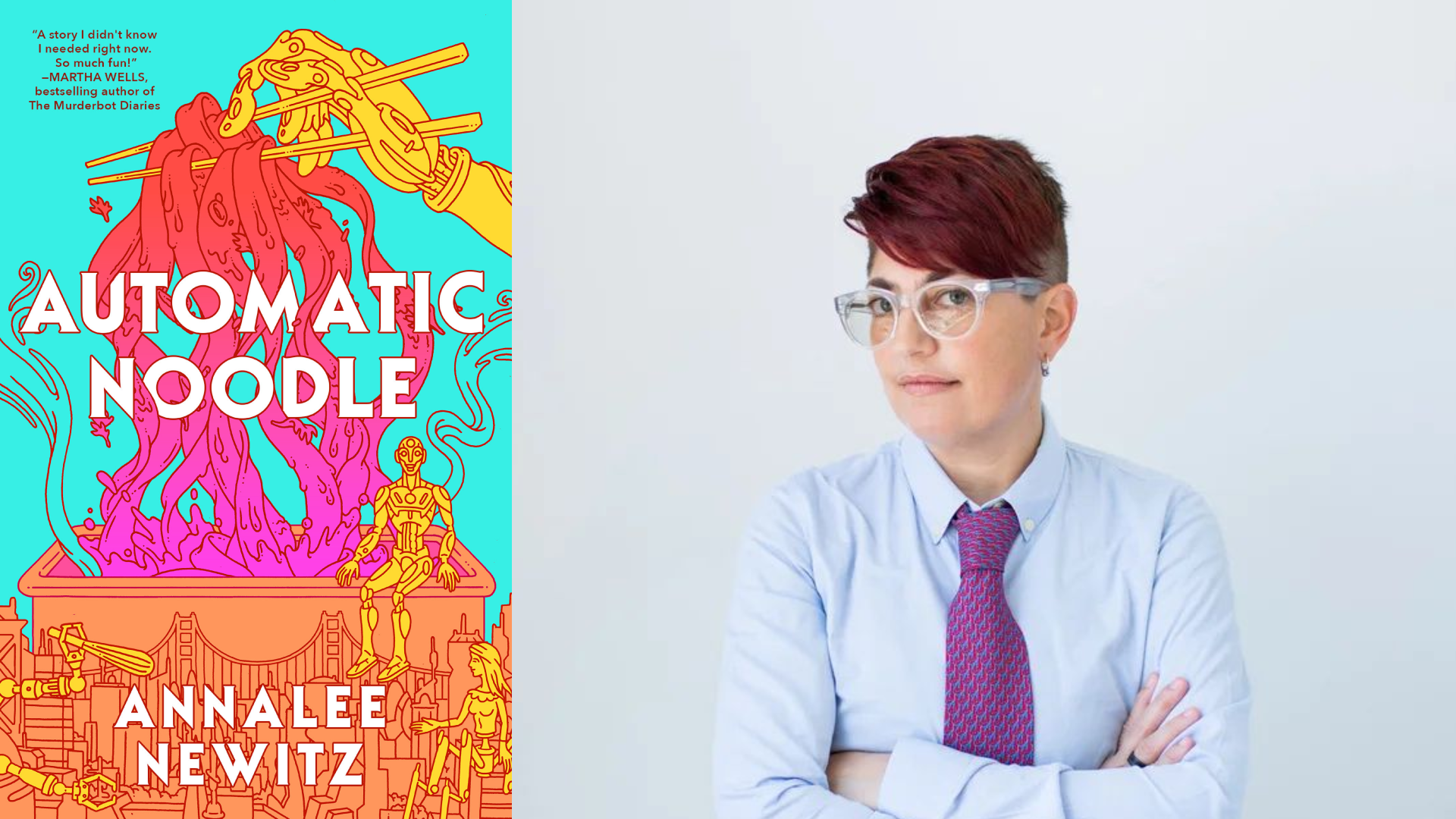
Annalee Newitz's new book is called "Automatic Noodle" (Photos courtesy of Annalee Newitz)
This partial transcript was computer-generated. While our team has reviewed it, there may be errors.
Alexis Madrigal: Welcome to Forum. I’m Alexis Madrigal. The year is 2064. California is a newly independent country. The smartest robots — at least by human figuring — have a version of citizenship, and they live alongside humans and other kinds of intelligences in a bombed-out San Francisco, the Bay Bridge in ruins.
This is the world of Automatic Noodle, an entry in the very slight genre of heartwarming dystopian robot fiction. And, of course, it would come from the mind of science journalist and sci-fi writer Annalee Newitz. Welcome back to Forum, Annalee.
Annalee Newitz: Yeah. Thanks for having me back.
Alexis Madrigal: So just talk to us a little bit more about building this world of Automatic Noodle. How does California become a newly independent country?
Annalee Newitz: Well, unfortunately, it goes through a really horrible war. And, you know, this is something I’ve been thinking about — like a lot of people in California. As the politics in our nation have become more polarized, there’s been this rejuvenation of interest in CalExit. And when I think about the possibility of the state declaring independence, war is always part of it.
I was thinking a lot about California’s long history of thinking about becoming independent, about the nation’s history of how it’s dealt with requests for independence and secession. And I was also thinking about how California would treat artificial intelligence if it actually became human equivalent.
Alexis Madrigal: And when you’re thinking about those things in your world-building — both as someone who likes to center things in reality as a science journalist and also as a historian — where are the analogs that you’ve drawn from in terms of how a nation’s laws might handle different classes of people?
Annalee Newitz: I was thinking a lot about our own history in California and how the state has dealt with immigration. We have a long history of treating immigrants as second-class citizens. We have the Chinese Exclusion Act, which came at the end of a really long period of indenture of Chinese and Japanese labor.
And I was also thinking about what’s going on right now with how we’re treating Latinx immigrants — folks from Central and South America who are coming in and who are actually doing a lot of the labor that keeps California’s economy going.
There’s this big area between citizen and non-citizen that I think people who are citizens don’t think about — the gradations of rights for people who are on a visa or on some kind of permanent residency. So I modeled what happens to the robots on what’s happening to immigrants right now, since they’re newly declared people who occupy this position of new arrivals in what’s also a new nation.
Alexis Madrigal: Yeah. I mean, it really made me think of two things. There’s almost a sort of Ellis Island scene as they arrive on the docks from their factory in Emeryville — one of the characters arrives from there.
Listeners to the show with long memories may remember a Forum conversation we did with Dylan Penningroth, the UC Berkeley scholar, called Before the Movement, about the different ways that Black Americans used the legal system before the Civil War and eventual freedom.
So tell us: what is the situation the robots find themselves in when the book begins?
Annalee Newitz: These are four robots who’ve been declared citizens by the new nation of California. They’ve all been working in a ghost kitchen — kind of a crappy job. After the war, California set up job placement services for these newly declared people.
Alexis Madrigal: “HII,” as they’re known in the book — human-equivalent intelligence.
Annalee Newitz: Right, human-equivalent intelligence, or HII. They’re distinguished from other kinds of AI that are more like “puppy-grade” intelligence. There are gradations, but the ones who get citizenship are HII.
They’d been working in this ghost kitchen when one day they woke up and discovered the owners had shut it down and left the country because they were involved in a crypto scam — as one does in the future.
Alexis Madrigal: Told you — the most San Francisco thing ever.
Annalee Newitz: Exactly. So they fled to the United States, where crypto scams are still legal, whereas California has consumer protections. And these four robots decide they want to keep working together in this restaurant.
They’re going to make a go of it even though California has laws against HII owning property or running a business. They have to figure out a legal loophole so they can run the restaurant and just get by. They don’t have big aspirations. They just want to keep living in a neighborhood called Kite Hill — based on Noe Valley — and make really great Beyond-Beyond noodles.
Alexis Madrigal: And it’s interesting because the loophole they find — and I won’t give it all away — involves another negotiation with a different form of artificial intelligence that lives on the blockchain.
It struck me that this book is arising directly out of this moment when people have started to interact with all these different kinds of intelligence that can communicate fluidly with humans but don’t think or live at all in the way that humans do. Waymo, ChatGPT, and all their variations seem like signs of this. Are we ready for that world?
Annalee Newitz: I think we have a lot of stories about how this world will look. And right now, we’re preparing for a world where human-equivalent artificial intelligences are our adversaries.
That’s particularly interesting because the way we’re hearing that story is through advertising from companies like OpenAI. They say, “We’re going to invent artificial general intelligence” — which is just another term for human-equivalent intelligence — “and it will take our jobs, it will take over, so we need rules to control it.”
So even as it’s being introduced as an idea, AI is portrayed as a menace that’s going to take things away from us. People are bracing for that. But what if, instead, we prepared for a world where we actually did invent human-equivalent intelligence, and they were like the robots in this book — regular people who have feelings, friendships, and just want to get by?
They’re not trying to take our jobs. They just want to hang out and be like us. We need to be preparing for that possibility for all kinds of reasons.
Alexis Madrigal: Yeah. One of the things I’ve been thinking about is how much of our culture and sense of what it means to be alive is encoded in our language. In order for these beings to communicate with us, they’d have to take that on.
One fascinating thing about this book is how the robots have what I’d think of as essentially human aspirations: a little self-determination, some useful work, friends, meaningful relationships.
Annalee Newitz: Yeah.
Alexis Madrigal: That’s part of what makes it so compelling.
Annalee Newitz: That’s exactly what I wanted to explore. Robots are such a useful metaphor. When we talk about AI or robots, it’s often really a metaphor for how we think about people who are different from us.
I wanted to tell a story where robots have humble aspirations and just want to be good neighbors, because stories about robots can be a test bed for how we think about welcoming new arrivals — to our country, neighborhoods, and communities. By telling stories about acceptance, about how these new arrivals are just trying to make a living and have some fun, we integrate the idea that strangers can be friends.
They’re not here to take our jobs. They’re here to enhance our lives — maybe by making us tasty noodles.
Alexis Madrigal: And yet one of the fun things about this book is how these robot people have different capacities. Their minds work differently, even if their “hearts” work the same as ours. Their bodies and brains are built on totally different architectures, which is fascinating to watch you play with in the book.
Annalee Newitz: Yeah. I really wanted my robots to be realistic. One of them is a soft robot — something that’s big right now. These are robots made of squishy, rubberized materials so they can squeeze into places or swim.
This robot, Kaiyen, is an octopus robot who communicates some emotions through LEDs embedded in their skin. When they’re excited about making money, little Ethereum symbols flash across their skin. They use crypto a lot since they’re not allowed to open bank accounts.
Another character has three-wheeled legs, and another is just a pair of arms attached to a mixer. That’s realistic too — a lot of real-world robots are just one or two arms.
Alexis Madrigal: Right. We’re talking with science journalist and sci-fi writer Annalee Newitz. They’ve written many books, some of which they’ve been on Forum for.
The latest is a novel called Automatic Noodle, the coziest post-apocalyptic fiction you could ask for. We want to hear from you: What does this conversation bring up for you about robots and how we’re conceiving of AI?
The book is set in a wildly different San Francisco, though some parts have survived. What parts of San Francisco do you think might last far into the future, through many evolutions?
Give us a call at 866-733-6786. That’s 866-733-6786. You can also email [email protected] or find us on social media — Blue Sky, Instagram, or KQED’s Discord community.
I’m Alexis Madrigal. Stay tuned for more with Annalee Newitz right after the break.