For months, economists have predicted that Trump’s tariff policy would crash the economy. While that has not yet happened, leading economic indicators, like inflation and jobs numbers, do indicate that the economy is slowing despite a strong stock market. We’ll talk about how this latest round of tariffs is impacting consumers and businesses, and hear how your spending and savings habits have changed.
Trump’s Tariff Policy Raising Prices of Coffee, Clothing and More
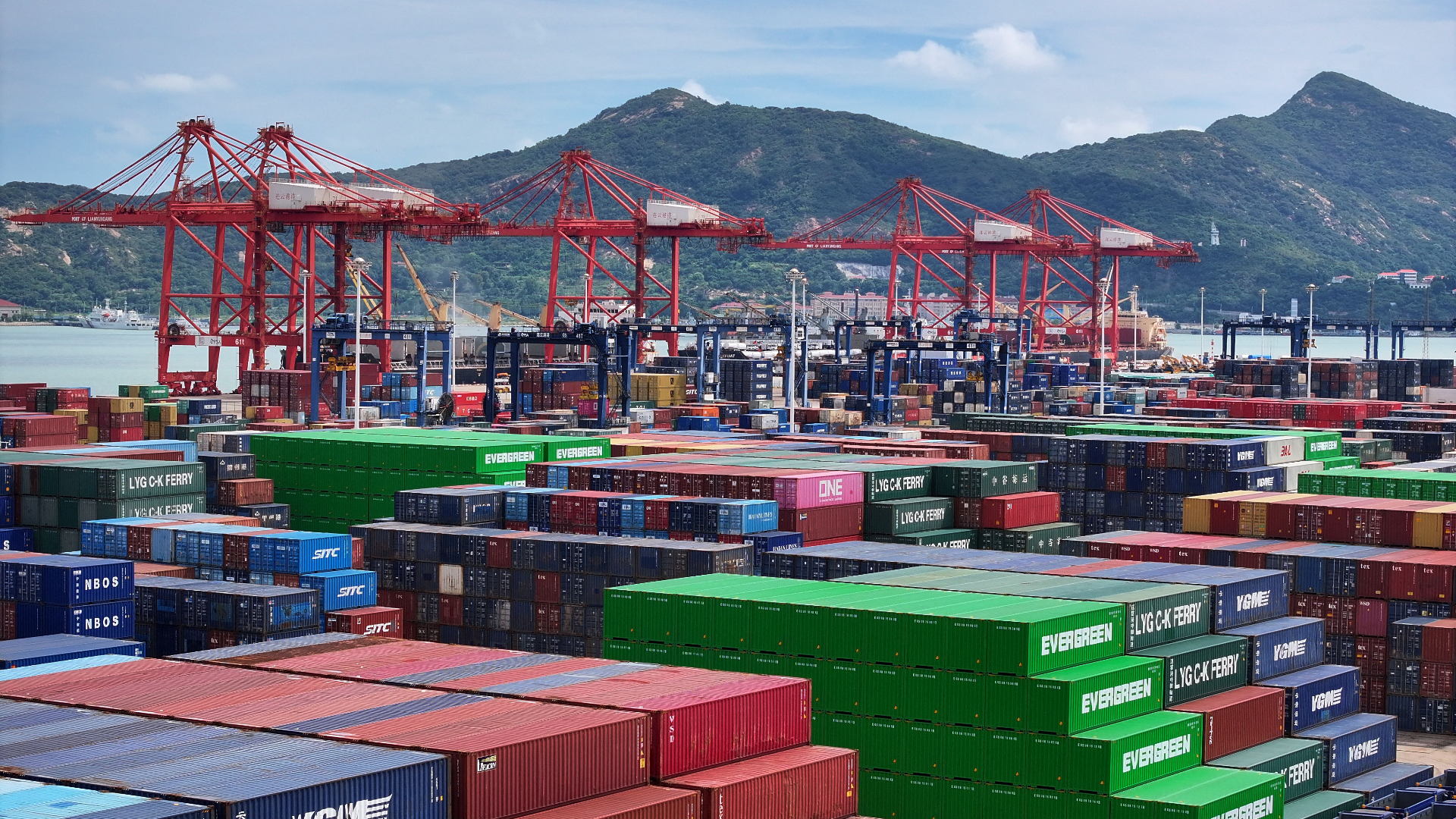
Containers are seen at the port in Lianyungang, in China's eastern Jiangsu province on August 12, 2025. President Donald Trump on August 11 ordered a delay in the reimposition of higher tariffs on Chinese goods, hours before a trade truce between Washington and Beijing was due to expire. (AFP via Getty Images)
This partial transcript was computer-generated. While our team has reviewed it, there may be errors.
Alexis Madrigal: Welcome to Forum. I’m Alexis Madrigal. We’re talking tariffs this morning, and here’s the thing: from the moment President Trump announced massive tariffs back on so-called Liberation Day, the vast majority of economists predicted they would be bad for U.S. consumers, businesses, and the economy as a whole — as economists have said about tariffs for decades.
It’s been months now, and while recent economic reports have not been great, the bottom hasn’t fallen out of the U.S. economy either. We dig in today on what businesses who import from abroad have been encountering, and try to make sense of the current moment in the economy.
First, we’re joined by Neale Mahoney, professor of economics at Stanford University, the Trione Director of the Stanford Institute for Economic Policy Research, and a former special policy advisor for economic policy with the White House National Economic Council. Welcome.
Neale Mahoney: Good to be with you.
Alexis Madrigal: We’re also joined by Tracy Alloway, financial journalist and co-host of Bloomberg’s celebrated Odd Lots podcast. Welcome, Tracy.
Tracy Alloway: Oh, celebrated — thank you so much.
Alexis Madrigal: Neale, let’s start with you. I mean, President Trump was very upfront about his tariff plans, and announced a flurry of them over the months. Economists have been worried. What are we seeing? Were the predictions that they would be bad for the economy wrong — or maybe too early?
Neale Mahoney: Too early. Most people, myself included, thought the effects would show up quicker in prices. But over the last few months in particular, we’re starting to see the impact of tariffs hit, and there’s more in the pipeline.
Alexis Madrigal: What do you think has made those effects in the consumer economy slower than economists predicted?
Neale Mahoney: Yeah, it’s a great question. Most people were basing their expectations on the tariffs during the first Trump administration, which hit pretty quickly. And this time around, I think there’s a number of factors. One is that a lot of businesses tried to front-run the tariffs by getting goods onto boats before the tariffs took effect. And once a good is on a boat, then it is no longer subject to tariffs.
A second thing is many businesses had high margins coming out of the post-pandemic period, and they had some room to eat the tariffs in the form of reduced profits. And the third thing — and maybe we’ll touch on it more — is that consumer demand has been slowing. Demand has basically been flat over the course of the year. And businesses, I think, were rightly scared about spooking consumers by raising prices.
Alexis Madrigal: I mean, Tracy, you’ve done some amazing reporting on the small business response to the tariffs — the, like, “get everything to the boats.” How did that actually work?
Tracy Alloway: Yeah, this is the thing. If you talk to a lot of smaller business owners in circa April of this year, there was a lot of uncertainty, a lot of confusion, a lot of people who were — to Neale’s point — scrambling to get items on boats before the tariffs actually came into effect. And I think we’re still waiting to see the ultimate impacts of that.
For instance, we spoke to one person on the podcast who owns a medium-sized clothing line, and she was saying that her entire spring season, when she should be thinking about what she’s gonna do for the winter, for Christmas time, her entire spring season was just taken up with finding boats to put items on, figuring out what shipping would actually look like, what the tariffs would actually look like. And so she didn’t have as much time to think about the next season. She’s worried that come Christmas time, come this winter, she’s gonna have less product available to shoppers.
And so I think the timeline is really, really important here. We cannot expect something like this to immediately show up. If tariffs go up by 10% for a certain good, it is not immediately gonna translate into a 10% increase at the cash register, for a variety of reasons. But one of those reasons is because we do have businesses who are trying to figure out the long-term impact of what all this is.
Alexis Madrigal: Neale, the Trump administration and President Trump specifically have been a fan of tariffs going back to the first administration. As we’ve seen them get implemented and play out over this year, what do you think we can say about what President Trump wants to see happen with these tariffs? Like, what’s the strategy we see in play here?
Neale Mahoney: I’m hopefully wise enough not to try and read Trump’s mind as to the strategy here, because I think it is changing all the time. But on tariffs, look, he’s been a longtime fan of tariffs. They provide him with a form of leverage with foreign governments. They provide him with a form of leverage with U.S. firms, and I can see that appealing to him.
He’s made arguments about bringing manufacturing back to the United States, but that doesn’t explain many of the tariffs he has in place. There’s no way we’re gonna be growing a substantial amount of coffee on our shores. He’s spoken about revenue effects, and that’s something we can talk about. I don’t think those effects will be huge, especially as businesses figure out how to substitute their inputs. So I don’t know if there is a really ironclad rationale for what he’s doing here, other than sort of liking the power.
Alexis Madrigal: Yeah, I mean, you mentioned tariffs as a revenue generator. From what I understand, the Trump administration expects hundreds of billions of dollars a year in revenue from the tariffs. Do you think that’s a likely scenario, or do you think that number will decrease, as you noted, as businesses essentially figure their way around them?
Neale Mahoney: I think the most recent data show they pulled in about $30 billion in June. And so if you annualize that, that is hundreds of billions of dollars in revenue. But firms will change their supply chains, and so this — what economists call a substitution effect — will reduce the revenue. So yeah, it’s a source of revenue.
The other thing to keep in mind is, in terms of the ways that the government can raise revenue, it’s a pretty bad one. About 50% of the goods that we import are what economists call intermediate inputs — steel, copper are great examples. And when you put tariffs on that, you raise the costs for businesses in the United States, and they have to change their production processes. That’s economically inefficient.
And the other thing is tariffs that hit on apparel — clothing for families — on toys for Christmas, on furniture, athletic equipment, that is a big tax on working people in the middle class. So if you think about the taxes we need to put our budget on a sustainable path, many economists don’t think that is the right path forward.
Alexis Madrigal: Tracy, we talked so much — I know everyone did — about inflation over the last few years. Talk to us a little bit about how a tariff on an imported good pushes through a business to the actual price of something someone’s gonna buy.
Tracy Alloway: I think this is really important. You know how during the pandemic we all kind of got to learn about worldwide logistics and how goods actually arrive in America? Well, guess what? This is another learning opportunity where we’re really gonna start to understand all the nuances of supply chains and how different companies interact with each other.
It’s a lot more complicated than you’d expect. For a single good, there are multiple points of contact — multiple players that will decide the ultimate price of the good you pay at the cash register. So it’s not just, you walk into a Lowe’s and Lowe’s has decided, because it’s selling you — I don’t know — a washing machine, and there’s a new tariff on the washing machine of 10%, that you’re gonna pay a 10% higher price. It doesn’t work like that.
There are all these different entities along the line of creating the washing machine who can decide to potentially absorb some of that cost themselves — parts suppliers, the factory in China putting the machine together, the shipper sending it to the U.S., the packager in the U.S., and the retailer. If any of them decide to absorb some cost, it might lead to a slightly reduced price increase for the U.S. consumer.
Earlier this week, consumer price inflation came in a lot lower than expected. But just today, producer prices came in a lot higher than expected, which suggests that some of those companies along the line are in fact paying higher prices for tariffed goods. The question is whether it’s just a matter of time before it makes its way down the line to the consumer.
Alexis Madrigal: Well, Neale, you were talking to our producer, Grace Won, about a really interesting kind of knock-on effect of tariffs, which would be — say — the price of auto insurance might go up because parts might be more expensive for your car.
Neale Mahoney: Yeah, that’s right. The tariffs are gonna show up in lots of unexpected places. And part of the silver lining of this, as someone who teaches economics, is it’s just a great example of how rich and interesting our economy is. So, like you mentioned, auto insurance is a great example because when you’re buying auto insurance, you’re buying repairs to your car. And if it gets more expensive to source those parts, then costs will be higher.
Another example is goods that are not tariffed but compete in markets with goods that are being tariffed. So if you’re a U.S. automaker and you’re competing against an automaker in Germany or in South Korea, and those autos are facing tariffs, then you’re gonna increase your prices. And so we’re gonna see prices — these sort of tariff spillover effects — on lots of goods which aren’t directly subject to tariffs.
And then, just returning to something I mentioned at the top, about half of the tariffs apply to inputs. These are things that are being built in America but using inputs like steel, like copper, that we’re buying from abroad. And so the tariffs are gonna show up in the final cost we face at the cash register because the inputs are now more expensive.
Alexis Madrigal: Yeah. We’re talking about how the latest rounds of tariffs announced by the Trump administration will affect consumers and businesses — how they already have. We’re joined by Neale Mahoney, professor of economics at Stanford University, and Tracy Alloway, financial journalist and co-host of Bloomberg’s Odd Lots podcast.
Of course, we want to hear from you too. We’re gonna bring on some small business owners in the Bay Area. Maybe you have a small business. Have you been planning or reacting to the tariffs? Maybe you’re a consumer and you’re changing your spending habits in advance of these anticipated effects of the tariffs.