Big Tech’s spending on AI infrastructure, like data centers, is so enormous that it’s reshaping the U.S. economy on a scale likened to the building of the railroads. AI is also now at the center of geopolitical conflicts, as President Trump strikes a deal with Nvidia allowing it to sell its chips to China, upending longstanding national security policy. And yet, the much-hyped launch of OpenAI’s ChatGPT-5 has left many users underwhelmed. We take stock of the way the AI industry is reshaping our world.
AI Reshapes the Economy and Roils Geopolitics, Even as GPT-5 Fizzles
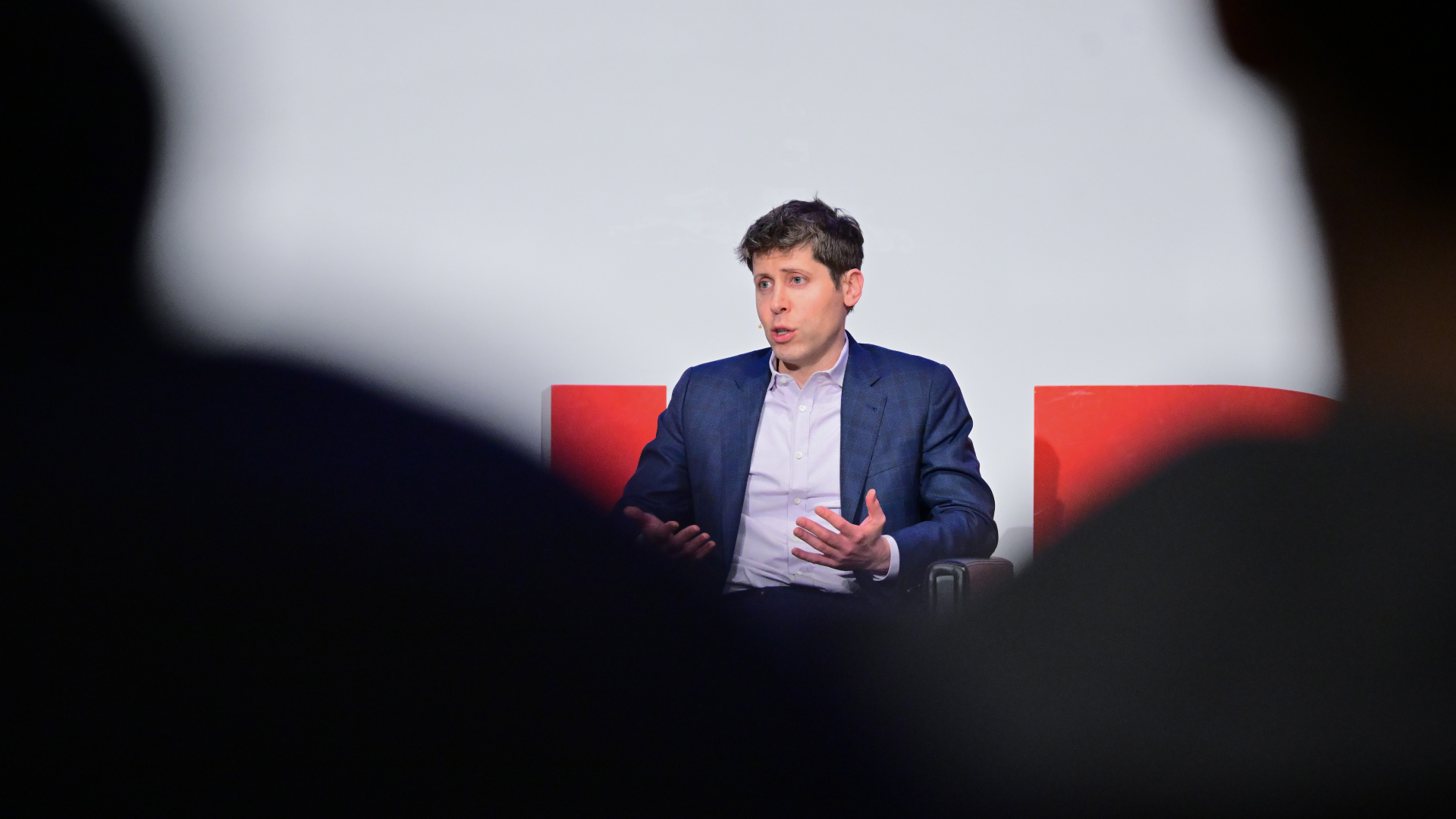
Sam Altman, co-founder and CEO of OpenAI, speaks during a panel discussion on the future of artificial intelligence at TU Berlin. (Sebastian Gollnow via Getty Images)
This partial transcript was computer-generated. While our team has reviewed it, there may be errors.
Alexis Madrigal: Welcome to Forum. I’m Alexis Madrigal.
The keyword here in the early part of our discussion is CapEx — that is, capital expenditures, or the money companies spend on long-term productive assets. Right now, if you’re a big tech company, your CapEx spending is exploding because you need — or think you need — to build massive data centers to train and run AI models.
In a single fiscal year, Meta might spend $70 billion, Google $85 billion, Microsoft $100 billion, Amazon $105 billion. This is crazy money, even by technology industry standards, and it’s warping the dynamics of our economy and our world.
Joining us to discuss: Zoë Schiffer, who oversees coverage of business in Silicon Valley at Wired. Welcome, Zoë.
Zoë Schiffer: Thanks for having me.
Alexis Madrigal: We’ve got Mat Honan, editor-in-chief of MIT Technology Review. Welcome, Mat.
Mat Honan: Thanks for having me too.
Alexis Madrigal: And Brian Merchant, a tech journalist who writes the Blood in the Machine newsletter and is the author of Blood in the Machine: The Origins of the Rebellion Against Big Tech. Welcome, Brian.
Brian Merchant: Thanks, Alexis.
Alexis Madrigal: So, Mat, let’s take a step back here at the beginning. The spending we’re seeing is wild — why is it happening? There have been cloud services, people have used Google Docs and Gmail for a long time. What’s different about these AI models that requires such huge buildouts?
Mat Honan: They’re extremely compute-intensive. The phrase you hear a lot is “compute,” which basically means they need a lot of processors and equipment to actually do what they do.
We did a big package on AI and energy earlier this year at Tech Review. One of the takeaways is that people are actually using it a lot, and we’re moving to a world with lots of “inference,” where data centers are being used by people querying these systems.
If you want to get your product out to a billion or more people, you’ve got to have these data centers to support it. There’s an arms race to be the company that can own a lot of this infrastructure — whether that ends up being OpenAI, Google, or someone else remains to be seen. They’re building it now to try and get a billion people using their products. It’s crazy.
Alexis Madrigal: And so these things are basically just a lot of GPUs, the way the systems work — particular kinds of chips — all sitting somewhere, drawing a lot of energy and doing the work of AI?
Mat Honan: Yeah. They’re sitting all over the country — tons in Virginia, Nevada, Texas — with data centers across the U.S. Think of them as a lot of chips wired together in giant buildings that use enormous amounts of electricity and a ton of water to keep them cool because they put off a lot of heat. Those chips all work in harmony to deliver your — often incorrect — answer.
Alexis Madrigal: Sometimes incorrect.
In 2009, I remember some Google researchers put out a commentary called “The Unreasonable Effectiveness of Data,” and it feels like that’s been a governing philosophy: more is more. The ideas for how these systems work are actually quite old, but the sheer volume of compute power and data is what’s new.
Mat Honan: That was the big argument a few years ago — just keep making these models bigger —and people have just been scaling ever since.
Alexis Madrigal: Zoë, you oversee business coverage. Have any company boards been like, “Maybe we’re spending too much”? Or is it the opposite — “Spend, spend, spend. Let’s go”?
Zoë Schiffer: You’re not seeing much fear about spending. In Q2 of this year, we looked at financial filings, and AI is a major driver of customer demand in search, advertising, and cloud computing. Even though these companies are spending billions every quarter on infrastructure, they’re actually increasing that spending to expand capacity. So far, investors are supportive.
Alexis Madrigal: What about smaller companies? Are they doing the same thing, or piggybacking on big tech?
Zoë Schiffer: It’s probably difficult right now to be a truly small AI company building frontier models. We’re seeing them backed by very large investors because you just need so much compute, like Mat said.
Alexis Madrigal: Brian, you wrote about this. Paul Kedrosky, a gimlet-eyed investor, compared what’s happening not just to major telecoms building out broadband, but also to the railroads — in terms of the intensity of the spend as a percentage of GDP. Do you buy that comparison?
Brian Merchant: It’s on its way there. That might have been a bit of a reach, but if it continues at this level without slowing down, we could get there.
Alexis Madrigal: One of Kedrosky’s other points was that the spending has been so huge it contributed more to GDP growth in the last quarter than all U.S. consumer spending. What do we make of that?
Brian Merchant: It’s wild. Consumer spending was lower than usual, which gave this AI spend an opportunity to overtake it. Some economists wonder whether AI spending is a bubble — and if so, whether it could drag down more than just the AI industry. Right now, AI spending is essentially propping up the economy.
Alexis Madrigal: Zoë, in your world, how did that argument land — that AI spending is serving as a kind of stimulus to make the economy look stronger?
Zoë Schiffer: I think there’s a lot to that. The big AI names talk about it constantly — they see it as America’s edge. But it’s also fundraising gold. Right now, it’s a self-fulfilling prophecy. The fear is that if it’s a bubble, it could affect more than just AI.
Alexis Madrigal: Mat, you’ve been in this game a long time. How would we even know if it’s a bubble?
Mat Honan: Usually when it’s too late. As long as the music keeps playing, everybody keeps dancing.
Alexis Madrigal: I guess another way of asking is: is the spending necessary for these companies’ goals and consumer demand, or is it just keeping up with peers so no one questions their AI strategy?
Zoë Schiffer: They truly believe it’s necessary. People building frontier models say they need the data centers and energy to make it happen. But GPT-5 and other models do raise the question: is more actually better? Are scaling laws holding, or do we need a new breakthrough to reach artificial general intelligence?
Alexis Madrigal: I was curious about that Chinese model DeepSeek that didn’t require as much hardware but performed well for the compute it used. Maybe companies would try different strategies rather than just scaling up — but it doesn’t seem like that’s happened, Mat.
Mat Honan: Some different strategies have emerged — smaller language models, more efficiency — but the big picture is still about scaling.
Alexis Madrigal: Can we talk about environmental costs? How do we weigh those against the output of these data centers?
Mat Honan: We should weigh them, but as a society we’re not doing it effectively. Data centers use enormous energy. Nuclear power could help, but that’s ten years away. In the short term, more natural gas plants will likely be built. We’ve seen reports of methane-spewing generators, rising electricity rates, and groundwater impacts. The promise is that AI will sort it all out, but right now it still struggles with basic tasks — which should make us skeptical about investing so heavily in it as part of our energy future.
Alexis Madrigal: Some energy folks told us recently that 25% of Virginia’s electricity is going to data centers. That’s huge, especially after years of flat energy demand.
Mat Honan: Texas has had similar issues. They brought in a lot of data centers — for crypto and AI — and during brownouts, it’s clear that was a mistake.
Alexis Madrigal: We’re talking about the newest developments in the AI industry with Mat Honan of MIT Technology Review; Brian Merchant, journalist and author of Blood in the Machine; and Zoë Schiffer of Wired magazine.
We want to hear from you — what do you think about all this AI investment? Good? Bad? How’s it going for the economy? Call us at 866-733-6786. Email [email protected]. Find us on social media @KQEDForum.
I’m Alexis Madrigal. Stay tuned.