In the past, a U.S. president deployed the National Guard on domestic soil to enforce laws or quash protests once every few decades in extremely rare circumstances. President Donald Trump has now done so twice in a matter of three months.. The first was in June to tamp down protests against his immigration policies in Los Angeles. A federal trial began Monday over whether Trump had the authority to order that deployment. Also on Monday, Trump announced sending the National Guards to Washington D.C. to fight crime and clear homeless shelters, despite the city reporting its lowest crime rate in 30 years. We’ll talk about how Trump is breaking precedents using federal troops for local law enforcement and what it means for our nation.
What Does Donald Trump’s Use of the National Guard Mean for our Democracy?
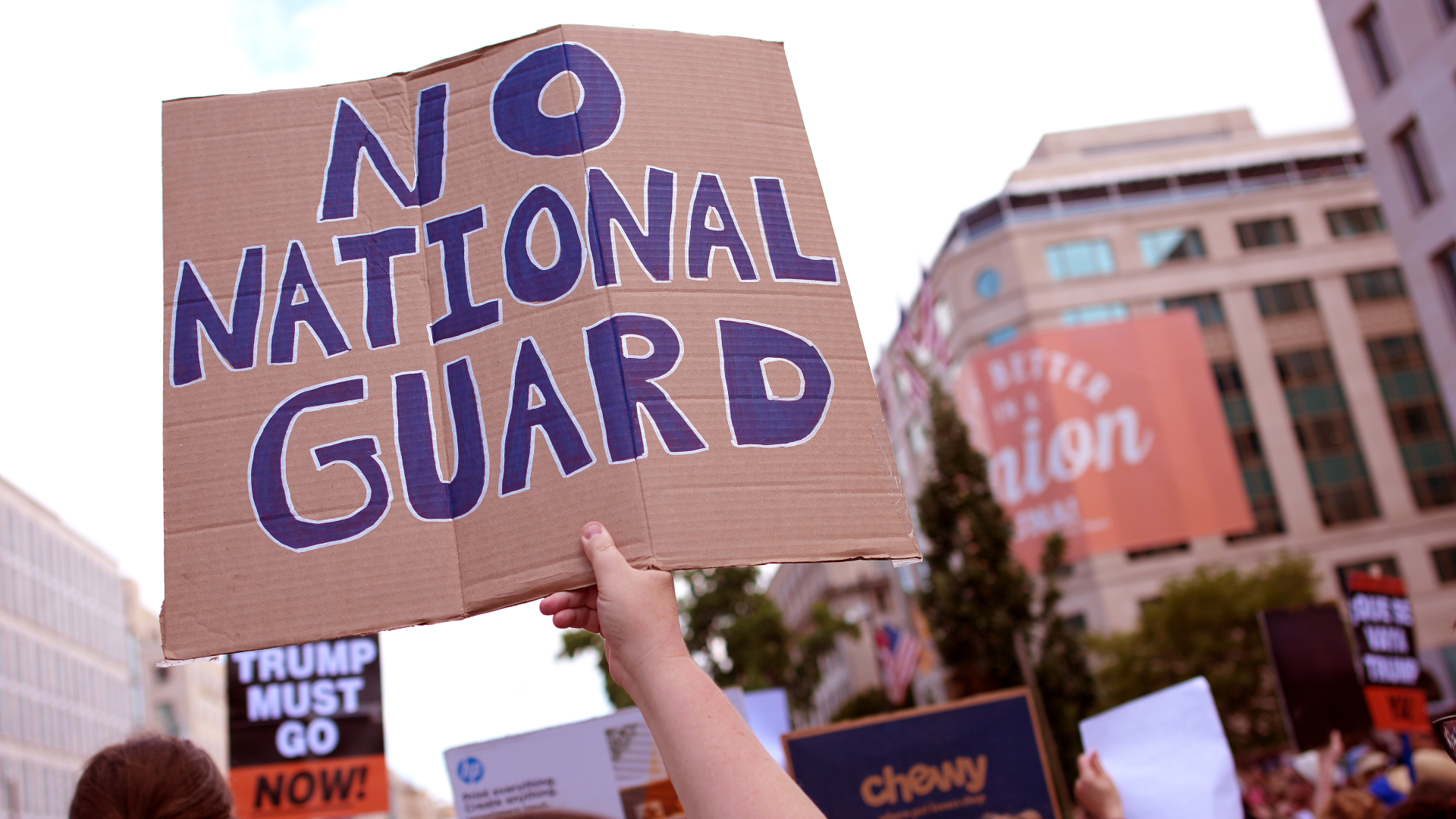
People participate in a rally against the Trump Administration's federal takeover of the District of Columbia, outside of the AFL-CIO on August 11, 2025 in Washington, DC. (Kevin Dietsch via Getty Images)
This partial transcript was computer-generated. While our team has reviewed it, there may be errors.
Alexis Madrigal: From KQED in San Francisco, I’m Alexis Madrigal. Donald Trump announced yesterday that he was deploying the National Guard in Washington, D.C., invoking a barrage of crime stats about the nation’s capital. He also mentioned Oakland by name. And the federal trial about his deployment of the National Guard in Los Angeles began this week. We’ll talk about these precedent-breaking deployments and what they mean for our nation’s democracy. That’s all coming up next, right after this news.
Welcome to Forum. I’m Alexis Madrigal. It is not unprecedented to deploy the National Guard on domestic soil — presidents from both parties have done it, particularly during the civil rights era in the South. But it has not been a common occurrence. Donald Trump has now deployed the National Guard twice in a few months, first in Los Angeles and now in Washington, D.C.
We’ll talk about Trump’s stated rationale, the legal issues at play, and where this new version of Trumpism fits in the long American democratic experiment. We’re joined this morning by Shawn Hubler, California correspondent with The New York Times. Welcome.
Shawn Hubler: Hello.
Alexis Madrigal: We’ve also got Jenny Jarvey, national correspondent with The Los Angeles Times. Welcome.
Jenny Jarvey: Hi. Thanks.
Alexis Madrigal: And we’ve got Laura Dickinson, professor of law at the George Washington University Law School. Welcome.
Laura Dickinson: Thanks for having me.
Alexis Madrigal: Jenny, let’s start with you. Can you tell us about Trump’s announcement yesterday about bringing the National Guard into D.C.? What was that press conference like?
Jenny Jarvey: Yeah. Well, he started off by saying that he would take federal control of Washington’s police department and activate 800 National Guard troops to help reestablish law and order. And he portrayed D.C. in very gruesome, apocalyptic terms. He described it — in his words — as a “terrifying hellscape” of crime, bloodshed, bedlam, and squalor, overtaken by bloodthirsty criminals and roving mobs of wild youth. So he said he planned to “get tough.”
He also suggested that other cities might be targeted — from Portland and Baltimore to Oakland. And he said that crime in D.C. is rising. That’s not exactly true. Well, it’s not true. Crime in D.C. is high compared to other cities across the country, but it’s also lower than it has been in decades. Data show that violent crime has declined significantly in D.C. over the last few years and is now at a 30-year low.
Alexis Madrigal: Yeah, I mean, I’m just looking at a Justice Department press release from January 2025 saying violent crime in D.C. hit a 30-year low. But, of course, there is still a substantial amount of crime and violence in Washington. Has anybody in the city asked for this sort of National Guard deployment? Have the police been calling for it, or is this purely a Trump maneuver?
Jenny Jarvey: The mayor of D.C. has described it as unsettling and unprecedented. She has not called for it, even though she says she’s tried to cooperate with federal officials leading up to this.
In a fact sheet yesterday, the Trump administration pointed out that D.C. has a very high homicide rate — about 27 per 100,000 residents, the fourth highest in the nation. For context, Compton’s is 20 per 100,000 and L.A.’s is around 7 per 100,000.
Officials in D.C., however, say that since 2023, they’ve been working hard to cut down on juvenile crime. They note their office has prosecuted over 90% of homicide and attempted homicide cases, 88% of violent assault cases, and 87% of carjacking cases. So there’s a gulf between what local officials are saying and what federal officials are saying about the state of crime in the area.
Alexis Madrigal: Well, and I think it contrasts with what we’ve seen in many American cities: massively high crime rates during the 1990s falling over the next few decades to lows in the late 2010s, then a spike during the pandemic, peaking in different cities at different times but drifting down in 2024 and beyond. That seems to track with Washington, D.C. as well.
You mentioned that Donald Trump singled out Oakland. Just for listeners who haven’t heard this yet — we’re not going to play it for you, but I’ll read it. Trump said:
“You look at Chicago, how bad it is. You look at Los Angeles, how bad it is. We have other cities that are very bad. New York has a problem. And then you have, of course, Baltimore and Oakland. We don’t even mention that anymore. They’re so far gone. We’re not gonna let it happen. We’re not gonna lose our cities over this.”
It was kind of a side swipe — he didn’t say he’s going to do anything specifically with Oakland. But we did have Barbara Lee responding, and our mayor here said he’s misrepresenting the city of Oakland, right?
Jenny Jarvey: Right. And I think there’s concern from mayors in California and across the country about what might take place next. They’ve already seen federal troops in Los Angeles, now D.C. The contexts are somewhat different in that D.C. isn’t a state, so Trump has slightly different authority there. But there’s concern about the extent to which this endeavor will be replicated across the country.
Alexis Madrigal: And some of that may rest on legal wrangling. Shawn Hubler, the trial over Trump’s deployment of the National Guard in Los Angeles back in June has begun. Tell us about what happened yesterday and what the trial is meant to decide.
Shawn Hubler: The trial is an offshoot of an attempt to stop the deployment that began very quickly after troops showed up on June 7. The question is whether the National Guard in L.A. has been used legally or has crossed the line into an illegal use of the military for domestic law enforcement.
Yesterday’s testimony included military officers in charge of the deployment and an ICE agent who was director of field operations in L.A. They described how the troops were used — whether specifically for law enforcement or as muscle backup for federal agents enforcing immigration law.
Alexis Madrigal: Why is that an important legal distinction? For those of us watching on TV, the National Guard in the streets looks like law enforcement. What’s the legal hair being split here?
Shawn Hubler: Most Americans know it’s rare for the military to be used for domestic law enforcement. There’s a reason we have local police to control crime and respond to protests — not the military.
That’s because of a law from the late 1800s, the Posse Comitatus Act, which forbids the use of the military for domestic law enforcement unless there’s an insurrection. The Trump administration didn’t declare an insurrection. Instead, they said they were deploying troops under Title 10 of the U.S. Code to protect federal agents enforcing federal law.
They argued this was necessary because California’s sanctuary law limits local law enforcement’s ability to help federal authorities with immigration enforcement. This law was passed during Trump’s first administration and has long been a sore spot between California and the president. The administration also cited protests and said they needed to “get Los Angeles back under control.”
Alexis Madrigal: Laura Dickinson, you’re a professor of law. Is that an argument you’ve often seen over the decades?
Laura Dickinson: No, this is very unusual — whether in D.C., L.A., or the other cities Trump is talking about. As Shawn noted, it’s very rare for the military to be used for domestic law enforcement. That’s reflected in our constitutional history, our constitutional text, and federal law.
The Posse Comitatus Act prohibits the military or federalized National Guard from conducting direct law enforcement unless there’s a specific exception. The reason is that in a democracy, you don’t want the military doing normal policing. They’re trained for other things, use force differently — that should be left to better-trained local police, unless there’s a real emergency.
D.C. is unique because it’s not a state. Under D.C. law, the president does have broad authority to use the National Guard. But even so, it’s arguably unprecedented for a president to call in the National Guard for what appears to be ordinary law enforcement without an emergency. And it’s not clear what they’ll actually be doing.
Alexis Madrigal: We’ll get to that in the next part of the show. We’re talking about how Trump is breaking precedent by using federal troops. We’re joined by Laura Dickinson from the George Washington University Law School, Jenny Jarvey from The Los Angeles Times, and Shawn Hubler with The New York Times. We’ll be back with more right after the break.