As ICE raids sweep across the country as a part of President Trump’s anti-immigrant policies, ethnic media outlets in California are playing an invaluable role keeping the communities they serve informed. We talk with media organizations that serve immigrant and diaspora audiences about how their communities are dealing with the impacts of the administration’s enforcement actions, how their approaches to news coverage has had to change, and what they think is coming next.
Where Mainstream Immigration Reporting Falls Short, Ethnic Media Outlets Step Up
We talk with media organizations that serve immigrant and diaspora audiences about how their communities are dealing with the impacts of the administration's enforcement actions, how their approaches to news coverage has had to change and what they think is coming next.
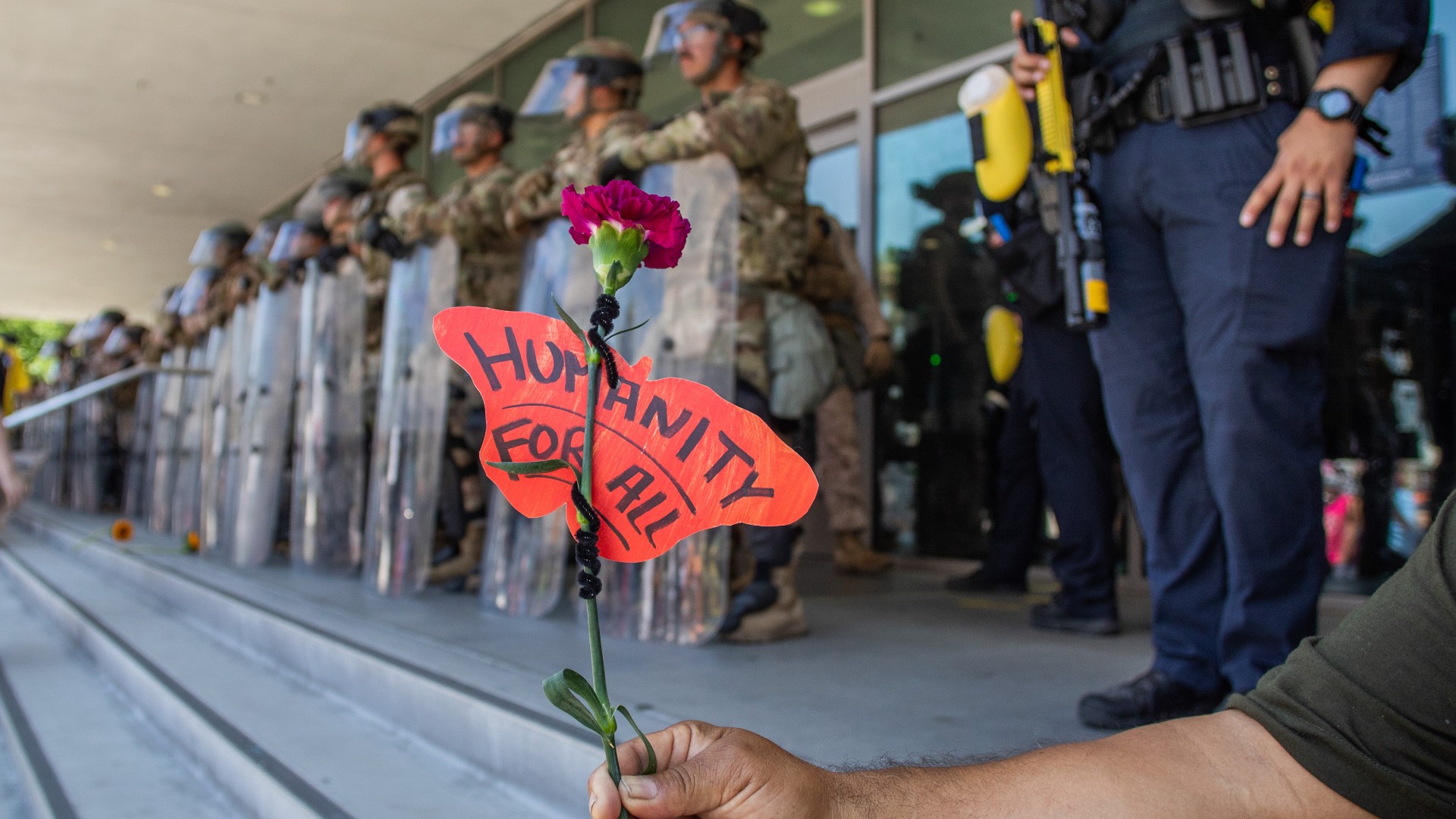
Xavier Deanda holds a flower and the message "Humanity for All" in front of the Federal building while a mix of the U.S. Marines, California National Guard and the Homeland Security officers guard the building during a protest against ICE raids on July 4, 2025 in Los Angeles, California. (Apu Gomes via Getty Images)
Here’s a breakdown of what each panelist brought to the table in our conversation about how ethnic media outlets are covering the Trump-era immigration crackdown. From street-level reporting to culturally attuned resource hubs, these organizations are delivering the information their communities need to stay safe, informed and connected.
Memo Torres (LA Taco)
LA Taco has pivoted its coverage almost entirely toward documenting ICE raids across Los Angeles. Known for his “Daily Memo” video dispatches, Memo Torres distills verified information about ICE and Border Patrol activity—including locations of raids, arrests, protests, and legal developments—into digestible nightly summaries.
“There was an abduction here. There was a raid there. They took three people over there. They arrested a US citizen over here,” he illustrated. His videos have created community feedback loops, with his viewers sharing sightings, identifying loved ones in videos and providing contextual updates. Much of this reporting involves discerning real ICE activity from rumors or police operations, particularly given masked agents and unmarked vehicles.
The recent raids, he said, are unprecedented in their intensity. He likened the atmosphere to “a method cleansing” with tactical gear, tear gas and flashbangs.
Despite the scale of what’s unfolding, Torres noted that “mainstream media will take the one big viral story”—investing heavily in a single flashpoint while leaving countless other incidents in the dark.
Julian Do (American Community Media)
Julian Do shared a broad perspective on the role of ethnic media. He said many journalists in ethnic media see themselves as “part of the community,” organizing legal clinics and forums, and providing crucial guidance on rights and legal risks. “They take on the role of being an advocate,” he said.
Do pointed out that for many immigrant communities, particularly Asian populations, recent ICE tactics echo traumatic experiences from their countries of origin—contributing to heightened fear and withdrawal from public life.
Do also brought up the financial precarity of many ethnic media outlets, which continue to serve their communities despite dwindling resources and shrinking news ecosystems. “There’s no clear answers,” he said, “but they feel very compelled to continue to serve.”
Tanay Gokhale (India Currents)
Tanay Gokhale brought attention to the often-overlooked population of undocumented Indian immigrants, estimated between 350,000 and 700,000. He raised the mounting anxieties facing H-1B workers, international students and undocumented residents—many of whom are navigating a system that wasn’t built with them in mind. “It’s a stressful time,” he said.
Gokhale said that some expecting parents are seeking early deliveries to ensure their children will qualify for U.S. citizenship. And in Fresno and other Central Valley communities, the fear is palpable: fewer people are visiting Indian grocery stores, and many are avoiding hospitals or public spaces altogether.
Sikh communities—many of whom are truck drivers or farm workers—are particularly at risk due to language barriers and recency of arrival, he said.
Madeleine Bair (El Tímpano)
El Tímpano delivers hyperlocal news in Spanish and Mayan Mam via text and Facebook, meeting East Bay residents where they are—and often, where no one else is. Madeleine Bair said Mayan Mam speakers are particularly vulnerable, facing steep linguistic, literacy and technological barriers. The questions her newsroom fields—how to get a passport for a U.S.-born child, how to prepare for possible family separation—show the daily fear so many families now live with.
Bair also talked about the corrosive impact of misinformation, noting that many subscribers reach out to verify rumors of ICE raids—most of which turn out to be false. In response, El Tímpano has made media literacy part of its mission. “Maybe when you see that posting on WhatsApp or on Facebook, don’t initially respond with panic,” she said.
On the Medi-Cal data breach—where immigration status was shared with the Department of Homeland Security—Bair said: “It’s contrary to what so many medical providers have been working on for ten years in trying to gain the trust of immigrants.”
Dzung Do (Nguoi Viet Daily News)
Dzung Do spoke to the deepening fear within the Vietnamese community, particularly among older immigrants whose legal status exists in a gray zone. For years, a pre-1995 agreement protected many from deportation—but recent shifts have stripped away that safeguard. The result is heightened anxiety for those who’ve lived in the U.S. for decades and built stable lives. Misinformation has only made matters worse, with rumors spreading that a visit to Vietnam could jeopardize reentry to the U.S.
On the media front, Do noted that while Nguoi Viet remains the last Vietnamese daily still publishing, the outlet has had to adapt to survive. “We have a YouTube channel. We’re online, and we have Facebook,” he said. “Social media is now the main focus for us.”
This content was edited by the Forum production team but was generated with the help of AI.