Handmade Tofu and Mochi Keep Traditions Alive in San Jose’s Japantown
Get it quick before it's gone! Handmade tofu and mochi sweets in San Jose's Japantown. Two devoted husband and wife teams have been quietly keeping tradition alive for more than 25 years with the sweetest results. No preservatives, no automation, just loving hands and hard work.
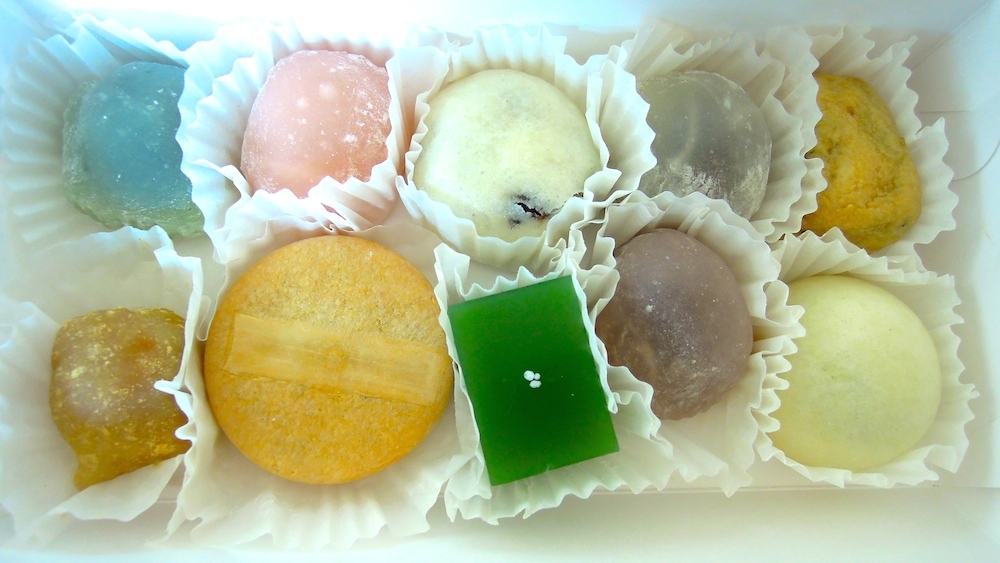
Handmade mochi and manju from Shuei-Do Manju Shop in San Jose Japantown. Photo: Anna Mindess
Amy Nozaki patted the jiggly block of tofu she has just uncovered after pressing it in a wooden crate and pronounced it “perfect.” She and her husband Chester run The San Jose Tofu Company, which may be the last local shop to make tofu the traditional way, completely by hand. This physically demanding, time-consuming process creates creamy blocks of utter freshness: sweet, silky, slightly nutty bean curd that is as far from those chalky chunks packed with preservatives in plastic tubs as a loaf of Acme's Pain au Levain is from Wonder Bread.
San Jose’s Nihon Machi, a long, wide city block, is one of only three Japantowns nationwide. (The others are Los Angeles’ Little Tokyo and San Francisco’s Japantown -- which I previously profiled on an Edible Excursions tasting tour).
Chester Nozaki, whose grandfather started San Jose Tofu Company in 1946. Photo: Anna Mindess
On my recent foray to San Jose’s Jackson Street, nestled among the gift shops, ukulele stores, ramen and sushi spots, I discovered two culinary cultural gems run with devotion by husband and wife teams: the Nozakis and the Kumamarus.
The San Jose Tofu Company was started in 1946 by Chester Nozaki’s grandfather and passed down to Chester’s father. Although Chester had worked in the shop as a boy, delivering fresh tofu on his trusty red Radio Flyer wagon, as the second son he had no plans to follow in his father’s footsteps. In fact, he was studying industrial engineering. But when his older brother declined to inherit the tofu company, Chester dropped out of college and stepped in to help his father. He met his future wife, Amy when she was a waitress at a Japanese restaurant down the street from the tofu shop. Amy, originally from Taiwan, turned out to have an innate talent making tofu and eventually joined the family team.
The mild-mannered Chester told me about a turning point in his life, “When I was in my 40s, customers began asking me if I was ever going to take over the business.” Emboldened, Chester informed his father that he didn’t want to wait until he was 64 years old to take the reins. As an oblique answer, his father immediately handed over the ledger book and described how he should make payments to vendors.
Once he was in charge, Chester’s first thought was to automate the business in order to produce more tofu. His father, in his characteristic soft-spoken manner, made it quite clear that this was not an option. Nowadays, Chester is in charge of PR and the business side, while deferring the cooking duties to his wife’s skill and intuition. Amy, clad in boots and apron, deftly navigated the slippery floor in the open kitchen, a simple set-up that allows the steady stream of customers to view the entire tofu-making process.
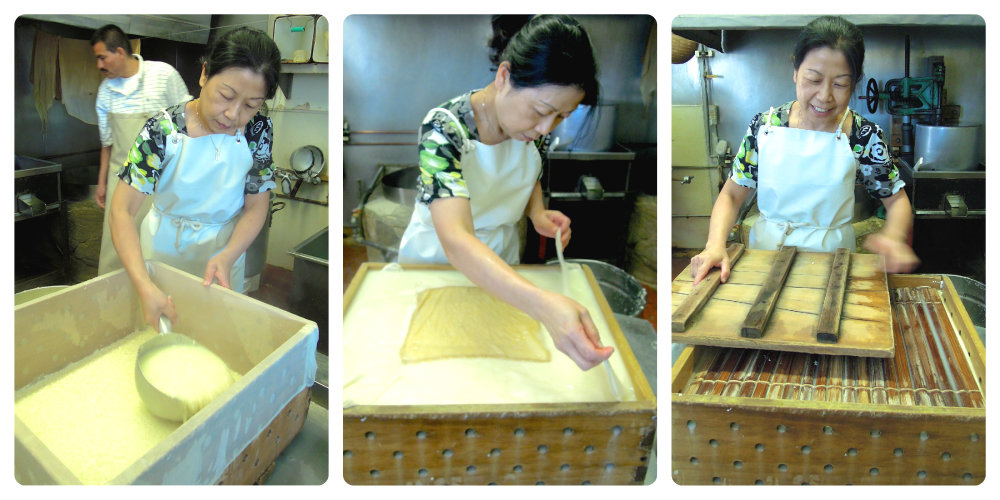
Amy Nozaki in a few of the steps involved in making tofu by hand. Photo: Anna Mindess
With the vagaries of weather and over 200 possible varieties of non-GMO soybeans, there is no ironclad recipe for length of cooking and pressing. “It all depends,” said Amy explaining that she does everything by feel. After the beans are soaked overnight, ground with the help of the shop’s lone machine (a bean grinder), they are cooked in water, then transferred to a hand-operated bean press which liquifies the ground beans into warm soy milk. A natural coagulant, nigari, is added to the soy milk. Armed with a large paddle, Amy stirred the curds in a huge pot until just the right consistency was achieved, then scooped them into wide rectangular wooden crates, lined with cheesecloth. These are covered with wooden mats and heavy weights for about a half an hour until they reach the desired density. Amy then turns out the scored tofu blocks to bobble in a cool water bath and hand cuts them into cubes.
Two years ago, the Nozakis added a new product to their line, a softer textured “tofu pudding” which comes with a brown sugar and ginger syrup, a traditional Taiwanese combination. This popular sweet sells out quickly every day.
Many of the customers are regulars who come into the shop armed with their own plastic tubs to transport their delicacies. The Nozakis sell to a few nearby markets but without any preservatives their tofu is at its best for only a few days. A while back, Iron Chef Morimoto visited the shop while he was setting up his restaurant in Napa. When he tasted the Nozakis’ tofu he was impressed with its sweetness and informed them he would serve it at his restaurant as long as they could deliver to Napa. Chester smiled ruefully and explained that he had to turn down the Chef’s request as his tiny family business didn’t have the resources to make such deliveries.
Batches of the Nozakis’ fresh tofu are produced all day long and usually sell out completely. “Quality is more important than quantity,” Chester said modestly. “Back in the store’s heyday we were producing up to 1600 blocks a day (versus the millions made by automated production companies). But the economic downturn had an impact and now we average 400-500 blocks a day. Our customer base is changing too as elderly Japanese customers are thinning out. But we are getting more Chinese, Korean, and Vietnamese consumers as well as a few Caucasians and Latinos.”
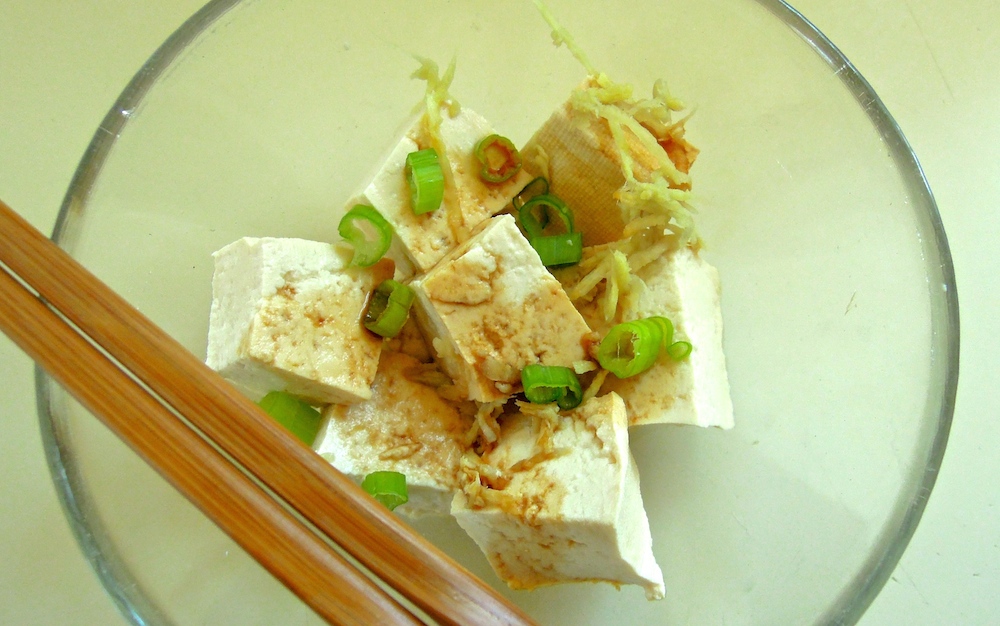
When I took my precious bundle of tofu home, I decided to let its pure fresh taste shine through and so prepared it in the simplest fashion: topped with grated ginger, chopped scallions and a drizzle of soy sauce.
The freshest tofu deserves the simplest preparation. Photo: Anna Mindess
Puffy Sweet Treats
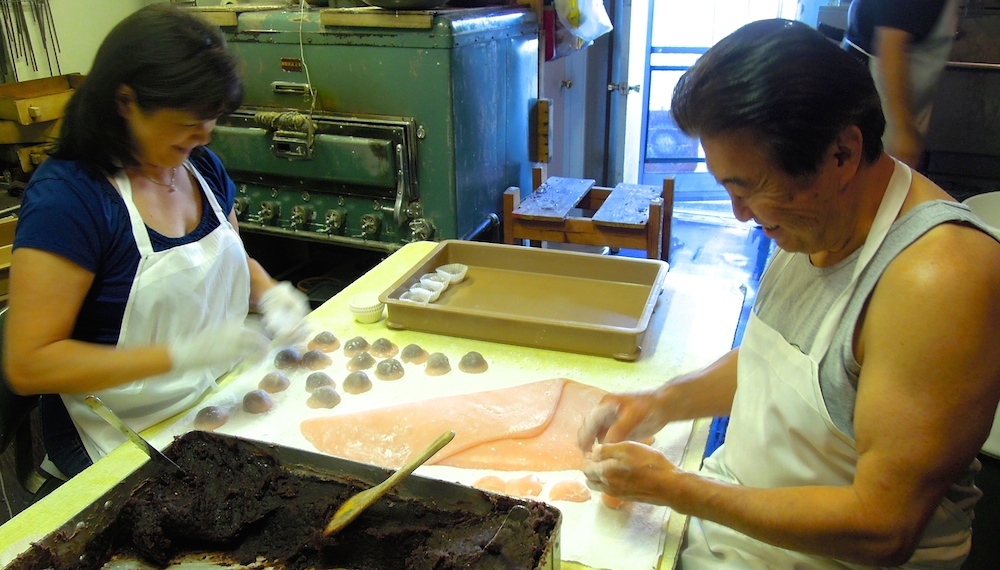
In a modest shop down the street from the Nozaki's tofu shop, a long glass case holds jewel-toned gems of sweetness: enticing orbs of pink, mauve, and gold. In the back room of Shuei-Do Manju Shop, I met Tom and Judy Kumamaru and learned the secrets behind these traditional Japanese treats. The couple sat amiably across from each other in the humid, sweet-scented room, like they have for 27 years, with a glowing pastel blob of hot rice flour mochi between them, their hands a blur of movement: pinch-stuff-fold-roll-pinch-stuff-fold-roll. They produce 800-1000 sweets a day: puffy pillows of rice flour mochi, glowing green yokan jelly cubes, strawberry chichidango or golden baked manju—most stuffed with the traditional red adzuki bean or white lima bean fillings, in a variety of shapes and combinations.
Judy and Tom Kumamaru have made mochi together for 27 years. Photo: Anna Mindess
Before they started making these soft sweet clouds, the couple fabricated other things. Judy was a dental technician fashioning false teeth and Tom manufactured printed circuit boards. With the looming prospect of layoffs in their future, they became interested in the idea of owning their own business.
Shuei-Do Manju Shop (the name literally means “gathering place”) has been around for 62 years and was established by another husband and wife team: the Ozawas. They ran the business for the first 35 years and were friends with Judy’s parents. One day while the four elders were on a fishing trip, Judy’s parents who were big fans of the store remarked that when the Ozawas retired, maybe one of their children could take over their business.
During the ensuing negotiations, the Ozawas promised to train Tom and Judy for the first 6 months of ownership, but there was just one snag. They refused to let them see the back room where the actual labor occurred until the deal was signed. “Maybe they thought we would get scared to see how much work it really took,” quips Judy smiling.
Tom, who was born in Japan and came to California when he was 4 years old, grew up in Stockton, where his father worked as a gardener and tofu maker. He wasn’t particularly fond of sweets. Now his days are filled with them. The beans for the anko fillings must be soaked overnight, then cooked, strained and pressed. He cooks the bean fillings, whips the hot rice mochi so it will have the proper elasticity and helps his wife roll out multitudes of little balls.
Stuff mochi ball with sweet bean filling. Repeat 800 times a day. Photo: Anna Mindess
Tom and Judy make 18 different kinds of manju and mochi, including a wildly popular variety for the traditional Japanese celebration of “Girls’ Day” in March—sakura mochi with textured pink rice wrapped in a cherry leaf. Although you can find boxed mochi in stores from Japantown to Trader Joe's, like the Nozakis, the Kumamarus use no preservatives, so their products are at their best for just a few days (but Tom says you can freeze them). They sell to a handful of stores and have a standing order for Apple. Steve Jobs had such an affection for handmade mochi that he told his chef to fly to Japan to procure some. A bit of research turned up Shuei-Do just 10 miles away, where Apple still has a standing order twice a week.
“Converting to machine-made mochi and manju is tempting; we could make maybe 2000 pieces an hour," said Tom, "but then we would lose our uniqueness. It’s important to carry on the tradition of working hard so that Japantown does not lose its special flavor. What makes me happy is seeing how customers react to their first taste,” added Tom, who was impressed to learn that many of his patrons hailed from countries across the globe, including Germany, Australia and Saudi Arabia. His rice flour treats also attract Asian customers, whose own cuisines feature similar rice flour sweets, including Korea, Vietnam and the Philippines.
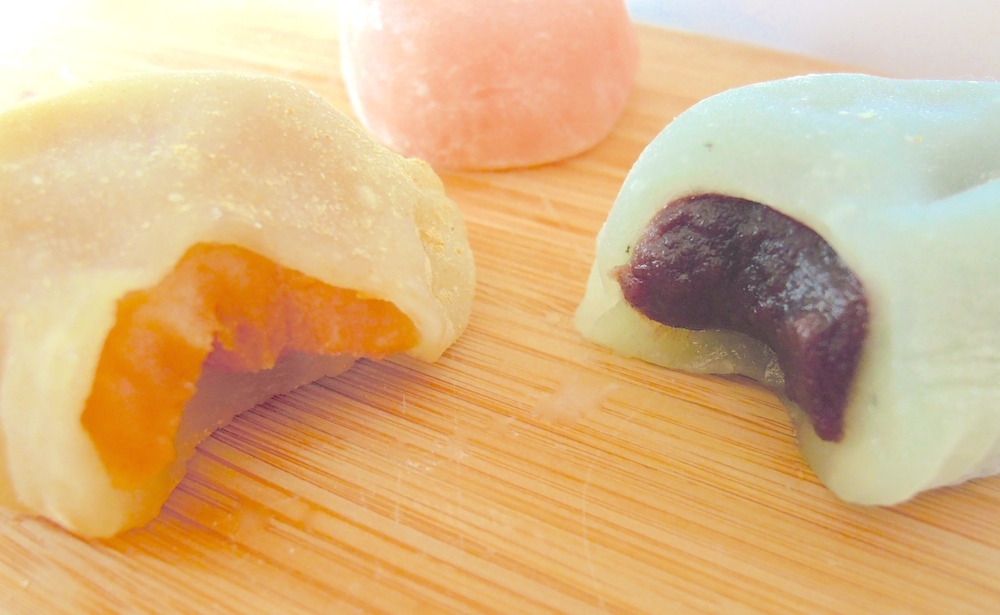
Mochi balls' sweet bean fillings. Photo: Anna Mindess
The classic Japanese filling is sweetened bean paste, but that doesn’t stop customers from making other requests. “People ask us to fill them with berries or chocolate,” said Judy, “but we prefer to stick to the traditional.” The one concession they’ve made is a crunchy peanut butter-filled mochi that achieves the perfect balance of sweet and salty.
Perhaps not surprisingly in the 21st century, neither the Nozakis’ nor the Kumamarus’ children (who are all in their 20s) have expressed any interest in taking over their parents’ businesses, so the future of these two cultural gems is uncertain, which makes their traditionally-made tofu and mochi all the more precious.
window.__IS_SSR__=true
window.__INITIAL_STATE__={
"attachmentsReducer": {
"audio_0": {
"type": "attachments",
"id": "audio_0",
"imgSizes": {
"kqedFullSize": {
"file": "https://ww2.kqed.org/news/wp-content/themes/KQED-unified/img/audio_bgs/background0.jpg"
}
}
},
"audio_1": {
"type": "attachments",
"id": "audio_1",
"imgSizes": {
"kqedFullSize": {
"file": "https://ww2.kqed.org/news/wp-content/themes/KQED-unified/img/audio_bgs/background1.jpg"
}
}
},
"audio_2": {
"type": "attachments",
"id": "audio_2",
"imgSizes": {
"kqedFullSize": {
"file": "https://ww2.kqed.org/news/wp-content/themes/KQED-unified/img/audio_bgs/background2.jpg"
}
}
},
"audio_3": {
"type": "attachments",
"id": "audio_3",
"imgSizes": {
"kqedFullSize": {
"file": "https://ww2.kqed.org/news/wp-content/themes/KQED-unified/img/audio_bgs/background3.jpg"
}
}
},
"audio_4": {
"type": "attachments",
"id": "audio_4",
"imgSizes": {
"kqedFullSize": {
"file": "https://ww2.kqed.org/news/wp-content/themes/KQED-unified/img/audio_bgs/background4.jpg"
}
}
},
"placeholder": {
"type": "attachments",
"id": "placeholder",
"imgSizes": {
"thumbnail": {
"file": "https://cdn.kqed.org/wp-content/uploads/2024/12/KQED-Default-Image-816638274-2000x1333-1-160x107.jpg",
"width": 160,
"height": 107,
"mimeType": "image/jpeg"
},
"medium": {
"file": "https://cdn.kqed.org/wp-content/uploads/2024/12/KQED-Default-Image-816638274-2000x1333-1-800x533.jpg",
"width": 800,
"height": 533,
"mimeType": "image/jpeg"
},
"medium_large": {
"file": "https://cdn.kqed.org/wp-content/uploads/2024/12/KQED-Default-Image-816638274-2000x1333-1-768x512.jpg",
"width": 768,
"height": 512,
"mimeType": "image/jpeg"
},
"large": {
"file": "https://cdn.kqed.org/wp-content/uploads/2024/12/KQED-Default-Image-816638274-2000x1333-1-1020x680.jpg",
"width": 1020,
"height": 680,
"mimeType": "image/jpeg"
},
"1536x1536": {
"file": "https://cdn.kqed.org/wp-content/uploads/2024/12/KQED-Default-Image-816638274-2000x1333-1-1536x1024.jpg",
"width": 1536,
"height": 1024,
"mimeType": "image/jpeg"
},
"fd-lrg": {
"file": "https://cdn.kqed.org/wp-content/uploads/2024/12/KQED-Default-Image-816638274-2000x1333-1-1536x1024.jpg",
"width": 1536,
"height": 1024,
"mimeType": "image/jpeg"
},
"fd-med": {
"file": "https://cdn.kqed.org/wp-content/uploads/2024/12/KQED-Default-Image-816638274-2000x1333-1-1020x680.jpg",
"width": 1020,
"height": 680,
"mimeType": "image/jpeg"
},
"fd-sm": {
"file": "https://cdn.kqed.org/wp-content/uploads/2024/12/KQED-Default-Image-816638274-2000x1333-1-800x533.jpg",
"width": 800,
"height": 533,
"mimeType": "image/jpeg"
},
"post-thumbnail": {
"file": "https://cdn.kqed.org/wp-content/uploads/2024/12/KQED-Default-Image-816638274-2000x1333-1-672x372.jpg",
"width": 672,
"height": 372,
"mimeType": "image/jpeg"
},
"twentyfourteen-full-width": {
"file": "https://cdn.kqed.org/wp-content/uploads/2024/12/KQED-Default-Image-816638274-2000x1333-1-1038x576.jpg",
"width": 1038,
"height": 576,
"mimeType": "image/jpeg"
},
"xxsmall": {
"file": "https://cdn.kqed.org/wp-content/uploads/2024/12/KQED-Default-Image-816638274-2000x1333-1-160x107.jpg",
"width": 160,
"height": 107,
"mimeType": "image/jpeg"
},
"xsmall": {
"file": "https://cdn.kqed.org/wp-content/uploads/2024/12/KQED-Default-Image-816638274-2000x1333-1-672x372.jpg",
"width": 672,
"height": 372,
"mimeType": "image/jpeg"
},
"small": {
"file": "https://cdn.kqed.org/wp-content/uploads/2024/12/KQED-Default-Image-816638274-2000x1333-1-672x372.jpg",
"width": 672,
"height": 372,
"mimeType": "image/jpeg"
},
"xlarge": {
"file": "https://cdn.kqed.org/wp-content/uploads/2024/12/KQED-Default-Image-816638274-2000x1333-1-1020x680.jpg",
"width": 1020,
"height": 680,
"mimeType": "image/jpeg"
},
"full-width": {
"file": "https://cdn.kqed.org/wp-content/uploads/2024/12/KQED-Default-Image-816638274-2000x1333-1-1920x1280.jpg",
"width": 1920,
"height": 1280,
"mimeType": "image/jpeg"
},
"guest-author-32": {
"file": "https://cdn.kqed.org/wp-content/uploads/2025/01/KQED-Default-Image-816638274-1333x1333-1-160x160.jpg",
"width": 32,
"height": 32,
"mimeType": "image/jpeg"
},
"guest-author-50": {
"file": "https://cdn.kqed.org/wp-content/uploads/2025/01/KQED-Default-Image-816638274-1333x1333-1-160x160.jpg",
"width": 50,
"height": 50,
"mimeType": "image/jpeg"
},
"guest-author-64": {
"file": "https://cdn.kqed.org/wp-content/uploads/2025/01/KQED-Default-Image-816638274-1333x1333-1-160x160.jpg",
"width": 64,
"height": 64,
"mimeType": "image/jpeg"
},
"guest-author-96": {
"file": "https://cdn.kqed.org/wp-content/uploads/2025/01/KQED-Default-Image-816638274-1333x1333-1-160x160.jpg",
"width": 96,
"height": 96,
"mimeType": "image/jpeg"
},
"guest-author-128": {
"file": "https://cdn.kqed.org/wp-content/uploads/2025/01/KQED-Default-Image-816638274-1333x1333-1-160x160.jpg",
"width": 128,
"height": 128,
"mimeType": "image/jpeg"
},
"detail": {
"file": "https://cdn.kqed.org/wp-content/uploads/2025/01/KQED-Default-Image-816638274-1333x1333-1-160x160.jpg",
"width": 160,
"height": 160,
"mimeType": "image/jpeg"
},
"kqedFullSize": {
"file": "https://cdn.kqed.org/wp-content/uploads/2024/12/KQED-Default-Image-816638274-2000x1333-1.jpg",
"width": 2000,
"height": 1333
}
}
},
"bayareabites_83553": {
"type": "attachments",
"id": "bayareabites_83553",
"meta": {
"index": "attachments_1716263798",
"site": "bayareabites",
"id": "83553",
"found": true
},
"parent": 83526,
"imgSizes": {
"kqedFullSize": {
"file": "https://ww2.kqed.org/app/uploads/sites/24/2014/06/Tofu-Collage640x360.jpg",
"width": 640,
"height": 360
}
},
"publishDate": 1402941084,
"modified": 1402941084,
"caption": null,
"description": null,
"title": "Tofu-Collage640x360",
"credit": null,
"status": "inherit",
"isLoading": false,
"fetchFailed": false
}
},
"audioPlayerReducer": {
"postId": "stream_live",
"isPaused": true,
"isPlaying": false,
"pfsActive": false,
"pledgeModalIsOpen": true,
"playerDrawerIsOpen": false,
"liveAudioPlayStartedAt": 0,
"liveAudioPlayContext": ""
},
"authorsReducer": {
"annamindess": {
"type": "authors",
"id": "5283",
"meta": {
"index": "authors_1716337520",
"id": "5283",
"found": true
},
"name": "Anna Mindess",
"firstName": "Anna",
"lastName": "Mindess",
"slug": "annamindess",
"email": "amindess@aol.com",
"display_author_email": false,
"staff_mastheads": [],
"title": "KQED Contributor",
"bio": "My passion is exploring the connections between food, travel and culture. I am a regular contributor to AFAR, Edible East Bay Magazine, Oakland Magazine, Berkeleyside's NOSH and other publications. I usually take a route that's slightly off the beaten path, like \u003ca href=\"http://edibleeastbay.com/online-magazine/fall-harvest-2017/fun-with-food-insults/\">collecting food-related insults\u003c/a> around the world or \u003ca href=\"https://www.afar.com/magazine/what-i-learned-hawking-sweet-potatoes-with-a-street-vendor-in-taiwan?email=amindess%40aol.com&utm_source=Sailthru&utm_medium=email&utm_campaign=Doctors%20Without%20Borders&utm_term=Daily%20Wander%20Newsletter\">volunteering with a Sweet Potato Mama\u003c/a> (street food seller) in Tapei.\r\n\r\nCulture is the thread that ties together my several careers. I also work as a sign language interpreter, educator and author. My study of Deaf culture has taken me around the world, where I am always on a quest to find Deaf-owned restaurants. I love making connections between my different worlds, for example in this AFAR story where I share \u003ca href=\"https://www.afar.com/magazine/tips-from-a-sign-language-interpreter-for-overcoming-language-barriers\">tips for communicating across cultures\u003c/a> that I learned from the real experts, Deaf people. Or this \u003ca href=\"http://edibleeastbay.com/online-magazine/fall-harvest-2017/deaf-chefs-compete/\">profile of a Deaf chef and culinary arts instructor\u003c/a> at the California School for the Deaf.\r\n\r\nTo see my visual/edible take on the world, follow me on Instagram: \u003ca href=\"https://www.instagram.com/annamindess/\">annamindess. \u003c/a>\r\n\r\nFor more of my stories: visit Contently \u003ca href=\"http://annamindess.contently.com\">annamindess.contently.com\u003c/a>",
"avatar": "https://secure.gravatar.com/avatar/23c79f04bf3d58b2e727d35ca471d184e8945f6ed82e41a0c062eab5e7dc2bb5?s=600&d=blank&r=g",
"twitter": null,
"bluesky": null,
"facebook": null,
"instagram": null,
"linkedin": null,
"sites": [
{
"site": "arts",
"roles": [
"subscriber"
]
},
{
"site": "bayareabites",
"roles": [
"author"
]
},
{
"site": "food",
"roles": [
"contributor"
]
}
],
"headData": {
"title": "Anna Mindess | KQED",
"description": "KQED Contributor",
"ogImgSrc": "https://secure.gravatar.com/avatar/23c79f04bf3d58b2e727d35ca471d184e8945f6ed82e41a0c062eab5e7dc2bb5?s=600&d=blank&r=g",
"twImgSrc": "https://secure.gravatar.com/avatar/23c79f04bf3d58b2e727d35ca471d184e8945f6ed82e41a0c062eab5e7dc2bb5?s=600&d=blank&r=g"
},
"isLoading": false,
"link": "/author/annamindess"
}
},
"pagesReducer": {},
"pfsSessionReducer": {},
"postsReducer": {
"stream_live": {
"type": "live",
"id": "stream_live",
"audioUrl": "https://hls.kqed.org/hls/kqed_app/playlist.m3u8",
"title": "Live Stream",
"excerpt": "Live Stream information currently unavailable.",
"link": "/radio",
"featImg": "",
"label": {
"name": "KQED Live",
"link": "/"
}
},
"stream_kqedNewscast": {
"type": "posts",
"id": "stream_kqedNewscast",
"audioUrl": "https://www.kqed.org/.stream/anon/radio/RDnews/newscast.mp3?_=1",
"title": "KQED Newscast",
"featImg": "",
"label": {
"name": "88.5 FM",
"link": "/"
}
},
"bayareabites_83526": {
"type": "posts",
"id": "bayareabites_83526",
"meta": {
"index": "posts_1716263798",
"site": "bayareabites",
"id": "83526",
"found": true
},
"articlePosition": 0,
"parent": 0,
"labelTerm": {
"site": "bayareabites"
},
"blocks": [],
"publishDate": 1402946198,
"format": "aside",
"disqusTitle": "Handmade Tofu and Mochi Keep Traditions Alive in San Jose’s Japantown",
"title": "Handmade Tofu and Mochi Keep Traditions Alive in San Jose’s Japantown",
"headTitle": "Bay Area Bites | KQED Food",
"content": "\u003cfigure id=\"attachment_83529\" class=\"wp-caption aligncenter\" style=\"max-width: 1000px\">\u003ca href=\"http://ww2.kqed.org/bayareabites/wp-content/uploads/sites/24/2014/06/mochi-box.jpg\">\u003cimg class=\"size-full wp-image-83529\" src=\"http://ww2.kqed.org/bayareabites/wp-content/uploads/sites/24/2014/06/mochi-box.jpg\" alt=\"Handmade mochi and manju from Shuei-Do Manju Shop in San Jose Japantown. Photo: Anna Mindess\" width=\"1000\" height=\"563\">\u003c/a>\u003cfigcaption class=\"wp-caption-text\">Handmade mochi and manju from Shuei-Do Manju Shop in San Jose Japantown. Photo: Anna Mindess\u003c/figcaption>\u003c/figure>\n\u003cp>Amy Nozaki patted the jiggly block of tofu she has just uncovered after pressing it in a wooden crate and pronounced it “perfect.” She and her husband Chester run \u003ca href=\"http://www.japantownsanjose.org/merch13.html\">The San Jose Tofu Company\u003c/a>, which may be the last local shop to make tofu the traditional way, completely by hand. This physically demanding, time-consuming process creates creamy blocks of utter freshness: sweet, silky, slightly nutty bean curd that is as far from those chalky chunks packed with preservatives in plastic tubs as a loaf of Acme's Pain au Levain is from Wonder Bread.\u003c/p>\n\u003cp>San Jose’s \u003cem>\u003ca href=\"http://www.japantownsanjose.org\">Nihon Machi\u003c/a>\u003c/em>, a long, wide city block, is one of only three Japantowns nationwide. (The others are Los Angeles’ Little Tokyo and San Francisco’s Japantown -- which I \u003ca href=\"http://ww2.kqed.org/bayareabites/2012/01/12/tasting-tour-uncovers-japantown%E2%80%99s-tempting-secrets/\">previously profiled\u003c/a> on an Edible Excursions tasting tour).\u003c/p>\n\u003cfigure id=\"attachment_83530\" class=\"wp-caption aligncenter\" style=\"max-width: 1000px\">\u003ca href=\"http://ww2.kqed.org/bayareabites/wp-content/uploads/sites/24/2014/06/Chester-Collage.jpg\">\u003cimg class=\"size-full wp-image-83530\" src=\"http://ww2.kqed.org/bayareabites/wp-content/uploads/sites/24/2014/06/Chester-Collage.jpg\" alt=\"Chester Nozaki, whose grandfather started San Jose Tofu Company. Photo: Anna Mindess\" width=\"1000\" height=\"503\">\u003c/a>\u003cfigcaption class=\"wp-caption-text\">Chester Nozaki, whose grandfather started San Jose Tofu Company in 1946. Photo: Anna Mindess\u003c/figcaption>\u003c/figure>\n\u003cp>On my recent foray to San Jose’s Jackson Street, nestled among the gift shops, ukulele stores, ramen and sushi spots, I discovered two culinary cultural gems run with devotion by husband and wife teams: the Nozakis and the Kumamarus.\u003c/p>\n\u003cp>The San Jose Tofu Company was started in 1946 by Chester Nozaki’s grandfather and passed down to Chester’s father. Although Chester had worked in the shop as a boy, delivering fresh tofu on his trusty red Radio Flyer wagon, as the second son he had no plans to follow in his father’s footsteps. In fact, he was studying industrial engineering. But when his older brother declined to inherit the tofu company, Chester dropped out of college and stepped in to help his father. He met his future wife, Amy when she was a waitress at a Japanese restaurant down the street from the tofu shop. Amy, originally from Taiwan, turned out to have an innate talent making tofu and eventually joined the family team.\u003c/p>\n\u003cp>The mild-mannered Chester told me about a turning point in his life, “When I was in my 40s, customers began asking me if I was ever going to take over the business.” Emboldened, Chester informed his father that he didn’t want to wait until he was 64 years old to take the reins. As an oblique answer, his father immediately handed over the ledger book and described how he should make payments to vendors.\u003c/p>\n\u003cp>[ad fullwidth]\u003c/p>\n\u003cp>Once he was in charge, Chester’s first thought was to automate the business in order to produce more tofu. His father, in his characteristic soft-spoken manner, made it quite clear that this was not an option. Nowadays, Chester is in charge of PR and the business side, while deferring the cooking duties to his wife’s skill and intuition. Amy, clad in boots and apron, deftly navigated the slippery floor in the open kitchen, a simple set-up that allows the steady stream of customers to view the entire tofu-making process.\u003c/p>\n\u003cfigure id=\"attachment_83531\" class=\"wp-caption aligncenter\" style=\"max-width: 1000px\">\u003ca href=\"http://ww2.kqed.org/bayareabites/wp-content/uploads/sites/24/2014/06/Tofu-Collage.jpg\">\u003cimg class=\"size-full wp-image-83531\" src=\"http://ww2.kqed.org/bayareabites/wp-content/uploads/sites/24/2014/06/Tofu-Collage.jpg\" alt=\"Amy Nozaki in a few of the steps involved in making tofu by hand. Photo: Anna Mindess\" width=\"1000\" height=\"500\">\u003c/a>\u003cfigcaption class=\"wp-caption-text\">Amy Nozaki in a few of the steps involved in making tofu by hand. Photo: Anna Mindess\u003c/figcaption>\u003c/figure>\n\u003cp>With the vagaries of weather and over 200 possible varieties of non-GMO soybeans, there is no ironclad recipe for length of cooking and pressing. “It all depends,” said Amy explaining that she does everything by feel. After the beans are soaked overnight, ground with the help of the shop’s lone machine (a bean grinder), they are cooked in water, then transferred to a hand-operated bean press which liquifies the ground beans into warm soy milk. A natural coagulant, \u003cem>nigari\u003c/em>, is added to the soy milk. Armed with a large paddle, Amy stirred the curds in a huge pot until just the right consistency was achieved, then scooped them into wide rectangular wooden crates, lined with cheesecloth. These are covered with wooden mats and heavy weights for about a half an hour until they reach the desired density. Amy then turns out the scored tofu blocks to bobble in a cool water bath and hand cuts them into cubes.\u003c/p>\n\u003cp>Two years ago, the Nozakis added a new product to their line, a softer textured “tofu pudding” which comes with a brown sugar and ginger syrup, a traditional Taiwanese combination. This popular sweet sells out quickly every day.\u003c/p>\n\u003cp>Many of the customers are regulars who come into the shop armed with their own plastic tubs to transport their delicacies. The Nozakis sell to a few nearby markets but without any preservatives their tofu is at its best for only a few days. A while back, Iron Chef Morimoto visited the shop while he was setting up his restaurant in Napa. When he tasted the Nozakis’ tofu he was impressed with its sweetness and informed them he would serve it at his restaurant as long as they could deliver to Napa. Chester smiled ruefully and explained that he had to turn down the Chef’s request as his tiny family business didn’t have the resources to make such deliveries.\u003c/p>\n\u003cp>Batches of the Nozakis’ fresh tofu are produced all day long and usually sell out completely. “Quality is more important than quantity,” Chester said modestly. “Back in the store’s heyday we were producing up to 1600 blocks a day (versus the millions made by automated production companies). But the economic downturn had an impact and now we average 400-500 blocks a day. Our customer base is changing too as elderly Japanese customers are thinning out. But we are getting more Chinese, Korean, and Vietnamese consumers as well as a few Caucasians and Latinos.”\u003c/p>\n\u003cp>When I took my precious bundle of tofu home, I decided to let its pure fresh taste shine through and so prepared it in the simplest fashion: topped with grated ginger, chopped scallions and a drizzle of soy sauce.\u003c/p>\n\u003cfigure id=\"attachment_83533\" class=\"wp-caption aligncenter\" style=\"max-width: 1000px\">\u003ca href=\"http://ww2.kqed.org/bayareabites/wp-content/uploads/sites/24/2014/06/simple-tofu-dinner.jpg\">\u003cimg class=\"size-full wp-image-83533\" src=\"http://ww2.kqed.org/bayareabites/wp-content/uploads/sites/24/2014/06/simple-tofu-dinner.jpg\" alt=\"The freshest tofu deserves the simplest preparation. Photo: Anna Mindess\" width=\"1000\" height=\"626\">\u003c/a>\u003cfigcaption class=\"wp-caption-text\">The freshest tofu deserves the simplest preparation. Photo: Anna Mindess\u003c/figcaption>\u003c/figure>\n\u003cp>\u003cstrong>Puffy Sweet Treats\u003c/strong>\u003c/p>\n\u003cp>In a modest shop down the street from the Nozaki's tofu shop, a long glass case holds jewel-toned gems of sweetness: enticing orbs of pink, mauve, and gold. In the back room of \u003ca href=\"http://www.japantownsanjose.org/shueidomanjushop.html\">Shuei-Do Manju Shop\u003c/a>, I met Tom and Judy Kumamaru and learned the secrets behind these traditional Japanese treats. The couple sat amiably across from each other in the humid, sweet-scented room, like they have for 27 years, with a glowing pastel blob of hot rice flour mochi between them, their hands a blur of movement: pinch-stuff-fold-roll-pinch-stuff-fold-roll. They produce 800-1000 sweets a day: puffy pillows of rice flour mochi, glowing green \u003cem>yokan\u003c/em> jelly cubes, strawberry \u003cem>chichidango\u003c/em> or golden baked manju—most stuffed with the traditional red adzuki bean or white lima bean fillings, in a variety of shapes and combinations.\u003c/p>\n\u003cfigure id=\"attachment_83536\" class=\"wp-caption aligncenter\" style=\"max-width: 1000px\">\u003ca href=\"http://ww2.kqed.org/bayareabites/wp-content/uploads/sites/24/2014/06/mochi-couple.jpg\">\u003cimg class=\"size-full wp-image-83536\" src=\"http://ww2.kqed.org/bayareabites/wp-content/uploads/sites/24/2014/06/mochi-couple.jpg\" alt=\"Judy and Tom Kumamaru have made mochi together for 27 years. Photo: Anna Mindess\" width=\"1000\" height=\"570\">\u003c/a>\u003cfigcaption class=\"wp-caption-text\">Judy and Tom Kumamaru have made mochi together for 27 years. Photo: Anna Mindess\u003c/figcaption>\u003c/figure>\n\u003cp>Before they started making these soft sweet clouds, the couple fabricated other things. Judy was a dental technician fashioning false teeth and Tom manufactured printed circuit boards. With the looming prospect of layoffs in their future, they became interested in the idea of owning their own business.\u003c/p>\n\u003cp>Shuei-Do Manju Shop (the name literally means “gathering place”) has been around for 62 years and was established by another husband and wife team: the Ozawas. They ran the business for the first 35 years and were friends with Judy’s parents. One day while the four elders were on a fishing trip, Judy’s parents who were big fans of the store remarked that when the Ozawas retired, maybe one of their children could take over their business.\u003c/p>\n\u003cp>During the ensuing negotiations, the Ozawas promised to train Tom and Judy for the first 6 months of ownership, but there was just one snag. They refused to let them see the back room where the actual labor occurred until the deal was signed. “Maybe they thought we would get scared to see how much work it really took,” quips Judy smiling.\u003c/p>\n\u003cp>Tom, who was born in Japan and came to California when he was 4 years old, grew up in Stockton, where his father worked as a gardener and tofu maker. He wasn’t particularly fond of sweets. Now his days are filled with them. The beans for the \u003cem>anko\u003c/em> fillings must be soaked overnight, then cooked, strained and pressed. He cooks the bean fillings, whips the hot rice mochi so it will have the proper elasticity and helps his wife roll out multitudes of little balls.\u003c/p>\n\u003cfigure id=\"attachment_83537\" class=\"wp-caption aligncenter\" style=\"max-width: 1000px\">\u003ca href=\"http://ww2.kqed.org/bayareabites/wp-content/uploads/sites/24/2014/06/making-mochi.jpg\">\u003cimg class=\"size-full wp-image-83537\" src=\"http://ww2.kqed.org/bayareabites/wp-content/uploads/sites/24/2014/06/making-mochi.jpg\" alt=\"Stuff mochi ball with sweet bean filling. Repeat 800 times a day. Photo: Anna Mindess\" width=\"1000\" height=\"563\">\u003c/a>\u003cfigcaption class=\"wp-caption-text\">Stuff mochi ball with sweet bean filling. Repeat 800 times a day. Photo: Anna Mindess\u003c/figcaption>\u003c/figure>\n\u003cp>Tom and Judy make 18 different kinds of manju and mochi, including a wildly popular variety for the traditional Japanese celebration of “Girls’ Day” in March—\u003cem>sakura\u003c/em> mochi with textured pink rice wrapped in a cherry leaf. Although you can find boxed mochi in stores from Japantown to Trader Joe's, like the Nozakis, the Kumamarus use no preservatives, so their products are at their best for just a few days (but Tom says you can freeze them). They sell to a handful of stores and have a standing order for Apple. Steve Jobs had such an affection for handmade mochi that he told his chef to fly to Japan to procure some. A bit of research turned up Shuei-Do just 10 miles away, where Apple still has a standing order twice a week.\u003c/p>\n\u003cp>“Converting to machine-made mochi and manju is tempting; we could make maybe 2000 pieces an hour,\" said Tom, \"but then we would lose our uniqueness. It’s important to carry on the tradition of working hard so that Japantown does not lose its special flavor. What makes me happy is seeing how customers react to their first taste,” added Tom, who was impressed to learn that many of his patrons hailed from countries across the globe, including Germany, Australia and Saudi Arabia. His rice flour treats also attract Asian customers, whose own cuisines feature similar rice flour sweets, including Korea, Vietnam and the Philippines.\u003c/p>\n\u003cfigure id=\"attachment_83535\" class=\"wp-caption aligncenter\" style=\"max-width: 1000px\">\u003ca href=\"http://ww2.kqed.org/bayareabites/wp-content/uploads/sites/24/2014/06/mochi-inside.jpg\">\u003cimg class=\"size-full wp-image-83535\" src=\"http://ww2.kqed.org/bayareabites/wp-content/uploads/sites/24/2014/06/mochi-inside.jpg\" alt=\"Mochi balls' sweet bean fillings. Photo: Anna Mindess\" width=\"1000\" height=\"615\">\u003c/a>\u003cfigcaption class=\"wp-caption-text\">Mochi balls' sweet bean fillings. Photo: Anna Mindess\u003c/figcaption>\u003c/figure>\n\u003cp>The classic Japanese filling is sweetened bean paste, but that doesn’t stop customers from making other requests. “People ask us to fill them with berries or chocolate,” said Judy, “but we prefer to stick to the traditional.” The one concession they’ve made is a crunchy peanut butter-filled mochi that achieves the perfect balance of sweet and salty.\u003c/p>\n\u003cp>Perhaps not surprisingly in the 21st century, neither the Nozakis’ nor the Kumamarus’ children (who are all in their 20s) have expressed any interest in taking over their parents’ businesses, so the future of these two cultural gems is uncertain, which makes their traditionally-made tofu and mochi all the more precious.\u003c/p>\n\u003cp>\u003ca href=\"http://www.japantownsanjose.org/merch13.html\">\u003cstrong>San Jose Tofu Company\u003c/strong>\u003c/a>\u003cbr>\n175 Jackson Street\u003cbr>\nSan Jose, 95112\u003cbr>\n(408) 292-7026\u003c/p>\n\u003cp>[ad floatright]\u003c/p>\n\u003cp>\u003ca href=\"http://www.japantownsanjose.org/shueidomanjushop.html\">\u003cstrong>Shuei-Do Manju Shop\u003c/strong>\u003c/a>\u003cbr>\n217 Jackson Street\u003cbr>\nSan Jose, 95112\u003cbr>\n(408) 294-4148\u003c/p>\n\n",
"disqusIdentifier": "83526 http://blogs.kqed.org/bayareabites/?p=83526",
"disqusUrl": "https://ww2.kqed.org/bayareabites/2014/06/16/handmade-tofu-and-mochi-keep-traditions-alive-in-san-joses-japantown/",
"stats": {
"hasVideo": false,
"hasChartOrMap": false,
"hasAudio": false,
"hasPolis": false,
"wordCount": 1890,
"hasGoogleForm": false,
"hasGallery": false,
"hasHearkenModule": false,
"iframeSrcs": [],
"paragraphCount": 25
},
"modified": 1403117973,
"excerpt": "Get it quick before it's gone! Handmade tofu and mochi sweets in San Jose's Japantown. Two devoted husband and wife teams have been quietly keeping tradition alive for more than 25 years with the sweetest results. No preservatives, no automation, just loving hands and hard work.",
"headData": {
"twImgId": "",
"twTitle": "",
"ogTitle": "",
"ogImgId": "",
"twDescription": "",
"description": "Get it quick before it's gone! Handmade tofu and mochi sweets in San Jose's Japantown. Two devoted husband and wife teams have been quietly keeping tradition alive for more than 25 years with the sweetest results. No preservatives, no automation, just loving hands and hard work.",
"title": "Handmade Tofu and Mochi Keep Traditions Alive in San Jose’s Japantown | KQED",
"ogDescription": "",
"schema": {
"@context": "https://schema.org",
"@type": "Article",
"headline": "Handmade Tofu and Mochi Keep Traditions Alive in San Jose’s Japantown",
"datePublished": "2014-06-16T12:16:38-07:00",
"dateModified": "2014-06-18T11:59:33-07:00",
"image": "https://cdn.kqed.org/wp-content/uploads/2020/02/KQED-OG-Image@1x.png",
"author": {
"@type": "Person",
"name": "Anna Mindess",
"jobTitle": "KQED Contributor",
"url": "https://www.kqed.org/author/annamindess"
}
},
"authorsData": [],
"tagData": []
},
"guestAuthors": [],
"slug": "handmade-tofu-and-mochi-keep-traditions-alive-in-san-joses-japantown",
"status": "publish",
"path": "/bayareabites/83526/handmade-tofu-and-mochi-keep-traditions-alive-in-san-joses-japantown",
"audioTrackLength": null,
"parsedContent": [
{
"type": "contentString",
"content": "\u003cdiv class=\"post-body\">\u003cp>\u003cfigure id=\"attachment_83529\" class=\"wp-caption aligncenter\" style=\"max-width: 1000px\">\u003ca href=\"http://ww2.kqed.org/bayareabites/wp-content/uploads/sites/24/2014/06/mochi-box.jpg\">\u003cimg class=\"size-full wp-image-83529\" src=\"http://ww2.kqed.org/bayareabites/wp-content/uploads/sites/24/2014/06/mochi-box.jpg\" alt=\"Handmade mochi and manju from Shuei-Do Manju Shop in San Jose Japantown. Photo: Anna Mindess\" width=\"1000\" height=\"563\">\u003c/a>\u003cfigcaption class=\"wp-caption-text\">Handmade mochi and manju from Shuei-Do Manju Shop in San Jose Japantown. Photo: Anna Mindess\u003c/figcaption>\u003c/figure>\n\u003cp>Amy Nozaki patted the jiggly block of tofu she has just uncovered after pressing it in a wooden crate and pronounced it “perfect.” She and her husband Chester run \u003ca href=\"http://www.japantownsanjose.org/merch13.html\">The San Jose Tofu Company\u003c/a>, which may be the last local shop to make tofu the traditional way, completely by hand. This physically demanding, time-consuming process creates creamy blocks of utter freshness: sweet, silky, slightly nutty bean curd that is as far from those chalky chunks packed with preservatives in plastic tubs as a loaf of Acme's Pain au Levain is from Wonder Bread.\u003c/p>\n\u003cp>San Jose’s \u003cem>\u003ca href=\"http://www.japantownsanjose.org\">Nihon Machi\u003c/a>\u003c/em>, a long, wide city block, is one of only three Japantowns nationwide. (The others are Los Angeles’ Little Tokyo and San Francisco’s Japantown -- which I \u003ca href=\"http://ww2.kqed.org/bayareabites/2012/01/12/tasting-tour-uncovers-japantown%E2%80%99s-tempting-secrets/\">previously profiled\u003c/a> on an Edible Excursions tasting tour).\u003c/p>\n\u003cfigure id=\"attachment_83530\" class=\"wp-caption aligncenter\" style=\"max-width: 1000px\">\u003ca href=\"http://ww2.kqed.org/bayareabites/wp-content/uploads/sites/24/2014/06/Chester-Collage.jpg\">\u003cimg class=\"size-full wp-image-83530\" src=\"http://ww2.kqed.org/bayareabites/wp-content/uploads/sites/24/2014/06/Chester-Collage.jpg\" alt=\"Chester Nozaki, whose grandfather started San Jose Tofu Company. Photo: Anna Mindess\" width=\"1000\" height=\"503\">\u003c/a>\u003cfigcaption class=\"wp-caption-text\">Chester Nozaki, whose grandfather started San Jose Tofu Company in 1946. Photo: Anna Mindess\u003c/figcaption>\u003c/figure>\n\u003cp>On my recent foray to San Jose’s Jackson Street, nestled among the gift shops, ukulele stores, ramen and sushi spots, I discovered two culinary cultural gems run with devotion by husband and wife teams: the Nozakis and the Kumamarus.\u003c/p>\n\u003cp>The San Jose Tofu Company was started in 1946 by Chester Nozaki’s grandfather and passed down to Chester’s father. Although Chester had worked in the shop as a boy, delivering fresh tofu on his trusty red Radio Flyer wagon, as the second son he had no plans to follow in his father’s footsteps. In fact, he was studying industrial engineering. But when his older brother declined to inherit the tofu company, Chester dropped out of college and stepped in to help his father. He met his future wife, Amy when she was a waitress at a Japanese restaurant down the street from the tofu shop. Amy, originally from Taiwan, turned out to have an innate talent making tofu and eventually joined the family team.\u003c/p>\n\u003cp>The mild-mannered Chester told me about a turning point in his life, “When I was in my 40s, customers began asking me if I was ever going to take over the business.” Emboldened, Chester informed his father that he didn’t want to wait until he was 64 years old to take the reins. As an oblique answer, his father immediately handed over the ledger book and described how he should make payments to vendors.\u003c/p>\n\u003cp>\u003c/p>\u003c/div>",
"attributes": {
"named": {},
"numeric": []
}
},
{
"type": "component",
"content": "",
"name": "ad",
"attributes": {
"named": {
"label": "fullwidth"
},
"numeric": [
"fullwidth"
]
}
},
{
"type": "contentString",
"content": "\u003cdiv class=\"post-body\">\u003cp>\u003c/p>\n\u003cp>Once he was in charge, Chester’s first thought was to automate the business in order to produce more tofu. His father, in his characteristic soft-spoken manner, made it quite clear that this was not an option. Nowadays, Chester is in charge of PR and the business side, while deferring the cooking duties to his wife’s skill and intuition. Amy, clad in boots and apron, deftly navigated the slippery floor in the open kitchen, a simple set-up that allows the steady stream of customers to view the entire tofu-making process.\u003c/p>\n\u003cfigure id=\"attachment_83531\" class=\"wp-caption aligncenter\" style=\"max-width: 1000px\">\u003ca href=\"http://ww2.kqed.org/bayareabites/wp-content/uploads/sites/24/2014/06/Tofu-Collage.jpg\">\u003cimg class=\"size-full wp-image-83531\" src=\"http://ww2.kqed.org/bayareabites/wp-content/uploads/sites/24/2014/06/Tofu-Collage.jpg\" alt=\"Amy Nozaki in a few of the steps involved in making tofu by hand. Photo: Anna Mindess\" width=\"1000\" height=\"500\">\u003c/a>\u003cfigcaption class=\"wp-caption-text\">Amy Nozaki in a few of the steps involved in making tofu by hand. Photo: Anna Mindess\u003c/figcaption>\u003c/figure>\n\u003cp>With the vagaries of weather and over 200 possible varieties of non-GMO soybeans, there is no ironclad recipe for length of cooking and pressing. “It all depends,” said Amy explaining that she does everything by feel. After the beans are soaked overnight, ground with the help of the shop’s lone machine (a bean grinder), they are cooked in water, then transferred to a hand-operated bean press which liquifies the ground beans into warm soy milk. A natural coagulant, \u003cem>nigari\u003c/em>, is added to the soy milk. Armed with a large paddle, Amy stirred the curds in a huge pot until just the right consistency was achieved, then scooped them into wide rectangular wooden crates, lined with cheesecloth. These are covered with wooden mats and heavy weights for about a half an hour until they reach the desired density. Amy then turns out the scored tofu blocks to bobble in a cool water bath and hand cuts them into cubes.\u003c/p>\n\u003cp>Two years ago, the Nozakis added a new product to their line, a softer textured “tofu pudding” which comes with a brown sugar and ginger syrup, a traditional Taiwanese combination. This popular sweet sells out quickly every day.\u003c/p>\n\u003cp>Many of the customers are regulars who come into the shop armed with their own plastic tubs to transport their delicacies. The Nozakis sell to a few nearby markets but without any preservatives their tofu is at its best for only a few days. A while back, Iron Chef Morimoto visited the shop while he was setting up his restaurant in Napa. When he tasted the Nozakis’ tofu he was impressed with its sweetness and informed them he would serve it at his restaurant as long as they could deliver to Napa. Chester smiled ruefully and explained that he had to turn down the Chef’s request as his tiny family business didn’t have the resources to make such deliveries.\u003c/p>\n\u003cp>Batches of the Nozakis’ fresh tofu are produced all day long and usually sell out completely. “Quality is more important than quantity,” Chester said modestly. “Back in the store’s heyday we were producing up to 1600 blocks a day (versus the millions made by automated production companies). But the economic downturn had an impact and now we average 400-500 blocks a day. Our customer base is changing too as elderly Japanese customers are thinning out. But we are getting more Chinese, Korean, and Vietnamese consumers as well as a few Caucasians and Latinos.”\u003c/p>\n\u003cp>When I took my precious bundle of tofu home, I decided to let its pure fresh taste shine through and so prepared it in the simplest fashion: topped with grated ginger, chopped scallions and a drizzle of soy sauce.\u003c/p>\n\u003cfigure id=\"attachment_83533\" class=\"wp-caption aligncenter\" style=\"max-width: 1000px\">\u003ca href=\"http://ww2.kqed.org/bayareabites/wp-content/uploads/sites/24/2014/06/simple-tofu-dinner.jpg\">\u003cimg class=\"size-full wp-image-83533\" src=\"http://ww2.kqed.org/bayareabites/wp-content/uploads/sites/24/2014/06/simple-tofu-dinner.jpg\" alt=\"The freshest tofu deserves the simplest preparation. Photo: Anna Mindess\" width=\"1000\" height=\"626\">\u003c/a>\u003cfigcaption class=\"wp-caption-text\">The freshest tofu deserves the simplest preparation. Photo: Anna Mindess\u003c/figcaption>\u003c/figure>\n\u003cp>\u003cstrong>Puffy Sweet Treats\u003c/strong>\u003c/p>\n\u003cp>In a modest shop down the street from the Nozaki's tofu shop, a long glass case holds jewel-toned gems of sweetness: enticing orbs of pink, mauve, and gold. In the back room of \u003ca href=\"http://www.japantownsanjose.org/shueidomanjushop.html\">Shuei-Do Manju Shop\u003c/a>, I met Tom and Judy Kumamaru and learned the secrets behind these traditional Japanese treats. The couple sat amiably across from each other in the humid, sweet-scented room, like they have for 27 years, with a glowing pastel blob of hot rice flour mochi between them, their hands a blur of movement: pinch-stuff-fold-roll-pinch-stuff-fold-roll. They produce 800-1000 sweets a day: puffy pillows of rice flour mochi, glowing green \u003cem>yokan\u003c/em> jelly cubes, strawberry \u003cem>chichidango\u003c/em> or golden baked manju—most stuffed with the traditional red adzuki bean or white lima bean fillings, in a variety of shapes and combinations.\u003c/p>\n\u003cfigure id=\"attachment_83536\" class=\"wp-caption aligncenter\" style=\"max-width: 1000px\">\u003ca href=\"http://ww2.kqed.org/bayareabites/wp-content/uploads/sites/24/2014/06/mochi-couple.jpg\">\u003cimg class=\"size-full wp-image-83536\" src=\"http://ww2.kqed.org/bayareabites/wp-content/uploads/sites/24/2014/06/mochi-couple.jpg\" alt=\"Judy and Tom Kumamaru have made mochi together for 27 years. Photo: Anna Mindess\" width=\"1000\" height=\"570\">\u003c/a>\u003cfigcaption class=\"wp-caption-text\">Judy and Tom Kumamaru have made mochi together for 27 years. Photo: Anna Mindess\u003c/figcaption>\u003c/figure>\n\u003cp>Before they started making these soft sweet clouds, the couple fabricated other things. Judy was a dental technician fashioning false teeth and Tom manufactured printed circuit boards. With the looming prospect of layoffs in their future, they became interested in the idea of owning their own business.\u003c/p>\n\u003cp>Shuei-Do Manju Shop (the name literally means “gathering place”) has been around for 62 years and was established by another husband and wife team: the Ozawas. They ran the business for the first 35 years and were friends with Judy’s parents. One day while the four elders were on a fishing trip, Judy’s parents who were big fans of the store remarked that when the Ozawas retired, maybe one of their children could take over their business.\u003c/p>\n\u003cp>During the ensuing negotiations, the Ozawas promised to train Tom and Judy for the first 6 months of ownership, but there was just one snag. They refused to let them see the back room where the actual labor occurred until the deal was signed. “Maybe they thought we would get scared to see how much work it really took,” quips Judy smiling.\u003c/p>\n\u003cp>Tom, who was born in Japan and came to California when he was 4 years old, grew up in Stockton, where his father worked as a gardener and tofu maker. He wasn’t particularly fond of sweets. Now his days are filled with them. The beans for the \u003cem>anko\u003c/em> fillings must be soaked overnight, then cooked, strained and pressed. He cooks the bean fillings, whips the hot rice mochi so it will have the proper elasticity and helps his wife roll out multitudes of little balls.\u003c/p>\n\u003cfigure id=\"attachment_83537\" class=\"wp-caption aligncenter\" style=\"max-width: 1000px\">\u003ca href=\"http://ww2.kqed.org/bayareabites/wp-content/uploads/sites/24/2014/06/making-mochi.jpg\">\u003cimg class=\"size-full wp-image-83537\" src=\"http://ww2.kqed.org/bayareabites/wp-content/uploads/sites/24/2014/06/making-mochi.jpg\" alt=\"Stuff mochi ball with sweet bean filling. Repeat 800 times a day. Photo: Anna Mindess\" width=\"1000\" height=\"563\">\u003c/a>\u003cfigcaption class=\"wp-caption-text\">Stuff mochi ball with sweet bean filling. Repeat 800 times a day. Photo: Anna Mindess\u003c/figcaption>\u003c/figure>\n\u003cp>Tom and Judy make 18 different kinds of manju and mochi, including a wildly popular variety for the traditional Japanese celebration of “Girls’ Day” in March—\u003cem>sakura\u003c/em> mochi with textured pink rice wrapped in a cherry leaf. Although you can find boxed mochi in stores from Japantown to Trader Joe's, like the Nozakis, the Kumamarus use no preservatives, so their products are at their best for just a few days (but Tom says you can freeze them). They sell to a handful of stores and have a standing order for Apple. Steve Jobs had such an affection for handmade mochi that he told his chef to fly to Japan to procure some. A bit of research turned up Shuei-Do just 10 miles away, where Apple still has a standing order twice a week.\u003c/p>\n\u003cp>“Converting to machine-made mochi and manju is tempting; we could make maybe 2000 pieces an hour,\" said Tom, \"but then we would lose our uniqueness. It’s important to carry on the tradition of working hard so that Japantown does not lose its special flavor. What makes me happy is seeing how customers react to their first taste,” added Tom, who was impressed to learn that many of his patrons hailed from countries across the globe, including Germany, Australia and Saudi Arabia. His rice flour treats also attract Asian customers, whose own cuisines feature similar rice flour sweets, including Korea, Vietnam and the Philippines.\u003c/p>\n\u003cfigure id=\"attachment_83535\" class=\"wp-caption aligncenter\" style=\"max-width: 1000px\">\u003ca href=\"http://ww2.kqed.org/bayareabites/wp-content/uploads/sites/24/2014/06/mochi-inside.jpg\">\u003cimg class=\"size-full wp-image-83535\" src=\"http://ww2.kqed.org/bayareabites/wp-content/uploads/sites/24/2014/06/mochi-inside.jpg\" alt=\"Mochi balls' sweet bean fillings. Photo: Anna Mindess\" width=\"1000\" height=\"615\">\u003c/a>\u003cfigcaption class=\"wp-caption-text\">Mochi balls' sweet bean fillings. Photo: Anna Mindess\u003c/figcaption>\u003c/figure>\n\u003cp>The classic Japanese filling is sweetened bean paste, but that doesn’t stop customers from making other requests. “People ask us to fill them with berries or chocolate,” said Judy, “but we prefer to stick to the traditional.” The one concession they’ve made is a crunchy peanut butter-filled mochi that achieves the perfect balance of sweet and salty.\u003c/p>\n\u003cp>Perhaps not surprisingly in the 21st century, neither the Nozakis’ nor the Kumamarus’ children (who are all in their 20s) have expressed any interest in taking over their parents’ businesses, so the future of these two cultural gems is uncertain, which makes their traditionally-made tofu and mochi all the more precious.\u003c/p>\n\u003cp>\u003ca href=\"http://www.japantownsanjose.org/merch13.html\">\u003cstrong>San Jose Tofu Company\u003c/strong>\u003c/a>\u003cbr>\n175 Jackson Street\u003cbr>\nSan Jose, 95112\u003cbr>\n(408) 292-7026\u003c/p>\n\u003cp>\u003c/p>\u003c/div>",
"attributes": {
"named": {},
"numeric": []
}
},
{
"type": "component",
"content": "",
"name": "ad",
"attributes": {
"named": {
"label": "floatright"
},
"numeric": [
"floatright"
]
}
},
{
"type": "contentString",
"content": "\u003cdiv class=\"post-body\">\u003cp>\u003c/p>\n\u003cp>\u003ca href=\"http://www.japantownsanjose.org/shueidomanjushop.html\">\u003cstrong>Shuei-Do Manju Shop\u003c/strong>\u003c/a>\u003cbr>\n217 Jackson Street\u003cbr>\nSan Jose, 95112\u003cbr>\n(408) 294-4148\u003c/p>\n\n\u003c/div>\u003c/p>",
"attributes": {
"named": {},
"numeric": []
}
}
],
"link": "/bayareabites/83526/handmade-tofu-and-mochi-keep-traditions-alive-in-san-joses-japantown",
"authors": [
"5283"
],
"categories": [
"bayareabites_2998",
"bayareabites_109",
"bayareabites_752",
"bayareabites_1653",
"bayareabites_1875",
"bayareabites_1873"
],
"tags": [
"bayareabites_13462",
"bayareabites_10046",
"bayareabites_10565",
"bayareabites_10052",
"bayareabites_14752",
"bayareabites_13463",
"bayareabites_13464"
],
"featImg": "bayareabites_83553",
"label": "bayareabites",
"isLoading": false,
"hasAllInfo": true
}
},
"podcastsReducer": {
"isFetching": false,
"fetchFailed": false,
"hasFetched": false,
"podcasts": {}
},
"radioProgramsReducer": {
"isFetching": false,
"fetchFailed": false,
"hasFetched": false,
"radioPrograms": {}
},
"radioSearchSegmentsReducer": {},
"programsReducer": {
"all-things-considered": {
"id": "all-things-considered",
"title": "All Things Considered",
"info": "Every weekday, \u003cem>All Things Considered\u003c/em> hosts Robert Siegel, Audie Cornish, Ari Shapiro, and Kelly McEvers present the program's trademark mix of news, interviews, commentaries, reviews, and offbeat features. Michel Martin hosts on the weekends.",
"airtime": "MON-FRI 1pm-2pm, 4:30pm-6:30pm\u003cbr />SAT-SUN 5pm-6pm",
"imageSrc": "https://cdn.kqed.org/wp-content/uploads/2024/04/All-Things-Considered-Podcast-Tile-360x360-1.jpg",
"officialWebsiteLink": "https://www.npr.org/programs/all-things-considered/",
"meta": {
"site": "news",
"source": "npr"
},
"link": "/radio/program/all-things-considered"
},
"american-suburb-podcast": {
"id": "american-suburb-podcast",
"title": "American Suburb: The Podcast",
"tagline": "The flip side of gentrification, told through one town",
"info": "Gentrification is changing cities across America, forcing people from neighborhoods they have long called home. Call them the displaced. Now those priced out of the Bay Area are looking for a better life in an unlikely place. American Suburb follows this migration to one California town along the Delta, 45 miles from San Francisco. But is this once sleepy suburb ready for them?",
"imageSrc": "https://cdn.kqed.org/wp-content/uploads/2024/04/American-Suburb-Podcast-Tile-703x703-1.jpg",
"officialWebsiteLink": "/news/series/american-suburb-podcast",
"meta": {
"site": "news",
"source": "kqed",
"order": 19
},
"link": "/news/series/american-suburb-podcast/",
"subscribe": {
"npr": "https://rpb3r.app.goo.gl/RBrW",
"apple": "https://itunes.apple.com/WebObjects/MZStore.woa/wa/viewPodcast?mt=2&id=1287748328",
"tuneIn": "https://tunein.com/radio/American-Suburb-p1086805/",
"rss": "https://ww2.kqed.org/news/series/american-suburb-podcast/feed/podcast",
"google": "https://podcasts.google.com/feed/aHR0cHM6Ly9mZWVkcy5tZWdhcGhvbmUuZm0vS1FJTkMzMDExODgxNjA5"
}
},
"baycurious": {
"id": "baycurious",
"title": "Bay Curious",
"tagline": "Exploring the Bay Area, one question at a time",
"info": "KQED’s new podcast, Bay Curious, gets to the bottom of the mysteries — both profound and peculiar — that give the Bay Area its unique identity. And we’ll do it with your help! You ask the questions. You decide what Bay Curious investigates. And you join us on the journey to find the answers.",
"imageSrc": "https://cdn.kqed.org/wp-content/uploads/2024/04/Bay-Curious-Podcast-Tile-703x703-1.jpg",
"imageAlt": "KQED Bay Curious",
"officialWebsiteLink": "/news/series/baycurious",
"meta": {
"site": "news",
"source": "kqed",
"order": 3
},
"link": "/podcasts/baycurious",
"subscribe": {
"apple": "https://podcasts.apple.com/us/podcast/bay-curious/id1172473406",
"npr": "https://www.npr.org/podcasts/500557090/bay-curious",
"rss": "https://ww2.kqed.org/news/category/bay-curious-podcast/feed/podcast",
"amazon": "https://music.amazon.com/podcasts/9a90d476-aa04-455d-9a4c-0871ed6216d4/bay-curious",
"stitcher": "https://www.stitcher.com/podcast/kqed/bay-curious",
"spotify": "https://open.spotify.com/show/6O76IdmhixfijmhTZLIJ8k"
}
},
"bbc-world-service": {
"id": "bbc-world-service",
"title": "BBC World Service",
"info": "The day's top stories from BBC News compiled twice daily in the week, once at weekends.",
"airtime": "MON-FRI 9pm-10pm, TUE-FRI 1am-2am",
"imageSrc": "https://cdn.kqed.org/wp-content/uploads/2024/04/BBC-World-Service-Podcast-Tile-360x360-1.jpg",
"officialWebsiteLink": "https://www.bbc.co.uk/sounds/play/live:bbc_world_service",
"meta": {
"site": "news",
"source": "BBC World Service"
},
"link": "/radio/program/bbc-world-service",
"subscribe": {
"apple": "https://itunes.apple.com/us/podcast/global-news-podcast/id135067274?mt=2",
"tuneIn": "https://tunein.com/radio/BBC-World-Service-p455581/",
"rss": "https://podcasts.files.bbci.co.uk/p02nq0gn.rss"
}
},
"californiareport": {
"id": "californiareport",
"title": "The California Report",
"tagline": "California, day by day",
"info": "KQED’s statewide radio news program providing daily coverage of issues, trends and public policy decisions.",
"imageSrc": "https://cdn.kqed.org/wp-content/uploads/2024/04/The-California-Report-Podcast-Tile-703x703-1.jpg",
"imageAlt": "KQED The California Report",
"officialWebsiteLink": "/californiareport",
"meta": {
"site": "news",
"source": "kqed",
"order": 8
},
"link": "/californiareport",
"subscribe": {
"apple": "https://podcasts.apple.com/us/podcast/kqeds-the-california-report/id79681292",
"amazon": "https://music.amazon.com/podcasts/26099305-72af-4542-9dde-ac1807fe36d5/kqed-s-the-california-report",
"npr": "https://www.npr.org/podcasts/432285393/the-california-report",
"stitcher": "https://www.stitcher.com/podcast/kqedfm-kqeds-the-california-report-podcast-8838",
"rss": "https://ww2.kqed.org/news/tag/tcram/feed/podcast"
}
},
"californiareportmagazine": {
"id": "californiareportmagazine",
"title": "The California Report Magazine",
"tagline": "Your state, your stories",
"info": "Every week, The California Report Magazine takes you on a road trip for the ears: to visit the places and meet the people who make California unique. The in-depth storytelling podcast from the California Report.",
"airtime": "FRI 4:30pm-5pm, 6:30pm-7pm, 11pm-11:30pm",
"imageSrc": "https://cdn.kqed.org/wp-content/uploads/2024/04/The-California-Report-Magazine-Podcast-Tile-703x703-1.jpg",
"imageAlt": "KQED The California Report Magazine",
"officialWebsiteLink": "/californiareportmagazine",
"meta": {
"site": "news",
"source": "kqed",
"order": 10
},
"link": "/californiareportmagazine",
"subscribe": {
"apple": "https://podcasts.apple.com/us/podcast/the-california-report-magazine/id1314750545",
"google": "https://podcasts.google.com/feed/aHR0cHM6Ly9mZWVkcy5tZWdhcGhvbmUuZm0vS1FJTkM3NjkwNjk1OTAz",
"npr": "https://www.npr.org/podcasts/564733126/the-california-report-magazine",
"stitcher": "https://www.stitcher.com/podcast/kqed/the-california-report-magazine",
"rss": "https://ww2.kqed.org/news/tag/tcrmag/feed/podcast"
}
},
"city-arts": {
"id": "city-arts",
"title": "City Arts & Lectures",
"info": "A one-hour radio program to hear celebrated writers, artists and thinkers address contemporary ideas and values, often discussing the creative process. Please note: tapes or transcripts are not available",
"imageSrc": "https://ww2.kqed.org/radio/wp-content/uploads/sites/50/2018/05/cityartsandlecture-300x300.jpg",
"officialWebsiteLink": "https://www.cityarts.net/",
"airtime": "SUN 1pm-2pm, TUE 10pm, WED 1am",
"meta": {
"site": "news",
"source": "City Arts & Lectures"
},
"link": "https://www.cityarts.net",
"subscribe": {
"tuneIn": "https://tunein.com/radio/City-Arts-and-Lectures-p692/",
"rss": "https://www.cityarts.net/feed/"
}
},
"closealltabs": {
"id": "closealltabs",
"title": "Close All Tabs",
"tagline": "Your irreverent guide to the trends redefining our world",
"info": "Close All Tabs breaks down how digital culture shapes our world through thoughtful insights and irreverent humor.",
"imageSrc": "https://cdn.kqed.org/wp-content/uploads/2025/02/CAT_2_Tile-scaled.jpg",
"imageAlt": "KQED Close All Tabs",
"officialWebsiteLink": "/podcasts/closealltabs",
"meta": {
"site": "news",
"source": "kqed",
"order": 1
},
"link": "/podcasts/closealltabs",
"subscribe": {
"apple": "https://podcasts.apple.com/us/podcast/close-all-tabs/id214663465",
"rss": "https://feeds.megaphone.fm/KQINC6993880386",
"amazon": "https://music.amazon.com/podcasts/92d9d4ac-67a3-4eed-b10a-fb45d45b1ef2/close-all-tabs",
"spotify": "https://open.spotify.com/show/6LAJFHnGK1pYXYzv6SIol6?si=deb0cae19813417c"
}
},
"code-switch-life-kit": {
"id": "code-switch-life-kit",
"title": "Code Switch / Life Kit",
"info": "\u003cem>Code Switch\u003c/em>, which listeners will hear in the first part of the hour, has fearless and much-needed conversations about race. Hosted by journalists of color, the show tackles the subject of race head-on, exploring how it impacts every part of society — from politics and pop culture to history, sports and more.\u003cbr />\u003cbr />\u003cem>Life Kit\u003c/em>, which will be in the second part of the hour, guides you through spaces and feelings no one prepares you for — from finances to mental health, from workplace microaggressions to imposter syndrome, from relationships to parenting. The show features experts with real world experience and shares their knowledge. Because everyone needs a little help being human.\u003cbr />\u003cbr />\u003ca href=\"https://www.npr.org/podcasts/510312/codeswitch\">\u003cem>Code Switch\u003c/em> offical site and podcast\u003c/a>\u003cbr />\u003ca href=\"https://www.npr.org/lifekit\">\u003cem>Life Kit\u003c/em> offical site and podcast\u003c/a>\u003cbr />",
"airtime": "SUN 9pm-10pm",
"imageSrc": "https://cdn.kqed.org/wp-content/uploads/2024/04/Code-Switch-Life-Kit-Podcast-Tile-360x360-1.jpg",
"meta": {
"site": "radio",
"source": "npr"
},
"link": "/radio/program/code-switch-life-kit",
"subscribe": {
"apple": "https://podcasts.apple.com/podcast/1112190608?mt=2&at=11l79Y&ct=nprdirectory",
"google": "https://podcasts.google.com/feed/aHR0cHM6Ly93d3cubnByLm9yZy9yc3MvcG9kY2FzdC5waHA_aWQ9NTEwMzEy",
"spotify": "https://open.spotify.com/show/3bExJ9JQpkwNhoHvaIIuyV",
"rss": "https://feeds.npr.org/510312/podcast.xml"
}
},
"commonwealth-club": {
"id": "commonwealth-club",
"title": "Commonwealth Club of California Podcast",
"info": "The Commonwealth Club of California is the nation's oldest and largest public affairs forum. As a non-partisan forum, The Club brings to the public airwaves diverse viewpoints on important topics. The Club's weekly radio broadcast - the oldest in the U.S., dating back to 1924 - is carried across the nation on public radio stations and is now podcasting. Our website archive features audio of our recent programs, as well as selected speeches from our long and distinguished history. This podcast feed is usually updated twice a week and is always un-edited.",
"airtime": "THU 10pm, FRI 1am",
"imageSrc": "https://cdn.kqed.org/wp-content/uploads/2024/04/Commonwealth-Club-Podcast-Tile-360x360-1.jpg",
"officialWebsiteLink": "https://www.commonwealthclub.org/podcasts",
"meta": {
"site": "news",
"source": "Commonwealth Club of California"
},
"link": "/radio/program/commonwealth-club",
"subscribe": {
"apple": "https://itunes.apple.com/us/podcast/commonwealth-club-of-california-podcast/id976334034?mt=2",
"google": "https://podcasts.google.com/feed/aHR0cDovL3d3dy5jb21tb253ZWFsdGhjbHViLm9yZy9hdWRpby9wb2RjYXN0L3dlZWtseS54bWw",
"tuneIn": "https://tunein.com/radio/Commonwealth-Club-of-California-p1060/"
}
},
"forum": {
"id": "forum",
"title": "Forum",
"tagline": "The conversation starts here",
"info": "KQED’s live call-in program discussing local, state, national and international issues, as well as in-depth interviews.",
"airtime": "MON-FRI 9am-11am, 10pm-11pm",
"imageSrc": "https://cdn.kqed.org/wp-content/uploads/2024/04/Forum-Podcast-Tile-703x703-1.jpg",
"imageAlt": "KQED Forum with Mina Kim and Alexis Madrigal",
"officialWebsiteLink": "/forum",
"meta": {
"site": "news",
"source": "kqed",
"order": 9
},
"link": "/forum",
"subscribe": {
"apple": "https://podcasts.apple.com/us/podcast/kqeds-forum/id73329719",
"google": "https://podcasts.google.com/feed/aHR0cHM6Ly9mZWVkcy5tZWdhcGhvbmUuZm0vS1FJTkM5NTU3MzgxNjMz",
"npr": "https://www.npr.org/podcasts/432307980/forum",
"stitcher": "https://www.stitcher.com/podcast/kqedfm-kqeds-forum-podcast",
"rss": "https://feeds.megaphone.fm/KQINC9557381633"
}
},
"freakonomics-radio": {
"id": "freakonomics-radio",
"title": "Freakonomics Radio",
"info": "Freakonomics Radio is a one-hour award-winning podcast and public-radio project hosted by Stephen Dubner, with co-author Steve Levitt as a regular guest. It is produced in partnership with WNYC.",
"imageSrc": "https://ww2.kqed.org/news/wp-content/uploads/sites/10/2018/05/freakonomicsRadio.png",
"officialWebsiteLink": "http://freakonomics.com/",
"airtime": "SUN 1am-2am, SAT 3pm-4pm",
"meta": {
"site": "radio",
"source": "WNYC"
},
"link": "/radio/program/freakonomics-radio",
"subscribe": {
"npr": "https://rpb3r.app.goo.gl/4s8b",
"apple": "https://itunes.apple.com/us/podcast/freakonomics-radio/id354668519",
"tuneIn": "https://tunein.com/podcasts/WNYC-Podcasts/Freakonomics-Radio-p272293/",
"rss": "https://feeds.feedburner.com/freakonomicsradio"
}
},
"fresh-air": {
"id": "fresh-air",
"title": "Fresh Air",
"info": "Hosted by Terry Gross, \u003cem>Fresh Air from WHYY\u003c/em> is the Peabody Award-winning weekday magazine of contemporary arts and issues. One of public radio's most popular programs, Fresh Air features intimate conversations with today's biggest luminaries.",
"airtime": "MON-FRI 7pm-8pm",
"imageSrc": "https://cdn.kqed.org/wp-content/uploads/2024/04/Fresh-Air-Podcast-Tile-360x360-1.jpg",
"officialWebsiteLink": "https://www.npr.org/programs/fresh-air/",
"meta": {
"site": "radio",
"source": "npr"
},
"link": "/radio/program/fresh-air",
"subscribe": {
"npr": "https://rpb3r.app.goo.gl/4s8b",
"apple": "https://itunes.apple.com/WebObjects/MZStore.woa/wa/viewPodcast?s=143441&mt=2&id=214089682&at=11l79Y&ct=nprdirectory",
"tuneIn": "https://tunein.com/radio/Fresh-Air-p17/",
"rss": "https://feeds.npr.org/381444908/podcast.xml"
}
},
"here-and-now": {
"id": "here-and-now",
"title": "Here & Now",
"info": "A live production of NPR and WBUR Boston, in collaboration with stations across the country, Here & Now reflects the fluid world of news as it's happening in the middle of the day, with timely, in-depth news, interviews and conversation. Hosted by Robin Young, Jeremy Hobson and Tonya Mosley.",
"airtime": "MON-THU 11am-12pm",
"imageSrc": "https://cdn.kqed.org/wp-content/uploads/2024/04/Here-And-Now-Podcast-Tile-360x360-1.jpg",
"officialWebsiteLink": "http://www.wbur.org/hereandnow",
"meta": {
"site": "news",
"source": "npr"
},
"link": "/radio/program/here-and-now",
"subsdcribe": {
"apple": "https://itunes.apple.com/WebObjects/MZStore.woa/wa/viewPodcast?mt=2&id=426698661",
"tuneIn": "https://tunein.com/radio/Here--Now-p211/",
"rss": "https://feeds.npr.org/510051/podcast.xml"
}
},
"hidden-brain": {
"id": "hidden-brain",
"title": "Hidden Brain",
"info": "Shankar Vedantam uses science and storytelling to reveal the unconscious patterns that drive human behavior, shape our choices and direct our relationships.",
"imageSrc": "https://ww2.kqed.org/radio/wp-content/uploads/sites/50/2018/05/hiddenbrain.jpg",
"officialWebsiteLink": "https://www.npr.org/series/423302056/hidden-brain",
"airtime": "SUN 7pm-8pm",
"meta": {
"site": "news",
"source": "NPR"
},
"link": "/radio/program/hidden-brain",
"subscribe": {
"apple": "https://itunes.apple.com/us/podcast/hidden-brain/id1028908750?mt=2",
"tuneIn": "https://tunein.com/podcasts/Science-Podcasts/Hidden-Brain-p787503/",
"rss": "https://feeds.npr.org/510308/podcast.xml"
}
},
"how-i-built-this": {
"id": "how-i-built-this",
"title": "How I Built This with Guy Raz",
"info": "Guy Raz dives into the stories behind some of the world's best known companies. How I Built This weaves a narrative journey about innovators, entrepreneurs and idealists—and the movements they built.",
"imageSrc": "https://ww2.kqed.org/news/wp-content/uploads/sites/10/2018/05/howIBuiltThis.png",
"officialWebsiteLink": "https://www.npr.org/podcasts/510313/how-i-built-this",
"airtime": "SUN 7:30pm-8pm",
"meta": {
"site": "news",
"source": "npr"
},
"link": "/radio/program/how-i-built-this",
"subscribe": {
"npr": "https://rpb3r.app.goo.gl/3zxy",
"apple": "https://itunes.apple.com/us/podcast/how-i-built-this-with-guy-raz/id1150510297?mt=2",
"tuneIn": "https://tunein.com/podcasts/Arts--Culture-Podcasts/How-I-Built-This-p910896/",
"rss": "https://feeds.npr.org/510313/podcast.xml"
}
},
"hyphenacion": {
"id": "hyphenacion",
"title": "Hyphenación",
"tagline": "Where conversation and cultura meet",
"info": "What kind of no sabo word is Hyphenación? For us, it’s about living within a hyphenation. Like being a third-gen Mexican-American from the Texas border now living that Bay Area Chicano life. Like Xorje! Each week we bring together a couple of hyphenated Latinos to talk all about personal life choices: family, careers, relationships, belonging … everything is on the table. ",
"imageSrc": "https://cdn.kqed.org/wp-content/uploads/2025/03/Hyphenacion_FinalAssets_PodcastTile.png",
"imageAlt": "KQED Hyphenación",
"officialWebsiteLink": "/podcasts/hyphenacion",
"meta": {
"site": "news",
"source": "kqed",
"order": 15
},
"link": "/podcasts/hyphenacion",
"subscribe": {
"apple": "https://podcasts.apple.com/us/podcast/hyphenaci%C3%B3n/id1191591838",
"spotify": "https://open.spotify.com/show/2p3Fifq96nw9BPcmFdIq0o?si=39209f7b25774f38",
"youtube": "https://www.youtube.com/c/kqedarts",
"amazon": "https://music.amazon.com/podcasts/6c3dd23c-93fb-4aab-97ba-1725fa6315f1/hyphenaci%C3%B3n",
"rss": "https://feeds.megaphone.fm/KQINC2275451163"
}
},
"jerrybrown": {
"id": "jerrybrown",
"title": "The Political Mind of Jerry Brown",
"tagline": "Lessons from a lifetime in politics",
"info": "The Political Mind of Jerry Brown brings listeners the wisdom of the former Governor, Mayor, and presidential candidate. Scott Shafer interviewed Brown for more than 40 hours, covering the former governor's life and half-century in the political game – and Brown has some lessons he'd like to share. ",
"imageSrc": "https://cdn.kqed.org/wp-content/uploads/2024/04/The-Political-Mind-of-Jerry-Brown-Podcast-Tile-703x703-1.jpg",
"imageAlt": "KQED The Political Mind of Jerry Brown",
"officialWebsiteLink": "/podcasts/jerrybrown",
"meta": {
"site": "news",
"source": "kqed",
"order": 18
},
"link": "/podcasts/jerrybrown",
"subscribe": {
"npr": "https://www.npr.org/podcasts/790253322/the-political-mind-of-jerry-brown",
"apple": "https://itunes.apple.com/us/podcast/id1492194549",
"rss": "https://ww2.kqed.org/news/series/jerrybrown/feed/podcast/",
"tuneIn": "http://tun.in/pjGcK",
"stitcher": "https://www.stitcher.com/podcast/kqed/the-political-mind-of-jerry-brown",
"spotify": "https://open.spotify.com/show/54C1dmuyFyKMFttY6X2j6r?si=K8SgRCoISNK6ZbjpXrX5-w",
"amazon": "https://music.amazon.com/podcasts/44420f75-3b0e-4301-ab3b-16da6b09e543/the-political-mind-of-jerry-brown"
}
},
"latino-usa": {
"id": "latino-usa",
"title": "Latino USA",
"airtime": "MON 1am-2am, SUN 6pm-7pm",
"info": "Latino USA, the radio journal of news and culture, is the only national, English-language radio program produced from a Latino perspective.",
"imageSrc": "https://ww2.kqed.org/radio/wp-content/uploads/sites/50/2018/04/latinoUsa.jpg",
"officialWebsiteLink": "http://latinousa.org/",
"meta": {
"site": "news",
"source": "npr"
},
"link": "/radio/program/latino-usa",
"subscribe": {
"npr": "https://rpb3r.app.goo.gl/xtTd",
"apple": "https://itunes.apple.com/WebObjects/MZStore.woa/wa/viewPodcast?s=143441&mt=2&id=79681317&at=11l79Y&ct=nprdirectory",
"tuneIn": "https://tunein.com/radio/Latino-USA-p621/",
"rss": "https://feeds.npr.org/510016/podcast.xml"
}
},
"marketplace": {
"id": "marketplace",
"title": "Marketplace",
"info": "Our flagship program, helmed by Kai Ryssdal, examines what the day in money delivered, through stories, conversations, newsworthy numbers and more. Updated Monday through Friday at about 3:30 p.m. PT.",
"airtime": "MON-FRI 4pm-4:30pm, MON-WED 6:30pm-7pm",
"imageSrc": "https://cdn.kqed.org/wp-content/uploads/2024/04/Marketplace-Podcast-Tile-360x360-1.jpg",
"officialWebsiteLink": "https://www.marketplace.org/",
"meta": {
"site": "news",
"source": "American Public Media"
},
"link": "/radio/program/marketplace",
"subscribe": {
"apple": "https://itunes.apple.com/WebObjects/MZStore.woa/wa/viewPodcast?s=143441&mt=2&id=201853034&at=11l79Y&ct=nprdirectory",
"tuneIn": "https://tunein.com/radio/APM-Marketplace-p88/",
"rss": "https://feeds.publicradio.org/public_feeds/marketplace-pm/rss/rss"
}
},
"masters-of-scale": {
"id": "masters-of-scale",
"title": "Masters of Scale",
"info": "Masters of Scale is an original podcast in which LinkedIn co-founder and Greylock Partner Reid Hoffman sets out to describe and prove theories that explain how great entrepreneurs take their companies from zero to a gazillion in ingenious fashion.",
"airtime": "Every other Wednesday June 12 through October 16 at 8pm (repeats Thursdays at 2am)",
"imageSrc": "https://cdn.kqed.org/wp-content/uploads/2024/04/Masters-of-Scale-Podcast-Tile-360x360-1.jpg",
"officialWebsiteLink": "https://mastersofscale.com/",
"meta": {
"site": "radio",
"source": "WaitWhat"
},
"link": "/radio/program/masters-of-scale",
"subscribe": {
"apple": "http://mastersofscale.app.link/",
"rss": "https://rss.art19.com/masters-of-scale"
}
},
"mindshift": {
"id": "mindshift",
"title": "MindShift",
"tagline": "A podcast about the future of learning and how we raise our kids",
"info": "The MindShift podcast explores the innovations in education that are shaping how kids learn. Hosts Ki Sung and Katrina Schwartz introduce listeners to educators, researchers, parents and students who are developing effective ways to improve how kids learn. We cover topics like how fed-up administrators are developing surprising tactics to deal with classroom disruptions; how listening to podcasts are helping kids develop reading skills; the consequences of overparenting; and why interdisciplinary learning can engage students on all ends of the traditional achievement spectrum. This podcast is part of the MindShift education site, a division of KQED News. KQED is an NPR/PBS member station based in San Francisco. You can also visit the MindShift website for episodes and supplemental blog posts or tweet us \u003ca href=\"https://twitter.com/MindShiftKQED\">@MindShiftKQED\u003c/a> or visit us at \u003ca href=\"/mindshift\">MindShift.KQED.org\u003c/a>",
"imageSrc": "https://cdn.kqed.org/wp-content/uploads/2024/04/Mindshift-Podcast-Tile-703x703-1.jpg",
"imageAlt": "KQED MindShift: How We Will Learn",
"officialWebsiteLink": "/mindshift/",
"meta": {
"site": "news",
"source": "kqed",
"order": 12
},
"link": "/podcasts/mindshift",
"subscribe": {
"apple": "https://podcasts.apple.com/us/podcast/mindshift-podcast/id1078765985",
"google": "https://podcasts.google.com/feed/aHR0cHM6Ly9mZWVkcy5tZWdhcGhvbmUuZm0vS1FJTkM1NzY0NjAwNDI5",
"npr": "https://www.npr.org/podcasts/464615685/mind-shift-podcast",
"stitcher": "https://www.stitcher.com/podcast/kqed/stories-teachers-share",
"spotify": "https://open.spotify.com/show/0MxSpNYZKNprFLCl7eEtyx"
}
},
"morning-edition": {
"id": "morning-edition",
"title": "Morning Edition",
"info": "\u003cem>Morning Edition\u003c/em> takes listeners around the country and the world with multi-faceted stories and commentaries every weekday. Hosts Steve Inskeep, David Greene and Rachel Martin bring you the latest breaking news and features to prepare you for the day.",
"airtime": "MON-FRI 3am-9am",
"imageSrc": "https://cdn.kqed.org/wp-content/uploads/2024/04/Morning-Edition-Podcast-Tile-360x360-1.jpg",
"officialWebsiteLink": "https://www.npr.org/programs/morning-edition/",
"meta": {
"site": "news",
"source": "npr"
},
"link": "/radio/program/morning-edition"
},
"onourwatch": {
"id": "onourwatch",
"title": "On Our Watch",
"tagline": "Deeply-reported investigative journalism",
"info": "For decades, the process for how police police themselves has been inconsistent – if not opaque. In some states, like California, these proceedings were completely hidden. After a new police transparency law unsealed scores of internal affairs files, our reporters set out to examine these cases and the shadow world of police discipline. On Our Watch brings listeners into the rooms where officers are questioned and witnesses are interrogated to find out who this system is really protecting. Is it the officers, or the public they've sworn to serve?",
"imageSrc": "https://cdn.kqed.org/wp-content/uploads/2024/04/On-Our-Watch-Podcast-Tile-703x703-1.jpg",
"imageAlt": "On Our Watch from NPR and KQED",
"officialWebsiteLink": "/podcasts/onourwatch",
"meta": {
"site": "news",
"source": "kqed",
"order": 11
},
"link": "/podcasts/onourwatch",
"subscribe": {
"apple": "https://podcasts.apple.com/podcast/id1567098962",
"google": "https://podcasts.google.com/feed/aHR0cHM6Ly9mZWVkcy5ucHIub3JnLzUxMDM2MC9wb2RjYXN0LnhtbD9zYz1nb29nbGVwb2RjYXN0cw",
"npr": "https://rpb3r.app.goo.gl/onourwatch",
"spotify": "https://open.spotify.com/show/0OLWoyizopu6tY1XiuX70x",
"tuneIn": "https://tunein.com/radio/On-Our-Watch-p1436229/",
"stitcher": "https://www.stitcher.com/show/on-our-watch",
"rss": "https://feeds.npr.org/510360/podcast.xml"
}
},
"on-the-media": {
"id": "on-the-media",
"title": "On The Media",
"info": "Our weekly podcast explores how the media 'sausage' is made, casts an incisive eye on fluctuations in the marketplace of ideas, and examines threats to the freedom of information and expression in America and abroad. For one hour a week, the show tries to lift the veil from the process of \"making media,\" especially news media, because it's through that lens that we see the world and the world sees us",
"airtime": "SUN 2pm-3pm, MON 12am-1am",
"imageSrc": "https://ww2.kqed.org/radio/wp-content/uploads/sites/50/2018/04/onTheMedia.png",
"officialWebsiteLink": "https://www.wnycstudios.org/shows/otm",
"meta": {
"site": "news",
"source": "wnyc"
},
"link": "/radio/program/on-the-media",
"subscribe": {
"apple": "https://itunes.apple.com/us/podcast/on-the-media/id73330715?mt=2",
"tuneIn": "https://tunein.com/radio/On-the-Media-p69/",
"rss": "http://feeds.wnyc.org/onthemedia"
}
},
"pbs-newshour": {
"id": "pbs-newshour",
"title": "PBS NewsHour",
"info": "Analysis, background reports and updates from the PBS NewsHour putting today's news in context.",
"airtime": "MON-FRI 3pm-4pm",
"imageSrc": "https://cdn.kqed.org/wp-content/uploads/2024/04/PBS-News-Hour-Podcast-Tile-360x360-1.jpg",
"officialWebsiteLink": "https://www.pbs.org/newshour/",
"meta": {
"site": "news",
"source": "pbs"
},
"link": "/radio/program/pbs-newshour",
"subscribe": {
"apple": "https://itunes.apple.com/us/podcast/pbs-newshour-full-show/id394432287?mt=2",
"tuneIn": "https://tunein.com/radio/PBS-NewsHour---Full-Show-p425698/",
"rss": "https://www.pbs.org/newshour/feeds/rss/podcasts/show"
}
},
"perspectives": {
"id": "perspectives",
"title": "Perspectives",
"tagline": "KQED's series of daily listener commentaries since 1991",
"info": "KQED's series of daily listener commentaries since 1991.",
"imageSrc": "https://cdn.kqed.org/wp-content/uploads/2025/01/Perspectives_Tile_Final.jpg",
"imageAlt": "KQED Perspectives",
"officialWebsiteLink": "/perspectives/",
"meta": {
"site": "radio",
"source": "kqed",
"order": 14
},
"link": "/perspectives",
"subscribe": {
"apple": "https://podcasts.apple.com/us/podcast/id73801135",
"npr": "https://www.npr.org/podcasts/432309616/perspectives",
"rss": "https://ww2.kqed.org/perspectives/category/perspectives/feed/",
"google": "https://podcasts.google.com/feed/aHR0cHM6Ly93dzIua3FlZC5vcmcvcGVyc3BlY3RpdmVzL2NhdGVnb3J5L3BlcnNwZWN0aXZlcy9mZWVkLw"
}
},
"planet-money": {
"id": "planet-money",
"title": "Planet Money",
"info": "The economy explained. Imagine you could call up a friend and say, Meet me at the bar and tell me what's going on with the economy. Now imagine that's actually a fun evening.",
"airtime": "SUN 3pm-4pm",
"imageSrc": "https://ww2.kqed.org/radio/wp-content/uploads/sites/50/2018/04/planetmoney.jpg",
"officialWebsiteLink": "https://www.npr.org/sections/money/",
"meta": {
"site": "news",
"source": "npr"
},
"link": "/radio/program/planet-money",
"subscribe": {
"npr": "https://rpb3r.app.goo.gl/M4f5",
"apple": "https://itunes.apple.com/us/podcast/planet-money/id290783428?mt=2",
"tuneIn": "https://tunein.com/podcasts/Business--Economics-Podcasts/Planet-Money-p164680/",
"rss": "https://feeds.npr.org/510289/podcast.xml"
}
},
"politicalbreakdown": {
"id": "politicalbreakdown",
"title": "Political Breakdown",
"tagline": "Politics from a personal perspective",
"info": "Political Breakdown is a new series that explores the political intersection of California and the nation. Each week hosts Scott Shafer and Marisa Lagos are joined with a new special guest to unpack politics -- with personality — and offer an insider’s glimpse at how politics happens.",
"airtime": "THU 6:30pm-7pm",
"imageSrc": "https://cdn.kqed.org/wp-content/uploads/2024/04/Political-Breakdown-2024-Podcast-Tile-703x703-1.jpg",
"imageAlt": "KQED Political Breakdown",
"officialWebsiteLink": "/podcasts/politicalbreakdown",
"meta": {
"site": "radio",
"source": "kqed",
"order": 5
},
"link": "/podcasts/politicalbreakdown",
"subscribe": {
"apple": "https://podcasts.apple.com/us/podcast/political-breakdown/id1327641087",
"amazon": "https://music.amazon.com/podcasts/e0c2d153-ad36-4c8d-901d-f1da6a724824/political-breakdown",
"npr": "https://www.npr.org/podcasts/572155894/political-breakdown",
"stitcher": "https://www.stitcher.com/podcast/kqed/political-breakdown",
"spotify": "https://open.spotify.com/show/07RVyIjIdk2WDuVehvBMoN",
"rss": "https://ww2.kqed.org/news/tag/political-breakdown/feed/podcast"
}
},
"possible": {
"id": "possible",
"title": "Possible",
"info": "Possible is hosted by entrepreneur Reid Hoffman and writer Aria Finger. Together in Possible, Hoffman and Finger lead enlightening discussions about building a brighter collective future. The show features interviews with visionary guests like Trevor Noah, Sam Altman and Janette Sadik-Khan. Possible paints an optimistic portrait of the world we can create through science, policy, business, art and our shared humanity. It asks: What if everything goes right for once? How can we get there? Each episode also includes a short fiction story generated by advanced AI GPT-4, serving as a thought-provoking springboard to speculate how humanity could leverage technology for good.",
"airtime": "SUN 2pm",
"imageSrc": "https://cdn.kqed.org/wp-content/uploads/2024/04/Possible-Podcast-Tile-360x360-1.jpg",
"officialWebsiteLink": "https://www.possible.fm/",
"meta": {
"site": "news",
"source": "Possible"
},
"link": "/radio/program/possible",
"subscribe": {
"apple": "https://podcasts.apple.com/us/podcast/possible/id1677184070",
"spotify": "https://open.spotify.com/show/730YpdUSNlMyPQwNnyjp4k"
}
},
"pri-the-world": {
"id": "pri-the-world",
"title": "PRI's The World: Latest Edition",
"info": "Each weekday, host Marco Werman and his team of producers bring you the world's most interesting stories in an hour of radio that reminds us just how small our planet really is.",
"airtime": "MON-FRI 2pm-3pm",
"imageSrc": "https://cdn.kqed.org/wp-content/uploads/2024/04/The-World-Podcast-Tile-360x360-1.jpg",
"officialWebsiteLink": "https://www.pri.org/programs/the-world",
"meta": {
"site": "news",
"source": "PRI"
},
"link": "/radio/program/pri-the-world",
"subscribe": {
"apple": "https://itunes.apple.com/us/podcast/pris-the-world-latest-edition/id278196007?mt=2",
"tuneIn": "https://tunein.com/podcasts/News--Politics-Podcasts/PRIs-The-World-p24/",
"rss": "http://feeds.feedburner.com/pri/theworld"
}
},
"radiolab": {
"id": "radiolab",
"title": "Radiolab",
"info": "A two-time Peabody Award-winner, Radiolab is an investigation told through sounds and stories, and centered around one big idea. In the Radiolab world, information sounds like music and science and culture collide. Hosted by Jad Abumrad and Robert Krulwich, the show is designed for listeners who demand skepticism, but appreciate wonder. WNYC Studios is the producer of other leading podcasts including Freakonomics Radio, Death, Sex & Money, On the Media and many more.",
"airtime": "SUN 12am-1am, SAT 2pm-3pm",
"imageSrc": "https://ww2.kqed.org/radio/wp-content/uploads/sites/50/2018/04/radiolab1400.png",
"officialWebsiteLink": "https://www.wnycstudios.org/shows/radiolab/",
"meta": {
"site": "science",
"source": "WNYC"
},
"link": "/radio/program/radiolab",
"subscribe": {
"apple": "https://itunes.apple.com/us/podcast/radiolab/id152249110?mt=2",
"tuneIn": "https://tunein.com/radio/RadioLab-p68032/",
"rss": "https://feeds.wnyc.org/radiolab"
}
},
"reveal": {
"id": "reveal",
"title": "Reveal",
"info": "Created by The Center for Investigative Reporting and PRX, Reveal is public radios first one-hour weekly radio show and podcast dedicated to investigative reporting. Credible, fact based and without a partisan agenda, Reveal combines the power and artistry of driveway moment storytelling with data-rich reporting on critically important issues. The result is stories that inform and inspire, arming our listeners with information to right injustices, hold the powerful accountable and improve lives.Reveal is hosted by Al Letson and showcases the award-winning work of CIR and newsrooms large and small across the nation. In a radio and podcast market crowded with choices, Reveal focuses on important and often surprising stories that illuminate the world for our listeners.",
"airtime": "SAT 4pm-5pm",
"imageSrc": "https://ww2.kqed.org/radio/wp-content/uploads/sites/50/2018/04/reveal300px.png",
"officialWebsiteLink": "https://www.revealnews.org/episodes/",
"meta": {
"site": "news",
"source": "npr"
},
"link": "/radio/program/reveal",
"subscribe": {
"apple": "https://itunes.apple.com/us/podcast/reveal/id886009669",
"tuneIn": "https://tunein.com/radio/Reveal-p679597/",
"rss": "http://feeds.revealradio.org/revealpodcast"
}
},
"rightnowish": {
"id": "rightnowish",
"title": "Rightnowish",
"tagline": "Art is where you find it",
"info": "Rightnowish digs into life in the Bay Area right now… ish. Journalist Pendarvis Harshaw takes us to galleries painted on the sides of liquor stores in West Oakland. We'll dance in warehouses in the Bayview, make smoothies with kids in South Berkeley, and listen to classical music in a 1984 Cutlass Supreme in Richmond. Every week, Pen talks to movers and shakers about how the Bay Area shapes what they create, and how they shape the place we call home.",
"imageSrc": "https://cdn.kqed.org/wp-content/uploads/2024/04/Rightnowish-Podcast-Tile-500x500-1.jpg",
"imageAlt": "KQED Rightnowish with Pendarvis Harshaw",
"officialWebsiteLink": "/podcasts/rightnowish",
"meta": {
"site": "arts",
"source": "kqed",
"order": 16
},
"link": "/podcasts/rightnowish",
"subscribe": {
"npr": "https://www.npr.org/podcasts/721590300/rightnowish",
"rss": "https://ww2.kqed.org/arts/programs/rightnowish/feed/podcast",
"apple": "https://podcasts.apple.com/us/podcast/rightnowish/id1482187648",
"stitcher": "https://www.stitcher.com/podcast/kqed/rightnowish",
"google": "https://podcasts.google.com/feed/aHR0cHM6Ly9mZWVkcy5tZWdhcGhvbmUuZm0vS1FJTkMxMjU5MTY3NDc4",
"spotify": "https://open.spotify.com/show/7kEJuafTzTVan7B78ttz1I"
}
},
"science-friday": {
"id": "science-friday",
"title": "Science Friday",
"info": "Science Friday is a weekly science talk show, broadcast live over public radio stations nationwide. Each week, the show focuses on science topics that are in the news and tries to bring an educated, balanced discussion to bear on the scientific issues at hand. Panels of expert guests join host Ira Flatow, a veteran science journalist, to discuss science and to take questions from listeners during the call-in portion of the program.",
"airtime": "FRI 11am-1pm",
"imageSrc": "https://cdn.kqed.org/wp-content/uploads/2024/04/Science-Friday-Podcast-Tile-360x360-1.jpg",
"officialWebsiteLink": "https://www.wnycstudios.org/shows/science-friday",
"meta": {
"site": "news",
"source": "npr"
},
"link": "/radio/program/science-friday",
"subscribe": {
"apple": "https://itunes.apple.com/WebObjects/MZStore.woa/wa/viewPodcast?s=143441&mt=2&id=73329284&at=11l79Y&ct=nprdirectory",
"tuneIn": "https://tunein.com/radio/Science-Friday-p394/",
"rss": "http://feeds.wnyc.org/science-friday"
}
},
"snap-judgment": {
"id": "snap-judgment",
"title": "Snap Judgment",
"tagline": "Real stories with killer beats",
"info": "The Snap Judgment radio show and podcast mixes real stories with killer beats to produce cinematic, dramatic radio. Snap's musical brand of storytelling dares listeners to see the world through the eyes of another. This is storytelling... with a BEAT!! Snap first aired on public radio stations nationwide in July 2010. Today, Snap Judgment airs on over 450 public radio stations and is brought to the airwaves by KQED & PRX.",
"airtime": "SAT 1pm-2pm, 9pm-10pm",
"imageSrc": "https://cdn.kqed.org/wp-content/uploads/2024/05/Snap-Judgment-Podcast-Tile-703x703-1.jpg",
"imageAlt": "KQED Snap Judgment",
"officialWebsiteLink": "https://snapjudgment.org",
"meta": {
"site": "arts",
"source": "kqed",
"order": 4
},
"link": "https://snapjudgment.org",
"subscribe": {
"apple": "https://podcasts.apple.com/us/podcast/snap-judgment/id283657561",
"npr": "https://www.npr.org/podcasts/449018144/snap-judgment",
"stitcher": "https://www.pandora.com/podcast/snap-judgment/PC:241?source=stitcher-sunset",
"spotify": "https://open.spotify.com/show/3Cct7ZWmxHNAtLgBTqjC5v",
"rss": "https://snap.feed.snapjudgment.org/"
}
},
"soldout": {
"id": "soldout",
"title": "SOLD OUT: Rethinking Housing in America",
"tagline": "A new future for housing",
"info": "Sold Out: Rethinking Housing in America",
"imageSrc": "https://cdn.kqed.org/wp-content/uploads/2024/04/Sold-Out-Podcast-Tile-703x703-1.jpg",
"imageAlt": "KQED Sold Out: Rethinking Housing in America",
"officialWebsiteLink": "/podcasts/soldout",
"meta": {
"site": "news",
"source": "kqed",
"order": 13
},
"link": "/podcasts/soldout",
"subscribe": {
"npr": "https://www.npr.org/podcasts/911586047/s-o-l-d-o-u-t-a-new-future-for-housing",
"apple": "https://podcasts.apple.com/us/podcast/introducing-sold-out-rethinking-housing-in-america/id1531354937",
"rss": "https://feeds.megaphone.fm/soldout",
"spotify": "https://open.spotify.com/show/38dTBSk2ISFoPiyYNoKn1X",
"stitcher": "https://www.stitcher.com/podcast/kqed/sold-out-rethinking-housing-in-america",
"tunein": "https://tunein.com/radio/SOLD-OUT-Rethinking-Housing-in-America-p1365871/"
}
},
"spooked": {
"id": "spooked",
"title": "Spooked",
"tagline": "True-life supernatural stories",
"info": "",
"imageSrc": "https://cdn.kqed.org/wp-content/uploads/2024/10/Spooked-Podcast-Tile-703x703-1.jpg",
"imageAlt": "KQED Spooked",
"officialWebsiteLink": "https://spookedpodcast.org/",
"meta": {
"site": "news",
"source": "kqed",
"order": 7
},
"link": "https://spookedpodcast.org/",
"subscribe": {
"apple": "https://podcasts.apple.com/us/podcast/spooked/id1279361017",
"npr": "https://www.npr.org/podcasts/549547848/snap-judgment-presents-spooked",
"spotify": "https://open.spotify.com/show/76571Rfl3m7PLJQZKQIGCT",
"rss": "https://feeds.simplecast.com/TBotaapn"
}
},
"tech-nation": {
"id": "tech-nation",
"title": "Tech Nation Radio Podcast",
"info": "Tech Nation is a weekly public radio program, hosted by Dr. Moira Gunn. Founded in 1993, it has grown from a simple interview show to a multi-faceted production, featuring conversations with noted technology and science leaders, and a weekly science and technology-related commentary.",
"airtime": "FRI 10pm",
"imageSrc": "https://cdn.kqed.org/wp-content/uploads/2024/04/Tech-Nation-Radio-Podcast-Tile-360x360-1.jpg",
"officialWebsiteLink": "http://technation.podomatic.com/",
"meta": {
"site": "science",
"source": "Tech Nation Media"
},
"link": "/radio/program/tech-nation",
"subscribe": {
"rss": "https://technation.podomatic.com/rss2.xml"
}
},
"ted-radio-hour": {
"id": "ted-radio-hour",
"title": "TED Radio Hour",
"info": "The TED Radio Hour is a journey through fascinating ideas, astonishing inventions, fresh approaches to old problems, and new ways to think and create.",
"airtime": "SUN 3pm-4pm, SAT 10pm-11pm",
"imageSrc": "https://ww2.kqed.org/radio/wp-content/uploads/sites/50/2018/04/tedRadioHour.jpg",
"officialWebsiteLink": "https://www.npr.org/programs/ted-radio-hour/?showDate=2018-06-22",
"meta": {
"site": "news",
"source": "npr"
},
"link": "/radio/program/ted-radio-hour",
"subscribe": {
"npr": "https://rpb3r.app.goo.gl/8vsS",
"apple": "https://itunes.apple.com/WebObjects/MZStore.woa/wa/viewPodcast?s=143441&mt=2&id=523121474&at=11l79Y&ct=nprdirectory",
"tuneIn": "https://tunein.com/radio/TED-Radio-Hour-p418021/",
"rss": "https://feeds.npr.org/510298/podcast.xml"
}
},
"thebay": {
"id": "thebay",
"title": "The Bay",
"tagline": "Local news to keep you rooted",
"info": "Host Devin Katayama walks you through the biggest story of the day with reporters and newsmakers.",
"imageSrc": "https://cdn.kqed.org/wp-content/uploads/2024/04/The-Bay-Podcast-Tile-703x703-1.jpg",
"imageAlt": "KQED The Bay",
"officialWebsiteLink": "/podcasts/thebay",
"meta": {
"site": "radio",
"source": "kqed",
"order": 2
},
"link": "/podcasts/thebay",
"subscribe": {
"apple": "https://podcasts.apple.com/us/podcast/the-bay/id1350043452",
"amazon": "https://music.amazon.com/podcasts/d800ea4c-7a2c-42f2-b861-edaf78a5db0b/the-bay",
"npr": "https://www.npr.org/podcasts/586725995/the-bay",
"stitcher": "https://www.stitcher.com/podcast/kqed/the-bay",
"spotify": "https://open.spotify.com/show/4BIKBKIujizLHlIlBNaAqQ",
"rss": "https://feeds.megaphone.fm/KQINC8259786327"
}
},
"thelatest": {
"id": "thelatest",
"title": "The Latest",
"tagline": "Trusted local news in real time",
"info": "",
"imageSrc": "https://cdn.kqed.org/wp-content/uploads/2025/05/The-Latest-2025-Podcast-Tile-703x703-1.jpg",
"imageAlt": "KQED The Latest",
"officialWebsiteLink": "/thelatest",
"meta": {
"site": "news",
"source": "kqed",
"order": 6
},
"link": "/thelatest",
"subscribe": {
"apple": "https://podcasts.apple.com/us/podcast/the-latest-from-kqed/id1197721799",
"npr": "https://www.npr.org/podcasts/1257949365/the-latest-from-k-q-e-d",
"spotify": "https://open.spotify.com/show/5KIIXMgM9GTi5AepwOYvIZ?si=bd3053fec7244dba",
"rss": "https://feeds.megaphone.fm/KQINC9137121918"
}
},
"theleap": {
"id": "theleap",
"title": "The Leap",
"tagline": "What if you closed your eyes, and jumped?",
"info": "Stories about people making dramatic, risky changes, told by award-winning public radio reporter Judy Campbell.",
"imageSrc": "https://cdn.kqed.org/wp-content/uploads/2024/04/The-Leap-Podcast-Tile-703x703-1.jpg",
"imageAlt": "KQED The Leap",
"officialWebsiteLink": "/podcasts/theleap",
"meta": {
"site": "news",
"source": "kqed",
"order": 17
},
"link": "/podcasts/theleap",
"subscribe": {
"apple": "https://podcasts.apple.com/us/podcast/the-leap/id1046668171",
"npr": "https://www.npr.org/podcasts/447248267/the-leap",
"stitcher": "https://www.stitcher.com/podcast/kqed/the-leap",
"spotify": "https://open.spotify.com/show/3sSlVHHzU0ytLwuGs1SD1U",
"rss": "https://ww2.kqed.org/news/programs/the-leap/feed/podcast"
}
},
"the-moth-radio-hour": {
"id": "the-moth-radio-hour",
"title": "The Moth Radio Hour",
"info": "Since its launch in 1997, The Moth has presented thousands of true stories, told live and without notes, to standing-room-only crowds worldwide. Moth storytellers stand alone, under a spotlight, with only a microphone and a roomful of strangers. The storyteller and the audience embark on a high-wire act of shared experience which is both terrifying and exhilarating. Since 2008, The Moth podcast has featured many of our favorite stories told live on Moth stages around the country. For information on all of our programs and live events, visit themoth.org.",
"airtime": "SAT 8pm-9pm and SUN 11am-12pm",
"imageSrc": "https://ww2.kqed.org/radio/wp-content/uploads/sites/50/2018/04/theMoth.jpg",
"officialWebsiteLink": "https://themoth.org/",
"meta": {
"site": "arts",
"source": "prx"
},
"link": "/radio/program/the-moth-radio-hour",
"subscribe": {
"apple": "https://itunes.apple.com/us/podcast/the-moth-podcast/id275699983?mt=2",
"tuneIn": "https://tunein.com/radio/The-Moth-p273888/",
"rss": "http://feeds.themoth.org/themothpodcast"
}
},
"the-new-yorker-radio-hour": {
"id": "the-new-yorker-radio-hour",
"title": "The New Yorker Radio Hour",
"info": "The New Yorker Radio Hour is a weekly program presented by the magazine's editor, David Remnick, and produced by WNYC Studios and The New Yorker. Each episode features a diverse mix of interviews, profiles, storytelling, and an occasional burst of humor inspired by the magazine, and shaped by its writers, artists, and editors. This isn't a radio version of a magazine, but something all its own, reflecting the rich possibilities of audio storytelling and conversation. Theme music for the show was composed and performed by Merrill Garbus of tUnE-YArDs.",
"airtime": "SAT 10am-11am",
"imageSrc": "https://cdn.kqed.org/wp-content/uploads/2024/04/The-New-Yorker-Podcast-Tile-360x360-1.jpg",
"officialWebsiteLink": "https://www.wnycstudios.org/shows/tnyradiohour",
"meta": {
"site": "arts",
"source": "WNYC"
},
"link": "/radio/program/the-new-yorker-radio-hour",
"subscribe": {
"apple": "https://itunes.apple.com/us/podcast/id1050430296",
"tuneIn": "https://tunein.com/podcasts/WNYC-Podcasts/New-Yorker-Radio-Hour-p803804/",
"rss": "https://feeds.feedburner.com/newyorkerradiohour"
}
},
"the-sam-sanders-show": {
"id": "the-sam-sanders-show",
"title": "The Sam Sanders Show",
"info": "One of public radio's most dynamic voices, Sam Sanders helped launch The NPR Politics Podcast and hosted NPR's hit show It's Been A Minute. Now, the award-winning host returns with something brand new, The Sam Sanders Show. Every week, Sam Sanders and friends dig into the culture that shapes our lives: what's driving the biggest trends, how artists really think, and even the memes you can't stop scrolling past. Sam is beloved for his way of unpacking the world and bringing you up close to fresh currents and engaging conversations. The Sam Sanders Show is smart, funny and always a good time.",
"airtime": "FRI 12-1pm AND SAT 11am-12pm",
"imageSrc": "https://cdn.kqed.org/wp-content/uploads/2025/11/The-Sam-Sanders-Show-Podcast-Tile-400x400-1.jpg",
"officialWebsiteLink": "https://www.kcrw.com/shows/the-sam-sanders-show/latest",
"meta": {
"site": "arts",
"source": "KCRW"
},
"link": "https://www.kcrw.com/shows/the-sam-sanders-show/latest",
"subscribe": {
"rss": "https://feed.cdnstream1.com/zjb/feed/download/ac/28/59/ac28594c-e1d0-4231-8728-61865cdc80e8.xml"
}
},
"the-splendid-table": {
"id": "the-splendid-table",
"title": "The Splendid Table",
"info": "\u003cem>The Splendid Table\u003c/em> hosts our nation's conversations about cooking, sustainability and food culture.",
"imageSrc": "https://cdn.kqed.org/wp-content/uploads/2024/04/The-Splendid-Table-Podcast-Tile-360x360-1.jpg",
"officialWebsiteLink": "https://www.splendidtable.org/",
"airtime": "SUN 10-11 pm",
"meta": {
"site": "radio",
"source": "npr"
},
"link": "/radio/program/the-splendid-table"
},
"this-american-life": {
"id": "this-american-life",
"title": "This American Life",
"info": "This American Life is a weekly public radio show, heard by 2.2 million people on more than 500 stations. Another 2.5 million people download the weekly podcast. It is hosted by Ira Glass, produced in collaboration with Chicago Public Media, delivered to stations by PRX The Public Radio Exchange, and has won all of the major broadcasting awards.",
"airtime": "SAT 12pm-1pm, 7pm-8pm",
"imageSrc": "https://ww2.kqed.org/radio/wp-content/uploads/sites/50/2018/04/thisAmericanLife.png",
"officialWebsiteLink": "https://www.thisamericanlife.org/",
"meta": {
"site": "news",
"source": "wbez"
},
"link": "/radio/program/this-american-life",
"subscribe": {
"apple": "https://itunes.apple.com/WebObjects/MZStore.woa/wa/viewPodcast?s=143441&mt=2&id=201671138&at=11l79Y&ct=nprdirectory",
"rss": "https://www.thisamericanlife.org/podcast/rss.xml"
}
},
"tinydeskradio": {
"id": "tinydeskradio",
"title": "Tiny Desk Radio",
"info": "We're bringing the best of Tiny Desk to the airwaves, only on public radio.",
"airtime": "SUN 8pm and SAT 9pm",
"imageSrc": "https://cdn.kqed.org/wp-content/uploads/2025/04/300x300-For-Member-Station-Logo-Tiny-Desk-Radio-@2x.png",
"officialWebsiteLink": "https://www.npr.org/series/g-s1-52030/tiny-desk-radio",
"meta": {
"site": "news",
"source": "npr"
},
"link": "/radio/program/tinydeskradio",
"subscribe": {
"rss": "https://feeds.npr.org/g-s1-52030/rss.xml"
}
},
"wait-wait-dont-tell-me": {
"id": "wait-wait-dont-tell-me",
"title": "Wait Wait... Don't Tell Me!",
"info": "Peter Sagal and Bill Kurtis host the weekly NPR News quiz show alongside some of the best and brightest news and entertainment personalities.",
"airtime": "SUN 10am-11am, SAT 11am-12pm, SAT 6pm-7pm",
"imageSrc": "https://cdn.kqed.org/wp-content/uploads/2024/04/Wait-Wait-Podcast-Tile-300x300-1.jpg",
"officialWebsiteLink": "https://www.npr.org/programs/wait-wait-dont-tell-me/",
"meta": {
"site": "news",
"source": "npr"
},
"link": "/radio/program/wait-wait-dont-tell-me",
"subscribe": {
"npr": "https://rpb3r.app.goo.gl/Xogv",
"apple": "https://itunes.apple.com/WebObjects/MZStore.woa/wa/viewPodcast?s=143441&mt=2&id=121493804&at=11l79Y&ct=nprdirectory",
"tuneIn": "https://tunein.com/radio/Wait-Wait-Dont-Tell-Me-p46/",
"rss": "https://feeds.npr.org/344098539/podcast.xml"
}
},
"weekend-edition-saturday": {
"id": "weekend-edition-saturday",
"title": "Weekend Edition Saturday",
"info": "Weekend Edition Saturday wraps up the week's news and offers a mix of analysis and features on a wide range of topics, including arts, sports, entertainment, and human interest stories. The two-hour program is hosted by NPR's Peabody Award-winning Scott Simon.",
"airtime": "SAT 5am-10am",
"imageSrc": "https://cdn.kqed.org/wp-content/uploads/2024/04/Weekend-Edition-Podcast-Tile-360x360-1.jpg",
"officialWebsiteLink": "https://www.npr.org/programs/weekend-edition-saturday/",
"meta": {
"site": "news",
"source": "npr"
},
"link": "/radio/program/weekend-edition-saturday"
},
"weekend-edition-sunday": {
"id": "weekend-edition-sunday",
"title": "Weekend Edition Sunday",
"info": "Weekend Edition Sunday features interviews with newsmakers, artists, scientists, politicians, musicians, writers, theologians and historians. The program has covered news events from Nelson Mandela's 1990 release from a South African prison to the capture of Saddam Hussein.",
"airtime": "SUN 5am-10am",
"imageSrc": "https://cdn.kqed.org/wp-content/uploads/2024/04/Weekend-Edition-Podcast-Tile-360x360-1.jpg",
"officialWebsiteLink": "https://www.npr.org/programs/weekend-edition-sunday/",
"meta": {
"site": "news",
"source": "npr"
},
"link": "/radio/program/weekend-edition-sunday"
}
},
"racesReducer": {},
"racesGenElectionReducer": {},
"racesGenElection2026Reducer": {},
"racesGenElection2026PresidentialReducer": {},
"radioSchedulesReducer": {},
"listsReducer": {},
"recallGuideReducer": {
"intros": {},
"policy": {},
"candidates": {}
},
"savedArticleReducer": {
"articles": [],
"status": {}
},
"newslettersReducer": {
"isFetching": false,
"fetchFailed": false,
"hasFetched": false,
"newsletters": {},
"isSubscribing": false,
"isUnsubscribing": false,
"subscribedNewsletters": {}
},
"termsReducer": {
"about": {
"name": "About",
"type": "terms",
"id": "about",
"slug": "about",
"link": "/about",
"taxonomy": "site"
},
"arts": {
"name": "Arts & Culture",
"grouping": [
"arts",
"pop",
"trulyca"
],
"description": "KQED Arts provides daily in-depth coverage of the Bay Area's music, art, film, performing arts, literature and arts news, as well as cultural commentary and criticism.",
"type": "terms",
"id": "arts",
"slug": "arts",
"link": "/arts",
"taxonomy": "site"
},
"artschool": {
"name": "Art School",
"parent": "arts",
"type": "terms",
"id": "artschool",
"slug": "artschool",
"link": "/artschool",
"taxonomy": "site"
},
"bayareabites": {
"name": "KQED food",
"grouping": [
"food",
"bayareabites",
"checkplease"
],
"parent": "food",
"type": "terms",
"id": "bayareabites",
"slug": "bayareabites",
"link": "/food",
"taxonomy": "site"
},
"bayareahiphop": {
"name": "Bay Area Hiphop",
"type": "terms",
"id": "bayareahiphop",
"slug": "bayareahiphop",
"link": "/bayareahiphop",
"taxonomy": "site"
},
"campaign21": {
"name": "Campaign 21",
"type": "terms",
"id": "campaign21",
"slug": "campaign21",
"link": "/campaign21",
"taxonomy": "site"
},
"careers": {
"name": "Careers",
"type": "terms",
"id": "careers",
"slug": "careers",
"link": "/careers",
"taxonomy": "site"
},
"checkplease": {
"name": "KQED food",
"grouping": [
"food",
"bayareabites",
"checkplease"
],
"parent": "food",
"type": "terms",
"id": "checkplease",
"slug": "checkplease",
"link": "/food",
"taxonomy": "site"
},
"education": {
"name": "Education",
"grouping": [
"education"
],
"type": "terms",
"id": "education",
"slug": "education",
"link": "/education",
"taxonomy": "site"
},
"elections": {
"name": "Elections",
"type": "terms",
"id": "elections",
"slug": "elections",
"link": "/elections",
"taxonomy": "site"
},
"events": {
"name": "Events",
"type": "terms",
"id": "events",
"slug": "events",
"link": "/events",
"taxonomy": "site"
},
"event": {
"name": "Event",
"alias": "events",
"type": "terms",
"id": "event",
"slug": "event",
"link": "/event",
"taxonomy": "site"
},
"filmschoolshorts": {
"name": "Film School Shorts",
"type": "terms",
"id": "filmschoolshorts",
"slug": "filmschoolshorts",
"link": "/filmschoolshorts",
"taxonomy": "site"
},
"food": {
"name": "KQED food",
"grouping": [
"food",
"bayareabites",
"checkplease"
],
"type": "terms",
"id": "food",
"slug": "food",
"link": "/food",
"taxonomy": "site"
},
"forum": {
"name": "Forum",
"relatedContentQuery": "posts/forum?",
"parent": "news",
"type": "terms",
"id": "forum",
"slug": "forum",
"link": "/forum",
"taxonomy": "site"
},
"futureofyou": {
"name": "Future of You",
"grouping": [
"science",
"futureofyou"
],
"parent": "science",
"type": "terms",
"id": "futureofyou",
"slug": "futureofyou",
"link": "/futureofyou",
"taxonomy": "site"
},
"jpepinheart": {
"name": "KQED food",
"relatedContentQuery": "posts/food,bayareabites,checkplease",
"parent": "food",
"type": "terms",
"id": "jpepinheart",
"slug": "jpepinheart",
"link": "/food",
"taxonomy": "site"
},
"liveblog": {
"name": "Live Blog",
"type": "terms",
"id": "liveblog",
"slug": "liveblog",
"link": "/liveblog",
"taxonomy": "site"
},
"livetv": {
"name": "Live TV",
"parent": "tv",
"type": "terms",
"id": "livetv",
"slug": "livetv",
"link": "/livetv",
"taxonomy": "site"
},
"lowdown": {
"name": "The Lowdown",
"relatedContentQuery": "posts/lowdown?",
"parent": "news",
"type": "terms",
"id": "lowdown",
"slug": "lowdown",
"link": "/lowdown",
"taxonomy": "site"
},
"mindshift": {
"name": "Mindshift",
"parent": "news",
"description": "MindShift explores the future of education by highlighting the innovative – and sometimes counterintuitive – ways educators and parents are helping all children succeed.",
"type": "terms",
"id": "mindshift",
"slug": "mindshift",
"link": "/mindshift",
"taxonomy": "site"
},
"news": {
"name": "News",
"grouping": [
"news",
"forum"
],
"type": "terms",
"id": "news",
"slug": "news",
"link": "/news",
"taxonomy": "site"
},
"newsletters": {
"name": "newsletters",
"type": "terms",
"id": "newsletters",
"slug": "newsletters",
"link": "/newsletters",
"taxonomy": "site"
},
"perspectives": {
"name": "Perspectives",
"parent": "radio",
"type": "terms",
"id": "perspectives",
"slug": "perspectives",
"link": "/perspectives",
"taxonomy": "site"
},
"podcasts": {
"name": "Podcasts",
"type": "terms",
"id": "podcasts",
"slug": "podcasts",
"link": "/podcasts",
"taxonomy": "site"
},
"pop": {
"name": "Pop",
"parent": "arts",
"type": "terms",
"id": "pop",
"slug": "pop",
"link": "/pop",
"taxonomy": "site"
},
"pressroom": {
"name": "Pressroom",
"type": "terms",
"id": "pressroom",
"slug": "pressroom",
"link": "/pressroom",
"taxonomy": "site"
},
"quest": {
"name": "Quest",
"parent": "science",
"type": "terms",
"id": "quest",
"slug": "quest",
"link": "/quest",
"taxonomy": "site"
},
"radio": {
"name": "Radio",
"grouping": [
"forum",
"perspectives"
],
"description": "Listen to KQED Public Radio – home of Forum and The California Report – on 88.5 FM in San Francisco, 89.3 FM in Sacramento, 88.3 FM in Santa Rosa and 88.1 FM in Martinez.",
"type": "terms",
"id": "radio",
"slug": "radio",
"link": "/radio",
"taxonomy": "site"
},
"root": {
"name": "KQED",
"image": "https://ww2.kqed.org/app/uploads/2020/02/KQED-OG-Image@1x.png",
"imageWidth": 1200,
"imageHeight": 630,
"headData": {
"title": "KQED | News, Radio, Podcasts, TV | Public Media for Northern California",
"description": "KQED provides public radio, television, and independent reporting on issues that matter to the Bay Area. We’re the NPR and PBS member station for Northern California."
},
"type": "terms",
"id": "root",
"slug": "root",
"link": "/root",
"taxonomy": "site"
},
"science": {
"name": "Science",
"grouping": [
"science",
"futureofyou"
],
"description": "KQED Science brings you award-winning science and environment coverage from the Bay Area and beyond.",
"type": "terms",
"id": "science",
"slug": "science",
"link": "/science",
"taxonomy": "site"
},
"stateofhealth": {
"name": "State of Health",
"parent": "science",
"type": "terms",
"id": "stateofhealth",
"slug": "stateofhealth",
"link": "/stateofhealth",
"taxonomy": "site"
},
"support": {
"name": "Support",
"type": "terms",
"id": "support",
"slug": "support",
"link": "/support",
"taxonomy": "site"
},
"thedolist": {
"name": "The Do List",
"parent": "arts",
"type": "terms",
"id": "thedolist",
"slug": "thedolist",
"link": "/thedolist",
"taxonomy": "site"
},
"trulyca": {
"name": "Truly CA",
"grouping": [
"arts",
"pop",
"trulyca"
],
"parent": "arts",
"type": "terms",
"id": "trulyca",
"slug": "trulyca",
"link": "/trulyca",
"taxonomy": "site"
},
"tv": {
"name": "TV",
"type": "terms",
"id": "tv",
"slug": "tv",
"link": "/tv",
"taxonomy": "site"
},
"voterguide": {
"name": "Voter Guide",
"parent": "elections",
"alias": "elections",
"type": "terms",
"id": "voterguide",
"slug": "voterguide",
"link": "/voterguide",
"taxonomy": "site"
},
"guiaelectoral": {
"name": "Guia Electoral",
"parent": "elections",
"alias": "elections",
"type": "terms",
"id": "guiaelectoral",
"slug": "guiaelectoral",
"link": "/guiaelectoral",
"taxonomy": "site"
},
"bayareabites_2998": {
"type": "terms",
"id": "bayareabites_2998",
"meta": {
"index": "terms_1716263798",
"site": "bayareabites",
"id": "2998",
"found": true
},
"relationships": {},
"featImg": null,
"name": "asian food and drink",
"description": null,
"taxonomy": "category",
"headData": {
"twImgId": null,
"twTitle": null,
"ogTitle": null,
"ogImgId": null,
"twDescription": null,
"description": null,
"title": "asian food and drink Archives | KQED Bay Area Bites",
"ogDescription": null
},
"ttid": 58,
"slug": "asian-food-and-drink",
"isLoading": false,
"link": "/bayareabites/category/asian-food-and-drink"
},
"bayareabites_109": {
"type": "terms",
"id": "bayareabites_109",
"meta": {
"index": "terms_1716263798",
"site": "bayareabites",
"id": "109",
"found": true
},
"relationships": {},
"featImg": null,
"name": "bay area",
"description": null,
"taxonomy": "category",
"headData": {
"twImgId": null,
"twTitle": null,
"ogTitle": null,
"ogImgId": null,
"twDescription": null,
"description": null,
"title": "bay area Archives | KQED Bay Area Bites",
"ogDescription": null
},
"ttid": 73,
"slug": "bay-area",
"isLoading": false,
"link": "/bayareabites/category/bay-area"
},
"bayareabites_752": {
"type": "terms",
"id": "bayareabites_752",
"meta": {
"index": "terms_1716263798",
"site": "bayareabites",
"id": "752",
"found": true
},
"relationships": {},
"featImg": null,
"name": "Bay Area Bites Food + Drink",
"description": null,
"taxonomy": "category",
"headData": {
"twImgId": null,
"twTitle": null,
"ogTitle": null,
"ogImgId": null,
"twDescription": null,
"description": null,
"title": "Bay Area Bites Food + Drink Archives | KQED Bay Area Bites",
"ogDescription": null
},
"ttid": 1,
"slug": "food-and-drink",
"isLoading": false,
"link": "/bayareabites/category/food-and-drink"
},
"bayareabites_1653": {
"type": "terms",
"id": "bayareabites_1653",
"meta": {
"index": "terms_1716263798",
"site": "bayareabites",
"id": "1653",
"found": true
},
"relationships": {},
"featImg": null,
"name": "dessert and chocolate",
"description": null,
"taxonomy": "category",
"headData": {
"twImgId": null,
"twTitle": null,
"ogTitle": null,
"ogImgId": null,
"twDescription": null,
"description": null,
"title": "dessert and chocolate Archives | KQED Bay Area Bites",
"ogDescription": null
},
"ttid": 12,
"slug": "dessert-and-chocolate",
"isLoading": false,
"link": "/bayareabites/category/dessert-and-chocolate"
},
"bayareabites_1875": {
"type": "terms",
"id": "bayareabites_1875",
"meta": {
"index": "terms_1716263798",
"site": "bayareabites",
"id": "1875",
"found": true
},
"relationships": {},
"featImg": null,
"name": "local food businesses",
"description": null,
"taxonomy": "category",
"headData": {
"twImgId": null,
"twTitle": null,
"ogTitle": null,
"ogImgId": null,
"twDescription": null,
"description": null,
"title": "local food businesses Archives | KQED Bay Area Bites",
"ogDescription": null
},
"ttid": 1453,
"slug": "local-food-businesses",
"isLoading": false,
"link": "/bayareabites/category/local-food-businesses"
},
"bayareabites_1873": {
"type": "terms",
"id": "bayareabites_1873",
"meta": {
"index": "terms_1716263798",
"site": "bayareabites",
"id": "1873",
"found": true
},
"relationships": {},
"featImg": null,
"name": "vegetarian and vegan",
"description": null,
"taxonomy": "category",
"headData": {
"twImgId": null,
"twTitle": null,
"ogTitle": null,
"ogImgId": null,
"twDescription": null,
"description": null,
"title": "vegetarian and vegan Archives | KQED Bay Area Bites",
"ogDescription": null
},
"ttid": 1451,
"slug": "vegetarian-and-vegan",
"isLoading": false,
"link": "/bayareabites/category/vegetarian-and-vegan"
},
"bayareabites_13462": {
"type": "terms",
"id": "bayareabites_13462",
"meta": {
"index": "terms_1716263798",
"site": "bayareabites",
"id": "13462",
"found": true
},
"relationships": {},
"featImg": null,
"name": "handmade tofu",
"description": null,
"taxonomy": "tag",
"headData": {
"twImgId": null,
"twTitle": null,
"ogTitle": null,
"ogImgId": null,
"twDescription": null,
"description": null,
"title": "handmade tofu Archives | KQED Bay Area Bites",
"ogDescription": null
},
"ttid": 7931,
"slug": "handmade-tofu",
"isLoading": false,
"link": "/bayareabites/tag/handmade-tofu"
},
"bayareabites_10046": {
"type": "terms",
"id": "bayareabites_10046",
"meta": {
"index": "terms_1716263798",
"site": "bayareabites",
"id": "10046",
"found": true
},
"relationships": {},
"featImg": null,
"name": "Japantown",
"description": null,
"taxonomy": "tag",
"headData": {
"twImgId": null,
"twTitle": null,
"ogTitle": null,
"ogImgId": null,
"twDescription": null,
"description": null,
"title": "Japantown Archives | KQED Bay Area Bites",
"ogDescription": null
},
"ttid": 4500,
"slug": "japantown",
"isLoading": false,
"link": "/bayareabites/tag/japantown"
},
"bayareabites_10565": {
"type": "terms",
"id": "bayareabites_10565",
"meta": {
"index": "terms_1716263798",
"site": "bayareabites",
"id": "10565",
"found": true
},
"relationships": {},
"featImg": null,
"name": "manju",
"description": null,
"taxonomy": "tag",
"headData": {
"twImgId": null,
"twTitle": null,
"ogTitle": null,
"ogImgId": null,
"twDescription": null,
"description": null,
"title": "manju Archives | KQED Bay Area Bites",
"ogDescription": null
},
"ttid": 5019,
"slug": "manju",
"isLoading": false,
"link": "/bayareabites/tag/manju"
},
"bayareabites_10052": {
"type": "terms",
"id": "bayareabites_10052",
"meta": {
"index": "terms_1716263798",
"site": "bayareabites",
"id": "10052",
"found": true
},
"relationships": {},
"featImg": null,
"name": "mochi",
"description": null,
"taxonomy": "tag",
"headData": {
"twImgId": null,
"twTitle": null,
"ogTitle": null,
"ogImgId": null,
"twDescription": null,
"description": null,
"title": "mochi Archives | KQED Bay Area Bites",
"ogDescription": null
},
"ttid": 4506,
"slug": "mochi",
"isLoading": false,
"link": "/bayareabites/tag/mochi"
},
"bayareabites_14752": {
"type": "terms",
"id": "bayareabites_14752",
"meta": {
"index": "terms_1716263798",
"site": "bayareabites",
"id": "14752",
"found": true
},
"relationships": {},
"featImg": null,
"name": "san jose",
"description": null,
"taxonomy": "tag",
"headData": {
"twImgId": null,
"twTitle": null,
"ogTitle": null,
"ogImgId": null,
"twDescription": null,
"description": null,
"title": "san jose Archives | KQED Bay Area Bites",
"ogDescription": null
},
"ttid": 230,
"slug": "san-jose",
"isLoading": false,
"link": "/bayareabites/tag/san-jose"
},
"bayareabites_13463": {
"type": "terms",
"id": "bayareabites_13463",
"meta": {
"index": "terms_1716263798",
"site": "bayareabites",
"id": "13463",
"found": true
},
"relationships": {},
"featImg": null,
"name": "San Jose Tofu Company",
"description": null,
"taxonomy": "tag",
"headData": {
"twImgId": null,
"twTitle": null,
"ogTitle": null,
"ogImgId": null,
"twDescription": null,
"description": null,
"title": "San Jose Tofu Company Archives | KQED Bay Area Bites",
"ogDescription": null
},
"ttid": 7932,
"slug": "san-jose-tofu-company",
"isLoading": false,
"link": "/bayareabites/tag/san-jose-tofu-company"
},
"bayareabites_13464": {
"type": "terms",
"id": "bayareabites_13464",
"meta": {
"index": "terms_1716263798",
"site": "bayareabites",
"id": "13464",
"found": true
},
"relationships": {},
"featImg": null,
"name": "Shuei-Do Manju Shop",
"description": null,
"taxonomy": "tag",
"headData": {
"twImgId": null,
"twTitle": null,
"ogTitle": null,
"ogImgId": null,
"twDescription": null,
"description": null,
"title": "Shuei-Do Manju Shop Archives | KQED Bay Area Bites",
"ogDescription": null
},
"ttid": 7933,
"slug": "shuei-do-manju-shop",
"isLoading": false,
"link": "/bayareabites/tag/shuei-do-manju-shop"
}
},
"userPermissionsReducer": {
"wpLoggedIn": false
},
"eventsReducer": {},
"fssReducer": {},
"tvDailyScheduleReducer": {},
"tvWeeklyScheduleReducer": {},
"tvPrimetimeScheduleReducer": {},
"tvMonthlyScheduleReducer": {},
"userAccountReducer": {
"user": {
"email": null,
"emailStatus": "EMAIL_UNVALIDATED",
"loggedStatus": "LOGGED_OUT",
"loggingChecked": false,
"articles": [],
"firstName": null,
"lastName": null,
"phoneNumber": null,
"fetchingMembership": false,
"membershipError": false,
"memberships": [
{
"id": null,
"startDate": null,
"firstName": null,
"lastName": null,
"familyNumber": null,
"memberNumber": null,
"memberSince": null,
"expirationDate": null,
"pfsEligible": false,
"isSustaining": false,
"membershipLevel": "Prospect",
"membershipStatus": "Non Member",
"lastGiftDate": null,
"renewalDate": null,
"lastDonationAmount": null
}
]
},
"authModal": {
"isOpen": false,
"view": "LANDING_VIEW"
},
"error": null
},
"youthMediaReducer": {},
"checkPleaseReducer": {
"filterData": {
"region": {
"key": "Restaurant Region",
"filters": [
"Any Region"
]
},
"cuisine": {
"key": "Restaurant Cuisine",
"filters": [
"Any Cuisine"
]
}
},
"restaurantDataById": {},
"restaurantIdsSorted": [],
"error": null
},
"userAgentReducer": {
"userAgent": "Mozilla/5.0 AppleWebKit/537.36 (KHTML, like Gecko; compatible; ClaudeBot/1.0; +claudebot@anthropic.com)",
"isBot": true
},
"requestOutcomesReducer": {
"notFound": []
},
"navPromosReducer": {
"isFetching": false,
"fetchFailed": false,
"hasFetched": true,
"promos": {
"news": {
"name": "2026 Voter Guide",
"link": "/voterguide",
"imageURL": "https://cdn.kqed.org/wp-content/uploads/2026/10/Nav-News-Nov2026ElectionCoverage@2x-7bd4aad4.png",
"description": "Get informed in minutes with our Voter Guide for California’s November 3 election."
},
"podcasts-radio": {},
"video-tv": {},
"events": {},
"support": {}
}
}
}