This post was updated March 18, 2018.
Why do customers travel from as far away as Sacramento and Eureka to a little shop on Albany’s Solano Avenue every March and leave with bags full of crushed sumac, sprouted wheat, and flower-shaped chickpea cookies? To celebrate Norooz (also spelled Nowruz) or Persian New Year, a secular holiday, observed in thousands of homes around the world on the first day of Spring.
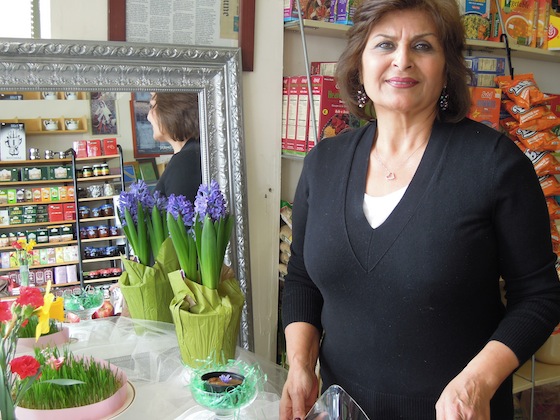
On a recent foray to Zands, my neighborhood Middle Eastern store, I spotted an intriguing assortment of items artfully arranged on a table. I asked the owner, Monier Attar, about the meaning of the arrangement and she graciously described the symbols and traditions associated with this ancient holiday.
Norooz, a pre-Islamic festival dating back at least 3000 years, is rooted in rituals from the Zoroastrian religion. This celebration of the first day of Spring originated in the geographical area then called Persia, but is now observed in many lands, including Iran, India, Iraq, Afghanistan, Central Asia, Canada and the U.S. It crosses religious and national boundaries and is celebrated by Persian Jews, Christians, Baha’is and Muslims.
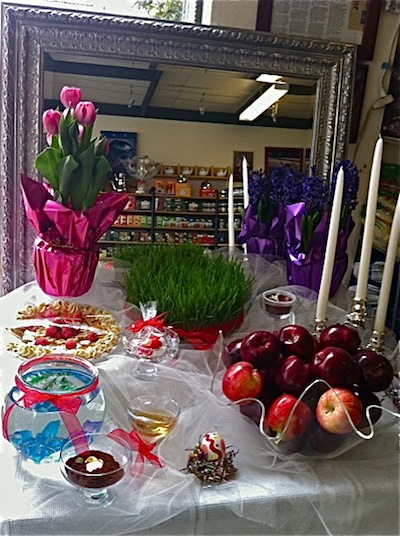
Photo courtesy Monier Attar
I am no stranger to symbolic foods (the Jewish Passover Seder plate includes horseradish for the bitterness of slavery and a fruit and nut mixture representing the mortar used by slaves for building structures in Egypt). But next to the food, I noticed several other items on the table-- goldfish in a bowl, a mirror, a dish full of what looks like grass, coins in a cup of reddish spice-- that pique my interest.
Attar explained that the most essential tradition of Norooz is for every family to prepare the Haft Sin or 7 symbolic items that start with the letter S (in Farsi):
Sabzeh, sprouted wheat or other grain growing in a dish, to symbolize rebirth.
Samanu, a sweet pudding made from sprouted wheat that represents fertility and the sweetness of life.
Seeb, apples, for health and beauty.
Senjed, the sweet, dried fruit of the Lotus tree, for love.
Sir, garlic, for medicine and good health.
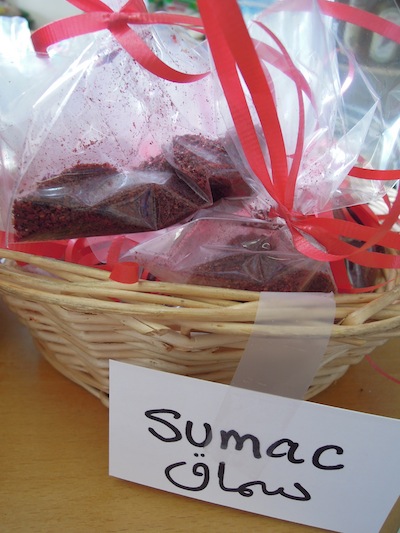
Somaq, crushed sumac berries, to reflect the color of the sunrise.
Serkeh, vinegar, to symbolize patience and age.
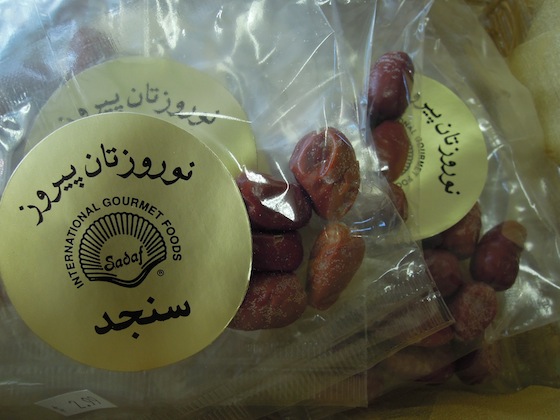
Senjed, one of the 7 foods that begin with S
Preparations must commence days before the actual day of the vernal equinox and include a thorough housecleaning, sprouting the grain and buying new clothes for everyone in the family.
The equinox is calculated to occur the moment that the Sun crosses the celestial equator and equalizes night and day, which happens at different times across the globe (see chart). This year, the West Coast will celebrate it Thursday, March 21st.
“It’s important that at the exact moment of the equinox, the family is sitting around the table, because you want the family to be together for the rest of the year,” says Attar. “We pray and hold hands and then the countdown on radio or TV announces the exact moment and we all kiss and hug. I’m getting goose bumps just talking about it,” says Attar, tearing up, “It’s emotional for me because I think of my parents.”
Attar grew up in Iran, but left in 1984, at age 35 with her 2 young children.
“I sacrificed my parents to make a new life for my children. My mom is still in Iran. When I was a child, New Years was the most exciting time. Every year it comes at a different hour. When it was at 4am, my mother woke us up an hour before to take a shower and put on new clothes. But the best part is that for the next 13 days the young people in the family go visit the older people who give them money, crisp new bills.”
This tradition is similar to the Chinese New Year tradition, where New Year’s bills are placed in red envelopes.
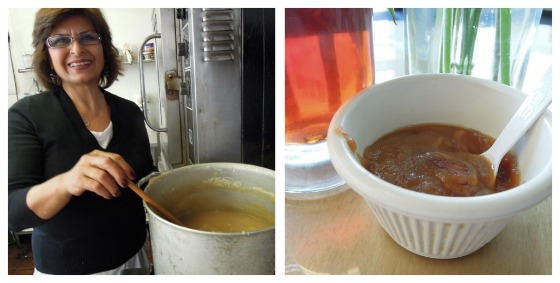
Of all the dishes on the Haft Sin, the hardest one to procure is the Samanu. It takes days to prepare a sweet creamy pudding made from sprouted wheat that is cooked for many hours. The wheat must be sprouted for 5 days until white roots and sprouts appear, then it is crushed and the mash repeatedly “milked” and cooked on the stove for at least 5 hours. It is finally finished overnight in a low oven to give it that burnished brown hue.
Attar offered me a taste. It was so sweet and nutty, it’s hard to believe it’s only made from sprouted wheat and flour. Many Persian families put a tiny symbolic dish of the stuff on their table but Attar cooks pots of it for her customers and says, “Once people taste how delicious it is, they actually want enough for their guests to eat.”
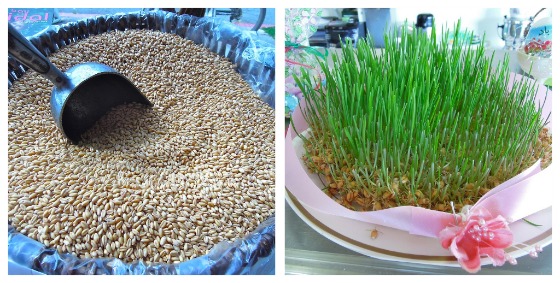
Whole wheat and its early sprouts
Another tradition is on the 13th day of the New Year, the family takes the Sabzeh (the sprouts growing in a dish) from their place on the table and after a picnic in the park, throws them into running water, to rid the house of sickness and sadness.
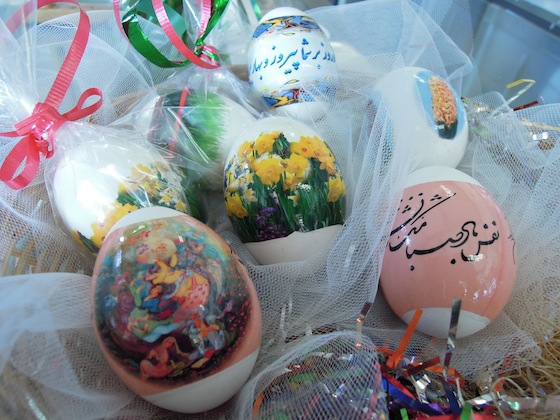
Additional items on the table may include: golden coins representing prosperity and wealth, a basket of painted eggs for fertility, live goldfish in a bowl of water for life, a flowering hyacinth for its lovely smell, lit candles for enlightenment and happiness, a mirror to represent truth or reflection and a platter of special pastries. Every year, Attar makes thousands of cookies from chickpea flour or rice flour with nuts.
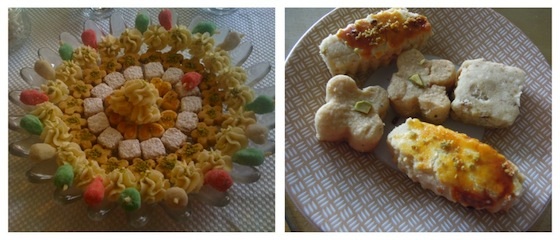
Cookie platter. Photo courtesy Monier Attar
The customary meal for New Year's Day is Sabzi Polo Mahi, rice with green herbs served with fish. Attar says this is the Persian equivalent of having turkey for Thanksgiving. She carries fresh whitefish and the traditional herbs for the rice: parsley, coriander, chives, dill and fenugreek.
Norooz also has special meaning to Zohal Nassrollahi, Berkeley City College student and first generation American. “When I was a child, the event seemed very magical. I’ve always loved certain things on the Haft Sin table: the glowing gold coins, the maroon colored sumac,” says Nassrollahi, who studies art and design.
“I plan to keep celebrating Norooz, even when I have children. It’s a way to stay connected to my culture, even though I have never been to Iran. But it’s kind of bittersweet, because the holiday is a lot about spending time with the family and we have such a small one, just my parents and me. I also love the tradition of Chahar Shanbeh Suri (or fire-jumping).”
This ritual traces back to Zoroastrianism, as a rite of purification. Bonfires are lit in the streets on the last Tuesday evening of the year and people leap over them while chanting. The translation, “Give me your beautiful red color, and take back my sickly pallor,” demonstrates the fire’s ability to cleanse.
“Fire is a powerful symbol,” says Nassrollahi, “When you hop over the fires, it takes away the negativities from the past year and helps you focus on the future.”
Berkeley’s Persian Center holds its annual bonfire-jumping event Tuesday evening March 19 on the 2000 block of Durant -- and invites both adults and children, Persians and non-Persians to join in the fire-jumping festivities with music and food.
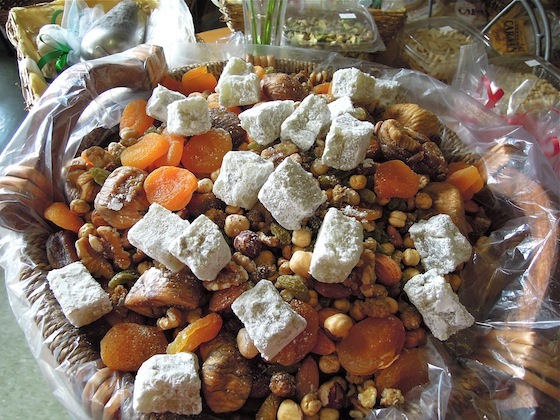
Attar carries the traditional snack of dried fruit and nuts to eat on Chahar Shanbeh Suri plus everything else one would need to fully celebrate the holiday. As she served me a cup of tea and some of her cookies, she told me Norooz (whose literal meaning is “new day”), is the perfect time to let go of grudges, apologize, hug and make-up and start over again.
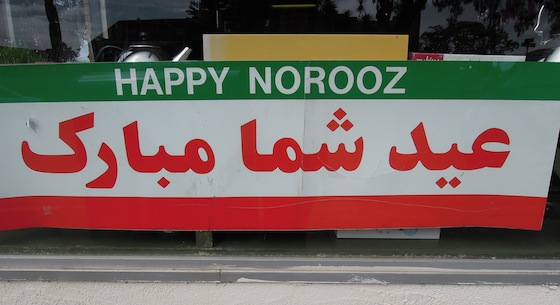
Norooz is included on UNESCO’s List of Intangible Cultural Heritage.