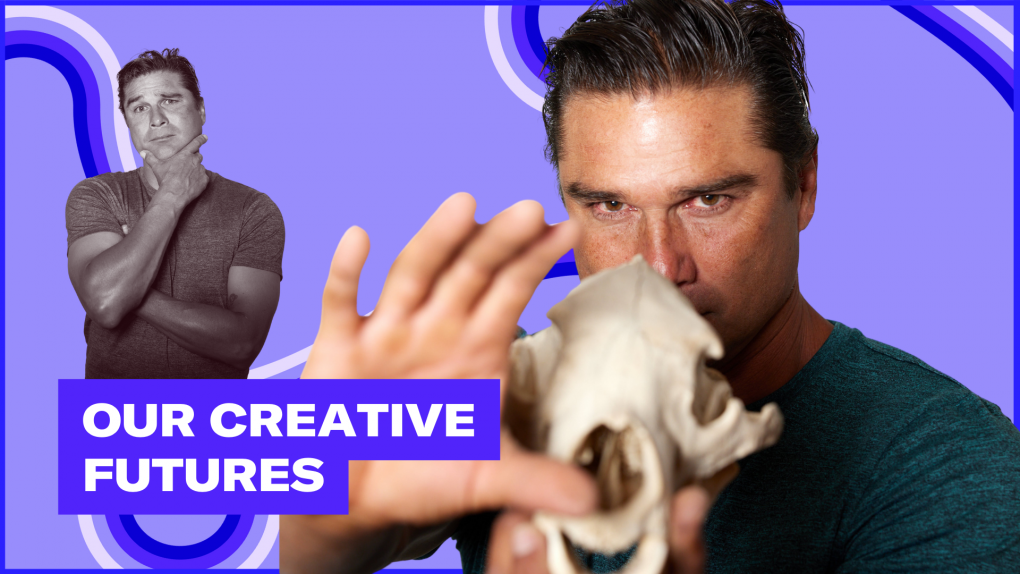
Theater Helped Him Feel Free at San Quentin—Now He’s Paying it Forward
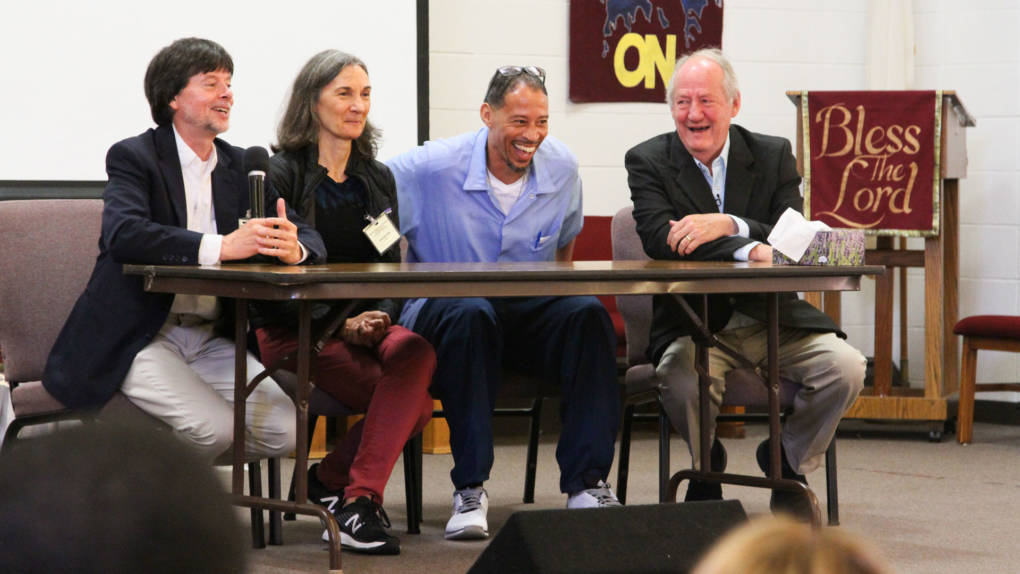
Ken Burns Visits San Quentin to Preview 'Country Music' Documentary For Inmates
California Inmate Takes Unlikely Path to Freedom: Podcasting
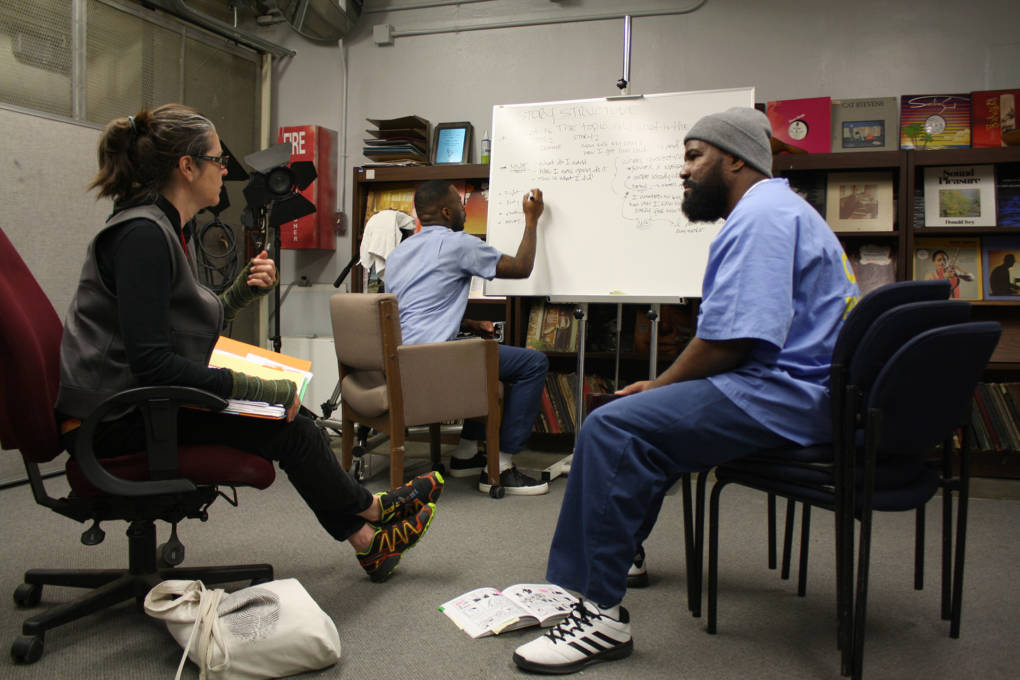
In This San Quentin Class, Inmates Write Their Way Into a Better Future
Sponsored
Player sponsored by
window.__IS_SSR__=true
window.__INITIAL_STATE__={
"attachmentsReducer": {
"audio_0": {
"type": "attachments",
"id": "audio_0",
"imgSizes": {
"kqedFullSize": {
"file": "https://ww2.kqed.org/news/wp-content/themes/KQED-unified/img/audio_bgs/background0.jpg"
}
}
},
"audio_1": {
"type": "attachments",
"id": "audio_1",
"imgSizes": {
"kqedFullSize": {
"file": "https://ww2.kqed.org/news/wp-content/themes/KQED-unified/img/audio_bgs/background1.jpg"
}
}
},
"audio_2": {
"type": "attachments",
"id": "audio_2",
"imgSizes": {
"kqedFullSize": {
"file": "https://ww2.kqed.org/news/wp-content/themes/KQED-unified/img/audio_bgs/background2.jpg"
}
}
},
"audio_3": {
"type": "attachments",
"id": "audio_3",
"imgSizes": {
"kqedFullSize": {
"file": "https://ww2.kqed.org/news/wp-content/themes/KQED-unified/img/audio_bgs/background3.jpg"
}
}
},
"audio_4": {
"type": "attachments",
"id": "audio_4",
"imgSizes": {
"kqedFullSize": {
"file": "https://ww2.kqed.org/news/wp-content/themes/KQED-unified/img/audio_bgs/background4.jpg"
}
}
},
"placeholder": {
"type": "attachments",
"id": "placeholder",
"imgSizes": {
"thumbnail": {
"file": "https://cdn.kqed.org/wp-content/uploads/2024/12/KQED-Default-Image-816638274-2000x1333-1-160x107.jpg",
"width": 160,
"height": 107,
"mimeType": "image/jpeg"
},
"medium": {
"file": "https://cdn.kqed.org/wp-content/uploads/2024/12/KQED-Default-Image-816638274-2000x1333-1-800x533.jpg",
"width": 800,
"height": 533,
"mimeType": "image/jpeg"
},
"medium_large": {
"file": "https://cdn.kqed.org/wp-content/uploads/2024/12/KQED-Default-Image-816638274-2000x1333-1-768x512.jpg",
"width": 768,
"height": 512,
"mimeType": "image/jpeg"
},
"large": {
"file": "https://cdn.kqed.org/wp-content/uploads/2024/12/KQED-Default-Image-816638274-2000x1333-1-1020x680.jpg",
"width": 1020,
"height": 680,
"mimeType": "image/jpeg"
},
"1536x1536": {
"file": "https://cdn.kqed.org/wp-content/uploads/2024/12/KQED-Default-Image-816638274-2000x1333-1-1536x1024.jpg",
"width": 1536,
"height": 1024,
"mimeType": "image/jpeg"
},
"fd-lrg": {
"file": "https://cdn.kqed.org/wp-content/uploads/2024/12/KQED-Default-Image-816638274-2000x1333-1-1536x1024.jpg",
"width": 1536,
"height": 1024,
"mimeType": "image/jpeg"
},
"fd-med": {
"file": "https://cdn.kqed.org/wp-content/uploads/2024/12/KQED-Default-Image-816638274-2000x1333-1-1020x680.jpg",
"width": 1020,
"height": 680,
"mimeType": "image/jpeg"
},
"fd-sm": {
"file": "https://cdn.kqed.org/wp-content/uploads/2024/12/KQED-Default-Image-816638274-2000x1333-1-800x533.jpg",
"width": 800,
"height": 533,
"mimeType": "image/jpeg"
},
"post-thumbnail": {
"file": "https://cdn.kqed.org/wp-content/uploads/2024/12/KQED-Default-Image-816638274-2000x1333-1-672x372.jpg",
"width": 672,
"height": 372,
"mimeType": "image/jpeg"
},
"twentyfourteen-full-width": {
"file": "https://cdn.kqed.org/wp-content/uploads/2024/12/KQED-Default-Image-816638274-2000x1333-1-1038x576.jpg",
"width": 1038,
"height": 576,
"mimeType": "image/jpeg"
},
"xxsmall": {
"file": "https://cdn.kqed.org/wp-content/uploads/2024/12/KQED-Default-Image-816638274-2000x1333-1-160x107.jpg",
"width": 160,
"height": 107,
"mimeType": "image/jpeg"
},
"xsmall": {
"file": "https://cdn.kqed.org/wp-content/uploads/2024/12/KQED-Default-Image-816638274-2000x1333-1-672x372.jpg",
"width": 672,
"height": 372,
"mimeType": "image/jpeg"
},
"small": {
"file": "https://cdn.kqed.org/wp-content/uploads/2024/12/KQED-Default-Image-816638274-2000x1333-1-672x372.jpg",
"width": 672,
"height": 372,
"mimeType": "image/jpeg"
},
"xlarge": {
"file": "https://cdn.kqed.org/wp-content/uploads/2024/12/KQED-Default-Image-816638274-2000x1333-1-1020x680.jpg",
"width": 1020,
"height": 680,
"mimeType": "image/jpeg"
},
"full-width": {
"file": "https://cdn.kqed.org/wp-content/uploads/2024/12/KQED-Default-Image-816638274-2000x1333-1-1920x1280.jpg",
"width": 1920,
"height": 1280,
"mimeType": "image/jpeg"
},
"guest-author-32": {
"file": "https://cdn.kqed.org/wp-content/uploads/2025/01/KQED-Default-Image-816638274-1333x1333-1-160x160.jpg",
"width": 32,
"height": 32,
"mimeType": "image/jpeg"
},
"guest-author-50": {
"file": "https://cdn.kqed.org/wp-content/uploads/2025/01/KQED-Default-Image-816638274-1333x1333-1-160x160.jpg",
"width": 50,
"height": 50,
"mimeType": "image/jpeg"
},
"guest-author-64": {
"file": "https://cdn.kqed.org/wp-content/uploads/2025/01/KQED-Default-Image-816638274-1333x1333-1-160x160.jpg",
"width": 64,
"height": 64,
"mimeType": "image/jpeg"
},
"guest-author-96": {
"file": "https://cdn.kqed.org/wp-content/uploads/2025/01/KQED-Default-Image-816638274-1333x1333-1-160x160.jpg",
"width": 96,
"height": 96,
"mimeType": "image/jpeg"
},
"guest-author-128": {
"file": "https://cdn.kqed.org/wp-content/uploads/2025/01/KQED-Default-Image-816638274-1333x1333-1-160x160.jpg",
"width": 128,
"height": 128,
"mimeType": "image/jpeg"
},
"detail": {
"file": "https://cdn.kqed.org/wp-content/uploads/2025/01/KQED-Default-Image-816638274-1333x1333-1-160x160.jpg",
"width": 160,
"height": 160,
"mimeType": "image/jpeg"
},
"kqedFullSize": {
"file": "https://cdn.kqed.org/wp-content/uploads/2024/12/KQED-Default-Image-816638274-2000x1333-1.jpg",
"width": 2000,
"height": 1333
}
}
},
"arts_13915516": {
"type": "attachments",
"id": "arts_13915516",
"meta": {
"index": "attachments_1716263798",
"site": "arts",
"id": "13915516",
"found": true
},
"parent": 13915493,
"imgSizes": {
"twentyfourteen-full-width": {
"file": "https://ww2.kqed.org/app/uploads/sites/2/2022/06/WORKING-FILE-Our-Creative-Futures-Featured-Image-4-1038x576.png",
"width": 1038,
"mimeType": "image/png",
"height": 576
},
"thumbnail": {
"file": "https://ww2.kqed.org/app/uploads/sites/2/2022/06/WORKING-FILE-Our-Creative-Futures-Featured-Image-4-160x90.png",
"width": 160,
"mimeType": "image/png",
"height": 90
},
"post-thumbnail": {
"file": "https://ww2.kqed.org/app/uploads/sites/2/2022/06/WORKING-FILE-Our-Creative-Futures-Featured-Image-4-672x372.png",
"width": 672,
"mimeType": "image/png",
"height": 372
},
"kqedFullSize": {
"file": "https://ww2.kqed.org/app/uploads/sites/2/2022/06/WORKING-FILE-Our-Creative-Futures-Featured-Image-4.png",
"width": 1920,
"height": 1080
},
"large": {
"file": "https://ww2.kqed.org/app/uploads/sites/2/2022/06/WORKING-FILE-Our-Creative-Futures-Featured-Image-4-1020x574.png",
"width": 1020,
"mimeType": "image/png",
"height": 574
},
"1536x1536": {
"file": "https://ww2.kqed.org/app/uploads/sites/2/2022/06/WORKING-FILE-Our-Creative-Futures-Featured-Image-4-1536x864.png",
"width": 1536,
"mimeType": "image/png",
"height": 864
},
"medium": {
"file": "https://ww2.kqed.org/app/uploads/sites/2/2022/06/WORKING-FILE-Our-Creative-Futures-Featured-Image-4-800x450.png",
"width": 800,
"mimeType": "image/png",
"height": 450
},
"medium_large": {
"file": "https://ww2.kqed.org/app/uploads/sites/2/2022/06/WORKING-FILE-Our-Creative-Futures-Featured-Image-4-768x432.png",
"width": 768,
"mimeType": "image/png",
"height": 432
}
},
"publishDate": 1656528618,
"modified": 1656613712,
"caption": "Juan Meza says Marin Shakespeare Company's San Quentin program helped him discover his inner artist. Amid the trauma of the pandemic, theater remains a crucial outlet for those still inside.",
"description": null,
"title": "Our Creative Futures - Juan Meza",
"credit": "Photos: Fred Greaves; design: Kelly Heigert",
"status": "inherit",
"altTag": null,
"fetchFailed": false,
"isLoading": false
},
"arts_13862097": {
"type": "attachments",
"id": "arts_13862097",
"meta": {
"index": "attachments_1716263798",
"site": "arts",
"id": "13862097",
"found": true
},
"parent": 0,
"imgSizes": {
"twentyfourteen-full-width": {
"file": "https://ww2.kqed.org/app/uploads/sites/2/2019/07/IMG_1789-1038x576.jpg",
"width": 1038,
"mimeType": "image/jpeg",
"height": 576
},
"thumbnail": {
"file": "https://ww2.kqed.org/app/uploads/sites/2/2019/07/IMG_1789-160x90.jpg",
"width": 160,
"mimeType": "image/jpeg",
"height": 90
},
"post-thumbnail": {
"file": "https://ww2.kqed.org/app/uploads/sites/2/2019/07/IMG_1789-672x372.jpg",
"width": 672,
"mimeType": "image/jpeg",
"height": 372
},
"kqedFullSize": {
"file": "https://ww2.kqed.org/app/uploads/sites/2/2019/07/IMG_1789.jpg",
"width": 1920,
"height": 1080
},
"large": {
"file": "https://ww2.kqed.org/app/uploads/sites/2/2019/07/IMG_1789-1020x574.jpg",
"width": 1020,
"mimeType": "image/jpeg",
"height": 574
},
"complete_open_graph": {
"file": "https://ww2.kqed.org/app/uploads/sites/2/2019/07/IMG_1789-1200x675.jpg",
"width": 1200,
"mimeType": "image/jpeg",
"height": 675
},
"full-width": {
"file": "https://ww2.kqed.org/app/uploads/sites/2/2019/07/IMG_1789-1920x1080.jpg",
"width": 1920,
"mimeType": "image/jpeg",
"height": 1080
},
"medium": {
"file": "https://ww2.kqed.org/app/uploads/sites/2/2019/07/IMG_1789-800x450.jpg",
"width": 800,
"mimeType": "image/jpeg",
"height": 450
},
"medium_large": {
"file": "https://ww2.kqed.org/app/uploads/sites/2/2019/07/IMG_1789-768x432.jpg",
"width": 768,
"mimeType": "image/jpeg",
"height": 432
}
},
"publishDate": 1564015458,
"modified": 1564015583,
"caption": "L to R: Ken Burns, Julie Dunfey, Rahsaan Thomas and Dayton Duncan on stage at San Quentin State Prison.",
"description": "L to R: Ken Burns, Julie Dunfey, Rahsaan Thomas and Dayton Duncan on stage at San Quentin State Prison.",
"title": "IMG_1789",
"credit": "Geraldine Montes/KQED",
"status": "inherit",
"fetchFailed": false,
"isLoading": false
},
"arts_13428656": {
"type": "attachments",
"id": "arts_13428656",
"meta": {
"index": "attachments_1716263798",
"site": "arts",
"id": "13428656",
"found": true
},
"parent": 13428651,
"imgSizes": {
"small": {
"file": "https://ww2.kqed.org/app/uploads/sites/2/2017/06/Story-pitch-session-520x347.jpg",
"width": 520,
"mimeType": "image/jpeg",
"height": 347
},
"twentyfourteen-full-width": {
"file": "https://ww2.kqed.org/app/uploads/sites/2/2017/06/Story-pitch-session-1038x576.jpg",
"width": 1038,
"mimeType": "image/jpeg",
"height": 576
},
"thumbnail": {
"file": "https://ww2.kqed.org/app/uploads/sites/2/2017/06/Story-pitch-session-160x107.jpg",
"width": 160,
"mimeType": "image/jpeg",
"height": 107
},
"fd-sm": {
"file": "https://ww2.kqed.org/app/uploads/sites/2/2017/06/Story-pitch-session-960x640.jpg",
"width": 960,
"mimeType": "image/jpeg",
"height": 640
},
"post-thumbnail": {
"file": "https://ww2.kqed.org/app/uploads/sites/2/2017/06/Story-pitch-session-672x372.jpg",
"width": 672,
"mimeType": "image/jpeg",
"height": 372
},
"xsmall": {
"file": "https://ww2.kqed.org/app/uploads/sites/2/2017/06/Story-pitch-session-375x250.jpg",
"width": 375,
"mimeType": "image/jpeg",
"height": 250
},
"kqedFullSize": {
"file": "https://ww2.kqed.org/app/uploads/sites/2/2017/06/Story-pitch-session.jpg",
"width": 1920,
"height": 1280
},
"large": {
"file": "https://ww2.kqed.org/app/uploads/sites/2/2017/06/Story-pitch-session-1020x680.jpg",
"width": 1020,
"mimeType": "image/jpeg",
"height": 680
},
"xlarge": {
"file": "https://ww2.kqed.org/app/uploads/sites/2/2017/06/Story-pitch-session-1180x787.jpg",
"width": 1180,
"mimeType": "image/jpeg",
"height": 787
},
"guest-author-50": {
"file": "https://ww2.kqed.org/app/uploads/sites/2/2017/06/Story-pitch-session-50x50.jpg",
"width": 50,
"mimeType": "image/jpeg",
"height": 50
},
"guest-author-96": {
"file": "https://ww2.kqed.org/app/uploads/sites/2/2017/06/Story-pitch-session-96x96.jpg",
"width": 96,
"mimeType": "image/jpeg",
"height": 96
},
"medium": {
"file": "https://ww2.kqed.org/app/uploads/sites/2/2017/06/Story-pitch-session-800x533.jpg",
"width": 800,
"mimeType": "image/jpeg",
"height": 533
},
"guest-author-64": {
"file": "https://ww2.kqed.org/app/uploads/sites/2/2017/06/Story-pitch-session-64x64.jpg",
"width": 64,
"mimeType": "image/jpeg",
"height": 64
},
"guest-author-32": {
"file": "https://ww2.kqed.org/app/uploads/sites/2/2017/06/Story-pitch-session-32x32.jpg",
"width": 32,
"mimeType": "image/jpeg",
"height": 32
},
"fd-lrg": {
"file": "https://ww2.kqed.org/app/uploads/sites/2/2017/06/Story-pitch-session-1920x1280.jpg",
"width": 1920,
"mimeType": "image/jpeg",
"height": 1280
},
"fd-med": {
"file": "https://ww2.kqed.org/app/uploads/sites/2/2017/06/Story-pitch-session-1180x787.jpg",
"width": 1180,
"mimeType": "image/jpeg",
"height": 787
},
"full-width": {
"file": "https://ww2.kqed.org/app/uploads/sites/2/2017/06/Story-pitch-session-1920x1280.jpg",
"width": 1920,
"mimeType": "image/jpeg",
"height": 1280
},
"detail": {
"file": "https://ww2.kqed.org/app/uploads/sites/2/2017/06/Story-pitch-session-150x150.jpg",
"width": 150,
"mimeType": "image/jpeg",
"height": 150
},
"medium_large": {
"file": "https://ww2.kqed.org/app/uploads/sites/2/2017/06/Story-pitch-session-768x512.jpg",
"width": 768,
"mimeType": "image/jpeg",
"height": 512
},
"guest-author-128": {
"file": "https://ww2.kqed.org/app/uploads/sites/2/2017/06/Story-pitch-session-128x128.jpg",
"width": 128,
"mimeType": "image/jpeg",
"height": 128
},
"xxsmall": {
"file": "https://ww2.kqed.org/app/uploads/sites/2/2017/06/Story-pitch-session-240x160.jpg",
"width": 240,
"mimeType": "image/jpeg",
"height": 160
}
},
"publishDate": 1497391716,
"modified": 1546454989,
"caption": "Nigel Poor, Antwan Williams and Earlonne Woods in a story pitch session at San Quentin, 2017.",
"description": "Nigel Poor, Antwan Williams and Earlonne Woods in a story pitch session at San Quentin, 2017.",
"title": "Story pitch session",
"credit": "Courtesy of Radiotopia",
"status": "inherit",
"fetchFailed": false,
"isLoading": false
},
"arts_13843598": {
"type": "attachments",
"id": "arts_13843598",
"meta": {
"index": "attachments_1716263798",
"site": "arts",
"id": "13843598",
"found": true
},
"parent": 13843559,
"imgSizes": {
"small": {
"file": "https://ww2.kqed.org/app/uploads/sites/2/2018/10/20110917_1100E-520x293.jpg",
"width": 520,
"mimeType": "image/jpeg",
"height": 293
},
"twentyfourteen-full-width": {
"file": "https://ww2.kqed.org/app/uploads/sites/2/2018/10/20110917_1100E-1038x576.jpg",
"width": 1038,
"mimeType": "image/jpeg",
"height": 576
},
"thumbnail": {
"file": "https://ww2.kqed.org/app/uploads/sites/2/2018/10/20110917_1100E-160x90.jpg",
"width": 160,
"mimeType": "image/jpeg",
"height": 90
},
"fd-sm": {
"file": "https://ww2.kqed.org/app/uploads/sites/2/2018/10/20110917_1100E-960x540.jpg",
"width": 960,
"mimeType": "image/jpeg",
"height": 540
},
"post-thumbnail": {
"file": "https://ww2.kqed.org/app/uploads/sites/2/2018/10/20110917_1100E-672x372.jpg",
"width": 672,
"mimeType": "image/jpeg",
"height": 372
},
"xsmall": {
"file": "https://ww2.kqed.org/app/uploads/sites/2/2018/10/20110917_1100E-375x211.jpg",
"width": 375,
"mimeType": "image/jpeg",
"height": 211
},
"kqedFullSize": {
"file": "https://ww2.kqed.org/app/uploads/sites/2/2018/10/20110917_1100E.jpg",
"width": 1200,
"height": 675
},
"large": {
"file": "https://ww2.kqed.org/app/uploads/sites/2/2018/10/20110917_1100E-1020x574.jpg",
"width": 1020,
"mimeType": "image/jpeg",
"height": 574
},
"xlarge": {
"file": "https://ww2.kqed.org/app/uploads/sites/2/2018/10/20110917_1100E-1180x664.jpg",
"width": 1180,
"mimeType": "image/jpeg",
"height": 664
},
"complete_open_graph": {
"file": "https://ww2.kqed.org/app/uploads/sites/2/2018/10/20110917_1100E-1200x675.jpg",
"width": 1200,
"mimeType": "image/jpeg",
"height": 675
},
"guest-author-50": {
"file": "https://ww2.kqed.org/app/uploads/sites/2/2018/10/20110917_1100E-50x50.jpg",
"width": 50,
"mimeType": "image/jpeg",
"height": 50
},
"guest-author-96": {
"file": "https://ww2.kqed.org/app/uploads/sites/2/2018/10/20110917_1100E-96x96.jpg",
"width": 96,
"mimeType": "image/jpeg",
"height": 96
},
"medium": {
"file": "https://ww2.kqed.org/app/uploads/sites/2/2018/10/20110917_1100E-800x450.jpg",
"width": 800,
"mimeType": "image/jpeg",
"height": 450
},
"guest-author-64": {
"file": "https://ww2.kqed.org/app/uploads/sites/2/2018/10/20110917_1100E-64x64.jpg",
"width": 64,
"mimeType": "image/jpeg",
"height": 64
},
"guest-author-32": {
"file": "https://ww2.kqed.org/app/uploads/sites/2/2018/10/20110917_1100E-32x32.jpg",
"width": 32,
"mimeType": "image/jpeg",
"height": 32
},
"fd-med": {
"file": "https://ww2.kqed.org/app/uploads/sites/2/2018/10/20110917_1100E-1180x664.jpg",
"width": 1180,
"mimeType": "image/jpeg",
"height": 664
},
"detail": {
"file": "https://ww2.kqed.org/app/uploads/sites/2/2018/10/20110917_1100E-150x150.jpg",
"width": 150,
"mimeType": "image/jpeg",
"height": 150
},
"medium_large": {
"file": "https://ww2.kqed.org/app/uploads/sites/2/2018/10/20110917_1100E-768x432.jpg",
"width": 768,
"mimeType": "image/jpeg",
"height": 432
},
"guest-author-128": {
"file": "https://ww2.kqed.org/app/uploads/sites/2/2018/10/20110917_1100E-128x128.jpg",
"width": 128,
"mimeType": "image/jpeg",
"height": 128
},
"xxsmall": {
"file": "https://ww2.kqed.org/app/uploads/sites/2/2018/10/20110917_1100E-240x135.jpg",
"width": 240,
"mimeType": "image/jpeg",
"height": 135
}
},
"publishDate": 1540577020,
"modified": 1540577206,
"caption": "Zoey Mullery (right), a longtime writing teacher at San Quentin, gives inmates the tools to tell their own stories. ",
"description": "Zoey Mullery (right), a longtime writing teacher at San Quentin, gives inmates the tools to tell their own stories. ",
"title": "2011 September",
"credit": "Peter Merts",
"status": "inherit",
"fetchFailed": false,
"isLoading": false
}
},
"audioPlayerReducer": {
"postId": "stream_live",
"isPaused": true,
"isPlaying": false,
"pfsActive": false,
"pledgeModalIsOpen": true,
"playerDrawerIsOpen": false
},
"authorsReducer": {
"byline_arts_13847946": {
"type": "authors",
"id": "byline_arts_13847946",
"meta": {
"override": true
},
"slug": "byline_arts_13847946",
"name": "Olga R. Rodriguez (AP)",
"isLoading": false
},
"slefebvre": {
"type": "authors",
"id": "11091",
"meta": {
"index": "authors_1716337520",
"id": "11091",
"found": true
},
"name": "Sam Lefebvre",
"firstName": "Sam",
"lastName": "Lefebvre",
"slug": "slefebvre",
"email": "sdlefebvre@gmail.com",
"display_author_email": false,
"staff_mastheads": [],
"title": null,
"bio": "Sam Lefebvre is an award-winning reporter at KQED Arts. He has worked as an editor and columnist at the \u003cem>East Bay Express\u003c/em>, \u003cem>SF Weekly \u003c/em>and Impose Magazine, and his journalism and criticism has appeared in \u003cem>The New York Times\u003c/em>, the Guardian and Pitchfork.",
"avatar": "https://secure.gravatar.com/avatar/143b570c3dec13ae74c6aa2369b04fc8?s=600&d=blank&r=g",
"twitter": "Lefebvre_Sam",
"facebook": null,
"instagram": null,
"linkedin": null,
"sites": [
{
"site": "arts",
"roles": [
"editor"
]
},
{
"site": "news",
"roles": [
"author"
]
}
],
"headData": {
"title": "Sam Lefebvre | KQED",
"description": null,
"ogImgSrc": "https://secure.gravatar.com/avatar/143b570c3dec13ae74c6aa2369b04fc8?s=600&d=blank&r=g",
"twImgSrc": "https://secure.gravatar.com/avatar/143b570c3dec13ae74c6aa2369b04fc8?s=600&d=blank&r=g"
},
"isLoading": false,
"link": "/author/slefebvre"
},
"ogpenn": {
"type": "authors",
"id": "11491",
"meta": {
"index": "authors_1716337520",
"id": "11491",
"found": true
},
"name": "Pendarvis Harshaw",
"firstName": "Pendarvis",
"lastName": "Harshaw",
"slug": "ogpenn",
"email": "ogpenn@gmail.com",
"display_author_email": false,
"staff_mastheads": [
"arts"
],
"title": "Community Engagement Reporter",
"bio": "Pendarvis Harshaw is an educator, host and writer with KQED Arts.",
"avatar": "https://secure.gravatar.com/avatar/093d33baff5354890e29ad83d58d2c49?s=600&d=blank&r=g",
"twitter": null,
"facebook": null,
"instagram": "ogpenn",
"linkedin": null,
"sites": [
{
"site": "arts",
"roles": [
"editor"
]
},
{
"site": "news",
"roles": [
"editor"
]
},
{
"site": "bayareabites",
"roles": [
"author"
]
},
{
"site": "hiphop",
"roles": [
"editor"
]
}
],
"headData": {
"title": "Pendarvis Harshaw | KQED",
"description": "Community Engagement Reporter",
"ogImgSrc": "https://secure.gravatar.com/avatar/093d33baff5354890e29ad83d58d2c49?s=600&d=blank&r=g",
"twImgSrc": "https://secure.gravatar.com/avatar/093d33baff5354890e29ad83d58d2c49?s=600&d=blank&r=g"
},
"isLoading": false,
"link": "/author/ogpenn"
},
"jsorapuru": {
"type": "authors",
"id": "11792",
"meta": {
"index": "authors_1716337520",
"id": "11792",
"found": true
},
"name": "Julian E.J. Sorapuru",
"firstName": "Julian",
"lastName": "Sorapuru",
"slug": "jsorapuru",
"email": "jsorapuru@kqed.org",
"display_author_email": true,
"staff_mastheads": [],
"title": "Arts & Culture Reporter",
"bio": "Julian E.J. Sorapuru is an Arts & Culture Intern at KQED. Prior to joining KQED Arts, he interned at both POLITICO, covering transportation policy, and \u003cem>The Times-Picayune\u003c/em>, covering government and politics in his hometown of New Orleans, LA. Julian was the first and only Black male Editor-in-Chief in the 119 year history of the University of San Francisco's student newspaper, the\u003cem> San Francisco Foghorn\u003c/em>. He currently resides in San Francisco, CA and enjoys soccer, photography, and reading.",
"avatar": "https://secure.gravatar.com/avatar/e4d0156d1244f96b87927aa011d794a8?s=600&d=blank&r=g",
"twitter": "JulianSorapuru",
"facebook": null,
"instagram": null,
"linkedin": null,
"sites": [
{
"site": "arts",
"roles": [
"editor"
]
}
],
"headData": {
"title": "Julian E.J. Sorapuru | KQED",
"description": "Arts & Culture Reporter",
"ogImgSrc": "https://secure.gravatar.com/avatar/e4d0156d1244f96b87927aa011d794a8?s=600&d=blank&r=g",
"twImgSrc": "https://secure.gravatar.com/avatar/e4d0156d1244f96b87927aa011d794a8?s=600&d=blank&r=g"
},
"isLoading": false,
"link": "/author/jsorapuru"
}
},
"breakingNewsReducer": {},
"pagesReducer": {},
"postsReducer": {
"stream_live": {
"type": "live",
"id": "stream_live",
"audioUrl": "https://streams.kqed.org/kqedradio",
"title": "Live Stream",
"excerpt": "Live Stream information currently unavailable.",
"link": "/radio",
"featImg": "",
"label": {
"name": "KQED Live",
"link": "/"
}
},
"stream_kqedNewscast": {
"type": "posts",
"id": "stream_kqedNewscast",
"audioUrl": "https://www.kqed.org/.stream/anon/radio/RDnews/newscast.mp3?_=1",
"title": "KQED Newscast",
"featImg": "",
"label": {
"name": "88.5 FM",
"link": "/"
}
},
"arts_13915493": {
"type": "posts",
"id": "arts_13915493",
"meta": {
"index": "posts_1716263798",
"site": "arts",
"id": "13915493",
"score": null,
"sort": [
1656613976000
]
},
"parent": 0,
"labelTerm": {},
"blocks": [],
"publishDate": 1656613976,
"format": "standard",
"title": "Theater Helped Him Feel Free at San Quentin—Now He’s Paying it Forward",
"headTitle": "Theater Helped Him Feel Free at San Quentin—Now He’s Paying it Forward | KQED",
"content": "\u003cp>\u003cem>\u003cstrong>Editor’s note:\u003c/strong> Two years into the pandemic, artists are charting new paths forward. Across the Bay Area, they’re advocating for better pay, sharing resources and looking out for their communities’ well-being. Welcome to \u003c/em>\u003ca href=\"http://kqed.org/ourcreativefutures\" target=\"_blank\" rel=\"noopener noreferrer\">Our Creative Futures\u003c/a>\u003cem>, a KQED Arts & Culture series that takes stock of the arts in this unpredictable climate. \u003ca href=\"https://artskqed.typeform.com/Artist2022\" target=\"_blank\" rel=\"noopener noreferrer\">Share your story here\u003c/a>.\u003c/em>\u003c/p>\n\u003cp>In 2020, Juan Meza thought he was going to die just a few months before he was due to be released from San Quentin State Prison after 24 total years of incarceration.\u003c/p>\n\u003cp>His neck and back were aching, he had an out-of-control fever and his blood pressure was skyrocketing. Meza had COVID during the first wave of the pandemic and, as he sat in his cell, he lamented losing one of the few things that brought him joy in prison—the acting program he participated in with Marin Shakespeare Company. [pullquote size='medium' align='right' citation='Juan Meza, an actor who was formerly incarcerated at San Quentin']‘I was able to show that I am a director, that I am a choreographer, that I am an actor, that I am a set designer, that I am essentially an artist.’[/pullquote]\u003c/p>\n\u003cp>“Acting, performing—doing these things were a release, a very lethargic process of getting stuff out that we needed to and everything. We didn’t have that avenue anymore and we didn’t know if we were going to get it back,” Meza says. “I think that was what was most disconcerting. It was just something that was devastating. Here’s something that we had worked towards, and now we couldn’t do anything again.”\u003c/p>\n\u003cp>\u003ca href=\"https://www.marinshakespeare.org/shakespeare-in-prison/\" target=\"_blank\" rel=\"noopener noreferrer\">Marin Shakespeare Company\u003c/a> had been running programming in San Quentin—providing a vital creative, emotional and social outlet for those inside—for 17 years uninterrupted until the pandemic hit.\u003c/p>\n\u003cp>The non-profit theater group has been working with incarcerated people since 2003. Today, they provide drama therapy-inspired acting classes to men, women and youth in 14 different California state prisons with the goal of fostering “self-reflection, self-expression, cooperation, compassion, and goal-setting” among class participants, according to their website.\u003c/p>\n\u003cfigure id=\"attachment_13915618\" class=\"wp-caption aligncenter\" style=\"max-width: 800px\">\u003cimg loading=\"lazy\" decoding=\"async\" class=\"size-medium wp-image-13915618\" src=\"https://ww2.kqed.org/app/uploads/sites/2/2022/06/juan-meza-composite-fred-greaves-800x240.jpg\" alt=\"\" width=\"800\" height=\"240\" srcset=\"https://cdn.kqed.org/wp-content/uploads/sites/2/2022/06/juan-meza-composite-fred-greaves-800x240.jpg 800w, https://cdn.kqed.org/wp-content/uploads/sites/2/2022/06/juan-meza-composite-fred-greaves-1020x306.jpg 1020w, https://cdn.kqed.org/wp-content/uploads/sites/2/2022/06/juan-meza-composite-fred-greaves-160x48.jpg 160w, https://cdn.kqed.org/wp-content/uploads/sites/2/2022/06/juan-meza-composite-fred-greaves-768x230.jpg 768w, https://cdn.kqed.org/wp-content/uploads/sites/2/2022/06/juan-meza-composite-fred-greaves-1536x461.jpg 1536w, https://cdn.kqed.org/wp-content/uploads/sites/2/2022/06/juan-meza-composite-fred-greaves.jpg 1920w\" sizes=\"(max-width: 800px) 100vw, 800px\">\u003cfigcaption class=\"wp-caption-text\">Since getting out of San Quentin State Prison in 2020, Colusa resident Juan Meza works in construction by day while continuing to pursue his passion for theater at Marin Shakespeare Company. \u003ccite>(Fred Greaves)\u003c/cite>\u003c/figcaption>\u003c/figure>\n\u003cp>Lesley Currier, Marin Shakespeare’s managing director, says the men in San Quentin draw “a lot of positive benefits” from her organization’s affiliation with the prison. Among them are “people rediscovering their own creativity; rediscovering their own sense of play,” she says.\u003c/p>\n\u003cp>“We hear so often: ‘Over the two and a half hours that I spent in the group, I felt like I was free. I didn’t feel like I was in prison,’” Currier says. “Doing something outside the box is really powerful, particularly for people who’ve been labeled, you know, ‘You are not someone who’s going to succeed. You’re a criminal.’ To do something else—to play, to have different roles—really makes you believe that you can do things that you hadn’t thought of doing before.” [aside postID=\"arts_13913890\"]\u003c/p>\n\u003cp>Meza, who goes by the stage name Losdini, attests that the acting program helped him reveal another side of himself. He got involved with Marin Shakespeare when he transferred to San Quentin after 16 years at another facility. “If I had never stepped into that first class in San Quentin with Marin Shakespeare Company, I would not have been able to reveal my humanity,” he says. “In that I was able to show that I am a director, that I am a choreographer, that I am an actor, that I am a set designer, that I am essentially an artist.”\u003c/p>\n\u003cfigure id=\"attachment_13915621\" class=\"wp-caption aligncenter\" style=\"max-width: 800px\">\u003cimg loading=\"lazy\" decoding=\"async\" class=\"size-medium wp-image-13915621\" src=\"https://ww2.kqed.org/app/uploads/sites/2/2022/06/fg_san-quentin-theatre_2022_06_21_R5B1148-800x1200.jpg\" alt=\"\" width=\"800\" height=\"1200\" srcset=\"https://cdn.kqed.org/wp-content/uploads/sites/2/2022/06/fg_san-quentin-theatre_2022_06_21_R5B1148-800x1200.jpg 800w, https://cdn.kqed.org/wp-content/uploads/sites/2/2022/06/fg_san-quentin-theatre_2022_06_21_R5B1148-1020x1530.jpg 1020w, https://cdn.kqed.org/wp-content/uploads/sites/2/2022/06/fg_san-quentin-theatre_2022_06_21_R5B1148-160x240.jpg 160w, https://cdn.kqed.org/wp-content/uploads/sites/2/2022/06/fg_san-quentin-theatre_2022_06_21_R5B1148-768x1152.jpg 768w, https://cdn.kqed.org/wp-content/uploads/sites/2/2022/06/fg_san-quentin-theatre_2022_06_21_R5B1148-1024x1536.jpg 1024w, https://cdn.kqed.org/wp-content/uploads/sites/2/2022/06/fg_san-quentin-theatre_2022_06_21_R5B1148-1366x2048.jpg 1366w, https://cdn.kqed.org/wp-content/uploads/sites/2/2022/06/fg_san-quentin-theatre_2022_06_21_R5B1148.jpg 1667w\" sizes=\"(max-width: 800px) 100vw, 800px\">\u003cfigcaption class=\"wp-caption-text\">Juan Meza plays bass at home in Colusa, California on June 21, 2022. \u003ccite>(Fred Greaves)\u003c/cite>\u003c/figcaption>\u003c/figure>\n\u003cp>But when COVID hit, Meza’s artistry was put on hold and Marin Shakespeare Company had to pivot their classes since their instructors were no longer allowed to visit the prison. First, they recorded a production of \u003cem>Romeo and Juliet\u003c/em>, put on by some of the formerly incarcerated actors who had been through their program, and sent them to the men in San Quentin.\u003c/p>\n\u003cp>When the prison prohibited them from sending more videos, the theater company distributed packets with writing exercises to stimulate the men’s creative skills. The prompts had Shakespearean themes that were also relevant to daily life during COVID, like plague, friendship, loyalty and self-care. After receiving the writing packages back, Marin Shakespeare posted the men’s writing to their website and even had some formerly incarcerated actors do dramatic readings of the writing that came from inside.\u003c/p>\n\u003cfigure id=\"attachment_13915622\" class=\"wp-caption aligncenter\" style=\"max-width: 800px\">\u003cimg loading=\"lazy\" decoding=\"async\" class=\"size-medium wp-image-13915622\" src=\"https://ww2.kqed.org/app/uploads/sites/2/2022/06/fg_san-quentin-theatre_2022_06_21_R5B1105-800x533.jpg\" alt=\"\" width=\"800\" height=\"533\" srcset=\"https://cdn.kqed.org/wp-content/uploads/sites/2/2022/06/fg_san-quentin-theatre_2022_06_21_R5B1105-800x533.jpg 800w, https://cdn.kqed.org/wp-content/uploads/sites/2/2022/06/fg_san-quentin-theatre_2022_06_21_R5B1105-1020x680.jpg 1020w, https://cdn.kqed.org/wp-content/uploads/sites/2/2022/06/fg_san-quentin-theatre_2022_06_21_R5B1105-160x107.jpg 160w, https://cdn.kqed.org/wp-content/uploads/sites/2/2022/06/fg_san-quentin-theatre_2022_06_21_R5B1105-768x512.jpg 768w, https://cdn.kqed.org/wp-content/uploads/sites/2/2022/06/fg_san-quentin-theatre_2022_06_21_R5B1105-1536x1024.jpg 1536w, https://cdn.kqed.org/wp-content/uploads/sites/2/2022/06/fg_san-quentin-theatre_2022_06_21_R5B1105-2048x1366.jpg 2048w, https://cdn.kqed.org/wp-content/uploads/sites/2/2022/06/fg_san-quentin-theatre_2022_06_21_R5B1105-1920x1280.jpg 1920w\" sizes=\"(max-width: 800px) 100vw, 800px\">\u003cfigcaption class=\"wp-caption-text\">Juan Meza smokes a cigarette outside his home in Colusa, California June 21, 2022. \u003ccite>(Fred Greaves)\u003c/cite>\u003c/figcaption>\u003c/figure>\n\u003cp>But even this makeshift programming wasn’t enough to distract from the hellish conditions inside San Quentin at the height of the pandemic. San Quentin had the worst COVID outbreak of any prison in California. Over 2,000 inmates were infected and 29 people died from the outbreak, which was caused by a \u003ca href=\"https://www.latimes.com/opinion/story/2022-01-28/covid-prison-san-quentin-ruling\" target=\"_blank\" rel=\"noopener noreferrer\">botched transfer of sick prisoners from Southern California\u003c/a>. The situation was then exacerbated by a lack of personal protective equipment in the prison and overcrowding, which made social distancing impossible.\u003c/p>\n\u003cp>According to Meza, “there was a lot of fear, there was a lot of anxiety, there’s a lot of unknowns, there was a lot of misinformation going around,” he says. “In a matter of two weeks, we were now locked in a cell again, unable to move, scared, frightened.” [aside postID=\"arts_13913947\"]\u003c/p>\n\u003cp>Currier says when the Marin Shakespeare Company was finally able to come back to San Quentin in June 2021, they spent their first couple of classes talking about what the men had experienced during quarantine. Currier says COVID was “really scary for the men” since “everyone knew someone who had died or who had yelled ‘man down,’” the phrase spoken to alert prison personnel that someone needed immediate medical attention.\u003c/p>\n\u003cp>Even today Currier says COVID continues to be used “as an excuse” to take away privileges from the men of San Quentin. Despite this, Marin Shakespeare Company was able to stage three performances in front of a live audience in December 2021 with the men of San Quentin, with a production of \u003cem>Henry IV\u003c/em> to come in August.\u003c/p>\n\u003cfigure id=\"attachment_13915509\" class=\"wp-caption aligncenter\" style=\"max-width: 800px\">\u003cimg loading=\"lazy\" decoding=\"async\" class=\"size-medium wp-image-13915509\" src=\"https://ww2.kqed.org/app/uploads/sites/2/2022/06/GettyImages-1322090464-800x534.jpg\" alt=\"\" width=\"800\" height=\"534\" srcset=\"https://cdn.kqed.org/wp-content/uploads/sites/2/2022/06/GettyImages-1322090464-800x534.jpg 800w, https://cdn.kqed.org/wp-content/uploads/sites/2/2022/06/GettyImages-1322090464-1020x680.jpg 1020w, https://cdn.kqed.org/wp-content/uploads/sites/2/2022/06/GettyImages-1322090464-160x107.jpg 160w, https://cdn.kqed.org/wp-content/uploads/sites/2/2022/06/GettyImages-1322090464-768x512.jpg 768w, https://cdn.kqed.org/wp-content/uploads/sites/2/2022/06/GettyImages-1322090464.jpg 1024w\" sizes=\"(max-width: 800px) 100vw, 800px\">\u003cfigcaption class=\"wp-caption-text\">Members of Shakespeare at San Quentin along with Marin Shakespeare Company’s and Director Suraya Keating (second from bottom on right) gather backstage before they perform “Twelfth Night” at San Quentin State Prison on Friday, August 5, 2011 in San Quentin, Calif. \u003ccite>(Lea Suzuki/Getty Images)\u003c/cite>\u003c/figcaption>\u003c/figure>\n\u003cp>By the time Marin Shakespeare Company returned to San Quentin, Meza had been paroled. Today, he is continuing his passion for acting and directing (he \u003ca href=\"https://www.youtube.com/watch?v=2-dF_hTiEE4\" target=\"_blank\" rel=\"noopener noreferrer\">co-directed his first production in May\u003c/a>) with Marin Shakespeare as part of their \u003ca href=\"https://www.marinshakespeare.org/returned-citizens-theatre-troupe/#:~:text=The%20mission%20of%20the%20Returned,understanding%20and%20communication%20through%20theatre.\" target=\"_blank\" rel=\"noopener noreferrer\">Returned Citizens Theater Troupe\u003c/a>, a program Currier says gets at the essence of the importance of MSC’s work in prisons.\u003c/p>\n\u003cp>“For the last seven years, we have been hiring actors who have been able to get out of prison to tell their stories through theater,” Currier says. “Some of the conversations after those performances have been amazing as many people say to me, ‘Well, it’s just really changed my attitude about criminal justice in this country,’ because the goal is we need to change hearts and minds so that we can change our laws.” [aside postID=\"arts_13914030\"]\u003c/p>\n\u003cp>Meza says his reasoning for returning to Marin Shakespeare Company post-incarceration is to pay forward what they did for him to the next person.\u003c/p>\n\u003cp>“Now that I’m not incarcerated in prison anymore, I still want to go back to the humans that are inside to sit with them and say, ‘Look, we can do this,’” Meza says. “There’s a niche that I can be in where I understand, like no volunteer will, what it means to be incarcerated. … I have that knowledge, I have that experience. Where other people can only sympathize, I can empathize.”\u003c/p>\n\u003cp>\u003cimg loading=\"lazy\" decoding=\"async\" class=\"aligncenter size-medium wp-image-12127869\" src=\"https://ww2.kqed.org/app/uploads/sites/2/2016/09/Q.Logo_.Break_-800x78.jpg\" alt=\"\" width=\"800\" height=\"78\" srcset=\"https://cdn.kqed.org/wp-content/uploads/sites/2/2016/09/Q.Logo_.Break_.jpg 800w, https://cdn.kqed.org/wp-content/uploads/sites/2/2016/09/Q.Logo_.Break_-400x39.jpg 400w, https://cdn.kqed.org/wp-content/uploads/sites/2/2016/09/Q.Logo_.Break_-768x75.jpg 768w\" sizes=\"(max-width: 800px) 100vw, 800px\">\u003c/p>\n\u003cp>\u003cem>Read more stories from \u003c/em>\u003ca href=\"http://kqed.org/ourcreativefutures\" target=\"_blank\" rel=\"noopener noreferrer\">Our Creative Futures\u003c/a>\u003cem> here. Have something to share? Tell us about how \u003ca href=\"https://artskqed.typeform.com/Artist2022\" target=\"_blank\" rel=\"noopener noreferrer\">the pandemic has impacted your art practice or community\u003c/a>.\u003c/em>\u003c/p>\n\u003cp>[ad fullwidth]\u003c/p>\n\u003cp>[ad floatright]\u003c/p>\n",
"stats": {
"hasVideo": false,
"hasChartOrMap": false,
"hasAudio": false,
"hasPolis": false,
"wordCount": 1463,
"hasGoogleForm": false,
"hasGallery": false,
"hasHearkenModule": false,
"iframeSrcs": [],
"paragraphCount": 23
},
"modified": 1705006664,
"excerpt": "A survivor of San Quentin's brutal COVID outbreak, Marin Shakespeare actor Juan Meza wants to help those still inside.",
"headData": {
"twImgId": "",
"twTitle": "",
"ogTitle": "",
"ogImgId": "",
"twDescription": "",
"description": "A survivor of San Quentin's brutal COVID outbreak, Marin Shakespeare actor Juan Meza wants to help those still inside.",
"title": "Theater Helped Him Feel Free at San Quentin—Now He’s Paying it Forward | KQED",
"ogDescription": "",
"schema": {
"@context": "https://schema.org",
"@type": "Article",
"headline": "Theater Helped Him Feel Free at San Quentin—Now He’s Paying it Forward",
"datePublished": "2022-06-30T11:32:56-07:00",
"dateModified": "2024-01-11T12:57:44-08:00",
"image": "https://cdn.kqed.org/wp-content/uploads/2020/02/KQED-OG-Image@1x.png"
}
},
"guestAuthors": [],
"slug": "theater-helped-him-feel-free-at-san-quentin-now-hes-paying-it-forward",
"status": "publish",
"sourceUrl": "https://www.kqed.org/ourcreativefutures",
"templateType": "standard",
"excludeFromSiteSearch": "Include",
"featuredImageType": "standard",
"sticky": false,
"source": "Our Creative Futures",
"path": "/arts/13915493/theater-helped-him-feel-free-at-san-quentin-now-hes-paying-it-forward",
"audioTrackLength": null,
"parsedContent": [
{
"type": "contentString",
"content": "\u003cdiv class=\"post-body\">\u003cp>\u003cp>\u003cem>\u003cstrong>Editor’s note:\u003c/strong> Two years into the pandemic, artists are charting new paths forward. Across the Bay Area, they’re advocating for better pay, sharing resources and looking out for their communities’ well-being. Welcome to \u003c/em>\u003ca href=\"http://kqed.org/ourcreativefutures\" target=\"_blank\" rel=\"noopener noreferrer\">Our Creative Futures\u003c/a>\u003cem>, a KQED Arts & Culture series that takes stock of the arts in this unpredictable climate. \u003ca href=\"https://artskqed.typeform.com/Artist2022\" target=\"_blank\" rel=\"noopener noreferrer\">Share your story here\u003c/a>.\u003c/em>\u003c/p>\n\u003cp>In 2020, Juan Meza thought he was going to die just a few months before he was due to be released from San Quentin State Prison after 24 total years of incarceration.\u003c/p>\n\u003cp>His neck and back were aching, he had an out-of-control fever and his blood pressure was skyrocketing. Meza had COVID during the first wave of the pandemic and, as he sat in his cell, he lamented losing one of the few things that brought him joy in prison—the acting program he participated in with Marin Shakespeare Company. \u003c/p>\u003c/div>",
"attributes": {
"named": {},
"numeric": []
}
},
{
"type": "component",
"content": "‘I was able to show that I am a director, that I am a choreographer, that I am an actor, that I am a set designer, that I am essentially an artist.’",
"name": "pullquote",
"attributes": {
"named": {
"size": "medium",
"align": "right",
"citation": "Juan Meza, an actor who was formerly incarcerated at San Quentin",
"label": ""
},
"numeric": []
}
},
{
"type": "contentString",
"content": "\u003cdiv class=\"post-body\">\u003cp>\u003c/p>\n\u003cp>“Acting, performing—doing these things were a release, a very lethargic process of getting stuff out that we needed to and everything. We didn’t have that avenue anymore and we didn’t know if we were going to get it back,” Meza says. “I think that was what was most disconcerting. It was just something that was devastating. Here’s something that we had worked towards, and now we couldn’t do anything again.”\u003c/p>\n\u003cp>\u003ca href=\"https://www.marinshakespeare.org/shakespeare-in-prison/\" target=\"_blank\" rel=\"noopener noreferrer\">Marin Shakespeare Company\u003c/a> had been running programming in San Quentin—providing a vital creative, emotional and social outlet for those inside—for 17 years uninterrupted until the pandemic hit.\u003c/p>\n\u003cp>The non-profit theater group has been working with incarcerated people since 2003. Today, they provide drama therapy-inspired acting classes to men, women and youth in 14 different California state prisons with the goal of fostering “self-reflection, self-expression, cooperation, compassion, and goal-setting” among class participants, according to their website.\u003c/p>\n\u003cfigure id=\"attachment_13915618\" class=\"wp-caption aligncenter\" style=\"max-width: 800px\">\u003cimg loading=\"lazy\" decoding=\"async\" class=\"size-medium wp-image-13915618\" src=\"https://ww2.kqed.org/app/uploads/sites/2/2022/06/juan-meza-composite-fred-greaves-800x240.jpg\" alt=\"\" width=\"800\" height=\"240\" srcset=\"https://cdn.kqed.org/wp-content/uploads/sites/2/2022/06/juan-meza-composite-fred-greaves-800x240.jpg 800w, https://cdn.kqed.org/wp-content/uploads/sites/2/2022/06/juan-meza-composite-fred-greaves-1020x306.jpg 1020w, https://cdn.kqed.org/wp-content/uploads/sites/2/2022/06/juan-meza-composite-fred-greaves-160x48.jpg 160w, https://cdn.kqed.org/wp-content/uploads/sites/2/2022/06/juan-meza-composite-fred-greaves-768x230.jpg 768w, https://cdn.kqed.org/wp-content/uploads/sites/2/2022/06/juan-meza-composite-fred-greaves-1536x461.jpg 1536w, https://cdn.kqed.org/wp-content/uploads/sites/2/2022/06/juan-meza-composite-fred-greaves.jpg 1920w\" sizes=\"(max-width: 800px) 100vw, 800px\">\u003cfigcaption class=\"wp-caption-text\">Since getting out of San Quentin State Prison in 2020, Colusa resident Juan Meza works in construction by day while continuing to pursue his passion for theater at Marin Shakespeare Company. \u003ccite>(Fred Greaves)\u003c/cite>\u003c/figcaption>\u003c/figure>\n\u003cp>Lesley Currier, Marin Shakespeare’s managing director, says the men in San Quentin draw “a lot of positive benefits” from her organization’s affiliation with the prison. Among them are “people rediscovering their own creativity; rediscovering their own sense of play,” she says.\u003c/p>\n\u003cp>“We hear so often: ‘Over the two and a half hours that I spent in the group, I felt like I was free. I didn’t feel like I was in prison,’” Currier says. “Doing something outside the box is really powerful, particularly for people who’ve been labeled, you know, ‘You are not someone who’s going to succeed. You’re a criminal.’ To do something else—to play, to have different roles—really makes you believe that you can do things that you hadn’t thought of doing before.” \u003c/p>\u003c/div>",
"attributes": {
"named": {},
"numeric": []
}
},
{
"type": "component",
"content": "",
"name": "aside",
"attributes": {
"named": {
"postid": "arts_13913890",
"label": ""
},
"numeric": []
}
},
{
"type": "contentString",
"content": "\u003cdiv class=\"post-body\">\u003cp>\u003c/p>\n\u003cp>Meza, who goes by the stage name Losdini, attests that the acting program helped him reveal another side of himself. He got involved with Marin Shakespeare when he transferred to San Quentin after 16 years at another facility. “If I had never stepped into that first class in San Quentin with Marin Shakespeare Company, I would not have been able to reveal my humanity,” he says. “In that I was able to show that I am a director, that I am a choreographer, that I am an actor, that I am a set designer, that I am essentially an artist.”\u003c/p>\n\u003cfigure id=\"attachment_13915621\" class=\"wp-caption aligncenter\" style=\"max-width: 800px\">\u003cimg loading=\"lazy\" decoding=\"async\" class=\"size-medium wp-image-13915621\" src=\"https://ww2.kqed.org/app/uploads/sites/2/2022/06/fg_san-quentin-theatre_2022_06_21_R5B1148-800x1200.jpg\" alt=\"\" width=\"800\" height=\"1200\" srcset=\"https://cdn.kqed.org/wp-content/uploads/sites/2/2022/06/fg_san-quentin-theatre_2022_06_21_R5B1148-800x1200.jpg 800w, https://cdn.kqed.org/wp-content/uploads/sites/2/2022/06/fg_san-quentin-theatre_2022_06_21_R5B1148-1020x1530.jpg 1020w, https://cdn.kqed.org/wp-content/uploads/sites/2/2022/06/fg_san-quentin-theatre_2022_06_21_R5B1148-160x240.jpg 160w, https://cdn.kqed.org/wp-content/uploads/sites/2/2022/06/fg_san-quentin-theatre_2022_06_21_R5B1148-768x1152.jpg 768w, https://cdn.kqed.org/wp-content/uploads/sites/2/2022/06/fg_san-quentin-theatre_2022_06_21_R5B1148-1024x1536.jpg 1024w, https://cdn.kqed.org/wp-content/uploads/sites/2/2022/06/fg_san-quentin-theatre_2022_06_21_R5B1148-1366x2048.jpg 1366w, https://cdn.kqed.org/wp-content/uploads/sites/2/2022/06/fg_san-quentin-theatre_2022_06_21_R5B1148.jpg 1667w\" sizes=\"(max-width: 800px) 100vw, 800px\">\u003cfigcaption class=\"wp-caption-text\">Juan Meza plays bass at home in Colusa, California on June 21, 2022. \u003ccite>(Fred Greaves)\u003c/cite>\u003c/figcaption>\u003c/figure>\n\u003cp>But when COVID hit, Meza’s artistry was put on hold and Marin Shakespeare Company had to pivot their classes since their instructors were no longer allowed to visit the prison. First, they recorded a production of \u003cem>Romeo and Juliet\u003c/em>, put on by some of the formerly incarcerated actors who had been through their program, and sent them to the men in San Quentin.\u003c/p>\n\u003cp>When the prison prohibited them from sending more videos, the theater company distributed packets with writing exercises to stimulate the men’s creative skills. The prompts had Shakespearean themes that were also relevant to daily life during COVID, like plague, friendship, loyalty and self-care. After receiving the writing packages back, Marin Shakespeare posted the men’s writing to their website and even had some formerly incarcerated actors do dramatic readings of the writing that came from inside.\u003c/p>\n\u003cfigure id=\"attachment_13915622\" class=\"wp-caption aligncenter\" style=\"max-width: 800px\">\u003cimg loading=\"lazy\" decoding=\"async\" class=\"size-medium wp-image-13915622\" src=\"https://ww2.kqed.org/app/uploads/sites/2/2022/06/fg_san-quentin-theatre_2022_06_21_R5B1105-800x533.jpg\" alt=\"\" width=\"800\" height=\"533\" srcset=\"https://cdn.kqed.org/wp-content/uploads/sites/2/2022/06/fg_san-quentin-theatre_2022_06_21_R5B1105-800x533.jpg 800w, https://cdn.kqed.org/wp-content/uploads/sites/2/2022/06/fg_san-quentin-theatre_2022_06_21_R5B1105-1020x680.jpg 1020w, https://cdn.kqed.org/wp-content/uploads/sites/2/2022/06/fg_san-quentin-theatre_2022_06_21_R5B1105-160x107.jpg 160w, https://cdn.kqed.org/wp-content/uploads/sites/2/2022/06/fg_san-quentin-theatre_2022_06_21_R5B1105-768x512.jpg 768w, https://cdn.kqed.org/wp-content/uploads/sites/2/2022/06/fg_san-quentin-theatre_2022_06_21_R5B1105-1536x1024.jpg 1536w, https://cdn.kqed.org/wp-content/uploads/sites/2/2022/06/fg_san-quentin-theatre_2022_06_21_R5B1105-2048x1366.jpg 2048w, https://cdn.kqed.org/wp-content/uploads/sites/2/2022/06/fg_san-quentin-theatre_2022_06_21_R5B1105-1920x1280.jpg 1920w\" sizes=\"(max-width: 800px) 100vw, 800px\">\u003cfigcaption class=\"wp-caption-text\">Juan Meza smokes a cigarette outside his home in Colusa, California June 21, 2022. \u003ccite>(Fred Greaves)\u003c/cite>\u003c/figcaption>\u003c/figure>\n\u003cp>But even this makeshift programming wasn’t enough to distract from the hellish conditions inside San Quentin at the height of the pandemic. San Quentin had the worst COVID outbreak of any prison in California. Over 2,000 inmates were infected and 29 people died from the outbreak, which was caused by a \u003ca href=\"https://www.latimes.com/opinion/story/2022-01-28/covid-prison-san-quentin-ruling\" target=\"_blank\" rel=\"noopener noreferrer\">botched transfer of sick prisoners from Southern California\u003c/a>. The situation was then exacerbated by a lack of personal protective equipment in the prison and overcrowding, which made social distancing impossible.\u003c/p>\n\u003cp>According to Meza, “there was a lot of fear, there was a lot of anxiety, there’s a lot of unknowns, there was a lot of misinformation going around,” he says. “In a matter of two weeks, we were now locked in a cell again, unable to move, scared, frightened.” \u003c/p>\u003c/div>",
"attributes": {
"named": {},
"numeric": []
}
},
{
"type": "component",
"content": "",
"name": "aside",
"attributes": {
"named": {
"postid": "arts_13913947",
"label": ""
},
"numeric": []
}
},
{
"type": "contentString",
"content": "\u003cdiv class=\"post-body\">\u003cp>\u003c/p>\n\u003cp>Currier says when the Marin Shakespeare Company was finally able to come back to San Quentin in June 2021, they spent their first couple of classes talking about what the men had experienced during quarantine. Currier says COVID was “really scary for the men” since “everyone knew someone who had died or who had yelled ‘man down,’” the phrase spoken to alert prison personnel that someone needed immediate medical attention.\u003c/p>\n\u003cp>Even today Currier says COVID continues to be used “as an excuse” to take away privileges from the men of San Quentin. Despite this, Marin Shakespeare Company was able to stage three performances in front of a live audience in December 2021 with the men of San Quentin, with a production of \u003cem>Henry IV\u003c/em> to come in August.\u003c/p>\n\u003cfigure id=\"attachment_13915509\" class=\"wp-caption aligncenter\" style=\"max-width: 800px\">\u003cimg loading=\"lazy\" decoding=\"async\" class=\"size-medium wp-image-13915509\" src=\"https://ww2.kqed.org/app/uploads/sites/2/2022/06/GettyImages-1322090464-800x534.jpg\" alt=\"\" width=\"800\" height=\"534\" srcset=\"https://cdn.kqed.org/wp-content/uploads/sites/2/2022/06/GettyImages-1322090464-800x534.jpg 800w, https://cdn.kqed.org/wp-content/uploads/sites/2/2022/06/GettyImages-1322090464-1020x680.jpg 1020w, https://cdn.kqed.org/wp-content/uploads/sites/2/2022/06/GettyImages-1322090464-160x107.jpg 160w, https://cdn.kqed.org/wp-content/uploads/sites/2/2022/06/GettyImages-1322090464-768x512.jpg 768w, https://cdn.kqed.org/wp-content/uploads/sites/2/2022/06/GettyImages-1322090464.jpg 1024w\" sizes=\"(max-width: 800px) 100vw, 800px\">\u003cfigcaption class=\"wp-caption-text\">Members of Shakespeare at San Quentin along with Marin Shakespeare Company’s and Director Suraya Keating (second from bottom on right) gather backstage before they perform “Twelfth Night” at San Quentin State Prison on Friday, August 5, 2011 in San Quentin, Calif. \u003ccite>(Lea Suzuki/Getty Images)\u003c/cite>\u003c/figcaption>\u003c/figure>\n\u003cp>By the time Marin Shakespeare Company returned to San Quentin, Meza had been paroled. Today, he is continuing his passion for acting and directing (he \u003ca href=\"https://www.youtube.com/watch?v=2-dF_hTiEE4\" target=\"_blank\" rel=\"noopener noreferrer\">co-directed his first production in May\u003c/a>) with Marin Shakespeare as part of their \u003ca href=\"https://www.marinshakespeare.org/returned-citizens-theatre-troupe/#:~:text=The%20mission%20of%20the%20Returned,understanding%20and%20communication%20through%20theatre.\" target=\"_blank\" rel=\"noopener noreferrer\">Returned Citizens Theater Troupe\u003c/a>, a program Currier says gets at the essence of the importance of MSC’s work in prisons.\u003c/p>\n\u003cp>“For the last seven years, we have been hiring actors who have been able to get out of prison to tell their stories through theater,” Currier says. “Some of the conversations after those performances have been amazing as many people say to me, ‘Well, it’s just really changed my attitude about criminal justice in this country,’ because the goal is we need to change hearts and minds so that we can change our laws.” \u003c/p>\u003c/div>",
"attributes": {
"named": {},
"numeric": []
}
},
{
"type": "component",
"content": "",
"name": "aside",
"attributes": {
"named": {
"postid": "arts_13914030",
"label": ""
},
"numeric": []
}
},
{
"type": "contentString",
"content": "\u003cdiv class=\"post-body\">\u003cp>\u003c/p>\n\u003cp>Meza says his reasoning for returning to Marin Shakespeare Company post-incarceration is to pay forward what they did for him to the next person.\u003c/p>\n\u003cp>“Now that I’m not incarcerated in prison anymore, I still want to go back to the humans that are inside to sit with them and say, ‘Look, we can do this,’” Meza says. “There’s a niche that I can be in where I understand, like no volunteer will, what it means to be incarcerated. … I have that knowledge, I have that experience. Where other people can only sympathize, I can empathize.”\u003c/p>\n\u003cp>\u003cimg loading=\"lazy\" decoding=\"async\" class=\"aligncenter size-medium wp-image-12127869\" src=\"https://ww2.kqed.org/app/uploads/sites/2/2016/09/Q.Logo_.Break_-800x78.jpg\" alt=\"\" width=\"800\" height=\"78\" srcset=\"https://cdn.kqed.org/wp-content/uploads/sites/2/2016/09/Q.Logo_.Break_.jpg 800w, https://cdn.kqed.org/wp-content/uploads/sites/2/2016/09/Q.Logo_.Break_-400x39.jpg 400w, https://cdn.kqed.org/wp-content/uploads/sites/2/2016/09/Q.Logo_.Break_-768x75.jpg 768w\" sizes=\"(max-width: 800px) 100vw, 800px\">\u003c/p>\n\u003cp>\u003cem>Read more stories from \u003c/em>\u003ca href=\"http://kqed.org/ourcreativefutures\" target=\"_blank\" rel=\"noopener noreferrer\">Our Creative Futures\u003c/a>\u003cem> here. Have something to share? Tell us about how \u003ca href=\"https://artskqed.typeform.com/Artist2022\" target=\"_blank\" rel=\"noopener noreferrer\">the pandemic has impacted your art practice or community\u003c/a>.\u003c/em>\u003c/p>\n\u003cp>\u003c/p>\u003c/div>",
"attributes": {
"named": {},
"numeric": []
}
},
{
"type": "component",
"content": "",
"name": "ad",
"attributes": {
"named": {
"label": "fullwidth"
},
"numeric": [
"fullwidth"
]
}
},
{
"type": "contentString",
"content": "\u003cdiv class=\"post-body\">\u003cp>\u003c/p>\n\u003cp>\u003c/p>\u003c/div>",
"attributes": {
"named": {},
"numeric": []
}
},
{
"type": "component",
"content": "",
"name": "ad",
"attributes": {
"named": {
"label": "floatright"
},
"numeric": [
"floatright"
]
}
},
{
"type": "contentString",
"content": "\u003cdiv class=\"post-body\">\u003cp>\u003c/p>\n\u003c/div>\u003c/p>",
"attributes": {
"named": {},
"numeric": []
}
}
],
"link": "/arts/13915493/theater-helped-him-feel-free-at-san-quentin-now-hes-paying-it-forward",
"authors": [
"11792"
],
"categories": [
"arts_1",
"arts_967"
],
"tags": [
"arts_10342",
"arts_10278",
"arts_17542",
"arts_1526",
"arts_1985",
"arts_5891"
],
"featImg": "arts_13915516",
"label": "source_arts_13915493"
},
"arts_13862081": {
"type": "posts",
"id": "arts_13862081",
"meta": {
"index": "posts_1716263798",
"site": "arts",
"id": "13862081",
"score": null,
"sort": [
1564023850000
]
},
"parent": 0,
"labelTerm": {
"site": "arts"
},
"blocks": [],
"publishDate": 1564023850,
"format": "standard",
"title": "Ken Burns Visits San Quentin to Preview 'Country Music' Documentary For Inmates",
"headTitle": "Ken Burns Visits San Quentin to Preview ‘Country Music’ Documentary For Inmates | KQED",
"content": "\u003cp>Ken Burns, the prolific documentary filmmaker, addressed roughly 100 inmates at San Quentin State Prison on Wednesday with a message about redemption, destigmatizing incarceration and country music.\u003c/p>\n\u003cp>Country star Merle Haggard, Burns explained, was once reluctant to acknowledge his stint at prisons including San Quentin, fearful it would hurt his professional reputation. But Johnny Cash, well-known for concert recordings at Folsom State Prison and San Quentin, urged Haggard to be open about his time behind bars, and to draw on his experiences.\u003c/p>\n\u003cp>What Cash knew, and country music affirms, Burns said, is that “the value of a human being does not end when you walk in the front door of a place like this,” adding, “I know I’m preaching to the choir.”\u003c/p>\n\u003cfigure id=\"attachment_13862094\" class=\"wp-caption aligncenter\" style=\"max-width: 800px\">\u003cimg loading=\"lazy\" decoding=\"async\" class=\"size-medium wp-image-13862094\" src=\"https://ww2.kqed.org/arts/wp-content/uploads/sites/2/2019/07/IMG_1555-800x450.jpg\" alt=\"Rahsaan Thomas, Ear Hustle co-host and San Quentin News contributor, speaks with Ken Burns. \" width=\"800\" height=\"450\" srcset=\"https://cdn.kqed.org/wp-content/uploads/sites/2/2019/07/IMG_1555-800x450.jpg 800w, https://cdn.kqed.org/wp-content/uploads/sites/2/2019/07/IMG_1555-160x90.jpg 160w, https://cdn.kqed.org/wp-content/uploads/sites/2/2019/07/IMG_1555-768x432.jpg 768w, https://cdn.kqed.org/wp-content/uploads/sites/2/2019/07/IMG_1555-1020x574.jpg 1020w, https://cdn.kqed.org/wp-content/uploads/sites/2/2019/07/IMG_1555-1200x675.jpg 1200w, https://cdn.kqed.org/wp-content/uploads/sites/2/2019/07/IMG_1555.jpg 1920w\" sizes=\"(max-width: 800px) 100vw, 800px\">\u003cfigcaption class=\"wp-caption-text\">Rahsaan Thomas, ‘Ear Hustle’ co-host and San Quentin News contributor, speaks with Ken Burns. \u003ccite>(Geraldine Montes/KQED)\u003c/cite>\u003c/figcaption>\u003c/figure>\n\u003cp>The occasion was a preview of \u003cem>Country Music\u003c/em>, Burns’ forthcoming eight-part, 16-hour series on the “uniquely American art form.” He played clips from the series, focused on Cash and Haggard’s ties to California’s penal system, before fielding questions from Rahsaan Thomas, “inside” co-host of \u003cem>Ear Hustle\u003c/em> and a contributor to \u003cem>San Quentin News\u003c/em>, plus other incarcerated audience members. \u003cem>Country Music\u003c/em> airs on PBS stations, including KQED, from Sept. 15–25.\u003c/p>\n\u003cp>The event, which general population inmates attended voluntarily, occurred in a 373-capacity protestant chapel next to a neatly landscaped courtyard where men in blue denim mowed lawns. In addition to Cash, the prison has hosted musical acts including Metallica, Crime and, most recently, Queens of the Stone Age.\u003c/p>\n\u003cp>[ad fullwidth]\u003c/p>\n\u003cp>The clips, together running a half hour, followed Haggard from his impoverished Central Valley upbringing to his time in prison (he witnessed Cash’s performance at San Quentin in 1959, while an inmate), and the development of his “outlaw” persona. Cash, meanwhile, is seen struggling with methamphetamine addiction before the concert recordings at Folsom and San Quentin draw acclaim and restart his career.\u003c/p>\n\u003cfigure id=\"attachment_13862096\" class=\"wp-caption aligncenter\" style=\"max-width: 800px\">\u003cimg loading=\"lazy\" decoding=\"async\" class=\"size-medium wp-image-13862096\" src=\"https://ww2.kqed.org/arts/wp-content/uploads/sites/2/2019/07/IMG_1720-800x450.jpg\" alt=\"Curly Ray Martin (L), who once shared a cell with Merle Haggard, sits next to Country Music writer and co-producer Dayton Duncan (R).\" width=\"800\" height=\"450\" srcset=\"https://cdn.kqed.org/wp-content/uploads/sites/2/2019/07/IMG_1720-800x450.jpg 800w, https://cdn.kqed.org/wp-content/uploads/sites/2/2019/07/IMG_1720-160x90.jpg 160w, https://cdn.kqed.org/wp-content/uploads/sites/2/2019/07/IMG_1720-768x432.jpg 768w, https://cdn.kqed.org/wp-content/uploads/sites/2/2019/07/IMG_1720-1020x574.jpg 1020w, https://cdn.kqed.org/wp-content/uploads/sites/2/2019/07/IMG_1720-1200x675.jpg 1200w, https://cdn.kqed.org/wp-content/uploads/sites/2/2019/07/IMG_1720.jpg 1920w\" sizes=\"(max-width: 800px) 100vw, 800px\">\u003cfigcaption class=\"wp-caption-text\">Curly Ray Martin (L), who once shared a cell with Merle Haggard, sits next to ‘Country Music’ writer and co-producer Dayton Duncan (R). \u003ccite>(Geraldine Montes/KQED)\u003c/cite>\u003c/figcaption>\u003c/figure>\n\u003cp>Dayton Duncan, \u003cem>Country Music\u003c/em>‘s writer and co-producer who took questions alongside Burns and co-producer Julie Dunfey, described San Quentin as central to Haggard’s story. “You know, how important was Valley Forge to George Washington?” he said.\u003c/p>\n\u003cp>Duncan, choking up, then acknowledged the presence of an 80-year-old inmate named Curly Ray Martin, who once shared a cell with Haggard. “Merle taught me how to play bass,” said Martin, who performed with West Coast artists such as Rose Maddox before being incarcerated 52 years ago. “Listenin’ to Merle in here, his songs, everybody knew he was destined to be a big star,” he said.\u003c/p>\n\u003cp>Thomas, who chatted with reporters about Robert Mueller’s congressional testimony that morning (“You’d be surprised by the political savvy on the yard,” he said), brought up Burns’ 2012 documentary \u003cem>The Central Park Five\u003c/em>, about five teenagers wrongly imprisoned after being coerced to confess to rape in 1989. Thomas asked the filmmaker about his views on criminal-justice reform.\u003c/p>\n\u003cfigure id=\"attachment_13862095\" class=\"wp-caption aligncenter\" style=\"max-width: 800px\">\u003cimg loading=\"lazy\" decoding=\"async\" class=\"size-medium wp-image-13862095\" src=\"https://ww2.kqed.org/arts/wp-content/uploads/sites/2/2019/07/IMG_1660-800x450.jpg\" alt=\"San Quentin News reporters interview Ken Burns.\" width=\"800\" height=\"450\" srcset=\"https://cdn.kqed.org/wp-content/uploads/sites/2/2019/07/IMG_1660-800x450.jpg 800w, https://cdn.kqed.org/wp-content/uploads/sites/2/2019/07/IMG_1660-160x90.jpg 160w, https://cdn.kqed.org/wp-content/uploads/sites/2/2019/07/IMG_1660-768x432.jpg 768w, https://cdn.kqed.org/wp-content/uploads/sites/2/2019/07/IMG_1660-1020x574.jpg 1020w, https://cdn.kqed.org/wp-content/uploads/sites/2/2019/07/IMG_1660-1200x675.jpg 1200w, https://cdn.kqed.org/wp-content/uploads/sites/2/2019/07/IMG_1660.jpg 1920w\" sizes=\"(max-width: 800px) 100vw, 800px\">\u003cfigcaption class=\"wp-caption-text\">San Quentin News reporters interview Ken Burns. \u003ccite>(Geraldine Montes/KQED)\u003c/cite>\u003c/figcaption>\u003c/figure>\n\u003cp>Burns responded that interrogation practices deserve scrutiny. Mentioning \u003cem>College Behind Bars\u003c/em>, a forthcoming Lynn Novick documentary he executive produced, Burns stressed the role of education in reducing recidivism. “This is the time,” he said, noting such reforms have bipartisan support. “It can’t come too soon.”\u003c/p>\n\u003cp>More than a dozen incarcerated audience members stepped up to a microphone to ask questions, almost all of them professing intimate knowledge of Burns’ work. (PBS is one of few channels available in prison.) One of them, a FirstWatch filmmaker, noted the “Ken Burns effect,” a style of panning and zooming, available to use through iMovie.\u003c/p>\n\u003cp>Laughing, Burns replied, “You have to thank Steve Jobs for that one.”\u003c/p>\n\u003cp>Anthony Evans, an inmate, asked how the film addresses the “symbiotic relationship between country and the blues.” Duncan responded that the documentary traces the international roots of country, and examines the former market division between “race” and “hillbilly” music. Burns similarly noted the debate over how to categorize Lil Nas X’s “Old Town Road” reflects how black people’s contributions to country have long been minimized or ignored.\u003c/p>\n\u003cp>“It’s appropriate we’re in a chapel,” Burns said. “I want to share with you the gospel of country music.”\u003c/p>\n\u003cp>\u003c/p>\n\u003cp> \u003c/p>\n\n",
"stats": {
"hasVideo": false,
"hasChartOrMap": false,
"hasAudio": false,
"hasPolis": false,
"wordCount": 803,
"hasGoogleForm": false,
"hasGallery": false,
"hasHearkenModule": false,
"iframeSrcs": [],
"paragraphCount": 16
},
"modified": 1705022492,
"excerpt": "The prolific documentary filmmaker delivered a message about redemption and destigmatizing incarceration.",
"headData": {
"twImgId": "",
"twTitle": "",
"ogTitle": "",
"ogImgId": "",
"twDescription": "",
"description": "The prolific documentary filmmaker delivered a message about redemption and destigmatizing incarceration.",
"title": "Ken Burns Visits San Quentin to Preview 'Country Music' Documentary For Inmates | KQED",
"ogDescription": "",
"schema": {
"@context": "https://schema.org",
"@type": "Article",
"headline": "Ken Burns Visits San Quentin to Preview 'Country Music' Documentary For Inmates",
"datePublished": "2019-07-24T20:04:10-07:00",
"dateModified": "2024-01-11T17:21:32-08:00",
"image": "https://cdn.kqed.org/wp-content/uploads/2020/02/KQED-OG-Image@1x.png"
}
},
"guestAuthors": [],
"slug": "ken-burns-visits-san-quentin-to-preview-country-music-documentary-for-inmates",
"status": "publish",
"templateType": "standard",
"featuredImageType": "standard",
"sticky": false,
"path": "/arts/13862081/ken-burns-visits-san-quentin-to-preview-country-music-documentary-for-inmates",
"audioTrackLength": null,
"parsedContent": [
{
"type": "contentString",
"content": "\u003cdiv class=\"post-body\">\u003cp>\u003cp>Ken Burns, the prolific documentary filmmaker, addressed roughly 100 inmates at San Quentin State Prison on Wednesday with a message about redemption, destigmatizing incarceration and country music.\u003c/p>\n\u003cp>Country star Merle Haggard, Burns explained, was once reluctant to acknowledge his stint at prisons including San Quentin, fearful it would hurt his professional reputation. But Johnny Cash, well-known for concert recordings at Folsom State Prison and San Quentin, urged Haggard to be open about his time behind bars, and to draw on his experiences.\u003c/p>\n\u003cp>What Cash knew, and country music affirms, Burns said, is that “the value of a human being does not end when you walk in the front door of a place like this,” adding, “I know I’m preaching to the choir.”\u003c/p>\n\u003cfigure id=\"attachment_13862094\" class=\"wp-caption aligncenter\" style=\"max-width: 800px\">\u003cimg loading=\"lazy\" decoding=\"async\" class=\"size-medium wp-image-13862094\" src=\"https://ww2.kqed.org/arts/wp-content/uploads/sites/2/2019/07/IMG_1555-800x450.jpg\" alt=\"Rahsaan Thomas, Ear Hustle co-host and San Quentin News contributor, speaks with Ken Burns. \" width=\"800\" height=\"450\" srcset=\"https://cdn.kqed.org/wp-content/uploads/sites/2/2019/07/IMG_1555-800x450.jpg 800w, https://cdn.kqed.org/wp-content/uploads/sites/2/2019/07/IMG_1555-160x90.jpg 160w, https://cdn.kqed.org/wp-content/uploads/sites/2/2019/07/IMG_1555-768x432.jpg 768w, https://cdn.kqed.org/wp-content/uploads/sites/2/2019/07/IMG_1555-1020x574.jpg 1020w, https://cdn.kqed.org/wp-content/uploads/sites/2/2019/07/IMG_1555-1200x675.jpg 1200w, https://cdn.kqed.org/wp-content/uploads/sites/2/2019/07/IMG_1555.jpg 1920w\" sizes=\"(max-width: 800px) 100vw, 800px\">\u003cfigcaption class=\"wp-caption-text\">Rahsaan Thomas, ‘Ear Hustle’ co-host and San Quentin News contributor, speaks with Ken Burns. \u003ccite>(Geraldine Montes/KQED)\u003c/cite>\u003c/figcaption>\u003c/figure>\n\u003cp>The occasion was a preview of \u003cem>Country Music\u003c/em>, Burns’ forthcoming eight-part, 16-hour series on the “uniquely American art form.” He played clips from the series, focused on Cash and Haggard’s ties to California’s penal system, before fielding questions from Rahsaan Thomas, “inside” co-host of \u003cem>Ear Hustle\u003c/em> and a contributor to \u003cem>San Quentin News\u003c/em>, plus other incarcerated audience members. \u003cem>Country Music\u003c/em> airs on PBS stations, including KQED, from Sept. 15–25.\u003c/p>\n\u003cp>The event, which general population inmates attended voluntarily, occurred in a 373-capacity protestant chapel next to a neatly landscaped courtyard where men in blue denim mowed lawns. In addition to Cash, the prison has hosted musical acts including Metallica, Crime and, most recently, Queens of the Stone Age.\u003c/p>\n\u003cp>\u003c/p>\u003c/div>",
"attributes": {
"named": {},
"numeric": []
}
},
{
"type": "component",
"content": "",
"name": "ad",
"attributes": {
"named": {
"label": "fullwidth"
},
"numeric": [
"fullwidth"
]
}
},
{
"type": "contentString",
"content": "\u003cdiv class=\"post-body\">\u003cp>\u003c/p>\n\u003cp>The clips, together running a half hour, followed Haggard from his impoverished Central Valley upbringing to his time in prison (he witnessed Cash’s performance at San Quentin in 1959, while an inmate), and the development of his “outlaw” persona. Cash, meanwhile, is seen struggling with methamphetamine addiction before the concert recordings at Folsom and San Quentin draw acclaim and restart his career.\u003c/p>\n\u003cfigure id=\"attachment_13862096\" class=\"wp-caption aligncenter\" style=\"max-width: 800px\">\u003cimg loading=\"lazy\" decoding=\"async\" class=\"size-medium wp-image-13862096\" src=\"https://ww2.kqed.org/arts/wp-content/uploads/sites/2/2019/07/IMG_1720-800x450.jpg\" alt=\"Curly Ray Martin (L), who once shared a cell with Merle Haggard, sits next to Country Music writer and co-producer Dayton Duncan (R).\" width=\"800\" height=\"450\" srcset=\"https://cdn.kqed.org/wp-content/uploads/sites/2/2019/07/IMG_1720-800x450.jpg 800w, https://cdn.kqed.org/wp-content/uploads/sites/2/2019/07/IMG_1720-160x90.jpg 160w, https://cdn.kqed.org/wp-content/uploads/sites/2/2019/07/IMG_1720-768x432.jpg 768w, https://cdn.kqed.org/wp-content/uploads/sites/2/2019/07/IMG_1720-1020x574.jpg 1020w, https://cdn.kqed.org/wp-content/uploads/sites/2/2019/07/IMG_1720-1200x675.jpg 1200w, https://cdn.kqed.org/wp-content/uploads/sites/2/2019/07/IMG_1720.jpg 1920w\" sizes=\"(max-width: 800px) 100vw, 800px\">\u003cfigcaption class=\"wp-caption-text\">Curly Ray Martin (L), who once shared a cell with Merle Haggard, sits next to ‘Country Music’ writer and co-producer Dayton Duncan (R). \u003ccite>(Geraldine Montes/KQED)\u003c/cite>\u003c/figcaption>\u003c/figure>\n\u003cp>Dayton Duncan, \u003cem>Country Music\u003c/em>‘s writer and co-producer who took questions alongside Burns and co-producer Julie Dunfey, described San Quentin as central to Haggard’s story. “You know, how important was Valley Forge to George Washington?” he said.\u003c/p>\n\u003cp>Duncan, choking up, then acknowledged the presence of an 80-year-old inmate named Curly Ray Martin, who once shared a cell with Haggard. “Merle taught me how to play bass,” said Martin, who performed with West Coast artists such as Rose Maddox before being incarcerated 52 years ago. “Listenin’ to Merle in here, his songs, everybody knew he was destined to be a big star,” he said.\u003c/p>\n\u003cp>Thomas, who chatted with reporters about Robert Mueller’s congressional testimony that morning (“You’d be surprised by the political savvy on the yard,” he said), brought up Burns’ 2012 documentary \u003cem>The Central Park Five\u003c/em>, about five teenagers wrongly imprisoned after being coerced to confess to rape in 1989. Thomas asked the filmmaker about his views on criminal-justice reform.\u003c/p>\n\u003cfigure id=\"attachment_13862095\" class=\"wp-caption aligncenter\" style=\"max-width: 800px\">\u003cimg loading=\"lazy\" decoding=\"async\" class=\"size-medium wp-image-13862095\" src=\"https://ww2.kqed.org/arts/wp-content/uploads/sites/2/2019/07/IMG_1660-800x450.jpg\" alt=\"San Quentin News reporters interview Ken Burns.\" width=\"800\" height=\"450\" srcset=\"https://cdn.kqed.org/wp-content/uploads/sites/2/2019/07/IMG_1660-800x450.jpg 800w, https://cdn.kqed.org/wp-content/uploads/sites/2/2019/07/IMG_1660-160x90.jpg 160w, https://cdn.kqed.org/wp-content/uploads/sites/2/2019/07/IMG_1660-768x432.jpg 768w, https://cdn.kqed.org/wp-content/uploads/sites/2/2019/07/IMG_1660-1020x574.jpg 1020w, https://cdn.kqed.org/wp-content/uploads/sites/2/2019/07/IMG_1660-1200x675.jpg 1200w, https://cdn.kqed.org/wp-content/uploads/sites/2/2019/07/IMG_1660.jpg 1920w\" sizes=\"(max-width: 800px) 100vw, 800px\">\u003cfigcaption class=\"wp-caption-text\">San Quentin News reporters interview Ken Burns. \u003ccite>(Geraldine Montes/KQED)\u003c/cite>\u003c/figcaption>\u003c/figure>\n\u003cp>Burns responded that interrogation practices deserve scrutiny. Mentioning \u003cem>College Behind Bars\u003c/em>, a forthcoming Lynn Novick documentary he executive produced, Burns stressed the role of education in reducing recidivism. “This is the time,” he said, noting such reforms have bipartisan support. “It can’t come too soon.”\u003c/p>\n\u003cp>More than a dozen incarcerated audience members stepped up to a microphone to ask questions, almost all of them professing intimate knowledge of Burns’ work. (PBS is one of few channels available in prison.) One of them, a FirstWatch filmmaker, noted the “Ken Burns effect,” a style of panning and zooming, available to use through iMovie.\u003c/p>\n\u003cp>Laughing, Burns replied, “You have to thank Steve Jobs for that one.”\u003c/p>\n\u003cp>Anthony Evans, an inmate, asked how the film addresses the “symbiotic relationship between country and the blues.” Duncan responded that the documentary traces the international roots of country, and examines the former market division between “race” and “hillbilly” music. Burns similarly noted the debate over how to categorize Lil Nas X’s “Old Town Road” reflects how black people’s contributions to country have long been minimized or ignored.\u003c/p>\n\u003cp>“It’s appropriate we’re in a chapel,” Burns said. “I want to share with you the gospel of country music.”\u003c/p>\n\u003cp>\u003c/p>\n\u003cp> \u003c/p>\n\n\u003c/div>\u003c/p>",
"attributes": {
"named": {},
"numeric": []
}
}
],
"link": "/arts/13862081/ken-burns-visits-san-quentin-to-preview-country-music-documentary-for-inmates",
"authors": [
"11091"
],
"categories": [
"arts_74",
"arts_69",
"arts_235"
],
"tags": [
"arts_7534",
"arts_7535",
"arts_1118",
"arts_2041",
"arts_746",
"arts_596",
"arts_1985",
"arts_5891"
],
"featImg": "arts_13862097",
"label": "arts"
},
"arts_13847946": {
"type": "posts",
"id": "arts_13847946",
"meta": {
"index": "posts_1716263798",
"site": "arts",
"id": "13847946",
"score": null,
"sort": [
1546455003000
]
},
"guestAuthors": [],
"slug": "california-inmate-takes-unlikely-path-to-freedom-podcasting",
"title": "California Inmate Takes Unlikely Path to Freedom: Podcasting",
"publishDate": 1546455003,
"format": "standard",
"headTitle": "California Inmate Takes Unlikely Path to Freedom: Podcasting | KQED",
"labelTerm": {
"site": "arts"
},
"content": "\u003cp>In California, inmates typically are granted parole by doing good deeds or showing they have been rehabilitated by becoming pastors, drug counselors or youth advocates. For Walter “Earlonne” Woods, the path to freedom was podcasting.\u003c/p>\n\u003cp>Woods, 47, was recently released from San Quentin State Prison after California Gov. Jerry Brown commuted his 31-years-to-life sentence for attempted armed robbery. Brown cited Woods’ leadership in helping other inmates and his work at \u003cem>\u003ca href=\"https://www.earhustlesq.com/\" target=\"_blank\" rel=\"noopener\">Ear Hustle\u003c/a>\u003c/em>, a podcast he co-hosts and co-produces that documents everyday life inside the prison.\u003c/p>\n\u003cp>[contextly_sidebar id=”bovN0iytS11UduaaABra2NsTOerQTJGS”]\u003c/p>\n\u003cp>Woods has since been hired as a full-time producer for the often funny and at times heart-wrenching podcast, which has been a smashing success since its launch in 2017. The show’s roughly 30 episodes have been downloaded 20 million times by fans all over the world.\u003c/p>\n\u003cp>Listeners have praised \u003cem>Ear Hustle\u003c/em> online as “eye-opening” and “incredibly humanizing.” But for Woods, one of the most meaningful reviews came from the governor’s office when they called with the good news.\u003c/p>\n\u003cp>[ad fullwidth]\u003c/p>\n\u003cp>“The one thing that the lady said, you know, she told me, ‘We love the podcast in this office,’” Woods told The Associated Press of the commutation call from Brown’s office. “I don’t know if the governor listens, but people in his office listen. People really like what we do.”\u003c/p>\n\u003cp>[contextly_sidebar id=”eUXsgMZtpOGqnp4LPaFvoKeHnvtd6z91″]\u003c/p>\n\u003cp>During their podcast, Woods and fellow creator and outside co-host, prison volunteer Nigel Poor, give listeners a peek into the hardships and small joys of men incarcerated at the medium-security facility.\u003c/p>\n\u003cp>In interviews with the hosts, inmates discuss struggles such as finding a compatible cellmate to share a 5-by-10-foot cell, share why they take care of frogs or black widow spiders as if they were pets, or describe the impact of solitary confinement or being on death row.\u003c/p>\n\u003cp>Woods, an affable man with a quick smile and a sharp sense of humor, helps listeners understand prison life, while Poor brings an outsider’s perspective, asking insightful questions that at times push inmates to reflect on what put them behind bars.\u003c/p>\n\u003cp>The podcast offers listeners an intimate look into lives society doesn’t spend much time thinking about, said Woods, who spent 21 years behind bars.\u003c/p>\n\u003cp>“People get to see the car chases. They get to see the trial. But they don’t know what happens after you get to prison,” Woods said. “We’ve been able to really humanize people, and people realize that those in prison are just people who made dumb decisions.”\u003c/p>\n\u003cp>Brown agreed, and in his commutation letter, issued the day before Thanksgiving, the governor said Woods “has clearly shown that he is no longer the man he was when he committed this crime.”\u003c/p>\n\u003cp>[contextly_sidebar id=”kJNIbIEfNzWOH1nrVMIVBjmMk0eZYJCu”]\u003c/p>\n\u003cp>“He has set a positive example for his peers and, through his podcast, has shared meaningful stories from those inside prison,” Brown wrote.\u003c/p>\n\u003cp>The podcast project started after Poor, a San Francisco Bay Area artist who has volunteered at San Quentin since 2011, approached Woods.\u003c/p>\n\u003cp>In 2016, Poor saw Public Radio Exchange’s Radiotopia network was sponsoring a podcast talent contest, and she asked Lt. Sam Robinson, San Quentin’s spokesman, for permission to enter. Another co-creator, Antwan Williams, who is serving 15 years for armed robbery, came on board to do its sound design.\u003c/p>\n\u003cp>Their pitch beat more than 1,500 contestants from 53 countries, and they received the backing of a group of radio professionals, Poor said.\u003c/p>\n\u003cp>“Everyone was shocked when we won, especially the prison. Lt. Robinson told me he let us enter because he never thought we would win,” she said, laughing.\u003c/p>\n\u003cp>\u003cem>Ear Hustle\u003c/em>—eavesdropping, in prison slang—has found international success, with fans sending cards and letters from as far as New Zealand, Qatar in the Middle East, and Mauritius in East Africa. The free show also can be accessed in prisons throughout California and the United Kingdom. New episodes are posted every couple of weeks.\u003c/p>\n\u003cp>Julie Shapiro, Radiotopia executive producer, describes the podcast as a “roller coaster of emotions” that challenges what people understand about life in prison.\u003c/p>\n\u003cp>“People don’t expect to have something in common with those telling their stories from prison, but the details of their lives resonate with listeners because they hear these men encounter daily life in some of the same ways that we do,” Shapiro said.\u003c/p>\n\u003cp>The outpouring of love and appreciation for the show has grown since Woods announced on a Nov. 24 episode that Brown commuted his sentence.\u003c/p>\n\u003cp>The first thing Woods did after walking through the prison gates on Nov. 30 was take in the view of the San Francisco Bay and of the ocean “as far as the eye can see.” An episode featured his first moments as a free man.\u003c/p>\n\u003cp>[contextly_sidebar id=”QrmYxhZUEedCDFsDc5SDp83z4KHAZu7a”]\u003c/p>\n\u003cp>Since then, he’s been noticing new styles, like women everywhere in yoga pants, and people walking through the streets with their heads bowed. He quickly realized they were looking at their smartphones, which didn’t exist when he started his sentence in 1997.\u003c/p>\n\u003cp>Woods has also spent time people-watching at a high-end department store, visited Disneyland and recently made eggs for the first time in two decades.\u003c/p>\n\u003cp>The fourth season of \u003cem>Ear Hustle\u003c/em>, which will be released this summer, will feature stories of his re-entry to society and interviews with other inmates released after long sentences. He and Poor also plan to visit maximum-security prisons and tell the stories of prisoners there.\u003c/p>\n\u003cp>\u003c/p>\n\u003cp>“There’s a lot of people that’s in there that should be out,” Woods said. “I created a podcast, but I’m not the exception.”\u003c/p>\n\n",
"blocks": [],
"excerpt": "Walter 'Earlonne' Woods was recently released from San Quentin State Prison after California Gov. Jerry Brown commuted his 31-years-to-life sentence for attempted armed robbery.",
"status": "publish",
"parent": 0,
"modified": 1726770865,
"stats": {
"hasAudio": false,
"hasVideo": false,
"hasChartOrMap": false,
"iframeSrcs": [],
"hasGoogleForm": false,
"hasGallery": false,
"hasHearkenModule": false,
"hasPolis": false,
"paragraphCount": 31,
"wordCount": 1011
},
"headData": {
"title": "California Inmate Takes Unlikely Path to Freedom: Podcasting | KQED",
"description": "Walter 'Earlonne' Woods was recently released from San Quentin State Prison after California Gov. Jerry Brown commuted his 31-years-to-life sentence for attempted armed robbery.",
"ogTitle": "",
"ogDescription": "",
"ogImgId": "",
"twTitle": "",
"twDescription": "",
"twImgId": "",
"schema": {
"@context": "https://schema.org",
"@type": "Article",
"headline": "California Inmate Takes Unlikely Path to Freedom: Podcasting",
"datePublished": "2019-01-02T10:50:03-08:00",
"dateModified": "2024-09-19T11:34:25-07:00",
"image": "https://cdn.kqed.org/wp-content/uploads/2020/02/KQED-OG-Image@1x.png"
}
},
"sticky": false,
"nprByline": "Olga R. Rodriguez (AP)",
"path": "/arts/13847946/california-inmate-takes-unlikely-path-to-freedom-podcasting",
"audioTrackLength": null,
"parsedContent": [
{
"type": "contentString",
"content": "\u003cdiv class=\"post-body\">\u003cp>\u003cp>In California, inmates typically are granted parole by doing good deeds or showing they have been rehabilitated by becoming pastors, drug counselors or youth advocates. For Walter “Earlonne” Woods, the path to freedom was podcasting.\u003c/p>\n\u003cp>Woods, 47, was recently released from San Quentin State Prison after California Gov. Jerry Brown commuted his 31-years-to-life sentence for attempted armed robbery. Brown cited Woods’ leadership in helping other inmates and his work at \u003cem>\u003ca href=\"https://www.earhustlesq.com/\" target=\"_blank\" rel=\"noopener\">Ear Hustle\u003c/a>\u003c/em>, a podcast he co-hosts and co-produces that documents everyday life inside the prison.\u003c/p>\n\u003cp>\u003c/p>\u003cp>\u003c/p>\u003cp>\u003c/p>\n\u003cp>Woods has since been hired as a full-time producer for the often funny and at times heart-wrenching podcast, which has been a smashing success since its launch in 2017. The show’s roughly 30 episodes have been downloaded 20 million times by fans all over the world.\u003c/p>\n\u003cp>Listeners have praised \u003cem>Ear Hustle\u003c/em> online as “eye-opening” and “incredibly humanizing.” But for Woods, one of the most meaningful reviews came from the governor’s office when they called with the good news.\u003c/p>\n\u003cp>\u003c/p>\u003c/div>",
"attributes": {
"named": {},
"numeric": []
}
},
{
"type": "component",
"content": "",
"name": "ad",
"attributes": {
"named": {
"label": "fullwidth"
},
"numeric": [
"fullwidth"
]
}
},
{
"type": "contentString",
"content": "\u003cdiv class=\"post-body\">\u003cp>\u003c/p>\n\u003cp>“The one thing that the lady said, you know, she told me, ‘We love the podcast in this office,’” Woods told The Associated Press of the commutation call from Brown’s office. “I don’t know if the governor listens, but people in his office listen. People really like what we do.”\u003c/p>\n\u003cp>\u003c/p>\u003cp>\u003c/p>\u003cp>\u003c/p>\n\u003cp>During their podcast, Woods and fellow creator and outside co-host, prison volunteer Nigel Poor, give listeners a peek into the hardships and small joys of men incarcerated at the medium-security facility.\u003c/p>\n\u003cp>In interviews with the hosts, inmates discuss struggles such as finding a compatible cellmate to share a 5-by-10-foot cell, share why they take care of frogs or black widow spiders as if they were pets, or describe the impact of solitary confinement or being on death row.\u003c/p>\n\u003cp>Woods, an affable man with a quick smile and a sharp sense of humor, helps listeners understand prison life, while Poor brings an outsider’s perspective, asking insightful questions that at times push inmates to reflect on what put them behind bars.\u003c/p>\n\u003cp>The podcast offers listeners an intimate look into lives society doesn’t spend much time thinking about, said Woods, who spent 21 years behind bars.\u003c/p>\n\u003cp>“People get to see the car chases. They get to see the trial. But they don’t know what happens after you get to prison,” Woods said. “We’ve been able to really humanize people, and people realize that those in prison are just people who made dumb decisions.”\u003c/p>\n\u003cp>Brown agreed, and in his commutation letter, issued the day before Thanksgiving, the governor said Woods “has clearly shown that he is no longer the man he was when he committed this crime.”\u003c/p>\n\u003cp>\u003c/p>\u003cp>\u003c/p>\u003cp>\u003c/p>\n\u003cp>“He has set a positive example for his peers and, through his podcast, has shared meaningful stories from those inside prison,” Brown wrote.\u003c/p>\n\u003cp>The podcast project started after Poor, a San Francisco Bay Area artist who has volunteered at San Quentin since 2011, approached Woods.\u003c/p>\n\u003cp>In 2016, Poor saw Public Radio Exchange’s Radiotopia network was sponsoring a podcast talent contest, and she asked Lt. Sam Robinson, San Quentin’s spokesman, for permission to enter. Another co-creator, Antwan Williams, who is serving 15 years for armed robbery, came on board to do its sound design.\u003c/p>\n\u003cp>Their pitch beat more than 1,500 contestants from 53 countries, and they received the backing of a group of radio professionals, Poor said.\u003c/p>\n\u003cp>“Everyone was shocked when we won, especially the prison. Lt. Robinson told me he let us enter because he never thought we would win,” she said, laughing.\u003c/p>\n\u003cp>\u003cem>Ear Hustle\u003c/em>—eavesdropping, in prison slang—has found international success, with fans sending cards and letters from as far as New Zealand, Qatar in the Middle East, and Mauritius in East Africa. The free show also can be accessed in prisons throughout California and the United Kingdom. New episodes are posted every couple of weeks.\u003c/p>\n\u003cp>Julie Shapiro, Radiotopia executive producer, describes the podcast as a “roller coaster of emotions” that challenges what people understand about life in prison.\u003c/p>\n\u003cp>“People don’t expect to have something in common with those telling their stories from prison, but the details of their lives resonate with listeners because they hear these men encounter daily life in some of the same ways that we do,” Shapiro said.\u003c/p>\n\u003cp>The outpouring of love and appreciation for the show has grown since Woods announced on a Nov. 24 episode that Brown commuted his sentence.\u003c/p>\n\u003cp>The first thing Woods did after walking through the prison gates on Nov. 30 was take in the view of the San Francisco Bay and of the ocean “as far as the eye can see.” An episode featured his first moments as a free man.\u003c/p>\n\u003cp>\u003c/p>\u003cp>\u003c/p>\u003cp>\u003c/p>\n\u003cp>Since then, he’s been noticing new styles, like women everywhere in yoga pants, and people walking through the streets with their heads bowed. He quickly realized they were looking at their smartphones, which didn’t exist when he started his sentence in 1997.\u003c/p>\n\u003cp>Woods has also spent time people-watching at a high-end department store, visited Disneyland and recently made eggs for the first time in two decades.\u003c/p>\n\u003cp>The fourth season of \u003cem>Ear Hustle\u003c/em>, which will be released this summer, will feature stories of his re-entry to society and interviews with other inmates released after long sentences. He and Poor also plan to visit maximum-security prisons and tell the stories of prisoners there.\u003c/p>\n\u003cp>\u003c/p>\n\u003cp>“There’s a lot of people that’s in there that should be out,” Woods said. “I created a podcast, but I’m not the exception.”\u003c/p>\n\n\u003c/div>\u003c/p>",
"attributes": {
"named": {},
"numeric": []
}
}
],
"link": "/arts/13847946/california-inmate-takes-unlikely-path-to-freedom-podcasting",
"authors": [
"byline_arts_13847946"
],
"categories": [
"arts_1",
"arts_235"
],
"tags": [
"arts_1893",
"arts_3837",
"arts_5891"
],
"featImg": "arts_13428656",
"label": "arts"
},
"arts_13843559": {
"type": "posts",
"id": "arts_13843559",
"meta": {
"index": "posts_1716263798",
"site": "arts",
"id": "13843559",
"score": null,
"sort": [
1540580109000
]
},
"parent": 0,
"labelTerm": {
"site": "arts"
},
"blocks": [],
"publishDate": 1540580109,
"format": "standard",
"title": "In This San Quentin Class, Inmates Write Their Way Into a Better Future",
"headTitle": "In This San Quentin Class, Inmates Write Their Way Into a Better Future | KQED",
"content": "\u003cp>\u003cspan style=\"font-size: 4.6875em;float: left;line-height: 0.733em;padding: 0.05em 0.1em 0 0;font-family: times, serif, georgia\">I\u003c/span> used to teach in a prison.\u003c/p>\n\u003cp>\u003cimg loading=\"lazy\" decoding=\"async\" class=\"alignright size-thumbnail wp-image-13833985\" src=\"https://ww2.kqed.org/arts/wp-content/uploads/sites/2/2018/05/OGPenn.Cap_-160x184.jpg\" alt=\"\" width=\"160\" height=\"184\" srcset=\"https://cdn.kqed.org/wp-content/uploads/sites/2/2018/05/OGPenn.Cap_-160x184.jpg 160w, https://cdn.kqed.org/wp-content/uploads/sites/2/2018/05/OGPenn.Cap_.jpg 180w\" sizes=\"(max-width: 160px) 100vw, 160px\">\u003c/p>\n\u003cp>For three Saturdays a month for five months, I’d drive to the California Medical Facility, a state prison in Vacaville, California, to teach writing classes.\u003c/p>\n\u003cp>The experience proved to be cathartic for me as well as the fellas in the class. The guys would write haikus, essays and personal statements. And then they’d share them, often showing their back teeth as they laughed hard about common experiences.\u003c/p>\n\u003cp>I walked away from that time period with a billion thoughts about justice, art, religion, relationships, stifled human potential and more. But most of the time, I just wondered how something as simple as teaching a class in prison could impact the American economy.\u003c/p>\n\u003cp>[ad fullwidth]\u003c/p>\n\u003cp>California is the world’s fifth largest economy. And with just over \u003ca href=\"https://www.cdcr.ca.gov/Reports_Research/Offender_Information_Services_Branch/Monthly/TPOP1A/TPOP1Ad1809.pdf\" target=\"_blank\" rel=\"noopener noreferrer\">120 thousand\u003c/a> people behind bars, the state is also home to the second-highest prison population in the nation—a nation that has the highest amount of incarcerated people in the \u003ca href=\"http://news.bbc.co.uk/2/shared/spl/hi/uk/06/prisons/html/nn2page1.stm\" target=\"_blank\" rel=\"noopener noreferrer\">world\u003c/a>.\u003c/p>\n\u003cp>Juxtapose those notes with the \u003ca href=\"https://www.npr.org/2011/05/23/136579580/california-is-ordered-to-cut-its-prison-population\" target=\"_blank\" rel=\"noopener noreferrer\">2011 Supreme Court ruling \u003c/a>that California’s overcrowded prisons violated the Eighth Amendment’s ban on cruel and unusual punishment. That was when the state was tasked with decreasing the prison population by 33,000 people in two years to meet federal standards. This led to the process of realignment through \u003ca href=\"https://leginfo.legislature.ca.gov/faces/billNavClient.xhtml?bill_id=201120120AB109\" target=\"_blank\" rel=\"noopener noreferrer\">AB 109\u003c/a>, which transferred some nonviolent offenders from state facilities to county jails. There was also a new prison built in Stockton, the California Health Care Facility, which opened in 2013.\u003c/p>\n\u003cp>That leaves me wondering about these folks who’ve been locked up, many of them sentenced before cell phones had internet capabilities. What happens when they get out? How will they land on their feet?\u003c/p>\n\u003cp>That’s where the classes come in.\u003c/p>\n\u003cp>Many Californian prisons offer more than just addiction and anger management classes: there are classes for everything from coding to gardening to dog training.\u003c/p>\n\u003cp>And that’s important because, beyond classes being a way for people who are incarcerated to earn credits toward their time served, the classes are a way to acquire skills that (\u003ca href=\"https://www.kqed.org/news/11692123/criminal-convictions-vex-8-million-californians-advocates-see-hope-for-relief\" target=\"_blank\" rel=\"noopener noreferrer\">theoretically\u003c/a>) will allow people to enter the workforce and contribute to the economy, both as producers and consumers.\u003c/p>\n\u003cp>Not to mention, the rehabilitation and release of folks should (again, \u003ca href=\"https://www.sacbee.com/opinion/california-forum/article211279304.html\" target=\"_blank\" rel=\"noopener noreferrer\">theoretically\u003c/a>) work toward freeing up some space in the state’s budget, as it costs millions of dollars to keep people incarcerated.\u003c/p>\n\u003cp>“There are people who are dependent on the California prison industry. That’ll have to be shifted around, too,” says Zoe Mullery, who has been teaching in California prisons for over two decades. “But that’s a good thing.”\u003c/p>\n\u003cp>\u003cspan style=\"font-size: 4.6875em;float: left;line-height: 0.733em;padding: 0.05em 0.1em 0 0;font-family: times, serif, georgia\">I\u003c/span> met Mullery over a year ago, right before I started teaching. As a part of the onboarding process at the William James Association, an organization that has been coordinating arts programs in prisons throughout California for over 40 years, I sat in on one of Mullery’s classes at San Quentin.\u003c/p>\n\u003cp>I had worked with the \u003cem>San Quentin News\u003c/em> before, so I was familiar with the facility. But that experience was a bit different than Mullery’s class.\u003c/p>\n\u003cp>First of all, the newsroom is nondescript and full of word processing machines. Mullery teaches in a classroom that looks like an industrial warehouse that was converted into an artsy loft, complete with visual art pieces scaling up the 20-foot wall toward the ceiling. If you didn’t know you were in prison, you might think you were in an art gallery in a gentrified part of urban America.\u003c/p>\n\u003cp>The class’ seats are set up in a circle. That’s where about a dozen men, a number of them with extensive sentences connected to heinous crimes, come to write about life.\u003c/p>\n\u003cfigure id=\"attachment_13843599\" class=\"wp-caption aligncenter\" style=\"max-width: 800px\">\u003cimg loading=\"lazy\" decoding=\"async\" class=\"size-medium wp-image-13843599\" src=\"https://ww2.kqed.org/arts/wp-content/uploads/sites/2/2018/10/20081029-9690-800x882.jpeg\" alt=\"Zoe Mullery and some of her students from San Quentin State Prison.\" width=\"800\" height=\"882\" srcset=\"https://cdn.kqed.org/wp-content/uploads/sites/2/2018/10/20081029-9690-800x882.jpeg 800w, https://cdn.kqed.org/wp-content/uploads/sites/2/2018/10/20081029-9690-160x176.jpeg 160w, https://cdn.kqed.org/wp-content/uploads/sites/2/2018/10/20081029-9690-768x846.jpeg 768w, https://cdn.kqed.org/wp-content/uploads/sites/2/2018/10/20081029-9690.jpeg 960w, https://cdn.kqed.org/wp-content/uploads/sites/2/2018/10/20081029-9690-240x265.jpeg 240w, https://cdn.kqed.org/wp-content/uploads/sites/2/2018/10/20081029-9690-375x413.jpeg 375w, https://cdn.kqed.org/wp-content/uploads/sites/2/2018/10/20081029-9690-520x573.jpeg 520w\" sizes=\"(max-width: 800px) 100vw, 800px\">\u003cfigcaption class=\"wp-caption-text\">Zoe Mullery and some of her students from San Quentin State Prison. \u003ccite>(Peter Merts)\u003c/cite>\u003c/figcaption>\u003c/figure>\n\u003cp>“It’s the ideal setting for a teacher because you’ve got a group of people who really, really want to be there,” says Mullery, who previously taught at a community college, where she says the experience wasn’t nearly the same. “Half of the people were there for credits or because their mom made them take the class. They’re not engaged and they’re on their phones most of the time.”\u003c/p>\n\u003cp>Despite the inmates’ eagerness to learn, the hard realities of incarceration often set in. “It can be a really depressing place,” Mullery says. “In personal ways, you get exposed to incredible injustices and pain, and you have to learn to live with all of that too.”\u003c/p>\n\u003cp>But even in that pain, there’s power.\u003c/p>\n\u003cp>She says that being active and doing something about it is much better than just reading about it. She compares mass incarceration to another major issue of our time: climate change. She says most people don’t feel like they have the power to do anything about it—and riding a bike to work everyday is just a small drop in the bucket.\u003c/p>\n\u003cp>But teaching in a prison and providing a platform for people to hone their crafts is Mullery’s way of chucking a stone at the Goliath-sized issue of America’s prison industrial complex.\u003c/p>\n\u003cp>Mullery works in a world that is all men. And Mullery is, as she put it, “not only a woman, I’m like 4’11 and a half.” But she uses that to her advantage. “I have a non-intimidating presence and that works in my favor. It creates trust more easily.”\u003c/p>\n\u003cp>She says she’s never dealt with discrimination or inappropriate behavior on the job. In fact, the guys she works with give her respect.\u003c/p>\n\u003cp>Juan Haines, a writer for the San Quentin News and student of Mullery’s, often jokes with her by saying, “Thanks for coming to prison.” Mullery playfully responds, “Thanks for being in prison.”\u003c/p>\n\u003cp>\u003cspan style=\"font-size: 4.6875em;float: left;line-height: 0.733em;padding: 0.05em 0.1em 0 0;font-family: times, serif, georgia\">A\u003c/span>s of late, the longstanding bond she’s built with guys behind bars like Haines has taken a turn: Mullery says that more and more of her students are getting out.\u003c/p>\n\u003cp>“It’s just so different now then it’s been in past years,” she says. “I can’t even keep up with the amount of people getting out!”\u003c/p>\n\u003cp>She’s seeing people who thought they’d have much longer sentences get drastic amounts of time decreased. “One guy got 30 plus years knocked off his sentence,” she tells me, noting that she started seeing this shift about two years ago.\u003c/p>\n\u003cp>In recent years, California passed many pieces of legislation that aimed at alleviated overcrowding, cutting the budget and undoing years of malignant policies.\u003c/p>\n\u003cp>\u003ca href=\"https://leginfo.legislature.ca.gov/faces/billNavClient.xhtml?bill_id=201320140SB260\" target=\"_blank\" rel=\"noopener noreferrer\">SB 260\u003c/a> passed in 2013 and \u003ca href=\"https://leginfo.legislature.ca.gov/faces/billNavClient.xhtml?bill_id=201520160SB261\" target=\"_blank\" rel=\"noopener noreferrer\">SB 261\u003c/a> passed in 2015; both pieces of legislation provided hope for parole to incarcerated folks who were minors when they were sentenced. Another significant piece of legislation was \u003ca href=\"https://ballotpedia.org/California_Proposition_47,_Reduced_Penalties_for_Some_Crimes_Initiative_(2014)\" target=\"_blank\" rel=\"noopener noreferrer\">Proposition 47\u003c/a>, which altered sentences for some nonviolent crimes, changing them to misdemeanors from felonies. Two years later, \u003ca href=\"https://ballotpedia.org/California_Proposition_57,_Parole_for_Non-Violent_Criminals_and_Juvenile_Court_Trial_Requirements_(2016)\" target=\"_blank\" rel=\"noopener noreferrer\">Proposition 57\u003c/a> expanded on that effort.\u003c/p>\n\u003cp>The laundry list of legislation includes bills signed this year, including changes to the \u003ca href=\"https://leginfo.legislature.ca.gov/faces/billTextClient.xhtml?bill_id=201720180SB10\" target=\"_blank\" rel=\"noopener noreferrer\">cash bail\u003c/a> system and practices of \u003ca href=\"https://leginfo.legislature.ca.gov/faces/billTextClient.xhtml?bill_id=201720180SB1421\" target=\"_blank\" rel=\"noopener noreferrer\">police transparency\u003c/a> in California.\u003c/p>\n\u003cp>Not to mention the high number of sentences Governor Brown has \u003ca href=\"https://www.washingtonpost.com/national/in-commuting-20-murder-convicts-sentences-california-governor-draws-praise-condemnation/2018/09/09/de31525e-b2ed-11e8-aed9-001309990777_story.html?utm_term=.ed543978e659\" target=\"_blank\" rel=\"noopener noreferrer\">commuted\u003c/a>: 82 during the seven years he’s been in office.\u003c/p>\n\u003cp>Mullery says that just about every former student of hers is doing great. “I’m happily surprised by how many get jobs connected to the work they were doing in prison,” she tells me, adding that some guys are doing restorative justice work or found work through reentry programs.\u003c/p>\n\u003cfigure id=\"attachment_13843600\" class=\"wp-caption aligncenter\" style=\"max-width: 800px\">\u003cimg loading=\"lazy\" decoding=\"async\" class=\"size-medium wp-image-13843600\" src=\"https://ww2.kqed.org/arts/wp-content/uploads/sites/2/2018/10/20161112_4980e-800x507.jpg\" alt=\"Zoe Mullery's students recently read their work to an audience of over 70 people. Even some former inmates came back to support their classmates. \" width=\"800\" height=\"507\" srcset=\"https://cdn.kqed.org/wp-content/uploads/sites/2/2018/10/20161112_4980e-800x507.jpg 800w, https://cdn.kqed.org/wp-content/uploads/sites/2/2018/10/20161112_4980e-160x101.jpg 160w, https://cdn.kqed.org/wp-content/uploads/sites/2/2018/10/20161112_4980e-768x487.jpg 768w, https://cdn.kqed.org/wp-content/uploads/sites/2/2018/10/20161112_4980e-1020x647.jpg 1020w, https://cdn.kqed.org/wp-content/uploads/sites/2/2018/10/20161112_4980e.jpg 1200w, https://cdn.kqed.org/wp-content/uploads/sites/2/2018/10/20161112_4980e-1180x748.jpg 1180w, https://cdn.kqed.org/wp-content/uploads/sites/2/2018/10/20161112_4980e-960x609.jpg 960w, https://cdn.kqed.org/wp-content/uploads/sites/2/2018/10/20161112_4980e-240x152.jpg 240w, https://cdn.kqed.org/wp-content/uploads/sites/2/2018/10/20161112_4980e-375x238.jpg 375w, https://cdn.kqed.org/wp-content/uploads/sites/2/2018/10/20161112_4980e-520x330.jpg 520w\" sizes=\"(max-width: 800px) 100vw, 800px\">\u003cfigcaption class=\"wp-caption-text\">Zoe Mullery’s students recently read their work to an audience of over 70 people. Even some former inmates came back to support their classmates. \u003ccite>(Peter Merts)\u003c/cite>\u003c/figcaption>\u003c/figure>\n\u003cp>This past weekend, San Quentin hosted the Brothers In Pen 12th Annual Public Reading, an event in which some of her current students read their work in front of a crowd of over 70 people. A handful of Mullery’s former students came back to the prison to attend the performance.\u003c/p>\n\u003cp>A former student of Mullery’s, writer and media producer \u003ca href=\"https://www.opensocietyfoundations.org/about/programs/us-programs/grantees/troy-williams\" target=\"_blank\" rel=\"noopener noreferrer\">Troy Williams\u003c/a>, recently received a Soros Fellowship to create media platforms for the formerly incarcerated. “Her classroom was a structure, a safe container, that allowed for me to write and grow,” Williams tells me during a phone call.\u003c/p>\n\u003cp>“Being able to go through the whole creative writing process, where you explore the development of characters, went a long way in exploring my own personal development,” says Williams. “When I wrote about a character, I had to know something about a character. I had to go through my personal Rolodex of experiences. And that allowed me to grow and understand those experiences.”\u003c/p>\n\u003cp>Mullery says that the reason guys are successfully transitioning out of her class and into society isn’t just about the skills acquired, but about their support network in the Bay Area.\u003c/p>\n\u003cp>She couldn’t tell me how many people get released from San Quentin and change their parole county to Alameda or San Francisco in order to stay connected to the great support network. That “support” isn’t just about getting a job and housing, but about emotional support too.\u003c/p>\n\u003cp>Mullery inspired me to broaden my lens and consider that the guys who’ve served time will get out and contribute to much more than the state’s economic well-being.\u003c/p>\n\u003cp>[ad floatright]\u003c/p>\n\u003cp>“If I look at the guys getting out and what they want to do with their time—I don’t think about it economically,” Mullery says. “I think about it as the health of our social world. I see people who want to deeply invest and contribute to making this a better state, a great country and a better world.”\u003c/p>\n\n",
"stats": {
"hasVideo": false,
"hasChartOrMap": false,
"hasAudio": false,
"hasPolis": false,
"wordCount": 1703,
"hasGoogleForm": false,
"hasGallery": false,
"hasHearkenModule": false,
"iframeSrcs": [],
"paragraphCount": 42
},
"modified": 1705027087,
"excerpt": "Zoe Mullery's writing classes are transforming inmates' lives during and after incarceration.",
"headData": {
"twImgId": "",
"twTitle": "",
"ogTitle": "",
"ogImgId": "",
"twDescription": "",
"description": "Zoe Mullery's writing classes are transforming inmates' lives during and after incarceration.",
"title": "In This San Quentin Class, Inmates Write Their Way Into a Better Future | KQED",
"ogDescription": "",
"schema": {
"@context": "https://schema.org",
"@type": "Article",
"headline": "In This San Quentin Class, Inmates Write Their Way Into a Better Future",
"datePublished": "2018-10-26T11:55:09-07:00",
"dateModified": "2024-01-11T18:38:07-08:00",
"image": "https://cdn.kqed.org/wp-content/uploads/2020/02/KQED-OG-Image@1x.png"
}
},
"guestAuthors": [],
"slug": "in-this-san-quentin-class-inmates-write-their-ways-into-better-futures",
"status": "publish",
"excludeFromSiteSearch": "Include",
"sticky": false,
"articleAge": "0",
"path": "/arts/13843559/in-this-san-quentin-class-inmates-write-their-ways-into-better-futures",
"audioTrackLength": null,
"parsedContent": [
{
"type": "contentString",
"content": "\u003cdiv class=\"post-body\">\u003cp>\u003cp>\u003cspan style=\"font-size: 4.6875em;float: left;line-height: 0.733em;padding: 0.05em 0.1em 0 0;font-family: times, serif, georgia\">I\u003c/span> used to teach in a prison.\u003c/p>\n\u003cp>\u003cimg loading=\"lazy\" decoding=\"async\" class=\"alignright size-thumbnail wp-image-13833985\" src=\"https://ww2.kqed.org/arts/wp-content/uploads/sites/2/2018/05/OGPenn.Cap_-160x184.jpg\" alt=\"\" width=\"160\" height=\"184\" srcset=\"https://cdn.kqed.org/wp-content/uploads/sites/2/2018/05/OGPenn.Cap_-160x184.jpg 160w, https://cdn.kqed.org/wp-content/uploads/sites/2/2018/05/OGPenn.Cap_.jpg 180w\" sizes=\"(max-width: 160px) 100vw, 160px\">\u003c/p>\n\u003cp>For three Saturdays a month for five months, I’d drive to the California Medical Facility, a state prison in Vacaville, California, to teach writing classes.\u003c/p>\n\u003cp>The experience proved to be cathartic for me as well as the fellas in the class. The guys would write haikus, essays and personal statements. And then they’d share them, often showing their back teeth as they laughed hard about common experiences.\u003c/p>\n\u003cp>I walked away from that time period with a billion thoughts about justice, art, religion, relationships, stifled human potential and more. But most of the time, I just wondered how something as simple as teaching a class in prison could impact the American economy.\u003c/p>\n\u003cp>\u003c/p>\u003c/div>",
"attributes": {
"named": {},
"numeric": []
}
},
{
"type": "component",
"content": "",
"name": "ad",
"attributes": {
"named": {
"label": "fullwidth"
},
"numeric": [
"fullwidth"
]
}
},
{
"type": "contentString",
"content": "\u003cdiv class=\"post-body\">\u003cp>\u003c/p>\n\u003cp>California is the world’s fifth largest economy. And with just over \u003ca href=\"https://www.cdcr.ca.gov/Reports_Research/Offender_Information_Services_Branch/Monthly/TPOP1A/TPOP1Ad1809.pdf\" target=\"_blank\" rel=\"noopener noreferrer\">120 thousand\u003c/a> people behind bars, the state is also home to the second-highest prison population in the nation—a nation that has the highest amount of incarcerated people in the \u003ca href=\"http://news.bbc.co.uk/2/shared/spl/hi/uk/06/prisons/html/nn2page1.stm\" target=\"_blank\" rel=\"noopener noreferrer\">world\u003c/a>.\u003c/p>\n\u003cp>Juxtapose those notes with the \u003ca href=\"https://www.npr.org/2011/05/23/136579580/california-is-ordered-to-cut-its-prison-population\" target=\"_blank\" rel=\"noopener noreferrer\">2011 Supreme Court ruling \u003c/a>that California’s overcrowded prisons violated the Eighth Amendment’s ban on cruel and unusual punishment. That was when the state was tasked with decreasing the prison population by 33,000 people in two years to meet federal standards. This led to the process of realignment through \u003ca href=\"https://leginfo.legislature.ca.gov/faces/billNavClient.xhtml?bill_id=201120120AB109\" target=\"_blank\" rel=\"noopener noreferrer\">AB 109\u003c/a>, which transferred some nonviolent offenders from state facilities to county jails. There was also a new prison built in Stockton, the California Health Care Facility, which opened in 2013.\u003c/p>\n\u003cp>That leaves me wondering about these folks who’ve been locked up, many of them sentenced before cell phones had internet capabilities. What happens when they get out? How will they land on their feet?\u003c/p>\n\u003cp>That’s where the classes come in.\u003c/p>\n\u003cp>Many Californian prisons offer more than just addiction and anger management classes: there are classes for everything from coding to gardening to dog training.\u003c/p>\n\u003cp>And that’s important because, beyond classes being a way for people who are incarcerated to earn credits toward their time served, the classes are a way to acquire skills that (\u003ca href=\"https://www.kqed.org/news/11692123/criminal-convictions-vex-8-million-californians-advocates-see-hope-for-relief\" target=\"_blank\" rel=\"noopener noreferrer\">theoretically\u003c/a>) will allow people to enter the workforce and contribute to the economy, both as producers and consumers.\u003c/p>\n\u003cp>Not to mention, the rehabilitation and release of folks should (again, \u003ca href=\"https://www.sacbee.com/opinion/california-forum/article211279304.html\" target=\"_blank\" rel=\"noopener noreferrer\">theoretically\u003c/a>) work toward freeing up some space in the state’s budget, as it costs millions of dollars to keep people incarcerated.\u003c/p>\n\u003cp>“There are people who are dependent on the California prison industry. That’ll have to be shifted around, too,” says Zoe Mullery, who has been teaching in California prisons for over two decades. “But that’s a good thing.”\u003c/p>\n\u003cp>\u003cspan style=\"font-size: 4.6875em;float: left;line-height: 0.733em;padding: 0.05em 0.1em 0 0;font-family: times, serif, georgia\">I\u003c/span> met Mullery over a year ago, right before I started teaching. As a part of the onboarding process at the William James Association, an organization that has been coordinating arts programs in prisons throughout California for over 40 years, I sat in on one of Mullery’s classes at San Quentin.\u003c/p>\n\u003cp>I had worked with the \u003cem>San Quentin News\u003c/em> before, so I was familiar with the facility. But that experience was a bit different than Mullery’s class.\u003c/p>\n\u003cp>First of all, the newsroom is nondescript and full of word processing machines. Mullery teaches in a classroom that looks like an industrial warehouse that was converted into an artsy loft, complete with visual art pieces scaling up the 20-foot wall toward the ceiling. If you didn’t know you were in prison, you might think you were in an art gallery in a gentrified part of urban America.\u003c/p>\n\u003cp>The class’ seats are set up in a circle. That’s where about a dozen men, a number of them with extensive sentences connected to heinous crimes, come to write about life.\u003c/p>\n\u003cfigure id=\"attachment_13843599\" class=\"wp-caption aligncenter\" style=\"max-width: 800px\">\u003cimg loading=\"lazy\" decoding=\"async\" class=\"size-medium wp-image-13843599\" src=\"https://ww2.kqed.org/arts/wp-content/uploads/sites/2/2018/10/20081029-9690-800x882.jpeg\" alt=\"Zoe Mullery and some of her students from San Quentin State Prison.\" width=\"800\" height=\"882\" srcset=\"https://cdn.kqed.org/wp-content/uploads/sites/2/2018/10/20081029-9690-800x882.jpeg 800w, https://cdn.kqed.org/wp-content/uploads/sites/2/2018/10/20081029-9690-160x176.jpeg 160w, https://cdn.kqed.org/wp-content/uploads/sites/2/2018/10/20081029-9690-768x846.jpeg 768w, https://cdn.kqed.org/wp-content/uploads/sites/2/2018/10/20081029-9690.jpeg 960w, https://cdn.kqed.org/wp-content/uploads/sites/2/2018/10/20081029-9690-240x265.jpeg 240w, https://cdn.kqed.org/wp-content/uploads/sites/2/2018/10/20081029-9690-375x413.jpeg 375w, https://cdn.kqed.org/wp-content/uploads/sites/2/2018/10/20081029-9690-520x573.jpeg 520w\" sizes=\"(max-width: 800px) 100vw, 800px\">\u003cfigcaption class=\"wp-caption-text\">Zoe Mullery and some of her students from San Quentin State Prison. \u003ccite>(Peter Merts)\u003c/cite>\u003c/figcaption>\u003c/figure>\n\u003cp>“It’s the ideal setting for a teacher because you’ve got a group of people who really, really want to be there,” says Mullery, who previously taught at a community college, where she says the experience wasn’t nearly the same. “Half of the people were there for credits or because their mom made them take the class. They’re not engaged and they’re on their phones most of the time.”\u003c/p>\n\u003cp>Despite the inmates’ eagerness to learn, the hard realities of incarceration often set in. “It can be a really depressing place,” Mullery says. “In personal ways, you get exposed to incredible injustices and pain, and you have to learn to live with all of that too.”\u003c/p>\n\u003cp>But even in that pain, there’s power.\u003c/p>\n\u003cp>She says that being active and doing something about it is much better than just reading about it. She compares mass incarceration to another major issue of our time: climate change. She says most people don’t feel like they have the power to do anything about it—and riding a bike to work everyday is just a small drop in the bucket.\u003c/p>\n\u003cp>But teaching in a prison and providing a platform for people to hone their crafts is Mullery’s way of chucking a stone at the Goliath-sized issue of America’s prison industrial complex.\u003c/p>\n\u003cp>Mullery works in a world that is all men. And Mullery is, as she put it, “not only a woman, I’m like 4’11 and a half.” But she uses that to her advantage. “I have a non-intimidating presence and that works in my favor. It creates trust more easily.”\u003c/p>\n\u003cp>She says she’s never dealt with discrimination or inappropriate behavior on the job. In fact, the guys she works with give her respect.\u003c/p>\n\u003cp>Juan Haines, a writer for the San Quentin News and student of Mullery’s, often jokes with her by saying, “Thanks for coming to prison.” Mullery playfully responds, “Thanks for being in prison.”\u003c/p>\n\u003cp>\u003cspan style=\"font-size: 4.6875em;float: left;line-height: 0.733em;padding: 0.05em 0.1em 0 0;font-family: times, serif, georgia\">A\u003c/span>s of late, the longstanding bond she’s built with guys behind bars like Haines has taken a turn: Mullery says that more and more of her students are getting out.\u003c/p>\n\u003cp>“It’s just so different now then it’s been in past years,” she says. “I can’t even keep up with the amount of people getting out!”\u003c/p>\n\u003cp>She’s seeing people who thought they’d have much longer sentences get drastic amounts of time decreased. “One guy got 30 plus years knocked off his sentence,” she tells me, noting that she started seeing this shift about two years ago.\u003c/p>\n\u003cp>In recent years, California passed many pieces of legislation that aimed at alleviated overcrowding, cutting the budget and undoing years of malignant policies.\u003c/p>\n\u003cp>\u003ca href=\"https://leginfo.legislature.ca.gov/faces/billNavClient.xhtml?bill_id=201320140SB260\" target=\"_blank\" rel=\"noopener noreferrer\">SB 260\u003c/a> passed in 2013 and \u003ca href=\"https://leginfo.legislature.ca.gov/faces/billNavClient.xhtml?bill_id=201520160SB261\" target=\"_blank\" rel=\"noopener noreferrer\">SB 261\u003c/a> passed in 2015; both pieces of legislation provided hope for parole to incarcerated folks who were minors when they were sentenced. Another significant piece of legislation was \u003ca href=\"https://ballotpedia.org/California_Proposition_47,_Reduced_Penalties_for_Some_Crimes_Initiative_(2014)\" target=\"_blank\" rel=\"noopener noreferrer\">Proposition 47\u003c/a>, which altered sentences for some nonviolent crimes, changing them to misdemeanors from felonies. Two years later, \u003ca href=\"https://ballotpedia.org/California_Proposition_57,_Parole_for_Non-Violent_Criminals_and_Juvenile_Court_Trial_Requirements_(2016)\" target=\"_blank\" rel=\"noopener noreferrer\">Proposition 57\u003c/a> expanded on that effort.\u003c/p>\n\u003cp>The laundry list of legislation includes bills signed this year, including changes to the \u003ca href=\"https://leginfo.legislature.ca.gov/faces/billTextClient.xhtml?bill_id=201720180SB10\" target=\"_blank\" rel=\"noopener noreferrer\">cash bail\u003c/a> system and practices of \u003ca href=\"https://leginfo.legislature.ca.gov/faces/billTextClient.xhtml?bill_id=201720180SB1421\" target=\"_blank\" rel=\"noopener noreferrer\">police transparency\u003c/a> in California.\u003c/p>\n\u003cp>Not to mention the high number of sentences Governor Brown has \u003ca href=\"https://www.washingtonpost.com/national/in-commuting-20-murder-convicts-sentences-california-governor-draws-praise-condemnation/2018/09/09/de31525e-b2ed-11e8-aed9-001309990777_story.html?utm_term=.ed543978e659\" target=\"_blank\" rel=\"noopener noreferrer\">commuted\u003c/a>: 82 during the seven years he’s been in office.\u003c/p>\n\u003cp>Mullery says that just about every former student of hers is doing great. “I’m happily surprised by how many get jobs connected to the work they were doing in prison,” she tells me, adding that some guys are doing restorative justice work or found work through reentry programs.\u003c/p>\n\u003cfigure id=\"attachment_13843600\" class=\"wp-caption aligncenter\" style=\"max-width: 800px\">\u003cimg loading=\"lazy\" decoding=\"async\" class=\"size-medium wp-image-13843600\" src=\"https://ww2.kqed.org/arts/wp-content/uploads/sites/2/2018/10/20161112_4980e-800x507.jpg\" alt=\"Zoe Mullery's students recently read their work to an audience of over 70 people. Even some former inmates came back to support their classmates. \" width=\"800\" height=\"507\" srcset=\"https://cdn.kqed.org/wp-content/uploads/sites/2/2018/10/20161112_4980e-800x507.jpg 800w, https://cdn.kqed.org/wp-content/uploads/sites/2/2018/10/20161112_4980e-160x101.jpg 160w, https://cdn.kqed.org/wp-content/uploads/sites/2/2018/10/20161112_4980e-768x487.jpg 768w, https://cdn.kqed.org/wp-content/uploads/sites/2/2018/10/20161112_4980e-1020x647.jpg 1020w, https://cdn.kqed.org/wp-content/uploads/sites/2/2018/10/20161112_4980e.jpg 1200w, https://cdn.kqed.org/wp-content/uploads/sites/2/2018/10/20161112_4980e-1180x748.jpg 1180w, https://cdn.kqed.org/wp-content/uploads/sites/2/2018/10/20161112_4980e-960x609.jpg 960w, https://cdn.kqed.org/wp-content/uploads/sites/2/2018/10/20161112_4980e-240x152.jpg 240w, https://cdn.kqed.org/wp-content/uploads/sites/2/2018/10/20161112_4980e-375x238.jpg 375w, https://cdn.kqed.org/wp-content/uploads/sites/2/2018/10/20161112_4980e-520x330.jpg 520w\" sizes=\"(max-width: 800px) 100vw, 800px\">\u003cfigcaption class=\"wp-caption-text\">Zoe Mullery’s students recently read their work to an audience of over 70 people. Even some former inmates came back to support their classmates. \u003ccite>(Peter Merts)\u003c/cite>\u003c/figcaption>\u003c/figure>\n\u003cp>This past weekend, San Quentin hosted the Brothers In Pen 12th Annual Public Reading, an event in which some of her current students read their work in front of a crowd of over 70 people. A handful of Mullery’s former students came back to the prison to attend the performance.\u003c/p>\n\u003cp>A former student of Mullery’s, writer and media producer \u003ca href=\"https://www.opensocietyfoundations.org/about/programs/us-programs/grantees/troy-williams\" target=\"_blank\" rel=\"noopener noreferrer\">Troy Williams\u003c/a>, recently received a Soros Fellowship to create media platforms for the formerly incarcerated. “Her classroom was a structure, a safe container, that allowed for me to write and grow,” Williams tells me during a phone call.\u003c/p>\n\u003cp>“Being able to go through the whole creative writing process, where you explore the development of characters, went a long way in exploring my own personal development,” says Williams. “When I wrote about a character, I had to know something about a character. I had to go through my personal Rolodex of experiences. And that allowed me to grow and understand those experiences.”\u003c/p>\n\u003cp>Mullery says that the reason guys are successfully transitioning out of her class and into society isn’t just about the skills acquired, but about their support network in the Bay Area.\u003c/p>\n\u003cp>She couldn’t tell me how many people get released from San Quentin and change their parole county to Alameda or San Francisco in order to stay connected to the great support network. That “support” isn’t just about getting a job and housing, but about emotional support too.\u003c/p>\n\u003cp>Mullery inspired me to broaden my lens and consider that the guys who’ve served time will get out and contribute to much more than the state’s economic well-being.\u003c/p>\n\u003cp>\u003c/p>\u003c/div>",
"attributes": {
"named": {},
"numeric": []
}
},
{
"type": "component",
"content": "",
"name": "ad",
"attributes": {
"named": {
"label": "floatright"
},
"numeric": [
"floatright"
]
}
},
{
"type": "contentString",
"content": "\u003cdiv class=\"post-body\">\u003cp>\u003c/p>\n\u003cp>“If I look at the guys getting out and what they want to do with their time—I don’t think about it economically,” Mullery says. “I think about it as the health of our social world. I see people who want to deeply invest and contribute to making this a better state, a great country and a better world.”\u003c/p>\n\n\u003c/div>\u003c/p>",
"attributes": {
"named": {},
"numeric": []
}
}
],
"link": "/arts/13843559/in-this-san-quentin-class-inmates-write-their-ways-into-better-futures",
"authors": [
"11491"
],
"categories": [
"arts_2303"
],
"tags": [
"arts_2767",
"arts_1118",
"arts_596",
"arts_2356",
"arts_5718",
"arts_1985",
"arts_5891",
"arts_5265"
],
"featImg": "arts_13843598",
"label": "arts"
}
},
"programsReducer": {
"all-things-considered": {
"id": "all-things-considered",
"title": "All Things Considered",
"info": "Every weekday, \u003cem>All Things Considered\u003c/em> hosts Robert Siegel, Audie Cornish, Ari Shapiro, and Kelly McEvers present the program's trademark mix of news, interviews, commentaries, reviews, and offbeat features. Michel Martin hosts on the weekends.",
"airtime": "MON-FRI 1pm-2pm, 4:30pm-6:30pm\u003cbr />SAT-SUN 5pm-6pm",
"imageSrc": "https://cdn.kqed.org/wp-content/uploads/2024/04/All-Things-Considered-Podcast-Tile-360x360-1.jpg",
"officialWebsiteLink": "https://www.npr.org/programs/all-things-considered/",
"meta": {
"site": "news",
"source": "npr"
},
"link": "/radio/program/all-things-considered"
},
"american-suburb-podcast": {
"id": "american-suburb-podcast",
"title": "American Suburb: The Podcast",
"tagline": "The flip side of gentrification, told through one town",
"info": "Gentrification is changing cities across America, forcing people from neighborhoods they have long called home. Call them the displaced. Now those priced out of the Bay Area are looking for a better life in an unlikely place. American Suburb follows this migration to one California town along the Delta, 45 miles from San Francisco. But is this once sleepy suburb ready for them?",
"imageSrc": "https://cdn.kqed.org/wp-content/uploads/2024/04/American-Suburb-Podcast-Tile-703x703-1.jpg",
"officialWebsiteLink": "/news/series/american-suburb-podcast",
"meta": {
"site": "news",
"source": "kqed",
"order": 19
},
"link": "/news/series/american-suburb-podcast/",
"subscribe": {
"npr": "https://rpb3r.app.goo.gl/RBrW",
"apple": "https://itunes.apple.com/WebObjects/MZStore.woa/wa/viewPodcast?mt=2&id=1287748328",
"tuneIn": "https://tunein.com/radio/American-Suburb-p1086805/",
"rss": "https://ww2.kqed.org/news/series/american-suburb-podcast/feed/podcast",
"google": "https://podcasts.google.com/feed/aHR0cHM6Ly9mZWVkcy5tZWdhcGhvbmUuZm0vS1FJTkMzMDExODgxNjA5"
}
},
"baycurious": {
"id": "baycurious",
"title": "Bay Curious",
"tagline": "Exploring the Bay Area, one question at a time",
"info": "KQED’s new podcast, Bay Curious, gets to the bottom of the mysteries — both profound and peculiar — that give the Bay Area its unique identity. And we’ll do it with your help! You ask the questions. You decide what Bay Curious investigates. And you join us on the journey to find the answers.",
"imageSrc": "https://cdn.kqed.org/wp-content/uploads/2024/04/Bay-Curious-Podcast-Tile-703x703-1.jpg",
"imageAlt": "\"KQED Bay Curious",
"officialWebsiteLink": "/news/series/baycurious",
"meta": {
"site": "news",
"source": "kqed",
"order": 3
},
"link": "/podcasts/baycurious",
"subscribe": {
"apple": "https://podcasts.apple.com/us/podcast/bay-curious/id1172473406",
"npr": "https://www.npr.org/podcasts/500557090/bay-curious",
"rss": "https://ww2.kqed.org/news/category/bay-curious-podcast/feed/podcast",
"google": "https://podcasts.google.com/feed/aHR0cHM6Ly93dzIua3FlZC5vcmcvbmV3cy9jYXRlZ29yeS9iYXktY3VyaW91cy1wb2RjYXN0L2ZlZWQvcG9kY2FzdA",
"stitcher": "https://www.stitcher.com/podcast/kqed/bay-curious",
"spotify": "https://open.spotify.com/show/6O76IdmhixfijmhTZLIJ8k"
}
},
"bbc-world-service": {
"id": "bbc-world-service",
"title": "BBC World Service",
"info": "The day's top stories from BBC News compiled twice daily in the week, once at weekends.",
"airtime": "MON-FRI 9pm-10pm, TUE-FRI 1am-2am",
"imageSrc": "https://cdn.kqed.org/wp-content/uploads/2024/04/BBC-World-Service-Podcast-Tile-360x360-1.jpg",
"officialWebsiteLink": "https://www.bbc.co.uk/sounds/play/live:bbc_world_service",
"meta": {
"site": "news",
"source": "BBC World Service"
},
"link": "/radio/program/bbc-world-service",
"subscribe": {
"apple": "https://itunes.apple.com/us/podcast/global-news-podcast/id135067274?mt=2",
"tuneIn": "https://tunein.com/radio/BBC-World-Service-p455581/",
"rss": "https://podcasts.files.bbci.co.uk/p02nq0gn.rss"
}
},
"californiareport": {
"id": "californiareport",
"title": "The California Report",
"tagline": "California, day by day",
"info": "KQED’s statewide radio news program providing daily coverage of issues, trends and public policy decisions.",
"imageSrc": "https://cdn.kqed.org/wp-content/uploads/2024/04/The-California-Report-Podcast-Tile-703x703-1.jpg",
"imageAlt": "KQED The California Report",
"officialWebsiteLink": "/californiareport",
"meta": {
"site": "news",
"source": "kqed",
"order": 8
},
"link": "/californiareport",
"subscribe": {
"apple": "https://podcasts.apple.com/us/podcast/kqeds-the-california-report/id79681292",
"google": "https://podcasts.google.com/feed/aHR0cHM6Ly9mZWVkcy5tZWdhcGhvbmUuZm0vS1FJTkM1MDAyODE4NTgz",
"npr": "https://www.npr.org/podcasts/432285393/the-california-report",
"stitcher": "https://www.stitcher.com/podcast/kqedfm-kqeds-the-california-report-podcast-8838",
"rss": "https://ww2.kqed.org/news/tag/tcram/feed/podcast"
}
},
"californiareportmagazine": {
"id": "californiareportmagazine",
"title": "The California Report Magazine",
"tagline": "Your state, your stories",
"info": "Every week, The California Report Magazine takes you on a road trip for the ears: to visit the places and meet the people who make California unique. The in-depth storytelling podcast from the California Report.",
"airtime": "FRI 4:30pm-5pm, 6:30pm-7pm, 11pm-11:30pm",
"imageSrc": "https://cdn.kqed.org/wp-content/uploads/2024/04/The-California-Report-Magazine-Podcast-Tile-703x703-1.jpg",
"imageAlt": "KQED The California Report Magazine",
"officialWebsiteLink": "/californiareportmagazine",
"meta": {
"site": "news",
"source": "kqed",
"order": 10
},
"link": "/californiareportmagazine",
"subscribe": {
"apple": "https://podcasts.apple.com/us/podcast/the-california-report-magazine/id1314750545",
"google": "https://podcasts.google.com/feed/aHR0cHM6Ly9mZWVkcy5tZWdhcGhvbmUuZm0vS1FJTkM3NjkwNjk1OTAz",
"npr": "https://www.npr.org/podcasts/564733126/the-california-report-magazine",
"stitcher": "https://www.stitcher.com/podcast/kqed/the-california-report-magazine",
"rss": "https://ww2.kqed.org/news/tag/tcrmag/feed/podcast"
}
},
"city-arts": {
"id": "city-arts",
"title": "City Arts & Lectures",
"info": "A one-hour radio program to hear celebrated writers, artists and thinkers address contemporary ideas and values, often discussing the creative process. Please note: tapes or transcripts are not available",
"imageSrc": "https://ww2.kqed.org/radio/wp-content/uploads/sites/50/2018/05/cityartsandlecture-300x300.jpg",
"officialWebsiteLink": "https://www.cityarts.net/",
"airtime": "SUN 1pm-2pm, TUE 10pm, WED 1am",
"meta": {
"site": "news",
"source": "City Arts & Lectures"
},
"link": "https://www.cityarts.net",
"subscribe": {
"tuneIn": "https://tunein.com/radio/City-Arts-and-Lectures-p692/",
"rss": "https://www.cityarts.net/feed/"
}
},
"closealltabs": {
"id": "closealltabs",
"title": "Close All Tabs",
"tagline": "Your irreverent guide to the trends redefining our world",
"info": "Close All Tabs breaks down how digital culture shapes our world through thoughtful insights and irreverent humor.",
"imageSrc": "https://cdn.kqed.org/wp-content/uploads/2025/02/CAT_2_Tile-scaled.jpg",
"imageAlt": "\"KQED Close All Tabs",
"officialWebsiteLink": "/podcasts/closealltabs",
"meta": {
"site": "news",
"source": "kqed",
"order": 1
},
"link": "/podcasts/closealltabs",
"subscribe": {
"apple": "https://podcasts.apple.com/us/podcast/close-all-tabs/id214663465",
"rss": "https://feeds.megaphone.fm/KQINC6993880386",
"amazon": "https://music.amazon.com/podcasts/92d9d4ac-67a3-4eed-b10a-fb45d45b1ef2/close-all-tabs",
"spotify": "https://open.spotify.com/show/6LAJFHnGK1pYXYzv6SIol6?si=deb0cae19813417c"
}
},
"code-switch-life-kit": {
"id": "code-switch-life-kit",
"title": "Code Switch / Life Kit",
"info": "\u003cem>Code Switch\u003c/em>, which listeners will hear in the first part of the hour, has fearless and much-needed conversations about race. Hosted by journalists of color, the show tackles the subject of race head-on, exploring how it impacts every part of society — from politics and pop culture to history, sports and more.\u003cbr />\u003cbr />\u003cem>Life Kit\u003c/em>, which will be in the second part of the hour, guides you through spaces and feelings no one prepares you for — from finances to mental health, from workplace microaggressions to imposter syndrome, from relationships to parenting. The show features experts with real world experience and shares their knowledge. Because everyone needs a little help being human.\u003cbr />\u003cbr />\u003ca href=\"https://www.npr.org/podcasts/510312/codeswitch\">\u003cem>Code Switch\u003c/em> offical site and podcast\u003c/a>\u003cbr />\u003ca href=\"https://www.npr.org/lifekit\">\u003cem>Life Kit\u003c/em> offical site and podcast\u003c/a>\u003cbr />",
"airtime": "SUN 9pm-10pm",
"imageSrc": "https://cdn.kqed.org/wp-content/uploads/2024/04/Code-Switch-Life-Kit-Podcast-Tile-360x360-1.jpg",
"meta": {
"site": "radio",
"source": "npr"
},
"link": "/radio/program/code-switch-life-kit",
"subscribe": {
"apple": "https://podcasts.apple.com/podcast/1112190608?mt=2&at=11l79Y&ct=nprdirectory",
"google": "https://podcasts.google.com/feed/aHR0cHM6Ly93d3cubnByLm9yZy9yc3MvcG9kY2FzdC5waHA_aWQ9NTEwMzEy",
"spotify": "https://open.spotify.com/show/3bExJ9JQpkwNhoHvaIIuyV",
"rss": "https://feeds.npr.org/510312/podcast.xml"
}
},
"commonwealth-club": {
"id": "commonwealth-club",
"title": "Commonwealth Club of California Podcast",
"info": "The Commonwealth Club of California is the nation's oldest and largest public affairs forum. As a non-partisan forum, The Club brings to the public airwaves diverse viewpoints on important topics. The Club's weekly radio broadcast - the oldest in the U.S., dating back to 1924 - is carried across the nation on public radio stations and is now podcasting. Our website archive features audio of our recent programs, as well as selected speeches from our long and distinguished history. This podcast feed is usually updated twice a week and is always un-edited.",
"airtime": "THU 10pm, FRI 1am",
"imageSrc": "https://cdn.kqed.org/wp-content/uploads/2024/04/Commonwealth-Club-Podcast-Tile-360x360-1.jpg",
"officialWebsiteLink": "https://www.commonwealthclub.org/podcasts",
"meta": {
"site": "news",
"source": "Commonwealth Club of California"
},
"link": "/radio/program/commonwealth-club",
"subscribe": {
"apple": "https://itunes.apple.com/us/podcast/commonwealth-club-of-california-podcast/id976334034?mt=2",
"google": "https://podcasts.google.com/feed/aHR0cDovL3d3dy5jb21tb253ZWFsdGhjbHViLm9yZy9hdWRpby9wb2RjYXN0L3dlZWtseS54bWw",
"tuneIn": "https://tunein.com/radio/Commonwealth-Club-of-California-p1060/"
}
},
"forum": {
"id": "forum",
"title": "Forum",
"tagline": "The conversation starts here",
"info": "KQED’s live call-in program discussing local, state, national and international issues, as well as in-depth interviews.",
"airtime": "MON-FRI 9am-11am, 10pm-11pm",
"imageSrc": "https://cdn.kqed.org/wp-content/uploads/2024/04/Forum-Podcast-Tile-703x703-1.jpg",
"imageAlt": "KQED Forum with Mina Kim and Alexis Madrigal",
"officialWebsiteLink": "/forum",
"meta": {
"site": "news",
"source": "kqed",
"order": 9
},
"link": "/forum",
"subscribe": {
"apple": "https://podcasts.apple.com/us/podcast/kqeds-forum/id73329719",
"google": "https://podcasts.google.com/feed/aHR0cHM6Ly9mZWVkcy5tZWdhcGhvbmUuZm0vS1FJTkM5NTU3MzgxNjMz",
"npr": "https://www.npr.org/podcasts/432307980/forum",
"stitcher": "https://www.stitcher.com/podcast/kqedfm-kqeds-forum-podcast",
"rss": "https://feeds.megaphone.fm/KQINC9557381633"
}
},
"freakonomics-radio": {
"id": "freakonomics-radio",
"title": "Freakonomics Radio",
"info": "Freakonomics Radio is a one-hour award-winning podcast and public-radio project hosted by Stephen Dubner, with co-author Steve Levitt as a regular guest. It is produced in partnership with WNYC.",
"imageSrc": "https://ww2.kqed.org/news/wp-content/uploads/sites/10/2018/05/freakonomicsRadio.png",
"officialWebsiteLink": "http://freakonomics.com/",
"airtime": "SUN 1am-2am, SAT 3pm-4pm",
"meta": {
"site": "radio",
"source": "WNYC"
},
"link": "/radio/program/freakonomics-radio",
"subscribe": {
"npr": "https://rpb3r.app.goo.gl/4s8b",
"apple": "https://itunes.apple.com/us/podcast/freakonomics-radio/id354668519",
"tuneIn": "https://tunein.com/podcasts/WNYC-Podcasts/Freakonomics-Radio-p272293/",
"rss": "https://feeds.feedburner.com/freakonomicsradio"
}
},
"fresh-air": {
"id": "fresh-air",
"title": "Fresh Air",
"info": "Hosted by Terry Gross, \u003cem>Fresh Air from WHYY\u003c/em> is the Peabody Award-winning weekday magazine of contemporary arts and issues. One of public radio's most popular programs, Fresh Air features intimate conversations with today's biggest luminaries.",
"airtime": "MON-FRI 7pm-8pm",
"imageSrc": "https://cdn.kqed.org/wp-content/uploads/2024/04/Fresh-Air-Podcast-Tile-360x360-1.jpg",
"officialWebsiteLink": "https://www.npr.org/programs/fresh-air/",
"meta": {
"site": "radio",
"source": "npr"
},
"link": "/radio/program/fresh-air",
"subscribe": {
"npr": "https://rpb3r.app.goo.gl/4s8b",
"apple": "https://itunes.apple.com/WebObjects/MZStore.woa/wa/viewPodcast?s=143441&mt=2&id=214089682&at=11l79Y&ct=nprdirectory",
"tuneIn": "https://tunein.com/radio/Fresh-Air-p17/",
"rss": "https://feeds.npr.org/381444908/podcast.xml"
}
},
"here-and-now": {
"id": "here-and-now",
"title": "Here & Now",
"info": "A live production of NPR and WBUR Boston, in collaboration with stations across the country, Here & Now reflects the fluid world of news as it's happening in the middle of the day, with timely, in-depth news, interviews and conversation. Hosted by Robin Young, Jeremy Hobson and Tonya Mosley.",
"airtime": "MON-THU 11am-12pm",
"imageSrc": "https://cdn.kqed.org/wp-content/uploads/2024/04/Here-And-Now-Podcast-Tile-360x360-1.jpg",
"officialWebsiteLink": "http://www.wbur.org/hereandnow",
"meta": {
"site": "news",
"source": "npr"
},
"link": "/radio/program/here-and-now",
"subsdcribe": {
"apple": "https://itunes.apple.com/WebObjects/MZStore.woa/wa/viewPodcast?mt=2&id=426698661",
"tuneIn": "https://tunein.com/radio/Here--Now-p211/",
"rss": "https://feeds.npr.org/510051/podcast.xml"
}
},
"hidden-brain": {
"id": "hidden-brain",
"title": "Hidden Brain",
"info": "Shankar Vedantam uses science and storytelling to reveal the unconscious patterns that drive human behavior, shape our choices and direct our relationships.",
"imageSrc": "https://ww2.kqed.org/radio/wp-content/uploads/sites/50/2018/05/hiddenbrain.jpg",
"officialWebsiteLink": "https://www.npr.org/series/423302056/hidden-brain",
"airtime": "SUN 7pm-8pm",
"meta": {
"site": "news",
"source": "NPR"
},
"link": "/radio/program/hidden-brain",
"subscribe": {
"apple": "https://itunes.apple.com/us/podcast/hidden-brain/id1028908750?mt=2",
"tuneIn": "https://tunein.com/podcasts/Science-Podcasts/Hidden-Brain-p787503/",
"rss": "https://feeds.npr.org/510308/podcast.xml"
}
},
"how-i-built-this": {
"id": "how-i-built-this",
"title": "How I Built This with Guy Raz",
"info": "Guy Raz dives into the stories behind some of the world's best known companies. How I Built This weaves a narrative journey about innovators, entrepreneurs and idealists—and the movements they built.",
"imageSrc": "https://ww2.kqed.org/news/wp-content/uploads/sites/10/2018/05/howIBuiltThis.png",
"officialWebsiteLink": "https://www.npr.org/podcasts/510313/how-i-built-this",
"airtime": "SUN 7:30pm-8pm",
"meta": {
"site": "news",
"source": "npr"
},
"link": "/radio/program/how-i-built-this",
"subscribe": {
"npr": "https://rpb3r.app.goo.gl/3zxy",
"apple": "https://itunes.apple.com/us/podcast/how-i-built-this-with-guy-raz/id1150510297?mt=2",
"tuneIn": "https://tunein.com/podcasts/Arts--Culture-Podcasts/How-I-Built-This-p910896/",
"rss": "https://feeds.npr.org/510313/podcast.xml"
}
},
"hyphenacion": {
"id": "hyphenacion",
"title": "Hyphenación",
"tagline": "Where conversation and cultura meet",
"info": "What kind of no sabo word is Hyphenación? For us, it’s about living within a hyphenation. Like being a third-gen Mexican-American from the Texas border now living that Bay Area Chicano life. Like Xorje! Each week we bring together a couple of hyphenated Latinos to talk all about personal life choices: family, careers, relationships, belonging … everything is on the table. ",
"imageSrc": "https://cdn.kqed.org/wp-content/uploads/2025/03/Hyphenacion_FinalAssets_PodcastTile.png",
"imageAlt": "KQED Hyphenación",
"officialWebsiteLink": "/podcasts/hyphenacion",
"meta": {
"site": "news",
"source": "kqed",
"order": 15
},
"link": "/podcasts/hyphenacion",
"subscribe": {
"apple": "https://podcasts.apple.com/us/podcast/hyphenaci%C3%B3n/id1191591838",
"spotify": "https://open.spotify.com/show/2p3Fifq96nw9BPcmFdIq0o?si=39209f7b25774f38",
"youtube": "https://www.youtube.com/c/kqedarts",
"amazon": "https://music.amazon.com/podcasts/6c3dd23c-93fb-4aab-97ba-1725fa6315f1/hyphenaci%C3%B3n",
"rss": "https://feeds.megaphone.fm/KQINC2275451163"
}
},
"jerrybrown": {
"id": "jerrybrown",
"title": "The Political Mind of Jerry Brown",
"tagline": "Lessons from a lifetime in politics",
"info": "The Political Mind of Jerry Brown brings listeners the wisdom of the former Governor, Mayor, and presidential candidate. Scott Shafer interviewed Brown for more than 40 hours, covering the former governor's life and half-century in the political game – and Brown has some lessons he'd like to share. ",
"imageSrc": "https://cdn.kqed.org/wp-content/uploads/2024/04/The-Political-Mind-of-Jerry-Brown-Podcast-Tile-703x703-1.jpg",
"imageAlt": "KQED The Political Mind of Jerry Brown",
"officialWebsiteLink": "/podcasts/jerrybrown",
"meta": {
"site": "news",
"source": "kqed",
"order": 18
},
"link": "/podcasts/jerrybrown",
"subscribe": {
"npr": "https://www.npr.org/podcasts/790253322/the-political-mind-of-jerry-brown",
"apple": "https://itunes.apple.com/us/podcast/id1492194549",
"rss": "https://ww2.kqed.org/news/series/jerrybrown/feed/podcast/",
"tuneIn": "http://tun.in/pjGcK",
"stitcher": "https://www.stitcher.com/podcast/kqed/the-political-mind-of-jerry-brown",
"spotify": "https://open.spotify.com/show/54C1dmuyFyKMFttY6X2j6r?si=K8SgRCoISNK6ZbjpXrX5-w",
"google": "https://podcasts.google.com/feed/aHR0cHM6Ly93dzIua3FlZC5vcmcvbmV3cy9zZXJpZXMvamVycnlicm93bi9mZWVkL3BvZGNhc3Qv"
}
},
"latino-usa": {
"id": "latino-usa",
"title": "Latino USA",
"airtime": "MON 1am-2am, SUN 6pm-7pm",
"info": "Latino USA, the radio journal of news and culture, is the only national, English-language radio program produced from a Latino perspective.",
"imageSrc": "https://ww2.kqed.org/radio/wp-content/uploads/sites/50/2018/04/latinoUsa.jpg",
"officialWebsiteLink": "http://latinousa.org/",
"meta": {
"site": "news",
"source": "npr"
},
"link": "/radio/program/latino-usa",
"subscribe": {
"npr": "https://rpb3r.app.goo.gl/xtTd",
"apple": "https://itunes.apple.com/WebObjects/MZStore.woa/wa/viewPodcast?s=143441&mt=2&id=79681317&at=11l79Y&ct=nprdirectory",
"tuneIn": "https://tunein.com/radio/Latino-USA-p621/",
"rss": "https://feeds.npr.org/510016/podcast.xml"
}
},
"marketplace": {
"id": "marketplace",
"title": "Marketplace",
"info": "Our flagship program, helmed by Kai Ryssdal, examines what the day in money delivered, through stories, conversations, newsworthy numbers and more. Updated Monday through Friday at about 3:30 p.m. PT.",
"airtime": "MON-FRI 4pm-4:30pm, MON-WED 6:30pm-7pm",
"imageSrc": "https://cdn.kqed.org/wp-content/uploads/2024/04/Marketplace-Podcast-Tile-360x360-1.jpg",
"officialWebsiteLink": "https://www.marketplace.org/",
"meta": {
"site": "news",
"source": "American Public Media"
},
"link": "/radio/program/marketplace",
"subscribe": {
"apple": "https://itunes.apple.com/WebObjects/MZStore.woa/wa/viewPodcast?s=143441&mt=2&id=201853034&at=11l79Y&ct=nprdirectory",
"tuneIn": "https://tunein.com/radio/APM-Marketplace-p88/",
"rss": "https://feeds.publicradio.org/public_feeds/marketplace-pm/rss/rss"
}
},
"masters-of-scale": {
"id": "masters-of-scale",
"title": "Masters of Scale",
"info": "Masters of Scale is an original podcast in which LinkedIn co-founder and Greylock Partner Reid Hoffman sets out to describe and prove theories that explain how great entrepreneurs take their companies from zero to a gazillion in ingenious fashion.",
"airtime": "Every other Wednesday June 12 through October 16 at 8pm (repeats Thursdays at 2am)",
"imageSrc": "https://cdn.kqed.org/wp-content/uploads/2024/04/Masters-of-Scale-Podcast-Tile-360x360-1.jpg",
"officialWebsiteLink": "https://mastersofscale.com/",
"meta": {
"site": "radio",
"source": "WaitWhat"
},
"link": "/radio/program/masters-of-scale",
"subscribe": {
"apple": "http://mastersofscale.app.link/",
"rss": "https://rss.art19.com/masters-of-scale"
}
},
"mindshift": {
"id": "mindshift",
"title": "MindShift",
"tagline": "A podcast about the future of learning and how we raise our kids",
"info": "The MindShift podcast explores the innovations in education that are shaping how kids learn. Hosts Ki Sung and Katrina Schwartz introduce listeners to educators, researchers, parents and students who are developing effective ways to improve how kids learn. We cover topics like how fed-up administrators are developing surprising tactics to deal with classroom disruptions; how listening to podcasts are helping kids develop reading skills; the consequences of overparenting; and why interdisciplinary learning can engage students on all ends of the traditional achievement spectrum. This podcast is part of the MindShift education site, a division of KQED News. KQED is an NPR/PBS member station based in San Francisco. You can also visit the MindShift website for episodes and supplemental blog posts or tweet us \u003ca href=\"https://twitter.com/MindShiftKQED\">@MindShiftKQED\u003c/a> or visit us at \u003ca href=\"/mindshift\">MindShift.KQED.org\u003c/a>",
"imageSrc": "https://cdn.kqed.org/wp-content/uploads/2024/04/Mindshift-Podcast-Tile-703x703-1.jpg",
"imageAlt": "KQED MindShift: How We Will Learn",
"officialWebsiteLink": "/mindshift/",
"meta": {
"site": "news",
"source": "kqed",
"order": 12
},
"link": "/podcasts/mindshift",
"subscribe": {
"apple": "https://podcasts.apple.com/us/podcast/mindshift-podcast/id1078765985",
"google": "https://podcasts.google.com/feed/aHR0cHM6Ly9mZWVkcy5tZWdhcGhvbmUuZm0vS1FJTkM1NzY0NjAwNDI5",
"npr": "https://www.npr.org/podcasts/464615685/mind-shift-podcast",
"stitcher": "https://www.stitcher.com/podcast/kqed/stories-teachers-share",
"spotify": "https://open.spotify.com/show/0MxSpNYZKNprFLCl7eEtyx"
}
},
"morning-edition": {
"id": "morning-edition",
"title": "Morning Edition",
"info": "\u003cem>Morning Edition\u003c/em> takes listeners around the country and the world with multi-faceted stories and commentaries every weekday. Hosts Steve Inskeep, David Greene and Rachel Martin bring you the latest breaking news and features to prepare you for the day.",
"airtime": "MON-FRI 3am-9am",
"imageSrc": "https://cdn.kqed.org/wp-content/uploads/2024/04/Morning-Edition-Podcast-Tile-360x360-1.jpg",
"officialWebsiteLink": "https://www.npr.org/programs/morning-edition/",
"meta": {
"site": "news",
"source": "npr"
},
"link": "/radio/program/morning-edition"
},
"onourwatch": {
"id": "onourwatch",
"title": "On Our Watch",
"tagline": "Deeply-reported investigative journalism",
"info": "For decades, the process for how police police themselves has been inconsistent – if not opaque. In some states, like California, these proceedings were completely hidden. After a new police transparency law unsealed scores of internal affairs files, our reporters set out to examine these cases and the shadow world of police discipline. On Our Watch brings listeners into the rooms where officers are questioned and witnesses are interrogated to find out who this system is really protecting. Is it the officers, or the public they've sworn to serve?",
"imageSrc": "https://cdn.kqed.org/wp-content/uploads/2024/04/On-Our-Watch-Podcast-Tile-703x703-1.jpg",
"imageAlt": "On Our Watch from NPR and KQED",
"officialWebsiteLink": "/podcasts/onourwatch",
"meta": {
"site": "news",
"source": "kqed",
"order": 11
},
"link": "/podcasts/onourwatch",
"subscribe": {
"apple": "https://podcasts.apple.com/podcast/id1567098962",
"google": "https://podcasts.google.com/feed/aHR0cHM6Ly9mZWVkcy5ucHIub3JnLzUxMDM2MC9wb2RjYXN0LnhtbD9zYz1nb29nbGVwb2RjYXN0cw",
"npr": "https://rpb3r.app.goo.gl/onourwatch",
"spotify": "https://open.spotify.com/show/0OLWoyizopu6tY1XiuX70x",
"tuneIn": "https://tunein.com/radio/On-Our-Watch-p1436229/",
"stitcher": "https://www.stitcher.com/show/on-our-watch",
"rss": "https://feeds.npr.org/510360/podcast.xml"
}
},
"on-the-media": {
"id": "on-the-media",
"title": "On The Media",
"info": "Our weekly podcast explores how the media 'sausage' is made, casts an incisive eye on fluctuations in the marketplace of ideas, and examines threats to the freedom of information and expression in America and abroad. For one hour a week, the show tries to lift the veil from the process of \"making media,\" especially news media, because it's through that lens that we see the world and the world sees us",
"airtime": "SUN 2pm-3pm, MON 12am-1am",
"imageSrc": "https://ww2.kqed.org/radio/wp-content/uploads/sites/50/2018/04/onTheMedia.png",
"officialWebsiteLink": "https://www.wnycstudios.org/shows/otm",
"meta": {
"site": "news",
"source": "wnyc"
},
"link": "/radio/program/on-the-media",
"subscribe": {
"apple": "https://itunes.apple.com/us/podcast/on-the-media/id73330715?mt=2",
"tuneIn": "https://tunein.com/radio/On-the-Media-p69/",
"rss": "http://feeds.wnyc.org/onthemedia"
}
},
"pbs-newshour": {
"id": "pbs-newshour",
"title": "PBS NewsHour",
"info": "Analysis, background reports and updates from the PBS NewsHour putting today's news in context.",
"airtime": "MON-FRI 3pm-4pm",
"imageSrc": "https://cdn.kqed.org/wp-content/uploads/2024/04/PBS-News-Hour-Podcast-Tile-360x360-1.jpg",
"officialWebsiteLink": "https://www.pbs.org/newshour/",
"meta": {
"site": "news",
"source": "pbs"
},
"link": "/radio/program/pbs-newshour",
"subscribe": {
"apple": "https://itunes.apple.com/us/podcast/pbs-newshour-full-show/id394432287?mt=2",
"tuneIn": "https://tunein.com/radio/PBS-NewsHour---Full-Show-p425698/",
"rss": "https://www.pbs.org/newshour/feeds/rss/podcasts/show"
}
},
"perspectives": {
"id": "perspectives",
"title": "Perspectives",
"tagline": "KQED's series of daily listener commentaries since 1991",
"info": "KQED's series of daily listener commentaries since 1991.",
"imageSrc": "https://cdn.kqed.org/wp-content/uploads/2025/01/Perspectives_Tile_Final.jpg",
"officialWebsiteLink": "/perspectives/",
"meta": {
"site": "radio",
"source": "kqed",
"order": 14
},
"link": "/perspectives",
"subscribe": {
"apple": "https://podcasts.apple.com/us/podcast/id73801135",
"npr": "https://www.npr.org/podcasts/432309616/perspectives",
"rss": "https://ww2.kqed.org/perspectives/category/perspectives/feed/",
"google": "https://podcasts.google.com/feed/aHR0cHM6Ly93dzIua3FlZC5vcmcvcGVyc3BlY3RpdmVzL2NhdGVnb3J5L3BlcnNwZWN0aXZlcy9mZWVkLw"
}
},
"planet-money": {
"id": "planet-money",
"title": "Planet Money",
"info": "The economy explained. Imagine you could call up a friend and say, Meet me at the bar and tell me what's going on with the economy. Now imagine that's actually a fun evening.",
"airtime": "SUN 3pm-4pm",
"imageSrc": "https://ww2.kqed.org/radio/wp-content/uploads/sites/50/2018/04/planetmoney.jpg",
"officialWebsiteLink": "https://www.npr.org/sections/money/",
"meta": {
"site": "news",
"source": "npr"
},
"link": "/radio/program/planet-money",
"subscribe": {
"npr": "https://rpb3r.app.goo.gl/M4f5",
"apple": "https://itunes.apple.com/us/podcast/planet-money/id290783428?mt=2",
"tuneIn": "https://tunein.com/podcasts/Business--Economics-Podcasts/Planet-Money-p164680/",
"rss": "https://feeds.npr.org/510289/podcast.xml"
}
},
"politicalbreakdown": {
"id": "politicalbreakdown",
"title": "Political Breakdown",
"tagline": "Politics from a personal perspective",
"info": "Political Breakdown is a new series that explores the political intersection of California and the nation. Each week hosts Scott Shafer and Marisa Lagos are joined with a new special guest to unpack politics -- with personality — and offer an insider’s glimpse at how politics happens.",
"airtime": "THU 6:30pm-7pm",
"imageSrc": "https://cdn.kqed.org/wp-content/uploads/2024/04/Political-Breakdown-2024-Podcast-Tile-703x703-1.jpg",
"imageAlt": "KQED Political Breakdown",
"officialWebsiteLink": "/podcasts/politicalbreakdown",
"meta": {
"site": "radio",
"source": "kqed",
"order": 5
},
"link": "/podcasts/politicalbreakdown",
"subscribe": {
"apple": "https://podcasts.apple.com/us/podcast/political-breakdown/id1327641087",
"google": "https://podcasts.google.com/feed/aHR0cHM6Ly9mZWVkcy5tZWdhcGhvbmUuZm0vS1FJTkM5Nzk2MzI2MTEx",
"npr": "https://www.npr.org/podcasts/572155894/political-breakdown",
"stitcher": "https://www.stitcher.com/podcast/kqed/political-breakdown",
"spotify": "https://open.spotify.com/show/07RVyIjIdk2WDuVehvBMoN",
"rss": "https://ww2.kqed.org/news/tag/political-breakdown/feed/podcast"
}
},
"possible": {
"id": "possible",
"title": "Possible",
"info": "Possible is hosted by entrepreneur Reid Hoffman and writer Aria Finger. Together in Possible, Hoffman and Finger lead enlightening discussions about building a brighter collective future. The show features interviews with visionary guests like Trevor Noah, Sam Altman and Janette Sadik-Khan. Possible paints an optimistic portrait of the world we can create through science, policy, business, art and our shared humanity. It asks: What if everything goes right for once? How can we get there? Each episode also includes a short fiction story generated by advanced AI GPT-4, serving as a thought-provoking springboard to speculate how humanity could leverage technology for good.",
"airtime": "SUN 2pm",
"imageSrc": "https://cdn.kqed.org/wp-content/uploads/2024/04/Possible-Podcast-Tile-360x360-1.jpg",
"officialWebsiteLink": "https://www.possible.fm/",
"meta": {
"site": "news",
"source": "Possible"
},
"link": "/radio/program/possible",
"subscribe": {
"apple": "https://podcasts.apple.com/us/podcast/possible/id1677184070",
"spotify": "https://open.spotify.com/show/730YpdUSNlMyPQwNnyjp4k"
}
},
"pri-the-world": {
"id": "pri-the-world",
"title": "PRI's The World: Latest Edition",
"info": "Each weekday, host Marco Werman and his team of producers bring you the world's most interesting stories in an hour of radio that reminds us just how small our planet really is.",
"airtime": "MON-FRI 2pm-3pm",
"imageSrc": "https://cdn.kqed.org/wp-content/uploads/2024/04/The-World-Podcast-Tile-360x360-1.jpg",
"officialWebsiteLink": "https://www.pri.org/programs/the-world",
"meta": {
"site": "news",
"source": "PRI"
},
"link": "/radio/program/pri-the-world",
"subscribe": {
"apple": "https://itunes.apple.com/us/podcast/pris-the-world-latest-edition/id278196007?mt=2",
"tuneIn": "https://tunein.com/podcasts/News--Politics-Podcasts/PRIs-The-World-p24/",
"rss": "http://feeds.feedburner.com/pri/theworld"
}
},
"radiolab": {
"id": "radiolab",
"title": "Radiolab",
"info": "A two-time Peabody Award-winner, Radiolab is an investigation told through sounds and stories, and centered around one big idea. In the Radiolab world, information sounds like music and science and culture collide. Hosted by Jad Abumrad and Robert Krulwich, the show is designed for listeners who demand skepticism, but appreciate wonder. WNYC Studios is the producer of other leading podcasts including Freakonomics Radio, Death, Sex & Money, On the Media and many more.",
"airtime": "SUN 12am-1am, SAT 2pm-3pm",
"imageSrc": "https://ww2.kqed.org/radio/wp-content/uploads/sites/50/2018/04/radiolab1400.png",
"officialWebsiteLink": "https://www.wnycstudios.org/shows/radiolab/",
"meta": {
"site": "science",
"source": "WNYC"
},
"link": "/radio/program/radiolab",
"subscribe": {
"apple": "https://itunes.apple.com/us/podcast/radiolab/id152249110?mt=2",
"tuneIn": "https://tunein.com/radio/RadioLab-p68032/",
"rss": "https://feeds.wnyc.org/radiolab"
}
},
"reveal": {
"id": "reveal",
"title": "Reveal",
"info": "Created by The Center for Investigative Reporting and PRX, Reveal is public radios first one-hour weekly radio show and podcast dedicated to investigative reporting. Credible, fact based and without a partisan agenda, Reveal combines the power and artistry of driveway moment storytelling with data-rich reporting on critically important issues. The result is stories that inform and inspire, arming our listeners with information to right injustices, hold the powerful accountable and improve lives.Reveal is hosted by Al Letson and showcases the award-winning work of CIR and newsrooms large and small across the nation. In a radio and podcast market crowded with choices, Reveal focuses on important and often surprising stories that illuminate the world for our listeners.",
"airtime": "SAT 4pm-5pm",
"imageSrc": "https://ww2.kqed.org/radio/wp-content/uploads/sites/50/2018/04/reveal300px.png",
"officialWebsiteLink": "https://www.revealnews.org/episodes/",
"meta": {
"site": "news",
"source": "npr"
},
"link": "/radio/program/reveal",
"subscribe": {
"apple": "https://itunes.apple.com/us/podcast/reveal/id886009669",
"tuneIn": "https://tunein.com/radio/Reveal-p679597/",
"rss": "http://feeds.revealradio.org/revealpodcast"
}
},
"rightnowish": {
"id": "rightnowish",
"title": "Rightnowish",
"tagline": "Art is where you find it",
"info": "Rightnowish digs into life in the Bay Area right now… ish. Journalist Pendarvis Harshaw takes us to galleries painted on the sides of liquor stores in West Oakland. We'll dance in warehouses in the Bayview, make smoothies with kids in South Berkeley, and listen to classical music in a 1984 Cutlass Supreme in Richmond. Every week, Pen talks to movers and shakers about how the Bay Area shapes what they create, and how they shape the place we call home.",
"imageSrc": "https://cdn.kqed.org/wp-content/uploads/2024/04/Rightnowish-Podcast-Tile-500x500-1.jpg",
"imageAlt": "KQED Rightnowish with Pendarvis Harshaw",
"officialWebsiteLink": "/podcasts/rightnowish",
"meta": {
"site": "arts",
"source": "kqed",
"order": 16
},
"link": "/podcasts/rightnowish",
"subscribe": {
"npr": "https://www.npr.org/podcasts/721590300/rightnowish",
"rss": "https://ww2.kqed.org/arts/programs/rightnowish/feed/podcast",
"apple": "https://podcasts.apple.com/us/podcast/rightnowish/id1482187648",
"stitcher": "https://www.stitcher.com/podcast/kqed/rightnowish",
"google": "https://podcasts.google.com/feed/aHR0cHM6Ly9mZWVkcy5tZWdhcGhvbmUuZm0vS1FJTkMxMjU5MTY3NDc4",
"spotify": "https://open.spotify.com/show/7kEJuafTzTVan7B78ttz1I"
}
},
"science-friday": {
"id": "science-friday",
"title": "Science Friday",
"info": "Science Friday is a weekly science talk show, broadcast live over public radio stations nationwide. Each week, the show focuses on science topics that are in the news and tries to bring an educated, balanced discussion to bear on the scientific issues at hand. Panels of expert guests join host Ira Flatow, a veteran science journalist, to discuss science and to take questions from listeners during the call-in portion of the program.",
"airtime": "FRI 11am-1pm",
"imageSrc": "https://cdn.kqed.org/wp-content/uploads/2024/04/Science-Friday-Podcast-Tile-360x360-1.jpg",
"officialWebsiteLink": "https://www.wnycstudios.org/shows/science-friday",
"meta": {
"site": "news",
"source": "npr"
},
"link": "/radio/program/science-friday",
"subscribe": {
"apple": "https://itunes.apple.com/WebObjects/MZStore.woa/wa/viewPodcast?s=143441&mt=2&id=73329284&at=11l79Y&ct=nprdirectory",
"tuneIn": "https://tunein.com/radio/Science-Friday-p394/",
"rss": "http://feeds.wnyc.org/science-friday"
}
},
"snap-judgment": {
"id": "snap-judgment",
"title": "Snap Judgment",
"tagline": "Real stories with killer beats",
"info": "The Snap Judgment radio show and podcast mixes real stories with killer beats to produce cinematic, dramatic radio. Snap's musical brand of storytelling dares listeners to see the world through the eyes of another. This is storytelling... with a BEAT!! Snap first aired on public radio stations nationwide in July 2010. Today, Snap Judgment airs on over 450 public radio stations and is brought to the airwaves by KQED & PRX.",
"airtime": "SAT 1pm-2pm, 9pm-10pm",
"imageSrc": "https://cdn.kqed.org/wp-content/uploads/2024/05/Snap-Judgment-Podcast-Tile-703x703-1.jpg",
"officialWebsiteLink": "https://snapjudgment.org",
"meta": {
"site": "arts",
"source": "kqed",
"order": 4
},
"link": "https://snapjudgment.org",
"subscribe": {
"apple": "https://podcasts.apple.com/us/podcast/snap-judgment/id283657561",
"npr": "https://www.npr.org/podcasts/449018144/snap-judgment",
"stitcher": "https://www.pandora.com/podcast/snap-judgment/PC:241?source=stitcher-sunset",
"spotify": "https://open.spotify.com/show/3Cct7ZWmxHNAtLgBTqjC5v",
"rss": "https://snap.feed.snapjudgment.org/"
}
},
"soldout": {
"id": "soldout",
"title": "SOLD OUT: Rethinking Housing in America",
"tagline": "A new future for housing",
"info": "Sold Out: Rethinking Housing in America",
"imageSrc": "https://cdn.kqed.org/wp-content/uploads/2024/04/Sold-Out-Podcast-Tile-703x703-1.jpg",
"imageAlt": "KQED Sold Out: Rethinking Housing in America",
"officialWebsiteLink": "/podcasts/soldout",
"meta": {
"site": "news",
"source": "kqed",
"order": 13
},
"link": "/podcasts/soldout",
"subscribe": {
"npr": "https://www.npr.org/podcasts/911586047/s-o-l-d-o-u-t-a-new-future-for-housing",
"apple": "https://podcasts.apple.com/us/podcast/introducing-sold-out-rethinking-housing-in-america/id1531354937",
"rss": "https://feeds.megaphone.fm/soldout",
"spotify": "https://open.spotify.com/show/38dTBSk2ISFoPiyYNoKn1X",
"stitcher": "https://www.stitcher.com/podcast/kqed/sold-out-rethinking-housing-in-america",
"tunein": "https://tunein.com/radio/SOLD-OUT-Rethinking-Housing-in-America-p1365871/",
"google": "https://podcasts.google.com/feed/aHR0cHM6Ly9mZWVkcy5tZWdhcGhvbmUuZm0vc29sZG91dA"
}
},
"spooked": {
"id": "spooked",
"title": "Spooked",
"tagline": "True-life supernatural stories",
"info": "",
"imageSrc": "https://cdn.kqed.org/wp-content/uploads/2024/10/Spooked-Podcast-Tile-703x703-1.jpg",
"imageAlt": "",
"officialWebsiteLink": "https://spookedpodcast.org/",
"meta": {
"site": "news",
"source": "kqed",
"order": 7
},
"link": "https://spookedpodcast.org/",
"subscribe": {
"apple": "https://podcasts.apple.com/us/podcast/spooked/id1279361017",
"npr": "https://www.npr.org/podcasts/549547848/snap-judgment-presents-spooked",
"spotify": "https://open.spotify.com/show/76571Rfl3m7PLJQZKQIGCT",
"rss": "https://feeds.simplecast.com/TBotaapn"
}
},
"tech-nation": {
"id": "tech-nation",
"title": "Tech Nation Radio Podcast",
"info": "Tech Nation is a weekly public radio program, hosted by Dr. Moira Gunn. Founded in 1993, it has grown from a simple interview show to a multi-faceted production, featuring conversations with noted technology and science leaders, and a weekly science and technology-related commentary.",
"airtime": "FRI 10pm",
"imageSrc": "https://cdn.kqed.org/wp-content/uploads/2024/04/Tech-Nation-Radio-Podcast-Tile-360x360-1.jpg",
"officialWebsiteLink": "http://technation.podomatic.com/",
"meta": {
"site": "science",
"source": "Tech Nation Media"
},
"link": "/radio/program/tech-nation",
"subscribe": {
"rss": "https://technation.podomatic.com/rss2.xml"
}
},
"ted-radio-hour": {
"id": "ted-radio-hour",
"title": "TED Radio Hour",
"info": "The TED Radio Hour is a journey through fascinating ideas, astonishing inventions, fresh approaches to old problems, and new ways to think and create.",
"airtime": "SUN 3pm-4pm, SAT 10pm-11pm",
"imageSrc": "https://ww2.kqed.org/radio/wp-content/uploads/sites/50/2018/04/tedRadioHour.jpg",
"officialWebsiteLink": "https://www.npr.org/programs/ted-radio-hour/?showDate=2018-06-22",
"meta": {
"site": "news",
"source": "npr"
},
"link": "/radio/program/ted-radio-hour",
"subscribe": {
"npr": "https://rpb3r.app.goo.gl/8vsS",
"apple": "https://itunes.apple.com/WebObjects/MZStore.woa/wa/viewPodcast?s=143441&mt=2&id=523121474&at=11l79Y&ct=nprdirectory",
"tuneIn": "https://tunein.com/radio/TED-Radio-Hour-p418021/",
"rss": "https://feeds.npr.org/510298/podcast.xml"
}
},
"thebay": {
"id": "thebay",
"title": "The Bay",
"tagline": "Local news to keep you rooted",
"info": "Host Devin Katayama walks you through the biggest story of the day with reporters and newsmakers.",
"imageSrc": "https://cdn.kqed.org/wp-content/uploads/2024/04/The-Bay-Podcast-Tile-703x703-1.jpg",
"imageAlt": "KQED The Bay",
"officialWebsiteLink": "/podcasts/thebay",
"meta": {
"site": "radio",
"source": "kqed",
"order": 2
},
"link": "/podcasts/thebay",
"subscribe": {
"apple": "https://podcasts.apple.com/us/podcast/the-bay/id1350043452",
"google": "https://podcasts.google.com/feed/aHR0cHM6Ly9mZWVkcy5tZWdhcGhvbmUuZm0vS1FJTkM4MjU5Nzg2MzI3",
"npr": "https://www.npr.org/podcasts/586725995/the-bay",
"stitcher": "https://www.stitcher.com/podcast/kqed/the-bay",
"spotify": "https://open.spotify.com/show/4BIKBKIujizLHlIlBNaAqQ",
"rss": "https://feeds.megaphone.fm/KQINC8259786327"
}
},
"thelatest": {
"id": "thelatest",
"title": "The Latest",
"tagline": "Trusted local news in real time",
"info": "",
"imageSrc": "https://cdn.kqed.org/wp-content/uploads/2025/05/The-Latest-2025-Podcast-Tile-703x703-1.jpg",
"imageAlt": "KQED The Latest",
"officialWebsiteLink": "/thelatest",
"meta": {
"site": "news",
"source": "kqed",
"order": 6
},
"link": "/thelatest",
"subscribe": {
"apple": "https://podcasts.apple.com/us/podcast/the-latest-from-kqed/id1197721799",
"npr": "https://www.npr.org/podcasts/1257949365/the-latest-from-k-q-e-d",
"spotify": "https://open.spotify.com/show/5KIIXMgM9GTi5AepwOYvIZ?si=bd3053fec7244dba",
"rss": "https://feeds.megaphone.fm/KQINC9137121918"
}
},
"theleap": {
"id": "theleap",
"title": "The Leap",
"tagline": "What if you closed your eyes, and jumped?",
"info": "Stories about people making dramatic, risky changes, told by award-winning public radio reporter Judy Campbell.",
"imageSrc": "https://cdn.kqed.org/wp-content/uploads/2024/04/The-Leap-Podcast-Tile-703x703-1.jpg",
"imageAlt": "KQED The Leap",
"officialWebsiteLink": "/podcasts/theleap",
"meta": {
"site": "news",
"source": "kqed",
"order": 17
},
"link": "/podcasts/theleap",
"subscribe": {
"apple": "https://podcasts.apple.com/us/podcast/the-leap/id1046668171",
"google": "https://podcasts.google.com/feed/aHR0cHM6Ly9mZWVkcy5tZWdhcGhvbmUuZm0vS1FJTkM0NTcwODQ2MjY2",
"npr": "https://www.npr.org/podcasts/447248267/the-leap",
"stitcher": "https://www.stitcher.com/podcast/kqed/the-leap",
"spotify": "https://open.spotify.com/show/3sSlVHHzU0ytLwuGs1SD1U",
"rss": "https://ww2.kqed.org/news/programs/the-leap/feed/podcast"
}
},
"the-moth-radio-hour": {
"id": "the-moth-radio-hour",
"title": "The Moth Radio Hour",
"info": "Since its launch in 1997, The Moth has presented thousands of true stories, told live and without notes, to standing-room-only crowds worldwide. Moth storytellers stand alone, under a spotlight, with only a microphone and a roomful of strangers. The storyteller and the audience embark on a high-wire act of shared experience which is both terrifying and exhilarating. Since 2008, The Moth podcast has featured many of our favorite stories told live on Moth stages around the country. For information on all of our programs and live events, visit themoth.org.",
"airtime": "SAT 8pm-9pm and SUN 11am-12pm",
"imageSrc": "https://ww2.kqed.org/radio/wp-content/uploads/sites/50/2018/04/theMoth.jpg",
"officialWebsiteLink": "https://themoth.org/",
"meta": {
"site": "arts",
"source": "prx"
},
"link": "/radio/program/the-moth-radio-hour",
"subscribe": {
"apple": "https://itunes.apple.com/us/podcast/the-moth-podcast/id275699983?mt=2",
"tuneIn": "https://tunein.com/radio/The-Moth-p273888/",
"rss": "http://feeds.themoth.org/themothpodcast"
}
},
"the-new-yorker-radio-hour": {
"id": "the-new-yorker-radio-hour",
"title": "The New Yorker Radio Hour",
"info": "The New Yorker Radio Hour is a weekly program presented by the magazine's editor, David Remnick, and produced by WNYC Studios and The New Yorker. Each episode features a diverse mix of interviews, profiles, storytelling, and an occasional burst of humor inspired by the magazine, and shaped by its writers, artists, and editors. This isn't a radio version of a magazine, but something all its own, reflecting the rich possibilities of audio storytelling and conversation. Theme music for the show was composed and performed by Merrill Garbus of tUnE-YArDs.",
"airtime": "SAT 10am-11am",
"imageSrc": "https://cdn.kqed.org/wp-content/uploads/2024/04/The-New-Yorker-Podcast-Tile-360x360-1.jpg",
"officialWebsiteLink": "https://www.wnycstudios.org/shows/tnyradiohour",
"meta": {
"site": "arts",
"source": "WNYC"
},
"link": "/radio/program/the-new-yorker-radio-hour",
"subscribe": {
"apple": "https://itunes.apple.com/us/podcast/id1050430296",
"tuneIn": "https://tunein.com/podcasts/WNYC-Podcasts/New-Yorker-Radio-Hour-p803804/",
"rss": "https://feeds.feedburner.com/newyorkerradiohour"
}
},
"the-sam-sanders-show": {
"id": "the-sam-sanders-show",
"title": "The Sam Sanders Show",
"info": "One of public radio's most dynamic voices, Sam Sanders helped launch The NPR Politics Podcast and hosted NPR's hit show It's Been A Minute. Now, the award-winning host returns with something brand new, The Sam Sanders Show. Every week, Sam Sanders and friends dig into the culture that shapes our lives: what's driving the biggest trends, how artists really think, and even the memes you can't stop scrolling past. Sam is beloved for his way of unpacking the world and bringing you up close to fresh currents and engaging conversations. The Sam Sanders Show is smart, funny and always a good time.",
"airtime": "FRI 12-1pm AND SAT 11am-12pm",
"imageSrc": "https://cdn.kqed.org/wp-content/uploads/2025/11/The-Sam-Sanders-Show-Podcast-Tile-400x400-1.jpg",
"officialWebsiteLink": "https://www.kcrw.com/shows/the-sam-sanders-show/latest",
"meta": {
"site": "arts",
"source": "KCRW"
},
"link": "https://www.kcrw.com/shows/the-sam-sanders-show/latest",
"subscribe": {
"rss": "https://feed.cdnstream1.com/zjb/feed/download/ac/28/59/ac28594c-e1d0-4231-8728-61865cdc80e8.xml"
}
},
"the-splendid-table": {
"id": "the-splendid-table",
"title": "The Splendid Table",
"info": "\u003cem>The Splendid Table\u003c/em> hosts our nation's conversations about cooking, sustainability and food culture.",
"imageSrc": "https://cdn.kqed.org/wp-content/uploads/2024/04/The-Splendid-Table-Podcast-Tile-360x360-1.jpg",
"officialWebsiteLink": "https://www.splendidtable.org/",
"airtime": "SUN 10-11 pm",
"meta": {
"site": "radio",
"source": "npr"
},
"link": "/radio/program/the-splendid-table"
},
"this-american-life": {
"id": "this-american-life",
"title": "This American Life",
"info": "This American Life is a weekly public radio show, heard by 2.2 million people on more than 500 stations. Another 2.5 million people download the weekly podcast. It is hosted by Ira Glass, produced in collaboration with Chicago Public Media, delivered to stations by PRX The Public Radio Exchange, and has won all of the major broadcasting awards.",
"airtime": "SAT 12pm-1pm, 7pm-8pm",
"imageSrc": "https://ww2.kqed.org/radio/wp-content/uploads/sites/50/2018/04/thisAmericanLife.png",
"officialWebsiteLink": "https://www.thisamericanlife.org/",
"meta": {
"site": "news",
"source": "wbez"
},
"link": "/radio/program/this-american-life",
"subscribe": {
"apple": "https://itunes.apple.com/WebObjects/MZStore.woa/wa/viewPodcast?s=143441&mt=2&id=201671138&at=11l79Y&ct=nprdirectory",
"rss": "https://www.thisamericanlife.org/podcast/rss.xml"
}
},
"tinydeskradio": {
"id": "tinydeskradio",
"title": "Tiny Desk Radio",
"info": "We're bringing the best of Tiny Desk to the airwaves, only on public radio.",
"airtime": "SUN 8pm and SAT 9pm",
"imageSrc": "https://cdn.kqed.org/wp-content/uploads/2025/04/300x300-For-Member-Station-Logo-Tiny-Desk-Radio-@2x.png",
"officialWebsiteLink": "https://www.npr.org/series/g-s1-52030/tiny-desk-radio",
"meta": {
"site": "news",
"source": "npr"
},
"link": "/radio/program/tinydeskradio",
"subscribe": {
"rss": "https://feeds.npr.org/g-s1-52030/rss.xml"
}
},
"wait-wait-dont-tell-me": {
"id": "wait-wait-dont-tell-me",
"title": "Wait Wait... Don't Tell Me!",
"info": "Peter Sagal and Bill Kurtis host the weekly NPR News quiz show alongside some of the best and brightest news and entertainment personalities.",
"airtime": "SUN 10am-11am, SAT 11am-12pm, SAT 6pm-7pm",
"imageSrc": "https://cdn.kqed.org/wp-content/uploads/2024/04/Wait-Wait-Podcast-Tile-300x300-1.jpg",
"officialWebsiteLink": "https://www.npr.org/programs/wait-wait-dont-tell-me/",
"meta": {
"site": "news",
"source": "npr"
},
"link": "/radio/program/wait-wait-dont-tell-me",
"subscribe": {
"npr": "https://rpb3r.app.goo.gl/Xogv",
"apple": "https://itunes.apple.com/WebObjects/MZStore.woa/wa/viewPodcast?s=143441&mt=2&id=121493804&at=11l79Y&ct=nprdirectory",
"tuneIn": "https://tunein.com/radio/Wait-Wait-Dont-Tell-Me-p46/",
"rss": "https://feeds.npr.org/344098539/podcast.xml"
}
},
"weekend-edition-saturday": {
"id": "weekend-edition-saturday",
"title": "Weekend Edition Saturday",
"info": "Weekend Edition Saturday wraps up the week's news and offers a mix of analysis and features on a wide range of topics, including arts, sports, entertainment, and human interest stories. The two-hour program is hosted by NPR's Peabody Award-winning Scott Simon.",
"airtime": "SAT 5am-10am",
"imageSrc": "https://cdn.kqed.org/wp-content/uploads/2024/04/Weekend-Edition-Podcast-Tile-360x360-1.jpg",
"officialWebsiteLink": "https://www.npr.org/programs/weekend-edition-saturday/",
"meta": {
"site": "news",
"source": "npr"
},
"link": "/radio/program/weekend-edition-saturday"
},
"weekend-edition-sunday": {
"id": "weekend-edition-sunday",
"title": "Weekend Edition Sunday",
"info": "Weekend Edition Sunday features interviews with newsmakers, artists, scientists, politicians, musicians, writers, theologians and historians. The program has covered news events from Nelson Mandela's 1990 release from a South African prison to the capture of Saddam Hussein.",
"airtime": "SUN 5am-10am",
"imageSrc": "https://cdn.kqed.org/wp-content/uploads/2024/04/Weekend-Edition-Podcast-Tile-360x360-1.jpg",
"officialWebsiteLink": "https://www.npr.org/programs/weekend-edition-sunday/",
"meta": {
"site": "news",
"source": "npr"
},
"link": "/radio/program/weekend-edition-sunday"
}
},
"racesReducer": {},
"racesGenElectionReducer": {},
"radioSchedulesReducer": {},
"listsReducer": {
"posts/arts?tag=san-quentin-state-prison": {
"isFetching": false,
"latestQuery": {
"from": 0,
"postsToRender": 9
},
"tag": null,
"vitalsOnly": true,
"totalRequested": 4,
"isLoading": false,
"isLoadingMore": true,
"total": {
"value": 4,
"relation": "eq"
},
"items": [
"arts_13915493",
"arts_13862081",
"arts_13847946",
"arts_13843559"
]
}
},
"recallGuideReducer": {
"intros": {},
"policy": {},
"candidates": {}
},
"savedArticleReducer": {
"articles": [],
"status": {}
},
"pfsSessionReducer": {},
"subscriptionsReducer": {},
"termsReducer": {
"about": {
"name": "About",
"type": "terms",
"id": "about",
"slug": "about",
"link": "/about",
"taxonomy": "site"
},
"arts": {
"name": "Arts & Culture",
"grouping": [
"arts",
"pop",
"trulyca"
],
"description": "KQED Arts provides daily in-depth coverage of the Bay Area's music, art, film, performing arts, literature and arts news, as well as cultural commentary and criticism.",
"type": "terms",
"id": "arts",
"slug": "arts",
"link": "/arts",
"taxonomy": "site"
},
"artschool": {
"name": "Art School",
"parent": "arts",
"type": "terms",
"id": "artschool",
"slug": "artschool",
"link": "/artschool",
"taxonomy": "site"
},
"bayareabites": {
"name": "KQED food",
"grouping": [
"food",
"bayareabites",
"checkplease"
],
"parent": "food",
"type": "terms",
"id": "bayareabites",
"slug": "bayareabites",
"link": "/food",
"taxonomy": "site"
},
"bayareahiphop": {
"name": "Bay Area Hiphop",
"type": "terms",
"id": "bayareahiphop",
"slug": "bayareahiphop",
"link": "/bayareahiphop",
"taxonomy": "site"
},
"campaign21": {
"name": "Campaign 21",
"type": "terms",
"id": "campaign21",
"slug": "campaign21",
"link": "/campaign21",
"taxonomy": "site"
},
"checkplease": {
"name": "KQED food",
"grouping": [
"food",
"bayareabites",
"checkplease"
],
"parent": "food",
"type": "terms",
"id": "checkplease",
"slug": "checkplease",
"link": "/food",
"taxonomy": "site"
},
"education": {
"name": "Education",
"grouping": [
"education"
],
"type": "terms",
"id": "education",
"slug": "education",
"link": "/education",
"taxonomy": "site"
},
"elections": {
"name": "Elections",
"type": "terms",
"id": "elections",
"slug": "elections",
"link": "/elections",
"taxonomy": "site"
},
"events": {
"name": "Events",
"type": "terms",
"id": "events",
"slug": "events",
"link": "/events",
"taxonomy": "site"
},
"event": {
"name": "Event",
"alias": "events",
"type": "terms",
"id": "event",
"slug": "event",
"link": "/event",
"taxonomy": "site"
},
"filmschoolshorts": {
"name": "Film School Shorts",
"type": "terms",
"id": "filmschoolshorts",
"slug": "filmschoolshorts",
"link": "/filmschoolshorts",
"taxonomy": "site"
},
"food": {
"name": "KQED food",
"grouping": [
"food",
"bayareabites",
"checkplease"
],
"type": "terms",
"id": "food",
"slug": "food",
"link": "/food",
"taxonomy": "site"
},
"forum": {
"name": "Forum",
"relatedContentQuery": "posts/forum?",
"parent": "news",
"type": "terms",
"id": "forum",
"slug": "forum",
"link": "/forum",
"taxonomy": "site"
},
"futureofyou": {
"name": "Future of You",
"grouping": [
"science",
"futureofyou"
],
"parent": "science",
"type": "terms",
"id": "futureofyou",
"slug": "futureofyou",
"link": "/futureofyou",
"taxonomy": "site"
},
"jpepinheart": {
"name": "KQED food",
"relatedContentQuery": "posts/food,bayareabites,checkplease",
"parent": "food",
"type": "terms",
"id": "jpepinheart",
"slug": "jpepinheart",
"link": "/food",
"taxonomy": "site"
},
"liveblog": {
"name": "Live Blog",
"type": "terms",
"id": "liveblog",
"slug": "liveblog",
"link": "/liveblog",
"taxonomy": "site"
},
"livetv": {
"name": "Live TV",
"parent": "tv",
"type": "terms",
"id": "livetv",
"slug": "livetv",
"link": "/livetv",
"taxonomy": "site"
},
"lowdown": {
"name": "The Lowdown",
"relatedContentQuery": "posts/lowdown?",
"parent": "news",
"type": "terms",
"id": "lowdown",
"slug": "lowdown",
"link": "/lowdown",
"taxonomy": "site"
},
"mindshift": {
"name": "Mindshift",
"parent": "news",
"description": "MindShift explores the future of education by highlighting the innovative – and sometimes counterintuitive – ways educators and parents are helping all children succeed.",
"type": "terms",
"id": "mindshift",
"slug": "mindshift",
"link": "/mindshift",
"taxonomy": "site"
},
"news": {
"name": "News",
"grouping": [
"news",
"forum"
],
"type": "terms",
"id": "news",
"slug": "news",
"link": "/news",
"taxonomy": "site"
},
"perspectives": {
"name": "Perspectives",
"parent": "radio",
"type": "terms",
"id": "perspectives",
"slug": "perspectives",
"link": "/perspectives",
"taxonomy": "site"
},
"podcasts": {
"name": "Podcasts",
"type": "terms",
"id": "podcasts",
"slug": "podcasts",
"link": "/podcasts",
"taxonomy": "site"
},
"pop": {
"name": "Pop",
"parent": "arts",
"type": "terms",
"id": "pop",
"slug": "pop",
"link": "/pop",
"taxonomy": "site"
},
"pressroom": {
"name": "Pressroom",
"type": "terms",
"id": "pressroom",
"slug": "pressroom",
"link": "/pressroom",
"taxonomy": "site"
},
"quest": {
"name": "Quest",
"parent": "science",
"type": "terms",
"id": "quest",
"slug": "quest",
"link": "/quest",
"taxonomy": "site"
},
"radio": {
"name": "Radio",
"grouping": [
"forum",
"perspectives"
],
"description": "Listen to KQED Public Radio – home of Forum and The California Report – on 88.5 FM in San Francisco, 89.3 FM in Sacramento, 88.3 FM in Santa Rosa and 88.1 FM in Martinez.",
"type": "terms",
"id": "radio",
"slug": "radio",
"link": "/radio",
"taxonomy": "site"
},
"root": {
"name": "KQED",
"image": "https://ww2.kqed.org/app/uploads/2020/02/KQED-OG-Image@1x.png",
"imageWidth": 1200,
"imageHeight": 630,
"headData": {
"title": "KQED | News, Radio, Podcasts, TV | Public Media for Northern California",
"description": "KQED provides public radio, television, and independent reporting on issues that matter to the Bay Area. We’re the NPR and PBS member station for Northern California."
},
"type": "terms",
"id": "root",
"slug": "root",
"link": "/root",
"taxonomy": "site"
},
"science": {
"name": "Science",
"grouping": [
"science",
"futureofyou"
],
"description": "KQED Science brings you award-winning science and environment coverage from the Bay Area and beyond.",
"type": "terms",
"id": "science",
"slug": "science",
"link": "/science",
"taxonomy": "site"
},
"stateofhealth": {
"name": "State of Health",
"parent": "science",
"type": "terms",
"id": "stateofhealth",
"slug": "stateofhealth",
"link": "/stateofhealth",
"taxonomy": "site"
},
"support": {
"name": "Support",
"type": "terms",
"id": "support",
"slug": "support",
"link": "/support",
"taxonomy": "site"
},
"thedolist": {
"name": "The Do List",
"parent": "arts",
"type": "terms",
"id": "thedolist",
"slug": "thedolist",
"link": "/thedolist",
"taxonomy": "site"
},
"trulyca": {
"name": "Truly CA",
"grouping": [
"arts",
"pop",
"trulyca"
],
"parent": "arts",
"type": "terms",
"id": "trulyca",
"slug": "trulyca",
"link": "/trulyca",
"taxonomy": "site"
},
"tv": {
"name": "TV",
"type": "terms",
"id": "tv",
"slug": "tv",
"link": "/tv",
"taxonomy": "site"
},
"voterguide": {
"name": "Voter Guide",
"parent": "elections",
"alias": "elections",
"type": "terms",
"id": "voterguide",
"slug": "voterguide",
"link": "/voterguide",
"taxonomy": "site"
},
"guiaelectoral": {
"name": "Guia Electoral",
"parent": "elections",
"alias": "elections",
"type": "terms",
"id": "guiaelectoral",
"slug": "guiaelectoral",
"link": "/guiaelectoral",
"taxonomy": "site"
},
"arts_5891": {
"type": "terms",
"id": "arts_5891",
"meta": {
"index": "terms_1716263798",
"site": "arts",
"id": "5891",
"found": true
},
"relationships": {},
"featImg": null,
"name": "san quentin state prison",
"description": null,
"taxonomy": "tag",
"headData": {
"twImgId": null,
"twTitle": null,
"ogTitle": null,
"ogImgId": null,
"twDescription": null,
"description": null,
"title": "san quentin state prison Archives | KQED Arts",
"ogDescription": null,
"imageData": {
"ogImageSize": {
"file": "https://cdn.kqed.org/wp-content/uploads/2020/02/KQED-OG-Image@1x.png",
"width": 1200,
"height": 630
},
"twImageSize": {
"file": "https://cdn.kqed.org/wp-content/uploads/2020/02/KQED-OG-Image@1x.png"
},
"twitterCard": "summary_large_image"
}
},
"ttid": 5903,
"slug": "san-quentin-state-prison",
"isLoading": false,
"link": "/arts/tag/san-quentin-state-prison"
},
"source_arts_13915493": {
"type": "terms",
"id": "source_arts_13915493",
"meta": {
"override": true
},
"name": "Our Creative Futures",
"link": "https://www.kqed.org/ourcreativefutures",
"isLoading": false
},
"arts_1": {
"type": "terms",
"id": "arts_1",
"meta": {
"index": "terms_1716263798",
"site": "arts",
"id": "1",
"found": true
},
"relationships": {},
"featImg": null,
"name": "Arts",
"description": null,
"taxonomy": "category",
"headData": {
"twImgId": null,
"twTitle": null,
"ogTitle": null,
"ogImgId": null,
"twDescription": null,
"description": null,
"title": "Arts Archives | KQED Arts",
"ogDescription": null
},
"ttid": 1,
"slug": "arts",
"isLoading": false,
"link": "/arts/category/arts"
},
"arts_967": {
"type": "terms",
"id": "arts_967",
"meta": {
"index": "terms_1716263798",
"site": "arts",
"id": "967",
"found": true
},
"relationships": {},
"featImg": null,
"name": "Theater",
"description": null,
"taxonomy": "category",
"headData": {
"twImgId": null,
"twTitle": null,
"ogTitle": null,
"ogImgId": null,
"twDescription": null,
"description": null,
"title": "Theater Archives | KQED Arts",
"ogDescription": null
},
"ttid": 985,
"slug": "theater",
"isLoading": false,
"link": "/arts/category/theater"
},
"arts_10342": {
"type": "terms",
"id": "arts_10342",
"meta": {
"index": "terms_1716263798",
"site": "arts",
"id": "10342",
"found": true
},
"relationships": {},
"featImg": null,
"name": "editorspick",
"description": null,
"taxonomy": "tag",
"headData": {
"twImgId": null,
"twTitle": null,
"ogTitle": null,
"ogImgId": null,
"twDescription": null,
"description": null,
"title": "editorspick Archives | KQED Arts",
"ogDescription": null
},
"ttid": 10354,
"slug": "editorspick",
"isLoading": false,
"link": "/arts/tag/editorspick"
},
"arts_10278": {
"type": "terms",
"id": "arts_10278",
"meta": {
"index": "terms_1716263798",
"site": "arts",
"id": "10278",
"found": true
},
"relationships": {},
"featImg": null,
"name": "featured-arts",
"description": null,
"taxonomy": "tag",
"headData": {
"twImgId": null,
"twTitle": null,
"ogTitle": null,
"ogImgId": null,
"twDescription": null,
"description": null,
"title": "featured-arts Archives | KQED Arts",
"ogDescription": null
},
"ttid": 10290,
"slug": "featured-arts",
"isLoading": false,
"link": "/arts/tag/featured-arts"
},
"arts_17542": {
"type": "terms",
"id": "arts_17542",
"meta": {
"index": "terms_1716263798",
"site": "arts",
"id": "17542",
"found": true
},
"relationships": {},
"featImg": null,
"name": "Our Creative Futures",
"description": "Two years into the pandemic, artists are charting new paths forward. Across the Bay Area, they’re advocating for better pay, sharing resources and looking out for their communities’ wellbeing. Welcome to \u003ci>Our Creative Futures\u003c/i>, a KQED Arts & Culture series that takes stock of the arts in this unpredictable climate.",
"taxonomy": "tag",
"headData": {
"twImgId": null,
"twTitle": null,
"ogTitle": null,
"ogImgId": null,
"twDescription": null,
"description": "Two years into the pandemic, artists are charting new paths forward. Across the Bay Area, they’re advocating for better pay, sharing resources and looking out for their communities’ wellbeing. Welcome to Our Creative Futures, a KQED Arts & Culture series that takes stock of the arts in this unpredictable climate.",
"title": "Our Creative Futures | KQED Arts",
"ogDescription": null
},
"ttid": 17554,
"slug": "our-creative-futures",
"isLoading": false,
"link": "/arts/tag/our-creative-futures"
},
"arts_1526": {
"type": "terms",
"id": "arts_1526",
"meta": {
"index": "terms_1716263798",
"site": "arts",
"id": "1526",
"found": true
},
"relationships": {},
"featImg": null,
"name": "prison",
"description": null,
"taxonomy": "tag",
"headData": {
"twImgId": null,
"twTitle": null,
"ogTitle": null,
"ogImgId": null,
"twDescription": null,
"description": null,
"title": "prison Archives | KQED Arts",
"ogDescription": null
},
"ttid": 1538,
"slug": "prison",
"isLoading": false,
"link": "/arts/tag/prison"
},
"arts_1985": {
"type": "terms",
"id": "arts_1985",
"meta": {
"index": "terms_1716263798",
"site": "arts",
"id": "1985",
"found": true
},
"relationships": {},
"featImg": null,
"name": "San Quentin",
"description": null,
"taxonomy": "tag",
"headData": {
"twImgId": null,
"twTitle": null,
"ogTitle": null,
"ogImgId": null,
"twDescription": null,
"description": null,
"title": "San Quentin Archives | KQED Arts",
"ogDescription": null
},
"ttid": 1997,
"slug": "san-quentin",
"isLoading": false,
"link": "/arts/tag/san-quentin"
},
"arts_74": {
"type": "terms",
"id": "arts_74",
"meta": {
"index": "terms_1716263798",
"site": "arts",
"id": "74",
"found": true
},
"relationships": {},
"featImg": null,
"name": "Movies",
"description": null,
"taxonomy": "category",
"headData": {
"twImgId": null,
"twTitle": null,
"ogTitle": null,
"ogImgId": null,
"twDescription": null,
"description": null,
"title": "Movies Archives | KQED Arts",
"ogDescription": null
},
"ttid": 75,
"slug": "movies",
"isLoading": false,
"link": "/arts/category/movies"
},
"arts_69": {
"type": "terms",
"id": "arts_69",
"meta": {
"index": "terms_1716263798",
"site": "arts",
"id": "69",
"found": true
},
"relationships": {},
"featImg": null,
"name": "Music",
"description": null,
"taxonomy": "category",
"headData": {
"twImgId": null,
"twTitle": null,
"ogTitle": null,
"ogImgId": null,
"twDescription": null,
"description": null,
"title": "Music Archives | KQED Arts",
"ogDescription": null
},
"ttid": 70,
"slug": "music",
"isLoading": false,
"link": "/arts/category/music"
},
"arts_235": {
"type": "terms",
"id": "arts_235",
"meta": {
"index": "terms_1716263798",
"site": "arts",
"id": "235",
"found": true
},
"relationships": {},
"featImg": null,
"name": "News",
"description": null,
"taxonomy": "category",
"headData": {
"twImgId": null,
"twTitle": null,
"ogTitle": null,
"ogImgId": null,
"twDescription": null,
"description": null,
"title": "News Archives | KQED Arts",
"ogDescription": null
},
"ttid": 236,
"slug": "news",
"isLoading": false,
"link": "/arts/category/news"
},
"arts_7534": {
"type": "terms",
"id": "arts_7534",
"meta": {
"index": "terms_1716263798",
"site": "arts",
"id": "7534",
"found": true
},
"relationships": {},
"featImg": null,
"name": "country music",
"description": null,
"taxonomy": "tag",
"headData": {
"twImgId": null,
"twTitle": null,
"ogTitle": null,
"ogImgId": null,
"twDescription": null,
"description": null,
"title": "country music Archives | KQED Arts",
"ogDescription": null
},
"ttid": 7546,
"slug": "country-music",
"isLoading": false,
"link": "/arts/tag/country-music"
},
"arts_7535": {
"type": "terms",
"id": "arts_7535",
"meta": {
"index": "terms_1716263798",
"site": "arts",
"id": "7535",
"found": true
},
"relationships": {},
"featImg": null,
"name": "countrymusicPBS",
"description": null,
"taxonomy": "tag",
"headData": {
"twImgId": null,
"twTitle": null,
"ogTitle": null,
"ogImgId": null,
"twDescription": null,
"description": null,
"title": "countrymusicPBS Archives | KQED Arts",
"ogDescription": null
},
"ttid": 7547,
"slug": "countrymusicpbs",
"isLoading": false,
"link": "/arts/tag/countrymusicpbs"
},
"arts_1118": {
"type": "terms",
"id": "arts_1118",
"meta": {
"index": "terms_1716263798",
"site": "arts",
"id": "1118",
"found": true
},
"relationships": {},
"featImg": null,
"name": "featured",
"description": null,
"taxonomy": "tag",
"headData": {
"twImgId": null,
"twTitle": null,
"ogTitle": null,
"ogImgId": null,
"twDescription": null,
"description": null,
"title": "featured Archives | KQED Arts",
"ogDescription": null
},
"ttid": 1135,
"slug": "featured",
"isLoading": false,
"link": "/arts/tag/featured"
},
"arts_2041": {
"type": "terms",
"id": "arts_2041",
"meta": {
"index": "terms_1716263798",
"site": "arts",
"id": "2041",
"found": true
},
"relationships": {},
"featImg": null,
"name": "Ken Burns",
"description": null,
"taxonomy": "tag",
"headData": {
"twImgId": null,
"twTitle": null,
"ogTitle": null,
"ogImgId": null,
"twDescription": null,
"description": null,
"title": "Ken Burns Archives | KQED Arts",
"ogDescription": null
},
"ttid": 2053,
"slug": "ken-burns",
"isLoading": false,
"link": "/arts/tag/ken-burns"
},
"arts_746": {
"type": "terms",
"id": "arts_746",
"meta": {
"index": "terms_1716263798",
"site": "arts",
"id": "746",
"found": true
},
"relationships": {},
"featImg": null,
"name": "news",
"description": null,
"taxonomy": "tag",
"headData": {
"twImgId": null,
"twTitle": null,
"ogTitle": null,
"ogImgId": null,
"twDescription": null,
"description": null,
"title": "news Archives | KQED Arts",
"ogDescription": null
},
"ttid": 764,
"slug": "news-2",
"isLoading": false,
"link": "/arts/tag/news-2"
},
"arts_596": {
"type": "terms",
"id": "arts_596",
"meta": {
"index": "terms_1716263798",
"site": "arts",
"id": "596",
"found": true
},
"relationships": {},
"featImg": null,
"name": "ntv",
"description": null,
"taxonomy": "tag",
"headData": {
"twImgId": null,
"twTitle": null,
"ogTitle": null,
"ogImgId": null,
"twDescription": null,
"description": null,
"title": "ntv Archives | KQED Arts",
"ogDescription": null
},
"ttid": 602,
"slug": "ntv",
"isLoading": false,
"link": "/arts/tag/ntv"
},
"arts_1893": {
"type": "terms",
"id": "arts_1893",
"meta": {
"index": "terms_1716263798",
"site": "arts",
"id": "1893",
"found": true
},
"relationships": {},
"featImg": null,
"name": "ear hustle",
"description": null,
"taxonomy": "tag",
"headData": {
"twImgId": null,
"twTitle": null,
"ogTitle": null,
"ogImgId": null,
"twDescription": null,
"description": null,
"title": "ear hustle Archives | KQED Arts",
"ogDescription": null
},
"ttid": 1905,
"slug": "ear-hustle",
"isLoading": false,
"link": "/arts/tag/ear-hustle"
},
"arts_3837": {
"type": "terms",
"id": "arts_3837",
"meta": {
"index": "terms_1716263798",
"site": "arts",
"id": "3837",
"found": true
},
"relationships": {},
"featImg": null,
"name": "podcasts",
"description": null,
"taxonomy": "tag",
"headData": {
"twImgId": null,
"twTitle": null,
"ogTitle": null,
"ogImgId": null,
"twDescription": null,
"description": null,
"title": "podcasts Archives | KQED Arts",
"ogDescription": null
},
"ttid": 3849,
"slug": "podcasts",
"isLoading": false,
"link": "/arts/tag/podcasts"
},
"arts_2303": {
"type": "terms",
"id": "arts_2303",
"meta": {
"index": "terms_1716263798",
"site": "arts",
"id": "2303",
"found": true
},
"relationships": {},
"featImg": null,
"name": "Commentary",
"description": null,
"taxonomy": "category",
"headData": {
"twImgId": null,
"twTitle": null,
"ogTitle": null,
"ogImgId": null,
"twDescription": null,
"description": null,
"title": "Commentary Archives | KQED Arts",
"ogDescription": null
},
"ttid": 2315,
"slug": "commentary",
"isLoading": false,
"link": "/arts/category/commentary"
},
"arts_2767": {
"type": "terms",
"id": "arts_2767",
"meta": {
"index": "terms_1716263798",
"site": "arts",
"id": "2767",
"found": true
},
"relationships": {},
"featImg": null,
"name": "commentary",
"description": null,
"taxonomy": "tag",
"headData": {
"twImgId": null,
"twTitle": null,
"ogTitle": null,
"ogImgId": null,
"twDescription": null,
"description": null,
"title": "commentary Archives | KQED Arts",
"ogDescription": null
},
"ttid": 2779,
"slug": "commentary",
"isLoading": false,
"link": "/arts/tag/commentary"
},
"arts_2356": {
"type": "terms",
"id": "arts_2356",
"meta": {
"index": "terms_1716263798",
"site": "arts",
"id": "2356",
"found": true
},
"relationships": {},
"featImg": null,
"name": "ogpenn",
"description": null,
"taxonomy": "tag",
"headData": {
"twImgId": null,
"twTitle": null,
"ogTitle": null,
"ogImgId": null,
"twDescription": null,
"description": null,
"title": "ogpenn Archives | KQED Arts",
"ogDescription": null
},
"ttid": 2368,
"slug": "ogpenn",
"isLoading": false,
"link": "/arts/tag/ogpenn"
},
"arts_5718": {
"type": "terms",
"id": "arts_5718",
"meta": {
"index": "terms_1716263798",
"site": "arts",
"id": "5718",
"found": true
},
"relationships": {},
"featImg": null,
"name": "restorative justice",
"description": null,
"taxonomy": "tag",
"headData": {
"twImgId": null,
"twTitle": null,
"ogTitle": null,
"ogImgId": null,
"twDescription": null,
"description": null,
"title": "restorative justice Archives | KQED Arts",
"ogDescription": null
},
"ttid": 5730,
"slug": "restorative-justice",
"isLoading": false,
"link": "/arts/tag/restorative-justice"
},
"arts_5265": {
"type": "terms",
"id": "arts_5265",
"meta": {
"index": "terms_1716263798",
"site": "arts",
"id": "5265",
"found": true
},
"relationships": {},
"featImg": null,
"name": "social justice",
"description": null,
"taxonomy": "tag",
"headData": {
"twImgId": null,
"twTitle": null,
"ogTitle": null,
"ogImgId": null,
"twDescription": null,
"description": null,
"title": "social justice Archives | KQED Arts",
"ogDescription": null
},
"ttid": 5277,
"slug": "social-justice",
"isLoading": false,
"link": "/arts/tag/social-justice"
}
},
"userAgentReducer": {
"userAgent": "Mozilla/5.0 AppleWebKit/537.36 (KHTML, like Gecko; compatible; ClaudeBot/1.0; +claudebot@anthropic.com)",
"isBot": true
},
"userPermissionsReducer": {
"wpLoggedIn": false
},
"localStorageReducer": {},
"browserHistoryReducer": [],
"eventsReducer": {},
"fssReducer": {},
"tvDailyScheduleReducer": {},
"tvWeeklyScheduleReducer": {},
"tvPrimetimeScheduleReducer": {},
"tvMonthlyScheduleReducer": {},
"userAccountReducer": {
"user": {
"email": null,
"emailStatus": "EMAIL_UNVALIDATED",
"loggedStatus": "LOGGED_OUT",
"loggingChecked": false,
"articles": [],
"firstName": null,
"lastName": null,
"phoneNumber": null,
"fetchingMembership": false,
"membershipError": false,
"memberships": [
{
"id": null,
"startDate": null,
"firstName": null,
"lastName": null,
"familyNumber": null,
"memberNumber": null,
"memberSince": null,
"expirationDate": null,
"pfsEligible": false,
"isSustaining": false,
"membershipLevel": "Prospect",
"membershipStatus": "Non Member",
"lastGiftDate": null,
"renewalDate": null,
"lastDonationAmount": null
}
]
},
"authModal": {
"isOpen": false,
"view": "LANDING_VIEW"
},
"error": null
},
"youthMediaReducer": {},
"checkPleaseReducer": {
"filterData": {},
"restaurantData": []
},
"location": {
"pathname": "/arts/tag/san-quentin-state-prison",
"previousPathname": "/"
}
}