This Night Market Puts Pacific Island Cuisine Front and Center
Hawaiian Barbecue Is This Late-Night Doughnut Shop’s Secret Weapon
This Self-Taught Bay Area Pitmaster Is Slanging Saucy, Hawaiian-Inspired Barbecue
Hayward’s Hawaiian May Day Festival Is a Delicious Celebration of Polynesian Diaspora
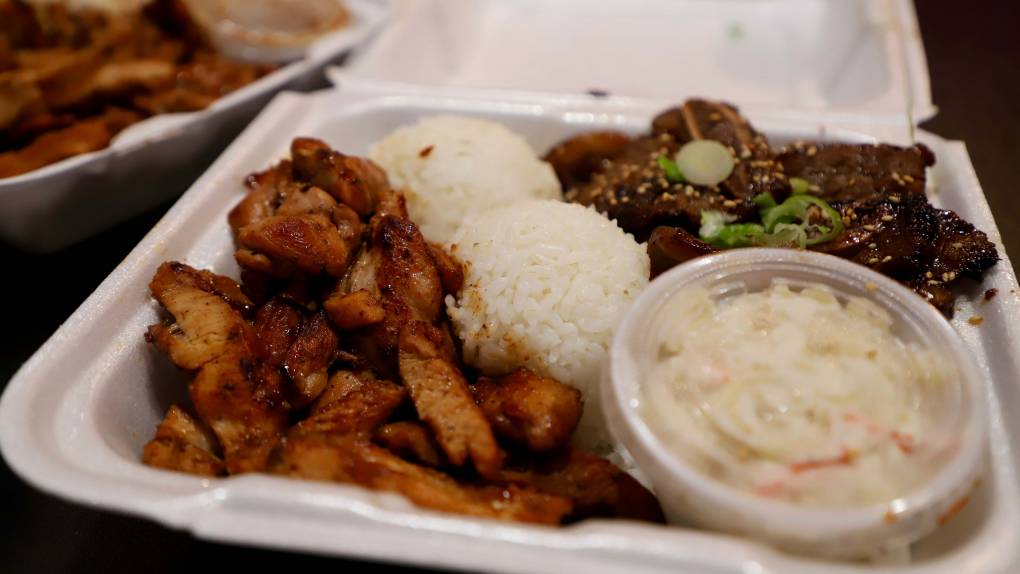
Why I Love Hawaiian BBQ: In Praise of One of the Bay's Great Multicultural Cuisines
Sponsored
Player sponsored by
window.__IS_SSR__=true
window.__INITIAL_STATE__={
"attachmentsReducer": {
"audio_0": {
"type": "attachments",
"id": "audio_0",
"imgSizes": {
"kqedFullSize": {
"file": "https://ww2.kqed.org/news/wp-content/themes/KQED-unified/img/audio_bgs/background0.jpg"
}
}
},
"audio_1": {
"type": "attachments",
"id": "audio_1",
"imgSizes": {
"kqedFullSize": {
"file": "https://ww2.kqed.org/news/wp-content/themes/KQED-unified/img/audio_bgs/background1.jpg"
}
}
},
"audio_2": {
"type": "attachments",
"id": "audio_2",
"imgSizes": {
"kqedFullSize": {
"file": "https://ww2.kqed.org/news/wp-content/themes/KQED-unified/img/audio_bgs/background2.jpg"
}
}
},
"audio_3": {
"type": "attachments",
"id": "audio_3",
"imgSizes": {
"kqedFullSize": {
"file": "https://ww2.kqed.org/news/wp-content/themes/KQED-unified/img/audio_bgs/background3.jpg"
}
}
},
"audio_4": {
"type": "attachments",
"id": "audio_4",
"imgSizes": {
"kqedFullSize": {
"file": "https://ww2.kqed.org/news/wp-content/themes/KQED-unified/img/audio_bgs/background4.jpg"
}
}
},
"placeholder": {
"type": "attachments",
"id": "placeholder",
"imgSizes": {
"thumbnail": {
"file": "https://cdn.kqed.org/wp-content/uploads/2024/12/KQED-Default-Image-816638274-2000x1333-1-160x107.jpg",
"width": 160,
"height": 107,
"mimeType": "image/jpeg"
},
"medium": {
"file": "https://cdn.kqed.org/wp-content/uploads/2024/12/KQED-Default-Image-816638274-2000x1333-1-800x533.jpg",
"width": 800,
"height": 533,
"mimeType": "image/jpeg"
},
"medium_large": {
"file": "https://cdn.kqed.org/wp-content/uploads/2024/12/KQED-Default-Image-816638274-2000x1333-1-768x512.jpg",
"width": 768,
"height": 512,
"mimeType": "image/jpeg"
},
"large": {
"file": "https://cdn.kqed.org/wp-content/uploads/2024/12/KQED-Default-Image-816638274-2000x1333-1-1020x680.jpg",
"width": 1020,
"height": 680,
"mimeType": "image/jpeg"
},
"1536x1536": {
"file": "https://cdn.kqed.org/wp-content/uploads/2024/12/KQED-Default-Image-816638274-2000x1333-1-1536x1024.jpg",
"width": 1536,
"height": 1024,
"mimeType": "image/jpeg"
},
"fd-lrg": {
"file": "https://cdn.kqed.org/wp-content/uploads/2024/12/KQED-Default-Image-816638274-2000x1333-1-1536x1024.jpg",
"width": 1536,
"height": 1024,
"mimeType": "image/jpeg"
},
"fd-med": {
"file": "https://cdn.kqed.org/wp-content/uploads/2024/12/KQED-Default-Image-816638274-2000x1333-1-1020x680.jpg",
"width": 1020,
"height": 680,
"mimeType": "image/jpeg"
},
"fd-sm": {
"file": "https://cdn.kqed.org/wp-content/uploads/2024/12/KQED-Default-Image-816638274-2000x1333-1-800x533.jpg",
"width": 800,
"height": 533,
"mimeType": "image/jpeg"
},
"post-thumbnail": {
"file": "https://cdn.kqed.org/wp-content/uploads/2024/12/KQED-Default-Image-816638274-2000x1333-1-672x372.jpg",
"width": 672,
"height": 372,
"mimeType": "image/jpeg"
},
"twentyfourteen-full-width": {
"file": "https://cdn.kqed.org/wp-content/uploads/2024/12/KQED-Default-Image-816638274-2000x1333-1-1038x576.jpg",
"width": 1038,
"height": 576,
"mimeType": "image/jpeg"
},
"xxsmall": {
"file": "https://cdn.kqed.org/wp-content/uploads/2024/12/KQED-Default-Image-816638274-2000x1333-1-160x107.jpg",
"width": 160,
"height": 107,
"mimeType": "image/jpeg"
},
"xsmall": {
"file": "https://cdn.kqed.org/wp-content/uploads/2024/12/KQED-Default-Image-816638274-2000x1333-1-672x372.jpg",
"width": 672,
"height": 372,
"mimeType": "image/jpeg"
},
"small": {
"file": "https://cdn.kqed.org/wp-content/uploads/2024/12/KQED-Default-Image-816638274-2000x1333-1-672x372.jpg",
"width": 672,
"height": 372,
"mimeType": "image/jpeg"
},
"xlarge": {
"file": "https://cdn.kqed.org/wp-content/uploads/2024/12/KQED-Default-Image-816638274-2000x1333-1-1020x680.jpg",
"width": 1020,
"height": 680,
"mimeType": "image/jpeg"
},
"full-width": {
"file": "https://cdn.kqed.org/wp-content/uploads/2024/12/KQED-Default-Image-816638274-2000x1333-1-1920x1280.jpg",
"width": 1920,
"height": 1280,
"mimeType": "image/jpeg"
},
"guest-author-32": {
"file": "https://cdn.kqed.org/wp-content/uploads/2025/01/KQED-Default-Image-816638274-1333x1333-1-160x160.jpg",
"width": 32,
"height": 32,
"mimeType": "image/jpeg"
},
"guest-author-50": {
"file": "https://cdn.kqed.org/wp-content/uploads/2025/01/KQED-Default-Image-816638274-1333x1333-1-160x160.jpg",
"width": 50,
"height": 50,
"mimeType": "image/jpeg"
},
"guest-author-64": {
"file": "https://cdn.kqed.org/wp-content/uploads/2025/01/KQED-Default-Image-816638274-1333x1333-1-160x160.jpg",
"width": 64,
"height": 64,
"mimeType": "image/jpeg"
},
"guest-author-96": {
"file": "https://cdn.kqed.org/wp-content/uploads/2025/01/KQED-Default-Image-816638274-1333x1333-1-160x160.jpg",
"width": 96,
"height": 96,
"mimeType": "image/jpeg"
},
"guest-author-128": {
"file": "https://cdn.kqed.org/wp-content/uploads/2025/01/KQED-Default-Image-816638274-1333x1333-1-160x160.jpg",
"width": 128,
"height": 128,
"mimeType": "image/jpeg"
},
"detail": {
"file": "https://cdn.kqed.org/wp-content/uploads/2025/01/KQED-Default-Image-816638274-1333x1333-1-160x160.jpg",
"width": 160,
"height": 160,
"mimeType": "image/jpeg"
},
"kqedFullSize": {
"file": "https://cdn.kqed.org/wp-content/uploads/2024/12/KQED-Default-Image-816638274-2000x1333-1.jpg",
"width": 2000,
"height": 1333
}
}
},
"arts_13966379": {
"type": "attachments",
"id": "arts_13966379",
"meta": {
"index": "attachments_1716263798",
"site": "arts",
"id": "13966379",
"found": true
},
"title": "Tokemoanas turkey tail bowl",
"publishDate": 1728516400,
"status": "inherit",
"parent": 13966361,
"modified": 1728516450,
"caption": "Braised turkey tails over rice — a Tongan specialty courtesy of Tokemoana.",
"credit": "Courtesy of Tokemoana Foods",
"altTag": "Braised turkey tails over rice in a small pot.",
"description": null,
"imgSizes": {
"medium": {
"file": "https://cdn.kqed.org/wp-content/uploads/sites/2/2024/10/Tokemoanas-turkey-tail-bowl-800x450.jpg",
"width": 800,
"height": 450,
"mimeType": "image/jpeg"
},
"large": {
"file": "https://cdn.kqed.org/wp-content/uploads/sites/2/2024/10/Tokemoanas-turkey-tail-bowl-1020x574.jpg",
"width": 1020,
"height": 574,
"mimeType": "image/jpeg"
},
"thumbnail": {
"file": "https://cdn.kqed.org/wp-content/uploads/sites/2/2024/10/Tokemoanas-turkey-tail-bowl-160x90.jpg",
"width": 160,
"height": 90,
"mimeType": "image/jpeg"
},
"medium_large": {
"file": "https://cdn.kqed.org/wp-content/uploads/sites/2/2024/10/Tokemoanas-turkey-tail-bowl-768x432.jpg",
"width": 768,
"height": 432,
"mimeType": "image/jpeg"
},
"1536x1536": {
"file": "https://cdn.kqed.org/wp-content/uploads/sites/2/2024/10/Tokemoanas-turkey-tail-bowl-1536x865.jpg",
"width": 1536,
"height": 865,
"mimeType": "image/jpeg"
},
"post-thumbnail": {
"file": "https://cdn.kqed.org/wp-content/uploads/sites/2/2024/10/Tokemoanas-turkey-tail-bowl-672x372.jpg",
"width": 672,
"height": 372,
"mimeType": "image/jpeg"
},
"twentyfourteen-full-width": {
"file": "https://cdn.kqed.org/wp-content/uploads/sites/2/2024/10/Tokemoanas-turkey-tail-bowl-1038x576.jpg",
"width": 1038,
"height": 576,
"mimeType": "image/jpeg"
},
"full-width": {
"file": "https://cdn.kqed.org/wp-content/uploads/sites/2/2024/10/Tokemoanas-turkey-tail-bowl-1920x1081.jpg",
"width": 1920,
"height": 1081,
"mimeType": "image/jpeg"
},
"kqedFullSize": {
"file": "https://cdn.kqed.org/wp-content/uploads/sites/2/2024/10/Tokemoanas-turkey-tail-bowl.jpg",
"width": 2000,
"height": 1126
}
},
"fetchFailed": false,
"isLoading": false
},
"arts_13962344": {
"type": "attachments",
"id": "arts_13962344",
"meta": {
"index": "attachments_1716263798",
"site": "arts",
"id": "13962344",
"found": true
},
"title": "SH 2-crop",
"publishDate": 1723163036,
"status": "inherit",
"parent": 13962340,
"modified": 1723163150,
"caption": "Open late in a Palo Alto strip mall, SH Hawaiian BBQ & Donuts specializes in hearty Hawaiian plate lunches.",
"credit": "Thien Pham",
"altTag": "Illustration: Two men seen through the window of a doughnut shop. They're devouring doughnuts and plates of Hawaiian barbecue.",
"description": null,
"imgSizes": {
"medium": {
"file": "https://cdn.kqed.org/wp-content/uploads/sites/2/2024/08/SH-2-crop-800x450.jpg",
"width": 800,
"height": 450,
"mimeType": "image/jpeg"
},
"large": {
"file": "https://cdn.kqed.org/wp-content/uploads/sites/2/2024/08/SH-2-crop-1020x574.jpg",
"width": 1020,
"height": 574,
"mimeType": "image/jpeg"
},
"thumbnail": {
"file": "https://cdn.kqed.org/wp-content/uploads/sites/2/2024/08/SH-2-crop-160x90.jpg",
"width": 160,
"height": 90,
"mimeType": "image/jpeg"
},
"medium_large": {
"file": "https://cdn.kqed.org/wp-content/uploads/sites/2/2024/08/SH-2-crop-768x432.jpg",
"width": 768,
"height": 432,
"mimeType": "image/jpeg"
},
"1536x1536": {
"file": "https://cdn.kqed.org/wp-content/uploads/sites/2/2024/08/SH-2-crop-1536x864.jpg",
"width": 1536,
"height": 864,
"mimeType": "image/jpeg"
},
"post-thumbnail": {
"file": "https://cdn.kqed.org/wp-content/uploads/sites/2/2024/08/SH-2-crop-672x372.jpg",
"width": 672,
"height": 372,
"mimeType": "image/jpeg"
},
"twentyfourteen-full-width": {
"file": "https://cdn.kqed.org/wp-content/uploads/sites/2/2024/08/SH-2-crop-1038x576.jpg",
"width": 1038,
"height": 576,
"mimeType": "image/jpeg"
},
"kqedFullSize": {
"file": "https://cdn.kqed.org/wp-content/uploads/sites/2/2024/08/SH-2-crop.jpg",
"width": 1920,
"height": 1080
}
},
"fetchFailed": false,
"isLoading": false
},
"arts_13929963": {
"type": "attachments",
"id": "arts_13929963",
"meta": {
"index": "attachments_1716263798",
"site": "arts",
"id": "13929963",
"found": true
},
"parent": 13929869,
"imgSizes": {
"twentyfourteen-full-width": {
"file": "https://ww2.kqed.org/app/uploads/sites/2/2023/05/island-bay-cocina_olivier-1038x576.jpg",
"width": 1038,
"mimeType": "image/jpeg",
"height": 576
},
"thumbnail": {
"file": "https://ww2.kqed.org/app/uploads/sites/2/2023/05/island-bay-cocina_olivier-160x110.jpg",
"width": 160,
"mimeType": "image/jpeg",
"height": 110
},
"post-thumbnail": {
"file": "https://ww2.kqed.org/app/uploads/sites/2/2023/05/island-bay-cocina_olivier-672x372.jpg",
"width": 672,
"mimeType": "image/jpeg",
"height": 372
},
"kqedFullSize": {
"file": "https://ww2.kqed.org/app/uploads/sites/2/2023/05/island-bay-cocina_olivier.jpg",
"width": 1920,
"height": 1320
},
"large": {
"file": "https://ww2.kqed.org/app/uploads/sites/2/2023/05/island-bay-cocina_olivier-1020x701.jpg",
"width": 1020,
"mimeType": "image/jpeg",
"height": 701
},
"1536x1536": {
"file": "https://ww2.kqed.org/app/uploads/sites/2/2023/05/island-bay-cocina_olivier-1536x1056.jpg",
"width": 1536,
"mimeType": "image/jpeg",
"height": 1056
},
"medium": {
"file": "https://ww2.kqed.org/app/uploads/sites/2/2023/05/island-bay-cocina_olivier-800x550.jpg",
"width": 800,
"mimeType": "image/jpeg",
"height": 550
},
"medium_large": {
"file": "https://ww2.kqed.org/app/uploads/sites/2/2023/05/island-bay-cocina_olivier-768x528.jpg",
"width": 768,
"mimeType": "image/jpeg",
"height": 528
}
},
"publishDate": 1685633840,
"modified": 1685634940,
"caption": "Olivier Grandvoinet shows off his signature \"Guavanero\" barbecue sauce. His pop-up, Island Bay Cocina, is selling island-inspired ribs and carnitas around the Bay.",
"description": null,
"title": "island bay cocina_olivier",
"credit": "Sahar Nayrami",
"status": "inherit",
"altTag": "A barbecue pitmaster in a Hawaiian shirt holds up two bottles of his signature sauce.",
"fetchFailed": false,
"isLoading": false
},
"arts_13912981": {
"type": "attachments",
"id": "arts_13912981",
"meta": {
"index": "attachments_1716263798",
"site": "arts",
"id": "13912981",
"found": true
},
"parent": 13912947,
"imgSizes": {
"thumbnail": {
"file": "https://ww2.kqed.org/app/uploads/sites/2/2022/05/ShaveIce-160x90.jpg",
"width": 160,
"mimeType": "image/jpeg",
"height": 90
},
"post-thumbnail": {
"file": "https://ww2.kqed.org/app/uploads/sites/2/2022/05/ShaveIce-672x372.jpg",
"width": 672,
"mimeType": "image/jpeg",
"height": 372
},
"kqedFullSize": {
"file": "https://ww2.kqed.org/app/uploads/sites/2/2022/05/ShaveIce.jpg",
"width": 790,
"height": 442
},
"medium_large": {
"file": "https://ww2.kqed.org/app/uploads/sites/2/2022/05/ShaveIce-768x430.jpg",
"width": 768,
"mimeType": "image/jpeg",
"height": 430
}
},
"publishDate": 1651789532,
"modified": 1651789639,
"caption": "The May Day festival will be a good chance to score some Hawaiian shave ice—and any number of other Pacific Island specialties.",
"description": null,
"title": "hawaii ice shave",
"credit": null,
"status": "inherit",
"altTag": "A bowl of Hawaiian shaved ice topped with purple, blue and yellow syrups.",
"fetchFailed": false,
"isLoading": false
},
"arts_13911071": {
"type": "attachments",
"id": "arts_13911071",
"meta": {
"index": "attachments_1716263798",
"site": "arts",
"id": "13911071",
"found": true
},
"parent": 13911062,
"imgSizes": {
"twentyfourteen-full-width": {
"file": "https://ww2.kqed.org/app/uploads/sites/2/2022/03/ilava_platelunch-1038x576.jpg",
"width": 1038,
"mimeType": "image/jpeg",
"height": 576
},
"thumbnail": {
"file": "https://ww2.kqed.org/app/uploads/sites/2/2022/03/ilava_platelunch-160x90.jpg",
"width": 160,
"mimeType": "image/jpeg",
"height": 90
},
"post-thumbnail": {
"file": "https://ww2.kqed.org/app/uploads/sites/2/2022/03/ilava_platelunch-672x372.jpg",
"width": 672,
"mimeType": "image/jpeg",
"height": 372
},
"kqedFullSize": {
"file": "https://ww2.kqed.org/app/uploads/sites/2/2022/03/ilava_platelunch-scaled.jpg",
"width": 2560,
"height": 1440
},
"2048x2048": {
"file": "https://ww2.kqed.org/app/uploads/sites/2/2022/03/ilava_platelunch-2048x1152.jpg",
"width": 2048,
"mimeType": "image/jpeg",
"height": 1152
},
"large": {
"file": "https://ww2.kqed.org/app/uploads/sites/2/2022/03/ilava_platelunch-1020x574.jpg",
"width": 1020,
"mimeType": "image/jpeg",
"height": 574
},
"1536x1536": {
"file": "https://ww2.kqed.org/app/uploads/sites/2/2022/03/ilava_platelunch-1536x864.jpg",
"width": 1536,
"mimeType": "image/jpeg",
"height": 864
},
"full-width": {
"file": "https://ww2.kqed.org/app/uploads/sites/2/2022/03/ilava_platelunch-1920x1080.jpg",
"width": 1920,
"mimeType": "image/jpeg",
"height": 1080
},
"medium": {
"file": "https://ww2.kqed.org/app/uploads/sites/2/2022/03/ilava_platelunch-800x450.jpg",
"width": 800,
"mimeType": "image/jpeg",
"height": 450
},
"medium_large": {
"file": "https://ww2.kqed.org/app/uploads/sites/2/2022/03/ilava_platelunch-768x432.jpg",
"width": 768,
"mimeType": "image/jpeg",
"height": 432
}
},
"publishDate": 1648151591,
"modified": 1648151728,
"caption": "A classic Hawaiian plate lunch at iLava comes with macaroni salad and two scoops of white rice.",
"description": null,
"title": "ilava_platelunch",
"credit": "Alan Chazaro",
"status": "inherit",
"altTag": "Hawaiian plate lunch with grilled chicken, short ribs, macaroni salad, and rice in a Styrofoam container.",
"fetchFailed": false,
"isLoading": false
}
},
"audioPlayerReducer": {
"postId": "stream_live",
"isPaused": true,
"isPlaying": false,
"pfsActive": false,
"pledgeModalIsOpen": true,
"playerDrawerIsOpen": false
},
"authorsReducer": {
"ltsai": {
"type": "authors",
"id": "11743",
"meta": {
"index": "authors_1716337520",
"id": "11743",
"found": true
},
"name": "Luke Tsai",
"firstName": "Luke",
"lastName": "Tsai",
"slug": "ltsai",
"email": "ltsai@kqed.org",
"display_author_email": true,
"staff_mastheads": [
"arts"
],
"title": "Food Editor",
"bio": "Luke Tsai is KQED's food editor and resident stinky tofu connoisseur. Prior to KQED, he was an editor at Eater SF, \u003cem>San Francisco \u003c/em>magazine, and the \u003cem>East Bay Express\u003c/em>, and his work has also appeared in TASTE, the \u003cem>San Francisco Chronicle\u003c/em>, and the \u003cem>Best Food Writing\u003c/em> anthology. When he isn't writing or editing, you'll find him eating most everything he can get his hands on.",
"avatar": "https://secure.gravatar.com/avatar/d1ff591a3047b143a0e23cf7f28fcac0?s=600&d=blank&r=g",
"twitter": "theluketsai",
"facebook": null,
"instagram": null,
"linkedin": null,
"sites": [
{
"site": "",
"roles": [
"editor"
]
},
{
"site": "arts",
"roles": [
"administrator"
]
},
{
"site": "bayareabites",
"roles": [
"editor"
]
},
{
"site": "food",
"roles": [
"editor"
]
}
],
"headData": {
"title": "Luke Tsai | KQED",
"description": "Food Editor",
"ogImgSrc": "https://secure.gravatar.com/avatar/d1ff591a3047b143a0e23cf7f28fcac0?s=600&d=blank&r=g",
"twImgSrc": "https://secure.gravatar.com/avatar/d1ff591a3047b143a0e23cf7f28fcac0?s=600&d=blank&r=g"
},
"isLoading": false,
"link": "/author/ltsai"
},
"achazaro": {
"type": "authors",
"id": "11748",
"meta": {
"index": "authors_1716337520",
"id": "11748",
"found": true
},
"name": "Alan Chazaro",
"firstName": "Alan",
"lastName": "Chazaro",
"slug": "achazaro",
"email": "agchazaro@gmail.com",
"display_author_email": true,
"staff_mastheads": [],
"title": "Food Writer and Reporter",
"bio": "Alan Chazaro is the author of \u003cem>This Is Not a Frank Ocean Cover Album\u003c/em> (Black Lawrence Press, 2019), \u003cem>Piñata Theory\u003c/em> (Black Lawrence Press, 2020), and \u003cem>Notes from the Eastern Span of the Bay Bridge\u003c/em> (Ghost City Press, 2021). He is a graduate of June Jordan’s Poetry for the People program at UC Berkeley and a former Lawrence Ferlinghetti Fellow at the University of San Francisco. He writes about sports, food, art, music, education, and culture while repping the Bay on \u003ca href=\"https://twitter.com/alan_chazaro\">Twitter\u003c/a> and \u003ca href=\"https://www.instagram.com/alan_chazaro/?hl=en\">Instagram\u003c/a> at @alan_chazaro.",
"avatar": "https://secure.gravatar.com/avatar/ea8b6dd970fc5c29e7a188e7d5861df7?s=600&d=blank&r=g",
"twitter": "alan_chazaro",
"facebook": null,
"instagram": null,
"linkedin": null,
"sites": [
{
"site": "arts",
"roles": [
"contributor"
]
},
{
"site": "news",
"roles": [
"editor"
]
}
],
"headData": {
"title": "Alan Chazaro | KQED",
"description": "Food Writer and Reporter",
"ogImgSrc": "https://secure.gravatar.com/avatar/ea8b6dd970fc5c29e7a188e7d5861df7?s=600&d=blank&r=g",
"twImgSrc": "https://secure.gravatar.com/avatar/ea8b6dd970fc5c29e7a188e7d5861df7?s=600&d=blank&r=g"
},
"isLoading": false,
"link": "/author/achazaro"
},
"tpham": {
"type": "authors",
"id": "11753",
"meta": {
"index": "authors_1716337520",
"id": "11753",
"found": true
},
"name": "Thien Pham",
"firstName": "Thien",
"lastName": "Pham",
"slug": "tpham",
"email": "thiendog@gmail.com",
"display_author_email": false,
"staff_mastheads": [],
"title": "KQED Contributor",
"bio": null,
"avatar": "https://secure.gravatar.com/avatar/fa68ed7d6a785e5294a7bb79a3f409c3?s=600&d=blank&r=g",
"twitter": null,
"facebook": null,
"instagram": null,
"linkedin": null,
"sites": [
{
"site": "arts",
"roles": [
"contributor"
]
}
],
"headData": {
"title": "Thien Pham | KQED",
"description": "KQED Contributor",
"ogImgSrc": "https://secure.gravatar.com/avatar/fa68ed7d6a785e5294a7bb79a3f409c3?s=600&d=blank&r=g",
"twImgSrc": "https://secure.gravatar.com/avatar/fa68ed7d6a785e5294a7bb79a3f409c3?s=600&d=blank&r=g"
},
"isLoading": false,
"link": "/author/tpham"
}
},
"breakingNewsReducer": {},
"pagesReducer": {},
"postsReducer": {
"stream_live": {
"type": "live",
"id": "stream_live",
"audioUrl": "https://streams.kqed.org/kqedradio",
"title": "Live Stream",
"excerpt": "Live Stream information currently unavailable.",
"link": "/radio",
"featImg": "",
"label": {
"name": "KQED Live",
"link": "/"
}
},
"stream_kqedNewscast": {
"type": "posts",
"id": "stream_kqedNewscast",
"audioUrl": "https://www.kqed.org/.stream/anon/radio/RDnews/newscast.mp3?_=1",
"title": "KQED Newscast",
"featImg": "",
"label": {
"name": "88.5 FM",
"link": "/"
}
},
"arts_13966361": {
"type": "posts",
"id": "arts_13966361",
"meta": {
"index": "posts_1716263798",
"site": "arts",
"id": "13966361",
"score": null,
"sort": [
1728517221000
]
},
"guestAuthors": [],
"slug": "pacific-islander-night-market-food-festival-east-palo-alto",
"title": "This Night Market Puts Pacific Island Cuisine Front and Center",
"publishDate": 1728517221,
"format": "aside",
"headTitle": "This Night Market Puts Pacific Island Cuisine Front and Center | KQED",
"labelTerm": {},
"content": "\u003cfigure id=\"attachment_13966376\" class=\"wp-caption alignnone\" style=\"max-width: 2000px\">\u003cimg loading=\"lazy\" decoding=\"async\" class=\"size-full wp-image-13966376\" src=\"https://cdn.kqed.org/wp-content/uploads/sites/2/2024/10/Tomemoanas-poly-plate2.jpg\" alt=\"A platter of assorted Tongan stews and other Polynesian dishes.\" width=\"2000\" height=\"1608\" srcset=\"https://cdn.kqed.org/wp-content/uploads/sites/2/2024/10/Tomemoanas-poly-plate2.jpg 2000w, https://cdn.kqed.org/wp-content/uploads/sites/2/2024/10/Tomemoanas-poly-plate2-800x643.jpg 800w, https://cdn.kqed.org/wp-content/uploads/sites/2/2024/10/Tomemoanas-poly-plate2-1020x820.jpg 1020w, https://cdn.kqed.org/wp-content/uploads/sites/2/2024/10/Tomemoanas-poly-plate2-160x129.jpg 160w, https://cdn.kqed.org/wp-content/uploads/sites/2/2024/10/Tomemoanas-poly-plate2-768x617.jpg 768w, https://cdn.kqed.org/wp-content/uploads/sites/2/2024/10/Tomemoanas-poly-plate2-1536x1235.jpg 1536w, https://cdn.kqed.org/wp-content/uploads/sites/2/2024/10/Tomemoanas-poly-plate2-1920x1544.jpg 1920w\" sizes=\"(max-width: 2000px) 100vw, 2000px\">\u003cfigcaption class=\"wp-caption-text\">A mixed platter from Tokemoana. The Tongan food business is one of several Pacific Island eateries that will be featured at the South Pacific Food Fest night market in East Palo Alto. \u003ccite>(Courtesy of Tokemoana Foods)\u003c/cite>\u003c/figcaption>\u003c/figure>\n\u003cp>These days the Bay Area is awash with so many \u003ca href=\"https://www.kqed.org/arts/13963258/bay-area-night-markets-food-fall-guide-2024\">night markets\u003c/a>, it’s possible for a hardcore street food lover to hit one up almost every single weekend. But the latest market to touch down on the Peninsula is almost certainly the only one where hungry visitors can feast on Fijian meat pies, Tongan teriyaki-braised turkey tails and \u003ca href=\"https://www.instagram.com/p/DAwQyYUyxYK/?hl=en\">watermelon ’otai\u003c/a>, \u003ci>and \u003c/i>Hawaiian barbecue plate lunches.\u003c/p>\n\u003cp>In fact, \u003ca href=\"https://www.instagram.com/southpacificfoodfest/?hl=en\">South Pacific Food Fest\u003c/a> is the Bay Area’s only night market dedicated exclusively to Pacific Island culture and cuisine. The annual event’s second edition takes place this Saturday, Oct. 12, at \u003ca href=\"https://www.university-circle.com/\">University Circle\u003c/a> in East Palo Alto.\u003c/p>\n\u003cp>[aside postID='arts_13963258,arts_13911062']The night market is the brainchild of Fusi Taaga (of \u003ca href=\"https://www.instagram.com/tokemoanafoods/?hl=en\">Tokemoana Foods\u003c/a>) and Angelina Hurrell, both of whom have spent years selling their island dishes at food events all over Northern California.\u003c/p>\n\u003cp>As Taaga tells it, many Pacific Island food vendors are no stranger to the Bay Area festival circuit, but they’re often relegated to supporting actor status at big events (like, say, \u003ca href=\"https://sfoutsidelands.com/food-and-drink/taste-of-the-bay-area/\">Outside Lands\u003c/a>) where food isn’t the main focus. And while the Bay is home to plenty of large-scale AAPI food festivals, the reality is that these tend to be heavy on the “AA” and relatively light on the “PI,” with maybe only one or two vendors at the most representing all of the different islands in the South Pacific.\u003c/p>\n\u003cfigure id=\"attachment_13966381\" class=\"wp-caption alignnone\" style=\"max-width: 2000px\">\u003cimg loading=\"lazy\" decoding=\"async\" class=\"size-full wp-image-13966381\" src=\"https://cdn.kqed.org/wp-content/uploads/sites/2/2024/10/south-pacific-food-fest-vendor.jpg\" alt=\"A vendor selling traditional woven crafts at a Pacific Islander festival.\" width=\"2000\" height=\"1377\" srcset=\"https://cdn.kqed.org/wp-content/uploads/sites/2/2024/10/south-pacific-food-fest-vendor.jpg 2000w, https://cdn.kqed.org/wp-content/uploads/sites/2/2024/10/south-pacific-food-fest-vendor-800x551.jpg 800w, https://cdn.kqed.org/wp-content/uploads/sites/2/2024/10/south-pacific-food-fest-vendor-1020x702.jpg 1020w, https://cdn.kqed.org/wp-content/uploads/sites/2/2024/10/south-pacific-food-fest-vendor-160x110.jpg 160w, https://cdn.kqed.org/wp-content/uploads/sites/2/2024/10/south-pacific-food-fest-vendor-768x529.jpg 768w, https://cdn.kqed.org/wp-content/uploads/sites/2/2024/10/south-pacific-food-fest-vendor-1536x1058.jpg 1536w, https://cdn.kqed.org/wp-content/uploads/sites/2/2024/10/south-pacific-food-fest-vendor-1920x1322.jpg 1920w\" sizes=\"(max-width: 2000px) 100vw, 2000px\">\u003cfigcaption class=\"wp-caption-text\">A crafts vendor at last year’s inaugural South Pacific Food Fest. \u003ccite>(Courtesy of Tokemoana Foods)\u003c/cite>\u003c/figcaption>\u003c/figure>\n\u003cp>“In a lot of those spaces, the actual representation from Pacific Islanders is very minimal,” Taaga says. “It’s not really anyone’s fault.” So, she and Hurrell decided to create a space of their own — a festival where Polynesian/Pacific Islander cuisine would be front and center.\u003c/p>\n\u003cp>[ad fullwidth]\u003c/p>\n\u003cp>In short, Taaga says, “We wanted to create an event where Pacific Islanders do feel like it’s about them and this community.”\u003c/p>\n\u003cp>The night market aspect was mostly just to accommodate working people’s schedules and help create an atmosphere — with art, music and other cultural performances — where folks would want to stay and hang out for a while, instead of just grabbing a meal on the run.\u003c/p>\n\u003cp>This year’s South Pacific Food Fest will feature 16 food vendors, culled from over 60 applications—an outpouring of interest that speaks to the abundance of island food here in the Bay Area. In fact, the local Pacific Islander food scene’s robustness may come as a surprise to those outside of the community: Apart from the ubiquity of \u003ca href=\"https://www.kqed.org/arts/13911062/hawaiian-barbecue-bay-area-multicultural-oakland-ilava\">Hawaiian barbecue restaurants\u003c/a> across the region, many of these businesses are food trucks, pop-ups and catering operations. Often, they don’t have a brick-and-mortar presence and haven’t gotten a ton of press coverage.\u003c/p>\n\u003cfigure id=\"attachment_13966377\" class=\"wp-caption alignnone\" style=\"max-width: 2000px\">\u003cimg loading=\"lazy\" decoding=\"async\" class=\"size-full wp-image-13966377\" src=\"https://cdn.kqed.org/wp-content/uploads/sites/2/2024/10/Bula-mince-n-cheese-pie.jpg\" alt=\"Fijian meat pie cut open so that the meaty cross section is visible.\" width=\"2000\" height=\"2500\" srcset=\"https://cdn.kqed.org/wp-content/uploads/sites/2/2024/10/Bula-mince-n-cheese-pie.jpg 2000w, https://cdn.kqed.org/wp-content/uploads/sites/2/2024/10/Bula-mince-n-cheese-pie-800x1000.jpg 800w, https://cdn.kqed.org/wp-content/uploads/sites/2/2024/10/Bula-mince-n-cheese-pie-1020x1275.jpg 1020w, https://cdn.kqed.org/wp-content/uploads/sites/2/2024/10/Bula-mince-n-cheese-pie-160x200.jpg 160w, https://cdn.kqed.org/wp-content/uploads/sites/2/2024/10/Bula-mince-n-cheese-pie-768x960.jpg 768w, https://cdn.kqed.org/wp-content/uploads/sites/2/2024/10/Bula-mince-n-cheese-pie-1229x1536.jpg 1229w, https://cdn.kqed.org/wp-content/uploads/sites/2/2024/10/Bula-mince-n-cheese-pie-1638x2048.jpg 1638w, https://cdn.kqed.org/wp-content/uploads/sites/2/2024/10/Bula-mince-n-cheese-pie-1920x2400.jpg 1920w\" sizes=\"(max-width: 2000px) 100vw, 2000px\">\u003cfigcaption class=\"wp-caption-text\">A Fijian mince and cheese pie from Bula Pies Fiji. \u003ccite>(Courtesy of Bula Pies Fiji)\u003c/cite>\u003c/figcaption>\u003c/figure>\n\u003cp>What Taaga and Hurrell hope, then, is that the night market will help showcase the tremendous diversity of Pacific Island cuisine. Saturday’s food lineup will include flaky-crusted Fijian-style minced beef pies and smoked brisket pies from \u003ca href=\"https://www.instagram.com/bula.pies.fiji/?hl=en\">Bula Pies Fiji\u003c/a> and lamb curry from \u003ca href=\"https://www.instagram.com/fijianbbq/\">Fijian BBQ\u003c/a>. Tokemoana, whose brick-and-mortar restaurant in San Mateo closed last year, will sell Tongan braised turkey tails and feke (octopus in cream sauce). And the chef for \u003ca href=\"https://www.instagram.com/p/DA2RsuwPIfn/\">Saia’s Spot in East Palo Alto\u003c/a> — perhaps the Bay Area’s first Tongan restaurant whose heyday was during the early 2000s — is coming out of retirement to serve lu kapapulu, a Polynesian staple made with taro leaves and corned beef.\u003c/p>\n\u003cp>Meanwhile, other Pacific Islander–owned businesses will serve dishes not typically associated with the South Pacific — like \u003ca href=\"https://www.instagram.com/p/DAokxVUyJ2c/\">hibachi\u003c/a> plates and \u003ca href=\"https://www.instagram.com/p/DAhqJo7vZ6E/\">Cajun seafood boil\u003c/a>, prepared with an island twist. Dessert options will include \u003ca href=\"https://www.instagram.com/p/DAzWk1OSmO0/?hl=en\">Dole whip\u003c/a> and the Samoan cinnamon cake known as puligi. And yes, there will be plenty of \u003ca href=\"https://www.instagram.com/its_poly_bbq_/\">Hawaiian barbecue\u003c/a> too.\u003c/p>\n\u003cfigure id=\"attachment_13966379\" class=\"wp-caption alignnone\" style=\"max-width: 2000px\">\u003cimg loading=\"lazy\" decoding=\"async\" class=\"size-full wp-image-13966379\" src=\"https://cdn.kqed.org/wp-content/uploads/sites/2/2024/10/Tokemoanas-turkey-tail-bowl.jpg\" alt=\"Braised turkey tails over rice in a small pot.\" width=\"2000\" height=\"1126\" srcset=\"https://cdn.kqed.org/wp-content/uploads/sites/2/2024/10/Tokemoanas-turkey-tail-bowl.jpg 2000w, https://cdn.kqed.org/wp-content/uploads/sites/2/2024/10/Tokemoanas-turkey-tail-bowl-800x450.jpg 800w, https://cdn.kqed.org/wp-content/uploads/sites/2/2024/10/Tokemoanas-turkey-tail-bowl-1020x574.jpg 1020w, https://cdn.kqed.org/wp-content/uploads/sites/2/2024/10/Tokemoanas-turkey-tail-bowl-160x90.jpg 160w, https://cdn.kqed.org/wp-content/uploads/sites/2/2024/10/Tokemoanas-turkey-tail-bowl-768x432.jpg 768w, https://cdn.kqed.org/wp-content/uploads/sites/2/2024/10/Tokemoanas-turkey-tail-bowl-1536x865.jpg 1536w, https://cdn.kqed.org/wp-content/uploads/sites/2/2024/10/Tokemoanas-turkey-tail-bowl-1920x1081.jpg 1920w\" sizes=\"(max-width: 2000px) 100vw, 2000px\">\u003cfigcaption class=\"wp-caption-text\">Braised turkey tails over rice — a Tongan specialty courtesy of Tokemoana. \u003ccite>(Courtesy of Tokemoana Foods)\u003c/cite>\u003c/figcaption>\u003c/figure>\n\u003cp>Taaga recalls that when she first opened her diner-like San Mateo restaurant, so many American customers came and ordered things like teriyaki cheeseburgers and banana macadamia nut pancakes — in other words, dishes that aren’t really Tongan foods at all. But then they would see, and become curious about, the more traditional dishes on the menu.\u003c/p>\n\u003cp>She hopes the South Pacific Food Fest can function in a similar way. The event will, first and foremost, be an opportunity for the local Pacific Island community to come together. But she also hopes those outside of the community will come, perhaps drawn in by the promise of poke bowls and Hawaiian barbecue. And once they’re there? Hopefully, Taaga says, they’ll also try some of the lesser-known foods on offer.\u003c/p>\n\u003cp>“It’s an opportunity for these businesses to showcase their food and their culture to the outside world,” Taaga says.\u003c/p>\n\u003chr>\n\u003cp>\u003c/p>\n\u003cp>\u003ca href=\"https://www.eventbrite.com/e/south-pacific-food-fest-tickets-1039309180737?aff=oddtdtcreator\">\u003ci>South Pacific Food Fest\u003c/i>\u003c/a>\u003ci> will take place on Saturday, Oct. 12, from 4–10 p.m. at University Circle in East Palo Alto. Admission is free.\u003c/i>\u003c/p>\n\n",
"blocks": [],
"excerpt": "The second annual South Pacific Food Fest comes to East Palo Alto.",
"status": "publish",
"parent": 0,
"modified": 1728517516,
"stats": {
"hasAudio": false,
"hasVideo": false,
"hasChartOrMap": false,
"iframeSrcs": [],
"hasGoogleForm": false,
"hasGallery": false,
"hasHearkenModule": false,
"hasPolis": false,
"paragraphCount": 16,
"wordCount": 926
},
"headData": {
"title": "South Pacific Night Market Puts Polynesian Food Front and Center | KQED",
"description": "The second annual South Pacific Food Fest comes to East Palo Alto.",
"ogTitle": "This Night Market Puts Pacific Island Cuisine Front and Center",
"ogDescription": "",
"ogImgId": "",
"twTitle": "This Night Market Puts Pacific Island Cuisine Front and Center",
"twDescription": "",
"twImgId": "",
"socialTitle": "South Pacific Night Market Puts Polynesian Food Front and Center %%page%% %%sep%% KQED",
"schema": {
"@context": "https://schema.org",
"@type": "Article",
"headline": "This Night Market Puts Pacific Island Cuisine Front and Center",
"datePublished": "2024-10-09T16:40:21-07:00",
"dateModified": "2024-10-09T16:45:16-07:00",
"image": "https://cdn.kqed.org/wp-content/uploads/2020/02/KQED-OG-Image@1x.png"
}
},
"source": "Food",
"sourceUrl": "https://www.kqed.org/food",
"sticky": false,
"nprStoryId": "kqed-13966361",
"excludeFromSiteSearch": "Include",
"articleAge": "0",
"path": "/arts/13966361/pacific-islander-night-market-food-festival-east-palo-alto",
"audioTrackLength": null,
"parsedContent": [
{
"type": "contentString",
"content": "\u003cdiv class=\"post-body\">\u003cp>\u003cfigure id=\"attachment_13966376\" class=\"wp-caption alignnone\" style=\"max-width: 2000px\">\u003cimg loading=\"lazy\" decoding=\"async\" class=\"size-full wp-image-13966376\" src=\"https://cdn.kqed.org/wp-content/uploads/sites/2/2024/10/Tomemoanas-poly-plate2.jpg\" alt=\"A platter of assorted Tongan stews and other Polynesian dishes.\" width=\"2000\" height=\"1608\" srcset=\"https://cdn.kqed.org/wp-content/uploads/sites/2/2024/10/Tomemoanas-poly-plate2.jpg 2000w, https://cdn.kqed.org/wp-content/uploads/sites/2/2024/10/Tomemoanas-poly-plate2-800x643.jpg 800w, https://cdn.kqed.org/wp-content/uploads/sites/2/2024/10/Tomemoanas-poly-plate2-1020x820.jpg 1020w, https://cdn.kqed.org/wp-content/uploads/sites/2/2024/10/Tomemoanas-poly-plate2-160x129.jpg 160w, https://cdn.kqed.org/wp-content/uploads/sites/2/2024/10/Tomemoanas-poly-plate2-768x617.jpg 768w, https://cdn.kqed.org/wp-content/uploads/sites/2/2024/10/Tomemoanas-poly-plate2-1536x1235.jpg 1536w, https://cdn.kqed.org/wp-content/uploads/sites/2/2024/10/Tomemoanas-poly-plate2-1920x1544.jpg 1920w\" sizes=\"(max-width: 2000px) 100vw, 2000px\">\u003cfigcaption class=\"wp-caption-text\">A mixed platter from Tokemoana. The Tongan food business is one of several Pacific Island eateries that will be featured at the South Pacific Food Fest night market in East Palo Alto. \u003ccite>(Courtesy of Tokemoana Foods)\u003c/cite>\u003c/figcaption>\u003c/figure>\n\u003cp>These days the Bay Area is awash with so many \u003ca href=\"https://www.kqed.org/arts/13963258/bay-area-night-markets-food-fall-guide-2024\">night markets\u003c/a>, it’s possible for a hardcore street food lover to hit one up almost every single weekend. But the latest market to touch down on the Peninsula is almost certainly the only one where hungry visitors can feast on Fijian meat pies, Tongan teriyaki-braised turkey tails and \u003ca href=\"https://www.instagram.com/p/DAwQyYUyxYK/?hl=en\">watermelon ’otai\u003c/a>, \u003ci>and \u003c/i>Hawaiian barbecue plate lunches.\u003c/p>\n\u003cp>In fact, \u003ca href=\"https://www.instagram.com/southpacificfoodfest/?hl=en\">South Pacific Food Fest\u003c/a> is the Bay Area’s only night market dedicated exclusively to Pacific Island culture and cuisine. The annual event’s second edition takes place this Saturday, Oct. 12, at \u003ca href=\"https://www.university-circle.com/\">University Circle\u003c/a> in East Palo Alto.\u003c/p>\n\u003cp>\u003c/p>\u003c/div>",
"attributes": {
"named": {},
"numeric": []
}
},
{
"type": "component",
"content": "",
"name": "aside",
"attributes": {
"named": {
"postid": "arts_13963258,arts_13911062",
"label": ""
},
"numeric": []
}
},
{
"type": "contentString",
"content": "\u003cdiv class=\"post-body\">\u003cp>The night market is the brainchild of Fusi Taaga (of \u003ca href=\"https://www.instagram.com/tokemoanafoods/?hl=en\">Tokemoana Foods\u003c/a>) and Angelina Hurrell, both of whom have spent years selling their island dishes at food events all over Northern California.\u003c/p>\n\u003cp>As Taaga tells it, many Pacific Island food vendors are no stranger to the Bay Area festival circuit, but they’re often relegated to supporting actor status at big events (like, say, \u003ca href=\"https://sfoutsidelands.com/food-and-drink/taste-of-the-bay-area/\">Outside Lands\u003c/a>) where food isn’t the main focus. And while the Bay is home to plenty of large-scale AAPI food festivals, the reality is that these tend to be heavy on the “AA” and relatively light on the “PI,” with maybe only one or two vendors at the most representing all of the different islands in the South Pacific.\u003c/p>\n\u003cfigure id=\"attachment_13966381\" class=\"wp-caption alignnone\" style=\"max-width: 2000px\">\u003cimg loading=\"lazy\" decoding=\"async\" class=\"size-full wp-image-13966381\" src=\"https://cdn.kqed.org/wp-content/uploads/sites/2/2024/10/south-pacific-food-fest-vendor.jpg\" alt=\"A vendor selling traditional woven crafts at a Pacific Islander festival.\" width=\"2000\" height=\"1377\" srcset=\"https://cdn.kqed.org/wp-content/uploads/sites/2/2024/10/south-pacific-food-fest-vendor.jpg 2000w, https://cdn.kqed.org/wp-content/uploads/sites/2/2024/10/south-pacific-food-fest-vendor-800x551.jpg 800w, https://cdn.kqed.org/wp-content/uploads/sites/2/2024/10/south-pacific-food-fest-vendor-1020x702.jpg 1020w, https://cdn.kqed.org/wp-content/uploads/sites/2/2024/10/south-pacific-food-fest-vendor-160x110.jpg 160w, https://cdn.kqed.org/wp-content/uploads/sites/2/2024/10/south-pacific-food-fest-vendor-768x529.jpg 768w, https://cdn.kqed.org/wp-content/uploads/sites/2/2024/10/south-pacific-food-fest-vendor-1536x1058.jpg 1536w, https://cdn.kqed.org/wp-content/uploads/sites/2/2024/10/south-pacific-food-fest-vendor-1920x1322.jpg 1920w\" sizes=\"(max-width: 2000px) 100vw, 2000px\">\u003cfigcaption class=\"wp-caption-text\">A crafts vendor at last year’s inaugural South Pacific Food Fest. \u003ccite>(Courtesy of Tokemoana Foods)\u003c/cite>\u003c/figcaption>\u003c/figure>\n\u003cp>“In a lot of those spaces, the actual representation from Pacific Islanders is very minimal,” Taaga says. “It’s not really anyone’s fault.” So, she and Hurrell decided to create a space of their own — a festival where Polynesian/Pacific Islander cuisine would be front and center.\u003c/p>\n\u003cp>\u003c/p>\u003c/div>",
"attributes": {
"named": {},
"numeric": []
}
},
{
"type": "component",
"content": "",
"name": "ad",
"attributes": {
"named": {
"label": "fullwidth"
},
"numeric": [
"fullwidth"
]
}
},
{
"type": "contentString",
"content": "\u003cdiv class=\"post-body\">\u003cp>\u003c/p>\n\u003cp>In short, Taaga says, “We wanted to create an event where Pacific Islanders do feel like it’s about them and this community.”\u003c/p>\n\u003cp>The night market aspect was mostly just to accommodate working people’s schedules and help create an atmosphere — with art, music and other cultural performances — where folks would want to stay and hang out for a while, instead of just grabbing a meal on the run.\u003c/p>\n\u003cp>This year’s South Pacific Food Fest will feature 16 food vendors, culled from over 60 applications—an outpouring of interest that speaks to the abundance of island food here in the Bay Area. In fact, the local Pacific Islander food scene’s robustness may come as a surprise to those outside of the community: Apart from the ubiquity of \u003ca href=\"https://www.kqed.org/arts/13911062/hawaiian-barbecue-bay-area-multicultural-oakland-ilava\">Hawaiian barbecue restaurants\u003c/a> across the region, many of these businesses are food trucks, pop-ups and catering operations. Often, they don’t have a brick-and-mortar presence and haven’t gotten a ton of press coverage.\u003c/p>\n\u003cfigure id=\"attachment_13966377\" class=\"wp-caption alignnone\" style=\"max-width: 2000px\">\u003cimg loading=\"lazy\" decoding=\"async\" class=\"size-full wp-image-13966377\" src=\"https://cdn.kqed.org/wp-content/uploads/sites/2/2024/10/Bula-mince-n-cheese-pie.jpg\" alt=\"Fijian meat pie cut open so that the meaty cross section is visible.\" width=\"2000\" height=\"2500\" srcset=\"https://cdn.kqed.org/wp-content/uploads/sites/2/2024/10/Bula-mince-n-cheese-pie.jpg 2000w, https://cdn.kqed.org/wp-content/uploads/sites/2/2024/10/Bula-mince-n-cheese-pie-800x1000.jpg 800w, https://cdn.kqed.org/wp-content/uploads/sites/2/2024/10/Bula-mince-n-cheese-pie-1020x1275.jpg 1020w, https://cdn.kqed.org/wp-content/uploads/sites/2/2024/10/Bula-mince-n-cheese-pie-160x200.jpg 160w, https://cdn.kqed.org/wp-content/uploads/sites/2/2024/10/Bula-mince-n-cheese-pie-768x960.jpg 768w, https://cdn.kqed.org/wp-content/uploads/sites/2/2024/10/Bula-mince-n-cheese-pie-1229x1536.jpg 1229w, https://cdn.kqed.org/wp-content/uploads/sites/2/2024/10/Bula-mince-n-cheese-pie-1638x2048.jpg 1638w, https://cdn.kqed.org/wp-content/uploads/sites/2/2024/10/Bula-mince-n-cheese-pie-1920x2400.jpg 1920w\" sizes=\"(max-width: 2000px) 100vw, 2000px\">\u003cfigcaption class=\"wp-caption-text\">A Fijian mince and cheese pie from Bula Pies Fiji. \u003ccite>(Courtesy of Bula Pies Fiji)\u003c/cite>\u003c/figcaption>\u003c/figure>\n\u003cp>What Taaga and Hurrell hope, then, is that the night market will help showcase the tremendous diversity of Pacific Island cuisine. Saturday’s food lineup will include flaky-crusted Fijian-style minced beef pies and smoked brisket pies from \u003ca href=\"https://www.instagram.com/bula.pies.fiji/?hl=en\">Bula Pies Fiji\u003c/a> and lamb curry from \u003ca href=\"https://www.instagram.com/fijianbbq/\">Fijian BBQ\u003c/a>. Tokemoana, whose brick-and-mortar restaurant in San Mateo closed last year, will sell Tongan braised turkey tails and feke (octopus in cream sauce). And the chef for \u003ca href=\"https://www.instagram.com/p/DA2RsuwPIfn/\">Saia’s Spot in East Palo Alto\u003c/a> — perhaps the Bay Area’s first Tongan restaurant whose heyday was during the early 2000s — is coming out of retirement to serve lu kapapulu, a Polynesian staple made with taro leaves and corned beef.\u003c/p>\n\u003cp>Meanwhile, other Pacific Islander–owned businesses will serve dishes not typically associated with the South Pacific — like \u003ca href=\"https://www.instagram.com/p/DAokxVUyJ2c/\">hibachi\u003c/a> plates and \u003ca href=\"https://www.instagram.com/p/DAhqJo7vZ6E/\">Cajun seafood boil\u003c/a>, prepared with an island twist. Dessert options will include \u003ca href=\"https://www.instagram.com/p/DAzWk1OSmO0/?hl=en\">Dole whip\u003c/a> and the Samoan cinnamon cake known as puligi. And yes, there will be plenty of \u003ca href=\"https://www.instagram.com/its_poly_bbq_/\">Hawaiian barbecue\u003c/a> too.\u003c/p>\n\u003cfigure id=\"attachment_13966379\" class=\"wp-caption alignnone\" style=\"max-width: 2000px\">\u003cimg loading=\"lazy\" decoding=\"async\" class=\"size-full wp-image-13966379\" src=\"https://cdn.kqed.org/wp-content/uploads/sites/2/2024/10/Tokemoanas-turkey-tail-bowl.jpg\" alt=\"Braised turkey tails over rice in a small pot.\" width=\"2000\" height=\"1126\" srcset=\"https://cdn.kqed.org/wp-content/uploads/sites/2/2024/10/Tokemoanas-turkey-tail-bowl.jpg 2000w, https://cdn.kqed.org/wp-content/uploads/sites/2/2024/10/Tokemoanas-turkey-tail-bowl-800x450.jpg 800w, https://cdn.kqed.org/wp-content/uploads/sites/2/2024/10/Tokemoanas-turkey-tail-bowl-1020x574.jpg 1020w, https://cdn.kqed.org/wp-content/uploads/sites/2/2024/10/Tokemoanas-turkey-tail-bowl-160x90.jpg 160w, https://cdn.kqed.org/wp-content/uploads/sites/2/2024/10/Tokemoanas-turkey-tail-bowl-768x432.jpg 768w, https://cdn.kqed.org/wp-content/uploads/sites/2/2024/10/Tokemoanas-turkey-tail-bowl-1536x865.jpg 1536w, https://cdn.kqed.org/wp-content/uploads/sites/2/2024/10/Tokemoanas-turkey-tail-bowl-1920x1081.jpg 1920w\" sizes=\"(max-width: 2000px) 100vw, 2000px\">\u003cfigcaption class=\"wp-caption-text\">Braised turkey tails over rice — a Tongan specialty courtesy of Tokemoana. \u003ccite>(Courtesy of Tokemoana Foods)\u003c/cite>\u003c/figcaption>\u003c/figure>\n\u003cp>Taaga recalls that when she first opened her diner-like San Mateo restaurant, so many American customers came and ordered things like teriyaki cheeseburgers and banana macadamia nut pancakes — in other words, dishes that aren’t really Tongan foods at all. But then they would see, and become curious about, the more traditional dishes on the menu.\u003c/p>\n\u003cp>She hopes the South Pacific Food Fest can function in a similar way. The event will, first and foremost, be an opportunity for the local Pacific Island community to come together. But she also hopes those outside of the community will come, perhaps drawn in by the promise of poke bowls and Hawaiian barbecue. And once they’re there? Hopefully, Taaga says, they’ll also try some of the lesser-known foods on offer.\u003c/p>\n\u003cp>“It’s an opportunity for these businesses to showcase their food and their culture to the outside world,” Taaga says.\u003c/p>\n\u003chr>\n\u003cp>\u003c/p>\n\u003cp>\u003ca href=\"https://www.eventbrite.com/e/south-pacific-food-fest-tickets-1039309180737?aff=oddtdtcreator\">\u003ci>South Pacific Food Fest\u003c/i>\u003c/a>\u003ci> will take place on Saturday, Oct. 12, from 4–10 p.m. at University Circle in East Palo Alto. Admission is free.\u003c/i>\u003c/p>\n\n\u003c/div>\u003c/p>",
"attributes": {
"named": {},
"numeric": []
}
}
],
"link": "/arts/13966361/pacific-islander-night-market-food-festival-east-palo-alto",
"authors": [
"11743"
],
"programs": [
"arts_140"
],
"categories": [
"arts_1",
"arts_12276",
"arts_22313"
],
"tags": [
"arts_11007",
"arts_3315",
"arts_10278",
"arts_1297",
"arts_22196",
"arts_17041",
"arts_12982",
"arts_585"
],
"featImg": "arts_13966379",
"label": "source_arts_13966361"
},
"arts_13962340": {
"type": "posts",
"id": "arts_13962340",
"meta": {
"index": "posts_1716263798",
"site": "arts",
"id": "13962340",
"score": null,
"sort": [
1723163564000
]
},
"guestAuthors": [],
"slug": "late-night-hawaiian-barbecue-donuts-palo-alto",
"title": "Hawaiian Barbecue Is This Late-Night Doughnut Shop’s Secret Weapon",
"publishDate": 1723163564,
"format": "aside",
"headTitle": "Hawaiian Barbecue Is This Late-Night Doughnut Shop’s Secret Weapon | KQED",
"labelTerm": {},
"content": "\u003cfigure id=\"attachment_13962345\" class=\"wp-caption alignnone\" style=\"max-width: 1920px\">\u003cimg loading=\"lazy\" decoding=\"async\" class=\"size-full wp-image-13962345\" src=\"https://cdn.kqed.org/wp-content/uploads/sites/2/2024/08/Sams-2.jpg\" alt=\"Illustration: Two men seen through the window of a doughnut shop. They're devouring doughnuts and plates of Hawaiian barbecue.\" width=\"1920\" height=\"1920\" srcset=\"https://cdn.kqed.org/wp-content/uploads/sites/2/2024/08/Sams-2.jpg 1920w, https://cdn.kqed.org/wp-content/uploads/sites/2/2024/08/Sams-2-800x800.jpg 800w, https://cdn.kqed.org/wp-content/uploads/sites/2/2024/08/Sams-2-1020x1020.jpg 1020w, https://cdn.kqed.org/wp-content/uploads/sites/2/2024/08/Sams-2-160x160.jpg 160w, https://cdn.kqed.org/wp-content/uploads/sites/2/2024/08/Sams-2-768x768.jpg 768w, https://cdn.kqed.org/wp-content/uploads/sites/2/2024/08/Sams-2-1536x1536.jpg 1536w\" sizes=\"(max-width: 1920px) 100vw, 1920px\">\u003cfigcaption class=\"wp-caption-text\">Open late in a Palo Alto strip mall, SH Hawaiian BBQ & Donuts specializes in hearty Hawaiian plate lunches. \u003ccite>(Thien Pham)\u003c/cite>\u003c/figcaption>\u003c/figure>\n\u003cp>\u003ca href=\"https://www.kqed.org/arts/tag/the-midnight-diners\">\u003ci>The Midnight Diners\u003c/i>\u003c/a>\u003ci> is a regular collaboration between KQED food editor Luke Tsai and graphic novelist \u003c/i>\u003ca href=\"https://www.instagram.com/thiendog/?hl=en\">\u003ci>Thien Pham\u003c/i>\u003c/a>\u003ci>. Follow them each week as they explore the hot pot restaurants, taco carts and 24-hour casino buffets that make up the Bay Area’s after-hours dining scene.\u003c/i>\u003c/p>\n\u003cp>In our quest to document the Bay Area’s sweetest and most sacred late-night haunts, let us not forget the humble doughnut shop. Temples to sweet-tooth possessors, havens for night owls and scratch lotto addicts, these fried pastry purveyors are often the only food business within a several-mile radius that’s open past midnight.\u003c/p>\n\u003cp>Located in a quiet Palo Alto strip mall, SH Hawaiian BBQ & Donuts isn’t a colorful, bustling hangout spot like a \u003ca href=\"https://www.instagram.com/bobsdonuts/?hl=en\">Bob’s\u003c/a>. (During our visit on a recent Friday night, it was almost completely empty.) It doesn’t have the surreal weirdness of a Silver Crest Donut Shop (\u003ca href=\"https://www.kqed.org/arts/13961794/silver-crest-closed-sf-donut-shop\">R.I.P.\u003c/a>). It isn’t quite open 24 hours. It doesn’t even sell lotto scratchers.\u003c/p>\n\u003cp>The one thing the doughnut shop/Hawaiian barbecue hybrid is committed to, though, is feeding anyone with a case of late-night munchies — and not just with doughnuts, but noodle soups, rice bowls and full-on Hawaiian plate lunches.\u003c/p>\n\u003cp>The restaurant falls vaguely in the same category as the kind of \u003ca href=\"https://eastbayexpress.com/doughnuts-and-barbecue-1/\">Cambodian-owned doughnut shop\u003c/a> that sells lemongrass-scented meat skewers and sticky-sweet chicken wings on the side — except the savory food menu is even broader and more eclectic. As its name indicates, the shop is best known for \u003ca href=\"https://www.kqed.org/arts/13911062/hawaiian-barbecue-bay-area-multicultural-oakland-ilava\">Hawaiian barbecue\u003c/a>, but like other Bay Area restaurants in this genre, it rounds out its menu with a wide array of Hawaiian and Chinese American takeout standards. There’s Spam musubi, of course, along with other comfort food favorites like loco moco and kalua pork. You can order a Hawaiian-Japanese beef curry plate, a bowl of wonton soup, and about a half-dozen different variations on saimin (Hawaii’s homegrown, ramen-like noodle soup).\u003c/p>\n\u003cp>[ad fullwidth]\u003c/p>\n\u003cp>There’s even Vietnamese pho on the menu, even if we weren’t quite feeling frisky enough to try it on this particular visit. The dining room looks the part, too: the bottles of sriracha and sweet chili sauce (and, why not, green Tabasco) on every table, the flatscreen TV perpetually tuned to cable news, and the Christmas decorations still lit up in the middle of July. It’s a pleasantly chill late-night coffee shop vibe (though the place seems to mostly do a lot of takeout business).\u003c/p>\n\u003cfigure id=\"attachment_13962346\" class=\"wp-caption alignnone\" style=\"max-width: 1920px\">\u003cimg loading=\"lazy\" decoding=\"async\" class=\"size-full wp-image-13962346\" src=\"https://cdn.kqed.org/wp-content/uploads/sites/2/2024/08/Sams.jpg\" alt=\"Illustration: The facade of SH Hawaiian BBQ & Donuts, lit up at night.\" width=\"1920\" height=\"1920\" srcset=\"https://cdn.kqed.org/wp-content/uploads/sites/2/2024/08/Sams.jpg 1920w, https://cdn.kqed.org/wp-content/uploads/sites/2/2024/08/Sams-800x800.jpg 800w, https://cdn.kqed.org/wp-content/uploads/sites/2/2024/08/Sams-1020x1020.jpg 1020w, https://cdn.kqed.org/wp-content/uploads/sites/2/2024/08/Sams-160x160.jpg 160w, https://cdn.kqed.org/wp-content/uploads/sites/2/2024/08/Sams-768x768.jpg 768w, https://cdn.kqed.org/wp-content/uploads/sites/2/2024/08/Sams-1536x1536.jpg 1536w\" sizes=\"(max-width: 1920px) 100vw, 1920px\">\u003cfigcaption class=\"wp-caption-text\">The restaurant has a pleasantly chill late-night coffee shop vibe. \u003ccite>(Thien Pham)\u003c/cite>\u003c/figcaption>\u003c/figure>\n\u003cp>In any case, if you’re in the mood for a big, meaty Hawaiian plate lunch at 2 o’clock in the morning — and you won’t believe how often I get this \u003ci>specific\u003c/i> late-night craving — this is your spot. The good news is that the food at SH is as tasty as we had hoped, especially if you stick to the straightforward offerings on the barbecue side of the menu.\u003c/p>\n\u003cp>If you’re feeling particularly famished, go for the “BBQ Mix” plate, which for about $17 comes jam-packed with teriyaki-glazed grilled chicken, beef and kalbi-style on-the-bone short ribs, two scoops of rice, and one scoop of excellent, mayonnaise-y mac salad. The chicken and the short ribs, in particular, were excellent — juicy and flavorful with a nicely caramelized char. It was such a generous plate of food, the takeout carton still had an impressive heft to it even after we’d eaten half of it.\u003c/p>\n\u003cp>\u003cspan style=\"font-weight: 400\">\u003cspan style=\"color: #2b2b2b;font-weight: 400\">[aside postID='arts_13961997,arts_13961613,arts_13911062']\u003c/span>\u003c/span>Maybe it was the lateness of the hour, but SH’s version of even something as ubiquitous as Spam musubi impressed us. Past midnight, where else can you get musubi where the Spam comes hot off the grill and the crisp nori is freshly toasted?\u003c/p>\n\u003cp>Of course, we couldn’t visit a late-night doughnut shop without scoring at least a couple of doughnuts, and in this regard too, SH’s offerings seemed to be a few notches better and more varied than the norm. In addition to the standard doughnut purveyor’s selection of crullers, cake doughnuts, variously-filled-and-glazed raised doughnuts, and croissant breakfast sandwiches, the shop also sells trendier items — maple-bacon bars, for instance, and doughnuts topped with ube-taro, Fruity Pebbles or Cinnamon Toast Crunch. (“Some young person is affiliated with this business,” I wrote in my notes.)\u003c/p>\n\u003cp>In the end, I opted for a classic apple fritter — a gargantuan specimen, and one of several different fritter varieties on offer. The first bite was the best bite: those wonderfully crisp edges, rich and oily without being too sweet. The sudden urge I felt to scratch off a lotto ticket notwithstanding, it was the perfect way to close out the night.\u003c/p>\n\u003chr>\n\u003cp>\u003c/p>\n\u003cp>\u003ci>SH Hawaiian BBQ & Donuts (3890 El Camino Real, Palo Alto) is open Mon.–Wed. 9 a.m.–2 a.m., Thu.–Sat. 8 a.m.–3 a.m. and Sun. 8 a.m.–2 a.m.\u003c/i>\u003c/p>\n\n",
"blocks": [],
"excerpt": "SH Hawaiian BBQ & Donuts is feeding Palo Alto’s hungry night owls.",
"status": "publish",
"parent": 0,
"modified": 1726786289,
"stats": {
"hasAudio": false,
"hasVideo": false,
"hasChartOrMap": false,
"iframeSrcs": [],
"hasGoogleForm": false,
"hasGallery": false,
"hasHearkenModule": false,
"hasPolis": false,
"paragraphCount": 14,
"wordCount": 909
},
"headData": {
"title": "This Late-Night Palo Alto Donut Shop Serves Hawaiian BBQ | KQED",
"description": "SH Hawaiian BBQ & Donuts is feeding Palo Alto’s hungry night owls.",
"ogTitle": "Hawaiian Barbecue Is This Late-Night Doughnut Shop’s Secret Weapon",
"ogDescription": "",
"ogImgId": "",
"twTitle": "Hawaiian Barbecue Is This Late-Night Doughnut Shop’s Secret Weapon",
"twDescription": "",
"twImgId": "",
"socialTitle": "This Late-Night Palo Alto Donut Shop Serves Hawaiian BBQ %%page%% %%sep%% KQED",
"schema": {
"@context": "https://schema.org",
"@type": "Article",
"headline": "Hawaiian Barbecue Is This Late-Night Doughnut Shop’s Secret Weapon",
"datePublished": "2024-08-08T17:32:44-07:00",
"dateModified": "2024-09-19T15:51:29-07:00",
"image": "https://cdn.kqed.org/wp-content/uploads/2020/02/KQED-OG-Image@1x.png"
}
},
"source": "The Midnight Diners",
"sourceUrl": "https://www.kqed.org/arts/tag/the-midnight-diners",
"sticky": false,
"nprStoryId": "kqed-13962340",
"excludeFromSiteSearch": "Include",
"articleAge": "0",
"path": "/arts/13962340/late-night-hawaiian-barbecue-donuts-palo-alto",
"audioTrackLength": null,
"parsedContent": [
{
"type": "contentString",
"content": "\u003cdiv class=\"post-body\">\u003cp>\u003cfigure id=\"attachment_13962345\" class=\"wp-caption alignnone\" style=\"max-width: 1920px\">\u003cimg loading=\"lazy\" decoding=\"async\" class=\"size-full wp-image-13962345\" src=\"https://cdn.kqed.org/wp-content/uploads/sites/2/2024/08/Sams-2.jpg\" alt=\"Illustration: Two men seen through the window of a doughnut shop. They're devouring doughnuts and plates of Hawaiian barbecue.\" width=\"1920\" height=\"1920\" srcset=\"https://cdn.kqed.org/wp-content/uploads/sites/2/2024/08/Sams-2.jpg 1920w, https://cdn.kqed.org/wp-content/uploads/sites/2/2024/08/Sams-2-800x800.jpg 800w, https://cdn.kqed.org/wp-content/uploads/sites/2/2024/08/Sams-2-1020x1020.jpg 1020w, https://cdn.kqed.org/wp-content/uploads/sites/2/2024/08/Sams-2-160x160.jpg 160w, https://cdn.kqed.org/wp-content/uploads/sites/2/2024/08/Sams-2-768x768.jpg 768w, https://cdn.kqed.org/wp-content/uploads/sites/2/2024/08/Sams-2-1536x1536.jpg 1536w\" sizes=\"(max-width: 1920px) 100vw, 1920px\">\u003cfigcaption class=\"wp-caption-text\">Open late in a Palo Alto strip mall, SH Hawaiian BBQ & Donuts specializes in hearty Hawaiian plate lunches. \u003ccite>(Thien Pham)\u003c/cite>\u003c/figcaption>\u003c/figure>\n\u003cp>\u003ca href=\"https://www.kqed.org/arts/tag/the-midnight-diners\">\u003ci>The Midnight Diners\u003c/i>\u003c/a>\u003ci> is a regular collaboration between KQED food editor Luke Tsai and graphic novelist \u003c/i>\u003ca href=\"https://www.instagram.com/thiendog/?hl=en\">\u003ci>Thien Pham\u003c/i>\u003c/a>\u003ci>. Follow them each week as they explore the hot pot restaurants, taco carts and 24-hour casino buffets that make up the Bay Area’s after-hours dining scene.\u003c/i>\u003c/p>\n\u003cp>In our quest to document the Bay Area’s sweetest and most sacred late-night haunts, let us not forget the humble doughnut shop. Temples to sweet-tooth possessors, havens for night owls and scratch lotto addicts, these fried pastry purveyors are often the only food business within a several-mile radius that’s open past midnight.\u003c/p>\n\u003cp>Located in a quiet Palo Alto strip mall, SH Hawaiian BBQ & Donuts isn’t a colorful, bustling hangout spot like a \u003ca href=\"https://www.instagram.com/bobsdonuts/?hl=en\">Bob’s\u003c/a>. (During our visit on a recent Friday night, it was almost completely empty.) It doesn’t have the surreal weirdness of a Silver Crest Donut Shop (\u003ca href=\"https://www.kqed.org/arts/13961794/silver-crest-closed-sf-donut-shop\">R.I.P.\u003c/a>). It isn’t quite open 24 hours. It doesn’t even sell lotto scratchers.\u003c/p>\n\u003cp>The one thing the doughnut shop/Hawaiian barbecue hybrid is committed to, though, is feeding anyone with a case of late-night munchies — and not just with doughnuts, but noodle soups, rice bowls and full-on Hawaiian plate lunches.\u003c/p>\n\u003cp>The restaurant falls vaguely in the same category as the kind of \u003ca href=\"https://eastbayexpress.com/doughnuts-and-barbecue-1/\">Cambodian-owned doughnut shop\u003c/a> that sells lemongrass-scented meat skewers and sticky-sweet chicken wings on the side — except the savory food menu is even broader and more eclectic. As its name indicates, the shop is best known for \u003ca href=\"https://www.kqed.org/arts/13911062/hawaiian-barbecue-bay-area-multicultural-oakland-ilava\">Hawaiian barbecue\u003c/a>, but like other Bay Area restaurants in this genre, it rounds out its menu with a wide array of Hawaiian and Chinese American takeout standards. There’s Spam musubi, of course, along with other comfort food favorites like loco moco and kalua pork. You can order a Hawaiian-Japanese beef curry plate, a bowl of wonton soup, and about a half-dozen different variations on saimin (Hawaii’s homegrown, ramen-like noodle soup).\u003c/p>\n\u003cp>\u003c/p>\u003c/div>",
"attributes": {
"named": {},
"numeric": []
}
},
{
"type": "component",
"content": "",
"name": "ad",
"attributes": {
"named": {
"label": "fullwidth"
},
"numeric": [
"fullwidth"
]
}
},
{
"type": "contentString",
"content": "\u003cdiv class=\"post-body\">\u003cp>\u003c/p>\n\u003cp>There’s even Vietnamese pho on the menu, even if we weren’t quite feeling frisky enough to try it on this particular visit. The dining room looks the part, too: the bottles of sriracha and sweet chili sauce (and, why not, green Tabasco) on every table, the flatscreen TV perpetually tuned to cable news, and the Christmas decorations still lit up in the middle of July. It’s a pleasantly chill late-night coffee shop vibe (though the place seems to mostly do a lot of takeout business).\u003c/p>\n\u003cfigure id=\"attachment_13962346\" class=\"wp-caption alignnone\" style=\"max-width: 1920px\">\u003cimg loading=\"lazy\" decoding=\"async\" class=\"size-full wp-image-13962346\" src=\"https://cdn.kqed.org/wp-content/uploads/sites/2/2024/08/Sams.jpg\" alt=\"Illustration: The facade of SH Hawaiian BBQ & Donuts, lit up at night.\" width=\"1920\" height=\"1920\" srcset=\"https://cdn.kqed.org/wp-content/uploads/sites/2/2024/08/Sams.jpg 1920w, https://cdn.kqed.org/wp-content/uploads/sites/2/2024/08/Sams-800x800.jpg 800w, https://cdn.kqed.org/wp-content/uploads/sites/2/2024/08/Sams-1020x1020.jpg 1020w, https://cdn.kqed.org/wp-content/uploads/sites/2/2024/08/Sams-160x160.jpg 160w, https://cdn.kqed.org/wp-content/uploads/sites/2/2024/08/Sams-768x768.jpg 768w, https://cdn.kqed.org/wp-content/uploads/sites/2/2024/08/Sams-1536x1536.jpg 1536w\" sizes=\"(max-width: 1920px) 100vw, 1920px\">\u003cfigcaption class=\"wp-caption-text\">The restaurant has a pleasantly chill late-night coffee shop vibe. \u003ccite>(Thien Pham)\u003c/cite>\u003c/figcaption>\u003c/figure>\n\u003cp>In any case, if you’re in the mood for a big, meaty Hawaiian plate lunch at 2 o’clock in the morning — and you won’t believe how often I get this \u003ci>specific\u003c/i> late-night craving — this is your spot. The good news is that the food at SH is as tasty as we had hoped, especially if you stick to the straightforward offerings on the barbecue side of the menu.\u003c/p>\n\u003cp>If you’re feeling particularly famished, go for the “BBQ Mix” plate, which for about $17 comes jam-packed with teriyaki-glazed grilled chicken, beef and kalbi-style on-the-bone short ribs, two scoops of rice, and one scoop of excellent, mayonnaise-y mac salad. The chicken and the short ribs, in particular, were excellent — juicy and flavorful with a nicely caramelized char. It was such a generous plate of food, the takeout carton still had an impressive heft to it even after we’d eaten half of it.\u003c/p>\n\u003cp>\u003cspan style=\"font-weight: 400\">\u003cspan style=\"color: #2b2b2b;font-weight: 400\">\u003c/p>\u003c/div>",
"attributes": {
"named": {},
"numeric": []
}
},
{
"type": "component",
"content": "",
"name": "aside",
"attributes": {
"named": {
"postid": "arts_13961997,arts_13961613,arts_13911062",
"label": ""
},
"numeric": []
}
},
{
"type": "contentString",
"content": "\u003cdiv class=\"post-body\">\u003cp>\u003c/span>\u003c/span>Maybe it was the lateness of the hour, but SH’s version of even something as ubiquitous as Spam musubi impressed us. Past midnight, where else can you get musubi where the Spam comes hot off the grill and the crisp nori is freshly toasted?\u003c/p>\n\u003cp>Of course, we couldn’t visit a late-night doughnut shop without scoring at least a couple of doughnuts, and in this regard too, SH’s offerings seemed to be a few notches better and more varied than the norm. In addition to the standard doughnut purveyor’s selection of crullers, cake doughnuts, variously-filled-and-glazed raised doughnuts, and croissant breakfast sandwiches, the shop also sells trendier items — maple-bacon bars, for instance, and doughnuts topped with ube-taro, Fruity Pebbles or Cinnamon Toast Crunch. (“Some young person is affiliated with this business,” I wrote in my notes.)\u003c/p>\n\u003cp>In the end, I opted for a classic apple fritter — a gargantuan specimen, and one of several different fritter varieties on offer. The first bite was the best bite: those wonderfully crisp edges, rich and oily without being too sweet. The sudden urge I felt to scratch off a lotto ticket notwithstanding, it was the perfect way to close out the night.\u003c/p>\n\u003chr>\n\u003cp>\u003c/p>\n\u003cp>\u003ci>SH Hawaiian BBQ & Donuts (3890 El Camino Real, Palo Alto) is open Mon.–Wed. 9 a.m.–2 a.m., Thu.–Sat. 8 a.m.–3 a.m. and Sun. 8 a.m.–2 a.m.\u003c/i>\u003c/p>\n\n\u003c/div>\u003c/p>",
"attributes": {
"named": {},
"numeric": []
}
}
],
"link": "/arts/13962340/late-night-hawaiian-barbecue-donuts-palo-alto",
"authors": [
"11743",
"11753"
],
"series": [
"arts_22316"
],
"categories": [
"arts_1",
"arts_12276"
],
"tags": [
"arts_10278",
"arts_1297",
"arts_17041",
"arts_8805",
"arts_1315",
"arts_21928"
],
"featImg": "arts_13962344",
"label": "source_arts_13962340"
},
"arts_13929869": {
"type": "posts",
"id": "arts_13929869",
"meta": {
"index": "posts_1716263798",
"site": "arts",
"id": "13929869",
"score": null,
"sort": [
1685635241000
]
},
"parent": 0,
"labelTerm": {},
"blocks": [],
"publishDate": 1685635241,
"format": "standard",
"title": "This Self-Taught Bay Area Pitmaster Is Slanging Saucy, Hawaiian-Inspired Barbecue",
"headTitle": "This Self-Taught Bay Area Pitmaster Is Slanging Saucy, Hawaiian-Inspired Barbecue | KQED",
"content": "\u003cp>No one has ever gone to Old Oakland’s \u003ca href=\"https://www.instagram.com/rusticales_oaklandarbor/?hl=en\">Sante Adairius\u003c/a> to grub on an island-style carnitas quesadilla. The narrow, wood-laden bar, whose quaint interior somehow reminds me of a scene from \u003ci>The\u003c/i> \u003ci>Lord of the Rings\u003c/i>, is better known for rustic ales.\u003c/p>\n\u003cp>But thanks to Olivier Grandvoinet and his pop-up, \u003ca href=\"https://www.instagram.com/islandbaycocina/\">Island Bay Cocina\u003c/a>, it’ll be possible to combine a German Maibock-style Günther with a bite of wood-smoked, guava-and-habanero-drenched pork this Saturday afternoon.\u003c/p>\n\u003cp>The pairing may sound uncommon. That’s because Grandvoinet — a mixed-race Black man who was born in Oregon, raised in Hawaii and came of age in San Francisco’s North Beach, where he mostly befriended immigrant and first-generation Latinos while attending high school in Potrero Hill — isn’t your average mainland American. His unique upbringing shows in his hard-to-categorize recipes. One thing is consistent, though: The man loves \u003ca href=\"https://www.kqed.org/bbq\">barbecuing\u003c/a>.\u003c/p>\n\u003cp>“I bring that Hawaiian spirit and a love for slow cooking,” says Grandvoinet. “I treat pork like it’s royalty, with the care it needs to be transformed into something special.”\u003c/p>\n\u003cp>After leaving his career in tech to pursue full-time food making during the pandemic, Grandvoinet has committed himself to the pursuit of soulful relaxation and liberated joy through serving his community — literally. And what food provides a more hands-off, share-your-plate, kick-back-and-enjoy-life’s-leisurely-pleasures vibe than wood-smoked barbecue?\u003c/p>\n\u003cfigure id=\"attachment_13929958\" class=\"wp-caption alignnone\" style=\"max-width: 800px\">\u003cimg loading=\"lazy\" decoding=\"async\" class=\"size-medium wp-image-13929958\" src=\"https://ww2.kqed.org/app/uploads/sites/2/2023/05/island-bay-cocina-carnitas-800x600.jpg\" alt=\"a rack of carnitas in the smoker\" width=\"800\" height=\"600\" srcset=\"https://cdn.kqed.org/wp-content/uploads/sites/2/2023/05/island-bay-cocina-carnitas-800x600.jpg 800w, https://cdn.kqed.org/wp-content/uploads/sites/2/2023/05/island-bay-cocina-carnitas-1020x765.jpg 1020w, https://cdn.kqed.org/wp-content/uploads/sites/2/2023/05/island-bay-cocina-carnitas-160x120.jpg 160w, https://cdn.kqed.org/wp-content/uploads/sites/2/2023/05/island-bay-cocina-carnitas-768x576.jpg 768w, https://cdn.kqed.org/wp-content/uploads/sites/2/2023/05/island-bay-cocina-carnitas-1536x1152.jpg 1536w, https://cdn.kqed.org/wp-content/uploads/sites/2/2023/05/island-bay-cocina-carnitas.jpg 1920w\" sizes=\"(max-width: 800px) 100vw, 800px\">\u003cfigcaption class=\"wp-caption-text\">A rack of “carnitas” (which are smoked for 10 hours) being prepared for quesadillas. \u003ccite>(Courtesy of Olivier G.)\u003c/cite>\u003c/figcaption>\u003c/figure>\n\u003cp>“Growing up, I felt a huge lack of barbecue from the Bay. Da’ Pitt on Divisadero was the best back in the day, but then it got replaced by some wack gentrified barbecue. I was bummed. I knew I needed to make some good barbecue,” Grandvoinet says.\u003c/p>\n\u003cp>[ad fullwidth]\u003c/p>\n\u003cp>As someone who grew up in a single-parent home “eating food off EBT in a wealthy San Francisco neighborhood,” Grandvoinet became a tech worker to help his mom keep up with the rising costs of living. But after four years, Grandvoinet felt unfulfilled and tokenized in the industry. After a layoff during the pandemic, he never looked back and dove into life as an aspiring pitmaster. Like many late-twentysomethings, he used YouTube and the internet to learn his new craft. Now, Grandvoinet embraces his non-traditional approach to the pit.\u003c/p>\n\u003cp>\u003cspan style=\"font-weight: 400\">[aside postID='arts_13911062,arts_13915646,arts_13929494']\u003c/span>What does that taste like? Besides his flagship “Fat Daddy Quesadilla” (which includes the aforementioned fat-slicked carnitas, crispy jack cheese, cilantro, onions and homemade guava habanero barbecue sauce), the “Big Kahuna” is Grandvoinet’s signature plate: a grilled all-beef hot dog topped with an intimidating amount of pulled pork, island slaw and barbecue sauce.\u003c/p>\n\u003cp>On other occasions, the chef might cook up Spam musubi (always under $5, he proudly emphasizes) or empanadas filled with chopped 14-hour brisket and diced jalapeños. Or he might serve a kalua pork sando with a side of five-cheese macaroni. And of course, he slangs hella racks of ribs, most notably at the popular San Francisco day party, “\u003ca href=\"https://www.instagram.com/rnbandribs/?hl=en\">R&B and Ribs\u003c/a>,” where he has been one of the rotating chefs since 2022.\u003c/p>\n\u003cp>When he’s not working as a self-taught chef, Grandvoinet tours the Bay Area to amplify other small food businesses through his social media channel, \u003ca href=\"https://www.instagram.com/oli_be_eatin/\">Oli Be Eatin\u003c/a>. His Mexican American sous chef and business partner, \u003ca href=\"https://www.instagram.com/drea.eats_/\">Drea Eats\u003c/a>, also contributes to the brand with her Latinx perspective and flavors. Together, they’re eating and cooking as a way to exchange cultural flavors.\u003c/p>\n\u003cfigure id=\"attachment_13929959\" class=\"wp-caption alignnone\" style=\"max-width: 800px\">\u003cimg loading=\"lazy\" decoding=\"async\" class=\"size-medium wp-image-13929959\" src=\"https://ww2.kqed.org/app/uploads/sites/2/2023/05/island-bay-cocina-hot-dog-800x600.jpg\" alt='a photo of \"the Big Kahuna\" which consists of a beef hot dog topped with pulled pork and island-style coleslaw' width=\"800\" height=\"600\" srcset=\"https://cdn.kqed.org/wp-content/uploads/sites/2/2023/05/island-bay-cocina-hot-dog-800x600.jpg 800w, https://cdn.kqed.org/wp-content/uploads/sites/2/2023/05/island-bay-cocina-hot-dog-1020x765.jpg 1020w, https://cdn.kqed.org/wp-content/uploads/sites/2/2023/05/island-bay-cocina-hot-dog-160x120.jpg 160w, https://cdn.kqed.org/wp-content/uploads/sites/2/2023/05/island-bay-cocina-hot-dog-768x576.jpg 768w, https://cdn.kqed.org/wp-content/uploads/sites/2/2023/05/island-bay-cocina-hot-dog-1536x1152.jpg 1536w, https://cdn.kqed.org/wp-content/uploads/sites/2/2023/05/island-bay-cocina-hot-dog.jpg 1920w\" sizes=\"(max-width: 800px) 100vw, 800px\">\u003cfigcaption class=\"wp-caption-text\">The “Big Kahuna” consists of a beef hot dog topped with pulled pork and island-style slaw. \u003ccite>(Courtesy of Olivier G. )\u003c/cite>\u003c/figcaption>\u003c/figure>\n\u003cp>“When I moved here [from Hawaii], I didn’t have a community to fall into. Most of my friends were Mexican American, Peruvian, Salvadoran. As a non-Latino, I never try to pose as something I’m not. But the cocina is where I learned so much about cooking — in the kitchen of my best friend’s home,” he says. \u003ci>\u003c/i>\u003c/p>\n\u003cp>From starting out in an immigrant’s cocina to supplying his own food concoctions for the Bay Area’s diverse masses at various locations around the region, Grandvoinet is simply on a quest to answer his own question: “Where’s the good barbecue at?”\u003c/p>\n\u003cp>\u003ci>\u003cimg loading=\"lazy\" decoding=\"async\" class=\"size-medium wp-image-12127869 aligncenter\" src=\"https://ww2.kqed.org/app/uploads/sites/2/2016/09/Q.Logo_.Break_-800x78.jpg\" alt=\"\" width=\"800\" height=\"78\" srcset=\"https://cdn.kqed.org/wp-content/uploads/sites/2/2016/09/Q.Logo_.Break_.jpg 800w, https://cdn.kqed.org/wp-content/uploads/sites/2/2016/09/Q.Logo_.Break_-400x39.jpg 400w, https://cdn.kqed.org/wp-content/uploads/sites/2/2016/09/Q.Logo_.Break_-768x75.jpg 768w\" sizes=\"(max-width: 800px) 100vw, 800px\">\u003c/i>\u003c/p>\n\u003cp>\u003c/p>\n\u003cp>\u003ca href=\"https://www.instagram.com/islandbaycocina/\">\u003ci>Island Bay Cocina\u003c/i>\u003c/a>\u003ci> will be at \u003c/i>\u003ca href=\"https://www.instagram.com/rusticales_oaklandarbor/\">\u003ci>Sante Adairius Oakland Arbor\u003c/i>\u003c/a>\u003ci> (460 8th St., Oakland) on Sat., June 3 from 2 p.m. to 8 p.m. or until sold out. Follow on \u003ca href=\"https://www.instagram.com/islandbaycocina/\">Instagram\u003c/a> for more information on future locations and events. For catering services, contact IslandBayCocina@gmail.com.\u003c/i>\u003c/p>\n\n",
"stats": {
"hasVideo": false,
"hasChartOrMap": false,
"hasAudio": false,
"hasPolis": false,
"wordCount": 822,
"hasGoogleForm": false,
"hasGallery": false,
"hasHearkenModule": false,
"iframeSrcs": [],
"paragraphCount": 16
},
"modified": 1705005430,
"excerpt": "Island Bay Cocina will pop up at the Sante Adairius bar in Old Oakland.",
"headData": {
"twImgId": "",
"twTitle": "This Bay Area Pitmaster Is Slanging Saucy, Hawaiian-Inspired Barbecue",
"socialTitle": "This Bay Area BBQ Pop-Up Sells Hawaiian-Inspired Ribs %%page%% %%sep%% KQED",
"ogTitle": "This Bay Area Pitmaster Is Slanging Saucy, Hawaiian-Inspired Barbecue",
"ogImgId": "",
"twDescription": "",
"description": "Island Bay Cocina will pop up at the Sante Adairius bar in Old Oakland.",
"title": "This Bay Area BBQ Pop-Up Sells Hawaiian-Inspired Ribs | KQED",
"ogDescription": "",
"schema": {
"@context": "https://schema.org",
"@type": "Article",
"headline": "This Self-Taught Bay Area Pitmaster Is Slanging Saucy, Hawaiian-Inspired Barbecue",
"datePublished": "2023-06-01T09:00:41-07:00",
"dateModified": "2024-01-11T12:37:10-08:00",
"image": "https://cdn.kqed.org/wp-content/uploads/2020/02/KQED-OG-Image@1x.png"
}
},
"guestAuthors": [],
"slug": "bay-area-hawaiian-barbecue-island-bay-cocina-pop-up-oakland",
"status": "publish",
"sourceUrl": "/food/",
"excludeFromSiteSearch": "Include",
"sticky": false,
"source": "Food",
"articleAge": "0",
"path": "/arts/13929869/bay-area-hawaiian-barbecue-island-bay-cocina-pop-up-oakland",
"audioTrackLength": null,
"parsedContent": [
{
"type": "contentString",
"content": "\u003cdiv class=\"post-body\">\u003cp>\u003cp>No one has ever gone to Old Oakland’s \u003ca href=\"https://www.instagram.com/rusticales_oaklandarbor/?hl=en\">Sante Adairius\u003c/a> to grub on an island-style carnitas quesadilla. The narrow, wood-laden bar, whose quaint interior somehow reminds me of a scene from \u003ci>The\u003c/i> \u003ci>Lord of the Rings\u003c/i>, is better known for rustic ales.\u003c/p>\n\u003cp>But thanks to Olivier Grandvoinet and his pop-up, \u003ca href=\"https://www.instagram.com/islandbaycocina/\">Island Bay Cocina\u003c/a>, it’ll be possible to combine a German Maibock-style Günther with a bite of wood-smoked, guava-and-habanero-drenched pork this Saturday afternoon.\u003c/p>\n\u003cp>The pairing may sound uncommon. That’s because Grandvoinet — a mixed-race Black man who was born in Oregon, raised in Hawaii and came of age in San Francisco’s North Beach, where he mostly befriended immigrant and first-generation Latinos while attending high school in Potrero Hill — isn’t your average mainland American. His unique upbringing shows in his hard-to-categorize recipes. One thing is consistent, though: The man loves \u003ca href=\"https://www.kqed.org/bbq\">barbecuing\u003c/a>.\u003c/p>\n\u003cp>“I bring that Hawaiian spirit and a love for slow cooking,” says Grandvoinet. “I treat pork like it’s royalty, with the care it needs to be transformed into something special.”\u003c/p>\n\u003cp>After leaving his career in tech to pursue full-time food making during the pandemic, Grandvoinet has committed himself to the pursuit of soulful relaxation and liberated joy through serving his community — literally. And what food provides a more hands-off, share-your-plate, kick-back-and-enjoy-life’s-leisurely-pleasures vibe than wood-smoked barbecue?\u003c/p>\n\u003cfigure id=\"attachment_13929958\" class=\"wp-caption alignnone\" style=\"max-width: 800px\">\u003cimg loading=\"lazy\" decoding=\"async\" class=\"size-medium wp-image-13929958\" src=\"https://ww2.kqed.org/app/uploads/sites/2/2023/05/island-bay-cocina-carnitas-800x600.jpg\" alt=\"a rack of carnitas in the smoker\" width=\"800\" height=\"600\" srcset=\"https://cdn.kqed.org/wp-content/uploads/sites/2/2023/05/island-bay-cocina-carnitas-800x600.jpg 800w, https://cdn.kqed.org/wp-content/uploads/sites/2/2023/05/island-bay-cocina-carnitas-1020x765.jpg 1020w, https://cdn.kqed.org/wp-content/uploads/sites/2/2023/05/island-bay-cocina-carnitas-160x120.jpg 160w, https://cdn.kqed.org/wp-content/uploads/sites/2/2023/05/island-bay-cocina-carnitas-768x576.jpg 768w, https://cdn.kqed.org/wp-content/uploads/sites/2/2023/05/island-bay-cocina-carnitas-1536x1152.jpg 1536w, https://cdn.kqed.org/wp-content/uploads/sites/2/2023/05/island-bay-cocina-carnitas.jpg 1920w\" sizes=\"(max-width: 800px) 100vw, 800px\">\u003cfigcaption class=\"wp-caption-text\">A rack of “carnitas” (which are smoked for 10 hours) being prepared for quesadillas. \u003ccite>(Courtesy of Olivier G.)\u003c/cite>\u003c/figcaption>\u003c/figure>\n\u003cp>“Growing up, I felt a huge lack of barbecue from the Bay. Da’ Pitt on Divisadero was the best back in the day, but then it got replaced by some wack gentrified barbecue. I was bummed. I knew I needed to make some good barbecue,” Grandvoinet says.\u003c/p>\n\u003cp>\u003c/p>\u003c/div>",
"attributes": {
"named": {},
"numeric": []
}
},
{
"type": "component",
"content": "",
"name": "ad",
"attributes": {
"named": {
"label": "fullwidth"
},
"numeric": [
"fullwidth"
]
}
},
{
"type": "contentString",
"content": "\u003cdiv class=\"post-body\">\u003cp>\u003c/p>\n\u003cp>As someone who grew up in a single-parent home “eating food off EBT in a wealthy San Francisco neighborhood,” Grandvoinet became a tech worker to help his mom keep up with the rising costs of living. But after four years, Grandvoinet felt unfulfilled and tokenized in the industry. After a layoff during the pandemic, he never looked back and dove into life as an aspiring pitmaster. Like many late-twentysomethings, he used YouTube and the internet to learn his new craft. Now, Grandvoinet embraces his non-traditional approach to the pit.\u003c/p>\n\u003cp>\u003cspan style=\"font-weight: 400\">\u003c/p>\u003c/div>",
"attributes": {
"named": {},
"numeric": []
}
},
{
"type": "component",
"content": "",
"name": "aside",
"attributes": {
"named": {
"postid": "arts_13911062,arts_13915646,arts_13929494",
"label": ""
},
"numeric": []
}
},
{
"type": "contentString",
"content": "\u003cdiv class=\"post-body\">\u003cp>\u003c/span>What does that taste like? Besides his flagship “Fat Daddy Quesadilla” (which includes the aforementioned fat-slicked carnitas, crispy jack cheese, cilantro, onions and homemade guava habanero barbecue sauce), the “Big Kahuna” is Grandvoinet’s signature plate: a grilled all-beef hot dog topped with an intimidating amount of pulled pork, island slaw and barbecue sauce.\u003c/p>\n\u003cp>On other occasions, the chef might cook up Spam musubi (always under $5, he proudly emphasizes) or empanadas filled with chopped 14-hour brisket and diced jalapeños. Or he might serve a kalua pork sando with a side of five-cheese macaroni. And of course, he slangs hella racks of ribs, most notably at the popular San Francisco day party, “\u003ca href=\"https://www.instagram.com/rnbandribs/?hl=en\">R&B and Ribs\u003c/a>,” where he has been one of the rotating chefs since 2022.\u003c/p>\n\u003cp>When he’s not working as a self-taught chef, Grandvoinet tours the Bay Area to amplify other small food businesses through his social media channel, \u003ca href=\"https://www.instagram.com/oli_be_eatin/\">Oli Be Eatin\u003c/a>. His Mexican American sous chef and business partner, \u003ca href=\"https://www.instagram.com/drea.eats_/\">Drea Eats\u003c/a>, also contributes to the brand with her Latinx perspective and flavors. Together, they’re eating and cooking as a way to exchange cultural flavors.\u003c/p>\n\u003cfigure id=\"attachment_13929959\" class=\"wp-caption alignnone\" style=\"max-width: 800px\">\u003cimg loading=\"lazy\" decoding=\"async\" class=\"size-medium wp-image-13929959\" src=\"https://ww2.kqed.org/app/uploads/sites/2/2023/05/island-bay-cocina-hot-dog-800x600.jpg\" alt='a photo of \"the Big Kahuna\" which consists of a beef hot dog topped with pulled pork and island-style coleslaw' width=\"800\" height=\"600\" srcset=\"https://cdn.kqed.org/wp-content/uploads/sites/2/2023/05/island-bay-cocina-hot-dog-800x600.jpg 800w, https://cdn.kqed.org/wp-content/uploads/sites/2/2023/05/island-bay-cocina-hot-dog-1020x765.jpg 1020w, https://cdn.kqed.org/wp-content/uploads/sites/2/2023/05/island-bay-cocina-hot-dog-160x120.jpg 160w, https://cdn.kqed.org/wp-content/uploads/sites/2/2023/05/island-bay-cocina-hot-dog-768x576.jpg 768w, https://cdn.kqed.org/wp-content/uploads/sites/2/2023/05/island-bay-cocina-hot-dog-1536x1152.jpg 1536w, https://cdn.kqed.org/wp-content/uploads/sites/2/2023/05/island-bay-cocina-hot-dog.jpg 1920w\" sizes=\"(max-width: 800px) 100vw, 800px\">\u003cfigcaption class=\"wp-caption-text\">The “Big Kahuna” consists of a beef hot dog topped with pulled pork and island-style slaw. \u003ccite>(Courtesy of Olivier G. )\u003c/cite>\u003c/figcaption>\u003c/figure>\n\u003cp>“When I moved here [from Hawaii], I didn’t have a community to fall into. Most of my friends were Mexican American, Peruvian, Salvadoran. As a non-Latino, I never try to pose as something I’m not. But the cocina is where I learned so much about cooking — in the kitchen of my best friend’s home,” he says. \u003ci>\u003c/i>\u003c/p>\n\u003cp>From starting out in an immigrant’s cocina to supplying his own food concoctions for the Bay Area’s diverse masses at various locations around the region, Grandvoinet is simply on a quest to answer his own question: “Where’s the good barbecue at?”\u003c/p>\n\u003cp>\u003ci>\u003cimg loading=\"lazy\" decoding=\"async\" class=\"size-medium wp-image-12127869 aligncenter\" src=\"https://ww2.kqed.org/app/uploads/sites/2/2016/09/Q.Logo_.Break_-800x78.jpg\" alt=\"\" width=\"800\" height=\"78\" srcset=\"https://cdn.kqed.org/wp-content/uploads/sites/2/2016/09/Q.Logo_.Break_.jpg 800w, https://cdn.kqed.org/wp-content/uploads/sites/2/2016/09/Q.Logo_.Break_-400x39.jpg 400w, https://cdn.kqed.org/wp-content/uploads/sites/2/2016/09/Q.Logo_.Break_-768x75.jpg 768w\" sizes=\"(max-width: 800px) 100vw, 800px\">\u003c/i>\u003c/p>\n\u003cp>\u003c/p>\n\u003cp>\u003ca href=\"https://www.instagram.com/islandbaycocina/\">\u003ci>Island Bay Cocina\u003c/i>\u003c/a>\u003ci> will be at \u003c/i>\u003ca href=\"https://www.instagram.com/rusticales_oaklandarbor/\">\u003ci>Sante Adairius Oakland Arbor\u003c/i>\u003c/a>\u003ci> (460 8th St., Oakland) on Sat., June 3 from 2 p.m. to 8 p.m. or until sold out. Follow on \u003ca href=\"https://www.instagram.com/islandbaycocina/\">Instagram\u003c/a> for more information on future locations and events. For catering services, contact IslandBayCocina@gmail.com.\u003c/i>\u003c/p>\n\n\u003c/div>\u003c/p>",
"attributes": {
"named": {},
"numeric": []
}
}
],
"link": "/arts/13929869/bay-area-hawaiian-barbecue-island-bay-cocina-pop-up-oakland",
"authors": [
"11748"
],
"programs": [
"arts_140"
],
"categories": [
"arts_1",
"arts_12276"
],
"tags": [
"arts_13831",
"arts_1297",
"arts_17041",
"arts_15755",
"arts_1146",
"arts_585"
],
"featImg": "arts_13929963",
"label": "source_arts_13929869"
},
"arts_13912947": {
"type": "posts",
"id": "arts_13912947",
"meta": {
"index": "posts_1716263798",
"site": "arts",
"id": "13912947",
"score": null,
"sort": [
1651789780000
]
},
"parent": 0,
"labelTerm": {},
"blocks": [],
"publishDate": 1651789780,
"format": "standard",
"title": "Hayward’s Hawaiian May Day Festival Is a Delicious Celebration of Polynesian Diaspora",
"headTitle": "Hayward’s Hawaiian May Day Festival Is a Delicious Celebration of Polynesian Diaspora | KQED",
"content": "\u003cp>\u003cspan style=\"font-weight: 400\">This weekend, the streets of downtown Hayward will be lined with every imaginable variety of Hawaiian and Polynesian fare to fill up an empty plate—everything from shave ice and loco moco to tuna burritos. \u003c/span>\u003c/p>\n\u003cp>\u003cspan style=\"font-weight: 400\">Food will be one of the main highlights of the 49th annual \u003c/span>\u003ca href=\"https://www.kumuhulaassociation.com/mayday\">\u003cspan style=\"font-weight: 400\">Hawaiian May Day Festival\u003c/span>\u003c/a>\u003cspan style=\"font-weight: 400\">, the largest event of its kind in the Bay Area. And since Hayward has \u003c/span>\u003ca href=\"https://www.sfgate.com/news/article/Bay-Area-has-big-Pacific-Islander-population-2839970.php\">\u003cspan style=\"font-weight: 400\">one of the largest Hawaiian populations in the nation\u003c/span>\u003c/a>\u003cspan style=\"font-weight: 400\">, it’s no surprise that the roving festival will return to the city on Saturday, May 7, after a two-year hiatus. Organized by \u003c/span>\u003ca href=\"https://www.kumuhulaassociation.com/\">\u003cspan style=\"font-weight: 400\">the Kumu Hula Association of Northern California\u003c/span>\u003c/a>\u003cspan style=\"font-weight: 400\">—a non-profit that promotes Hawaiian culture in the Bay Area—the free festival celebrates Hawaiian traditions through music, dance, arts and, of course, food. \u003c/span>\u003c/p>\n\u003cp>\u003cspan style=\"font-weight: 400\">“Food is what brings us together,” says Deanie Villiados, president of the Kuma Hula Association. “Sharing dinner is Hawaiian style. We invite everyone, no matter how much we have.”\u003c/span>\u003c/p>\n\u003cp>\u003cspan style=\"font-weight: 400\">To be sure, there will be plenty to share. Highlights will include sweets like haupia pie—made from thick coconut milk and chocolate, then stacked on a freshly baked pie crust and topped off with whipped cream. Savory dishes will run the gamut from Spam and eggs and garlic shrimp to my eternal favorite, \u003c/span>\u003ca href=\"https://www.kqed.org/arts/13911062/hawaiian-barbecue-bay-area-multicultural-oakland-ilava\">\u003cspan style=\"font-weight: 400\">Hawaiian barbecue\u003c/span>\u003c/a>\u003cspan style=\"font-weight: 400\">.\u003c/span>\u003c/p>\n\u003cp>\u003cspan style=\"font-weight: 400\">“It’s a form of love. It’s a sense of family. It’s about being together and enjoying each other’s company like brothers and sisters. That’s true ohana,” Villiados says. \u003c/span>\u003c/p>\n\u003cp>[ad fullwidth]\u003c/p>\n\u003cp>\u003cspan style=\"font-weight: 400\">[aside postID='arts_13911062,arts_13897894']In true Bay Area spirit, this Hawaiian festival will also serve Filipino, Samoan, Fijian, Guamanian and even Mexican foods, showcasing the many Polynesian amd multiethnic diasporas who have migrated here over the decades to form pockets of community and solidarity through cuisine. The twelve featured vendors will include traditional Hawaiian food businesses, but also spots like \u003c/span>\u003ca href=\"https://www.instagram.com/alpastorpapi415/?hl=en\">\u003cspan style=\"font-weight: 400\">Al Pastor Papi\u003c/span>\u003c/a>\u003cspan style=\"font-weight: 400\"> (Mexican street tacos), Chef T’s Kitchen (tuna burritos and miso salmon) and \u003c/span>\u003ca href=\"https://www.instagram.com/moshut/?hl=en\">\u003cspan style=\"font-weight: 400\">Mo’s Hut\u003c/span>\u003c/a>\u003cspan style=\"font-weight: 400\"> (Samoan-style corned beef chop suey).\u003c/span>\u003c/p>\n\u003cp>\u003cspan style=\"font-weight: 400\">To enhance the island flavors, musical performances from Polynesian vocalist \u003c/span>\u003ca href=\"https://www.tenellemusic.com/\">\u003cspan style=\"font-weight: 400\">Tenelle\u003c/span>\u003c/a>\u003cspan style=\"font-weight: 400\"> and R&B singer \u003c/span>\u003ca href=\"https://www.youtube.com/watch?v=VSeHLr9de1Q\">\u003cspan style=\"font-weight: 400\">Reno Anoa’i\u003c/span>\u003c/a>\u003cspan style=\"font-weight: 400\">, along with appearances from reggae bands \u003c/span>\u003ca href=\"https://www.instagram.com/thrivingmusic\">\u003cspan style=\"font-weight: 400\">THRIVE!\u003c/span>\u003c/a>\u003cspan style=\"font-weight: 400\"> and \u003c/span>\u003ca href=\"https://www.instagram.com/nativeelements/\">\u003cspan style=\"font-weight: 400\">Native Elements\u003c/span>\u003c/a>\u003cspan style=\"font-weight: 400\">, will accompany halau-style hulu dance lessons and bamboo carving.\u003c/span>\u003c/p>\n\u003cp>\u003cspan style=\"font-weight: 400\">So, whether you’re a longtime poke eater or a first-timer, pull up to get a taste of what the Pacific’s best has to offer.\u003c/span>\u003c/p>\n\u003cp>\u003cimg loading=\"lazy\" decoding=\"async\" class=\"aligncenter size-full wp-image-12904247\" src=\"https://ww2.kqed.org/app/uploads/sites/2/2017/03/Q.Logo_.Break_-400x39.jpg\" alt=\"\" width=\"400\" height=\"39\" srcset=\"https://cdn.kqed.org/wp-content/uploads/sites/2/2017/03/Q.Logo_.Break_-400x39.jpg 400w, https://cdn.kqed.org/wp-content/uploads/sites/2/2017/03/Q.Logo_.Break_-400x39-160x16.jpg 160w, https://cdn.kqed.org/wp-content/uploads/sites/2/2017/03/Q.Logo_.Break_-400x39-240x23.jpg 240w, https://cdn.kqed.org/wp-content/uploads/sites/2/2017/03/Q.Logo_.Break_-400x39-375x37.jpg 375w\" sizes=\"(max-width: 400px) 100vw, 400px\">\u003c/p>\n\u003cp>\u003c/p>\n\u003cp>\u003ci>\u003cspan style=\"font-weight: 400\">The \u003c/span>\u003c/i>\u003ca href=\"https://www.kumuhulaassociation.com/mayday\">\u003ci>\u003cspan style=\"font-weight: 400\">Hawaiian May Day Festival\u003c/span>\u003c/i>\u003c/a>\u003ci>\u003cspan style=\"font-weight: 400\"> will take place on Saturday, May 7, 10 am–6 pm, at B St. and Main St. in Hayward. \u003c/span>\u003c/i>\u003c/p>\n\n",
"stats": {
"hasVideo": false,
"hasChartOrMap": false,
"hasAudio": false,
"hasPolis": false,
"wordCount": 450,
"hasGoogleForm": false,
"hasGallery": false,
"hasHearkenModule": false,
"iframeSrcs": [],
"paragraphCount": 12
},
"modified": 1705006890,
"excerpt": "The May 7 event returns to downtown Hayward with shave ice, loco moco and tuna burritos. ",
"headData": {
"twImgId": "",
"twTitle": "",
"ogTitle": "",
"ogImgId": "",
"twDescription": "",
"description": "The May 7 event returns to downtown Hayward with shave ice, loco moco and tuna burritos. ",
"title": "Hayward’s Hawaiian May Day Festival Is a Delicious Celebration of Polynesian Diaspora | KQED",
"ogDescription": "",
"schema": {
"@context": "https://schema.org",
"@type": "Article",
"headline": "Hayward’s Hawaiian May Day Festival Is a Delicious Celebration of Polynesian Diaspora",
"datePublished": "2022-05-05T15:29:40-07:00",
"dateModified": "2024-01-11T13:01:30-08:00",
"image": "https://cdn.kqed.org/wp-content/uploads/2020/02/KQED-OG-Image@1x.png"
}
},
"guestAuthors": [],
"slug": "hawaiian-may-day-festival-polynesian-food-hayward",
"status": "publish",
"sourceUrl": "https://www.kqed.org/food",
"excludeFromSiteSearch": "Include",
"sticky": false,
"source": "Food",
"path": "/arts/13912947/hawaiian-may-day-festival-polynesian-food-hayward",
"audioTrackLength": null,
"parsedContent": [
{
"type": "contentString",
"content": "\u003cdiv class=\"post-body\">\u003cp>\u003cp>\u003cspan style=\"font-weight: 400\">This weekend, the streets of downtown Hayward will be lined with every imaginable variety of Hawaiian and Polynesian fare to fill up an empty plate—everything from shave ice and loco moco to tuna burritos. \u003c/span>\u003c/p>\n\u003cp>\u003cspan style=\"font-weight: 400\">Food will be one of the main highlights of the 49th annual \u003c/span>\u003ca href=\"https://www.kumuhulaassociation.com/mayday\">\u003cspan style=\"font-weight: 400\">Hawaiian May Day Festival\u003c/span>\u003c/a>\u003cspan style=\"font-weight: 400\">, the largest event of its kind in the Bay Area. And since Hayward has \u003c/span>\u003ca href=\"https://www.sfgate.com/news/article/Bay-Area-has-big-Pacific-Islander-population-2839970.php\">\u003cspan style=\"font-weight: 400\">one of the largest Hawaiian populations in the nation\u003c/span>\u003c/a>\u003cspan style=\"font-weight: 400\">, it’s no surprise that the roving festival will return to the city on Saturday, May 7, after a two-year hiatus. Organized by \u003c/span>\u003ca href=\"https://www.kumuhulaassociation.com/\">\u003cspan style=\"font-weight: 400\">the Kumu Hula Association of Northern California\u003c/span>\u003c/a>\u003cspan style=\"font-weight: 400\">—a non-profit that promotes Hawaiian culture in the Bay Area—the free festival celebrates Hawaiian traditions through music, dance, arts and, of course, food. \u003c/span>\u003c/p>\n\u003cp>\u003cspan style=\"font-weight: 400\">“Food is what brings us together,” says Deanie Villiados, president of the Kuma Hula Association. “Sharing dinner is Hawaiian style. We invite everyone, no matter how much we have.”\u003c/span>\u003c/p>\n\u003cp>\u003cspan style=\"font-weight: 400\">To be sure, there will be plenty to share. Highlights will include sweets like haupia pie—made from thick coconut milk and chocolate, then stacked on a freshly baked pie crust and topped off with whipped cream. Savory dishes will run the gamut from Spam and eggs and garlic shrimp to my eternal favorite, \u003c/span>\u003ca href=\"https://www.kqed.org/arts/13911062/hawaiian-barbecue-bay-area-multicultural-oakland-ilava\">\u003cspan style=\"font-weight: 400\">Hawaiian barbecue\u003c/span>\u003c/a>\u003cspan style=\"font-weight: 400\">.\u003c/span>\u003c/p>\n\u003cp>\u003cspan style=\"font-weight: 400\">“It’s a form of love. It’s a sense of family. It’s about being together and enjoying each other’s company like brothers and sisters. That’s true ohana,” Villiados says. \u003c/span>\u003c/p>\n\u003cp>\u003c/p>\u003c/div>",
"attributes": {
"named": {},
"numeric": []
}
},
{
"type": "component",
"content": "",
"name": "ad",
"attributes": {
"named": {
"label": "fullwidth"
},
"numeric": [
"fullwidth"
]
}
},
{
"type": "contentString",
"content": "\u003cdiv class=\"post-body\">\u003cp>\u003c/p>\n\u003cp>\u003cspan style=\"font-weight: 400\">\u003c/p>\u003c/div>",
"attributes": {
"named": {},
"numeric": []
}
},
{
"type": "component",
"content": "",
"name": "aside",
"attributes": {
"named": {
"postid": "arts_13911062,arts_13897894",
"label": ""
},
"numeric": []
}
},
{
"type": "contentString",
"content": "\u003cdiv class=\"post-body\">\u003cp>In true Bay Area spirit, this Hawaiian festival will also serve Filipino, Samoan, Fijian, Guamanian and even Mexican foods, showcasing the many Polynesian amd multiethnic diasporas who have migrated here over the decades to form pockets of community and solidarity through cuisine. The twelve featured vendors will include traditional Hawaiian food businesses, but also spots like \u003c/span>\u003ca href=\"https://www.instagram.com/alpastorpapi415/?hl=en\">\u003cspan style=\"font-weight: 400\">Al Pastor Papi\u003c/span>\u003c/a>\u003cspan style=\"font-weight: 400\"> (Mexican street tacos), Chef T’s Kitchen (tuna burritos and miso salmon) and \u003c/span>\u003ca href=\"https://www.instagram.com/moshut/?hl=en\">\u003cspan style=\"font-weight: 400\">Mo’s Hut\u003c/span>\u003c/a>\u003cspan style=\"font-weight: 400\"> (Samoan-style corned beef chop suey).\u003c/span>\u003c/p>\n\u003cp>\u003cspan style=\"font-weight: 400\">To enhance the island flavors, musical performances from Polynesian vocalist \u003c/span>\u003ca href=\"https://www.tenellemusic.com/\">\u003cspan style=\"font-weight: 400\">Tenelle\u003c/span>\u003c/a>\u003cspan style=\"font-weight: 400\"> and R&B singer \u003c/span>\u003ca href=\"https://www.youtube.com/watch?v=VSeHLr9de1Q\">\u003cspan style=\"font-weight: 400\">Reno Anoa’i\u003c/span>\u003c/a>\u003cspan style=\"font-weight: 400\">, along with appearances from reggae bands \u003c/span>\u003ca href=\"https://www.instagram.com/thrivingmusic\">\u003cspan style=\"font-weight: 400\">THRIVE!\u003c/span>\u003c/a>\u003cspan style=\"font-weight: 400\"> and \u003c/span>\u003ca href=\"https://www.instagram.com/nativeelements/\">\u003cspan style=\"font-weight: 400\">Native Elements\u003c/span>\u003c/a>\u003cspan style=\"font-weight: 400\">, will accompany halau-style hulu dance lessons and bamboo carving.\u003c/span>\u003c/p>\n\u003cp>\u003cspan style=\"font-weight: 400\">So, whether you’re a longtime poke eater or a first-timer, pull up to get a taste of what the Pacific’s best has to offer.\u003c/span>\u003c/p>\n\u003cp>\u003cimg loading=\"lazy\" decoding=\"async\" class=\"aligncenter size-full wp-image-12904247\" src=\"https://ww2.kqed.org/app/uploads/sites/2/2017/03/Q.Logo_.Break_-400x39.jpg\" alt=\"\" width=\"400\" height=\"39\" srcset=\"https://cdn.kqed.org/wp-content/uploads/sites/2/2017/03/Q.Logo_.Break_-400x39.jpg 400w, https://cdn.kqed.org/wp-content/uploads/sites/2/2017/03/Q.Logo_.Break_-400x39-160x16.jpg 160w, https://cdn.kqed.org/wp-content/uploads/sites/2/2017/03/Q.Logo_.Break_-400x39-240x23.jpg 240w, https://cdn.kqed.org/wp-content/uploads/sites/2/2017/03/Q.Logo_.Break_-400x39-375x37.jpg 375w\" sizes=\"(max-width: 400px) 100vw, 400px\">\u003c/p>\n\u003cp>\u003c/p>\n\u003cp>\u003ci>\u003cspan style=\"font-weight: 400\">The \u003c/span>\u003c/i>\u003ca href=\"https://www.kumuhulaassociation.com/mayday\">\u003ci>\u003cspan style=\"font-weight: 400\">Hawaiian May Day Festival\u003c/span>\u003c/i>\u003c/a>\u003ci>\u003cspan style=\"font-weight: 400\"> will take place on Saturday, May 7, 10 am–6 pm, at B St. and Main St. in Hayward. \u003c/span>\u003c/i>\u003c/p>\n\n\u003c/div>\u003c/p>",
"attributes": {
"named": {},
"numeric": []
}
}
],
"link": "/arts/13912947/hawaiian-may-day-festival-polynesian-food-hayward",
"authors": [
"11748"
],
"programs": [
"arts_140"
],
"categories": [
"arts_1",
"arts_12276"
],
"tags": [
"arts_1297",
"arts_17041",
"arts_585"
],
"featImg": "arts_13912981",
"label": "source_arts_13912947"
},
"arts_13911062": {
"type": "posts",
"id": "arts_13911062",
"meta": {
"index": "posts_1716263798",
"site": "arts",
"id": "13911062",
"score": null,
"sort": [
1648155000000
]
},
"parent": 0,
"labelTerm": {},
"blocks": [],
"publishDate": 1648155000,
"format": "standard",
"title": "Why I Love Hawaiian BBQ: In Praise of One of the Bay's Great Multicultural Cuisines",
"headTitle": "Why I Love Hawaiian BBQ: In Praise of One of the Bay’s Great Multicultural Cuisines | KQED",
"content": "\u003cp>\u003cspan style=\"font-weight: 400\">[dropcap]F[/dropcap]or most of two decades, I grew up in a single-parent home in the South Bay with a Mexican immigrant father. I remember that our first apartment complex was surrounded by Vietnamese and Chinese immigrants, many of whom didn’t speak English. Still, we all learned how to communicate and mix our customs, spending time in each other’s homes and eating each other’s food. For me and my brother, that meant an extra dose of potstickers and noodles as kids. Our world opened up beyond the tortas, bistec, and quesadillas my dad would often make for dinner, and as I grew older, I understood what it meant to constantly translate cultures through taste.\u003c/span>\u003c/p>\n\u003cp>\u003cspan style=\"font-weight: 400\">In our neighborhood, we had access to everything from Round Table Pizza and Kentucky Fried Chicken to Middle Eastern rotisserie and German hofbrauhaus. But as a first-generation Mexican American with all of these options, there was one plate I grew to relish more than any other: Hawaiian barbecue.\u003c/span>\u003c/p>\n\u003cp>\u003cspan style=\"font-weight: 400\">The “plate lunch” combo was my favorite, no matter where I got it. It always arrived in a steamy container with a creamy scoop of macaroni salad, a lump of sticky white rice, and strips of grilled chicken on a bed of greens—all for a relatively affordable price. Occasionally, I’d mix it up with some breaded katsu for the extra crunch, or order two scoops of mac instead of rice. A can of sinfully sweet Hawaiian Sun completed the meal. I never questioned the origins of the dish.\u003c/span>\u003c/p>\n\u003cp>\u003cspan style=\"font-weight: 400\">But eventually I wondered: Did this really come from Hawaii? And how did it get to become such a popular meal for Northern Californians? \u003c/span>\u003c/p>\n\u003cp>\u003cspan style=\"font-weight: 400\">What I’ve come to understand is that…it’s complicated. There’s a distinction between “Hawaiian-style” foods and foods that are part of the “true,” original Hawaiian diet, such as fish, poi (a mash of starchy vegetables like taro or plantain) and certain fruits that are native to the islands. The rest has been modified over years of migration, colonialism and interchange.\u003c/span>\u003c/p>\n\u003cp>[ad fullwidth]\u003c/p>\n\u003cp>\u003cspan style=\"font-weight: 400\">Spam musubi? A mix of Japanese sushi and U.S. infantry rations from World War II. Loco moco? A mash-up of Spaniard-introduced beef, British gravy and Chinese rice that a group of young cooks tossed into a bowl at a diner in Hilo, Hawaii, in 1949. (One of the teens, \u003c/span>\u003ca href=\"https://www.eastbaytimes.com/2018/11/30/loco-moco-hawaiis-iconic-dish-has-roots-in-the-east-bay/\">\u003cspan style=\"font-weight: 400\">George Takahashi, later migrated to San Leandro\u003c/span>\u003c/a>\u003cspan style=\"font-weight: 400\">.) “Hawaiian pizza”? Don’t even think about it. Even the ukulele was brought over by the Portuguese, along with their sausages, oils and batters—key contributions that led to Hawaii’s eventual boom in fried treats like poi doughnuts.\u003c/span>\u003c/p>\n\u003cfigure id=\"attachment_13911077\" class=\"wp-caption alignnone\" style=\"max-width: 2560px\">\u003cimg loading=\"lazy\" decoding=\"async\" class=\"size-full wp-image-13911077\" src=\"https://ww2.kqed.org/app/uploads/sites/2/2022/03/hawaiianbbq_ilava-scaled.jpg\" alt='iLava Hawaiian Barbecue owner Nicolle Jacinto makes a \"hang loose\" hand gesture in front of an ocean mural inside her East Oakland restaurant.' width=\"2560\" height=\"1440\" srcset=\"https://cdn.kqed.org/wp-content/uploads/sites/2/2022/03/hawaiianbbq_ilava-scaled.jpg 2560w, https://cdn.kqed.org/wp-content/uploads/sites/2/2022/03/hawaiianbbq_ilava-800x450.jpg 800w, https://cdn.kqed.org/wp-content/uploads/sites/2/2022/03/hawaiianbbq_ilava-1020x574.jpg 1020w, https://cdn.kqed.org/wp-content/uploads/sites/2/2022/03/hawaiianbbq_ilava-160x90.jpg 160w, https://cdn.kqed.org/wp-content/uploads/sites/2/2022/03/hawaiianbbq_ilava-768x432.jpg 768w, https://cdn.kqed.org/wp-content/uploads/sites/2/2022/03/hawaiianbbq_ilava-1536x864.jpg 1536w, https://cdn.kqed.org/wp-content/uploads/sites/2/2022/03/hawaiianbbq_ilava-2048x1152.jpg 2048w, https://cdn.kqed.org/wp-content/uploads/sites/2/2022/03/hawaiianbbq_ilava-1920x1080.jpg 1920w\" sizes=\"(max-width: 2560px) 100vw, 2560px\">\u003cfigcaption class=\"wp-caption-text\">Nicole Jacinto fell in love with barbecuing in her native Philippines. Now, she runs a Hawaiian barbecue spot in a Latino strip mall in East Oakland. \u003ccite>(Alan Chazaro)\u003c/cite>\u003c/figcaption>\u003c/figure>\n\u003ch2>Fusion in an Unlikely Place\u003c/h2>\n\u003cp>\u003cspan style=\"font-weight: 400\">The story of Hawaiian barbecue isn’t a story about the sanctity of the purest Hawaiian foods. Instead, it’s a celebration of what it means to be from many places at once, of having mixed upbringings, of melting together a multitude of deliciously imperfect cultural elements and serving them in a Styrofoam to-go box. Most importantly, it’s about finding and tasting that fusion in the most unlikely places—like a Central American strip mall in East Oakland.\u003c/span>\u003c/p>\n\u003cp>\u003cspan style=\"font-weight: 400\">“Hawaiian food isn’t just 100% Hawaiian food, especially in the Bay Area,” says Nicolle Jacinto, owner of \u003c/span>\u003ca href=\"https://www.ilavahawaiianbbq.com/\">\u003cspan style=\"font-weight: 400\">iLava Hawaiian Barbecue\u003c/span>\u003c/a>\u003cspan style=\"font-weight: 400\">, which sits in the aforementioned strip mall. “It’s a mix of many cultures. There’s a fusion and variety of ethnicities here, and since we all eat different foods, Hawaiian has been able to become so popular.”\u003c/span>\u003c/p>\n\u003cp>\u003cspan style=\"font-weight: 400\">The restaurant is located on a metaphorical island on High Street and International Boulevard. It’s a barely noticeable independent shop surrounded by taco trucks, mega-mercados, lavanderías, pawn shops, armed security guards and fast food joints. Yet right in the heart of this predominantly Latino epicenter, you’ll find this tropically inspired restaurant, serving classic plates of island-style food to a diverse clientele of Spanish-speaking immigrants, high-schoolers and other non-Hawaiians.\u003c/span>\u003c/p>\n\u003cp>\u003cspan style=\"font-weight: 400\">[pullquote size=\"large\" align=\"right\"]“The story of Hawaiian barbecue isn’t a story about the sanctity of the purest Hawaiian foods. Instead, it’s a celebration of what it means to be from many places at once.”[/pullquote]Jacinto opened the business in 2017, when her former employer at Hawaiian Grill Express in San Lorenzo asked if she would be interested in running her own restaurant as a part-owner. Since then, Jacinto has overseen iLava’s success, expanding into catering services and a food truck that circulates the entire Bay Area.\u003c/span>\u003c/p>\n\u003cp>\u003cspan style=\"font-weight: 400\">The business serves classic Hawaiian-style plate lunches that feature dishes like barbecue chicken, beef and short ribs, kalua pork, lau lau and garlic shrimp. There’s also a menu of fresh tropical smoothies like the “Hawaiian Sunrise,” a tangy blend of passionfruit and mango. \u003c/span>\u003c/p>\n\u003cp>\u003cspan style=\"font-weight: 400\">The one \u003c/span>\u003ca href=\"https://www.yelp.com/biz/ilava-hawaiian-barbecue-oakland-4\">\u003cspan style=\"font-weight: 400\">Yelp\u003c/span>\u003c/a>\u003cspan style=\"font-weight: 400\"> reviewer who says iLava is “not a true authentic Hawaiian place” because they don’t serve poi seems to miss the point about what the restaurant does do well: a Californicated version of Pacific Island sustenance, served at reasonable prices, in a part of the city that otherwise lacks any major Polynesian presence.\u003c/span>\u003c/p>\n\u003cp>\u003cspan style=\"font-weight: 400\">In many ways, Hawaiian culinary history seems to be just that—a whirlpool of various, inexplicably linked ingredients from miscellaneous sources that can be cooked on the spot for anyone who’s hungry. Jacinto embodies this fusion in her own journey. After immigrating to the East Bay from the Philippines in 2009, Jacinto missed the flavors of her past. Though she isn’t Hawaiian by birth, many of her Filipino family members migrated to Hawaii in the 1990s. During yearly trips to the islands, she learned about the nuanced varieties of regional foods while helping her mother cook for relatives. According to Jacinto, the parallels between Hawaiians and Filipinos are unmistakable, highlighted by “a great sense of hospitality, an appreciation for tropical weather and a love of grilled meat.”\u003c/span>\u003c/p>\n\u003cp>\u003cspan style=\"font-weight: 400\">“My favorite Hawaiian dish is kalua pork,” she tells me. “It’s slow roasted, and it’s basically lechón in the Philippines. It’s prepared slightly differently—lechón is crispier—but it’s almost the same.” (A Latina employee at iLava excitedly compared the dish to carnitas.) Filipino ube (mashed purple yam) has a distinct purple hue, just like Hawaiian poi.\u003c/span>\u003c/p>\n\u003cp>\u003cspan style=\"font-weight: 400\">From a young age, Jacinto would cook skewered meats in the streets of her native country, grilling them over open flames and selling them to neighbors and passersby on their way to work. It was relatively inexpensive and convenient, she explains, to prepare food in this fashion. That’s where she gained an appreciation for barbecuing.\u003c/span>\u003c/p>\n\u003ch2>A Bay Area Classic\u003c/h2>\n\u003cp>\u003cspan style=\"font-weight: 400\">Of course, Hawaiian food is much more than grilled meats. But that particular style, commonly known as “Hawaiian BBQ,” is the one that’s the most widely available here in the Bay Area—especially the classic style of meal known as the plate lunch. Born from \u003c/span>\u003ca href=\"https://hawaiioceanproject.com/a-brief-history-of-plate-lunches-in-hawaii/\">\u003cspan style=\"font-weight: 400\">a working-class context of mixed leftover foods—\u003c/span>\u003c/a>\u003cspan style=\"font-weight: 400\">scraps from previous night’s meals consisting of rice, macaroni and a protein, heaped in a to-go bento box—the plate lunch has become an indisputable California favorite. \u003c/span>\u003c/p>\n\u003cfigure id=\"attachment_13911080\" class=\"wp-caption alignleft\" style=\"max-width: 1920px\">\u003cimg loading=\"lazy\" decoding=\"async\" class=\"size-full wp-image-13911080\" src=\"https://ww2.kqed.org/app/uploads/sites/2/2022/03/patricklandeza_poke-scaled.jpg\" alt=\"Patrick Landeza mixes poke inside a large metal bowl..\" width=\"1920\" height=\"2560\" srcset=\"https://cdn.kqed.org/wp-content/uploads/sites/2/2022/03/patricklandeza_poke-scaled.jpg 1920w, https://cdn.kqed.org/wp-content/uploads/sites/2/2022/03/patricklandeza_poke-800x1067.jpg 800w, https://cdn.kqed.org/wp-content/uploads/sites/2/2022/03/patricklandeza_poke-1020x1360.jpg 1020w, https://cdn.kqed.org/wp-content/uploads/sites/2/2022/03/patricklandeza_poke-160x213.jpg 160w, https://cdn.kqed.org/wp-content/uploads/sites/2/2022/03/patricklandeza_poke-768x1024.jpg 768w, https://cdn.kqed.org/wp-content/uploads/sites/2/2022/03/patricklandeza_poke-1152x1536.jpg 1152w, https://cdn.kqed.org/wp-content/uploads/sites/2/2022/03/patricklandeza_poke-1536x2048.jpg 1536w\" sizes=\"(max-width: 1920px) 100vw, 1920px\">\u003cfigcaption class=\"wp-caption-text\">Patrick Landeza, a Hawaiian cook and musician based in Hayward, specializes in poke. But he appreciates the way Hawaiian barbecue spots make the culture more accessible to the mainstream. \u003ccite>(Courtesy of Patrick Landeza)\u003c/cite>\u003c/figcaption>\u003c/figure>\n\u003cp>\u003cspan style=\"font-weight: 400\">“A plate lunch is just a mixture of things. We’re talking about Japanese, Korean, Hawaiian and more. We’re here in the Bay Area, and this is our taste profile, so that’s why it’s popping up everywhere,” says Patrick Landeza, a Hawaiian cook and musician who owns \u003c/span>\u003ca href=\"https://landezasisland.com/\">\u003cspan style=\"font-weight: 400\">Landeza’s Island Poke & Catering\u003c/span>\u003c/a>\u003cspan style=\"font-weight: 400\"> in Hayward, and is a member of the \u003c/span>\u003ca href=\"https://hccnc.org/\">\u003cspan style=\"font-weight: 400\">Hawai’i Chamber of Commerce in Northern California\u003c/span>\u003c/a>\u003cspan style=\"font-weight: 400\">.\u003c/span>\u003c/p>\n\u003cp>\u003cspan style=\"font-weight: 400\">Though Landeza believes most Hawaiian barbecue outlets lack “true aloha,” or a sense of soul and genuine service, he also admits that they are good at “doing what they do by serving comfort food.” Raised on the “island of Berkeley,” Landeza specializes in poke—bowls of diced raw fish and other ingredients—which is a certified Hawaiian staple. As a Bay Area Hawaiian OG, he acknowledges the importance and accessibility of mainstream Hawaiian barbecue among the non-Hawaiian population.\u003c/span>\u003c/p>\n\u003cp>\u003cspan style=\"font-weight: 400\">The cuisine’s origins on the mainland date back to 1999 when Johnson Kam and Eddie Flores, Jr. opened their \u003c/span>\u003ca href=\"http://archives.starbulletin.com/1999/11/26/business/story1.html\">\u003cspan style=\"font-weight: 400\">first L&L Hawaiian BBQ outside of Hawaii\u003c/span>\u003c/a>\u003cspan style=\"font-weight: 400\">. This was already three decades after the pair had successfully launched the original L&L Drive-In in 1976, in the Kalihi neighborhood of Oahu.\u003c/span>\u003c/p>\n\u003cp>\u003cspan style=\"font-weight: 400\">Their brand of quick, simple Hawaiian fare reached California’s shores when \u003c/span>\u003ca href=\"http://archives.starbulletin.com/1999/11/26/business/story1.html\">\u003cspan style=\"font-weight: 400\">a former employee relocated to San Francisco\u003c/span>\u003c/a>\u003cspan style=\"font-weight: 400\"> and began to serve his own Hawaiian-style plate lunches as a side hustle, Landeza explains. That initial success eventually led to the commercialization of Hawaiian food services that have since proliferated under the L&L brand name. Nowadays, the chain boasts over 200 locations throughout the United States, including a recent opening of their first franchise as far east as Florida. \u003c/span>\u003c/p>\n\u003cp>\u003cspan style=\"font-weight: 400\">Like the plate lunches they serve, L&L’s take on \u003c/span>\u003ca href=\"https://www.hawaiianbarbecue.com/about/\">\u003cspan style=\"font-weight: 400\">“the state food of Hawaii”\u003c/span>\u003c/a>\u003cspan style=\"font-weight: 400\"> is a fusion of past traditions with modern business opportunities. They were able to offer ownership to anyone willing to invest in their franchise model—whether Hawaiian-heritaged or not. A wave of shops selling what we now know as “Hawaiian BBQ” emerged as a result, often owned by immigrants like Jacinto.\u003c/span>\u003c/p>\n\u003cp>\u003cspan style=\"font-weight: 400\">[pullquote size=\"large\" align=\"right\"]“Eating a Filipino-prepared Hawaiian plate lunch in Oakland served by Latino employees represents the beauty of what food can teach us about our human similarities.”[/pullquote]There are other reasons \u003c/span>\u003ca href=\"https://sf.eater.com/2019/1/28/18178937/hawaiian-food-trend-san-francisco-bay-area\">\u003cspan style=\"font-weight: 400\">Hawaiian food has reached trending status in the Bay\u003c/span>\u003c/a>\u003cspan style=\"font-weight: 400\">. For starters, \u003c/span>\u003ca href=\"https://www.sfgate.com/news/article/Bay-Area-has-big-Pacific-Islander-population-2839970.php\">\u003cspan style=\"font-weight: 400\">the region is home to the largest population of Polynesian islanders\u003c/span>\u003c/a>\u003cspan style=\"font-weight: 400\"> who’ve transplanted to the contiguous stateside, making this the world’s biggest Little Island, with the cities of Hayward and Vallejo boasting the most Hawaiian residents. This proximity for cultural exchange largely explains why so many Americanized Polynesian trends have been popularized in the Bay, including tiki bars and \u003c/span>\u003ca href=\"https://www.curacaoliqueur.com/articles/the-mai-tai-history-and-its-recipes-explained\">\u003cspan style=\"font-weight: 400\">the disputed origins of the mai tai cocktail\u003c/span>\u003c/a>\u003cspan style=\"font-weight: 400\">. \u003c/span>\u003c/p>\n\u003cp>\u003cspan style=\"font-weight: 400\">For many, these can come across as a form of \u003c/span>\u003ca href=\"https://www.latimes.com/food/story/2019-11-27/tiki-bar-problems\">\u003cspan style=\"font-weight: 400\">cultural appropriation and “colonial nostalgia\u003c/span>\u003c/a>\u003cspan style=\"font-weight: 400\">.” I’ve seen the same exotic simplification happen with Mexican food—it’s tricky territory to mindlessly enjoy a tiki beverage or “Aloha burger” without considering the layers beneath the surface. On the one hand, it represents some attempt to offer the flavors and experiences of a region. But when done poorly, it comes off as kitschy, tone-deaf and imperialistically exploitative. \u003c/span>\u003c/p>\n\u003cp>\u003cspan style=\"font-weight: 400\">In the case of iLava, though, eating a Filipino-prepared Hawaiian plate lunch in Oakland served by Latino employees represents the beauty of what food can teach us about our human similarities.\u003c/span>\u003c/p>\n\u003cp>\u003cspan style=\"font-weight: 400\">[aside postID='arts_13900855,arts_13898436,arts_13904835']“Food is a vehicle for building community, creating and nurturing that community,” says Landeza. “I don’t do Hawaiian barbecue. I am a Hawaiian caterer who does Hawaiian food. But coming from the mainland with Hawaiian roots, we miss these foods because we identify with it, and we want to relive that however we can. I’ve lived in both worlds, and there is a way to share that aloha, through food and music.”\u003c/span>\u003c/p>\n\u003cp>\u003cspan style=\"font-weight: 400\">Whatever your personal preferences may be, I can only speak for mine: I’ll take a Hawaiian-style barbecue plate lunch any day of the week. There’s just something refreshingly simple about it, and it reminds me of how we’re all a mixture of histories that are outside of anyone’s control or simple definitions. In a way, this mishmash is the only thing I know. It’s a place of comfort for me as the child of immigrants.\u003c/span>\u003c/p>\n\u003cp>\u003cspan style=\"font-weight: 400\">Jacinto, an immigrant herself, feels similarly. “Hawaii reminds me of my home—the warmth, the green, the beaches,” she says. “It’s the closest where I can feel like I’m home.”\u003c/span>\u003c/p>\n\u003cp>\u003cspan style=\"font-weight: 400\">Who can’t stomach that?\u003c/span>\u003c/p>\n\u003cp>\u003cimg loading=\"lazy\" decoding=\"async\" class=\"aligncenter size-full wp-image-12904247\" src=\"https://ww2.kqed.org/app/uploads/sites/2/2017/03/Q.Logo_.Break_-400x39.jpg\" alt=\"\" width=\"400\" height=\"39\" srcset=\"https://cdn.kqed.org/wp-content/uploads/sites/2/2017/03/Q.Logo_.Break_-400x39.jpg 400w, https://cdn.kqed.org/wp-content/uploads/sites/2/2017/03/Q.Logo_.Break_-400x39-160x16.jpg 160w, https://cdn.kqed.org/wp-content/uploads/sites/2/2017/03/Q.Logo_.Break_-400x39-240x23.jpg 240w, https://cdn.kqed.org/wp-content/uploads/sites/2/2017/03/Q.Logo_.Break_-400x39-375x37.jpg 375w\" sizes=\"(max-width: 400px) 100vw, 400px\">\u003c/p>\n\u003cp>[ad floatright]\u003c/p>\n\u003cp>\u003cem>iLava Hawaiian Barbecue is open 11 am–8:15 pm daily at 1446 High St. in Oakland.\u003c/em>\u003c/p>\n\n",
"stats": {
"hasVideo": false,
"hasChartOrMap": false,
"hasAudio": false,
"hasPolis": false,
"wordCount": 2186,
"hasGoogleForm": false,
"hasGallery": false,
"hasHearkenModule": false,
"iframeSrcs": [],
"paragraphCount": 32
},
"modified": 1705007051,
"excerpt": "A first-generation Mexican American takes comfort in the cultural mishmash of a classic plate lunch.",
"headData": {
"twImgId": "",
"twTitle": "Why I Love Hawaiian BBQ: In Praise of One of the Bay's Great Multicultural Cuisines",
"socialTitle": "Hawaiian Barbecue Is One of the Bay Area's Great Multicultural Cuisines %%page%% %%sep%% KQED",
"ogTitle": "Why I Love Hawaiian BBQ: In Praise of One of the Bay's Great Multicultural Cuisines",
"ogImgId": "",
"twDescription": "",
"description": "A first-generation Mexican American takes comfort in the cultural mishmash of a classic plate lunch.",
"title": "Hawaiian Barbecue Is One of the Bay Area's Great Multicultural Cuisines | KQED",
"ogDescription": "",
"schema": {
"@context": "https://schema.org",
"@type": "Article",
"headline": "Why I Love Hawaiian BBQ: In Praise of One of the Bay's Great Multicultural Cuisines",
"datePublished": "2022-03-24T13:50:00-07:00",
"dateModified": "2024-01-11T13:04:11-08:00",
"image": "https://cdn.kqed.org/wp-content/uploads/2020/02/KQED-OG-Image@1x.png"
}
},
"guestAuthors": [],
"slug": "hawaiian-barbecue-bay-area-multicultural-oakland-ilava",
"status": "publish",
"sourceUrl": "/food/",
"templateType": "standard",
"excludeFromSiteSearch": "Include",
"featuredImageType": "standard",
"sticky": false,
"source": "Food",
"path": "/arts/13911062/hawaiian-barbecue-bay-area-multicultural-oakland-ilava",
"audioTrackLength": null,
"parsedContent": [
{
"type": "contentString",
"content": "\u003cdiv class=\"post-body\">\u003cp>\u003cp>\u003cspan style=\"font-weight: 400\">\u003c/p>\u003cp>\u003cspan class=\"utils-parseShortcode-shortcodes-__dropcapShortcode__dropcap\">F\u003c/span>\u003c/p>\u003cp>or most of two decades, I grew up in a single-parent home in the South Bay with a Mexican immigrant father. I remember that our first apartment complex was surrounded by Vietnamese and Chinese immigrants, many of whom didn’t speak English. Still, we all learned how to communicate and mix our customs, spending time in each other’s homes and eating each other’s food. For me and my brother, that meant an extra dose of potstickers and noodles as kids. Our world opened up beyond the tortas, bistec, and quesadillas my dad would often make for dinner, and as I grew older, I understood what it meant to constantly translate cultures through taste.\u003c/span>\u003c/p>\n\u003cp>\u003cspan style=\"font-weight: 400\">In our neighborhood, we had access to everything from Round Table Pizza and Kentucky Fried Chicken to Middle Eastern rotisserie and German hofbrauhaus. But as a first-generation Mexican American with all of these options, there was one plate I grew to relish more than any other: Hawaiian barbecue.\u003c/span>\u003c/p>\n\u003cp>\u003cspan style=\"font-weight: 400\">The “plate lunch” combo was my favorite, no matter where I got it. It always arrived in a steamy container with a creamy scoop of macaroni salad, a lump of sticky white rice, and strips of grilled chicken on a bed of greens—all for a relatively affordable price. Occasionally, I’d mix it up with some breaded katsu for the extra crunch, or order two scoops of mac instead of rice. A can of sinfully sweet Hawaiian Sun completed the meal. I never questioned the origins of the dish.\u003c/span>\u003c/p>\n\u003cp>\u003cspan style=\"font-weight: 400\">But eventually I wondered: Did this really come from Hawaii? And how did it get to become such a popular meal for Northern Californians? \u003c/span>\u003c/p>\n\u003cp>\u003cspan style=\"font-weight: 400\">What I’ve come to understand is that…it’s complicated. There’s a distinction between “Hawaiian-style” foods and foods that are part of the “true,” original Hawaiian diet, such as fish, poi (a mash of starchy vegetables like taro or plantain) and certain fruits that are native to the islands. The rest has been modified over years of migration, colonialism and interchange.\u003c/span>\u003c/p>\n\u003cp>\u003c/p>\u003c/div>",
"attributes": {
"named": {},
"numeric": []
}
},
{
"type": "component",
"content": "",
"name": "ad",
"attributes": {
"named": {
"label": "fullwidth"
},
"numeric": [
"fullwidth"
]
}
},
{
"type": "contentString",
"content": "\u003cdiv class=\"post-body\">\u003cp>\u003c/p>\n\u003cp>\u003cspan style=\"font-weight: 400\">Spam musubi? A mix of Japanese sushi and U.S. infantry rations from World War II. Loco moco? A mash-up of Spaniard-introduced beef, British gravy and Chinese rice that a group of young cooks tossed into a bowl at a diner in Hilo, Hawaii, in 1949. (One of the teens, \u003c/span>\u003ca href=\"https://www.eastbaytimes.com/2018/11/30/loco-moco-hawaiis-iconic-dish-has-roots-in-the-east-bay/\">\u003cspan style=\"font-weight: 400\">George Takahashi, later migrated to San Leandro\u003c/span>\u003c/a>\u003cspan style=\"font-weight: 400\">.) “Hawaiian pizza”? Don’t even think about it. Even the ukulele was brought over by the Portuguese, along with their sausages, oils and batters—key contributions that led to Hawaii’s eventual boom in fried treats like poi doughnuts.\u003c/span>\u003c/p>\n\u003cfigure id=\"attachment_13911077\" class=\"wp-caption alignnone\" style=\"max-width: 2560px\">\u003cimg loading=\"lazy\" decoding=\"async\" class=\"size-full wp-image-13911077\" src=\"https://ww2.kqed.org/app/uploads/sites/2/2022/03/hawaiianbbq_ilava-scaled.jpg\" alt='iLava Hawaiian Barbecue owner Nicolle Jacinto makes a \"hang loose\" hand gesture in front of an ocean mural inside her East Oakland restaurant.' width=\"2560\" height=\"1440\" srcset=\"https://cdn.kqed.org/wp-content/uploads/sites/2/2022/03/hawaiianbbq_ilava-scaled.jpg 2560w, https://cdn.kqed.org/wp-content/uploads/sites/2/2022/03/hawaiianbbq_ilava-800x450.jpg 800w, https://cdn.kqed.org/wp-content/uploads/sites/2/2022/03/hawaiianbbq_ilava-1020x574.jpg 1020w, https://cdn.kqed.org/wp-content/uploads/sites/2/2022/03/hawaiianbbq_ilava-160x90.jpg 160w, https://cdn.kqed.org/wp-content/uploads/sites/2/2022/03/hawaiianbbq_ilava-768x432.jpg 768w, https://cdn.kqed.org/wp-content/uploads/sites/2/2022/03/hawaiianbbq_ilava-1536x864.jpg 1536w, https://cdn.kqed.org/wp-content/uploads/sites/2/2022/03/hawaiianbbq_ilava-2048x1152.jpg 2048w, https://cdn.kqed.org/wp-content/uploads/sites/2/2022/03/hawaiianbbq_ilava-1920x1080.jpg 1920w\" sizes=\"(max-width: 2560px) 100vw, 2560px\">\u003cfigcaption class=\"wp-caption-text\">Nicole Jacinto fell in love with barbecuing in her native Philippines. Now, she runs a Hawaiian barbecue spot in a Latino strip mall in East Oakland. \u003ccite>(Alan Chazaro)\u003c/cite>\u003c/figcaption>\u003c/figure>\n\u003ch2>Fusion in an Unlikely Place\u003c/h2>\n\u003cp>\u003cspan style=\"font-weight: 400\">The story of Hawaiian barbecue isn’t a story about the sanctity of the purest Hawaiian foods. Instead, it’s a celebration of what it means to be from many places at once, of having mixed upbringings, of melting together a multitude of deliciously imperfect cultural elements and serving them in a Styrofoam to-go box. Most importantly, it’s about finding and tasting that fusion in the most unlikely places—like a Central American strip mall in East Oakland.\u003c/span>\u003c/p>\n\u003cp>\u003cspan style=\"font-weight: 400\">“Hawaiian food isn’t just 100% Hawaiian food, especially in the Bay Area,” says Nicolle Jacinto, owner of \u003c/span>\u003ca href=\"https://www.ilavahawaiianbbq.com/\">\u003cspan style=\"font-weight: 400\">iLava Hawaiian Barbecue\u003c/span>\u003c/a>\u003cspan style=\"font-weight: 400\">, which sits in the aforementioned strip mall. “It’s a mix of many cultures. There’s a fusion and variety of ethnicities here, and since we all eat different foods, Hawaiian has been able to become so popular.”\u003c/span>\u003c/p>\n\u003cp>\u003cspan style=\"font-weight: 400\">The restaurant is located on a metaphorical island on High Street and International Boulevard. It’s a barely noticeable independent shop surrounded by taco trucks, mega-mercados, lavanderías, pawn shops, armed security guards and fast food joints. Yet right in the heart of this predominantly Latino epicenter, you’ll find this tropically inspired restaurant, serving classic plates of island-style food to a diverse clientele of Spanish-speaking immigrants, high-schoolers and other non-Hawaiians.\u003c/span>\u003c/p>\n\u003cp>\u003cspan style=\"font-weight: 400\">\u003c/p>\u003c/div>",
"attributes": {
"named": {},
"numeric": []
}
},
{
"type": "component",
"content": "“The story of Hawaiian barbecue isn’t a story about the sanctity of the purest Hawaiian foods. Instead, it’s a celebration of what it means to be from many places at once.”",
"name": "pullquote",
"attributes": {
"named": {
"size": "large",
"align": "right",
"label": ""
},
"numeric": []
}
},
{
"type": "contentString",
"content": "\u003cdiv class=\"post-body\">\u003cp>Jacinto opened the business in 2017, when her former employer at Hawaiian Grill Express in San Lorenzo asked if she would be interested in running her own restaurant as a part-owner. Since then, Jacinto has overseen iLava’s success, expanding into catering services and a food truck that circulates the entire Bay Area.\u003c/span>\u003c/p>\n\u003cp>\u003cspan style=\"font-weight: 400\">The business serves classic Hawaiian-style plate lunches that feature dishes like barbecue chicken, beef and short ribs, kalua pork, lau lau and garlic shrimp. There’s also a menu of fresh tropical smoothies like the “Hawaiian Sunrise,” a tangy blend of passionfruit and mango. \u003c/span>\u003c/p>\n\u003cp>\u003cspan style=\"font-weight: 400\">The one \u003c/span>\u003ca href=\"https://www.yelp.com/biz/ilava-hawaiian-barbecue-oakland-4\">\u003cspan style=\"font-weight: 400\">Yelp\u003c/span>\u003c/a>\u003cspan style=\"font-weight: 400\"> reviewer who says iLava is “not a true authentic Hawaiian place” because they don’t serve poi seems to miss the point about what the restaurant does do well: a Californicated version of Pacific Island sustenance, served at reasonable prices, in a part of the city that otherwise lacks any major Polynesian presence.\u003c/span>\u003c/p>\n\u003cp>\u003cspan style=\"font-weight: 400\">In many ways, Hawaiian culinary history seems to be just that—a whirlpool of various, inexplicably linked ingredients from miscellaneous sources that can be cooked on the spot for anyone who’s hungry. Jacinto embodies this fusion in her own journey. After immigrating to the East Bay from the Philippines in 2009, Jacinto missed the flavors of her past. Though she isn’t Hawaiian by birth, many of her Filipino family members migrated to Hawaii in the 1990s. During yearly trips to the islands, she learned about the nuanced varieties of regional foods while helping her mother cook for relatives. According to Jacinto, the parallels between Hawaiians and Filipinos are unmistakable, highlighted by “a great sense of hospitality, an appreciation for tropical weather and a love of grilled meat.”\u003c/span>\u003c/p>\n\u003cp>\u003cspan style=\"font-weight: 400\">“My favorite Hawaiian dish is kalua pork,” she tells me. “It’s slow roasted, and it’s basically lechón in the Philippines. It’s prepared slightly differently—lechón is crispier—but it’s almost the same.” (A Latina employee at iLava excitedly compared the dish to carnitas.) Filipino ube (mashed purple yam) has a distinct purple hue, just like Hawaiian poi.\u003c/span>\u003c/p>\n\u003cp>\u003cspan style=\"font-weight: 400\">From a young age, Jacinto would cook skewered meats in the streets of her native country, grilling them over open flames and selling them to neighbors and passersby on their way to work. It was relatively inexpensive and convenient, she explains, to prepare food in this fashion. That’s where she gained an appreciation for barbecuing.\u003c/span>\u003c/p>\n\u003ch2>A Bay Area Classic\u003c/h2>\n\u003cp>\u003cspan style=\"font-weight: 400\">Of course, Hawaiian food is much more than grilled meats. But that particular style, commonly known as “Hawaiian BBQ,” is the one that’s the most widely available here in the Bay Area—especially the classic style of meal known as the plate lunch. Born from \u003c/span>\u003ca href=\"https://hawaiioceanproject.com/a-brief-history-of-plate-lunches-in-hawaii/\">\u003cspan style=\"font-weight: 400\">a working-class context of mixed leftover foods—\u003c/span>\u003c/a>\u003cspan style=\"font-weight: 400\">scraps from previous night’s meals consisting of rice, macaroni and a protein, heaped in a to-go bento box—the plate lunch has become an indisputable California favorite. \u003c/span>\u003c/p>\n\u003cfigure id=\"attachment_13911080\" class=\"wp-caption alignleft\" style=\"max-width: 1920px\">\u003cimg loading=\"lazy\" decoding=\"async\" class=\"size-full wp-image-13911080\" src=\"https://ww2.kqed.org/app/uploads/sites/2/2022/03/patricklandeza_poke-scaled.jpg\" alt=\"Patrick Landeza mixes poke inside a large metal bowl..\" width=\"1920\" height=\"2560\" srcset=\"https://cdn.kqed.org/wp-content/uploads/sites/2/2022/03/patricklandeza_poke-scaled.jpg 1920w, https://cdn.kqed.org/wp-content/uploads/sites/2/2022/03/patricklandeza_poke-800x1067.jpg 800w, https://cdn.kqed.org/wp-content/uploads/sites/2/2022/03/patricklandeza_poke-1020x1360.jpg 1020w, https://cdn.kqed.org/wp-content/uploads/sites/2/2022/03/patricklandeza_poke-160x213.jpg 160w, https://cdn.kqed.org/wp-content/uploads/sites/2/2022/03/patricklandeza_poke-768x1024.jpg 768w, https://cdn.kqed.org/wp-content/uploads/sites/2/2022/03/patricklandeza_poke-1152x1536.jpg 1152w, https://cdn.kqed.org/wp-content/uploads/sites/2/2022/03/patricklandeza_poke-1536x2048.jpg 1536w\" sizes=\"(max-width: 1920px) 100vw, 1920px\">\u003cfigcaption class=\"wp-caption-text\">Patrick Landeza, a Hawaiian cook and musician based in Hayward, specializes in poke. But he appreciates the way Hawaiian barbecue spots make the culture more accessible to the mainstream. \u003ccite>(Courtesy of Patrick Landeza)\u003c/cite>\u003c/figcaption>\u003c/figure>\n\u003cp>\u003cspan style=\"font-weight: 400\">“A plate lunch is just a mixture of things. We’re talking about Japanese, Korean, Hawaiian and more. We’re here in the Bay Area, and this is our taste profile, so that’s why it’s popping up everywhere,” says Patrick Landeza, a Hawaiian cook and musician who owns \u003c/span>\u003ca href=\"https://landezasisland.com/\">\u003cspan style=\"font-weight: 400\">Landeza’s Island Poke & Catering\u003c/span>\u003c/a>\u003cspan style=\"font-weight: 400\"> in Hayward, and is a member of the \u003c/span>\u003ca href=\"https://hccnc.org/\">\u003cspan style=\"font-weight: 400\">Hawai’i Chamber of Commerce in Northern California\u003c/span>\u003c/a>\u003cspan style=\"font-weight: 400\">.\u003c/span>\u003c/p>\n\u003cp>\u003cspan style=\"font-weight: 400\">Though Landeza believes most Hawaiian barbecue outlets lack “true aloha,” or a sense of soul and genuine service, he also admits that they are good at “doing what they do by serving comfort food.” Raised on the “island of Berkeley,” Landeza specializes in poke—bowls of diced raw fish and other ingredients—which is a certified Hawaiian staple. As a Bay Area Hawaiian OG, he acknowledges the importance and accessibility of mainstream Hawaiian barbecue among the non-Hawaiian population.\u003c/span>\u003c/p>\n\u003cp>\u003cspan style=\"font-weight: 400\">The cuisine’s origins on the mainland date back to 1999 when Johnson Kam and Eddie Flores, Jr. opened their \u003c/span>\u003ca href=\"http://archives.starbulletin.com/1999/11/26/business/story1.html\">\u003cspan style=\"font-weight: 400\">first L&L Hawaiian BBQ outside of Hawaii\u003c/span>\u003c/a>\u003cspan style=\"font-weight: 400\">. This was already three decades after the pair had successfully launched the original L&L Drive-In in 1976, in the Kalihi neighborhood of Oahu.\u003c/span>\u003c/p>\n\u003cp>\u003cspan style=\"font-weight: 400\">Their brand of quick, simple Hawaiian fare reached California’s shores when \u003c/span>\u003ca href=\"http://archives.starbulletin.com/1999/11/26/business/story1.html\">\u003cspan style=\"font-weight: 400\">a former employee relocated to San Francisco\u003c/span>\u003c/a>\u003cspan style=\"font-weight: 400\"> and began to serve his own Hawaiian-style plate lunches as a side hustle, Landeza explains. That initial success eventually led to the commercialization of Hawaiian food services that have since proliferated under the L&L brand name. Nowadays, the chain boasts over 200 locations throughout the United States, including a recent opening of their first franchise as far east as Florida. \u003c/span>\u003c/p>\n\u003cp>\u003cspan style=\"font-weight: 400\">Like the plate lunches they serve, L&L’s take on \u003c/span>\u003ca href=\"https://www.hawaiianbarbecue.com/about/\">\u003cspan style=\"font-weight: 400\">“the state food of Hawaii”\u003c/span>\u003c/a>\u003cspan style=\"font-weight: 400\"> is a fusion of past traditions with modern business opportunities. They were able to offer ownership to anyone willing to invest in their franchise model—whether Hawaiian-heritaged or not. A wave of shops selling what we now know as “Hawaiian BBQ” emerged as a result, often owned by immigrants like Jacinto.\u003c/span>\u003c/p>\n\u003cp>\u003cspan style=\"font-weight: 400\">\u003c/p>\u003c/div>",
"attributes": {
"named": {},
"numeric": []
}
},
{
"type": "component",
"content": "“Eating a Filipino-prepared Hawaiian plate lunch in Oakland served by Latino employees represents the beauty of what food can teach us about our human similarities.”",
"name": "pullquote",
"attributes": {
"named": {
"size": "large",
"align": "right",
"label": ""
},
"numeric": []
}
},
{
"type": "contentString",
"content": "\u003cdiv class=\"post-body\">\u003cp>There are other reasons \u003c/span>\u003ca href=\"https://sf.eater.com/2019/1/28/18178937/hawaiian-food-trend-san-francisco-bay-area\">\u003cspan style=\"font-weight: 400\">Hawaiian food has reached trending status in the Bay\u003c/span>\u003c/a>\u003cspan style=\"font-weight: 400\">. For starters, \u003c/span>\u003ca href=\"https://www.sfgate.com/news/article/Bay-Area-has-big-Pacific-Islander-population-2839970.php\">\u003cspan style=\"font-weight: 400\">the region is home to the largest population of Polynesian islanders\u003c/span>\u003c/a>\u003cspan style=\"font-weight: 400\"> who’ve transplanted to the contiguous stateside, making this the world’s biggest Little Island, with the cities of Hayward and Vallejo boasting the most Hawaiian residents. This proximity for cultural exchange largely explains why so many Americanized Polynesian trends have been popularized in the Bay, including tiki bars and \u003c/span>\u003ca href=\"https://www.curacaoliqueur.com/articles/the-mai-tai-history-and-its-recipes-explained\">\u003cspan style=\"font-weight: 400\">the disputed origins of the mai tai cocktail\u003c/span>\u003c/a>\u003cspan style=\"font-weight: 400\">. \u003c/span>\u003c/p>\n\u003cp>\u003cspan style=\"font-weight: 400\">For many, these can come across as a form of \u003c/span>\u003ca href=\"https://www.latimes.com/food/story/2019-11-27/tiki-bar-problems\">\u003cspan style=\"font-weight: 400\">cultural appropriation and “colonial nostalgia\u003c/span>\u003c/a>\u003cspan style=\"font-weight: 400\">.” I’ve seen the same exotic simplification happen with Mexican food—it’s tricky territory to mindlessly enjoy a tiki beverage or “Aloha burger” without considering the layers beneath the surface. On the one hand, it represents some attempt to offer the flavors and experiences of a region. But when done poorly, it comes off as kitschy, tone-deaf and imperialistically exploitative. \u003c/span>\u003c/p>\n\u003cp>\u003cspan style=\"font-weight: 400\">In the case of iLava, though, eating a Filipino-prepared Hawaiian plate lunch in Oakland served by Latino employees represents the beauty of what food can teach us about our human similarities.\u003c/span>\u003c/p>\n\u003cp>\u003cspan style=\"font-weight: 400\">\u003c/p>\u003c/div>",
"attributes": {
"named": {},
"numeric": []
}
},
{
"type": "component",
"content": "",
"name": "aside",
"attributes": {
"named": {
"postid": "arts_13900855,arts_13898436,arts_13904835",
"label": ""
},
"numeric": []
}
},
{
"type": "contentString",
"content": "\u003cdiv class=\"post-body\">\u003cp>“Food is a vehicle for building community, creating and nurturing that community,” says Landeza. “I don’t do Hawaiian barbecue. I am a Hawaiian caterer who does Hawaiian food. But coming from the mainland with Hawaiian roots, we miss these foods because we identify with it, and we want to relive that however we can. I’ve lived in both worlds, and there is a way to share that aloha, through food and music.”\u003c/span>\u003c/p>\n\u003cp>\u003cspan style=\"font-weight: 400\">Whatever your personal preferences may be, I can only speak for mine: I’ll take a Hawaiian-style barbecue plate lunch any day of the week. There’s just something refreshingly simple about it, and it reminds me of how we’re all a mixture of histories that are outside of anyone’s control or simple definitions. In a way, this mishmash is the only thing I know. It’s a place of comfort for me as the child of immigrants.\u003c/span>\u003c/p>\n\u003cp>\u003cspan style=\"font-weight: 400\">Jacinto, an immigrant herself, feels similarly. “Hawaii reminds me of my home—the warmth, the green, the beaches,” she says. “It’s the closest where I can feel like I’m home.”\u003c/span>\u003c/p>\n\u003cp>\u003cspan style=\"font-weight: 400\">Who can’t stomach that?\u003c/span>\u003c/p>\n\u003cp>\u003cimg loading=\"lazy\" decoding=\"async\" class=\"aligncenter size-full wp-image-12904247\" src=\"https://ww2.kqed.org/app/uploads/sites/2/2017/03/Q.Logo_.Break_-400x39.jpg\" alt=\"\" width=\"400\" height=\"39\" srcset=\"https://cdn.kqed.org/wp-content/uploads/sites/2/2017/03/Q.Logo_.Break_-400x39.jpg 400w, https://cdn.kqed.org/wp-content/uploads/sites/2/2017/03/Q.Logo_.Break_-400x39-160x16.jpg 160w, https://cdn.kqed.org/wp-content/uploads/sites/2/2017/03/Q.Logo_.Break_-400x39-240x23.jpg 240w, https://cdn.kqed.org/wp-content/uploads/sites/2/2017/03/Q.Logo_.Break_-400x39-375x37.jpg 375w\" sizes=\"(max-width: 400px) 100vw, 400px\">\u003c/p>\n\u003cp>\u003c/p>\u003c/div>",
"attributes": {
"named": {},
"numeric": []
}
},
{
"type": "component",
"content": "",
"name": "ad",
"attributes": {
"named": {
"label": "floatright"
},
"numeric": [
"floatright"
]
}
},
{
"type": "contentString",
"content": "\u003cdiv class=\"post-body\">\u003cp>\u003c/p>\n\u003cp>\u003cem>iLava Hawaiian Barbecue is open 11 am–8:15 pm daily at 1446 High St. in Oakland.\u003c/em>\u003c/p>\n\n\u003c/div>\u003c/p>",
"attributes": {
"named": {},
"numeric": []
}
}
],
"link": "/arts/13911062/hawaiian-barbecue-bay-area-multicultural-oakland-ilava",
"authors": [
"11748"
],
"categories": [
"arts_1",
"arts_12276"
],
"tags": [
"arts_13831",
"arts_5016",
"arts_10342",
"arts_10278",
"arts_1297",
"arts_17041",
"arts_1143"
],
"featImg": "arts_13911071",
"label": "source_arts_13911062"
}
},
"programsReducer": {
"all-things-considered": {
"id": "all-things-considered",
"title": "All Things Considered",
"info": "Every weekday, \u003cem>All Things Considered\u003c/em> hosts Robert Siegel, Audie Cornish, Ari Shapiro, and Kelly McEvers present the program's trademark mix of news, interviews, commentaries, reviews, and offbeat features. Michel Martin hosts on the weekends.",
"airtime": "MON-FRI 1pm-2pm, 4:30pm-6:30pm\u003cbr />SAT-SUN 5pm-6pm",
"imageSrc": "https://cdn.kqed.org/wp-content/uploads/2024/04/All-Things-Considered-Podcast-Tile-360x360-1.jpg",
"officialWebsiteLink": "https://www.npr.org/programs/all-things-considered/",
"meta": {
"site": "news",
"source": "npr"
},
"link": "/radio/program/all-things-considered"
},
"american-suburb-podcast": {
"id": "american-suburb-podcast",
"title": "American Suburb: The Podcast",
"tagline": "The flip side of gentrification, told through one town",
"info": "Gentrification is changing cities across America, forcing people from neighborhoods they have long called home. Call them the displaced. Now those priced out of the Bay Area are looking for a better life in an unlikely place. American Suburb follows this migration to one California town along the Delta, 45 miles from San Francisco. But is this once sleepy suburb ready for them?",
"imageSrc": "https://cdn.kqed.org/wp-content/uploads/2024/04/American-Suburb-Podcast-Tile-703x703-1.jpg",
"officialWebsiteLink": "/news/series/american-suburb-podcast",
"meta": {
"site": "news",
"source": "kqed",
"order": 19
},
"link": "/news/series/american-suburb-podcast/",
"subscribe": {
"npr": "https://rpb3r.app.goo.gl/RBrW",
"apple": "https://itunes.apple.com/WebObjects/MZStore.woa/wa/viewPodcast?mt=2&id=1287748328",
"tuneIn": "https://tunein.com/radio/American-Suburb-p1086805/",
"rss": "https://ww2.kqed.org/news/series/american-suburb-podcast/feed/podcast",
"google": "https://podcasts.google.com/feed/aHR0cHM6Ly9mZWVkcy5tZWdhcGhvbmUuZm0vS1FJTkMzMDExODgxNjA5"
}
},
"baycurious": {
"id": "baycurious",
"title": "Bay Curious",
"tagline": "Exploring the Bay Area, one question at a time",
"info": "KQED’s new podcast, Bay Curious, gets to the bottom of the mysteries — both profound and peculiar — that give the Bay Area its unique identity. And we’ll do it with your help! You ask the questions. You decide what Bay Curious investigates. And you join us on the journey to find the answers.",
"imageSrc": "https://cdn.kqed.org/wp-content/uploads/2024/04/Bay-Curious-Podcast-Tile-703x703-1.jpg",
"imageAlt": "\"KQED Bay Curious",
"officialWebsiteLink": "/news/series/baycurious",
"meta": {
"site": "news",
"source": "kqed",
"order": 3
},
"link": "/podcasts/baycurious",
"subscribe": {
"apple": "https://podcasts.apple.com/us/podcast/bay-curious/id1172473406",
"npr": "https://www.npr.org/podcasts/500557090/bay-curious",
"rss": "https://ww2.kqed.org/news/category/bay-curious-podcast/feed/podcast",
"google": "https://podcasts.google.com/feed/aHR0cHM6Ly93dzIua3FlZC5vcmcvbmV3cy9jYXRlZ29yeS9iYXktY3VyaW91cy1wb2RjYXN0L2ZlZWQvcG9kY2FzdA",
"stitcher": "https://www.stitcher.com/podcast/kqed/bay-curious",
"spotify": "https://open.spotify.com/show/6O76IdmhixfijmhTZLIJ8k"
}
},
"bbc-world-service": {
"id": "bbc-world-service",
"title": "BBC World Service",
"info": "The day's top stories from BBC News compiled twice daily in the week, once at weekends.",
"airtime": "MON-FRI 9pm-10pm, TUE-FRI 1am-2am",
"imageSrc": "https://cdn.kqed.org/wp-content/uploads/2024/04/BBC-World-Service-Podcast-Tile-360x360-1.jpg",
"officialWebsiteLink": "https://www.bbc.co.uk/sounds/play/live:bbc_world_service",
"meta": {
"site": "news",
"source": "BBC World Service"
},
"link": "/radio/program/bbc-world-service",
"subscribe": {
"apple": "https://itunes.apple.com/us/podcast/global-news-podcast/id135067274?mt=2",
"tuneIn": "https://tunein.com/radio/BBC-World-Service-p455581/",
"rss": "https://podcasts.files.bbci.co.uk/p02nq0gn.rss"
}
},
"californiareport": {
"id": "californiareport",
"title": "The California Report",
"tagline": "California, day by day",
"info": "KQED’s statewide radio news program providing daily coverage of issues, trends and public policy decisions.",
"imageSrc": "https://cdn.kqed.org/wp-content/uploads/2024/04/The-California-Report-Podcast-Tile-703x703-1.jpg",
"imageAlt": "KQED The California Report",
"officialWebsiteLink": "/californiareport",
"meta": {
"site": "news",
"source": "kqed",
"order": 8
},
"link": "/californiareport",
"subscribe": {
"apple": "https://podcasts.apple.com/us/podcast/kqeds-the-california-report/id79681292",
"google": "https://podcasts.google.com/feed/aHR0cHM6Ly9mZWVkcy5tZWdhcGhvbmUuZm0vS1FJTkM1MDAyODE4NTgz",
"npr": "https://www.npr.org/podcasts/432285393/the-california-report",
"stitcher": "https://www.stitcher.com/podcast/kqedfm-kqeds-the-california-report-podcast-8838",
"rss": "https://ww2.kqed.org/news/tag/tcram/feed/podcast"
}
},
"californiareportmagazine": {
"id": "californiareportmagazine",
"title": "The California Report Magazine",
"tagline": "Your state, your stories",
"info": "Every week, The California Report Magazine takes you on a road trip for the ears: to visit the places and meet the people who make California unique. The in-depth storytelling podcast from the California Report.",
"airtime": "FRI 4:30pm-5pm, 6:30pm-7pm, 11pm-11:30pm",
"imageSrc": "https://cdn.kqed.org/wp-content/uploads/2024/04/The-California-Report-Magazine-Podcast-Tile-703x703-1.jpg",
"imageAlt": "KQED The California Report Magazine",
"officialWebsiteLink": "/californiareportmagazine",
"meta": {
"site": "news",
"source": "kqed",
"order": 10
},
"link": "/californiareportmagazine",
"subscribe": {
"apple": "https://podcasts.apple.com/us/podcast/the-california-report-magazine/id1314750545",
"google": "https://podcasts.google.com/feed/aHR0cHM6Ly9mZWVkcy5tZWdhcGhvbmUuZm0vS1FJTkM3NjkwNjk1OTAz",
"npr": "https://www.npr.org/podcasts/564733126/the-california-report-magazine",
"stitcher": "https://www.stitcher.com/podcast/kqed/the-california-report-magazine",
"rss": "https://ww2.kqed.org/news/tag/tcrmag/feed/podcast"
}
},
"city-arts": {
"id": "city-arts",
"title": "City Arts & Lectures",
"info": "A one-hour radio program to hear celebrated writers, artists and thinkers address contemporary ideas and values, often discussing the creative process. Please note: tapes or transcripts are not available",
"imageSrc": "https://ww2.kqed.org/radio/wp-content/uploads/sites/50/2018/05/cityartsandlecture-300x300.jpg",
"officialWebsiteLink": "https://www.cityarts.net/",
"airtime": "SUN 1pm-2pm, TUE 10pm, WED 1am",
"meta": {
"site": "news",
"source": "City Arts & Lectures"
},
"link": "https://www.cityarts.net",
"subscribe": {
"tuneIn": "https://tunein.com/radio/City-Arts-and-Lectures-p692/",
"rss": "https://www.cityarts.net/feed/"
}
},
"closealltabs": {
"id": "closealltabs",
"title": "Close All Tabs",
"tagline": "Your irreverent guide to the trends redefining our world",
"info": "Close All Tabs breaks down how digital culture shapes our world through thoughtful insights and irreverent humor.",
"imageSrc": "https://cdn.kqed.org/wp-content/uploads/2025/02/CAT_2_Tile-scaled.jpg",
"imageAlt": "\"KQED Close All Tabs",
"officialWebsiteLink": "/podcasts/closealltabs",
"meta": {
"site": "news",
"source": "kqed",
"order": 1
},
"link": "/podcasts/closealltabs",
"subscribe": {
"apple": "https://podcasts.apple.com/us/podcast/close-all-tabs/id214663465",
"rss": "https://feeds.megaphone.fm/KQINC6993880386",
"amazon": "https://music.amazon.com/podcasts/92d9d4ac-67a3-4eed-b10a-fb45d45b1ef2/close-all-tabs",
"spotify": "https://open.spotify.com/show/6LAJFHnGK1pYXYzv6SIol6?si=deb0cae19813417c"
}
},
"code-switch-life-kit": {
"id": "code-switch-life-kit",
"title": "Code Switch / Life Kit",
"info": "\u003cem>Code Switch\u003c/em>, which listeners will hear in the first part of the hour, has fearless and much-needed conversations about race. Hosted by journalists of color, the show tackles the subject of race head-on, exploring how it impacts every part of society — from politics and pop culture to history, sports and more.\u003cbr />\u003cbr />\u003cem>Life Kit\u003c/em>, which will be in the second part of the hour, guides you through spaces and feelings no one prepares you for — from finances to mental health, from workplace microaggressions to imposter syndrome, from relationships to parenting. The show features experts with real world experience and shares their knowledge. Because everyone needs a little help being human.\u003cbr />\u003cbr />\u003ca href=\"https://www.npr.org/podcasts/510312/codeswitch\">\u003cem>Code Switch\u003c/em> offical site and podcast\u003c/a>\u003cbr />\u003ca href=\"https://www.npr.org/lifekit\">\u003cem>Life Kit\u003c/em> offical site and podcast\u003c/a>\u003cbr />",
"airtime": "SUN 9pm-10pm",
"imageSrc": "https://cdn.kqed.org/wp-content/uploads/2024/04/Code-Switch-Life-Kit-Podcast-Tile-360x360-1.jpg",
"meta": {
"site": "radio",
"source": "npr"
},
"link": "/radio/program/code-switch-life-kit",
"subscribe": {
"apple": "https://podcasts.apple.com/podcast/1112190608?mt=2&at=11l79Y&ct=nprdirectory",
"google": "https://podcasts.google.com/feed/aHR0cHM6Ly93d3cubnByLm9yZy9yc3MvcG9kY2FzdC5waHA_aWQ9NTEwMzEy",
"spotify": "https://open.spotify.com/show/3bExJ9JQpkwNhoHvaIIuyV",
"rss": "https://feeds.npr.org/510312/podcast.xml"
}
},
"commonwealth-club": {
"id": "commonwealth-club",
"title": "Commonwealth Club of California Podcast",
"info": "The Commonwealth Club of California is the nation's oldest and largest public affairs forum. As a non-partisan forum, The Club brings to the public airwaves diverse viewpoints on important topics. The Club's weekly radio broadcast - the oldest in the U.S., dating back to 1924 - is carried across the nation on public radio stations and is now podcasting. Our website archive features audio of our recent programs, as well as selected speeches from our long and distinguished history. This podcast feed is usually updated twice a week and is always un-edited.",
"airtime": "THU 10pm, FRI 1am",
"imageSrc": "https://cdn.kqed.org/wp-content/uploads/2024/04/Commonwealth-Club-Podcast-Tile-360x360-1.jpg",
"officialWebsiteLink": "https://www.commonwealthclub.org/podcasts",
"meta": {
"site": "news",
"source": "Commonwealth Club of California"
},
"link": "/radio/program/commonwealth-club",
"subscribe": {
"apple": "https://itunes.apple.com/us/podcast/commonwealth-club-of-california-podcast/id976334034?mt=2",
"google": "https://podcasts.google.com/feed/aHR0cDovL3d3dy5jb21tb253ZWFsdGhjbHViLm9yZy9hdWRpby9wb2RjYXN0L3dlZWtseS54bWw",
"tuneIn": "https://tunein.com/radio/Commonwealth-Club-of-California-p1060/"
}
},
"forum": {
"id": "forum",
"title": "Forum",
"tagline": "The conversation starts here",
"info": "KQED’s live call-in program discussing local, state, national and international issues, as well as in-depth interviews.",
"airtime": "MON-FRI 9am-11am, 10pm-11pm",
"imageSrc": "https://cdn.kqed.org/wp-content/uploads/2024/04/Forum-Podcast-Tile-703x703-1.jpg",
"imageAlt": "KQED Forum with Mina Kim and Alexis Madrigal",
"officialWebsiteLink": "/forum",
"meta": {
"site": "news",
"source": "kqed",
"order": 9
},
"link": "/forum",
"subscribe": {
"apple": "https://podcasts.apple.com/us/podcast/kqeds-forum/id73329719",
"google": "https://podcasts.google.com/feed/aHR0cHM6Ly9mZWVkcy5tZWdhcGhvbmUuZm0vS1FJTkM5NTU3MzgxNjMz",
"npr": "https://www.npr.org/podcasts/432307980/forum",
"stitcher": "https://www.stitcher.com/podcast/kqedfm-kqeds-forum-podcast",
"rss": "https://feeds.megaphone.fm/KQINC9557381633"
}
},
"freakonomics-radio": {
"id": "freakonomics-radio",
"title": "Freakonomics Radio",
"info": "Freakonomics Radio is a one-hour award-winning podcast and public-radio project hosted by Stephen Dubner, with co-author Steve Levitt as a regular guest. It is produced in partnership with WNYC.",
"imageSrc": "https://ww2.kqed.org/news/wp-content/uploads/sites/10/2018/05/freakonomicsRadio.png",
"officialWebsiteLink": "http://freakonomics.com/",
"airtime": "SUN 1am-2am, SAT 3pm-4pm",
"meta": {
"site": "radio",
"source": "WNYC"
},
"link": "/radio/program/freakonomics-radio",
"subscribe": {
"npr": "https://rpb3r.app.goo.gl/4s8b",
"apple": "https://itunes.apple.com/us/podcast/freakonomics-radio/id354668519",
"tuneIn": "https://tunein.com/podcasts/WNYC-Podcasts/Freakonomics-Radio-p272293/",
"rss": "https://feeds.feedburner.com/freakonomicsradio"
}
},
"fresh-air": {
"id": "fresh-air",
"title": "Fresh Air",
"info": "Hosted by Terry Gross, \u003cem>Fresh Air from WHYY\u003c/em> is the Peabody Award-winning weekday magazine of contemporary arts and issues. One of public radio's most popular programs, Fresh Air features intimate conversations with today's biggest luminaries.",
"airtime": "MON-FRI 7pm-8pm",
"imageSrc": "https://cdn.kqed.org/wp-content/uploads/2024/04/Fresh-Air-Podcast-Tile-360x360-1.jpg",
"officialWebsiteLink": "https://www.npr.org/programs/fresh-air/",
"meta": {
"site": "radio",
"source": "npr"
},
"link": "/radio/program/fresh-air",
"subscribe": {
"npr": "https://rpb3r.app.goo.gl/4s8b",
"apple": "https://itunes.apple.com/WebObjects/MZStore.woa/wa/viewPodcast?s=143441&mt=2&id=214089682&at=11l79Y&ct=nprdirectory",
"tuneIn": "https://tunein.com/radio/Fresh-Air-p17/",
"rss": "https://feeds.npr.org/381444908/podcast.xml"
}
},
"here-and-now": {
"id": "here-and-now",
"title": "Here & Now",
"info": "A live production of NPR and WBUR Boston, in collaboration with stations across the country, Here & Now reflects the fluid world of news as it's happening in the middle of the day, with timely, in-depth news, interviews and conversation. Hosted by Robin Young, Jeremy Hobson and Tonya Mosley.",
"airtime": "MON-THU 11am-12pm",
"imageSrc": "https://cdn.kqed.org/wp-content/uploads/2024/04/Here-And-Now-Podcast-Tile-360x360-1.jpg",
"officialWebsiteLink": "http://www.wbur.org/hereandnow",
"meta": {
"site": "news",
"source": "npr"
},
"link": "/radio/program/here-and-now",
"subsdcribe": {
"apple": "https://itunes.apple.com/WebObjects/MZStore.woa/wa/viewPodcast?mt=2&id=426698661",
"tuneIn": "https://tunein.com/radio/Here--Now-p211/",
"rss": "https://feeds.npr.org/510051/podcast.xml"
}
},
"hidden-brain": {
"id": "hidden-brain",
"title": "Hidden Brain",
"info": "Shankar Vedantam uses science and storytelling to reveal the unconscious patterns that drive human behavior, shape our choices and direct our relationships.",
"imageSrc": "https://ww2.kqed.org/radio/wp-content/uploads/sites/50/2018/05/hiddenbrain.jpg",
"officialWebsiteLink": "https://www.npr.org/series/423302056/hidden-brain",
"airtime": "SUN 7pm-8pm",
"meta": {
"site": "news",
"source": "NPR"
},
"link": "/radio/program/hidden-brain",
"subscribe": {
"apple": "https://itunes.apple.com/us/podcast/hidden-brain/id1028908750?mt=2",
"tuneIn": "https://tunein.com/podcasts/Science-Podcasts/Hidden-Brain-p787503/",
"rss": "https://feeds.npr.org/510308/podcast.xml"
}
},
"how-i-built-this": {
"id": "how-i-built-this",
"title": "How I Built This with Guy Raz",
"info": "Guy Raz dives into the stories behind some of the world's best known companies. How I Built This weaves a narrative journey about innovators, entrepreneurs and idealists—and the movements they built.",
"imageSrc": "https://ww2.kqed.org/news/wp-content/uploads/sites/10/2018/05/howIBuiltThis.png",
"officialWebsiteLink": "https://www.npr.org/podcasts/510313/how-i-built-this",
"airtime": "SUN 7:30pm-8pm",
"meta": {
"site": "news",
"source": "npr"
},
"link": "/radio/program/how-i-built-this",
"subscribe": {
"npr": "https://rpb3r.app.goo.gl/3zxy",
"apple": "https://itunes.apple.com/us/podcast/how-i-built-this-with-guy-raz/id1150510297?mt=2",
"tuneIn": "https://tunein.com/podcasts/Arts--Culture-Podcasts/How-I-Built-This-p910896/",
"rss": "https://feeds.npr.org/510313/podcast.xml"
}
},
"hyphenacion": {
"id": "hyphenacion",
"title": "Hyphenación",
"tagline": "Where conversation and cultura meet",
"info": "What kind of no sabo word is Hyphenación? For us, it’s about living within a hyphenation. Like being a third-gen Mexican-American from the Texas border now living that Bay Area Chicano life. Like Xorje! Each week we bring together a couple of hyphenated Latinos to talk all about personal life choices: family, careers, relationships, belonging … everything is on the table. ",
"imageSrc": "https://cdn.kqed.org/wp-content/uploads/2025/03/Hyphenacion_FinalAssets_PodcastTile.png",
"imageAlt": "KQED Hyphenación",
"officialWebsiteLink": "/podcasts/hyphenacion",
"meta": {
"site": "news",
"source": "kqed",
"order": 15
},
"link": "/podcasts/hyphenacion",
"subscribe": {
"apple": "https://podcasts.apple.com/us/podcast/hyphenaci%C3%B3n/id1191591838",
"spotify": "https://open.spotify.com/show/2p3Fifq96nw9BPcmFdIq0o?si=39209f7b25774f38",
"youtube": "https://www.youtube.com/c/kqedarts",
"amazon": "https://music.amazon.com/podcasts/6c3dd23c-93fb-4aab-97ba-1725fa6315f1/hyphenaci%C3%B3n",
"rss": "https://feeds.megaphone.fm/KQINC2275451163"
}
},
"jerrybrown": {
"id": "jerrybrown",
"title": "The Political Mind of Jerry Brown",
"tagline": "Lessons from a lifetime in politics",
"info": "The Political Mind of Jerry Brown brings listeners the wisdom of the former Governor, Mayor, and presidential candidate. Scott Shafer interviewed Brown for more than 40 hours, covering the former governor's life and half-century in the political game – and Brown has some lessons he'd like to share. ",
"imageSrc": "https://cdn.kqed.org/wp-content/uploads/2024/04/The-Political-Mind-of-Jerry-Brown-Podcast-Tile-703x703-1.jpg",
"imageAlt": "KQED The Political Mind of Jerry Brown",
"officialWebsiteLink": "/podcasts/jerrybrown",
"meta": {
"site": "news",
"source": "kqed",
"order": 18
},
"link": "/podcasts/jerrybrown",
"subscribe": {
"npr": "https://www.npr.org/podcasts/790253322/the-political-mind-of-jerry-brown",
"apple": "https://itunes.apple.com/us/podcast/id1492194549",
"rss": "https://ww2.kqed.org/news/series/jerrybrown/feed/podcast/",
"tuneIn": "http://tun.in/pjGcK",
"stitcher": "https://www.stitcher.com/podcast/kqed/the-political-mind-of-jerry-brown",
"spotify": "https://open.spotify.com/show/54C1dmuyFyKMFttY6X2j6r?si=K8SgRCoISNK6ZbjpXrX5-w",
"google": "https://podcasts.google.com/feed/aHR0cHM6Ly93dzIua3FlZC5vcmcvbmV3cy9zZXJpZXMvamVycnlicm93bi9mZWVkL3BvZGNhc3Qv"
}
},
"latino-usa": {
"id": "latino-usa",
"title": "Latino USA",
"airtime": "MON 1am-2am, SUN 6pm-7pm",
"info": "Latino USA, the radio journal of news and culture, is the only national, English-language radio program produced from a Latino perspective.",
"imageSrc": "https://ww2.kqed.org/radio/wp-content/uploads/sites/50/2018/04/latinoUsa.jpg",
"officialWebsiteLink": "http://latinousa.org/",
"meta": {
"site": "news",
"source": "npr"
},
"link": "/radio/program/latino-usa",
"subscribe": {
"npr": "https://rpb3r.app.goo.gl/xtTd",
"apple": "https://itunes.apple.com/WebObjects/MZStore.woa/wa/viewPodcast?s=143441&mt=2&id=79681317&at=11l79Y&ct=nprdirectory",
"tuneIn": "https://tunein.com/radio/Latino-USA-p621/",
"rss": "https://feeds.npr.org/510016/podcast.xml"
}
},
"marketplace": {
"id": "marketplace",
"title": "Marketplace",
"info": "Our flagship program, helmed by Kai Ryssdal, examines what the day in money delivered, through stories, conversations, newsworthy numbers and more. Updated Monday through Friday at about 3:30 p.m. PT.",
"airtime": "MON-FRI 4pm-4:30pm, MON-WED 6:30pm-7pm",
"imageSrc": "https://cdn.kqed.org/wp-content/uploads/2024/04/Marketplace-Podcast-Tile-360x360-1.jpg",
"officialWebsiteLink": "https://www.marketplace.org/",
"meta": {
"site": "news",
"source": "American Public Media"
},
"link": "/radio/program/marketplace",
"subscribe": {
"apple": "https://itunes.apple.com/WebObjects/MZStore.woa/wa/viewPodcast?s=143441&mt=2&id=201853034&at=11l79Y&ct=nprdirectory",
"tuneIn": "https://tunein.com/radio/APM-Marketplace-p88/",
"rss": "https://feeds.publicradio.org/public_feeds/marketplace-pm/rss/rss"
}
},
"masters-of-scale": {
"id": "masters-of-scale",
"title": "Masters of Scale",
"info": "Masters of Scale is an original podcast in which LinkedIn co-founder and Greylock Partner Reid Hoffman sets out to describe and prove theories that explain how great entrepreneurs take their companies from zero to a gazillion in ingenious fashion.",
"airtime": "Every other Wednesday June 12 through October 16 at 8pm (repeats Thursdays at 2am)",
"imageSrc": "https://cdn.kqed.org/wp-content/uploads/2024/04/Masters-of-Scale-Podcast-Tile-360x360-1.jpg",
"officialWebsiteLink": "https://mastersofscale.com/",
"meta": {
"site": "radio",
"source": "WaitWhat"
},
"link": "/radio/program/masters-of-scale",
"subscribe": {
"apple": "http://mastersofscale.app.link/",
"rss": "https://rss.art19.com/masters-of-scale"
}
},
"mindshift": {
"id": "mindshift",
"title": "MindShift",
"tagline": "A podcast about the future of learning and how we raise our kids",
"info": "The MindShift podcast explores the innovations in education that are shaping how kids learn. Hosts Ki Sung and Katrina Schwartz introduce listeners to educators, researchers, parents and students who are developing effective ways to improve how kids learn. We cover topics like how fed-up administrators are developing surprising tactics to deal with classroom disruptions; how listening to podcasts are helping kids develop reading skills; the consequences of overparenting; and why interdisciplinary learning can engage students on all ends of the traditional achievement spectrum. This podcast is part of the MindShift education site, a division of KQED News. KQED is an NPR/PBS member station based in San Francisco. You can also visit the MindShift website for episodes and supplemental blog posts or tweet us \u003ca href=\"https://twitter.com/MindShiftKQED\">@MindShiftKQED\u003c/a> or visit us at \u003ca href=\"/mindshift\">MindShift.KQED.org\u003c/a>",
"imageSrc": "https://cdn.kqed.org/wp-content/uploads/2024/04/Mindshift-Podcast-Tile-703x703-1.jpg",
"imageAlt": "KQED MindShift: How We Will Learn",
"officialWebsiteLink": "/mindshift/",
"meta": {
"site": "news",
"source": "kqed",
"order": 12
},
"link": "/podcasts/mindshift",
"subscribe": {
"apple": "https://podcasts.apple.com/us/podcast/mindshift-podcast/id1078765985",
"google": "https://podcasts.google.com/feed/aHR0cHM6Ly9mZWVkcy5tZWdhcGhvbmUuZm0vS1FJTkM1NzY0NjAwNDI5",
"npr": "https://www.npr.org/podcasts/464615685/mind-shift-podcast",
"stitcher": "https://www.stitcher.com/podcast/kqed/stories-teachers-share",
"spotify": "https://open.spotify.com/show/0MxSpNYZKNprFLCl7eEtyx"
}
},
"morning-edition": {
"id": "morning-edition",
"title": "Morning Edition",
"info": "\u003cem>Morning Edition\u003c/em> takes listeners around the country and the world with multi-faceted stories and commentaries every weekday. Hosts Steve Inskeep, David Greene and Rachel Martin bring you the latest breaking news and features to prepare you for the day.",
"airtime": "MON-FRI 3am-9am",
"imageSrc": "https://cdn.kqed.org/wp-content/uploads/2024/04/Morning-Edition-Podcast-Tile-360x360-1.jpg",
"officialWebsiteLink": "https://www.npr.org/programs/morning-edition/",
"meta": {
"site": "news",
"source": "npr"
},
"link": "/radio/program/morning-edition"
},
"onourwatch": {
"id": "onourwatch",
"title": "On Our Watch",
"tagline": "Deeply-reported investigative journalism",
"info": "For decades, the process for how police police themselves has been inconsistent – if not opaque. In some states, like California, these proceedings were completely hidden. After a new police transparency law unsealed scores of internal affairs files, our reporters set out to examine these cases and the shadow world of police discipline. On Our Watch brings listeners into the rooms where officers are questioned and witnesses are interrogated to find out who this system is really protecting. Is it the officers, or the public they've sworn to serve?",
"imageSrc": "https://cdn.kqed.org/wp-content/uploads/2024/04/On-Our-Watch-Podcast-Tile-703x703-1.jpg",
"imageAlt": "On Our Watch from NPR and KQED",
"officialWebsiteLink": "/podcasts/onourwatch",
"meta": {
"site": "news",
"source": "kqed",
"order": 11
},
"link": "/podcasts/onourwatch",
"subscribe": {
"apple": "https://podcasts.apple.com/podcast/id1567098962",
"google": "https://podcasts.google.com/feed/aHR0cHM6Ly9mZWVkcy5ucHIub3JnLzUxMDM2MC9wb2RjYXN0LnhtbD9zYz1nb29nbGVwb2RjYXN0cw",
"npr": "https://rpb3r.app.goo.gl/onourwatch",
"spotify": "https://open.spotify.com/show/0OLWoyizopu6tY1XiuX70x",
"tuneIn": "https://tunein.com/radio/On-Our-Watch-p1436229/",
"stitcher": "https://www.stitcher.com/show/on-our-watch",
"rss": "https://feeds.npr.org/510360/podcast.xml"
}
},
"on-the-media": {
"id": "on-the-media",
"title": "On The Media",
"info": "Our weekly podcast explores how the media 'sausage' is made, casts an incisive eye on fluctuations in the marketplace of ideas, and examines threats to the freedom of information and expression in America and abroad. For one hour a week, the show tries to lift the veil from the process of \"making media,\" especially news media, because it's through that lens that we see the world and the world sees us",
"airtime": "SUN 2pm-3pm, MON 12am-1am",
"imageSrc": "https://ww2.kqed.org/radio/wp-content/uploads/sites/50/2018/04/onTheMedia.png",
"officialWebsiteLink": "https://www.wnycstudios.org/shows/otm",
"meta": {
"site": "news",
"source": "wnyc"
},
"link": "/radio/program/on-the-media",
"subscribe": {
"apple": "https://itunes.apple.com/us/podcast/on-the-media/id73330715?mt=2",
"tuneIn": "https://tunein.com/radio/On-the-Media-p69/",
"rss": "http://feeds.wnyc.org/onthemedia"
}
},
"pbs-newshour": {
"id": "pbs-newshour",
"title": "PBS NewsHour",
"info": "Analysis, background reports and updates from the PBS NewsHour putting today's news in context.",
"airtime": "MON-FRI 3pm-4pm",
"imageSrc": "https://cdn.kqed.org/wp-content/uploads/2024/04/PBS-News-Hour-Podcast-Tile-360x360-1.jpg",
"officialWebsiteLink": "https://www.pbs.org/newshour/",
"meta": {
"site": "news",
"source": "pbs"
},
"link": "/radio/program/pbs-newshour",
"subscribe": {
"apple": "https://itunes.apple.com/us/podcast/pbs-newshour-full-show/id394432287?mt=2",
"tuneIn": "https://tunein.com/radio/PBS-NewsHour---Full-Show-p425698/",
"rss": "https://www.pbs.org/newshour/feeds/rss/podcasts/show"
}
},
"perspectives": {
"id": "perspectives",
"title": "Perspectives",
"tagline": "KQED's series of daily listener commentaries since 1991",
"info": "KQED's series of daily listener commentaries since 1991.",
"imageSrc": "https://cdn.kqed.org/wp-content/uploads/2025/01/Perspectives_Tile_Final.jpg",
"officialWebsiteLink": "/perspectives/",
"meta": {
"site": "radio",
"source": "kqed",
"order": 14
},
"link": "/perspectives",
"subscribe": {
"apple": "https://podcasts.apple.com/us/podcast/id73801135",
"npr": "https://www.npr.org/podcasts/432309616/perspectives",
"rss": "https://ww2.kqed.org/perspectives/category/perspectives/feed/",
"google": "https://podcasts.google.com/feed/aHR0cHM6Ly93dzIua3FlZC5vcmcvcGVyc3BlY3RpdmVzL2NhdGVnb3J5L3BlcnNwZWN0aXZlcy9mZWVkLw"
}
},
"planet-money": {
"id": "planet-money",
"title": "Planet Money",
"info": "The economy explained. Imagine you could call up a friend and say, Meet me at the bar and tell me what's going on with the economy. Now imagine that's actually a fun evening.",
"airtime": "SUN 3pm-4pm",
"imageSrc": "https://ww2.kqed.org/radio/wp-content/uploads/sites/50/2018/04/planetmoney.jpg",
"officialWebsiteLink": "https://www.npr.org/sections/money/",
"meta": {
"site": "news",
"source": "npr"
},
"link": "/radio/program/planet-money",
"subscribe": {
"npr": "https://rpb3r.app.goo.gl/M4f5",
"apple": "https://itunes.apple.com/us/podcast/planet-money/id290783428?mt=2",
"tuneIn": "https://tunein.com/podcasts/Business--Economics-Podcasts/Planet-Money-p164680/",
"rss": "https://feeds.npr.org/510289/podcast.xml"
}
},
"politicalbreakdown": {
"id": "politicalbreakdown",
"title": "Political Breakdown",
"tagline": "Politics from a personal perspective",
"info": "Political Breakdown is a new series that explores the political intersection of California and the nation. Each week hosts Scott Shafer and Marisa Lagos are joined with a new special guest to unpack politics -- with personality — and offer an insider’s glimpse at how politics happens.",
"airtime": "THU 6:30pm-7pm",
"imageSrc": "https://cdn.kqed.org/wp-content/uploads/2024/04/Political-Breakdown-2024-Podcast-Tile-703x703-1.jpg",
"imageAlt": "KQED Political Breakdown",
"officialWebsiteLink": "/podcasts/politicalbreakdown",
"meta": {
"site": "radio",
"source": "kqed",
"order": 5
},
"link": "/podcasts/politicalbreakdown",
"subscribe": {
"apple": "https://podcasts.apple.com/us/podcast/political-breakdown/id1327641087",
"google": "https://podcasts.google.com/feed/aHR0cHM6Ly9mZWVkcy5tZWdhcGhvbmUuZm0vS1FJTkM5Nzk2MzI2MTEx",
"npr": "https://www.npr.org/podcasts/572155894/political-breakdown",
"stitcher": "https://www.stitcher.com/podcast/kqed/political-breakdown",
"spotify": "https://open.spotify.com/show/07RVyIjIdk2WDuVehvBMoN",
"rss": "https://ww2.kqed.org/news/tag/political-breakdown/feed/podcast"
}
},
"possible": {
"id": "possible",
"title": "Possible",
"info": "Possible is hosted by entrepreneur Reid Hoffman and writer Aria Finger. Together in Possible, Hoffman and Finger lead enlightening discussions about building a brighter collective future. The show features interviews with visionary guests like Trevor Noah, Sam Altman and Janette Sadik-Khan. Possible paints an optimistic portrait of the world we can create through science, policy, business, art and our shared humanity. It asks: What if everything goes right for once? How can we get there? Each episode also includes a short fiction story generated by advanced AI GPT-4, serving as a thought-provoking springboard to speculate how humanity could leverage technology for good.",
"airtime": "SUN 2pm",
"imageSrc": "https://cdn.kqed.org/wp-content/uploads/2024/04/Possible-Podcast-Tile-360x360-1.jpg",
"officialWebsiteLink": "https://www.possible.fm/",
"meta": {
"site": "news",
"source": "Possible"
},
"link": "/radio/program/possible",
"subscribe": {
"apple": "https://podcasts.apple.com/us/podcast/possible/id1677184070",
"spotify": "https://open.spotify.com/show/730YpdUSNlMyPQwNnyjp4k"
}
},
"pri-the-world": {
"id": "pri-the-world",
"title": "PRI's The World: Latest Edition",
"info": "Each weekday, host Marco Werman and his team of producers bring you the world's most interesting stories in an hour of radio that reminds us just how small our planet really is.",
"airtime": "MON-FRI 2pm-3pm",
"imageSrc": "https://cdn.kqed.org/wp-content/uploads/2024/04/The-World-Podcast-Tile-360x360-1.jpg",
"officialWebsiteLink": "https://www.pri.org/programs/the-world",
"meta": {
"site": "news",
"source": "PRI"
},
"link": "/radio/program/pri-the-world",
"subscribe": {
"apple": "https://itunes.apple.com/us/podcast/pris-the-world-latest-edition/id278196007?mt=2",
"tuneIn": "https://tunein.com/podcasts/News--Politics-Podcasts/PRIs-The-World-p24/",
"rss": "http://feeds.feedburner.com/pri/theworld"
}
},
"radiolab": {
"id": "radiolab",
"title": "Radiolab",
"info": "A two-time Peabody Award-winner, Radiolab is an investigation told through sounds and stories, and centered around one big idea. In the Radiolab world, information sounds like music and science and culture collide. Hosted by Jad Abumrad and Robert Krulwich, the show is designed for listeners who demand skepticism, but appreciate wonder. WNYC Studios is the producer of other leading podcasts including Freakonomics Radio, Death, Sex & Money, On the Media and many more.",
"airtime": "SUN 12am-1am, SAT 2pm-3pm",
"imageSrc": "https://ww2.kqed.org/radio/wp-content/uploads/sites/50/2018/04/radiolab1400.png",
"officialWebsiteLink": "https://www.wnycstudios.org/shows/radiolab/",
"meta": {
"site": "science",
"source": "WNYC"
},
"link": "/radio/program/radiolab",
"subscribe": {
"apple": "https://itunes.apple.com/us/podcast/radiolab/id152249110?mt=2",
"tuneIn": "https://tunein.com/radio/RadioLab-p68032/",
"rss": "https://feeds.wnyc.org/radiolab"
}
},
"reveal": {
"id": "reveal",
"title": "Reveal",
"info": "Created by The Center for Investigative Reporting and PRX, Reveal is public radios first one-hour weekly radio show and podcast dedicated to investigative reporting. Credible, fact based and without a partisan agenda, Reveal combines the power and artistry of driveway moment storytelling with data-rich reporting on critically important issues. The result is stories that inform and inspire, arming our listeners with information to right injustices, hold the powerful accountable and improve lives.Reveal is hosted by Al Letson and showcases the award-winning work of CIR and newsrooms large and small across the nation. In a radio and podcast market crowded with choices, Reveal focuses on important and often surprising stories that illuminate the world for our listeners.",
"airtime": "SAT 4pm-5pm",
"imageSrc": "https://ww2.kqed.org/radio/wp-content/uploads/sites/50/2018/04/reveal300px.png",
"officialWebsiteLink": "https://www.revealnews.org/episodes/",
"meta": {
"site": "news",
"source": "npr"
},
"link": "/radio/program/reveal",
"subscribe": {
"apple": "https://itunes.apple.com/us/podcast/reveal/id886009669",
"tuneIn": "https://tunein.com/radio/Reveal-p679597/",
"rss": "http://feeds.revealradio.org/revealpodcast"
}
},
"rightnowish": {
"id": "rightnowish",
"title": "Rightnowish",
"tagline": "Art is where you find it",
"info": "Rightnowish digs into life in the Bay Area right now… ish. Journalist Pendarvis Harshaw takes us to galleries painted on the sides of liquor stores in West Oakland. We'll dance in warehouses in the Bayview, make smoothies with kids in South Berkeley, and listen to classical music in a 1984 Cutlass Supreme in Richmond. Every week, Pen talks to movers and shakers about how the Bay Area shapes what they create, and how they shape the place we call home.",
"imageSrc": "https://cdn.kqed.org/wp-content/uploads/2024/04/Rightnowish-Podcast-Tile-500x500-1.jpg",
"imageAlt": "KQED Rightnowish with Pendarvis Harshaw",
"officialWebsiteLink": "/podcasts/rightnowish",
"meta": {
"site": "arts",
"source": "kqed",
"order": 16
},
"link": "/podcasts/rightnowish",
"subscribe": {
"npr": "https://www.npr.org/podcasts/721590300/rightnowish",
"rss": "https://ww2.kqed.org/arts/programs/rightnowish/feed/podcast",
"apple": "https://podcasts.apple.com/us/podcast/rightnowish/id1482187648",
"stitcher": "https://www.stitcher.com/podcast/kqed/rightnowish",
"google": "https://podcasts.google.com/feed/aHR0cHM6Ly9mZWVkcy5tZWdhcGhvbmUuZm0vS1FJTkMxMjU5MTY3NDc4",
"spotify": "https://open.spotify.com/show/7kEJuafTzTVan7B78ttz1I"
}
},
"science-friday": {
"id": "science-friday",
"title": "Science Friday",
"info": "Science Friday is a weekly science talk show, broadcast live over public radio stations nationwide. Each week, the show focuses on science topics that are in the news and tries to bring an educated, balanced discussion to bear on the scientific issues at hand. Panels of expert guests join host Ira Flatow, a veteran science journalist, to discuss science and to take questions from listeners during the call-in portion of the program.",
"airtime": "FRI 11am-1pm",
"imageSrc": "https://cdn.kqed.org/wp-content/uploads/2024/04/Science-Friday-Podcast-Tile-360x360-1.jpg",
"officialWebsiteLink": "https://www.wnycstudios.org/shows/science-friday",
"meta": {
"site": "news",
"source": "npr"
},
"link": "/radio/program/science-friday",
"subscribe": {
"apple": "https://itunes.apple.com/WebObjects/MZStore.woa/wa/viewPodcast?s=143441&mt=2&id=73329284&at=11l79Y&ct=nprdirectory",
"tuneIn": "https://tunein.com/radio/Science-Friday-p394/",
"rss": "http://feeds.wnyc.org/science-friday"
}
},
"snap-judgment": {
"id": "snap-judgment",
"title": "Snap Judgment",
"tagline": "Real stories with killer beats",
"info": "The Snap Judgment radio show and podcast mixes real stories with killer beats to produce cinematic, dramatic radio. Snap's musical brand of storytelling dares listeners to see the world through the eyes of another. This is storytelling... with a BEAT!! Snap first aired on public radio stations nationwide in July 2010. Today, Snap Judgment airs on over 450 public radio stations and is brought to the airwaves by KQED & PRX.",
"airtime": "SAT 1pm-2pm, 9pm-10pm",
"imageSrc": "https://cdn.kqed.org/wp-content/uploads/2024/05/Snap-Judgment-Podcast-Tile-703x703-1.jpg",
"officialWebsiteLink": "https://snapjudgment.org",
"meta": {
"site": "arts",
"source": "kqed",
"order": 4
},
"link": "https://snapjudgment.org",
"subscribe": {
"apple": "https://podcasts.apple.com/us/podcast/snap-judgment/id283657561",
"npr": "https://www.npr.org/podcasts/449018144/snap-judgment",
"stitcher": "https://www.pandora.com/podcast/snap-judgment/PC:241?source=stitcher-sunset",
"spotify": "https://open.spotify.com/show/3Cct7ZWmxHNAtLgBTqjC5v",
"rss": "https://snap.feed.snapjudgment.org/"
}
},
"soldout": {
"id": "soldout",
"title": "SOLD OUT: Rethinking Housing in America",
"tagline": "A new future for housing",
"info": "Sold Out: Rethinking Housing in America",
"imageSrc": "https://cdn.kqed.org/wp-content/uploads/2024/04/Sold-Out-Podcast-Tile-703x703-1.jpg",
"imageAlt": "KQED Sold Out: Rethinking Housing in America",
"officialWebsiteLink": "/podcasts/soldout",
"meta": {
"site": "news",
"source": "kqed",
"order": 13
},
"link": "/podcasts/soldout",
"subscribe": {
"npr": "https://www.npr.org/podcasts/911586047/s-o-l-d-o-u-t-a-new-future-for-housing",
"apple": "https://podcasts.apple.com/us/podcast/introducing-sold-out-rethinking-housing-in-america/id1531354937",
"rss": "https://feeds.megaphone.fm/soldout",
"spotify": "https://open.spotify.com/show/38dTBSk2ISFoPiyYNoKn1X",
"stitcher": "https://www.stitcher.com/podcast/kqed/sold-out-rethinking-housing-in-america",
"tunein": "https://tunein.com/radio/SOLD-OUT-Rethinking-Housing-in-America-p1365871/",
"google": "https://podcasts.google.com/feed/aHR0cHM6Ly9mZWVkcy5tZWdhcGhvbmUuZm0vc29sZG91dA"
}
},
"spooked": {
"id": "spooked",
"title": "Spooked",
"tagline": "True-life supernatural stories",
"info": "",
"imageSrc": "https://cdn.kqed.org/wp-content/uploads/2024/10/Spooked-Podcast-Tile-703x703-1.jpg",
"imageAlt": "",
"officialWebsiteLink": "https://spookedpodcast.org/",
"meta": {
"site": "news",
"source": "kqed",
"order": 7
},
"link": "https://spookedpodcast.org/",
"subscribe": {
"apple": "https://podcasts.apple.com/us/podcast/spooked/id1279361017",
"npr": "https://www.npr.org/podcasts/549547848/snap-judgment-presents-spooked",
"spotify": "https://open.spotify.com/show/76571Rfl3m7PLJQZKQIGCT",
"rss": "https://feeds.simplecast.com/TBotaapn"
}
},
"tech-nation": {
"id": "tech-nation",
"title": "Tech Nation Radio Podcast",
"info": "Tech Nation is a weekly public radio program, hosted by Dr. Moira Gunn. Founded in 1993, it has grown from a simple interview show to a multi-faceted production, featuring conversations with noted technology and science leaders, and a weekly science and technology-related commentary.",
"airtime": "FRI 10pm",
"imageSrc": "https://cdn.kqed.org/wp-content/uploads/2024/04/Tech-Nation-Radio-Podcast-Tile-360x360-1.jpg",
"officialWebsiteLink": "http://technation.podomatic.com/",
"meta": {
"site": "science",
"source": "Tech Nation Media"
},
"link": "/radio/program/tech-nation",
"subscribe": {
"rss": "https://technation.podomatic.com/rss2.xml"
}
},
"ted-radio-hour": {
"id": "ted-radio-hour",
"title": "TED Radio Hour",
"info": "The TED Radio Hour is a journey through fascinating ideas, astonishing inventions, fresh approaches to old problems, and new ways to think and create.",
"airtime": "SUN 3pm-4pm, SAT 10pm-11pm",
"imageSrc": "https://ww2.kqed.org/radio/wp-content/uploads/sites/50/2018/04/tedRadioHour.jpg",
"officialWebsiteLink": "https://www.npr.org/programs/ted-radio-hour/?showDate=2018-06-22",
"meta": {
"site": "news",
"source": "npr"
},
"link": "/radio/program/ted-radio-hour",
"subscribe": {
"npr": "https://rpb3r.app.goo.gl/8vsS",
"apple": "https://itunes.apple.com/WebObjects/MZStore.woa/wa/viewPodcast?s=143441&mt=2&id=523121474&at=11l79Y&ct=nprdirectory",
"tuneIn": "https://tunein.com/radio/TED-Radio-Hour-p418021/",
"rss": "https://feeds.npr.org/510298/podcast.xml"
}
},
"thebay": {
"id": "thebay",
"title": "The Bay",
"tagline": "Local news to keep you rooted",
"info": "Host Devin Katayama walks you through the biggest story of the day with reporters and newsmakers.",
"imageSrc": "https://cdn.kqed.org/wp-content/uploads/2024/04/The-Bay-Podcast-Tile-703x703-1.jpg",
"imageAlt": "KQED The Bay",
"officialWebsiteLink": "/podcasts/thebay",
"meta": {
"site": "radio",
"source": "kqed",
"order": 2
},
"link": "/podcasts/thebay",
"subscribe": {
"apple": "https://podcasts.apple.com/us/podcast/the-bay/id1350043452",
"google": "https://podcasts.google.com/feed/aHR0cHM6Ly9mZWVkcy5tZWdhcGhvbmUuZm0vS1FJTkM4MjU5Nzg2MzI3",
"npr": "https://www.npr.org/podcasts/586725995/the-bay",
"stitcher": "https://www.stitcher.com/podcast/kqed/the-bay",
"spotify": "https://open.spotify.com/show/4BIKBKIujizLHlIlBNaAqQ",
"rss": "https://feeds.megaphone.fm/KQINC8259786327"
}
},
"thelatest": {
"id": "thelatest",
"title": "The Latest",
"tagline": "Trusted local news in real time",
"info": "",
"imageSrc": "https://cdn.kqed.org/wp-content/uploads/2025/05/The-Latest-2025-Podcast-Tile-703x703-1.jpg",
"imageAlt": "KQED The Latest",
"officialWebsiteLink": "/thelatest",
"meta": {
"site": "news",
"source": "kqed",
"order": 6
},
"link": "/thelatest",
"subscribe": {
"apple": "https://podcasts.apple.com/us/podcast/the-latest-from-kqed/id1197721799",
"npr": "https://www.npr.org/podcasts/1257949365/the-latest-from-k-q-e-d",
"spotify": "https://open.spotify.com/show/5KIIXMgM9GTi5AepwOYvIZ?si=bd3053fec7244dba",
"rss": "https://feeds.megaphone.fm/KQINC9137121918"
}
},
"theleap": {
"id": "theleap",
"title": "The Leap",
"tagline": "What if you closed your eyes, and jumped?",
"info": "Stories about people making dramatic, risky changes, told by award-winning public radio reporter Judy Campbell.",
"imageSrc": "https://cdn.kqed.org/wp-content/uploads/2024/04/The-Leap-Podcast-Tile-703x703-1.jpg",
"imageAlt": "KQED The Leap",
"officialWebsiteLink": "/podcasts/theleap",
"meta": {
"site": "news",
"source": "kqed",
"order": 17
},
"link": "/podcasts/theleap",
"subscribe": {
"apple": "https://podcasts.apple.com/us/podcast/the-leap/id1046668171",
"google": "https://podcasts.google.com/feed/aHR0cHM6Ly9mZWVkcy5tZWdhcGhvbmUuZm0vS1FJTkM0NTcwODQ2MjY2",
"npr": "https://www.npr.org/podcasts/447248267/the-leap",
"stitcher": "https://www.stitcher.com/podcast/kqed/the-leap",
"spotify": "https://open.spotify.com/show/3sSlVHHzU0ytLwuGs1SD1U",
"rss": "https://ww2.kqed.org/news/programs/the-leap/feed/podcast"
}
},
"the-moth-radio-hour": {
"id": "the-moth-radio-hour",
"title": "The Moth Radio Hour",
"info": "Since its launch in 1997, The Moth has presented thousands of true stories, told live and without notes, to standing-room-only crowds worldwide. Moth storytellers stand alone, under a spotlight, with only a microphone and a roomful of strangers. The storyteller and the audience embark on a high-wire act of shared experience which is both terrifying and exhilarating. Since 2008, The Moth podcast has featured many of our favorite stories told live on Moth stages around the country. For information on all of our programs and live events, visit themoth.org.",
"airtime": "SAT 8pm-9pm and SUN 11am-12pm",
"imageSrc": "https://ww2.kqed.org/radio/wp-content/uploads/sites/50/2018/04/theMoth.jpg",
"officialWebsiteLink": "https://themoth.org/",
"meta": {
"site": "arts",
"source": "prx"
},
"link": "/radio/program/the-moth-radio-hour",
"subscribe": {
"apple": "https://itunes.apple.com/us/podcast/the-moth-podcast/id275699983?mt=2",
"tuneIn": "https://tunein.com/radio/The-Moth-p273888/",
"rss": "http://feeds.themoth.org/themothpodcast"
}
},
"the-new-yorker-radio-hour": {
"id": "the-new-yorker-radio-hour",
"title": "The New Yorker Radio Hour",
"info": "The New Yorker Radio Hour is a weekly program presented by the magazine's editor, David Remnick, and produced by WNYC Studios and The New Yorker. Each episode features a diverse mix of interviews, profiles, storytelling, and an occasional burst of humor inspired by the magazine, and shaped by its writers, artists, and editors. This isn't a radio version of a magazine, but something all its own, reflecting the rich possibilities of audio storytelling and conversation. Theme music for the show was composed and performed by Merrill Garbus of tUnE-YArDs.",
"airtime": "SAT 10am-11am",
"imageSrc": "https://cdn.kqed.org/wp-content/uploads/2024/04/The-New-Yorker-Podcast-Tile-360x360-1.jpg",
"officialWebsiteLink": "https://www.wnycstudios.org/shows/tnyradiohour",
"meta": {
"site": "arts",
"source": "WNYC"
},
"link": "/radio/program/the-new-yorker-radio-hour",
"subscribe": {
"apple": "https://itunes.apple.com/us/podcast/id1050430296",
"tuneIn": "https://tunein.com/podcasts/WNYC-Podcasts/New-Yorker-Radio-Hour-p803804/",
"rss": "https://feeds.feedburner.com/newyorkerradiohour"
}
},
"the-sam-sanders-show": {
"id": "the-sam-sanders-show",
"title": "The Sam Sanders Show",
"info": "One of public radio's most dynamic voices, Sam Sanders helped launch The NPR Politics Podcast and hosted NPR's hit show It's Been A Minute. Now, the award-winning host returns with something brand new, The Sam Sanders Show. Every week, Sam Sanders and friends dig into the culture that shapes our lives: what's driving the biggest trends, how artists really think, and even the memes you can't stop scrolling past. Sam is beloved for his way of unpacking the world and bringing you up close to fresh currents and engaging conversations. The Sam Sanders Show is smart, funny and always a good time.",
"airtime": "FRI 12-1pm AND SAT 11am-12pm",
"imageSrc": "https://cdn.kqed.org/wp-content/uploads/2025/11/The-Sam-Sanders-Show-Podcast-Tile-400x400-1.jpg",
"officialWebsiteLink": "https://www.kcrw.com/shows/the-sam-sanders-show/latest",
"meta": {
"site": "arts",
"source": "KCRW"
},
"link": "https://www.kcrw.com/shows/the-sam-sanders-show/latest",
"subscribe": {
"rss": "https://feed.cdnstream1.com/zjb/feed/download/ac/28/59/ac28594c-e1d0-4231-8728-61865cdc80e8.xml"
}
},
"the-splendid-table": {
"id": "the-splendid-table",
"title": "The Splendid Table",
"info": "\u003cem>The Splendid Table\u003c/em> hosts our nation's conversations about cooking, sustainability and food culture.",
"imageSrc": "https://cdn.kqed.org/wp-content/uploads/2024/04/The-Splendid-Table-Podcast-Tile-360x360-1.jpg",
"officialWebsiteLink": "https://www.splendidtable.org/",
"airtime": "SUN 10-11 pm",
"meta": {
"site": "radio",
"source": "npr"
},
"link": "/radio/program/the-splendid-table"
},
"this-american-life": {
"id": "this-american-life",
"title": "This American Life",
"info": "This American Life is a weekly public radio show, heard by 2.2 million people on more than 500 stations. Another 2.5 million people download the weekly podcast. It is hosted by Ira Glass, produced in collaboration with Chicago Public Media, delivered to stations by PRX The Public Radio Exchange, and has won all of the major broadcasting awards.",
"airtime": "SAT 12pm-1pm, 7pm-8pm",
"imageSrc": "https://ww2.kqed.org/radio/wp-content/uploads/sites/50/2018/04/thisAmericanLife.png",
"officialWebsiteLink": "https://www.thisamericanlife.org/",
"meta": {
"site": "news",
"source": "wbez"
},
"link": "/radio/program/this-american-life",
"subscribe": {
"apple": "https://itunes.apple.com/WebObjects/MZStore.woa/wa/viewPodcast?s=143441&mt=2&id=201671138&at=11l79Y&ct=nprdirectory",
"rss": "https://www.thisamericanlife.org/podcast/rss.xml"
}
},
"tinydeskradio": {
"id": "tinydeskradio",
"title": "Tiny Desk Radio",
"info": "We're bringing the best of Tiny Desk to the airwaves, only on public radio.",
"airtime": "SUN 8pm and SAT 9pm",
"imageSrc": "https://cdn.kqed.org/wp-content/uploads/2025/04/300x300-For-Member-Station-Logo-Tiny-Desk-Radio-@2x.png",
"officialWebsiteLink": "https://www.npr.org/series/g-s1-52030/tiny-desk-radio",
"meta": {
"site": "news",
"source": "npr"
},
"link": "/radio/program/tinydeskradio",
"subscribe": {
"rss": "https://feeds.npr.org/g-s1-52030/rss.xml"
}
},
"wait-wait-dont-tell-me": {
"id": "wait-wait-dont-tell-me",
"title": "Wait Wait... Don't Tell Me!",
"info": "Peter Sagal and Bill Kurtis host the weekly NPR News quiz show alongside some of the best and brightest news and entertainment personalities.",
"airtime": "SUN 10am-11am, SAT 11am-12pm, SAT 6pm-7pm",
"imageSrc": "https://cdn.kqed.org/wp-content/uploads/2024/04/Wait-Wait-Podcast-Tile-300x300-1.jpg",
"officialWebsiteLink": "https://www.npr.org/programs/wait-wait-dont-tell-me/",
"meta": {
"site": "news",
"source": "npr"
},
"link": "/radio/program/wait-wait-dont-tell-me",
"subscribe": {
"npr": "https://rpb3r.app.goo.gl/Xogv",
"apple": "https://itunes.apple.com/WebObjects/MZStore.woa/wa/viewPodcast?s=143441&mt=2&id=121493804&at=11l79Y&ct=nprdirectory",
"tuneIn": "https://tunein.com/radio/Wait-Wait-Dont-Tell-Me-p46/",
"rss": "https://feeds.npr.org/344098539/podcast.xml"
}
},
"weekend-edition-saturday": {
"id": "weekend-edition-saturday",
"title": "Weekend Edition Saturday",
"info": "Weekend Edition Saturday wraps up the week's news and offers a mix of analysis and features on a wide range of topics, including arts, sports, entertainment, and human interest stories. The two-hour program is hosted by NPR's Peabody Award-winning Scott Simon.",
"airtime": "SAT 5am-10am",
"imageSrc": "https://cdn.kqed.org/wp-content/uploads/2024/04/Weekend-Edition-Podcast-Tile-360x360-1.jpg",
"officialWebsiteLink": "https://www.npr.org/programs/weekend-edition-saturday/",
"meta": {
"site": "news",
"source": "npr"
},
"link": "/radio/program/weekend-edition-saturday"
},
"weekend-edition-sunday": {
"id": "weekend-edition-sunday",
"title": "Weekend Edition Sunday",
"info": "Weekend Edition Sunday features interviews with newsmakers, artists, scientists, politicians, musicians, writers, theologians and historians. The program has covered news events from Nelson Mandela's 1990 release from a South African prison to the capture of Saddam Hussein.",
"airtime": "SUN 5am-10am",
"imageSrc": "https://cdn.kqed.org/wp-content/uploads/2024/04/Weekend-Edition-Podcast-Tile-360x360-1.jpg",
"officialWebsiteLink": "https://www.npr.org/programs/weekend-edition-sunday/",
"meta": {
"site": "news",
"source": "npr"
},
"link": "/radio/program/weekend-edition-sunday"
}
},
"racesReducer": {},
"racesGenElectionReducer": {},
"radioSchedulesReducer": {},
"listsReducer": {
"posts/arts?tag=hawaiian-barbecue": {
"isFetching": false,
"latestQuery": {
"from": 0,
"postsToRender": 9
},
"tag": null,
"vitalsOnly": true,
"totalRequested": 5,
"isLoading": false,
"isLoadingMore": true,
"total": {
"value": 5,
"relation": "eq"
},
"items": [
"arts_13966361",
"arts_13962340",
"arts_13929869",
"arts_13912947",
"arts_13911062"
]
}
},
"recallGuideReducer": {
"intros": {},
"policy": {},
"candidates": {}
},
"savedArticleReducer": {
"articles": [],
"status": {}
},
"pfsSessionReducer": {},
"subscriptionsReducer": {},
"termsReducer": {
"about": {
"name": "About",
"type": "terms",
"id": "about",
"slug": "about",
"link": "/about",
"taxonomy": "site"
},
"arts": {
"name": "Arts & Culture",
"grouping": [
"arts",
"pop",
"trulyca"
],
"description": "KQED Arts provides daily in-depth coverage of the Bay Area's music, art, film, performing arts, literature and arts news, as well as cultural commentary and criticism.",
"type": "terms",
"id": "arts",
"slug": "arts",
"link": "/arts",
"taxonomy": "site"
},
"artschool": {
"name": "Art School",
"parent": "arts",
"type": "terms",
"id": "artschool",
"slug": "artschool",
"link": "/artschool",
"taxonomy": "site"
},
"bayareabites": {
"name": "KQED food",
"grouping": [
"food",
"bayareabites",
"checkplease"
],
"parent": "food",
"type": "terms",
"id": "bayareabites",
"slug": "bayareabites",
"link": "/food",
"taxonomy": "site"
},
"bayareahiphop": {
"name": "Bay Area Hiphop",
"type": "terms",
"id": "bayareahiphop",
"slug": "bayareahiphop",
"link": "/bayareahiphop",
"taxonomy": "site"
},
"campaign21": {
"name": "Campaign 21",
"type": "terms",
"id": "campaign21",
"slug": "campaign21",
"link": "/campaign21",
"taxonomy": "site"
},
"checkplease": {
"name": "KQED food",
"grouping": [
"food",
"bayareabites",
"checkplease"
],
"parent": "food",
"type": "terms",
"id": "checkplease",
"slug": "checkplease",
"link": "/food",
"taxonomy": "site"
},
"education": {
"name": "Education",
"grouping": [
"education"
],
"type": "terms",
"id": "education",
"slug": "education",
"link": "/education",
"taxonomy": "site"
},
"elections": {
"name": "Elections",
"type": "terms",
"id": "elections",
"slug": "elections",
"link": "/elections",
"taxonomy": "site"
},
"events": {
"name": "Events",
"type": "terms",
"id": "events",
"slug": "events",
"link": "/events",
"taxonomy": "site"
},
"event": {
"name": "Event",
"alias": "events",
"type": "terms",
"id": "event",
"slug": "event",
"link": "/event",
"taxonomy": "site"
},
"filmschoolshorts": {
"name": "Film School Shorts",
"type": "terms",
"id": "filmschoolshorts",
"slug": "filmschoolshorts",
"link": "/filmschoolshorts",
"taxonomy": "site"
},
"food": {
"name": "KQED food",
"grouping": [
"food",
"bayareabites",
"checkplease"
],
"type": "terms",
"id": "food",
"slug": "food",
"link": "/food",
"taxonomy": "site"
},
"forum": {
"name": "Forum",
"relatedContentQuery": "posts/forum?",
"parent": "news",
"type": "terms",
"id": "forum",
"slug": "forum",
"link": "/forum",
"taxonomy": "site"
},
"futureofyou": {
"name": "Future of You",
"grouping": [
"science",
"futureofyou"
],
"parent": "science",
"type": "terms",
"id": "futureofyou",
"slug": "futureofyou",
"link": "/futureofyou",
"taxonomy": "site"
},
"jpepinheart": {
"name": "KQED food",
"relatedContentQuery": "posts/food,bayareabites,checkplease",
"parent": "food",
"type": "terms",
"id": "jpepinheart",
"slug": "jpepinheart",
"link": "/food",
"taxonomy": "site"
},
"liveblog": {
"name": "Live Blog",
"type": "terms",
"id": "liveblog",
"slug": "liveblog",
"link": "/liveblog",
"taxonomy": "site"
},
"livetv": {
"name": "Live TV",
"parent": "tv",
"type": "terms",
"id": "livetv",
"slug": "livetv",
"link": "/livetv",
"taxonomy": "site"
},
"lowdown": {
"name": "The Lowdown",
"relatedContentQuery": "posts/lowdown?",
"parent": "news",
"type": "terms",
"id": "lowdown",
"slug": "lowdown",
"link": "/lowdown",
"taxonomy": "site"
},
"mindshift": {
"name": "Mindshift",
"parent": "news",
"description": "MindShift explores the future of education by highlighting the innovative – and sometimes counterintuitive – ways educators and parents are helping all children succeed.",
"type": "terms",
"id": "mindshift",
"slug": "mindshift",
"link": "/mindshift",
"taxonomy": "site"
},
"news": {
"name": "News",
"grouping": [
"news",
"forum"
],
"type": "terms",
"id": "news",
"slug": "news",
"link": "/news",
"taxonomy": "site"
},
"perspectives": {
"name": "Perspectives",
"parent": "radio",
"type": "terms",
"id": "perspectives",
"slug": "perspectives",
"link": "/perspectives",
"taxonomy": "site"
},
"podcasts": {
"name": "Podcasts",
"type": "terms",
"id": "podcasts",
"slug": "podcasts",
"link": "/podcasts",
"taxonomy": "site"
},
"pop": {
"name": "Pop",
"parent": "arts",
"type": "terms",
"id": "pop",
"slug": "pop",
"link": "/pop",
"taxonomy": "site"
},
"pressroom": {
"name": "Pressroom",
"type": "terms",
"id": "pressroom",
"slug": "pressroom",
"link": "/pressroom",
"taxonomy": "site"
},
"quest": {
"name": "Quest",
"parent": "science",
"type": "terms",
"id": "quest",
"slug": "quest",
"link": "/quest",
"taxonomy": "site"
},
"radio": {
"name": "Radio",
"grouping": [
"forum",
"perspectives"
],
"description": "Listen to KQED Public Radio – home of Forum and The California Report – on 88.5 FM in San Francisco, 89.3 FM in Sacramento, 88.3 FM in Santa Rosa and 88.1 FM in Martinez.",
"type": "terms",
"id": "radio",
"slug": "radio",
"link": "/radio",
"taxonomy": "site"
},
"root": {
"name": "KQED",
"image": "https://ww2.kqed.org/app/uploads/2020/02/KQED-OG-Image@1x.png",
"imageWidth": 1200,
"imageHeight": 630,
"headData": {
"title": "KQED | News, Radio, Podcasts, TV | Public Media for Northern California",
"description": "KQED provides public radio, television, and independent reporting on issues that matter to the Bay Area. We’re the NPR and PBS member station for Northern California."
},
"type": "terms",
"id": "root",
"slug": "root",
"link": "/root",
"taxonomy": "site"
},
"science": {
"name": "Science",
"grouping": [
"science",
"futureofyou"
],
"description": "KQED Science brings you award-winning science and environment coverage from the Bay Area and beyond.",
"type": "terms",
"id": "science",
"slug": "science",
"link": "/science",
"taxonomy": "site"
},
"stateofhealth": {
"name": "State of Health",
"parent": "science",
"type": "terms",
"id": "stateofhealth",
"slug": "stateofhealth",
"link": "/stateofhealth",
"taxonomy": "site"
},
"support": {
"name": "Support",
"type": "terms",
"id": "support",
"slug": "support",
"link": "/support",
"taxonomy": "site"
},
"thedolist": {
"name": "The Do List",
"parent": "arts",
"type": "terms",
"id": "thedolist",
"slug": "thedolist",
"link": "/thedolist",
"taxonomy": "site"
},
"trulyca": {
"name": "Truly CA",
"grouping": [
"arts",
"pop",
"trulyca"
],
"parent": "arts",
"type": "terms",
"id": "trulyca",
"slug": "trulyca",
"link": "/trulyca",
"taxonomy": "site"
},
"tv": {
"name": "TV",
"type": "terms",
"id": "tv",
"slug": "tv",
"link": "/tv",
"taxonomy": "site"
},
"voterguide": {
"name": "Voter Guide",
"parent": "elections",
"alias": "elections",
"type": "terms",
"id": "voterguide",
"slug": "voterguide",
"link": "/voterguide",
"taxonomy": "site"
},
"guiaelectoral": {
"name": "Guia Electoral",
"parent": "elections",
"alias": "elections",
"type": "terms",
"id": "guiaelectoral",
"slug": "guiaelectoral",
"link": "/guiaelectoral",
"taxonomy": "site"
},
"arts_17041": {
"type": "terms",
"id": "arts_17041",
"meta": {
"index": "terms_1716263798",
"site": "arts",
"id": "17041",
"found": true
},
"relationships": {},
"featImg": null,
"name": "hawaiian barbecue",
"description": null,
"taxonomy": "tag",
"headData": {
"twImgId": null,
"twTitle": null,
"ogTitle": null,
"ogImgId": null,
"twDescription": null,
"description": null,
"title": "hawaiian barbecue Archives | KQED Arts",
"ogDescription": null,
"imageData": {
"ogImageSize": {
"file": "https://cdn.kqed.org/wp-content/uploads/2020/02/KQED-OG-Image@1x.png",
"width": 1200,
"height": 630
},
"twImageSize": {
"file": "https://cdn.kqed.org/wp-content/uploads/2020/02/KQED-OG-Image@1x.png"
},
"twitterCard": "summary_large_image"
}
},
"ttid": 17053,
"slug": "hawaiian-barbecue",
"isLoading": false,
"link": "/arts/tag/hawaiian-barbecue"
},
"source_arts_13966361": {
"type": "terms",
"id": "source_arts_13966361",
"meta": {
"override": true
},
"name": "Food",
"link": "https://www.kqed.org/food",
"isLoading": false
},
"source_arts_13962340": {
"type": "terms",
"id": "source_arts_13962340",
"meta": {
"override": true
},
"name": "The Midnight Diners",
"link": "https://www.kqed.org/arts/tag/the-midnight-diners",
"isLoading": false
},
"source_arts_13929869": {
"type": "terms",
"id": "source_arts_13929869",
"meta": {
"override": true
},
"name": "Food",
"link": "/food/",
"isLoading": false
},
"source_arts_13912947": {
"type": "terms",
"id": "source_arts_13912947",
"meta": {
"override": true
},
"name": "Food",
"link": "https://www.kqed.org/food",
"isLoading": false
},
"source_arts_13911062": {
"type": "terms",
"id": "source_arts_13911062",
"meta": {
"override": true
},
"name": "Food",
"link": "/food/",
"isLoading": false
},
"arts_140": {
"type": "terms",
"id": "arts_140",
"meta": {
"index": "terms_1716263798",
"site": "arts",
"id": "140",
"found": true
},
"relationships": {},
"name": "The Do List",
"slug": "the-do-list",
"taxonomy": "program",
"description": null,
"featImg": "https://cdn.kqed.org/wp-content/uploads/sites/2/2015/11/The-Do-LIst-logo-2014-horizontal-015.png",
"headData": {
"title": "The Do List Archives | KQED Arts",
"description": null,
"ogTitle": null,
"ogDescription": null,
"ogImgId": null,
"twTitle": null,
"twDescription": null,
"twImgId": null
},
"ttid": 141,
"isLoading": false,
"link": "/arts/program/the-do-list"
},
"arts_1": {
"type": "terms",
"id": "arts_1",
"meta": {
"index": "terms_1716263798",
"site": "arts",
"id": "1",
"found": true
},
"relationships": {},
"featImg": null,
"name": "Arts",
"description": null,
"taxonomy": "category",
"headData": {
"twImgId": null,
"twTitle": null,
"ogTitle": null,
"ogImgId": null,
"twDescription": null,
"description": null,
"title": "Arts Archives | KQED Arts",
"ogDescription": null
},
"ttid": 1,
"slug": "arts",
"isLoading": false,
"link": "/arts/category/arts"
},
"arts_12276": {
"type": "terms",
"id": "arts_12276",
"meta": {
"index": "terms_1716263798",
"site": "arts",
"id": "12276",
"found": true
},
"relationships": {},
"featImg": null,
"name": "Food",
"description": null,
"taxonomy": "category",
"headData": {
"twImgId": null,
"twTitle": null,
"ogTitle": null,
"ogImgId": null,
"twDescription": null,
"description": "Explore the Bay Area culinary scene through KQED's food stories, recipes, dining experiences, and stories from the diverse tastemakers that define the Bay's cuisines.",
"title": "Bay Area Food Archives, Articles, News, and Reviews | KQED",
"ogDescription": null
},
"ttid": 12288,
"slug": "food",
"isLoading": false,
"link": "/arts/category/food"
},
"arts_22313": {
"type": "terms",
"id": "arts_22313",
"meta": {
"index": "terms_1716263798",
"site": "arts",
"id": "22313",
"found": true
},
"relationships": {},
"name": "The Do List",
"slug": "the-do-list",
"taxonomy": "category",
"description": null,
"featImg": null,
"headData": {
"title": "The Do List | KQED Arts",
"description": null,
"ogTitle": null,
"ogDescription": null,
"ogImgId": null,
"twTitle": null,
"twDescription": null,
"twImgId": null
},
"ttid": 22325,
"isLoading": false,
"link": "/arts/category/the-do-list"
},
"arts_11007": {
"type": "terms",
"id": "arts_11007",
"meta": {
"index": "terms_1716263798",
"site": "arts",
"id": "11007",
"found": true
},
"relationships": {},
"featImg": null,
"name": "AAPI",
"description": null,
"taxonomy": "tag",
"headData": {
"twImgId": null,
"twTitle": null,
"ogTitle": null,
"ogImgId": null,
"twDescription": null,
"description": null,
"title": "AAPI Archives | KQED Arts",
"ogDescription": null
},
"ttid": 11019,
"slug": "aapi",
"isLoading": false,
"link": "/arts/tag/aapi"
},
"arts_3315": {
"type": "terms",
"id": "arts_3315",
"meta": {
"index": "terms_1716263798",
"site": "arts",
"id": "3315",
"found": true
},
"relationships": {},
"featImg": null,
"name": "East Palo Alto",
"description": null,
"taxonomy": "tag",
"headData": {
"twImgId": null,
"twTitle": null,
"ogTitle": null,
"ogImgId": null,
"twDescription": null,
"description": null,
"title": "East Palo Alto Archives | KQED Arts",
"ogDescription": null
},
"ttid": 3327,
"slug": "east-palo-alto",
"isLoading": false,
"link": "/arts/tag/east-palo-alto"
},
"arts_10278": {
"type": "terms",
"id": "arts_10278",
"meta": {
"index": "terms_1716263798",
"site": "arts",
"id": "10278",
"found": true
},
"relationships": {},
"featImg": null,
"name": "featured-arts",
"description": null,
"taxonomy": "tag",
"headData": {
"twImgId": null,
"twTitle": null,
"ogTitle": null,
"ogImgId": null,
"twDescription": null,
"description": null,
"title": "featured-arts Archives | KQED Arts",
"ogDescription": null
},
"ttid": 10290,
"slug": "featured-arts",
"isLoading": false,
"link": "/arts/tag/featured-arts"
},
"arts_1297": {
"type": "terms",
"id": "arts_1297",
"meta": {
"index": "terms_1716263798",
"site": "arts",
"id": "1297",
"found": true
},
"relationships": {},
"featImg": null,
"name": "food",
"description": null,
"taxonomy": "tag",
"headData": {
"twImgId": null,
"twTitle": null,
"ogTitle": null,
"ogImgId": null,
"twDescription": null,
"description": null,
"title": "food Archives | KQED Arts",
"ogDescription": null
},
"ttid": 1309,
"slug": "food",
"isLoading": false,
"link": "/arts/tag/food"
},
"arts_22196": {
"type": "terms",
"id": "arts_22196",
"meta": {
"index": "terms_1716263798",
"site": "arts",
"id": "22196",
"found": true
},
"relationships": {},
"name": "food truck",
"slug": "food-truck",
"taxonomy": "tag",
"description": null,
"featImg": null,
"headData": {
"title": "food truck Archives | KQED Arts",
"description": null,
"ogTitle": null,
"ogDescription": null,
"ogImgId": null,
"twTitle": null,
"twDescription": null,
"twImgId": null
},
"ttid": 22208,
"isLoading": false,
"link": "/arts/tag/food-truck"
},
"arts_12982": {
"type": "terms",
"id": "arts_12982",
"meta": {
"index": "terms_1716263798",
"site": "arts",
"id": "12982",
"found": true
},
"relationships": {},
"featImg": null,
"name": "street vendors",
"description": null,
"taxonomy": "tag",
"headData": {
"twImgId": null,
"twTitle": null,
"ogTitle": null,
"ogImgId": null,
"twDescription": null,
"description": null,
"title": "street vendors Archives | KQED Arts",
"ogDescription": null
},
"ttid": 12994,
"slug": "street-vendors",
"isLoading": false,
"link": "/arts/tag/street-vendors"
},
"arts_585": {
"type": "terms",
"id": "arts_585",
"meta": {
"index": "terms_1716263798",
"site": "arts",
"id": "585",
"found": true
},
"relationships": {},
"featImg": null,
"name": "thedolist",
"description": null,
"taxonomy": "tag",
"headData": {
"twImgId": null,
"twTitle": null,
"ogTitle": null,
"ogImgId": null,
"twDescription": null,
"description": null,
"title": "thedolist Archives | KQED Arts",
"ogDescription": null
},
"ttid": 590,
"slug": "thedolist",
"isLoading": false,
"link": "/arts/tag/thedolist"
},
"arts_21866": {
"type": "terms",
"id": "arts_21866",
"meta": {
"index": "terms_1716263798",
"site": "arts",
"id": "21866",
"found": true
},
"relationships": {},
"featImg": null,
"name": "Arts and Culture",
"description": null,
"taxonomy": "interest",
"headData": {
"twImgId": null,
"twTitle": null,
"ogTitle": null,
"ogImgId": null,
"twDescription": null,
"description": null,
"title": "Arts and Culture Archives | KQED Arts",
"ogDescription": null
},
"ttid": 21878,
"slug": "arts-and-culture",
"isLoading": false,
"link": "/arts/interest/arts-and-culture"
},
"arts_21879": {
"type": "terms",
"id": "arts_21879",
"meta": {
"index": "terms_1716263798",
"site": "arts",
"id": "21879",
"found": true
},
"relationships": {},
"featImg": null,
"name": "Entertainment",
"description": null,
"taxonomy": "interest",
"headData": {
"twImgId": null,
"twTitle": null,
"ogTitle": null,
"ogImgId": null,
"twDescription": null,
"description": null,
"title": "Entertainment Archives | KQED Arts",
"ogDescription": null
},
"ttid": 21891,
"slug": "entertainment",
"isLoading": false,
"link": "/arts/interest/entertainment"
},
"arts_21870": {
"type": "terms",
"id": "arts_21870",
"meta": {
"index": "terms_1716263798",
"site": "arts",
"id": "21870",
"found": true
},
"relationships": {},
"featImg": null,
"name": "Events",
"description": null,
"taxonomy": "interest",
"headData": {
"twImgId": null,
"twTitle": null,
"ogTitle": null,
"ogImgId": null,
"twDescription": null,
"description": null,
"title": "Events Archives | KQED Arts",
"ogDescription": null
},
"ttid": 21882,
"slug": "events",
"isLoading": false,
"link": "/arts/interest/events"
},
"arts_21865": {
"type": "terms",
"id": "arts_21865",
"meta": {
"index": "terms_1716263798",
"site": "arts",
"id": "21865",
"found": true
},
"relationships": {},
"featImg": null,
"name": "Food and Drink",
"description": null,
"taxonomy": "interest",
"headData": {
"twImgId": null,
"twTitle": null,
"ogTitle": null,
"ogImgId": null,
"twDescription": null,
"description": null,
"title": "Food and Drink Archives | KQED Arts",
"ogDescription": null
},
"ttid": 21877,
"slug": "food-and-drink",
"isLoading": false,
"link": "/arts/interest/food-and-drink"
},
"arts_21874": {
"type": "terms",
"id": "arts_21874",
"meta": {
"index": "terms_1716263798",
"site": "arts",
"id": "21874",
"found": true
},
"relationships": {},
"featImg": null,
"name": "Peninsula",
"description": null,
"taxonomy": "interest",
"headData": {
"twImgId": null,
"twTitle": null,
"ogTitle": null,
"ogImgId": null,
"twDescription": null,
"description": null,
"title": "Peninsula Archives | KQED Arts",
"ogDescription": null
},
"ttid": 21886,
"slug": "peninsula",
"isLoading": false,
"link": "/arts/interest/peninsula"
},
"arts_22316": {
"type": "terms",
"id": "arts_22316",
"meta": {
"index": "terms_1716263798",
"site": "arts",
"id": "22316",
"found": true
},
"relationships": {},
"name": "The Midnight Diners",
"slug": "midnight-diners",
"taxonomy": "series",
"description": null,
"featImg": null,
"headData": {
"title": "The Midnight Diners | KQED Arts",
"description": null,
"ogTitle": null,
"ogDescription": null,
"ogImgId": null,
"twTitle": null,
"twDescription": null,
"twImgId": null
},
"ttid": 22328,
"isLoading": false,
"link": "/arts/series/midnight-diners"
},
"arts_8805": {
"type": "terms",
"id": "arts_8805",
"meta": {
"index": "terms_1716263798",
"site": "arts",
"id": "8805",
"found": true
},
"relationships": {},
"featImg": null,
"name": "late night",
"description": null,
"taxonomy": "tag",
"headData": {
"twImgId": null,
"twTitle": null,
"ogTitle": null,
"ogImgId": null,
"twDescription": null,
"description": null,
"title": "late night Archives | KQED Arts",
"ogDescription": null
},
"ttid": 8817,
"slug": "late-night",
"isLoading": false,
"link": "/arts/tag/late-night"
},
"arts_1315": {
"type": "terms",
"id": "arts_1315",
"meta": {
"index": "terms_1716263798",
"site": "arts",
"id": "1315",
"found": true
},
"relationships": {},
"featImg": null,
"name": "Palo Alto",
"description": null,
"taxonomy": "tag",
"headData": {
"twImgId": null,
"twTitle": null,
"ogTitle": null,
"ogImgId": null,
"twDescription": null,
"description": null,
"title": "Palo Alto Archives | KQED Arts",
"ogDescription": null
},
"ttid": 1327,
"slug": "palo-alto",
"isLoading": false,
"link": "/arts/tag/palo-alto"
},
"arts_21928": {
"type": "terms",
"id": "arts_21928",
"meta": {
"index": "terms_1716263798",
"site": "arts",
"id": "21928",
"found": true
},
"relationships": {},
"featImg": null,
"name": "The Midnight Diners",
"description": "The Midnight Diners is a regular collaboration between KQED food editor Luke Tsai and artist Thien Pham. Follow them each week as they explore the hot pot restaurants, taco carts and 24-hour casino buffets that make up the Bay Area’s after-hours dining scene.",
"taxonomy": "tag",
"headData": {
"twImgId": null,
"twTitle": null,
"ogTitle": null,
"ogImgId": null,
"twDescription": null,
"description": "The Midnight Diners is a regular collaboration between KQED food editor Luke Tsai and artist Thien Pham. Follow them each week as they explore the hot pot restaurants, taco carts and 24-hour casino buffets that make up the Bay Area’s after-hours dining scene.",
"title": "The Midnight Diners Archives | KQED Arts",
"ogDescription": null
},
"ttid": 21940,
"slug": "the-midnight-diners",
"isLoading": false,
"link": "/arts/tag/the-midnight-diners"
},
"arts_21861": {
"type": "terms",
"id": "arts_21861",
"meta": {
"index": "terms_1716263798",
"site": "arts",
"id": "21861",
"found": true
},
"relationships": {},
"featImg": null,
"name": "South Bay",
"description": null,
"taxonomy": "interest",
"headData": {
"twImgId": null,
"twTitle": null,
"ogTitle": null,
"ogImgId": null,
"twDescription": null,
"description": null,
"title": "South Bay Archives | KQED Arts",
"ogDescription": null
},
"ttid": 21873,
"slug": "south-bay",
"isLoading": false,
"link": "/arts/interest/south-bay"
},
"arts_13831": {
"type": "terms",
"id": "arts_13831",
"meta": {
"index": "terms_1716263798",
"site": "arts",
"id": "13831",
"found": true
},
"relationships": {},
"featImg": null,
"name": "barbecue",
"description": null,
"taxonomy": "tag",
"headData": {
"twImgId": null,
"twTitle": null,
"ogTitle": null,
"ogImgId": null,
"twDescription": null,
"description": null,
"title": "barbecue Archives | KQED Arts",
"ogDescription": null
},
"ttid": 13843,
"slug": "barbecue",
"isLoading": false,
"link": "/arts/tag/barbecue"
},
"arts_15755": {
"type": "terms",
"id": "arts_15755",
"meta": {
"index": "terms_1716263798",
"site": "arts",
"id": "15755",
"found": true
},
"relationships": {},
"featImg": null,
"name": "Old Oakland",
"description": null,
"taxonomy": "tag",
"headData": {
"twImgId": null,
"twTitle": null,
"ogTitle": null,
"ogImgId": null,
"twDescription": null,
"description": null,
"title": "Old Oakland Archives | KQED Arts",
"ogDescription": null
},
"ttid": 15767,
"slug": "old-oakland",
"isLoading": false,
"link": "/arts/tag/old-oakland"
},
"arts_1146": {
"type": "terms",
"id": "arts_1146",
"meta": {
"index": "terms_1716263798",
"site": "arts",
"id": "1146",
"found": true
},
"relationships": {},
"featImg": null,
"name": "San Francisco",
"description": null,
"taxonomy": "tag",
"headData": {
"twImgId": null,
"twTitle": null,
"ogTitle": null,
"ogImgId": null,
"twDescription": null,
"description": null,
"title": "San Francisco Archives | KQED Arts",
"ogDescription": null
},
"ttid": 701,
"slug": "san-francisco",
"isLoading": false,
"link": "/arts/tag/san-francisco"
},
"arts_5016": {
"type": "terms",
"id": "arts_5016",
"meta": {
"index": "terms_1716263798",
"site": "arts",
"id": "5016",
"found": true
},
"relationships": {},
"featImg": null,
"name": "east oakland",
"description": null,
"taxonomy": "tag",
"headData": {
"twImgId": null,
"twTitle": null,
"ogTitle": null,
"ogImgId": null,
"twDescription": null,
"description": null,
"title": "east oakland Archives | KQED Arts",
"ogDescription": null
},
"ttid": 5028,
"slug": "east-oakland",
"isLoading": false,
"link": "/arts/tag/east-oakland"
},
"arts_10342": {
"type": "terms",
"id": "arts_10342",
"meta": {
"index": "terms_1716263798",
"site": "arts",
"id": "10342",
"found": true
},
"relationships": {},
"featImg": null,
"name": "editorspick",
"description": null,
"taxonomy": "tag",
"headData": {
"twImgId": null,
"twTitle": null,
"ogTitle": null,
"ogImgId": null,
"twDescription": null,
"description": null,
"title": "editorspick Archives | KQED Arts",
"ogDescription": null
},
"ttid": 10354,
"slug": "editorspick",
"isLoading": false,
"link": "/arts/tag/editorspick"
},
"arts_1143": {
"type": "terms",
"id": "arts_1143",
"meta": {
"index": "terms_1716263798",
"site": "arts",
"id": "1143",
"found": true
},
"relationships": {},
"featImg": null,
"name": "Oakland",
"description": null,
"taxonomy": "tag",
"headData": {
"twImgId": null,
"twTitle": null,
"ogTitle": null,
"ogImgId": null,
"twDescription": null,
"description": null,
"title": "Oakland Archives | KQED Arts",
"ogDescription": null
},
"ttid": 692,
"slug": "oakland",
"isLoading": false,
"link": "/arts/tag/oakland"
}
},
"userAgentReducer": {
"userAgent": "Mozilla/5.0 AppleWebKit/537.36 (KHTML, like Gecko; compatible; ClaudeBot/1.0; +claudebot@anthropic.com)",
"isBot": true
},
"userPermissionsReducer": {
"wpLoggedIn": false
},
"localStorageReducer": {},
"browserHistoryReducer": [],
"eventsReducer": {},
"fssReducer": {},
"tvDailyScheduleReducer": {},
"tvWeeklyScheduleReducer": {},
"tvPrimetimeScheduleReducer": {},
"tvMonthlyScheduleReducer": {},
"userAccountReducer": {
"user": {
"email": null,
"emailStatus": "EMAIL_UNVALIDATED",
"loggedStatus": "LOGGED_OUT",
"loggingChecked": false,
"articles": [],
"firstName": null,
"lastName": null,
"phoneNumber": null,
"fetchingMembership": false,
"membershipError": false,
"memberships": [
{
"id": null,
"startDate": null,
"firstName": null,
"lastName": null,
"familyNumber": null,
"memberNumber": null,
"memberSince": null,
"expirationDate": null,
"pfsEligible": false,
"isSustaining": false,
"membershipLevel": "Prospect",
"membershipStatus": "Non Member",
"lastGiftDate": null,
"renewalDate": null,
"lastDonationAmount": null
}
]
},
"authModal": {
"isOpen": false,
"view": "LANDING_VIEW"
},
"error": null
},
"youthMediaReducer": {},
"checkPleaseReducer": {
"filterData": {},
"restaurantData": []
},
"location": {
"pathname": "/arts/tag/hawaiian-barbecue",
"previousPathname": "/"
}
}