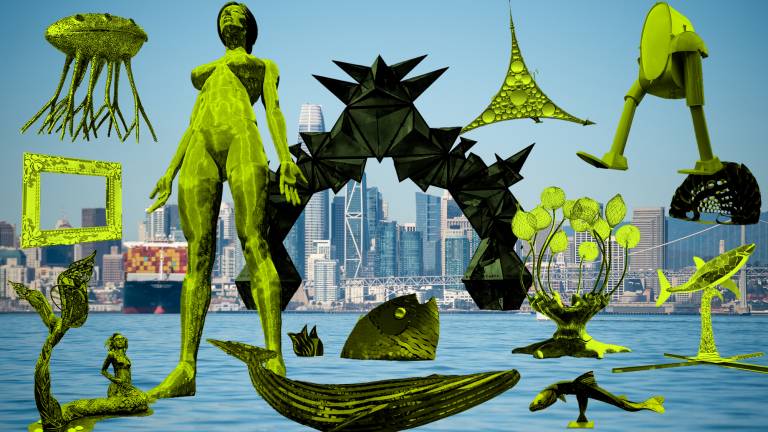
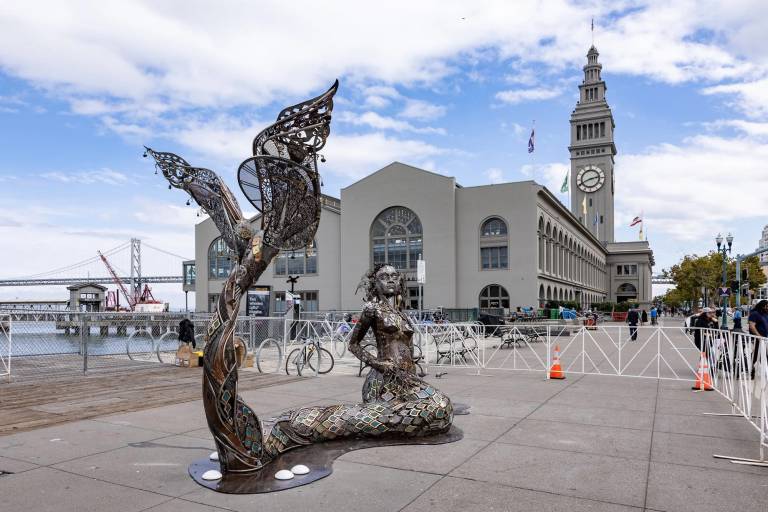
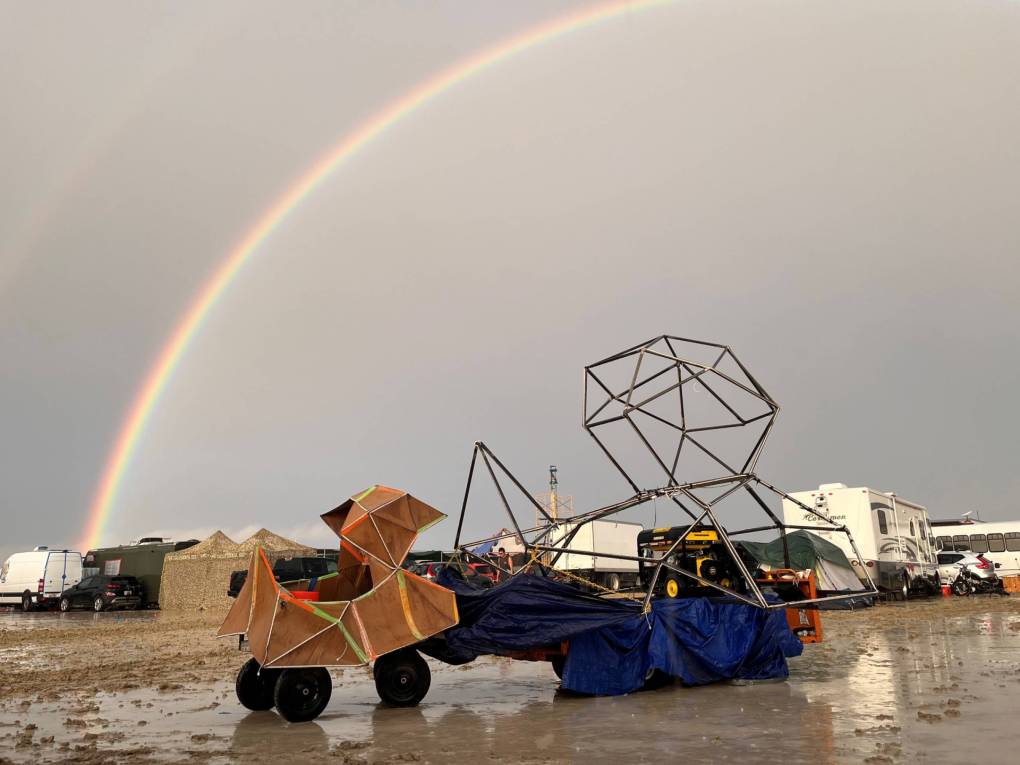
Who Has a Say in the Flood of Public Art Coming to San Francisco?
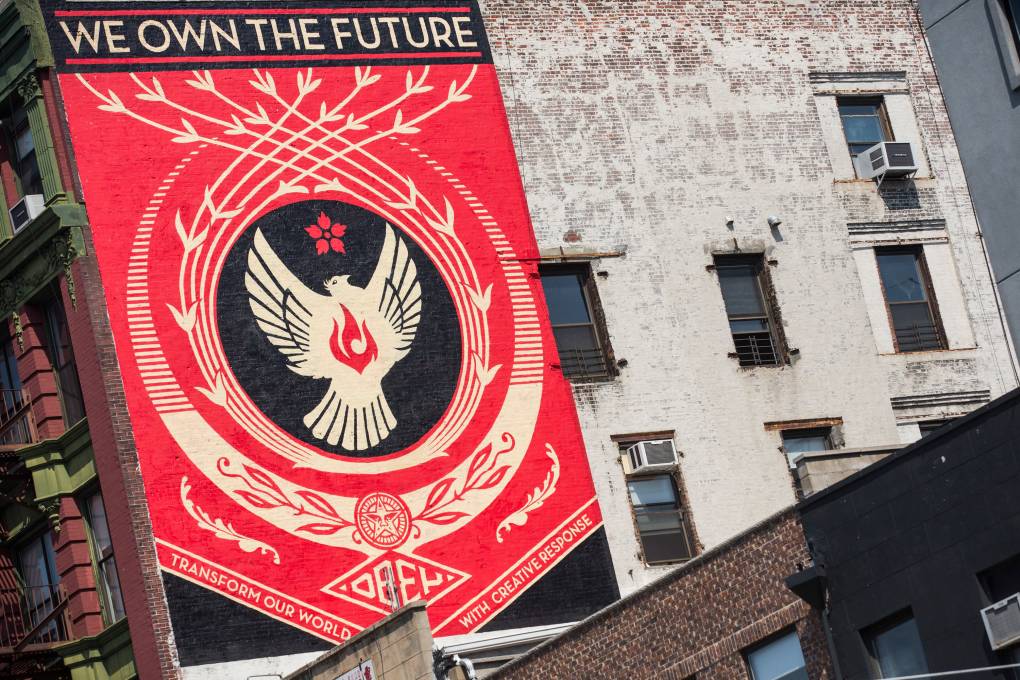
More Big Burning Man Art Is Coming to San Francisco
The Burning Man Party Is Over. Now a Massive Cleanup Begins
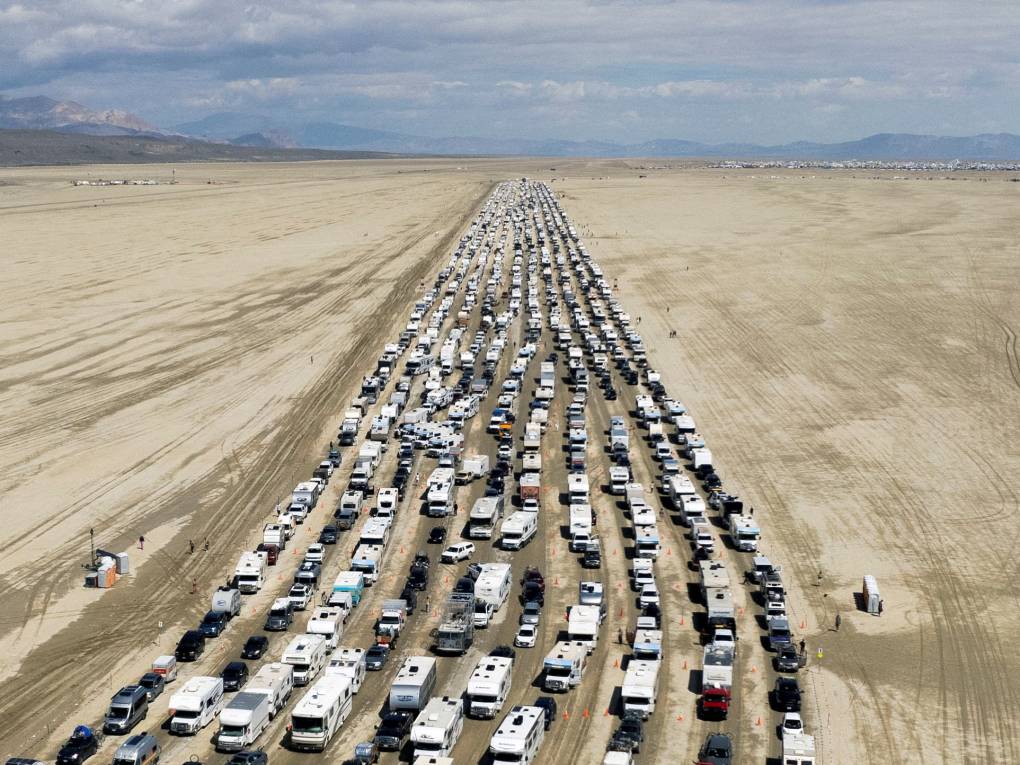
Burning Man Festival Attendees, Finally Free to Leave, Face Hours of Traffic
‘The Art of Protest’ Doc Profiles Activist Artists on a Pressing Mission
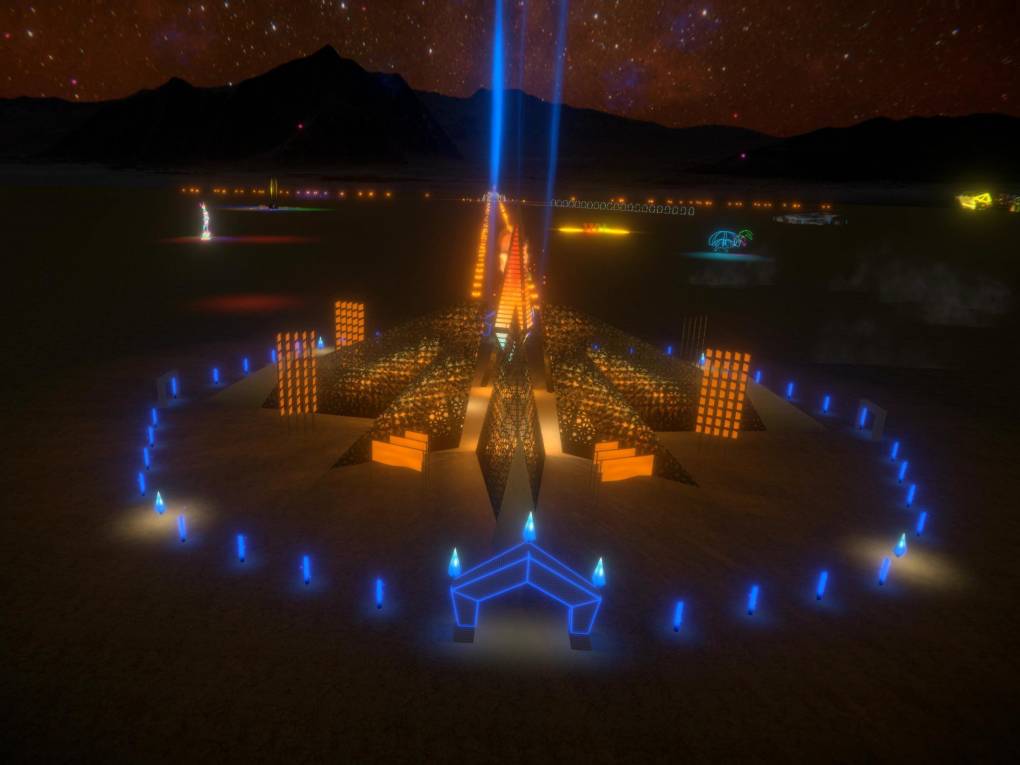
As Burning Man Goes Virtual, Organizers Try to Capture the Communal Aspect
Burning Man Exhibit at Oakland Museum Asks Few Questions of Festival's Purpose
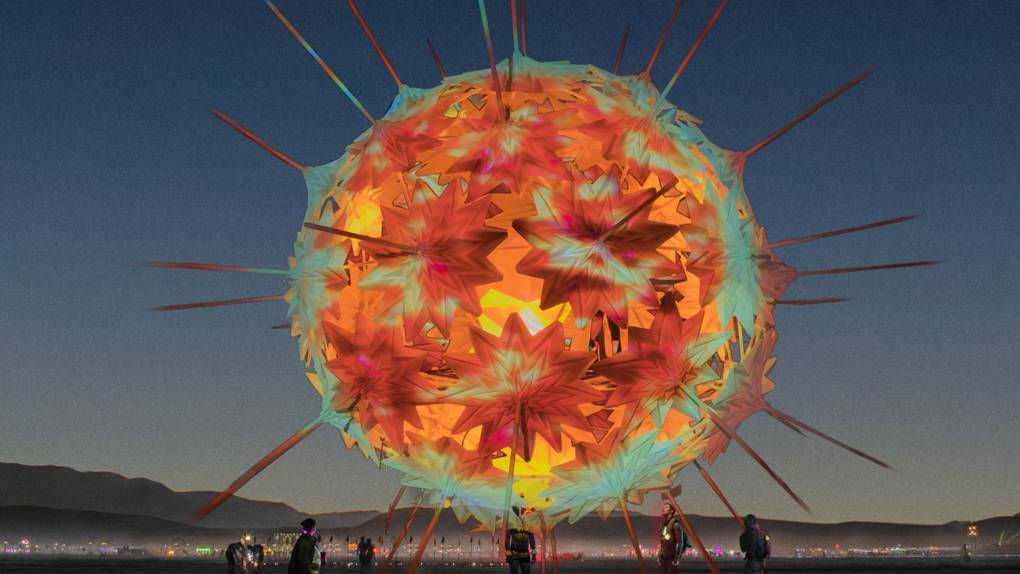
RadiaLumia Lights Up the Desert at Burning Man Like a Disco Ball
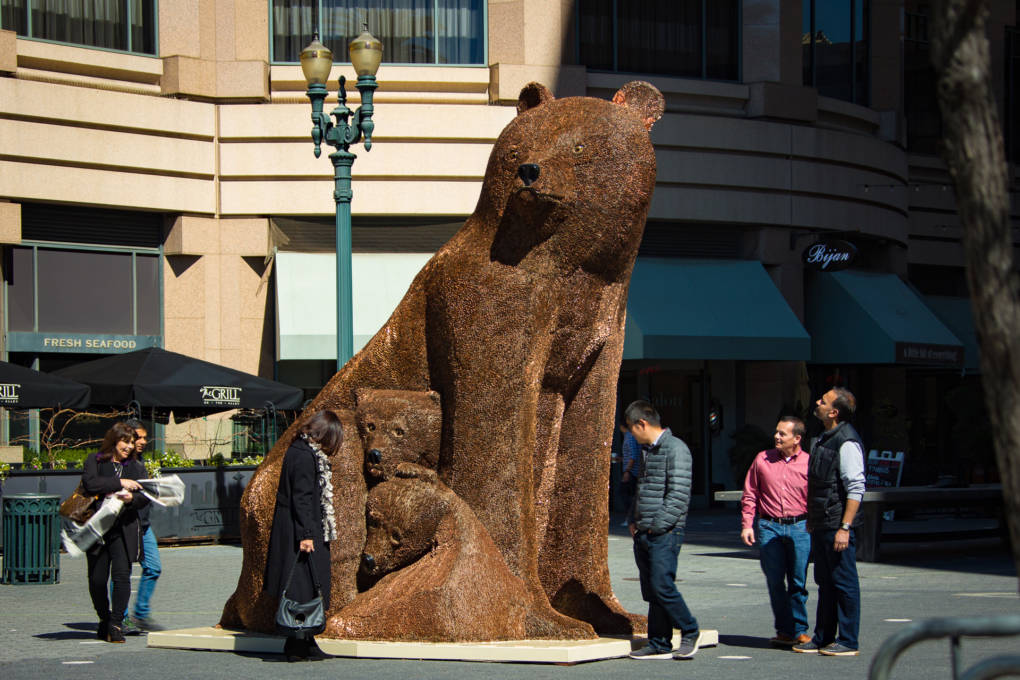
Mama Penny Bear's Back Story is as Delightful as You'd Expect
Sponsored
Player sponsored by
window.__IS_SSR__=true
window.__INITIAL_STATE__={
"attachmentsReducer": {
"audio_0": {
"type": "attachments",
"id": "audio_0",
"imgSizes": {
"kqedFullSize": {
"file": "https://ww2.kqed.org/news/wp-content/themes/KQED-unified/img/audio_bgs/background0.jpg"
}
}
},
"audio_1": {
"type": "attachments",
"id": "audio_1",
"imgSizes": {
"kqedFullSize": {
"file": "https://ww2.kqed.org/news/wp-content/themes/KQED-unified/img/audio_bgs/background1.jpg"
}
}
},
"audio_2": {
"type": "attachments",
"id": "audio_2",
"imgSizes": {
"kqedFullSize": {
"file": "https://ww2.kqed.org/news/wp-content/themes/KQED-unified/img/audio_bgs/background2.jpg"
}
}
},
"audio_3": {
"type": "attachments",
"id": "audio_3",
"imgSizes": {
"kqedFullSize": {
"file": "https://ww2.kqed.org/news/wp-content/themes/KQED-unified/img/audio_bgs/background3.jpg"
}
}
},
"audio_4": {
"type": "attachments",
"id": "audio_4",
"imgSizes": {
"kqedFullSize": {
"file": "https://ww2.kqed.org/news/wp-content/themes/KQED-unified/img/audio_bgs/background4.jpg"
}
}
},
"placeholder": {
"type": "attachments",
"id": "placeholder",
"imgSizes": {
"thumbnail": {
"file": "https://cdn.kqed.org/wp-content/uploads/2024/12/KQED-Default-Image-816638274-2000x1333-1-160x107.jpg",
"width": 160,
"height": 107,
"mimeType": "image/jpeg"
},
"medium": {
"file": "https://cdn.kqed.org/wp-content/uploads/2024/12/KQED-Default-Image-816638274-2000x1333-1-800x533.jpg",
"width": 800,
"height": 533,
"mimeType": "image/jpeg"
},
"medium_large": {
"file": "https://cdn.kqed.org/wp-content/uploads/2024/12/KQED-Default-Image-816638274-2000x1333-1-768x512.jpg",
"width": 768,
"height": 512,
"mimeType": "image/jpeg"
},
"large": {
"file": "https://cdn.kqed.org/wp-content/uploads/2024/12/KQED-Default-Image-816638274-2000x1333-1-1020x680.jpg",
"width": 1020,
"height": 680,
"mimeType": "image/jpeg"
},
"1536x1536": {
"file": "https://cdn.kqed.org/wp-content/uploads/2024/12/KQED-Default-Image-816638274-2000x1333-1-1536x1024.jpg",
"width": 1536,
"height": 1024,
"mimeType": "image/jpeg"
},
"fd-lrg": {
"file": "https://cdn.kqed.org/wp-content/uploads/2024/12/KQED-Default-Image-816638274-2000x1333-1-1536x1024.jpg",
"width": 1536,
"height": 1024,
"mimeType": "image/jpeg"
},
"fd-med": {
"file": "https://cdn.kqed.org/wp-content/uploads/2024/12/KQED-Default-Image-816638274-2000x1333-1-1020x680.jpg",
"width": 1020,
"height": 680,
"mimeType": "image/jpeg"
},
"fd-sm": {
"file": "https://cdn.kqed.org/wp-content/uploads/2024/12/KQED-Default-Image-816638274-2000x1333-1-800x533.jpg",
"width": 800,
"height": 533,
"mimeType": "image/jpeg"
},
"post-thumbnail": {
"file": "https://cdn.kqed.org/wp-content/uploads/2024/12/KQED-Default-Image-816638274-2000x1333-1-672x372.jpg",
"width": 672,
"height": 372,
"mimeType": "image/jpeg"
},
"twentyfourteen-full-width": {
"file": "https://cdn.kqed.org/wp-content/uploads/2024/12/KQED-Default-Image-816638274-2000x1333-1-1038x576.jpg",
"width": 1038,
"height": 576,
"mimeType": "image/jpeg"
},
"xxsmall": {
"file": "https://cdn.kqed.org/wp-content/uploads/2024/12/KQED-Default-Image-816638274-2000x1333-1-160x107.jpg",
"width": 160,
"height": 107,
"mimeType": "image/jpeg"
},
"xsmall": {
"file": "https://cdn.kqed.org/wp-content/uploads/2024/12/KQED-Default-Image-816638274-2000x1333-1-672x372.jpg",
"width": 672,
"height": 372,
"mimeType": "image/jpeg"
},
"small": {
"file": "https://cdn.kqed.org/wp-content/uploads/2024/12/KQED-Default-Image-816638274-2000x1333-1-672x372.jpg",
"width": 672,
"height": 372,
"mimeType": "image/jpeg"
},
"xlarge": {
"file": "https://cdn.kqed.org/wp-content/uploads/2024/12/KQED-Default-Image-816638274-2000x1333-1-1020x680.jpg",
"width": 1020,
"height": 680,
"mimeType": "image/jpeg"
},
"full-width": {
"file": "https://cdn.kqed.org/wp-content/uploads/2024/12/KQED-Default-Image-816638274-2000x1333-1-1920x1280.jpg",
"width": 1920,
"height": 1280,
"mimeType": "image/jpeg"
},
"guest-author-32": {
"file": "https://cdn.kqed.org/wp-content/uploads/2025/01/KQED-Default-Image-816638274-1333x1333-1-160x160.jpg",
"width": 32,
"height": 32,
"mimeType": "image/jpeg"
},
"guest-author-50": {
"file": "https://cdn.kqed.org/wp-content/uploads/2025/01/KQED-Default-Image-816638274-1333x1333-1-160x160.jpg",
"width": 50,
"height": 50,
"mimeType": "image/jpeg"
},
"guest-author-64": {
"file": "https://cdn.kqed.org/wp-content/uploads/2025/01/KQED-Default-Image-816638274-1333x1333-1-160x160.jpg",
"width": 64,
"height": 64,
"mimeType": "image/jpeg"
},
"guest-author-96": {
"file": "https://cdn.kqed.org/wp-content/uploads/2025/01/KQED-Default-Image-816638274-1333x1333-1-160x160.jpg",
"width": 96,
"height": 96,
"mimeType": "image/jpeg"
},
"guest-author-128": {
"file": "https://cdn.kqed.org/wp-content/uploads/2025/01/KQED-Default-Image-816638274-1333x1333-1-160x160.jpg",
"width": 128,
"height": 128,
"mimeType": "image/jpeg"
},
"detail": {
"file": "https://cdn.kqed.org/wp-content/uploads/2025/01/KQED-Default-Image-816638274-1333x1333-1-160x160.jpg",
"width": 160,
"height": 160,
"mimeType": "image/jpeg"
},
"kqedFullSize": {
"file": "https://cdn.kqed.org/wp-content/uploads/2024/12/KQED-Default-Image-816638274-2000x1333-1.jpg",
"width": 2000,
"height": 1333
}
}
},
"arts_13982187": {
"type": "attachments",
"id": "arts_13982187",
"meta": {
"index": "attachments_1716263798",
"site": "arts",
"id": "13982187",
"found": true
},
"title": "19x16_2000",
"publishDate": 1759871117,
"status": "inherit",
"parent": 13982175,
"modified": 1759872695,
"caption": "Already installed and proposed large-scale sculptures that will make up the Sijbrandij Foundation's Big Art Loop, by artists Dana Albany, Marco Cochrane, Peter Hazel, El Nino, Mathias Gmachl, Kristen Berg, Davis McCarty, Michael Christian, Bryan Tedrick, DeWitt Godfrey and Chris Wollard.",
"credit": "Photo by Beth LaBerge/KQED; Collage by Sarah Hotchkiss",
"altTag": "collage of sculptures superimposed over city skyline",
"description": null,
"imgSizes": {
"thumbnail": {
"file": "https://cdn.kqed.org/wp-content/uploads/sites/2/2025/10/19x16_2000-160x90.jpg",
"width": 160,
"height": 90,
"mimeType": "image/jpeg"
},
"medium_large": {
"file": "https://cdn.kqed.org/wp-content/uploads/sites/2/2025/10/19x16_2000-768x432.jpg",
"width": 768,
"height": 432,
"mimeType": "image/jpeg"
},
"1536x1536": {
"file": "https://cdn.kqed.org/wp-content/uploads/sites/2/2025/10/19x16_2000-1536x864.jpg",
"width": 1536,
"height": 864,
"mimeType": "image/jpeg"
},
"post-thumbnail": {
"file": "https://cdn.kqed.org/wp-content/uploads/sites/2/2025/10/19x16_2000-672x372.jpg",
"width": 672,
"height": 372,
"mimeType": "image/jpeg"
},
"twentyfourteen-full-width": {
"file": "https://cdn.kqed.org/wp-content/uploads/sites/2/2025/10/19x16_2000-1038x576.jpg",
"width": 1038,
"height": 576,
"mimeType": "image/jpeg"
},
"kqedFullSize": {
"file": "https://cdn.kqed.org/wp-content/uploads/sites/2/2025/10/19x16_2000.jpg",
"width": 2000,
"height": 1125
}
},
"fetchFailed": false,
"isLoading": false
},
"arts_13981941": {
"type": "attachments",
"id": "arts_13981941",
"meta": {
"index": "attachments_1716263798",
"site": "arts",
"id": "13981941",
"found": true
},
"title": "Coralee-55_2000",
"publishDate": 1759261899,
"status": "inherit",
"parent": 13981940,
"modified": 1759261937,
"caption": "Dana Albany's 'Coralee,' installed at San Francisco Pier 1/2.",
"credit": "Arianna Cunha",
"altTag": "recycled metal sculpture of mermaid on waterfront",
"description": null,
"imgSizes": {
"thumbnail": {
"file": "https://cdn.kqed.org/wp-content/uploads/sites/2/2025/09/Coralee-55_2000-160x107.jpg",
"width": 160,
"height": 107,
"mimeType": "image/jpeg"
},
"medium_large": {
"file": "https://cdn.kqed.org/wp-content/uploads/sites/2/2025/09/Coralee-55_2000-768x512.jpg",
"width": 768,
"height": 512,
"mimeType": "image/jpeg"
},
"1536x1536": {
"file": "https://cdn.kqed.org/wp-content/uploads/sites/2/2025/09/Coralee-55_2000-1536x1025.jpg",
"width": 1536,
"height": 1025,
"mimeType": "image/jpeg"
},
"post-thumbnail": {
"file": "https://cdn.kqed.org/wp-content/uploads/sites/2/2025/09/Coralee-55_2000-672x372.jpg",
"width": 672,
"height": 372,
"mimeType": "image/jpeg"
},
"twentyfourteen-full-width": {
"file": "https://cdn.kqed.org/wp-content/uploads/sites/2/2025/09/Coralee-55_2000-1038x576.jpg",
"width": 1038,
"height": 576,
"mimeType": "image/jpeg"
},
"kqedFullSize": {
"file": "https://cdn.kqed.org/wp-content/uploads/sites/2/2025/09/Coralee-55_2000.jpg",
"width": 2000,
"height": 1334
}
},
"fetchFailed": false,
"isLoading": false
},
"arts_13934437": {
"type": "attachments",
"id": "arts_13934437",
"meta": {
"index": "attachments_1716263798",
"site": "arts",
"id": "13934437",
"found": true
},
"parent": 13934431,
"imgSizes": {
"twentyfourteen-full-width": {
"file": "https://ww2.kqed.org/app/uploads/sites/2/2023/09/GettyImages-1643692002-scaled-e1694110749370-1038x576.jpg",
"width": 1038,
"mimeType": "image/jpeg",
"height": 576
},
"thumbnail": {
"file": "https://ww2.kqed.org/app/uploads/sites/2/2023/09/GettyImages-1643692002-scaled-e1694110749370-160x120.jpg",
"width": 160,
"mimeType": "image/jpeg",
"height": 120
},
"post-thumbnail": {
"file": "https://ww2.kqed.org/app/uploads/sites/2/2023/09/GettyImages-1643692002-scaled-e1694110749370-672x372.jpg",
"width": 672,
"mimeType": "image/jpeg",
"height": 372
},
"kqedFullSize": {
"file": "https://ww2.kqed.org/app/uploads/sites/2/2023/09/GettyImages-1643692002-scaled-e1694110749370.jpg",
"width": 1920,
"height": 1440
},
"2048x2048": {
"file": "https://ww2.kqed.org/app/uploads/sites/2/2023/09/GettyImages-1643692002-2048x1536.jpg",
"width": 2048,
"mimeType": "image/jpeg",
"height": 1536
},
"large": {
"file": "https://ww2.kqed.org/app/uploads/sites/2/2023/09/GettyImages-1643692002-scaled-e1694110749370-1020x765.jpg",
"width": 1020,
"mimeType": "image/jpeg",
"height": 765
},
"1536x1536": {
"file": "https://ww2.kqed.org/app/uploads/sites/2/2023/09/GettyImages-1643692002-scaled-e1694110749370-1536x1152.jpg",
"width": 1536,
"mimeType": "image/jpeg",
"height": 1152
},
"full-width": {
"file": "https://ww2.kqed.org/app/uploads/sites/2/2023/09/GettyImages-1643692002-1920x1440.jpg",
"width": 1920,
"mimeType": "image/jpeg",
"height": 1440
},
"medium": {
"file": "https://ww2.kqed.org/app/uploads/sites/2/2023/09/GettyImages-1643692002-scaled-e1694110749370-800x600.jpg",
"width": 800,
"mimeType": "image/jpeg",
"height": 600
},
"medium_large": {
"file": "https://ww2.kqed.org/app/uploads/sites/2/2023/09/GettyImages-1643692002-scaled-e1694110749370-768x576.jpg",
"width": 768,
"mimeType": "image/jpeg",
"height": 576
}
},
"publishDate": 1694110728,
"modified": 1694111263,
"caption": "Tens of thousands of Burning Man attendees got stranded this year, after heavy rainfall.",
"description": null,
"title": "Tens of thousands of Burning Man attendees got stranded this year, after heavy rainfall.",
"credit": "David Crane/dpa (Photo by David Crane/picture alliance via Getty Images",
"status": "inherit",
"altTag": "A rainbow curves across an overcast sky. Strange detritus litters a muddy landscape.",
"fetchFailed": false,
"isLoading": false
},
"arts_13934281": {
"type": "attachments",
"id": "arts_13934281",
"meta": {
"index": "attachments_1716263798",
"site": "arts",
"id": "13934281",
"found": true
},
"parent": 13934280,
"imgSizes": {
"twentyfourteen-full-width": {
"file": "https://ww2.kqed.org/app/uploads/sites/2/2023/09/2023-09-04t230720z_1872180995_rc2y13aa7qhf_rtrmadp_3_usa-burningman-2035fe6713a719da0c17042071832a27882c81c4-1038x576.jpg",
"width": 1038,
"mimeType": "image/jpeg",
"height": 576
},
"thumbnail": {
"file": "https://ww2.kqed.org/app/uploads/sites/2/2023/09/2023-09-04t230720z_1872180995_rc2y13aa7qhf_rtrmadp_3_usa-burningman-2035fe6713a719da0c17042071832a27882c81c4-160x120.jpg",
"width": 160,
"mimeType": "image/jpeg",
"height": 120
},
"post-thumbnail": {
"file": "https://ww2.kqed.org/app/uploads/sites/2/2023/09/2023-09-04t230720z_1872180995_rc2y13aa7qhf_rtrmadp_3_usa-burningman-2035fe6713a719da0c17042071832a27882c81c4-672x372.jpg",
"width": 672,
"mimeType": "image/jpeg",
"height": 372
},
"kqedFullSize": {
"file": "https://ww2.kqed.org/app/uploads/sites/2/2023/09/2023-09-04t230720z_1872180995_rc2y13aa7qhf_rtrmadp_3_usa-burningman-2035fe6713a719da0c17042071832a27882c81c4.jpg",
"width": 1925,
"height": 1444
},
"large": {
"file": "https://ww2.kqed.org/app/uploads/sites/2/2023/09/2023-09-04t230720z_1872180995_rc2y13aa7qhf_rtrmadp_3_usa-burningman-2035fe6713a719da0c17042071832a27882c81c4-1020x765.jpg",
"width": 1020,
"mimeType": "image/jpeg",
"height": 765
},
"1536x1536": {
"file": "https://ww2.kqed.org/app/uploads/sites/2/2023/09/2023-09-04t230720z_1872180995_rc2y13aa7qhf_rtrmadp_3_usa-burningman-2035fe6713a719da0c17042071832a27882c81c4-1536x1152.jpg",
"width": 1536,
"mimeType": "image/jpeg",
"height": 1152
},
"full-width": {
"file": "https://ww2.kqed.org/app/uploads/sites/2/2023/09/2023-09-04t230720z_1872180995_rc2y13aa7qhf_rtrmadp_3_usa-burningman-2035fe6713a719da0c17042071832a27882c81c4-1920x1440.jpg",
"width": 1920,
"mimeType": "image/jpeg",
"height": 1440
},
"medium": {
"file": "https://ww2.kqed.org/app/uploads/sites/2/2023/09/2023-09-04t230720z_1872180995_rc2y13aa7qhf_rtrmadp_3_usa-burningman-2035fe6713a719da0c17042071832a27882c81c4-800x600.jpg",
"width": 800,
"mimeType": "image/jpeg",
"height": 600
},
"medium_large": {
"file": "https://ww2.kqed.org/app/uploads/sites/2/2023/09/2023-09-04t230720z_1872180995_rc2y13aa7qhf_rtrmadp_3_usa-burningman-2035fe6713a719da0c17042071832a27882c81c4-768x576.jpg",
"width": 768,
"mimeType": "image/jpeg",
"height": 576
}
},
"publishDate": 1693935329,
"modified": 1693935862,
"caption": "Vehicles seen departing the Burning Man festival in Black Rock City on Monday.",
"description": null,
"title": "Vehicles seen departing the Burning Man festival in Black Rock City on Monday.",
"credit": "Matt Mills McKnight/ Reuters",
"status": "inherit",
"altTag": "Ten lanes of tightly packed traffic stretch across a dirt path, stretching off into the distance as far as the eye can see.",
"fetchFailed": false,
"isLoading": false
},
"arts_13888027": {
"type": "attachments",
"id": "arts_13888027",
"meta": {
"index": "attachments_1716263798",
"site": "arts",
"id": "13888027",
"found": true
},
"parent": 13887999,
"imgSizes": {
"twentyfourteen-full-width": {
"file": "https://ww2.kqed.org/app/uploads/sites/2/2020/10/GettyImages-454257460-1038x576.jpg",
"width": 1038,
"mimeType": "image/jpeg",
"height": 576
},
"thumbnail": {
"file": "https://ww2.kqed.org/app/uploads/sites/2/2020/10/GettyImages-454257460-160x107.jpg",
"width": 160,
"mimeType": "image/jpeg",
"height": 107
},
"post-thumbnail": {
"file": "https://ww2.kqed.org/app/uploads/sites/2/2020/10/GettyImages-454257460-672x372.jpg",
"width": 672,
"mimeType": "image/jpeg",
"height": 372
},
"kqedFullSize": {
"file": "https://ww2.kqed.org/app/uploads/sites/2/2020/10/GettyImages-454257460-scaled.jpg",
"width": 2560,
"height": 1708
},
"2048x2048": {
"file": "https://ww2.kqed.org/app/uploads/sites/2/2020/10/GettyImages-454257460-2048x1366.jpg",
"width": 2048,
"mimeType": "image/jpeg",
"height": 1366
},
"large": {
"file": "https://ww2.kqed.org/app/uploads/sites/2/2020/10/GettyImages-454257460-1020x680.jpg",
"width": 1020,
"mimeType": "image/jpeg",
"height": 680
},
"1536x1536": {
"file": "https://ww2.kqed.org/app/uploads/sites/2/2020/10/GettyImages-454257460-1536x1025.jpg",
"width": 1536,
"mimeType": "image/jpeg",
"height": 1025
},
"full-width": {
"file": "https://ww2.kqed.org/app/uploads/sites/2/2020/10/GettyImages-454257460-1920x1281.jpg",
"width": 1920,
"mimeType": "image/jpeg",
"height": 1281
},
"medium": {
"file": "https://ww2.kqed.org/app/uploads/sites/2/2020/10/GettyImages-454257460-800x534.jpg",
"width": 800,
"mimeType": "image/jpeg",
"height": 534
},
"medium_large": {
"file": "https://ww2.kqed.org/app/uploads/sites/2/2020/10/GettyImages-454257460-768x512.jpg",
"width": 768,
"mimeType": "image/jpeg",
"height": 512
}
},
"publishDate": 1602800711,
"modified": 1602800823,
"caption": "A Shepard Fairey mural, as seen on a building at 161 Bowery, New York, on August 27, 2014. The mural reads, \"We Own The Future, Transform Our World With Creative Response.\" ",
"description": "A Shepard Fairey mural, as seen on a building at 161 Bowery, New York, on August 27, 2014. The mural reads, \"We Own The Future, Transform Our World With Creative Response.\" ",
"title": "A Shepard Fairey mural, as seen on a building at 161 Bowery, New York, on August 27, 2014. The mural reads, \"We Own The Future, Transform Our World With Creative Response.\"",
"credit": "Andrew Burton/Getty Images",
"status": "inherit",
"fetchFailed": false,
"isLoading": false
},
"arts_13885766": {
"type": "attachments",
"id": "arts_13885766",
"meta": {
"index": "attachments_1716263798",
"site": "arts",
"id": "13885766",
"found": true
},
"parent": 13885765,
"imgSizes": {
"twentyfourteen-full-width": {
"file": "https://ww2.kqed.org/app/uploads/sites/2/2020/09/multiverse-universe-ethereal-empyrean-experience-by-laurence-_renzo_-verbeck-sylvia-adrienne-lisse-jeremy-roush-02eac315e49c1909212dc229c03147b03927f7b4-1038x576.jpg",
"width": 1038,
"mimeType": "image/jpeg",
"height": 576
},
"thumbnail": {
"file": "https://ww2.kqed.org/app/uploads/sites/2/2020/09/multiverse-universe-ethereal-empyrean-experience-by-laurence-_renzo_-verbeck-sylvia-adrienne-lisse-jeremy-roush-02eac315e49c1909212dc229c03147b03927f7b4-160x120.jpg",
"width": 160,
"mimeType": "image/jpeg",
"height": 120
},
"post-thumbnail": {
"file": "https://ww2.kqed.org/app/uploads/sites/2/2020/09/multiverse-universe-ethereal-empyrean-experience-by-laurence-_renzo_-verbeck-sylvia-adrienne-lisse-jeremy-roush-02eac315e49c1909212dc229c03147b03927f7b4-672x372.jpg",
"width": 672,
"mimeType": "image/jpeg",
"height": 372
},
"kqedFullSize": {
"file": "https://ww2.kqed.org/app/uploads/sites/2/2020/09/multiverse-universe-ethereal-empyrean-experience-by-laurence-_renzo_-verbeck-sylvia-adrienne-lisse-jeremy-roush-02eac315e49c1909212dc229c03147b03927f7b4-scaled-e1599159831141.jpg",
"width": 1920,
"height": 1440
},
"2048x2048": {
"file": "https://ww2.kqed.org/app/uploads/sites/2/2020/09/multiverse-universe-ethereal-empyrean-experience-by-laurence-_renzo_-verbeck-sylvia-adrienne-lisse-jeremy-roush-02eac315e49c1909212dc229c03147b03927f7b4-2048x1536.jpg",
"width": 2048,
"mimeType": "image/jpeg",
"height": 1536
},
"large": {
"file": "https://ww2.kqed.org/app/uploads/sites/2/2020/09/multiverse-universe-ethereal-empyrean-experience-by-laurence-_renzo_-verbeck-sylvia-adrienne-lisse-jeremy-roush-02eac315e49c1909212dc229c03147b03927f7b4-1020x765.jpg",
"width": 1020,
"mimeType": "image/jpeg",
"height": 765
},
"1536x1536": {
"file": "https://ww2.kqed.org/app/uploads/sites/2/2020/09/multiverse-universe-ethereal-empyrean-experience-by-laurence-_renzo_-verbeck-sylvia-adrienne-lisse-jeremy-roush-02eac315e49c1909212dc229c03147b03927f7b4-1536x1152.jpg",
"width": 1536,
"mimeType": "image/jpeg",
"height": 1152
},
"full-width": {
"file": "https://ww2.kqed.org/app/uploads/sites/2/2020/09/multiverse-universe-ethereal-empyrean-experience-by-laurence-_renzo_-verbeck-sylvia-adrienne-lisse-jeremy-roush-02eac315e49c1909212dc229c03147b03927f7b4-1920x1440.jpg",
"width": 1920,
"mimeType": "image/jpeg",
"height": 1440
},
"medium": {
"file": "https://ww2.kqed.org/app/uploads/sites/2/2020/09/multiverse-universe-ethereal-empyrean-experience-by-laurence-_renzo_-verbeck-sylvia-adrienne-lisse-jeremy-roush-02eac315e49c1909212dc229c03147b03927f7b4-800x600.jpg",
"width": 800,
"mimeType": "image/jpeg",
"height": 600
},
"medium_large": {
"file": "https://ww2.kqed.org/app/uploads/sites/2/2020/09/multiverse-universe-ethereal-empyrean-experience-by-laurence-_renzo_-verbeck-sylvia-adrienne-lisse-jeremy-roush-02eac315e49c1909212dc229c03147b03927f7b4-768x576.jpg",
"width": 768,
"mimeType": "image/jpeg",
"height": 576
}
},
"publishDate": 1599159457,
"modified": 1599159867,
"caption": "The Multiverse Ethereal Empyrean Experience, by Laurence \"Renzo\" Verbeck and Sylvia Adrienne Lisse, was selected as the official Black Rock City Temple for 2020.",
"description": "The Multiverse Ethereal Empyrean Experience, by Laurence \"Renzo\" Verbeck and Sylvia Adrienne Lisse, was selected as the official Black Rock City Temple for 2020.",
"title": "The Multiverse Ethereal Empyrean Experience, by Laurence \"Renzo\" Verbeck and Sylvia Adrienne Lisse, was selected as the official Black Rock City Temple for 2020.",
"credit": "Kye Horton/Burning Man",
"status": "inherit",
"fetchFailed": false,
"isLoading": false
},
"arts_13868165": {
"type": "attachments",
"id": "arts_13868165",
"meta": {
"index": "attachments_1716263798",
"site": "arts",
"id": "13868165",
"found": true
},
"parent": 13868108,
"imgSizes": {
"twentyfourteen-full-width": {
"file": "https://ww2.kqed.org/app/uploads/sites/2/2019/10/Shrumen-Lumen-1038x576.jpg",
"width": 1038,
"mimeType": "image/jpeg",
"height": 576
},
"thumbnail": {
"file": "https://ww2.kqed.org/app/uploads/sites/2/2019/10/Shrumen-Lumen-160x106.jpg",
"width": 160,
"mimeType": "image/jpeg",
"height": 106
},
"post-thumbnail": {
"file": "https://ww2.kqed.org/app/uploads/sites/2/2019/10/Shrumen-Lumen-672x372.jpg",
"width": 672,
"mimeType": "image/jpeg",
"height": 372
},
"kqedFullSize": {
"file": "https://ww2.kqed.org/app/uploads/sites/2/2019/10/Shrumen-Lumen.jpg",
"width": 2000,
"height": 1321
},
"large": {
"file": "https://ww2.kqed.org/app/uploads/sites/2/2019/10/Shrumen-Lumen-1020x674.jpg",
"width": 1020,
"mimeType": "image/jpeg",
"height": 674
},
"complete_open_graph": {
"file": "https://ww2.kqed.org/app/uploads/sites/2/2019/10/Shrumen-Lumen-1200x793.jpg",
"width": 1200,
"mimeType": "image/jpeg",
"height": 793
},
"full-width": {
"file": "https://ww2.kqed.org/app/uploads/sites/2/2019/10/Shrumen-Lumen-1920x1268.jpg",
"width": 1920,
"mimeType": "image/jpeg",
"height": 1268
},
"medium": {
"file": "https://ww2.kqed.org/app/uploads/sites/2/2019/10/Shrumen-Lumen-800x528.jpg",
"width": 800,
"mimeType": "image/jpeg",
"height": 528
},
"medium_large": {
"file": "https://ww2.kqed.org/app/uploads/sites/2/2019/10/Shrumen-Lumen-768x507.jpg",
"width": 768,
"mimeType": "image/jpeg",
"height": 507
}
},
"publishDate": 1570839335,
"modified": 1570839468,
"caption": "FoldHaus, 'Shrumen Lumen,' 2016.",
"description": "FoldHaus, 'Shrumen Lumen,' 2016.",
"title": "No Spectators",
"credit": "Ron Blunt",
"status": "inherit",
"fetchFailed": false,
"isLoading": false
},
"arts_13839698": {
"type": "attachments",
"id": "arts_13839698",
"meta": {
"index": "attachments_1716263798",
"site": "arts",
"id": "13839698",
"found": true
},
"parent": 13839695,
"imgSizes": {
"small": {
"file": "https://ww2.kqed.org/app/uploads/sites/2/2018/08/c5e6e2bb3887c58318d868d7caf6f2b1_original-520x293.jpg",
"width": 520,
"mimeType": "image/jpeg",
"height": 293
},
"twentyfourteen-full-width": {
"file": "https://ww2.kqed.org/app/uploads/sites/2/2018/08/c5e6e2bb3887c58318d868d7caf6f2b1_original-1038x576.jpg",
"width": 1038,
"mimeType": "image/jpeg",
"height": 576
},
"thumbnail": {
"file": "https://ww2.kqed.org/app/uploads/sites/2/2018/08/c5e6e2bb3887c58318d868d7caf6f2b1_original-160x90.jpg",
"width": 160,
"mimeType": "image/jpeg",
"height": 90
},
"fd-sm": {
"file": "https://ww2.kqed.org/app/uploads/sites/2/2018/08/c5e6e2bb3887c58318d868d7caf6f2b1_original-960x540.jpg",
"width": 960,
"mimeType": "image/jpeg",
"height": 540
},
"post-thumbnail": {
"file": "https://ww2.kqed.org/app/uploads/sites/2/2018/08/c5e6e2bb3887c58318d868d7caf6f2b1_original-672x372.jpg",
"width": 672,
"mimeType": "image/jpeg",
"height": 372
},
"xsmall": {
"file": "https://ww2.kqed.org/app/uploads/sites/2/2018/08/c5e6e2bb3887c58318d868d7caf6f2b1_original-375x211.jpg",
"width": 375,
"mimeType": "image/jpeg",
"height": 211
},
"kqedFullSize": {
"file": "https://ww2.kqed.org/app/uploads/sites/2/2018/08/c5e6e2bb3887c58318d868d7caf6f2b1_original.jpg",
"width": 1552,
"height": 873
},
"large": {
"file": "https://ww2.kqed.org/app/uploads/sites/2/2018/08/c5e6e2bb3887c58318d868d7caf6f2b1_original-1020x574.jpg",
"width": 1020,
"mimeType": "image/jpeg",
"height": 574
},
"xlarge": {
"file": "https://ww2.kqed.org/app/uploads/sites/2/2018/08/c5e6e2bb3887c58318d868d7caf6f2b1_original-1180x664.jpg",
"width": 1180,
"mimeType": "image/jpeg",
"height": 664
},
"complete_open_graph": {
"file": "https://ww2.kqed.org/app/uploads/sites/2/2018/08/c5e6e2bb3887c58318d868d7caf6f2b1_original-1200x675.jpg",
"width": 1200,
"mimeType": "image/jpeg",
"height": 675
},
"guest-author-50": {
"file": "https://ww2.kqed.org/app/uploads/sites/2/2018/08/c5e6e2bb3887c58318d868d7caf6f2b1_original-50x50.jpg",
"width": 50,
"mimeType": "image/jpeg",
"height": 50
},
"guest-author-96": {
"file": "https://ww2.kqed.org/app/uploads/sites/2/2018/08/c5e6e2bb3887c58318d868d7caf6f2b1_original-96x96.jpg",
"width": 96,
"mimeType": "image/jpeg",
"height": 96
},
"medium": {
"file": "https://ww2.kqed.org/app/uploads/sites/2/2018/08/c5e6e2bb3887c58318d868d7caf6f2b1_original-800x450.jpg",
"width": 800,
"mimeType": "image/jpeg",
"height": 450
},
"guest-author-64": {
"file": "https://ww2.kqed.org/app/uploads/sites/2/2018/08/c5e6e2bb3887c58318d868d7caf6f2b1_original-64x64.jpg",
"width": 64,
"mimeType": "image/jpeg",
"height": 64
},
"guest-author-32": {
"file": "https://ww2.kqed.org/app/uploads/sites/2/2018/08/c5e6e2bb3887c58318d868d7caf6f2b1_original-32x32.jpg",
"width": 32,
"mimeType": "image/jpeg",
"height": 32
},
"fd-med": {
"file": "https://ww2.kqed.org/app/uploads/sites/2/2018/08/c5e6e2bb3887c58318d868d7caf6f2b1_original-1180x664.jpg",
"width": 1180,
"mimeType": "image/jpeg",
"height": 664
},
"detail": {
"file": "https://ww2.kqed.org/app/uploads/sites/2/2018/08/c5e6e2bb3887c58318d868d7caf6f2b1_original-150x150.jpg",
"width": 150,
"mimeType": "image/jpeg",
"height": 150
},
"medium_large": {
"file": "https://ww2.kqed.org/app/uploads/sites/2/2018/08/c5e6e2bb3887c58318d868d7caf6f2b1_original-768x432.jpg",
"width": 768,
"mimeType": "image/jpeg",
"height": 432
},
"guest-author-128": {
"file": "https://ww2.kqed.org/app/uploads/sites/2/2018/08/c5e6e2bb3887c58318d868d7caf6f2b1_original-128x128.jpg",
"width": 128,
"mimeType": "image/jpeg",
"height": 128
},
"xxsmall": {
"file": "https://ww2.kqed.org/app/uploads/sites/2/2018/08/c5e6e2bb3887c58318d868d7caf6f2b1_original-240x135.jpg",
"width": 240,
"mimeType": "image/jpeg",
"height": 135
}
},
"publishDate": 1535138787,
"modified": 1535138874,
"caption": "RadiaLumia is the latest contribution to the Playa from the Foldhaus, an art collective based in San Francisco. ",
"description": "RadiaLumia is the latest contribution to the Playa from the Foldhaus, an art collective based in San Francisco. ",
"title": "c5e6e2bb3887c58318d868d7caf6f2b1_original",
"credit": "Photo: Courtesy of Foldhaus",
"status": "inherit",
"fetchFailed": false,
"isLoading": false
},
"arts_13830088": {
"type": "attachments",
"id": "arts_13830088",
"meta": {
"index": "attachments_1716263798",
"site": "arts",
"id": "13830088",
"found": true
},
"parent": 13830080,
"imgSizes": {
"small": {
"file": "https://ww2.kqed.org/app/uploads/sites/2/2018/04/RS30547_Ursa-Mater-San-Jose-2-qut-520x347.jpg",
"width": 520,
"mimeType": "image/jpeg",
"height": 347
},
"twentyfourteen-full-width": {
"file": "https://ww2.kqed.org/app/uploads/sites/2/2018/04/RS30547_Ursa-Mater-San-Jose-2-qut-1038x576.jpg",
"width": 1038,
"mimeType": "image/jpeg",
"height": 576
},
"thumbnail": {
"file": "https://ww2.kqed.org/app/uploads/sites/2/2018/04/RS30547_Ursa-Mater-San-Jose-2-qut-160x107.jpg",
"width": 160,
"mimeType": "image/jpeg",
"height": 107
},
"fd-sm": {
"file": "https://ww2.kqed.org/app/uploads/sites/2/2018/04/RS30547_Ursa-Mater-San-Jose-2-qut-960x640.jpg",
"width": 960,
"mimeType": "image/jpeg",
"height": 640
},
"post-thumbnail": {
"file": "https://ww2.kqed.org/app/uploads/sites/2/2018/04/RS30547_Ursa-Mater-San-Jose-2-qut-672x372.jpg",
"width": 672,
"mimeType": "image/jpeg",
"height": 372
},
"xsmall": {
"file": "https://ww2.kqed.org/app/uploads/sites/2/2018/04/RS30547_Ursa-Mater-San-Jose-2-qut-375x250.jpg",
"width": 375,
"mimeType": "image/jpeg",
"height": 250
},
"kqedFullSize": {
"file": "https://ww2.kqed.org/app/uploads/sites/2/2018/04/RS30547_Ursa-Mater-San-Jose-2-qut.jpg",
"width": 1920,
"height": 1280
},
"large": {
"file": "https://ww2.kqed.org/app/uploads/sites/2/2018/04/RS30547_Ursa-Mater-San-Jose-2-qut-1020x680.jpg",
"width": 1020,
"mimeType": "image/jpeg",
"height": 680
},
"xlarge": {
"file": "https://ww2.kqed.org/app/uploads/sites/2/2018/04/RS30547_Ursa-Mater-San-Jose-2-qut-1180x787.jpg",
"width": 1180,
"mimeType": "image/jpeg",
"height": 787
},
"complete_open_graph": {
"file": "https://ww2.kqed.org/app/uploads/sites/2/2018/04/RS30547_Ursa-Mater-San-Jose-2-qut-1200x800.jpg",
"width": 1200,
"mimeType": "image/jpeg",
"height": 800
},
"guest-author-50": {
"file": "https://ww2.kqed.org/app/uploads/sites/2/2018/04/RS30547_Ursa-Mater-San-Jose-2-qut-50x50.jpg",
"width": 50,
"mimeType": "image/jpeg",
"height": 50
},
"guest-author-96": {
"file": "https://ww2.kqed.org/app/uploads/sites/2/2018/04/RS30547_Ursa-Mater-San-Jose-2-qut-96x96.jpg",
"width": 96,
"mimeType": "image/jpeg",
"height": 96
},
"medium": {
"file": "https://ww2.kqed.org/app/uploads/sites/2/2018/04/RS30547_Ursa-Mater-San-Jose-2-qut-800x533.jpg",
"width": 800,
"mimeType": "image/jpeg",
"height": 533
},
"guest-author-64": {
"file": "https://ww2.kqed.org/app/uploads/sites/2/2018/04/RS30547_Ursa-Mater-San-Jose-2-qut-64x64.jpg",
"width": 64,
"mimeType": "image/jpeg",
"height": 64
},
"guest-author-32": {
"file": "https://ww2.kqed.org/app/uploads/sites/2/2018/04/RS30547_Ursa-Mater-San-Jose-2-qut-32x32.jpg",
"width": 32,
"mimeType": "image/jpeg",
"height": 32
},
"fd-lrg": {
"file": "https://ww2.kqed.org/app/uploads/sites/2/2018/04/RS30547_Ursa-Mater-San-Jose-2-qut-1920x1280.jpg",
"width": 1920,
"mimeType": "image/jpeg",
"height": 1280
},
"fd-med": {
"file": "https://ww2.kqed.org/app/uploads/sites/2/2018/04/RS30547_Ursa-Mater-San-Jose-2-qut-1180x787.jpg",
"width": 1180,
"mimeType": "image/jpeg",
"height": 787
},
"full-width": {
"file": "https://ww2.kqed.org/app/uploads/sites/2/2018/04/RS30547_Ursa-Mater-San-Jose-2-qut-1920x1280.jpg",
"width": 1920,
"mimeType": "image/jpeg",
"height": 1280
},
"detail": {
"file": "https://ww2.kqed.org/app/uploads/sites/2/2018/04/RS30547_Ursa-Mater-San-Jose-2-qut-150x150.jpg",
"width": 150,
"mimeType": "image/jpeg",
"height": 150
},
"medium_large": {
"file": "https://ww2.kqed.org/app/uploads/sites/2/2018/04/RS30547_Ursa-Mater-San-Jose-2-qut-768x512.jpg",
"width": 768,
"mimeType": "image/jpeg",
"height": 512
},
"guest-author-128": {
"file": "https://ww2.kqed.org/app/uploads/sites/2/2018/04/RS30547_Ursa-Mater-San-Jose-2-qut-128x128.jpg",
"width": 128,
"mimeType": "image/jpeg",
"height": 128
},
"xxsmall": {
"file": "https://ww2.kqed.org/app/uploads/sites/2/2018/04/RS30547_Ursa-Mater-San-Jose-2-qut-240x160.jpg",
"width": 240,
"mimeType": "image/jpeg",
"height": 160
}
},
"publishDate": 1524274223,
"modified": 1524274260,
"caption": "\"Ursa Mater\" aka \"Mama Penny Bear\" is obviously, openly appealing to passers by in downtown San Jose. Californians love bears, for one thing, but most people do a second double-take when they realize the sculpture's \"fur\" is made of pennies.",
"description": "\"Ursa Mater\" aka \"Mama Penny Bear\" is obviously, openly appealing to passers by in downtown San Jose. Californians love bears, for one thing, but most people do a second double-take when they realize the sculpture's \"fur\" is made of pennies.",
"title": "RS30547_Ursa Mater San Jose 2-qut",
"credit": "Photo: Courtesy of Lisa Ferguson",
"status": "inherit",
"fetchFailed": false,
"isLoading": false
}
},
"audioPlayerReducer": {
"postId": "stream_live",
"isPaused": true,
"isPlaying": false,
"pfsActive": false,
"pledgeModalIsOpen": true,
"playerDrawerIsOpen": false
},
"authorsReducer": {
"byline_arts_13934431": {
"type": "authors",
"id": "byline_arts_13934431",
"meta": {
"override": true
},
"slug": "byline_arts_13934431",
"name": "Ed Komenda, Gabe Stern and Scott Sonner, Associated Press",
"isLoading": false
},
"byline_arts_13934280": {
"type": "authors",
"id": "byline_arts_13934280",
"meta": {
"override": true
},
"slug": "byline_arts_13934280",
"name": "Chloe Veltman",
"isLoading": false
},
"byline_arts_13885765": {
"type": "authors",
"id": "byline_arts_13885765",
"meta": {
"override": true
},
"slug": "byline_arts_13885765",
"name": "Elizabeth Blair",
"isLoading": false
},
"shotchkiss": {
"type": "authors",
"id": "61",
"meta": {
"index": "authors_1716337520",
"id": "61",
"found": true
},
"name": "Sarah Hotchkiss",
"firstName": "Sarah",
"lastName": "Hotchkiss",
"slug": "shotchkiss",
"email": "shotchkiss@kqed.org",
"display_author_email": true,
"staff_mastheads": [
"arts"
],
"title": "Senior Editor",
"bio": "Sarah Hotchkiss is a San Francisco \u003ca href=\"http://www.sarahhotchkiss.com\">artist\u003c/a> and arts writer. In 2019, she received the Dorothea & Leo Rabkin Foundation grant for visual art journalism and in 2020 she received a Society of Professional Journalists, Northern California award for excellence in arts and culture reporting.",
"avatar": "https://secure.gravatar.com/avatar/ca38c7f54590856cd4947d26274f8a90?s=600&d=blank&r=g",
"twitter": null,
"facebook": null,
"instagram": null,
"linkedin": null,
"sites": [
{
"site": "",
"roles": [
"editor"
]
},
{
"site": "arts",
"roles": [
"Contributor",
"administrator"
]
},
{
"site": "artschool",
"roles": [
"administrator"
]
},
{
"site": "news",
"roles": [
"editor"
]
},
{
"site": "pop",
"roles": [
"administrator"
]
},
{
"site": "bayareabites",
"roles": [
"editor"
]
},
{
"site": "spark",
"roles": [
"editor"
]
},
{
"site": "checkplease",
"roles": [
"editor"
]
}
],
"headData": {
"title": "Sarah Hotchkiss | KQED",
"description": "Senior Editor",
"ogImgSrc": "https://secure.gravatar.com/avatar/ca38c7f54590856cd4947d26274f8a90?s=600&d=blank&r=g",
"twImgSrc": "https://secure.gravatar.com/avatar/ca38c7f54590856cd4947d26274f8a90?s=600&d=blank&r=g"
},
"isLoading": false,
"link": "/author/shotchkiss"
},
"rachael-myrow": {
"type": "authors",
"id": "251",
"meta": {
"index": "authors_1716337520",
"id": "251",
"found": true
},
"name": "Rachael Myrow",
"firstName": "Rachael",
"lastName": "Myrow",
"slug": "rachael-myrow",
"email": "rmyrow@kqed.org",
"display_author_email": true,
"staff_mastheads": [
"news"
],
"title": "Senior Editor of KQED's Silicon Valley News Desk",
"bio": "• I write and edit stories about how Silicon Valley power and policies shape everyday life in California. I’m also passionate about making Bay Area history and culture more accessible to a broad public. • I’ve been a journalist for most of my life, starting in high school with The Franklin Press in Los Angeles, where I grew up. While earning my first degree in English at UC Berkeley, I got my start in public radio at KALX-FM. After completing a second degree in journalism at Cal, I landed my first professional job at Marketplace, then moved on to KPCC (now LAist), and then KQED, where I hosted The California Report for more than seven years. • My reporting has appeared on NPR, The World, WBUR’s \u003ci>Here & Now\u003c/i>, and the BBC. I also guest host for KQED’s \u003ci>Forum\u003c/i>, as well as the Commonwealth Club in San Francisco. • I speak periodically on media, democracy and technology issues, and do voiceover work for documentaries and educational video projects. • Outside of the studio, you'll find me hiking Bay Area trails and whipping up Insta-ready meals in my kitchen. • I do not accept gifts, money, or favors from anyone connected to my reporting, I don't pay people for information, and I do not support or donate to political causes. • I strive to treat the people I report on with fairness, honesty, and respect. I also recognize there are often multiple sides to a story and work to verify information through multiple sources and documentation. If I get something wrong, I correct it.",
"avatar": "https://secure.gravatar.com/avatar/87bf8cb5874e045cdff430523a6d48b1?s=600&d=blank&r=g",
"twitter": "rachaelmyrow",
"facebook": null,
"instagram": null,
"linkedin": "https://www.linkedin.com/in/rachaelmyrow/",
"sites": [
{
"site": "arts",
"roles": [
"administrator"
]
},
{
"site": "news",
"roles": [
"edit_others_posts",
"editor"
]
},
{
"site": "futureofyou",
"roles": [
"editor"
]
},
{
"site": "bayareabites",
"roles": [
"editor"
]
},
{
"site": "stateofhealth",
"roles": [
"editor"
]
},
{
"site": "science",
"roles": [
"editor"
]
},
{
"site": "food",
"roles": [
"editor"
]
},
{
"site": "forum",
"roles": [
"editor"
]
},
{
"site": "liveblog",
"roles": [
"author"
]
}
],
"headData": {
"title": "Rachael Myrow | KQED",
"description": "Senior Editor of KQED's Silicon Valley News Desk",
"ogImgSrc": "https://secure.gravatar.com/avatar/87bf8cb5874e045cdff430523a6d48b1?s=600&d=blank&r=g",
"twImgSrc": "https://secure.gravatar.com/avatar/87bf8cb5874e045cdff430523a6d48b1?s=600&d=blank&r=g"
},
"isLoading": false,
"link": "/author/rachael-myrow"
},
"ralexandra": {
"type": "authors",
"id": "11242",
"meta": {
"index": "authors_1716337520",
"id": "11242",
"found": true
},
"name": "Rae Alexandra",
"firstName": "Rae",
"lastName": "Alexandra",
"slug": "ralexandra",
"email": "ralexandra@kqed.org",
"display_author_email": true,
"staff_mastheads": [
"arts"
],
"title": "Reporter/Producer",
"bio": "Rae Alexandra is a Reporter/Producer for KQED Arts & Culture, and the creator/author of the \u003ca href=\"https://www.kqed.org/arts/program/rebel-girls-from-bay-area-history\">Rebel Girls From Bay Area History\u003c/a> and \u003ca href=\"https://www.kqed.org/bizarrebayarea\">Bizarre Bay Area\u003c/a> series. Her debut book, \u003ca href=\"https://citylights.com/politics-current-events-history/unsung-heroines35-women-who-changed/\">Unsung Heroines: 35 Women Who Changed the Bay Area\u003c/a> will be published by City Lights in Spring 2026. In 2023, Rae was awarded an SPJ Excellence in Journalism Award for Arts & Culture. Rae was born and raised in Wales and subsequently — even after two decades in Northern California — still uses phrases that regularly baffle her coworkers.",
"avatar": "https://secure.gravatar.com/avatar/d5ef3d663d9adae1345d06932a3951de?s=600&d=blank&r=g",
"twitter": null,
"facebook": null,
"instagram": null,
"linkedin": null,
"sites": [
{
"site": "arts",
"roles": [
"editor"
]
},
{
"site": "news",
"roles": [
"editor"
]
},
{
"site": "pop",
"roles": [
"editor"
]
},
{
"site": "bayareabites",
"roles": [
"editor"
]
},
{
"site": "science",
"roles": [
"editor"
]
}
],
"headData": {
"title": "Rae Alexandra | KQED",
"description": "Reporter/Producer",
"ogImgSrc": "https://secure.gravatar.com/avatar/d5ef3d663d9adae1345d06932a3951de?s=600&d=blank&r=g",
"twImgSrc": "https://secure.gravatar.com/avatar/d5ef3d663d9adae1345d06932a3951de?s=600&d=blank&r=g"
},
"isLoading": false,
"link": "/author/ralexandra"
},
"nvoynovskaya": {
"type": "authors",
"id": "11387",
"meta": {
"index": "authors_1716337520",
"id": "11387",
"found": true
},
"name": "Nastia Voynovskaya",
"firstName": "Nastia",
"lastName": "Voynovskaya",
"slug": "nvoynovskaya",
"email": "nvoynovskaya@kqed.org",
"display_author_email": false,
"staff_mastheads": [
"arts"
],
"title": "Editor and reporter",
"bio": "Nastia Voynovskaya is a reporter and editor at KQED Arts & Culture. She's been covering the arts in the Bay Area for over a decade, with a focus on music, queer culture, labor issues and grassroots organizing. She has edited KQED story series such as Trans Bay: A History of San Francisco's Gender-Diverse Community, and co-created KQED's Bay Area hip-hop history project, That's My Word. Nastia's work has been recognized by the Society of Professional Journalists and San Francisco Press Club. She holds a BA in comparative literature from UC Berkeley.",
"avatar": "https://secure.gravatar.com/avatar/310649817772dd2a98e5dfecb6b24842?s=600&d=blank&r=g",
"twitter": null,
"facebook": null,
"instagram": "https://www.instagram.com/nananastia/",
"linkedin": null,
"sites": [
{
"site": "arts",
"roles": [
"administrator"
]
},
{
"site": "news",
"roles": [
"editor"
]
},
{
"site": "pop",
"roles": [
"administrator"
]
},
{
"site": "bayareabites",
"roles": [
"editor"
]
},
{
"site": "podcasts",
"roles": [
"editor"
]
},
{
"site": "hiphop",
"roles": [
"editor"
]
}
],
"headData": {
"title": "Nastia Voynovskaya | KQED",
"description": "Editor and reporter",
"ogImgSrc": "https://secure.gravatar.com/avatar/310649817772dd2a98e5dfecb6b24842?s=600&d=blank&r=g",
"twImgSrc": "https://secure.gravatar.com/avatar/310649817772dd2a98e5dfecb6b24842?s=600&d=blank&r=g"
},
"isLoading": false,
"link": "/author/nvoynovskaya"
}
},
"breakingNewsReducer": {},
"pagesReducer": {},
"postsReducer": {
"stream_live": {
"type": "live",
"id": "stream_live",
"audioUrl": "https://streams.kqed.org/kqedradio",
"title": "Live Stream",
"excerpt": "Live Stream information currently unavailable.",
"link": "/radio",
"featImg": "",
"label": {
"name": "KQED Live",
"link": "/"
}
},
"stream_kqedNewscast": {
"type": "posts",
"id": "stream_kqedNewscast",
"audioUrl": "https://www.kqed.org/.stream/anon/radio/RDnews/newscast.mp3?_=1",
"title": "KQED Newscast",
"featImg": "",
"label": {
"name": "88.5 FM",
"link": "/"
}
},
"arts_13982175": {
"type": "posts",
"id": "arts_13982175",
"meta": {
"index": "posts_1716263798",
"site": "arts",
"id": "13982175",
"score": null,
"sort": [
1759950039000
]
},
"guestAuthors": [],
"slug": "big-art-loop-sijbrandij-foundation-san-francisco-public-art",
"title": "Who Has a Say in the Flood of Public Art Coming to San Francisco?",
"publishDate": 1759950039,
"format": "aside",
"headTitle": "Who Has a Say in the Flood of Public Art Coming to San Francisco? | KQED",
"labelTerm": {},
"content": "\u003cfigure id=\"attachment_13982183\" class=\"wp-caption aligncenter\" style=\"max-width: 2000px\">\u003cimg loading=\"lazy\" decoding=\"async\" class=\"size-full wp-image-13982183\" src=\"https://cdn.kqed.org/wp-content/uploads/sites/2/2025/10/BigArtOverSF2_2000.jpg\" alt=\"collage of sculptures superimposed over city skyline\" width=\"2000\" height=\"1331\" srcset=\"https://cdn.kqed.org/wp-content/uploads/sites/2/2025/10/BigArtOverSF2_2000.jpg 2000w, https://cdn.kqed.org/wp-content/uploads/sites/2/2025/10/BigArtOverSF2_2000-160x106.jpg 160w, https://cdn.kqed.org/wp-content/uploads/sites/2/2025/10/BigArtOverSF2_2000-768x511.jpg 768w, https://cdn.kqed.org/wp-content/uploads/sites/2/2025/10/BigArtOverSF2_2000-1536x1022.jpg 1536w\" sizes=\"auto, (max-width: 2000px) 100vw, 2000px\">\u003cfigcaption class=\"wp-caption-text\">Already installed and proposed large-scale sculptures that will make up the Sijbrandij Foundation’s Big Art Loop, created by artists Dana Albany, Marco Cochrane, Peter Hazel, El Nino, Mathias Gmachl, Kristen Berg, Davis McCarty, Michael Christian, Bryan Tedrick, DeWitt Godfrey and Chris Wollard. \u003ccite>(Photo by Beth LaBerge/KQED; Collage by Sarah Hotchkiss)\u003c/cite>\u003c/figcaption>\u003c/figure>\n\u003cp>People who make \u003ca href=\"https://www.kqed.org/arts/tag/public-art\">public art\u003c/a> are the first to tell you that it is not a speedy process.\u003c/p>\n\u003cp>It took eight long years for Jesse Schlesinger’s \u003ci>\u003ca href=\"https://kiosk.sfartscommission.org/objects-1/info?query=_ID%20%3D%20%22ALL%22%20and%20Disp_Obj_Type%20%3D%20%22Sculpture%22%20and%20Disp_Maker_1%20%3D%20%22Jesse%20Schlesinger%22&sort=7&objectName=Cover%20Record:%20Pacific%20Transit\">Pacific Transit\u003c/a>\u003c/i> to come to fruition in the Outer Sunset neighborhood, where the San Francisco Arts Commission installed his 10 bronze, stone and cast-concrete sculptures in February.\u003c/p>\n\u003cp>“As challenging as those years were — and on occasion they intensely pushed the limits of my patience and were totally exasperating,” he says, “in the end, and what kept me at it, was that I would be afforded the opportunity to make work of this scale.”\u003c/p>\n\u003cp>With the SFAC commission came requirements for permanence and durability in a coastal environment. Both he and SFAC staff worked hard to reach out to and get buy-in from the neighborhood’s residents and small businesses, who in turn helped keep the project alive during the years of delays.\u003c/p>\n\u003cfigure id=\"attachment_13982179\" class=\"wp-caption aligncenter\" style=\"max-width: 2000px\">\u003cimg loading=\"lazy\" decoding=\"async\" class=\"size-full wp-image-13982179\" src=\"https://cdn.kqed.org/wp-content/uploads/sites/2/2025/10/Schlesinger_2000.jpg\" alt=\"cast bronze driftwood, round stone and concrete plinths on city street\" width=\"2000\" height=\"1333\" srcset=\"https://cdn.kqed.org/wp-content/uploads/sites/2/2025/10/Schlesinger_2000.jpg 2000w, https://cdn.kqed.org/wp-content/uploads/sites/2/2025/10/Schlesinger_2000-160x107.jpg 160w, https://cdn.kqed.org/wp-content/uploads/sites/2/2025/10/Schlesinger_2000-768x512.jpg 768w, https://cdn.kqed.org/wp-content/uploads/sites/2/2025/10/Schlesinger_2000-1536x1024.jpg 1536w\" sizes=\"auto, (max-width: 2000px) 100vw, 2000px\">\u003cfigcaption class=\"wp-caption-text\">Three of the 10 pieces in Jesse Schlesinger’s ‘Pacific Transit,’ 2024; Bronze and stone on concrete at Judah and the Great Highway. \u003ccite>(Photo by Ethan Kaplan; Courtesy of the San Francisco Arts Commission)\u003c/cite>\u003c/figcaption>\u003c/figure>\n\u003cp>In stark contrast, the \u003ca href=\"https://sijbrandijfoundation.org/public-big-art\">Sijbrandij Foundation\u003c/a> has managed to place temporary public art around San Francisco with great speed. Since late 2024, the nonprofit established by billionaire Sid Sijbrandij, co-founder of GitLab, has funded eight pieces of “big art,” and plans to install another dozen along San Francisco’s eastern waterfront by the end of 2025.\u003c/p>\n\u003cp>[ad fullwidth]\u003c/p>\n\u003cp>[aside postID='arts_13981940']Last week, the foundation and \u003ca href=\"https://www.instagram.com/p/DPPoC-QkjDk/?hl=en\">Mayor Daniel Lurie\u003c/a> announced the launch of a “\u003ca href=\"https://www.kqed.org/arts/13981940/big-art-loop-burning-man-san-francisco-sijbrandij-foundation\">Big Art Loop\u003c/a>” around the city, aiming to install up to 100 pieces of temporary large-scale public art over the next three years. Many of those pieces, inevitably, will be leftovers from Burning Man. “We’re fans of big art in general,” Sijbrandij told KQED, “but of course, yes, in San Francisco, a lot of the big art people make does visit Burning Man.”\u003c/p>\n\u003cp>With this project, the Sijbrandij Foundation and the art agency Building 180, which oversees curation and operations, will radically alter the aesthetic and physical landscape of San Francisco. And they’ll do it with little to no oversight from the \u003ca href=\"https://www.sfartscommission.org/our-role-impact/about-commission/policies-guidelines/Public-ArtCivic-Art-Collection#2.%20Charter\">arts commission tasked by our city charter\u003c/a> with the approval of all public artworks.\u003c/p>\n\u003cp>In other words: A billionaire aims to display 100 pieces of large-scale art around the city, which he’s allowed to do simply because he’s paying for it. And the city of San Francisco isn’t saying no to him.\u003c/p>\n\u003cfigure id=\"attachment_13981941\" class=\"wp-caption aligncenter\" style=\"max-width: 2000px\">\u003cimg loading=\"lazy\" decoding=\"async\" class=\"size-full wp-image-13981941\" src=\"https://cdn.kqed.org/wp-content/uploads/sites/2/2025/09/Coralee-55_2000.jpg\" alt=\"recycled metal sculpture of mermaid on waterfront\" width=\"2000\" height=\"1334\" srcset=\"https://cdn.kqed.org/wp-content/uploads/sites/2/2025/09/Coralee-55_2000.jpg 2000w, https://cdn.kqed.org/wp-content/uploads/sites/2/2025/09/Coralee-55_2000-160x107.jpg 160w, https://cdn.kqed.org/wp-content/uploads/sites/2/2025/09/Coralee-55_2000-768x512.jpg 768w, https://cdn.kqed.org/wp-content/uploads/sites/2/2025/09/Coralee-55_2000-1536x1025.jpg 1536w\" sizes=\"auto, (max-width: 2000px) 100vw, 2000px\">\u003cfigcaption class=\"wp-caption-text\">Dana Albany’s ‘Coralee,’ installed at San Francisco Pier 1/2 as part of the Big Art Loop. \u003ccite>(Arianna Cunha)\u003c/cite>\u003c/figcaption>\u003c/figure>\n\u003ch2>‘Time to consider that public process’\u003c/h2>\n\u003cp>To be clear, the Sijbrandij Foundation and Building 180 have gone about the Big Art Loop project through legal channels, completely by the book. The project’s first temporary art installations at \u003ca href=\"https://www.kqed.org/arts/13973169/temporary-public-art-great-highway-ocean-beach-plans\">Sunset Dunes\u003c/a>, in \u003ca href=\"https://sfrecpark.org/CivicAlerts.aspx?AID=2339\">Golden Gate Park\u003c/a> and at \u003ca href=\"https://www.kqed.org/arts/13974401/r-evolution-marco-cochrane-embarcadero-plaza-nude-woman-sculpture\">Embarcadero Plaza\u003c/a> were all accomplished in partnership with the Recreation and Parks department, and passed through the Art Commission for approval.\u003c/p>\n\u003cp>The newest Sijbrandij-funded installation, Dana Albany’s \u003ci>\u003ca href=\"https://www.kqed.org/arts/13981940/big-art-loop-burning-man-san-francisco-sijbrandij-foundation\">Coralee\u003c/a>\u003c/i>, a recycled metal and glass mermaid, is situated at Pier ½, on Port of San Francisco property. It and the 11 pieces to come, stretching from Fisherman’s Wharf to Heron’s Head Park, were approved by the Port’s executive director, per the Port’s Public Art Program.\u003c/p>\n\u003cp>But just because the Big Art Loop team has found a way to install large-scale sculpture in public spaces by going through city agencies that \u003ci>don’t\u003c/i> specialize in art, doesn’t mean it should.\u003c/p>\n\u003cp>Sijbrandij told KQED that the project was partially inspired by how much big art is \u003ci>not\u003c/i> on display. “It gets built, these amazing pieces, and they’re sitting around in storage,” he said. “When I learned that, I was like, ‘Let’s get them out of storage and get them into the city so that they can enrich people’s days.’”\u003c/p>\n\u003cp>Jill Manton, a public art professional and the former director of the SFAC’s Public Art Trust and Special Initiatives, believes the city could use more temporary public art. “I think there’s great benefits on many levels,” she told KQED, “to introducing art to the public in a way that they don’t feel like, ‘Wow, I don’t really love this. I have to live with it forever.’”\u003c/p>\n\u003cp>Manton wrote the 2012 legislation that created the city’s \u003ca href=\"https://www.sfartscommission.org/our-role-impact/about-commission/policies-guidelines/public-art-trust-fact-sheet\">Public Art Trust\u003c/a>, which allows private developers to put their \u003ca href=\"https://sfplanning.org/privately-owned-public-open-space-and-public-art\">1%-for-art requirement\u003c/a> into a funding pool in lieu of installing publicly accessible art themselves. The trust can pay for temporary or permanent public art, for the conservation of the Civic Art Collection, or can be made available to eligible cultural nonprofits for public-facing programs or capital improvements.\u003c/p>\n\u003cfigure id=\"attachment_13982181\" class=\"wp-caption aligncenter\" style=\"max-width: 2000px\">\u003cimg loading=\"lazy\" decoding=\"async\" class=\"size-full wp-image-13982181\" src=\"https://cdn.kqed.org/wp-content/uploads/sites/2/2025/10/GettyImages-2161499390_2000.jpg\" alt=\"large bronze of young woman in jogging gear in front of ferry building\" width=\"2000\" height=\"1334\" srcset=\"https://cdn.kqed.org/wp-content/uploads/sites/2/2025/10/GettyImages-2161499390_2000.jpg 2000w, https://cdn.kqed.org/wp-content/uploads/sites/2/2025/10/GettyImages-2161499390_2000-160x107.jpg 160w, https://cdn.kqed.org/wp-content/uploads/sites/2/2025/10/GettyImages-2161499390_2000-768x512.jpg 768w, https://cdn.kqed.org/wp-content/uploads/sites/2/2025/10/GettyImages-2161499390_2000-1536x1025.jpg 1536w\" sizes=\"auto, (max-width: 2000px) 100vw, 2000px\">\u003cfigcaption class=\"wp-caption-text\">Thomas J. Price’s ‘As Sounds Turn to Noise’ photographed in front of the San Francisco Ferry Building on July 14, 2024. \u003ccite>(Scott Strazzante/San Francisco Chronicle via Getty Images)\u003c/cite>\u003c/figcaption>\u003c/figure>\n\u003cp>Most recently, the trust paid for the temporary installation of Thomas J. Price’s \u003ci>\u003ca href=\"https://www.sfartscommission.org/our-role-impact/press-room/press-release/nine-foot-bronze-sculpture-internationally-renowned-artist\">As Sounds Turn to Noise\u003c/a>\u003c/i>, a 9-foot-tall statue of a young Black woman in jogging gear, right where \u003ci>Coralee\u003c/i> is now placed. It’s worth noting that Price’s piece, loaned by Hauser & Wirth gallery, wouldn’t meet the size requirements of the Big Art Loop, which wants work over 10 feet in height or width. The Big Art Loop is not going for subtlety; it seeks to interrupt the visual landscape and stop people in their tracks.\u003c/p>\n\u003cp>[aside postID='news_12055275']Manton says she didn’t get to install nearly as much temporary public artwork as she would have liked during her tenure. Certain established sites in the city — the Civic Center, Patricia’s Green in Hayes Valley — have been the most common destinations for temporary sculpture. She also explains that many of the pieces the SFAC installed over the years did not go through a period of public feedback, due to their temporary nature. “For better or worse,” she says, “we didn’t hold open public meetings about the next big project coming to Civic Center.”\u003c/p>\n\u003cp>“Now when I hear about a program like the Big Art Loop, where they’ve mapped out multiple locations, I think it’s time to consider that public process,” Manton says. “Because it’s not an occasional, every few years, every five years or something like that. It’s occurring with regular frequency now.”\u003c/p>\n\u003cp>Schlesinger shares that sentiment. “I wish that some of these [Big Art Loop pieces] were going through the vetting process that I went through,” he says, even if these works are only installed for six months to a year. With the massive volume of artwork planned, “It just feels a little bit like a slippery slope.”\u003c/p>\n\u003cfigure id=\"attachment_13974425\" class=\"wp-caption aligncenter\" style=\"max-width: 2000px\">\u003cimg loading=\"lazy\" decoding=\"async\" class=\"size-full wp-image-13974425\" src=\"https://cdn.kqed.org/wp-content/uploads/sites/2/2025/04/20240410_GiantNakedLadyEmbarcadero_GC-10_qed.jpg\" alt=\"giant metal mesh sculpture of nude woman in front of SF Ferry Building, crowd below\" width=\"2000\" height=\"1333\" srcset=\"https://cdn.kqed.org/wp-content/uploads/sites/2/2025/04/20240410_GiantNakedLadyEmbarcadero_GC-10_qed.jpg 2000w, https://cdn.kqed.org/wp-content/uploads/sites/2/2025/04/20240410_GiantNakedLadyEmbarcadero_GC-10_qed-800x533.jpg 800w, https://cdn.kqed.org/wp-content/uploads/sites/2/2025/04/20240410_GiantNakedLadyEmbarcadero_GC-10_qed-1020x680.jpg 1020w, https://cdn.kqed.org/wp-content/uploads/sites/2/2025/04/20240410_GiantNakedLadyEmbarcadero_GC-10_qed-160x107.jpg 160w, https://cdn.kqed.org/wp-content/uploads/sites/2/2025/04/20240410_GiantNakedLadyEmbarcadero_GC-10_qed-768x512.jpg 768w, https://cdn.kqed.org/wp-content/uploads/sites/2/2025/04/20240410_GiantNakedLadyEmbarcadero_GC-10_qed-1536x1024.jpg 1536w, https://cdn.kqed.org/wp-content/uploads/sites/2/2025/04/20240410_GiantNakedLadyEmbarcadero_GC-10_qed-1920x1280.jpg 1920w\" sizes=\"auto, (max-width: 2000px) 100vw, 2000px\">\u003cfigcaption class=\"wp-caption-text\">People gather for the April 10, 2025 press preview of ‘R-Evolution, a 45-foot metal statue created by Petaluma artist Marco Cochrane, installed at Embarcadero Plaza in San Francisco. \u003ccite>(Gina Castro/KQED)\u003c/cite>\u003c/figcaption>\u003c/figure>\n\u003cp>We’re already witnessing that slippery slope. Marco Cochrane’s \u003ci>R-Evolution\u003c/i> was placed in Embarcadero Plaza in April for a period of six months, with the option to extend its installation up to a year. The piece was quietly extended by Recreation and Parks through March 2026, as first reported by \u003ca href=\"https://sfstandard.com/2025/09/30/embaracadero-naked-lady-statue-extension-march-2026/\">SF Standard\u003c/a>. A city spokesperson told KQED it could stay for even longer, pending approval by Recreation and Parks and the SFAC.\u003c/p>\n\u003cp>Meanwhile, the Building 180 team says securing public buy-in for Big Art Loop installations has been a challenge. “What we would love to learn from you is how do we get more feedback from the community?” the Building 180 account wrote to this reporter over Instagram. “No one shows up to commission meetings or community meetings anymore, we do outreach, flyers, show up to panels and no one responds. Except on social media?”\u003c/p>\n\u003cp>One agency that does have experience in this regard is — you guessed it — the SFAC.\u003c/p>\n\u003ch2>We don’t have to reinvent the wheel\u003c/h2>\n\u003cp>When the SFAC is involved in a piece of public art, a staff of arts professionals — trained curators, many of them — works with community members and neighborhood groups to spread the word about the project. An ad hoc review panel that includes project stakeholders evaluates proposals. The mayoral-appointed Visual Arts Committee and ultimately the full Arts Commission weigh in. And most importantly, an announced period of public feedback allows for in-person and written comment.\u003c/p>\n\u003cp>[aside postID='arts_13938291']In the case of the renovation of the Chinatown Public Health Center, rigorous outreach via community groups was crucial to the decision to \u003ca href=\"https://www.kqed.org/arts/13938291/sfac-remove-dragon-relief-broadway-tunnel-chinatown\">remove Patti Bowler’s 1970 \u003ci>Dragon Relief\u003c/i>\u003c/a> from the building’s Broadway-facing façade — a sculpture that, incidentally, was installed without any say-so from the neighborhood’s residents.\u003c/p>\n\u003cp>Could the Sijbrandij Foundation direct its Big Art Loop funding to the Public Art Trust, earmark it for large-scale temporary sculpture and let the SFAC do what they do best? Manton says that unfortunately, the Public Art Trust isn’t currently set up to receive private donations — just funds from eligible private developers. But there’s no reason that legislation couldn’t change.\u003c/p>\n\u003cp>She also points to \u003ca href=\"https://www.sfartscommission.org/get-involved/donate\">ArtCare\u003c/a>, a nonprofit that can receive donations towards the upkeep of the Civic Art Collection. Such funds helped restore Keith Haring’s \u003ci>Untitled (Three Dancing Figures)\u003c/i> in 2012 outside Moscone Center. Perhaps its scope could be expanded to receive funds from the Sijbrandij Foundation for temporary public artworks.\u003c/p>\n\u003cp>If Mayor Lurie really wants to make the Big Art Loop a successful public-private partnership, why not utilize existing city expertise and remunerate city staffers for their time in the process? The only downsides I can think of are that the project might move slower (not necessarily a bad thing) and Building 180 wouldn’t get to pick all the art.\u003c/p>\n\u003cfigure id=\"attachment_13974428\" class=\"wp-caption aligncenter\" style=\"max-width: 2000px\">\u003cimg loading=\"lazy\" decoding=\"async\" class=\"size-full wp-image-13974428\" src=\"https://cdn.kqed.org/wp-content/uploads/sites/2/2025/04/20240410_GiantNakedLadyEmbarcadero_GC-17_qed.jpg\" alt=\"\" width=\"2000\" height=\"1333\" srcset=\"https://cdn.kqed.org/wp-content/uploads/sites/2/2025/04/20240410_GiantNakedLadyEmbarcadero_GC-17_qed.jpg 2000w, https://cdn.kqed.org/wp-content/uploads/sites/2/2025/04/20240410_GiantNakedLadyEmbarcadero_GC-17_qed-800x533.jpg 800w, https://cdn.kqed.org/wp-content/uploads/sites/2/2025/04/20240410_GiantNakedLadyEmbarcadero_GC-17_qed-1020x680.jpg 1020w, https://cdn.kqed.org/wp-content/uploads/sites/2/2025/04/20240410_GiantNakedLadyEmbarcadero_GC-17_qed-160x107.jpg 160w, https://cdn.kqed.org/wp-content/uploads/sites/2/2025/04/20240410_GiantNakedLadyEmbarcadero_GC-17_qed-768x512.jpg 768w, https://cdn.kqed.org/wp-content/uploads/sites/2/2025/04/20240410_GiantNakedLadyEmbarcadero_GC-17_qed-1536x1024.jpg 1536w, https://cdn.kqed.org/wp-content/uploads/sites/2/2025/04/20240410_GiantNakedLadyEmbarcadero_GC-17_qed-1920x1280.jpg 1920w\" sizes=\"auto, (max-width: 2000px) 100vw, 2000px\">\u003cfigcaption class=\"wp-caption-text\">Representatives of the San Francisco Arts Commission, Recreation and Parks, the Port of San Francisco, Building 180 and, at center, model Deja Solis and artist Marco Cochrane imitate the pose of ‘R-Evolution’ at Embarcadero Plaza. \u003ccite>(Gina Castro/KQED)\u003c/cite>\u003c/figcaption>\u003c/figure>\n\u003cp>Instead, we have private money funding large-scale art of its own choosing in some of San Francisco’s most iconic public spaces. The Big Art Loop, unlike the SFAC, is not tasked with the responsibility of displaying artworks that reflect “diversity in style, scale, media, and artistic sources as well as diverse cultural communities and perspectives.” The Big Art Loop looks for existing work only, which artists created with their own funds or fundraised towards — a prohibitive up-front expense for so many.\u003c/p>\n\u003cp>What happens when the Big Art Loop runs out of Port and Recreation and Parks properties to place its 100 pieces on? For the loop to be truly equitable, it needs to spread its gift of temporary public art beyond established scenic destinations.\u003c/p>\n\u003cp>As for the public’s role as the recipient of these gifts — let your appreciation or criticisms of this project be known in tangible ways. Email or call \u003ca href=\"https://sfrecpark.org/415/Contact-Us\">Recreation and Parks\u003c/a>, the \u003ca href=\"https://www.sfport.com/contactus\">Port of San Francisco\u003c/a>, the \u003ca href=\"https://www.sfartscommission.org/our-role-impact/contact\">SFAC\u003c/a>, \u003ca href=\"https://building180.com/contact\">Building 180\u003c/a> \u003ci>and\u003c/i> the \u003ca href=\"mailto:foundation@sijbrandijfoundation.org\" target=\"_blank\" rel=\"noopener\">Sijbrandij Foundation\u003c/a>. Tell them what you think of the Big Art Loop, which will be occupying your public space for the next three years.\u003c/p>\n\u003cp>[ad floatright]\u003c/p>\n\u003cp>\u003ci>Oct. 7: A previous version of this story mis-titled Jesse Schlesinger’s public artwork.\u003c/i>\u003c/p>\n\n",
"blocks": [],
"excerpt": "The Sijbrandij Foundation’s plan to install 100 pieces of large-scale art around the city needs public oversight.",
"status": "publish",
"parent": 0,
"modified": 1759950069,
"stats": {
"hasAudio": false,
"hasVideo": false,
"hasChartOrMap": false,
"iframeSrcs": [],
"hasGoogleForm": false,
"hasGallery": false,
"hasHearkenModule": false,
"hasPolis": false,
"paragraphCount": 32,
"wordCount": 2071
},
"headData": {
"title": "The Big Art Loop Needs Public Oversight | KQED",
"description": "The Sijbrandij Foundation’s plan to install 100 pieces of large-scale art around the city needs public oversight.",
"ogTitle": "Who Has a Say In the Flood of Public Art Coming to San Francisco?",
"ogDescription": "",
"ogImgId": "",
"twTitle": "Who Has a Say In the Flood of Public Art Coming to San Francisco?",
"twDescription": "",
"twImgId": "",
"socialTitle": "The Big Art Loop Needs Public Oversight %%page%% %%sep%% KQED",
"schema": {
"@context": "https://schema.org",
"@type": "Article",
"headline": "Who Has a Say in the Flood of Public Art Coming to San Francisco?",
"datePublished": "2025-10-08T12:00:39-07:00",
"dateModified": "2025-10-08T12:01:09-07:00",
"image": "https://cdn.kqed.org/wp-content/uploads/2020/02/KQED-OG-Image@1x.png"
}
},
"primaryCategory": {
"termId": 1,
"slug": "arts",
"name": "Arts"
},
"source": "Commentary",
"sticky": false,
"nprStoryId": "kqed-13982175",
"templateType": "standard",
"featuredImageType": "standard",
"excludeFromSiteSearch": "Include",
"articleAge": "0",
"path": "/arts/13982175/big-art-loop-sijbrandij-foundation-san-francisco-public-art",
"audioTrackLength": null,
"parsedContent": [
{
"type": "contentString",
"content": "\u003cdiv class=\"post-body\">\u003cp>\u003cfigure id=\"attachment_13982183\" class=\"wp-caption aligncenter\" style=\"max-width: 2000px\">\u003cimg loading=\"lazy\" decoding=\"async\" class=\"size-full wp-image-13982183\" src=\"https://cdn.kqed.org/wp-content/uploads/sites/2/2025/10/BigArtOverSF2_2000.jpg\" alt=\"collage of sculptures superimposed over city skyline\" width=\"2000\" height=\"1331\" srcset=\"https://cdn.kqed.org/wp-content/uploads/sites/2/2025/10/BigArtOverSF2_2000.jpg 2000w, https://cdn.kqed.org/wp-content/uploads/sites/2/2025/10/BigArtOverSF2_2000-160x106.jpg 160w, https://cdn.kqed.org/wp-content/uploads/sites/2/2025/10/BigArtOverSF2_2000-768x511.jpg 768w, https://cdn.kqed.org/wp-content/uploads/sites/2/2025/10/BigArtOverSF2_2000-1536x1022.jpg 1536w\" sizes=\"auto, (max-width: 2000px) 100vw, 2000px\">\u003cfigcaption class=\"wp-caption-text\">Already installed and proposed large-scale sculptures that will make up the Sijbrandij Foundation’s Big Art Loop, created by artists Dana Albany, Marco Cochrane, Peter Hazel, El Nino, Mathias Gmachl, Kristen Berg, Davis McCarty, Michael Christian, Bryan Tedrick, DeWitt Godfrey and Chris Wollard. \u003ccite>(Photo by Beth LaBerge/KQED; Collage by Sarah Hotchkiss)\u003c/cite>\u003c/figcaption>\u003c/figure>\n\u003cp>People who make \u003ca href=\"https://www.kqed.org/arts/tag/public-art\">public art\u003c/a> are the first to tell you that it is not a speedy process.\u003c/p>\n\u003cp>It took eight long years for Jesse Schlesinger’s \u003ci>\u003ca href=\"https://kiosk.sfartscommission.org/objects-1/info?query=_ID%20%3D%20%22ALL%22%20and%20Disp_Obj_Type%20%3D%20%22Sculpture%22%20and%20Disp_Maker_1%20%3D%20%22Jesse%20Schlesinger%22&sort=7&objectName=Cover%20Record:%20Pacific%20Transit\">Pacific Transit\u003c/a>\u003c/i> to come to fruition in the Outer Sunset neighborhood, where the San Francisco Arts Commission installed his 10 bronze, stone and cast-concrete sculptures in February.\u003c/p>\n\u003cp>“As challenging as those years were — and on occasion they intensely pushed the limits of my patience and were totally exasperating,” he says, “in the end, and what kept me at it, was that I would be afforded the opportunity to make work of this scale.”\u003c/p>\n\u003cp>With the SFAC commission came requirements for permanence and durability in a coastal environment. Both he and SFAC staff worked hard to reach out to and get buy-in from the neighborhood’s residents and small businesses, who in turn helped keep the project alive during the years of delays.\u003c/p>\n\u003cfigure id=\"attachment_13982179\" class=\"wp-caption aligncenter\" style=\"max-width: 2000px\">\u003cimg loading=\"lazy\" decoding=\"async\" class=\"size-full wp-image-13982179\" src=\"https://cdn.kqed.org/wp-content/uploads/sites/2/2025/10/Schlesinger_2000.jpg\" alt=\"cast bronze driftwood, round stone and concrete plinths on city street\" width=\"2000\" height=\"1333\" srcset=\"https://cdn.kqed.org/wp-content/uploads/sites/2/2025/10/Schlesinger_2000.jpg 2000w, https://cdn.kqed.org/wp-content/uploads/sites/2/2025/10/Schlesinger_2000-160x107.jpg 160w, https://cdn.kqed.org/wp-content/uploads/sites/2/2025/10/Schlesinger_2000-768x512.jpg 768w, https://cdn.kqed.org/wp-content/uploads/sites/2/2025/10/Schlesinger_2000-1536x1024.jpg 1536w\" sizes=\"auto, (max-width: 2000px) 100vw, 2000px\">\u003cfigcaption class=\"wp-caption-text\">Three of the 10 pieces in Jesse Schlesinger’s ‘Pacific Transit,’ 2024; Bronze and stone on concrete at Judah and the Great Highway. \u003ccite>(Photo by Ethan Kaplan; Courtesy of the San Francisco Arts Commission)\u003c/cite>\u003c/figcaption>\u003c/figure>\n\u003cp>In stark contrast, the \u003ca href=\"https://sijbrandijfoundation.org/public-big-art\">Sijbrandij Foundation\u003c/a> has managed to place temporary public art around San Francisco with great speed. Since late 2024, the nonprofit established by billionaire Sid Sijbrandij, co-founder of GitLab, has funded eight pieces of “big art,” and plans to install another dozen along San Francisco’s eastern waterfront by the end of 2025.\u003c/p>\n\u003cp>\u003c/p>\u003c/div>",
"attributes": {
"named": {},
"numeric": []
}
},
{
"type": "component",
"content": "",
"name": "ad",
"attributes": {
"named": {
"label": "fullwidth"
},
"numeric": [
"fullwidth"
]
}
},
{
"type": "contentString",
"content": "\u003cdiv class=\"post-body\">\u003cp>\u003c/p>\n\u003cp>\u003c/p>\u003c/div>",
"attributes": {
"named": {},
"numeric": []
}
},
{
"type": "component",
"content": "",
"name": "aside",
"attributes": {
"named": {
"postid": "arts_13981940",
"label": ""
},
"numeric": []
}
},
{
"type": "contentString",
"content": "\u003cdiv class=\"post-body\">\u003cp>Last week, the foundation and \u003ca href=\"https://www.instagram.com/p/DPPoC-QkjDk/?hl=en\">Mayor Daniel Lurie\u003c/a> announced the launch of a “\u003ca href=\"https://www.kqed.org/arts/13981940/big-art-loop-burning-man-san-francisco-sijbrandij-foundation\">Big Art Loop\u003c/a>” around the city, aiming to install up to 100 pieces of temporary large-scale public art over the next three years. Many of those pieces, inevitably, will be leftovers from Burning Man. “We’re fans of big art in general,” Sijbrandij told KQED, “but of course, yes, in San Francisco, a lot of the big art people make does visit Burning Man.”\u003c/p>\n\u003cp>With this project, the Sijbrandij Foundation and the art agency Building 180, which oversees curation and operations, will radically alter the aesthetic and physical landscape of San Francisco. And they’ll do it with little to no oversight from the \u003ca href=\"https://www.sfartscommission.org/our-role-impact/about-commission/policies-guidelines/Public-ArtCivic-Art-Collection#2.%20Charter\">arts commission tasked by our city charter\u003c/a> with the approval of all public artworks.\u003c/p>\n\u003cp>In other words: A billionaire aims to display 100 pieces of large-scale art around the city, which he’s allowed to do simply because he’s paying for it. And the city of San Francisco isn’t saying no to him.\u003c/p>\n\u003cfigure id=\"attachment_13981941\" class=\"wp-caption aligncenter\" style=\"max-width: 2000px\">\u003cimg loading=\"lazy\" decoding=\"async\" class=\"size-full wp-image-13981941\" src=\"https://cdn.kqed.org/wp-content/uploads/sites/2/2025/09/Coralee-55_2000.jpg\" alt=\"recycled metal sculpture of mermaid on waterfront\" width=\"2000\" height=\"1334\" srcset=\"https://cdn.kqed.org/wp-content/uploads/sites/2/2025/09/Coralee-55_2000.jpg 2000w, https://cdn.kqed.org/wp-content/uploads/sites/2/2025/09/Coralee-55_2000-160x107.jpg 160w, https://cdn.kqed.org/wp-content/uploads/sites/2/2025/09/Coralee-55_2000-768x512.jpg 768w, https://cdn.kqed.org/wp-content/uploads/sites/2/2025/09/Coralee-55_2000-1536x1025.jpg 1536w\" sizes=\"auto, (max-width: 2000px) 100vw, 2000px\">\u003cfigcaption class=\"wp-caption-text\">Dana Albany’s ‘Coralee,’ installed at San Francisco Pier 1/2 as part of the Big Art Loop. \u003ccite>(Arianna Cunha)\u003c/cite>\u003c/figcaption>\u003c/figure>\n\u003ch2>‘Time to consider that public process’\u003c/h2>\n\u003cp>To be clear, the Sijbrandij Foundation and Building 180 have gone about the Big Art Loop project through legal channels, completely by the book. The project’s first temporary art installations at \u003ca href=\"https://www.kqed.org/arts/13973169/temporary-public-art-great-highway-ocean-beach-plans\">Sunset Dunes\u003c/a>, in \u003ca href=\"https://sfrecpark.org/CivicAlerts.aspx?AID=2339\">Golden Gate Park\u003c/a> and at \u003ca href=\"https://www.kqed.org/arts/13974401/r-evolution-marco-cochrane-embarcadero-plaza-nude-woman-sculpture\">Embarcadero Plaza\u003c/a> were all accomplished in partnership with the Recreation and Parks department, and passed through the Art Commission for approval.\u003c/p>\n\u003cp>The newest Sijbrandij-funded installation, Dana Albany’s \u003ci>\u003ca href=\"https://www.kqed.org/arts/13981940/big-art-loop-burning-man-san-francisco-sijbrandij-foundation\">Coralee\u003c/a>\u003c/i>, a recycled metal and glass mermaid, is situated at Pier ½, on Port of San Francisco property. It and the 11 pieces to come, stretching from Fisherman’s Wharf to Heron’s Head Park, were approved by the Port’s executive director, per the Port’s Public Art Program.\u003c/p>\n\u003cp>But just because the Big Art Loop team has found a way to install large-scale sculpture in public spaces by going through city agencies that \u003ci>don’t\u003c/i> specialize in art, doesn’t mean it should.\u003c/p>\n\u003cp>Sijbrandij told KQED that the project was partially inspired by how much big art is \u003ci>not\u003c/i> on display. “It gets built, these amazing pieces, and they’re sitting around in storage,” he said. “When I learned that, I was like, ‘Let’s get them out of storage and get them into the city so that they can enrich people’s days.’”\u003c/p>\n\u003cp>Jill Manton, a public art professional and the former director of the SFAC’s Public Art Trust and Special Initiatives, believes the city could use more temporary public art. “I think there’s great benefits on many levels,” she told KQED, “to introducing art to the public in a way that they don’t feel like, ‘Wow, I don’t really love this. I have to live with it forever.’”\u003c/p>\n\u003cp>Manton wrote the 2012 legislation that created the city’s \u003ca href=\"https://www.sfartscommission.org/our-role-impact/about-commission/policies-guidelines/public-art-trust-fact-sheet\">Public Art Trust\u003c/a>, which allows private developers to put their \u003ca href=\"https://sfplanning.org/privately-owned-public-open-space-and-public-art\">1%-for-art requirement\u003c/a> into a funding pool in lieu of installing publicly accessible art themselves. The trust can pay for temporary or permanent public art, for the conservation of the Civic Art Collection, or can be made available to eligible cultural nonprofits for public-facing programs or capital improvements.\u003c/p>\n\u003cfigure id=\"attachment_13982181\" class=\"wp-caption aligncenter\" style=\"max-width: 2000px\">\u003cimg loading=\"lazy\" decoding=\"async\" class=\"size-full wp-image-13982181\" src=\"https://cdn.kqed.org/wp-content/uploads/sites/2/2025/10/GettyImages-2161499390_2000.jpg\" alt=\"large bronze of young woman in jogging gear in front of ferry building\" width=\"2000\" height=\"1334\" srcset=\"https://cdn.kqed.org/wp-content/uploads/sites/2/2025/10/GettyImages-2161499390_2000.jpg 2000w, https://cdn.kqed.org/wp-content/uploads/sites/2/2025/10/GettyImages-2161499390_2000-160x107.jpg 160w, https://cdn.kqed.org/wp-content/uploads/sites/2/2025/10/GettyImages-2161499390_2000-768x512.jpg 768w, https://cdn.kqed.org/wp-content/uploads/sites/2/2025/10/GettyImages-2161499390_2000-1536x1025.jpg 1536w\" sizes=\"auto, (max-width: 2000px) 100vw, 2000px\">\u003cfigcaption class=\"wp-caption-text\">Thomas J. Price’s ‘As Sounds Turn to Noise’ photographed in front of the San Francisco Ferry Building on July 14, 2024. \u003ccite>(Scott Strazzante/San Francisco Chronicle via Getty Images)\u003c/cite>\u003c/figcaption>\u003c/figure>\n\u003cp>Most recently, the trust paid for the temporary installation of Thomas J. Price’s \u003ci>\u003ca href=\"https://www.sfartscommission.org/our-role-impact/press-room/press-release/nine-foot-bronze-sculpture-internationally-renowned-artist\">As Sounds Turn to Noise\u003c/a>\u003c/i>, a 9-foot-tall statue of a young Black woman in jogging gear, right where \u003ci>Coralee\u003c/i> is now placed. It’s worth noting that Price’s piece, loaned by Hauser & Wirth gallery, wouldn’t meet the size requirements of the Big Art Loop, which wants work over 10 feet in height or width. The Big Art Loop is not going for subtlety; it seeks to interrupt the visual landscape and stop people in their tracks.\u003c/p>\n\u003cp>\u003c/p>\u003c/div>",
"attributes": {
"named": {},
"numeric": []
}
},
{
"type": "component",
"content": "",
"name": "aside",
"attributes": {
"named": {
"postid": "news_12055275",
"label": ""
},
"numeric": []
}
},
{
"type": "contentString",
"content": "\u003cdiv class=\"post-body\">\u003cp>Manton says she didn’t get to install nearly as much temporary public artwork as she would have liked during her tenure. Certain established sites in the city — the Civic Center, Patricia’s Green in Hayes Valley — have been the most common destinations for temporary sculpture. She also explains that many of the pieces the SFAC installed over the years did not go through a period of public feedback, due to their temporary nature. “For better or worse,” she says, “we didn’t hold open public meetings about the next big project coming to Civic Center.”\u003c/p>\n\u003cp>“Now when I hear about a program like the Big Art Loop, where they’ve mapped out multiple locations, I think it’s time to consider that public process,” Manton says. “Because it’s not an occasional, every few years, every five years or something like that. It’s occurring with regular frequency now.”\u003c/p>\n\u003cp>Schlesinger shares that sentiment. “I wish that some of these [Big Art Loop pieces] were going through the vetting process that I went through,” he says, even if these works are only installed for six months to a year. With the massive volume of artwork planned, “It just feels a little bit like a slippery slope.”\u003c/p>\n\u003cfigure id=\"attachment_13974425\" class=\"wp-caption aligncenter\" style=\"max-width: 2000px\">\u003cimg loading=\"lazy\" decoding=\"async\" class=\"size-full wp-image-13974425\" src=\"https://cdn.kqed.org/wp-content/uploads/sites/2/2025/04/20240410_GiantNakedLadyEmbarcadero_GC-10_qed.jpg\" alt=\"giant metal mesh sculpture of nude woman in front of SF Ferry Building, crowd below\" width=\"2000\" height=\"1333\" srcset=\"https://cdn.kqed.org/wp-content/uploads/sites/2/2025/04/20240410_GiantNakedLadyEmbarcadero_GC-10_qed.jpg 2000w, https://cdn.kqed.org/wp-content/uploads/sites/2/2025/04/20240410_GiantNakedLadyEmbarcadero_GC-10_qed-800x533.jpg 800w, https://cdn.kqed.org/wp-content/uploads/sites/2/2025/04/20240410_GiantNakedLadyEmbarcadero_GC-10_qed-1020x680.jpg 1020w, https://cdn.kqed.org/wp-content/uploads/sites/2/2025/04/20240410_GiantNakedLadyEmbarcadero_GC-10_qed-160x107.jpg 160w, https://cdn.kqed.org/wp-content/uploads/sites/2/2025/04/20240410_GiantNakedLadyEmbarcadero_GC-10_qed-768x512.jpg 768w, https://cdn.kqed.org/wp-content/uploads/sites/2/2025/04/20240410_GiantNakedLadyEmbarcadero_GC-10_qed-1536x1024.jpg 1536w, https://cdn.kqed.org/wp-content/uploads/sites/2/2025/04/20240410_GiantNakedLadyEmbarcadero_GC-10_qed-1920x1280.jpg 1920w\" sizes=\"auto, (max-width: 2000px) 100vw, 2000px\">\u003cfigcaption class=\"wp-caption-text\">People gather for the April 10, 2025 press preview of ‘R-Evolution, a 45-foot metal statue created by Petaluma artist Marco Cochrane, installed at Embarcadero Plaza in San Francisco. \u003ccite>(Gina Castro/KQED)\u003c/cite>\u003c/figcaption>\u003c/figure>\n\u003cp>We’re already witnessing that slippery slope. Marco Cochrane’s \u003ci>R-Evolution\u003c/i> was placed in Embarcadero Plaza in April for a period of six months, with the option to extend its installation up to a year. The piece was quietly extended by Recreation and Parks through March 2026, as first reported by \u003ca href=\"https://sfstandard.com/2025/09/30/embaracadero-naked-lady-statue-extension-march-2026/\">SF Standard\u003c/a>. A city spokesperson told KQED it could stay for even longer, pending approval by Recreation and Parks and the SFAC.\u003c/p>\n\u003cp>Meanwhile, the Building 180 team says securing public buy-in for Big Art Loop installations has been a challenge. “What we would love to learn from you is how do we get more feedback from the community?” the Building 180 account wrote to this reporter over Instagram. “No one shows up to commission meetings or community meetings anymore, we do outreach, flyers, show up to panels and no one responds. Except on social media?”\u003c/p>\n\u003cp>One agency that does have experience in this regard is — you guessed it — the SFAC.\u003c/p>\n\u003ch2>We don’t have to reinvent the wheel\u003c/h2>\n\u003cp>When the SFAC is involved in a piece of public art, a staff of arts professionals — trained curators, many of them — works with community members and neighborhood groups to spread the word about the project. An ad hoc review panel that includes project stakeholders evaluates proposals. The mayoral-appointed Visual Arts Committee and ultimately the full Arts Commission weigh in. And most importantly, an announced period of public feedback allows for in-person and written comment.\u003c/p>\n\u003cp>\u003c/p>\u003c/div>",
"attributes": {
"named": {},
"numeric": []
}
},
{
"type": "component",
"content": "",
"name": "aside",
"attributes": {
"named": {
"postid": "arts_13938291",
"label": ""
},
"numeric": []
}
},
{
"type": "contentString",
"content": "\u003cdiv class=\"post-body\">\u003cp>In the case of the renovation of the Chinatown Public Health Center, rigorous outreach via community groups was crucial to the decision to \u003ca href=\"https://www.kqed.org/arts/13938291/sfac-remove-dragon-relief-broadway-tunnel-chinatown\">remove Patti Bowler’s 1970 \u003ci>Dragon Relief\u003c/i>\u003c/a> from the building’s Broadway-facing façade — a sculpture that, incidentally, was installed without any say-so from the neighborhood’s residents.\u003c/p>\n\u003cp>Could the Sijbrandij Foundation direct its Big Art Loop funding to the Public Art Trust, earmark it for large-scale temporary sculpture and let the SFAC do what they do best? Manton says that unfortunately, the Public Art Trust isn’t currently set up to receive private donations — just funds from eligible private developers. But there’s no reason that legislation couldn’t change.\u003c/p>\n\u003cp>She also points to \u003ca href=\"https://www.sfartscommission.org/get-involved/donate\">ArtCare\u003c/a>, a nonprofit that can receive donations towards the upkeep of the Civic Art Collection. Such funds helped restore Keith Haring’s \u003ci>Untitled (Three Dancing Figures)\u003c/i> in 2012 outside Moscone Center. Perhaps its scope could be expanded to receive funds from the Sijbrandij Foundation for temporary public artworks.\u003c/p>\n\u003cp>If Mayor Lurie really wants to make the Big Art Loop a successful public-private partnership, why not utilize existing city expertise and remunerate city staffers for their time in the process? The only downsides I can think of are that the project might move slower (not necessarily a bad thing) and Building 180 wouldn’t get to pick all the art.\u003c/p>\n\u003cfigure id=\"attachment_13974428\" class=\"wp-caption aligncenter\" style=\"max-width: 2000px\">\u003cimg loading=\"lazy\" decoding=\"async\" class=\"size-full wp-image-13974428\" src=\"https://cdn.kqed.org/wp-content/uploads/sites/2/2025/04/20240410_GiantNakedLadyEmbarcadero_GC-17_qed.jpg\" alt=\"\" width=\"2000\" height=\"1333\" srcset=\"https://cdn.kqed.org/wp-content/uploads/sites/2/2025/04/20240410_GiantNakedLadyEmbarcadero_GC-17_qed.jpg 2000w, https://cdn.kqed.org/wp-content/uploads/sites/2/2025/04/20240410_GiantNakedLadyEmbarcadero_GC-17_qed-800x533.jpg 800w, https://cdn.kqed.org/wp-content/uploads/sites/2/2025/04/20240410_GiantNakedLadyEmbarcadero_GC-17_qed-1020x680.jpg 1020w, https://cdn.kqed.org/wp-content/uploads/sites/2/2025/04/20240410_GiantNakedLadyEmbarcadero_GC-17_qed-160x107.jpg 160w, https://cdn.kqed.org/wp-content/uploads/sites/2/2025/04/20240410_GiantNakedLadyEmbarcadero_GC-17_qed-768x512.jpg 768w, https://cdn.kqed.org/wp-content/uploads/sites/2/2025/04/20240410_GiantNakedLadyEmbarcadero_GC-17_qed-1536x1024.jpg 1536w, https://cdn.kqed.org/wp-content/uploads/sites/2/2025/04/20240410_GiantNakedLadyEmbarcadero_GC-17_qed-1920x1280.jpg 1920w\" sizes=\"auto, (max-width: 2000px) 100vw, 2000px\">\u003cfigcaption class=\"wp-caption-text\">Representatives of the San Francisco Arts Commission, Recreation and Parks, the Port of San Francisco, Building 180 and, at center, model Deja Solis and artist Marco Cochrane imitate the pose of ‘R-Evolution’ at Embarcadero Plaza. \u003ccite>(Gina Castro/KQED)\u003c/cite>\u003c/figcaption>\u003c/figure>\n\u003cp>Instead, we have private money funding large-scale art of its own choosing in some of San Francisco’s most iconic public spaces. The Big Art Loop, unlike the SFAC, is not tasked with the responsibility of displaying artworks that reflect “diversity in style, scale, media, and artistic sources as well as diverse cultural communities and perspectives.” The Big Art Loop looks for existing work only, which artists created with their own funds or fundraised towards — a prohibitive up-front expense for so many.\u003c/p>\n\u003cp>What happens when the Big Art Loop runs out of Port and Recreation and Parks properties to place its 100 pieces on? For the loop to be truly equitable, it needs to spread its gift of temporary public art beyond established scenic destinations.\u003c/p>\n\u003cp>As for the public’s role as the recipient of these gifts — let your appreciation or criticisms of this project be known in tangible ways. Email or call \u003ca href=\"https://sfrecpark.org/415/Contact-Us\">Recreation and Parks\u003c/a>, the \u003ca href=\"https://www.sfport.com/contactus\">Port of San Francisco\u003c/a>, the \u003ca href=\"https://www.sfartscommission.org/our-role-impact/contact\">SFAC\u003c/a>, \u003ca href=\"https://building180.com/contact\">Building 180\u003c/a> \u003ci>and\u003c/i> the \u003ca href=\"mailto:foundation@sijbrandijfoundation.org\" target=\"_blank\" rel=\"noopener\">Sijbrandij Foundation\u003c/a>. Tell them what you think of the Big Art Loop, which will be occupying your public space for the next three years.\u003c/p>\n\u003cp>\u003c/p>\u003c/div>",
"attributes": {
"named": {},
"numeric": []
}
},
{
"type": "component",
"content": "",
"name": "ad",
"attributes": {
"named": {
"label": "floatright"
},
"numeric": [
"floatright"
]
}
},
{
"type": "contentString",
"content": "\u003cdiv class=\"post-body\">\u003cp>\u003c/p>\n\u003cp>\u003ci>Oct. 7: A previous version of this story mis-titled Jesse Schlesinger’s public artwork.\u003c/i>\u003c/p>\n\n\u003c/div>\u003c/p>",
"attributes": {
"named": {},
"numeric": []
}
}
],
"link": "/arts/13982175/big-art-loop-sijbrandij-foundation-san-francisco-public-art",
"authors": [
"61"
],
"categories": [
"arts_1",
"arts_2303",
"arts_235"
],
"tags": [
"arts_1335",
"arts_10342",
"arts_10278",
"arts_10422",
"arts_2628",
"arts_1300"
],
"featImg": "arts_13982187",
"label": "source_arts_13982175"
},
"arts_13981940": {
"type": "posts",
"id": "arts_13981940",
"meta": {
"index": "posts_1716263798",
"site": "arts",
"id": "13981940",
"score": null,
"sort": [
1759265862000
]
},
"guestAuthors": [],
"slug": "big-art-loop-burning-man-san-francisco-sijbrandij-foundation",
"title": "More Big Burning Man Art Is Coming to San Francisco",
"publishDate": 1759265862,
"format": "standard",
"headTitle": "More Big Burning Man Art Is Coming to San Francisco | KQED",
"labelTerm": {
"site": "arts"
},
"content": "\u003cp>Five months after the installation of \u003ci>\u003ca href=\"https://www.kqed.org/arts/13974401/r-evolution-marco-cochrane-embarcadero-plaza-nude-woman-sculpture\">R-Evolution\u003c/a>\u003c/i>, the giant metal sculpture of a nude woman in Embarcadero Plaza, and just two months since the appearance of the sea-serpent \u003ci>Naga\u003c/i> in Golden Gate Park, the \u003ca href=\"https://sijbrandijfoundation.org/\">Sijbrandij Foundation\u003c/a> has unveiled the latest piece of “big art” in San Francisco.\u003c/p>\n\u003cp>[aside postID='arts_13982175']\u003ci>\u003ca href=\"https://www.danaalbanyart.com/coralee\">Coralee\u003c/a>\u003c/i>, an 18-foot-long mermaid made from recycled metal and glass by Bay Area artist Dana Albany, is now installed at the Port of San Francisco’s Pier ½ through September 2026. Made at Chatsworth House in Derbyshire, England for the exhibition \u003ci>Radical Horizons: The Art of Burning Man\u003c/i>, the sculpture is, according to the artist, “a symbol of feminine strength and beauty, a modern-day heroine.”\u003c/p>\n\u003cp>\u003cem>Coralee\u003c/em> is also the official harbinger of a major announcement: Over the next three years, the Sijbrandij Foundation plans to fund the installation of up to 100 pieces of large-scale, temporary public art in San Francisco, forming a 34-mile path around the city dubbed the “\u003ca href=\"https://www.bigartloop.org/\">Big Art Loop\u003c/a>.”\u003c/p>\n\u003cp>“San Francisco would be fine without this,” Sid Sijbrandij told KQED, “but our goal is to activate public spaces, foster civic pride and create shared moments through art.” Sijbrandij, the former CEO of GitLab, is working with the art agency Building 180 for the curation and operations of the Big Art Loop.\u003c/p>\n\u003cp>So far, the private foundation has spent $2 million to situate eight artworks across the city, at Sunset Dunes, in Golden Gate Park, on Market Street, and along the Embarcadero.\u003c/p>\n\u003cp>[ad fullwidth]\u003c/p>\n\u003cp>Sijbrandij hopes to get other funders interested in the project, explaining that it will take “a lot of effort and probably other donors” to reach the project goal of 100 artworks.\u003c/p>\n\u003cp>In addition to \u003ci>Coralee\u003c/i>, 11 pieces are planned for installation this fall on Port-owned property along the city’s eastern waterfront, between Heron’s Head Park and Fisherman’s Wharf. A public event on Nov. 6 will celebrate this first phase of the project.\u003c/p>\n\u003cp>\u003c!-- iframe plugin v.4.3 wordpress.org/plugins/iframe/ -->\u003cbr>\n\u003ciframe loading=\"lazy\" src=\"https://www.google.com/maps/d/embed?mid=1kDqQMcpTsD7Sbgz4hJCAWOx-B5lytZE&ehbc=2E312F\" width=\"640\" height=\"500\" scrolling=\"yes\" class=\"iframe-class\" frameborder=\"0\">\u003c/iframe>\u003c/p>\n\u003cp>A map of the Big Art Loop incorporates existing, permanent public art pieces like Ruth Asawa’s \u003ci>Aurora\u003c/i> along the Embarcadero and Mildred Howard’s \u003ci>Promissory Notes\u003c/i> at the \u003ca href=\"https://www.kqed.org/arts/13920940/new-southeast-community-center-bayview-art-sfac-sfpuc\">Southeast Community Center\u003c/a>. Recently installed pieces funded by the Sijbrandij Foundation are currently clustered along the Great Highway, JFK Drive and the Embarcadero. The southern border of the loop, through Ingleside, the Excelsior and McLaren Park, contains just a few pieces of existing public art.\u003c/p>\n\u003cp>According to Building 180 co-founder and CEO Shannon Riley, the Big Art Loop already has a database of large-scale artwork available for the project. Building 180 and the Sijbrandij Foundation have also put out \u003ca href=\"https://form.fillout.com/t/grfaCBwmKaus\">an open call for existing sculptures\u003c/a> over 10 feet in height or length.\u003c/p>\n\u003cp>Artworks will be selected for the Big Art Loop based on feasibility requirements, scale, availability and cost, along with input from local residents and community groups, said Riley. “Something I think that’s unique and different that we hadn’t done with \u003ci>R-Evolution\u003c/i>,” Riley told KQED, “is that we’re really leaning into our partners to help curate and select what they think is going to fit their community. We’re doing more community work than we have in the past.”\u003c/p>\n\u003cfigure id=\"attachment_13974425\" class=\"wp-caption aligncenter\" style=\"max-width: 2000px\">\u003cimg loading=\"lazy\" decoding=\"async\" class=\"size-full wp-image-13974425\" src=\"https://cdn.kqed.org/wp-content/uploads/sites/2/2025/04/20240410_GiantNakedLadyEmbarcadero_GC-10_qed.jpg\" alt=\"giant metal mesh sculpture of nude woman in front of SF Ferry Building, crowd below\" width=\"2000\" height=\"1333\" srcset=\"https://cdn.kqed.org/wp-content/uploads/sites/2/2025/04/20240410_GiantNakedLadyEmbarcadero_GC-10_qed.jpg 2000w, https://cdn.kqed.org/wp-content/uploads/sites/2/2025/04/20240410_GiantNakedLadyEmbarcadero_GC-10_qed-800x533.jpg 800w, https://cdn.kqed.org/wp-content/uploads/sites/2/2025/04/20240410_GiantNakedLadyEmbarcadero_GC-10_qed-1020x680.jpg 1020w, https://cdn.kqed.org/wp-content/uploads/sites/2/2025/04/20240410_GiantNakedLadyEmbarcadero_GC-10_qed-160x107.jpg 160w, https://cdn.kqed.org/wp-content/uploads/sites/2/2025/04/20240410_GiantNakedLadyEmbarcadero_GC-10_qed-768x512.jpg 768w, https://cdn.kqed.org/wp-content/uploads/sites/2/2025/04/20240410_GiantNakedLadyEmbarcadero_GC-10_qed-1536x1024.jpg 1536w, https://cdn.kqed.org/wp-content/uploads/sites/2/2025/04/20240410_GiantNakedLadyEmbarcadero_GC-10_qed-1920x1280.jpg 1920w\" sizes=\"auto, (max-width: 2000px) 100vw, 2000px\">\u003cfigcaption class=\"wp-caption-text\">People gather for the April 10, 2025 press preview of ‘R-Evolution, a 45-foot metal statue created by Petaluma artist Marco Cochrane, installed at Embarcadero Plaza in San Francisco. \u003ccite>(Gina Castro/KQED)\u003c/cite>\u003c/figcaption>\u003c/figure>\n\u003cp>Unlike \u003ci>R-Evolution\u003c/i> (renewed for another six months at Embarcadero Plaza), which passed through the Arts Commission for approval — with a modicum of opportunity for public feedback — the artwork heading to the city’s waterfront sites did not go through the Arts Commission, and were presented just once in \u003ca href=\"https://sanfrancisco.granicus.com/player/clip/50364?view_id=92&redirect=true\">a publicly accessible meeting of the Port Commission\u003c/a> on July 8, 2025.\u003c/p>\n\u003cp>In a period of public comment at that meeting, representatives from the San Francisco Giants and the Ferry Building voiced their support for the project, along with one call from a member of the general public (in favor) and a prewritten letter from Ariel Sutro, co-founder of Coven, a nonprofit accelerator for “big art.”\u003c/p>\n\u003cp>Per the Port’s public art program, the person who ultimately approves so-called “unsolicited art” — that is, art proposed by an artist or sponsor for a Port site — is the Port’s executive director.\u003c/p>\n\u003cp>[aside postID='arts_13981044']Along with Albany’s \u003ci>Coralee\u003c/i>, the next phase of the Big Art Loop includes work by artists Peter Hazel, El Nino, Mathias Gmachl, Davis McCarty, Michael Christian, Bryan Tedrick, DeWitt Godfrey and Chris Wollard. Eight of these artists have exhibited their work at Burning Man; many of the pieces slated for installation along the waterfront had their debuts at the festival in Nevada’s Black Rock Desert.\u003c/p>\n\u003cp>Sijbrandij said he’s attended Burning Man four times. “One of the highlights was the beautiful art,” he said. “We’ve always wondered why you could have that beautiful art there, but it wasn’t anywhere else. And Burning Man is — although it’s a very inclusive community — it’s not very inclusive to get there. It’s expensive and impractical for people to visit. So we’re really excited to bring some of the Burning Man arts to the city. With the caveat that, like, half of it isn’t from Burning Man.”\u003c/p>\n\u003cp>The Big Art Loop arrives as the San Francisco Arts Commission \u003ca href=\"https://www.sfartscommission.org/find-opportunities/calls-for-artists/shaping-legacy-temporary-public-art-projects\">launches its own effort to situate temporary artworks in public space\u003c/a>, in response to an audit of the city’s existing monuments and memorials.\u003c/p>\n\u003cp>The SFAC-funded public art projects will cap the three-year Shaping Legacy project, which engaged underrepresented communities in discussions about the city’s “commemorative landscape.” Selected works, which will be approved by the arts commission’s Visual Arts Committee and then the full commission (where public feedback is also encouraged), are anticipated to take place between April 2026 and October 2026.\u003c/p>\n\u003cp>\u003c/p>\n\u003cp>\u003ci>Update Oct. 8: Kristen Berg’s name was removed from the list of artists included in the next phase of the Big Art Loop.\u003c/i>\u003c/p>\n\n",
"blocks": [],
"excerpt": "A private foundation hopes to place up to 100 large-scale sculptures in public spaces over the next three years.",
"status": "publish",
"parent": 0,
"modified": 1760048206,
"stats": {
"hasAudio": false,
"hasVideo": false,
"hasChartOrMap": true,
"iframeSrcs": [
"https://www.google.com/maps/d/embed"
],
"hasGoogleForm": false,
"hasGallery": false,
"hasHearkenModule": false,
"hasPolis": false,
"paragraphCount": 21,
"wordCount": 1064
},
"headData": {
"title": "More Big Burning Man Art Is Coming to San Francisco | KQED",
"description": "A private foundation hopes to place up to 100 large-scale sculptures in public spaces over the next three years.",
"ogTitle": "",
"ogDescription": "",
"ogImgId": "",
"twTitle": "",
"twDescription": "",
"twImgId": "",
"schema": {
"@context": "https://schema.org",
"@type": "Article",
"headline": "More Big Burning Man Art Is Coming to San Francisco",
"datePublished": "2025-09-30T13:57:42-07:00",
"dateModified": "2025-10-09T15:16:46-07:00",
"image": "https://cdn.kqed.org/wp-content/uploads/2020/02/KQED-OG-Image@1x.png"
}
},
"primaryCategory": {
"termId": 1,
"slug": "arts",
"name": "Arts"
},
"sticky": false,
"nprStoryId": "kqed-13981940",
"templateType": "standard",
"featuredImageType": "standard",
"excludeFromSiteSearch": "Include",
"articleAge": "0",
"path": "/arts/13981940/big-art-loop-burning-man-san-francisco-sijbrandij-foundation",
"audioTrackLength": null,
"parsedContent": [
{
"type": "contentString",
"content": "\u003cdiv class=\"post-body\">\u003cp>\u003cp>Five months after the installation of \u003ci>\u003ca href=\"https://www.kqed.org/arts/13974401/r-evolution-marco-cochrane-embarcadero-plaza-nude-woman-sculpture\">R-Evolution\u003c/a>\u003c/i>, the giant metal sculpture of a nude woman in Embarcadero Plaza, and just two months since the appearance of the sea-serpent \u003ci>Naga\u003c/i> in Golden Gate Park, the \u003ca href=\"https://sijbrandijfoundation.org/\">Sijbrandij Foundation\u003c/a> has unveiled the latest piece of “big art” in San Francisco.\u003c/p>\n\u003cp>\u003c/p>\u003c/div>",
"attributes": {
"named": {},
"numeric": []
}
},
{
"type": "component",
"content": "",
"name": "aside",
"attributes": {
"named": {
"postid": "arts_13982175",
"label": ""
},
"numeric": []
}
},
{
"type": "contentString",
"content": "\u003cdiv class=\"post-body\">\u003cp>\u003ci>\u003ca href=\"https://www.danaalbanyart.com/coralee\">Coralee\u003c/a>\u003c/i>, an 18-foot-long mermaid made from recycled metal and glass by Bay Area artist Dana Albany, is now installed at the Port of San Francisco’s Pier ½ through September 2026. Made at Chatsworth House in Derbyshire, England for the exhibition \u003ci>Radical Horizons: The Art of Burning Man\u003c/i>, the sculpture is, according to the artist, “a symbol of feminine strength and beauty, a modern-day heroine.”\u003c/p>\n\u003cp>\u003cem>Coralee\u003c/em> is also the official harbinger of a major announcement: Over the next three years, the Sijbrandij Foundation plans to fund the installation of up to 100 pieces of large-scale, temporary public art in San Francisco, forming a 34-mile path around the city dubbed the “\u003ca href=\"https://www.bigartloop.org/\">Big Art Loop\u003c/a>.”\u003c/p>\n\u003cp>“San Francisco would be fine without this,” Sid Sijbrandij told KQED, “but our goal is to activate public spaces, foster civic pride and create shared moments through art.” Sijbrandij, the former CEO of GitLab, is working with the art agency Building 180 for the curation and operations of the Big Art Loop.\u003c/p>\n\u003cp>So far, the private foundation has spent $2 million to situate eight artworks across the city, at Sunset Dunes, in Golden Gate Park, on Market Street, and along the Embarcadero.\u003c/p>\n\u003cp>\u003c/p>\u003c/div>",
"attributes": {
"named": {},
"numeric": []
}
},
{
"type": "component",
"content": "",
"name": "ad",
"attributes": {
"named": {
"label": "fullwidth"
},
"numeric": [
"fullwidth"
]
}
},
{
"type": "contentString",
"content": "\u003cdiv class=\"post-body\">\u003cp>\u003c/p>\n\u003cp>Sijbrandij hopes to get other funders interested in the project, explaining that it will take “a lot of effort and probably other donors” to reach the project goal of 100 artworks.\u003c/p>\n\u003cp>In addition to \u003ci>Coralee\u003c/i>, 11 pieces are planned for installation this fall on Port-owned property along the city’s eastern waterfront, between Heron’s Head Park and Fisherman’s Wharf. A public event on Nov. 6 will celebrate this first phase of the project.\u003c/p>\n\u003cp>\u003c!-- iframe plugin v.4.3 wordpress.org/plugins/iframe/ -->\u003cbr>\n\u003ciframe loading=\"lazy\" src=\"https://www.google.com/maps/d/embed?mid=1kDqQMcpTsD7Sbgz4hJCAWOx-B5lytZE&ehbc=2E312F\" width=\"640\" height=\"500\" scrolling=\"yes\" class=\"iframe-class\" frameborder=\"0\">\u003c/iframe>\u003c/p>\n\u003cp>A map of the Big Art Loop incorporates existing, permanent public art pieces like Ruth Asawa’s \u003ci>Aurora\u003c/i> along the Embarcadero and Mildred Howard’s \u003ci>Promissory Notes\u003c/i> at the \u003ca href=\"https://www.kqed.org/arts/13920940/new-southeast-community-center-bayview-art-sfac-sfpuc\">Southeast Community Center\u003c/a>. Recently installed pieces funded by the Sijbrandij Foundation are currently clustered along the Great Highway, JFK Drive and the Embarcadero. The southern border of the loop, through Ingleside, the Excelsior and McLaren Park, contains just a few pieces of existing public art.\u003c/p>\n\u003cp>According to Building 180 co-founder and CEO Shannon Riley, the Big Art Loop already has a database of large-scale artwork available for the project. Building 180 and the Sijbrandij Foundation have also put out \u003ca href=\"https://form.fillout.com/t/grfaCBwmKaus\">an open call for existing sculptures\u003c/a> over 10 feet in height or length.\u003c/p>\n\u003cp>Artworks will be selected for the Big Art Loop based on feasibility requirements, scale, availability and cost, along with input from local residents and community groups, said Riley. “Something I think that’s unique and different that we hadn’t done with \u003ci>R-Evolution\u003c/i>,” Riley told KQED, “is that we’re really leaning into our partners to help curate and select what they think is going to fit their community. We’re doing more community work than we have in the past.”\u003c/p>\n\u003cfigure id=\"attachment_13974425\" class=\"wp-caption aligncenter\" style=\"max-width: 2000px\">\u003cimg loading=\"lazy\" decoding=\"async\" class=\"size-full wp-image-13974425\" src=\"https://cdn.kqed.org/wp-content/uploads/sites/2/2025/04/20240410_GiantNakedLadyEmbarcadero_GC-10_qed.jpg\" alt=\"giant metal mesh sculpture of nude woman in front of SF Ferry Building, crowd below\" width=\"2000\" height=\"1333\" srcset=\"https://cdn.kqed.org/wp-content/uploads/sites/2/2025/04/20240410_GiantNakedLadyEmbarcadero_GC-10_qed.jpg 2000w, https://cdn.kqed.org/wp-content/uploads/sites/2/2025/04/20240410_GiantNakedLadyEmbarcadero_GC-10_qed-800x533.jpg 800w, https://cdn.kqed.org/wp-content/uploads/sites/2/2025/04/20240410_GiantNakedLadyEmbarcadero_GC-10_qed-1020x680.jpg 1020w, https://cdn.kqed.org/wp-content/uploads/sites/2/2025/04/20240410_GiantNakedLadyEmbarcadero_GC-10_qed-160x107.jpg 160w, https://cdn.kqed.org/wp-content/uploads/sites/2/2025/04/20240410_GiantNakedLadyEmbarcadero_GC-10_qed-768x512.jpg 768w, https://cdn.kqed.org/wp-content/uploads/sites/2/2025/04/20240410_GiantNakedLadyEmbarcadero_GC-10_qed-1536x1024.jpg 1536w, https://cdn.kqed.org/wp-content/uploads/sites/2/2025/04/20240410_GiantNakedLadyEmbarcadero_GC-10_qed-1920x1280.jpg 1920w\" sizes=\"auto, (max-width: 2000px) 100vw, 2000px\">\u003cfigcaption class=\"wp-caption-text\">People gather for the April 10, 2025 press preview of ‘R-Evolution, a 45-foot metal statue created by Petaluma artist Marco Cochrane, installed at Embarcadero Plaza in San Francisco. \u003ccite>(Gina Castro/KQED)\u003c/cite>\u003c/figcaption>\u003c/figure>\n\u003cp>Unlike \u003ci>R-Evolution\u003c/i> (renewed for another six months at Embarcadero Plaza), which passed through the Arts Commission for approval — with a modicum of opportunity for public feedback — the artwork heading to the city’s waterfront sites did not go through the Arts Commission, and were presented just once in \u003ca href=\"https://sanfrancisco.granicus.com/player/clip/50364?view_id=92&redirect=true\">a publicly accessible meeting of the Port Commission\u003c/a> on July 8, 2025.\u003c/p>\n\u003cp>In a period of public comment at that meeting, representatives from the San Francisco Giants and the Ferry Building voiced their support for the project, along with one call from a member of the general public (in favor) and a prewritten letter from Ariel Sutro, co-founder of Coven, a nonprofit accelerator for “big art.”\u003c/p>\n\u003cp>Per the Port’s public art program, the person who ultimately approves so-called “unsolicited art” — that is, art proposed by an artist or sponsor for a Port site — is the Port’s executive director.\u003c/p>\n\u003cp>\u003c/p>\u003c/div>",
"attributes": {
"named": {},
"numeric": []
}
},
{
"type": "component",
"content": "",
"name": "aside",
"attributes": {
"named": {
"postid": "arts_13981044",
"label": ""
},
"numeric": []
}
},
{
"type": "contentString",
"content": "\u003cdiv class=\"post-body\">\u003cp>Along with Albany’s \u003ci>Coralee\u003c/i>, the next phase of the Big Art Loop includes work by artists Peter Hazel, El Nino, Mathias Gmachl, Davis McCarty, Michael Christian, Bryan Tedrick, DeWitt Godfrey and Chris Wollard. Eight of these artists have exhibited their work at Burning Man; many of the pieces slated for installation along the waterfront had their debuts at the festival in Nevada’s Black Rock Desert.\u003c/p>\n\u003cp>Sijbrandij said he’s attended Burning Man four times. “One of the highlights was the beautiful art,” he said. “We’ve always wondered why you could have that beautiful art there, but it wasn’t anywhere else. And Burning Man is — although it’s a very inclusive community — it’s not very inclusive to get there. It’s expensive and impractical for people to visit. So we’re really excited to bring some of the Burning Man arts to the city. With the caveat that, like, half of it isn’t from Burning Man.”\u003c/p>\n\u003cp>The Big Art Loop arrives as the San Francisco Arts Commission \u003ca href=\"https://www.sfartscommission.org/find-opportunities/calls-for-artists/shaping-legacy-temporary-public-art-projects\">launches its own effort to situate temporary artworks in public space\u003c/a>, in response to an audit of the city’s existing monuments and memorials.\u003c/p>\n\u003cp>The SFAC-funded public art projects will cap the three-year Shaping Legacy project, which engaged underrepresented communities in discussions about the city’s “commemorative landscape.” Selected works, which will be approved by the arts commission’s Visual Arts Committee and then the full commission (where public feedback is also encouraged), are anticipated to take place between April 2026 and October 2026.\u003c/p>\n\u003cp>\u003c/p>\n\u003cp>\u003ci>Update Oct. 8: Kristen Berg’s name was removed from the list of artists included in the next phase of the Big Art Loop.\u003c/i>\u003c/p>\n\n\u003c/div>\u003c/p>",
"attributes": {
"named": {},
"numeric": []
}
}
],
"link": "/arts/13981940/big-art-loop-burning-man-san-francisco-sijbrandij-foundation",
"authors": [
"61"
],
"categories": [
"arts_1",
"arts_235",
"arts_70"
],
"tags": [
"arts_1335",
"arts_10278",
"arts_10422",
"arts_2628",
"arts_1879"
],
"featImg": "arts_13981941",
"label": "arts"
},
"arts_13934431": {
"type": "posts",
"id": "arts_13934431",
"meta": {
"index": "posts_1716263798",
"site": "arts",
"id": "13934431",
"score": null,
"sort": [
1694112755000
]
},
"guestAuthors": [],
"slug": "the-burning-man-2023-mud-cleanup-playa-pollution",
"title": "The Burning Man Party Is Over. Now a Massive Cleanup Begins",
"publishDate": 1694112755,
"format": "standard",
"headTitle": "The Burning Man Party Is Over. Now a Massive Cleanup Begins | KQED",
"labelTerm": {
"site": "arts"
},
"content": "\u003cp>The rain has passed, and the temple has burned. Now, as Burning Man slowly empties, it’s time to clean up.\u003c/p>\n\u003cp>Burning Man organizers have three weeks to clean up any remnants of the makeshift city plopped across over 4 square miles (10 square kilometers) of the Black Rock Desert in northwestern Nevada, but a summer storm that left tens of thousands stranded in ankle-deep mud could alter that timeframe.\u003c/p>\n\u003cp>[aside postid='arts_13934280']The annual gathering, which launched on a San Francisco beach in 1986, attracts nearly 80,000 artists, musicians and activists to the sprawling stretch of public land for a weeklong mix of wilderness camping and avant-garde performances. One of the principles of Burning Man is to leave no trace — an expectation that all attendees will pack out everything they brought to Black Rock City and clean out their camps before leaving.\u003c/p>\n\u003cp>But in the aftermath of torrential rains that closed roads, jammed traffic and forced many to walk miles barefoot through the muck, the area is dotted with abandoned vehicles, rugs, furniture, tents and trash. In a normal year, the desert floor is harder and easier to navigate, but flooding and deep imprints from vehicles spinning tires in the muck have made traveling there more difficult.\u003c/p>\n\u003cp>This week, many attendees descended on the airport in Reno, Nevada, to get last-minute flights home. Car washes at times turned away vehicles too caked in mud and clay, according to KTVN-TV in Reno. There are signs outside nearby grocery stores banning disposal of Burning Man-related trash and recycling in their bins.\u003c/p>\n\u003cp>[ad fullwidth]\u003c/p>\n\u003cp>Eleonora Segreti, who lives in central Italy and made her second visit this year to Burning Man, left the site early Tuesday.\u003c/p>\n\u003cp>Leave no trace is “a strong principle,” she said Tuesday after taking a shuttle to Reno-Tahoe International Airport. “If it is a matter of staying overnight one extra day to do the work to clean up, most of the people are doing that.”\u003c/p>\n\u003cp>But that sentiment is not felt by everyone. Jeffrey Longoria of San Francisco said since he started attending, trash issues have gotten worse.\u003c/p>\n\u003cp>“People are starting to leave a trace,” said Longoria, 37, while cleaning his mud-stained boots outside of a Walmart in Reno. “They’re forgetting the core principles of the burn.”\u003c/p>\n\u003cp>The erosion of those core principals might be in part because many of the festival’s original attendees have gotten older, he said, and there’s a wave of newer attendees — “the kind that have a couple hundred thousand-dollar RVs and are careless about the environment.”\u003c/p>\n\u003cfigure id=\"attachment_13934444\" class=\"wp-caption aligncenter\" style=\"max-width: 800px\">\u003cimg loading=\"lazy\" decoding=\"async\" class=\"size-medium wp-image-13934444\" src=\"https://ww2.kqed.org/app/uploads/sites/2/2023/09/GettyImages-1645979832-scaled-e1694111658726-800x534.jpg\" alt=\"Streams of fireworks shoot up from the ground in the desert. They explode around a large geometric sculpture.\" width=\"800\" height=\"534\" srcset=\"https://cdn.kqed.org/wp-content/uploads/sites/2/2023/09/GettyImages-1645979832-scaled-e1694111658726-800x534.jpg 800w, https://cdn.kqed.org/wp-content/uploads/sites/2/2023/09/GettyImages-1645979832-scaled-e1694111658726-1020x681.jpg 1020w, https://cdn.kqed.org/wp-content/uploads/sites/2/2023/09/GettyImages-1645979832-scaled-e1694111658726-160x107.jpg 160w, https://cdn.kqed.org/wp-content/uploads/sites/2/2023/09/GettyImages-1645979832-scaled-e1694111658726-768x512.jpg 768w, https://cdn.kqed.org/wp-content/uploads/sites/2/2023/09/GettyImages-1645979832-scaled-e1694111658726-1536x1025.jpg 1536w, https://cdn.kqed.org/wp-content/uploads/sites/2/2023/09/GettyImages-1645979832-scaled-e1694111658726.jpg 1920w\" sizes=\"(max-width: 800px) 100vw, 800px\">\u003cfigcaption class=\"wp-caption-text\">The roads out of Burning Man finally opened on Monday afternoon. The festival’s grand finale was also delayed by muddy conditions. \u003ccite>(JULIE JAMMOT/AFP via Getty Images)\u003c/cite>\u003c/figcaption>\u003c/figure>\n\u003cp>A permit issued by the U.S. Bureau of Land Management requires Burning Man organizers to clear the area of debris after vehicles exit the desert, about 100 miles (161 kilometers) northeast of Reno. Burning Man organizers did not immediately respond to questions from The Associated Press about how the rain will impact the cleanup timeline.\u003c/p>\n\u003cp>In a media update Wednesday evening, organizers said “individuals who had to leave before their carpools and camps were ready to depart, and camps who needed to leave early due to the storm, are returning to the event site today through Saturday to disassemble their projects, tear down their camps, and remove their possessions.”\u003c/p>\n\u003cp>The temporary closure of the area for Burning Man is in effect for 66 days each year, according to the BLM: 31 to build the makeshift city, nine for the main event and 26 for post-festival cleanup.\u003c/p>\n\u003cp>Last year, after the festival’s return following a two-year hiatus due to the pandemic, the Burning Man team narrowly passed its Oct. 7 inspection.\u003c/p>\n\u003cp>“But it was extraordinarily and alarmingly close,” the restoration team’s manager wrote earlier this year in a post on the Burning Man website summarizing last year’s cleanup efforts, while urging attendees leave no trace.\u003c/p>\n\u003cp>[aside postid='arts_13839695']The post described 2022 as one of the “messiest playas in recent history” — evidenced by a 15-yard (13 meters) dumpster filled with cardboard boxes, glass bottles, carpeted rugs and plastic. The cleanup team also collected more than 1,000 tent stakes — “the most dangerous” and abundant debris left behind, according to the post.\u003c/p>\n\u003cp>During the 2022 inspection, BLM surveyed 120 different areas chosen at random across the festival site for trash and debris, according to Burning Man’s annual cleanup report. They failed eight of the tests last year and would not have passed if they had failed 12, according to the report.\u003c/p>\n\u003cp>Cleanup also involves smoothing out the dried lake bed with large rakes attached to trucks and picking up trash on the frequented highways, according to BLM spokesperson John Asselin.\u003c/p>\n\u003cp>Next month, teams made up of federal employees and Burning Man organizers will again conduct a site inspection. Event organizers will be on the hook for any repairs that are identified as necessary, Asselin said.\u003c/p>\n\u003cp>Many festival attendees — who refer to themselves as burners — arrive with limited supplies. Challenges in the form of brutal heat, dust storms and torrential rains are expected and, largely, welcomed.\u003c/p>\n\u003cp>While there, they build an elaborate if temporary city of themed camps, decorated art cars and guerilla theatrics.\u003c/p>\n\u003cp>The ceremonial burnings of a towering, faceless effigy Monday night, and the temple Tuesday night had been postponed because of heavy rain. More than a half-inch (1.3 centimeters) fell on Friday, turning the powdery desert floor into mud.\u003c/p>\n\u003cfigure id=\"attachment_13934442\" class=\"wp-caption aligncenter\" style=\"max-width: 800px\">\u003cimg loading=\"lazy\" decoding=\"async\" class=\"size-medium wp-image-13934442\" src=\"https://ww2.kqed.org/app/uploads/sites/2/2023/09/GettyImages-1643691487-scaled-e1694111336787-800x600.jpg\" alt=\"The sun sets over a makeshift muddy campsite. Rainwater pools around tents. \" width=\"800\" height=\"600\" srcset=\"https://cdn.kqed.org/wp-content/uploads/sites/2/2023/09/GettyImages-1643691487-scaled-e1694111336787-800x600.jpg 800w, https://cdn.kqed.org/wp-content/uploads/sites/2/2023/09/GettyImages-1643691487-scaled-e1694111336787-1020x765.jpg 1020w, https://cdn.kqed.org/wp-content/uploads/sites/2/2023/09/GettyImages-1643691487-scaled-e1694111336787-160x120.jpg 160w, https://cdn.kqed.org/wp-content/uploads/sites/2/2023/09/GettyImages-1643691487-scaled-e1694111336787-768x576.jpg 768w, https://cdn.kqed.org/wp-content/uploads/sites/2/2023/09/GettyImages-1643691487-scaled-e1694111336787-1536x1152.jpg 1536w, https://cdn.kqed.org/wp-content/uploads/sites/2/2023/09/GettyImages-1643691487-scaled-e1694111336787.jpg 1920w\" sizes=\"(max-width: 800px) 100vw, 800px\">\u003cfigcaption class=\"wp-caption-text\">Burning Man 2023. \u003ccite>(David Crane/picture alliance via Getty Images)\u003c/cite>\u003c/figcaption>\u003c/figure>\n\u003cp>For many, torching the temple has become the centerpiece of the celebration — an intimate, spiritual tradition in which attendees commemorate departed loved ones.\u003c/p>\n\u003cp>Nevada U.S. Rep. Mark Amodei, whose district includes Black Rock Desert, said Burning Man is a positive event for the area. Its organizers work well with local officials and he expects they again will meet the requirement to clean up, even if it’s “more of a chore this time.”\u003c/p>\n\u003cp>Still, Amodei said, Burning Man organizers have been good partners and have cleaned up after themselves in past years, as their event permit requires.\u003c/p>\n\u003cp>Cliff Osborne, a tow truck operator who is in his sixth year working at Burning Man, estimated that since Monday, his company has towed 50 vehicles to the highway, and freed another 60 vehicles from mud.\u003c/p>\n\u003cp>[aside postid='arts_13934383']For the first time this year, organizers hired a road-grader to smooth ruts in the well-traveled road from the festival site to the highway, Osborne said.\u003c/p>\n\u003cp>He said on Wednesday that roads were hardening, dusty air had returned and he had seen no one injured. The site itself “is more messy this year than in the past,” with a lot more garbage, he said.\u003c/p>\n\u003cp>Amodei told the AP it would be “a little bit more of a chore this time” to clean up the site. “And I’m sure they’re up to the task.”\u003c/p>\n\u003cp>Some festivalgoers plan to stay as long as it takes to clean the grounds.\u003c/p>\n\u003cp>“This is a national conservation area, and it’s part of our mission to leave it and as good a condition as we found it,” said Alexander Elmendorf, 36, who planned to stay until Friday. “So that means getting every bed, utensil, every cigarette butt.”\u003c/p>\n\u003cp>[ad floatright]\u003c/p>\n\u003cp>\u003cem>Sonner and Stern reported from Reno, Nevada, and Komenda reported from Tacoma, Washington. Associated Press reporters Rio Yamat and Ken Ritter in Las Vegas contributed. Stern is a corps member for The Associated Press/Report for America Statehouse News Initiative. Report for America is a nonprofit national service program that places journalists in local newsrooms.\u003c/em>\u003c/p>\n\n",
"blocks": [],
"excerpt": "2022's Burning Man left one of the ‘messiest playas in recent history.’ How much worse will ankle-deep mud make things?",
"status": "publish",
"parent": 0,
"modified": 1726757805,
"stats": {
"hasAudio": false,
"hasVideo": false,
"hasChartOrMap": false,
"iframeSrcs": [],
"hasGoogleForm": false,
"hasGallery": false,
"hasHearkenModule": false,
"hasPolis": false,
"paragraphCount": 34,
"wordCount": 1342
},
"headData": {
"title": "The Burning Man Party Is Over. Now a Massive Cleanup Begins | KQED",
"description": "2022's Burning Man left one of the ‘messiest playas in recent history.’ How much worse will ankle-deep mud make things?",
"ogTitle": "",
"ogDescription": "",
"ogImgId": "",
"twTitle": "",
"twDescription": "",
"twImgId": "",
"schema": {
"@context": "https://schema.org",
"@type": "Article",
"headline": "The Burning Man Party Is Over. Now a Massive Cleanup Begins",
"datePublished": "2023-09-07T11:52:35-07:00",
"dateModified": "2024-09-19T07:56:45-07:00",
"image": "https://cdn.kqed.org/wp-content/uploads/2020/02/KQED-OG-Image@1x.png"
}
},
"sticky": false,
"nprByline": "Ed Komenda, Gabe Stern and Scott Sonner, Associated Press",
"templateType": "standard",
"featuredImageType": "standard",
"excludeFromSiteSearch": "Include",
"showOnAuthorArchivePages": "No",
"articleAge": "0",
"path": "/arts/13934431/the-burning-man-2023-mud-cleanup-playa-pollution",
"audioTrackLength": null,
"parsedContent": [
{
"type": "contentString",
"content": "\u003cdiv class=\"post-body\">\u003cp>\u003cp>The rain has passed, and the temple has burned. Now, as Burning Man slowly empties, it’s time to clean up.\u003c/p>\n\u003cp>Burning Man organizers have three weeks to clean up any remnants of the makeshift city plopped across over 4 square miles (10 square kilometers) of the Black Rock Desert in northwestern Nevada, but a summer storm that left tens of thousands stranded in ankle-deep mud could alter that timeframe.\u003c/p>\n\u003cp>\u003c/p>\u003c/div>",
"attributes": {
"named": {},
"numeric": []
}
},
{
"type": "component",
"content": "",
"name": "aside",
"attributes": {
"named": {
"postid": "arts_13934280",
"label": ""
},
"numeric": []
}
},
{
"type": "contentString",
"content": "\u003cdiv class=\"post-body\">\u003cp>The annual gathering, which launched on a San Francisco beach in 1986, attracts nearly 80,000 artists, musicians and activists to the sprawling stretch of public land for a weeklong mix of wilderness camping and avant-garde performances. One of the principles of Burning Man is to leave no trace — an expectation that all attendees will pack out everything they brought to Black Rock City and clean out their camps before leaving.\u003c/p>\n\u003cp>But in the aftermath of torrential rains that closed roads, jammed traffic and forced many to walk miles barefoot through the muck, the area is dotted with abandoned vehicles, rugs, furniture, tents and trash. In a normal year, the desert floor is harder and easier to navigate, but flooding and deep imprints from vehicles spinning tires in the muck have made traveling there more difficult.\u003c/p>\n\u003cp>This week, many attendees descended on the airport in Reno, Nevada, to get last-minute flights home. Car washes at times turned away vehicles too caked in mud and clay, according to KTVN-TV in Reno. There are signs outside nearby grocery stores banning disposal of Burning Man-related trash and recycling in their bins.\u003c/p>\n\u003cp>\u003c/p>\u003c/div>",
"attributes": {
"named": {},
"numeric": []
}
},
{
"type": "component",
"content": "",
"name": "ad",
"attributes": {
"named": {
"label": "fullwidth"
},
"numeric": [
"fullwidth"
]
}
},
{
"type": "contentString",
"content": "\u003cdiv class=\"post-body\">\u003cp>\u003c/p>\n\u003cp>Eleonora Segreti, who lives in central Italy and made her second visit this year to Burning Man, left the site early Tuesday.\u003c/p>\n\u003cp>Leave no trace is “a strong principle,” she said Tuesday after taking a shuttle to Reno-Tahoe International Airport. “If it is a matter of staying overnight one extra day to do the work to clean up, most of the people are doing that.”\u003c/p>\n\u003cp>But that sentiment is not felt by everyone. Jeffrey Longoria of San Francisco said since he started attending, trash issues have gotten worse.\u003c/p>\n\u003cp>“People are starting to leave a trace,” said Longoria, 37, while cleaning his mud-stained boots outside of a Walmart in Reno. “They’re forgetting the core principles of the burn.”\u003c/p>\n\u003cp>The erosion of those core principals might be in part because many of the festival’s original attendees have gotten older, he said, and there’s a wave of newer attendees — “the kind that have a couple hundred thousand-dollar RVs and are careless about the environment.”\u003c/p>\n\u003cfigure id=\"attachment_13934444\" class=\"wp-caption aligncenter\" style=\"max-width: 800px\">\u003cimg loading=\"lazy\" decoding=\"async\" class=\"size-medium wp-image-13934444\" src=\"https://ww2.kqed.org/app/uploads/sites/2/2023/09/GettyImages-1645979832-scaled-e1694111658726-800x534.jpg\" alt=\"Streams of fireworks shoot up from the ground in the desert. They explode around a large geometric sculpture.\" width=\"800\" height=\"534\" srcset=\"https://cdn.kqed.org/wp-content/uploads/sites/2/2023/09/GettyImages-1645979832-scaled-e1694111658726-800x534.jpg 800w, https://cdn.kqed.org/wp-content/uploads/sites/2/2023/09/GettyImages-1645979832-scaled-e1694111658726-1020x681.jpg 1020w, https://cdn.kqed.org/wp-content/uploads/sites/2/2023/09/GettyImages-1645979832-scaled-e1694111658726-160x107.jpg 160w, https://cdn.kqed.org/wp-content/uploads/sites/2/2023/09/GettyImages-1645979832-scaled-e1694111658726-768x512.jpg 768w, https://cdn.kqed.org/wp-content/uploads/sites/2/2023/09/GettyImages-1645979832-scaled-e1694111658726-1536x1025.jpg 1536w, https://cdn.kqed.org/wp-content/uploads/sites/2/2023/09/GettyImages-1645979832-scaled-e1694111658726.jpg 1920w\" sizes=\"(max-width: 800px) 100vw, 800px\">\u003cfigcaption class=\"wp-caption-text\">The roads out of Burning Man finally opened on Monday afternoon. The festival’s grand finale was also delayed by muddy conditions. \u003ccite>(JULIE JAMMOT/AFP via Getty Images)\u003c/cite>\u003c/figcaption>\u003c/figure>\n\u003cp>A permit issued by the U.S. Bureau of Land Management requires Burning Man organizers to clear the area of debris after vehicles exit the desert, about 100 miles (161 kilometers) northeast of Reno. Burning Man organizers did not immediately respond to questions from The Associated Press about how the rain will impact the cleanup timeline.\u003c/p>\n\u003cp>In a media update Wednesday evening, organizers said “individuals who had to leave before their carpools and camps were ready to depart, and camps who needed to leave early due to the storm, are returning to the event site today through Saturday to disassemble their projects, tear down their camps, and remove their possessions.”\u003c/p>\n\u003cp>The temporary closure of the area for Burning Man is in effect for 66 days each year, according to the BLM: 31 to build the makeshift city, nine for the main event and 26 for post-festival cleanup.\u003c/p>\n\u003cp>Last year, after the festival’s return following a two-year hiatus due to the pandemic, the Burning Man team narrowly passed its Oct. 7 inspection.\u003c/p>\n\u003cp>“But it was extraordinarily and alarmingly close,” the restoration team’s manager wrote earlier this year in a post on the Burning Man website summarizing last year’s cleanup efforts, while urging attendees leave no trace.\u003c/p>\n\u003cp>\u003c/p>\u003c/div>",
"attributes": {
"named": {},
"numeric": []
}
},
{
"type": "component",
"content": "",
"name": "aside",
"attributes": {
"named": {
"postid": "arts_13839695",
"label": ""
},
"numeric": []
}
},
{
"type": "contentString",
"content": "\u003cdiv class=\"post-body\">\u003cp>The post described 2022 as one of the “messiest playas in recent history” — evidenced by a 15-yard (13 meters) dumpster filled with cardboard boxes, glass bottles, carpeted rugs and plastic. The cleanup team also collected more than 1,000 tent stakes — “the most dangerous” and abundant debris left behind, according to the post.\u003c/p>\n\u003cp>During the 2022 inspection, BLM surveyed 120 different areas chosen at random across the festival site for trash and debris, according to Burning Man’s annual cleanup report. They failed eight of the tests last year and would not have passed if they had failed 12, according to the report.\u003c/p>\n\u003cp>Cleanup also involves smoothing out the dried lake bed with large rakes attached to trucks and picking up trash on the frequented highways, according to BLM spokesperson John Asselin.\u003c/p>\n\u003cp>Next month, teams made up of federal employees and Burning Man organizers will again conduct a site inspection. Event organizers will be on the hook for any repairs that are identified as necessary, Asselin said.\u003c/p>\n\u003cp>Many festival attendees — who refer to themselves as burners — arrive with limited supplies. Challenges in the form of brutal heat, dust storms and torrential rains are expected and, largely, welcomed.\u003c/p>\n\u003cp>While there, they build an elaborate if temporary city of themed camps, decorated art cars and guerilla theatrics.\u003c/p>\n\u003cp>The ceremonial burnings of a towering, faceless effigy Monday night, and the temple Tuesday night had been postponed because of heavy rain. More than a half-inch (1.3 centimeters) fell on Friday, turning the powdery desert floor into mud.\u003c/p>\n\u003cfigure id=\"attachment_13934442\" class=\"wp-caption aligncenter\" style=\"max-width: 800px\">\u003cimg loading=\"lazy\" decoding=\"async\" class=\"size-medium wp-image-13934442\" src=\"https://ww2.kqed.org/app/uploads/sites/2/2023/09/GettyImages-1643691487-scaled-e1694111336787-800x600.jpg\" alt=\"The sun sets over a makeshift muddy campsite. Rainwater pools around tents. \" width=\"800\" height=\"600\" srcset=\"https://cdn.kqed.org/wp-content/uploads/sites/2/2023/09/GettyImages-1643691487-scaled-e1694111336787-800x600.jpg 800w, https://cdn.kqed.org/wp-content/uploads/sites/2/2023/09/GettyImages-1643691487-scaled-e1694111336787-1020x765.jpg 1020w, https://cdn.kqed.org/wp-content/uploads/sites/2/2023/09/GettyImages-1643691487-scaled-e1694111336787-160x120.jpg 160w, https://cdn.kqed.org/wp-content/uploads/sites/2/2023/09/GettyImages-1643691487-scaled-e1694111336787-768x576.jpg 768w, https://cdn.kqed.org/wp-content/uploads/sites/2/2023/09/GettyImages-1643691487-scaled-e1694111336787-1536x1152.jpg 1536w, https://cdn.kqed.org/wp-content/uploads/sites/2/2023/09/GettyImages-1643691487-scaled-e1694111336787.jpg 1920w\" sizes=\"(max-width: 800px) 100vw, 800px\">\u003cfigcaption class=\"wp-caption-text\">Burning Man 2023. \u003ccite>(David Crane/picture alliance via Getty Images)\u003c/cite>\u003c/figcaption>\u003c/figure>\n\u003cp>For many, torching the temple has become the centerpiece of the celebration — an intimate, spiritual tradition in which attendees commemorate departed loved ones.\u003c/p>\n\u003cp>Nevada U.S. Rep. Mark Amodei, whose district includes Black Rock Desert, said Burning Man is a positive event for the area. Its organizers work well with local officials and he expects they again will meet the requirement to clean up, even if it’s “more of a chore this time.”\u003c/p>\n\u003cp>Still, Amodei said, Burning Man organizers have been good partners and have cleaned up after themselves in past years, as their event permit requires.\u003c/p>\n\u003cp>Cliff Osborne, a tow truck operator who is in his sixth year working at Burning Man, estimated that since Monday, his company has towed 50 vehicles to the highway, and freed another 60 vehicles from mud.\u003c/p>\n\u003cp>\u003c/p>\u003c/div>",
"attributes": {
"named": {},
"numeric": []
}
},
{
"type": "component",
"content": "",
"name": "aside",
"attributes": {
"named": {
"postid": "arts_13934383",
"label": ""
},
"numeric": []
}
},
{
"type": "contentString",
"content": "\u003cdiv class=\"post-body\">\u003cp>For the first time this year, organizers hired a road-grader to smooth ruts in the well-traveled road from the festival site to the highway, Osborne said.\u003c/p>\n\u003cp>He said on Wednesday that roads were hardening, dusty air had returned and he had seen no one injured. The site itself “is more messy this year than in the past,” with a lot more garbage, he said.\u003c/p>\n\u003cp>Amodei told the AP it would be “a little bit more of a chore this time” to clean up the site. “And I’m sure they’re up to the task.”\u003c/p>\n\u003cp>Some festivalgoers plan to stay as long as it takes to clean the grounds.\u003c/p>\n\u003cp>“This is a national conservation area, and it’s part of our mission to leave it and as good a condition as we found it,” said Alexander Elmendorf, 36, who planned to stay until Friday. “So that means getting every bed, utensil, every cigarette butt.”\u003c/p>\n\u003cp>\u003c/p>\u003c/div>",
"attributes": {
"named": {},
"numeric": []
}
},
{
"type": "component",
"content": "",
"name": "ad",
"attributes": {
"named": {
"label": "floatright"
},
"numeric": [
"floatright"
]
}
},
{
"type": "contentString",
"content": "\u003cdiv class=\"post-body\">\u003cp>\u003c/p>\n\u003cp>\u003cem>Sonner and Stern reported from Reno, Nevada, and Komenda reported from Tacoma, Washington. Associated Press reporters Rio Yamat and Ken Ritter in Las Vegas contributed. Stern is a corps member for The Associated Press/Report for America Statehouse News Initiative. Report for America is a nonprofit national service program that places journalists in local newsrooms.\u003c/em>\u003c/p>\n\n\u003c/div>\u003c/p>",
"attributes": {
"named": {},
"numeric": []
}
}
],
"link": "/arts/13934431/the-burning-man-2023-mud-cleanup-playa-pollution",
"authors": [
"byline_arts_13934431"
],
"categories": [
"arts_1",
"arts_235"
],
"tags": [
"arts_1335",
"arts_1694"
],
"featImg": "arts_13934437",
"label": "arts"
},
"arts_13934280": {
"type": "posts",
"id": "arts_13934280",
"meta": {
"index": "posts_1716263798",
"site": "arts",
"id": "13934280",
"score": null,
"sort": [
1693936400000
]
},
"guestAuthors": [],
"slug": "burning-man-attendees-stuck-in-mud-traffic-festival",
"title": "Burning Man Festival Attendees, Finally Free to Leave, Face Hours of Traffic",
"publishDate": 1693936400,
"format": "standard",
"headTitle": "Burning Man Festival Attendees, Finally Free to Leave, Face Hours of Traffic | KQED",
"labelTerm": {
"term": 137,
"site": "arts"
},
"content": "\u003cp>Organizers of the annual Burning Man music and arts festival lifted a driving ban on Monday afternoon as muddy roads that had stranded thousands of attendees in the Nevada desert had dried up enough to allow people to begin leaving.\u003c/p>\n\u003cp>[aside postid='arts_13933276']“Exodus operations have officially begun in Black Rock City,” \u003ca href=\"https://burningman.org/event/wetplaya2023/\">organizers posted\u003c/a> Monday at 2 p.m. local time, about seven hours before the festival’s fiery conclusion. The torching of a giant, faceless, man-shaped effigy was carried out Monday evening, after having been postponed twice due to the weather.\u003c/p>\n\u003cp>But as of Tuesday morning, the festival was asking participants to consider staying a little longer if they could. Traffic was so congested that at one point, it was taking drivers roughly seven hours to traverse a 5-mile route, pocked with puddles, to the nearest paved road. By midmorning, that time had dropped to 2-3 hours, \u003ca href=\"https://twitter.com/bmantraffic/status/1699080461656699198\">the organizers said on social media. \u003c/a>\u003c/p>\n\u003cp>And that was just the beginning of the journey home for the roughly 72,000 attendees who traveled to the festival’s remote site in northern Nevada, about 120 miles north of the nearest airport in Reno. \u003ca href=\"https://twitter.com/RenoAirport/status/1698911517566210426\">The airport warned on social media\u003c/a> that it did not have the facilities to house travelers for long periods of time while they sorted out plans.\u003c/p>\n\u003cp>https://twitter.com/RenoAirport/status/1698911517566210426\u003c/p>\n\u003cp>[ad fullwidth]\u003c/p>\n\u003cp>Even during normal years, exodus\u003ca href=\"https://survival.burningman.org/transportation-traffic/exodus/\"> traffic jams can last for six to nine hours\u003c/a>, according to the organizers. Cars, trucks and RVs stuffed with sleeping bags, stoves and tents all cram onto a single two-lane road leading to the nearest major highway.\u003c/p>\n\u003cp>But this year’s participants had been stranded since Sunday, after storms turned the desert playa into a mud bath. Close to an inch of precipitation flooded the area starting on Friday, prompting event organizers to close access to the festival until vehicles could safely pass and to warn campers to conserve food and water.\u003c/p>\n\u003ch3>Wet weather didn’t dampen the Burning Man spirit\u003c/h3>\n\u003cp>Despite reports of stuck vehicles, overflowing port-a-potties, postponed bus pickups and spotty Wi-Fi service, \u003ca href=\"https://www.npr.org/2023/09/02/1197441202/burning-man-festival-rains-floods-stranded-nevada\">several attendees who spoke to NPR\u003c/a> say the wet weather hadn’t dampened moods.\u003c/p>\n\u003cp>“We’re pooling all our food as far as resources. And I would say honestly, walking around the city, spirits are pretty high,” attendee Anya Kamenetz \u003ca href=\"https://www.npr.org/2023/09/03/1197461152/thousands-of-burning-man-attendees-are-stranded-in-the-nevada-desert\">said on Sunday\u003c/a>.\u003c/p>\n\u003cp>The challenging conditions are testing a community of so-called burners, which touts self-reliance and communal effort among its \u003ca href=\"https://burningman.org/about/10-principles/\">core principles\u003c/a>.\u003c/p>\n\u003cp>[aside postid='arts_13885765']Event volunteer Josh Lease said that in true Burning Man spirit, people were sharing warm clothes and phone chargers where they could — and they kept the music blaring.\u003c/p>\n\u003cp>“It’s like any other Burning Man, just muddy,” he told NPR on Saturday evening.\u003c/p>\n\u003cp>“The warnings do sound very dire, and of course, the organization has to tell people to take care,” said \u003ca href=\"https://www.npr.org/people/1196799368/claudia-peschiutta\">Claudia Peschiutta\u003c/a>, an editor with NPR’s \u003cem>Morning Edition\u003c/em> who attended the event, but “I haven’t seen one person who seems worried about it at all.”\u003c/p>\n\u003cp>Some frustration, however, started to seep in for some attendees by Sunday.\u003c/p>\n\u003cp>In rainy Burning Mans past, longtime burner Joe Bamberg said he’s seen couches, carpets and clothes eventually dry out. But this time, he said, “all is damp and will be ruined by mold,” he said.\u003c/p>\n\u003cp>“I am not thrilled,” said Bamberg, who added: “People make do, it is part of the adventure.”\u003c/p>\n\u003cp>Meanwhile, authorities in Nevada were investigating a death at the site. The Pershing County sheriff said on Saturday that a person was found dead on the playa but declined to offer any further details \u003ca href=\"https://www.cnn.com/videos/us/2023/09/03/burning-man-stranded-update-county-official-cnntm-vpx.cnn\">in an interview with CNN\u003c/a> on Monday.\u003c/p>\n\u003cfigure id=\"attachment_13934282\" class=\"wp-caption aligncenter\" style=\"max-width: 800px\">\u003cimg loading=\"lazy\" decoding=\"async\" class=\"size-medium wp-image-13934282\" src=\"https://ww2.kqed.org/app/uploads/sites/2/2023/09/gettyimages-1642957320-4e5f3959be8d1d234fa4ce76db21432cf9824015-800x600.jpg\" alt=\"\" width=\"800\" height=\"600\" srcset=\"https://cdn.kqed.org/wp-content/uploads/sites/2/2023/09/gettyimages-1642957320-4e5f3959be8d1d234fa4ce76db21432cf9824015-800x600.jpg 800w, https://cdn.kqed.org/wp-content/uploads/sites/2/2023/09/gettyimages-1642957320-4e5f3959be8d1d234fa4ce76db21432cf9824015-1020x765.jpg 1020w, https://cdn.kqed.org/wp-content/uploads/sites/2/2023/09/gettyimages-1642957320-4e5f3959be8d1d234fa4ce76db21432cf9824015-160x120.jpg 160w, https://cdn.kqed.org/wp-content/uploads/sites/2/2023/09/gettyimages-1642957320-4e5f3959be8d1d234fa4ce76db21432cf9824015-768x576.jpg 768w, https://cdn.kqed.org/wp-content/uploads/sites/2/2023/09/gettyimages-1642957320-4e5f3959be8d1d234fa4ce76db21432cf9824015.jpg 1023w\" sizes=\"(max-width: 800px) 100vw, 800px\">\u003cfigcaption class=\"wp-caption-text\">Burning Man attendees walk through a muddy desert plain on Saturday, after heavy rains pelted the annual Nevada festival. \u003ccite>(Julie Jammot/ AFP via Getty Images)\u003c/cite>\u003c/figcaption>\u003c/figure>\n\u003ch3>Some burners made the trek out on foot\u003c/h3>\n\u003cp>The \u003ca href=\"https://burningman.org/\">Burning Man Organization\u003c/a> had begun telling attendees to shelter in place on Saturday, when it announced that access into and out of the site was closed for the remainder of the event, which runs from Aug. 27 through Sep. 4. Only emergency vehicles were allowed to pass, the organization said in a \u003ca href=\"https://docs.google.com/spreadsheets/d/1AfpmyriBHIFQ_Jymw3wHn9dtAGTgLcAjbnogNPsLvEA/htmlview#gid=0\">statement\u003c/a>.\u003c/p>\n\u003cp>“Conserve food, water, and fuel, and shelter in a warm, safe space,” the statement urged those stuck in the desert.\u003c/p>\n\u003cp>Although they urged attendees against driving on Sunday, event officials said that some vehicles designed for off-road terrain had been able to navigate the mud and successfully leave the event.\u003c/p>\n\u003cp>Other attendees chose to walk several miles across the muck to exit the grounds.\u003c/p>\n\u003cp>Music producer Diplo said he and comedian Chris Rock escaped the event on Saturday after walking 6 miles before hitching a ride from a fan in a pickup truck.\u003c/p>\n\u003cp>“I legit walked the side of the road for hours with my thumb out cuz I have a show in dc tonight and didnt want to let yall down,” \u003ca href=\"https://www.instagram.com/reel/CwtMcuQuuDY/?utm_source=ig_web_copy_link\">he wrote in an Instagram post\u003c/a>.\u003c/p>\n\u003cp>https://www.instagram.com/reel/CwtMcuQuuDY/\u003c/p>\n\u003cp>Neal Katyal, former acting Obama-era solicitor general, also made the trek out. He \u003ca href=\"https://twitter.com/neal_katyal/status/1698302619083509871?s=20\">said he was safe\u003c/a> after his first trip to the festival ended with “an incredibly harrowing 6-mile hike at midnight through heavy and slippery mud.”\u003c/p>\n\u003cp>President Biden had been briefed on the situation, according to a White House official. Event attendees were told over the weekend to listen to state and local officials, and event organizers, the administration official said.\u003c/p>\n\u003cp>[aside postid='arts_13839695']“We have come here knowing this is a place where we bring everything we need to survive,” the organization said in a statement Saturday night. “It is because of this that we are all well-prepared for a weather event like this.”\u003c/p>\n\u003cp>“We have done table-top drills for events like this. We are engaged full-time on all aspects of safety and looking ahead to our Exodus as our next priority.”\u003c/p>\n\u003cp>More than 70,000 people visit the makeshift town of Black Rock City every year to dance, make art and join a self-sufficient, counter-cultural community.\u003c/p>\n\u003cp>The weeklong festival began in 1986 as a small gathering in San Francisco. Today, celebrities, tech moguls and social media influencers are common attendees. \u003ca href=\"https://tickets.burningman.org/?_gl=1%2Anja9og%2A_ga%2AMTk2NDMwOTYxMS4xNjkzOTEwMDA3%2A_ga_411YJ8ZFDE%2AMTY5MzkxNzEzNy4yLjEuMTY5MzkxOTEzNy4wLjAuMA..\">This year’s ticket prices\u003c/a> started at $575.\u003c/p>\n\u003cp>[ad floatright]\u003c/p>\n\u003cp>The weekend’s events weren’t the first time the entrance had been blocked at this year’s festival. A group of climate protesters caused \u003ca href=\"https://www.theguardian.com/culture/2023/aug/28/burning-man-protest-climate-change-environment\">miles of gridlock\u003c/a> at the start of the event by parking a 28-foot trailer in the way.\u003c/p>\n\u003cdiv class=\"fullattribution\">\u003cem>Copyright 2023 NPR. To see more, \u003ca href=\"https://www.npr.org\">visit NPR\u003c/a>.\u003cimg decoding=\"async\" src=\"https://www.google-analytics.com/__utm.gif?utmac=UA-5828686-4&utmdt=Burning+Man+festival+attendees%2C+finally+free+to+leave%2C+face+hours+of+traffic&utme=8(APIKey)9(MDAxOTAwOTE4MDEyMTkxMDAzNjczZDljZA004)\">\u003c/em>\u003c/div>\n\n",
"blocks": [],
"excerpt": "Organizers had asked attendees to shelter in place on Saturday, as torrential rains turned the desert site into a mud pit. ",
"status": "publish",
"parent": 0,
"modified": 1726757823,
"stats": {
"hasAudio": false,
"hasVideo": false,
"hasChartOrMap": false,
"iframeSrcs": [],
"hasGoogleForm": false,
"hasGallery": false,
"hasHearkenModule": false,
"hasPolis": false,
"paragraphCount": 31,
"wordCount": 1142
},
"headData": {
"title": "Burning Man Festival Attendees, Finally Free to Leave, Face Hours of Traffic | KQED",
"description": "Organizers had asked attendees to shelter in place on Saturday, as torrential rains turned the desert site into a mud pit. ",
"ogTitle": "",
"ogDescription": "",
"ogImgId": "",
"twTitle": "",
"twDescription": "",
"twImgId": "",
"schema": {
"@context": "https://schema.org",
"@type": "Article",
"headline": "Burning Man Festival Attendees, Finally Free to Leave, Face Hours of Traffic",
"datePublished": "2023-09-05T10:53:20-07:00",
"dateModified": "2024-09-19T07:57:03-07:00",
"image": "https://cdn.kqed.org/wp-content/uploads/2020/02/KQED-OG-Image@1x.png"
}
},
"sticky": false,
"nprImageCredit": "Matt Mills McKnight",
"nprByline": "Chloe Veltman",
"nprImageAgency": "Reuters",
"nprStoryId": "1197587557",
"nprApiLink": "http://api.npr.org/query?id=1197587557&apiKey=MDAxOTAwOTE4MDEyMTkxMDAzNjczZDljZA004",
"nprHtmlLink": "https://www.npr.org/2023/09/05/1197587557/burning-man-exodus-2023-mud?ft=nprml&f=1197587557",
"nprRetrievedStory": "1",
"nprPubDate": "Tue, 05 Sep 2023 11:52:00 -0400",
"nprStoryDate": "Tue, 05 Sep 2023 08:54:08 -0400",
"nprLastModifiedDate": "Tue, 05 Sep 2023 11:52:21 -0400",
"templateType": "standard",
"featuredImageType": "standard",
"excludeFromSiteSearch": "Include",
"showOnAuthorArchivePages": "No",
"articleAge": "0",
"path": "/arts/13934280/burning-man-attendees-stuck-in-mud-traffic-festival",
"audioTrackLength": null,
"parsedContent": [
{
"type": "contentString",
"content": "\u003cdiv class=\"post-body\">\u003cp>\u003cp>Organizers of the annual Burning Man music and arts festival lifted a driving ban on Monday afternoon as muddy roads that had stranded thousands of attendees in the Nevada desert had dried up enough to allow people to begin leaving.\u003c/p>\n\u003cp>\u003c/p>\u003c/div>",
"attributes": {
"named": {},
"numeric": []
}
},
{
"type": "component",
"content": "",
"name": "aside",
"attributes": {
"named": {
"postid": "arts_13933276",
"label": ""
},
"numeric": []
}
},
{
"type": "contentString",
"content": "\u003cdiv class=\"post-body\">\u003cp>“Exodus operations have officially begun in Black Rock City,” \u003ca href=\"https://burningman.org/event/wetplaya2023/\">organizers posted\u003c/a> Monday at 2 p.m. local time, about seven hours before the festival’s fiery conclusion. The torching of a giant, faceless, man-shaped effigy was carried out Monday evening, after having been postponed twice due to the weather.\u003c/p>\n\u003cp>But as of Tuesday morning, the festival was asking participants to consider staying a little longer if they could. Traffic was so congested that at one point, it was taking drivers roughly seven hours to traverse a 5-mile route, pocked with puddles, to the nearest paved road. By midmorning, that time had dropped to 2-3 hours, \u003ca href=\"https://twitter.com/bmantraffic/status/1699080461656699198\">the organizers said on social media. \u003c/a>\u003c/p>\n\u003cp>And that was just the beginning of the journey home for the roughly 72,000 attendees who traveled to the festival’s remote site in northern Nevada, about 120 miles north of the nearest airport in Reno. \u003ca href=\"https://twitter.com/RenoAirport/status/1698911517566210426\">The airport warned on social media\u003c/a> that it did not have the facilities to house travelers for long periods of time while they sorted out plans.\u003c/p>\u003c/p>\u003c/div>",
"attributes": {
"named": {},
"numeric": []
}
},
{
"type": "component",
"content": "",
"name": "singleTwitterStatus",
"attributes": {
"named": {
"id": "1698911517566210426"
},
"numeric": []
}
},
{
"type": "contentString",
"content": "\u003cdiv class=\"post-body\">\u003cp>\n\u003cp>\u003c/p>\u003c/div>",
"attributes": {
"named": {},
"numeric": []
}
},
{
"type": "component",
"content": "",
"name": "ad",
"attributes": {
"named": {
"label": "fullwidth"
},
"numeric": [
"fullwidth"
]
}
},
{
"type": "contentString",
"content": "\u003cdiv class=\"post-body\">\u003cp>\u003c/p>\n\u003cp>Even during normal years, exodus\u003ca href=\"https://survival.burningman.org/transportation-traffic/exodus/\"> traffic jams can last for six to nine hours\u003c/a>, according to the organizers. Cars, trucks and RVs stuffed with sleeping bags, stoves and tents all cram onto a single two-lane road leading to the nearest major highway.\u003c/p>\n\u003cp>But this year’s participants had been stranded since Sunday, after storms turned the desert playa into a mud bath. Close to an inch of precipitation flooded the area starting on Friday, prompting event organizers to close access to the festival until vehicles could safely pass and to warn campers to conserve food and water.\u003c/p>\n\u003ch3>Wet weather didn’t dampen the Burning Man spirit\u003c/h3>\n\u003cp>Despite reports of stuck vehicles, overflowing port-a-potties, postponed bus pickups and spotty Wi-Fi service, \u003ca href=\"https://www.npr.org/2023/09/02/1197441202/burning-man-festival-rains-floods-stranded-nevada\">several attendees who spoke to NPR\u003c/a> say the wet weather hadn’t dampened moods.\u003c/p>\n\u003cp>“We’re pooling all our food as far as resources. And I would say honestly, walking around the city, spirits are pretty high,” attendee Anya Kamenetz \u003ca href=\"https://www.npr.org/2023/09/03/1197461152/thousands-of-burning-man-attendees-are-stranded-in-the-nevada-desert\">said on Sunday\u003c/a>.\u003c/p>\n\u003cp>The challenging conditions are testing a community of so-called burners, which touts self-reliance and communal effort among its \u003ca href=\"https://burningman.org/about/10-principles/\">core principles\u003c/a>.\u003c/p>\n\u003cp>\u003c/p>\u003c/div>",
"attributes": {
"named": {},
"numeric": []
}
},
{
"type": "component",
"content": "",
"name": "aside",
"attributes": {
"named": {
"postid": "arts_13885765",
"label": ""
},
"numeric": []
}
},
{
"type": "contentString",
"content": "\u003cdiv class=\"post-body\">\u003cp>Event volunteer Josh Lease said that in true Burning Man spirit, people were sharing warm clothes and phone chargers where they could — and they kept the music blaring.\u003c/p>\n\u003cp>“It’s like any other Burning Man, just muddy,” he told NPR on Saturday evening.\u003c/p>\n\u003cp>“The warnings do sound very dire, and of course, the organization has to tell people to take care,” said \u003ca href=\"https://www.npr.org/people/1196799368/claudia-peschiutta\">Claudia Peschiutta\u003c/a>, an editor with NPR’s \u003cem>Morning Edition\u003c/em> who attended the event, but “I haven’t seen one person who seems worried about it at all.”\u003c/p>\n\u003cp>Some frustration, however, started to seep in for some attendees by Sunday.\u003c/p>\n\u003cp>In rainy Burning Mans past, longtime burner Joe Bamberg said he’s seen couches, carpets and clothes eventually dry out. But this time, he said, “all is damp and will be ruined by mold,” he said.\u003c/p>\n\u003cp>“I am not thrilled,” said Bamberg, who added: “People make do, it is part of the adventure.”\u003c/p>\n\u003cp>Meanwhile, authorities in Nevada were investigating a death at the site. The Pershing County sheriff said on Saturday that a person was found dead on the playa but declined to offer any further details \u003ca href=\"https://www.cnn.com/videos/us/2023/09/03/burning-man-stranded-update-county-official-cnntm-vpx.cnn\">in an interview with CNN\u003c/a> on Monday.\u003c/p>\n\u003cfigure id=\"attachment_13934282\" class=\"wp-caption aligncenter\" style=\"max-width: 800px\">\u003cimg loading=\"lazy\" decoding=\"async\" class=\"size-medium wp-image-13934282\" src=\"https://ww2.kqed.org/app/uploads/sites/2/2023/09/gettyimages-1642957320-4e5f3959be8d1d234fa4ce76db21432cf9824015-800x600.jpg\" alt=\"\" width=\"800\" height=\"600\" srcset=\"https://cdn.kqed.org/wp-content/uploads/sites/2/2023/09/gettyimages-1642957320-4e5f3959be8d1d234fa4ce76db21432cf9824015-800x600.jpg 800w, https://cdn.kqed.org/wp-content/uploads/sites/2/2023/09/gettyimages-1642957320-4e5f3959be8d1d234fa4ce76db21432cf9824015-1020x765.jpg 1020w, https://cdn.kqed.org/wp-content/uploads/sites/2/2023/09/gettyimages-1642957320-4e5f3959be8d1d234fa4ce76db21432cf9824015-160x120.jpg 160w, https://cdn.kqed.org/wp-content/uploads/sites/2/2023/09/gettyimages-1642957320-4e5f3959be8d1d234fa4ce76db21432cf9824015-768x576.jpg 768w, https://cdn.kqed.org/wp-content/uploads/sites/2/2023/09/gettyimages-1642957320-4e5f3959be8d1d234fa4ce76db21432cf9824015.jpg 1023w\" sizes=\"(max-width: 800px) 100vw, 800px\">\u003cfigcaption class=\"wp-caption-text\">Burning Man attendees walk through a muddy desert plain on Saturday, after heavy rains pelted the annual Nevada festival. \u003ccite>(Julie Jammot/ AFP via Getty Images)\u003c/cite>\u003c/figcaption>\u003c/figure>\n\u003ch3>Some burners made the trek out on foot\u003c/h3>\n\u003cp>The \u003ca href=\"https://burningman.org/\">Burning Man Organization\u003c/a> had begun telling attendees to shelter in place on Saturday, when it announced that access into and out of the site was closed for the remainder of the event, which runs from Aug. 27 through Sep. 4. Only emergency vehicles were allowed to pass, the organization said in a \u003ca href=\"https://docs.google.com/spreadsheets/d/1AfpmyriBHIFQ_Jymw3wHn9dtAGTgLcAjbnogNPsLvEA/htmlview#gid=0\">statement\u003c/a>.\u003c/p>\n\u003cp>“Conserve food, water, and fuel, and shelter in a warm, safe space,” the statement urged those stuck in the desert.\u003c/p>\n\u003cp>Although they urged attendees against driving on Sunday, event officials said that some vehicles designed for off-road terrain had been able to navigate the mud and successfully leave the event.\u003c/p>\n\u003cp>Other attendees chose to walk several miles across the muck to exit the grounds.\u003c/p>\n\u003cp>Music producer Diplo said he and comedian Chris Rock escaped the event on Saturday after walking 6 miles before hitching a ride from a fan in a pickup truck.\u003c/p>\n\u003cp>“I legit walked the side of the road for hours with my thumb out cuz I have a show in dc tonight and didnt want to let yall down,” \u003ca href=\"https://www.instagram.com/reel/CwtMcuQuuDY/?utm_source=ig_web_copy_link\">he wrote in an Instagram post\u003c/a>.\u003c/p>\u003c/p>\u003c/div>",
"attributes": {
"named": {},
"numeric": []
}
},
{
"type": "component",
"content": "",
"name": "instagramLink",
"attributes": {
"named": {
"instagramUrl": "https://www.instagram.com/reel/CwtMcuQuuDY/"
},
"numeric": []
}
},
{
"type": "contentString",
"content": "\u003cdiv class=\"post-body\">\u003cp>\u003cp>Neal Katyal, former acting Obama-era solicitor general, also made the trek out. He \u003ca href=\"https://twitter.com/neal_katyal/status/1698302619083509871?s=20\">said he was safe\u003c/a> after his first trip to the festival ended with “an incredibly harrowing 6-mile hike at midnight through heavy and slippery mud.”\u003c/p>\n\u003cp>President Biden had been briefed on the situation, according to a White House official. Event attendees were told over the weekend to listen to state and local officials, and event organizers, the administration official said.\u003c/p>\n\u003cp>\u003c/p>\u003c/div>",
"attributes": {
"named": {},
"numeric": []
}
},
{
"type": "component",
"content": "",
"name": "aside",
"attributes": {
"named": {
"postid": "arts_13839695",
"label": ""
},
"numeric": []
}
},
{
"type": "contentString",
"content": "\u003cdiv class=\"post-body\">\u003cp>“We have come here knowing this is a place where we bring everything we need to survive,” the organization said in a statement Saturday night. “It is because of this that we are all well-prepared for a weather event like this.”\u003c/p>\n\u003cp>“We have done table-top drills for events like this. We are engaged full-time on all aspects of safety and looking ahead to our Exodus as our next priority.”\u003c/p>\n\u003cp>More than 70,000 people visit the makeshift town of Black Rock City every year to dance, make art and join a self-sufficient, counter-cultural community.\u003c/p>\n\u003cp>The weeklong festival began in 1986 as a small gathering in San Francisco. Today, celebrities, tech moguls and social media influencers are common attendees. \u003ca href=\"https://tickets.burningman.org/?_gl=1%2Anja9og%2A_ga%2AMTk2NDMwOTYxMS4xNjkzOTEwMDA3%2A_ga_411YJ8ZFDE%2AMTY5MzkxNzEzNy4yLjEuMTY5MzkxOTEzNy4wLjAuMA..\">This year’s ticket prices\u003c/a> started at $575.\u003c/p>\n\u003cp>\u003c/p>\u003c/div>",
"attributes": {
"named": {},
"numeric": []
}
},
{
"type": "component",
"content": "",
"name": "ad",
"attributes": {
"named": {
"label": "floatright"
},
"numeric": [
"floatright"
]
}
},
{
"type": "contentString",
"content": "\u003cdiv class=\"post-body\">\u003cp>\u003c/p>\n\u003cp>The weekend’s events weren’t the first time the entrance had been blocked at this year’s festival. A group of climate protesters caused \u003ca href=\"https://www.theguardian.com/culture/2023/aug/28/burning-man-protest-climate-change-environment\">miles of gridlock\u003c/a> at the start of the event by parking a 28-foot trailer in the way.\u003c/p>\n\u003cdiv class=\"fullattribution\">\u003cem>Copyright 2023 NPR. To see more, \u003ca href=\"https://www.npr.org\">visit NPR\u003c/a>.\u003cimg decoding=\"async\" src=\"https://www.google-analytics.com/__utm.gif?utmac=UA-5828686-4&utmdt=Burning+Man+festival+attendees%2C+finally+free+to+leave%2C+face+hours+of+traffic&utme=8(APIKey)9(MDAxOTAwOTE4MDEyMTkxMDAzNjczZDljZA004)\">\u003c/em>\u003c/div>\n\n\u003c/div>\u003c/p>",
"attributes": {
"named": {},
"numeric": []
}
}
],
"link": "/arts/13934280/burning-man-attendees-stuck-in-mud-traffic-festival",
"authors": [
"byline_arts_13934280"
],
"categories": [
"arts_1",
"arts_69",
"arts_235"
],
"tags": [
"arts_1335",
"arts_1694"
],
"affiliates": [
"arts_137"
],
"featImg": "arts_13934281",
"label": "arts_137"
},
"arts_13887999": {
"type": "posts",
"id": "arts_13887999",
"meta": {
"index": "posts_1716263798",
"site": "arts",
"id": "13887999",
"score": null,
"sort": [
1603138490000
]
},
"parent": 0,
"labelTerm": {
"site": "arts",
"term": 140
},
"blocks": [],
"publishDate": 1603138490,
"format": "standard",
"title": "‘The Art of Protest’ Doc Profiles Activist Artists on a Pressing Mission",
"headTitle": "‘The Art of Protest’ Doc Profiles Activist Artists on a Pressing Mission | KQED",
"content": "\u003cp>\u003cem>The Art of Protest\u003c/em> is not a measured, neutral or objective documentary. It’s an unabashed call to action for protesters, outspoken artists and radical musicians—and it’s not in the least bit interested in being anything else. If you don’t fall into any of those categories, there’s a good chance at least some of its content will offend you. If you are a person upset with the state of the world, it’s likely to provide inspiration. But, more than anything, \u003ci>The Art of Protest\u003c/i> is a succinct snapshot of an America dominated by political divisions.\u003c/p>\n\u003cp>[aside postID='arts_13837892']The film is divisive because of who produced it: \u003ca href=\"https://thisisindecline.com/\" target=\"_blank\" rel=\"noopener noreferrer\">INDECLINE\u003c/a>. The anonymous art collective has been active in the Bay Area—along with major cities across the country—for nearly 20 years. You might remember them for the naked \u003ca href=\"https://www.kqed.org/pop/33376/so-theres-a-naked-donald-trump-statue-in-the-castro-now-nsfw\" target=\"_blank\" rel=\"noopener noreferrer\">Donald Trump statue\u003c/a> they installed in the Castro back in 2016. Or the “1-800-GOT-JUNK?” billboard in Emeryville they transformed into \u003ca href=\"https://news.artnet.com/art-world/indecline-trump-immigration-billboad-1307870\" target=\"_blank\" rel=\"noopener noreferrer\">an anti-ICE statement\u003c/a> in 2018. As this film explains, the group has also, at various times, built a cemetery on a Trump golf course (“Here lies decency” read one of the tombstones), and built a rat-infested cell inside a Trump Hotel room.\u003c/p>\n\u003cp>But \u003cem>The Art of Protest\u003c/em> is not simply an advertisement for the activism of INDECLINE. The 45-minute film also features a fairly astonishing array of voices from the art, music and protest worlds, all of whom passionately share their views about the important role art can have in changing the world. And many of them are brazen about their willingness to cross legal lines to do it. Monica Guzman of LA’s \u003ca href=\"https://www.sunrisemovement.org/\" target=\"_blank\" rel=\"noopener noreferrer\">Sunrise Movement\u003c/a> notes: “Breaking a law is a reminder to young people that the laws have to change. Why are we supposed to be following laws when corporations are destroying our planet?”\u003c/p>\n\u003cp>https://www.youtube.com/watch?v=uYvUaChT508\u003c/p>\n\u003cp>Featured artists include \u003ca href=\"https://www.ralphsteadman.com/\" target=\"_blank\" rel=\"noopener noreferrer\">Ralph Steadman\u003c/a>, \u003ca href=\"https://obeygiant.com/\" target=\"_blank\" rel=\"noopener noreferrer\">Shepard Fairey\u003c/a>, \u003ca href=\"https://www.bbc.com/sport/american-football/53415638\" target=\"_blank\" rel=\"noopener noreferrer\">Fabian Williams and Ash Nash\u003c/a>, \u003ca href=\"http://monicacanilao.com/\" target=\"_blank\" rel=\"noopener noreferrer\">Monica Canilao\u003c/a>, \u003ca href=\"http://www.drooker.com/\" target=\"_blank\" rel=\"noopener noreferrer\">Eric Drooker\u003c/a>, \u003ca href=\"https://jodieherrera.com/\" target=\"_blank\" rel=\"noopener noreferrer\">Jodie Herrera\u003c/a> and many more. All speak passionately (and punchily—some are reduced to swift soundbites) about their motivations and methods. As do political practical jokers \u003ca href=\"https://theyesmen.org/\" target=\"_blank\" rel=\"noopener noreferrer\">The Yes Men\u003c/a>, photographer \u003ca href=\"https://en.wikipedia.org/wiki/Glen_E._Friedman\" target=\"_blank\" rel=\"noopener noreferrer\">Glen E. Friedman\u003c/a>, West Memphis Three survivor \u003ca href=\"https://twitter.com/damienechols\" target=\"_blank\" rel=\"noopener noreferrer\">Damien Echols\u003c/a>, trans activist \u003ca href=\"https://twitter.com/buckangel\" target=\"_blank\" rel=\"noopener noreferrer\">Buck Angel\u003c/a>, and former Minister of Culture for the Black Panther Party, \u003ca href=\"https://en.wikipedia.org/wiki/Emory_Douglas\" target=\"_blank\" rel=\"noopener noreferrer\">Emory Douglas\u003c/a>. Douglas describes how art was an essential method of spreading the group’s message. “The power of art,” he says, “is that it tells the truth that you won’t get from a bureaucrat, or politicians.”\u003c/p>\n\u003cp>Musicians interviewed include Moby, Tom Morello, Dave Navarro and members of Anti-Flag, Youth Brigade, Agnostic Front, Rise Against, Crass and Pussy Riot. (“We were prepared to die for what we believe in,” Nadya Tolokonnikova casually notes.) Bay Area punk mainstays like Jello Biafra, Fat Mike from NOFX, and \u003ca href=\"https://winstonsmith.com/\" target=\"_blank\" rel=\"noopener noreferrer\">Winston Smith\u003c/a> all pop up. As does San Francisco-based Burning Man co-founder \u003ca href=\"https://en.wikipedia.org/wiki/John_Law_(artist)\" target=\"_blank\" rel=\"noopener noreferrer\">John Law\u003c/a>, who firmly states, “Fucking shit up is really fixing things.”\u003c/p>\n\u003cp>[ad fullwidth]\u003c/p>\n\u003cp>Just as the interviewees hold nothing back, the documentary’s visuals are equally unfiltered. That means sitting through some deeply upsetting (though already infamous) footage of Black men and protesters being harmed by police officers, as well as clips from racist rallies. Footage of children playing soccer with replicas of prominent politicians’ heads also does not fail in its goal to shock.\u003c/p>\n\u003cp>\u003cem>The Art of Protest\u003c/em> then is a single-minded attempt to win viewers over to the ideas of revolutionary action. And it does so with a passion and urgency that, at times, feels infectious. But it’s in more sedate moments that the film has the greatest impact. Like when musician \u003ca href=\"https://www.grandsonmusic.com/dirty?ref=https://www.google.com/\" target=\"_blank\" rel=\"noopener noreferrer\">Grandson\u003c/a> makes activism in art seem like merely a matter of good mental health: “Art parallels with the pent up anger—the unresolved calls for justice.” Or when Shepard Fairey points out that all art is capable of sharing something valuable with society. “The more contributing their voice in a creative way,” the Obey mastermind says, “the better the world will be.”\u003c/p>\n\u003cp>\u003cem>The Art of Protest\u003c/em> can be streamed in full at \u003ca href=\"https://www.rollingstone.com/culture/culture-news/indecline-documentary-art-of-protest-resistance-1074196/\" target=\"_blank\" rel=\"noopener noreferrer\">RollingStone.com\u003c/a>.\u003c/p>\n\u003cp>\u003c/p>\n",
"stats": {
"hasVideo": true,
"hasChartOrMap": false,
"hasAudio": false,
"hasPolis": false,
"wordCount": 728,
"hasGoogleForm": false,
"hasGallery": false,
"hasHearkenModule": false,
"iframeSrcs": [],
"paragraphCount": 10
},
"modified": 1705019970,
"excerpt": "The short film is far from neutral, but it captures the inspiring passion of artists and musician dedicated to change.",
"headData": {
"twImgId": "",
"twTitle": "",
"ogTitle": "",
"ogImgId": "",
"twDescription": "",
"description": "The short film is far from neutral, but it captures the inspiring passion of artists and musician dedicated to change.",
"title": "‘The Art of Protest’ Doc Profiles Activist Artists on a Pressing Mission | KQED",
"ogDescription": "",
"schema": {
"@context": "https://schema.org",
"@type": "Article",
"headline": "‘The Art of Protest’ Doc Profiles Activist Artists on a Pressing Mission",
"datePublished": "2020-10-19T13:14:50-07:00",
"dateModified": "2024-01-11T16:39:30-08:00",
"image": "https://cdn.kqed.org/wp-content/uploads/2020/02/KQED-OG-Image@1x.png"
}
},
"guestAuthors": [],
"slug": "the-art-of-protest-doc-profiles-activist-artists-on-a-pressing-mission",
"status": "publish",
"templateType": "standard",
"featuredImageType": "standard",
"sticky": false,
"path": "/arts/13887999/the-art-of-protest-doc-profiles-activist-artists-on-a-pressing-mission",
"audioTrackLength": null,
"parsedContent": [
{
"type": "contentString",
"content": "\u003cdiv class=\"post-body\">\u003cp>\u003cp>\u003cem>The Art of Protest\u003c/em> is not a measured, neutral or objective documentary. It’s an unabashed call to action for protesters, outspoken artists and radical musicians—and it’s not in the least bit interested in being anything else. If you don’t fall into any of those categories, there’s a good chance at least some of its content will offend you. If you are a person upset with the state of the world, it’s likely to provide inspiration. But, more than anything, \u003ci>The Art of Protest\u003c/i> is a succinct snapshot of an America dominated by political divisions.\u003c/p>\n\u003cp>\u003c/p>\u003c/div>",
"attributes": {
"named": {},
"numeric": []
}
},
{
"type": "component",
"content": "",
"name": "aside",
"attributes": {
"named": {
"postid": "arts_13837892",
"label": ""
},
"numeric": []
}
},
{
"type": "contentString",
"content": "\u003cdiv class=\"post-body\">\u003cp>The film is divisive because of who produced it: \u003ca href=\"https://thisisindecline.com/\" target=\"_blank\" rel=\"noopener noreferrer\">INDECLINE\u003c/a>. The anonymous art collective has been active in the Bay Area—along with major cities across the country—for nearly 20 years. You might remember them for the naked \u003ca href=\"https://www.kqed.org/pop/33376/so-theres-a-naked-donald-trump-statue-in-the-castro-now-nsfw\" target=\"_blank\" rel=\"noopener noreferrer\">Donald Trump statue\u003c/a> they installed in the Castro back in 2016. Or the “1-800-GOT-JUNK?” billboard in Emeryville they transformed into \u003ca href=\"https://news.artnet.com/art-world/indecline-trump-immigration-billboad-1307870\" target=\"_blank\" rel=\"noopener noreferrer\">an anti-ICE statement\u003c/a> in 2018. As this film explains, the group has also, at various times, built a cemetery on a Trump golf course (“Here lies decency” read one of the tombstones), and built a rat-infested cell inside a Trump Hotel room.\u003c/p>\n\u003cp>But \u003cem>The Art of Protest\u003c/em> is not simply an advertisement for the activism of INDECLINE. The 45-minute film also features a fairly astonishing array of voices from the art, music and protest worlds, all of whom passionately share their views about the important role art can have in changing the world. And many of them are brazen about their willingness to cross legal lines to do it. Monica Guzman of LA’s \u003ca href=\"https://www.sunrisemovement.org/\" target=\"_blank\" rel=\"noopener noreferrer\">Sunrise Movement\u003c/a> notes: “Breaking a law is a reminder to young people that the laws have to change. Why are we supposed to be following laws when corporations are destroying our planet?”\u003c/p>\u003c/p>\u003cp>\u003cspan class='utils-parseShortcode-shortcodes-__youtubeShortcode__embedYoutube'>\n \u003cspan class='utils-parseShortcode-shortcodes-__youtubeShortcode__embedYoutubeInside'>\n \u003ciframe\n loading='lazy'\n class='utils-parseShortcode-shortcodes-__youtubeShortcode__youtubePlayer'\n type='text/html'\n src='//www.youtube.com/embed/uYvUaChT508'\n title='//www.youtube.com/embed/uYvUaChT508'\n allowfullscreen='true'\n style='border:0;'>\u003c/iframe>\n \u003c/span>\n \u003c/span>\u003c/p>\u003cp>\u003cp>Featured artists include \u003ca href=\"https://www.ralphsteadman.com/\" target=\"_blank\" rel=\"noopener noreferrer\">Ralph Steadman\u003c/a>, \u003ca href=\"https://obeygiant.com/\" target=\"_blank\" rel=\"noopener noreferrer\">Shepard Fairey\u003c/a>, \u003ca href=\"https://www.bbc.com/sport/american-football/53415638\" target=\"_blank\" rel=\"noopener noreferrer\">Fabian Williams and Ash Nash\u003c/a>, \u003ca href=\"http://monicacanilao.com/\" target=\"_blank\" rel=\"noopener noreferrer\">Monica Canilao\u003c/a>, \u003ca href=\"http://www.drooker.com/\" target=\"_blank\" rel=\"noopener noreferrer\">Eric Drooker\u003c/a>, \u003ca href=\"https://jodieherrera.com/\" target=\"_blank\" rel=\"noopener noreferrer\">Jodie Herrera\u003c/a> and many more. All speak passionately (and punchily—some are reduced to swift soundbites) about their motivations and methods. As do political practical jokers \u003ca href=\"https://theyesmen.org/\" target=\"_blank\" rel=\"noopener noreferrer\">The Yes Men\u003c/a>, photographer \u003ca href=\"https://en.wikipedia.org/wiki/Glen_E._Friedman\" target=\"_blank\" rel=\"noopener noreferrer\">Glen E. Friedman\u003c/a>, West Memphis Three survivor \u003ca href=\"https://twitter.com/damienechols\" target=\"_blank\" rel=\"noopener noreferrer\">Damien Echols\u003c/a>, trans activist \u003ca href=\"https://twitter.com/buckangel\" target=\"_blank\" rel=\"noopener noreferrer\">Buck Angel\u003c/a>, and former Minister of Culture for the Black Panther Party, \u003ca href=\"https://en.wikipedia.org/wiki/Emory_Douglas\" target=\"_blank\" rel=\"noopener noreferrer\">Emory Douglas\u003c/a>. Douglas describes how art was an essential method of spreading the group’s message. “The power of art,” he says, “is that it tells the truth that you won’t get from a bureaucrat, or politicians.”\u003c/p>\n\u003cp>Musicians interviewed include Moby, Tom Morello, Dave Navarro and members of Anti-Flag, Youth Brigade, Agnostic Front, Rise Against, Crass and Pussy Riot. (“We were prepared to die for what we believe in,” Nadya Tolokonnikova casually notes.) Bay Area punk mainstays like Jello Biafra, Fat Mike from NOFX, and \u003ca href=\"https://winstonsmith.com/\" target=\"_blank\" rel=\"noopener noreferrer\">Winston Smith\u003c/a> all pop up. As does San Francisco-based Burning Man co-founder \u003ca href=\"https://en.wikipedia.org/wiki/John_Law_(artist)\" target=\"_blank\" rel=\"noopener noreferrer\">John Law\u003c/a>, who firmly states, “Fucking shit up is really fixing things.”\u003c/p>\n\u003cp>\u003c/p>\u003c/div>",
"attributes": {
"named": {},
"numeric": []
}
},
{
"type": "component",
"content": "",
"name": "ad",
"attributes": {
"named": {
"label": "fullwidth"
},
"numeric": [
"fullwidth"
]
}
},
{
"type": "contentString",
"content": "\u003cdiv class=\"post-body\">\u003cp>\u003c/p>\n\u003cp>Just as the interviewees hold nothing back, the documentary’s visuals are equally unfiltered. That means sitting through some deeply upsetting (though already infamous) footage of Black men and protesters being harmed by police officers, as well as clips from racist rallies. Footage of children playing soccer with replicas of prominent politicians’ heads also does not fail in its goal to shock.\u003c/p>\n\u003cp>\u003cem>The Art of Protest\u003c/em> then is a single-minded attempt to win viewers over to the ideas of revolutionary action. And it does so with a passion and urgency that, at times, feels infectious. But it’s in more sedate moments that the film has the greatest impact. Like when musician \u003ca href=\"https://www.grandsonmusic.com/dirty?ref=https://www.google.com/\" target=\"_blank\" rel=\"noopener noreferrer\">Grandson\u003c/a> makes activism in art seem like merely a matter of good mental health: “Art parallels with the pent up anger—the unresolved calls for justice.” Or when Shepard Fairey points out that all art is capable of sharing something valuable with society. “The more contributing their voice in a creative way,” the Obey mastermind says, “the better the world will be.”\u003c/p>\n\u003cp>\u003cem>The Art of Protest\u003c/em> can be streamed in full at \u003ca href=\"https://www.rollingstone.com/culture/culture-news/indecline-documentary-art-of-protest-resistance-1074196/\" target=\"_blank\" rel=\"noopener noreferrer\">RollingStone.com\u003c/a>.\u003c/p>\n\u003cp>\u003c/p>\n\u003c/div>\u003c/p>",
"attributes": {
"named": {},
"numeric": []
}
}
],
"link": "/arts/13887999/the-art-of-protest-doc-profiles-activist-artists-on-a-pressing-mission",
"authors": [
"11242"
],
"programs": [
"arts_140"
],
"categories": [
"arts_1",
"arts_75",
"arts_990"
],
"tags": [
"arts_4459",
"arts_8811",
"arts_1335",
"arts_5471",
"arts_903",
"arts_1737",
"arts_913",
"arts_585"
],
"featImg": "arts_13888027",
"label": "arts_140"
},
"arts_13885765": {
"type": "posts",
"id": "arts_13885765",
"meta": {
"index": "posts_1716263798",
"site": "arts",
"id": "13885765",
"score": null,
"sort": [
1599160177000
]
},
"parent": 0,
"labelTerm": {
"site": "arts",
"term": 137
},
"blocks": [],
"publishDate": 1599160177,
"format": "standard",
"title": "As Burning Man Goes Virtual, Organizers Try to Capture the Communal Aspect",
"headTitle": "As Burning Man Goes Virtual, Organizers Try to Capture the Communal Aspect | KQED",
"content": "\u003cp>Burning Man—the dazzling, days-long, annual arts and lovefest drawing 70,000 to the dusty Nevada desert—was cancelled this year. But organizers are trying to capture the quintessential, communal arts experience online.\u003c/p>\n\u003cp>For this year’s theme, \u003ca href=\"https://kindling.burningman.org/multiverse/\" target=\"_blank\" rel=\"noopener noreferrer\">Multiverse\u003c/a>, teams have created 2D and 3D virtual experiences. The program runs Aug. 30-Sept. 6.\u003c/p>\n\u003cp>The chaos and creativity of Burning Man usually involves thousands of artists and volunteers trekking to the vast, windy, barren desert to build enormous, eye-popping, often whimsical sculptures. This year, you can turn on your webcam or virtual-reality headset to attend an art class or DJ dance party—or even join a virtual \u003ca href=\"https://kindling.burningman.org/events/gratitude-circle-group-hug-with-halcyon/\" target=\"_blank\" rel=\"noopener noreferrer\">group hug\u003c/a>.\u003c/p>\n\u003cp>In the desert, the Burning Man Temple is typically a place spacious enough for people to walk into and reflect, grieve or leave an offering. This year, you can \u003cem>sort of\u003c/em> do that at the \u003ca href=\"https://kindling.burningman.org/multiverse/temple/\" target=\"_blank\" rel=\"noopener noreferrer\">Ethereal Empyrean Experience\u003c/a> with a mobile device, desktop, or VR headset.\u003c/p>\n\u003cp>Ed Cooke, one of the creators of \u003ca href=\"https://sparklever.se/\" target=\"_blank\" rel=\"noopener noreferrer\">SparkleVerse\u003c/a>, says that to recreate the desert experience, burners—as attendees are called—have set up tents in their living rooms and dressed up in costumes.\u003c/p>\n\u003cp>[ad fullwidth]\u003c/p>\n\u003cp>“Getting up and dancing in front of your screen, bothering to put on a costume, jumping around, these things are extraordinarily powerful in terms of taking you into new realms of experience,” he says. “Radical self-expression” is one of Burning Man’s 10 Principles.\u003c/p>\n\u003cp>Cooke admits that online he doesn’t experience “the sense of awe of the scale of things” he experiences in the desert, but he’s convinced the kind of joyful, communal experience he’s had there in the past can be achieved virtually.\u003c/p>\n\u003cp>Other burners are having none of it. “It’s not the same thing,” says Douglas Wolk, who’s been going to Burning Man for 20 years.\u003c/p>\n\u003cfigure id=\"attachment_13885767\" class=\"wp-caption aligncenter\" style=\"max-width: 800px\">\u003cimg loading=\"lazy\" decoding=\"async\" class=\"size-medium wp-image-13885767\" src=\"https://ww2.kqed.org/app/uploads/sites/2/2020/09/brcvr-playa-wide-shot_wide-0e86c5bb1e765ac633d607e8deda837d7da879d9-800x450.jpg\" alt=\"BRCvr was created by Athena Demos, Doug Jacobson and Greg Edwards, who are longtime burners.\" width=\"800\" height=\"450\" srcset=\"https://cdn.kqed.org/wp-content/uploads/sites/2/2020/09/brcvr-playa-wide-shot_wide-0e86c5bb1e765ac633d607e8deda837d7da879d9-800x450.jpg 800w, https://cdn.kqed.org/wp-content/uploads/sites/2/2020/09/brcvr-playa-wide-shot_wide-0e86c5bb1e765ac633d607e8deda837d7da879d9-1020x573.jpg 1020w, https://cdn.kqed.org/wp-content/uploads/sites/2/2020/09/brcvr-playa-wide-shot_wide-0e86c5bb1e765ac633d607e8deda837d7da879d9-160x90.jpg 160w, https://cdn.kqed.org/wp-content/uploads/sites/2/2020/09/brcvr-playa-wide-shot_wide-0e86c5bb1e765ac633d607e8deda837d7da879d9-768x432.jpg 768w, https://cdn.kqed.org/wp-content/uploads/sites/2/2020/09/brcvr-playa-wide-shot_wide-0e86c5bb1e765ac633d607e8deda837d7da879d9.jpg 1464w\" sizes=\"(max-width: 800px) 100vw, 800px\">\u003cfigcaption class=\"wp-caption-text\">BRCvr was created by Athena Demos, Doug Jacobson and Greg Edwards, who are longtime burners. \u003ccite>(Kye Horton/Burning Man)\u003c/cite>\u003c/figcaption>\u003c/figure>\n\u003cp>Wolk says he keeps going back to Burning Man because he believes in its principles such as no advertising and immediacy, which organizers describe as seeking “to overcome barriers that stand between us and a recognition of our inner selves, the reality of those around us, participation in society, and contact with a natural world exceeding human powers.”\u003c/p>\n\u003cp>Wolk says, when everyone is off the grid together, the relationships are unlike anything else. “All kinds of people meet in this difficult, sometimes frustrating environment and they’re pretty much all there to help each other,” he says. “It’s really not the same thing to be sitting in front of your computer.”\u003c/p>\n\u003cp>Longtime Burning Man artist Jennifer Lewin has mixed feelings about this year’s virtual festival. While she thinks it’s “a very interesting experiment,” she misses the opportunity to “test the limits” of her large, interactive, public sculptures.\u003c/p>\n\u003cp>With the dust, heat, wind and thousands of people ready to play, “Burning Man is the best place possible for me to go to test interactive sculptures, says Lewin. “If your work can survive Burning Man, it can survive anywhere.”\u003c/p>\n\u003cp>Computer images of Lewin’s work \u003ca href=\"https://journal.burningman.org/2020/03/burning-man-arts/brc-art/2020-honoraria-announcement/attachment/cosmos-by-jen-lewin/\" target=\"_blank\" rel=\"noopener noreferrer\">Cosmos\u003c/a>, now on display in Tokyo, are in the \u003ca href=\"https://www.instagram.com/p/CEpSeE1FlxQ/\" target=\"_blank\" rel=\"noopener noreferrer\">DustyMultiverse\u003c/a> this year. Lewin says, while they are “perfect conceptualizations” of the work, they don’t face any “real world problems.”\u003c/p>\n\u003cp>Burning Man curators know they can’t fully replicate the uniquely communal and physical experience of Black Rock City. Kim Cook, director of creative initiatives at Burning Man Project, says the goal this year is “connection and creativity and sharing experiences.” With some 90 events taking place around the world, she says “the ethos of Burning Man is not restricted to one location.”\u003c/p>\n\u003cp>\u003c/p>\n\u003cp>The culmination of the festival is the burning of the giant sculpture of the Burning Man. This year organizers will stream videos of people doing burns in their backyards, fire dancing, or even just lighting candles.\u003c/p>\n\u003cdiv class=\"fullattribution\">\u003cem>Copyright 2020 NPR. To see more, visit \u003ca href=\"https://www.npr.org\" target=\"_blank\" rel=\"noopener noreferrer\">NPR\u003c/a>.\u003cimg decoding=\"async\" src=\"https://www.google-analytics.com/__utm.gif?utmac=UA-5828686-4&utmdt=As+Burning+Man+Goes+Virtual%2C+Organizers+Try+To+Capture+The+Communal+Aspect&utme=8(APIKey)9(MDAxOTAwOTE4MDEyMTkxMDAzNjczZDljZA004)\">\u003c/em>\u003c/div>\n\n",
"stats": {
"hasVideo": false,
"hasChartOrMap": false,
"hasAudio": false,
"hasPolis": false,
"wordCount": 707,
"hasGoogleForm": false,
"hasGallery": false,
"hasHearkenModule": false,
"iframeSrcs": [],
"paragraphCount": 17
},
"modified": 1705020184,
"excerpt": "Burners can attend an art class, DJ dance party—or even join a virtual group hug—via webcam or virtual reality. ",
"headData": {
"twImgId": "",
"twTitle": "",
"ogTitle": "",
"ogImgId": "",
"twDescription": "",
"description": "Burners can attend an art class, DJ dance party—or even join a virtual group hug—via webcam or virtual reality. ",
"title": "As Burning Man Goes Virtual, Organizers Try to Capture the Communal Aspect | KQED",
"ogDescription": "",
"schema": {
"@context": "https://schema.org",
"@type": "Article",
"headline": "As Burning Man Goes Virtual, Organizers Try to Capture the Communal Aspect",
"datePublished": "2020-09-03T12:09:37-07:00",
"dateModified": "2024-01-11T16:43:04-08:00",
"image": "https://cdn.kqed.org/wp-content/uploads/2020/02/KQED-OG-Image@1x.png"
}
},
"guestAuthors": [],
"slug": "as-burning-man-goes-virtual-organizers-try-to-capture-the-communal-aspect",
"status": "publish",
"nprApiLink": "http://api.npr.org/query?id=908767529&apiKey=MDAxOTAwOTE4MDEyMTkxMDAzNjczZDljZA004",
"templateType": "standard",
"nprStoryDate": "Thu, 03 Sep 2020 05:01:00 -0400",
"nprLastModifiedDate": "Thu, 03 Sep 2020 14:01:28 -0400",
"featuredImageType": "standard",
"nprHtmlLink": "https://www.npr.org/2020/09/03/908767529/as-burning-man-goes-virtual-organizers-try-to-capture-the-communal-aspect?ft=nprml&f=908767529",
"nprAudio": "https://ondemand.npr.org/anon.npr-mp3/npr/me/2020/09/20200903_me_as_burning_man_goes_virtual_organizers_try_to_capture_the_communal_aspect.mp3?orgId=1&topicId=1008&d=214&p=3&story=908767529&ft=nprml&f=908767529",
"nprImageAgency": "Burning Man",
"nprAudioM3u": "http://api.npr.org/m3u/1909086071-cb5764.m3u?orgId=1&topicId=1008&d=214&p=3&story=908767529&ft=nprml&f=908767529",
"nprStoryId": "908767529",
"nprByline": "Elizabeth Blair",
"sticky": false,
"nprImageCredit": "Kye Horton",
"nprRetrievedStory": "1",
"nprPubDate": "Thu, 03 Sep 2020 14:01:00 -0400",
"path": "/arts/13885765/as-burning-man-goes-virtual-organizers-try-to-capture-the-communal-aspect",
"audioUrl": "https://ondemand.npr.org/anon.npr-mp3/npr/me/2020/09/20200903_me_as_burning_man_goes_virtual_organizers_try_to_capture_the_communal_aspect.mp3?orgId=1&topicId=1008&d=214&p=3&story=908767529&ft=nprml&f=908767529",
"audioTrackLength": null,
"parsedContent": [
{
"type": "contentString",
"content": "\u003cdiv class=\"post-body\">\u003cp>\u003cp>Burning Man—the dazzling, days-long, annual arts and lovefest drawing 70,000 to the dusty Nevada desert—was cancelled this year. But organizers are trying to capture the quintessential, communal arts experience online.\u003c/p>\n\u003cp>For this year’s theme, \u003ca href=\"https://kindling.burningman.org/multiverse/\" target=\"_blank\" rel=\"noopener noreferrer\">Multiverse\u003c/a>, teams have created 2D and 3D virtual experiences. The program runs Aug. 30-Sept. 6.\u003c/p>\n\u003cp>The chaos and creativity of Burning Man usually involves thousands of artists and volunteers trekking to the vast, windy, barren desert to build enormous, eye-popping, often whimsical sculptures. This year, you can turn on your webcam or virtual-reality headset to attend an art class or DJ dance party—or even join a virtual \u003ca href=\"https://kindling.burningman.org/events/gratitude-circle-group-hug-with-halcyon/\" target=\"_blank\" rel=\"noopener noreferrer\">group hug\u003c/a>.\u003c/p>\n\u003cp>In the desert, the Burning Man Temple is typically a place spacious enough for people to walk into and reflect, grieve or leave an offering. This year, you can \u003cem>sort of\u003c/em> do that at the \u003ca href=\"https://kindling.burningman.org/multiverse/temple/\" target=\"_blank\" rel=\"noopener noreferrer\">Ethereal Empyrean Experience\u003c/a> with a mobile device, desktop, or VR headset.\u003c/p>\n\u003cp>Ed Cooke, one of the creators of \u003ca href=\"https://sparklever.se/\" target=\"_blank\" rel=\"noopener noreferrer\">SparkleVerse\u003c/a>, says that to recreate the desert experience, burners—as attendees are called—have set up tents in their living rooms and dressed up in costumes.\u003c/p>\n\u003cp>\u003c/p>\u003c/div>",
"attributes": {
"named": {},
"numeric": []
}
},
{
"type": "component",
"content": "",
"name": "ad",
"attributes": {
"named": {
"label": "fullwidth"
},
"numeric": [
"fullwidth"
]
}
},
{
"type": "contentString",
"content": "\u003cdiv class=\"post-body\">\u003cp>\u003c/p>\n\u003cp>“Getting up and dancing in front of your screen, bothering to put on a costume, jumping around, these things are extraordinarily powerful in terms of taking you into new realms of experience,” he says. “Radical self-expression” is one of Burning Man’s 10 Principles.\u003c/p>\n\u003cp>Cooke admits that online he doesn’t experience “the sense of awe of the scale of things” he experiences in the desert, but he’s convinced the kind of joyful, communal experience he’s had there in the past can be achieved virtually.\u003c/p>\n\u003cp>Other burners are having none of it. “It’s not the same thing,” says Douglas Wolk, who’s been going to Burning Man for 20 years.\u003c/p>\n\u003cfigure id=\"attachment_13885767\" class=\"wp-caption aligncenter\" style=\"max-width: 800px\">\u003cimg loading=\"lazy\" decoding=\"async\" class=\"size-medium wp-image-13885767\" src=\"https://ww2.kqed.org/app/uploads/sites/2/2020/09/brcvr-playa-wide-shot_wide-0e86c5bb1e765ac633d607e8deda837d7da879d9-800x450.jpg\" alt=\"BRCvr was created by Athena Demos, Doug Jacobson and Greg Edwards, who are longtime burners.\" width=\"800\" height=\"450\" srcset=\"https://cdn.kqed.org/wp-content/uploads/sites/2/2020/09/brcvr-playa-wide-shot_wide-0e86c5bb1e765ac633d607e8deda837d7da879d9-800x450.jpg 800w, https://cdn.kqed.org/wp-content/uploads/sites/2/2020/09/brcvr-playa-wide-shot_wide-0e86c5bb1e765ac633d607e8deda837d7da879d9-1020x573.jpg 1020w, https://cdn.kqed.org/wp-content/uploads/sites/2/2020/09/brcvr-playa-wide-shot_wide-0e86c5bb1e765ac633d607e8deda837d7da879d9-160x90.jpg 160w, https://cdn.kqed.org/wp-content/uploads/sites/2/2020/09/brcvr-playa-wide-shot_wide-0e86c5bb1e765ac633d607e8deda837d7da879d9-768x432.jpg 768w, https://cdn.kqed.org/wp-content/uploads/sites/2/2020/09/brcvr-playa-wide-shot_wide-0e86c5bb1e765ac633d607e8deda837d7da879d9.jpg 1464w\" sizes=\"(max-width: 800px) 100vw, 800px\">\u003cfigcaption class=\"wp-caption-text\">BRCvr was created by Athena Demos, Doug Jacobson and Greg Edwards, who are longtime burners. \u003ccite>(Kye Horton/Burning Man)\u003c/cite>\u003c/figcaption>\u003c/figure>\n\u003cp>Wolk says he keeps going back to Burning Man because he believes in its principles such as no advertising and immediacy, which organizers describe as seeking “to overcome barriers that stand between us and a recognition of our inner selves, the reality of those around us, participation in society, and contact with a natural world exceeding human powers.”\u003c/p>\n\u003cp>Wolk says, when everyone is off the grid together, the relationships are unlike anything else. “All kinds of people meet in this difficult, sometimes frustrating environment and they’re pretty much all there to help each other,” he says. “It’s really not the same thing to be sitting in front of your computer.”\u003c/p>\n\u003cp>Longtime Burning Man artist Jennifer Lewin has mixed feelings about this year’s virtual festival. While she thinks it’s “a very interesting experiment,” she misses the opportunity to “test the limits” of her large, interactive, public sculptures.\u003c/p>\n\u003cp>With the dust, heat, wind and thousands of people ready to play, “Burning Man is the best place possible for me to go to test interactive sculptures, says Lewin. “If your work can survive Burning Man, it can survive anywhere.”\u003c/p>\n\u003cp>Computer images of Lewin’s work \u003ca href=\"https://journal.burningman.org/2020/03/burning-man-arts/brc-art/2020-honoraria-announcement/attachment/cosmos-by-jen-lewin/\" target=\"_blank\" rel=\"noopener noreferrer\">Cosmos\u003c/a>, now on display in Tokyo, are in the \u003ca href=\"https://www.instagram.com/p/CEpSeE1FlxQ/\" target=\"_blank\" rel=\"noopener noreferrer\">DustyMultiverse\u003c/a> this year. Lewin says, while they are “perfect conceptualizations” of the work, they don’t face any “real world problems.”\u003c/p>\n\u003cp>Burning Man curators know they can’t fully replicate the uniquely communal and physical experience of Black Rock City. Kim Cook, director of creative initiatives at Burning Man Project, says the goal this year is “connection and creativity and sharing experiences.” With some 90 events taking place around the world, she says “the ethos of Burning Man is not restricted to one location.”\u003c/p>\n\u003cp>\u003c/p>\n\u003cp>The culmination of the festival is the burning of the giant sculpture of the Burning Man. This year organizers will stream videos of people doing burns in their backyards, fire dancing, or even just lighting candles.\u003c/p>\n\u003cdiv class=\"fullattribution\">\u003cem>Copyright 2020 NPR. To see more, visit \u003ca href=\"https://www.npr.org\" target=\"_blank\" rel=\"noopener noreferrer\">NPR\u003c/a>.\u003cimg decoding=\"async\" src=\"https://www.google-analytics.com/__utm.gif?utmac=UA-5828686-4&utmdt=As+Burning+Man+Goes+Virtual%2C+Organizers+Try+To+Capture+The+Communal+Aspect&utme=8(APIKey)9(MDAxOTAwOTE4MDEyMTkxMDAzNjczZDljZA004)\">\u003c/em>\u003c/div>\n\n\u003c/div>\u003c/p>",
"attributes": {
"named": {},
"numeric": []
}
}
],
"link": "/arts/13885765/as-burning-man-goes-virtual-organizers-try-to-capture-the-communal-aspect",
"authors": [
"byline_arts_13885765"
],
"categories": [
"arts_1",
"arts_75"
],
"tags": [
"arts_1335"
],
"affiliates": [
"arts_137"
],
"featImg": "arts_13885766",
"label": "arts_137"
},
"arts_13868108": {
"type": "posts",
"id": "arts_13868108",
"meta": {
"index": "posts_1716263798",
"site": "arts",
"id": "13868108",
"score": null,
"sort": [
1571083141000
]
},
"guestAuthors": [],
"slug": "burning-man-no-spectators-oakland-museum",
"title": "Burning Man Exhibit at Oakland Museum Asks Few Questions of Festival's Purpose",
"publishDate": 1571083141,
"format": "standard",
"headTitle": "Burning Man Exhibit at Oakland Museum Asks Few Questions of Festival’s Purpose | KQED",
"labelTerm": {
"term": 140,
"site": "arts"
},
"content": "\u003cp>Burning Man is a polarizing topic here in the Bay Area, where the arts and music festival was founded in 1986 at Baker Beach in San Francisco.\u003c/p>\n\u003cp>For some, it’s not just a yearly gathering, but an entire lifestyle—one that may or may not include a penchant for fire-twirling; a love for deep house and dubstep; and a uniform of top hats, goggles, faux fur and/or white dreads. Meanwhile, many who stay behind in the Bay Area during Burning Man week actually \u003cem>\u003ca href=\"https://www.thrillist.com/lifestyle/san-francisco/things-to-do-in-sf-during-burning-man\" target=\"_blank\" rel=\"noopener noreferrer\">celebrate\u003c/a>\u003c/em> when all the Burners leave town for their annual pilgrimage to Black Rock City, Nevada, where the festival takes place every August.\u003c/p>\n\u003cfigure id=\"attachment_13868166\" class=\"wp-caption alignright\" style=\"max-width: 800px\">\u003cimg loading=\"lazy\" decoding=\"async\" class=\"size-medium wp-image-13868166\" src=\"https://ww2.kqed.org/arts/wp-content/uploads/sites/2/2019/10/IMG_7342-800x1067.jpg\" alt=\"'Temple of Reunion' by David Best.\" width=\"800\" height=\"1067\" srcset=\"https://cdn.kqed.org/wp-content/uploads/sites/2/2019/10/IMG_7342.jpg 800w, https://cdn.kqed.org/wp-content/uploads/sites/2/2019/10/IMG_7342-160x213.jpg 160w, https://cdn.kqed.org/wp-content/uploads/sites/2/2019/10/IMG_7342-768x1024.jpg 768w\" sizes=\"(max-width: 800px) 100vw, 800px\">\u003cfigcaption class=\"wp-caption-text\">‘Temple of Reunion’ by David Best. \u003ccite>(Nastia Voynovskaya)\u003c/cite>\u003c/figcaption>\u003c/figure>\n\u003cp>Even if Burning Man rubs you the wrong way, the principles of the festival are ones most progressive people can get behind: radical self-expression, communal effort and civic responsibility, to name a few. But because of its execution—namely the fact that it costs thousands of dollars to attend when factoring ticket costs, vehicle passes, transportation, food and desert survival gear—it falls short on its professed ideal of “radical inclusion,” and attracts a \u003ca href=\"https://qz.com/1112285/burning-man-census-data-show-is-most-demographically-similar-to-massachussets/\" target=\"_blank\" rel=\"noopener noreferrer\">mostly white, affluent audience\u003c/a>, including a growing number of Silicon Valley tech elite. (In 2018, Burning Man reported that the median household income of attendees was $101,700, and that 76 percent of them were white.)\u003c/p>\n\u003cp>\u003cem>No Spectators: The Art of Burning Man\u003c/em>, a new exhibit at Oakland Museum of California, aims to bring out the best in Burning Man’s utopian vision, and allow laypeople to see some of its most impressive installation art without spending an entire paycheck, or several, to go to the Playa. In this final stop of a touring exhibition organized by the Smithsonian American Art Museum’s Renwick Gallery, the show celebrates Burning Man’s important place as a catalyst of maker culture and industrial arts, but ultimately leaves cultural analysis to be desired.\u003c/p>\n\u003cp>In the museum courtyard outside the main gallery space, an elaborate wooden temple by David Best—clearly inspired by Southeast Asian Buddhist architecture—replicates the elaborate, ephemeral structures he annually creates at Burning Man. Called \u003cem>Temple of Reunion\u003c/em>, the piece invites museum-goers to write homages to lost loved ones on its wooden blocks. In the desert, Best’s temples are burned at the end of the week in a cathartic ritual.\u003c/p>\n\u003cp>Within the gallery, \u003cem>Gamelatron Bidadari\u003c/em>, a sound installation by Aaron Taylor Kuffner, features mechanized Indonesian gongs that ring out in calming, meditative tones. The skilled craftsmanship and visual appeal of \u003cem>Temple of Reunion\u003c/em> and \u003cem>Gamelatron Bidadari\u003c/em> are undeniable, and they are some of the most beautiful pieces in the exhibit. Both by white artists, these pieces nevertheless over-rely on Eastern religious aesthetics, removing their cultural significance by placing them in the drug-fueled spectacle of the Playa (and now its homage in the museum).\u003c/p>\n\u003cp>It’s precisely this casual attitude towards cultural appropriation—and the ways Burners consume non-white aesthetics at an event largely bereft of people of color—that makes the disconnect between Burning Man and its utopian principles off-putting to many, including at least one artist in the exhibit itself.\u003c/p>\n\u003cfigure id=\"attachment_13868179\" class=\"wp-caption aligncenter\" style=\"max-width: 800px\">\u003cimg loading=\"lazy\" decoding=\"async\" class=\"size-medium wp-image-13868179\" src=\"https://ww2.kqed.org/arts/wp-content/uploads/sites/2/2019/10/Tin-Pan-Dragon-800x572.jpg\" alt=\"Duane Flatmo, Tin Pan Dragon , 2006.\" width=\"800\" height=\"572\" srcset=\"https://cdn.kqed.org/wp-content/uploads/sites/2/2019/10/Tin-Pan-Dragon-800x572.jpg 800w, https://cdn.kqed.org/wp-content/uploads/sites/2/2019/10/Tin-Pan-Dragon-160x114.jpg 160w, https://cdn.kqed.org/wp-content/uploads/sites/2/2019/10/Tin-Pan-Dragon-768x549.jpg 768w, https://cdn.kqed.org/wp-content/uploads/sites/2/2019/10/Tin-Pan-Dragon-1020x729.jpg 1020w, https://cdn.kqed.org/wp-content/uploads/sites/2/2019/10/Tin-Pan-Dragon-1200x858.jpg 1200w, https://cdn.kqed.org/wp-content/uploads/sites/2/2019/10/Tin-Pan-Dragon.jpg 1920w\" sizes=\"(max-width: 800px) 100vw, 800px\">\u003cfigcaption class=\"wp-caption-text\">Duane Flatmo, Tin Pan Dragon , 2006. \u003ccite>(Libby Weiler)\u003c/cite>\u003c/figcaption>\u003c/figure>\n\u003cp>“I have a little bit of a cognitive dissonance going on with Burning Man,” says Rachel Sadd (a.k.a. Rachel McCrafty), a Bay Area artist who created an interactive piece for the exhibit called \u003cem>Gift-o-Matic\u003c/em>, where viewers can make necklaces and origami butterflies to put in a giant gumball machine for others to take home. “The amazing, life-changing experiences, the art, the desert sun, the challenges, the things I learn about myself—things I love. Things I don’t love? So much effort, resources, thought and passion are put together to express the voice of a single group of artists—white men—to a singular audience: predominantly white people.”\u003c/p>\n\u003cp>Even with these ongoing conversations within and outside of the Burning Man community, the show is populated with placards touting Burning Man’s activist-sounding ideals, with little thought to whether the festival lives up to its stated principles. Walking through it, I wished that—like many OMCA shows have skillfully done (most recently, \u003ca href=\"https://www.kqed.org/arts/13854867/at-omca-californias-past-present-and-future-is-queer\" target=\"_blank\" rel=\"noopener noreferrer\">\u003cem>Queer California\u003c/em>\u003c/a>)—it would have made a greater effort to realistically examine the festival’s broader social context.\u003c/p>\n\u003cp>An adjoining smaller exhibition, \u003cem>City of Dust: The Evolution of Burning Man\u003c/em>, organized by the Nevada Museum of Art, does little to examine how Burning Man’s reputation at large transformed from an anarchist hippie gathering to a playground for the rich, instead displaying early flyers and photos from Burning Man’s Baker Beach days. There’s also little information about \u003ca href=\"https://www.billboard.com/articles/news/dance/8527874/evolution-electronic-music-burning-man\" target=\"_blank\" rel=\"noopener noreferrer\">music at Burning Man\u003c/a>, which has coalesced into its own subgenre, and how the festival is now regarded as an electronic dance music (EDM) destination. With high-profile acts like Diplo and Flume performing in recent years, Burning Man’s EDM aspect certainly adds to a mainstream, commercial appeal largely unmentioned in the exhibit.\u003c/p>\n\u003cfigure id=\"attachment_13868167\" class=\"wp-caption aligncenter\" style=\"max-width: 800px\">\u003cimg loading=\"lazy\" decoding=\"async\" class=\"size-medium wp-image-13868167\" src=\"https://ww2.kqed.org/arts/wp-content/uploads/sites/2/2019/10/Inner-Orbit-800x534.jpg\" alt=\"HYBYCOZO, Inner Orbit , 2017.\" width=\"800\" height=\"534\" srcset=\"https://cdn.kqed.org/wp-content/uploads/sites/2/2019/10/Inner-Orbit-800x534.jpg 800w, https://cdn.kqed.org/wp-content/uploads/sites/2/2019/10/Inner-Orbit-160x107.jpg 160w, https://cdn.kqed.org/wp-content/uploads/sites/2/2019/10/Inner-Orbit-768x512.jpg 768w, https://cdn.kqed.org/wp-content/uploads/sites/2/2019/10/Inner-Orbit-1020x681.jpg 1020w, https://cdn.kqed.org/wp-content/uploads/sites/2/2019/10/Inner-Orbit-1200x801.jpg 1200w, https://cdn.kqed.org/wp-content/uploads/sites/2/2019/10/Inner-Orbit.jpg 1920w\" sizes=\"(max-width: 800px) 100vw, 800px\">\u003cfigcaption class=\"wp-caption-text\">HYBYCOZO, Inner Orbit, 2017. \u003ccite>(Image courtesy of the Cincinnati Art Museum, photography by Leigh Vukov.)\u003c/cite>\u003c/figcaption>\u003c/figure>\n\u003cp>Without this context, \u003cem>No Spectators\u003c/em> does a good job inspiring its audience to \u003cem>want\u003c/em> to believe in Burning Man’s ideals through sheer eye candy. A bus converted into a silent movie theater—complete with a ticket window and seating—by the 150-person collective Five Ton Crane attests to the impressive teamwork and trust that Burners tap into to make the event possible.\u003c/p>\n\u003cp>\u003cem>Shrumen Lumen\u003c/em>, two glowing, LED-lit mushrooms by FoldHaus Art Collective, convey an otherworldly, magical atmosphere. And works like HYBYCOZO’s \u003cem>Inner Orbit: Lvov\u003c/em> and \u003cem>Trocto—\u003c/em>two hanging, steel geometric sculptures with intricate laser-cut patterns casting dazzling shadows—speak to Burning Man artists’ embrace of emerging fabrication technologies.\u003c/p>\n\u003cp>Still, as much as Burning Man professes to be a radical, intentional utopia that exists parallel to our materialistic, detached society, no art exists in a vacuum. And without the right social context, \u003cem>No Spectators\u003c/em> reads as a surface-level celebration of a cultural phenomenon with so many other angles worthy of exploration.\u003c/p>\n\u003cp>\u003cimg loading=\"lazy\" decoding=\"async\" class=\"aligncenter size-medium wp-image-12127869\" src=\"https://ww2.kqed.org/arts/wp-content/uploads/sites/2/2016/09/Q.Logo_.Break_-800x78.jpg\" alt=\"\" width=\"800\" height=\"78\" srcset=\"https://cdn.kqed.org/wp-content/uploads/sites/2/2016/09/Q.Logo_.Break_.jpg 800w, https://cdn.kqed.org/wp-content/uploads/sites/2/2016/09/Q.Logo_.Break_-400x39.jpg 400w, https://cdn.kqed.org/wp-content/uploads/sites/2/2016/09/Q.Logo_.Break_-768x75.jpg 768w\" sizes=\"(max-width: 800px) 100vw, 800px\">\u003c/p>\n\u003cp>No Spectators: The Art of Burning Man\u003cem> is on view at Oakland Museum of California through Feb. 16, 2020. \u003ca href=\"https://museumca.org/exhibit/no-spectators-art-burning-man\" target=\"_blank\" rel=\"noopener noreferrer\">Details here\u003c/a>. \u003c/em>\u003c/p>\n\u003cp>[ad fullwidth]\u003c/p>\n\u003cp>[ad floatright]\u003c/p>\n",
"blocks": [],
"excerpt": "The Burning Man-themed exhibition 'No Spectators' misses a sense of the festival's disconnect from its utopian ideals. ",
"status": "publish",
"parent": 0,
"modified": 1726766085,
"stats": {
"hasAudio": false,
"hasVideo": false,
"hasChartOrMap": false,
"iframeSrcs": [],
"hasGoogleForm": false,
"hasGallery": false,
"hasHearkenModule": false,
"hasPolis": false,
"paragraphCount": 17,
"wordCount": 1093
},
"headData": {
"title": "Burning Man Exhibit at Oakland Museum Asks Few Questions of Festival's Purpose | KQED",
"description": "The Burning Man-themed exhibition 'No Spectators' misses a sense of the festival's disconnect from its utopian ideals. ",
"ogTitle": "",
"ogDescription": "",
"ogImgId": "",
"twTitle": "",
"twDescription": "",
"twImgId": "",
"schema": {
"@context": "https://schema.org",
"@type": "Article",
"headline": "Burning Man Exhibit at Oakland Museum Asks Few Questions of Festival's Purpose",
"datePublished": "2019-10-14T12:59:01-07:00",
"dateModified": "2024-09-19T10:14:45-07:00",
"image": "https://cdn.kqed.org/wp-content/uploads/2020/02/KQED-OG-Image@1x.png"
}
},
"sticky": false,
"templateType": "standard",
"featuredImageType": "standard",
"startTime": 1570863600,
"endTime": 1581840000,
"startTimeString": "Oct. 12, 2019–Feb. 16, 2020",
"venueName": "Oakland Museum of California",
"venueAddress": "1000 Oak St., Oakland",
"eventLink": "https://museumca.org/exhibit/no-spectators-art-burning-man",
"excludeFromSiteSearch": "Include",
"articleAge": "0",
"path": "/arts/13868108/burning-man-no-spectators-oakland-museum",
"audioTrackLength": null,
"parsedContent": [
{
"type": "contentString",
"content": "\u003cdiv class=\"post-body\">\u003cp>\u003cp>Burning Man is a polarizing topic here in the Bay Area, where the arts and music festival was founded in 1986 at Baker Beach in San Francisco.\u003c/p>\n\u003cp>For some, it’s not just a yearly gathering, but an entire lifestyle—one that may or may not include a penchant for fire-twirling; a love for deep house and dubstep; and a uniform of top hats, goggles, faux fur and/or white dreads. Meanwhile, many who stay behind in the Bay Area during Burning Man week actually \u003cem>\u003ca href=\"https://www.thrillist.com/lifestyle/san-francisco/things-to-do-in-sf-during-burning-man\" target=\"_blank\" rel=\"noopener noreferrer\">celebrate\u003c/a>\u003c/em> when all the Burners leave town for their annual pilgrimage to Black Rock City, Nevada, where the festival takes place every August.\u003c/p>\n\u003cfigure id=\"attachment_13868166\" class=\"wp-caption alignright\" style=\"max-width: 800px\">\u003cimg loading=\"lazy\" decoding=\"async\" class=\"size-medium wp-image-13868166\" src=\"https://ww2.kqed.org/arts/wp-content/uploads/sites/2/2019/10/IMG_7342-800x1067.jpg\" alt=\"'Temple of Reunion' by David Best.\" width=\"800\" height=\"1067\" srcset=\"https://cdn.kqed.org/wp-content/uploads/sites/2/2019/10/IMG_7342.jpg 800w, https://cdn.kqed.org/wp-content/uploads/sites/2/2019/10/IMG_7342-160x213.jpg 160w, https://cdn.kqed.org/wp-content/uploads/sites/2/2019/10/IMG_7342-768x1024.jpg 768w\" sizes=\"(max-width: 800px) 100vw, 800px\">\u003cfigcaption class=\"wp-caption-text\">‘Temple of Reunion’ by David Best. \u003ccite>(Nastia Voynovskaya)\u003c/cite>\u003c/figcaption>\u003c/figure>\n\u003cp>Even if Burning Man rubs you the wrong way, the principles of the festival are ones most progressive people can get behind: radical self-expression, communal effort and civic responsibility, to name a few. But because of its execution—namely the fact that it costs thousands of dollars to attend when factoring ticket costs, vehicle passes, transportation, food and desert survival gear—it falls short on its professed ideal of “radical inclusion,” and attracts a \u003ca href=\"https://qz.com/1112285/burning-man-census-data-show-is-most-demographically-similar-to-massachussets/\" target=\"_blank\" rel=\"noopener noreferrer\">mostly white, affluent audience\u003c/a>, including a growing number of Silicon Valley tech elite. (In 2018, Burning Man reported that the median household income of attendees was $101,700, and that 76 percent of them were white.)\u003c/p>\n\u003cp>\u003cem>No Spectators: The Art of Burning Man\u003c/em>, a new exhibit at Oakland Museum of California, aims to bring out the best in Burning Man’s utopian vision, and allow laypeople to see some of its most impressive installation art without spending an entire paycheck, or several, to go to the Playa. In this final stop of a touring exhibition organized by the Smithsonian American Art Museum’s Renwick Gallery, the show celebrates Burning Man’s important place as a catalyst of maker culture and industrial arts, but ultimately leaves cultural analysis to be desired.\u003c/p>\n\u003cp>In the museum courtyard outside the main gallery space, an elaborate wooden temple by David Best—clearly inspired by Southeast Asian Buddhist architecture—replicates the elaborate, ephemeral structures he annually creates at Burning Man. Called \u003cem>Temple of Reunion\u003c/em>, the piece invites museum-goers to write homages to lost loved ones on its wooden blocks. In the desert, Best’s temples are burned at the end of the week in a cathartic ritual.\u003c/p>\n\u003cp>Within the gallery, \u003cem>Gamelatron Bidadari\u003c/em>, a sound installation by Aaron Taylor Kuffner, features mechanized Indonesian gongs that ring out in calming, meditative tones. The skilled craftsmanship and visual appeal of \u003cem>Temple of Reunion\u003c/em> and \u003cem>Gamelatron Bidadari\u003c/em> are undeniable, and they are some of the most beautiful pieces in the exhibit. Both by white artists, these pieces nevertheless over-rely on Eastern religious aesthetics, removing their cultural significance by placing them in the drug-fueled spectacle of the Playa (and now its homage in the museum).\u003c/p>\n\u003cp>It’s precisely this casual attitude towards cultural appropriation—and the ways Burners consume non-white aesthetics at an event largely bereft of people of color—that makes the disconnect between Burning Man and its utopian principles off-putting to many, including at least one artist in the exhibit itself.\u003c/p>\n\u003cfigure id=\"attachment_13868179\" class=\"wp-caption aligncenter\" style=\"max-width: 800px\">\u003cimg loading=\"lazy\" decoding=\"async\" class=\"size-medium wp-image-13868179\" src=\"https://ww2.kqed.org/arts/wp-content/uploads/sites/2/2019/10/Tin-Pan-Dragon-800x572.jpg\" alt=\"Duane Flatmo, Tin Pan Dragon , 2006.\" width=\"800\" height=\"572\" srcset=\"https://cdn.kqed.org/wp-content/uploads/sites/2/2019/10/Tin-Pan-Dragon-800x572.jpg 800w, https://cdn.kqed.org/wp-content/uploads/sites/2/2019/10/Tin-Pan-Dragon-160x114.jpg 160w, https://cdn.kqed.org/wp-content/uploads/sites/2/2019/10/Tin-Pan-Dragon-768x549.jpg 768w, https://cdn.kqed.org/wp-content/uploads/sites/2/2019/10/Tin-Pan-Dragon-1020x729.jpg 1020w, https://cdn.kqed.org/wp-content/uploads/sites/2/2019/10/Tin-Pan-Dragon-1200x858.jpg 1200w, https://cdn.kqed.org/wp-content/uploads/sites/2/2019/10/Tin-Pan-Dragon.jpg 1920w\" sizes=\"(max-width: 800px) 100vw, 800px\">\u003cfigcaption class=\"wp-caption-text\">Duane Flatmo, Tin Pan Dragon , 2006. \u003ccite>(Libby Weiler)\u003c/cite>\u003c/figcaption>\u003c/figure>\n\u003cp>“I have a little bit of a cognitive dissonance going on with Burning Man,” says Rachel Sadd (a.k.a. Rachel McCrafty), a Bay Area artist who created an interactive piece for the exhibit called \u003cem>Gift-o-Matic\u003c/em>, where viewers can make necklaces and origami butterflies to put in a giant gumball machine for others to take home. “The amazing, life-changing experiences, the art, the desert sun, the challenges, the things I learn about myself—things I love. Things I don’t love? So much effort, resources, thought and passion are put together to express the voice of a single group of artists—white men—to a singular audience: predominantly white people.”\u003c/p>\n\u003cp>Even with these ongoing conversations within and outside of the Burning Man community, the show is populated with placards touting Burning Man’s activist-sounding ideals, with little thought to whether the festival lives up to its stated principles. Walking through it, I wished that—like many OMCA shows have skillfully done (most recently, \u003ca href=\"https://www.kqed.org/arts/13854867/at-omca-californias-past-present-and-future-is-queer\" target=\"_blank\" rel=\"noopener noreferrer\">\u003cem>Queer California\u003c/em>\u003c/a>)—it would have made a greater effort to realistically examine the festival’s broader social context.\u003c/p>\n\u003cp>An adjoining smaller exhibition, \u003cem>City of Dust: The Evolution of Burning Man\u003c/em>, organized by the Nevada Museum of Art, does little to examine how Burning Man’s reputation at large transformed from an anarchist hippie gathering to a playground for the rich, instead displaying early flyers and photos from Burning Man’s Baker Beach days. There’s also little information about \u003ca href=\"https://www.billboard.com/articles/news/dance/8527874/evolution-electronic-music-burning-man\" target=\"_blank\" rel=\"noopener noreferrer\">music at Burning Man\u003c/a>, which has coalesced into its own subgenre, and how the festival is now regarded as an electronic dance music (EDM) destination. With high-profile acts like Diplo and Flume performing in recent years, Burning Man’s EDM aspect certainly adds to a mainstream, commercial appeal largely unmentioned in the exhibit.\u003c/p>\n\u003cfigure id=\"attachment_13868167\" class=\"wp-caption aligncenter\" style=\"max-width: 800px\">\u003cimg loading=\"lazy\" decoding=\"async\" class=\"size-medium wp-image-13868167\" src=\"https://ww2.kqed.org/arts/wp-content/uploads/sites/2/2019/10/Inner-Orbit-800x534.jpg\" alt=\"HYBYCOZO, Inner Orbit , 2017.\" width=\"800\" height=\"534\" srcset=\"https://cdn.kqed.org/wp-content/uploads/sites/2/2019/10/Inner-Orbit-800x534.jpg 800w, https://cdn.kqed.org/wp-content/uploads/sites/2/2019/10/Inner-Orbit-160x107.jpg 160w, https://cdn.kqed.org/wp-content/uploads/sites/2/2019/10/Inner-Orbit-768x512.jpg 768w, https://cdn.kqed.org/wp-content/uploads/sites/2/2019/10/Inner-Orbit-1020x681.jpg 1020w, https://cdn.kqed.org/wp-content/uploads/sites/2/2019/10/Inner-Orbit-1200x801.jpg 1200w, https://cdn.kqed.org/wp-content/uploads/sites/2/2019/10/Inner-Orbit.jpg 1920w\" sizes=\"(max-width: 800px) 100vw, 800px\">\u003cfigcaption class=\"wp-caption-text\">HYBYCOZO, Inner Orbit, 2017. \u003ccite>(Image courtesy of the Cincinnati Art Museum, photography by Leigh Vukov.)\u003c/cite>\u003c/figcaption>\u003c/figure>\n\u003cp>Without this context, \u003cem>No Spectators\u003c/em> does a good job inspiring its audience to \u003cem>want\u003c/em> to believe in Burning Man’s ideals through sheer eye candy. A bus converted into a silent movie theater—complete with a ticket window and seating—by the 150-person collective Five Ton Crane attests to the impressive teamwork and trust that Burners tap into to make the event possible.\u003c/p>\n\u003cp>\u003cem>Shrumen Lumen\u003c/em>, two glowing, LED-lit mushrooms by FoldHaus Art Collective, convey an otherworldly, magical atmosphere. And works like HYBYCOZO’s \u003cem>Inner Orbit: Lvov\u003c/em> and \u003cem>Trocto—\u003c/em>two hanging, steel geometric sculptures with intricate laser-cut patterns casting dazzling shadows—speak to Burning Man artists’ embrace of emerging fabrication technologies.\u003c/p>\n\u003cp>Still, as much as Burning Man professes to be a radical, intentional utopia that exists parallel to our materialistic, detached society, no art exists in a vacuum. And without the right social context, \u003cem>No Spectators\u003c/em> reads as a surface-level celebration of a cultural phenomenon with so many other angles worthy of exploration.\u003c/p>\n\u003cp>\u003cimg loading=\"lazy\" decoding=\"async\" class=\"aligncenter size-medium wp-image-12127869\" src=\"https://ww2.kqed.org/arts/wp-content/uploads/sites/2/2016/09/Q.Logo_.Break_-800x78.jpg\" alt=\"\" width=\"800\" height=\"78\" srcset=\"https://cdn.kqed.org/wp-content/uploads/sites/2/2016/09/Q.Logo_.Break_.jpg 800w, https://cdn.kqed.org/wp-content/uploads/sites/2/2016/09/Q.Logo_.Break_-400x39.jpg 400w, https://cdn.kqed.org/wp-content/uploads/sites/2/2016/09/Q.Logo_.Break_-768x75.jpg 768w\" sizes=\"(max-width: 800px) 100vw, 800px\">\u003c/p>\n\u003cp>No Spectators: The Art of Burning Man\u003cem> is on view at Oakland Museum of California through Feb. 16, 2020. \u003ca href=\"https://museumca.org/exhibit/no-spectators-art-burning-man\" target=\"_blank\" rel=\"noopener noreferrer\">Details here\u003c/a>. \u003c/em>\u003c/p>\n\u003cp>\u003c/p>\u003c/div>",
"attributes": {
"named": {},
"numeric": []
}
},
{
"type": "component",
"content": "",
"name": "ad",
"attributes": {
"named": {
"label": "fullwidth"
},
"numeric": [
"fullwidth"
]
}
},
{
"type": "contentString",
"content": "\u003cdiv class=\"post-body\">\u003cp>\u003c/p>\n\u003cp>\u003c/p>\u003c/div>",
"attributes": {
"named": {},
"numeric": []
}
},
{
"type": "component",
"content": "",
"name": "ad",
"attributes": {
"named": {
"label": "floatright"
},
"numeric": [
"floatright"
]
}
},
{
"type": "contentString",
"content": "\u003cdiv class=\"post-body\">\u003cp>\u003c/p>\n\u003c/div>\u003c/p>",
"attributes": {
"named": {},
"numeric": []
}
}
],
"link": "/arts/13868108/burning-man-no-spectators-oakland-museum",
"authors": [
"11387"
],
"programs": [
"arts_140"
],
"categories": [
"arts_2303",
"arts_69",
"arts_70"
],
"tags": [
"arts_1335",
"arts_2767",
"arts_1118",
"arts_2755",
"arts_769"
],
"featImg": "arts_13868165",
"label": "arts_140"
},
"arts_13839695": {
"type": "posts",
"id": "arts_13839695",
"meta": {
"index": "posts_1716263798",
"site": "arts",
"id": "13839695",
"score": null,
"sort": [
1535202054000
]
},
"guestAuthors": [],
"slug": "radialumia-lights-up-the-desert-at-burning-man-like-a-disco-ball",
"title": "RadiaLumia Lights Up the Desert at Burning Man Like a Disco Ball",
"publishDate": 1535202054,
"format": "audio",
"headTitle": "RadiaLumia Lights Up the Desert at Burning Man Like a Disco Ball | KQED",
"labelTerm": {
"site": "arts"
},
"content": "\u003cp>Imagine a spiky dandelion puff that’s illuminated from within by an LED light show at night and you have \u003ca href=\"https://www.foldhaus.com/radialumia/\" target=\"_blank\" rel=\"noopener\">RadiaLumia\u003c/a>, a five story-tall geodesic sphere, covered with giant radiant spikes and 42 sensor-driven origami shells that open and close.\u003c/p>\n\u003cp>Oh that’s right: you don’t have to imagine. You can see it right there. But those panels that look like flowers move. You can see one here:\u003c/p>\n\u003cfigure id=\"attachment_13839705\" class=\"wp-caption aligncenter\" style=\"max-width: 270px\">\u003cimg loading=\"lazy\" decoding=\"async\" class=\"size-full wp-image-13839705\" src=\"https://ww2.kqed.org/arts/wp-content/uploads/sites/2/2018/08/radialumia-motion.gif\" alt=\"42 motors make the origami move.\" width=\"270\" height=\"480\">\u003cfigcaption class=\"wp-caption-text\">42 motors make the origami move. \u003ccite>(GIF: Courtesy of FoldHaus)\u003c/cite>\u003c/figcaption>\u003c/figure>\n\u003cp>And here:\u003c/p>\n\u003cfigure id=\"attachment_13839706\" class=\"wp-caption aligncenter\" style=\"max-width: 360px\">\u003cimg loading=\"lazy\" decoding=\"async\" class=\"size-full wp-image-13839706\" src=\"https://ww2.kqed.org/arts/wp-content/uploads/sites/2/2018/08/radialumia-mvmt.gif\" alt=\"Is this a robot? Or something more organic? This year's art theme is "I, Robot" but who's going to be a stickler about that?\" width=\"360\" height=\"305\">\u003cfigcaption class=\"wp-caption-text\">Is this a robot? Or something more organic? This year’s art theme is “I, Robot” but who’s going to be a stickler about that? \u003ccite>(GIF: Courtesy of FoldHaus)\u003c/cite>\u003c/figcaption>\u003c/figure>\n\u003cp>“It’s the kind of art that you almost need \u003ca href=\"https://burningman.org\" target=\"_blank\" rel=\"noopener\">Burning Man\u003c/a> to inspire. It’s so audacious and also whimsical at the same time,” says Jesse Silver, a VP of product at the cannabis company Pax and one of the leaders of an army of roughly fifty volunteers who call themselves \u003ca href=\"https://www.foldhaus.com\" target=\"_blank\" rel=\"noopener\">FoldHaus\u003c/a>.\u003c/p>\n\u003cp>Who are they? Bay Area\u003cb>\u003c/b> designers and engineers — many of them connected to the design firm \u003ca href=\"https://www.ideo.com\" target=\"_blank\" rel=\"noopener\">IDEO\u003c/a>. Like Joerg Student, an executive design director and the other FoldHaus lead. “All of our sculptures are somehow inspired by nature. Like, we did flowers [\u003ca href=\"https://www.foldhaus.com/blumen-lumen/\" target=\"_blank\" rel=\"noopener\">Blumen Lumen\u003c/a>], and then we did mushrooms [\u003ca href=\"https://www.foldhaus.com/shrumen-lumen/\" target=\"_blank\" rel=\"noopener\">Shrumen Lumen\u003c/a>]. This year, the inspiration comes from this tiny protozoa called radiolaria that floats in the ocean,” Student says.\u003c/p>\n\u003cp>[ad fullwidth]\u003c/p>\n\u003cp>Radiolaria come in all shapes and sizes, as this nifty video demonstrates: [youtube https://www.youtube.com/watch?v=6XQ2z9GERtI]\u003c/p>\n\u003cp>Once the FoldHaus team settled on a type of radiolaria, a huge amount of creativity and sweat equity went into turning the idea into reality. “I think each of our projects builds on the last one,” Silver says. “It would be almost impossible to come out here and build anything like this as a first time Playa artist. Our ability to make something of this complexity level is just because we’ve done the mushroom project before and the flower project before that.”\u003c/p>\n\u003cp>Silver continues, “There are so many subsystems that are so so complicated and just so intricate. So there’s a team of people that just worked on computer systems and interaction, and a whole team of people that worked on power and wiring, and a whole team of people that worked on construction and structure. So it’s the first time we’ve built a project where I’m actually not sure if there’s any one person who really knows all of the details.”\u003c/p>\n\u003cp>There are even volunteers whose contribution will be watching over the sculpture to keep people from damaging the work. “It’s very unlikely someone would deliberately do something malicious. But the worry about this structure is mainly that it looks very climb-able. It’s essentially a geodesic sphere with all the struts and you kind of want to just grab onto one and scale it,” Silver admits.\u003c/p>\n\u003cfigure id=\"attachment_13839709\" class=\"wp-caption aligncenter\" style=\"max-width: 800px\">\u003cimg loading=\"lazy\" decoding=\"async\" class=\"size-medium wp-image-13839709\" src=\"https://ww2.kqed.org/arts/wp-content/uploads/sites/2/2018/08/radialumia-inside-800x531.jpeg\" alt=\"Burning Man art is built to withstand dust storms — and people high on drugs — so it travels well beyond the desert. The 2016 project “Shrumen Lumen” is showing with other Burning Man art at the Smithsonian American Art Museum in Washington, DC through the end of the year. But “RadiaLumia” is so big, it may require something like a city plaza to hold it. Anyone? \" width=\"800\" height=\"531\" srcset=\"https://cdn.kqed.org/wp-content/uploads/sites/2/2018/08/radialumia-inside-800x531.jpeg 800w, https://cdn.kqed.org/wp-content/uploads/sites/2/2018/08/radialumia-inside-160x106.jpeg 160w, https://cdn.kqed.org/wp-content/uploads/sites/2/2018/08/radialumia-inside-768x510.jpeg 768w, https://cdn.kqed.org/wp-content/uploads/sites/2/2018/08/radialumia-inside-1020x677.jpeg 1020w, https://cdn.kqed.org/wp-content/uploads/sites/2/2018/08/radialumia-inside-1200x797.jpeg 1200w, https://cdn.kqed.org/wp-content/uploads/sites/2/2018/08/radialumia-inside-1180x784.jpeg 1180w, https://cdn.kqed.org/wp-content/uploads/sites/2/2018/08/radialumia-inside-960x637.jpeg 960w, https://cdn.kqed.org/wp-content/uploads/sites/2/2018/08/radialumia-inside-240x159.jpeg 240w, https://cdn.kqed.org/wp-content/uploads/sites/2/2018/08/radialumia-inside-375x249.jpeg 375w, https://cdn.kqed.org/wp-content/uploads/sites/2/2018/08/radialumia-inside-520x345.jpeg 520w, https://cdn.kqed.org/wp-content/uploads/sites/2/2018/08/radialumia-inside.jpeg 1500w\" sizes=\"(max-width: 800px) 100vw, 800px\">\u003cfigcaption class=\"wp-caption-text\">Burning Man art is built to withstand dust storms — and people high on drugs — so it travels well beyond the desert. The 2016 project “Shrumen Lumen” is showing with other Burning Man art at the Smithsonian American Art Museum in Washington, DC through the end of the year. But “RadiaLumia” is so big, it may require something like a city plaza to hold it. Anyone? \u003ccite>(Photo: Courtesy of RadiaLumia)\u003c/cite>\u003c/figcaption>\u003c/figure>\n\u003cp>That said, RadiaLumia is interactive. There’s a platform inside, where visitors can climb up to get an inside view. Sensors built into the panels within reach of people on the sand tell the computer running commands to generates new patterns.\u003c/p>\n\u003cp>\u003c/p>\n\u003cp>The intent, after all, is to incite delight, Student says. “Wow! It’s beautiful, and then it starts moving, and then [people] scream out loud. Which makes us happy.”\u003c/p>\n\n",
"blocks": [],
"excerpt": "This year's Burning Man sculpture from FoldHaus draws inspiration from the Playa's ancient past as a sea bed.",
"status": "publish",
"parent": 0,
"modified": 1726770993,
"stats": {
"hasAudio": false,
"hasVideo": true,
"hasChartOrMap": false,
"iframeSrcs": [],
"hasGoogleForm": false,
"hasGallery": false,
"hasHearkenModule": false,
"hasPolis": false,
"paragraphCount": 13,
"wordCount": 679
},
"headData": {
"title": "RadiaLumia Lights Up the Desert at Burning Man Like a Disco Ball | KQED",
"description": "This year's Burning Man sculpture from FoldHaus draws inspiration from the Playa's ancient past as a sea bed.",
"ogTitle": "",
"ogDescription": "",
"ogImgId": "",
"twTitle": "",
"twDescription": "",
"twImgId": "",
"schema": {
"@context": "https://schema.org",
"@type": "Article",
"headline": "RadiaLumia Lights Up the Desert at Burning Man Like a Disco Ball",
"datePublished": "2018-08-25T06:00:54-07:00",
"dateModified": "2024-09-19T11:36:33-07:00",
"image": "https://cdn.kqed.org/wp-content/uploads/2020/02/KQED-OG-Image@1x.png"
}
},
"audioUrl": "https://www.kqed.org/.stream/anon/radio/RDnews/2018/08/myrowradia.mp3",
"sticky": false,
"audioTrackLength": 116,
"path": "/arts/13839695/radialumia-lights-up-the-desert-at-burning-man-like-a-disco-ball",
"parsedContent": [
{
"type": "contentString",
"content": "\u003cdiv class=\"post-body\">\u003cp>\u003cp>Imagine a spiky dandelion puff that’s illuminated from within by an LED light show at night and you have \u003ca href=\"https://www.foldhaus.com/radialumia/\" target=\"_blank\" rel=\"noopener\">RadiaLumia\u003c/a>, a five story-tall geodesic sphere, covered with giant radiant spikes and 42 sensor-driven origami shells that open and close.\u003c/p>\n\u003cp>Oh that’s right: you don’t have to imagine. You can see it right there. But those panels that look like flowers move. You can see one here:\u003c/p>\n\u003cfigure id=\"attachment_13839705\" class=\"wp-caption aligncenter\" style=\"max-width: 270px\">\u003cimg loading=\"lazy\" decoding=\"async\" class=\"size-full wp-image-13839705\" src=\"https://ww2.kqed.org/arts/wp-content/uploads/sites/2/2018/08/radialumia-motion.gif\" alt=\"42 motors make the origami move.\" width=\"270\" height=\"480\">\u003cfigcaption class=\"wp-caption-text\">42 motors make the origami move. \u003ccite>(GIF: Courtesy of FoldHaus)\u003c/cite>\u003c/figcaption>\u003c/figure>\n\u003cp>And here:\u003c/p>\n\u003cfigure id=\"attachment_13839706\" class=\"wp-caption aligncenter\" style=\"max-width: 360px\">\u003cimg loading=\"lazy\" decoding=\"async\" class=\"size-full wp-image-13839706\" src=\"https://ww2.kqed.org/arts/wp-content/uploads/sites/2/2018/08/radialumia-mvmt.gif\" alt=\"Is this a robot? Or something more organic? This year's art theme is "I, Robot" but who's going to be a stickler about that?\" width=\"360\" height=\"305\">\u003cfigcaption class=\"wp-caption-text\">Is this a robot? Or something more organic? This year’s art theme is “I, Robot” but who’s going to be a stickler about that? \u003ccite>(GIF: Courtesy of FoldHaus)\u003c/cite>\u003c/figcaption>\u003c/figure>\n\u003cp>“It’s the kind of art that you almost need \u003ca href=\"https://burningman.org\" target=\"_blank\" rel=\"noopener\">Burning Man\u003c/a> to inspire. It’s so audacious and also whimsical at the same time,” says Jesse Silver, a VP of product at the cannabis company Pax and one of the leaders of an army of roughly fifty volunteers who call themselves \u003ca href=\"https://www.foldhaus.com\" target=\"_blank\" rel=\"noopener\">FoldHaus\u003c/a>.\u003c/p>\n\u003cp>Who are they? Bay Area\u003cb>\u003c/b> designers and engineers — many of them connected to the design firm \u003ca href=\"https://www.ideo.com\" target=\"_blank\" rel=\"noopener\">IDEO\u003c/a>. Like Joerg Student, an executive design director and the other FoldHaus lead. “All of our sculptures are somehow inspired by nature. Like, we did flowers [\u003ca href=\"https://www.foldhaus.com/blumen-lumen/\" target=\"_blank\" rel=\"noopener\">Blumen Lumen\u003c/a>], and then we did mushrooms [\u003ca href=\"https://www.foldhaus.com/shrumen-lumen/\" target=\"_blank\" rel=\"noopener\">Shrumen Lumen\u003c/a>]. This year, the inspiration comes from this tiny protozoa called radiolaria that floats in the ocean,” Student says.\u003c/p>\n\u003cp>\u003c/p>\u003c/div>",
"attributes": {
"named": {},
"numeric": []
}
},
{
"type": "component",
"content": "",
"name": "ad",
"attributes": {
"named": {
"label": "fullwidth"
},
"numeric": [
"fullwidth"
]
}
},
{
"type": "contentString",
"content": "\u003cdiv class=\"post-body\">\u003cp>\u003c/p>\n\u003cp>Radiolaria come in all shapes and sizes, as this nifty video demonstrates: \u003c/p>\u003cp>\u003cspan class='utils-parseShortcode-shortcodes-__youtubeShortcode__embedYoutube'>\n \u003cspan class='utils-parseShortcode-shortcodes-__youtubeShortcode__embedYoutubeInside'>\n \u003ciframe\n loading='lazy'\n class='utils-parseShortcode-shortcodes-__youtubeShortcode__youtubePlayer'\n type='text/html'\n src='//www.youtube.com/embed/6XQ2z9GERtI'\n title='//www.youtube.com/embed/6XQ2z9GERtI'\n allowfullscreen='true'\n style='border:0;'>\u003c/iframe>\n \u003c/span>\n \u003c/span>\u003c/p>\u003cp>\u003c/p>\n\u003cp>Once the FoldHaus team settled on a type of radiolaria, a huge amount of creativity and sweat equity went into turning the idea into reality. “I think each of our projects builds on the last one,” Silver says. “It would be almost impossible to come out here and build anything like this as a first time Playa artist. Our ability to make something of this complexity level is just because we’ve done the mushroom project before and the flower project before that.”\u003c/p>\n\u003cp>Silver continues, “There are so many subsystems that are so so complicated and just so intricate. So there’s a team of people that just worked on computer systems and interaction, and a whole team of people that worked on power and wiring, and a whole team of people that worked on construction and structure. So it’s the first time we’ve built a project where I’m actually not sure if there’s any one person who really knows all of the details.”\u003c/p>\n\u003cp>There are even volunteers whose contribution will be watching over the sculpture to keep people from damaging the work. “It’s very unlikely someone would deliberately do something malicious. But the worry about this structure is mainly that it looks very climb-able. It’s essentially a geodesic sphere with all the struts and you kind of want to just grab onto one and scale it,” Silver admits.\u003c/p>\n\u003cfigure id=\"attachment_13839709\" class=\"wp-caption aligncenter\" style=\"max-width: 800px\">\u003cimg loading=\"lazy\" decoding=\"async\" class=\"size-medium wp-image-13839709\" src=\"https://ww2.kqed.org/arts/wp-content/uploads/sites/2/2018/08/radialumia-inside-800x531.jpeg\" alt=\"Burning Man art is built to withstand dust storms — and people high on drugs — so it travels well beyond the desert. The 2016 project “Shrumen Lumen” is showing with other Burning Man art at the Smithsonian American Art Museum in Washington, DC through the end of the year. But “RadiaLumia” is so big, it may require something like a city plaza to hold it. Anyone? \" width=\"800\" height=\"531\" srcset=\"https://cdn.kqed.org/wp-content/uploads/sites/2/2018/08/radialumia-inside-800x531.jpeg 800w, https://cdn.kqed.org/wp-content/uploads/sites/2/2018/08/radialumia-inside-160x106.jpeg 160w, https://cdn.kqed.org/wp-content/uploads/sites/2/2018/08/radialumia-inside-768x510.jpeg 768w, https://cdn.kqed.org/wp-content/uploads/sites/2/2018/08/radialumia-inside-1020x677.jpeg 1020w, https://cdn.kqed.org/wp-content/uploads/sites/2/2018/08/radialumia-inside-1200x797.jpeg 1200w, https://cdn.kqed.org/wp-content/uploads/sites/2/2018/08/radialumia-inside-1180x784.jpeg 1180w, https://cdn.kqed.org/wp-content/uploads/sites/2/2018/08/radialumia-inside-960x637.jpeg 960w, https://cdn.kqed.org/wp-content/uploads/sites/2/2018/08/radialumia-inside-240x159.jpeg 240w, https://cdn.kqed.org/wp-content/uploads/sites/2/2018/08/radialumia-inside-375x249.jpeg 375w, https://cdn.kqed.org/wp-content/uploads/sites/2/2018/08/radialumia-inside-520x345.jpeg 520w, https://cdn.kqed.org/wp-content/uploads/sites/2/2018/08/radialumia-inside.jpeg 1500w\" sizes=\"(max-width: 800px) 100vw, 800px\">\u003cfigcaption class=\"wp-caption-text\">Burning Man art is built to withstand dust storms — and people high on drugs — so it travels well beyond the desert. The 2016 project “Shrumen Lumen” is showing with other Burning Man art at the Smithsonian American Art Museum in Washington, DC through the end of the year. But “RadiaLumia” is so big, it may require something like a city plaza to hold it. Anyone? \u003ccite>(Photo: Courtesy of RadiaLumia)\u003c/cite>\u003c/figcaption>\u003c/figure>\n\u003cp>That said, RadiaLumia is interactive. There’s a platform inside, where visitors can climb up to get an inside view. Sensors built into the panels within reach of people on the sand tell the computer running commands to generates new patterns.\u003c/p>\n\u003cp>\u003c/p>\n\u003cp>The intent, after all, is to incite delight, Student says. “Wow! It’s beautiful, and then it starts moving, and then [people] scream out loud. Which makes us happy.”\u003c/p>\n\n\u003c/div>\u003c/p>",
"attributes": {
"named": {},
"numeric": []
}
}
],
"link": "/arts/13839695/radialumia-lights-up-the-desert-at-burning-man-like-a-disco-ball",
"authors": [
"251"
],
"categories": [
"arts_1",
"arts_235",
"arts_70"
],
"tags": [
"arts_1335",
"arts_1118",
"arts_596",
"arts_4642",
"arts_5164"
],
"featImg": "arts_13839698",
"label": "arts"
},
"arts_13830080": {
"type": "posts",
"id": "arts_13830080",
"meta": {
"index": "posts_1716263798",
"site": "arts",
"id": "13830080",
"score": null,
"sort": [
1524922215000
]
},
"guestAuthors": [],
"slug": "mama-penny-bears-back-story-is-as-delightful-as-youd-expect",
"title": "Mama Penny Bear's Back Story is as Delightful as You'd Expect",
"publishDate": 1524922215,
"format": "audio",
"headTitle": "Mama Penny Bear’s Back Story is as Delightful as You’d Expect | KQED",
"labelTerm": {
"term": 140,
"site": "arts"
},
"content": "\u003cp>The sculpture is 12 feet tall — 12 feet six inches if you count the ears. A 5,700 pound grizzly bear with two cubs nestled into her side. She has a fancy Latin name, Ursa Mater, but really, everyone just calls her Mama Penny Bear — including the artists, \u003ca href=\"https://www.mr-and-mrs-ferguson.com\" target=\"_blank\" rel=\"noopener\">Robert and Lisa Ferguson\u003c/a>.\u003cb> \u003c/b>\u003c/p>\n\u003cp>Do I need to tell you they met and married three years later\u003cspan class=\"Apple-converted-space\"> \u003c/span>at Burning Man?\u003c/p>\n\u003cp>And every year, a few weeks after they return from the burn, Lisa will come up with a flash of inspiration for their next project.\u003cspan class=\"Apple-converted-space\"> Robert says, “\u003c/span>She’ll be sitting on the couch and go “Sooooo, hear me out. I have this idea.” She comes up with these concepts, then I’m the one that has to figure out how to execute ‘em.”\u003c/p>\n\u003cp>Robert has a welding company in Hayward. Lisa’s a cinematographer, and for a number of years now, she’s been obsessed with pennies.\u003cspan class=\"Apple-converted-space\"> “\u003c/span>Cause they’re being taken \u003ca href=\"http://www.mint.ca/store/mint/about-the-mint/phasing-out-the-penny-6900002#.Wtqboy-ZOMJ\" target=\"_blank\" rel=\"noopener\">out of circulation\u003c/a> in Canada,” Lisa says. Also, \u003cspan class=\"Apple-converted-space\">“\u003c/span>People have this thing with pennies, Cause they’re whimsical. It’s a fun coin.”\u003c/p>\n\u003cp>Lisa was the one who suggested tens of thousands of pennies turned on their sides would look like fur, and Robert figured he could get them to stay up and in using adhesive stucco called Loctite over a bear built of steel and foam. “You push the pennies in and two hours later, they weren’t coming out,” he says.\u003cb> \u003c/b>\u003ci>\u003c/i>\u003c/p>\n\u003cfigure id=\"attachment_13830089\" class=\"wp-caption aligncenter\" style=\"max-width: 800px\">\u003cimg loading=\"lazy\" decoding=\"async\" class=\"size-medium wp-image-13830089\" src=\"https://ww2.kqed.org/arts/wp-content/uploads/sites/2/2018/04/RS30549_Ursa-Mater-Burning-Man-1-qut-800x450.jpg\" alt=\""Ursa Mater" aka "Mama Penny Bear" on the Playa at Burning Man. "It's battle tested," says Robert Ferguson. "You're out in the desert in wind, blowing sand, heat, rain. And people are at it, 70,000 of them. At the end of the day, it comes home intact, you know you have something that's going to be able to be in the public eye."\" width=\"800\" height=\"450\" srcset=\"https://cdn.kqed.org/wp-content/uploads/sites/2/2018/04/RS30549_Ursa-Mater-Burning-Man-1-qut-800x450.jpg 800w, https://cdn.kqed.org/wp-content/uploads/sites/2/2018/04/RS30549_Ursa-Mater-Burning-Man-1-qut-160x90.jpg 160w, https://cdn.kqed.org/wp-content/uploads/sites/2/2018/04/RS30549_Ursa-Mater-Burning-Man-1-qut-768x432.jpg 768w, https://cdn.kqed.org/wp-content/uploads/sites/2/2018/04/RS30549_Ursa-Mater-Burning-Man-1-qut-1020x574.jpg 1020w, https://cdn.kqed.org/wp-content/uploads/sites/2/2018/04/RS30549_Ursa-Mater-Burning-Man-1-qut-1200x675.jpg 1200w, https://cdn.kqed.org/wp-content/uploads/sites/2/2018/04/RS30549_Ursa-Mater-Burning-Man-1-qut.jpg 1920w, https://cdn.kqed.org/wp-content/uploads/sites/2/2018/04/RS30549_Ursa-Mater-Burning-Man-1-qut-1180x664.jpg 1180w, https://cdn.kqed.org/wp-content/uploads/sites/2/2018/04/RS30549_Ursa-Mater-Burning-Man-1-qut-960x540.jpg 960w, https://cdn.kqed.org/wp-content/uploads/sites/2/2018/04/RS30549_Ursa-Mater-Burning-Man-1-qut-240x135.jpg 240w, https://cdn.kqed.org/wp-content/uploads/sites/2/2018/04/RS30549_Ursa-Mater-Burning-Man-1-qut-375x211.jpg 375w, https://cdn.kqed.org/wp-content/uploads/sites/2/2018/04/RS30549_Ursa-Mater-Burning-Man-1-qut-520x293.jpg 520w\" sizes=\"(max-width: 800px) 100vw, 800px\">\u003cfigcaption class=\"wp-caption-text\">“Ursa Mater” aka “Mama Penny Bear” on the Playa at Burning Man. “It’s battle tested,” says Robert Ferguson. “You’re out in the desert in wind, blowing sand, heat, rain. And people are at it, 70,000 of them. At the end of the day, it comes home intact, you know you have something that’s going to be able to be in the public eye.” \u003ccite>(Photo: Courtesy of Lisa Ferguson)\u003c/cite>\u003c/figcaption>\u003c/figure>\n\u003cp>A growing number of art works from Burning Man are moving on to the nation’s museums and city plazas. But only San Jose has a three year partnership with the \u003ca href=\"https://burningman.org/culture/burning-man-arts/\" target=\"_blank\" rel=\"noopener\">Burning Man Foundation\u003c/a> to bring a rotating cast of Burning Man sculptures to the city’s streets. It’s called the “Playa to the Paseo” project.\u003c/p>\n\u003cp>[ad fullwidth]\u003c/p>\n\u003cp>It all started when the Director of Cultural Affairs for the City of San Jose, Kerry Adams Hapner went to Burning Man for the first time in 2016. “I was blown away,” she says. ” The quality and scale of the artwork was unsurpassed. I know some select projects do receive grants from Burning Man, but the artists do it in large part on their own dime. And these artists are not necessarily the ones applying for our public art commissions.”\u003c/p>\n\u003cp>She was also excited by the outsider aesthetic of the art on display on the Burning Man playa. “So dynamic, engaging, interactive. I realized there is a huge opportunity here to assist the artists and deliver a reciprocal benefit to the community of San Jose,” steeped as it is, she says, in “authentic maker culture.”\u003c/p>\n\u003cp>The Burning Man Project gives out $1.3 million in grants each year and resources like fuel, heavy equipment, labor, et cetera. San Jose and Burning Man co-curate what gets selected, based largely on quality and what works in an urban environment. Cost and availability dictate how long the works stay up in San Jose.\u003c/p>\n\u003cp>Mama Penny Bear is the second of three Burning Man pieces installed in San Jose so far.\u003cspan class=\"Apple-converted-space\"> \u003c/span>The first was the Sonic Runway, at San Jose City Hall, from November to March of this year. The newest is“Tara Mechani” is a 15-foot-high metal figurative sculpture by Bay Area artist Dana Albany, now in the Plaza de Cesar Chavez though June 9, 2018.\u003c/p>\n\u003cfigure id=\"attachment_13830090\" class=\"wp-caption aligncenter\" style=\"max-width: 800px\">\u003cimg loading=\"lazy\" decoding=\"async\" class=\"size-medium wp-image-13830090\" src=\"https://ww2.kqed.org/arts/wp-content/uploads/sites/2/2018/04/RS30548_Penny-The-Goose-qut-800x533.jpg\" alt=\""Ursa Mater" aka "Mama Penny Bear" is the third in a series of penny sculptures that started with this goose. Coming next? A bald eagle. Lisa warns it will appear more threatening. "The eagle's staring right at you. The talons are at your chest level. So you'll feel like a squirrel or a gopher, about to be taken off the ground." \" width=\"800\" height=\"533\" srcset=\"https://cdn.kqed.org/wp-content/uploads/sites/2/2018/04/RS30548_Penny-The-Goose-qut-800x533.jpg 800w, https://cdn.kqed.org/wp-content/uploads/sites/2/2018/04/RS30548_Penny-The-Goose-qut-160x107.jpg 160w, https://cdn.kqed.org/wp-content/uploads/sites/2/2018/04/RS30548_Penny-The-Goose-qut-768x512.jpg 768w, https://cdn.kqed.org/wp-content/uploads/sites/2/2018/04/RS30548_Penny-The-Goose-qut-1020x680.jpg 1020w, https://cdn.kqed.org/wp-content/uploads/sites/2/2018/04/RS30548_Penny-The-Goose-qut-1200x800.jpg 1200w, https://cdn.kqed.org/wp-content/uploads/sites/2/2018/04/RS30548_Penny-The-Goose-qut.jpg 1920w, https://cdn.kqed.org/wp-content/uploads/sites/2/2018/04/RS30548_Penny-The-Goose-qut-1180x787.jpg 1180w, https://cdn.kqed.org/wp-content/uploads/sites/2/2018/04/RS30548_Penny-The-Goose-qut-960x640.jpg 960w, https://cdn.kqed.org/wp-content/uploads/sites/2/2018/04/RS30548_Penny-The-Goose-qut-240x160.jpg 240w, https://cdn.kqed.org/wp-content/uploads/sites/2/2018/04/RS30548_Penny-The-Goose-qut-375x250.jpg 375w, https://cdn.kqed.org/wp-content/uploads/sites/2/2018/04/RS30548_Penny-The-Goose-qut-520x347.jpg 520w\" sizes=\"(max-width: 800px) 100vw, 800px\">\u003cfigcaption class=\"wp-caption-text\">“Ursa Mater” aka “Mama Penny Bear” is the third in a series of penny sculptures that started with this goose. Coming next? A bald eagle. Lisa warns it will appear more threatening. “The eagle’s staring right at you. The talons are at your chest level. So you’ll feel like a squirrel or a gopher, about to be taken off the ground.” \u003ccite>(Photo: Courtesy of Lisa Ferguson)\u003c/cite>\u003c/figcaption>\u003c/figure>\n\u003cp>Mama Penny Bear is up in the Paseo de San Antonio near the Fairmont Hotel\u003cspan class=\"Apple-converted-space\"> \u003c/span>through the month of May. After that, it’s off to Lake Tahoe for a year. Ursa Major, the first bear the Fergusons made, is on view at Smithsonian’s \u003ca href=\"https://americanart.si.edu/exhibitions/burning-man\" target=\"_blank\" rel=\"noopener\">Renwick Gallery\u003c/a> in Washington DC. To see a great video of how both bears were made, click \u003ca href=\"https://www.mr-and-mrs-ferguson.com/ursa-major/\">here\u003c/a>.\u003c/p>\n\u003cp>Lisa and Robert say the first question everybody asks is how many pennies did it take to make Mama Penny Bear? “Also, why would anybody do this?” Lisa says, chuckling.\u003c/p>\n\u003cp>\u003c/p>\n\u003cp>If you don’t intuit the answer to the second question, there may be no answer that works for you. But the answer to the first question? 205,000 pennies.\u003c/p>\n\n",
"blocks": [],
"excerpt": "Each year in Nevada’s Black Rock Desert, enormous art installations go up. Many are burned. But not all. ",
"status": "publish",
"parent": 0,
"modified": 1726771150,
"stats": {
"hasAudio": false,
"hasVideo": false,
"hasChartOrMap": false,
"iframeSrcs": [],
"hasGoogleForm": false,
"hasGallery": false,
"hasHearkenModule": false,
"hasPolis": false,
"paragraphCount": 15,
"wordCount": 900
},
"headData": {
"title": "Mama Penny Bear's Back Story is as Delightful as You'd Expect | KQED",
"description": "Each year in Nevada’s Black Rock Desert, enormous art installations go up. Many are burned. But not all. ",
"ogTitle": "",
"ogDescription": "",
"ogImgId": "",
"twTitle": "",
"twDescription": "",
"twImgId": "",
"schema": {
"@context": "https://schema.org",
"@type": "Article",
"headline": "Mama Penny Bear's Back Story is as Delightful as You'd Expect",
"datePublished": "2018-04-28T06:30:15-07:00",
"dateModified": "2024-09-19T11:39:10-07:00",
"image": "https://cdn.kqed.org/wp-content/uploads/2020/02/KQED-OG-Image@1x.png"
}
},
"audioUrl": "https://www.kqed.org/.stream/anon/radio/2018/04/pennybears.mp3",
"sticky": false,
"path": "/arts/13830080/mama-penny-bears-back-story-is-as-delightful-as-youd-expect",
"audioTrackLength": null,
"parsedContent": [
{
"type": "contentString",
"content": "\u003cdiv class=\"post-body\">\u003cp>\u003cp>The sculpture is 12 feet tall — 12 feet six inches if you count the ears. A 5,700 pound grizzly bear with two cubs nestled into her side. She has a fancy Latin name, Ursa Mater, but really, everyone just calls her Mama Penny Bear — including the artists, \u003ca href=\"https://www.mr-and-mrs-ferguson.com\" target=\"_blank\" rel=\"noopener\">Robert and Lisa Ferguson\u003c/a>.\u003cb> \u003c/b>\u003c/p>\n\u003cp>Do I need to tell you they met and married three years later\u003cspan class=\"Apple-converted-space\"> \u003c/span>at Burning Man?\u003c/p>\n\u003cp>And every year, a few weeks after they return from the burn, Lisa will come up with a flash of inspiration for their next project.\u003cspan class=\"Apple-converted-space\"> Robert says, “\u003c/span>She’ll be sitting on the couch and go “Sooooo, hear me out. I have this idea.” She comes up with these concepts, then I’m the one that has to figure out how to execute ‘em.”\u003c/p>\n\u003cp>Robert has a welding company in Hayward. Lisa’s a cinematographer, and for a number of years now, she’s been obsessed with pennies.\u003cspan class=\"Apple-converted-space\"> “\u003c/span>Cause they’re being taken \u003ca href=\"http://www.mint.ca/store/mint/about-the-mint/phasing-out-the-penny-6900002#.Wtqboy-ZOMJ\" target=\"_blank\" rel=\"noopener\">out of circulation\u003c/a> in Canada,” Lisa says. Also, \u003cspan class=\"Apple-converted-space\">“\u003c/span>People have this thing with pennies, Cause they’re whimsical. It’s a fun coin.”\u003c/p>\n\u003cp>Lisa was the one who suggested tens of thousands of pennies turned on their sides would look like fur, and Robert figured he could get them to stay up and in using adhesive stucco called Loctite over a bear built of steel and foam. “You push the pennies in and two hours later, they weren’t coming out,” he says.\u003cb> \u003c/b>\u003ci>\u003c/i>\u003c/p>\n\u003cfigure id=\"attachment_13830089\" class=\"wp-caption aligncenter\" style=\"max-width: 800px\">\u003cimg loading=\"lazy\" decoding=\"async\" class=\"size-medium wp-image-13830089\" src=\"https://ww2.kqed.org/arts/wp-content/uploads/sites/2/2018/04/RS30549_Ursa-Mater-Burning-Man-1-qut-800x450.jpg\" alt=\""Ursa Mater" aka "Mama Penny Bear" on the Playa at Burning Man. "It's battle tested," says Robert Ferguson. "You're out in the desert in wind, blowing sand, heat, rain. And people are at it, 70,000 of them. At the end of the day, it comes home intact, you know you have something that's going to be able to be in the public eye."\" width=\"800\" height=\"450\" srcset=\"https://cdn.kqed.org/wp-content/uploads/sites/2/2018/04/RS30549_Ursa-Mater-Burning-Man-1-qut-800x450.jpg 800w, https://cdn.kqed.org/wp-content/uploads/sites/2/2018/04/RS30549_Ursa-Mater-Burning-Man-1-qut-160x90.jpg 160w, https://cdn.kqed.org/wp-content/uploads/sites/2/2018/04/RS30549_Ursa-Mater-Burning-Man-1-qut-768x432.jpg 768w, https://cdn.kqed.org/wp-content/uploads/sites/2/2018/04/RS30549_Ursa-Mater-Burning-Man-1-qut-1020x574.jpg 1020w, https://cdn.kqed.org/wp-content/uploads/sites/2/2018/04/RS30549_Ursa-Mater-Burning-Man-1-qut-1200x675.jpg 1200w, https://cdn.kqed.org/wp-content/uploads/sites/2/2018/04/RS30549_Ursa-Mater-Burning-Man-1-qut.jpg 1920w, https://cdn.kqed.org/wp-content/uploads/sites/2/2018/04/RS30549_Ursa-Mater-Burning-Man-1-qut-1180x664.jpg 1180w, https://cdn.kqed.org/wp-content/uploads/sites/2/2018/04/RS30549_Ursa-Mater-Burning-Man-1-qut-960x540.jpg 960w, https://cdn.kqed.org/wp-content/uploads/sites/2/2018/04/RS30549_Ursa-Mater-Burning-Man-1-qut-240x135.jpg 240w, https://cdn.kqed.org/wp-content/uploads/sites/2/2018/04/RS30549_Ursa-Mater-Burning-Man-1-qut-375x211.jpg 375w, https://cdn.kqed.org/wp-content/uploads/sites/2/2018/04/RS30549_Ursa-Mater-Burning-Man-1-qut-520x293.jpg 520w\" sizes=\"(max-width: 800px) 100vw, 800px\">\u003cfigcaption class=\"wp-caption-text\">“Ursa Mater” aka “Mama Penny Bear” on the Playa at Burning Man. “It’s battle tested,” says Robert Ferguson. “You’re out in the desert in wind, blowing sand, heat, rain. And people are at it, 70,000 of them. At the end of the day, it comes home intact, you know you have something that’s going to be able to be in the public eye.” \u003ccite>(Photo: Courtesy of Lisa Ferguson)\u003c/cite>\u003c/figcaption>\u003c/figure>\n\u003cp>A growing number of art works from Burning Man are moving on to the nation’s museums and city plazas. But only San Jose has a three year partnership with the \u003ca href=\"https://burningman.org/culture/burning-man-arts/\" target=\"_blank\" rel=\"noopener\">Burning Man Foundation\u003c/a> to bring a rotating cast of Burning Man sculptures to the city’s streets. It’s called the “Playa to the Paseo” project.\u003c/p>\n\u003cp>\u003c/p>\u003c/div>",
"attributes": {
"named": {},
"numeric": []
}
},
{
"type": "component",
"content": "",
"name": "ad",
"attributes": {
"named": {
"label": "fullwidth"
},
"numeric": [
"fullwidth"
]
}
},
{
"type": "contentString",
"content": "\u003cdiv class=\"post-body\">\u003cp>\u003c/p>\n\u003cp>It all started when the Director of Cultural Affairs for the City of San Jose, Kerry Adams Hapner went to Burning Man for the first time in 2016. “I was blown away,” she says. ” The quality and scale of the artwork was unsurpassed. I know some select projects do receive grants from Burning Man, but the artists do it in large part on their own dime. And these artists are not necessarily the ones applying for our public art commissions.”\u003c/p>\n\u003cp>She was also excited by the outsider aesthetic of the art on display on the Burning Man playa. “So dynamic, engaging, interactive. I realized there is a huge opportunity here to assist the artists and deliver a reciprocal benefit to the community of San Jose,” steeped as it is, she says, in “authentic maker culture.”\u003c/p>\n\u003cp>The Burning Man Project gives out $1.3 million in grants each year and resources like fuel, heavy equipment, labor, et cetera. San Jose and Burning Man co-curate what gets selected, based largely on quality and what works in an urban environment. Cost and availability dictate how long the works stay up in San Jose.\u003c/p>\n\u003cp>Mama Penny Bear is the second of three Burning Man pieces installed in San Jose so far.\u003cspan class=\"Apple-converted-space\"> \u003c/span>The first was the Sonic Runway, at San Jose City Hall, from November to March of this year. The newest is“Tara Mechani” is a 15-foot-high metal figurative sculpture by Bay Area artist Dana Albany, now in the Plaza de Cesar Chavez though June 9, 2018.\u003c/p>\n\u003cfigure id=\"attachment_13830090\" class=\"wp-caption aligncenter\" style=\"max-width: 800px\">\u003cimg loading=\"lazy\" decoding=\"async\" class=\"size-medium wp-image-13830090\" src=\"https://ww2.kqed.org/arts/wp-content/uploads/sites/2/2018/04/RS30548_Penny-The-Goose-qut-800x533.jpg\" alt=\""Ursa Mater" aka "Mama Penny Bear" is the third in a series of penny sculptures that started with this goose. Coming next? A bald eagle. Lisa warns it will appear more threatening. "The eagle's staring right at you. The talons are at your chest level. So you'll feel like a squirrel or a gopher, about to be taken off the ground." \" width=\"800\" height=\"533\" srcset=\"https://cdn.kqed.org/wp-content/uploads/sites/2/2018/04/RS30548_Penny-The-Goose-qut-800x533.jpg 800w, https://cdn.kqed.org/wp-content/uploads/sites/2/2018/04/RS30548_Penny-The-Goose-qut-160x107.jpg 160w, https://cdn.kqed.org/wp-content/uploads/sites/2/2018/04/RS30548_Penny-The-Goose-qut-768x512.jpg 768w, https://cdn.kqed.org/wp-content/uploads/sites/2/2018/04/RS30548_Penny-The-Goose-qut-1020x680.jpg 1020w, https://cdn.kqed.org/wp-content/uploads/sites/2/2018/04/RS30548_Penny-The-Goose-qut-1200x800.jpg 1200w, https://cdn.kqed.org/wp-content/uploads/sites/2/2018/04/RS30548_Penny-The-Goose-qut.jpg 1920w, https://cdn.kqed.org/wp-content/uploads/sites/2/2018/04/RS30548_Penny-The-Goose-qut-1180x787.jpg 1180w, https://cdn.kqed.org/wp-content/uploads/sites/2/2018/04/RS30548_Penny-The-Goose-qut-960x640.jpg 960w, https://cdn.kqed.org/wp-content/uploads/sites/2/2018/04/RS30548_Penny-The-Goose-qut-240x160.jpg 240w, https://cdn.kqed.org/wp-content/uploads/sites/2/2018/04/RS30548_Penny-The-Goose-qut-375x250.jpg 375w, https://cdn.kqed.org/wp-content/uploads/sites/2/2018/04/RS30548_Penny-The-Goose-qut-520x347.jpg 520w\" sizes=\"(max-width: 800px) 100vw, 800px\">\u003cfigcaption class=\"wp-caption-text\">“Ursa Mater” aka “Mama Penny Bear” is the third in a series of penny sculptures that started with this goose. Coming next? A bald eagle. Lisa warns it will appear more threatening. “The eagle’s staring right at you. The talons are at your chest level. So you’ll feel like a squirrel or a gopher, about to be taken off the ground.” \u003ccite>(Photo: Courtesy of Lisa Ferguson)\u003c/cite>\u003c/figcaption>\u003c/figure>\n\u003cp>Mama Penny Bear is up in the Paseo de San Antonio near the Fairmont Hotel\u003cspan class=\"Apple-converted-space\"> \u003c/span>through the month of May. After that, it’s off to Lake Tahoe for a year. Ursa Major, the first bear the Fergusons made, is on view at Smithsonian’s \u003ca href=\"https://americanart.si.edu/exhibitions/burning-man\" target=\"_blank\" rel=\"noopener\">Renwick Gallery\u003c/a> in Washington DC. To see a great video of how both bears were made, click \u003ca href=\"https://www.mr-and-mrs-ferguson.com/ursa-major/\">here\u003c/a>.\u003c/p>\n\u003cp>Lisa and Robert say the first question everybody asks is how many pennies did it take to make Mama Penny Bear? “Also, why would anybody do this?” Lisa says, chuckling.\u003c/p>\n\u003cp>\u003c/p>\n\u003cp>If you don’t intuit the answer to the second question, there may be no answer that works for you. But the answer to the first question? 205,000 pennies.\u003c/p>\n\n\u003c/div>\u003c/p>",
"attributes": {
"named": {},
"numeric": []
}
}
],
"link": "/arts/13830080/mama-penny-bears-back-story-is-as-delightful-as-youd-expect",
"authors": [
"251"
],
"programs": [
"arts_140"
],
"categories": [
"arts_1",
"arts_235",
"arts_70"
],
"tags": [
"arts_1335",
"arts_1118",
"arts_2628",
"arts_4642",
"arts_1084",
"arts_3001"
],
"featImg": "arts_13830088",
"label": "arts_140"
}
},
"programsReducer": {
"all-things-considered": {
"id": "all-things-considered",
"title": "All Things Considered",
"info": "Every weekday, \u003cem>All Things Considered\u003c/em> hosts Robert Siegel, Audie Cornish, Ari Shapiro, and Kelly McEvers present the program's trademark mix of news, interviews, commentaries, reviews, and offbeat features. Michel Martin hosts on the weekends.",
"airtime": "MON-FRI 1pm-2pm, 4:30pm-6:30pm\u003cbr />SAT-SUN 5pm-6pm",
"imageSrc": "https://cdn.kqed.org/wp-content/uploads/2024/04/All-Things-Considered-Podcast-Tile-360x360-1.jpg",
"officialWebsiteLink": "https://www.npr.org/programs/all-things-considered/",
"meta": {
"site": "news",
"source": "npr"
},
"link": "/radio/program/all-things-considered"
},
"american-suburb-podcast": {
"id": "american-suburb-podcast",
"title": "American Suburb: The Podcast",
"tagline": "The flip side of gentrification, told through one town",
"info": "Gentrification is changing cities across America, forcing people from neighborhoods they have long called home. Call them the displaced. Now those priced out of the Bay Area are looking for a better life in an unlikely place. American Suburb follows this migration to one California town along the Delta, 45 miles from San Francisco. But is this once sleepy suburb ready for them?",
"imageSrc": "https://cdn.kqed.org/wp-content/uploads/2024/04/American-Suburb-Podcast-Tile-703x703-1.jpg",
"officialWebsiteLink": "/news/series/american-suburb-podcast",
"meta": {
"site": "news",
"source": "kqed",
"order": 19
},
"link": "/news/series/american-suburb-podcast/",
"subscribe": {
"npr": "https://rpb3r.app.goo.gl/RBrW",
"apple": "https://itunes.apple.com/WebObjects/MZStore.woa/wa/viewPodcast?mt=2&id=1287748328",
"tuneIn": "https://tunein.com/radio/American-Suburb-p1086805/",
"rss": "https://ww2.kqed.org/news/series/american-suburb-podcast/feed/podcast",
"google": "https://podcasts.google.com/feed/aHR0cHM6Ly9mZWVkcy5tZWdhcGhvbmUuZm0vS1FJTkMzMDExODgxNjA5"
}
},
"baycurious": {
"id": "baycurious",
"title": "Bay Curious",
"tagline": "Exploring the Bay Area, one question at a time",
"info": "KQED’s new podcast, Bay Curious, gets to the bottom of the mysteries — both profound and peculiar — that give the Bay Area its unique identity. And we’ll do it with your help! You ask the questions. You decide what Bay Curious investigates. And you join us on the journey to find the answers.",
"imageSrc": "https://cdn.kqed.org/wp-content/uploads/2024/04/Bay-Curious-Podcast-Tile-703x703-1.jpg",
"imageAlt": "\"KQED Bay Curious",
"officialWebsiteLink": "/news/series/baycurious",
"meta": {
"site": "news",
"source": "kqed",
"order": 3
},
"link": "/podcasts/baycurious",
"subscribe": {
"apple": "https://podcasts.apple.com/us/podcast/bay-curious/id1172473406",
"npr": "https://www.npr.org/podcasts/500557090/bay-curious",
"rss": "https://ww2.kqed.org/news/category/bay-curious-podcast/feed/podcast",
"google": "https://podcasts.google.com/feed/aHR0cHM6Ly93dzIua3FlZC5vcmcvbmV3cy9jYXRlZ29yeS9iYXktY3VyaW91cy1wb2RjYXN0L2ZlZWQvcG9kY2FzdA",
"stitcher": "https://www.stitcher.com/podcast/kqed/bay-curious",
"spotify": "https://open.spotify.com/show/6O76IdmhixfijmhTZLIJ8k"
}
},
"bbc-world-service": {
"id": "bbc-world-service",
"title": "BBC World Service",
"info": "The day's top stories from BBC News compiled twice daily in the week, once at weekends.",
"airtime": "MON-FRI 9pm-10pm, TUE-FRI 1am-2am",
"imageSrc": "https://cdn.kqed.org/wp-content/uploads/2024/04/BBC-World-Service-Podcast-Tile-360x360-1.jpg",
"officialWebsiteLink": "https://www.bbc.co.uk/sounds/play/live:bbc_world_service",
"meta": {
"site": "news",
"source": "BBC World Service"
},
"link": "/radio/program/bbc-world-service",
"subscribe": {
"apple": "https://itunes.apple.com/us/podcast/global-news-podcast/id135067274?mt=2",
"tuneIn": "https://tunein.com/radio/BBC-World-Service-p455581/",
"rss": "https://podcasts.files.bbci.co.uk/p02nq0gn.rss"
}
},
"californiareport": {
"id": "californiareport",
"title": "The California Report",
"tagline": "California, day by day",
"info": "KQED’s statewide radio news program providing daily coverage of issues, trends and public policy decisions.",
"imageSrc": "https://cdn.kqed.org/wp-content/uploads/2024/04/The-California-Report-Podcast-Tile-703x703-1.jpg",
"imageAlt": "KQED The California Report",
"officialWebsiteLink": "/californiareport",
"meta": {
"site": "news",
"source": "kqed",
"order": 8
},
"link": "/californiareport",
"subscribe": {
"apple": "https://podcasts.apple.com/us/podcast/kqeds-the-california-report/id79681292",
"google": "https://podcasts.google.com/feed/aHR0cHM6Ly9mZWVkcy5tZWdhcGhvbmUuZm0vS1FJTkM1MDAyODE4NTgz",
"npr": "https://www.npr.org/podcasts/432285393/the-california-report",
"stitcher": "https://www.stitcher.com/podcast/kqedfm-kqeds-the-california-report-podcast-8838",
"rss": "https://ww2.kqed.org/news/tag/tcram/feed/podcast"
}
},
"californiareportmagazine": {
"id": "californiareportmagazine",
"title": "The California Report Magazine",
"tagline": "Your state, your stories",
"info": "Every week, The California Report Magazine takes you on a road trip for the ears: to visit the places and meet the people who make California unique. The in-depth storytelling podcast from the California Report.",
"airtime": "FRI 4:30pm-5pm, 6:30pm-7pm, 11pm-11:30pm",
"imageSrc": "https://cdn.kqed.org/wp-content/uploads/2024/04/The-California-Report-Magazine-Podcast-Tile-703x703-1.jpg",
"imageAlt": "KQED The California Report Magazine",
"officialWebsiteLink": "/californiareportmagazine",
"meta": {
"site": "news",
"source": "kqed",
"order": 10
},
"link": "/californiareportmagazine",
"subscribe": {
"apple": "https://podcasts.apple.com/us/podcast/the-california-report-magazine/id1314750545",
"google": "https://podcasts.google.com/feed/aHR0cHM6Ly9mZWVkcy5tZWdhcGhvbmUuZm0vS1FJTkM3NjkwNjk1OTAz",
"npr": "https://www.npr.org/podcasts/564733126/the-california-report-magazine",
"stitcher": "https://www.stitcher.com/podcast/kqed/the-california-report-magazine",
"rss": "https://ww2.kqed.org/news/tag/tcrmag/feed/podcast"
}
},
"city-arts": {
"id": "city-arts",
"title": "City Arts & Lectures",
"info": "A one-hour radio program to hear celebrated writers, artists and thinkers address contemporary ideas and values, often discussing the creative process. Please note: tapes or transcripts are not available",
"imageSrc": "https://ww2.kqed.org/radio/wp-content/uploads/sites/50/2018/05/cityartsandlecture-300x300.jpg",
"officialWebsiteLink": "https://www.cityarts.net/",
"airtime": "SUN 1pm-2pm, TUE 10pm, WED 1am",
"meta": {
"site": "news",
"source": "City Arts & Lectures"
},
"link": "https://www.cityarts.net",
"subscribe": {
"tuneIn": "https://tunein.com/radio/City-Arts-and-Lectures-p692/",
"rss": "https://www.cityarts.net/feed/"
}
},
"closealltabs": {
"id": "closealltabs",
"title": "Close All Tabs",
"tagline": "Your irreverent guide to the trends redefining our world",
"info": "Close All Tabs breaks down how digital culture shapes our world through thoughtful insights and irreverent humor.",
"imageSrc": "https://cdn.kqed.org/wp-content/uploads/2025/02/CAT_2_Tile-scaled.jpg",
"imageAlt": "\"KQED Close All Tabs",
"officialWebsiteLink": "/podcasts/closealltabs",
"meta": {
"site": "news",
"source": "kqed",
"order": 1
},
"link": "/podcasts/closealltabs",
"subscribe": {
"apple": "https://podcasts.apple.com/us/podcast/close-all-tabs/id214663465",
"rss": "https://feeds.megaphone.fm/KQINC6993880386",
"amazon": "https://music.amazon.com/podcasts/92d9d4ac-67a3-4eed-b10a-fb45d45b1ef2/close-all-tabs",
"spotify": "https://open.spotify.com/show/6LAJFHnGK1pYXYzv6SIol6?si=deb0cae19813417c"
}
},
"code-switch-life-kit": {
"id": "code-switch-life-kit",
"title": "Code Switch / Life Kit",
"info": "\u003cem>Code Switch\u003c/em>, which listeners will hear in the first part of the hour, has fearless and much-needed conversations about race. Hosted by journalists of color, the show tackles the subject of race head-on, exploring how it impacts every part of society — from politics and pop culture to history, sports and more.\u003cbr />\u003cbr />\u003cem>Life Kit\u003c/em>, which will be in the second part of the hour, guides you through spaces and feelings no one prepares you for — from finances to mental health, from workplace microaggressions to imposter syndrome, from relationships to parenting. The show features experts with real world experience and shares their knowledge. Because everyone needs a little help being human.\u003cbr />\u003cbr />\u003ca href=\"https://www.npr.org/podcasts/510312/codeswitch\">\u003cem>Code Switch\u003c/em> offical site and podcast\u003c/a>\u003cbr />\u003ca href=\"https://www.npr.org/lifekit\">\u003cem>Life Kit\u003c/em> offical site and podcast\u003c/a>\u003cbr />",
"airtime": "SUN 9pm-10pm",
"imageSrc": "https://cdn.kqed.org/wp-content/uploads/2024/04/Code-Switch-Life-Kit-Podcast-Tile-360x360-1.jpg",
"meta": {
"site": "radio",
"source": "npr"
},
"link": "/radio/program/code-switch-life-kit",
"subscribe": {
"apple": "https://podcasts.apple.com/podcast/1112190608?mt=2&at=11l79Y&ct=nprdirectory",
"google": "https://podcasts.google.com/feed/aHR0cHM6Ly93d3cubnByLm9yZy9yc3MvcG9kY2FzdC5waHA_aWQ9NTEwMzEy",
"spotify": "https://open.spotify.com/show/3bExJ9JQpkwNhoHvaIIuyV",
"rss": "https://feeds.npr.org/510312/podcast.xml"
}
},
"commonwealth-club": {
"id": "commonwealth-club",
"title": "Commonwealth Club of California Podcast",
"info": "The Commonwealth Club of California is the nation's oldest and largest public affairs forum. As a non-partisan forum, The Club brings to the public airwaves diverse viewpoints on important topics. The Club's weekly radio broadcast - the oldest in the U.S., dating back to 1924 - is carried across the nation on public radio stations and is now podcasting. Our website archive features audio of our recent programs, as well as selected speeches from our long and distinguished history. This podcast feed is usually updated twice a week and is always un-edited.",
"airtime": "THU 10pm, FRI 1am",
"imageSrc": "https://cdn.kqed.org/wp-content/uploads/2024/04/Commonwealth-Club-Podcast-Tile-360x360-1.jpg",
"officialWebsiteLink": "https://www.commonwealthclub.org/podcasts",
"meta": {
"site": "news",
"source": "Commonwealth Club of California"
},
"link": "/radio/program/commonwealth-club",
"subscribe": {
"apple": "https://itunes.apple.com/us/podcast/commonwealth-club-of-california-podcast/id976334034?mt=2",
"google": "https://podcasts.google.com/feed/aHR0cDovL3d3dy5jb21tb253ZWFsdGhjbHViLm9yZy9hdWRpby9wb2RjYXN0L3dlZWtseS54bWw",
"tuneIn": "https://tunein.com/radio/Commonwealth-Club-of-California-p1060/"
}
},
"forum": {
"id": "forum",
"title": "Forum",
"tagline": "The conversation starts here",
"info": "KQED’s live call-in program discussing local, state, national and international issues, as well as in-depth interviews.",
"airtime": "MON-FRI 9am-11am, 10pm-11pm",
"imageSrc": "https://cdn.kqed.org/wp-content/uploads/2024/04/Forum-Podcast-Tile-703x703-1.jpg",
"imageAlt": "KQED Forum with Mina Kim and Alexis Madrigal",
"officialWebsiteLink": "/forum",
"meta": {
"site": "news",
"source": "kqed",
"order": 9
},
"link": "/forum",
"subscribe": {
"apple": "https://podcasts.apple.com/us/podcast/kqeds-forum/id73329719",
"google": "https://podcasts.google.com/feed/aHR0cHM6Ly9mZWVkcy5tZWdhcGhvbmUuZm0vS1FJTkM5NTU3MzgxNjMz",
"npr": "https://www.npr.org/podcasts/432307980/forum",
"stitcher": "https://www.stitcher.com/podcast/kqedfm-kqeds-forum-podcast",
"rss": "https://feeds.megaphone.fm/KQINC9557381633"
}
},
"freakonomics-radio": {
"id": "freakonomics-radio",
"title": "Freakonomics Radio",
"info": "Freakonomics Radio is a one-hour award-winning podcast and public-radio project hosted by Stephen Dubner, with co-author Steve Levitt as a regular guest. It is produced in partnership with WNYC.",
"imageSrc": "https://ww2.kqed.org/news/wp-content/uploads/sites/10/2018/05/freakonomicsRadio.png",
"officialWebsiteLink": "http://freakonomics.com/",
"airtime": "SUN 1am-2am, SAT 3pm-4pm",
"meta": {
"site": "radio",
"source": "WNYC"
},
"link": "/radio/program/freakonomics-radio",
"subscribe": {
"npr": "https://rpb3r.app.goo.gl/4s8b",
"apple": "https://itunes.apple.com/us/podcast/freakonomics-radio/id354668519",
"tuneIn": "https://tunein.com/podcasts/WNYC-Podcasts/Freakonomics-Radio-p272293/",
"rss": "https://feeds.feedburner.com/freakonomicsradio"
}
},
"fresh-air": {
"id": "fresh-air",
"title": "Fresh Air",
"info": "Hosted by Terry Gross, \u003cem>Fresh Air from WHYY\u003c/em> is the Peabody Award-winning weekday magazine of contemporary arts and issues. One of public radio's most popular programs, Fresh Air features intimate conversations with today's biggest luminaries.",
"airtime": "MON-FRI 7pm-8pm",
"imageSrc": "https://cdn.kqed.org/wp-content/uploads/2024/04/Fresh-Air-Podcast-Tile-360x360-1.jpg",
"officialWebsiteLink": "https://www.npr.org/programs/fresh-air/",
"meta": {
"site": "radio",
"source": "npr"
},
"link": "/radio/program/fresh-air",
"subscribe": {
"npr": "https://rpb3r.app.goo.gl/4s8b",
"apple": "https://itunes.apple.com/WebObjects/MZStore.woa/wa/viewPodcast?s=143441&mt=2&id=214089682&at=11l79Y&ct=nprdirectory",
"tuneIn": "https://tunein.com/radio/Fresh-Air-p17/",
"rss": "https://feeds.npr.org/381444908/podcast.xml"
}
},
"here-and-now": {
"id": "here-and-now",
"title": "Here & Now",
"info": "A live production of NPR and WBUR Boston, in collaboration with stations across the country, Here & Now reflects the fluid world of news as it's happening in the middle of the day, with timely, in-depth news, interviews and conversation. Hosted by Robin Young, Jeremy Hobson and Tonya Mosley.",
"airtime": "MON-THU 11am-12pm",
"imageSrc": "https://cdn.kqed.org/wp-content/uploads/2024/04/Here-And-Now-Podcast-Tile-360x360-1.jpg",
"officialWebsiteLink": "http://www.wbur.org/hereandnow",
"meta": {
"site": "news",
"source": "npr"
},
"link": "/radio/program/here-and-now",
"subsdcribe": {
"apple": "https://itunes.apple.com/WebObjects/MZStore.woa/wa/viewPodcast?mt=2&id=426698661",
"tuneIn": "https://tunein.com/radio/Here--Now-p211/",
"rss": "https://feeds.npr.org/510051/podcast.xml"
}
},
"hidden-brain": {
"id": "hidden-brain",
"title": "Hidden Brain",
"info": "Shankar Vedantam uses science and storytelling to reveal the unconscious patterns that drive human behavior, shape our choices and direct our relationships.",
"imageSrc": "https://ww2.kqed.org/radio/wp-content/uploads/sites/50/2018/05/hiddenbrain.jpg",
"officialWebsiteLink": "https://www.npr.org/series/423302056/hidden-brain",
"airtime": "SUN 7pm-8pm",
"meta": {
"site": "news",
"source": "NPR"
},
"link": "/radio/program/hidden-brain",
"subscribe": {
"apple": "https://itunes.apple.com/us/podcast/hidden-brain/id1028908750?mt=2",
"tuneIn": "https://tunein.com/podcasts/Science-Podcasts/Hidden-Brain-p787503/",
"rss": "https://feeds.npr.org/510308/podcast.xml"
}
},
"how-i-built-this": {
"id": "how-i-built-this",
"title": "How I Built This with Guy Raz",
"info": "Guy Raz dives into the stories behind some of the world's best known companies. How I Built This weaves a narrative journey about innovators, entrepreneurs and idealists—and the movements they built.",
"imageSrc": "https://ww2.kqed.org/news/wp-content/uploads/sites/10/2018/05/howIBuiltThis.png",
"officialWebsiteLink": "https://www.npr.org/podcasts/510313/how-i-built-this",
"airtime": "SUN 7:30pm-8pm",
"meta": {
"site": "news",
"source": "npr"
},
"link": "/radio/program/how-i-built-this",
"subscribe": {
"npr": "https://rpb3r.app.goo.gl/3zxy",
"apple": "https://itunes.apple.com/us/podcast/how-i-built-this-with-guy-raz/id1150510297?mt=2",
"tuneIn": "https://tunein.com/podcasts/Arts--Culture-Podcasts/How-I-Built-This-p910896/",
"rss": "https://feeds.npr.org/510313/podcast.xml"
}
},
"hyphenacion": {
"id": "hyphenacion",
"title": "Hyphenación",
"tagline": "Where conversation and cultura meet",
"info": "What kind of no sabo word is Hyphenación? For us, it’s about living within a hyphenation. Like being a third-gen Mexican-American from the Texas border now living that Bay Area Chicano life. Like Xorje! Each week we bring together a couple of hyphenated Latinos to talk all about personal life choices: family, careers, relationships, belonging … everything is on the table. ",
"imageSrc": "https://cdn.kqed.org/wp-content/uploads/2025/03/Hyphenacion_FinalAssets_PodcastTile.png",
"imageAlt": "KQED Hyphenación",
"officialWebsiteLink": "/podcasts/hyphenacion",
"meta": {
"site": "news",
"source": "kqed",
"order": 15
},
"link": "/podcasts/hyphenacion",
"subscribe": {
"apple": "https://podcasts.apple.com/us/podcast/hyphenaci%C3%B3n/id1191591838",
"spotify": "https://open.spotify.com/show/2p3Fifq96nw9BPcmFdIq0o?si=39209f7b25774f38",
"youtube": "https://www.youtube.com/c/kqedarts",
"amazon": "https://music.amazon.com/podcasts/6c3dd23c-93fb-4aab-97ba-1725fa6315f1/hyphenaci%C3%B3n",
"rss": "https://feeds.megaphone.fm/KQINC2275451163"
}
},
"jerrybrown": {
"id": "jerrybrown",
"title": "The Political Mind of Jerry Brown",
"tagline": "Lessons from a lifetime in politics",
"info": "The Political Mind of Jerry Brown brings listeners the wisdom of the former Governor, Mayor, and presidential candidate. Scott Shafer interviewed Brown for more than 40 hours, covering the former governor's life and half-century in the political game – and Brown has some lessons he'd like to share. ",
"imageSrc": "https://cdn.kqed.org/wp-content/uploads/2024/04/The-Political-Mind-of-Jerry-Brown-Podcast-Tile-703x703-1.jpg",
"imageAlt": "KQED The Political Mind of Jerry Brown",
"officialWebsiteLink": "/podcasts/jerrybrown",
"meta": {
"site": "news",
"source": "kqed",
"order": 18
},
"link": "/podcasts/jerrybrown",
"subscribe": {
"npr": "https://www.npr.org/podcasts/790253322/the-political-mind-of-jerry-brown",
"apple": "https://itunes.apple.com/us/podcast/id1492194549",
"rss": "https://ww2.kqed.org/news/series/jerrybrown/feed/podcast/",
"tuneIn": "http://tun.in/pjGcK",
"stitcher": "https://www.stitcher.com/podcast/kqed/the-political-mind-of-jerry-brown",
"spotify": "https://open.spotify.com/show/54C1dmuyFyKMFttY6X2j6r?si=K8SgRCoISNK6ZbjpXrX5-w",
"google": "https://podcasts.google.com/feed/aHR0cHM6Ly93dzIua3FlZC5vcmcvbmV3cy9zZXJpZXMvamVycnlicm93bi9mZWVkL3BvZGNhc3Qv"
}
},
"latino-usa": {
"id": "latino-usa",
"title": "Latino USA",
"airtime": "MON 1am-2am, SUN 6pm-7pm",
"info": "Latino USA, the radio journal of news and culture, is the only national, English-language radio program produced from a Latino perspective.",
"imageSrc": "https://ww2.kqed.org/radio/wp-content/uploads/sites/50/2018/04/latinoUsa.jpg",
"officialWebsiteLink": "http://latinousa.org/",
"meta": {
"site": "news",
"source": "npr"
},
"link": "/radio/program/latino-usa",
"subscribe": {
"npr": "https://rpb3r.app.goo.gl/xtTd",
"apple": "https://itunes.apple.com/WebObjects/MZStore.woa/wa/viewPodcast?s=143441&mt=2&id=79681317&at=11l79Y&ct=nprdirectory",
"tuneIn": "https://tunein.com/radio/Latino-USA-p621/",
"rss": "https://feeds.npr.org/510016/podcast.xml"
}
},
"marketplace": {
"id": "marketplace",
"title": "Marketplace",
"info": "Our flagship program, helmed by Kai Ryssdal, examines what the day in money delivered, through stories, conversations, newsworthy numbers and more. Updated Monday through Friday at about 3:30 p.m. PT.",
"airtime": "MON-FRI 4pm-4:30pm, MON-WED 6:30pm-7pm",
"imageSrc": "https://cdn.kqed.org/wp-content/uploads/2024/04/Marketplace-Podcast-Tile-360x360-1.jpg",
"officialWebsiteLink": "https://www.marketplace.org/",
"meta": {
"site": "news",
"source": "American Public Media"
},
"link": "/radio/program/marketplace",
"subscribe": {
"apple": "https://itunes.apple.com/WebObjects/MZStore.woa/wa/viewPodcast?s=143441&mt=2&id=201853034&at=11l79Y&ct=nprdirectory",
"tuneIn": "https://tunein.com/radio/APM-Marketplace-p88/",
"rss": "https://feeds.publicradio.org/public_feeds/marketplace-pm/rss/rss"
}
},
"masters-of-scale": {
"id": "masters-of-scale",
"title": "Masters of Scale",
"info": "Masters of Scale is an original podcast in which LinkedIn co-founder and Greylock Partner Reid Hoffman sets out to describe and prove theories that explain how great entrepreneurs take their companies from zero to a gazillion in ingenious fashion.",
"airtime": "Every other Wednesday June 12 through October 16 at 8pm (repeats Thursdays at 2am)",
"imageSrc": "https://cdn.kqed.org/wp-content/uploads/2024/04/Masters-of-Scale-Podcast-Tile-360x360-1.jpg",
"officialWebsiteLink": "https://mastersofscale.com/",
"meta": {
"site": "radio",
"source": "WaitWhat"
},
"link": "/radio/program/masters-of-scale",
"subscribe": {
"apple": "http://mastersofscale.app.link/",
"rss": "https://rss.art19.com/masters-of-scale"
}
},
"mindshift": {
"id": "mindshift",
"title": "MindShift",
"tagline": "A podcast about the future of learning and how we raise our kids",
"info": "The MindShift podcast explores the innovations in education that are shaping how kids learn. Hosts Ki Sung and Katrina Schwartz introduce listeners to educators, researchers, parents and students who are developing effective ways to improve how kids learn. We cover topics like how fed-up administrators are developing surprising tactics to deal with classroom disruptions; how listening to podcasts are helping kids develop reading skills; the consequences of overparenting; and why interdisciplinary learning can engage students on all ends of the traditional achievement spectrum. This podcast is part of the MindShift education site, a division of KQED News. KQED is an NPR/PBS member station based in San Francisco. You can also visit the MindShift website for episodes and supplemental blog posts or tweet us \u003ca href=\"https://twitter.com/MindShiftKQED\">@MindShiftKQED\u003c/a> or visit us at \u003ca href=\"/mindshift\">MindShift.KQED.org\u003c/a>",
"imageSrc": "https://cdn.kqed.org/wp-content/uploads/2024/04/Mindshift-Podcast-Tile-703x703-1.jpg",
"imageAlt": "KQED MindShift: How We Will Learn",
"officialWebsiteLink": "/mindshift/",
"meta": {
"site": "news",
"source": "kqed",
"order": 12
},
"link": "/podcasts/mindshift",
"subscribe": {
"apple": "https://podcasts.apple.com/us/podcast/mindshift-podcast/id1078765985",
"google": "https://podcasts.google.com/feed/aHR0cHM6Ly9mZWVkcy5tZWdhcGhvbmUuZm0vS1FJTkM1NzY0NjAwNDI5",
"npr": "https://www.npr.org/podcasts/464615685/mind-shift-podcast",
"stitcher": "https://www.stitcher.com/podcast/kqed/stories-teachers-share",
"spotify": "https://open.spotify.com/show/0MxSpNYZKNprFLCl7eEtyx"
}
},
"morning-edition": {
"id": "morning-edition",
"title": "Morning Edition",
"info": "\u003cem>Morning Edition\u003c/em> takes listeners around the country and the world with multi-faceted stories and commentaries every weekday. Hosts Steve Inskeep, David Greene and Rachel Martin bring you the latest breaking news and features to prepare you for the day.",
"airtime": "MON-FRI 3am-9am",
"imageSrc": "https://cdn.kqed.org/wp-content/uploads/2024/04/Morning-Edition-Podcast-Tile-360x360-1.jpg",
"officialWebsiteLink": "https://www.npr.org/programs/morning-edition/",
"meta": {
"site": "news",
"source": "npr"
},
"link": "/radio/program/morning-edition"
},
"onourwatch": {
"id": "onourwatch",
"title": "On Our Watch",
"tagline": "Deeply-reported investigative journalism",
"info": "For decades, the process for how police police themselves has been inconsistent – if not opaque. In some states, like California, these proceedings were completely hidden. After a new police transparency law unsealed scores of internal affairs files, our reporters set out to examine these cases and the shadow world of police discipline. On Our Watch brings listeners into the rooms where officers are questioned and witnesses are interrogated to find out who this system is really protecting. Is it the officers, or the public they've sworn to serve?",
"imageSrc": "https://cdn.kqed.org/wp-content/uploads/2024/04/On-Our-Watch-Podcast-Tile-703x703-1.jpg",
"imageAlt": "On Our Watch from NPR and KQED",
"officialWebsiteLink": "/podcasts/onourwatch",
"meta": {
"site": "news",
"source": "kqed",
"order": 11
},
"link": "/podcasts/onourwatch",
"subscribe": {
"apple": "https://podcasts.apple.com/podcast/id1567098962",
"google": "https://podcasts.google.com/feed/aHR0cHM6Ly9mZWVkcy5ucHIub3JnLzUxMDM2MC9wb2RjYXN0LnhtbD9zYz1nb29nbGVwb2RjYXN0cw",
"npr": "https://rpb3r.app.goo.gl/onourwatch",
"spotify": "https://open.spotify.com/show/0OLWoyizopu6tY1XiuX70x",
"tuneIn": "https://tunein.com/radio/On-Our-Watch-p1436229/",
"stitcher": "https://www.stitcher.com/show/on-our-watch",
"rss": "https://feeds.npr.org/510360/podcast.xml"
}
},
"on-the-media": {
"id": "on-the-media",
"title": "On The Media",
"info": "Our weekly podcast explores how the media 'sausage' is made, casts an incisive eye on fluctuations in the marketplace of ideas, and examines threats to the freedom of information and expression in America and abroad. For one hour a week, the show tries to lift the veil from the process of \"making media,\" especially news media, because it's through that lens that we see the world and the world sees us",
"airtime": "SUN 2pm-3pm, MON 12am-1am",
"imageSrc": "https://ww2.kqed.org/radio/wp-content/uploads/sites/50/2018/04/onTheMedia.png",
"officialWebsiteLink": "https://www.wnycstudios.org/shows/otm",
"meta": {
"site": "news",
"source": "wnyc"
},
"link": "/radio/program/on-the-media",
"subscribe": {
"apple": "https://itunes.apple.com/us/podcast/on-the-media/id73330715?mt=2",
"tuneIn": "https://tunein.com/radio/On-the-Media-p69/",
"rss": "http://feeds.wnyc.org/onthemedia"
}
},
"pbs-newshour": {
"id": "pbs-newshour",
"title": "PBS NewsHour",
"info": "Analysis, background reports and updates from the PBS NewsHour putting today's news in context.",
"airtime": "MON-FRI 3pm-4pm",
"imageSrc": "https://cdn.kqed.org/wp-content/uploads/2024/04/PBS-News-Hour-Podcast-Tile-360x360-1.jpg",
"officialWebsiteLink": "https://www.pbs.org/newshour/",
"meta": {
"site": "news",
"source": "pbs"
},
"link": "/radio/program/pbs-newshour",
"subscribe": {
"apple": "https://itunes.apple.com/us/podcast/pbs-newshour-full-show/id394432287?mt=2",
"tuneIn": "https://tunein.com/radio/PBS-NewsHour---Full-Show-p425698/",
"rss": "https://www.pbs.org/newshour/feeds/rss/podcasts/show"
}
},
"perspectives": {
"id": "perspectives",
"title": "Perspectives",
"tagline": "KQED's series of daily listener commentaries since 1991",
"info": "KQED's series of daily listener commentaries since 1991.",
"imageSrc": "https://cdn.kqed.org/wp-content/uploads/2025/01/Perspectives_Tile_Final.jpg",
"officialWebsiteLink": "/perspectives/",
"meta": {
"site": "radio",
"source": "kqed",
"order": 14
},
"link": "/perspectives",
"subscribe": {
"apple": "https://podcasts.apple.com/us/podcast/id73801135",
"npr": "https://www.npr.org/podcasts/432309616/perspectives",
"rss": "https://ww2.kqed.org/perspectives/category/perspectives/feed/",
"google": "https://podcasts.google.com/feed/aHR0cHM6Ly93dzIua3FlZC5vcmcvcGVyc3BlY3RpdmVzL2NhdGVnb3J5L3BlcnNwZWN0aXZlcy9mZWVkLw"
}
},
"planet-money": {
"id": "planet-money",
"title": "Planet Money",
"info": "The economy explained. Imagine you could call up a friend and say, Meet me at the bar and tell me what's going on with the economy. Now imagine that's actually a fun evening.",
"airtime": "SUN 3pm-4pm",
"imageSrc": "https://ww2.kqed.org/radio/wp-content/uploads/sites/50/2018/04/planetmoney.jpg",
"officialWebsiteLink": "https://www.npr.org/sections/money/",
"meta": {
"site": "news",
"source": "npr"
},
"link": "/radio/program/planet-money",
"subscribe": {
"npr": "https://rpb3r.app.goo.gl/M4f5",
"apple": "https://itunes.apple.com/us/podcast/planet-money/id290783428?mt=2",
"tuneIn": "https://tunein.com/podcasts/Business--Economics-Podcasts/Planet-Money-p164680/",
"rss": "https://feeds.npr.org/510289/podcast.xml"
}
},
"politicalbreakdown": {
"id": "politicalbreakdown",
"title": "Political Breakdown",
"tagline": "Politics from a personal perspective",
"info": "Political Breakdown is a new series that explores the political intersection of California and the nation. Each week hosts Scott Shafer and Marisa Lagos are joined with a new special guest to unpack politics -- with personality — and offer an insider’s glimpse at how politics happens.",
"airtime": "THU 6:30pm-7pm",
"imageSrc": "https://cdn.kqed.org/wp-content/uploads/2024/04/Political-Breakdown-2024-Podcast-Tile-703x703-1.jpg",
"imageAlt": "KQED Political Breakdown",
"officialWebsiteLink": "/podcasts/politicalbreakdown",
"meta": {
"site": "radio",
"source": "kqed",
"order": 5
},
"link": "/podcasts/politicalbreakdown",
"subscribe": {
"apple": "https://podcasts.apple.com/us/podcast/political-breakdown/id1327641087",
"google": "https://podcasts.google.com/feed/aHR0cHM6Ly9mZWVkcy5tZWdhcGhvbmUuZm0vS1FJTkM5Nzk2MzI2MTEx",
"npr": "https://www.npr.org/podcasts/572155894/political-breakdown",
"stitcher": "https://www.stitcher.com/podcast/kqed/political-breakdown",
"spotify": "https://open.spotify.com/show/07RVyIjIdk2WDuVehvBMoN",
"rss": "https://ww2.kqed.org/news/tag/political-breakdown/feed/podcast"
}
},
"possible": {
"id": "possible",
"title": "Possible",
"info": "Possible is hosted by entrepreneur Reid Hoffman and writer Aria Finger. Together in Possible, Hoffman and Finger lead enlightening discussions about building a brighter collective future. The show features interviews with visionary guests like Trevor Noah, Sam Altman and Janette Sadik-Khan. Possible paints an optimistic portrait of the world we can create through science, policy, business, art and our shared humanity. It asks: What if everything goes right for once? How can we get there? Each episode also includes a short fiction story generated by advanced AI GPT-4, serving as a thought-provoking springboard to speculate how humanity could leverage technology for good.",
"airtime": "SUN 2pm",
"imageSrc": "https://cdn.kqed.org/wp-content/uploads/2024/04/Possible-Podcast-Tile-360x360-1.jpg",
"officialWebsiteLink": "https://www.possible.fm/",
"meta": {
"site": "news",
"source": "Possible"
},
"link": "/radio/program/possible",
"subscribe": {
"apple": "https://podcasts.apple.com/us/podcast/possible/id1677184070",
"spotify": "https://open.spotify.com/show/730YpdUSNlMyPQwNnyjp4k"
}
},
"pri-the-world": {
"id": "pri-the-world",
"title": "PRI's The World: Latest Edition",
"info": "Each weekday, host Marco Werman and his team of producers bring you the world's most interesting stories in an hour of radio that reminds us just how small our planet really is.",
"airtime": "MON-FRI 2pm-3pm",
"imageSrc": "https://cdn.kqed.org/wp-content/uploads/2024/04/The-World-Podcast-Tile-360x360-1.jpg",
"officialWebsiteLink": "https://www.pri.org/programs/the-world",
"meta": {
"site": "news",
"source": "PRI"
},
"link": "/radio/program/pri-the-world",
"subscribe": {
"apple": "https://itunes.apple.com/us/podcast/pris-the-world-latest-edition/id278196007?mt=2",
"tuneIn": "https://tunein.com/podcasts/News--Politics-Podcasts/PRIs-The-World-p24/",
"rss": "http://feeds.feedburner.com/pri/theworld"
}
},
"radiolab": {
"id": "radiolab",
"title": "Radiolab",
"info": "A two-time Peabody Award-winner, Radiolab is an investigation told through sounds and stories, and centered around one big idea. In the Radiolab world, information sounds like music and science and culture collide. Hosted by Jad Abumrad and Robert Krulwich, the show is designed for listeners who demand skepticism, but appreciate wonder. WNYC Studios is the producer of other leading podcasts including Freakonomics Radio, Death, Sex & Money, On the Media and many more.",
"airtime": "SUN 12am-1am, SAT 2pm-3pm",
"imageSrc": "https://ww2.kqed.org/radio/wp-content/uploads/sites/50/2018/04/radiolab1400.png",
"officialWebsiteLink": "https://www.wnycstudios.org/shows/radiolab/",
"meta": {
"site": "science",
"source": "WNYC"
},
"link": "/radio/program/radiolab",
"subscribe": {
"apple": "https://itunes.apple.com/us/podcast/radiolab/id152249110?mt=2",
"tuneIn": "https://tunein.com/radio/RadioLab-p68032/",
"rss": "https://feeds.wnyc.org/radiolab"
}
},
"reveal": {
"id": "reveal",
"title": "Reveal",
"info": "Created by The Center for Investigative Reporting and PRX, Reveal is public radios first one-hour weekly radio show and podcast dedicated to investigative reporting. Credible, fact based and without a partisan agenda, Reveal combines the power and artistry of driveway moment storytelling with data-rich reporting on critically important issues. The result is stories that inform and inspire, arming our listeners with information to right injustices, hold the powerful accountable and improve lives.Reveal is hosted by Al Letson and showcases the award-winning work of CIR and newsrooms large and small across the nation. In a radio and podcast market crowded with choices, Reveal focuses on important and often surprising stories that illuminate the world for our listeners.",
"airtime": "SAT 4pm-5pm",
"imageSrc": "https://ww2.kqed.org/radio/wp-content/uploads/sites/50/2018/04/reveal300px.png",
"officialWebsiteLink": "https://www.revealnews.org/episodes/",
"meta": {
"site": "news",
"source": "npr"
},
"link": "/radio/program/reveal",
"subscribe": {
"apple": "https://itunes.apple.com/us/podcast/reveal/id886009669",
"tuneIn": "https://tunein.com/radio/Reveal-p679597/",
"rss": "http://feeds.revealradio.org/revealpodcast"
}
},
"rightnowish": {
"id": "rightnowish",
"title": "Rightnowish",
"tagline": "Art is where you find it",
"info": "Rightnowish digs into life in the Bay Area right now… ish. Journalist Pendarvis Harshaw takes us to galleries painted on the sides of liquor stores in West Oakland. We'll dance in warehouses in the Bayview, make smoothies with kids in South Berkeley, and listen to classical music in a 1984 Cutlass Supreme in Richmond. Every week, Pen talks to movers and shakers about how the Bay Area shapes what they create, and how they shape the place we call home.",
"imageSrc": "https://cdn.kqed.org/wp-content/uploads/2024/04/Rightnowish-Podcast-Tile-500x500-1.jpg",
"imageAlt": "KQED Rightnowish with Pendarvis Harshaw",
"officialWebsiteLink": "/podcasts/rightnowish",
"meta": {
"site": "arts",
"source": "kqed",
"order": 16
},
"link": "/podcasts/rightnowish",
"subscribe": {
"npr": "https://www.npr.org/podcasts/721590300/rightnowish",
"rss": "https://ww2.kqed.org/arts/programs/rightnowish/feed/podcast",
"apple": "https://podcasts.apple.com/us/podcast/rightnowish/id1482187648",
"stitcher": "https://www.stitcher.com/podcast/kqed/rightnowish",
"google": "https://podcasts.google.com/feed/aHR0cHM6Ly9mZWVkcy5tZWdhcGhvbmUuZm0vS1FJTkMxMjU5MTY3NDc4",
"spotify": "https://open.spotify.com/show/7kEJuafTzTVan7B78ttz1I"
}
},
"science-friday": {
"id": "science-friday",
"title": "Science Friday",
"info": "Science Friday is a weekly science talk show, broadcast live over public radio stations nationwide. Each week, the show focuses on science topics that are in the news and tries to bring an educated, balanced discussion to bear on the scientific issues at hand. Panels of expert guests join host Ira Flatow, a veteran science journalist, to discuss science and to take questions from listeners during the call-in portion of the program.",
"airtime": "FRI 11am-1pm",
"imageSrc": "https://cdn.kqed.org/wp-content/uploads/2024/04/Science-Friday-Podcast-Tile-360x360-1.jpg",
"officialWebsiteLink": "https://www.wnycstudios.org/shows/science-friday",
"meta": {
"site": "news",
"source": "npr"
},
"link": "/radio/program/science-friday",
"subscribe": {
"apple": "https://itunes.apple.com/WebObjects/MZStore.woa/wa/viewPodcast?s=143441&mt=2&id=73329284&at=11l79Y&ct=nprdirectory",
"tuneIn": "https://tunein.com/radio/Science-Friday-p394/",
"rss": "http://feeds.wnyc.org/science-friday"
}
},
"snap-judgment": {
"id": "snap-judgment",
"title": "Snap Judgment",
"tagline": "Real stories with killer beats",
"info": "The Snap Judgment radio show and podcast mixes real stories with killer beats to produce cinematic, dramatic radio. Snap's musical brand of storytelling dares listeners to see the world through the eyes of another. This is storytelling... with a BEAT!! Snap first aired on public radio stations nationwide in July 2010. Today, Snap Judgment airs on over 450 public radio stations and is brought to the airwaves by KQED & PRX.",
"airtime": "SAT 1pm-2pm, 9pm-10pm",
"imageSrc": "https://cdn.kqed.org/wp-content/uploads/2024/05/Snap-Judgment-Podcast-Tile-703x703-1.jpg",
"officialWebsiteLink": "https://snapjudgment.org",
"meta": {
"site": "arts",
"source": "kqed",
"order": 4
},
"link": "https://snapjudgment.org",
"subscribe": {
"apple": "https://podcasts.apple.com/us/podcast/snap-judgment/id283657561",
"npr": "https://www.npr.org/podcasts/449018144/snap-judgment",
"stitcher": "https://www.pandora.com/podcast/snap-judgment/PC:241?source=stitcher-sunset",
"spotify": "https://open.spotify.com/show/3Cct7ZWmxHNAtLgBTqjC5v",
"rss": "https://snap.feed.snapjudgment.org/"
}
},
"soldout": {
"id": "soldout",
"title": "SOLD OUT: Rethinking Housing in America",
"tagline": "A new future for housing",
"info": "Sold Out: Rethinking Housing in America",
"imageSrc": "https://cdn.kqed.org/wp-content/uploads/2024/04/Sold-Out-Podcast-Tile-703x703-1.jpg",
"imageAlt": "KQED Sold Out: Rethinking Housing in America",
"officialWebsiteLink": "/podcasts/soldout",
"meta": {
"site": "news",
"source": "kqed",
"order": 13
},
"link": "/podcasts/soldout",
"subscribe": {
"npr": "https://www.npr.org/podcasts/911586047/s-o-l-d-o-u-t-a-new-future-for-housing",
"apple": "https://podcasts.apple.com/us/podcast/introducing-sold-out-rethinking-housing-in-america/id1531354937",
"rss": "https://feeds.megaphone.fm/soldout",
"spotify": "https://open.spotify.com/show/38dTBSk2ISFoPiyYNoKn1X",
"stitcher": "https://www.stitcher.com/podcast/kqed/sold-out-rethinking-housing-in-america",
"tunein": "https://tunein.com/radio/SOLD-OUT-Rethinking-Housing-in-America-p1365871/",
"google": "https://podcasts.google.com/feed/aHR0cHM6Ly9mZWVkcy5tZWdhcGhvbmUuZm0vc29sZG91dA"
}
},
"spooked": {
"id": "spooked",
"title": "Spooked",
"tagline": "True-life supernatural stories",
"info": "",
"imageSrc": "https://cdn.kqed.org/wp-content/uploads/2024/10/Spooked-Podcast-Tile-703x703-1.jpg",
"imageAlt": "",
"officialWebsiteLink": "https://spookedpodcast.org/",
"meta": {
"site": "news",
"source": "kqed",
"order": 7
},
"link": "https://spookedpodcast.org/",
"subscribe": {
"apple": "https://podcasts.apple.com/us/podcast/spooked/id1279361017",
"npr": "https://www.npr.org/podcasts/549547848/snap-judgment-presents-spooked",
"spotify": "https://open.spotify.com/show/76571Rfl3m7PLJQZKQIGCT",
"rss": "https://feeds.simplecast.com/TBotaapn"
}
},
"tech-nation": {
"id": "tech-nation",
"title": "Tech Nation Radio Podcast",
"info": "Tech Nation is a weekly public radio program, hosted by Dr. Moira Gunn. Founded in 1993, it has grown from a simple interview show to a multi-faceted production, featuring conversations with noted technology and science leaders, and a weekly science and technology-related commentary.",
"airtime": "FRI 10pm",
"imageSrc": "https://cdn.kqed.org/wp-content/uploads/2024/04/Tech-Nation-Radio-Podcast-Tile-360x360-1.jpg",
"officialWebsiteLink": "http://technation.podomatic.com/",
"meta": {
"site": "science",
"source": "Tech Nation Media"
},
"link": "/radio/program/tech-nation",
"subscribe": {
"rss": "https://technation.podomatic.com/rss2.xml"
}
},
"ted-radio-hour": {
"id": "ted-radio-hour",
"title": "TED Radio Hour",
"info": "The TED Radio Hour is a journey through fascinating ideas, astonishing inventions, fresh approaches to old problems, and new ways to think and create.",
"airtime": "SUN 3pm-4pm, SAT 10pm-11pm",
"imageSrc": "https://ww2.kqed.org/radio/wp-content/uploads/sites/50/2018/04/tedRadioHour.jpg",
"officialWebsiteLink": "https://www.npr.org/programs/ted-radio-hour/?showDate=2018-06-22",
"meta": {
"site": "news",
"source": "npr"
},
"link": "/radio/program/ted-radio-hour",
"subscribe": {
"npr": "https://rpb3r.app.goo.gl/8vsS",
"apple": "https://itunes.apple.com/WebObjects/MZStore.woa/wa/viewPodcast?s=143441&mt=2&id=523121474&at=11l79Y&ct=nprdirectory",
"tuneIn": "https://tunein.com/radio/TED-Radio-Hour-p418021/",
"rss": "https://feeds.npr.org/510298/podcast.xml"
}
},
"thebay": {
"id": "thebay",
"title": "The Bay",
"tagline": "Local news to keep you rooted",
"info": "Host Devin Katayama walks you through the biggest story of the day with reporters and newsmakers.",
"imageSrc": "https://cdn.kqed.org/wp-content/uploads/2024/04/The-Bay-Podcast-Tile-703x703-1.jpg",
"imageAlt": "KQED The Bay",
"officialWebsiteLink": "/podcasts/thebay",
"meta": {
"site": "radio",
"source": "kqed",
"order": 2
},
"link": "/podcasts/thebay",
"subscribe": {
"apple": "https://podcasts.apple.com/us/podcast/the-bay/id1350043452",
"google": "https://podcasts.google.com/feed/aHR0cHM6Ly9mZWVkcy5tZWdhcGhvbmUuZm0vS1FJTkM4MjU5Nzg2MzI3",
"npr": "https://www.npr.org/podcasts/586725995/the-bay",
"stitcher": "https://www.stitcher.com/podcast/kqed/the-bay",
"spotify": "https://open.spotify.com/show/4BIKBKIujizLHlIlBNaAqQ",
"rss": "https://feeds.megaphone.fm/KQINC8259786327"
}
},
"thelatest": {
"id": "thelatest",
"title": "The Latest",
"tagline": "Trusted local news in real time",
"info": "",
"imageSrc": "https://cdn.kqed.org/wp-content/uploads/2025/05/The-Latest-2025-Podcast-Tile-703x703-1.jpg",
"imageAlt": "KQED The Latest",
"officialWebsiteLink": "/thelatest",
"meta": {
"site": "news",
"source": "kqed",
"order": 6
},
"link": "/thelatest",
"subscribe": {
"apple": "https://podcasts.apple.com/us/podcast/the-latest-from-kqed/id1197721799",
"npr": "https://www.npr.org/podcasts/1257949365/the-latest-from-k-q-e-d",
"spotify": "https://open.spotify.com/show/5KIIXMgM9GTi5AepwOYvIZ?si=bd3053fec7244dba",
"rss": "https://feeds.megaphone.fm/KQINC9137121918"
}
},
"theleap": {
"id": "theleap",
"title": "The Leap",
"tagline": "What if you closed your eyes, and jumped?",
"info": "Stories about people making dramatic, risky changes, told by award-winning public radio reporter Judy Campbell.",
"imageSrc": "https://cdn.kqed.org/wp-content/uploads/2024/04/The-Leap-Podcast-Tile-703x703-1.jpg",
"imageAlt": "KQED The Leap",
"officialWebsiteLink": "/podcasts/theleap",
"meta": {
"site": "news",
"source": "kqed",
"order": 17
},
"link": "/podcasts/theleap",
"subscribe": {
"apple": "https://podcasts.apple.com/us/podcast/the-leap/id1046668171",
"google": "https://podcasts.google.com/feed/aHR0cHM6Ly9mZWVkcy5tZWdhcGhvbmUuZm0vS1FJTkM0NTcwODQ2MjY2",
"npr": "https://www.npr.org/podcasts/447248267/the-leap",
"stitcher": "https://www.stitcher.com/podcast/kqed/the-leap",
"spotify": "https://open.spotify.com/show/3sSlVHHzU0ytLwuGs1SD1U",
"rss": "https://ww2.kqed.org/news/programs/the-leap/feed/podcast"
}
},
"the-moth-radio-hour": {
"id": "the-moth-radio-hour",
"title": "The Moth Radio Hour",
"info": "Since its launch in 1997, The Moth has presented thousands of true stories, told live and without notes, to standing-room-only crowds worldwide. Moth storytellers stand alone, under a spotlight, with only a microphone and a roomful of strangers. The storyteller and the audience embark on a high-wire act of shared experience which is both terrifying and exhilarating. Since 2008, The Moth podcast has featured many of our favorite stories told live on Moth stages around the country. For information on all of our programs and live events, visit themoth.org.",
"airtime": "SAT 8pm-9pm and SUN 11am-12pm",
"imageSrc": "https://ww2.kqed.org/radio/wp-content/uploads/sites/50/2018/04/theMoth.jpg",
"officialWebsiteLink": "https://themoth.org/",
"meta": {
"site": "arts",
"source": "prx"
},
"link": "/radio/program/the-moth-radio-hour",
"subscribe": {
"apple": "https://itunes.apple.com/us/podcast/the-moth-podcast/id275699983?mt=2",
"tuneIn": "https://tunein.com/radio/The-Moth-p273888/",
"rss": "http://feeds.themoth.org/themothpodcast"
}
},
"the-new-yorker-radio-hour": {
"id": "the-new-yorker-radio-hour",
"title": "The New Yorker Radio Hour",
"info": "The New Yorker Radio Hour is a weekly program presented by the magazine's editor, David Remnick, and produced by WNYC Studios and The New Yorker. Each episode features a diverse mix of interviews, profiles, storytelling, and an occasional burst of humor inspired by the magazine, and shaped by its writers, artists, and editors. This isn't a radio version of a magazine, but something all its own, reflecting the rich possibilities of audio storytelling and conversation. Theme music for the show was composed and performed by Merrill Garbus of tUnE-YArDs.",
"airtime": "SAT 10am-11am",
"imageSrc": "https://cdn.kqed.org/wp-content/uploads/2024/04/The-New-Yorker-Podcast-Tile-360x360-1.jpg",
"officialWebsiteLink": "https://www.wnycstudios.org/shows/tnyradiohour",
"meta": {
"site": "arts",
"source": "WNYC"
},
"link": "/radio/program/the-new-yorker-radio-hour",
"subscribe": {
"apple": "https://itunes.apple.com/us/podcast/id1050430296",
"tuneIn": "https://tunein.com/podcasts/WNYC-Podcasts/New-Yorker-Radio-Hour-p803804/",
"rss": "https://feeds.feedburner.com/newyorkerradiohour"
}
},
"the-sam-sanders-show": {
"id": "the-sam-sanders-show",
"title": "The Sam Sanders Show",
"info": "One of public radio's most dynamic voices, Sam Sanders helped launch The NPR Politics Podcast and hosted NPR's hit show It's Been A Minute. Now, the award-winning host returns with something brand new, The Sam Sanders Show. Every week, Sam Sanders and friends dig into the culture that shapes our lives: what's driving the biggest trends, how artists really think, and even the memes you can't stop scrolling past. Sam is beloved for his way of unpacking the world and bringing you up close to fresh currents and engaging conversations. The Sam Sanders Show is smart, funny and always a good time.",
"airtime": "FRI 12-1pm AND SAT 11am-12pm",
"imageSrc": "https://cdn.kqed.org/wp-content/uploads/2025/11/The-Sam-Sanders-Show-Podcast-Tile-400x400-1.jpg",
"officialWebsiteLink": "https://www.kcrw.com/shows/the-sam-sanders-show/latest",
"meta": {
"site": "arts",
"source": "KCRW"
},
"link": "https://www.kcrw.com/shows/the-sam-sanders-show/latest",
"subscribe": {
"rss": "https://feed.cdnstream1.com/zjb/feed/download/ac/28/59/ac28594c-e1d0-4231-8728-61865cdc80e8.xml"
}
},
"the-splendid-table": {
"id": "the-splendid-table",
"title": "The Splendid Table",
"info": "\u003cem>The Splendid Table\u003c/em> hosts our nation's conversations about cooking, sustainability and food culture.",
"imageSrc": "https://cdn.kqed.org/wp-content/uploads/2024/04/The-Splendid-Table-Podcast-Tile-360x360-1.jpg",
"officialWebsiteLink": "https://www.splendidtable.org/",
"airtime": "SUN 10-11 pm",
"meta": {
"site": "radio",
"source": "npr"
},
"link": "/radio/program/the-splendid-table"
},
"this-american-life": {
"id": "this-american-life",
"title": "This American Life",
"info": "This American Life is a weekly public radio show, heard by 2.2 million people on more than 500 stations. Another 2.5 million people download the weekly podcast. It is hosted by Ira Glass, produced in collaboration with Chicago Public Media, delivered to stations by PRX The Public Radio Exchange, and has won all of the major broadcasting awards.",
"airtime": "SAT 12pm-1pm, 7pm-8pm",
"imageSrc": "https://ww2.kqed.org/radio/wp-content/uploads/sites/50/2018/04/thisAmericanLife.png",
"officialWebsiteLink": "https://www.thisamericanlife.org/",
"meta": {
"site": "news",
"source": "wbez"
},
"link": "/radio/program/this-american-life",
"subscribe": {
"apple": "https://itunes.apple.com/WebObjects/MZStore.woa/wa/viewPodcast?s=143441&mt=2&id=201671138&at=11l79Y&ct=nprdirectory",
"rss": "https://www.thisamericanlife.org/podcast/rss.xml"
}
},
"tinydeskradio": {
"id": "tinydeskradio",
"title": "Tiny Desk Radio",
"info": "We're bringing the best of Tiny Desk to the airwaves, only on public radio.",
"airtime": "SUN 8pm and SAT 9pm",
"imageSrc": "https://cdn.kqed.org/wp-content/uploads/2025/04/300x300-For-Member-Station-Logo-Tiny-Desk-Radio-@2x.png",
"officialWebsiteLink": "https://www.npr.org/series/g-s1-52030/tiny-desk-radio",
"meta": {
"site": "news",
"source": "npr"
},
"link": "/radio/program/tinydeskradio",
"subscribe": {
"rss": "https://feeds.npr.org/g-s1-52030/rss.xml"
}
},
"wait-wait-dont-tell-me": {
"id": "wait-wait-dont-tell-me",
"title": "Wait Wait... Don't Tell Me!",
"info": "Peter Sagal and Bill Kurtis host the weekly NPR News quiz show alongside some of the best and brightest news and entertainment personalities.",
"airtime": "SUN 10am-11am, SAT 11am-12pm, SAT 6pm-7pm",
"imageSrc": "https://cdn.kqed.org/wp-content/uploads/2024/04/Wait-Wait-Podcast-Tile-300x300-1.jpg",
"officialWebsiteLink": "https://www.npr.org/programs/wait-wait-dont-tell-me/",
"meta": {
"site": "news",
"source": "npr"
},
"link": "/radio/program/wait-wait-dont-tell-me",
"subscribe": {
"npr": "https://rpb3r.app.goo.gl/Xogv",
"apple": "https://itunes.apple.com/WebObjects/MZStore.woa/wa/viewPodcast?s=143441&mt=2&id=121493804&at=11l79Y&ct=nprdirectory",
"tuneIn": "https://tunein.com/radio/Wait-Wait-Dont-Tell-Me-p46/",
"rss": "https://feeds.npr.org/344098539/podcast.xml"
}
},
"weekend-edition-saturday": {
"id": "weekend-edition-saturday",
"title": "Weekend Edition Saturday",
"info": "Weekend Edition Saturday wraps up the week's news and offers a mix of analysis and features on a wide range of topics, including arts, sports, entertainment, and human interest stories. The two-hour program is hosted by NPR's Peabody Award-winning Scott Simon.",
"airtime": "SAT 5am-10am",
"imageSrc": "https://cdn.kqed.org/wp-content/uploads/2024/04/Weekend-Edition-Podcast-Tile-360x360-1.jpg",
"officialWebsiteLink": "https://www.npr.org/programs/weekend-edition-saturday/",
"meta": {
"site": "news",
"source": "npr"
},
"link": "/radio/program/weekend-edition-saturday"
},
"weekend-edition-sunday": {
"id": "weekend-edition-sunday",
"title": "Weekend Edition Sunday",
"info": "Weekend Edition Sunday features interviews with newsmakers, artists, scientists, politicians, musicians, writers, theologians and historians. The program has covered news events from Nelson Mandela's 1990 release from a South African prison to the capture of Saddam Hussein.",
"airtime": "SUN 5am-10am",
"imageSrc": "https://cdn.kqed.org/wp-content/uploads/2024/04/Weekend-Edition-Podcast-Tile-360x360-1.jpg",
"officialWebsiteLink": "https://www.npr.org/programs/weekend-edition-sunday/",
"meta": {
"site": "news",
"source": "npr"
},
"link": "/radio/program/weekend-edition-sunday"
}
},
"racesReducer": {},
"racesGenElectionReducer": {},
"radioSchedulesReducer": {},
"listsReducer": {
"posts/arts?tag=burning-man": {
"isFetching": false,
"latestQuery": {
"from": 0,
"postsToRender": 9
},
"tag": null,
"vitalsOnly": true,
"totalRequested": 9,
"isLoading": false,
"isLoadingMore": true,
"total": {
"value": 11,
"relation": "eq"
},
"items": [
"arts_13982175",
"arts_13981940",
"arts_13934431",
"arts_13934280",
"arts_13887999",
"arts_13885765",
"arts_13868108",
"arts_13839695",
"arts_13830080"
]
}
},
"recallGuideReducer": {
"intros": {},
"policy": {},
"candidates": {}
},
"savedArticleReducer": {
"articles": [],
"status": {}
},
"pfsSessionReducer": {},
"subscriptionsReducer": {},
"termsReducer": {
"about": {
"name": "About",
"type": "terms",
"id": "about",
"slug": "about",
"link": "/about",
"taxonomy": "site"
},
"arts": {
"name": "Arts & Culture",
"grouping": [
"arts",
"pop",
"trulyca"
],
"description": "KQED Arts provides daily in-depth coverage of the Bay Area's music, art, film, performing arts, literature and arts news, as well as cultural commentary and criticism.",
"type": "terms",
"id": "arts",
"slug": "arts",
"link": "/arts",
"taxonomy": "site"
},
"artschool": {
"name": "Art School",
"parent": "arts",
"type": "terms",
"id": "artschool",
"slug": "artschool",
"link": "/artschool",
"taxonomy": "site"
},
"bayareabites": {
"name": "KQED food",
"grouping": [
"food",
"bayareabites",
"checkplease"
],
"parent": "food",
"type": "terms",
"id": "bayareabites",
"slug": "bayareabites",
"link": "/food",
"taxonomy": "site"
},
"bayareahiphop": {
"name": "Bay Area Hiphop",
"type": "terms",
"id": "bayareahiphop",
"slug": "bayareahiphop",
"link": "/bayareahiphop",
"taxonomy": "site"
},
"campaign21": {
"name": "Campaign 21",
"type": "terms",
"id": "campaign21",
"slug": "campaign21",
"link": "/campaign21",
"taxonomy": "site"
},
"checkplease": {
"name": "KQED food",
"grouping": [
"food",
"bayareabites",
"checkplease"
],
"parent": "food",
"type": "terms",
"id": "checkplease",
"slug": "checkplease",
"link": "/food",
"taxonomy": "site"
},
"education": {
"name": "Education",
"grouping": [
"education"
],
"type": "terms",
"id": "education",
"slug": "education",
"link": "/education",
"taxonomy": "site"
},
"elections": {
"name": "Elections",
"type": "terms",
"id": "elections",
"slug": "elections",
"link": "/elections",
"taxonomy": "site"
},
"events": {
"name": "Events",
"type": "terms",
"id": "events",
"slug": "events",
"link": "/events",
"taxonomy": "site"
},
"event": {
"name": "Event",
"alias": "events",
"type": "terms",
"id": "event",
"slug": "event",
"link": "/event",
"taxonomy": "site"
},
"filmschoolshorts": {
"name": "Film School Shorts",
"type": "terms",
"id": "filmschoolshorts",
"slug": "filmschoolshorts",
"link": "/filmschoolshorts",
"taxonomy": "site"
},
"food": {
"name": "KQED food",
"grouping": [
"food",
"bayareabites",
"checkplease"
],
"type": "terms",
"id": "food",
"slug": "food",
"link": "/food",
"taxonomy": "site"
},
"forum": {
"name": "Forum",
"relatedContentQuery": "posts/forum?",
"parent": "news",
"type": "terms",
"id": "forum",
"slug": "forum",
"link": "/forum",
"taxonomy": "site"
},
"futureofyou": {
"name": "Future of You",
"grouping": [
"science",
"futureofyou"
],
"parent": "science",
"type": "terms",
"id": "futureofyou",
"slug": "futureofyou",
"link": "/futureofyou",
"taxonomy": "site"
},
"jpepinheart": {
"name": "KQED food",
"relatedContentQuery": "posts/food,bayareabites,checkplease",
"parent": "food",
"type": "terms",
"id": "jpepinheart",
"slug": "jpepinheart",
"link": "/food",
"taxonomy": "site"
},
"liveblog": {
"name": "Live Blog",
"type": "terms",
"id": "liveblog",
"slug": "liveblog",
"link": "/liveblog",
"taxonomy": "site"
},
"livetv": {
"name": "Live TV",
"parent": "tv",
"type": "terms",
"id": "livetv",
"slug": "livetv",
"link": "/livetv",
"taxonomy": "site"
},
"lowdown": {
"name": "The Lowdown",
"relatedContentQuery": "posts/lowdown?",
"parent": "news",
"type": "terms",
"id": "lowdown",
"slug": "lowdown",
"link": "/lowdown",
"taxonomy": "site"
},
"mindshift": {
"name": "Mindshift",
"parent": "news",
"description": "MindShift explores the future of education by highlighting the innovative – and sometimes counterintuitive – ways educators and parents are helping all children succeed.",
"type": "terms",
"id": "mindshift",
"slug": "mindshift",
"link": "/mindshift",
"taxonomy": "site"
},
"news": {
"name": "News",
"grouping": [
"news",
"forum"
],
"type": "terms",
"id": "news",
"slug": "news",
"link": "/news",
"taxonomy": "site"
},
"perspectives": {
"name": "Perspectives",
"parent": "radio",
"type": "terms",
"id": "perspectives",
"slug": "perspectives",
"link": "/perspectives",
"taxonomy": "site"
},
"podcasts": {
"name": "Podcasts",
"type": "terms",
"id": "podcasts",
"slug": "podcasts",
"link": "/podcasts",
"taxonomy": "site"
},
"pop": {
"name": "Pop",
"parent": "arts",
"type": "terms",
"id": "pop",
"slug": "pop",
"link": "/pop",
"taxonomy": "site"
},
"pressroom": {
"name": "Pressroom",
"type": "terms",
"id": "pressroom",
"slug": "pressroom",
"link": "/pressroom",
"taxonomy": "site"
},
"quest": {
"name": "Quest",
"parent": "science",
"type": "terms",
"id": "quest",
"slug": "quest",
"link": "/quest",
"taxonomy": "site"
},
"radio": {
"name": "Radio",
"grouping": [
"forum",
"perspectives"
],
"description": "Listen to KQED Public Radio – home of Forum and The California Report – on 88.5 FM in San Francisco, 89.3 FM in Sacramento, 88.3 FM in Santa Rosa and 88.1 FM in Martinez.",
"type": "terms",
"id": "radio",
"slug": "radio",
"link": "/radio",
"taxonomy": "site"
},
"root": {
"name": "KQED",
"image": "https://ww2.kqed.org/app/uploads/2020/02/KQED-OG-Image@1x.png",
"imageWidth": 1200,
"imageHeight": 630,
"headData": {
"title": "KQED | News, Radio, Podcasts, TV | Public Media for Northern California",
"description": "KQED provides public radio, television, and independent reporting on issues that matter to the Bay Area. We’re the NPR and PBS member station for Northern California."
},
"type": "terms",
"id": "root",
"slug": "root",
"link": "/root",
"taxonomy": "site"
},
"science": {
"name": "Science",
"grouping": [
"science",
"futureofyou"
],
"description": "KQED Science brings you award-winning science and environment coverage from the Bay Area and beyond.",
"type": "terms",
"id": "science",
"slug": "science",
"link": "/science",
"taxonomy": "site"
},
"stateofhealth": {
"name": "State of Health",
"parent": "science",
"type": "terms",
"id": "stateofhealth",
"slug": "stateofhealth",
"link": "/stateofhealth",
"taxonomy": "site"
},
"support": {
"name": "Support",
"type": "terms",
"id": "support",
"slug": "support",
"link": "/support",
"taxonomy": "site"
},
"thedolist": {
"name": "The Do List",
"parent": "arts",
"type": "terms",
"id": "thedolist",
"slug": "thedolist",
"link": "/thedolist",
"taxonomy": "site"
},
"trulyca": {
"name": "Truly CA",
"grouping": [
"arts",
"pop",
"trulyca"
],
"parent": "arts",
"type": "terms",
"id": "trulyca",
"slug": "trulyca",
"link": "/trulyca",
"taxonomy": "site"
},
"tv": {
"name": "TV",
"type": "terms",
"id": "tv",
"slug": "tv",
"link": "/tv",
"taxonomy": "site"
},
"voterguide": {
"name": "Voter Guide",
"parent": "elections",
"alias": "elections",
"type": "terms",
"id": "voterguide",
"slug": "voterguide",
"link": "/voterguide",
"taxonomy": "site"
},
"guiaelectoral": {
"name": "Guia Electoral",
"parent": "elections",
"alias": "elections",
"type": "terms",
"id": "guiaelectoral",
"slug": "guiaelectoral",
"link": "/guiaelectoral",
"taxonomy": "site"
},
"arts_1335": {
"type": "terms",
"id": "arts_1335",
"meta": {
"index": "terms_1716263798",
"site": "arts",
"id": "1335",
"found": true
},
"relationships": {},
"featImg": null,
"name": "Burning Man",
"description": null,
"taxonomy": "tag",
"headData": {
"twImgId": null,
"twTitle": null,
"ogTitle": null,
"ogImgId": null,
"twDescription": null,
"description": null,
"title": "Burning Man Archives | KQED Arts",
"ogDescription": null,
"imageData": {
"ogImageSize": {
"file": "https://cdn.kqed.org/wp-content/uploads/2020/02/KQED-OG-Image@1x.png",
"width": 1200,
"height": 630
},
"twImageSize": {
"file": "https://cdn.kqed.org/wp-content/uploads/2020/02/KQED-OG-Image@1x.png"
},
"twitterCard": "summary_large_image"
}
},
"ttid": 1347,
"slug": "burning-man",
"isLoading": false,
"link": "/arts/tag/burning-man"
},
"source_arts_13982175": {
"type": "terms",
"id": "source_arts_13982175",
"meta": {
"override": true
},
"name": "Commentary",
"isLoading": false
},
"arts_1": {
"type": "terms",
"id": "arts_1",
"meta": {
"index": "terms_1716263798",
"site": "arts",
"id": "1",
"found": true
},
"relationships": {},
"featImg": null,
"name": "Arts",
"description": null,
"taxonomy": "category",
"headData": {
"twImgId": null,
"twTitle": null,
"ogTitle": null,
"ogImgId": null,
"twDescription": null,
"description": null,
"title": "Arts Archives | KQED Arts",
"ogDescription": null
},
"ttid": 1,
"slug": "arts",
"isLoading": false,
"link": "/arts/category/arts"
},
"arts_2303": {
"type": "terms",
"id": "arts_2303",
"meta": {
"index": "terms_1716263798",
"site": "arts",
"id": "2303",
"found": true
},
"relationships": {},
"featImg": null,
"name": "Commentary",
"description": null,
"taxonomy": "category",
"headData": {
"twImgId": null,
"twTitle": null,
"ogTitle": null,
"ogImgId": null,
"twDescription": null,
"description": null,
"title": "Commentary Archives | KQED Arts",
"ogDescription": null
},
"ttid": 2315,
"slug": "commentary",
"isLoading": false,
"link": "/arts/category/commentary"
},
"arts_235": {
"type": "terms",
"id": "arts_235",
"meta": {
"index": "terms_1716263798",
"site": "arts",
"id": "235",
"found": true
},
"relationships": {},
"featImg": null,
"name": "News",
"description": null,
"taxonomy": "category",
"headData": {
"twImgId": null,
"twTitle": null,
"ogTitle": null,
"ogImgId": null,
"twDescription": null,
"description": null,
"title": "News Archives | KQED Arts",
"ogDescription": null
},
"ttid": 236,
"slug": "news",
"isLoading": false,
"link": "/arts/category/news"
},
"arts_10342": {
"type": "terms",
"id": "arts_10342",
"meta": {
"index": "terms_1716263798",
"site": "arts",
"id": "10342",
"found": true
},
"relationships": {},
"featImg": null,
"name": "editorspick",
"description": null,
"taxonomy": "tag",
"headData": {
"twImgId": null,
"twTitle": null,
"ogTitle": null,
"ogImgId": null,
"twDescription": null,
"description": null,
"title": "editorspick Archives | KQED Arts",
"ogDescription": null
},
"ttid": 10354,
"slug": "editorspick",
"isLoading": false,
"link": "/arts/tag/editorspick"
},
"arts_10278": {
"type": "terms",
"id": "arts_10278",
"meta": {
"index": "terms_1716263798",
"site": "arts",
"id": "10278",
"found": true
},
"relationships": {},
"featImg": null,
"name": "featured-arts",
"description": null,
"taxonomy": "tag",
"headData": {
"twImgId": null,
"twTitle": null,
"ogTitle": null,
"ogImgId": null,
"twDescription": null,
"description": null,
"title": "featured-arts Archives | KQED Arts",
"ogDescription": null
},
"ttid": 10290,
"slug": "featured-arts",
"isLoading": false,
"link": "/arts/tag/featured-arts"
},
"arts_10422": {
"type": "terms",
"id": "arts_10422",
"meta": {
"index": "terms_1716263798",
"site": "arts",
"id": "10422",
"found": true
},
"relationships": {},
"featImg": null,
"name": "featured-news",
"description": null,
"taxonomy": "tag",
"headData": {
"twImgId": null,
"twTitle": null,
"ogTitle": null,
"ogImgId": null,
"twDescription": null,
"description": null,
"title": "featured-news Archives | KQED Arts",
"ogDescription": null
},
"ttid": 10434,
"slug": "featured-news",
"isLoading": false,
"link": "/arts/tag/featured-news"
},
"arts_2628": {
"type": "terms",
"id": "arts_2628",
"meta": {
"index": "terms_1716263798",
"site": "arts",
"id": "2628",
"found": true
},
"relationships": {},
"name": "Public Art",
"slug": "public-art",
"taxonomy": "tag",
"description": null,
"featImg": null,
"headData": {
"title": "Public Art | KQED Arts",
"description": null,
"ogTitle": null,
"ogDescription": null,
"ogImgId": null,
"twTitle": null,
"twDescription": null,
"twImgId": null
},
"ttid": 2640,
"isLoading": false,
"link": "/arts/tag/public-art"
},
"arts_1300": {
"type": "terms",
"id": "arts_1300",
"meta": {
"index": "terms_1716263798",
"site": "arts",
"id": "1300",
"found": true
},
"relationships": {},
"featImg": null,
"name": "San Francisco Arts Commission",
"description": null,
"taxonomy": "tag",
"headData": {
"twImgId": null,
"twTitle": null,
"ogTitle": null,
"ogImgId": null,
"twDescription": null,
"description": null,
"title": "San Francisco Arts Commission Archives | KQED Arts",
"ogDescription": null
},
"ttid": 1312,
"slug": "san-francisco-arts-commission",
"isLoading": false,
"link": "/arts/tag/san-francisco-arts-commission"
},
"arts_21866": {
"type": "terms",
"id": "arts_21866",
"meta": {
"index": "terms_1716263798",
"site": "arts",
"id": "21866",
"found": true
},
"relationships": {},
"featImg": null,
"name": "Arts and Culture",
"description": null,
"taxonomy": "interest",
"headData": {
"twImgId": null,
"twTitle": null,
"ogTitle": null,
"ogImgId": null,
"twDescription": null,
"description": null,
"title": "Arts and Culture Archives | KQED Arts",
"ogDescription": null
},
"ttid": 21878,
"slug": "arts-and-culture",
"isLoading": false,
"link": "/arts/interest/arts-and-culture"
},
"arts_21863": {
"type": "terms",
"id": "arts_21863",
"meta": {
"index": "terms_1716263798",
"site": "arts",
"id": "21863",
"found": true
},
"relationships": {},
"featImg": null,
"name": "News",
"description": null,
"taxonomy": "interest",
"headData": {
"twImgId": null,
"twTitle": null,
"ogTitle": null,
"ogImgId": null,
"twDescription": null,
"description": null,
"title": "News Archives | KQED Arts",
"ogDescription": null
},
"ttid": 21875,
"slug": "news",
"isLoading": false,
"link": "/arts/interest/news"
},
"arts_21859": {
"type": "terms",
"id": "arts_21859",
"meta": {
"index": "terms_1716263798",
"site": "arts",
"id": "21859",
"found": true
},
"relationships": {},
"featImg": null,
"name": "San Francisco",
"description": null,
"taxonomy": "interest",
"headData": {
"twImgId": null,
"twTitle": null,
"ogTitle": null,
"ogImgId": null,
"twDescription": null,
"description": null,
"title": "San Francisco Archives | KQED Arts",
"ogDescription": null
},
"ttid": 21871,
"slug": "san-francisco",
"isLoading": false,
"link": "/arts/interest/san-francisco"
},
"arts_70": {
"type": "terms",
"id": "arts_70",
"meta": {
"index": "terms_1716263798",
"site": "arts",
"id": "70",
"found": true
},
"relationships": {},
"featImg": null,
"name": "Visual Arts",
"description": null,
"taxonomy": "category",
"headData": {
"twImgId": null,
"twTitle": null,
"ogTitle": null,
"ogImgId": null,
"twDescription": null,
"description": null,
"title": "Visual Arts Archives | KQED Arts",
"ogDescription": null
},
"ttid": 71,
"slug": "visualarts",
"isLoading": false,
"link": "/arts/category/visualarts"
},
"arts_1879": {
"type": "terms",
"id": "arts_1879",
"meta": {
"index": "terms_1716263798",
"site": "arts",
"id": "1879",
"found": true
},
"relationships": {},
"featImg": null,
"name": "sfac",
"description": null,
"taxonomy": "tag",
"headData": {
"twImgId": null,
"twTitle": null,
"ogTitle": null,
"ogImgId": null,
"twDescription": null,
"description": null,
"title": "sfac Archives | KQED Arts",
"ogDescription": null
},
"ttid": 1891,
"slug": "sfac",
"isLoading": false,
"link": "/arts/tag/sfac"
},
"arts_1694": {
"type": "terms",
"id": "arts_1694",
"meta": {
"index": "terms_1716263798",
"site": "arts",
"id": "1694",
"found": true
},
"relationships": {},
"featImg": null,
"name": "music festivals",
"description": null,
"taxonomy": "tag",
"headData": {
"twImgId": null,
"twTitle": null,
"ogTitle": null,
"ogImgId": null,
"twDescription": null,
"description": null,
"title": "music festivals Archives | KQED Arts",
"ogDescription": null
},
"ttid": 1706,
"slug": "music-festivals",
"isLoading": false,
"link": "/arts/tag/music-festivals"
},
"arts_69": {
"type": "terms",
"id": "arts_69",
"meta": {
"index": "terms_1716263798",
"site": "arts",
"id": "69",
"found": true
},
"relationships": {},
"featImg": null,
"name": "Music",
"description": null,
"taxonomy": "category",
"headData": {
"twImgId": null,
"twTitle": null,
"ogTitle": null,
"ogImgId": null,
"twDescription": null,
"description": null,
"title": "Music Archives | KQED Arts",
"ogDescription": null
},
"ttid": 70,
"slug": "music",
"isLoading": false,
"link": "/arts/category/music"
},
"arts_137": {
"type": "terms",
"id": "arts_137",
"meta": {
"index": "terms_1716263798",
"site": "arts",
"id": "137",
"found": true
},
"relationships": {},
"featImg": "https://ww2.kqed.org/app/uploads/sites/2/2014/04/logo-npr-lg1.png",
"name": "NPR",
"description": null,
"taxonomy": "affiliate",
"headData": {
"twImgId": null,
"twTitle": null,
"ogTitle": null,
"ogImgId": null,
"twDescription": null,
"description": null,
"title": "NPR Archives | KQED Arts",
"ogDescription": null
},
"ttid": 138,
"slug": "npr",
"isLoading": false,
"link": "/arts/affiliate/npr"
},
"arts_140": {
"type": "terms",
"id": "arts_140",
"meta": {
"index": "terms_1716263798",
"site": "arts",
"id": "140",
"found": true
},
"relationships": {},
"name": "The Do List",
"slug": "the-do-list",
"taxonomy": "program",
"description": null,
"featImg": "https://cdn.kqed.org/wp-content/uploads/sites/2/2015/11/The-Do-LIst-logo-2014-horizontal-015.png",
"headData": {
"title": "The Do List Archives | KQED Arts",
"description": null,
"ogTitle": null,
"ogDescription": null,
"ogImgId": null,
"twTitle": null,
"twDescription": null,
"twImgId": null
},
"ttid": 141,
"isLoading": false,
"link": "/arts/program/the-do-list"
},
"arts_75": {
"type": "terms",
"id": "arts_75",
"meta": {
"index": "terms_1716263798",
"site": "arts",
"id": "75",
"found": true
},
"relationships": {},
"featImg": null,
"name": "Pop Culture",
"description": null,
"taxonomy": "category",
"headData": {
"twImgId": null,
"twTitle": null,
"ogTitle": null,
"ogImgId": null,
"twDescription": null,
"description": null,
"title": "Pop Culture Archives | KQED Arts",
"ogDescription": null
},
"ttid": 76,
"slug": "popculture",
"isLoading": false,
"link": "/arts/category/popculture"
},
"arts_990": {
"type": "terms",
"id": "arts_990",
"meta": {
"index": "terms_1716263798",
"site": "arts",
"id": "990",
"found": true
},
"relationships": {},
"featImg": null,
"name": "TV",
"description": null,
"taxonomy": "category",
"headData": {
"twImgId": null,
"twTitle": null,
"ogTitle": null,
"ogImgId": null,
"twDescription": null,
"description": null,
"title": "TV Archives | KQED Arts",
"ogDescription": null
},
"ttid": 1008,
"slug": "tv",
"isLoading": false,
"link": "/arts/category/tv"
},
"arts_4459": {
"type": "terms",
"id": "arts_4459",
"meta": {
"index": "terms_1716263798",
"site": "arts",
"id": "4459",
"found": true
},
"relationships": {},
"featImg": null,
"name": "activism",
"description": null,
"taxonomy": "tag",
"headData": {
"twImgId": null,
"twTitle": null,
"ogTitle": null,
"ogImgId": null,
"twDescription": null,
"description": null,
"title": "activism Archives | KQED Arts",
"ogDescription": null
},
"ttid": 4471,
"slug": "activism",
"isLoading": false,
"link": "/arts/tag/activism"
},
"arts_8811": {
"type": "terms",
"id": "arts_8811",
"meta": {
"index": "terms_1716263798",
"site": "arts",
"id": "8811",
"found": true
},
"relationships": {},
"featImg": null,
"name": "banksy",
"description": null,
"taxonomy": "tag",
"headData": {
"twImgId": null,
"twTitle": null,
"ogTitle": null,
"ogImgId": null,
"twDescription": null,
"description": null,
"title": "banksy Archives | KQED Arts",
"ogDescription": null
},
"ttid": 8823,
"slug": "banksy",
"isLoading": false,
"link": "/arts/tag/banksy"
},
"arts_5471": {
"type": "terms",
"id": "arts_5471",
"meta": {
"index": "terms_1716263798",
"site": "arts",
"id": "5471",
"found": true
},
"relationships": {},
"featImg": null,
"name": "emory douglas",
"description": null,
"taxonomy": "tag",
"headData": {
"twImgId": null,
"twTitle": null,
"ogTitle": null,
"ogImgId": null,
"twDescription": null,
"description": null,
"title": "emory douglas Archives | KQED Arts",
"ogDescription": null
},
"ttid": 5483,
"slug": "emory-douglas",
"isLoading": false,
"link": "/arts/tag/emory-douglas"
},
"arts_903": {
"type": "terms",
"id": "arts_903",
"meta": {
"index": "terms_1716263798",
"site": "arts",
"id": "903",
"found": true
},
"relationships": {},
"featImg": null,
"name": "graffiti",
"description": null,
"taxonomy": "tag",
"headData": {
"twImgId": null,
"twTitle": null,
"ogTitle": null,
"ogImgId": null,
"twDescription": null,
"description": null,
"title": "graffiti Archives | KQED Arts",
"ogDescription": null
},
"ttid": 921,
"slug": "graffiti",
"isLoading": false,
"link": "/arts/tag/graffiti"
},
"arts_1737": {
"type": "terms",
"id": "arts_1737",
"meta": {
"index": "terms_1716263798",
"site": "arts",
"id": "1737",
"found": true
},
"relationships": {},
"featImg": null,
"name": "murals",
"description": null,
"taxonomy": "tag",
"headData": {
"twImgId": null,
"twTitle": null,
"ogTitle": null,
"ogImgId": null,
"twDescription": null,
"description": null,
"title": "murals Archives | KQED Arts",
"ogDescription": null
},
"ttid": 1749,
"slug": "murals",
"isLoading": false,
"link": "/arts/tag/murals"
},
"arts_913": {
"type": "terms",
"id": "arts_913",
"meta": {
"index": "terms_1716263798",
"site": "arts",
"id": "913",
"found": true
},
"relationships": {},
"featImg": null,
"name": "punk",
"description": null,
"taxonomy": "tag",
"headData": {
"twImgId": null,
"twTitle": null,
"ogTitle": null,
"ogImgId": null,
"twDescription": null,
"description": null,
"title": "punk Archives | KQED Arts",
"ogDescription": null
},
"ttid": 931,
"slug": "punk",
"isLoading": false,
"link": "/arts/tag/punk"
},
"arts_585": {
"type": "terms",
"id": "arts_585",
"meta": {
"index": "terms_1716263798",
"site": "arts",
"id": "585",
"found": true
},
"relationships": {},
"featImg": null,
"name": "thedolist",
"description": null,
"taxonomy": "tag",
"headData": {
"twImgId": null,
"twTitle": null,
"ogTitle": null,
"ogImgId": null,
"twDescription": null,
"description": null,
"title": "thedolist Archives | KQED Arts",
"ogDescription": null
},
"ttid": 590,
"slug": "thedolist",
"isLoading": false,
"link": "/arts/tag/thedolist"
},
"arts_2767": {
"type": "terms",
"id": "arts_2767",
"meta": {
"index": "terms_1716263798",
"site": "arts",
"id": "2767",
"found": true
},
"relationships": {},
"featImg": null,
"name": "commentary",
"description": null,
"taxonomy": "tag",
"headData": {
"twImgId": null,
"twTitle": null,
"ogTitle": null,
"ogImgId": null,
"twDescription": null,
"description": null,
"title": "commentary Archives | KQED Arts",
"ogDescription": null
},
"ttid": 2779,
"slug": "commentary",
"isLoading": false,
"link": "/arts/tag/commentary"
},
"arts_1118": {
"type": "terms",
"id": "arts_1118",
"meta": {
"index": "terms_1716263798",
"site": "arts",
"id": "1118",
"found": true
},
"relationships": {},
"featImg": null,
"name": "featured",
"description": null,
"taxonomy": "tag",
"headData": {
"twImgId": null,
"twTitle": null,
"ogTitle": null,
"ogImgId": null,
"twDescription": null,
"description": null,
"title": "featured Archives | KQED Arts",
"ogDescription": null
},
"ttid": 1135,
"slug": "featured",
"isLoading": false,
"link": "/arts/tag/featured"
},
"arts_2755": {
"type": "terms",
"id": "arts_2755",
"meta": {
"index": "terms_1716263798",
"site": "arts",
"id": "2755",
"found": true
},
"relationships": {},
"featImg": null,
"name": "Oakland Museum of California",
"description": null,
"taxonomy": "tag",
"headData": {
"twImgId": null,
"twTitle": null,
"ogTitle": null,
"ogImgId": null,
"twDescription": null,
"description": null,
"title": "Oakland Museum of California Archives | KQED Arts",
"ogDescription": null
},
"ttid": 2767,
"slug": "oakland-museum-of-california",
"isLoading": false,
"link": "/arts/tag/oakland-museum-of-california"
},
"arts_769": {
"type": "terms",
"id": "arts_769",
"meta": {
"index": "terms_1716263798",
"site": "arts",
"id": "769",
"found": true
},
"relationships": {},
"featImg": null,
"name": "review",
"description": null,
"taxonomy": "tag",
"headData": {
"twImgId": null,
"twTitle": null,
"ogTitle": null,
"ogImgId": null,
"twDescription": null,
"description": null,
"title": "review Archives | KQED Arts",
"ogDescription": null
},
"ttid": 787,
"slug": "review",
"isLoading": false,
"link": "/arts/tag/review"
},
"arts_596": {
"type": "terms",
"id": "arts_596",
"meta": {
"index": "terms_1716263798",
"site": "arts",
"id": "596",
"found": true
},
"relationships": {},
"featImg": null,
"name": "ntv",
"description": null,
"taxonomy": "tag",
"headData": {
"twImgId": null,
"twTitle": null,
"ogTitle": null,
"ogImgId": null,
"twDescription": null,
"description": null,
"title": "ntv Archives | KQED Arts",
"ogDescription": null
},
"ttid": 602,
"slug": "ntv",
"isLoading": false,
"link": "/arts/tag/ntv"
},
"arts_4642": {
"type": "terms",
"id": "arts_4642",
"meta": {
"index": "terms_1716263798",
"site": "arts",
"id": "4642",
"found": true
},
"relationships": {},
"featImg": null,
"name": "Rachael Myrow",
"description": null,
"taxonomy": "tag",
"headData": {
"twImgId": null,
"twTitle": null,
"ogTitle": null,
"ogImgId": null,
"twDescription": null,
"description": null,
"title": "Rachael Myrow Archives | KQED Arts",
"ogDescription": null
},
"ttid": 4654,
"slug": "rachael-myrow",
"isLoading": false,
"link": "/arts/tag/rachael-myrow"
},
"arts_5164": {
"type": "terms",
"id": "arts_5164",
"meta": {
"index": "terms_1716263798",
"site": "arts",
"id": "5164",
"found": true
},
"relationships": {},
"featImg": null,
"name": "SVCulture",
"description": null,
"taxonomy": "tag",
"headData": {
"twImgId": null,
"twTitle": null,
"ogTitle": null,
"ogImgId": null,
"twDescription": null,
"description": null,
"title": "SVCulture Archives | KQED Arts",
"ogDescription": null
},
"ttid": 5176,
"slug": "svculture",
"isLoading": false,
"link": "/arts/tag/svculture"
},
"arts_1084": {
"type": "terms",
"id": "arts_1084",
"meta": {
"index": "terms_1716263798",
"site": "arts",
"id": "1084",
"found": true
},
"relationships": {},
"featImg": null,
"name": "San Jose",
"description": null,
"taxonomy": "tag",
"headData": {
"twImgId": null,
"twTitle": null,
"ogTitle": null,
"ogImgId": null,
"twDescription": null,
"description": null,
"title": "San Jose Archives | KQED Arts",
"ogDescription": null
},
"ttid": 1101,
"slug": "san-jose",
"isLoading": false,
"link": "/arts/tag/san-jose"
},
"arts_3001": {
"type": "terms",
"id": "arts_3001",
"meta": {
"index": "terms_1716263798",
"site": "arts",
"id": "3001",
"found": true
},
"relationships": {},
"featImg": null,
"name": "silicon valley",
"description": null,
"taxonomy": "tag",
"headData": {
"twImgId": null,
"twTitle": null,
"ogTitle": null,
"ogImgId": null,
"twDescription": null,
"description": null,
"title": "silicon valley Archives | KQED Arts",
"ogDescription": null
},
"ttid": 3013,
"slug": "silicon-valley",
"isLoading": false,
"link": "/arts/tag/silicon-valley"
}
},
"userAgentReducer": {
"userAgent": "Mozilla/5.0 AppleWebKit/537.36 (KHTML, like Gecko; compatible; ClaudeBot/1.0; +claudebot@anthropic.com)",
"isBot": true
},
"userPermissionsReducer": {
"wpLoggedIn": false
},
"localStorageReducer": {},
"browserHistoryReducer": [],
"eventsReducer": {},
"fssReducer": {},
"tvDailyScheduleReducer": {},
"tvWeeklyScheduleReducer": {},
"tvPrimetimeScheduleReducer": {},
"tvMonthlyScheduleReducer": {},
"userAccountReducer": {
"user": {
"email": null,
"emailStatus": "EMAIL_UNVALIDATED",
"loggedStatus": "LOGGED_OUT",
"loggingChecked": false,
"articles": [],
"firstName": null,
"lastName": null,
"phoneNumber": null,
"fetchingMembership": false,
"membershipError": false,
"memberships": [
{
"id": null,
"startDate": null,
"firstName": null,
"lastName": null,
"familyNumber": null,
"memberNumber": null,
"memberSince": null,
"expirationDate": null,
"pfsEligible": false,
"isSustaining": false,
"membershipLevel": "Prospect",
"membershipStatus": "Non Member",
"lastGiftDate": null,
"renewalDate": null,
"lastDonationAmount": null
}
]
},
"authModal": {
"isOpen": false,
"view": "LANDING_VIEW"
},
"error": null
},
"youthMediaReducer": {},
"checkPleaseReducer": {
"filterData": {},
"restaurantData": []
},
"location": {
"pathname": "/arts/tag/burning-man",
"previousPathname": "/"
}
}