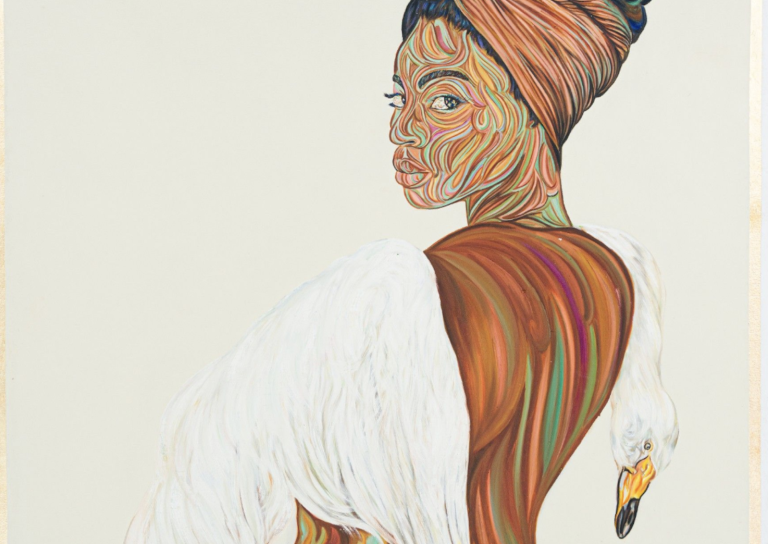
San Francisco Gets a Brand New Gallery — With a Focus on African Artists
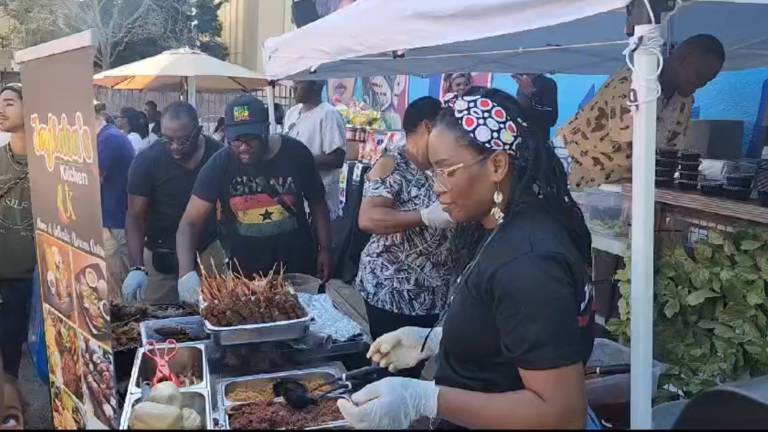
African Restaurant Week Wants to Expand the Bay Area’s Palate
The Bay’s First African Restaurant Week Celebrates the Whole Continent
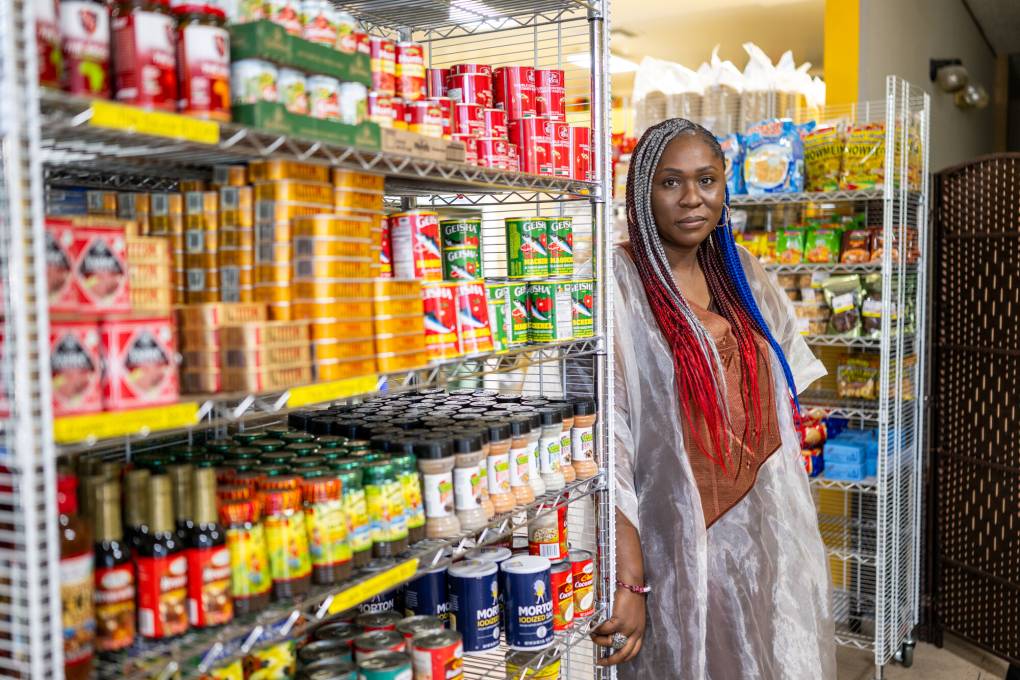
Beloved African and Caribbean Market Is Opening a New Restaurant in Oakland
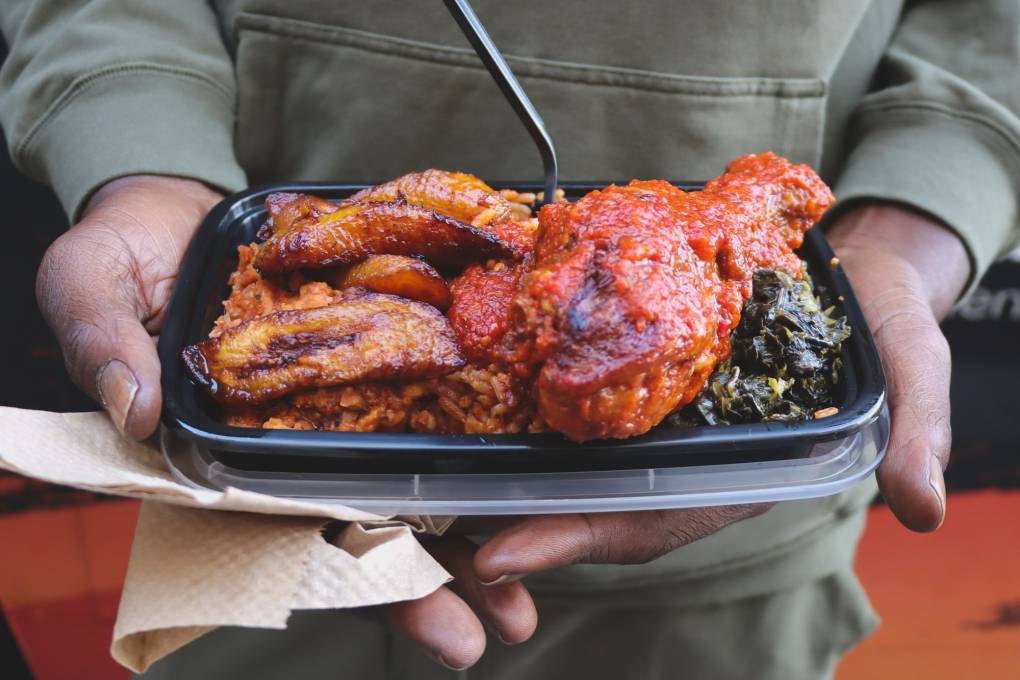
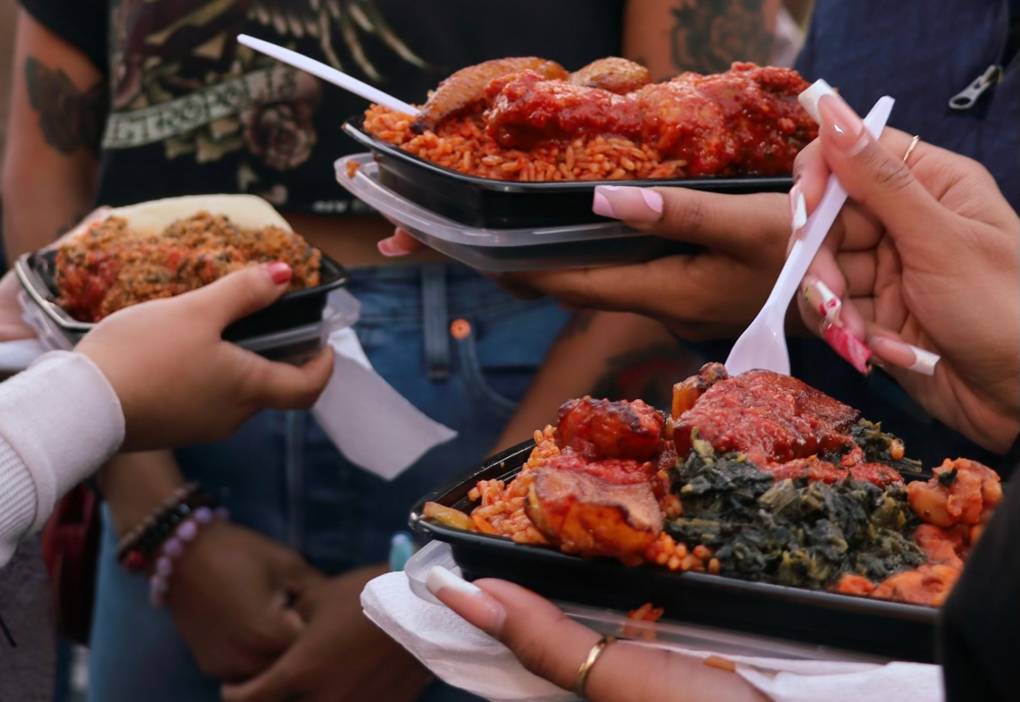
At Jollof Festival Oakland, West African Chefs Face Off in a Battle Royale of Rice
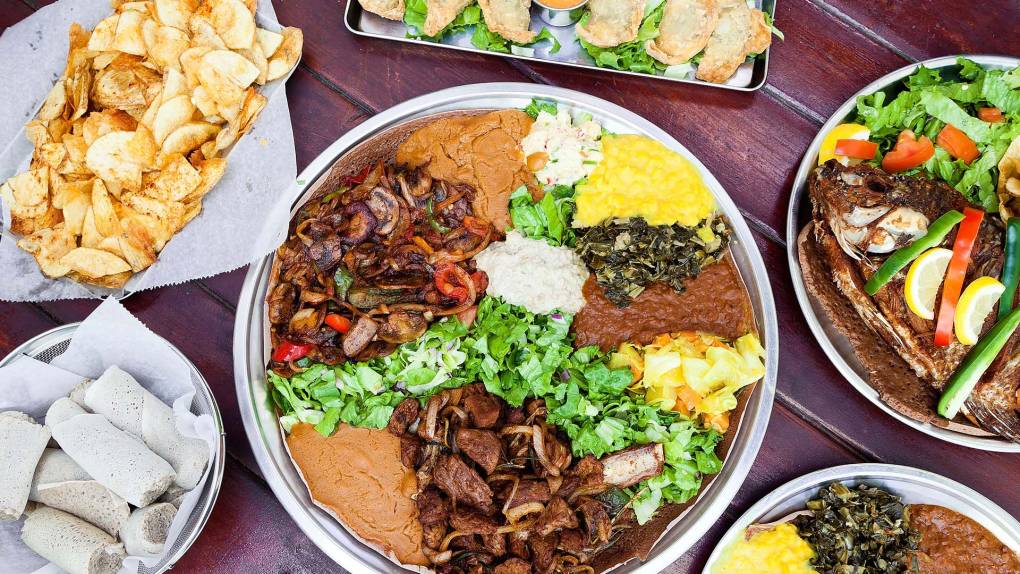
A New Bay Area Food Festival Celebrates Chefs of Color and Diasporic Unity
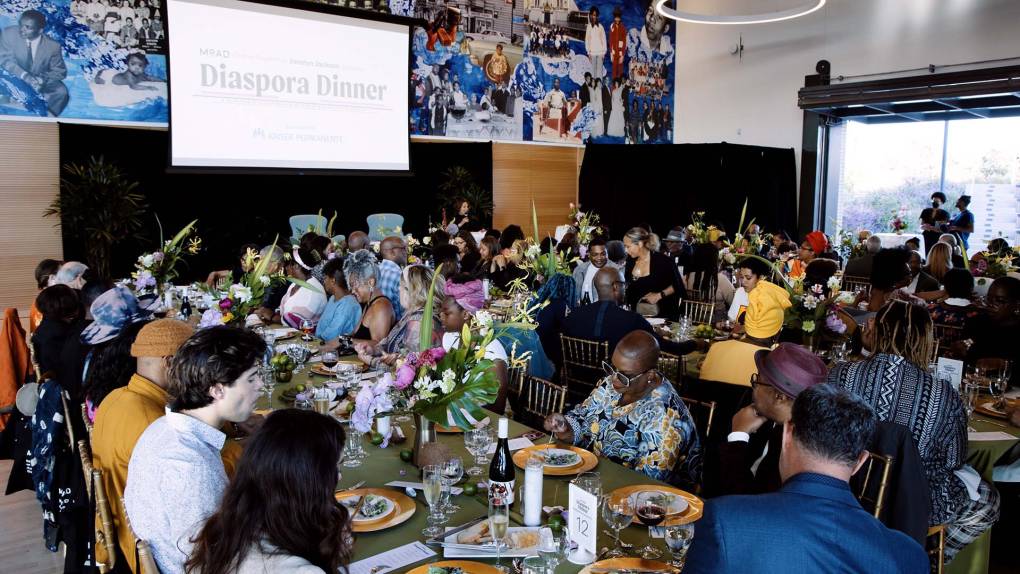
MoAD Hosts ‘High on the Hog’ Author for a Blowout Dinner
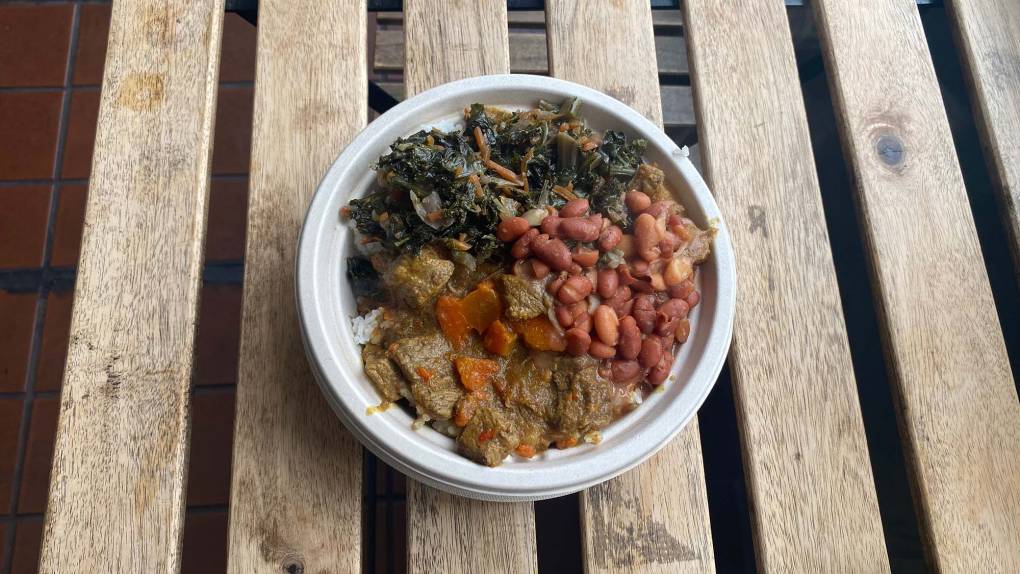
The Bay Area’s First Tanzanian Restaurant Takes Root in West Oakland
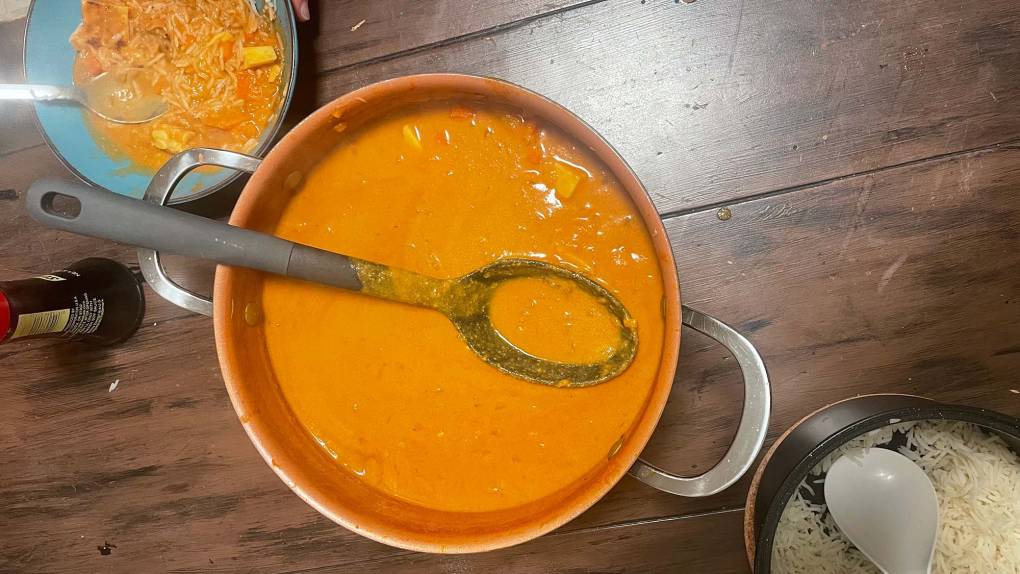
How the Bay Area Taught Me to Love Vegan Food — and Make It Ghanaian
Player sponsored by
window.__IS_SSR__=true
window.__INITIAL_STATE__={
"attachmentsReducer": {
"audio_0": {
"type": "attachments",
"id": "audio_0",
"imgSizes": {
"kqedFullSize": {
"file": "https://ww2.kqed.org/news/wp-content/themes/KQED-unified/img/audio_bgs/background0.jpg"
}
}
},
"audio_1": {
"type": "attachments",
"id": "audio_1",
"imgSizes": {
"kqedFullSize": {
"file": "https://ww2.kqed.org/news/wp-content/themes/KQED-unified/img/audio_bgs/background1.jpg"
}
}
},
"audio_2": {
"type": "attachments",
"id": "audio_2",
"imgSizes": {
"kqedFullSize": {
"file": "https://ww2.kqed.org/news/wp-content/themes/KQED-unified/img/audio_bgs/background2.jpg"
}
}
},
"audio_3": {
"type": "attachments",
"id": "audio_3",
"imgSizes": {
"kqedFullSize": {
"file": "https://ww2.kqed.org/news/wp-content/themes/KQED-unified/img/audio_bgs/background3.jpg"
}
}
},
"audio_4": {
"type": "attachments",
"id": "audio_4",
"imgSizes": {
"kqedFullSize": {
"file": "https://ww2.kqed.org/news/wp-content/themes/KQED-unified/img/audio_bgs/background4.jpg"
}
}
},
"placeholder": {
"type": "attachments",
"id": "placeholder",
"imgSizes": {
"thumbnail": {
"file": "https://cdn.kqed.org/wp-content/uploads/2024/12/KQED-Default-Image-816638274-2000x1333-1-160x107.jpg",
"width": 160,
"height": 107,
"mimeType": "image/jpeg"
},
"medium": {
"file": "https://cdn.kqed.org/wp-content/uploads/2024/12/KQED-Default-Image-816638274-2000x1333-1-800x533.jpg",
"width": 800,
"height": 533,
"mimeType": "image/jpeg"
},
"medium_large": {
"file": "https://cdn.kqed.org/wp-content/uploads/2024/12/KQED-Default-Image-816638274-2000x1333-1-768x512.jpg",
"width": 768,
"height": 512,
"mimeType": "image/jpeg"
},
"large": {
"file": "https://cdn.kqed.org/wp-content/uploads/2024/12/KQED-Default-Image-816638274-2000x1333-1-1020x680.jpg",
"width": 1020,
"height": 680,
"mimeType": "image/jpeg"
},
"1536x1536": {
"file": "https://cdn.kqed.org/wp-content/uploads/2024/12/KQED-Default-Image-816638274-2000x1333-1-1536x1024.jpg",
"width": 1536,
"height": 1024,
"mimeType": "image/jpeg"
},
"fd-lrg": {
"file": "https://cdn.kqed.org/wp-content/uploads/2024/12/KQED-Default-Image-816638274-2000x1333-1-1536x1024.jpg",
"width": 1536,
"height": 1024,
"mimeType": "image/jpeg"
},
"fd-med": {
"file": "https://cdn.kqed.org/wp-content/uploads/2024/12/KQED-Default-Image-816638274-2000x1333-1-1020x680.jpg",
"width": 1020,
"height": 680,
"mimeType": "image/jpeg"
},
"fd-sm": {
"file": "https://cdn.kqed.org/wp-content/uploads/2024/12/KQED-Default-Image-816638274-2000x1333-1-800x533.jpg",
"width": 800,
"height": 533,
"mimeType": "image/jpeg"
},
"post-thumbnail": {
"file": "https://cdn.kqed.org/wp-content/uploads/2024/12/KQED-Default-Image-816638274-2000x1333-1-672x372.jpg",
"width": 672,
"height": 372,
"mimeType": "image/jpeg"
},
"twentyfourteen-full-width": {
"file": "https://cdn.kqed.org/wp-content/uploads/2024/12/KQED-Default-Image-816638274-2000x1333-1-1038x576.jpg",
"width": 1038,
"height": 576,
"mimeType": "image/jpeg"
},
"xxsmall": {
"file": "https://cdn.kqed.org/wp-content/uploads/2024/12/KQED-Default-Image-816638274-2000x1333-1-160x107.jpg",
"width": 160,
"height": 107,
"mimeType": "image/jpeg"
},
"xsmall": {
"file": "https://cdn.kqed.org/wp-content/uploads/2024/12/KQED-Default-Image-816638274-2000x1333-1-672x372.jpg",
"width": 672,
"height": 372,
"mimeType": "image/jpeg"
},
"small": {
"file": "https://cdn.kqed.org/wp-content/uploads/2024/12/KQED-Default-Image-816638274-2000x1333-1-672x372.jpg",
"width": 672,
"height": 372,
"mimeType": "image/jpeg"
},
"xlarge": {
"file": "https://cdn.kqed.org/wp-content/uploads/2024/12/KQED-Default-Image-816638274-2000x1333-1-1020x680.jpg",
"width": 1020,
"height": 680,
"mimeType": "image/jpeg"
},
"full-width": {
"file": "https://cdn.kqed.org/wp-content/uploads/2024/12/KQED-Default-Image-816638274-2000x1333-1-1920x1280.jpg",
"width": 1920,
"height": 1280,
"mimeType": "image/jpeg"
},
"guest-author-32": {
"file": "https://cdn.kqed.org/wp-content/uploads/2025/01/KQED-Default-Image-816638274-1333x1333-1-160x160.jpg",
"width": 32,
"height": 32,
"mimeType": "image/jpeg"
},
"guest-author-50": {
"file": "https://cdn.kqed.org/wp-content/uploads/2025/01/KQED-Default-Image-816638274-1333x1333-1-160x160.jpg",
"width": 50,
"height": 50,
"mimeType": "image/jpeg"
},
"guest-author-64": {
"file": "https://cdn.kqed.org/wp-content/uploads/2025/01/KQED-Default-Image-816638274-1333x1333-1-160x160.jpg",
"width": 64,
"height": 64,
"mimeType": "image/jpeg"
},
"guest-author-96": {
"file": "https://cdn.kqed.org/wp-content/uploads/2025/01/KQED-Default-Image-816638274-1333x1333-1-160x160.jpg",
"width": 96,
"height": 96,
"mimeType": "image/jpeg"
},
"guest-author-128": {
"file": "https://cdn.kqed.org/wp-content/uploads/2025/01/KQED-Default-Image-816638274-1333x1333-1-160x160.jpg",
"width": 128,
"height": 128,
"mimeType": "image/jpeg"
},
"detail": {
"file": "https://cdn.kqed.org/wp-content/uploads/2025/01/KQED-Default-Image-816638274-1333x1333-1-160x160.jpg",
"width": 160,
"height": 160,
"mimeType": "image/jpeg"
},
"kqedFullSize": {
"file": "https://cdn.kqed.org/wp-content/uploads/2024/12/KQED-Default-Image-816638274-2000x1333-1.jpg",
"width": 2000,
"height": 1333
}
}
},
"arts_13986653": {
"type": "attachments",
"id": "arts_13986653",
"meta": {
"index": "attachments_1716263798",
"site": "arts",
"id": "13986653",
"found": true
},
"title": "swan",
"publishDate": 1770884079,
"status": "inherit",
"parent": 13986545,
"modified": 1770884113,
"caption": "‘The Load (2025)’ by Ayanda Mabulu.",
"credit": "Courtesy of AOCA",
"altTag": "A contemporary painting featuring a Black woman wearing a hair wrap, her back to the viewer, with a white swan draped over her front, its neck resting on her shoulder.",
"description": null,
"imgSizes": {
"thumbnail": {
"file": "https://cdn.kqed.org/wp-content/uploads/sites/2/2026/02/swan-1-160x113.png",
"width": 160,
"height": 113,
"mimeType": "image/png"
},
"medium_large": {
"file": "https://cdn.kqed.org/wp-content/uploads/sites/2/2026/02/swan-1-768x544.png",
"width": 768,
"height": 544,
"mimeType": "image/png"
},
"post-thumbnail": {
"file": "https://cdn.kqed.org/wp-content/uploads/sites/2/2026/02/swan-1-672x372.png",
"width": 672,
"height": 372,
"mimeType": "image/png"
},
"twentyfourteen-full-width": {
"file": "https://cdn.kqed.org/wp-content/uploads/sites/2/2026/02/swan-1-1038x576.png",
"width": 1038,
"height": 576,
"mimeType": "image/png"
},
"npr-cds-wide": {
"file": "https://cdn.kqed.org/wp-content/uploads/sites/2/2026/02/swan-1-1200x675.png",
"width": 1200,
"height": 675,
"mimeType": "image/png"
},
"kqedFullSize": {
"file": "https://cdn.kqed.org/wp-content/uploads/sites/2/2026/02/swan-1.png",
"width": 1474,
"height": 1044
}
},
"isLoading": false,
"fetchFailed": false
},
"arts_13981321": {
"type": "attachments",
"id": "arts_13981321",
"meta": {
"index": "attachments_1716263798",
"site": "arts",
"id": "13981321",
"found": true
},
"title": "jaybaba kitchen festival",
"publishDate": 1757631916,
"status": "inherit",
"parent": 13981316,
"modified": 1757632086,
"caption": "JayBaba's Kitchen was one of the most popular stands at the inaugural Bay Area African Restaurant Week Festival, held at For the Culture in Oakland in September 2024. This year's restaurant week festivities will run from Sept. 12–21.",
"credit": "Courtesy of JayBaba's Kitchen",
"altTag": "A food stand at a festival serves meat skewers and trays of rice.",
"description": null,
"imgSizes": {
"thumbnail": {
"file": "https://cdn.kqed.org/wp-content/uploads/sites/2/2025/09/jaybaba-kitchen-festival-160x90.jpg",
"width": 160,
"height": 90,
"mimeType": "image/jpeg"
},
"medium_large": {
"file": "https://cdn.kqed.org/wp-content/uploads/sites/2/2025/09/jaybaba-kitchen-festival-768x432.jpg",
"width": 768,
"height": 432,
"mimeType": "image/jpeg"
},
"1536x1536": {
"file": "https://cdn.kqed.org/wp-content/uploads/sites/2/2025/09/jaybaba-kitchen-festival-1536x864.jpg",
"width": 1536,
"height": 864,
"mimeType": "image/jpeg"
},
"post-thumbnail": {
"file": "https://cdn.kqed.org/wp-content/uploads/sites/2/2025/09/jaybaba-kitchen-festival-672x372.jpg",
"width": 672,
"height": 372,
"mimeType": "image/jpeg"
},
"twentyfourteen-full-width": {
"file": "https://cdn.kqed.org/wp-content/uploads/sites/2/2025/09/jaybaba-kitchen-festival-1038x576.jpg",
"width": 1038,
"height": 576,
"mimeType": "image/jpeg"
},
"kqedFullSize": {
"file": "https://cdn.kqed.org/wp-content/uploads/sites/2/2025/09/jaybaba-kitchen-festival.jpg",
"width": 2000,
"height": 1125
}
},
"isLoading": false,
"fetchFailed": false
},
"arts_13964187": {
"type": "attachments",
"id": "arts_13964187",
"meta": {
"index": "attachments_1716263798",
"site": "arts",
"id": "13964187",
"found": true
},
"title": "jollof kitchen hero",
"publishDate": 1726179816,
"status": "inherit",
"parent": 13964180,
"modified": 1726179942,
"caption": "Jollof Kitchen's locally famous jollof rice will be one of the many diasporic dishes featured at the first annual Bay Area African Restaurant Week, which runs Sept. 12–22, 2024.",
"credit": "Courtesy of Jollof Kitchen",
"altTag": "Man holding a takeout container of birght orange jollof rice with chicken and plantains.",
"description": null,
"imgSizes": {
"medium": {
"file": "https://cdn.kqed.org/wp-content/uploads/sites/2/2024/09/jollof-kitchen-hero-800x533.jpg",
"width": 800,
"height": 533,
"mimeType": "image/jpeg"
},
"large": {
"file": "https://cdn.kqed.org/wp-content/uploads/sites/2/2024/09/jollof-kitchen-hero-1020x680.jpg",
"width": 1020,
"height": 680,
"mimeType": "image/jpeg"
},
"thumbnail": {
"file": "https://cdn.kqed.org/wp-content/uploads/sites/2/2024/09/jollof-kitchen-hero-160x107.jpg",
"width": 160,
"height": 107,
"mimeType": "image/jpeg"
},
"medium_large": {
"file": "https://cdn.kqed.org/wp-content/uploads/sites/2/2024/09/jollof-kitchen-hero-768x512.jpg",
"width": 768,
"height": 512,
"mimeType": "image/jpeg"
},
"1536x1536": {
"file": "https://cdn.kqed.org/wp-content/uploads/sites/2/2024/09/jollof-kitchen-hero-1536x1024.jpg",
"width": 1536,
"height": 1024,
"mimeType": "image/jpeg"
},
"post-thumbnail": {
"file": "https://cdn.kqed.org/wp-content/uploads/sites/2/2024/09/jollof-kitchen-hero-672x372.jpg",
"width": 672,
"height": 372,
"mimeType": "image/jpeg"
},
"twentyfourteen-full-width": {
"file": "https://cdn.kqed.org/wp-content/uploads/sites/2/2024/09/jollof-kitchen-hero-1038x576.jpg",
"width": 1038,
"height": 576,
"mimeType": "image/jpeg"
},
"full-width": {
"file": "https://cdn.kqed.org/wp-content/uploads/sites/2/2024/09/jollof-kitchen-hero-1920x1280.jpg",
"width": 1920,
"height": 1280,
"mimeType": "image/jpeg"
},
"kqedFullSize": {
"file": "https://cdn.kqed.org/wp-content/uploads/sites/2/2024/09/jollof-kitchen-hero.jpg",
"width": 2000,
"height": 1333
}
},
"isLoading": false,
"fetchFailed": false
},
"arts_13960943": {
"type": "attachments",
"id": "arts_13960943",
"meta": {
"index": "attachments_1716263798",
"site": "arts",
"id": "13960943",
"found": true
},
"title": "240709-ManMustWak2-45-BL_qed",
"publishDate": 1720644853,
"status": "inherit",
"parent": 0,
"modified": 1720656196,
"caption": "Owner Queenkay Amamgbo at the E. 18th Street location of Man Must Wak, an Afro-Caribbean market, in Oakland on July 9, 2024. Amamgbo opened the second location of the market near Lake Merritt in June of 2024.",
"credit": "Beth LaBerge/KQED",
"altTag": "A woman with long red, white and blue braids poses next to a display of spices and tinned fish inside an African market.",
"description": null,
"imgSizes": {
"medium": {
"file": "https://cdn.kqed.org/wp-content/uploads/sites/2/2024/07/240709-ManMustWak2-45-BL_qed-800x533.jpg",
"width": 800,
"height": 533,
"mimeType": "image/jpeg"
},
"large": {
"file": "https://cdn.kqed.org/wp-content/uploads/sites/2/2024/07/240709-ManMustWak2-45-BL_qed-1020x680.jpg",
"width": 1020,
"height": 680,
"mimeType": "image/jpeg"
},
"thumbnail": {
"file": "https://cdn.kqed.org/wp-content/uploads/sites/2/2024/07/240709-ManMustWak2-45-BL_qed-160x107.jpg",
"width": 160,
"height": 107,
"mimeType": "image/jpeg"
},
"medium_large": {
"file": "https://cdn.kqed.org/wp-content/uploads/sites/2/2024/07/240709-ManMustWak2-45-BL_qed-768x512.jpg",
"width": 768,
"height": 512,
"mimeType": "image/jpeg"
},
"1536x1536": {
"file": "https://cdn.kqed.org/wp-content/uploads/sites/2/2024/07/240709-ManMustWak2-45-BL_qed-1536x1024.jpg",
"width": 1536,
"height": 1024,
"mimeType": "image/jpeg"
},
"post-thumbnail": {
"file": "https://cdn.kqed.org/wp-content/uploads/sites/2/2024/07/240709-ManMustWak2-45-BL_qed-672x372.jpg",
"width": 672,
"height": 372,
"mimeType": "image/jpeg"
},
"twentyfourteen-full-width": {
"file": "https://cdn.kqed.org/wp-content/uploads/sites/2/2024/07/240709-ManMustWak2-45-BL_qed-1038x576.jpg",
"width": 1038,
"height": 576,
"mimeType": "image/jpeg"
},
"full-width": {
"file": "https://cdn.kqed.org/wp-content/uploads/sites/2/2024/07/240709-ManMustWak2-45-BL_qed-1920x1280.jpg",
"width": 1920,
"height": 1280,
"mimeType": "image/jpeg"
},
"kqedFullSize": {
"file": "https://cdn.kqed.org/wp-content/uploads/sites/2/2024/07/240709-ManMustWak2-45-BL_qed.jpg",
"width": 2000,
"height": 1333
}
},
"isLoading": false,
"fetchFailed": false
},
"arts_13960583": {
"type": "attachments",
"id": "arts_13960583",
"meta": {
"index": "attachments_1716263798",
"site": "arts",
"id": "13960583",
"found": true
},
"title": "jollof kitchen crop",
"publishDate": 1719617887,
"status": "inherit",
"parent": 13960580,
"modified": 1719617999,
"caption": "Customers enjoying their orders of Jollof Kitchen's Nigerian-style jollof rice. Owner Kemi Tijaniqudus won the Oakland edition of Jollof Festival in 2021 and 2023.",
"credit": "Courtesy of Jollof Kitchen",
"altTag": "Customers eating jollof rice out of black plastic takeout containers.",
"description": null,
"imgSizes": {
"medium": {
"file": "https://cdn.kqed.org/wp-content/uploads/sites/2/2024/07/jollof-kitchen-crop-800x550.jpg",
"width": 800,
"height": 550,
"mimeType": "image/jpeg"
},
"large": {
"file": "https://cdn.kqed.org/wp-content/uploads/sites/2/2024/07/jollof-kitchen-crop-1020x702.jpg",
"width": 1020,
"height": 702,
"mimeType": "image/jpeg"
},
"thumbnail": {
"file": "https://cdn.kqed.org/wp-content/uploads/sites/2/2024/07/jollof-kitchen-crop-160x110.jpg",
"width": 160,
"height": 110,
"mimeType": "image/jpeg"
},
"medium_large": {
"file": "https://cdn.kqed.org/wp-content/uploads/sites/2/2024/07/jollof-kitchen-crop-768x528.jpg",
"width": 768,
"height": 528,
"mimeType": "image/jpeg"
},
"1536x1536": {
"file": "https://cdn.kqed.org/wp-content/uploads/sites/2/2024/07/jollof-kitchen-crop-1536x1057.jpg",
"width": 1536,
"height": 1057,
"mimeType": "image/jpeg"
},
"post-thumbnail": {
"file": "https://cdn.kqed.org/wp-content/uploads/sites/2/2024/07/jollof-kitchen-crop-672x372.jpg",
"width": 672,
"height": 372,
"mimeType": "image/jpeg"
},
"twentyfourteen-full-width": {
"file": "https://cdn.kqed.org/wp-content/uploads/sites/2/2024/07/jollof-kitchen-crop-1038x576.jpg",
"width": 1038,
"height": 576,
"mimeType": "image/jpeg"
},
"kqedFullSize": {
"file": "https://cdn.kqed.org/wp-content/uploads/sites/2/2024/07/jollof-kitchen-crop.jpg",
"width": 1920,
"height": 1321
}
},
"isLoading": false,
"fetchFailed": false
},
"arts_13956601": {
"type": "attachments",
"id": "arts_13956601",
"meta": {
"index": "attachments_1716263798",
"site": "arts",
"id": "13956601",
"found": true
},
"parent": 13956017,
"imgSizes": {
"twentyfourteen-full-width": {
"file": "https://cdn.kqed.org/wp-content/uploads/sites/2/2024/04/Colucci-spread_courtesy-of-cafe-colucci-1038x576.jpg",
"width": 1038,
"mimeType": "image/jpeg",
"height": 576
},
"thumbnail": {
"file": "https://cdn.kqed.org/wp-content/uploads/sites/2/2024/04/Colucci-spread_courtesy-of-cafe-colucci-160x90.jpg",
"width": 160,
"mimeType": "image/jpeg",
"height": 90
},
"post-thumbnail": {
"file": "https://cdn.kqed.org/wp-content/uploads/sites/2/2024/04/Colucci-spread_courtesy-of-cafe-colucci-672x372.jpg",
"width": 672,
"mimeType": "image/jpeg",
"height": 372
},
"kqedFullSize": {
"file": "https://cdn.kqed.org/wp-content/uploads/sites/2/2024/04/Colucci-spread_courtesy-of-cafe-colucci.jpg",
"width": 1920,
"height": 1080
},
"large": {
"file": "https://cdn.kqed.org/wp-content/uploads/sites/2/2024/04/Colucci-spread_courtesy-of-cafe-colucci-1020x574.jpg",
"width": 1020,
"mimeType": "image/jpeg",
"height": 574
},
"1536x1536": {
"file": "https://cdn.kqed.org/wp-content/uploads/sites/2/2024/04/Colucci-spread_courtesy-of-cafe-colucci-1536x864.jpg",
"width": 1536,
"mimeType": "image/jpeg",
"height": 864
},
"medium": {
"file": "https://cdn.kqed.org/wp-content/uploads/sites/2/2024/04/Colucci-spread_courtesy-of-cafe-colucci-800x450.jpg",
"width": 800,
"mimeType": "image/jpeg",
"height": 450
},
"medium_large": {
"file": "https://cdn.kqed.org/wp-content/uploads/sites/2/2024/04/Colucci-spread_courtesy-of-cafe-colucci-768x432.jpg",
"width": 768,
"mimeType": "image/jpeg",
"height": 432
}
},
"publishDate": 1713984302,
"modified": 1713984490,
"caption": "At the first-ever POC Food & Wine Festival Oakland's Cafe Colucci will be on hand to rep the cuisine of the Ethiopian diaspora.",
"description": null,
"title": "Colucci spread_courtesy of cafe colucci",
"credit": "Courtesy of Cafe Colucci",
"status": "inherit",
"altTag": "A sumptuous spread of Ethiopian dishes, including a large round platter lined with injera.",
"isLoading": false,
"fetchFailed": false
},
"arts_13956500": {
"type": "attachments",
"id": "arts_13956500",
"meta": {
"index": "attachments_1716263798",
"site": "arts",
"id": "13956500",
"found": true
},
"parent": 13956497,
"imgSizes": {
"twentyfourteen-full-width": {
"file": "https://cdn.kqed.org/wp-content/uploads/sites/2/2024/04/Fox_Nakai_Diaspora-Dinner_.00_00_57_22-1038x576.jpg",
"width": 1038,
"mimeType": "image/jpeg",
"height": 576
},
"thumbnail": {
"file": "https://cdn.kqed.org/wp-content/uploads/sites/2/2024/04/Fox_Nakai_Diaspora-Dinner_.00_00_57_22-160x90.jpg",
"width": 160,
"mimeType": "image/jpeg",
"height": 90
},
"post-thumbnail": {
"file": "https://cdn.kqed.org/wp-content/uploads/sites/2/2024/04/Fox_Nakai_Diaspora-Dinner_.00_00_57_22-672x372.jpg",
"width": 672,
"mimeType": "image/jpeg",
"height": 372
},
"kqedFullSize": {
"file": "https://cdn.kqed.org/wp-content/uploads/sites/2/2024/04/Fox_Nakai_Diaspora-Dinner_.00_00_57_22.jpg",
"width": 1920,
"height": 1080
},
"large": {
"file": "https://cdn.kqed.org/wp-content/uploads/sites/2/2024/04/Fox_Nakai_Diaspora-Dinner_.00_00_57_22-1020x574.jpg",
"width": 1020,
"mimeType": "image/jpeg",
"height": 574
},
"1536x1536": {
"file": "https://cdn.kqed.org/wp-content/uploads/sites/2/2024/04/Fox_Nakai_Diaspora-Dinner_.00_00_57_22-1536x864.jpg",
"width": 1536,
"mimeType": "image/jpeg",
"height": 864
},
"medium": {
"file": "https://cdn.kqed.org/wp-content/uploads/sites/2/2024/04/Fox_Nakai_Diaspora-Dinner_.00_00_57_22-800x450.jpg",
"width": 800,
"mimeType": "image/jpeg",
"height": 450
},
"medium_large": {
"file": "https://cdn.kqed.org/wp-content/uploads/sites/2/2024/04/Fox_Nakai_Diaspora-Dinner_.00_00_57_22-768x432.jpg",
"width": 768,
"mimeType": "image/jpeg",
"height": 432
}
},
"publishDate": 1713912419,
"modified": 1713912633,
"caption": "The packed house at last year's Diaspora Dinner, which MoAD hosted at the Southeast Community Center in the Bayview.",
"description": null,
"title": "Fox_Nakai_Diaspora Dinner_.00_00_57_22",
"credit": "Fox Nakai, courtesy of MoAD",
"status": "inherit",
"altTag": "The crowded dining room at an elegant gala. The text projected onto a screen reads, \"Diaspora Dinner.\"",
"isLoading": false,
"fetchFailed": false
},
"arts_13954272": {
"type": "attachments",
"id": "arts_13954272",
"meta": {
"index": "attachments_1716263798",
"site": "arts",
"id": "13954272",
"found": true
},
"parent": 13954267,
"imgSizes": {
"twentyfourteen-full-width": {
"file": "https://cdn.kqed.org/wp-content/uploads/sites/2/2024/03/swahili-spot-lead-1038x576.jpg",
"width": 1038,
"mimeType": "image/jpeg",
"height": 576
},
"thumbnail": {
"file": "https://cdn.kqed.org/wp-content/uploads/sites/2/2024/03/swahili-spot-lead-160x90.jpg",
"width": 160,
"mimeType": "image/jpeg",
"height": 90
},
"post-thumbnail": {
"file": "https://cdn.kqed.org/wp-content/uploads/sites/2/2024/03/swahili-spot-lead-672x372.jpg",
"width": 672,
"mimeType": "image/jpeg",
"height": 372
},
"kqedFullSize": {
"file": "https://cdn.kqed.org/wp-content/uploads/sites/2/2024/03/swahili-spot-lead.jpg",
"width": 2000,
"height": 1125
},
"large": {
"file": "https://cdn.kqed.org/wp-content/uploads/sites/2/2024/03/swahili-spot-lead-1020x574.jpg",
"width": 1020,
"mimeType": "image/jpeg",
"height": 574
},
"1536x1536": {
"file": "https://cdn.kqed.org/wp-content/uploads/sites/2/2024/03/swahili-spot-lead-1536x864.jpg",
"width": 1536,
"mimeType": "image/jpeg",
"height": 864
},
"full-width": {
"file": "https://cdn.kqed.org/wp-content/uploads/sites/2/2024/03/swahili-spot-lead-1920x1080.jpg",
"width": 1920,
"mimeType": "image/jpeg",
"height": 1080
},
"medium": {
"file": "https://cdn.kqed.org/wp-content/uploads/sites/2/2024/03/swahili-spot-lead-800x450.jpg",
"width": 800,
"mimeType": "image/jpeg",
"height": 450
},
"medium_large": {
"file": "https://cdn.kqed.org/wp-content/uploads/sites/2/2024/03/swahili-spot-lead-768x432.jpg",
"width": 768,
"mimeType": "image/jpeg",
"height": 432
}
},
"publishDate": 1710790397,
"modified": 1710790483,
"caption": "Swahili Spot is bringing traditional Tanzanian curries — like this beef curry bowl — to a small storefront in West Oakland.",
"description": null,
"title": "swahili spot - lead",
"credit": "Luke Tsai/KQED",
"status": "inherit",
"altTag": "A curry rice bowl topped with beef, greens and beans.",
"isLoading": false,
"fetchFailed": false
},
"arts_13953906": {
"type": "attachments",
"id": "arts_13953906",
"meta": {
"index": "attachments_1716263798",
"site": "arts",
"id": "13953906",
"found": true
},
"parent": 13953866,
"imgSizes": {
"twentyfourteen-full-width": {
"file": "https://cdn.kqed.org/wp-content/uploads/sites/2/2024/03/ghanaian-peanut-stew-featured-1038x576.jpg",
"width": 1038,
"mimeType": "image/jpeg",
"height": 576
},
"thumbnail": {
"file": "https://cdn.kqed.org/wp-content/uploads/sites/2/2024/03/ghanaian-peanut-stew-featured-160x90.jpg",
"width": 160,
"mimeType": "image/jpeg",
"height": 90
},
"post-thumbnail": {
"file": "https://cdn.kqed.org/wp-content/uploads/sites/2/2024/03/ghanaian-peanut-stew-featured-672x372.jpg",
"width": 672,
"mimeType": "image/jpeg",
"height": 372
},
"kqedFullSize": {
"file": "https://cdn.kqed.org/wp-content/uploads/sites/2/2024/03/ghanaian-peanut-stew-featured.jpg",
"width": 2000,
"height": 1125
},
"large": {
"file": "https://cdn.kqed.org/wp-content/uploads/sites/2/2024/03/ghanaian-peanut-stew-featured-1020x574.jpg",
"width": 1020,
"mimeType": "image/jpeg",
"height": 574
},
"1536x1536": {
"file": "https://cdn.kqed.org/wp-content/uploads/sites/2/2024/03/ghanaian-peanut-stew-featured-1536x864.jpg",
"width": 1536,
"mimeType": "image/jpeg",
"height": 864
},
"full-width": {
"file": "https://cdn.kqed.org/wp-content/uploads/sites/2/2024/03/ghanaian-peanut-stew-featured-1920x1080.jpg",
"width": 1920,
"mimeType": "image/jpeg",
"height": 1080
},
"medium": {
"file": "https://cdn.kqed.org/wp-content/uploads/sites/2/2024/03/ghanaian-peanut-stew-featured-800x450.jpg",
"width": 800,
"mimeType": "image/jpeg",
"height": 450
},
"medium_large": {
"file": "https://cdn.kqed.org/wp-content/uploads/sites/2/2024/03/ghanaian-peanut-stew-featured-768x432.jpg",
"width": 768,
"mimeType": "image/jpeg",
"height": 432
}
},
"publishDate": 1710197655,
"modified": 1710199152,
"caption": "Traditionally prepared with chicken or other meats, a vegan version of Ghanaian peanut stew tastes just as good. ",
"description": null,
"title": "ghanaian peanut stew - featured",
"credit": "Kofi Ansong",
"status": "inherit",
"altTag": "A pot of bright orange peanut stew in a pot, with rice on the side.",
"isLoading": false,
"fetchFailed": false
}
},
"audioPlayerReducer": {
"postId": "stream_live",
"isPaused": true,
"isPlaying": false,
"pfsActive": false,
"pledgeModalIsOpen": true,
"playerDrawerIsOpen": false
},
"authorsReducer": {
"byline_arts_13953866": {
"type": "authors",
"id": "byline_arts_13953866",
"meta": {
"override": true
},
"slug": "byline_arts_13953866",
"name": "Kofi Ansong",
"isLoading": false
},
"ralexandra": {
"type": "authors",
"id": "11242",
"meta": {
"index": "authors_1716337520",
"id": "11242",
"found": true
},
"name": "Rae Alexandra",
"firstName": "Rae",
"lastName": "Alexandra",
"slug": "ralexandra",
"email": "ralexandra@kqed.org",
"display_author_email": true,
"staff_mastheads": [
"arts"
],
"title": "Reporter/Producer",
"bio": "Rae Alexandra is a Reporter/Producer for KQED Arts & Culture, and the creator/author of the \u003ca href=\"https://www.kqed.org/arts/program/rebel-girls-from-bay-area-history\">Rebel Girls From Bay Area History\u003c/a> and \u003ca href=\"https://www.kqed.org/bizarrebayarea\">Bizarre Bay Area\u003c/a> series. Her debut book, \u003ca href=\"https://citylights.com/politics-current-events-history/unsung-heroines35-women-who-changed/\">Unsung Heroines: 35 Women Who Changed the Bay Area\u003c/a> was published by City Lights in March 2026. In 2023, Rae was awarded an SPJ Excellence in Journalism Award for Arts & Culture. Rae was born and raised in Wales and subsequently — even after two decades in Northern California — still uses phrases that regularly baffle her coworkers.",
"avatar": "https://secure.gravatar.com/avatar/d5ef3d663d9adae1345d06932a3951de?s=600&d=blank&r=g",
"twitter": null,
"bluesky": null,
"facebook": null,
"instagram": null,
"linkedin": null,
"sites": [
{
"site": "arts",
"roles": [
"editor"
]
},
{
"site": "news",
"roles": [
"editor"
]
},
{
"site": "pop",
"roles": [
"editor"
]
},
{
"site": "bayareabites",
"roles": [
"editor"
]
},
{
"site": "science",
"roles": [
"editor"
]
}
],
"headData": {
"title": "Rae Alexandra | KQED",
"description": "Reporter/Producer",
"ogImgSrc": "https://secure.gravatar.com/avatar/d5ef3d663d9adae1345d06932a3951de?s=600&d=blank&r=g",
"twImgSrc": "https://secure.gravatar.com/avatar/d5ef3d663d9adae1345d06932a3951de?s=600&d=blank&r=g"
},
"isLoading": false,
"link": "/author/ralexandra"
},
"ltsai": {
"type": "authors",
"id": "11743",
"meta": {
"index": "authors_1716337520",
"id": "11743",
"found": true
},
"name": "Luke Tsai",
"firstName": "Luke",
"lastName": "Tsai",
"slug": "ltsai",
"email": "ltsai@kqed.org",
"display_author_email": true,
"staff_mastheads": [
"arts"
],
"title": "Food Editor",
"bio": "Luke Tsai is KQED's food editor and resident stinky tofu connoisseur. Prior to KQED, he was an editor at Eater SF, \u003cem>San Francisco \u003c/em>magazine, and the \u003cem>East Bay Express\u003c/em>, and his work has also appeared in TASTE, the \u003cem>San Francisco Chronicle\u003c/em>, and the \u003cem>Best Food Writing\u003c/em> anthology. When he isn't writing or editing, you'll find him eating most everything he can get his hands on.",
"avatar": "https://secure.gravatar.com/avatar/d1ff591a3047b143a0e23cf7f28fcac0?s=600&d=blank&r=g",
"twitter": "theluketsai",
"bluesky": null,
"facebook": null,
"instagram": null,
"linkedin": null,
"sites": [
{
"site": "",
"roles": [
"editor"
]
},
{
"site": "arts",
"roles": [
"administrator"
]
},
{
"site": "news",
"roles": [
"editor",
"contributor"
]
},
{
"site": "bayareabites",
"roles": [
"editor"
]
},
{
"site": "food",
"roles": [
"editor"
]
}
],
"headData": {
"title": "Luke Tsai | KQED",
"description": "Food Editor",
"ogImgSrc": "https://secure.gravatar.com/avatar/d1ff591a3047b143a0e23cf7f28fcac0?s=600&d=blank&r=g",
"twImgSrc": "https://secure.gravatar.com/avatar/d1ff591a3047b143a0e23cf7f28fcac0?s=600&d=blank&r=g"
},
"isLoading": false,
"link": "/author/ltsai"
},
"achazaro": {
"type": "authors",
"id": "11748",
"meta": {
"index": "authors_1716337520",
"id": "11748",
"found": true
},
"name": "Alan Chazaro",
"firstName": "Alan",
"lastName": "Chazaro",
"slug": "achazaro",
"email": "agchazaro@gmail.com",
"display_author_email": true,
"staff_mastheads": [],
"title": "Food Writer and Reporter",
"bio": "Alan Chazaro is the author of \u003cem>This Is Not a Frank Ocean Cover Album\u003c/em> (Black Lawrence Press, 2019), \u003cem>Piñata Theory\u003c/em> (Black Lawrence Press, 2020), and \u003cem>Notes from the Eastern Span of the Bay Bridge\u003c/em> (Ghost City Press, 2021). He is a graduate of June Jordan’s Poetry for the People program at UC Berkeley and a former Lawrence Ferlinghetti Fellow at the University of San Francisco. He writes about sports, food, art, music, education, and culture while repping the Bay on \u003ca href=\"https://twitter.com/alan_chazaro\">Twitter\u003c/a> and \u003ca href=\"https://www.instagram.com/alan_chazaro/?hl=en\">Instagram\u003c/a> at @alan_chazaro.",
"avatar": "https://secure.gravatar.com/avatar/ea8b6dd970fc5c29e7a188e7d5861df7?s=600&d=blank&r=g",
"twitter": "alan_chazaro",
"facebook": null,
"instagram": null,
"linkedin": null,
"sites": [
{
"site": "arts",
"roles": [
"contributor"
]
},
{
"site": "news",
"roles": [
"editor"
]
}
],
"headData": {
"title": "Alan Chazaro | KQED",
"description": "Food Writer and Reporter",
"ogImgSrc": "https://secure.gravatar.com/avatar/ea8b6dd970fc5c29e7a188e7d5861df7?s=600&d=blank&r=g",
"twImgSrc": "https://secure.gravatar.com/avatar/ea8b6dd970fc5c29e7a188e7d5861df7?s=600&d=blank&r=g"
},
"isLoading": false,
"link": "/author/achazaro"
},
"bduffett": {
"type": "authors",
"id": "11902",
"meta": {
"index": "authors_1716337520",
"id": "11902",
"found": true
},
"name": "Becky Duffett",
"firstName": "Becky",
"lastName": "Duffett",
"slug": "bduffett",
"email": "duffettr@gmail.com",
"display_author_email": false,
"staff_mastheads": [],
"title": "KQED Contributor",
"bio": null,
"avatar": "https://secure.gravatar.com/avatar/e5baf1733e81ecc5f55104a3c095028c?s=600&d=blank&r=g",
"twitter": null,
"facebook": null,
"instagram": null,
"linkedin": null,
"sites": [
{
"site": "arts",
"roles": [
"contributor"
]
}
],
"headData": {
"title": "Becky Duffett | KQED",
"description": "KQED Contributor",
"ogImgSrc": "https://secure.gravatar.com/avatar/e5baf1733e81ecc5f55104a3c095028c?s=600&d=blank&r=g",
"twImgSrc": "https://secure.gravatar.com/avatar/e5baf1733e81ecc5f55104a3c095028c?s=600&d=blank&r=g"
},
"isLoading": false,
"link": "/author/bduffett"
}
},
"breakingNewsReducer": {},
"pagesReducer": {},
"postsReducer": {
"stream_live": {
"type": "live",
"id": "stream_live",
"audioUrl": "https://streams.kqed.org/kqedradio",
"title": "Live Stream",
"excerpt": "Live Stream information currently unavailable.",
"link": "/radio",
"featImg": "",
"label": {
"name": "KQED Live",
"link": "/"
}
},
"stream_kqedNewscast": {
"type": "posts",
"id": "stream_kqedNewscast",
"audioUrl": "https://www.kqed.org/.stream/anon/radio/RDnews/newscast.mp3?_=1",
"title": "KQED Newscast",
"featImg": "",
"label": {
"name": "88.5 FM",
"link": "/"
}
},
"arts_13986545": {
"type": "posts",
"id": "arts_13986545",
"meta": {
"index": "posts_1716263798",
"site": "arts",
"id": "13986545",
"score": null,
"sort": [
1770936153000
]
},
"guestAuthors": [],
"slug": "afropop-review-art-of-contemporary-africa-gallery-minnesota-st-project-sf",
"title": "San Francisco Gets a Brand New Gallery — With a Focus on African Artists",
"publishDate": 1770936153,
"format": "aside",
"headTitle": "San Francisco Gets a Brand New Gallery — With a Focus on African Artists | KQED",
"labelTerm": {},
"content": "\u003cfigure id=\"attachment_13986618\" class=\"wp-caption aligncenter\" style=\"max-width: 1667px\">\u003cimg loading=\"lazy\" decoding=\"async\" class=\"wp-image-13986618 size-full\" src=\"https://cdn.kqed.org/wp-content/uploads/sites/2/2026/02/swan.png\" alt=\"A contemporary painting featuring a Black woman wearing a hair wrap, her back to the viewer, with a white swan draped over her front, its neck resting on her shoulder. She is wearing blue jeans. \" width=\"1667\" height=\"2000\" srcset=\"https://cdn.kqed.org/wp-content/uploads/sites/2/2026/02/swan.png 1667w, https://cdn.kqed.org/wp-content/uploads/sites/2/2026/02/swan-160x192.png 160w, https://cdn.kqed.org/wp-content/uploads/sites/2/2026/02/swan-768x921.png 768w, https://cdn.kqed.org/wp-content/uploads/sites/2/2026/02/swan-1280x1536.png 1280w\" sizes=\"auto, (max-width: 1667px) 100vw, 1667px\">\u003cfigcaption class=\"wp-caption-text\">Ayanda Mabulu, ‘The Load,’ 2025. \u003ccite>(Courtesy of AOCA )\u003c/cite>\u003c/figcaption>\u003c/figure>\n\u003cp>The first thing you see when you enter \u003ca href=\"https://www.aocaart.com/\">Art of Contemporary Africa\u003c/a> (AOCA) — a brand new gallery at the \u003ca href=\"https://www.kqed.org/arts/tag/minnesota-street-project\">Minnesota Street Project\u003c/a> — are three stunning, large scale, oil and gold leaf portraits of Black women by Ayanda Mabulu. In his own country, Mabulu is a controversial figure known for unflinching depictions of South Africa’s political landscape, from the apartheid era to the present day. His work often inspires heated discussion, outrage and discomfort.\u003c/p>\n\u003cp>The three pieces Mabulu contributes to AOCA’s inaugural exhibition \u003cem>Afropop\u003c/em>, however, are unexpectedly serene. \u003cem>The Load\u003c/em>, \u003cem>The Hunt\u003c/em> and \u003cem>Nongqawuse\u003c/em> each focus on African women as holders of cultural memory, power and adaptability. Mabulu’s work here is a stunning start to a show that offers a mixed bag of contemporary talent, brought together as a means to display work by artists from as many corners of the African continent as possible.\u003c/p>\n\u003cp>[aside postid='arts_13985813']AOCA has been three years in the making, a sister gallery to Johannesburg’s \u003ca href=\"https://themelrosegallery.com/\">The Melrose\u003c/a>, started by Craig Mark and fine art photographer Clint Strydom eight years ago. Mark and Strydom have long been focused on bringing contemporary African art to American audiences whenever art fairs around the country — in Miami, Los Angeles, Palm Beach, Chicago and others — presented the opportunity.\u003c/p>\n\u003cp>The decision to open a permanent gallery in San Francisco arose after Mark’s three children moved to the Bay Area to study at \u003ca href=\"https://www.kqed.org/news/tag/university-of-san-francisco\">University of San Francisco\u003c/a> and \u003ca href=\"https://www.kqed.org/news/tag/uc-berkeley\">UC Berkeley\u003c/a>. Mark says he immediately felt at home in San Francisco, where he is now based full-time.\u003c/p>\n\u003cp>“I felt similarities with Capetown,” he tells KQED Arts. “The vibes, the geography, the community engagement, the beautiful mix of different genres. There’s always something going on in the city.”\u003c/p>\n\u003cp>[ad fullwidth]\u003c/p>\n\u003cp>AOCA moves into the Minnesota Street Project space that was previously home to Rena Bransten Gallery. Mark is the first new tenant in the complex after \u003ca href=\"https://www.kqed.org/arts/13984752/jack-fischer-gallery-closing-minnesota-street-project\">four galleries announced their closure\u003c/a> in late 2025.\u003c/p>\n\u003cfigure id=\"attachment_13986651\" class=\"wp-caption aligncenter\" style=\"max-width: 2000px\">\u003cimg loading=\"lazy\" decoding=\"async\" class=\"size-full wp-image-13986651\" src=\"https://cdn.kqed.org/wp-content/uploads/sites/2/2026/02/battle-of-choice.png\" alt=\"A piece of contemporary art, dark with several glowing elements depicts a distorted view of humanity, twisted and blended with animals.\" width=\"2000\" height=\"1721\" srcset=\"https://cdn.kqed.org/wp-content/uploads/sites/2/2026/02/battle-of-choice.png 2000w, https://cdn.kqed.org/wp-content/uploads/sites/2/2026/02/battle-of-choice-160x138.png 160w, https://cdn.kqed.org/wp-content/uploads/sites/2/2026/02/battle-of-choice-768x661.png 768w, https://cdn.kqed.org/wp-content/uploads/sites/2/2026/02/battle-of-choice-1536x1322.png 1536w\" sizes=\"auto, (max-width: 2000px) 100vw, 2000px\">\u003cfigcaption class=\"wp-caption-text\">Mwass Githinji, ‘The Battle of Choice.’ \u003ccite>(Courtesy of AOCA)\u003c/cite>\u003c/figcaption>\u003c/figure>\n\u003cp>The artists featured in \u003cem>Afropop\u003c/em> hail from Uganda, Kenya, Ivory Coast, Cameroon, Democratic Republic of Congo, South Africa, Costa Rica and Barbados. They range in age from 25 to 90. And though the work in the show doesn’t always feel unified in style or theme, one gets the impression that Mark and Strydom are simply keen to show the Bay, right out of the gate, the wide range of what the contemporary African art world has to offer.\u003c/p>\n\u003cp>“A lot of the \u003cem>Afropop\u003c/em> works have traditional elements to them but also have a modern, contemporary feel that gives the show an interesting energy,” Mark says. “[\u003cem>Afropop\u003c/em> is] not supposed to be a representation of Africa as a whole. There’s one and a half billion people there! But by 2030, it’s estimated that 42% of the world’s youth will be in Africa. Their voice becomes extremely important globally. So I think you’re going to see more and more African [art] shows [in the U.S.]”\u003c/p>\n\u003cp>[aside postid='arts_13986355']Other standout pieces featured in \u003cem>Afropop\u003c/em> include \u003cem>The Battle of Choice\u003c/em> and \u003cem>Doomed\u003c/em> by Mwass Githinji. The 31-year-old Kenyan artist explores mythological underworlds and ongoing skirmishes between man and nature. So dimly lit and disorienting are his oil and pastel works, the viewer can’t help but think of the Mariana Trench’s deep sea creatures, both monstrous and fascinating to the human eye.\u003c/p>\n\u003cp>Elsewhere, Marcel Tchopwe explores the dearth of professional jobs in his native Cameroon, for even the most qualified candidates. \u003cem>Docteur de call box\u003c/em> depicts a man in scrubs, stethoscope slung around his neck, hawking cell phones on a street corner, seated dejectedly on a plastic chair.\u003c/p>\n\u003cfigure id=\"attachment_13986652\" class=\"wp-caption aligncenter\" style=\"max-width: 1882px\">\u003cimg loading=\"lazy\" decoding=\"async\" class=\"size-full wp-image-13986652\" src=\"https://cdn.kqed.org/wp-content/uploads/sites/2/2026/02/calls-50.png\" alt=\"A predominantly lilac and purple painting depicting a Black man in doctor's scrubs seated on a plastic chair underneath a white umbrella. A sign at his right reads CALLS 50.\" width=\"1882\" height=\"2000\" srcset=\"https://cdn.kqed.org/wp-content/uploads/sites/2/2026/02/calls-50.png 1882w, https://cdn.kqed.org/wp-content/uploads/sites/2/2026/02/calls-50-160x170.png 160w, https://cdn.kqed.org/wp-content/uploads/sites/2/2026/02/calls-50-768x816.png 768w, https://cdn.kqed.org/wp-content/uploads/sites/2/2026/02/calls-50-1445x1536.png 1445w\" sizes=\"auto, (max-width: 1882px) 100vw, 1882px\">\u003cfigcaption class=\"wp-caption-text\">Marcel Tchopwe, ‘Docteur de call box.’ \u003ccite>(Courtesy of AOCA)\u003c/cite>\u003c/figcaption>\u003c/figure>\n\u003cp>Other artists on display include Akilah Watts, Dr. Willie Bester, Mederic Turay, Aza Mansongi, Edozie Anedu and Pascal Konan.\u003c/p>\n\u003cp>[aside postid='arts_13986135']In the future, Mark is hoping that AOCA can bring together African and African American artists for collaborations and panel discussions at the gallery. In the meantime, after \u003cem>Afropop\u003c/em> opens, Mark and Strydom will work with the \u003ca href=\"https://www.amfedarts.org/\">American Federation of Arts\u003c/a> to tour an exhibition of pieces by Dr. Esther Mahlangu, whose striking work also appears in \u003cem>Afropop\u003c/em>. The 90-year-old artist explores her heritage in large-scale paintings and pottery inspired by the murals of the Ndebele people.\u003c/p>\n\u003cp>“There has been a traditional underrepresentation of African artists in the U.S. Very few of them have done museum shows,” Mark notes. “Artists from Africa need this kind of international exposure.”\u003c/p>\n\u003chr>\n\u003cp>\u003c/p>\n\u003cp>\u003cem>‘Afropop’ is on view at \u003ca href=\"https://www.aocaart.com/\">Art of Contemporary Africa\u003c/a> (1275 Minnesota St., San Francisco) Feb. 12–March 29, 2026. The opening reception takes place Thursday, Feb. 12, 6:30–9:30 p.m.\u003c/em>\u003c/p>\n\n",
"blocks": [],
"excerpt": "Art of Contemporary Africa opens with a group show in one of Minnesota Street Project’s recently vacated galleries.",
"status": "publish",
"parent": 0,
"modified": 1770937827,
"stats": {
"hasAudio": false,
"hasVideo": false,
"hasChartOrMap": false,
"iframeSrcs": [],
"hasGoogleForm": false,
"hasGallery": false,
"hasHearkenModule": false,
"hasPolis": false,
"paragraphCount": 16,
"wordCount": 844
},
"headData": {
"title": "New Gallery Brings Art of Contemporary Africa to SF | KQED",
"description": "Art of Contemporary Africa opens with a group show in one of Minnesota Street Project’s recently vacated galleries.",
"ogTitle": "San Francisco Gets a Brand New Gallery — With a Focus on African Artists",
"ogDescription": "",
"ogImgId": "",
"twTitle": "San Francisco Gets a Brand New Gallery — With a Focus on African Artists",
"twDescription": "",
"twImgId": "",
"socialTitle": "New Gallery Brings Art of Contemporary Africa to SF %%page%% %%sep%% KQED",
"schema": {
"@context": "https://schema.org",
"@type": "Article",
"headline": "San Francisco Gets a Brand New Gallery — With a Focus on African Artists",
"datePublished": "2026-02-12T14:42:33-08:00",
"dateModified": "2026-02-12T15:10:27-08:00",
"image": "https://cdn.kqed.org/wp-content/uploads/2020/02/KQED-OG-Image@1x.png"
}
},
"primaryCategory": {
"termId": 1,
"slug": "arts",
"name": "Arts"
},
"source": "The Do List",
"sourceUrl": "https://www.kqed.org/thedolist",
"sticky": false,
"nprStoryId": "kqed-13986545",
"templateType": "standard",
"featuredImageType": "standard",
"excludeFromSiteSearch": "Include",
"articleAge": "0",
"path": "/arts/13986545/afropop-review-art-of-contemporary-africa-gallery-minnesota-st-project-sf",
"audioTrackLength": null,
"parsedContent": [
{
"type": "contentString",
"content": "\u003cdiv class=\"post-body\">\u003cp>\u003cfigure id=\"attachment_13986618\" class=\"wp-caption aligncenter\" style=\"max-width: 1667px\">\u003cimg loading=\"lazy\" decoding=\"async\" class=\"wp-image-13986618 size-full\" src=\"https://cdn.kqed.org/wp-content/uploads/sites/2/2026/02/swan.png\" alt=\"A contemporary painting featuring a Black woman wearing a hair wrap, her back to the viewer, with a white swan draped over her front, its neck resting on her shoulder. She is wearing blue jeans. \" width=\"1667\" height=\"2000\" srcset=\"https://cdn.kqed.org/wp-content/uploads/sites/2/2026/02/swan.png 1667w, https://cdn.kqed.org/wp-content/uploads/sites/2/2026/02/swan-160x192.png 160w, https://cdn.kqed.org/wp-content/uploads/sites/2/2026/02/swan-768x921.png 768w, https://cdn.kqed.org/wp-content/uploads/sites/2/2026/02/swan-1280x1536.png 1280w\" sizes=\"auto, (max-width: 1667px) 100vw, 1667px\">\u003cfigcaption class=\"wp-caption-text\">Ayanda Mabulu, ‘The Load,’ 2025. \u003ccite>(Courtesy of AOCA )\u003c/cite>\u003c/figcaption>\u003c/figure>\n\u003cp>The first thing you see when you enter \u003ca href=\"https://www.aocaart.com/\">Art of Contemporary Africa\u003c/a> (AOCA) — a brand new gallery at the \u003ca href=\"https://www.kqed.org/arts/tag/minnesota-street-project\">Minnesota Street Project\u003c/a> — are three stunning, large scale, oil and gold leaf portraits of Black women by Ayanda Mabulu. In his own country, Mabulu is a controversial figure known for unflinching depictions of South Africa’s political landscape, from the apartheid era to the present day. His work often inspires heated discussion, outrage and discomfort.\u003c/p>\n\u003cp>The three pieces Mabulu contributes to AOCA’s inaugural exhibition \u003cem>Afropop\u003c/em>, however, are unexpectedly serene. \u003cem>The Load\u003c/em>, \u003cem>The Hunt\u003c/em> and \u003cem>Nongqawuse\u003c/em> each focus on African women as holders of cultural memory, power and adaptability. Mabulu’s work here is a stunning start to a show that offers a mixed bag of contemporary talent, brought together as a means to display work by artists from as many corners of the African continent as possible.\u003c/p>\n\u003cp>\u003c/p>\u003c/div>",
"attributes": {
"named": {},
"numeric": []
}
},
{
"type": "component",
"content": "",
"name": "aside",
"attributes": {
"named": {
"postid": "arts_13985813",
"label": ""
},
"numeric": []
}
},
{
"type": "contentString",
"content": "\u003cdiv class=\"post-body\">\u003cp>AOCA has been three years in the making, a sister gallery to Johannesburg’s \u003ca href=\"https://themelrosegallery.com/\">The Melrose\u003c/a>, started by Craig Mark and fine art photographer Clint Strydom eight years ago. Mark and Strydom have long been focused on bringing contemporary African art to American audiences whenever art fairs around the country — in Miami, Los Angeles, Palm Beach, Chicago and others — presented the opportunity.\u003c/p>\n\u003cp>The decision to open a permanent gallery in San Francisco arose after Mark’s three children moved to the Bay Area to study at \u003ca href=\"https://www.kqed.org/news/tag/university-of-san-francisco\">University of San Francisco\u003c/a> and \u003ca href=\"https://www.kqed.org/news/tag/uc-berkeley\">UC Berkeley\u003c/a>. Mark says he immediately felt at home in San Francisco, where he is now based full-time.\u003c/p>\n\u003cp>“I felt similarities with Capetown,” he tells KQED Arts. “The vibes, the geography, the community engagement, the beautiful mix of different genres. There’s always something going on in the city.”\u003c/p>\n\u003cp>\u003c/p>\u003c/div>",
"attributes": {
"named": {},
"numeric": []
}
},
{
"type": "component",
"content": "",
"name": "ad",
"attributes": {
"named": {
"label": "fullwidth"
},
"numeric": [
"fullwidth"
]
}
},
{
"type": "contentString",
"content": "\u003cdiv class=\"post-body\">\u003cp>\u003c/p>\n\u003cp>AOCA moves into the Minnesota Street Project space that was previously home to Rena Bransten Gallery. Mark is the first new tenant in the complex after \u003ca href=\"https://www.kqed.org/arts/13984752/jack-fischer-gallery-closing-minnesota-street-project\">four galleries announced their closure\u003c/a> in late 2025.\u003c/p>\n\u003cfigure id=\"attachment_13986651\" class=\"wp-caption aligncenter\" style=\"max-width: 2000px\">\u003cimg loading=\"lazy\" decoding=\"async\" class=\"size-full wp-image-13986651\" src=\"https://cdn.kqed.org/wp-content/uploads/sites/2/2026/02/battle-of-choice.png\" alt=\"A piece of contemporary art, dark with several glowing elements depicts a distorted view of humanity, twisted and blended with animals.\" width=\"2000\" height=\"1721\" srcset=\"https://cdn.kqed.org/wp-content/uploads/sites/2/2026/02/battle-of-choice.png 2000w, https://cdn.kqed.org/wp-content/uploads/sites/2/2026/02/battle-of-choice-160x138.png 160w, https://cdn.kqed.org/wp-content/uploads/sites/2/2026/02/battle-of-choice-768x661.png 768w, https://cdn.kqed.org/wp-content/uploads/sites/2/2026/02/battle-of-choice-1536x1322.png 1536w\" sizes=\"auto, (max-width: 2000px) 100vw, 2000px\">\u003cfigcaption class=\"wp-caption-text\">Mwass Githinji, ‘The Battle of Choice.’ \u003ccite>(Courtesy of AOCA)\u003c/cite>\u003c/figcaption>\u003c/figure>\n\u003cp>The artists featured in \u003cem>Afropop\u003c/em> hail from Uganda, Kenya, Ivory Coast, Cameroon, Democratic Republic of Congo, South Africa, Costa Rica and Barbados. They range in age from 25 to 90. And though the work in the show doesn’t always feel unified in style or theme, one gets the impression that Mark and Strydom are simply keen to show the Bay, right out of the gate, the wide range of what the contemporary African art world has to offer.\u003c/p>\n\u003cp>“A lot of the \u003cem>Afropop\u003c/em> works have traditional elements to them but also have a modern, contemporary feel that gives the show an interesting energy,” Mark says. “[\u003cem>Afropop\u003c/em> is] not supposed to be a representation of Africa as a whole. There’s one and a half billion people there! But by 2030, it’s estimated that 42% of the world’s youth will be in Africa. Their voice becomes extremely important globally. So I think you’re going to see more and more African [art] shows [in the U.S.]”\u003c/p>\n\u003cp>\u003c/p>\u003c/div>",
"attributes": {
"named": {},
"numeric": []
}
},
{
"type": "component",
"content": "",
"name": "aside",
"attributes": {
"named": {
"postid": "arts_13986355",
"label": ""
},
"numeric": []
}
},
{
"type": "contentString",
"content": "\u003cdiv class=\"post-body\">\u003cp>Other standout pieces featured in \u003cem>Afropop\u003c/em> include \u003cem>The Battle of Choice\u003c/em> and \u003cem>Doomed\u003c/em> by Mwass Githinji. The 31-year-old Kenyan artist explores mythological underworlds and ongoing skirmishes between man and nature. So dimly lit and disorienting are his oil and pastel works, the viewer can’t help but think of the Mariana Trench’s deep sea creatures, both monstrous and fascinating to the human eye.\u003c/p>\n\u003cp>Elsewhere, Marcel Tchopwe explores the dearth of professional jobs in his native Cameroon, for even the most qualified candidates. \u003cem>Docteur de call box\u003c/em> depicts a man in scrubs, stethoscope slung around his neck, hawking cell phones on a street corner, seated dejectedly on a plastic chair.\u003c/p>\n\u003cfigure id=\"attachment_13986652\" class=\"wp-caption aligncenter\" style=\"max-width: 1882px\">\u003cimg loading=\"lazy\" decoding=\"async\" class=\"size-full wp-image-13986652\" src=\"https://cdn.kqed.org/wp-content/uploads/sites/2/2026/02/calls-50.png\" alt=\"A predominantly lilac and purple painting depicting a Black man in doctor's scrubs seated on a plastic chair underneath a white umbrella. A sign at his right reads CALLS 50.\" width=\"1882\" height=\"2000\" srcset=\"https://cdn.kqed.org/wp-content/uploads/sites/2/2026/02/calls-50.png 1882w, https://cdn.kqed.org/wp-content/uploads/sites/2/2026/02/calls-50-160x170.png 160w, https://cdn.kqed.org/wp-content/uploads/sites/2/2026/02/calls-50-768x816.png 768w, https://cdn.kqed.org/wp-content/uploads/sites/2/2026/02/calls-50-1445x1536.png 1445w\" sizes=\"auto, (max-width: 1882px) 100vw, 1882px\">\u003cfigcaption class=\"wp-caption-text\">Marcel Tchopwe, ‘Docteur de call box.’ \u003ccite>(Courtesy of AOCA)\u003c/cite>\u003c/figcaption>\u003c/figure>\n\u003cp>Other artists on display include Akilah Watts, Dr. Willie Bester, Mederic Turay, Aza Mansongi, Edozie Anedu and Pascal Konan.\u003c/p>\n\u003cp>\u003c/p>\u003c/div>",
"attributes": {
"named": {},
"numeric": []
}
},
{
"type": "component",
"content": "",
"name": "aside",
"attributes": {
"named": {
"postid": "arts_13986135",
"label": ""
},
"numeric": []
}
},
{
"type": "contentString",
"content": "\u003cdiv class=\"post-body\">\u003cp>In the future, Mark is hoping that AOCA can bring together African and African American artists for collaborations and panel discussions at the gallery. In the meantime, after \u003cem>Afropop\u003c/em> opens, Mark and Strydom will work with the \u003ca href=\"https://www.amfedarts.org/\">American Federation of Arts\u003c/a> to tour an exhibition of pieces by Dr. Esther Mahlangu, whose striking work also appears in \u003cem>Afropop\u003c/em>. The 90-year-old artist explores her heritage in large-scale paintings and pottery inspired by the murals of the Ndebele people.\u003c/p>\n\u003cp>“There has been a traditional underrepresentation of African artists in the U.S. Very few of them have done museum shows,” Mark notes. “Artists from Africa need this kind of international exposure.”\u003c/p>\n\u003chr>\n\u003cp>\u003c/p>\n\u003cp>\u003cem>‘Afropop’ is on view at \u003ca href=\"https://www.aocaart.com/\">Art of Contemporary Africa\u003c/a> (1275 Minnesota St., San Francisco) Feb. 12–March 29, 2026. The opening reception takes place Thursday, Feb. 12, 6:30–9:30 p.m.\u003c/em>\u003c/p>\n\n\u003c/div>\u003c/p>",
"attributes": {
"named": {},
"numeric": []
}
}
],
"link": "/arts/13986545/afropop-review-art-of-contemporary-africa-gallery-minnesota-st-project-sf",
"authors": [
"11242"
],
"programs": [
"arts_140"
],
"categories": [
"arts_1",
"arts_75",
"arts_22313",
"arts_70"
],
"tags": [
"arts_4976",
"arts_2438",
"arts_10278",
"arts_22219",
"arts_585"
],
"featImg": "arts_13986653",
"label": "source_arts_13986545"
},
"arts_13981316": {
"type": "posts",
"id": "arts_13981316",
"meta": {
"index": "posts_1716263798",
"site": "arts",
"id": "13981316",
"score": null,
"sort": [
1757632909000
]
},
"guestAuthors": [],
"slug": "african-restaurant-week-oakland-bay-area-nigerian-ethiopian-food-jollof-rice",
"title": "African Restaurant Week Wants to Expand the Bay Area’s Palate",
"publishDate": 1757632909,
"format": "standard",
"headTitle": "African Restaurant Week Wants to Expand the Bay Area’s Palate | KQED",
"labelTerm": {},
"content": "\u003cp>On a bright, sun-soaked Sunday afternoon last September, a crowd of 400-plus food lovers gathered in style at an \u003ca href=\"https://www.kqed.org/arts/tag/oakland\">Oakland\u003c/a> nightclub to close out the Bay Area’s \u003ca href=\"https://www.kqed.org/arts/13964180/bay-area-african-restaurant-week-nigerian-ethiopian-jollof-oakland\">first ever African Restaurant Week\u003c/a>. While the DJ spun AfroBeats, chefs and caterers representing various corners of the African diaspora passed out sizzling suya skewers and big heaping plates of jollof rice and whole grilled fish.\u003c/p>\n\u003cp>“People loved it,” says \u003ca href=\"https://www.instagram.com/jollofkitchen/\">Jollof Kitchen’s\u003c/a> Kemi Tijaniqudus, who co-organized the event. “I loved that all kinds of people came just to taste the different foods. It wasn’t just Africans.”\u003c/p>\n\u003cp>The annual celebration of African food returns to the Bay Area this week and will run from Sept. 12–21, kicking off with an opening night party at Parliament in Oakland on Sept. 12.\u003c/p>\n\u003cp>Similar to a typical restaurant week, Bay Area African Restaurant Week features a lineup of 28 participating restaurants that will offer deals and special menu items over the course of the 10-day promotion. The list of participants is like a who’s who of diasporic African food in the Bay, running the gamut from decades-old neighborhood staples like \u003ca href=\"https://www.instagram.com/redseaoakland/?hl=en\">Red Sea\u003c/a> in Oakland and \u003ca href=\"https://www.instagram.com/bissapbaobab/?hl=en\">Bissap Baobab\u003c/a> in the Mission, to splashy up-and-comers like Old Oakland’s Afro-Caribbean cocktail spot \u003ca href=\"https://www.instagram.com/nosso.oak/?hl=en\">Nosso Bar\u003c/a> and Jack London Nigerian newcomer \u003ca href=\"https://www.instagram.com/9jagrills/?hl=en\">9jaGrills\u003c/a>. Most will give a 10% discount to customers who mention African Restaurant Week.\u003c/p>\n\u003cp>The promotion launched last year as a collaboration between Tijaniqudus and Akin Akinsanya, founder of a New York–based company that puts on similar \u003ca href=\"https://africanrestaurantweek.com/about-african-restaurant-week/\">African Restaurant Week\u003c/a> events all over the country. Tijaniqudus says when she came up with the idea for the event, her explicit goal was to shine a light on the tremendous diversity of African food in the Bay Area, where certain cuisines, like Nigerian food and Ethiopian food, have achieved a certain degree of mainstream popularity. But what about the cuisines of Zimbabwe or Gambia? What about Ghana or \u003ca href=\"https://www.kqed.org/arts/13954267/tanzanian-restaurant-swahili-spot-west-oakland-curry\">Tanzania\u003c/a>? Tijanqudus’ dream was that Bay Area food enthusiasts would fall in love with those cuisines as well.\u003c/p>\n\u003cfigure id=\"attachment_13960583\" class=\"wp-caption alignnone\" style=\"max-width: 1920px\">\u003cimg loading=\"lazy\" decoding=\"async\" class=\"size-full wp-image-13960583\" src=\"https://cdn.kqed.org/wp-content/uploads/sites/2/2024/07/jollof-kitchen-crop.jpg\" alt=\"Customers eating jollof rice out of black plastic takeout containers.\" width=\"1920\" height=\"1321\" srcset=\"https://cdn.kqed.org/wp-content/uploads/sites/2/2024/07/jollof-kitchen-crop.jpg 1920w, https://cdn.kqed.org/wp-content/uploads/sites/2/2024/07/jollof-kitchen-crop-800x550.jpg 800w, https://cdn.kqed.org/wp-content/uploads/sites/2/2024/07/jollof-kitchen-crop-1020x702.jpg 1020w, https://cdn.kqed.org/wp-content/uploads/sites/2/2024/07/jollof-kitchen-crop-160x110.jpg 160w, https://cdn.kqed.org/wp-content/uploads/sites/2/2024/07/jollof-kitchen-crop-768x528.jpg 768w, https://cdn.kqed.org/wp-content/uploads/sites/2/2024/07/jollof-kitchen-crop-1536x1057.jpg 1536w\" sizes=\"auto, (max-width: 1920px) 100vw, 1920px\">\u003cfigcaption class=\"wp-caption-text\">Customers enjoying their orders of Jollof Kitchen’s Nigerian-style jollof rice. Owner Kemi Tijaniqudus is one of the co-organizers of Bay Area African Restaurant Week. \u003ccite>(Courtesy of Jollof Kitchen)\u003c/cite>\u003c/figcaption>\u003c/figure>\n\u003cp>The challenge, Tijanqudus explains, is that most of the Bay Area chefs specializing in those cuisines don’t have restaurants of their own, so they can’t really participate in a traditional restaurant week. The solution was to close out the event with a big African food festival — the aforementioned Oakland courtyard gathering, which has been expanded to two days this year, Sept. 20 and Sept. 21, at \u003ca href=\"https://www.instagram.com/fortheculture701/\">For the Culture \u003c/a>in Oakland.\u003c/p>\n\u003cp>[ad fullwidth]\u003c/p>\n\u003cp>Jason Wealth, a Ghanaian American who runs \u003ca href=\"https://www.instagram.com/jaybabas_kitchen/\">JayBaba’s Kitchen\u003c/a>, says he started his pop-up and catering company three years ago as a way to spread his love for Ghanaian cooking and to show how luxurious African food can be. He explains that the cuisine is similar to Nigerian food except a lot less spicy — but still packed with flavor. And despite Ghanaian food’s relatively low visibility in the Bay, Wealth says his stand was the most popular one at last year’s African Restaurant Week closing festival.\u003c/p>\n\u003cp>“I was the only person who had over 50 people waiting in line to get my food,” he says with evident pride.\u003c/p>\n\u003cp>One of the biggest hits? His whole tilapia, which he and his team grilled over hot coals right there in the courtyard. At this year’s two-day festival, Wealth will bring the tilapia back, along with his waakye (a rice and bean dish) and Ghanaian-style jollof.\u003c/p>\n\u003cfigure id=\"attachment_13981323\" class=\"wp-caption alignnone\" style=\"max-width: 2000px\">\u003cimg loading=\"lazy\" decoding=\"async\" class=\"size-full wp-image-13981323\" src=\"https://cdn.kqed.org/wp-content/uploads/sites/2/2025/09/jaybaba-tilapia.jpg\" alt=\"Whole fish cooking over hot coals.\" width=\"2000\" height=\"2000\" srcset=\"https://cdn.kqed.org/wp-content/uploads/sites/2/2025/09/jaybaba-tilapia.jpg 2000w, https://cdn.kqed.org/wp-content/uploads/sites/2/2025/09/jaybaba-tilapia-160x160.jpg 160w, https://cdn.kqed.org/wp-content/uploads/sites/2/2025/09/jaybaba-tilapia-768x768.jpg 768w, https://cdn.kqed.org/wp-content/uploads/sites/2/2025/09/jaybaba-tilapia-1536x1536.jpg 1536w\" sizes=\"auto, (max-width: 2000px) 100vw, 2000px\">\u003cfigcaption class=\"wp-caption-text\">Whole tilapia cooking over hot coals, courtesy of JayBaba’s Kitchen. \u003ccite>(Courtesy of JayBaba's Kitchen)\u003c/cite>\u003c/figcaption>\u003c/figure>\n\u003cp>Guests who want to explore the Bay Area’s harder-to-find African cuisines can also check out the Sept. 12 kickoff party at Parliament, where Jollof Kitchen (Nigerian) will be joined by \u003ca href=\"https://www.instagram.com/tutifrutisbazaar/?hl=en\">Tuti Fruti’s Bazaar\u003c/a> (Gambian) and \u003ca href=\"https://www.instagram.com/vumbamtskitchen/?hl=en\">Vumba Mts Kitchen\u003c/a> (Zimbabwean). All three vendors will be selling their food at the closing festival as well.\u003c/p>\n\u003cp>\u003cspan style=\"font-weight: 400\">[aside postID='arts_13978846,arts_13960580']\u003c/span>Both the opening and closing celebrations will be open to guests 21-years-old and up, since the venues are bars and nightclubs.\u003c/p>\n\u003cp>Tijaniqudus, who first made a name for herself as a two-time winner of the Bay Area \u003ca href=\"https://www.kqed.org/arts/13960580/jollof-festival-oakland-west-african-food-competition-nigerian-sierra-leone\">Jollof Festival\u003c/a>, says what she loves about African Restaurant Week is that there isn’t any sense of competition with the other vendors.\u003c/p>\n\u003cp>“We just want everybody to come represent,” she says. “This is more of an exhibit, just showing off what you have and introducing our cultures to other people.”\u003c/p>\n\u003chr>\n\u003cp>\u003c/p>\n\u003cp>\u003ci>Bay Area African Restaurant Week will run from Sept. 12–21. You can view the current list of \u003c/i>\u003ca href=\"https://africanrestaurantweek.com/bayarea/\">\u003ci>participating restaurants\u003c/i>\u003c/a>\u003ci> on the African Restaurant Week website. The kickoff party will be held on Friday, Sept. 12 from 6–10 p.m. at Parliament (811 Washington St., Oakland). The two-day \u003c/i>\u003ci>closing festival\u003c/i>\u003ci> will be held at For the Culture (701 Clay St., Oakland) on Saturday, Sept. 20 and Sunday, Sept. 21, from noon–6 p.m. Food and beverages will be sold a la carte. Note: Both the opening and closing events are ages 21+ only.\u003c/i>\u003c/p>\n\n",
"blocks": [],
"excerpt": "Lesser-known caterers and food trucks aim to show off the continent’s diverse cuisines.",
"status": "publish",
"parent": 0,
"modified": 1757654909,
"stats": {
"hasAudio": false,
"hasVideo": false,
"hasChartOrMap": false,
"iframeSrcs": [],
"hasGoogleForm": false,
"hasGallery": false,
"hasHearkenModule": false,
"hasPolis": false,
"paragraphCount": 16,
"wordCount": 912
},
"headData": {
"title": "African Restaurant Week Returns to the Bay Area | KQED",
"description": "Lesser-known caterers and food trucks aim to show off the continent’s diverse cuisines.",
"ogTitle": "African Restaurant Week Wants to Expand the Bay Area’s Palate",
"ogDescription": "",
"ogImgId": "",
"twTitle": "African Restaurant Week Wants to Expand the Bay Area’s Palate",
"twDescription": "",
"twImgId": "",
"socialTitle": "African Restaurant Week Returns to the Bay Area %%page%% %%sep%% KQED",
"schema": {
"@context": "https://schema.org",
"@type": "Article",
"headline": "African Restaurant Week Wants to Expand the Bay Area’s Palate",
"datePublished": "2025-09-11T16:21:49-07:00",
"dateModified": "2025-09-11T22:28:29-07:00",
"image": "https://cdn.kqed.org/wp-content/uploads/2020/02/KQED-OG-Image@1x.png"
}
},
"primaryCategory": {
"termId": 12276,
"slug": "food",
"name": "Food"
},
"source": "Food",
"sourceUrl": "https://www.kqed.org/food",
"sticky": false,
"nprStoryId": "kqed-13981316",
"templateType": "standard",
"featuredImageType": "standard",
"excludeFromSiteSearch": "Include",
"articleAge": "0",
"path": "/arts/13981316/african-restaurant-week-oakland-bay-area-nigerian-ethiopian-food-jollof-rice",
"audioTrackLength": null,
"parsedContent": [
{
"type": "contentString",
"content": "\u003cdiv class=\"post-body\">\u003cp>\u003cp>On a bright, sun-soaked Sunday afternoon last September, a crowd of 400-plus food lovers gathered in style at an \u003ca href=\"https://www.kqed.org/arts/tag/oakland\">Oakland\u003c/a> nightclub to close out the Bay Area’s \u003ca href=\"https://www.kqed.org/arts/13964180/bay-area-african-restaurant-week-nigerian-ethiopian-jollof-oakland\">first ever African Restaurant Week\u003c/a>. While the DJ spun AfroBeats, chefs and caterers representing various corners of the African diaspora passed out sizzling suya skewers and big heaping plates of jollof rice and whole grilled fish.\u003c/p>\n\u003cp>“People loved it,” says \u003ca href=\"https://www.instagram.com/jollofkitchen/\">Jollof Kitchen’s\u003c/a> Kemi Tijaniqudus, who co-organized the event. “I loved that all kinds of people came just to taste the different foods. It wasn’t just Africans.”\u003c/p>\n\u003cp>The annual celebration of African food returns to the Bay Area this week and will run from Sept. 12–21, kicking off with an opening night party at Parliament in Oakland on Sept. 12.\u003c/p>\n\u003cp>Similar to a typical restaurant week, Bay Area African Restaurant Week features a lineup of 28 participating restaurants that will offer deals and special menu items over the course of the 10-day promotion. The list of participants is like a who’s who of diasporic African food in the Bay, running the gamut from decades-old neighborhood staples like \u003ca href=\"https://www.instagram.com/redseaoakland/?hl=en\">Red Sea\u003c/a> in Oakland and \u003ca href=\"https://www.instagram.com/bissapbaobab/?hl=en\">Bissap Baobab\u003c/a> in the Mission, to splashy up-and-comers like Old Oakland’s Afro-Caribbean cocktail spot \u003ca href=\"https://www.instagram.com/nosso.oak/?hl=en\">Nosso Bar\u003c/a> and Jack London Nigerian newcomer \u003ca href=\"https://www.instagram.com/9jagrills/?hl=en\">9jaGrills\u003c/a>. Most will give a 10% discount to customers who mention African Restaurant Week.\u003c/p>\n\u003cp>The promotion launched last year as a collaboration between Tijaniqudus and Akin Akinsanya, founder of a New York–based company that puts on similar \u003ca href=\"https://africanrestaurantweek.com/about-african-restaurant-week/\">African Restaurant Week\u003c/a> events all over the country. Tijaniqudus says when she came up with the idea for the event, her explicit goal was to shine a light on the tremendous diversity of African food in the Bay Area, where certain cuisines, like Nigerian food and Ethiopian food, have achieved a certain degree of mainstream popularity. But what about the cuisines of Zimbabwe or Gambia? What about Ghana or \u003ca href=\"https://www.kqed.org/arts/13954267/tanzanian-restaurant-swahili-spot-west-oakland-curry\">Tanzania\u003c/a>? Tijanqudus’ dream was that Bay Area food enthusiasts would fall in love with those cuisines as well.\u003c/p>\n\u003cfigure id=\"attachment_13960583\" class=\"wp-caption alignnone\" style=\"max-width: 1920px\">\u003cimg loading=\"lazy\" decoding=\"async\" class=\"size-full wp-image-13960583\" src=\"https://cdn.kqed.org/wp-content/uploads/sites/2/2024/07/jollof-kitchen-crop.jpg\" alt=\"Customers eating jollof rice out of black plastic takeout containers.\" width=\"1920\" height=\"1321\" srcset=\"https://cdn.kqed.org/wp-content/uploads/sites/2/2024/07/jollof-kitchen-crop.jpg 1920w, https://cdn.kqed.org/wp-content/uploads/sites/2/2024/07/jollof-kitchen-crop-800x550.jpg 800w, https://cdn.kqed.org/wp-content/uploads/sites/2/2024/07/jollof-kitchen-crop-1020x702.jpg 1020w, https://cdn.kqed.org/wp-content/uploads/sites/2/2024/07/jollof-kitchen-crop-160x110.jpg 160w, https://cdn.kqed.org/wp-content/uploads/sites/2/2024/07/jollof-kitchen-crop-768x528.jpg 768w, https://cdn.kqed.org/wp-content/uploads/sites/2/2024/07/jollof-kitchen-crop-1536x1057.jpg 1536w\" sizes=\"auto, (max-width: 1920px) 100vw, 1920px\">\u003cfigcaption class=\"wp-caption-text\">Customers enjoying their orders of Jollof Kitchen’s Nigerian-style jollof rice. Owner Kemi Tijaniqudus is one of the co-organizers of Bay Area African Restaurant Week. \u003ccite>(Courtesy of Jollof Kitchen)\u003c/cite>\u003c/figcaption>\u003c/figure>\n\u003cp>The challenge, Tijanqudus explains, is that most of the Bay Area chefs specializing in those cuisines don’t have restaurants of their own, so they can’t really participate in a traditional restaurant week. The solution was to close out the event with a big African food festival — the aforementioned Oakland courtyard gathering, which has been expanded to two days this year, Sept. 20 and Sept. 21, at \u003ca href=\"https://www.instagram.com/fortheculture701/\">For the Culture \u003c/a>in Oakland.\u003c/p>\n\u003cp>\u003c/p>\u003c/div>",
"attributes": {
"named": {},
"numeric": []
}
},
{
"type": "component",
"content": "",
"name": "ad",
"attributes": {
"named": {
"label": "fullwidth"
},
"numeric": [
"fullwidth"
]
}
},
{
"type": "contentString",
"content": "\u003cdiv class=\"post-body\">\u003cp>\u003c/p>\n\u003cp>Jason Wealth, a Ghanaian American who runs \u003ca href=\"https://www.instagram.com/jaybabas_kitchen/\">JayBaba’s Kitchen\u003c/a>, says he started his pop-up and catering company three years ago as a way to spread his love for Ghanaian cooking and to show how luxurious African food can be. He explains that the cuisine is similar to Nigerian food except a lot less spicy — but still packed with flavor. And despite Ghanaian food’s relatively low visibility in the Bay, Wealth says his stand was the most popular one at last year’s African Restaurant Week closing festival.\u003c/p>\n\u003cp>“I was the only person who had over 50 people waiting in line to get my food,” he says with evident pride.\u003c/p>\n\u003cp>One of the biggest hits? His whole tilapia, which he and his team grilled over hot coals right there in the courtyard. At this year’s two-day festival, Wealth will bring the tilapia back, along with his waakye (a rice and bean dish) and Ghanaian-style jollof.\u003c/p>\n\u003cfigure id=\"attachment_13981323\" class=\"wp-caption alignnone\" style=\"max-width: 2000px\">\u003cimg loading=\"lazy\" decoding=\"async\" class=\"size-full wp-image-13981323\" src=\"https://cdn.kqed.org/wp-content/uploads/sites/2/2025/09/jaybaba-tilapia.jpg\" alt=\"Whole fish cooking over hot coals.\" width=\"2000\" height=\"2000\" srcset=\"https://cdn.kqed.org/wp-content/uploads/sites/2/2025/09/jaybaba-tilapia.jpg 2000w, https://cdn.kqed.org/wp-content/uploads/sites/2/2025/09/jaybaba-tilapia-160x160.jpg 160w, https://cdn.kqed.org/wp-content/uploads/sites/2/2025/09/jaybaba-tilapia-768x768.jpg 768w, https://cdn.kqed.org/wp-content/uploads/sites/2/2025/09/jaybaba-tilapia-1536x1536.jpg 1536w\" sizes=\"auto, (max-width: 2000px) 100vw, 2000px\">\u003cfigcaption class=\"wp-caption-text\">Whole tilapia cooking over hot coals, courtesy of JayBaba’s Kitchen. \u003ccite>(Courtesy of JayBaba's Kitchen)\u003c/cite>\u003c/figcaption>\u003c/figure>\n\u003cp>Guests who want to explore the Bay Area’s harder-to-find African cuisines can also check out the Sept. 12 kickoff party at Parliament, where Jollof Kitchen (Nigerian) will be joined by \u003ca href=\"https://www.instagram.com/tutifrutisbazaar/?hl=en\">Tuti Fruti’s Bazaar\u003c/a> (Gambian) and \u003ca href=\"https://www.instagram.com/vumbamtskitchen/?hl=en\">Vumba Mts Kitchen\u003c/a> (Zimbabwean). All three vendors will be selling their food at the closing festival as well.\u003c/p>\n\u003cp>\u003cspan style=\"font-weight: 400\">\u003c/p>\u003c/div>",
"attributes": {
"named": {},
"numeric": []
}
},
{
"type": "component",
"content": "",
"name": "aside",
"attributes": {
"named": {
"postid": "arts_13978846,arts_13960580",
"label": ""
},
"numeric": []
}
},
{
"type": "contentString",
"content": "\u003cdiv class=\"post-body\">\u003cp>\u003c/span>Both the opening and closing celebrations will be open to guests 21-years-old and up, since the venues are bars and nightclubs.\u003c/p>\n\u003cp>Tijaniqudus, who first made a name for herself as a two-time winner of the Bay Area \u003ca href=\"https://www.kqed.org/arts/13960580/jollof-festival-oakland-west-african-food-competition-nigerian-sierra-leone\">Jollof Festival\u003c/a>, says what she loves about African Restaurant Week is that there isn’t any sense of competition with the other vendors.\u003c/p>\n\u003cp>“We just want everybody to come represent,” she says. “This is more of an exhibit, just showing off what you have and introducing our cultures to other people.”\u003c/p>\n\u003chr>\n\u003cp>\u003c/p>\n\u003cp>\u003ci>Bay Area African Restaurant Week will run from Sept. 12–21. You can view the current list of \u003c/i>\u003ca href=\"https://africanrestaurantweek.com/bayarea/\">\u003ci>participating restaurants\u003c/i>\u003c/a>\u003ci> on the African Restaurant Week website. The kickoff party will be held on Friday, Sept. 12 from 6–10 p.m. at Parliament (811 Washington St., Oakland). The two-day \u003c/i>\u003ci>closing festival\u003c/i>\u003ci> will be held at For the Culture (701 Clay St., Oakland) on Saturday, Sept. 20 and Sunday, Sept. 21, from noon–6 p.m. Food and beverages will be sold a la carte. Note: Both the opening and closing events are ages 21+ only.\u003c/i>\u003c/p>\n\n\u003c/div>\u003c/p>",
"attributes": {
"named": {},
"numeric": []
}
}
],
"link": "/arts/13981316/african-restaurant-week-oakland-bay-area-nigerian-ethiopian-food-jollof-rice",
"authors": [
"11743"
],
"programs": [
"arts_140"
],
"categories": [
"arts_1",
"arts_12276",
"arts_235"
],
"tags": [
"arts_2438",
"arts_10278",
"arts_1297",
"arts_746",
"arts_1143",
"arts_585",
"arts_21774"
],
"featImg": "arts_13981321",
"label": "source_arts_13981316"
},
"arts_13964180": {
"type": "posts",
"id": "arts_13964180",
"meta": {
"index": "posts_1716263798",
"site": "arts",
"id": "13964180",
"score": null,
"sort": [
1726180752000
]
},
"guestAuthors": [],
"slug": "bay-area-african-restaurant-week-nigerian-ethiopian-jollof-oakland",
"title": "The Bay’s First African Restaurant Week Celebrates the Whole Continent",
"publishDate": 1726180752,
"format": "standard",
"headTitle": "The Bay’s First African Restaurant Week Celebrates the Whole Continent | KQED",
"labelTerm": {},
"content": "\u003cp>The Bay Area is home to decades-old \u003ca href=\"https://www.kqed.org/arts/13905230/zeni-ethiopian-restaurant-san-jose\">kitfo houses\u003c/a>, spirited \u003ca href=\"https://www.kqed.org/arts/13960580/jollof-festival-oakland-west-african-food-competition-nigerian-sierra-leone\">jollof rivalries\u003c/a> and innovative \u003ca href=\"https://www.kqed.org/arts/13938506/cafe-colucci-pop-up-oakland-ethiopian-ghanaian-selasie-dotse\">Ghanaian-Ethiopian fine dining mashups\u003c/a>. But it has never had an entire week dedicated to celebrating the African continent’s diverse and varied cuisines.\u003c/p>\n\u003cp>Until now, that is. Today, the first ever \u003ca href=\"https://africanrestaurantweek.com/bayarea/\">Bay Area African Restaurant Week\u003c/a> kicks off with a slew of prix-fixe meal deals and pop-up events, mostly spread across the East Bay and San Francisco. Organizers hope the ten-day promotion, which runs from Sept. 12–22, will give a boost to some of the region’s up-and-coming African and Afro-Caribbean food businesses — and that it will be the start of a rich and flavor-packed annual tradition.\u003c/p>\n\u003cp>\u003cspan style=\"font-weight: 400\">[aside postID='arts_13960580']\u003c/span>Co-organizer Kemi Tijaniqudus of the Nigerian food truck \u003ca href=\"https://www.instagram.com/jollofkitchen/\">Jollof Kitchen\u003c/a> says she first started thinking about organizing some kind of African food festival as early as 2015. Her idea, she says, was to bring greater visibility to cuisines from across the continent — “west, east, north, south” — beyond the handful of African dishes, like jollof rice and the \u003ca href=\"https://eastbayexpress.com/the-curious-history-of-the-eritrean-and-ethiopian-veggie-combo-2-1/\">Ethiopian veggie combo\u003c/a>, that have already gained mainstream traction.\u003c/p>\n\u003cp>“People know Ethiopian food and West African food, but you hardly hear people talk about Zimbabwe, South Africa or Rwanda,” she says.\u003c/p>\n\u003cp>For several years, though, the everyday demands of operating a food truck business didn’t leave Tijaniqudus with enough bandwidth to put together an event on the scale and scope she was imagining. Then she heard about \u003ca href=\"https://africanrestaurantweek.com/\">African Restaurant Week\u003c/a>, a national organization based in New York that has been hosting weeklong African restaurant promotions in cities across the country \u003ca href=\"https://www.prlog.org/12215599-nyc-celebrates-its-first-ever-african-restaurant-week-2013.html\">since 2013\u003c/a>. Why not pool resources with a group that was already doing the work to highlight African food and culture, and had experience with the logistics of putting a large-scale event like this together? So, Tijaniqudus reached out and initiated a collaboration with African Restaurant Week founder Akin Akinsanya.\u003c/p>\n\u003cp>[ad fullwidth]\u003c/p>\n\u003cp>The resulting Bay Area African Restaurant Week is a cross between a traditional restaurant week promotion and the kind of grand, one-day festival that Tijaniqudus had initially envisioned. As with any other restaurant week, the 25 African restaurants who have currently signed up to participate will offer special discounted meal deals over the course of those ten days. But the event will also be bookended with big, audacious kickoff and closing parties that spotlight food trucks, caterers and other smaller vendors that don’t have a regular brick-and-mortar location. Like other African Restaurant Week events across the country, the Bay Area iteration will also showcase cuisines from across the African diaspora, particularly the Afro-Caribbean islands.\u003c/p>\n\u003cfigure id=\"attachment_13954275\" class=\"wp-caption alignnone\" style=\"max-width: 2000px\">\u003cimg loading=\"lazy\" decoding=\"async\" class=\"size-full wp-image-13954275\" src=\"https://cdn.kqed.org/wp-content/uploads/sites/2/2024/03/swahili-spot-beef-bowl.jpg\" alt=\"Beef curry bowl loaded with beans and greens.\" width=\"2000\" height=\"1500\" srcset=\"https://cdn.kqed.org/wp-content/uploads/sites/2/2024/03/swahili-spot-beef-bowl.jpg 2000w, https://cdn.kqed.org/wp-content/uploads/sites/2/2024/03/swahili-spot-beef-bowl-800x600.jpg 800w, https://cdn.kqed.org/wp-content/uploads/sites/2/2024/03/swahili-spot-beef-bowl-1020x765.jpg 1020w, https://cdn.kqed.org/wp-content/uploads/sites/2/2024/03/swahili-spot-beef-bowl-160x120.jpg 160w, https://cdn.kqed.org/wp-content/uploads/sites/2/2024/03/swahili-spot-beef-bowl-768x576.jpg 768w, https://cdn.kqed.org/wp-content/uploads/sites/2/2024/03/swahili-spot-beef-bowl-1536x1152.jpg 1536w, https://cdn.kqed.org/wp-content/uploads/sites/2/2024/03/swahili-spot-beef-bowl-1920x1440.jpg 1920w\" sizes=\"(max-width: 2000px) 100vw, 2000px\">\u003cfigcaption class=\"wp-caption-text\">A Tanzanian beef curry bowl at Oakland’s Swahili Spot, one of the local restaurants participating in African Restaurant Week. \u003ccite>(Luke Tsai/KQED)\u003c/cite>\u003c/figcaption>\u003c/figure>\n\u003cp>The \u003ca href=\"https://www.eventbrite.com/e/kick-off-bay-area-african-restaurant-week-2024-tickets-1004733172967?aff=oddtdtcreator\">Sept. 13 kickoff event\u003c/a> at Oakland’s Parliament nightclub, for instance, will feature Ghanaian jollof from \u003ca href=\"https://www.instagram.com/jaybabas_kitchen/\">JayBaba’s Kitchen\u003c/a>, Zimbabwean sadza (cornmeal mash) served with sardines or peanut butter chicken from \u003ca href=\"https://nendoro.co/pages/vumba-mts-kitchen-menu?srsltid=AfmBOop-PsKc0ODvL7d101ykUHRrcIKFse4G-vqP8-cLrlylMXmqH2vu\">Vumba Mts Kitchen\u003c/a>, Gambian food from San Jose-based Tutti Fruti Kitchen and Nigerian food from \u003ca href=\"https://www.instagram.com/thegrubrepublic_/?hl=en\">The Grub Republic\u003c/a> — plus music from a lineup of local AfroBeats DJs. \u003ca href=\"https://www.instagram.com/p/C_uOK2xM79i/?img_index=1\">Another pop-up\u003c/a>, held on Sept. 14 at Oakland’s Zanzi dance club, will focus on Nigeria’s street food–style grilled meats known as suya.\u003c/p>\n\u003cp>\u003cspan style=\"font-weight: 400\">[aside postID='arts_13960933,arts_13954267']\u003c/span>Meanwhile, the \u003ca href=\"https://www.eventbrite.com/e/bay-area-african-restaurant-week-festival-2024-tickets-944469241927?aff=oddtdtcreator\">Sept. 22 close-out event\u003c/a> at \u003ca href=\"https://www.instagram.com/fortheculture701/?hl=en\">For the Culture\u003c/a> will be even larger in scale, with restaurants like Swahili Spot (the \u003ca href=\"https://www.kqed.org/arts/13954267/tanzanian-restaurant-swahili-spot-west-oakland-curry\">Bay Area’s only Tanzanian restaurant\u003c/a>) and Tijaniqudus’ own \u003ca href=\"https://www.kqed.org/arts/13960580/jollof-festival-oakland-west-african-food-competition-nigerian-sierra-leone\">jollof championship–winning truck\u003c/a>, Jollof Kitchen, joining the festivities, along with a cooking competition for home cooks, a retail marketplace, and an array of cultural performances.\u003c/p>\n\u003cp>\u003ca href=\"https://africanrestaurantweek.com/bayarea/\">Most of the restaurants participating in the ten-day promotion\u003c/a> will offer a 10% discount to customers who mention African Restaurant Week. That includes high-profile spots like \u003ca href=\"https://azizasf.com/\">Aziza\u003c/a>, the upscale Moroccan restaurant in San Francisco’s Outer Richmond neighborhood, as well as relative newcomers like \u003ca href=\"https://www.kqed.org/arts/13936332/tchaka-haitian-restaurant-oakland\">T’Chaka\u003c/a>, the Haitian standout in Old Oakland. A few, like Oakland’s Trinidadian hot spot, \u003ca href=\"https://www.instagram.com/cocobreezeco/?hl=en\">Cocobreeze\u003c/a>, will also offer special combo meals and a prix-fixe deal — $65 for a four-course meal for two. And Golden Safari, a popular Nigerian restaurant in Hayward, will give away hand-crafted commemorative Nigerian plateware as a souvenir.\u003c/p>\n\u003cfigure id=\"attachment_13936339\" class=\"wp-caption alignnone\" style=\"max-width: 2000px\">\u003cimg loading=\"lazy\" decoding=\"async\" class=\"size-full wp-image-13936339\" src=\"https://cdn.kqed.org/wp-content/uploads/sites/2/2023/10/tchaka_griot.jpg\" alt=\"Fried pork, rice, plantains and pikliz (pickled cabbage and carrots) on a dark blue plate.\" width=\"2000\" height=\"1375\" srcset=\"https://cdn.kqed.org/wp-content/uploads/sites/2/2023/10/tchaka_griot.jpg 2000w, https://cdn.kqed.org/wp-content/uploads/sites/2/2023/10/tchaka_griot-800x550.jpg 800w, https://cdn.kqed.org/wp-content/uploads/sites/2/2023/10/tchaka_griot-1020x701.jpg 1020w, https://cdn.kqed.org/wp-content/uploads/sites/2/2023/10/tchaka_griot-160x110.jpg 160w, https://cdn.kqed.org/wp-content/uploads/sites/2/2023/10/tchaka_griot-768x528.jpg 768w, https://cdn.kqed.org/wp-content/uploads/sites/2/2023/10/tchaka_griot-1536x1056.jpg 1536w, https://cdn.kqed.org/wp-content/uploads/sites/2/2023/10/tchaka_griot-1920x1320.jpg 1920w\" sizes=\"(max-width: 2000px) 100vw, 2000px\">\u003cfigcaption class=\"wp-caption-text\">Griot, a citrus-marinated fried pork dish, is one of the Haitian specialties served at T’chaka in Old Oakland. \u003ccite>(Luke Tsai/KQED)\u003c/cite>\u003c/figcaption>\u003c/figure>\n\u003cfigure id=\"attachment_13964189\" class=\"wp-caption alignnone\" style=\"max-width: 2000px\">\u003cimg loading=\"lazy\" decoding=\"async\" class=\"size-full wp-image-13964189\" src=\"https://cdn.kqed.org/wp-content/uploads/sites/2/2024/09/Oxtails-and-Curry-Goat-Best-of-Both-Worlds-Combo.jpg\" alt=\"Takeout container with curry goat, braised oxtails, plantains, and rice and peas.\" width=\"2000\" height=\"1250\" srcset=\"https://cdn.kqed.org/wp-content/uploads/sites/2/2024/09/Oxtails-and-Curry-Goat-Best-of-Both-Worlds-Combo.jpg 2000w, https://cdn.kqed.org/wp-content/uploads/sites/2/2024/09/Oxtails-and-Curry-Goat-Best-of-Both-Worlds-Combo-800x500.jpg 800w, https://cdn.kqed.org/wp-content/uploads/sites/2/2024/09/Oxtails-and-Curry-Goat-Best-of-Both-Worlds-Combo-1020x638.jpg 1020w, https://cdn.kqed.org/wp-content/uploads/sites/2/2024/09/Oxtails-and-Curry-Goat-Best-of-Both-Worlds-Combo-160x100.jpg 160w, https://cdn.kqed.org/wp-content/uploads/sites/2/2024/09/Oxtails-and-Curry-Goat-Best-of-Both-Worlds-Combo-768x480.jpg 768w, https://cdn.kqed.org/wp-content/uploads/sites/2/2024/09/Oxtails-and-Curry-Goat-Best-of-Both-Worlds-Combo-1536x960.jpg 1536w, https://cdn.kqed.org/wp-content/uploads/sites/2/2024/09/Oxtails-and-Curry-Goat-Best-of-Both-Worlds-Combo-1920x1200.jpg 1920w\" sizes=\"(max-width: 2000px) 100vw, 2000px\">\u003cfigcaption class=\"wp-caption-text\">A “Best of Both Worlds” combo plate with oxtails and curry goat — one of Cocobreeze’s African Restaurant Week specials. \u003ccite>(Courtesy of Cocobreeze)\u003c/cite>\u003c/figcaption>\u003c/figure>\n\u003cp>In many ways, the very existence of Bay Area African Restaurant Week is a testament to how much more mainstream exposure the cuisines of the African diaspora have achieved over the past several years. An event of this scale would have been almost inconceivable in the Bay Area even a decade ago, when very few of these cuisines had received much local recognition or coverage outside of the immigrant communities themselves.\u003c/p>\n\u003cp>Tijaniqudus says that as much as she has always loved sharing her own Nigerian culture and food, she hopes this restaurant week will help take the Bay Area’s African food scene to the next level.\u003c/p>\n\u003cp>“People know jollof, jollof, jollof,” she says. “We want people to taste all of the African foods.”\u003c/p>\n\u003chr>\n\u003cp>\u003c/p>\n\u003cp>\u003ci>Bay Area African Restaurant Week will run from Sept. 12–22. An updated (and growing) list of participating restaurants is available on the \u003c/i>\u003ca href=\"https://africanrestaurantweek.com/bayarea/\">\u003ci>African Restaurant Week website\u003c/i>\u003c/a>\u003ci>. The \u003c/i>\u003ca href=\"https://www.eventbrite.com/e/kick-off-bay-area-african-restaurant-week-2024-tickets-1004733172967?aff=oddtdtcreator\">\u003ci>kickoff party\u003c/i>\u003c/a>\u003ci> will be held on Friday, Sept. 13 from 6–10 p.m. at Parliament (811 Washington St., Oakland). The \u003c/i>\u003ca href=\"https://www.eventbrite.com/e/bay-area-african-restaurant-week-festival-2024-tickets-944469241927?aff=oddtdtcreator\">\u003ci>closing festival\u003c/i>\u003c/a>\u003ci> at For the Culture (701 Clay St., Oakland) will be held on Sunday, Sept. 22 from noon–7 p.m. Tickets for both events are currently free when reserved in advance; food and beverages will be sold a la carte.\u003c/i>\u003c/p>\n\n",
"blocks": [],
"excerpt": "A stacked lineup of pop-ups, dance parties and discounted menu items will highlight both wildly popular and lesser known national cuisines.",
"status": "publish",
"parent": 0,
"modified": 1726247527,
"stats": {
"hasAudio": false,
"hasVideo": false,
"hasChartOrMap": false,
"iframeSrcs": [],
"hasGoogleForm": false,
"hasGallery": false,
"hasHearkenModule": false,
"hasPolis": false,
"paragraphCount": 15,
"wordCount": 1018
},
"headData": {
"title": "The First Bay Area African Restaurant Week Celebrates the Whole Continent | KQED",
"description": "A stacked lineup of pop-ups, dance parties and discounted menu items will highlight both wildly popular and lesser known national cuisines.",
"ogTitle": "The Bay’s First African Restaurant Week Celebrates the Whole Continent",
"ogDescription": "",
"ogImgId": "",
"twTitle": "The Bay’s First African Restaurant Week Celebrates the Whole Continent",
"twDescription": "",
"twImgId": "",
"socialTitle": "The First Bay Area African Restaurant Week Celebrates the Whole Continent %%page%% %%sep%% KQED",
"schema": {
"@context": "https://schema.org",
"@type": "Article",
"headline": "The Bay’s First African Restaurant Week Celebrates the Whole Continent",
"datePublished": "2024-09-12T15:39:12-07:00",
"dateModified": "2024-09-13T10:12:07-07:00",
"image": "https://cdn.kqed.org/wp-content/uploads/2020/02/KQED-OG-Image@1x.png"
}
},
"source": "Food",
"sourceUrl": "https://www.kqed.org/food",
"sticky": false,
"nprStoryId": "kqed-13964180",
"excludeFromSiteSearch": "Include",
"articleAge": "0",
"path": "/arts/13964180/bay-area-african-restaurant-week-nigerian-ethiopian-jollof-oakland",
"audioTrackLength": null,
"parsedContent": [
{
"type": "contentString",
"content": "\u003cdiv class=\"post-body\">\u003cp>\u003cp>The Bay Area is home to decades-old \u003ca href=\"https://www.kqed.org/arts/13905230/zeni-ethiopian-restaurant-san-jose\">kitfo houses\u003c/a>, spirited \u003ca href=\"https://www.kqed.org/arts/13960580/jollof-festival-oakland-west-african-food-competition-nigerian-sierra-leone\">jollof rivalries\u003c/a> and innovative \u003ca href=\"https://www.kqed.org/arts/13938506/cafe-colucci-pop-up-oakland-ethiopian-ghanaian-selasie-dotse\">Ghanaian-Ethiopian fine dining mashups\u003c/a>. But it has never had an entire week dedicated to celebrating the African continent’s diverse and varied cuisines.\u003c/p>\n\u003cp>Until now, that is. Today, the first ever \u003ca href=\"https://africanrestaurantweek.com/bayarea/\">Bay Area African Restaurant Week\u003c/a> kicks off with a slew of prix-fixe meal deals and pop-up events, mostly spread across the East Bay and San Francisco. Organizers hope the ten-day promotion, which runs from Sept. 12–22, will give a boost to some of the region’s up-and-coming African and Afro-Caribbean food businesses — and that it will be the start of a rich and flavor-packed annual tradition.\u003c/p>\n\u003cp>\u003cspan style=\"font-weight: 400\">\u003c/p>\u003c/div>",
"attributes": {
"named": {},
"numeric": []
}
},
{
"type": "component",
"content": "",
"name": "aside",
"attributes": {
"named": {
"postid": "arts_13960580",
"label": ""
},
"numeric": []
}
},
{
"type": "contentString",
"content": "\u003cdiv class=\"post-body\">\u003cp>\u003c/span>Co-organizer Kemi Tijaniqudus of the Nigerian food truck \u003ca href=\"https://www.instagram.com/jollofkitchen/\">Jollof Kitchen\u003c/a> says she first started thinking about organizing some kind of African food festival as early as 2015. Her idea, she says, was to bring greater visibility to cuisines from across the continent — “west, east, north, south” — beyond the handful of African dishes, like jollof rice and the \u003ca href=\"https://eastbayexpress.com/the-curious-history-of-the-eritrean-and-ethiopian-veggie-combo-2-1/\">Ethiopian veggie combo\u003c/a>, that have already gained mainstream traction.\u003c/p>\n\u003cp>“People know Ethiopian food and West African food, but you hardly hear people talk about Zimbabwe, South Africa or Rwanda,” she says.\u003c/p>\n\u003cp>For several years, though, the everyday demands of operating a food truck business didn’t leave Tijaniqudus with enough bandwidth to put together an event on the scale and scope she was imagining. Then she heard about \u003ca href=\"https://africanrestaurantweek.com/\">African Restaurant Week\u003c/a>, a national organization based in New York that has been hosting weeklong African restaurant promotions in cities across the country \u003ca href=\"https://www.prlog.org/12215599-nyc-celebrates-its-first-ever-african-restaurant-week-2013.html\">since 2013\u003c/a>. Why not pool resources with a group that was already doing the work to highlight African food and culture, and had experience with the logistics of putting a large-scale event like this together? So, Tijaniqudus reached out and initiated a collaboration with African Restaurant Week founder Akin Akinsanya.\u003c/p>\n\u003cp>\u003c/p>\u003c/div>",
"attributes": {
"named": {},
"numeric": []
}
},
{
"type": "component",
"content": "",
"name": "ad",
"attributes": {
"named": {
"label": "fullwidth"
},
"numeric": [
"fullwidth"
]
}
},
{
"type": "contentString",
"content": "\u003cdiv class=\"post-body\">\u003cp>\u003c/p>\n\u003cp>The resulting Bay Area African Restaurant Week is a cross between a traditional restaurant week promotion and the kind of grand, one-day festival that Tijaniqudus had initially envisioned. As with any other restaurant week, the 25 African restaurants who have currently signed up to participate will offer special discounted meal deals over the course of those ten days. But the event will also be bookended with big, audacious kickoff and closing parties that spotlight food trucks, caterers and other smaller vendors that don’t have a regular brick-and-mortar location. Like other African Restaurant Week events across the country, the Bay Area iteration will also showcase cuisines from across the African diaspora, particularly the Afro-Caribbean islands.\u003c/p>\n\u003cfigure id=\"attachment_13954275\" class=\"wp-caption alignnone\" style=\"max-width: 2000px\">\u003cimg loading=\"lazy\" decoding=\"async\" class=\"size-full wp-image-13954275\" src=\"https://cdn.kqed.org/wp-content/uploads/sites/2/2024/03/swahili-spot-beef-bowl.jpg\" alt=\"Beef curry bowl loaded with beans and greens.\" width=\"2000\" height=\"1500\" srcset=\"https://cdn.kqed.org/wp-content/uploads/sites/2/2024/03/swahili-spot-beef-bowl.jpg 2000w, https://cdn.kqed.org/wp-content/uploads/sites/2/2024/03/swahili-spot-beef-bowl-800x600.jpg 800w, https://cdn.kqed.org/wp-content/uploads/sites/2/2024/03/swahili-spot-beef-bowl-1020x765.jpg 1020w, https://cdn.kqed.org/wp-content/uploads/sites/2/2024/03/swahili-spot-beef-bowl-160x120.jpg 160w, https://cdn.kqed.org/wp-content/uploads/sites/2/2024/03/swahili-spot-beef-bowl-768x576.jpg 768w, https://cdn.kqed.org/wp-content/uploads/sites/2/2024/03/swahili-spot-beef-bowl-1536x1152.jpg 1536w, https://cdn.kqed.org/wp-content/uploads/sites/2/2024/03/swahili-spot-beef-bowl-1920x1440.jpg 1920w\" sizes=\"(max-width: 2000px) 100vw, 2000px\">\u003cfigcaption class=\"wp-caption-text\">A Tanzanian beef curry bowl at Oakland’s Swahili Spot, one of the local restaurants participating in African Restaurant Week. \u003ccite>(Luke Tsai/KQED)\u003c/cite>\u003c/figcaption>\u003c/figure>\n\u003cp>The \u003ca href=\"https://www.eventbrite.com/e/kick-off-bay-area-african-restaurant-week-2024-tickets-1004733172967?aff=oddtdtcreator\">Sept. 13 kickoff event\u003c/a> at Oakland’s Parliament nightclub, for instance, will feature Ghanaian jollof from \u003ca href=\"https://www.instagram.com/jaybabas_kitchen/\">JayBaba’s Kitchen\u003c/a>, Zimbabwean sadza (cornmeal mash) served with sardines or peanut butter chicken from \u003ca href=\"https://nendoro.co/pages/vumba-mts-kitchen-menu?srsltid=AfmBOop-PsKc0ODvL7d101ykUHRrcIKFse4G-vqP8-cLrlylMXmqH2vu\">Vumba Mts Kitchen\u003c/a>, Gambian food from San Jose-based Tutti Fruti Kitchen and Nigerian food from \u003ca href=\"https://www.instagram.com/thegrubrepublic_/?hl=en\">The Grub Republic\u003c/a> — plus music from a lineup of local AfroBeats DJs. \u003ca href=\"https://www.instagram.com/p/C_uOK2xM79i/?img_index=1\">Another pop-up\u003c/a>, held on Sept. 14 at Oakland’s Zanzi dance club, will focus on Nigeria’s street food–style grilled meats known as suya.\u003c/p>\n\u003cp>\u003cspan style=\"font-weight: 400\">\u003c/p>\u003c/div>",
"attributes": {
"named": {},
"numeric": []
}
},
{
"type": "component",
"content": "",
"name": "aside",
"attributes": {
"named": {
"postid": "arts_13960933,arts_13954267",
"label": ""
},
"numeric": []
}
},
{
"type": "contentString",
"content": "\u003cdiv class=\"post-body\">\u003cp>\u003c/span>Meanwhile, the \u003ca href=\"https://www.eventbrite.com/e/bay-area-african-restaurant-week-festival-2024-tickets-944469241927?aff=oddtdtcreator\">Sept. 22 close-out event\u003c/a> at \u003ca href=\"https://www.instagram.com/fortheculture701/?hl=en\">For the Culture\u003c/a> will be even larger in scale, with restaurants like Swahili Spot (the \u003ca href=\"https://www.kqed.org/arts/13954267/tanzanian-restaurant-swahili-spot-west-oakland-curry\">Bay Area’s only Tanzanian restaurant\u003c/a>) and Tijaniqudus’ own \u003ca href=\"https://www.kqed.org/arts/13960580/jollof-festival-oakland-west-african-food-competition-nigerian-sierra-leone\">jollof championship–winning truck\u003c/a>, Jollof Kitchen, joining the festivities, along with a cooking competition for home cooks, a retail marketplace, and an array of cultural performances.\u003c/p>\n\u003cp>\u003ca href=\"https://africanrestaurantweek.com/bayarea/\">Most of the restaurants participating in the ten-day promotion\u003c/a> will offer a 10% discount to customers who mention African Restaurant Week. That includes high-profile spots like \u003ca href=\"https://azizasf.com/\">Aziza\u003c/a>, the upscale Moroccan restaurant in San Francisco’s Outer Richmond neighborhood, as well as relative newcomers like \u003ca href=\"https://www.kqed.org/arts/13936332/tchaka-haitian-restaurant-oakland\">T’Chaka\u003c/a>, the Haitian standout in Old Oakland. A few, like Oakland’s Trinidadian hot spot, \u003ca href=\"https://www.instagram.com/cocobreezeco/?hl=en\">Cocobreeze\u003c/a>, will also offer special combo meals and a prix-fixe deal — $65 for a four-course meal for two. And Golden Safari, a popular Nigerian restaurant in Hayward, will give away hand-crafted commemorative Nigerian plateware as a souvenir.\u003c/p>\n\u003cfigure id=\"attachment_13936339\" class=\"wp-caption alignnone\" style=\"max-width: 2000px\">\u003cimg loading=\"lazy\" decoding=\"async\" class=\"size-full wp-image-13936339\" src=\"https://cdn.kqed.org/wp-content/uploads/sites/2/2023/10/tchaka_griot.jpg\" alt=\"Fried pork, rice, plantains and pikliz (pickled cabbage and carrots) on a dark blue plate.\" width=\"2000\" height=\"1375\" srcset=\"https://cdn.kqed.org/wp-content/uploads/sites/2/2023/10/tchaka_griot.jpg 2000w, https://cdn.kqed.org/wp-content/uploads/sites/2/2023/10/tchaka_griot-800x550.jpg 800w, https://cdn.kqed.org/wp-content/uploads/sites/2/2023/10/tchaka_griot-1020x701.jpg 1020w, https://cdn.kqed.org/wp-content/uploads/sites/2/2023/10/tchaka_griot-160x110.jpg 160w, https://cdn.kqed.org/wp-content/uploads/sites/2/2023/10/tchaka_griot-768x528.jpg 768w, https://cdn.kqed.org/wp-content/uploads/sites/2/2023/10/tchaka_griot-1536x1056.jpg 1536w, https://cdn.kqed.org/wp-content/uploads/sites/2/2023/10/tchaka_griot-1920x1320.jpg 1920w\" sizes=\"(max-width: 2000px) 100vw, 2000px\">\u003cfigcaption class=\"wp-caption-text\">Griot, a citrus-marinated fried pork dish, is one of the Haitian specialties served at T’chaka in Old Oakland. \u003ccite>(Luke Tsai/KQED)\u003c/cite>\u003c/figcaption>\u003c/figure>\n\u003cfigure id=\"attachment_13964189\" class=\"wp-caption alignnone\" style=\"max-width: 2000px\">\u003cimg loading=\"lazy\" decoding=\"async\" class=\"size-full wp-image-13964189\" src=\"https://cdn.kqed.org/wp-content/uploads/sites/2/2024/09/Oxtails-and-Curry-Goat-Best-of-Both-Worlds-Combo.jpg\" alt=\"Takeout container with curry goat, braised oxtails, plantains, and rice and peas.\" width=\"2000\" height=\"1250\" srcset=\"https://cdn.kqed.org/wp-content/uploads/sites/2/2024/09/Oxtails-and-Curry-Goat-Best-of-Both-Worlds-Combo.jpg 2000w, https://cdn.kqed.org/wp-content/uploads/sites/2/2024/09/Oxtails-and-Curry-Goat-Best-of-Both-Worlds-Combo-800x500.jpg 800w, https://cdn.kqed.org/wp-content/uploads/sites/2/2024/09/Oxtails-and-Curry-Goat-Best-of-Both-Worlds-Combo-1020x638.jpg 1020w, https://cdn.kqed.org/wp-content/uploads/sites/2/2024/09/Oxtails-and-Curry-Goat-Best-of-Both-Worlds-Combo-160x100.jpg 160w, https://cdn.kqed.org/wp-content/uploads/sites/2/2024/09/Oxtails-and-Curry-Goat-Best-of-Both-Worlds-Combo-768x480.jpg 768w, https://cdn.kqed.org/wp-content/uploads/sites/2/2024/09/Oxtails-and-Curry-Goat-Best-of-Both-Worlds-Combo-1536x960.jpg 1536w, https://cdn.kqed.org/wp-content/uploads/sites/2/2024/09/Oxtails-and-Curry-Goat-Best-of-Both-Worlds-Combo-1920x1200.jpg 1920w\" sizes=\"(max-width: 2000px) 100vw, 2000px\">\u003cfigcaption class=\"wp-caption-text\">A “Best of Both Worlds” combo plate with oxtails and curry goat — one of Cocobreeze’s African Restaurant Week specials. \u003ccite>(Courtesy of Cocobreeze)\u003c/cite>\u003c/figcaption>\u003c/figure>\n\u003cp>In many ways, the very existence of Bay Area African Restaurant Week is a testament to how much more mainstream exposure the cuisines of the African diaspora have achieved over the past several years. An event of this scale would have been almost inconceivable in the Bay Area even a decade ago, when very few of these cuisines had received much local recognition or coverage outside of the immigrant communities themselves.\u003c/p>\n\u003cp>Tijaniqudus says that as much as she has always loved sharing her own Nigerian culture and food, she hopes this restaurant week will help take the Bay Area’s African food scene to the next level.\u003c/p>\n\u003cp>“People know jollof, jollof, jollof,” she says. “We want people to taste all of the African foods.”\u003c/p>\n\u003chr>\n\u003cp>\u003c/p>\n\u003cp>\u003ci>Bay Area African Restaurant Week will run from Sept. 12–22. An updated (and growing) list of participating restaurants is available on the \u003c/i>\u003ca href=\"https://africanrestaurantweek.com/bayarea/\">\u003ci>African Restaurant Week website\u003c/i>\u003c/a>\u003ci>. The \u003c/i>\u003ca href=\"https://www.eventbrite.com/e/kick-off-bay-area-african-restaurant-week-2024-tickets-1004733172967?aff=oddtdtcreator\">\u003ci>kickoff party\u003c/i>\u003c/a>\u003ci> will be held on Friday, Sept. 13 from 6–10 p.m. at Parliament (811 Washington St., Oakland). The \u003c/i>\u003ca href=\"https://www.eventbrite.com/e/bay-area-african-restaurant-week-festival-2024-tickets-944469241927?aff=oddtdtcreator\">\u003ci>closing festival\u003c/i>\u003c/a>\u003ci> at For the Culture (701 Clay St., Oakland) will be held on Sunday, Sept. 22 from noon–7 p.m. Tickets for both events are currently free when reserved in advance; food and beverages will be sold a la carte.\u003c/i>\u003c/p>\n\n\u003c/div>\u003c/p>",
"attributes": {
"named": {},
"numeric": []
}
}
],
"link": "/arts/13964180/bay-area-african-restaurant-week-nigerian-ethiopian-jollof-oakland",
"authors": [
"11743"
],
"programs": [
"arts_140"
],
"categories": [
"arts_1",
"arts_12276"
],
"tags": [
"arts_2438",
"arts_21761",
"arts_10278",
"arts_1297",
"arts_1143",
"arts_1146",
"arts_585",
"arts_21774"
],
"featImg": "arts_13964187",
"label": "source_arts_13964180"
},
"arts_13960933": {
"type": "posts",
"id": "arts_13960933",
"meta": {
"index": "posts_1716263798",
"site": "arts",
"id": "13960933",
"score": null,
"sort": [
1720711853000
]
},
"guestAuthors": [],
"slug": "man-must-wak-west-african-market-a-new-restaurant-oakland-lake-merritt",
"title": "Beloved African and Caribbean Market Is Opening a New Restaurant in Oakland",
"publishDate": 1720711853,
"format": "standard",
"headTitle": "Beloved African and Caribbean Market Is Opening a New Restaurant in Oakland | KQED",
"labelTerm": {},
"content": "\u003cp>A few weeks ago on a formerly quiet corner near Lake Merritt, anyone buzzing by on 18th Street might have spotted a freshly painted building in juicy mango yellow. A small crowd gathered around a colorful mural while tables and umbrellas spilled across the parking lot and the smoky scent of jollof rice and jerk chicken filled the air.\u003c/p>\n\u003cp>Welcome to the new flagship for \u003ca href=\"https://manmustwak.net\">Man Must Wak\u003c/a>, one of the few African and Caribbean markets in the Bay Area. The store celebrated the grand opening of its new Oakland location on Saturday, June 15, and announced plans to build out a fast-casual restaurant on the premises by summer 2025. “This is a decades-long dream,” says owner Queenkay Amamgbo. “I wanted a place where I could have a kitchen and a parking lot.”\u003c/p>\n\u003cp>Man Must Wak has been serving the community for 26 years. “It’s one of the first African grocery stores in the Bay Area,” says Kemi Tijaniqudus of \u003ca href=\"https://thejollofkitchen.com\">Jollof Kitchen\u003c/a>, the Nigerian food truck. “That’s where I started going since the minute I stepped into this country.” She’s one of many local chefs who are regulars, along with Frantz Felix of \u003ca href=\"https://www.kqed.org/arts/13936332/tchaka-haitian-restaurant-oakland\">T’chaka\u003c/a> and Roxanne Mosley of \u003ca href=\"https://sweetfingersrestaurant.com\">Sweet Fingers\u003c/a>. The original market on 8th Street in Old Oakland is the place to go for hard-to-find ingredients that offer a taste of home, like goat, stockfish, egusi (melon seeds) and plantain chips.\u003c/p>\n\u003cp>Amamgbo, the owner, grew up in Lagos and comes from the Igbo tribe of southeast Nigeria. She moved to the States when she was 18 to live with an aunt in Washington, D.C., before continuing to Hollywood to pursue a career in acting. There she met her first husband Charles Emeka Amamgbo, a businessman headed to Holland or back to Nigeria. The couple compromised and settled in the Bay Area.\u003c/p>\n\u003cfigure id=\"attachment_13960959\" class=\"wp-caption alignnone\" style=\"max-width: 2000px\">\u003cimg loading=\"lazy\" decoding=\"async\" class=\"size-full wp-image-13960959\" src=\"https://cdn.kqed.org/wp-content/uploads/sites/2/2024/07/240709-ManMustWak2-42-BL_qed.jpg\" alt=\"Afro-Caribbean market Man Must Wak's bright yellow storefront with a mural depicting a woman strolling through a bustling African outdoor market.\" width=\"2000\" height=\"1333\" srcset=\"https://cdn.kqed.org/wp-content/uploads/sites/2/2024/07/240709-ManMustWak2-42-BL_qed.jpg 2000w, https://cdn.kqed.org/wp-content/uploads/sites/2/2024/07/240709-ManMustWak2-42-BL_qed-800x533.jpg 800w, https://cdn.kqed.org/wp-content/uploads/sites/2/2024/07/240709-ManMustWak2-42-BL_qed-1020x680.jpg 1020w, https://cdn.kqed.org/wp-content/uploads/sites/2/2024/07/240709-ManMustWak2-42-BL_qed-160x107.jpg 160w, https://cdn.kqed.org/wp-content/uploads/sites/2/2024/07/240709-ManMustWak2-42-BL_qed-768x512.jpg 768w, https://cdn.kqed.org/wp-content/uploads/sites/2/2024/07/240709-ManMustWak2-42-BL_qed-1536x1024.jpg 1536w, https://cdn.kqed.org/wp-content/uploads/sites/2/2024/07/240709-ManMustWak2-42-BL_qed-1920x1280.jpg 1920w\" sizes=\"(max-width: 2000px) 100vw, 2000px\">\u003cfigcaption class=\"wp-caption-text\">The market’s new location — just a couple of blocks away from Lake Merritt — will eventually feature a fast-casual restaurant. \u003ccite>(Beth LaBerge/KQED)\u003c/cite>\u003c/figcaption>\u003c/figure>\n\u003cp>Charles opened the original Man Must Wak in downtown Oakland in 1998. Amamgbo says he was tired of working for European companies and loved serving the West African community. “He liked to help people. People came in for advice and to seek solace,” Amamgbo says. “I learned a lot from him, that you should have a safe space for people to come to.” The name Man Must Wak literally means “man must eat” in Nigerian Pidgin, so it’s slang for a universal truth: “Whether you’re paying with EBT or an Amex Black Card, we’ve all gotta eat.”\u003c/p>\n\u003cp>[ad fullwidth]\u003c/p>\n\u003cp>Charles died from leukemia in 2007 at only 43 years old. Amamgbo became a young widow at 33, with their two little boys then six and three. She had been busy working a corporate job and taking care of a sick husband. She knew the vendors and customers at the market but hadn’t looked at the books. When she inherited Man Must Wak, she realized the business was $100,000 in debt, had not paid taxes for four or five years, and was behind on payments to vendors.\u003c/p>\n\u003cp>\u003cspan style=\"font-weight: 400\">\u003cspan style=\"color: #2b2b2b;font-weight: 400\">[aside postID='arts_13936332,arts_13960580']\u003c/span>\u003c/span>She ran Man Must Wak by herself as a single mom for the next decade, with the support of close family and friends and loyal employees. In the beginning, she heard some people placed bets on how many months she would last before she closed shop and moved back to L.A. “I just went tunnel-vision and focused on survival mode,” Amamgbo says. “It’s through tragedy or loss that you know who really cares about you.”\u003c/p>\n\u003cp>Years later, a lady from church told Amamgbo to get coffee with this “really nice guy.” Amamgbo recognized Dennis Itua, a former customer who had moved away for a few years. She liked his dimples and creative streak as an interior designer, but wasn’t convinced — “he was very quiet.” When they did finally get together, Itua said, “You just be your Oprah, and I’ll be your Stedman,” referring to the TV star’s longtime partner. A couple of years ago, when the real Stedman Graham came into Man Must Wak, Itua happened to be in the shop to casually greet the celebrity. Shoppers in the store were delighted and it blew up on Facebook.\u003c/p>\n\u003cfigure id=\"attachment_13960860\" class=\"wp-caption alignnone\" style=\"max-width: 2000px\">\u003cimg loading=\"lazy\" decoding=\"async\" class=\"size-full wp-image-13960860\" src=\"https://cdn.kqed.org/wp-content/uploads/sites/2/2024/07/240709-ManMustWak2-12-BL.jpg\" alt=\"A married couple shares a laugh while standing behind the counter inside the market they run.\" width=\"2000\" height=\"1333\" srcset=\"https://cdn.kqed.org/wp-content/uploads/sites/2/2024/07/240709-ManMustWak2-12-BL.jpg 2000w, https://cdn.kqed.org/wp-content/uploads/sites/2/2024/07/240709-ManMustWak2-12-BL-800x533.jpg 800w, https://cdn.kqed.org/wp-content/uploads/sites/2/2024/07/240709-ManMustWak2-12-BL-1020x680.jpg 1020w, https://cdn.kqed.org/wp-content/uploads/sites/2/2024/07/240709-ManMustWak2-12-BL-160x107.jpg 160w, https://cdn.kqed.org/wp-content/uploads/sites/2/2024/07/240709-ManMustWak2-12-BL-768x512.jpg 768w, https://cdn.kqed.org/wp-content/uploads/sites/2/2024/07/240709-ManMustWak2-12-BL-1536x1024.jpg 1536w, https://cdn.kqed.org/wp-content/uploads/sites/2/2024/07/240709-ManMustWak2-12-BL-1920x1280.jpg 1920w\" sizes=\"(max-width: 2000px) 100vw, 2000px\">\u003cfigcaption class=\"wp-caption-text\">Amamgbo and husband Dennis Itua stand behind the counter at the E. 18th Street location of Man Must Wak. \u003ccite>(Beth LaBerge/KQED)\u003c/cite>\u003c/figcaption>\u003c/figure>\n\u003cp>The couple got married in 2017, and Itua has been an integral part of the business ever since. Along with their three boys: Chika Amamgbo (22 years old) recently graduated from Howard University, Lota Amamgbo (19) is going to study arts at SF State and Ero Itua (20) is at film school in L.A. They’ve all worked weekends and summers stocking shelves and bagging groceries. “We want to build a strong, solid legacy,” Amamgbo says. “You don’t have to work here, but this is going to be something you can be part of and run.”\u003c/p>\n\u003cp>The new market by Lake Merritt will eventually be triple the size of the original. Amamgbo took out an SBA loan to buy the entire standalone building. The market itself is 7,500 square feet, the parking lot is 2,000 square feet and they plan to build out and up, adding an extension and rooftop deck. For now, they started with a fresh coat of yellow paint and rolled in shelves. Amamgbo’s nephew, the artist Gabriel Olubori Babaoye, painted the mural on the storefront, inspired by an African woman wading through a bustling market. The big renovation is still to come, but the vision for the fast-casual restaurant is a hot bar lined with steaming trays of grilled meats, fried rice and more. So you’ll swing through the door, hit the hot bar right in the center, peruse the market over to the left, and snag a seat at one of the tables outside.\u003c/p>\n\u003cfigure id=\"attachment_13960962\" class=\"wp-caption alignnone\" style=\"max-width: 1600px\">\u003cimg loading=\"lazy\" decoding=\"async\" class=\"size-full wp-image-13960962\" src=\"https://cdn.kqed.org/wp-content/uploads/sites/2/2024/07/A7400282_websize.jpg\" alt=\"Meat cooking on a grill.\" width=\"1600\" height=\"1067\" srcset=\"https://cdn.kqed.org/wp-content/uploads/sites/2/2024/07/A7400282_websize.jpg 1600w, https://cdn.kqed.org/wp-content/uploads/sites/2/2024/07/A7400282_websize-800x534.jpg 800w, https://cdn.kqed.org/wp-content/uploads/sites/2/2024/07/A7400282_websize-1020x680.jpg 1020w, https://cdn.kqed.org/wp-content/uploads/sites/2/2024/07/A7400282_websize-160x107.jpg 160w, https://cdn.kqed.org/wp-content/uploads/sites/2/2024/07/A7400282_websize-768x512.jpg 768w, https://cdn.kqed.org/wp-content/uploads/sites/2/2024/07/A7400282_websize-1536x1024.jpg 1536w\" sizes=\"(max-width: 1600px) 100vw, 1600px\">\u003cfigcaption class=\"wp-caption-text\">Meat sizzling on the grill during Man Must Wak’s grand opening event on June 15, 2024. \u003ccite>(Joseph Sintum Photography, courtesy of Man Must Wak)\u003c/cite>\u003c/figcaption>\u003c/figure>\n\u003cfigure id=\"attachment_13960946\" class=\"wp-caption alignnone\" style=\"max-width: 2000px\">\u003cimg loading=\"lazy\" decoding=\"async\" class=\"size-full wp-image-13960946\" src=\"https://cdn.kqed.org/wp-content/uploads/sites/2/2024/07/240709-ManMustWak2-26-BL_qed.jpg\" alt=\"A woman shows off a bag of Scotch bonnet peppers.\" width=\"2000\" height=\"1333\" srcset=\"https://cdn.kqed.org/wp-content/uploads/sites/2/2024/07/240709-ManMustWak2-26-BL_qed.jpg 2000w, https://cdn.kqed.org/wp-content/uploads/sites/2/2024/07/240709-ManMustWak2-26-BL_qed-800x533.jpg 800w, https://cdn.kqed.org/wp-content/uploads/sites/2/2024/07/240709-ManMustWak2-26-BL_qed-1020x680.jpg 1020w, https://cdn.kqed.org/wp-content/uploads/sites/2/2024/07/240709-ManMustWak2-26-BL_qed-160x107.jpg 160w, https://cdn.kqed.org/wp-content/uploads/sites/2/2024/07/240709-ManMustWak2-26-BL_qed-768x512.jpg 768w, https://cdn.kqed.org/wp-content/uploads/sites/2/2024/07/240709-ManMustWak2-26-BL_qed-1536x1024.jpg 1536w, https://cdn.kqed.org/wp-content/uploads/sites/2/2024/07/240709-ManMustWak2-26-BL_qed-1920x1280.jpg 1920w\" sizes=\"(max-width: 2000px) 100vw, 2000px\">\u003cfigcaption class=\"wp-caption-text\">Amamgbo shows off a package of frozen Scotch bonnet peppers — just one of the many Afro-Caribbean specialty ingredients her market carries. \u003ccite>(Beth LaBerge/KQED)\u003c/cite>\u003c/figcaption>\u003c/figure>\n\u003cp>They plan to add the restaurant by summer 2025. Itua, the chef of the family, grew up in hospitality — his father owned hotels, restaurants and bakeries in Nigeria. He’s been cooking behind the scenes for years, handling all of the prepared foods and catering. “It’ll be a fusion of African and Caribbean cuisine,” Amamgbo says. “The best of both worlds.” She’s already talking big game about their jollof rice. “The best Nigerian jollof rice. Period.” Itua’s specialty is a whole fish which he seasons and grills “to perfection.” Jamaican favorites will include curry goat and jerk chicken, along with spinach sauce, okra sauce and moi moi (bean pudding).\u003c/p>\n\u003cp>For longtime fans of the Man Must Wak, it’ll be exciting to swing by and try hot items for the first time. And for a whole new audience of Oakland diners, it’s a rare opportunity to taste West African home cooking in a central location. Star chef Pierre Thiam, who just made the \u003ca href=\"https://www.instagram.com/p/C8J_y75yhdm/?hl=en&img_index=1\">James Beard Cookbook Hall of Fame\u003c/a>, says he can’t wait. “West African cuisine is finally getting recognized worldwide,” Thiam says. He cites restaurants like \u003ca href=\"https://www.tatiananyc.com\">Tatiana\u003c/a> in New York, an impossible-to-get reservation, and \u003ca href=\"https://guide.michelin.com/us/en/greater-london/london/restaurant/ikoyi\">Ikoyi\u003c/a> and \u003ca href=\"https://guide.michelin.com/us/en/greater-london/london/restaurant/akoko\">Akoko\u003c/a> in London, which finally snagged Michelin stars, and insists it’s just as important to have an accessible market and restaurant in the heart of Oakland.\u003c/p>\n\u003cp>“She’s a strong personality. She’s a queen,” he says of Amamgbo. “You have to respect that … Culture is so powerful, and that really is a blessing for us West Africans to have a place like that, and it’s a blessing for others who haven’t experienced it before.”\u003c/p>\n\u003cfigure id=\"attachment_13960964\" class=\"wp-caption alignnone\" style=\"max-width: 1999px\">\u003cimg loading=\"lazy\" decoding=\"async\" class=\"size-full wp-image-13960964\" src=\"https://cdn.kqed.org/wp-content/uploads/sites/2/2024/07/240709-ManMustWak2-08-BL_qed.jpg\" alt=\"A man and woman stand in front of the yellow mural that decorates the front of their Afro-Caribbean market.\" width=\"1999\" height=\"1333\" srcset=\"https://cdn.kqed.org/wp-content/uploads/sites/2/2024/07/240709-ManMustWak2-08-BL_qed.jpg 1999w, https://cdn.kqed.org/wp-content/uploads/sites/2/2024/07/240709-ManMustWak2-08-BL_qed-800x533.jpg 800w, https://cdn.kqed.org/wp-content/uploads/sites/2/2024/07/240709-ManMustWak2-08-BL_qed-1020x680.jpg 1020w, https://cdn.kqed.org/wp-content/uploads/sites/2/2024/07/240709-ManMustWak2-08-BL_qed-160x107.jpg 160w, https://cdn.kqed.org/wp-content/uploads/sites/2/2024/07/240709-ManMustWak2-08-BL_qed-768x512.jpg 768w, https://cdn.kqed.org/wp-content/uploads/sites/2/2024/07/240709-ManMustWak2-08-BL_qed-1536x1024.jpg 1536w, https://cdn.kqed.org/wp-content/uploads/sites/2/2024/07/240709-ManMustWak2-08-BL_qed-1920x1280.jpg 1920w\" sizes=\"(max-width: 1999px) 100vw, 1999px\">\u003cfigcaption class=\"wp-caption-text\">Amamgbo and Itua stand in front of their new Lake Merritt storefront. The restaurant portion of the business is expected to open in summer 2025. \u003ccite>(Beth LaBerge/KQED)\u003c/cite>\u003c/figcaption>\u003c/figure>\n\u003cp>In the meantime, while the restaurant is still in the works, Amamgbo plans to get this party started. The new market is already fully open for business, and Itua will be firing up the grill for more events in the parking lot this summer.\u003c/p>\n\u003cp>“We are your home away from home, a place where you go to feel loved and accepted,” Amamgbo says. “You’re not judged for being too loud, because we are loud.”\u003c/p>\n\u003chr>\n\u003cp>[ad floatright]\u003c/p>\n\u003cp>\u003ci>Man Must Wak’s new market and forthcoming restaurant is located at 401 E. 18th St. in Oakland, near Lake Merritt; its current hours are 9:30 a.m. to 6:30 p.m. daily. The original Old Oakland location remains open 9:30 a.m. to 6:30 p.m. daily at 547 8th St. Follow the market’s \u003c/i>\u003ca href=\"https://www.instagram.com/manmustwak/?hl=en\">\u003ci>Instagram\u003c/i>\u003c/a>\u003ci> page for updates and details about upcoming events.\u003c/i>\u003c/p>\n\n",
"blocks": [],
"excerpt": "Man Must Wak opened a new market location on June 15 and plans to add a fast-casual restaurant by summer 2025.",
"status": "publish",
"parent": 0,
"modified": 1720802579,
"stats": {
"hasAudio": false,
"hasVideo": false,
"hasChartOrMap": false,
"iframeSrcs": [],
"hasGoogleForm": false,
"hasGallery": false,
"hasHearkenModule": false,
"hasPolis": false,
"paragraphCount": 18,
"wordCount": 1595
},
"headData": {
"title": "Beloved Afro-Caribbean Market Will Open a Restaurant in Oakland | KQED",
"description": "Man Must Wak opened a new market location on June 15 and plans to add a fast-casual restaurant by summer 2025.",
"ogTitle": "Beloved African and Caribbean Market Is Opening a New Restaurant in Oakland",
"ogDescription": "",
"ogImgId": "",
"twTitle": "Beloved African and Caribbean Market Is Opening a New Restaurant in Oakland",
"twDescription": "",
"twImgId": "",
"socialTitle": "Beloved Afro-Caribbean Market Will Open a Restaurant in Oakland %%page%% %%sep%% KQED",
"schema": {
"@context": "https://schema.org",
"@type": "Article",
"headline": "Beloved African and Caribbean Market Is Opening a New Restaurant in Oakland",
"datePublished": "2024-07-11T08:30:53-07:00",
"dateModified": "2024-07-12T09:42:59-07:00",
"image": "https://cdn.kqed.org/wp-content/uploads/2020/02/KQED-OG-Image@1x.png"
}
},
"source": "Food",
"sourceUrl": "https://www.kqed.org/food",
"sticky": false,
"nprStoryId": "kqed-13960933",
"excludeFromSiteSearch": "Include",
"articleAge": "0",
"path": "/arts/13960933/man-must-wak-west-african-market-a-new-restaurant-oakland-lake-merritt",
"audioTrackLength": null,
"parsedContent": [
{
"type": "contentString",
"content": "\u003cdiv class=\"post-body\">\u003cp>\u003cp>A few weeks ago on a formerly quiet corner near Lake Merritt, anyone buzzing by on 18th Street might have spotted a freshly painted building in juicy mango yellow. A small crowd gathered around a colorful mural while tables and umbrellas spilled across the parking lot and the smoky scent of jollof rice and jerk chicken filled the air.\u003c/p>\n\u003cp>Welcome to the new flagship for \u003ca href=\"https://manmustwak.net\">Man Must Wak\u003c/a>, one of the few African and Caribbean markets in the Bay Area. The store celebrated the grand opening of its new Oakland location on Saturday, June 15, and announced plans to build out a fast-casual restaurant on the premises by summer 2025. “This is a decades-long dream,” says owner Queenkay Amamgbo. “I wanted a place where I could have a kitchen and a parking lot.”\u003c/p>\n\u003cp>Man Must Wak has been serving the community for 26 years. “It’s one of the first African grocery stores in the Bay Area,” says Kemi Tijaniqudus of \u003ca href=\"https://thejollofkitchen.com\">Jollof Kitchen\u003c/a>, the Nigerian food truck. “That’s where I started going since the minute I stepped into this country.” She’s one of many local chefs who are regulars, along with Frantz Felix of \u003ca href=\"https://www.kqed.org/arts/13936332/tchaka-haitian-restaurant-oakland\">T’chaka\u003c/a> and Roxanne Mosley of \u003ca href=\"https://sweetfingersrestaurant.com\">Sweet Fingers\u003c/a>. The original market on 8th Street in Old Oakland is the place to go for hard-to-find ingredients that offer a taste of home, like goat, stockfish, egusi (melon seeds) and plantain chips.\u003c/p>\n\u003cp>Amamgbo, the owner, grew up in Lagos and comes from the Igbo tribe of southeast Nigeria. She moved to the States when she was 18 to live with an aunt in Washington, D.C., before continuing to Hollywood to pursue a career in acting. There she met her first husband Charles Emeka Amamgbo, a businessman headed to Holland or back to Nigeria. The couple compromised and settled in the Bay Area.\u003c/p>\n\u003cfigure id=\"attachment_13960959\" class=\"wp-caption alignnone\" style=\"max-width: 2000px\">\u003cimg loading=\"lazy\" decoding=\"async\" class=\"size-full wp-image-13960959\" src=\"https://cdn.kqed.org/wp-content/uploads/sites/2/2024/07/240709-ManMustWak2-42-BL_qed.jpg\" alt=\"Afro-Caribbean market Man Must Wak's bright yellow storefront with a mural depicting a woman strolling through a bustling African outdoor market.\" width=\"2000\" height=\"1333\" srcset=\"https://cdn.kqed.org/wp-content/uploads/sites/2/2024/07/240709-ManMustWak2-42-BL_qed.jpg 2000w, https://cdn.kqed.org/wp-content/uploads/sites/2/2024/07/240709-ManMustWak2-42-BL_qed-800x533.jpg 800w, https://cdn.kqed.org/wp-content/uploads/sites/2/2024/07/240709-ManMustWak2-42-BL_qed-1020x680.jpg 1020w, https://cdn.kqed.org/wp-content/uploads/sites/2/2024/07/240709-ManMustWak2-42-BL_qed-160x107.jpg 160w, https://cdn.kqed.org/wp-content/uploads/sites/2/2024/07/240709-ManMustWak2-42-BL_qed-768x512.jpg 768w, https://cdn.kqed.org/wp-content/uploads/sites/2/2024/07/240709-ManMustWak2-42-BL_qed-1536x1024.jpg 1536w, https://cdn.kqed.org/wp-content/uploads/sites/2/2024/07/240709-ManMustWak2-42-BL_qed-1920x1280.jpg 1920w\" sizes=\"(max-width: 2000px) 100vw, 2000px\">\u003cfigcaption class=\"wp-caption-text\">The market’s new location — just a couple of blocks away from Lake Merritt — will eventually feature a fast-casual restaurant. \u003ccite>(Beth LaBerge/KQED)\u003c/cite>\u003c/figcaption>\u003c/figure>\n\u003cp>Charles opened the original Man Must Wak in downtown Oakland in 1998. Amamgbo says he was tired of working for European companies and loved serving the West African community. “He liked to help people. People came in for advice and to seek solace,” Amamgbo says. “I learned a lot from him, that you should have a safe space for people to come to.” The name Man Must Wak literally means “man must eat” in Nigerian Pidgin, so it’s slang for a universal truth: “Whether you’re paying with EBT or an Amex Black Card, we’ve all gotta eat.”\u003c/p>\n\u003cp>\u003c/p>\u003c/div>",
"attributes": {
"named": {},
"numeric": []
}
},
{
"type": "component",
"content": "",
"name": "ad",
"attributes": {
"named": {
"label": "fullwidth"
},
"numeric": [
"fullwidth"
]
}
},
{
"type": "contentString",
"content": "\u003cdiv class=\"post-body\">\u003cp>\u003c/p>\n\u003cp>Charles died from leukemia in 2007 at only 43 years old. Amamgbo became a young widow at 33, with their two little boys then six and three. She had been busy working a corporate job and taking care of a sick husband. She knew the vendors and customers at the market but hadn’t looked at the books. When she inherited Man Must Wak, she realized the business was $100,000 in debt, had not paid taxes for four or five years, and was behind on payments to vendors.\u003c/p>\n\u003cp>\u003cspan style=\"font-weight: 400\">\u003cspan style=\"color: #2b2b2b;font-weight: 400\">\u003c/p>\u003c/div>",
"attributes": {
"named": {},
"numeric": []
}
},
{
"type": "component",
"content": "",
"name": "aside",
"attributes": {
"named": {
"postid": "arts_13936332,arts_13960580",
"label": ""
},
"numeric": []
}
},
{
"type": "contentString",
"content": "\u003cdiv class=\"post-body\">\u003cp>\u003c/span>\u003c/span>She ran Man Must Wak by herself as a single mom for the next decade, with the support of close family and friends and loyal employees. In the beginning, she heard some people placed bets on how many months she would last before she closed shop and moved back to L.A. “I just went tunnel-vision and focused on survival mode,” Amamgbo says. “It’s through tragedy or loss that you know who really cares about you.”\u003c/p>\n\u003cp>Years later, a lady from church told Amamgbo to get coffee with this “really nice guy.” Amamgbo recognized Dennis Itua, a former customer who had moved away for a few years. She liked his dimples and creative streak as an interior designer, but wasn’t convinced — “he was very quiet.” When they did finally get together, Itua said, “You just be your Oprah, and I’ll be your Stedman,” referring to the TV star’s longtime partner. A couple of years ago, when the real Stedman Graham came into Man Must Wak, Itua happened to be in the shop to casually greet the celebrity. Shoppers in the store were delighted and it blew up on Facebook.\u003c/p>\n\u003cfigure id=\"attachment_13960860\" class=\"wp-caption alignnone\" style=\"max-width: 2000px\">\u003cimg loading=\"lazy\" decoding=\"async\" class=\"size-full wp-image-13960860\" src=\"https://cdn.kqed.org/wp-content/uploads/sites/2/2024/07/240709-ManMustWak2-12-BL.jpg\" alt=\"A married couple shares a laugh while standing behind the counter inside the market they run.\" width=\"2000\" height=\"1333\" srcset=\"https://cdn.kqed.org/wp-content/uploads/sites/2/2024/07/240709-ManMustWak2-12-BL.jpg 2000w, https://cdn.kqed.org/wp-content/uploads/sites/2/2024/07/240709-ManMustWak2-12-BL-800x533.jpg 800w, https://cdn.kqed.org/wp-content/uploads/sites/2/2024/07/240709-ManMustWak2-12-BL-1020x680.jpg 1020w, https://cdn.kqed.org/wp-content/uploads/sites/2/2024/07/240709-ManMustWak2-12-BL-160x107.jpg 160w, https://cdn.kqed.org/wp-content/uploads/sites/2/2024/07/240709-ManMustWak2-12-BL-768x512.jpg 768w, https://cdn.kqed.org/wp-content/uploads/sites/2/2024/07/240709-ManMustWak2-12-BL-1536x1024.jpg 1536w, https://cdn.kqed.org/wp-content/uploads/sites/2/2024/07/240709-ManMustWak2-12-BL-1920x1280.jpg 1920w\" sizes=\"(max-width: 2000px) 100vw, 2000px\">\u003cfigcaption class=\"wp-caption-text\">Amamgbo and husband Dennis Itua stand behind the counter at the E. 18th Street location of Man Must Wak. \u003ccite>(Beth LaBerge/KQED)\u003c/cite>\u003c/figcaption>\u003c/figure>\n\u003cp>The couple got married in 2017, and Itua has been an integral part of the business ever since. Along with their three boys: Chika Amamgbo (22 years old) recently graduated from Howard University, Lota Amamgbo (19) is going to study arts at SF State and Ero Itua (20) is at film school in L.A. They’ve all worked weekends and summers stocking shelves and bagging groceries. “We want to build a strong, solid legacy,” Amamgbo says. “You don’t have to work here, but this is going to be something you can be part of and run.”\u003c/p>\n\u003cp>The new market by Lake Merritt will eventually be triple the size of the original. Amamgbo took out an SBA loan to buy the entire standalone building. The market itself is 7,500 square feet, the parking lot is 2,000 square feet and they plan to build out and up, adding an extension and rooftop deck. For now, they started with a fresh coat of yellow paint and rolled in shelves. Amamgbo’s nephew, the artist Gabriel Olubori Babaoye, painted the mural on the storefront, inspired by an African woman wading through a bustling market. The big renovation is still to come, but the vision for the fast-casual restaurant is a hot bar lined with steaming trays of grilled meats, fried rice and more. So you’ll swing through the door, hit the hot bar right in the center, peruse the market over to the left, and snag a seat at one of the tables outside.\u003c/p>\n\u003cfigure id=\"attachment_13960962\" class=\"wp-caption alignnone\" style=\"max-width: 1600px\">\u003cimg loading=\"lazy\" decoding=\"async\" class=\"size-full wp-image-13960962\" src=\"https://cdn.kqed.org/wp-content/uploads/sites/2/2024/07/A7400282_websize.jpg\" alt=\"Meat cooking on a grill.\" width=\"1600\" height=\"1067\" srcset=\"https://cdn.kqed.org/wp-content/uploads/sites/2/2024/07/A7400282_websize.jpg 1600w, https://cdn.kqed.org/wp-content/uploads/sites/2/2024/07/A7400282_websize-800x534.jpg 800w, https://cdn.kqed.org/wp-content/uploads/sites/2/2024/07/A7400282_websize-1020x680.jpg 1020w, https://cdn.kqed.org/wp-content/uploads/sites/2/2024/07/A7400282_websize-160x107.jpg 160w, https://cdn.kqed.org/wp-content/uploads/sites/2/2024/07/A7400282_websize-768x512.jpg 768w, https://cdn.kqed.org/wp-content/uploads/sites/2/2024/07/A7400282_websize-1536x1024.jpg 1536w\" sizes=\"(max-width: 1600px) 100vw, 1600px\">\u003cfigcaption class=\"wp-caption-text\">Meat sizzling on the grill during Man Must Wak’s grand opening event on June 15, 2024. \u003ccite>(Joseph Sintum Photography, courtesy of Man Must Wak)\u003c/cite>\u003c/figcaption>\u003c/figure>\n\u003cfigure id=\"attachment_13960946\" class=\"wp-caption alignnone\" style=\"max-width: 2000px\">\u003cimg loading=\"lazy\" decoding=\"async\" class=\"size-full wp-image-13960946\" src=\"https://cdn.kqed.org/wp-content/uploads/sites/2/2024/07/240709-ManMustWak2-26-BL_qed.jpg\" alt=\"A woman shows off a bag of Scotch bonnet peppers.\" width=\"2000\" height=\"1333\" srcset=\"https://cdn.kqed.org/wp-content/uploads/sites/2/2024/07/240709-ManMustWak2-26-BL_qed.jpg 2000w, https://cdn.kqed.org/wp-content/uploads/sites/2/2024/07/240709-ManMustWak2-26-BL_qed-800x533.jpg 800w, https://cdn.kqed.org/wp-content/uploads/sites/2/2024/07/240709-ManMustWak2-26-BL_qed-1020x680.jpg 1020w, https://cdn.kqed.org/wp-content/uploads/sites/2/2024/07/240709-ManMustWak2-26-BL_qed-160x107.jpg 160w, https://cdn.kqed.org/wp-content/uploads/sites/2/2024/07/240709-ManMustWak2-26-BL_qed-768x512.jpg 768w, https://cdn.kqed.org/wp-content/uploads/sites/2/2024/07/240709-ManMustWak2-26-BL_qed-1536x1024.jpg 1536w, https://cdn.kqed.org/wp-content/uploads/sites/2/2024/07/240709-ManMustWak2-26-BL_qed-1920x1280.jpg 1920w\" sizes=\"(max-width: 2000px) 100vw, 2000px\">\u003cfigcaption class=\"wp-caption-text\">Amamgbo shows off a package of frozen Scotch bonnet peppers — just one of the many Afro-Caribbean specialty ingredients her market carries. \u003ccite>(Beth LaBerge/KQED)\u003c/cite>\u003c/figcaption>\u003c/figure>\n\u003cp>They plan to add the restaurant by summer 2025. Itua, the chef of the family, grew up in hospitality — his father owned hotels, restaurants and bakeries in Nigeria. He’s been cooking behind the scenes for years, handling all of the prepared foods and catering. “It’ll be a fusion of African and Caribbean cuisine,” Amamgbo says. “The best of both worlds.” She’s already talking big game about their jollof rice. “The best Nigerian jollof rice. Period.” Itua’s specialty is a whole fish which he seasons and grills “to perfection.” Jamaican favorites will include curry goat and jerk chicken, along with spinach sauce, okra sauce and moi moi (bean pudding).\u003c/p>\n\u003cp>For longtime fans of the Man Must Wak, it’ll be exciting to swing by and try hot items for the first time. And for a whole new audience of Oakland diners, it’s a rare opportunity to taste West African home cooking in a central location. Star chef Pierre Thiam, who just made the \u003ca href=\"https://www.instagram.com/p/C8J_y75yhdm/?hl=en&img_index=1\">James Beard Cookbook Hall of Fame\u003c/a>, says he can’t wait. “West African cuisine is finally getting recognized worldwide,” Thiam says. He cites restaurants like \u003ca href=\"https://www.tatiananyc.com\">Tatiana\u003c/a> in New York, an impossible-to-get reservation, and \u003ca href=\"https://guide.michelin.com/us/en/greater-london/london/restaurant/ikoyi\">Ikoyi\u003c/a> and \u003ca href=\"https://guide.michelin.com/us/en/greater-london/london/restaurant/akoko\">Akoko\u003c/a> in London, which finally snagged Michelin stars, and insists it’s just as important to have an accessible market and restaurant in the heart of Oakland.\u003c/p>\n\u003cp>“She’s a strong personality. She’s a queen,” he says of Amamgbo. “You have to respect that … Culture is so powerful, and that really is a blessing for us West Africans to have a place like that, and it’s a blessing for others who haven’t experienced it before.”\u003c/p>\n\u003cfigure id=\"attachment_13960964\" class=\"wp-caption alignnone\" style=\"max-width: 1999px\">\u003cimg loading=\"lazy\" decoding=\"async\" class=\"size-full wp-image-13960964\" src=\"https://cdn.kqed.org/wp-content/uploads/sites/2/2024/07/240709-ManMustWak2-08-BL_qed.jpg\" alt=\"A man and woman stand in front of the yellow mural that decorates the front of their Afro-Caribbean market.\" width=\"1999\" height=\"1333\" srcset=\"https://cdn.kqed.org/wp-content/uploads/sites/2/2024/07/240709-ManMustWak2-08-BL_qed.jpg 1999w, https://cdn.kqed.org/wp-content/uploads/sites/2/2024/07/240709-ManMustWak2-08-BL_qed-800x533.jpg 800w, https://cdn.kqed.org/wp-content/uploads/sites/2/2024/07/240709-ManMustWak2-08-BL_qed-1020x680.jpg 1020w, https://cdn.kqed.org/wp-content/uploads/sites/2/2024/07/240709-ManMustWak2-08-BL_qed-160x107.jpg 160w, https://cdn.kqed.org/wp-content/uploads/sites/2/2024/07/240709-ManMustWak2-08-BL_qed-768x512.jpg 768w, https://cdn.kqed.org/wp-content/uploads/sites/2/2024/07/240709-ManMustWak2-08-BL_qed-1536x1024.jpg 1536w, https://cdn.kqed.org/wp-content/uploads/sites/2/2024/07/240709-ManMustWak2-08-BL_qed-1920x1280.jpg 1920w\" sizes=\"(max-width: 1999px) 100vw, 1999px\">\u003cfigcaption class=\"wp-caption-text\">Amamgbo and Itua stand in front of their new Lake Merritt storefront. The restaurant portion of the business is expected to open in summer 2025. \u003ccite>(Beth LaBerge/KQED)\u003c/cite>\u003c/figcaption>\u003c/figure>\n\u003cp>In the meantime, while the restaurant is still in the works, Amamgbo plans to get this party started. The new market is already fully open for business, and Itua will be firing up the grill for more events in the parking lot this summer.\u003c/p>\n\u003cp>“We are your home away from home, a place where you go to feel loved and accepted,” Amamgbo says. “You’re not judged for being too loud, because we are loud.”\u003c/p>\n\u003chr>\n\u003cp>\u003c/p>\u003c/div>",
"attributes": {
"named": {},
"numeric": []
}
},
{
"type": "component",
"content": "",
"name": "ad",
"attributes": {
"named": {
"label": "floatright"
},
"numeric": [
"floatright"
]
}
},
{
"type": "contentString",
"content": "\u003cdiv class=\"post-body\">\u003cp>\u003c/p>\n\u003cp>\u003ci>Man Must Wak’s new market and forthcoming restaurant is located at 401 E. 18th St. in Oakland, near Lake Merritt; its current hours are 9:30 a.m. to 6:30 p.m. daily. The original Old Oakland location remains open 9:30 a.m. to 6:30 p.m. daily at 547 8th St. Follow the market’s \u003c/i>\u003ca href=\"https://www.instagram.com/manmustwak/?hl=en\">\u003ci>Instagram\u003c/i>\u003c/a>\u003ci> page for updates and details about upcoming events.\u003c/i>\u003c/p>\n\n\u003c/div>\u003c/p>",
"attributes": {
"named": {},
"numeric": []
}
}
],
"link": "/arts/13960933/man-must-wak-west-african-market-a-new-restaurant-oakland-lake-merritt",
"authors": [
"11902"
],
"categories": [
"arts_1",
"arts_12276"
],
"tags": [
"arts_2438",
"arts_21619",
"arts_10278",
"arts_1297",
"arts_1785",
"arts_1143",
"arts_15755",
"arts_21774"
],
"featImg": "arts_13960943",
"label": "source_arts_13960933"
},
"arts_13960580": {
"type": "posts",
"id": "arts_13960580",
"meta": {
"index": "posts_1716263798",
"site": "arts",
"id": "13960580",
"score": null,
"sort": [
1719936049000
]
},
"guestAuthors": [],
"slug": "jollof-festival-oakland-west-african-food-competition-nigerian-sierra-leone",
"title": "At Jollof Festival Oakland, West African Chefs Face Off in a Battle Royale of Rice",
"publishDate": 1719936049,
"format": "standard",
"headTitle": "At Jollof Festival Oakland, West African Chefs Face Off in a Battle Royale of Rice | KQED",
"labelTerm": {},
"content": "\u003cp>In West African diasporic communities, jollof rice isn’t just a delicious dish. It’s the red-tinged subject of a thousand dinner table squabbles, Facebook group feuds and friendly trash-talk sessions. Who makes it best? Is it Gambia or Senegal, where \u003ca href=\"https://trtafrika.com/lifestyle/the-unending-spicy-debate-on-west-africas-jollof-rice-17657471\">jollof rice is believed to have originated\u003c/a>? Or is it Nigeria or Ghana or one the many other countries across West Africa that have embraced and added their own unique twists to the beloved staple dish?\u003c/p>\n\u003cp>That eternal debate is the basis of \u003ca href=\"https://jolloffestival.com/\">Jollof Festival\u003c/a>, a touring nationwide cultural celebration and nationality-based jollof rice competition that will stop in 12 different cities this year, including Oakland on July 13.\u003c/p>\n\u003cp>Kemi Tijaniqudus, who runs the Nigerian food truck \u003ca href=\"https://www.instagram.com/jollofkitchen/\">Jollof Kitchen\u003c/a>, won the Oakland edition both years she competed, 2021 and 2023. Her victories are a point of pride, not just for herself but for the Bay Area’s broader Nigerian community.\u003c/p>\n\u003cp>As she puts it, “People have different opinions, but hey, we always win. You can choose whatever you like, but I know I will take the crown.” In fact, Tijaniqudus says part of the reason she has retired from the competition and won’t be competing this year is because it’s unfair: “I already know Nigerian jollof is going to win.”\u003c/p>\n\u003cp>If those sound like fighting words, that’s all part of the fun — and the friendly but heated rivalry — of Jollof Festival, where delicious food meets a healthy dose of cultural and nationalistic pride.\u003c/p>\n\u003cp>[ad fullwidth]\u003c/p>\n\u003cp>Co-produced by Jollof Festival founder Ishmael Osekre and two local collaborators — Quiana Webster and Dj Leone, both active participants in Oakland’s Afrobeats and R&B scenes — the Oakland event will feature local chefs and caterers competing on behalf of Ghana, Nigeria, Liberia, Senegal and Sierra Leone.\u003c/p>\n\u003cp>\u003cspan style=\"font-weight: 400\">\u003cspan style=\"color: #2b2b2b;font-weight: 400\">[aside postID='arts_13896069,arts_13953866,arts_13954267']\u003c/span>\u003c/span>Here’s how it works: Anyone can pay a $10 general admission ticket to take part in the day’s festivities, which will include a range of West African food vendors; booths selling clothing, jewelry and art; and various cultural performances and family-friendly activities. But attendees who want a vote will have to buy a higher-tier ($45) ticket, which gives access to a blind tasting of jollof rice samples from each of the competitors.\u003c/p>\n\u003cp>Since it’s a blind tasting, a voter with roots in, say, Ghana technically wouldn’t be able to just automatically vote for the Ghanaian entry. The judging should be based on taste alone — though savvy jollof heads might still be able to sniff out their own mother country’s representative. For instance, Tijaniqudus explains that Nigerian jollof is famous for its telltale smokiness, so anyone familiar with that taste would have recognized her entry last year after taking one bite: “Oh shit, this is Nigerian jollof!” And Ralphina Seymoun, who represented Gambia at last year’s competition along with her husband Mohamed Bereteh, says she served a special white jollof — made with broken jasmine rice and no tomatoes — that you would only find in Gambia.\u003c/p>\n\u003cfigure id=\"attachment_13960585\" class=\"wp-caption alignnone\" style=\"max-width: 1920px\">\u003cimg loading=\"lazy\" decoding=\"async\" class=\"size-full wp-image-13960585\" src=\"https://cdn.kqed.org/wp-content/uploads/sites/2/2024/07/tutti-fruti-jollof.jpg\" alt=\"A takeout container of jollof rice and two plastic bags of juice.\" width=\"1920\" height=\"1920\" srcset=\"https://cdn.kqed.org/wp-content/uploads/sites/2/2024/07/tutti-fruti-jollof.jpg 1920w, https://cdn.kqed.org/wp-content/uploads/sites/2/2024/07/tutti-fruti-jollof-800x800.jpg 800w, https://cdn.kqed.org/wp-content/uploads/sites/2/2024/07/tutti-fruti-jollof-1020x1020.jpg 1020w, https://cdn.kqed.org/wp-content/uploads/sites/2/2024/07/tutti-fruti-jollof-160x160.jpg 160w, https://cdn.kqed.org/wp-content/uploads/sites/2/2024/07/tutti-fruti-jollof-768x768.jpg 768w, https://cdn.kqed.org/wp-content/uploads/sites/2/2024/07/tutti-fruti-jollof-1536x1536.jpg 1536w\" sizes=\"(max-width: 1920px) 100vw, 1920px\">\u003cfigcaption class=\"wp-caption-text\">Gambian-style white jollof rice courtesy of San Jose’s Ralphina Seymoun and Mohamed Bereteh. \u003ccite>(Courtesy of Tutti Fruti Kitchen)\u003c/cite>\u003c/figcaption>\u003c/figure>\n\u003cp>Seymon’s San Jose–based catering business, Tutti Fruti Kitchen, didn’t win last year’s Jollof Festival. Gambia is such a tiny country, she explains, that it would be tough to beat out Nigeria in a popularity contest. “But we sold out first,” she says with evident pride. This year Seymoun and her husband will switch gears and compete on behalf of Bereteh’s native Sierra Leone. It’s a simpler style of red rice, Seymoun explains, with its main distinguishing feature that the meat and gravy are cooked separately and served on top instead of everything getting stir-fried together.\u003c/p>\n\u003cp>While the names of her rivals have yet to be released, she’s sure to be up against stiff competition — again, with contenders representing Ghana, Nigeria, Liberia and Senegal also gunning for the crown. Will Seymon’s second time be the charm, allowing Sierra Leone to hoist up the final trophy this year?\u003c/p>\n\u003cp>The only way to find out, as the event organizers like to say, is to let the jollof wars begin.\u003c/p>\n\u003chr>\n\u003cp>\u003c/p>\n\u003cp>\u003ca href=\"https://jolloffestival.com/\">\u003ci>Jollof Festival Oakland\u003c/i>\u003c/a>\u003ci> will take place on Saturday, July 13, 2–7 p.m., at 7th West (1255 7th St.) in West Oakland — though, as the event organizers’\u003c/i>\u003ca href=\"https://events.eventnoire.com/e/jollof-festival-oak24/tickets\"> \u003ci>disclaimer\u003c/i>\u003c/a>\u003ci> notes, “This is an African event, things may run on African time.” Tickets start at $10 — $45 if you want to participate (and vote) in the blind tasting of the competitors’ jollof entries.\u003c/i>\u003c/p>\n\n",
"blocks": [],
"excerpt": "In this traveling jollof war, only one nation can reign supreme. ",
"status": "publish",
"parent": 0,
"modified": 1719944959,
"stats": {
"hasAudio": false,
"hasVideo": false,
"hasChartOrMap": false,
"iframeSrcs": [],
"hasGoogleForm": false,
"hasGallery": false,
"hasHearkenModule": false,
"hasPolis": false,
"paragraphCount": 14,
"wordCount": 810
},
"headData": {
"title": "At Jollof Festival Oakland, West African Chefs Face Off in a Battle Royale of Rice | KQED",
"description": "In this traveling jollof war, only one nation can reign supreme. ",
"ogTitle": "",
"ogDescription": "",
"ogImgId": "",
"twTitle": "",
"twDescription": "",
"twImgId": "",
"schema": {
"@context": "https://schema.org",
"@type": "Article",
"headline": "At Jollof Festival Oakland, West African Chefs Face Off in a Battle Royale of Rice",
"datePublished": "2024-07-02T09:00:49-07:00",
"dateModified": "2024-07-02T11:29:19-07:00",
"image": "https://cdn.kqed.org/wp-content/uploads/2020/02/KQED-OG-Image@1x.png"
}
},
"source": "Food",
"sourceUrl": "https://www.kqed.org/food",
"sticky": false,
"nprStoryId": "kqed-13960580",
"excludeFromSiteSearch": "Include",
"articleAge": "0",
"path": "/arts/13960580/jollof-festival-oakland-west-african-food-competition-nigerian-sierra-leone",
"audioTrackLength": null,
"parsedContent": [
{
"type": "contentString",
"content": "\u003cdiv class=\"post-body\">\u003cp>\u003cp>In West African diasporic communities, jollof rice isn’t just a delicious dish. It’s the red-tinged subject of a thousand dinner table squabbles, Facebook group feuds and friendly trash-talk sessions. Who makes it best? Is it Gambia or Senegal, where \u003ca href=\"https://trtafrika.com/lifestyle/the-unending-spicy-debate-on-west-africas-jollof-rice-17657471\">jollof rice is believed to have originated\u003c/a>? Or is it Nigeria or Ghana or one the many other countries across West Africa that have embraced and added their own unique twists to the beloved staple dish?\u003c/p>\n\u003cp>That eternal debate is the basis of \u003ca href=\"https://jolloffestival.com/\">Jollof Festival\u003c/a>, a touring nationwide cultural celebration and nationality-based jollof rice competition that will stop in 12 different cities this year, including Oakland on July 13.\u003c/p>\n\u003cp>Kemi Tijaniqudus, who runs the Nigerian food truck \u003ca href=\"https://www.instagram.com/jollofkitchen/\">Jollof Kitchen\u003c/a>, won the Oakland edition both years she competed, 2021 and 2023. Her victories are a point of pride, not just for herself but for the Bay Area’s broader Nigerian community.\u003c/p>\n\u003cp>As she puts it, “People have different opinions, but hey, we always win. You can choose whatever you like, but I know I will take the crown.” In fact, Tijaniqudus says part of the reason she has retired from the competition and won’t be competing this year is because it’s unfair: “I already know Nigerian jollof is going to win.”\u003c/p>\n\u003cp>If those sound like fighting words, that’s all part of the fun — and the friendly but heated rivalry — of Jollof Festival, where delicious food meets a healthy dose of cultural and nationalistic pride.\u003c/p>\n\u003cp>\u003c/p>\u003c/div>",
"attributes": {
"named": {},
"numeric": []
}
},
{
"type": "component",
"content": "",
"name": "ad",
"attributes": {
"named": {
"label": "fullwidth"
},
"numeric": [
"fullwidth"
]
}
},
{
"type": "contentString",
"content": "\u003cdiv class=\"post-body\">\u003cp>\u003c/p>\n\u003cp>Co-produced by Jollof Festival founder Ishmael Osekre and two local collaborators — Quiana Webster and Dj Leone, both active participants in Oakland’s Afrobeats and R&B scenes — the Oakland event will feature local chefs and caterers competing on behalf of Ghana, Nigeria, Liberia, Senegal and Sierra Leone.\u003c/p>\n\u003cp>\u003cspan style=\"font-weight: 400\">\u003cspan style=\"color: #2b2b2b;font-weight: 400\">\u003c/p>\u003c/div>",
"attributes": {
"named": {},
"numeric": []
}
},
{
"type": "component",
"content": "",
"name": "aside",
"attributes": {
"named": {
"postid": "arts_13896069,arts_13953866,arts_13954267",
"label": ""
},
"numeric": []
}
},
{
"type": "contentString",
"content": "\u003cdiv class=\"post-body\">\u003cp>\u003c/span>\u003c/span>Here’s how it works: Anyone can pay a $10 general admission ticket to take part in the day’s festivities, which will include a range of West African food vendors; booths selling clothing, jewelry and art; and various cultural performances and family-friendly activities. But attendees who want a vote will have to buy a higher-tier ($45) ticket, which gives access to a blind tasting of jollof rice samples from each of the competitors.\u003c/p>\n\u003cp>Since it’s a blind tasting, a voter with roots in, say, Ghana technically wouldn’t be able to just automatically vote for the Ghanaian entry. The judging should be based on taste alone — though savvy jollof heads might still be able to sniff out their own mother country’s representative. For instance, Tijaniqudus explains that Nigerian jollof is famous for its telltale smokiness, so anyone familiar with that taste would have recognized her entry last year after taking one bite: “Oh shit, this is Nigerian jollof!” And Ralphina Seymoun, who represented Gambia at last year’s competition along with her husband Mohamed Bereteh, says she served a special white jollof — made with broken jasmine rice and no tomatoes — that you would only find in Gambia.\u003c/p>\n\u003cfigure id=\"attachment_13960585\" class=\"wp-caption alignnone\" style=\"max-width: 1920px\">\u003cimg loading=\"lazy\" decoding=\"async\" class=\"size-full wp-image-13960585\" src=\"https://cdn.kqed.org/wp-content/uploads/sites/2/2024/07/tutti-fruti-jollof.jpg\" alt=\"A takeout container of jollof rice and two plastic bags of juice.\" width=\"1920\" height=\"1920\" srcset=\"https://cdn.kqed.org/wp-content/uploads/sites/2/2024/07/tutti-fruti-jollof.jpg 1920w, https://cdn.kqed.org/wp-content/uploads/sites/2/2024/07/tutti-fruti-jollof-800x800.jpg 800w, https://cdn.kqed.org/wp-content/uploads/sites/2/2024/07/tutti-fruti-jollof-1020x1020.jpg 1020w, https://cdn.kqed.org/wp-content/uploads/sites/2/2024/07/tutti-fruti-jollof-160x160.jpg 160w, https://cdn.kqed.org/wp-content/uploads/sites/2/2024/07/tutti-fruti-jollof-768x768.jpg 768w, https://cdn.kqed.org/wp-content/uploads/sites/2/2024/07/tutti-fruti-jollof-1536x1536.jpg 1536w\" sizes=\"(max-width: 1920px) 100vw, 1920px\">\u003cfigcaption class=\"wp-caption-text\">Gambian-style white jollof rice courtesy of San Jose’s Ralphina Seymoun and Mohamed Bereteh. \u003ccite>(Courtesy of Tutti Fruti Kitchen)\u003c/cite>\u003c/figcaption>\u003c/figure>\n\u003cp>Seymon’s San Jose–based catering business, Tutti Fruti Kitchen, didn’t win last year’s Jollof Festival. Gambia is such a tiny country, she explains, that it would be tough to beat out Nigeria in a popularity contest. “But we sold out first,” she says with evident pride. This year Seymoun and her husband will switch gears and compete on behalf of Bereteh’s native Sierra Leone. It’s a simpler style of red rice, Seymoun explains, with its main distinguishing feature that the meat and gravy are cooked separately and served on top instead of everything getting stir-fried together.\u003c/p>\n\u003cp>While the names of her rivals have yet to be released, she’s sure to be up against stiff competition — again, with contenders representing Ghana, Nigeria, Liberia and Senegal also gunning for the crown. Will Seymon’s second time be the charm, allowing Sierra Leone to hoist up the final trophy this year?\u003c/p>\n\u003cp>The only way to find out, as the event organizers like to say, is to let the jollof wars begin.\u003c/p>\n\u003chr>\n\u003cp>\u003c/p>\n\u003cp>\u003ca href=\"https://jolloffestival.com/\">\u003ci>Jollof Festival Oakland\u003c/i>\u003c/a>\u003ci> will take place on Saturday, July 13, 2–7 p.m., at 7th West (1255 7th St.) in West Oakland — though, as the event organizers’\u003c/i>\u003ca href=\"https://events.eventnoire.com/e/jollof-festival-oak24/tickets\"> \u003ci>disclaimer\u003c/i>\u003c/a>\u003ci> notes, “This is an African event, things may run on African time.” Tickets start at $10 — $45 if you want to participate (and vote) in the blind tasting of the competitors’ jollof entries.\u003c/i>\u003c/p>\n\n\u003c/div>\u003c/p>",
"attributes": {
"named": {},
"numeric": []
}
}
],
"link": "/arts/13960580/jollof-festival-oakland-west-african-food-competition-nigerian-sierra-leone",
"authors": [
"11743"
],
"programs": [
"arts_140"
],
"categories": [
"arts_1",
"arts_12276"
],
"tags": [
"arts_2438",
"arts_11374",
"arts_1297",
"arts_1143",
"arts_585",
"arts_21774",
"arts_2533"
],
"featImg": "arts_13960583",
"label": "source_arts_13960580"
},
"arts_13956017": {
"type": "posts",
"id": "arts_13956017",
"meta": {
"index": "posts_1716263798",
"site": "arts",
"id": "13956017",
"score": null,
"sort": [
1714149075000
]
},
"guestAuthors": [],
"slug": "poc-food-festival-san-francisco-berkeley",
"title": "A New Bay Area Food Festival Celebrates Chefs of Color and Diasporic Unity",
"publishDate": 1714149075,
"format": "standard",
"headTitle": "A New Bay Area Food Festival Celebrates Chefs of Color and Diasporic Unity | KQED",
"labelTerm": {},
"content": "\u003cp>You’re at a food and wine festival in the Bay Area. But instead of the usual Chardonnay and chicken pairing, you’re drinking arak — an anise seed–based Palestinian spirit — and eating hearty Ethiopian sambussas in a space that is designated for diasporic, cross-communal celebration.\u003c/p>\n\u003cp>You might sip on \u003ca href=\"https://www.instagram.com/drinkkace/\">a Filipino and Taiwanese tea\u003c/a> founded by a pair of young AAPI entrepreneurs while enjoying bites from \u003ca href=\"https://www.kqed.org/event/1610\">Chef Nelson German — the Dominican savant behind Oakland’s alaMar and Sobre Mesa\u003c/a>. And since true nourishment requires more than just food and beverages, you can sneak off for a CBD sound bath, or keep your energy balanced at an R&B Soul Lounge, before returning for the afterparty.\u003c/p>\n\u003cp>That’s a snippet of the vision that San Francisco event organizer Gina Mariko Rosales has in mind for the first-ever \u003ca href=\"https://www.pocfoodandwine.com/\">POC Food and Wine Festival\u003c/a>.\u003c/p>\n\u003cp>“We want people to know up front that it’s a diverse space, and you’re welcome here,” Rosales says. “We’re already battling in the wine space. It doesn’t feel comfortable or safe for some people, and I knew I needed to create and name it so people would feel it’s a space for them. This is a celebration of the global majority. You gotta have big balls to do this shit. It’s not an easy feat.”\u003c/p>\n\u003cp>Having co-founded UNDISCOVERED SF’s Creative Night Market in SOMA Pilipinas, and with nearly a decade of experience working as an event specialist with Google, Rosales believes she has the savvy and background to execute such an ambitious three-day festival.\u003c/p>\n\u003cp>[ad fullwidth]\u003c/p>\n\u003cp>“I had a huge desire to build a multicultural space to come together and meet each other, share resources, create collaborations that didn’t exist and expand our reach and make it bigger than any one cultural group. We need a space to come together,” she continues.\u003c/p>\n\u003cfigure id=\"attachment_13956309\" class=\"wp-caption alignnone\" style=\"max-width: 1024px\">\u003cimg loading=\"lazy\" decoding=\"async\" class=\"size-full wp-image-13956309\" src=\"https://cdn.kqed.org/wp-content/uploads/sites/2/2024/04/ginamariko-pocfoodandwine-3.jpg\" alt=\"A woman in a red jacket stands before a lavish spread of drinks, appetizers and flowers.\" width=\"1024\" height=\"683\" srcset=\"https://cdn.kqed.org/wp-content/uploads/sites/2/2024/04/ginamariko-pocfoodandwine-3.jpg 1024w, https://cdn.kqed.org/wp-content/uploads/sites/2/2024/04/ginamariko-pocfoodandwine-3-800x534.jpg 800w, https://cdn.kqed.org/wp-content/uploads/sites/2/2024/04/ginamariko-pocfoodandwine-3-1020x680.jpg 1020w, https://cdn.kqed.org/wp-content/uploads/sites/2/2024/04/ginamariko-pocfoodandwine-3-160x107.jpg 160w, https://cdn.kqed.org/wp-content/uploads/sites/2/2024/04/ginamariko-pocfoodandwine-3-768x512.jpg 768w\" sizes=\"(max-width: 1024px) 100vw, 1024px\">\u003cfigcaption class=\"wp-caption-text\">The festival is the brainchild of San Francisco event planner Gina Mariko Rosales. \u003ccite>(Melissa De Mata)\u003c/cite>\u003c/figcaption>\u003c/figure>\n\u003cp>In all, the bodacious festival will include seven events happening across two venues in Berkeley and San Francisco from Thursday, May 2, through Sunday, May 5 (with Friday, May 3, as an off-day). The inaugural festivities will comprise a who’s who of Bay Area foodmakers and small business owners of color, all gathered at one intentional table.\u003c/p>\n\u003cp>The festival will kick off with a “Palestinian Family Meal” featuring one of the Bay Area’s most notable Palestinian chefs in Reem Assil (of \u003ca href=\"https://www.instagram.com/reemscalifornia/\">Reem’s\u003c/a>). Assil’s dishes — an array of mezzes, flatbreads, sweets and more served for large group enjoyment — will be paired with\u003ca href=\"https://www.terahwineco.com/\"> Terah Wine Co.\u003c/a> and Terra Sancta, a local winemaker and an importer of Middle Eastern wines and arak, respectively.\u003c/p>\n\u003cp>The opening night dinner underscores a mindful awareness to serve more than just good food. Rosales believes it’s also an opportunity to empower, uplift and educate around the various, complex politics that different Bay Area groups — often working in solidarity — must combat.\u003c/p>\n\u003cfigure id=\"attachment_13956598\" class=\"wp-caption alignleft\" style=\"max-width: 1920px\">\u003cimg loading=\"lazy\" decoding=\"async\" class=\"size-full wp-image-13956598\" src=\"https://cdn.kqed.org/wp-content/uploads/sites/2/2024/04/Alanna-Hale_ShishBarak_LambDumplings_021.jpg\" alt=\"A bowl of Palestinian lamb dumplings in yogurt sauce, presented in a pale yellow bowl.\" width=\"1920\" height=\"2259\" srcset=\"https://cdn.kqed.org/wp-content/uploads/sites/2/2024/04/Alanna-Hale_ShishBarak_LambDumplings_021.jpg 1920w, https://cdn.kqed.org/wp-content/uploads/sites/2/2024/04/Alanna-Hale_ShishBarak_LambDumplings_021-800x941.jpg 800w, https://cdn.kqed.org/wp-content/uploads/sites/2/2024/04/Alanna-Hale_ShishBarak_LambDumplings_021-1020x1200.jpg 1020w, https://cdn.kqed.org/wp-content/uploads/sites/2/2024/04/Alanna-Hale_ShishBarak_LambDumplings_021-160x188.jpg 160w, https://cdn.kqed.org/wp-content/uploads/sites/2/2024/04/Alanna-Hale_ShishBarak_LambDumplings_021-768x904.jpg 768w, https://cdn.kqed.org/wp-content/uploads/sites/2/2024/04/Alanna-Hale_ShishBarak_LambDumplings_021-1305x1536.jpg 1305w, https://cdn.kqed.org/wp-content/uploads/sites/2/2024/04/Alanna-Hale_ShishBarak_LambDumplings_021-1741x2048.jpg 1741w\" sizes=\"(max-width: 1920px) 100vw, 1920px\">\u003cfigcaption class=\"wp-caption-text\">For the festival’s Saturday main event, Reem’s will serve shish barak — lamb dumplings in yogurt sauce. \u003ccite>(Courtesy of Alanna Hale)\u003c/cite>\u003c/figcaption>\u003c/figure>\n\u003cp>“Food is an entryway to culture,” Rosales says. “Everyone wants good food. That’s how you get people in, and then it’s up to you to teach a lesson.”\u003c/p>\n\u003cp>Other festival highlights will include Saturday’s “Main Dish,” a palate-friendly carousel of curated food-and-wine pairings from 14 participating chefs. Featured dishes include \u003ca href=\"https://www.instagram.com/cheftudavidphu\">Chef Tu David Phu\u003c/a>’s banh khot (a rich Vietnamese pancake) with caviar and velarde truffle, \u003ca href=\"https://www.instagram.com/tacossincero\">Tacos Sincero\u003c/a>’s charred sweet potato tostada with lime aioli, and salsa verde, and \u003ca href=\"https://www.instagram.com/tartsdefeybesse/\">Tarts de Feybesse\u003c/a>’s iÎle flottante — floating meringue in a custardy creme anglaise, infused with flavors from the Philippines.\u003c/p>\n\u003cp>The concept is to expose festival goers with as many diverse foodmakers as possible from the Bay Area’s impressive scene.\u003c/p>\n\u003cp>“Putting Ethiopia and the greater continent of Africa on the culinary map has always been our mission,” a representative for one participant, Oakland’s \u003ca href=\"https://www.instagram.com/cafecolucci/\">Cafe Colucci\u003c/a>, told KQED via email. “This is an opportunity to show our greater Bay Area community the power and importance of our diverse food environment.”\u003c/p>\n\u003cp>\u003cspan style=\"font-weight: 400\">[aside postID='arts_13954899,arts_13956178,arts_13929494']\u003c/span>A “Brown Is Beautiful” afterparty and a “Closing Family Meal” with \u003ca href=\"https://www.instagram.com/bigbadwolfsf/?hl=en\">Big Bad Wolf\u003c/a> — a popular cannabis-infused pop-up from first-generation Korean American chef Haeji Chun — will close out the festivities.\u003c/p>\n\u003cp>Think of that \u003ca href=\"https://www.youtube.com/watch?v=aQ1aEaRyR5A\">T.W.D.Y song, “Player’s Holiday”\u003c/a> — but add in lentil dips, old-world vino, DJs, marketplace vendors, diasporic snacks, CBD goods and botanicals distributed for and by people of color in an effort to heal and connect.\u003c/p>\n\u003cp>“The heart of what we want to get at with this festival is sharing culture. But this is also about Brown and Black joy,” says Rosales. “We need and deserve spaces where we are taken care of. We deserve nice things. We deserve beautiful experiences. We don’t always have to be struggling and hustling.”\u003c/p>\n\u003chr>\n\u003cp>\u003c/p>\n\u003cp>\u003cem>\u003ca href=\"https://www.pocfoodandwine.com/events/\">The POC Food and Wine Festival\u003c/a> will take place from Thursday, May 2, through Sunday, May 5, at \u003ca href=\"https://www.fouronenine.com/\">Four One Nine\u003c/a> (419 10th St.) in San Francisco and \u003ca href=\"https://cielcreativespace.com/\">Ciel Creative Space\u003c/a> (935 Carleton St.) in Berkeley. \u003ca href=\"https://www.pocfoodandwine.com/tickets/\">Sliding-scale ticket options\u003c/a> are available. Attendees can select single events, entire days, the complete weekend package or the VIP package, depending on their budgets.\u003c/em>\u003c/p>\n\n",
"blocks": [],
"excerpt": "The first-ever 'POC Food and Wine Festival' features an array of foodmakers, winemakers and merchants of color.",
"status": "publish",
"parent": 0,
"modified": 1726701625,
"stats": {
"hasAudio": false,
"hasVideo": false,
"hasChartOrMap": false,
"iframeSrcs": [],
"hasGoogleForm": false,
"hasGallery": false,
"hasHearkenModule": false,
"hasPolis": false,
"paragraphCount": 19,
"wordCount": 967
},
"headData": {
"title": "A New Bay Area Food Festival Celebrates Chefs of Color and Diasporic Unity | KQED",
"description": "The first-ever 'POC Food and Wine Festival' features an array of foodmakers, winemakers and merchants of color.",
"ogTitle": "",
"ogDescription": "",
"ogImgId": "",
"twTitle": "",
"twDescription": "",
"twImgId": "",
"schema": {
"@context": "https://schema.org",
"@type": "Article",
"headline": "A New Bay Area Food Festival Celebrates Chefs of Color and Diasporic Unity",
"datePublished": "2024-04-26T09:31:15-07:00",
"dateModified": "2024-09-18T16:20:25-07:00",
"image": "https://cdn.kqed.org/wp-content/uploads/2020/02/KQED-OG-Image@1x.png"
}
},
"source": "Food",
"sourceUrl": "https://www.kqed.org/food",
"sticky": false,
"nprStoryId": "kqed-13956017",
"excludeFromSiteSearch": "Include",
"articleAge": "0",
"path": "/arts/13956017/poc-food-festival-san-francisco-berkeley",
"audioTrackLength": null,
"parsedContent": [
{
"type": "contentString",
"content": "\u003cdiv class=\"post-body\">\u003cp>\u003cp>You’re at a food and wine festival in the Bay Area. But instead of the usual Chardonnay and chicken pairing, you’re drinking arak — an anise seed–based Palestinian spirit — and eating hearty Ethiopian sambussas in a space that is designated for diasporic, cross-communal celebration.\u003c/p>\n\u003cp>You might sip on \u003ca href=\"https://www.instagram.com/drinkkace/\">a Filipino and Taiwanese tea\u003c/a> founded by a pair of young AAPI entrepreneurs while enjoying bites from \u003ca href=\"https://www.kqed.org/event/1610\">Chef Nelson German — the Dominican savant behind Oakland’s alaMar and Sobre Mesa\u003c/a>. And since true nourishment requires more than just food and beverages, you can sneak off for a CBD sound bath, or keep your energy balanced at an R&B Soul Lounge, before returning for the afterparty.\u003c/p>\n\u003cp>That’s a snippet of the vision that San Francisco event organizer Gina Mariko Rosales has in mind for the first-ever \u003ca href=\"https://www.pocfoodandwine.com/\">POC Food and Wine Festival\u003c/a>.\u003c/p>\n\u003cp>“We want people to know up front that it’s a diverse space, and you’re welcome here,” Rosales says. “We’re already battling in the wine space. It doesn’t feel comfortable or safe for some people, and I knew I needed to create and name it so people would feel it’s a space for them. This is a celebration of the global majority. You gotta have big balls to do this shit. It’s not an easy feat.”\u003c/p>\n\u003cp>Having co-founded UNDISCOVERED SF’s Creative Night Market in SOMA Pilipinas, and with nearly a decade of experience working as an event specialist with Google, Rosales believes she has the savvy and background to execute such an ambitious three-day festival.\u003c/p>\n\u003cp>\u003c/p>\u003c/div>",
"attributes": {
"named": {},
"numeric": []
}
},
{
"type": "component",
"content": "",
"name": "ad",
"attributes": {
"named": {
"label": "fullwidth"
},
"numeric": [
"fullwidth"
]
}
},
{
"type": "contentString",
"content": "\u003cdiv class=\"post-body\">\u003cp>\u003c/p>\n\u003cp>“I had a huge desire to build a multicultural space to come together and meet each other, share resources, create collaborations that didn’t exist and expand our reach and make it bigger than any one cultural group. We need a space to come together,” she continues.\u003c/p>\n\u003cfigure id=\"attachment_13956309\" class=\"wp-caption alignnone\" style=\"max-width: 1024px\">\u003cimg loading=\"lazy\" decoding=\"async\" class=\"size-full wp-image-13956309\" src=\"https://cdn.kqed.org/wp-content/uploads/sites/2/2024/04/ginamariko-pocfoodandwine-3.jpg\" alt=\"A woman in a red jacket stands before a lavish spread of drinks, appetizers and flowers.\" width=\"1024\" height=\"683\" srcset=\"https://cdn.kqed.org/wp-content/uploads/sites/2/2024/04/ginamariko-pocfoodandwine-3.jpg 1024w, https://cdn.kqed.org/wp-content/uploads/sites/2/2024/04/ginamariko-pocfoodandwine-3-800x534.jpg 800w, https://cdn.kqed.org/wp-content/uploads/sites/2/2024/04/ginamariko-pocfoodandwine-3-1020x680.jpg 1020w, https://cdn.kqed.org/wp-content/uploads/sites/2/2024/04/ginamariko-pocfoodandwine-3-160x107.jpg 160w, https://cdn.kqed.org/wp-content/uploads/sites/2/2024/04/ginamariko-pocfoodandwine-3-768x512.jpg 768w\" sizes=\"(max-width: 1024px) 100vw, 1024px\">\u003cfigcaption class=\"wp-caption-text\">The festival is the brainchild of San Francisco event planner Gina Mariko Rosales. \u003ccite>(Melissa De Mata)\u003c/cite>\u003c/figcaption>\u003c/figure>\n\u003cp>In all, the bodacious festival will include seven events happening across two venues in Berkeley and San Francisco from Thursday, May 2, through Sunday, May 5 (with Friday, May 3, as an off-day). The inaugural festivities will comprise a who’s who of Bay Area foodmakers and small business owners of color, all gathered at one intentional table.\u003c/p>\n\u003cp>The festival will kick off with a “Palestinian Family Meal” featuring one of the Bay Area’s most notable Palestinian chefs in Reem Assil (of \u003ca href=\"https://www.instagram.com/reemscalifornia/\">Reem’s\u003c/a>). Assil’s dishes — an array of mezzes, flatbreads, sweets and more served for large group enjoyment — will be paired with\u003ca href=\"https://www.terahwineco.com/\"> Terah Wine Co.\u003c/a> and Terra Sancta, a local winemaker and an importer of Middle Eastern wines and arak, respectively.\u003c/p>\n\u003cp>The opening night dinner underscores a mindful awareness to serve more than just good food. Rosales believes it’s also an opportunity to empower, uplift and educate around the various, complex politics that different Bay Area groups — often working in solidarity — must combat.\u003c/p>\n\u003cfigure id=\"attachment_13956598\" class=\"wp-caption alignleft\" style=\"max-width: 1920px\">\u003cimg loading=\"lazy\" decoding=\"async\" class=\"size-full wp-image-13956598\" src=\"https://cdn.kqed.org/wp-content/uploads/sites/2/2024/04/Alanna-Hale_ShishBarak_LambDumplings_021.jpg\" alt=\"A bowl of Palestinian lamb dumplings in yogurt sauce, presented in a pale yellow bowl.\" width=\"1920\" height=\"2259\" srcset=\"https://cdn.kqed.org/wp-content/uploads/sites/2/2024/04/Alanna-Hale_ShishBarak_LambDumplings_021.jpg 1920w, https://cdn.kqed.org/wp-content/uploads/sites/2/2024/04/Alanna-Hale_ShishBarak_LambDumplings_021-800x941.jpg 800w, https://cdn.kqed.org/wp-content/uploads/sites/2/2024/04/Alanna-Hale_ShishBarak_LambDumplings_021-1020x1200.jpg 1020w, https://cdn.kqed.org/wp-content/uploads/sites/2/2024/04/Alanna-Hale_ShishBarak_LambDumplings_021-160x188.jpg 160w, https://cdn.kqed.org/wp-content/uploads/sites/2/2024/04/Alanna-Hale_ShishBarak_LambDumplings_021-768x904.jpg 768w, https://cdn.kqed.org/wp-content/uploads/sites/2/2024/04/Alanna-Hale_ShishBarak_LambDumplings_021-1305x1536.jpg 1305w, https://cdn.kqed.org/wp-content/uploads/sites/2/2024/04/Alanna-Hale_ShishBarak_LambDumplings_021-1741x2048.jpg 1741w\" sizes=\"(max-width: 1920px) 100vw, 1920px\">\u003cfigcaption class=\"wp-caption-text\">For the festival’s Saturday main event, Reem’s will serve shish barak — lamb dumplings in yogurt sauce. \u003ccite>(Courtesy of Alanna Hale)\u003c/cite>\u003c/figcaption>\u003c/figure>\n\u003cp>“Food is an entryway to culture,” Rosales says. “Everyone wants good food. That’s how you get people in, and then it’s up to you to teach a lesson.”\u003c/p>\n\u003cp>Other festival highlights will include Saturday’s “Main Dish,” a palate-friendly carousel of curated food-and-wine pairings from 14 participating chefs. Featured dishes include \u003ca href=\"https://www.instagram.com/cheftudavidphu\">Chef Tu David Phu\u003c/a>’s banh khot (a rich Vietnamese pancake) with caviar and velarde truffle, \u003ca href=\"https://www.instagram.com/tacossincero\">Tacos Sincero\u003c/a>’s charred sweet potato tostada with lime aioli, and salsa verde, and \u003ca href=\"https://www.instagram.com/tartsdefeybesse/\">Tarts de Feybesse\u003c/a>’s iÎle flottante — floating meringue in a custardy creme anglaise, infused with flavors from the Philippines.\u003c/p>\n\u003cp>The concept is to expose festival goers with as many diverse foodmakers as possible from the Bay Area’s impressive scene.\u003c/p>\n\u003cp>“Putting Ethiopia and the greater continent of Africa on the culinary map has always been our mission,” a representative for one participant, Oakland’s \u003ca href=\"https://www.instagram.com/cafecolucci/\">Cafe Colucci\u003c/a>, told KQED via email. “This is an opportunity to show our greater Bay Area community the power and importance of our diverse food environment.”\u003c/p>\n\u003cp>\u003cspan style=\"font-weight: 400\">\u003c/p>\u003c/div>",
"attributes": {
"named": {},
"numeric": []
}
},
{
"type": "component",
"content": "",
"name": "aside",
"attributes": {
"named": {
"postid": "arts_13954899,arts_13956178,arts_13929494",
"label": ""
},
"numeric": []
}
},
{
"type": "contentString",
"content": "\u003cdiv class=\"post-body\">\u003cp>\u003c/span>A “Brown Is Beautiful” afterparty and a “Closing Family Meal” with \u003ca href=\"https://www.instagram.com/bigbadwolfsf/?hl=en\">Big Bad Wolf\u003c/a> — a popular cannabis-infused pop-up from first-generation Korean American chef Haeji Chun — will close out the festivities.\u003c/p>\n\u003cp>Think of that \u003ca href=\"https://www.youtube.com/watch?v=aQ1aEaRyR5A\">T.W.D.Y song, “Player’s Holiday”\u003c/a> — but add in lentil dips, old-world vino, DJs, marketplace vendors, diasporic snacks, CBD goods and botanicals distributed for and by people of color in an effort to heal and connect.\u003c/p>\n\u003cp>“The heart of what we want to get at with this festival is sharing culture. But this is also about Brown and Black joy,” says Rosales. “We need and deserve spaces where we are taken care of. We deserve nice things. We deserve beautiful experiences. We don’t always have to be struggling and hustling.”\u003c/p>\n\u003chr>\n\u003cp>\u003c/p>\n\u003cp>\u003cem>\u003ca href=\"https://www.pocfoodandwine.com/events/\">The POC Food and Wine Festival\u003c/a> will take place from Thursday, May 2, through Sunday, May 5, at \u003ca href=\"https://www.fouronenine.com/\">Four One Nine\u003c/a> (419 10th St.) in San Francisco and \u003ca href=\"https://cielcreativespace.com/\">Ciel Creative Space\u003c/a> (935 Carleton St.) in Berkeley. \u003ca href=\"https://www.pocfoodandwine.com/tickets/\">Sliding-scale ticket options\u003c/a> are available. Attendees can select single events, entire days, the complete weekend package or the VIP package, depending on their budgets.\u003c/em>\u003c/p>\n\n\u003c/div>\u003c/p>",
"attributes": {
"named": {},
"numeric": []
}
}
],
"link": "/arts/13956017/poc-food-festival-san-francisco-berkeley",
"authors": [
"11748"
],
"programs": [
"arts_140"
],
"categories": [
"arts_1",
"arts_12276"
],
"tags": [
"arts_2438",
"arts_4672",
"arts_1270",
"arts_21727",
"arts_10278",
"arts_22068",
"arts_2855",
"arts_1297",
"arts_1720",
"arts_14985",
"arts_21682",
"arts_1146",
"arts_585"
],
"featImg": "arts_13956601",
"label": "source_arts_13956017"
},
"arts_13956497": {
"type": "posts",
"id": "arts_13956497",
"meta": {
"index": "posts_1716263798",
"site": "arts",
"id": "13956497",
"score": null,
"sort": [
1713913256000
]
},
"parent": 0,
"labelTerm": {},
"blocks": [],
"publishDate": 1713913256,
"format": "standard",
"title": "MoAD Hosts ‘High on the Hog’ Author for a Blowout Dinner",
"headTitle": "MoAD Hosts ‘High on the Hog’ Author for a Blowout Dinner | KQED",
"content": "\u003cp>Long before Netflix released \u003ci>High on the Hog\u003c/i>, its award-winning food docu-series based on Dr. Jessica B. Harris’ book of the same name, Harris herself was already a living legend. Food historian, author of a dozen classic cookbooks and unofficial poet laureate of \u003ca href=\"https://twitter.com/strongblacklead/status/1400544874047307776?lang=en\">yams\u003c/a>, okra and black-eyed peas, Harris literally wrote the book on how diasporic African foodways shaped America. When the Smithsonian’s National Museum of African American History and Culture was planning its new cafeteria a few years back, Harris was the one the museum tapped to \u003ca href=\"https://www.nytimes.com/2016/11/28/dining/african-american-museum-sweet-home-cafe.html\">help conceptualize the menu\u003c/a>.\u003c/p>\n\u003cfigure id=\"attachment_13956501\" class=\"wp-caption alignright\" style=\"max-width: 1707px\">\u003cimg loading=\"lazy\" decoding=\"async\" class=\"size-full wp-image-13956501\" src=\"https://cdn.kqed.org/wp-content/uploads/sites/2/2024/04/DrHarris-headshot-scaled.jpg\" alt=\"Headshot of an African American woman in glasses seated inside an elegant restaurant.\" width=\"1707\" height=\"2560\" srcset=\"https://cdn.kqed.org/wp-content/uploads/sites/2/2024/04/DrHarris-headshot-scaled.jpg 1707w, https://cdn.kqed.org/wp-content/uploads/sites/2/2024/04/DrHarris-headshot-800x1200.jpg 800w, https://cdn.kqed.org/wp-content/uploads/sites/2/2024/04/DrHarris-headshot-1020x1529.jpg 1020w, https://cdn.kqed.org/wp-content/uploads/sites/2/2024/04/DrHarris-headshot-160x240.jpg 160w, https://cdn.kqed.org/wp-content/uploads/sites/2/2024/04/DrHarris-headshot-768x1152.jpg 768w, https://cdn.kqed.org/wp-content/uploads/sites/2/2024/04/DrHarris-headshot-1024x1536.jpg 1024w, https://cdn.kqed.org/wp-content/uploads/sites/2/2024/04/DrHarris-headshot-1366x2048.jpg 1366w\" sizes=\"(max-width: 1707px) 100vw, 1707px\">\u003cfigcaption class=\"wp-caption-text\">Dr. Jessica B. Harris is this year’s featured speaker. \u003ccite>(Courtesy of Dr. Jessica B. Harris)\u003c/cite>\u003c/figcaption>\u003c/figure>\n\u003cp>And so, when San Francisco’s Museum of the African Diaspora had to pick a featured speaker for this year’s splashy “\u003ca href=\"https://www.moadsf.org/event/diaspora-dinner-2024\">Diaspora Dinner\u003c/a>,” the museum’s \u003ca href=\"https://www.kqed.org/arts/13930013/moad-diaspora-dinner-bay-area-black-women-chefs-intergenerational-sf-bayview\">signature fundraising event\u003c/a>, inviting Harris was a no-brainer.\u003c/p>\n\u003cp>On Saturday, May 4, Harris will take the stage at MoAD for a conversation about the history of diasporic African food, moderated by chef Adrian Lipscombe. The talk will be the highlight of a blowout dinner featuring dishes from Harris’s cookbooks — all cooked under the supervision of MoAD chef-in-residence \u003ca href=\"https://www.kqed.org/arts/13923936/moad-new-chef-in-residence-jocelyn-jackson-peoples-kitchen-collective\">Jocelyn Jackson\u003c/a>, who calls Harris “an incredible icon” to the Black community.\u003c/p>\n\u003cp>According to Harris, one of the main reasons she decided to write \u003ci>High on the Hog\u003c/i> in the first place was because in her cookbooks, “the headnotes for the recipes kept getting longer and longer, which indicated that there was more to be said.”\u003c/p>\n\u003cp>She has seen a late-career revival after producers Fabienne Toback and Karis Jagger optioned the \u003ci>High on the Hog\u003c/i> for Netflix\u003ci>, \u003c/i>introducing her work to a new generation. Like the book that inspired it, the show (which recently released a second season) takes viewers on a journey from the open-air markets of Benin, in West Africa, to the rice fields of South Carolina, the barbecue pits of Texas and beyond. It’s a culinary history that’s intertwined with the suffering that enslaved Africans faced — but also their resilience and ingenuity in maintaining their connection to Africa.\u003c/p>\n\u003cp>[ad fullwidth]\u003c/p>\n\u003cp>[aside postID='arts_13923936,arts_13930013']The menu for MoAD’s Diaspora Dinner will also reflect that journey. While Jackson is keeping most of it a secret, she says one dish she plans to serve is acaraje, a Brazilian black-eyed pea fritter that’s usually stuffed with smoked shellfish and fried in palm oil. As Harris notes, it’s a dish that traces its roots back to southwestern Nigeria, where they eat a white bean fritter called akara.\u003c/p>\n\u003cp>“The bean has changed, but the oil remains red palm oil,” Harris explains. “There’s a lot of history in that.”\u003c/p>\n\u003cp>Ultimately, Harris’s vision of the future of food and community for the African diaspora is refreshingly hopeful. She sees young, Black fine-dining chefs using their training to find new ways to connect to their cultures, and she says, “Change is the most wonderful thing about food.”\u003c/p>\n\u003cfigure id=\"attachment_13956503\" class=\"wp-caption alignnone\" style=\"max-width: 1920px\">\u003cimg loading=\"lazy\" decoding=\"async\" class=\"size-full wp-image-13956503\" src=\"https://cdn.kqed.org/wp-content/uploads/sites/2/2024/04/2023-6-7_Diaspora-Dinner-38_Tinashe-Chidarikire-courtesy-of-MoAD.jpg\" alt=\"Fried plantains topped with pumpkin seeds.\" width=\"1920\" height=\"1200\" srcset=\"https://cdn.kqed.org/wp-content/uploads/sites/2/2024/04/2023-6-7_Diaspora-Dinner-38_Tinashe-Chidarikire-courtesy-of-MoAD.jpg 1920w, https://cdn.kqed.org/wp-content/uploads/sites/2/2024/04/2023-6-7_Diaspora-Dinner-38_Tinashe-Chidarikire-courtesy-of-MoAD-800x500.jpg 800w, https://cdn.kqed.org/wp-content/uploads/sites/2/2024/04/2023-6-7_Diaspora-Dinner-38_Tinashe-Chidarikire-courtesy-of-MoAD-1020x638.jpg 1020w, https://cdn.kqed.org/wp-content/uploads/sites/2/2024/04/2023-6-7_Diaspora-Dinner-38_Tinashe-Chidarikire-courtesy-of-MoAD-160x100.jpg 160w, https://cdn.kqed.org/wp-content/uploads/sites/2/2024/04/2023-6-7_Diaspora-Dinner-38_Tinashe-Chidarikire-courtesy-of-MoAD-768x480.jpg 768w, https://cdn.kqed.org/wp-content/uploads/sites/2/2024/04/2023-6-7_Diaspora-Dinner-38_Tinashe-Chidarikire-courtesy-of-MoAD-1536x960.jpg 1536w\" sizes=\"(max-width: 1920px) 100vw, 1920px\">\u003cfigcaption class=\"wp-caption-text\">A dish of fried plantains from last year’s Diaspora Dinner. \u003ccite>(Tinashe Chidarikire, courtesy of MoAD)\u003c/cite>\u003c/figcaption>\u003c/figure>\n\u003cp>Even as she acknowledges the way that a city like San Francisco has seen a \u003ca href=\"https://www.kqed.org/news/11952984/reparations-commentary\">tremendous exodus\u003c/a> of its Black population, Harris urges us to take an even broader view: “Yes, it’s displacement — but it is such a slim displacement in proportion to the ultimate displacement, which was the one from the African continent.”\u003c/p>\n\u003cp>“We will find ways to come together,” she says. “The communing of sitting at or around a table is cardinal to our existence — I think that is not going to be diminished. It may evolve, but it’s there.”\u003c/p>\n\u003chr>\n\u003cp>\u003c/p>\n\u003cp>\u003ci>MoAD’s annual \u003c/i>\u003ca href=\"https://www.moadsf.org/event/diaspora-dinner-2024\">\u003ci>Diaspora Dinner\u003c/i>\u003c/a>\u003ci> will take place at the museum (685 Mission St., San Francisco) and the adjacent St. Regis Hotel on Saturday, May 4, from 6–9 p.m. General admission tickets are sold out at this time, but a handful of VIP tickets, which include a private meet-and-greet, are still available.\u003c/i>\u003c/p>\n\n",
"stats": {
"hasVideo": false,
"hasChartOrMap": false,
"hasAudio": false,
"hasPolis": false,
"wordCount": 710,
"hasGoogleForm": false,
"hasGallery": false,
"hasHearkenModule": false,
"iframeSrcs": [],
"paragraphCount": 13
},
"modified": 1713913828,
"excerpt": "Food historian Dr. Jessica B. Harris is one of America’s foremost experts on diasporic African cuisine.",
"headData": {
"twImgId": "",
"twTitle": "MoAD Hosts ‘High on the Hog’ Author for a Blowout Dinner",
"socialTitle": "MoAD's Diaspora Dinner Stars ‘High on the Hog’ Author %%page%% %%sep%% KQED",
"ogTitle": "MoAD Hosts ‘High on the Hog’ Author for a Blowout Dinner",
"ogImgId": "",
"twDescription": "",
"description": "Food historian Dr. Jessica B. Harris is one of America’s foremost experts on diasporic African cuisine.",
"title": "MoAD's Diaspora Dinner Stars ‘High on the Hog’ Author | KQED",
"ogDescription": "",
"schema": {
"@context": "https://schema.org",
"@type": "Article",
"headline": "MoAD Hosts ‘High on the Hog’ Author for a Blowout Dinner",
"datePublished": "2024-04-23T16:00:56-07:00",
"dateModified": "2024-04-23T16:10:28-07:00",
"image": "https://cdn.kqed.org/wp-content/uploads/2020/02/KQED-OG-Image@1x.png"
}
},
"guestAuthors": [],
"slug": "moad-diaspora-dinner-high-on-the-hog-jessica-harris-sf",
"status": "publish",
"sourceUrl": "https://www.kqed.org/food",
"excludeFromSiteSearch": "Include",
"sticky": false,
"source": "Food",
"articleAge": "0",
"nprStoryId": "kqed-13956497",
"path": "/arts/13956497/moad-diaspora-dinner-high-on-the-hog-jessica-harris-sf",
"audioTrackLength": null,
"parsedContent": [
{
"type": "contentString",
"content": "\u003cdiv class=\"post-body\">\u003cp>\u003cp>Long before Netflix released \u003ci>High on the Hog\u003c/i>, its award-winning food docu-series based on Dr. Jessica B. Harris’ book of the same name, Harris herself was already a living legend. Food historian, author of a dozen classic cookbooks and unofficial poet laureate of \u003ca href=\"https://twitter.com/strongblacklead/status/1400544874047307776?lang=en\">yams\u003c/a>, okra and black-eyed peas, Harris literally wrote the book on how diasporic African foodways shaped America. When the Smithsonian’s National Museum of African American History and Culture was planning its new cafeteria a few years back, Harris was the one the museum tapped to \u003ca href=\"https://www.nytimes.com/2016/11/28/dining/african-american-museum-sweet-home-cafe.html\">help conceptualize the menu\u003c/a>.\u003c/p>\n\u003cfigure id=\"attachment_13956501\" class=\"wp-caption alignright\" style=\"max-width: 1707px\">\u003cimg loading=\"lazy\" decoding=\"async\" class=\"size-full wp-image-13956501\" src=\"https://cdn.kqed.org/wp-content/uploads/sites/2/2024/04/DrHarris-headshot-scaled.jpg\" alt=\"Headshot of an African American woman in glasses seated inside an elegant restaurant.\" width=\"1707\" height=\"2560\" srcset=\"https://cdn.kqed.org/wp-content/uploads/sites/2/2024/04/DrHarris-headshot-scaled.jpg 1707w, https://cdn.kqed.org/wp-content/uploads/sites/2/2024/04/DrHarris-headshot-800x1200.jpg 800w, https://cdn.kqed.org/wp-content/uploads/sites/2/2024/04/DrHarris-headshot-1020x1529.jpg 1020w, https://cdn.kqed.org/wp-content/uploads/sites/2/2024/04/DrHarris-headshot-160x240.jpg 160w, https://cdn.kqed.org/wp-content/uploads/sites/2/2024/04/DrHarris-headshot-768x1152.jpg 768w, https://cdn.kqed.org/wp-content/uploads/sites/2/2024/04/DrHarris-headshot-1024x1536.jpg 1024w, https://cdn.kqed.org/wp-content/uploads/sites/2/2024/04/DrHarris-headshot-1366x2048.jpg 1366w\" sizes=\"(max-width: 1707px) 100vw, 1707px\">\u003cfigcaption class=\"wp-caption-text\">Dr. Jessica B. Harris is this year’s featured speaker. \u003ccite>(Courtesy of Dr. Jessica B. Harris)\u003c/cite>\u003c/figcaption>\u003c/figure>\n\u003cp>And so, when San Francisco’s Museum of the African Diaspora had to pick a featured speaker for this year’s splashy “\u003ca href=\"https://www.moadsf.org/event/diaspora-dinner-2024\">Diaspora Dinner\u003c/a>,” the museum’s \u003ca href=\"https://www.kqed.org/arts/13930013/moad-diaspora-dinner-bay-area-black-women-chefs-intergenerational-sf-bayview\">signature fundraising event\u003c/a>, inviting Harris was a no-brainer.\u003c/p>\n\u003cp>On Saturday, May 4, Harris will take the stage at MoAD for a conversation about the history of diasporic African food, moderated by chef Adrian Lipscombe. The talk will be the highlight of a blowout dinner featuring dishes from Harris’s cookbooks — all cooked under the supervision of MoAD chef-in-residence \u003ca href=\"https://www.kqed.org/arts/13923936/moad-new-chef-in-residence-jocelyn-jackson-peoples-kitchen-collective\">Jocelyn Jackson\u003c/a>, who calls Harris “an incredible icon” to the Black community.\u003c/p>\n\u003cp>According to Harris, one of the main reasons she decided to write \u003ci>High on the Hog\u003c/i> in the first place was because in her cookbooks, “the headnotes for the recipes kept getting longer and longer, which indicated that there was more to be said.”\u003c/p>\n\u003cp>She has seen a late-career revival after producers Fabienne Toback and Karis Jagger optioned the \u003ci>High on the Hog\u003c/i> for Netflix\u003ci>, \u003c/i>introducing her work to a new generation. Like the book that inspired it, the show (which recently released a second season) takes viewers on a journey from the open-air markets of Benin, in West Africa, to the rice fields of South Carolina, the barbecue pits of Texas and beyond. It’s a culinary history that’s intertwined with the suffering that enslaved Africans faced — but also their resilience and ingenuity in maintaining their connection to Africa.\u003c/p>\n\u003cp>\u003c/p>\u003c/div>",
"attributes": {
"named": {},
"numeric": []
}
},
{
"type": "component",
"content": "",
"name": "ad",
"attributes": {
"named": {
"label": "fullwidth"
},
"numeric": [
"fullwidth"
]
}
},
{
"type": "contentString",
"content": "\u003cdiv class=\"post-body\">\u003cp>\u003c/p>\n\u003cp>\u003c/p>\u003c/div>",
"attributes": {
"named": {},
"numeric": []
}
},
{
"type": "component",
"content": "",
"name": "aside",
"attributes": {
"named": {
"postid": "arts_13923936,arts_13930013",
"label": ""
},
"numeric": []
}
},
{
"type": "contentString",
"content": "\u003cdiv class=\"post-body\">\u003cp>The menu for MoAD’s Diaspora Dinner will also reflect that journey. While Jackson is keeping most of it a secret, she says one dish she plans to serve is acaraje, a Brazilian black-eyed pea fritter that’s usually stuffed with smoked shellfish and fried in palm oil. As Harris notes, it’s a dish that traces its roots back to southwestern Nigeria, where they eat a white bean fritter called akara.\u003c/p>\n\u003cp>“The bean has changed, but the oil remains red palm oil,” Harris explains. “There’s a lot of history in that.”\u003c/p>\n\u003cp>Ultimately, Harris’s vision of the future of food and community for the African diaspora is refreshingly hopeful. She sees young, Black fine-dining chefs using their training to find new ways to connect to their cultures, and she says, “Change is the most wonderful thing about food.”\u003c/p>\n\u003cfigure id=\"attachment_13956503\" class=\"wp-caption alignnone\" style=\"max-width: 1920px\">\u003cimg loading=\"lazy\" decoding=\"async\" class=\"size-full wp-image-13956503\" src=\"https://cdn.kqed.org/wp-content/uploads/sites/2/2024/04/2023-6-7_Diaspora-Dinner-38_Tinashe-Chidarikire-courtesy-of-MoAD.jpg\" alt=\"Fried plantains topped with pumpkin seeds.\" width=\"1920\" height=\"1200\" srcset=\"https://cdn.kqed.org/wp-content/uploads/sites/2/2024/04/2023-6-7_Diaspora-Dinner-38_Tinashe-Chidarikire-courtesy-of-MoAD.jpg 1920w, https://cdn.kqed.org/wp-content/uploads/sites/2/2024/04/2023-6-7_Diaspora-Dinner-38_Tinashe-Chidarikire-courtesy-of-MoAD-800x500.jpg 800w, https://cdn.kqed.org/wp-content/uploads/sites/2/2024/04/2023-6-7_Diaspora-Dinner-38_Tinashe-Chidarikire-courtesy-of-MoAD-1020x638.jpg 1020w, https://cdn.kqed.org/wp-content/uploads/sites/2/2024/04/2023-6-7_Diaspora-Dinner-38_Tinashe-Chidarikire-courtesy-of-MoAD-160x100.jpg 160w, https://cdn.kqed.org/wp-content/uploads/sites/2/2024/04/2023-6-7_Diaspora-Dinner-38_Tinashe-Chidarikire-courtesy-of-MoAD-768x480.jpg 768w, https://cdn.kqed.org/wp-content/uploads/sites/2/2024/04/2023-6-7_Diaspora-Dinner-38_Tinashe-Chidarikire-courtesy-of-MoAD-1536x960.jpg 1536w\" sizes=\"(max-width: 1920px) 100vw, 1920px\">\u003cfigcaption class=\"wp-caption-text\">A dish of fried plantains from last year’s Diaspora Dinner. \u003ccite>(Tinashe Chidarikire, courtesy of MoAD)\u003c/cite>\u003c/figcaption>\u003c/figure>\n\u003cp>Even as she acknowledges the way that a city like San Francisco has seen a \u003ca href=\"https://www.kqed.org/news/11952984/reparations-commentary\">tremendous exodus\u003c/a> of its Black population, Harris urges us to take an even broader view: “Yes, it’s displacement — but it is such a slim displacement in proportion to the ultimate displacement, which was the one from the African continent.”\u003c/p>\n\u003cp>“We will find ways to come together,” she says. “The communing of sitting at or around a table is cardinal to our existence — I think that is not going to be diminished. It may evolve, but it’s there.”\u003c/p>\n\u003chr>\n\u003cp>\u003c/p>\n\u003cp>\u003ci>MoAD’s annual \u003c/i>\u003ca href=\"https://www.moadsf.org/event/diaspora-dinner-2024\">\u003ci>Diaspora Dinner\u003c/i>\u003c/a>\u003ci> will take place at the museum (685 Mission St., San Francisco) and the adjacent St. Regis Hotel on Saturday, May 4, from 6–9 p.m. General admission tickets are sold out at this time, but a handful of VIP tickets, which include a private meet-and-greet, are still available.\u003c/i>\u003c/p>\n\n\u003c/div>\u003c/p>",
"attributes": {
"named": {},
"numeric": []
}
}
],
"link": "/arts/13956497/moad-diaspora-dinner-high-on-the-hog-jessica-harris-sf",
"authors": [
"11743"
],
"programs": [
"arts_140"
],
"categories": [
"arts_1",
"arts_12276"
],
"tags": [
"arts_2438",
"arts_1297",
"arts_1987",
"arts_1146",
"arts_14729",
"arts_585"
],
"featImg": "arts_13956500",
"label": "source_arts_13956497"
},
"arts_13954267": {
"type": "posts",
"id": "arts_13954267",
"meta": {
"index": "posts_1716263798",
"site": "arts",
"id": "13954267",
"score": null,
"sort": [
1710792287000
]
},
"parent": 0,
"labelTerm": {},
"blocks": [],
"publishDate": 1710792287,
"format": "standard",
"title": "The Bay Area’s First Tanzanian Restaurant Takes Root in West Oakland",
"headTitle": "The Bay Area’s First Tanzanian Restaurant Takes Root in West Oakland | KQED",
"content": "\u003cp>Ever since Priscilla Mkenda immigrated to the Bay Area in the late ’90s, she wondered why there wasn’t a single restaurant here that served Tanzanian food — the rich curries and flaky chapati flatbreads of her native country. “I think there is big potential,” she’d tell herself over the home-cooked meals that she prepared for her friends and family.\u003c/p>\n\u003cp>As was the case for many aspiring food entrepreneurs, 2020’s pandemic shutdown finally prompted Mkenda to do something about it — to start her very own Tanzanian pop-up near Lake Merritt in Oakland, first with friends she met at an African dance class and then by herself. Eventually, she parlayed the business into a food truck. Then, last spring, she took another step and signed the lease on a commercial kitchen and takeout restaurant in West Oakland. She called it \u003ca href=\"https://www.instagram.com/swahilispot_bayarea/\">Swahili Spot\u003c/a>.\u003c/p>\n\u003cp>It was in this small storefront with Swahili food words (“kuku” for chicken, “mzuzu” for plantain) handwritten on the walls, that I got my first taste of homestyle Tanzanian beef curry over coconut rice and the dense, lightly sweetened rice cakes known as vitumbua.\u003c/p>\n\u003cfigure id=\"attachment_13954273\" class=\"wp-caption alignnone\" style=\"max-width: 2000px\">\u003cimg loading=\"lazy\" decoding=\"async\" class=\"size-full wp-image-13954273\" src=\"https://cdn.kqed.org/wp-content/uploads/sites/2/2024/03/swahili-spot-exterior.jpg\" alt='Exterior of a restaurant with a sign for \"Swahili Spot\" in green lettering overhead. ' width=\"2000\" height=\"1500\" srcset=\"https://cdn.kqed.org/wp-content/uploads/sites/2/2024/03/swahili-spot-exterior.jpg 2000w, https://cdn.kqed.org/wp-content/uploads/sites/2/2024/03/swahili-spot-exterior-800x600.jpg 800w, https://cdn.kqed.org/wp-content/uploads/sites/2/2024/03/swahili-spot-exterior-1020x765.jpg 1020w, https://cdn.kqed.org/wp-content/uploads/sites/2/2024/03/swahili-spot-exterior-160x120.jpg 160w, https://cdn.kqed.org/wp-content/uploads/sites/2/2024/03/swahili-spot-exterior-768x576.jpg 768w, https://cdn.kqed.org/wp-content/uploads/sites/2/2024/03/swahili-spot-exterior-1536x1152.jpg 1536w, https://cdn.kqed.org/wp-content/uploads/sites/2/2024/03/swahili-spot-exterior-1920x1440.jpg 1920w\" sizes=\"(max-width: 2000px) 100vw, 2000px\">\u003cfigcaption class=\"wp-caption-text\">The restaurant opened on Peralta Street in the spring of 2023. \u003ccite>(Luke Tsai/KQED)\u003c/cite>\u003c/figcaption>\u003c/figure>\n\u003cp>Mkenda, who grew up in Tanzania and Uganda and moved to the Bay Area for university in 1999, says all of her food is born out of nostalgia. “My menu is a history, actually,” she says. It’s exactly what I grew up eating back home.” Her signature beef and chicken curry bowls are recreations of what she ate at boarding school as a kid — they’re staples of the cuisine that anyone who’s ever visited Tanzania would have eaten.\u003c/p>\n\u003cp>The beef curry I tried was surprisingly light — “it’s not spicy-hot, it’s spicy with flavor,” as Mkenda puts it. Instead of the heavy bass line of cumin and coriander that you might get with an Indian curry or even a Japanese curry, Swahili Spot’s curry has the brighter, more mellow flavor notes that you get from the addition of cinnamon and cloves. The beef itself was tender and flavorful, but it was almost more of a side dish. The most delicious thing in the bowl was a big pile of savory sautéed kale.\u003c/p>\n\u003cp>[ad fullwidth]\u003c/p>\n\u003cp>“My intention is healthy eating,” Mkenda says, noting that the curry bowls consist of about two ounces of meat, two ounces of beans and probably three ounces of greens, plus a couple slices of fried plantain on top as a crowning touch.\u003c/p>\n\u003cfigure id=\"attachment_13954274\" class=\"wp-caption alignnone\" style=\"max-width: 2000px\">\u003cimg loading=\"lazy\" decoding=\"async\" class=\"size-full wp-image-13954274\" src=\"https://cdn.kqed.org/wp-content/uploads/sites/2/2024/03/swahili-spot-vitumbua.jpg\" alt=\"A hand holding a well-browned, oval-shaped rice cake against a blue background.\" width=\"2000\" height=\"1500\" srcset=\"https://cdn.kqed.org/wp-content/uploads/sites/2/2024/03/swahili-spot-vitumbua.jpg 2000w, https://cdn.kqed.org/wp-content/uploads/sites/2/2024/03/swahili-spot-vitumbua-800x600.jpg 800w, https://cdn.kqed.org/wp-content/uploads/sites/2/2024/03/swahili-spot-vitumbua-1020x765.jpg 1020w, https://cdn.kqed.org/wp-content/uploads/sites/2/2024/03/swahili-spot-vitumbua-160x120.jpg 160w, https://cdn.kqed.org/wp-content/uploads/sites/2/2024/03/swahili-spot-vitumbua-768x576.jpg 768w, https://cdn.kqed.org/wp-content/uploads/sites/2/2024/03/swahili-spot-vitumbua-1536x1152.jpg 1536w, https://cdn.kqed.org/wp-content/uploads/sites/2/2024/03/swahili-spot-vitumbua-1920x1440.jpg 1920w\" sizes=\"(max-width: 2000px) 100vw, 2000px\">\u003cfigcaption class=\"wp-caption-text\">Vitumbua rice cakes are a popular breakfast street food in Tanzania. \u003ccite>(Luke Tsai/KQED)\u003c/cite>\u003c/figcaption>\u003c/figure>\n\u003cp>The rest of the menu covers the whole gamut of traditional Tanzanian dishes. There are vitumbua rice pancakes — a popular breakfast street food — which are like dense, chewy balls of slightly gingery rice pudding. There’s chips mayai, or “zege,” which is essentially a French fry omelet, similar to a Spanish tortilla. And, for heartier eaters, Mkenda fries whole fish and serves it with ugali — the traditional Tanzanian cornmeal dough — on the side.\u003c/p>\n\u003cp>[aside postID='arts_13953866,arts_13938506,arts_13896069']Now is as good a time as any to check Swahili Spot out: As part of this year’s \u003ca href=\"https://www.kqed.org/arts/13953885/oakland-restaurant-week-2024\">Oakland Restaurant Week\u003c/a> promotion, from March 14–24, the restaurant is selling its entire menu of curry bowls and lunch plates for a \u003ca href=\"https://www.visitoakland.com/listing/sawahili-spot/7831/\">slightly discounted rate\u003c/a>.\u003c/p>\n\u003cp>Not content to run a single takeout restaurant, Mkenda’s hope is to eventually launch additional branches of Swahili Spot all across California. Her long-term goal? To open a fancy sit-down restaurant that’ll really put Tanzanian food on the map here in the Bay.\u003c/p>\n\u003cp>“Cooking is my passion. Cooking is my therapy, actually,” Mkenda says. “Whenever I’m idle or bored, that is my go-to place.”\u003c/p>\n\u003cfigure id=\"attachment_13954275\" class=\"wp-caption alignnone\" style=\"max-width: 2000px\">\u003cimg loading=\"lazy\" decoding=\"async\" class=\"size-full wp-image-13954275\" src=\"https://cdn.kqed.org/wp-content/uploads/sites/2/2024/03/swahili-spot-beef-bowl.jpg\" alt=\"Beef curry bowl loaded with beans and greens.\" width=\"2000\" height=\"1500\" srcset=\"https://cdn.kqed.org/wp-content/uploads/sites/2/2024/03/swahili-spot-beef-bowl.jpg 2000w, https://cdn.kqed.org/wp-content/uploads/sites/2/2024/03/swahili-spot-beef-bowl-800x600.jpg 800w, https://cdn.kqed.org/wp-content/uploads/sites/2/2024/03/swahili-spot-beef-bowl-1020x765.jpg 1020w, https://cdn.kqed.org/wp-content/uploads/sites/2/2024/03/swahili-spot-beef-bowl-160x120.jpg 160w, https://cdn.kqed.org/wp-content/uploads/sites/2/2024/03/swahili-spot-beef-bowl-768x576.jpg 768w, https://cdn.kqed.org/wp-content/uploads/sites/2/2024/03/swahili-spot-beef-bowl-1536x1152.jpg 1536w, https://cdn.kqed.org/wp-content/uploads/sites/2/2024/03/swahili-spot-beef-bowl-1920x1440.jpg 1920w\" sizes=\"(max-width: 2000px) 100vw, 2000px\">\u003cfigcaption class=\"wp-caption-text\">Another view of the beef curry bowl, which is subtly spiced with cinnamon and cloves. \u003ccite>(Luke Tsai/KQED)\u003c/cite>\u003c/figcaption>\u003c/figure>\n\u003cp>\u003cimg loading=\"lazy\" decoding=\"async\" class=\"alignnone size-full wp-image-12127869\" src=\"https://cdn.kqed.org/wp-content/uploads/sites/2/2016/09/Q.Logo_.Break_.jpg\" alt=\"\" width=\"800\" height=\"78\" srcset=\"https://cdn.kqed.org/wp-content/uploads/sites/2/2016/09/Q.Logo_.Break_.jpg 800w, https://cdn.kqed.org/wp-content/uploads/sites/2/2016/09/Q.Logo_.Break_-400x39.jpg 400w, https://cdn.kqed.org/wp-content/uploads/sites/2/2016/09/Q.Logo_.Break_-768x75.jpg 768w\" sizes=\"(max-width: 800px) 100vw, 800px\">\u003c/p>\n\u003cp>\u003c/p>\n\u003cp>\u003ca href=\"https://www.swahilispot.com/\">\u003ci>Swahili Spot\u003c/i>\u003c/a>\u003ci> is open Friday to Sunday, 11 a.m.–5 p.m. at 1327 Peralta St. in Oakland.\u003c/i>\u003c/p>\n\n",
"stats": {
"hasVideo": false,
"hasChartOrMap": false,
"hasAudio": false,
"hasPolis": false,
"wordCount": 714,
"hasGoogleForm": false,
"hasGallery": false,
"hasHearkenModule": false,
"iframeSrcs": [],
"paragraphCount": 14
},
"modified": 1710797343,
"excerpt": "Swahili Spot is introducing diners to Tanzanian curries and other East African flavors.",
"headData": {
"twImgId": "",
"twTitle": "The Bay Area’s First Tanzanian Restaurant Takes Root in West Oakland",
"socialTitle": "Swahili Spot Is the Bay Area’s First Tanzanian Restaurant %%sep%% KQED",
"ogTitle": "The Bay Area’s First Tanzanian Restaurant Takes Root in West Oakland",
"ogImgId": "",
"twDescription": "Swahili Spot is introducing diners to Tanzanian curries and other East African flavors.",
"description": "The West Oakland takeout restaurant is introducing diners to Tanzanian curries and other East African flavors.",
"socialDescription": "The West Oakland takeout restaurant is introducing diners to Tanzanian curries and other East African flavors.",
"title": "Swahili Spot Is the Bay Area’s First Tanzanian Restaurant | KQED",
"ogDescription": "Swahili Spot is introducing diners to Tanzanian curries and other East African flavors.",
"schema": {
"@context": "https://schema.org",
"@type": "Article",
"headline": "The Bay Area’s First Tanzanian Restaurant Takes Root in West Oakland",
"datePublished": "2024-03-18T13:04:47-07:00",
"dateModified": "2024-03-18T14:29:03-07:00",
"image": "https://cdn.kqed.org/wp-content/uploads/2020/02/KQED-OG-Image@1x.png"
}
},
"guestAuthors": [],
"slug": "tanzanian-restaurant-swahili-spot-west-oakland-curry",
"status": "publish",
"sourceUrl": "https://www.kqed.org/food",
"templateType": "standard",
"excludeFromSiteSearch": "Include",
"featuredImageType": "standard",
"sticky": false,
"source": "Food",
"articleAge": "0",
"path": "/arts/13954267/tanzanian-restaurant-swahili-spot-west-oakland-curry",
"audioTrackLength": null,
"parsedContent": [
{
"type": "contentString",
"content": "\u003cdiv class=\"post-body\">\u003cp>\u003cp>Ever since Priscilla Mkenda immigrated to the Bay Area in the late ’90s, she wondered why there wasn’t a single restaurant here that served Tanzanian food — the rich curries and flaky chapati flatbreads of her native country. “I think there is big potential,” she’d tell herself over the home-cooked meals that she prepared for her friends and family.\u003c/p>\n\u003cp>As was the case for many aspiring food entrepreneurs, 2020’s pandemic shutdown finally prompted Mkenda to do something about it — to start her very own Tanzanian pop-up near Lake Merritt in Oakland, first with friends she met at an African dance class and then by herself. Eventually, she parlayed the business into a food truck. Then, last spring, she took another step and signed the lease on a commercial kitchen and takeout restaurant in West Oakland. She called it \u003ca href=\"https://www.instagram.com/swahilispot_bayarea/\">Swahili Spot\u003c/a>.\u003c/p>\n\u003cp>It was in this small storefront with Swahili food words (“kuku” for chicken, “mzuzu” for plantain) handwritten on the walls, that I got my first taste of homestyle Tanzanian beef curry over coconut rice and the dense, lightly sweetened rice cakes known as vitumbua.\u003c/p>\n\u003cfigure id=\"attachment_13954273\" class=\"wp-caption alignnone\" style=\"max-width: 2000px\">\u003cimg loading=\"lazy\" decoding=\"async\" class=\"size-full wp-image-13954273\" src=\"https://cdn.kqed.org/wp-content/uploads/sites/2/2024/03/swahili-spot-exterior.jpg\" alt='Exterior of a restaurant with a sign for \"Swahili Spot\" in green lettering overhead. ' width=\"2000\" height=\"1500\" srcset=\"https://cdn.kqed.org/wp-content/uploads/sites/2/2024/03/swahili-spot-exterior.jpg 2000w, https://cdn.kqed.org/wp-content/uploads/sites/2/2024/03/swahili-spot-exterior-800x600.jpg 800w, https://cdn.kqed.org/wp-content/uploads/sites/2/2024/03/swahili-spot-exterior-1020x765.jpg 1020w, https://cdn.kqed.org/wp-content/uploads/sites/2/2024/03/swahili-spot-exterior-160x120.jpg 160w, https://cdn.kqed.org/wp-content/uploads/sites/2/2024/03/swahili-spot-exterior-768x576.jpg 768w, https://cdn.kqed.org/wp-content/uploads/sites/2/2024/03/swahili-spot-exterior-1536x1152.jpg 1536w, https://cdn.kqed.org/wp-content/uploads/sites/2/2024/03/swahili-spot-exterior-1920x1440.jpg 1920w\" sizes=\"(max-width: 2000px) 100vw, 2000px\">\u003cfigcaption class=\"wp-caption-text\">The restaurant opened on Peralta Street in the spring of 2023. \u003ccite>(Luke Tsai/KQED)\u003c/cite>\u003c/figcaption>\u003c/figure>\n\u003cp>Mkenda, who grew up in Tanzania and Uganda and moved to the Bay Area for university in 1999, says all of her food is born out of nostalgia. “My menu is a history, actually,” she says. It’s exactly what I grew up eating back home.” Her signature beef and chicken curry bowls are recreations of what she ate at boarding school as a kid — they’re staples of the cuisine that anyone who’s ever visited Tanzania would have eaten.\u003c/p>\n\u003cp>The beef curry I tried was surprisingly light — “it’s not spicy-hot, it’s spicy with flavor,” as Mkenda puts it. Instead of the heavy bass line of cumin and coriander that you might get with an Indian curry or even a Japanese curry, Swahili Spot’s curry has the brighter, more mellow flavor notes that you get from the addition of cinnamon and cloves. The beef itself was tender and flavorful, but it was almost more of a side dish. The most delicious thing in the bowl was a big pile of savory sautéed kale.\u003c/p>\n\u003cp>\u003c/p>\u003c/div>",
"attributes": {
"named": {},
"numeric": []
}
},
{
"type": "component",
"content": "",
"name": "ad",
"attributes": {
"named": {
"label": "fullwidth"
},
"numeric": [
"fullwidth"
]
}
},
{
"type": "contentString",
"content": "\u003cdiv class=\"post-body\">\u003cp>\u003c/p>\n\u003cp>“My intention is healthy eating,” Mkenda says, noting that the curry bowls consist of about two ounces of meat, two ounces of beans and probably three ounces of greens, plus a couple slices of fried plantain on top as a crowning touch.\u003c/p>\n\u003cfigure id=\"attachment_13954274\" class=\"wp-caption alignnone\" style=\"max-width: 2000px\">\u003cimg loading=\"lazy\" decoding=\"async\" class=\"size-full wp-image-13954274\" src=\"https://cdn.kqed.org/wp-content/uploads/sites/2/2024/03/swahili-spot-vitumbua.jpg\" alt=\"A hand holding a well-browned, oval-shaped rice cake against a blue background.\" width=\"2000\" height=\"1500\" srcset=\"https://cdn.kqed.org/wp-content/uploads/sites/2/2024/03/swahili-spot-vitumbua.jpg 2000w, https://cdn.kqed.org/wp-content/uploads/sites/2/2024/03/swahili-spot-vitumbua-800x600.jpg 800w, https://cdn.kqed.org/wp-content/uploads/sites/2/2024/03/swahili-spot-vitumbua-1020x765.jpg 1020w, https://cdn.kqed.org/wp-content/uploads/sites/2/2024/03/swahili-spot-vitumbua-160x120.jpg 160w, https://cdn.kqed.org/wp-content/uploads/sites/2/2024/03/swahili-spot-vitumbua-768x576.jpg 768w, https://cdn.kqed.org/wp-content/uploads/sites/2/2024/03/swahili-spot-vitumbua-1536x1152.jpg 1536w, https://cdn.kqed.org/wp-content/uploads/sites/2/2024/03/swahili-spot-vitumbua-1920x1440.jpg 1920w\" sizes=\"(max-width: 2000px) 100vw, 2000px\">\u003cfigcaption class=\"wp-caption-text\">Vitumbua rice cakes are a popular breakfast street food in Tanzania. \u003ccite>(Luke Tsai/KQED)\u003c/cite>\u003c/figcaption>\u003c/figure>\n\u003cp>The rest of the menu covers the whole gamut of traditional Tanzanian dishes. There are vitumbua rice pancakes — a popular breakfast street food — which are like dense, chewy balls of slightly gingery rice pudding. There’s chips mayai, or “zege,” which is essentially a French fry omelet, similar to a Spanish tortilla. And, for heartier eaters, Mkenda fries whole fish and serves it with ugali — the traditional Tanzanian cornmeal dough — on the side.\u003c/p>\n\u003cp>\u003c/p>\u003c/div>",
"attributes": {
"named": {},
"numeric": []
}
},
{
"type": "component",
"content": "",
"name": "aside",
"attributes": {
"named": {
"postid": "arts_13953866,arts_13938506,arts_13896069",
"label": ""
},
"numeric": []
}
},
{
"type": "contentString",
"content": "\u003cdiv class=\"post-body\">\u003cp>Now is as good a time as any to check Swahili Spot out: As part of this year’s \u003ca href=\"https://www.kqed.org/arts/13953885/oakland-restaurant-week-2024\">Oakland Restaurant Week\u003c/a> promotion, from March 14–24, the restaurant is selling its entire menu of curry bowls and lunch plates for a \u003ca href=\"https://www.visitoakland.com/listing/sawahili-spot/7831/\">slightly discounted rate\u003c/a>.\u003c/p>\n\u003cp>Not content to run a single takeout restaurant, Mkenda’s hope is to eventually launch additional branches of Swahili Spot all across California. Her long-term goal? To open a fancy sit-down restaurant that’ll really put Tanzanian food on the map here in the Bay.\u003c/p>\n\u003cp>“Cooking is my passion. Cooking is my therapy, actually,” Mkenda says. “Whenever I’m idle or bored, that is my go-to place.”\u003c/p>\n\u003cfigure id=\"attachment_13954275\" class=\"wp-caption alignnone\" style=\"max-width: 2000px\">\u003cimg loading=\"lazy\" decoding=\"async\" class=\"size-full wp-image-13954275\" src=\"https://cdn.kqed.org/wp-content/uploads/sites/2/2024/03/swahili-spot-beef-bowl.jpg\" alt=\"Beef curry bowl loaded with beans and greens.\" width=\"2000\" height=\"1500\" srcset=\"https://cdn.kqed.org/wp-content/uploads/sites/2/2024/03/swahili-spot-beef-bowl.jpg 2000w, https://cdn.kqed.org/wp-content/uploads/sites/2/2024/03/swahili-spot-beef-bowl-800x600.jpg 800w, https://cdn.kqed.org/wp-content/uploads/sites/2/2024/03/swahili-spot-beef-bowl-1020x765.jpg 1020w, https://cdn.kqed.org/wp-content/uploads/sites/2/2024/03/swahili-spot-beef-bowl-160x120.jpg 160w, https://cdn.kqed.org/wp-content/uploads/sites/2/2024/03/swahili-spot-beef-bowl-768x576.jpg 768w, https://cdn.kqed.org/wp-content/uploads/sites/2/2024/03/swahili-spot-beef-bowl-1536x1152.jpg 1536w, https://cdn.kqed.org/wp-content/uploads/sites/2/2024/03/swahili-spot-beef-bowl-1920x1440.jpg 1920w\" sizes=\"(max-width: 2000px) 100vw, 2000px\">\u003cfigcaption class=\"wp-caption-text\">Another view of the beef curry bowl, which is subtly spiced with cinnamon and cloves. \u003ccite>(Luke Tsai/KQED)\u003c/cite>\u003c/figcaption>\u003c/figure>\n\u003cp>\u003cimg loading=\"lazy\" decoding=\"async\" class=\"alignnone size-full wp-image-12127869\" src=\"https://cdn.kqed.org/wp-content/uploads/sites/2/2016/09/Q.Logo_.Break_.jpg\" alt=\"\" width=\"800\" height=\"78\" srcset=\"https://cdn.kqed.org/wp-content/uploads/sites/2/2016/09/Q.Logo_.Break_.jpg 800w, https://cdn.kqed.org/wp-content/uploads/sites/2/2016/09/Q.Logo_.Break_-400x39.jpg 400w, https://cdn.kqed.org/wp-content/uploads/sites/2/2016/09/Q.Logo_.Break_-768x75.jpg 768w\" sizes=\"(max-width: 800px) 100vw, 800px\">\u003c/p>\n\u003cp>\u003c/p>\n\u003cp>\u003ca href=\"https://www.swahilispot.com/\">\u003ci>Swahili Spot\u003c/i>\u003c/a>\u003ci> is open Friday to Sunday, 11 a.m.–5 p.m. at 1327 Peralta St. in Oakland.\u003c/i>\u003c/p>\n\n\u003c/div>\u003c/p>",
"attributes": {
"named": {},
"numeric": []
}
}
],
"link": "/arts/13954267/tanzanian-restaurant-swahili-spot-west-oakland-curry",
"authors": [
"11743"
],
"categories": [
"arts_1",
"arts_12276"
],
"tags": [
"arts_2438",
"arts_10278",
"arts_1297",
"arts_1143",
"arts_585",
"arts_2533"
],
"featImg": "arts_13954272",
"label": "source_arts_13954267"
},
"arts_13953866": {
"type": "posts",
"id": "arts_13953866",
"meta": {
"index": "posts_1716263798",
"site": "arts",
"id": "13953866",
"score": null,
"sort": [
1710267805000
]
},
"parent": 0,
"labelTerm": {},
"blocks": [],
"publishDate": 1710267805,
"format": "standard",
"title": "How the Bay Area Taught Me to Love Vegan Food — and Make It Ghanaian",
"headTitle": "How the Bay Area Taught Me to Love Vegan Food — and Make It Ghanaian | KQED",
"content": "\u003cp>[dropcap]A[/dropcap]bout two years ago, I went to my first vegan restaurant in the Bay. I was so excited to walk around \u003ca href=\"https://www.kqed.org/arts/tag/lake-merritt\">Lake Merritt\u003c/a> with my date, Kai, that I commuted one hour from the Mission and responded enthusiastically to her suggestion of lunch at \u003ca href=\"https://www.kqed.org/arts/13895209/vegan-mob-oakland-mission-sf-expansion-food-truck-toriano-gordon-senor-sisig-vegano\">Vegan Mob\u003c/a> — even though I don’t like vegan food. Or I didn’t think I did, anyway.\u003c/p>\n\u003cp>It was my first time visiting Oakland, and its village charm and conspicuous Blackness made me feel happily nostalgic for my hometown back in Connecticut. By the time we approached the quaint lime-green building, I practically forgot we were going to a vegan restaurant. It helped, too, that Vegan Mob’s lineup of plant-based burgers and barbecue plates didn’t look like any other vegan food I’d seen. Reading the menu, I fantasized about the brisket and ribs from my favorite soul food restaurants.\u003c/p>\n\u003cp>Over plates of Impossible Burgers and candied yams, Kai and I joked around and recounted our childhoods. It was only after the meal, when she asked how I liked the vegan meat, that I began to consider the question. I was delighted but a little disoriented. I knew I had not eaten animal meat, but nothing about the meal \u003ci>felt\u003c/i> vegan either. I appreciated the lightness of the mushroom burger patty, and just how tasty and everyday all of the food was.\u003c/p>\n\u003cfigure id=\"attachment_13953909\" class=\"wp-caption alignnone\" style=\"max-width: 1920px\">\u003cimg loading=\"lazy\" decoding=\"async\" class=\"size-full wp-image-13953909\" src=\"https://cdn.kqed.org/wp-content/uploads/sites/2/2024/03/VeganMob.jpg\" alt='Man in a black \"Good Hood\" sweatshirt gestures toward the Vegan Mob food truck behind him.' width=\"1920\" height=\"1081\" srcset=\"https://cdn.kqed.org/wp-content/uploads/sites/2/2024/03/VeganMob.jpg 1920w, https://cdn.kqed.org/wp-content/uploads/sites/2/2024/03/VeganMob-800x450.jpg 800w, https://cdn.kqed.org/wp-content/uploads/sites/2/2024/03/VeganMob-1020x574.jpg 1020w, https://cdn.kqed.org/wp-content/uploads/sites/2/2024/03/VeganMob-160x90.jpg 160w, https://cdn.kqed.org/wp-content/uploads/sites/2/2024/03/VeganMob-768x432.jpg 768w, https://cdn.kqed.org/wp-content/uploads/sites/2/2024/03/VeganMob-1536x865.jpg 1536w\" sizes=\"(max-width: 1920px) 100vw, 1920px\">\u003cfigcaption class=\"wp-caption-text\">Chef and owner Toriano Gordon poses in front of the food-truck incarnation of his vegan soul food business, Vegan Mob. The original Oakland location near Lake Merritt closed in 2023. \u003ccite>(Vegan Mob/IG)\u003c/cite>\u003c/figcaption>\u003c/figure>\n\u003cp>Prior to this, my most salient experiences with vegan food were from the dinner parties my white, effective-altruist friend hosted during college. The tofu in the chickpea curry he cooked was always watery, and I pushed chunks of it around my bowl more than I ate it. Most of our mealtime conversations were about the self-sacrifice needed to create a more environmentally, racially and morally just world.\u003c/p>\n\u003cp>Like a good kid forcing himself to swallow his broccoli, I endured those meals because I believed the discipline was healthy and the discussions were thought provoking — not because the food actually tasted good. I saw veganism as a form of liberal asceticism, where taste and pleasure were less important than the morality of one’s diet. That all the vegans I knew were ardently political, and that the few restaurants they brought me to were absent of spice, supported this viewpoint.\u003c/p>\n\u003cp>[ad fullwidth]\u003c/p>\n\u003cp>Vegan Mob challenged these biases. A few months later, \u003ca href=\"https://www.kqed.org/arts/13910234/taqueria-la-venganza-vegan-tacos-mexican-latinx-impossible-foods\">Taqueria La Venganza\u003c/a>, a vegan Mexican restaurant in North Oakland, upended them. I’d suggested the place when Seiji, an old high school friend who is vegetarian, reached out to grab a meal. What I didn’t tell him was that I still suspected that vegan food was, generally speaking, kind of gross.\u003c/p>\n\u003cp>But each mouthful of La Venganza’s two-pound soy carne asada burrito — and the fresh lettuce, tomato and guac they packed into it — was delicious. We spent the first half of our reunion in awe of the food, and in awe of ourselves after learning how quickly each of us could eat an entire pound.\u003c/p>\n\u003cfigure id=\"attachment_13910279\" class=\"wp-caption alignnone\" style=\"max-width: 2560px\">\u003cimg loading=\"lazy\" decoding=\"async\" class=\"size-full wp-image-13910279\" src=\"https://cdn.kqed.org/wp-content/uploads/sites/2/2022/03/venganza_burrito-scaled.jpg\" alt=\"Vegan carne asada with all the fixings on a flour tortilla, ready to get rolled into a burrito.\" width=\"2560\" height=\"1600\" srcset=\"https://cdn.kqed.org/wp-content/uploads/sites/2/2022/03/venganza_burrito-scaled.jpg 2560w, https://cdn.kqed.org/wp-content/uploads/sites/2/2022/03/venganza_burrito-800x500.jpg 800w, https://cdn.kqed.org/wp-content/uploads/sites/2/2022/03/venganza_burrito-1020x638.jpg 1020w, https://cdn.kqed.org/wp-content/uploads/sites/2/2022/03/venganza_burrito-160x100.jpg 160w, https://cdn.kqed.org/wp-content/uploads/sites/2/2022/03/venganza_burrito-768x480.jpg 768w, https://cdn.kqed.org/wp-content/uploads/sites/2/2022/03/venganza_burrito-1536x960.jpg 1536w, https://cdn.kqed.org/wp-content/uploads/sites/2/2022/03/venganza_burrito-2048x1280.jpg 2048w, https://cdn.kqed.org/wp-content/uploads/sites/2/2022/03/venganza_burrito-1920x1200.jpg 1920w\" sizes=\"(max-width: 2560px) 100vw, 2560px\">\u003cfigcaption class=\"wp-caption-text\">The burritos at Taqueria La Venganza weigh two pounds. Instead of beef, the carne asada is made with soy chips. \u003ccite>(Raul Medina)\u003c/cite>\u003c/figcaption>\u003c/figure>\n\u003cp>Eventually, we revisited our time at boarding school, which dug up complicated memories that I usually avoid talking about. But the bond that Seiji and I had formed over those burritos — the way the food made us feel so comfortable and at home — helped lower my inhibitions. For the first time I expressed out loud my sense of betrayal that a math teacher I had admired is currently in prison for sexually assaulting one of my classmates. We grieved and reflected deep into the night.\u003c/p>\n\u003cp>\u003ca href=\"https://www.kqed.org/arts/13935854/miso-aedan-koji-kitchen-community-sf\">This is why I love food so much\u003c/a>. Every meal is a ritual, a recurring pause that allows us to reflect on the beauty, joy and sadness of life — especially when we share those meals with others. Now I realized that vegan food didn’t have to be something I only ate when philosophizing about morality or social justice. It could simply be part of the fabric of my everyday life.\u003c/p>\n\u003cp>[pullquote size=\"large\" align=\"right\"]‘Whenever I discussed a vegan future with friends, it felt like I was envisioning a world where Ghanaian food didn’t exist.’[/pullquote]My newfound appreciation of vegan eating has also expanded my understanding of Ghanaian food — the food of my own cultural background. Because I had grown up on plates of crab in okra stew and chicken in jollof rice, I assumed the cuisine needed meat to achieve its savory and dense perfection. So whenever I discussed a vegan or vegetarian future with friends, it felt like I was envisioning a world where Ghanaian food didn’t exist.\u003c/p>\n\u003cp>But these \u003ca href=\"https://www.kqed.org/forum/2010101887767/the-bay-areas-new-and-evolving-vegan-scene-with-luke-tsai\">new, ethnically specific vegan restaurants in the Bay\u003c/a> made me realize that my assumption that Ghanaian cuisine had to have meat was unfounded. Recently, I asked my roommate, Russell, to help me make a vegan version of my favorite dish: peanut soup. This was the dish I always requested from my mom during breaks from boarding school, so nowadays, without asking, I always return home to \u003ci>omo tuo\u003c/i>, or rice balls, waiting to be doused in this soup of peanut butter, tomato paste, spices and chicken stock. To make our vegan version, Russell and I used vegetable stock, and we used tempeh in place of the chicken that normally bulks up the soup. To compensate for the lack of meat, we reduced the soup for longer and added more peanut butter.\u003c/p>\n\u003cp>The result was the earthiest and sweetest version of the dish I had ever eaten. The velvety soup held on perfectly to the rice, and the mildness of the vegetable stock really allowed the peanuts to shine. As we slurped the last few spoonfuls from our second servings, we began fantasizing about the tweaks and adjustments we’d make on our next batch.\u003c/p>\n\u003cfigure id=\"attachment_13953913\" class=\"wp-caption alignnone\" style=\"max-width: 1920px\">\u003cimg loading=\"lazy\" decoding=\"async\" class=\"size-full wp-image-13953913\" src=\"https://cdn.kqed.org/wp-content/uploads/sites/2/2024/03/peanut-stew-group-photo.jpg\" alt=\"A man stirs a pot of peanut stew while a young woman looks on, pressing her hands together in anticipation.\" width=\"1920\" height=\"2560\" srcset=\"https://cdn.kqed.org/wp-content/uploads/sites/2/2024/03/peanut-stew-group-photo.jpg 1920w, https://cdn.kqed.org/wp-content/uploads/sites/2/2024/03/peanut-stew-group-photo-800x1067.jpg 800w, https://cdn.kqed.org/wp-content/uploads/sites/2/2024/03/peanut-stew-group-photo-1020x1360.jpg 1020w, https://cdn.kqed.org/wp-content/uploads/sites/2/2024/03/peanut-stew-group-photo-160x213.jpg 160w, https://cdn.kqed.org/wp-content/uploads/sites/2/2024/03/peanut-stew-group-photo-768x1024.jpg 768w, https://cdn.kqed.org/wp-content/uploads/sites/2/2024/03/peanut-stew-group-photo-1152x1536.jpg 1152w, https://cdn.kqed.org/wp-content/uploads/sites/2/2024/03/peanut-stew-group-photo-1536x2048.jpg 1536w\" sizes=\"(max-width: 1920px) 100vw, 1920px\">\u003cfigcaption class=\"wp-caption-text\">For the author (left), veganizing his favorite Ghanaian dish — peanut stew — was a fun and meaningful way to celebrate with friends. \u003ccite>(Courtesy of Kofi Ansong)\u003c/cite>\u003c/figcaption>\u003c/figure>\n\u003cp>My folks back at home marveled over the photos of the soup that I sent to the family group chat. And the next morning, my mom called to share something I hadn’t known: that her grandmother, Akua, had largely avoided eating meat. Instead, she prepared jollof rice, tilapia bean stew and other traditional, “meaty” dishes using only vegetables.\u003c/p>\n\u003cp>\u003cb>\u003cstrong>\u003cspan style=\"font-weight: 400\">[aside postID='arts_13910234,arts_13895209,arts_13935854']\u003c/span>\u003c/strong>\u003c/b>My own grandmother Lydia — Akua’s daughter — demonstrated her love most vividly through the meals she cooked for me growing up. Her funeral a couple years ago was essentially a village feast, where aunties, cousins and neighbors who had all experienced my grandmother’s love cooked in her memory. Buckets of freshly boiled kenkey, banku and other Ghanaian staples surrounded too many stews and grilled meats for me to try. Hearing that Akua had cooked similarly for my mom back in Ghana, but with little to no meat, was all the proof I needed that vegetarianism and veganism have a home in Ghanaian cuisine.\u003c/p>\n\u003cp>[ad floatright]\u003c/p>\n\u003cp>These days, Russell and I cook both vegan and meat-based versions of dishes at the same time, so we can see how they compare — our most recent experiment was coq au vin. I am also reinterpreting more Ghanaian foods just as my great-grandmother Akua once did. Fufu, a ball of pounded plantains, served in a soup of palm oil and spiced peppers, is next. I no longer dismiss whole cuisines or dietary choices, or limit my thinking on what must be in a dish. All cuisines can be vegan, I’ve learned. And their flavors can deepen my understanding of myself and my world.\u003c/p>\n\n",
"stats": {
"hasVideo": false,
"hasChartOrMap": false,
"hasAudio": false,
"hasPolis": false,
"wordCount": 1352,
"hasGoogleForm": false,
"hasGallery": false,
"hasHearkenModule": false,
"iframeSrcs": [],
"paragraphCount": 17
},
"modified": 1710267805,
"excerpt": "Vegan Mob and Taqueria La Venganza helped show me that culturally specific foods don't need to have meat.",
"headData": {
"twImgId": "",
"twTitle": "How the Bay Area Taught Me to Love Vegan Food — and Make It Ghanaian",
"socialTitle": "Vegan Ghanaian Food: How the Bay Area Helped Me Embrace It %%page%% %%sep%% KQED",
"ogTitle": "How the Bay Area Taught Me to Love Vegan Food — and Make It Ghanaian",
"ogImgId": "",
"twDescription": "",
"description": "Vegan Mob and Taqueria La Venganza helped show me that culturally specific foods don't need to have meat.",
"title": "Vegan Ghanaian Food: How the Bay Area Helped Me Embrace It | KQED",
"ogDescription": "",
"schema": {
"@context": "https://schema.org",
"@type": "Article",
"headline": "How the Bay Area Taught Me to Love Vegan Food — and Make It Ghanaian",
"datePublished": "2024-03-12T11:23:25-07:00",
"dateModified": "2024-03-12T11:23:25-07:00",
"image": "https://cdn.kqed.org/wp-content/uploads/2020/02/KQED-OG-Image@1x.png"
}
},
"guestAuthors": [],
"slug": "ghanaian-vegan-food-bay-area-essay",
"status": "publish",
"sourceUrl": "https://www.kqed.org/food",
"nprByline": "Kofi Ansong",
"excludeFromSiteSearch": "Include",
"sticky": false,
"source": "Food",
"showOnAuthorArchivePages": "No",
"articleAge": "0",
"path": "/arts/13953866/ghanaian-vegan-food-bay-area-essay",
"audioTrackLength": null,
"parsedContent": [
{
"type": "contentString",
"content": "\u003cdiv class=\"post-body\">\u003cp>\u003cp>\u003c/p>\u003cp>\u003cspan class=\"utils-parseShortcode-shortcodes-__dropcapShortcode__dropcap\">A\u003c/span>\u003c/p>\u003cp>bout two years ago, I went to my first vegan restaurant in the Bay. I was so excited to walk around \u003ca href=\"https://www.kqed.org/arts/tag/lake-merritt\">Lake Merritt\u003c/a> with my date, Kai, that I commuted one hour from the Mission and responded enthusiastically to her suggestion of lunch at \u003ca href=\"https://www.kqed.org/arts/13895209/vegan-mob-oakland-mission-sf-expansion-food-truck-toriano-gordon-senor-sisig-vegano\">Vegan Mob\u003c/a> — even though I don’t like vegan food. Or I didn’t think I did, anyway.\u003c/p>\n\u003cp>It was my first time visiting Oakland, and its village charm and conspicuous Blackness made me feel happily nostalgic for my hometown back in Connecticut. By the time we approached the quaint lime-green building, I practically forgot we were going to a vegan restaurant. It helped, too, that Vegan Mob’s lineup of plant-based burgers and barbecue plates didn’t look like any other vegan food I’d seen. Reading the menu, I fantasized about the brisket and ribs from my favorite soul food restaurants.\u003c/p>\n\u003cp>Over plates of Impossible Burgers and candied yams, Kai and I joked around and recounted our childhoods. It was only after the meal, when she asked how I liked the vegan meat, that I began to consider the question. I was delighted but a little disoriented. I knew I had not eaten animal meat, but nothing about the meal \u003ci>felt\u003c/i> vegan either. I appreciated the lightness of the mushroom burger patty, and just how tasty and everyday all of the food was.\u003c/p>\n\u003cfigure id=\"attachment_13953909\" class=\"wp-caption alignnone\" style=\"max-width: 1920px\">\u003cimg loading=\"lazy\" decoding=\"async\" class=\"size-full wp-image-13953909\" src=\"https://cdn.kqed.org/wp-content/uploads/sites/2/2024/03/VeganMob.jpg\" alt='Man in a black \"Good Hood\" sweatshirt gestures toward the Vegan Mob food truck behind him.' width=\"1920\" height=\"1081\" srcset=\"https://cdn.kqed.org/wp-content/uploads/sites/2/2024/03/VeganMob.jpg 1920w, https://cdn.kqed.org/wp-content/uploads/sites/2/2024/03/VeganMob-800x450.jpg 800w, https://cdn.kqed.org/wp-content/uploads/sites/2/2024/03/VeganMob-1020x574.jpg 1020w, https://cdn.kqed.org/wp-content/uploads/sites/2/2024/03/VeganMob-160x90.jpg 160w, https://cdn.kqed.org/wp-content/uploads/sites/2/2024/03/VeganMob-768x432.jpg 768w, https://cdn.kqed.org/wp-content/uploads/sites/2/2024/03/VeganMob-1536x865.jpg 1536w\" sizes=\"(max-width: 1920px) 100vw, 1920px\">\u003cfigcaption class=\"wp-caption-text\">Chef and owner Toriano Gordon poses in front of the food-truck incarnation of his vegan soul food business, Vegan Mob. The original Oakland location near Lake Merritt closed in 2023. \u003ccite>(Vegan Mob/IG)\u003c/cite>\u003c/figcaption>\u003c/figure>\n\u003cp>Prior to this, my most salient experiences with vegan food were from the dinner parties my white, effective-altruist friend hosted during college. The tofu in the chickpea curry he cooked was always watery, and I pushed chunks of it around my bowl more than I ate it. Most of our mealtime conversations were about the self-sacrifice needed to create a more environmentally, racially and morally just world.\u003c/p>\n\u003cp>Like a good kid forcing himself to swallow his broccoli, I endured those meals because I believed the discipline was healthy and the discussions were thought provoking — not because the food actually tasted good. I saw veganism as a form of liberal asceticism, where taste and pleasure were less important than the morality of one’s diet. That all the vegans I knew were ardently political, and that the few restaurants they brought me to were absent of spice, supported this viewpoint.\u003c/p>\n\u003cp>\u003c/p>\u003c/div>",
"attributes": {
"named": {},
"numeric": []
}
},
{
"type": "component",
"content": "",
"name": "ad",
"attributes": {
"named": {
"label": "fullwidth"
},
"numeric": [
"fullwidth"
]
}
},
{
"type": "contentString",
"content": "\u003cdiv class=\"post-body\">\u003cp>\u003c/p>\n\u003cp>Vegan Mob challenged these biases. A few months later, \u003ca href=\"https://www.kqed.org/arts/13910234/taqueria-la-venganza-vegan-tacos-mexican-latinx-impossible-foods\">Taqueria La Venganza\u003c/a>, a vegan Mexican restaurant in North Oakland, upended them. I’d suggested the place when Seiji, an old high school friend who is vegetarian, reached out to grab a meal. What I didn’t tell him was that I still suspected that vegan food was, generally speaking, kind of gross.\u003c/p>\n\u003cp>But each mouthful of La Venganza’s two-pound soy carne asada burrito — and the fresh lettuce, tomato and guac they packed into it — was delicious. We spent the first half of our reunion in awe of the food, and in awe of ourselves after learning how quickly each of us could eat an entire pound.\u003c/p>\n\u003cfigure id=\"attachment_13910279\" class=\"wp-caption alignnone\" style=\"max-width: 2560px\">\u003cimg loading=\"lazy\" decoding=\"async\" class=\"size-full wp-image-13910279\" src=\"https://cdn.kqed.org/wp-content/uploads/sites/2/2022/03/venganza_burrito-scaled.jpg\" alt=\"Vegan carne asada with all the fixings on a flour tortilla, ready to get rolled into a burrito.\" width=\"2560\" height=\"1600\" srcset=\"https://cdn.kqed.org/wp-content/uploads/sites/2/2022/03/venganza_burrito-scaled.jpg 2560w, https://cdn.kqed.org/wp-content/uploads/sites/2/2022/03/venganza_burrito-800x500.jpg 800w, https://cdn.kqed.org/wp-content/uploads/sites/2/2022/03/venganza_burrito-1020x638.jpg 1020w, https://cdn.kqed.org/wp-content/uploads/sites/2/2022/03/venganza_burrito-160x100.jpg 160w, https://cdn.kqed.org/wp-content/uploads/sites/2/2022/03/venganza_burrito-768x480.jpg 768w, https://cdn.kqed.org/wp-content/uploads/sites/2/2022/03/venganza_burrito-1536x960.jpg 1536w, https://cdn.kqed.org/wp-content/uploads/sites/2/2022/03/venganza_burrito-2048x1280.jpg 2048w, https://cdn.kqed.org/wp-content/uploads/sites/2/2022/03/venganza_burrito-1920x1200.jpg 1920w\" sizes=\"(max-width: 2560px) 100vw, 2560px\">\u003cfigcaption class=\"wp-caption-text\">The burritos at Taqueria La Venganza weigh two pounds. Instead of beef, the carne asada is made with soy chips. \u003ccite>(Raul Medina)\u003c/cite>\u003c/figcaption>\u003c/figure>\n\u003cp>Eventually, we revisited our time at boarding school, which dug up complicated memories that I usually avoid talking about. But the bond that Seiji and I had formed over those burritos — the way the food made us feel so comfortable and at home — helped lower my inhibitions. For the first time I expressed out loud my sense of betrayal that a math teacher I had admired is currently in prison for sexually assaulting one of my classmates. We grieved and reflected deep into the night.\u003c/p>\n\u003cp>\u003ca href=\"https://www.kqed.org/arts/13935854/miso-aedan-koji-kitchen-community-sf\">This is why I love food so much\u003c/a>. Every meal is a ritual, a recurring pause that allows us to reflect on the beauty, joy and sadness of life — especially when we share those meals with others. Now I realized that vegan food didn’t have to be something I only ate when philosophizing about morality or social justice. It could simply be part of the fabric of my everyday life.\u003c/p>\n\u003cp>\u003c/p>\u003c/div>",
"attributes": {
"named": {},
"numeric": []
}
},
{
"type": "component",
"content": "‘Whenever I discussed a vegan future with friends, it felt like I was envisioning a world where Ghanaian food didn’t exist.’",
"name": "pullquote",
"attributes": {
"named": {
"size": "large",
"align": "right",
"label": ""
},
"numeric": []
}
},
{
"type": "contentString",
"content": "\u003cdiv class=\"post-body\">\u003cp>My newfound appreciation of vegan eating has also expanded my understanding of Ghanaian food — the food of my own cultural background. Because I had grown up on plates of crab in okra stew and chicken in jollof rice, I assumed the cuisine needed meat to achieve its savory and dense perfection. So whenever I discussed a vegan or vegetarian future with friends, it felt like I was envisioning a world where Ghanaian food didn’t exist.\u003c/p>\n\u003cp>But these \u003ca href=\"https://www.kqed.org/forum/2010101887767/the-bay-areas-new-and-evolving-vegan-scene-with-luke-tsai\">new, ethnically specific vegan restaurants in the Bay\u003c/a> made me realize that my assumption that Ghanaian cuisine had to have meat was unfounded. Recently, I asked my roommate, Russell, to help me make a vegan version of my favorite dish: peanut soup. This was the dish I always requested from my mom during breaks from boarding school, so nowadays, without asking, I always return home to \u003ci>omo tuo\u003c/i>, or rice balls, waiting to be doused in this soup of peanut butter, tomato paste, spices and chicken stock. To make our vegan version, Russell and I used vegetable stock, and we used tempeh in place of the chicken that normally bulks up the soup. To compensate for the lack of meat, we reduced the soup for longer and added more peanut butter.\u003c/p>\n\u003cp>The result was the earthiest and sweetest version of the dish I had ever eaten. The velvety soup held on perfectly to the rice, and the mildness of the vegetable stock really allowed the peanuts to shine. As we slurped the last few spoonfuls from our second servings, we began fantasizing about the tweaks and adjustments we’d make on our next batch.\u003c/p>\n\u003cfigure id=\"attachment_13953913\" class=\"wp-caption alignnone\" style=\"max-width: 1920px\">\u003cimg loading=\"lazy\" decoding=\"async\" class=\"size-full wp-image-13953913\" src=\"https://cdn.kqed.org/wp-content/uploads/sites/2/2024/03/peanut-stew-group-photo.jpg\" alt=\"A man stirs a pot of peanut stew while a young woman looks on, pressing her hands together in anticipation.\" width=\"1920\" height=\"2560\" srcset=\"https://cdn.kqed.org/wp-content/uploads/sites/2/2024/03/peanut-stew-group-photo.jpg 1920w, https://cdn.kqed.org/wp-content/uploads/sites/2/2024/03/peanut-stew-group-photo-800x1067.jpg 800w, https://cdn.kqed.org/wp-content/uploads/sites/2/2024/03/peanut-stew-group-photo-1020x1360.jpg 1020w, https://cdn.kqed.org/wp-content/uploads/sites/2/2024/03/peanut-stew-group-photo-160x213.jpg 160w, https://cdn.kqed.org/wp-content/uploads/sites/2/2024/03/peanut-stew-group-photo-768x1024.jpg 768w, https://cdn.kqed.org/wp-content/uploads/sites/2/2024/03/peanut-stew-group-photo-1152x1536.jpg 1152w, https://cdn.kqed.org/wp-content/uploads/sites/2/2024/03/peanut-stew-group-photo-1536x2048.jpg 1536w\" sizes=\"(max-width: 1920px) 100vw, 1920px\">\u003cfigcaption class=\"wp-caption-text\">For the author (left), veganizing his favorite Ghanaian dish — peanut stew — was a fun and meaningful way to celebrate with friends. \u003ccite>(Courtesy of Kofi Ansong)\u003c/cite>\u003c/figcaption>\u003c/figure>\n\u003cp>My folks back at home marveled over the photos of the soup that I sent to the family group chat. And the next morning, my mom called to share something I hadn’t known: that her grandmother, Akua, had largely avoided eating meat. Instead, she prepared jollof rice, tilapia bean stew and other traditional, “meaty” dishes using only vegetables.\u003c/p>\n\u003cp>\u003cb>\u003cstrong>\u003cspan style=\"font-weight: 400\">\u003c/p>\u003c/div>",
"attributes": {
"named": {},
"numeric": []
}
},
{
"type": "component",
"content": "",
"name": "aside",
"attributes": {
"named": {
"postid": "arts_13910234,arts_13895209,arts_13935854",
"label": ""
},
"numeric": []
}
},
{
"type": "contentString",
"content": "\u003cdiv class=\"post-body\">\u003cp>\u003c/span>\u003c/strong>\u003c/b>My own grandmother Lydia — Akua’s daughter — demonstrated her love most vividly through the meals she cooked for me growing up. Her funeral a couple years ago was essentially a village feast, where aunties, cousins and neighbors who had all experienced my grandmother’s love cooked in her memory. Buckets of freshly boiled kenkey, banku and other Ghanaian staples surrounded too many stews and grilled meats for me to try. Hearing that Akua had cooked similarly for my mom back in Ghana, but with little to no meat, was all the proof I needed that vegetarianism and veganism have a home in Ghanaian cuisine.\u003c/p>\n\u003cp>\u003c/p>\u003c/div>",
"attributes": {
"named": {},
"numeric": []
}
},
{
"type": "component",
"content": "",
"name": "ad",
"attributes": {
"named": {
"label": "floatright"
},
"numeric": [
"floatright"
]
}
},
{
"type": "contentString",
"content": "\u003cdiv class=\"post-body\">\u003cp>\u003c/p>\n\u003cp>These days, Russell and I cook both vegan and meat-based versions of dishes at the same time, so we can see how they compare — our most recent experiment was coq au vin. I am also reinterpreting more Ghanaian foods just as my great-grandmother Akua once did. Fufu, a ball of pounded plantains, served in a soup of palm oil and spiced peppers, is next. I no longer dismiss whole cuisines or dietary choices, or limit my thinking on what must be in a dish. All cuisines can be vegan, I’ve learned. And their flavors can deepen my understanding of myself and my world.\u003c/p>\n\n\u003c/div>\u003c/p>",
"attributes": {
"named": {},
"numeric": []
}
}
],
"link": "/arts/13953866/ghanaian-vegan-food-bay-area-essay",
"authors": [
"byline_arts_13953866"
],
"categories": [
"arts_1",
"arts_12276"
],
"tags": [
"arts_2438",
"arts_991",
"arts_10278",
"arts_1297",
"arts_10426",
"arts_14087",
"arts_21774"
],
"featImg": "arts_13953906",
"label": "source_arts_13953866"
}
},
"programsReducer": {
"all-things-considered": {
"id": "all-things-considered",
"title": "All Things Considered",
"info": "Every weekday, \u003cem>All Things Considered\u003c/em> hosts Robert Siegel, Audie Cornish, Ari Shapiro, and Kelly McEvers present the program's trademark mix of news, interviews, commentaries, reviews, and offbeat features. Michel Martin hosts on the weekends.",
"airtime": "MON-FRI 1pm-2pm, 4:30pm-6:30pm\u003cbr />SAT-SUN 5pm-6pm",
"imageSrc": "https://cdn.kqed.org/wp-content/uploads/2024/04/All-Things-Considered-Podcast-Tile-360x360-1.jpg",
"officialWebsiteLink": "https://www.npr.org/programs/all-things-considered/",
"meta": {
"site": "news",
"source": "npr"
},
"link": "/radio/program/all-things-considered"
},
"american-suburb-podcast": {
"id": "american-suburb-podcast",
"title": "American Suburb: The Podcast",
"tagline": "The flip side of gentrification, told through one town",
"info": "Gentrification is changing cities across America, forcing people from neighborhoods they have long called home. Call them the displaced. Now those priced out of the Bay Area are looking for a better life in an unlikely place. American Suburb follows this migration to one California town along the Delta, 45 miles from San Francisco. But is this once sleepy suburb ready for them?",
"imageSrc": "https://cdn.kqed.org/wp-content/uploads/2024/04/American-Suburb-Podcast-Tile-703x703-1.jpg",
"officialWebsiteLink": "/news/series/american-suburb-podcast",
"meta": {
"site": "news",
"source": "kqed",
"order": 19
},
"link": "/news/series/american-suburb-podcast/",
"subscribe": {
"npr": "https://rpb3r.app.goo.gl/RBrW",
"apple": "https://itunes.apple.com/WebObjects/MZStore.woa/wa/viewPodcast?mt=2&id=1287748328",
"tuneIn": "https://tunein.com/radio/American-Suburb-p1086805/",
"rss": "https://ww2.kqed.org/news/series/american-suburb-podcast/feed/podcast",
"google": "https://podcasts.google.com/feed/aHR0cHM6Ly9mZWVkcy5tZWdhcGhvbmUuZm0vS1FJTkMzMDExODgxNjA5"
}
},
"baycurious": {
"id": "baycurious",
"title": "Bay Curious",
"tagline": "Exploring the Bay Area, one question at a time",
"info": "KQED’s new podcast, Bay Curious, gets to the bottom of the mysteries — both profound and peculiar — that give the Bay Area its unique identity. And we’ll do it with your help! You ask the questions. You decide what Bay Curious investigates. And you join us on the journey to find the answers.",
"imageSrc": "https://cdn.kqed.org/wp-content/uploads/2024/04/Bay-Curious-Podcast-Tile-703x703-1.jpg",
"imageAlt": "KQED Bay Curious",
"officialWebsiteLink": "/news/series/baycurious",
"meta": {
"site": "news",
"source": "kqed",
"order": 3
},
"link": "/podcasts/baycurious",
"subscribe": {
"apple": "https://podcasts.apple.com/us/podcast/bay-curious/id1172473406",
"npr": "https://www.npr.org/podcasts/500557090/bay-curious",
"rss": "https://ww2.kqed.org/news/category/bay-curious-podcast/feed/podcast",
"amazon": "https://music.amazon.com/podcasts/9a90d476-aa04-455d-9a4c-0871ed6216d4/bay-curious",
"stitcher": "https://www.stitcher.com/podcast/kqed/bay-curious",
"spotify": "https://open.spotify.com/show/6O76IdmhixfijmhTZLIJ8k"
}
},
"bbc-world-service": {
"id": "bbc-world-service",
"title": "BBC World Service",
"info": "The day's top stories from BBC News compiled twice daily in the week, once at weekends.",
"airtime": "MON-FRI 9pm-10pm, TUE-FRI 1am-2am",
"imageSrc": "https://cdn.kqed.org/wp-content/uploads/2024/04/BBC-World-Service-Podcast-Tile-360x360-1.jpg",
"officialWebsiteLink": "https://www.bbc.co.uk/sounds/play/live:bbc_world_service",
"meta": {
"site": "news",
"source": "BBC World Service"
},
"link": "/radio/program/bbc-world-service",
"subscribe": {
"apple": "https://itunes.apple.com/us/podcast/global-news-podcast/id135067274?mt=2",
"tuneIn": "https://tunein.com/radio/BBC-World-Service-p455581/",
"rss": "https://podcasts.files.bbci.co.uk/p02nq0gn.rss"
}
},
"californiareport": {
"id": "californiareport",
"title": "The California Report",
"tagline": "California, day by day",
"info": "KQED’s statewide radio news program providing daily coverage of issues, trends and public policy decisions.",
"imageSrc": "https://cdn.kqed.org/wp-content/uploads/2024/04/The-California-Report-Podcast-Tile-703x703-1.jpg",
"imageAlt": "KQED The California Report",
"officialWebsiteLink": "/californiareport",
"meta": {
"site": "news",
"source": "kqed",
"order": 8
},
"link": "/californiareport",
"subscribe": {
"apple": "https://podcasts.apple.com/us/podcast/kqeds-the-california-report/id79681292",
"amazon": "https://music.amazon.com/podcasts/26099305-72af-4542-9dde-ac1807fe36d5/kqed-s-the-california-report",
"npr": "https://www.npr.org/podcasts/432285393/the-california-report",
"stitcher": "https://www.stitcher.com/podcast/kqedfm-kqeds-the-california-report-podcast-8838",
"rss": "https://ww2.kqed.org/news/tag/tcram/feed/podcast"
}
},
"californiareportmagazine": {
"id": "californiareportmagazine",
"title": "The California Report Magazine",
"tagline": "Your state, your stories",
"info": "Every week, The California Report Magazine takes you on a road trip for the ears: to visit the places and meet the people who make California unique. The in-depth storytelling podcast from the California Report.",
"airtime": "FRI 4:30pm-5pm, 6:30pm-7pm, 11pm-11:30pm",
"imageSrc": "https://cdn.kqed.org/wp-content/uploads/2024/04/The-California-Report-Magazine-Podcast-Tile-703x703-1.jpg",
"imageAlt": "KQED The California Report Magazine",
"officialWebsiteLink": "/californiareportmagazine",
"meta": {
"site": "news",
"source": "kqed",
"order": 10
},
"link": "/californiareportmagazine",
"subscribe": {
"apple": "https://podcasts.apple.com/us/podcast/the-california-report-magazine/id1314750545",
"google": "https://podcasts.google.com/feed/aHR0cHM6Ly9mZWVkcy5tZWdhcGhvbmUuZm0vS1FJTkM3NjkwNjk1OTAz",
"npr": "https://www.npr.org/podcasts/564733126/the-california-report-magazine",
"stitcher": "https://www.stitcher.com/podcast/kqed/the-california-report-magazine",
"rss": "https://ww2.kqed.org/news/tag/tcrmag/feed/podcast"
}
},
"city-arts": {
"id": "city-arts",
"title": "City Arts & Lectures",
"info": "A one-hour radio program to hear celebrated writers, artists and thinkers address contemporary ideas and values, often discussing the creative process. Please note: tapes or transcripts are not available",
"imageSrc": "https://ww2.kqed.org/radio/wp-content/uploads/sites/50/2018/05/cityartsandlecture-300x300.jpg",
"officialWebsiteLink": "https://www.cityarts.net/",
"airtime": "SUN 1pm-2pm, TUE 10pm, WED 1am",
"meta": {
"site": "news",
"source": "City Arts & Lectures"
},
"link": "https://www.cityarts.net",
"subscribe": {
"tuneIn": "https://tunein.com/radio/City-Arts-and-Lectures-p692/",
"rss": "https://www.cityarts.net/feed/"
}
},
"closealltabs": {
"id": "closealltabs",
"title": "Close All Tabs",
"tagline": "Your irreverent guide to the trends redefining our world",
"info": "Close All Tabs breaks down how digital culture shapes our world through thoughtful insights and irreverent humor.",
"imageSrc": "https://cdn.kqed.org/wp-content/uploads/2025/02/CAT_2_Tile-scaled.jpg",
"imageAlt": "KQED Close All Tabs",
"officialWebsiteLink": "/podcasts/closealltabs",
"meta": {
"site": "news",
"source": "kqed",
"order": 1
},
"link": "/podcasts/closealltabs",
"subscribe": {
"apple": "https://podcasts.apple.com/us/podcast/close-all-tabs/id214663465",
"rss": "https://feeds.megaphone.fm/KQINC6993880386",
"amazon": "https://music.amazon.com/podcasts/92d9d4ac-67a3-4eed-b10a-fb45d45b1ef2/close-all-tabs",
"spotify": "https://open.spotify.com/show/6LAJFHnGK1pYXYzv6SIol6?si=deb0cae19813417c"
}
},
"code-switch-life-kit": {
"id": "code-switch-life-kit",
"title": "Code Switch / Life Kit",
"info": "\u003cem>Code Switch\u003c/em>, which listeners will hear in the first part of the hour, has fearless and much-needed conversations about race. Hosted by journalists of color, the show tackles the subject of race head-on, exploring how it impacts every part of society — from politics and pop culture to history, sports and more.\u003cbr />\u003cbr />\u003cem>Life Kit\u003c/em>, which will be in the second part of the hour, guides you through spaces and feelings no one prepares you for — from finances to mental health, from workplace microaggressions to imposter syndrome, from relationships to parenting. The show features experts with real world experience and shares their knowledge. Because everyone needs a little help being human.\u003cbr />\u003cbr />\u003ca href=\"https://www.npr.org/podcasts/510312/codeswitch\">\u003cem>Code Switch\u003c/em> offical site and podcast\u003c/a>\u003cbr />\u003ca href=\"https://www.npr.org/lifekit\">\u003cem>Life Kit\u003c/em> offical site and podcast\u003c/a>\u003cbr />",
"airtime": "SUN 9pm-10pm",
"imageSrc": "https://cdn.kqed.org/wp-content/uploads/2024/04/Code-Switch-Life-Kit-Podcast-Tile-360x360-1.jpg",
"meta": {
"site": "radio",
"source": "npr"
},
"link": "/radio/program/code-switch-life-kit",
"subscribe": {
"apple": "https://podcasts.apple.com/podcast/1112190608?mt=2&at=11l79Y&ct=nprdirectory",
"google": "https://podcasts.google.com/feed/aHR0cHM6Ly93d3cubnByLm9yZy9yc3MvcG9kY2FzdC5waHA_aWQ9NTEwMzEy",
"spotify": "https://open.spotify.com/show/3bExJ9JQpkwNhoHvaIIuyV",
"rss": "https://feeds.npr.org/510312/podcast.xml"
}
},
"commonwealth-club": {
"id": "commonwealth-club",
"title": "Commonwealth Club of California Podcast",
"info": "The Commonwealth Club of California is the nation's oldest and largest public affairs forum. As a non-partisan forum, The Club brings to the public airwaves diverse viewpoints on important topics. The Club's weekly radio broadcast - the oldest in the U.S., dating back to 1924 - is carried across the nation on public radio stations and is now podcasting. Our website archive features audio of our recent programs, as well as selected speeches from our long and distinguished history. This podcast feed is usually updated twice a week and is always un-edited.",
"airtime": "THU 10pm, FRI 1am",
"imageSrc": "https://cdn.kqed.org/wp-content/uploads/2024/04/Commonwealth-Club-Podcast-Tile-360x360-1.jpg",
"officialWebsiteLink": "https://www.commonwealthclub.org/podcasts",
"meta": {
"site": "news",
"source": "Commonwealth Club of California"
},
"link": "/radio/program/commonwealth-club",
"subscribe": {
"apple": "https://itunes.apple.com/us/podcast/commonwealth-club-of-california-podcast/id976334034?mt=2",
"google": "https://podcasts.google.com/feed/aHR0cDovL3d3dy5jb21tb253ZWFsdGhjbHViLm9yZy9hdWRpby9wb2RjYXN0L3dlZWtseS54bWw",
"tuneIn": "https://tunein.com/radio/Commonwealth-Club-of-California-p1060/"
}
},
"forum": {
"id": "forum",
"title": "Forum",
"tagline": "The conversation starts here",
"info": "KQED’s live call-in program discussing local, state, national and international issues, as well as in-depth interviews.",
"airtime": "MON-FRI 9am-11am, 10pm-11pm",
"imageSrc": "https://cdn.kqed.org/wp-content/uploads/2024/04/Forum-Podcast-Tile-703x703-1.jpg",
"imageAlt": "KQED Forum with Mina Kim and Alexis Madrigal",
"officialWebsiteLink": "/forum",
"meta": {
"site": "news",
"source": "kqed",
"order": 9
},
"link": "/forum",
"subscribe": {
"apple": "https://podcasts.apple.com/us/podcast/kqeds-forum/id73329719",
"google": "https://podcasts.google.com/feed/aHR0cHM6Ly9mZWVkcy5tZWdhcGhvbmUuZm0vS1FJTkM5NTU3MzgxNjMz",
"npr": "https://www.npr.org/podcasts/432307980/forum",
"stitcher": "https://www.stitcher.com/podcast/kqedfm-kqeds-forum-podcast",
"rss": "https://feeds.megaphone.fm/KQINC9557381633"
}
},
"freakonomics-radio": {
"id": "freakonomics-radio",
"title": "Freakonomics Radio",
"info": "Freakonomics Radio is a one-hour award-winning podcast and public-radio project hosted by Stephen Dubner, with co-author Steve Levitt as a regular guest. It is produced in partnership with WNYC.",
"imageSrc": "https://ww2.kqed.org/news/wp-content/uploads/sites/10/2018/05/freakonomicsRadio.png",
"officialWebsiteLink": "http://freakonomics.com/",
"airtime": "SUN 1am-2am, SAT 3pm-4pm",
"meta": {
"site": "radio",
"source": "WNYC"
},
"link": "/radio/program/freakonomics-radio",
"subscribe": {
"npr": "https://rpb3r.app.goo.gl/4s8b",
"apple": "https://itunes.apple.com/us/podcast/freakonomics-radio/id354668519",
"tuneIn": "https://tunein.com/podcasts/WNYC-Podcasts/Freakonomics-Radio-p272293/",
"rss": "https://feeds.feedburner.com/freakonomicsradio"
}
},
"fresh-air": {
"id": "fresh-air",
"title": "Fresh Air",
"info": "Hosted by Terry Gross, \u003cem>Fresh Air from WHYY\u003c/em> is the Peabody Award-winning weekday magazine of contemporary arts and issues. One of public radio's most popular programs, Fresh Air features intimate conversations with today's biggest luminaries.",
"airtime": "MON-FRI 7pm-8pm",
"imageSrc": "https://cdn.kqed.org/wp-content/uploads/2024/04/Fresh-Air-Podcast-Tile-360x360-1.jpg",
"officialWebsiteLink": "https://www.npr.org/programs/fresh-air/",
"meta": {
"site": "radio",
"source": "npr"
},
"link": "/radio/program/fresh-air",
"subscribe": {
"npr": "https://rpb3r.app.goo.gl/4s8b",
"apple": "https://itunes.apple.com/WebObjects/MZStore.woa/wa/viewPodcast?s=143441&mt=2&id=214089682&at=11l79Y&ct=nprdirectory",
"tuneIn": "https://tunein.com/radio/Fresh-Air-p17/",
"rss": "https://feeds.npr.org/381444908/podcast.xml"
}
},
"here-and-now": {
"id": "here-and-now",
"title": "Here & Now",
"info": "A live production of NPR and WBUR Boston, in collaboration with stations across the country, Here & Now reflects the fluid world of news as it's happening in the middle of the day, with timely, in-depth news, interviews and conversation. Hosted by Robin Young, Jeremy Hobson and Tonya Mosley.",
"airtime": "MON-THU 11am-12pm",
"imageSrc": "https://cdn.kqed.org/wp-content/uploads/2024/04/Here-And-Now-Podcast-Tile-360x360-1.jpg",
"officialWebsiteLink": "http://www.wbur.org/hereandnow",
"meta": {
"site": "news",
"source": "npr"
},
"link": "/radio/program/here-and-now",
"subsdcribe": {
"apple": "https://itunes.apple.com/WebObjects/MZStore.woa/wa/viewPodcast?mt=2&id=426698661",
"tuneIn": "https://tunein.com/radio/Here--Now-p211/",
"rss": "https://feeds.npr.org/510051/podcast.xml"
}
},
"hidden-brain": {
"id": "hidden-brain",
"title": "Hidden Brain",
"info": "Shankar Vedantam uses science and storytelling to reveal the unconscious patterns that drive human behavior, shape our choices and direct our relationships.",
"imageSrc": "https://ww2.kqed.org/radio/wp-content/uploads/sites/50/2018/05/hiddenbrain.jpg",
"officialWebsiteLink": "https://www.npr.org/series/423302056/hidden-brain",
"airtime": "SUN 7pm-8pm",
"meta": {
"site": "news",
"source": "NPR"
},
"link": "/radio/program/hidden-brain",
"subscribe": {
"apple": "https://itunes.apple.com/us/podcast/hidden-brain/id1028908750?mt=2",
"tuneIn": "https://tunein.com/podcasts/Science-Podcasts/Hidden-Brain-p787503/",
"rss": "https://feeds.npr.org/510308/podcast.xml"
}
},
"how-i-built-this": {
"id": "how-i-built-this",
"title": "How I Built This with Guy Raz",
"info": "Guy Raz dives into the stories behind some of the world's best known companies. How I Built This weaves a narrative journey about innovators, entrepreneurs and idealists—and the movements they built.",
"imageSrc": "https://ww2.kqed.org/news/wp-content/uploads/sites/10/2018/05/howIBuiltThis.png",
"officialWebsiteLink": "https://www.npr.org/podcasts/510313/how-i-built-this",
"airtime": "SUN 7:30pm-8pm",
"meta": {
"site": "news",
"source": "npr"
},
"link": "/radio/program/how-i-built-this",
"subscribe": {
"npr": "https://rpb3r.app.goo.gl/3zxy",
"apple": "https://itunes.apple.com/us/podcast/how-i-built-this-with-guy-raz/id1150510297?mt=2",
"tuneIn": "https://tunein.com/podcasts/Arts--Culture-Podcasts/How-I-Built-This-p910896/",
"rss": "https://feeds.npr.org/510313/podcast.xml"
}
},
"hyphenacion": {
"id": "hyphenacion",
"title": "Hyphenación",
"tagline": "Where conversation and cultura meet",
"info": "What kind of no sabo word is Hyphenación? For us, it’s about living within a hyphenation. Like being a third-gen Mexican-American from the Texas border now living that Bay Area Chicano life. Like Xorje! Each week we bring together a couple of hyphenated Latinos to talk all about personal life choices: family, careers, relationships, belonging … everything is on the table. ",
"imageSrc": "https://cdn.kqed.org/wp-content/uploads/2025/03/Hyphenacion_FinalAssets_PodcastTile.png",
"imageAlt": "KQED Hyphenación",
"officialWebsiteLink": "/podcasts/hyphenacion",
"meta": {
"site": "news",
"source": "kqed",
"order": 15
},
"link": "/podcasts/hyphenacion",
"subscribe": {
"apple": "https://podcasts.apple.com/us/podcast/hyphenaci%C3%B3n/id1191591838",
"spotify": "https://open.spotify.com/show/2p3Fifq96nw9BPcmFdIq0o?si=39209f7b25774f38",
"youtube": "https://www.youtube.com/c/kqedarts",
"amazon": "https://music.amazon.com/podcasts/6c3dd23c-93fb-4aab-97ba-1725fa6315f1/hyphenaci%C3%B3n",
"rss": "https://feeds.megaphone.fm/KQINC2275451163"
}
},
"jerrybrown": {
"id": "jerrybrown",
"title": "The Political Mind of Jerry Brown",
"tagline": "Lessons from a lifetime in politics",
"info": "The Political Mind of Jerry Brown brings listeners the wisdom of the former Governor, Mayor, and presidential candidate. Scott Shafer interviewed Brown for more than 40 hours, covering the former governor's life and half-century in the political game – and Brown has some lessons he'd like to share. ",
"imageSrc": "https://cdn.kqed.org/wp-content/uploads/2024/04/The-Political-Mind-of-Jerry-Brown-Podcast-Tile-703x703-1.jpg",
"imageAlt": "KQED The Political Mind of Jerry Brown",
"officialWebsiteLink": "/podcasts/jerrybrown",
"meta": {
"site": "news",
"source": "kqed",
"order": 18
},
"link": "/podcasts/jerrybrown",
"subscribe": {
"npr": "https://www.npr.org/podcasts/790253322/the-political-mind-of-jerry-brown",
"apple": "https://itunes.apple.com/us/podcast/id1492194549",
"rss": "https://ww2.kqed.org/news/series/jerrybrown/feed/podcast/",
"tuneIn": "http://tun.in/pjGcK",
"stitcher": "https://www.stitcher.com/podcast/kqed/the-political-mind-of-jerry-brown",
"spotify": "https://open.spotify.com/show/54C1dmuyFyKMFttY6X2j6r?si=K8SgRCoISNK6ZbjpXrX5-w",
"amazon": "https://music.amazon.com/podcasts/44420f75-3b0e-4301-ab3b-16da6b09e543/the-political-mind-of-jerry-brown"
}
},
"latino-usa": {
"id": "latino-usa",
"title": "Latino USA",
"airtime": "MON 1am-2am, SUN 6pm-7pm",
"info": "Latino USA, the radio journal of news and culture, is the only national, English-language radio program produced from a Latino perspective.",
"imageSrc": "https://ww2.kqed.org/radio/wp-content/uploads/sites/50/2018/04/latinoUsa.jpg",
"officialWebsiteLink": "http://latinousa.org/",
"meta": {
"site": "news",
"source": "npr"
},
"link": "/radio/program/latino-usa",
"subscribe": {
"npr": "https://rpb3r.app.goo.gl/xtTd",
"apple": "https://itunes.apple.com/WebObjects/MZStore.woa/wa/viewPodcast?s=143441&mt=2&id=79681317&at=11l79Y&ct=nprdirectory",
"tuneIn": "https://tunein.com/radio/Latino-USA-p621/",
"rss": "https://feeds.npr.org/510016/podcast.xml"
}
},
"marketplace": {
"id": "marketplace",
"title": "Marketplace",
"info": "Our flagship program, helmed by Kai Ryssdal, examines what the day in money delivered, through stories, conversations, newsworthy numbers and more. Updated Monday through Friday at about 3:30 p.m. PT.",
"airtime": "MON-FRI 4pm-4:30pm, MON-WED 6:30pm-7pm",
"imageSrc": "https://cdn.kqed.org/wp-content/uploads/2024/04/Marketplace-Podcast-Tile-360x360-1.jpg",
"officialWebsiteLink": "https://www.marketplace.org/",
"meta": {
"site": "news",
"source": "American Public Media"
},
"link": "/radio/program/marketplace",
"subscribe": {
"apple": "https://itunes.apple.com/WebObjects/MZStore.woa/wa/viewPodcast?s=143441&mt=2&id=201853034&at=11l79Y&ct=nprdirectory",
"tuneIn": "https://tunein.com/radio/APM-Marketplace-p88/",
"rss": "https://feeds.publicradio.org/public_feeds/marketplace-pm/rss/rss"
}
},
"masters-of-scale": {
"id": "masters-of-scale",
"title": "Masters of Scale",
"info": "Masters of Scale is an original podcast in which LinkedIn co-founder and Greylock Partner Reid Hoffman sets out to describe and prove theories that explain how great entrepreneurs take their companies from zero to a gazillion in ingenious fashion.",
"airtime": "Every other Wednesday June 12 through October 16 at 8pm (repeats Thursdays at 2am)",
"imageSrc": "https://cdn.kqed.org/wp-content/uploads/2024/04/Masters-of-Scale-Podcast-Tile-360x360-1.jpg",
"officialWebsiteLink": "https://mastersofscale.com/",
"meta": {
"site": "radio",
"source": "WaitWhat"
},
"link": "/radio/program/masters-of-scale",
"subscribe": {
"apple": "http://mastersofscale.app.link/",
"rss": "https://rss.art19.com/masters-of-scale"
}
},
"mindshift": {
"id": "mindshift",
"title": "MindShift",
"tagline": "A podcast about the future of learning and how we raise our kids",
"info": "The MindShift podcast explores the innovations in education that are shaping how kids learn. Hosts Ki Sung and Katrina Schwartz introduce listeners to educators, researchers, parents and students who are developing effective ways to improve how kids learn. We cover topics like how fed-up administrators are developing surprising tactics to deal with classroom disruptions; how listening to podcasts are helping kids develop reading skills; the consequences of overparenting; and why interdisciplinary learning can engage students on all ends of the traditional achievement spectrum. This podcast is part of the MindShift education site, a division of KQED News. KQED is an NPR/PBS member station based in San Francisco. You can also visit the MindShift website for episodes and supplemental blog posts or tweet us \u003ca href=\"https://twitter.com/MindShiftKQED\">@MindShiftKQED\u003c/a> or visit us at \u003ca href=\"/mindshift\">MindShift.KQED.org\u003c/a>",
"imageSrc": "https://cdn.kqed.org/wp-content/uploads/2024/04/Mindshift-Podcast-Tile-703x703-1.jpg",
"imageAlt": "KQED MindShift: How We Will Learn",
"officialWebsiteLink": "/mindshift/",
"meta": {
"site": "news",
"source": "kqed",
"order": 12
},
"link": "/podcasts/mindshift",
"subscribe": {
"apple": "https://podcasts.apple.com/us/podcast/mindshift-podcast/id1078765985",
"google": "https://podcasts.google.com/feed/aHR0cHM6Ly9mZWVkcy5tZWdhcGhvbmUuZm0vS1FJTkM1NzY0NjAwNDI5",
"npr": "https://www.npr.org/podcasts/464615685/mind-shift-podcast",
"stitcher": "https://www.stitcher.com/podcast/kqed/stories-teachers-share",
"spotify": "https://open.spotify.com/show/0MxSpNYZKNprFLCl7eEtyx"
}
},
"morning-edition": {
"id": "morning-edition",
"title": "Morning Edition",
"info": "\u003cem>Morning Edition\u003c/em> takes listeners around the country and the world with multi-faceted stories and commentaries every weekday. Hosts Steve Inskeep, David Greene and Rachel Martin bring you the latest breaking news and features to prepare you for the day.",
"airtime": "MON-FRI 3am-9am",
"imageSrc": "https://cdn.kqed.org/wp-content/uploads/2024/04/Morning-Edition-Podcast-Tile-360x360-1.jpg",
"officialWebsiteLink": "https://www.npr.org/programs/morning-edition/",
"meta": {
"site": "news",
"source": "npr"
},
"link": "/radio/program/morning-edition"
},
"onourwatch": {
"id": "onourwatch",
"title": "On Our Watch",
"tagline": "Deeply-reported investigative journalism",
"info": "For decades, the process for how police police themselves has been inconsistent – if not opaque. In some states, like California, these proceedings were completely hidden. After a new police transparency law unsealed scores of internal affairs files, our reporters set out to examine these cases and the shadow world of police discipline. On Our Watch brings listeners into the rooms where officers are questioned and witnesses are interrogated to find out who this system is really protecting. Is it the officers, or the public they've sworn to serve?",
"imageSrc": "https://cdn.kqed.org/wp-content/uploads/2024/04/On-Our-Watch-Podcast-Tile-703x703-1.jpg",
"imageAlt": "On Our Watch from NPR and KQED",
"officialWebsiteLink": "/podcasts/onourwatch",
"meta": {
"site": "news",
"source": "kqed",
"order": 11
},
"link": "/podcasts/onourwatch",
"subscribe": {
"apple": "https://podcasts.apple.com/podcast/id1567098962",
"google": "https://podcasts.google.com/feed/aHR0cHM6Ly9mZWVkcy5ucHIub3JnLzUxMDM2MC9wb2RjYXN0LnhtbD9zYz1nb29nbGVwb2RjYXN0cw",
"npr": "https://rpb3r.app.goo.gl/onourwatch",
"spotify": "https://open.spotify.com/show/0OLWoyizopu6tY1XiuX70x",
"tuneIn": "https://tunein.com/radio/On-Our-Watch-p1436229/",
"stitcher": "https://www.stitcher.com/show/on-our-watch",
"rss": "https://feeds.npr.org/510360/podcast.xml"
}
},
"on-the-media": {
"id": "on-the-media",
"title": "On The Media",
"info": "Our weekly podcast explores how the media 'sausage' is made, casts an incisive eye on fluctuations in the marketplace of ideas, and examines threats to the freedom of information and expression in America and abroad. For one hour a week, the show tries to lift the veil from the process of \"making media,\" especially news media, because it's through that lens that we see the world and the world sees us",
"airtime": "SUN 2pm-3pm, MON 12am-1am",
"imageSrc": "https://ww2.kqed.org/radio/wp-content/uploads/sites/50/2018/04/onTheMedia.png",
"officialWebsiteLink": "https://www.wnycstudios.org/shows/otm",
"meta": {
"site": "news",
"source": "wnyc"
},
"link": "/radio/program/on-the-media",
"subscribe": {
"apple": "https://itunes.apple.com/us/podcast/on-the-media/id73330715?mt=2",
"tuneIn": "https://tunein.com/radio/On-the-Media-p69/",
"rss": "http://feeds.wnyc.org/onthemedia"
}
},
"pbs-newshour": {
"id": "pbs-newshour",
"title": "PBS NewsHour",
"info": "Analysis, background reports and updates from the PBS NewsHour putting today's news in context.",
"airtime": "MON-FRI 3pm-4pm",
"imageSrc": "https://cdn.kqed.org/wp-content/uploads/2024/04/PBS-News-Hour-Podcast-Tile-360x360-1.jpg",
"officialWebsiteLink": "https://www.pbs.org/newshour/",
"meta": {
"site": "news",
"source": "pbs"
},
"link": "/radio/program/pbs-newshour",
"subscribe": {
"apple": "https://itunes.apple.com/us/podcast/pbs-newshour-full-show/id394432287?mt=2",
"tuneIn": "https://tunein.com/radio/PBS-NewsHour---Full-Show-p425698/",
"rss": "https://www.pbs.org/newshour/feeds/rss/podcasts/show"
}
},
"perspectives": {
"id": "perspectives",
"title": "Perspectives",
"tagline": "KQED's series of daily listener commentaries since 1991",
"info": "KQED's series of daily listener commentaries since 1991.",
"imageSrc": "https://cdn.kqed.org/wp-content/uploads/2025/01/Perspectives_Tile_Final.jpg",
"imageAlt": "KQED Perspectives",
"officialWebsiteLink": "/perspectives/",
"meta": {
"site": "radio",
"source": "kqed",
"order": 14
},
"link": "/perspectives",
"subscribe": {
"apple": "https://podcasts.apple.com/us/podcast/id73801135",
"npr": "https://www.npr.org/podcasts/432309616/perspectives",
"rss": "https://ww2.kqed.org/perspectives/category/perspectives/feed/",
"google": "https://podcasts.google.com/feed/aHR0cHM6Ly93dzIua3FlZC5vcmcvcGVyc3BlY3RpdmVzL2NhdGVnb3J5L3BlcnNwZWN0aXZlcy9mZWVkLw"
}
},
"planet-money": {
"id": "planet-money",
"title": "Planet Money",
"info": "The economy explained. Imagine you could call up a friend and say, Meet me at the bar and tell me what's going on with the economy. Now imagine that's actually a fun evening.",
"airtime": "SUN 3pm-4pm",
"imageSrc": "https://ww2.kqed.org/radio/wp-content/uploads/sites/50/2018/04/planetmoney.jpg",
"officialWebsiteLink": "https://www.npr.org/sections/money/",
"meta": {
"site": "news",
"source": "npr"
},
"link": "/radio/program/planet-money",
"subscribe": {
"npr": "https://rpb3r.app.goo.gl/M4f5",
"apple": "https://itunes.apple.com/us/podcast/planet-money/id290783428?mt=2",
"tuneIn": "https://tunein.com/podcasts/Business--Economics-Podcasts/Planet-Money-p164680/",
"rss": "https://feeds.npr.org/510289/podcast.xml"
}
},
"politicalbreakdown": {
"id": "politicalbreakdown",
"title": "Political Breakdown",
"tagline": "Politics from a personal perspective",
"info": "Political Breakdown is a new series that explores the political intersection of California and the nation. Each week hosts Scott Shafer and Marisa Lagos are joined with a new special guest to unpack politics -- with personality — and offer an insider’s glimpse at how politics happens.",
"airtime": "THU 6:30pm-7pm",
"imageSrc": "https://cdn.kqed.org/wp-content/uploads/2024/04/Political-Breakdown-2024-Podcast-Tile-703x703-1.jpg",
"imageAlt": "KQED Political Breakdown",
"officialWebsiteLink": "/podcasts/politicalbreakdown",
"meta": {
"site": "radio",
"source": "kqed",
"order": 5
},
"link": "/podcasts/politicalbreakdown",
"subscribe": {
"apple": "https://podcasts.apple.com/us/podcast/political-breakdown/id1327641087",
"amazon": "https://music.amazon.com/podcasts/e0c2d153-ad36-4c8d-901d-f1da6a724824/political-breakdown",
"npr": "https://www.npr.org/podcasts/572155894/political-breakdown",
"stitcher": "https://www.stitcher.com/podcast/kqed/political-breakdown",
"spotify": "https://open.spotify.com/show/07RVyIjIdk2WDuVehvBMoN",
"rss": "https://ww2.kqed.org/news/tag/political-breakdown/feed/podcast"
}
},
"possible": {
"id": "possible",
"title": "Possible",
"info": "Possible is hosted by entrepreneur Reid Hoffman and writer Aria Finger. Together in Possible, Hoffman and Finger lead enlightening discussions about building a brighter collective future. The show features interviews with visionary guests like Trevor Noah, Sam Altman and Janette Sadik-Khan. Possible paints an optimistic portrait of the world we can create through science, policy, business, art and our shared humanity. It asks: What if everything goes right for once? How can we get there? Each episode also includes a short fiction story generated by advanced AI GPT-4, serving as a thought-provoking springboard to speculate how humanity could leverage technology for good.",
"airtime": "SUN 2pm",
"imageSrc": "https://cdn.kqed.org/wp-content/uploads/2024/04/Possible-Podcast-Tile-360x360-1.jpg",
"officialWebsiteLink": "https://www.possible.fm/",
"meta": {
"site": "news",
"source": "Possible"
},
"link": "/radio/program/possible",
"subscribe": {
"apple": "https://podcasts.apple.com/us/podcast/possible/id1677184070",
"spotify": "https://open.spotify.com/show/730YpdUSNlMyPQwNnyjp4k"
}
},
"pri-the-world": {
"id": "pri-the-world",
"title": "PRI's The World: Latest Edition",
"info": "Each weekday, host Marco Werman and his team of producers bring you the world's most interesting stories in an hour of radio that reminds us just how small our planet really is.",
"airtime": "MON-FRI 2pm-3pm",
"imageSrc": "https://cdn.kqed.org/wp-content/uploads/2024/04/The-World-Podcast-Tile-360x360-1.jpg",
"officialWebsiteLink": "https://www.pri.org/programs/the-world",
"meta": {
"site": "news",
"source": "PRI"
},
"link": "/radio/program/pri-the-world",
"subscribe": {
"apple": "https://itunes.apple.com/us/podcast/pris-the-world-latest-edition/id278196007?mt=2",
"tuneIn": "https://tunein.com/podcasts/News--Politics-Podcasts/PRIs-The-World-p24/",
"rss": "http://feeds.feedburner.com/pri/theworld"
}
},
"radiolab": {
"id": "radiolab",
"title": "Radiolab",
"info": "A two-time Peabody Award-winner, Radiolab is an investigation told through sounds and stories, and centered around one big idea. In the Radiolab world, information sounds like music and science and culture collide. Hosted by Jad Abumrad and Robert Krulwich, the show is designed for listeners who demand skepticism, but appreciate wonder. WNYC Studios is the producer of other leading podcasts including Freakonomics Radio, Death, Sex & Money, On the Media and many more.",
"airtime": "SUN 12am-1am, SAT 2pm-3pm",
"imageSrc": "https://ww2.kqed.org/radio/wp-content/uploads/sites/50/2018/04/radiolab1400.png",
"officialWebsiteLink": "https://www.wnycstudios.org/shows/radiolab/",
"meta": {
"site": "science",
"source": "WNYC"
},
"link": "/radio/program/radiolab",
"subscribe": {
"apple": "https://itunes.apple.com/us/podcast/radiolab/id152249110?mt=2",
"tuneIn": "https://tunein.com/radio/RadioLab-p68032/",
"rss": "https://feeds.wnyc.org/radiolab"
}
},
"reveal": {
"id": "reveal",
"title": "Reveal",
"info": "Created by The Center for Investigative Reporting and PRX, Reveal is public radios first one-hour weekly radio show and podcast dedicated to investigative reporting. Credible, fact based and without a partisan agenda, Reveal combines the power and artistry of driveway moment storytelling with data-rich reporting on critically important issues. The result is stories that inform and inspire, arming our listeners with information to right injustices, hold the powerful accountable and improve lives.Reveal is hosted by Al Letson and showcases the award-winning work of CIR and newsrooms large and small across the nation. In a radio and podcast market crowded with choices, Reveal focuses on important and often surprising stories that illuminate the world for our listeners.",
"airtime": "SAT 4pm-5pm",
"imageSrc": "https://ww2.kqed.org/radio/wp-content/uploads/sites/50/2018/04/reveal300px.png",
"officialWebsiteLink": "https://www.revealnews.org/episodes/",
"meta": {
"site": "news",
"source": "npr"
},
"link": "/radio/program/reveal",
"subscribe": {
"apple": "https://itunes.apple.com/us/podcast/reveal/id886009669",
"tuneIn": "https://tunein.com/radio/Reveal-p679597/",
"rss": "http://feeds.revealradio.org/revealpodcast"
}
},
"rightnowish": {
"id": "rightnowish",
"title": "Rightnowish",
"tagline": "Art is where you find it",
"info": "Rightnowish digs into life in the Bay Area right now… ish. Journalist Pendarvis Harshaw takes us to galleries painted on the sides of liquor stores in West Oakland. We'll dance in warehouses in the Bayview, make smoothies with kids in South Berkeley, and listen to classical music in a 1984 Cutlass Supreme in Richmond. Every week, Pen talks to movers and shakers about how the Bay Area shapes what they create, and how they shape the place we call home.",
"imageSrc": "https://cdn.kqed.org/wp-content/uploads/2024/04/Rightnowish-Podcast-Tile-500x500-1.jpg",
"imageAlt": "KQED Rightnowish with Pendarvis Harshaw",
"officialWebsiteLink": "/podcasts/rightnowish",
"meta": {
"site": "arts",
"source": "kqed",
"order": 16
},
"link": "/podcasts/rightnowish",
"subscribe": {
"npr": "https://www.npr.org/podcasts/721590300/rightnowish",
"rss": "https://ww2.kqed.org/arts/programs/rightnowish/feed/podcast",
"apple": "https://podcasts.apple.com/us/podcast/rightnowish/id1482187648",
"stitcher": "https://www.stitcher.com/podcast/kqed/rightnowish",
"google": "https://podcasts.google.com/feed/aHR0cHM6Ly9mZWVkcy5tZWdhcGhvbmUuZm0vS1FJTkMxMjU5MTY3NDc4",
"spotify": "https://open.spotify.com/show/7kEJuafTzTVan7B78ttz1I"
}
},
"science-friday": {
"id": "science-friday",
"title": "Science Friday",
"info": "Science Friday is a weekly science talk show, broadcast live over public radio stations nationwide. Each week, the show focuses on science topics that are in the news and tries to bring an educated, balanced discussion to bear on the scientific issues at hand. Panels of expert guests join host Ira Flatow, a veteran science journalist, to discuss science and to take questions from listeners during the call-in portion of the program.",
"airtime": "FRI 11am-1pm",
"imageSrc": "https://cdn.kqed.org/wp-content/uploads/2024/04/Science-Friday-Podcast-Tile-360x360-1.jpg",
"officialWebsiteLink": "https://www.wnycstudios.org/shows/science-friday",
"meta": {
"site": "news",
"source": "npr"
},
"link": "/radio/program/science-friday",
"subscribe": {
"apple": "https://itunes.apple.com/WebObjects/MZStore.woa/wa/viewPodcast?s=143441&mt=2&id=73329284&at=11l79Y&ct=nprdirectory",
"tuneIn": "https://tunein.com/radio/Science-Friday-p394/",
"rss": "http://feeds.wnyc.org/science-friday"
}
},
"snap-judgment": {
"id": "snap-judgment",
"title": "Snap Judgment",
"tagline": "Real stories with killer beats",
"info": "The Snap Judgment radio show and podcast mixes real stories with killer beats to produce cinematic, dramatic radio. Snap's musical brand of storytelling dares listeners to see the world through the eyes of another. This is storytelling... with a BEAT!! Snap first aired on public radio stations nationwide in July 2010. Today, Snap Judgment airs on over 450 public radio stations and is brought to the airwaves by KQED & PRX.",
"airtime": "SAT 1pm-2pm, 9pm-10pm",
"imageSrc": "https://cdn.kqed.org/wp-content/uploads/2024/05/Snap-Judgment-Podcast-Tile-703x703-1.jpg",
"imageAlt": "KQED Snap Judgment",
"officialWebsiteLink": "https://snapjudgment.org",
"meta": {
"site": "arts",
"source": "kqed",
"order": 4
},
"link": "https://snapjudgment.org",
"subscribe": {
"apple": "https://podcasts.apple.com/us/podcast/snap-judgment/id283657561",
"npr": "https://www.npr.org/podcasts/449018144/snap-judgment",
"stitcher": "https://www.pandora.com/podcast/snap-judgment/PC:241?source=stitcher-sunset",
"spotify": "https://open.spotify.com/show/3Cct7ZWmxHNAtLgBTqjC5v",
"rss": "https://snap.feed.snapjudgment.org/"
}
},
"soldout": {
"id": "soldout",
"title": "SOLD OUT: Rethinking Housing in America",
"tagline": "A new future for housing",
"info": "Sold Out: Rethinking Housing in America",
"imageSrc": "https://cdn.kqed.org/wp-content/uploads/2024/04/Sold-Out-Podcast-Tile-703x703-1.jpg",
"imageAlt": "KQED Sold Out: Rethinking Housing in America",
"officialWebsiteLink": "/podcasts/soldout",
"meta": {
"site": "news",
"source": "kqed",
"order": 13
},
"link": "/podcasts/soldout",
"subscribe": {
"npr": "https://www.npr.org/podcasts/911586047/s-o-l-d-o-u-t-a-new-future-for-housing",
"apple": "https://podcasts.apple.com/us/podcast/introducing-sold-out-rethinking-housing-in-america/id1531354937",
"rss": "https://feeds.megaphone.fm/soldout",
"spotify": "https://open.spotify.com/show/38dTBSk2ISFoPiyYNoKn1X",
"stitcher": "https://www.stitcher.com/podcast/kqed/sold-out-rethinking-housing-in-america",
"tunein": "https://tunein.com/radio/SOLD-OUT-Rethinking-Housing-in-America-p1365871/"
}
},
"spooked": {
"id": "spooked",
"title": "Spooked",
"tagline": "True-life supernatural stories",
"info": "",
"imageSrc": "https://cdn.kqed.org/wp-content/uploads/2024/10/Spooked-Podcast-Tile-703x703-1.jpg",
"imageAlt": "KQED Spooked",
"officialWebsiteLink": "https://spookedpodcast.org/",
"meta": {
"site": "news",
"source": "kqed",
"order": 7
},
"link": "https://spookedpodcast.org/",
"subscribe": {
"apple": "https://podcasts.apple.com/us/podcast/spooked/id1279361017",
"npr": "https://www.npr.org/podcasts/549547848/snap-judgment-presents-spooked",
"spotify": "https://open.spotify.com/show/76571Rfl3m7PLJQZKQIGCT",
"rss": "https://feeds.simplecast.com/TBotaapn"
}
},
"tech-nation": {
"id": "tech-nation",
"title": "Tech Nation Radio Podcast",
"info": "Tech Nation is a weekly public radio program, hosted by Dr. Moira Gunn. Founded in 1993, it has grown from a simple interview show to a multi-faceted production, featuring conversations with noted technology and science leaders, and a weekly science and technology-related commentary.",
"airtime": "FRI 10pm",
"imageSrc": "https://cdn.kqed.org/wp-content/uploads/2024/04/Tech-Nation-Radio-Podcast-Tile-360x360-1.jpg",
"officialWebsiteLink": "http://technation.podomatic.com/",
"meta": {
"site": "science",
"source": "Tech Nation Media"
},
"link": "/radio/program/tech-nation",
"subscribe": {
"rss": "https://technation.podomatic.com/rss2.xml"
}
},
"ted-radio-hour": {
"id": "ted-radio-hour",
"title": "TED Radio Hour",
"info": "The TED Radio Hour is a journey through fascinating ideas, astonishing inventions, fresh approaches to old problems, and new ways to think and create.",
"airtime": "SUN 3pm-4pm, SAT 10pm-11pm",
"imageSrc": "https://ww2.kqed.org/radio/wp-content/uploads/sites/50/2018/04/tedRadioHour.jpg",
"officialWebsiteLink": "https://www.npr.org/programs/ted-radio-hour/?showDate=2018-06-22",
"meta": {
"site": "news",
"source": "npr"
},
"link": "/radio/program/ted-radio-hour",
"subscribe": {
"npr": "https://rpb3r.app.goo.gl/8vsS",
"apple": "https://itunes.apple.com/WebObjects/MZStore.woa/wa/viewPodcast?s=143441&mt=2&id=523121474&at=11l79Y&ct=nprdirectory",
"tuneIn": "https://tunein.com/radio/TED-Radio-Hour-p418021/",
"rss": "https://feeds.npr.org/510298/podcast.xml"
}
},
"thebay": {
"id": "thebay",
"title": "The Bay",
"tagline": "Local news to keep you rooted",
"info": "Host Devin Katayama walks you through the biggest story of the day with reporters and newsmakers.",
"imageSrc": "https://cdn.kqed.org/wp-content/uploads/2024/04/The-Bay-Podcast-Tile-703x703-1.jpg",
"imageAlt": "KQED The Bay",
"officialWebsiteLink": "/podcasts/thebay",
"meta": {
"site": "radio",
"source": "kqed",
"order": 2
},
"link": "/podcasts/thebay",
"subscribe": {
"apple": "https://podcasts.apple.com/us/podcast/the-bay/id1350043452",
"amazon": "https://music.amazon.com/podcasts/d800ea4c-7a2c-42f2-b861-edaf78a5db0b/the-bay",
"npr": "https://www.npr.org/podcasts/586725995/the-bay",
"stitcher": "https://www.stitcher.com/podcast/kqed/the-bay",
"spotify": "https://open.spotify.com/show/4BIKBKIujizLHlIlBNaAqQ",
"rss": "https://feeds.megaphone.fm/KQINC8259786327"
}
},
"thelatest": {
"id": "thelatest",
"title": "The Latest",
"tagline": "Trusted local news in real time",
"info": "",
"imageSrc": "https://cdn.kqed.org/wp-content/uploads/2025/05/The-Latest-2025-Podcast-Tile-703x703-1.jpg",
"imageAlt": "KQED The Latest",
"officialWebsiteLink": "/thelatest",
"meta": {
"site": "news",
"source": "kqed",
"order": 6
},
"link": "/thelatest",
"subscribe": {
"apple": "https://podcasts.apple.com/us/podcast/the-latest-from-kqed/id1197721799",
"npr": "https://www.npr.org/podcasts/1257949365/the-latest-from-k-q-e-d",
"spotify": "https://open.spotify.com/show/5KIIXMgM9GTi5AepwOYvIZ?si=bd3053fec7244dba",
"rss": "https://feeds.megaphone.fm/KQINC9137121918"
}
},
"theleap": {
"id": "theleap",
"title": "The Leap",
"tagline": "What if you closed your eyes, and jumped?",
"info": "Stories about people making dramatic, risky changes, told by award-winning public radio reporter Judy Campbell.",
"imageSrc": "https://cdn.kqed.org/wp-content/uploads/2024/04/The-Leap-Podcast-Tile-703x703-1.jpg",
"imageAlt": "KQED The Leap",
"officialWebsiteLink": "/podcasts/theleap",
"meta": {
"site": "news",
"source": "kqed",
"order": 17
},
"link": "/podcasts/theleap",
"subscribe": {
"apple": "https://podcasts.apple.com/us/podcast/the-leap/id1046668171",
"npr": "https://www.npr.org/podcasts/447248267/the-leap",
"stitcher": "https://www.stitcher.com/podcast/kqed/the-leap",
"spotify": "https://open.spotify.com/show/3sSlVHHzU0ytLwuGs1SD1U",
"rss": "https://ww2.kqed.org/news/programs/the-leap/feed/podcast"
}
},
"the-moth-radio-hour": {
"id": "the-moth-radio-hour",
"title": "The Moth Radio Hour",
"info": "Since its launch in 1997, The Moth has presented thousands of true stories, told live and without notes, to standing-room-only crowds worldwide. Moth storytellers stand alone, under a spotlight, with only a microphone and a roomful of strangers. The storyteller and the audience embark on a high-wire act of shared experience which is both terrifying and exhilarating. Since 2008, The Moth podcast has featured many of our favorite stories told live on Moth stages around the country. For information on all of our programs and live events, visit themoth.org.",
"airtime": "SAT 8pm-9pm and SUN 11am-12pm",
"imageSrc": "https://ww2.kqed.org/radio/wp-content/uploads/sites/50/2018/04/theMoth.jpg",
"officialWebsiteLink": "https://themoth.org/",
"meta": {
"site": "arts",
"source": "prx"
},
"link": "/radio/program/the-moth-radio-hour",
"subscribe": {
"apple": "https://itunes.apple.com/us/podcast/the-moth-podcast/id275699983?mt=2",
"tuneIn": "https://tunein.com/radio/The-Moth-p273888/",
"rss": "http://feeds.themoth.org/themothpodcast"
}
},
"the-new-yorker-radio-hour": {
"id": "the-new-yorker-radio-hour",
"title": "The New Yorker Radio Hour",
"info": "The New Yorker Radio Hour is a weekly program presented by the magazine's editor, David Remnick, and produced by WNYC Studios and The New Yorker. Each episode features a diverse mix of interviews, profiles, storytelling, and an occasional burst of humor inspired by the magazine, and shaped by its writers, artists, and editors. This isn't a radio version of a magazine, but something all its own, reflecting the rich possibilities of audio storytelling and conversation. Theme music for the show was composed and performed by Merrill Garbus of tUnE-YArDs.",
"airtime": "SAT 10am-11am",
"imageSrc": "https://cdn.kqed.org/wp-content/uploads/2024/04/The-New-Yorker-Podcast-Tile-360x360-1.jpg",
"officialWebsiteLink": "https://www.wnycstudios.org/shows/tnyradiohour",
"meta": {
"site": "arts",
"source": "WNYC"
},
"link": "/radio/program/the-new-yorker-radio-hour",
"subscribe": {
"apple": "https://itunes.apple.com/us/podcast/id1050430296",
"tuneIn": "https://tunein.com/podcasts/WNYC-Podcasts/New-Yorker-Radio-Hour-p803804/",
"rss": "https://feeds.feedburner.com/newyorkerradiohour"
}
},
"the-sam-sanders-show": {
"id": "the-sam-sanders-show",
"title": "The Sam Sanders Show",
"info": "One of public radio's most dynamic voices, Sam Sanders helped launch The NPR Politics Podcast and hosted NPR's hit show It's Been A Minute. Now, the award-winning host returns with something brand new, The Sam Sanders Show. Every week, Sam Sanders and friends dig into the culture that shapes our lives: what's driving the biggest trends, how artists really think, and even the memes you can't stop scrolling past. Sam is beloved for his way of unpacking the world and bringing you up close to fresh currents and engaging conversations. The Sam Sanders Show is smart, funny and always a good time.",
"airtime": "FRI 12-1pm AND SAT 11am-12pm",
"imageSrc": "https://cdn.kqed.org/wp-content/uploads/2025/11/The-Sam-Sanders-Show-Podcast-Tile-400x400-1.jpg",
"officialWebsiteLink": "https://www.kcrw.com/shows/the-sam-sanders-show/latest",
"meta": {
"site": "arts",
"source": "KCRW"
},
"link": "https://www.kcrw.com/shows/the-sam-sanders-show/latest",
"subscribe": {
"rss": "https://feed.cdnstream1.com/zjb/feed/download/ac/28/59/ac28594c-e1d0-4231-8728-61865cdc80e8.xml"
}
},
"the-splendid-table": {
"id": "the-splendid-table",
"title": "The Splendid Table",
"info": "\u003cem>The Splendid Table\u003c/em> hosts our nation's conversations about cooking, sustainability and food culture.",
"imageSrc": "https://cdn.kqed.org/wp-content/uploads/2024/04/The-Splendid-Table-Podcast-Tile-360x360-1.jpg",
"officialWebsiteLink": "https://www.splendidtable.org/",
"airtime": "SUN 10-11 pm",
"meta": {
"site": "radio",
"source": "npr"
},
"link": "/radio/program/the-splendid-table"
},
"this-american-life": {
"id": "this-american-life",
"title": "This American Life",
"info": "This American Life is a weekly public radio show, heard by 2.2 million people on more than 500 stations. Another 2.5 million people download the weekly podcast. It is hosted by Ira Glass, produced in collaboration with Chicago Public Media, delivered to stations by PRX The Public Radio Exchange, and has won all of the major broadcasting awards.",
"airtime": "SAT 12pm-1pm, 7pm-8pm",
"imageSrc": "https://ww2.kqed.org/radio/wp-content/uploads/sites/50/2018/04/thisAmericanLife.png",
"officialWebsiteLink": "https://www.thisamericanlife.org/",
"meta": {
"site": "news",
"source": "wbez"
},
"link": "/radio/program/this-american-life",
"subscribe": {
"apple": "https://itunes.apple.com/WebObjects/MZStore.woa/wa/viewPodcast?s=143441&mt=2&id=201671138&at=11l79Y&ct=nprdirectory",
"rss": "https://www.thisamericanlife.org/podcast/rss.xml"
}
},
"tinydeskradio": {
"id": "tinydeskradio",
"title": "Tiny Desk Radio",
"info": "We're bringing the best of Tiny Desk to the airwaves, only on public radio.",
"airtime": "SUN 8pm and SAT 9pm",
"imageSrc": "https://cdn.kqed.org/wp-content/uploads/2025/04/300x300-For-Member-Station-Logo-Tiny-Desk-Radio-@2x.png",
"officialWebsiteLink": "https://www.npr.org/series/g-s1-52030/tiny-desk-radio",
"meta": {
"site": "news",
"source": "npr"
},
"link": "/radio/program/tinydeskradio",
"subscribe": {
"rss": "https://feeds.npr.org/g-s1-52030/rss.xml"
}
},
"wait-wait-dont-tell-me": {
"id": "wait-wait-dont-tell-me",
"title": "Wait Wait... Don't Tell Me!",
"info": "Peter Sagal and Bill Kurtis host the weekly NPR News quiz show alongside some of the best and brightest news and entertainment personalities.",
"airtime": "SUN 10am-11am, SAT 11am-12pm, SAT 6pm-7pm",
"imageSrc": "https://cdn.kqed.org/wp-content/uploads/2024/04/Wait-Wait-Podcast-Tile-300x300-1.jpg",
"officialWebsiteLink": "https://www.npr.org/programs/wait-wait-dont-tell-me/",
"meta": {
"site": "news",
"source": "npr"
},
"link": "/radio/program/wait-wait-dont-tell-me",
"subscribe": {
"npr": "https://rpb3r.app.goo.gl/Xogv",
"apple": "https://itunes.apple.com/WebObjects/MZStore.woa/wa/viewPodcast?s=143441&mt=2&id=121493804&at=11l79Y&ct=nprdirectory",
"tuneIn": "https://tunein.com/radio/Wait-Wait-Dont-Tell-Me-p46/",
"rss": "https://feeds.npr.org/344098539/podcast.xml"
}
},
"weekend-edition-saturday": {
"id": "weekend-edition-saturday",
"title": "Weekend Edition Saturday",
"info": "Weekend Edition Saturday wraps up the week's news and offers a mix of analysis and features on a wide range of topics, including arts, sports, entertainment, and human interest stories. The two-hour program is hosted by NPR's Peabody Award-winning Scott Simon.",
"airtime": "SAT 5am-10am",
"imageSrc": "https://cdn.kqed.org/wp-content/uploads/2024/04/Weekend-Edition-Podcast-Tile-360x360-1.jpg",
"officialWebsiteLink": "https://www.npr.org/programs/weekend-edition-saturday/",
"meta": {
"site": "news",
"source": "npr"
},
"link": "/radio/program/weekend-edition-saturday"
},
"weekend-edition-sunday": {
"id": "weekend-edition-sunday",
"title": "Weekend Edition Sunday",
"info": "Weekend Edition Sunday features interviews with newsmakers, artists, scientists, politicians, musicians, writers, theologians and historians. The program has covered news events from Nelson Mandela's 1990 release from a South African prison to the capture of Saddam Hussein.",
"airtime": "SUN 5am-10am",
"imageSrc": "https://cdn.kqed.org/wp-content/uploads/2024/04/Weekend-Edition-Podcast-Tile-360x360-1.jpg",
"officialWebsiteLink": "https://www.npr.org/programs/weekend-edition-sunday/",
"meta": {
"site": "news",
"source": "npr"
},
"link": "/radio/program/weekend-edition-sunday"
}
},
"racesReducer": {},
"racesGenElectionReducer": {},
"radioSchedulesReducer": {},
"listsReducer": {
"posts/arts?tag=african-diaspora": {
"isFetching": false,
"latestQuery": {
"from": 0,
"postsToRender": 9
},
"tag": null,
"vitalsOnly": true,
"totalRequested": 9,
"isLoading": false,
"isLoadingMore": true,
"total": {
"value": 19,
"relation": "eq"
},
"items": [
"arts_13986545",
"arts_13981316",
"arts_13964180",
"arts_13960933",
"arts_13960580",
"arts_13956017",
"arts_13956497",
"arts_13954267",
"arts_13953866"
]
}
},
"recallGuideReducer": {
"intros": {},
"policy": {},
"candidates": {}
},
"savedArticleReducer": {
"articles": [],
"status": {}
},
"pfsSessionReducer": {},
"subscriptionsReducer": {},
"termsReducer": {
"about": {
"name": "About",
"type": "terms",
"id": "about",
"slug": "about",
"link": "/about",
"taxonomy": "site"
},
"arts": {
"name": "Arts & Culture",
"grouping": [
"arts",
"pop",
"trulyca"
],
"description": "KQED Arts provides daily in-depth coverage of the Bay Area's music, art, film, performing arts, literature and arts news, as well as cultural commentary and criticism.",
"type": "terms",
"id": "arts",
"slug": "arts",
"link": "/arts",
"taxonomy": "site"
},
"artschool": {
"name": "Art School",
"parent": "arts",
"type": "terms",
"id": "artschool",
"slug": "artschool",
"link": "/artschool",
"taxonomy": "site"
},
"bayareabites": {
"name": "KQED food",
"grouping": [
"food",
"bayareabites",
"checkplease"
],
"parent": "food",
"type": "terms",
"id": "bayareabites",
"slug": "bayareabites",
"link": "/food",
"taxonomy": "site"
},
"bayareahiphop": {
"name": "Bay Area Hiphop",
"type": "terms",
"id": "bayareahiphop",
"slug": "bayareahiphop",
"link": "/bayareahiphop",
"taxonomy": "site"
},
"campaign21": {
"name": "Campaign 21",
"type": "terms",
"id": "campaign21",
"slug": "campaign21",
"link": "/campaign21",
"taxonomy": "site"
},
"checkplease": {
"name": "KQED food",
"grouping": [
"food",
"bayareabites",
"checkplease"
],
"parent": "food",
"type": "terms",
"id": "checkplease",
"slug": "checkplease",
"link": "/food",
"taxonomy": "site"
},
"education": {
"name": "Education",
"grouping": [
"education"
],
"type": "terms",
"id": "education",
"slug": "education",
"link": "/education",
"taxonomy": "site"
},
"elections": {
"name": "Elections",
"type": "terms",
"id": "elections",
"slug": "elections",
"link": "/elections",
"taxonomy": "site"
},
"events": {
"name": "Events",
"type": "terms",
"id": "events",
"slug": "events",
"link": "/events",
"taxonomy": "site"
},
"event": {
"name": "Event",
"alias": "events",
"type": "terms",
"id": "event",
"slug": "event",
"link": "/event",
"taxonomy": "site"
},
"filmschoolshorts": {
"name": "Film School Shorts",
"type": "terms",
"id": "filmschoolshorts",
"slug": "filmschoolshorts",
"link": "/filmschoolshorts",
"taxonomy": "site"
},
"food": {
"name": "KQED food",
"grouping": [
"food",
"bayareabites",
"checkplease"
],
"type": "terms",
"id": "food",
"slug": "food",
"link": "/food",
"taxonomy": "site"
},
"forum": {
"name": "Forum",
"relatedContentQuery": "posts/forum?",
"parent": "news",
"type": "terms",
"id": "forum",
"slug": "forum",
"link": "/forum",
"taxonomy": "site"
},
"futureofyou": {
"name": "Future of You",
"grouping": [
"science",
"futureofyou"
],
"parent": "science",
"type": "terms",
"id": "futureofyou",
"slug": "futureofyou",
"link": "/futureofyou",
"taxonomy": "site"
},
"jpepinheart": {
"name": "KQED food",
"relatedContentQuery": "posts/food,bayareabites,checkplease",
"parent": "food",
"type": "terms",
"id": "jpepinheart",
"slug": "jpepinheart",
"link": "/food",
"taxonomy": "site"
},
"liveblog": {
"name": "Live Blog",
"type": "terms",
"id": "liveblog",
"slug": "liveblog",
"link": "/liveblog",
"taxonomy": "site"
},
"livetv": {
"name": "Live TV",
"parent": "tv",
"type": "terms",
"id": "livetv",
"slug": "livetv",
"link": "/livetv",
"taxonomy": "site"
},
"lowdown": {
"name": "The Lowdown",
"relatedContentQuery": "posts/lowdown?",
"parent": "news",
"type": "terms",
"id": "lowdown",
"slug": "lowdown",
"link": "/lowdown",
"taxonomy": "site"
},
"mindshift": {
"name": "Mindshift",
"parent": "news",
"description": "MindShift explores the future of education by highlighting the innovative – and sometimes counterintuitive – ways educators and parents are helping all children succeed.",
"type": "terms",
"id": "mindshift",
"slug": "mindshift",
"link": "/mindshift",
"taxonomy": "site"
},
"news": {
"name": "News",
"grouping": [
"news",
"forum"
],
"type": "terms",
"id": "news",
"slug": "news",
"link": "/news",
"taxonomy": "site"
},
"perspectives": {
"name": "Perspectives",
"parent": "radio",
"type": "terms",
"id": "perspectives",
"slug": "perspectives",
"link": "/perspectives",
"taxonomy": "site"
},
"podcasts": {
"name": "Podcasts",
"type": "terms",
"id": "podcasts",
"slug": "podcasts",
"link": "/podcasts",
"taxonomy": "site"
},
"pop": {
"name": "Pop",
"parent": "arts",
"type": "terms",
"id": "pop",
"slug": "pop",
"link": "/pop",
"taxonomy": "site"
},
"pressroom": {
"name": "Pressroom",
"type": "terms",
"id": "pressroom",
"slug": "pressroom",
"link": "/pressroom",
"taxonomy": "site"
},
"quest": {
"name": "Quest",
"parent": "science",
"type": "terms",
"id": "quest",
"slug": "quest",
"link": "/quest",
"taxonomy": "site"
},
"radio": {
"name": "Radio",
"grouping": [
"forum",
"perspectives"
],
"description": "Listen to KQED Public Radio – home of Forum and The California Report – on 88.5 FM in San Francisco, 89.3 FM in Sacramento, 88.3 FM in Santa Rosa and 88.1 FM in Martinez.",
"type": "terms",
"id": "radio",
"slug": "radio",
"link": "/radio",
"taxonomy": "site"
},
"root": {
"name": "KQED",
"image": "https://ww2.kqed.org/app/uploads/2020/02/KQED-OG-Image@1x.png",
"imageWidth": 1200,
"imageHeight": 630,
"headData": {
"title": "KQED | News, Radio, Podcasts, TV | Public Media for Northern California",
"description": "KQED provides public radio, television, and independent reporting on issues that matter to the Bay Area. We’re the NPR and PBS member station for Northern California."
},
"type": "terms",
"id": "root",
"slug": "root",
"link": "/root",
"taxonomy": "site"
},
"science": {
"name": "Science",
"grouping": [
"science",
"futureofyou"
],
"description": "KQED Science brings you award-winning science and environment coverage from the Bay Area and beyond.",
"type": "terms",
"id": "science",
"slug": "science",
"link": "/science",
"taxonomy": "site"
},
"stateofhealth": {
"name": "State of Health",
"parent": "science",
"type": "terms",
"id": "stateofhealth",
"slug": "stateofhealth",
"link": "/stateofhealth",
"taxonomy": "site"
},
"support": {
"name": "Support",
"type": "terms",
"id": "support",
"slug": "support",
"link": "/support",
"taxonomy": "site"
},
"thedolist": {
"name": "The Do List",
"parent": "arts",
"type": "terms",
"id": "thedolist",
"slug": "thedolist",
"link": "/thedolist",
"taxonomy": "site"
},
"trulyca": {
"name": "Truly CA",
"grouping": [
"arts",
"pop",
"trulyca"
],
"parent": "arts",
"type": "terms",
"id": "trulyca",
"slug": "trulyca",
"link": "/trulyca",
"taxonomy": "site"
},
"tv": {
"name": "TV",
"type": "terms",
"id": "tv",
"slug": "tv",
"link": "/tv",
"taxonomy": "site"
},
"voterguide": {
"name": "Voter Guide",
"parent": "elections",
"alias": "elections",
"type": "terms",
"id": "voterguide",
"slug": "voterguide",
"link": "/voterguide",
"taxonomy": "site"
},
"guiaelectoral": {
"name": "Guia Electoral",
"parent": "elections",
"alias": "elections",
"type": "terms",
"id": "guiaelectoral",
"slug": "guiaelectoral",
"link": "/guiaelectoral",
"taxonomy": "site"
},
"arts_2438": {
"type": "terms",
"id": "arts_2438",
"meta": {
"index": "terms_1716263798",
"site": "arts",
"id": "2438",
"found": true
},
"relationships": {},
"featImg": null,
"name": "African diaspora",
"description": null,
"taxonomy": "tag",
"headData": {
"twImgId": null,
"twTitle": null,
"ogTitle": null,
"ogImgId": null,
"twDescription": null,
"description": null,
"title": "African diaspora Archives | KQED Arts",
"ogDescription": null,
"imageData": {
"ogImageSize": {
"file": "https://cdn.kqed.org/wp-content/uploads/2020/02/KQED-OG-Image@1x.png",
"width": 1200,
"height": 630
},
"twImageSize": {
"file": "https://cdn.kqed.org/wp-content/uploads/2020/02/KQED-OG-Image@1x.png"
},
"twitterCard": "summary_large_image"
}
},
"ttid": 2450,
"slug": "african-diaspora",
"isLoading": false,
"link": "/arts/tag/african-diaspora"
},
"source_arts_13986545": {
"type": "terms",
"id": "source_arts_13986545",
"meta": {
"override": true
},
"name": "The Do List",
"link": "https://www.kqed.org/thedolist",
"isLoading": false
},
"source_arts_13981316": {
"type": "terms",
"id": "source_arts_13981316",
"meta": {
"override": true
},
"name": "Food",
"link": "https://www.kqed.org/food",
"isLoading": false
},
"source_arts_13964180": {
"type": "terms",
"id": "source_arts_13964180",
"meta": {
"override": true
},
"name": "Food",
"link": "https://www.kqed.org/food",
"isLoading": false
},
"source_arts_13960933": {
"type": "terms",
"id": "source_arts_13960933",
"meta": {
"override": true
},
"name": "Food",
"link": "https://www.kqed.org/food",
"isLoading": false
},
"source_arts_13960580": {
"type": "terms",
"id": "source_arts_13960580",
"meta": {
"override": true
},
"name": "Food",
"link": "https://www.kqed.org/food",
"isLoading": false
},
"source_arts_13956017": {
"type": "terms",
"id": "source_arts_13956017",
"meta": {
"override": true
},
"name": "Food",
"link": "https://www.kqed.org/food",
"isLoading": false
},
"source_arts_13956497": {
"type": "terms",
"id": "source_arts_13956497",
"meta": {
"override": true
},
"name": "Food",
"link": "https://www.kqed.org/food",
"isLoading": false
},
"source_arts_13954267": {
"type": "terms",
"id": "source_arts_13954267",
"meta": {
"override": true
},
"name": "Food",
"link": "https://www.kqed.org/food",
"isLoading": false
},
"source_arts_13953866": {
"type": "terms",
"id": "source_arts_13953866",
"meta": {
"override": true
},
"name": "Food",
"link": "https://www.kqed.org/food",
"isLoading": false
},
"arts_140": {
"type": "terms",
"id": "arts_140",
"meta": {
"index": "terms_1716263798",
"site": "arts",
"id": "140",
"found": true
},
"relationships": {},
"name": "The Do List",
"slug": "the-do-list",
"taxonomy": "program",
"description": null,
"featImg": "https://cdn.kqed.org/wp-content/uploads/sites/2/2015/11/The-Do-LIst-logo-2014-horizontal-015.png",
"headData": {
"title": "The Do List Archives | KQED Arts",
"description": null,
"ogTitle": null,
"ogDescription": null,
"ogImgId": null,
"twTitle": null,
"twDescription": null,
"twImgId": null
},
"ttid": 141,
"isLoading": false,
"link": "/arts/program/the-do-list"
},
"arts_1": {
"type": "terms",
"id": "arts_1",
"meta": {
"index": "terms_1716263798",
"site": "arts",
"id": "1",
"found": true
},
"relationships": {},
"featImg": null,
"name": "Arts",
"description": null,
"taxonomy": "category",
"headData": {
"twImgId": null,
"twTitle": null,
"ogTitle": null,
"ogImgId": null,
"twDescription": null,
"description": null,
"title": "Arts Archives | KQED Arts",
"ogDescription": null
},
"ttid": 1,
"slug": "arts",
"isLoading": false,
"link": "/arts/category/arts"
},
"arts_75": {
"type": "terms",
"id": "arts_75",
"meta": {
"index": "terms_1716263798",
"site": "arts",
"id": "75",
"found": true
},
"relationships": {},
"featImg": null,
"name": "Pop Culture",
"description": null,
"taxonomy": "category",
"headData": {
"twImgId": null,
"twTitle": null,
"ogTitle": null,
"ogImgId": null,
"twDescription": null,
"description": null,
"title": "Pop Culture Archives | KQED Arts",
"ogDescription": null
},
"ttid": 76,
"slug": "popculture",
"isLoading": false,
"link": "/arts/category/popculture"
},
"arts_22313": {
"type": "terms",
"id": "arts_22313",
"meta": {
"index": "terms_1716263798",
"site": "arts",
"id": "22313",
"found": true
},
"relationships": {},
"name": "The Do List",
"slug": "the-do-list",
"taxonomy": "category",
"description": null,
"featImg": null,
"headData": {
"title": "The Do List | KQED Arts",
"description": null,
"ogTitle": null,
"ogDescription": null,
"ogImgId": null,
"twTitle": null,
"twDescription": null,
"twImgId": null
},
"ttid": 22325,
"isLoading": false,
"link": "/arts/category/the-do-list"
},
"arts_70": {
"type": "terms",
"id": "arts_70",
"meta": {
"index": "terms_1716263798",
"site": "arts",
"id": "70",
"found": true
},
"relationships": {},
"featImg": null,
"name": "Visual Arts",
"description": null,
"taxonomy": "category",
"headData": {
"twImgId": null,
"twTitle": null,
"ogTitle": null,
"ogImgId": null,
"twDescription": null,
"description": null,
"title": "Visual Arts Archives | KQED Arts",
"ogDescription": null
},
"ttid": 71,
"slug": "visualarts",
"isLoading": false,
"link": "/arts/category/visualarts"
},
"arts_4976": {
"type": "terms",
"id": "arts_4976",
"meta": {
"index": "terms_1716263798",
"site": "arts",
"id": "4976",
"found": true
},
"relationships": {},
"featImg": null,
"name": "africa",
"description": null,
"taxonomy": "tag",
"headData": {
"twImgId": null,
"twTitle": null,
"ogTitle": null,
"ogImgId": null,
"twDescription": null,
"description": null,
"title": "africa Archives | KQED Arts",
"ogDescription": null
},
"ttid": 4988,
"slug": "africa",
"isLoading": false,
"link": "/arts/tag/africa"
},
"arts_10278": {
"type": "terms",
"id": "arts_10278",
"meta": {
"index": "terms_1716263798",
"site": "arts",
"id": "10278",
"found": true
},
"relationships": {},
"featImg": null,
"name": "featured-arts",
"description": null,
"taxonomy": "tag",
"headData": {
"twImgId": null,
"twTitle": null,
"ogTitle": null,
"ogImgId": null,
"twDescription": null,
"description": null,
"title": "featured-arts Archives | KQED Arts",
"ogDescription": null
},
"ttid": 10290,
"slug": "featured-arts",
"isLoading": false,
"link": "/arts/tag/featured-arts"
},
"arts_22219": {
"type": "terms",
"id": "arts_22219",
"meta": {
"index": "terms_1716263798",
"site": "arts",
"id": "22219",
"found": true
},
"relationships": {},
"name": "Minnesota Street Project",
"slug": "minnesota-street-project",
"taxonomy": "tag",
"description": null,
"featImg": null,
"headData": {
"title": "Minnesota Street Project | KQED Arts",
"description": null,
"ogTitle": null,
"ogDescription": null,
"ogImgId": null,
"twTitle": null,
"twDescription": null,
"twImgId": null
},
"ttid": 22231,
"isLoading": false,
"link": "/arts/tag/minnesota-street-project"
},
"arts_585": {
"type": "terms",
"id": "arts_585",
"meta": {
"index": "terms_1716263798",
"site": "arts",
"id": "585",
"found": true
},
"relationships": {},
"featImg": null,
"name": "thedolist",
"description": null,
"taxonomy": "tag",
"headData": {
"twImgId": null,
"twTitle": null,
"ogTitle": null,
"ogImgId": null,
"twDescription": null,
"description": null,
"title": "thedolist Archives | KQED Arts",
"ogDescription": null
},
"ttid": 590,
"slug": "thedolist",
"isLoading": false,
"link": "/arts/tag/thedolist"
},
"arts_21866": {
"type": "terms",
"id": "arts_21866",
"meta": {
"index": "terms_1716263798",
"site": "arts",
"id": "21866",
"found": true
},
"relationships": {},
"featImg": null,
"name": "Arts and Culture",
"description": null,
"taxonomy": "interest",
"headData": {
"twImgId": null,
"twTitle": null,
"ogTitle": null,
"ogImgId": null,
"twDescription": null,
"description": null,
"title": "Arts and Culture Archives | KQED Arts",
"ogDescription": null
},
"ttid": 21878,
"slug": "arts-and-culture",
"isLoading": false,
"link": "/arts/interest/arts-and-culture"
},
"arts_21870": {
"type": "terms",
"id": "arts_21870",
"meta": {
"index": "terms_1716263798",
"site": "arts",
"id": "21870",
"found": true
},
"relationships": {},
"featImg": null,
"name": "Events",
"description": null,
"taxonomy": "interest",
"headData": {
"twImgId": null,
"twTitle": null,
"ogTitle": null,
"ogImgId": null,
"twDescription": null,
"description": null,
"title": "Events Archives | KQED Arts",
"ogDescription": null
},
"ttid": 21882,
"slug": "events",
"isLoading": false,
"link": "/arts/interest/events"
},
"arts_21859": {
"type": "terms",
"id": "arts_21859",
"meta": {
"index": "terms_1716263798",
"site": "arts",
"id": "21859",
"found": true
},
"relationships": {},
"featImg": null,
"name": "San Francisco",
"description": null,
"taxonomy": "interest",
"headData": {
"twImgId": null,
"twTitle": null,
"ogTitle": null,
"ogImgId": null,
"twDescription": null,
"description": null,
"title": "San Francisco Archives | KQED Arts",
"ogDescription": null
},
"ttid": 21871,
"slug": "san-francisco",
"isLoading": false,
"link": "/arts/interest/san-francisco"
},
"arts_12276": {
"type": "terms",
"id": "arts_12276",
"meta": {
"index": "terms_1716263798",
"site": "arts",
"id": "12276",
"found": true
},
"relationships": {},
"featImg": null,
"name": "Food",
"description": null,
"taxonomy": "category",
"headData": {
"twImgId": null,
"twTitle": null,
"ogTitle": null,
"ogImgId": null,
"twDescription": null,
"description": "Explore the Bay Area culinary scene through KQED's food stories, recipes, dining experiences, and stories from the diverse tastemakers that define the Bay's cuisines.",
"title": "Bay Area Food Archives, Articles, News, and Reviews | KQED",
"ogDescription": null
},
"ttid": 12288,
"slug": "food",
"isLoading": false,
"link": "/arts/category/food"
},
"arts_235": {
"type": "terms",
"id": "arts_235",
"meta": {
"index": "terms_1716263798",
"site": "arts",
"id": "235",
"found": true
},
"relationships": {},
"featImg": null,
"name": "News",
"description": null,
"taxonomy": "category",
"headData": {
"twImgId": null,
"twTitle": null,
"ogTitle": null,
"ogImgId": null,
"twDescription": null,
"description": null,
"title": "News Archives | KQED Arts",
"ogDescription": null
},
"ttid": 236,
"slug": "news",
"isLoading": false,
"link": "/arts/category/news"
},
"arts_1297": {
"type": "terms",
"id": "arts_1297",
"meta": {
"index": "terms_1716263798",
"site": "arts",
"id": "1297",
"found": true
},
"relationships": {},
"featImg": null,
"name": "food",
"description": null,
"taxonomy": "tag",
"headData": {
"twImgId": null,
"twTitle": null,
"ogTitle": null,
"ogImgId": null,
"twDescription": null,
"description": null,
"title": "food Archives | KQED Arts",
"ogDescription": null
},
"ttid": 1309,
"slug": "food",
"isLoading": false,
"link": "/arts/tag/food"
},
"arts_746": {
"type": "terms",
"id": "arts_746",
"meta": {
"index": "terms_1716263798",
"site": "arts",
"id": "746",
"found": true
},
"relationships": {},
"featImg": null,
"name": "news",
"description": null,
"taxonomy": "tag",
"headData": {
"twImgId": null,
"twTitle": null,
"ogTitle": null,
"ogImgId": null,
"twDescription": null,
"description": null,
"title": "news Archives | KQED Arts",
"ogDescription": null
},
"ttid": 764,
"slug": "news-2",
"isLoading": false,
"link": "/arts/tag/news-2"
},
"arts_1143": {
"type": "terms",
"id": "arts_1143",
"meta": {
"index": "terms_1716263798",
"site": "arts",
"id": "1143",
"found": true
},
"relationships": {},
"featImg": null,
"name": "Oakland",
"description": null,
"taxonomy": "tag",
"headData": {
"twImgId": null,
"twTitle": null,
"ogTitle": null,
"ogImgId": null,
"twDescription": null,
"description": null,
"title": "Oakland Archives | KQED Arts",
"ogDescription": null
},
"ttid": 692,
"slug": "oakland",
"isLoading": false,
"link": "/arts/tag/oakland"
},
"arts_21774": {
"type": "terms",
"id": "arts_21774",
"meta": {
"index": "terms_1716263798",
"site": "arts",
"id": "21774",
"found": true
},
"relationships": {},
"featImg": null,
"name": "west african",
"description": null,
"taxonomy": "tag",
"headData": {
"twImgId": null,
"twTitle": null,
"ogTitle": null,
"ogImgId": null,
"twDescription": null,
"description": null,
"title": "west african Archives | KQED Arts",
"ogDescription": null
},
"ttid": 21786,
"slug": "west-african",
"isLoading": false,
"link": "/arts/tag/west-african"
},
"arts_21865": {
"type": "terms",
"id": "arts_21865",
"meta": {
"index": "terms_1716263798",
"site": "arts",
"id": "21865",
"found": true
},
"relationships": {},
"featImg": null,
"name": "Food and Drink",
"description": null,
"taxonomy": "interest",
"headData": {
"twImgId": null,
"twTitle": null,
"ogTitle": null,
"ogImgId": null,
"twDescription": null,
"description": null,
"title": "Food and Drink Archives | KQED Arts",
"ogDescription": null
},
"ttid": 21877,
"slug": "food-and-drink",
"isLoading": false,
"link": "/arts/interest/food-and-drink"
},
"arts_21860": {
"type": "terms",
"id": "arts_21860",
"meta": {
"index": "terms_1716263798",
"site": "arts",
"id": "21860",
"found": true
},
"relationships": {},
"featImg": null,
"name": "Oakland",
"description": null,
"taxonomy": "interest",
"headData": {
"twImgId": null,
"twTitle": null,
"ogTitle": null,
"ogImgId": null,
"twDescription": null,
"description": null,
"title": "Oakland Archives | KQED Arts",
"ogDescription": null
},
"ttid": 21872,
"slug": "oakland",
"isLoading": false,
"link": "/arts/interest/oakland"
},
"arts_21761": {
"type": "terms",
"id": "arts_21761",
"meta": {
"index": "terms_1716263798",
"site": "arts",
"id": "21761",
"found": true
},
"relationships": {},
"featImg": null,
"name": "ethiopian food",
"description": null,
"taxonomy": "tag",
"headData": {
"twImgId": null,
"twTitle": null,
"ogTitle": null,
"ogImgId": null,
"twDescription": null,
"description": null,
"title": "ethiopian food Archives | KQED Arts",
"ogDescription": null
},
"ttid": 21773,
"slug": "ethiopian-food",
"isLoading": false,
"link": "/arts/tag/ethiopian-food"
},
"arts_1146": {
"type": "terms",
"id": "arts_1146",
"meta": {
"index": "terms_1716263798",
"site": "arts",
"id": "1146",
"found": true
},
"relationships": {},
"featImg": null,
"name": "San Francisco",
"description": null,
"taxonomy": "tag",
"headData": {
"twImgId": null,
"twTitle": null,
"ogTitle": null,
"ogImgId": null,
"twDescription": null,
"description": null,
"title": "San Francisco Archives | KQED Arts",
"ogDescription": null
},
"ttid": 701,
"slug": "san-francisco",
"isLoading": false,
"link": "/arts/tag/san-francisco"
},
"arts_21868": {
"type": "terms",
"id": "arts_21868",
"meta": {
"index": "terms_1716263798",
"site": "arts",
"id": "21868",
"found": true
},
"relationships": {},
"featImg": null,
"name": "California",
"description": null,
"taxonomy": "interest",
"headData": {
"twImgId": null,
"twTitle": null,
"ogTitle": null,
"ogImgId": null,
"twDescription": null,
"description": null,
"title": "California Archives | KQED Arts",
"ogDescription": null
},
"ttid": 21880,
"slug": "california",
"isLoading": false,
"link": "/arts/interest/california"
},
"arts_21871": {
"type": "terms",
"id": "arts_21871",
"meta": {
"index": "terms_1716263798",
"site": "arts",
"id": "21871",
"found": true
},
"relationships": {},
"featImg": null,
"name": "East Bay",
"description": null,
"taxonomy": "interest",
"headData": {
"twImgId": null,
"twTitle": null,
"ogTitle": null,
"ogImgId": null,
"twDescription": null,
"description": null,
"title": "East Bay Archives | KQED Arts",
"ogDescription": null
},
"ttid": 21883,
"slug": "east-bay",
"isLoading": false,
"link": "/arts/interest/east-bay"
},
"arts_21879": {
"type": "terms",
"id": "arts_21879",
"meta": {
"index": "terms_1716263798",
"site": "arts",
"id": "21879",
"found": true
},
"relationships": {},
"featImg": null,
"name": "Entertainment",
"description": null,
"taxonomy": "interest",
"headData": {
"twImgId": null,
"twTitle": null,
"ogTitle": null,
"ogImgId": null,
"twDescription": null,
"description": null,
"title": "Entertainment Archives | KQED Arts",
"ogDescription": null
},
"ttid": 21891,
"slug": "entertainment",
"isLoading": false,
"link": "/arts/interest/entertainment"
},
"arts_21878": {
"type": "terms",
"id": "arts_21878",
"meta": {
"index": "terms_1716263798",
"site": "arts",
"id": "21878",
"found": true
},
"relationships": {},
"featImg": null,
"name": "Immigration",
"description": null,
"taxonomy": "interest",
"headData": {
"twImgId": null,
"twTitle": null,
"ogTitle": null,
"ogImgId": null,
"twDescription": null,
"description": null,
"title": "Immigration Archives | KQED Arts",
"ogDescription": null
},
"ttid": 21890,
"slug": "immigration",
"isLoading": false,
"link": "/arts/interest/immigration"
},
"arts_21619": {
"type": "terms",
"id": "arts_21619",
"meta": {
"index": "terms_1716263798",
"site": "arts",
"id": "21619",
"found": true
},
"relationships": {},
"featImg": null,
"name": "caribbean food",
"description": null,
"taxonomy": "tag",
"headData": {
"twImgId": null,
"twTitle": null,
"ogTitle": null,
"ogImgId": null,
"twDescription": null,
"description": null,
"title": "caribbean food Archives | KQED Arts",
"ogDescription": null
},
"ttid": 21631,
"slug": "caribbean-food",
"isLoading": false,
"link": "/arts/tag/caribbean-food"
},
"arts_1785": {
"type": "terms",
"id": "arts_1785",
"meta": {
"index": "terms_1716263798",
"site": "arts",
"id": "1785",
"found": true
},
"relationships": {},
"featImg": null,
"name": "lake merritt",
"description": null,
"taxonomy": "tag",
"headData": {
"twImgId": null,
"twTitle": null,
"ogTitle": null,
"ogImgId": null,
"twDescription": null,
"description": null,
"title": "lake merritt Archives | KQED Arts",
"ogDescription": null
},
"ttid": 1797,
"slug": "lake-merritt",
"isLoading": false,
"link": "/arts/tag/lake-merritt"
},
"arts_15755": {
"type": "terms",
"id": "arts_15755",
"meta": {
"index": "terms_1716263798",
"site": "arts",
"id": "15755",
"found": true
},
"relationships": {},
"featImg": null,
"name": "Old Oakland",
"description": null,
"taxonomy": "tag",
"headData": {
"twImgId": null,
"twTitle": null,
"ogTitle": null,
"ogImgId": null,
"twDescription": null,
"description": null,
"title": "Old Oakland Archives | KQED Arts",
"ogDescription": null
},
"ttid": 15767,
"slug": "old-oakland",
"isLoading": false,
"link": "/arts/tag/old-oakland"
},
"arts_21863": {
"type": "terms",
"id": "arts_21863",
"meta": {
"index": "terms_1716263798",
"site": "arts",
"id": "21863",
"found": true
},
"relationships": {},
"featImg": null,
"name": "News",
"description": null,
"taxonomy": "interest",
"headData": {
"twImgId": null,
"twTitle": null,
"ogTitle": null,
"ogImgId": null,
"twDescription": null,
"description": null,
"title": "News Archives | KQED Arts",
"ogDescription": null
},
"ttid": 21875,
"slug": "news",
"isLoading": false,
"link": "/arts/interest/news"
},
"arts_11374": {
"type": "terms",
"id": "arts_11374",
"meta": {
"index": "terms_1716263798",
"site": "arts",
"id": "11374",
"found": true
},
"relationships": {},
"featImg": null,
"name": "arts-featured",
"description": null,
"taxonomy": "tag",
"headData": {
"twImgId": null,
"twTitle": null,
"ogTitle": null,
"ogImgId": null,
"twDescription": null,
"description": null,
"title": "arts-featured Archives | KQED Arts",
"ogDescription": null
},
"ttid": 11386,
"slug": "arts-featured",
"isLoading": false,
"link": "/arts/tag/arts-featured"
},
"arts_2533": {
"type": "terms",
"id": "arts_2533",
"meta": {
"index": "terms_1716263798",
"site": "arts",
"id": "2533",
"found": true
},
"relationships": {},
"featImg": null,
"name": "West Oakland",
"description": null,
"taxonomy": "tag",
"headData": {
"twImgId": null,
"twTitle": null,
"ogTitle": null,
"ogImgId": null,
"twDescription": null,
"description": null,
"title": "West Oakland Archives | KQED Arts",
"ogDescription": null
},
"ttid": 2545,
"slug": "west-oakland",
"isLoading": false,
"link": "/arts/tag/west-oakland"
},
"arts_21861": {
"type": "terms",
"id": "arts_21861",
"meta": {
"index": "terms_1716263798",
"site": "arts",
"id": "21861",
"found": true
},
"relationships": {},
"featImg": null,
"name": "South Bay",
"description": null,
"taxonomy": "interest",
"headData": {
"twImgId": null,
"twTitle": null,
"ogTitle": null,
"ogImgId": null,
"twDescription": null,
"description": null,
"title": "South Bay Archives | KQED Arts",
"ogDescription": null
},
"ttid": 21873,
"slug": "south-bay",
"isLoading": false,
"link": "/arts/interest/south-bay"
},
"arts_4672": {
"type": "terms",
"id": "arts_4672",
"meta": {
"index": "terms_1716263798",
"site": "arts",
"id": "4672",
"found": true
},
"relationships": {},
"featImg": null,
"name": "Asian American",
"description": null,
"taxonomy": "tag",
"headData": {
"twImgId": null,
"twTitle": null,
"ogTitle": null,
"ogImgId": null,
"twDescription": null,
"description": null,
"title": "Asian American Archives | KQED Arts",
"ogDescription": null
},
"ttid": 4684,
"slug": "asian-american",
"isLoading": false,
"link": "/arts/tag/asian-american"
},
"arts_1270": {
"type": "terms",
"id": "arts_1270",
"meta": {
"index": "terms_1716263798",
"site": "arts",
"id": "1270",
"found": true
},
"relationships": {},
"featImg": null,
"name": "Berkeley",
"description": null,
"taxonomy": "tag",
"headData": {
"twImgId": null,
"twTitle": null,
"ogTitle": null,
"ogImgId": null,
"twDescription": null,
"description": null,
"title": "Berkeley Archives | KQED Arts",
"ogDescription": null
},
"ttid": 1282,
"slug": "berkeley",
"isLoading": false,
"link": "/arts/tag/berkeley"
},
"arts_21727": {
"type": "terms",
"id": "arts_21727",
"meta": {
"index": "terms_1716263798",
"site": "arts",
"id": "21727",
"found": true
},
"relationships": {},
"featImg": null,
"name": "chinese food",
"description": null,
"taxonomy": "tag",
"headData": {
"twImgId": null,
"twTitle": null,
"ogTitle": null,
"ogImgId": null,
"twDescription": null,
"description": null,
"title": "chinese food Archives | KQED Arts",
"ogDescription": null
},
"ttid": 21739,
"slug": "chinese-food",
"isLoading": false,
"link": "/arts/tag/chinese-food"
},
"arts_22068": {
"type": "terms",
"id": "arts_22068",
"meta": {
"index": "terms_1716263798",
"site": "arts",
"id": "22068",
"found": true
},
"relationships": {},
"featImg": null,
"name": "festivals",
"description": null,
"taxonomy": "tag",
"headData": {
"twImgId": null,
"twTitle": null,
"ogTitle": null,
"ogImgId": null,
"twDescription": null,
"description": null,
"title": "festivals Archives | KQED Arts",
"ogDescription": null
},
"ttid": 22080,
"slug": "festivals",
"isLoading": false,
"link": "/arts/tag/festivals"
},
"arts_2855": {
"type": "terms",
"id": "arts_2855",
"meta": {
"index": "terms_1716263798",
"site": "arts",
"id": "2855",
"found": true
},
"relationships": {},
"featImg": null,
"name": "Filipino",
"description": null,
"taxonomy": "tag",
"headData": {
"twImgId": null,
"twTitle": null,
"ogTitle": null,
"ogImgId": null,
"twDescription": null,
"description": null,
"title": "Filipino Archives | KQED Arts",
"ogDescription": null
},
"ttid": 2867,
"slug": "filipino",
"isLoading": false,
"link": "/arts/tag/filipino"
},
"arts_1720": {
"type": "terms",
"id": "arts_1720",
"meta": {
"index": "terms_1716263798",
"site": "arts",
"id": "1720",
"found": true
},
"relationships": {},
"featImg": null,
"name": "local music",
"description": null,
"taxonomy": "tag",
"headData": {
"twImgId": null,
"twTitle": null,
"ogTitle": null,
"ogImgId": null,
"twDescription": null,
"description": null,
"title": "local music Archives | KQED Arts",
"ogDescription": null
},
"ttid": 1732,
"slug": "local-music",
"isLoading": false,
"link": "/arts/tag/local-music"
},
"arts_14985": {
"type": "terms",
"id": "arts_14985",
"meta": {
"index": "terms_1716263798",
"site": "arts",
"id": "14985",
"found": true
},
"relationships": {},
"featImg": null,
"name": "mexican food",
"description": null,
"taxonomy": "tag",
"headData": {
"twImgId": null,
"twTitle": null,
"ogTitle": null,
"ogImgId": null,
"twDescription": null,
"description": null,
"title": "mexican food Archives | KQED Arts",
"ogDescription": null
},
"ttid": 14997,
"slug": "mexican-food",
"isLoading": false,
"link": "/arts/tag/mexican-food"
},
"arts_21682": {
"type": "terms",
"id": "arts_21682",
"meta": {
"index": "terms_1716263798",
"site": "arts",
"id": "21682",
"found": true
},
"relationships": {},
"featImg": null,
"name": "palestine",
"description": null,
"taxonomy": "tag",
"headData": {
"twImgId": null,
"twTitle": null,
"ogTitle": null,
"ogImgId": null,
"twDescription": null,
"description": null,
"title": "palestine Archives | KQED Arts",
"ogDescription": null
},
"ttid": 21694,
"slug": "palestine",
"isLoading": false,
"link": "/arts/tag/palestine"
},
"arts_21872": {
"type": "terms",
"id": "arts_21872",
"meta": {
"index": "terms_1716263798",
"site": "arts",
"id": "21872",
"found": true
},
"relationships": {},
"featImg": null,
"name": "Berkeley",
"description": null,
"taxonomy": "interest",
"headData": {
"twImgId": null,
"twTitle": null,
"ogTitle": null,
"ogImgId": null,
"twDescription": null,
"description": null,
"title": "Berkeley Archives | KQED Arts",
"ogDescription": null
},
"ttid": 21884,
"slug": "berkeley",
"isLoading": false,
"link": "/arts/interest/berkeley"
},
"arts_1987": {
"type": "terms",
"id": "arts_1987",
"meta": {
"index": "terms_1716263798",
"site": "arts",
"id": "1987",
"found": true
},
"relationships": {},
"featImg": null,
"name": "Museum of the African Diaspora",
"description": null,
"taxonomy": "tag",
"headData": {
"twImgId": null,
"twTitle": null,
"ogTitle": null,
"ogImgId": null,
"twDescription": null,
"description": null,
"title": "Museum of the African Diaspora Archives | KQED Arts",
"ogDescription": null
},
"ttid": 1999,
"slug": "museum-of-the-african-diaspora",
"isLoading": false,
"link": "/arts/tag/museum-of-the-african-diaspora"
},
"arts_14729": {
"type": "terms",
"id": "arts_14729",
"meta": {
"index": "terms_1716263798",
"site": "arts",
"id": "14729",
"found": true
},
"relationships": {},
"featImg": null,
"name": "soul food",
"description": null,
"taxonomy": "tag",
"headData": {
"twImgId": null,
"twTitle": null,
"ogTitle": null,
"ogImgId": null,
"twDescription": null,
"description": null,
"title": "soul food Archives | KQED Arts",
"ogDescription": null
},
"ttid": 14741,
"slug": "soul-food",
"isLoading": false,
"link": "/arts/tag/soul-food"
},
"arts_991": {
"type": "terms",
"id": "arts_991",
"meta": {
"index": "terms_1716263798",
"site": "arts",
"id": "991",
"found": true
},
"relationships": {},
"featImg": null,
"name": "Essay",
"description": null,
"taxonomy": "tag",
"headData": {
"twImgId": null,
"twTitle": null,
"ogTitle": null,
"ogImgId": null,
"twDescription": null,
"description": null,
"title": "Essay Archives | KQED Arts",
"ogDescription": null
},
"ttid": 1009,
"slug": "essay",
"isLoading": false,
"link": "/arts/tag/essay"
},
"arts_10426": {
"type": "terms",
"id": "arts_10426",
"meta": {
"index": "terms_1716263798",
"site": "arts",
"id": "10426",
"found": true
},
"relationships": {},
"featImg": null,
"name": "personal essay",
"description": null,
"taxonomy": "tag",
"headData": {
"twImgId": null,
"twTitle": null,
"ogTitle": null,
"ogImgId": null,
"twDescription": null,
"description": null,
"title": "personal essay Archives | KQED Arts",
"ogDescription": null
},
"ttid": 10438,
"slug": "personal-essay",
"isLoading": false,
"link": "/arts/tag/personal-essay"
},
"arts_14087": {
"type": "terms",
"id": "arts_14087",
"meta": {
"index": "terms_1716263798",
"site": "arts",
"id": "14087",
"found": true
},
"relationships": {},
"featImg": null,
"name": "vegan",
"description": null,
"taxonomy": "tag",
"headData": {
"twImgId": null,
"twTitle": null,
"ogTitle": null,
"ogImgId": null,
"twDescription": null,
"description": null,
"title": "vegan Archives | KQED Arts",
"ogDescription": null
},
"ttid": 14099,
"slug": "vegan",
"isLoading": false,
"link": "/arts/tag/vegan"
}
},
"userAgentReducer": {
"userAgent": "Mozilla/5.0 AppleWebKit/537.36 (KHTML, like Gecko; compatible; ClaudeBot/1.0; +claudebot@anthropic.com)",
"isBot": true
},
"userPermissionsReducer": {
"wpLoggedIn": false
},
"localStorageReducer": {},
"browserHistoryReducer": [],
"eventsReducer": {},
"fssReducer": {},
"tvDailyScheduleReducer": {},
"tvWeeklyScheduleReducer": {},
"tvPrimetimeScheduleReducer": {},
"tvMonthlyScheduleReducer": {},
"userAccountReducer": {
"user": {
"email": null,
"emailStatus": "EMAIL_UNVALIDATED",
"loggedStatus": "LOGGED_OUT",
"loggingChecked": false,
"articles": [],
"firstName": null,
"lastName": null,
"phoneNumber": null,
"fetchingMembership": false,
"membershipError": false,
"memberships": [
{
"id": null,
"startDate": null,
"firstName": null,
"lastName": null,
"familyNumber": null,
"memberNumber": null,
"memberSince": null,
"expirationDate": null,
"pfsEligible": false,
"isSustaining": false,
"membershipLevel": "Prospect",
"membershipStatus": "Non Member",
"lastGiftDate": null,
"renewalDate": null,
"lastDonationAmount": null
}
]
},
"authModal": {
"isOpen": false,
"view": "LANDING_VIEW"
},
"error": null
},
"youthMediaReducer": {},
"checkPleaseReducer": {
"filterData": {
"region": {
"key": "Restaurant Region",
"filters": [
"Any Region"
]
},
"cuisine": {
"key": "Restaurant Cuisine",
"filters": [
"Any Cuisine"
]
}
},
"restaurantDataById": {},
"restaurantIdsSorted": [],
"error": null
},
"location": {
"pathname": "/arts/tag/african-diaspora",
"previousPathname": "/"
}
}