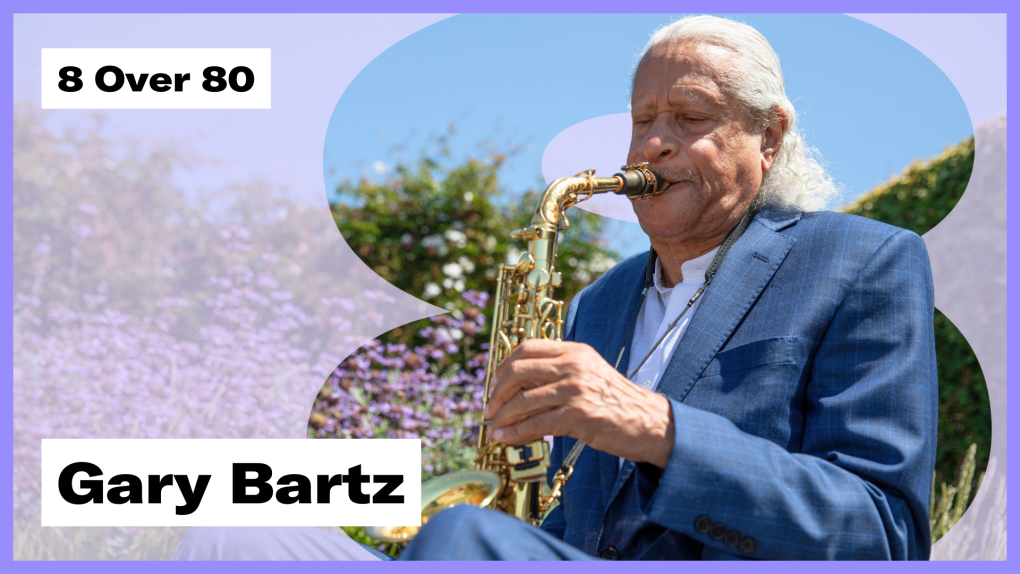
For 82-Year-Old Jazz Saxophonist Gary Bartz, ‘Music Is My Religion’
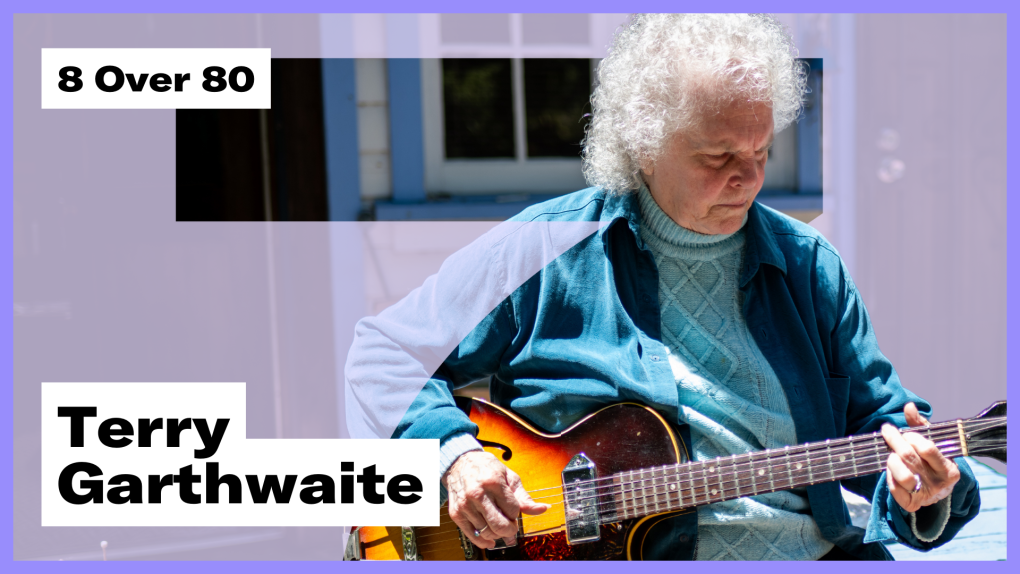
Joy of Cooking’s Terry Garthwaite Broke Barriers in Rock — and Still Refuses to Be Defined
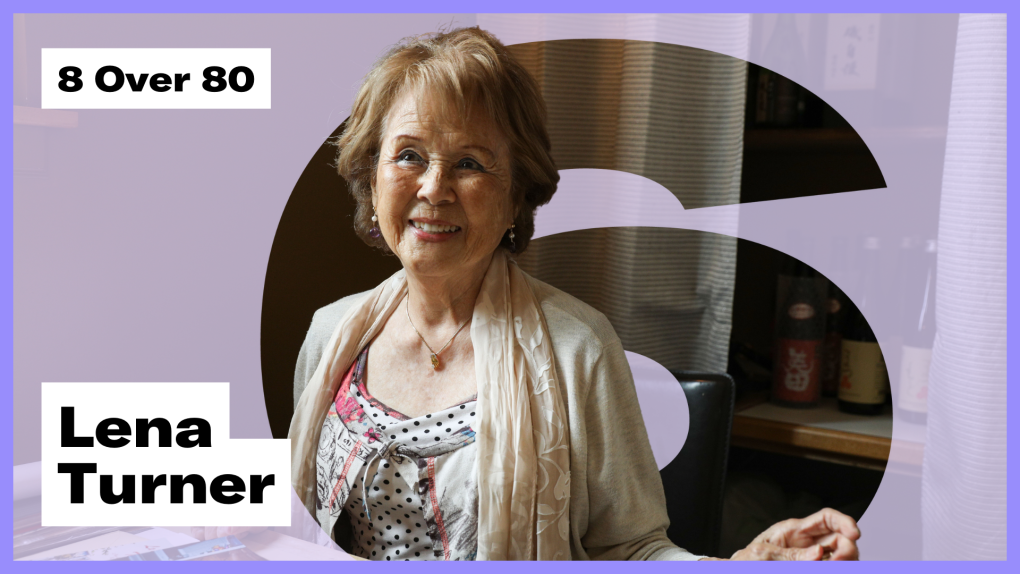
How Lena Turner, a 93-Year-Old Japantown Legend, Brought Ramen to San Francisco
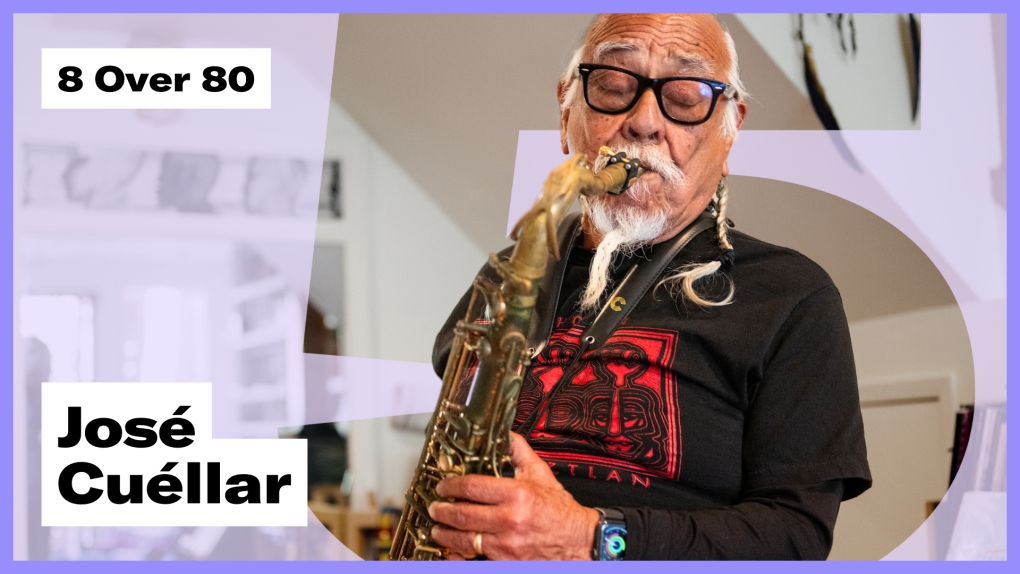
How Anthropologist José Cuéllar Became Dr. Loco, the Last Pachuco
After a Lifetime of Music and Activism, Vangie Buell’s Not Done Inspiring Others
Derek Liecty’s Life in Soccer Led to a National Championship — and Drew Him Out of the Closet
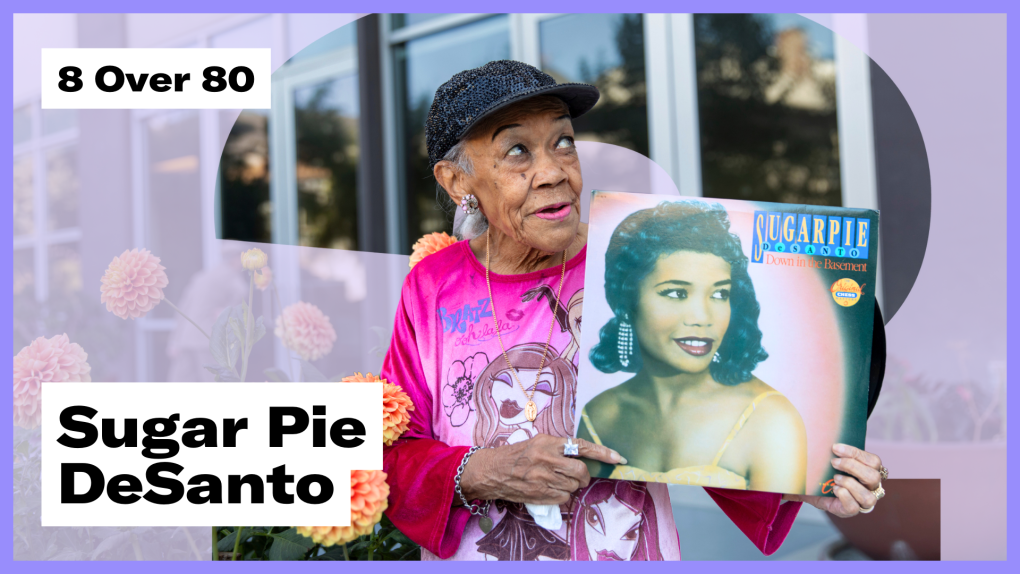
Sugar Pie DeSanto, the 87-Year-Old Firecracker of R&B, Plots Her Comeback
The Contagious Joy of Maija Peeples-Bright’s Animal-Filled World
Sponsored
Player sponsored by
window.__IS_SSR__=true
window.__INITIAL_STATE__={
"attachmentsReducer": {
"audio_0": {
"type": "attachments",
"id": "audio_0",
"imgSizes": {
"kqedFullSize": {
"file": "https://ww2.kqed.org/news/wp-content/themes/KQED-unified/img/audio_bgs/background0.jpg"
}
}
},
"audio_1": {
"type": "attachments",
"id": "audio_1",
"imgSizes": {
"kqedFullSize": {
"file": "https://ww2.kqed.org/news/wp-content/themes/KQED-unified/img/audio_bgs/background1.jpg"
}
}
},
"audio_2": {
"type": "attachments",
"id": "audio_2",
"imgSizes": {
"kqedFullSize": {
"file": "https://ww2.kqed.org/news/wp-content/themes/KQED-unified/img/audio_bgs/background2.jpg"
}
}
},
"audio_3": {
"type": "attachments",
"id": "audio_3",
"imgSizes": {
"kqedFullSize": {
"file": "https://ww2.kqed.org/news/wp-content/themes/KQED-unified/img/audio_bgs/background3.jpg"
}
}
},
"audio_4": {
"type": "attachments",
"id": "audio_4",
"imgSizes": {
"kqedFullSize": {
"file": "https://ww2.kqed.org/news/wp-content/themes/KQED-unified/img/audio_bgs/background4.jpg"
}
}
},
"placeholder": {
"type": "attachments",
"id": "placeholder",
"imgSizes": {
"thumbnail": {
"file": "https://cdn.kqed.org/wp-content/uploads/2024/12/KQED-Default-Image-816638274-2000x1333-1-160x107.jpg",
"width": 160,
"height": 107,
"mimeType": "image/jpeg"
},
"medium": {
"file": "https://cdn.kqed.org/wp-content/uploads/2024/12/KQED-Default-Image-816638274-2000x1333-1-800x533.jpg",
"width": 800,
"height": 533,
"mimeType": "image/jpeg"
},
"medium_large": {
"file": "https://cdn.kqed.org/wp-content/uploads/2024/12/KQED-Default-Image-816638274-2000x1333-1-768x512.jpg",
"width": 768,
"height": 512,
"mimeType": "image/jpeg"
},
"large": {
"file": "https://cdn.kqed.org/wp-content/uploads/2024/12/KQED-Default-Image-816638274-2000x1333-1-1020x680.jpg",
"width": 1020,
"height": 680,
"mimeType": "image/jpeg"
},
"1536x1536": {
"file": "https://cdn.kqed.org/wp-content/uploads/2024/12/KQED-Default-Image-816638274-2000x1333-1-1536x1024.jpg",
"width": 1536,
"height": 1024,
"mimeType": "image/jpeg"
},
"fd-lrg": {
"file": "https://cdn.kqed.org/wp-content/uploads/2024/12/KQED-Default-Image-816638274-2000x1333-1-1536x1024.jpg",
"width": 1536,
"height": 1024,
"mimeType": "image/jpeg"
},
"fd-med": {
"file": "https://cdn.kqed.org/wp-content/uploads/2024/12/KQED-Default-Image-816638274-2000x1333-1-1020x680.jpg",
"width": 1020,
"height": 680,
"mimeType": "image/jpeg"
},
"fd-sm": {
"file": "https://cdn.kqed.org/wp-content/uploads/2024/12/KQED-Default-Image-816638274-2000x1333-1-800x533.jpg",
"width": 800,
"height": 533,
"mimeType": "image/jpeg"
},
"post-thumbnail": {
"file": "https://cdn.kqed.org/wp-content/uploads/2024/12/KQED-Default-Image-816638274-2000x1333-1-672x372.jpg",
"width": 672,
"height": 372,
"mimeType": "image/jpeg"
},
"twentyfourteen-full-width": {
"file": "https://cdn.kqed.org/wp-content/uploads/2024/12/KQED-Default-Image-816638274-2000x1333-1-1038x576.jpg",
"width": 1038,
"height": 576,
"mimeType": "image/jpeg"
},
"xxsmall": {
"file": "https://cdn.kqed.org/wp-content/uploads/2024/12/KQED-Default-Image-816638274-2000x1333-1-160x107.jpg",
"width": 160,
"height": 107,
"mimeType": "image/jpeg"
},
"xsmall": {
"file": "https://cdn.kqed.org/wp-content/uploads/2024/12/KQED-Default-Image-816638274-2000x1333-1-672x372.jpg",
"width": 672,
"height": 372,
"mimeType": "image/jpeg"
},
"small": {
"file": "https://cdn.kqed.org/wp-content/uploads/2024/12/KQED-Default-Image-816638274-2000x1333-1-672x372.jpg",
"width": 672,
"height": 372,
"mimeType": "image/jpeg"
},
"xlarge": {
"file": "https://cdn.kqed.org/wp-content/uploads/2024/12/KQED-Default-Image-816638274-2000x1333-1-1020x680.jpg",
"width": 1020,
"height": 680,
"mimeType": "image/jpeg"
},
"full-width": {
"file": "https://cdn.kqed.org/wp-content/uploads/2024/12/KQED-Default-Image-816638274-2000x1333-1-1920x1280.jpg",
"width": 1920,
"height": 1280,
"mimeType": "image/jpeg"
},
"guest-author-32": {
"file": "https://cdn.kqed.org/wp-content/uploads/2025/01/KQED-Default-Image-816638274-1333x1333-1-160x160.jpg",
"width": 32,
"height": 32,
"mimeType": "image/jpeg"
},
"guest-author-50": {
"file": "https://cdn.kqed.org/wp-content/uploads/2025/01/KQED-Default-Image-816638274-1333x1333-1-160x160.jpg",
"width": 50,
"height": 50,
"mimeType": "image/jpeg"
},
"guest-author-64": {
"file": "https://cdn.kqed.org/wp-content/uploads/2025/01/KQED-Default-Image-816638274-1333x1333-1-160x160.jpg",
"width": 64,
"height": 64,
"mimeType": "image/jpeg"
},
"guest-author-96": {
"file": "https://cdn.kqed.org/wp-content/uploads/2025/01/KQED-Default-Image-816638274-1333x1333-1-160x160.jpg",
"width": 96,
"height": 96,
"mimeType": "image/jpeg"
},
"guest-author-128": {
"file": "https://cdn.kqed.org/wp-content/uploads/2025/01/KQED-Default-Image-816638274-1333x1333-1-160x160.jpg",
"width": 128,
"height": 128,
"mimeType": "image/jpeg"
},
"detail": {
"file": "https://cdn.kqed.org/wp-content/uploads/2025/01/KQED-Default-Image-816638274-1333x1333-1-160x160.jpg",
"width": 160,
"height": 160,
"mimeType": "image/jpeg"
},
"kqedFullSize": {
"file": "https://cdn.kqed.org/wp-content/uploads/2024/12/KQED-Default-Image-816638274-2000x1333-1.jpg",
"width": 2000,
"height": 1333
}
}
},
"arts_13935191": {
"type": "attachments",
"id": "arts_13935191",
"meta": {
"index": "attachments_1716263798",
"site": "arts",
"id": "13935191",
"found": true
},
"parent": 13935159,
"imgSizes": {
"twentyfourteen-full-width": {
"file": "https://ww2.kqed.org/app/uploads/sites/2/2023/09/8-Over-80-—-Thumbnail-1920-x-1080-1-2-1038x576.png",
"width": 1038,
"mimeType": "image/png",
"height": 576
},
"thumbnail": {
"file": "https://ww2.kqed.org/app/uploads/sites/2/2023/09/8-Over-80-—-Thumbnail-1920-x-1080-1-2-160x90.png",
"width": 160,
"mimeType": "image/png",
"height": 90
},
"post-thumbnail": {
"file": "https://ww2.kqed.org/app/uploads/sites/2/2023/09/8-Over-80-—-Thumbnail-1920-x-1080-1-2-672x372.png",
"width": 672,
"mimeType": "image/png",
"height": 372
},
"kqedFullSize": {
"file": "https://ww2.kqed.org/app/uploads/sites/2/2023/09/8-Over-80-—-Thumbnail-1920-x-1080-1-2.png",
"width": 1920,
"height": 1080
},
"large": {
"file": "https://ww2.kqed.org/app/uploads/sites/2/2023/09/8-Over-80-—-Thumbnail-1920-x-1080-1-2-1020x574.png",
"width": 1020,
"mimeType": "image/png",
"height": 574
},
"1536x1536": {
"file": "https://ww2.kqed.org/app/uploads/sites/2/2023/09/8-Over-80-—-Thumbnail-1920-x-1080-1-2-1536x864.png",
"width": 1536,
"mimeType": "image/png",
"height": 864
},
"medium": {
"file": "https://ww2.kqed.org/app/uploads/sites/2/2023/09/8-Over-80-—-Thumbnail-1920-x-1080-1-2-800x450.png",
"width": 800,
"mimeType": "image/png",
"height": 450
},
"medium_large": {
"file": "https://ww2.kqed.org/app/uploads/sites/2/2023/09/8-Over-80-—-Thumbnail-1920-x-1080-1-2-768x432.png",
"width": 768,
"mimeType": "image/png",
"height": 432
}
},
"publishDate": 1695274842,
"modified": 1695274875,
"caption": "Gary Bartz plays saxophone on the rooftop of KQED in San Francisco, Aug. 13, 2023. The recently named NEA Jazz Master has just finished recording three new projects, due to be released in 2024. ",
"description": null,
"title": "8 Over 80 — Thumbnail (1920 x 1080) (1)",
"credit": "Juliana Yamada/KQED",
"status": "inherit",
"altTag": "A man with white hair and a blue suit plays alto saxophone with foliage in the background.",
"fetchFailed": false,
"isLoading": false
},
"arts_13935187": {
"type": "attachments",
"id": "arts_13935187",
"meta": {
"index": "attachments_1716263798",
"site": "arts",
"id": "13935187",
"found": true
},
"parent": 13935159,
"imgSizes": {
"twentyfourteen-full-width": {
"file": "https://ww2.kqed.org/app/uploads/sites/2/2023/09/Bartz.Rooftop.MAIN_-1038x576.jpg",
"width": 1038,
"mimeType": "image/jpeg",
"height": 576
},
"thumbnail": {
"file": "https://ww2.kqed.org/app/uploads/sites/2/2023/09/Bartz.Rooftop.MAIN_-160x107.jpg",
"width": 160,
"mimeType": "image/jpeg",
"height": 107
},
"post-thumbnail": {
"file": "https://ww2.kqed.org/app/uploads/sites/2/2023/09/Bartz.Rooftop.MAIN_-672x372.jpg",
"width": 672,
"mimeType": "image/jpeg",
"height": 372
},
"kqedFullSize": {
"file": "https://ww2.kqed.org/app/uploads/sites/2/2023/09/Bartz.Rooftop.MAIN_.jpg",
"width": 1920,
"height": 1280
},
"large": {
"file": "https://ww2.kqed.org/app/uploads/sites/2/2023/09/Bartz.Rooftop.MAIN_-1020x680.jpg",
"width": 1020,
"mimeType": "image/jpeg",
"height": 680
},
"1536x1536": {
"file": "https://ww2.kqed.org/app/uploads/sites/2/2023/09/Bartz.Rooftop.MAIN_-1536x1024.jpg",
"width": 1536,
"mimeType": "image/jpeg",
"height": 1024
},
"medium": {
"file": "https://ww2.kqed.org/app/uploads/sites/2/2023/09/Bartz.Rooftop.MAIN_-800x533.jpg",
"width": 800,
"mimeType": "image/jpeg",
"height": 533
},
"medium_large": {
"file": "https://ww2.kqed.org/app/uploads/sites/2/2023/09/Bartz.Rooftop.MAIN_-768x512.jpg",
"width": 768,
"mimeType": "image/jpeg",
"height": 512
}
},
"publishDate": 1695269541,
"modified": 1695269658,
"caption": "Gary Bartz plays saxophone on the rooftop of KQED in San Francisco, Aug. 13, 2023. The recently named NEA Jazz Master has just finished recording three new projects, due to be released in 2024. ",
"description": null,
"title": "Bartz.Rooftop.MAIN",
"credit": "Juliana Yamada/KQED",
"status": "inherit",
"altTag": "A man with white hair and a blue suit plays alto saxophone with foliage in the background.",
"fetchFailed": false,
"isLoading": false
},
"arts_13934913": {
"type": "attachments",
"id": "arts_13934913",
"meta": {
"index": "attachments_1716263798",
"site": "arts",
"id": "13934913",
"found": true
},
"parent": 13934843,
"imgSizes": {
"twentyfourteen-full-width": {
"file": "https://ww2.kqed.org/app/uploads/sites/2/2023/09/8-Over-80-—-Thumbnail-1920-x-1080-3-1038x576.png",
"width": 1038,
"mimeType": "image/png",
"height": 576
},
"thumbnail": {
"file": "https://ww2.kqed.org/app/uploads/sites/2/2023/09/8-Over-80-—-Thumbnail-1920-x-1080-3-160x90.png",
"width": 160,
"mimeType": "image/png",
"height": 90
},
"post-thumbnail": {
"file": "https://ww2.kqed.org/app/uploads/sites/2/2023/09/8-Over-80-—-Thumbnail-1920-x-1080-3-672x372.png",
"width": 672,
"mimeType": "image/png",
"height": 372
},
"kqedFullSize": {
"file": "https://ww2.kqed.org/app/uploads/sites/2/2023/09/8-Over-80-—-Thumbnail-1920-x-1080-3.png",
"width": 1920,
"height": 1080
},
"large": {
"file": "https://ww2.kqed.org/app/uploads/sites/2/2023/09/8-Over-80-—-Thumbnail-1920-x-1080-3-1020x574.png",
"width": 1020,
"mimeType": "image/png",
"height": 574
},
"1536x1536": {
"file": "https://ww2.kqed.org/app/uploads/sites/2/2023/09/8-Over-80-—-Thumbnail-1920-x-1080-3-1536x864.png",
"width": 1536,
"mimeType": "image/png",
"height": 864
},
"medium": {
"file": "https://ww2.kqed.org/app/uploads/sites/2/2023/09/8-Over-80-—-Thumbnail-1920-x-1080-3-800x450.png",
"width": 800,
"mimeType": "image/png",
"height": 450
},
"medium_large": {
"file": "https://ww2.kqed.org/app/uploads/sites/2/2023/09/8-Over-80-—-Thumbnail-1920-x-1080-3-768x432.png",
"width": 768,
"mimeType": "image/png",
"height": 432
}
},
"publishDate": 1695075151,
"modified": 1695075235,
"caption": "Terry Garthwaite, 84, plays guitar at her home in San Geronimo on July 6, 2023.",
"description": null,
"title": "8 Over 80 — Thumbnail (1920 x 1080) (3)",
"credit": "Beth LaBerge/KQED",
"status": "inherit",
"altTag": "An older woman with white hair plays a guitar with the text \"8 Over 80\" and \"Terry Garthwaite\" overlaid",
"fetchFailed": false,
"isLoading": false
},
"arts_13934932": {
"type": "attachments",
"id": "arts_13934932",
"meta": {
"index": "attachments_1716263798",
"site": "arts",
"id": "13934932",
"found": true
},
"parent": 13934843,
"imgSizes": {
"twentyfourteen-full-width": {
"file": "https://ww2.kqed.org/app/uploads/sites/2/2023/09/230706-TerryGarthwaite-13-BL-qut-1038x576.jpg",
"width": 1038,
"mimeType": "image/jpeg",
"height": 576
},
"thumbnail": {
"file": "https://ww2.kqed.org/app/uploads/sites/2/2023/09/230706-TerryGarthwaite-13-BL-qut-160x107.jpg",
"width": 160,
"mimeType": "image/jpeg",
"height": 107
},
"post-thumbnail": {
"file": "https://ww2.kqed.org/app/uploads/sites/2/2023/09/230706-TerryGarthwaite-13-BL-qut-672x372.jpg",
"width": 672,
"mimeType": "image/jpeg",
"height": 372
},
"kqedFullSize": {
"file": "https://ww2.kqed.org/app/uploads/sites/2/2023/09/230706-TerryGarthwaite-13-BL-qut.jpg",
"width": 1920,
"height": 1280
},
"large": {
"file": "https://ww2.kqed.org/app/uploads/sites/2/2023/09/230706-TerryGarthwaite-13-BL-qut-1020x680.jpg",
"width": 1020,
"mimeType": "image/jpeg",
"height": 680
},
"1536x1536": {
"file": "https://ww2.kqed.org/app/uploads/sites/2/2023/09/230706-TerryGarthwaite-13-BL-qut-1536x1024.jpg",
"width": 1536,
"mimeType": "image/jpeg",
"height": 1024
},
"medium": {
"file": "https://ww2.kqed.org/app/uploads/sites/2/2023/09/230706-TerryGarthwaite-13-BL-qut-800x533.jpg",
"width": 800,
"mimeType": "image/jpeg",
"height": 533
},
"medium_large": {
"file": "https://ww2.kqed.org/app/uploads/sites/2/2023/09/230706-TerryGarthwaite-13-BL-qut-768x512.jpg",
"width": 768,
"mimeType": "image/jpeg",
"height": 512
}
},
"publishDate": 1695079647,
"modified": 1695150572,
"caption": "Terry Garthwaite plays guitar at her home in San Geronimo on July 6, 2023.",
"description": null,
"title": "Terry Garthwaite, 84, plays guitar at her home in San Geronimo on July 6, 2023.",
"credit": "Beth LaBerge/KQED",
"status": "inherit",
"altTag": "an older white woman with curly white hair smiles while sitting in her living room and playing guitar",
"fetchFailed": false,
"isLoading": false
},
"arts_13934892": {
"type": "attachments",
"id": "arts_13934892",
"meta": {
"index": "attachments_1716263798",
"site": "arts",
"id": "13934892",
"found": true
},
"parent": 13934852,
"imgSizes": {
"twentyfourteen-full-width": {
"file": "https://ww2.kqed.org/app/uploads/sites/2/2023/09/8-Over-80-—-Thumbnail-1920-x-1080-2-1-1038x576.png",
"width": 1038,
"mimeType": "image/png",
"height": 576
},
"thumbnail": {
"file": "https://ww2.kqed.org/app/uploads/sites/2/2023/09/8-Over-80-—-Thumbnail-1920-x-1080-2-1-160x90.png",
"width": 160,
"mimeType": "image/png",
"height": 90
},
"post-thumbnail": {
"file": "https://ww2.kqed.org/app/uploads/sites/2/2023/09/8-Over-80-—-Thumbnail-1920-x-1080-2-1-672x372.png",
"width": 672,
"mimeType": "image/png",
"height": 372
},
"kqedFullSize": {
"file": "https://ww2.kqed.org/app/uploads/sites/2/2023/09/8-Over-80-—-Thumbnail-1920-x-1080-2-1.png",
"width": 1920,
"height": 1080
},
"large": {
"file": "https://ww2.kqed.org/app/uploads/sites/2/2023/09/8-Over-80-—-Thumbnail-1920-x-1080-2-1-1020x574.png",
"width": 1020,
"mimeType": "image/png",
"height": 574
},
"1536x1536": {
"file": "https://ww2.kqed.org/app/uploads/sites/2/2023/09/8-Over-80-—-Thumbnail-1920-x-1080-2-1-1536x864.png",
"width": 1536,
"mimeType": "image/png",
"height": 864
},
"medium": {
"file": "https://ww2.kqed.org/app/uploads/sites/2/2023/09/8-Over-80-—-Thumbnail-1920-x-1080-2-1-800x450.png",
"width": 800,
"mimeType": "image/png",
"height": 450
},
"medium_large": {
"file": "https://ww2.kqed.org/app/uploads/sites/2/2023/09/8-Over-80-—-Thumbnail-1920-x-1080-2-1-768x432.png",
"width": 768,
"mimeType": "image/png",
"height": 432
}
},
"publishDate": 1695062508,
"modified": 1695069280,
"caption": "Lena Turner, 93, sits for a portrait in her now-closed restaurant, Chika and Sake. Turner has been a restauranteur in San Francisco's Japantown for almost five decades now.",
"description": null,
"title": "8 Over 80 — Thumbnail (1920 x 1080) (2)",
"credit": "Juliana Yamada/KQED",
"status": "inherit",
"altTag": "An older woman smiles while sitting at a table, the text \"8 Over 80\" and \"Lena Turner\" is overlaid",
"fetchFailed": false,
"isLoading": false
},
"arts_13934930": {
"type": "attachments",
"id": "arts_13934930",
"meta": {
"index": "attachments_1716263798",
"site": "arts",
"id": "13934930",
"found": true
},
"parent": 13934852,
"imgSizes": {
"twentyfourteen-full-width": {
"file": "https://ww2.kqed.org/app/uploads/sites/2/2023/09/20230727-LenaTurner-26-JY-qut-1038x576.jpg",
"width": 1038,
"mimeType": "image/jpeg",
"height": 576
},
"thumbnail": {
"file": "https://ww2.kqed.org/app/uploads/sites/2/2023/09/20230727-LenaTurner-26-JY-qut-160x107.jpg",
"width": 160,
"mimeType": "image/jpeg",
"height": 107
},
"post-thumbnail": {
"file": "https://ww2.kqed.org/app/uploads/sites/2/2023/09/20230727-LenaTurner-26-JY-qut-672x372.jpg",
"width": 672,
"mimeType": "image/jpeg",
"height": 372
},
"kqedFullSize": {
"file": "https://ww2.kqed.org/app/uploads/sites/2/2023/09/20230727-LenaTurner-26-JY-qut.jpg",
"width": 1920,
"height": 1280
},
"large": {
"file": "https://ww2.kqed.org/app/uploads/sites/2/2023/09/20230727-LenaTurner-26-JY-qut-1020x680.jpg",
"width": 1020,
"mimeType": "image/jpeg",
"height": 680
},
"1536x1536": {
"file": "https://ww2.kqed.org/app/uploads/sites/2/2023/09/20230727-LenaTurner-26-JY-qut-1536x1024.jpg",
"width": 1536,
"mimeType": "image/jpeg",
"height": 1024
},
"medium": {
"file": "https://ww2.kqed.org/app/uploads/sites/2/2023/09/20230727-LenaTurner-26-JY-qut-800x533.jpg",
"width": 800,
"mimeType": "image/jpeg",
"height": 533
},
"medium_large": {
"file": "https://ww2.kqed.org/app/uploads/sites/2/2023/09/20230727-LenaTurner-26-JY-qut-768x512.jpg",
"width": 768,
"mimeType": "image/jpeg",
"height": 512
}
},
"publishDate": 1695078885,
"modified": 1695079537,
"caption": "Lena Turner, 93, sits inside her now-closed restaurant, Chika & Sake. Turner has been a restauranteur in San Francisco’s Japantown for almost five decades.",
"description": null,
"title": "20230727-LenaTurner-26-JY-qut",
"credit": "Juliana Yamada/KQED",
"status": "inherit",
"altTag": "An older woman in a white shawl smiles while seated in front of a stack of old photos.",
"fetchFailed": false,
"isLoading": false
},
"arts_13934876": {
"type": "attachments",
"id": "arts_13934876",
"meta": {
"index": "attachments_1716263798",
"site": "arts",
"id": "13934876",
"found": true
},
"parent": 13934296,
"imgSizes": {
"twentyfourteen-full-width": {
"file": "https://ww2.kqed.org/app/uploads/sites/2/2023/09/8-Over-80-—-Thumbnail-1920-x-1080-2-1038x576.png",
"width": 1038,
"mimeType": "image/png",
"height": 576
},
"thumbnail": {
"file": "https://ww2.kqed.org/app/uploads/sites/2/2023/09/8-Over-80-—-Thumbnail-1920-x-1080-2-160x90.png",
"width": 160,
"mimeType": "image/png",
"height": 90
},
"post-thumbnail": {
"file": "https://ww2.kqed.org/app/uploads/sites/2/2023/09/8-Over-80-—-Thumbnail-1920-x-1080-2-672x372.png",
"width": 672,
"mimeType": "image/png",
"height": 372
},
"kqedFullSize": {
"file": "https://ww2.kqed.org/app/uploads/sites/2/2023/09/8-Over-80-—-Thumbnail-1920-x-1080-2.png",
"width": 1920,
"height": 1080
},
"large": {
"file": "https://ww2.kqed.org/app/uploads/sites/2/2023/09/8-Over-80-—-Thumbnail-1920-x-1080-2-1020x574.png",
"width": 1020,
"mimeType": "image/png",
"height": 574
},
"1536x1536": {
"file": "https://ww2.kqed.org/app/uploads/sites/2/2023/09/8-Over-80-—-Thumbnail-1920-x-1080-2-1536x864.png",
"width": 1536,
"mimeType": "image/png",
"height": 864
},
"medium": {
"file": "https://ww2.kqed.org/app/uploads/sites/2/2023/09/8-Over-80-—-Thumbnail-1920-x-1080-2-800x450.png",
"width": 800,
"mimeType": "image/png",
"height": 450
},
"medium_large": {
"file": "https://ww2.kqed.org/app/uploads/sites/2/2023/09/8-Over-80-—-Thumbnail-1920-x-1080-2-768x432.png",
"width": 768,
"mimeType": "image/png",
"height": 432
}
},
"publishDate": 1695014308,
"modified": 1695014388,
"caption": "José Cuéllar, 82, plays the saxophone at his home in San Francisco on July 21, 2023. As a professor emeritus of Chicano studies at San Francisco State University, he has led a dual career as an academic and leader of Dr. Loco’s Rockin’ Jalapeño Band.",
"description": null,
"title": "8 Over 80 — Thumbnail (1920 x 1080)",
"credit": "Beth LaBerge/KQED",
"status": "inherit",
"altTag": null,
"fetchFailed": false,
"isLoading": false
},
"arts_13934402": {
"type": "attachments",
"id": "arts_13934402",
"meta": {
"index": "attachments_1716263798",
"site": "arts",
"id": "13934402",
"found": true
},
"parent": 13934296,
"imgSizes": {
"twentyfourteen-full-width": {
"file": "https://ww2.kqed.org/app/uploads/sites/2/2023/09/RS67183_230721-JoséCuéllar8over80-06-BL_COVER-1038x576.jpg",
"width": 1038,
"mimeType": "image/jpeg",
"height": 576
},
"thumbnail": {
"file": "https://ww2.kqed.org/app/uploads/sites/2/2023/09/RS67183_230721-JoséCuéllar8over80-06-BL_COVER-160x107.jpg",
"width": 160,
"mimeType": "image/jpeg",
"height": 107
},
"post-thumbnail": {
"file": "https://ww2.kqed.org/app/uploads/sites/2/2023/09/RS67183_230721-JoséCuéllar8over80-06-BL_COVER-672x372.jpg",
"width": 672,
"mimeType": "image/jpeg",
"height": 372
},
"kqedFullSize": {
"file": "https://ww2.kqed.org/app/uploads/sites/2/2023/09/RS67183_230721-JoséCuéllar8over80-06-BL_COVER.jpg",
"width": 2000,
"height": 1333
},
"large": {
"file": "https://ww2.kqed.org/app/uploads/sites/2/2023/09/RS67183_230721-JoséCuéllar8over80-06-BL_COVER-1020x680.jpg",
"width": 1020,
"mimeType": "image/jpeg",
"height": 680
},
"1536x1536": {
"file": "https://ww2.kqed.org/app/uploads/sites/2/2023/09/RS67183_230721-JoséCuéllar8over80-06-BL_COVER-1536x1024.jpg",
"width": 1536,
"mimeType": "image/jpeg",
"height": 1024
},
"full-width": {
"file": "https://ww2.kqed.org/app/uploads/sites/2/2023/09/RS67183_230721-JoséCuéllar8over80-06-BL_COVER-1920x1280.jpg",
"width": 1920,
"mimeType": "image/jpeg",
"height": 1280
},
"medium": {
"file": "https://ww2.kqed.org/app/uploads/sites/2/2023/09/RS67183_230721-JoséCuéllar8over80-06-BL_COVER-800x533.jpg",
"width": 800,
"mimeType": "image/jpeg",
"height": 533
},
"medium_large": {
"file": "https://ww2.kqed.org/app/uploads/sites/2/2023/09/RS67183_230721-JoséCuéllar8over80-06-BL_COVER-768x512.jpg",
"width": 768,
"mimeType": "image/jpeg",
"height": 512
}
},
"publishDate": 1694042649,
"modified": 1694043959,
"caption": "José Cuéllar, 82, plays the saxophone at his home in San Francisco on July 21, 2023. As a professor emeritus of Chicano studies at San Francisco State University, he has led a dual career as an academic and leader of Dr. Loco’s Rockin’ Jalapeño Band.",
"description": null,
"title": "RS67183_230721-JoséCuéllar8over80-06-BL_COVER",
"credit": "Beth LaBerge/KQED",
"status": "inherit",
"altTag": "An older man with white braids and glasses plays a saxophone in his home",
"fetchFailed": false,
"isLoading": false
},
"arts_13934752": {
"type": "attachments",
"id": "arts_13934752",
"meta": {
"index": "attachments_1716263798",
"site": "arts",
"id": "13934752",
"found": true
},
"parent": 13934726,
"imgSizes": {
"twentyfourteen-full-width": {
"file": "https://ww2.kqed.org/app/uploads/sites/2/2023/09/8-Over-80-—-Thumbnail-1920-x-1080-1-1-1038x576.png",
"width": 1038,
"mimeType": "image/png",
"height": 576
},
"thumbnail": {
"file": "https://ww2.kqed.org/app/uploads/sites/2/2023/09/8-Over-80-—-Thumbnail-1920-x-1080-1-1-160x90.png",
"width": 160,
"mimeType": "image/png",
"height": 90
},
"post-thumbnail": {
"file": "https://ww2.kqed.org/app/uploads/sites/2/2023/09/8-Over-80-—-Thumbnail-1920-x-1080-1-1-672x372.png",
"width": 672,
"mimeType": "image/png",
"height": 372
},
"kqedFullSize": {
"file": "https://ww2.kqed.org/app/uploads/sites/2/2023/09/8-Over-80-—-Thumbnail-1920-x-1080-1-1.png",
"width": 1920,
"height": 1080
},
"large": {
"file": "https://ww2.kqed.org/app/uploads/sites/2/2023/09/8-Over-80-—-Thumbnail-1920-x-1080-1-1-1020x574.png",
"width": 1020,
"mimeType": "image/png",
"height": 574
},
"1536x1536": {
"file": "https://ww2.kqed.org/app/uploads/sites/2/2023/09/8-Over-80-—-Thumbnail-1920-x-1080-1-1-1536x864.png",
"width": 1536,
"mimeType": "image/png",
"height": 864
},
"medium": {
"file": "https://ww2.kqed.org/app/uploads/sites/2/2023/09/8-Over-80-—-Thumbnail-1920-x-1080-1-1-800x450.png",
"width": 800,
"mimeType": "image/png",
"height": 450
},
"medium_large": {
"file": "https://ww2.kqed.org/app/uploads/sites/2/2023/09/8-Over-80-—-Thumbnail-1920-x-1080-1-1-768x432.png",
"width": 768,
"mimeType": "image/png",
"height": 432
}
},
"publishDate": 1694636187,
"modified": 1694640485,
"caption": "Filipina American activist and musician Evangeline \"Vangie\" Canonizado Buell, 91, plays guitar and sings during a hootenanny she helped organize at Piedmont Gardens senior living community in Oakland on May 24, 2023, a folk music performance with residents and staff.",
"description": null,
"title": "8 Over 80 — Thumbnail (1920 x 1080) (1)",
"credit": "Beth LaBerge/KQED",
"status": "inherit",
"altTag": "An older woman in a pink shirt looks at a music stand and holds a guitar. The text \"8 over 80\" and \"Vangie Buell\" is overlaid",
"fetchFailed": false,
"isLoading": false
},
"arts_13934754": {
"type": "attachments",
"id": "arts_13934754",
"meta": {
"index": "attachments_1716263798",
"site": "arts",
"id": "13934754",
"found": true
},
"parent": 13934726,
"imgSizes": {
"twentyfourteen-full-width": {
"file": "https://ww2.kqed.org/app/uploads/sites/2/2023/09/RS66065_017_KQEDArts_MusicianVangieBuell_05242023_2000-1038x576.jpg",
"width": 1038,
"mimeType": "image/jpeg",
"height": 576
},
"thumbnail": {
"file": "https://ww2.kqed.org/app/uploads/sites/2/2023/09/RS66065_017_KQEDArts_MusicianVangieBuell_05242023_2000-160x107.jpg",
"width": 160,
"mimeType": "image/jpeg",
"height": 107
},
"post-thumbnail": {
"file": "https://ww2.kqed.org/app/uploads/sites/2/2023/09/RS66065_017_KQEDArts_MusicianVangieBuell_05242023_2000-672x372.jpg",
"width": 672,
"mimeType": "image/jpeg",
"height": 372
},
"kqedFullSize": {
"file": "https://ww2.kqed.org/app/uploads/sites/2/2023/09/RS66065_017_KQEDArts_MusicianVangieBuell_05242023_2000.jpg",
"width": 2000,
"height": 1333
},
"large": {
"file": "https://ww2.kqed.org/app/uploads/sites/2/2023/09/RS66065_017_KQEDArts_MusicianVangieBuell_05242023_2000-1020x680.jpg",
"width": 1020,
"mimeType": "image/jpeg",
"height": 680
},
"1536x1536": {
"file": "https://ww2.kqed.org/app/uploads/sites/2/2023/09/RS66065_017_KQEDArts_MusicianVangieBuell_05242023_2000-1536x1024.jpg",
"width": 1536,
"mimeType": "image/jpeg",
"height": 1024
},
"full-width": {
"file": "https://ww2.kqed.org/app/uploads/sites/2/2023/09/RS66065_017_KQEDArts_MusicianVangieBuell_05242023_2000-1920x1280.jpg",
"width": 1920,
"mimeType": "image/jpeg",
"height": 1280
},
"medium": {
"file": "https://ww2.kqed.org/app/uploads/sites/2/2023/09/RS66065_017_KQEDArts_MusicianVangieBuell_05242023_2000-800x533.jpg",
"width": 800,
"mimeType": "image/jpeg",
"height": 533
},
"medium_large": {
"file": "https://ww2.kqed.org/app/uploads/sites/2/2023/09/RS66065_017_KQEDArts_MusicianVangieBuell_05242023_2000-768x512.jpg",
"width": 768,
"mimeType": "image/jpeg",
"height": 512
}
},
"publishDate": 1694640673,
"modified": 1694640716,
"caption": "Filipina American activist and musician Evangeline \"Vangie\" Canonizado Buell, 91, plays guitar and sings during a hootenanny she helped organize at Piedmont Gardens senior living community in Oakland on May 24, 2023, a folk music performance with residents and staff.",
"description": null,
"title": "RS66065_017_KQEDArts_MusicianVangieBuell_05242023_2000",
"credit": "Beth LaBerge/KQED",
"status": "inherit",
"altTag": "An older woman in a pink shirt looks at a music stand and holds a guitar. The text \"8 over 80\" and \"Vangie Buell\" is overlaid",
"fetchFailed": false,
"isLoading": false
},
"arts_13934641": {
"type": "attachments",
"id": "arts_13934641",
"meta": {
"index": "attachments_1716263798",
"site": "arts",
"id": "13934641",
"found": true
},
"parent": 13934415,
"imgSizes": {
"twentyfourteen-full-width": {
"file": "https://ww2.kqed.org/app/uploads/sites/2/2023/09/8-Over-80-—-Thumbnail-1920-x-1080-1-1038x576.png",
"width": 1038,
"mimeType": "image/png",
"height": 576
},
"thumbnail": {
"file": "https://ww2.kqed.org/app/uploads/sites/2/2023/09/8-Over-80-—-Thumbnail-1920-x-1080-1-160x90.png",
"width": 160,
"mimeType": "image/png",
"height": 90
},
"post-thumbnail": {
"file": "https://ww2.kqed.org/app/uploads/sites/2/2023/09/8-Over-80-—-Thumbnail-1920-x-1080-1-672x372.png",
"width": 672,
"mimeType": "image/png",
"height": 372
},
"kqedFullSize": {
"file": "https://ww2.kqed.org/app/uploads/sites/2/2023/09/8-Over-80-—-Thumbnail-1920-x-1080-1.png",
"width": 1920,
"height": 1080
},
"large": {
"file": "https://ww2.kqed.org/app/uploads/sites/2/2023/09/8-Over-80-—-Thumbnail-1920-x-1080-1-1020x574.png",
"width": 1020,
"mimeType": "image/png",
"height": 574
},
"1536x1536": {
"file": "https://ww2.kqed.org/app/uploads/sites/2/2023/09/8-Over-80-—-Thumbnail-1920-x-1080-1-1536x864.png",
"width": 1536,
"mimeType": "image/png",
"height": 864
},
"medium": {
"file": "https://ww2.kqed.org/app/uploads/sites/2/2023/09/8-Over-80-—-Thumbnail-1920-x-1080-1-800x450.png",
"width": 800,
"mimeType": "image/png",
"height": 450
},
"medium_large": {
"file": "https://ww2.kqed.org/app/uploads/sites/2/2023/09/8-Over-80-—-Thumbnail-1920-x-1080-1-768x432.png",
"width": 768,
"mimeType": "image/png",
"height": 432
}
},
"publishDate": 1694542200,
"modified": 1694542318,
"caption": "Derek Liecty, former general manager of the Oakland Clippers soccer team and longtime supporter of the sport, at his home in Walnut Creek on July 13, 2023.\n",
"description": null,
"title": "8 Over 80 — Thumbnail (1920 x 1080)",
"credit": "Martin do Nascimento/KQED",
"status": "inherit",
"altTag": "An older man in a blue polo shirt looks to the right with the number 3 and the tex \"8 Over 80\" and \"Derek Liecty\" overlaid",
"fetchFailed": false,
"isLoading": false
},
"arts_13931617": {
"type": "attachments",
"id": "arts_13931617",
"meta": {
"index": "attachments_1716263798",
"site": "arts",
"id": "13931617",
"found": true
},
"parent": 13934415,
"imgSizes": {
"twentyfourteen-full-width": {
"file": "https://ww2.kqed.org/app/uploads/sites/2/2023/07/230713-DEREK-LIECTY-MHN-03-KQED-1038x576.jpg",
"width": 1038,
"mimeType": "image/jpeg",
"height": 576
},
"thumbnail": {
"file": "https://ww2.kqed.org/app/uploads/sites/2/2023/07/230713-DEREK-LIECTY-MHN-03-KQED-160x107.jpg",
"width": 160,
"mimeType": "image/jpeg",
"height": 107
},
"post-thumbnail": {
"file": "https://ww2.kqed.org/app/uploads/sites/2/2023/07/230713-DEREK-LIECTY-MHN-03-KQED-672x372.jpg",
"width": 672,
"mimeType": "image/jpeg",
"height": 372
},
"kqedFullSize": {
"file": "https://ww2.kqed.org/app/uploads/sites/2/2023/07/230713-DEREK-LIECTY-MHN-03-KQED.jpg",
"width": 2000,
"height": 1333
},
"large": {
"file": "https://ww2.kqed.org/app/uploads/sites/2/2023/07/230713-DEREK-LIECTY-MHN-03-KQED-1020x680.jpg",
"width": 1020,
"mimeType": "image/jpeg",
"height": 680
},
"1536x1536": {
"file": "https://ww2.kqed.org/app/uploads/sites/2/2023/07/230713-DEREK-LIECTY-MHN-03-KQED-1536x1024.jpg",
"width": 1536,
"mimeType": "image/jpeg",
"height": 1024
},
"full-width": {
"file": "https://ww2.kqed.org/app/uploads/sites/2/2023/07/230713-DEREK-LIECTY-MHN-03-KQED-1920x1280.jpg",
"width": 1920,
"mimeType": "image/jpeg",
"height": 1280
},
"medium": {
"file": "https://ww2.kqed.org/app/uploads/sites/2/2023/07/230713-DEREK-LIECTY-MHN-03-KQED-800x533.jpg",
"width": 800,
"mimeType": "image/jpeg",
"height": 533
},
"medium_large": {
"file": "https://ww2.kqed.org/app/uploads/sites/2/2023/07/230713-DEREK-LIECTY-MHN-03-KQED-768x512.jpg",
"width": 768,
"mimeType": "image/jpeg",
"height": 512
}
},
"publishDate": 1689290987,
"modified": 1694542490,
"caption": "Derek Liecty at his home in Walnut Creek on July 13, 2023. Liecty was the first general manager of the Oakland Clippers, a short-lived soccer team that won the National Professional Soccer League championship in 1967.",
"description": null,
"title": "Derek Liecty at his home in Walnut Creek on July 13, 2023.",
"credit": "Martin do Nascimento/KQED",
"status": "inherit",
"altTag": "An elderly man sits in a large cushioned chair looking at the camera.",
"fetchFailed": false,
"isLoading": false
},
"arts_13934614": {
"type": "attachments",
"id": "arts_13934614",
"meta": {
"index": "attachments_1716263798",
"site": "arts",
"id": "13934614",
"found": true
},
"parent": 13934476,
"imgSizes": {
"twentyfourteen-full-width": {
"file": "https://ww2.kqed.org/app/uploads/sites/2/2023/09/8-Over-80-—-SugarPieDesanto-1038x576.png",
"width": 1038,
"mimeType": "image/png",
"height": 576
},
"thumbnail": {
"file": "https://ww2.kqed.org/app/uploads/sites/2/2023/09/8-Over-80-—-SugarPieDesanto-160x90.png",
"width": 160,
"mimeType": "image/png",
"height": 90
},
"post-thumbnail": {
"file": "https://ww2.kqed.org/app/uploads/sites/2/2023/09/8-Over-80-—-SugarPieDesanto-672x372.png",
"width": 672,
"mimeType": "image/png",
"height": 372
},
"kqedFullSize": {
"file": "https://ww2.kqed.org/app/uploads/sites/2/2023/09/8-Over-80-—-SugarPieDesanto.png",
"width": 1920,
"height": 1080
},
"large": {
"file": "https://ww2.kqed.org/app/uploads/sites/2/2023/09/8-Over-80-—-SugarPieDesanto-1020x574.png",
"width": 1020,
"mimeType": "image/png",
"height": 574
},
"1536x1536": {
"file": "https://ww2.kqed.org/app/uploads/sites/2/2023/09/8-Over-80-—-SugarPieDesanto-1536x864.png",
"width": 1536,
"mimeType": "image/png",
"height": 864
},
"medium": {
"file": "https://ww2.kqed.org/app/uploads/sites/2/2023/09/8-Over-80-—-SugarPieDesanto-800x450.png",
"width": 800,
"mimeType": "image/png",
"height": 450
},
"medium_large": {
"file": "https://ww2.kqed.org/app/uploads/sites/2/2023/09/8-Over-80-—-SugarPieDesanto-768x432.png",
"width": 768,
"mimeType": "image/png",
"height": 432
}
},
"publishDate": 1694477182,
"modified": 1694477324,
"caption": "Sugar Pie DeSanto poses for a portrait with her record, 'Down in the Basement' outside her home in Oakland, Calif., on Friday, Sept. 8, 2023. DeSanto, 87, released her latest album 'Sugar’s Suite' in 2018.",
"description": null,
"title": "8 Over 80 — SugarPieDesanto",
"credit": "Beth LaBerge/KQED",
"status": "inherit",
"altTag": "An 87-year-old woman with a pink top and sequined hat poses in front of flowers with text \"8 Over 80\" and \"Sugar Pie DeSanto\" overlaid",
"fetchFailed": false,
"isLoading": false
},
"arts_13934573": {
"type": "attachments",
"id": "arts_13934573",
"meta": {
"index": "attachments_1716263798",
"site": "arts",
"id": "13934573",
"found": true
},
"parent": 13934476,
"imgSizes": {
"twentyfourteen-full-width": {
"file": "https://ww2.kqed.org/app/uploads/sites/2/2023/09/20230908-SugarPieDeSanto-02-JY-qut-1038x576.jpg",
"width": 1038,
"mimeType": "image/jpeg",
"height": 576
},
"thumbnail": {
"file": "https://ww2.kqed.org/app/uploads/sites/2/2023/09/20230908-SugarPieDeSanto-02-JY-qut-160x107.jpg",
"width": 160,
"mimeType": "image/jpeg",
"height": 107
},
"post-thumbnail": {
"file": "https://ww2.kqed.org/app/uploads/sites/2/2023/09/20230908-SugarPieDeSanto-02-JY-qut-672x372.jpg",
"width": 672,
"mimeType": "image/jpeg",
"height": 372
},
"kqedFullSize": {
"file": "https://ww2.kqed.org/app/uploads/sites/2/2023/09/20230908-SugarPieDeSanto-02-JY-qut.jpg",
"width": 1920,
"height": 1280
},
"large": {
"file": "https://ww2.kqed.org/app/uploads/sites/2/2023/09/20230908-SugarPieDeSanto-02-JY-qut-1020x680.jpg",
"width": 1020,
"mimeType": "image/jpeg",
"height": 680
},
"1536x1536": {
"file": "https://ww2.kqed.org/app/uploads/sites/2/2023/09/20230908-SugarPieDeSanto-02-JY-qut-1536x1024.jpg",
"width": 1536,
"mimeType": "image/jpeg",
"height": 1024
},
"medium": {
"file": "https://ww2.kqed.org/app/uploads/sites/2/2023/09/20230908-SugarPieDeSanto-02-JY-qut-800x533.jpg",
"width": 800,
"mimeType": "image/jpeg",
"height": 533
},
"medium_large": {
"file": "https://ww2.kqed.org/app/uploads/sites/2/2023/09/20230908-SugarPieDeSanto-02-JY-qut-768x512.jpg",
"width": 768,
"mimeType": "image/jpeg",
"height": 512
}
},
"publishDate": 1694452559,
"modified": 1694453028,
"caption": "Sugar Pie DeSanto poses for a portrait with her record, 'Down in the Basement' outside her home in Oakland, Calif., on Friday, Sept. 8, 2023. DeSanto, 87, released her latest album 'Sugar’s Suite' in 2018.",
"description": null,
"title": "20230908-SugarPieDeSanto-02-JY-qut",
"credit": "Juliana Yamada/KQED",
"status": "inherit",
"altTag": "An 87-year-old woman with a pink top and sequined hat poses in front of flowers.",
"fetchFailed": false,
"isLoading": false
},
"arts_13934540": {
"type": "attachments",
"id": "arts_13934540",
"meta": {
"index": "attachments_1716263798",
"site": "arts",
"id": "13934540",
"found": true
},
"parent": 13934441,
"imgSizes": {
"twentyfourteen-full-width": {
"file": "https://ww2.kqed.org/app/uploads/sites/2/2023/09/8-Over-80-—-Thumbnail-1920-x-1080-1038x576.png",
"width": 1038,
"mimeType": "image/png",
"height": 576
},
"thumbnail": {
"file": "https://ww2.kqed.org/app/uploads/sites/2/2023/09/8-Over-80-—-Thumbnail-1920-x-1080-160x90.png",
"width": 160,
"mimeType": "image/png",
"height": 90
},
"post-thumbnail": {
"file": "https://ww2.kqed.org/app/uploads/sites/2/2023/09/8-Over-80-—-Thumbnail-1920-x-1080-672x372.png",
"width": 672,
"mimeType": "image/png",
"height": 372
},
"kqedFullSize": {
"file": "https://ww2.kqed.org/app/uploads/sites/2/2023/09/8-Over-80-—-Thumbnail-1920-x-1080.png",
"width": 1920,
"height": 1080
},
"large": {
"file": "https://ww2.kqed.org/app/uploads/sites/2/2023/09/8-Over-80-—-Thumbnail-1920-x-1080-1020x574.png",
"width": 1020,
"mimeType": "image/png",
"height": 574
},
"1536x1536": {
"file": "https://ww2.kqed.org/app/uploads/sites/2/2023/09/8-Over-80-—-Thumbnail-1920-x-1080-1536x864.png",
"width": 1536,
"mimeType": "image/png",
"height": 864
},
"medium": {
"file": "https://ww2.kqed.org/app/uploads/sites/2/2023/09/8-Over-80-—-Thumbnail-1920-x-1080-800x450.png",
"width": 800,
"mimeType": "image/png",
"height": 450
},
"medium_large": {
"file": "https://ww2.kqed.org/app/uploads/sites/2/2023/09/8-Over-80-—-Thumbnail-1920-x-1080-768x432.png",
"width": 768,
"mimeType": "image/png",
"height": 432
}
},
"publishDate": 1694200091,
"modified": 1694200192,
"caption": "Maija Peeples-Bright, 81, paints a sculpture at her home studio in Rocklin, California on July 17, 2023.",
"description": null,
"title": "8 Over 80 — Thumbnail (1920 x 1080)",
"credit": "Photo by Beth LaBerge/KQED",
"status": "inherit",
"altTag": "An older woman in a hand-painted shirt looks down at a colorful sculpture, the text \"8 Over 80\" and \"Maija Peeples-Bright\" is overlaid",
"fetchFailed": false,
"isLoading": false
},
"arts_13934541": {
"type": "attachments",
"id": "arts_13934541",
"meta": {
"index": "attachments_1716263798",
"site": "arts",
"id": "13934541",
"found": true
},
"parent": 13934441,
"imgSizes": {
"twentyfourteen-full-width": {
"file": "https://ww2.kqed.org/app/uploads/sites/2/2023/09/230717-MaijaPeeplesBright-33-BL_2000-1038x576.jpg",
"width": 1038,
"mimeType": "image/jpeg",
"height": 576
},
"thumbnail": {
"file": "https://ww2.kqed.org/app/uploads/sites/2/2023/09/230717-MaijaPeeplesBright-33-BL_2000-160x107.jpg",
"width": 160,
"mimeType": "image/jpeg",
"height": 107
},
"post-thumbnail": {
"file": "https://ww2.kqed.org/app/uploads/sites/2/2023/09/230717-MaijaPeeplesBright-33-BL_2000-672x372.jpg",
"width": 672,
"mimeType": "image/jpeg",
"height": 372
},
"kqedFullSize": {
"file": "https://ww2.kqed.org/app/uploads/sites/2/2023/09/230717-MaijaPeeplesBright-33-BL_2000.jpg",
"width": 2000,
"height": 1333
},
"large": {
"file": "https://ww2.kqed.org/app/uploads/sites/2/2023/09/230717-MaijaPeeplesBright-33-BL_2000-1020x680.jpg",
"width": 1020,
"mimeType": "image/jpeg",
"height": 680
},
"1536x1536": {
"file": "https://ww2.kqed.org/app/uploads/sites/2/2023/09/230717-MaijaPeeplesBright-33-BL_2000-1536x1024.jpg",
"width": 1536,
"mimeType": "image/jpeg",
"height": 1024
},
"full-width": {
"file": "https://ww2.kqed.org/app/uploads/sites/2/2023/09/230717-MaijaPeeplesBright-33-BL_2000-1920x1280.jpg",
"width": 1920,
"mimeType": "image/jpeg",
"height": 1280
},
"medium": {
"file": "https://ww2.kqed.org/app/uploads/sites/2/2023/09/230717-MaijaPeeplesBright-33-BL_2000-800x533.jpg",
"width": 800,
"mimeType": "image/jpeg",
"height": 533
},
"medium_large": {
"file": "https://ww2.kqed.org/app/uploads/sites/2/2023/09/230717-MaijaPeeplesBright-33-BL_2000-768x512.jpg",
"width": 768,
"mimeType": "image/jpeg",
"height": 512
}
},
"publishDate": 1694200439,
"modified": 1694200522,
"caption": "Maija Peeples-Bright, 81, paints a sculpture in her home studio in Rocklin, California on July 17, 2023.",
"description": null,
"title": "230717-MaijaPeeplesBright-33-BL_2000",
"credit": "Beth LaBerge/KQED",
"status": "inherit",
"altTag": "An older woman in a hand-painted shirt looks down at colorful sculpture with paintings on wall behind her",
"fetchFailed": false,
"isLoading": false
}
},
"audioPlayerReducer": {
"postId": "stream_live",
"isPaused": true,
"isPlaying": false,
"pfsActive": false,
"pledgeModalIsOpen": true,
"playerDrawerIsOpen": false
},
"authorsReducer": {
"shotchkiss": {
"type": "authors",
"id": "61",
"meta": {
"index": "authors_1716337520",
"id": "61",
"found": true
},
"name": "Sarah Hotchkiss",
"firstName": "Sarah",
"lastName": "Hotchkiss",
"slug": "shotchkiss",
"email": "shotchkiss@kqed.org",
"display_author_email": true,
"staff_mastheads": [
"arts"
],
"title": "Senior Editor",
"bio": "Sarah Hotchkiss is a San Francisco \u003ca href=\"http://www.sarahhotchkiss.com\">artist\u003c/a> and arts writer. In 2019, she received the Dorothea & Leo Rabkin Foundation grant for visual art journalism and in 2020 she received a Society of Professional Journalists, Northern California award for excellence in arts and culture reporting.",
"avatar": "https://secure.gravatar.com/avatar/ca38c7f54590856cd4947d26274f8a90?s=600&d=blank&r=g",
"twitter": null,
"facebook": null,
"instagram": null,
"linkedin": null,
"sites": [
{
"site": "",
"roles": [
"editor"
]
},
{
"site": "arts",
"roles": [
"Contributor",
"administrator"
]
},
{
"site": "artschool",
"roles": [
"administrator"
]
},
{
"site": "news",
"roles": [
"editor"
]
},
{
"site": "pop",
"roles": [
"administrator"
]
},
{
"site": "bayareabites",
"roles": [
"editor"
]
},
{
"site": "spark",
"roles": [
"editor"
]
},
{
"site": "checkplease",
"roles": [
"editor"
]
}
],
"headData": {
"title": "Sarah Hotchkiss | KQED",
"description": "Senior Editor",
"ogImgSrc": "https://secure.gravatar.com/avatar/ca38c7f54590856cd4947d26274f8a90?s=600&d=blank&r=g",
"twImgSrc": "https://secure.gravatar.com/avatar/ca38c7f54590856cd4947d26274f8a90?s=600&d=blank&r=g"
},
"isLoading": false,
"link": "/author/shotchkiss"
},
"agilbert": {
"type": "authors",
"id": "86",
"meta": {
"index": "authors_1716337520",
"id": "86",
"found": true
},
"name": "Andrew Gilbert",
"firstName": "Andrew",
"lastName": "Gilbert",
"slug": "agilbert",
"email": "jazzscribe@aol.com",
"display_author_email": false,
"staff_mastheads": [],
"title": "KQED Contributor",
"bio": "A Los Angeles native based in the Berkeley area since 1996, Andrew Gilbert covers jazz, international music and dance for KQED's \u003ci>California Report, \u003c/i>the\u003ci> Mercury News\u003c/i>, \u003ci>San Francisco Chronicle\u003c/i>, \u003ci>Berkeleyside.com\u003c/i>, and other publications. He is available for weddings and bar and bat mitzvahs. #jazzscribe",
"avatar": "https://secure.gravatar.com/avatar/445e6fe4cc696bd39773e3c90f5108b6?s=600&d=blank&r=g",
"twitter": null,
"facebook": null,
"instagram": null,
"linkedin": null,
"sites": [
{
"site": "arts",
"roles": [
"Contributor",
"author"
]
},
{
"site": "news",
"roles": [
"author"
]
}
],
"headData": {
"title": "Andrew Gilbert | KQED",
"description": "KQED Contributor",
"ogImgSrc": "https://secure.gravatar.com/avatar/445e6fe4cc696bd39773e3c90f5108b6?s=600&d=blank&r=g",
"twImgSrc": "https://secure.gravatar.com/avatar/445e6fe4cc696bd39773e3c90f5108b6?s=600&d=blank&r=g"
},
"isLoading": false,
"link": "/author/agilbert"
},
"gmeline": {
"type": "authors",
"id": "185",
"meta": {
"index": "authors_1716337520",
"id": "185",
"found": true
},
"name": "Gabe Meline",
"firstName": "Gabe",
"lastName": "Meline",
"slug": "gmeline",
"email": "gmeline@kqed.org",
"display_author_email": false,
"staff_mastheads": [
"arts"
],
"title": "Senior Editor, KQED Arts & Culture",
"bio": "Gabe Meline entered journalism at age 15 making photocopied zines, and has since earned awards from the Edward R. Murrow Awards, the Society for Professional Journalists, the Online Journalism Awards, the Association of Alternative Newsweeklies and the California Newspaper Publishers Association. Prior to KQED, he was the editor of the \u003cem>North Bay Bohemian\u003c/em> and a touring musician. He lives with his wife, his daughter, and a 1964 Volvo in his hometown of Santa Rosa, CA.",
"avatar": "https://secure.gravatar.com/avatar/80e9715844c5fc3f07edac5b08973b76?s=600&d=blank&r=g",
"twitter": null,
"facebook": null,
"instagram": "gmeline",
"linkedin": null,
"sites": [
{
"site": "",
"roles": [
"editor"
]
},
{
"site": "arts",
"roles": [
"administrator"
]
},
{
"site": "artschool",
"roles": [
"editor"
]
},
{
"site": "news",
"roles": [
"author"
]
},
{
"site": "pop",
"roles": [
"editor"
]
},
{
"site": "bayareabites",
"roles": [
"editor"
]
},
{
"site": "food",
"roles": [
"editor"
]
},
{
"site": "liveblog",
"roles": [
"editor"
]
},
{
"site": "hiphop",
"roles": [
"editor"
]
}
],
"headData": {
"title": "Gabe Meline | KQED",
"description": "Senior Editor, KQED Arts & Culture",
"ogImgSrc": "https://secure.gravatar.com/avatar/80e9715844c5fc3f07edac5b08973b76?s=600&d=blank&r=g",
"twImgSrc": "https://secure.gravatar.com/avatar/80e9715844c5fc3f07edac5b08973b76?s=600&d=blank&r=g"
},
"isLoading": false,
"link": "/author/gmeline"
},
"esilvers": {
"type": "authors",
"id": "7237",
"meta": {
"index": "authors_1716337520",
"id": "7237",
"found": true
},
"name": "Emma Silvers",
"firstName": "Emma",
"lastName": "Silvers",
"slug": "esilvers",
"email": "esilvers@kqed.org",
"display_author_email": false,
"staff_mastheads": [],
"title": "KQED Contributor",
"bio": "Emma Silvers is an editor at KQED Arts and a former digital producer at KQED News. Born and raised in the Bay Area, she has previously been an arts and entertainment editor at the \u003cem>San Francisco Chronicle\u003c/em>, \u003cem>SF Weekly\u003c/em> and the \u003cem>San Francisco Bay Guardian.\u003c/em> \u003ca href=\"https://www.emmasilvers.com\">Her work\u003c/a> has also appeared in \u003cem>Rolling Stone\u003c/em>, Pitchfork and \u003cem>Mother Jones\u003c/em>. In 2017 she was the recipient of the Society of Professional Journalists-Northern California's award for arts and culture reporting. In 1993 she \u003ca href=\"https://www.kqed.org/pop/16759/wait-what-my-coworker-was-a-voice-over-hyperventilator-for-jurassic-park\">hyperventilated in \u003cem>Jurassic Park\u003c/em>\u003c/a>.",
"avatar": "https://secure.gravatar.com/avatar/247beada39b88ea5759db1f51dba05cf?s=600&d=blank&r=g",
"twitter": "emmaruthless",
"facebook": null,
"instagram": null,
"linkedin": null,
"sites": [
{
"site": "arts",
"roles": [
"editor"
]
},
{
"site": "news",
"roles": [
"editor"
]
},
{
"site": "pop",
"roles": [
"contributor"
]
},
{
"site": "bayareabites",
"roles": [
"editor"
]
},
{
"site": "food",
"roles": [
"contributor"
]
},
{
"site": "liveblog",
"roles": [
"editor"
]
}
],
"headData": {
"title": "Emma Silvers | KQED",
"description": "KQED Contributor",
"ogImgSrc": "https://secure.gravatar.com/avatar/247beada39b88ea5759db1f51dba05cf?s=600&d=blank&r=g",
"twImgSrc": "https://secure.gravatar.com/avatar/247beada39b88ea5759db1f51dba05cf?s=600&d=blank&r=g"
},
"isLoading": false,
"link": "/author/esilvers"
},
"nvoynovskaya": {
"type": "authors",
"id": "11387",
"meta": {
"index": "authors_1716337520",
"id": "11387",
"found": true
},
"name": "Nastia Voynovskaya",
"firstName": "Nastia",
"lastName": "Voynovskaya",
"slug": "nvoynovskaya",
"email": "nvoynovskaya@kqed.org",
"display_author_email": false,
"staff_mastheads": [
"arts"
],
"title": "Editor and reporter",
"bio": "Nastia Voynovskaya is a reporter and editor at KQED Arts & Culture. She's been covering the arts in the Bay Area for over a decade, with a focus on music, queer culture, labor issues and grassroots organizing. She has edited KQED story series such as Trans Bay: A History of San Francisco's Gender-Diverse Community, and co-created KQED's Bay Area hip-hop history project, That's My Word. Nastia's work has been recognized by the Society of Professional Journalists and San Francisco Press Club. She holds a BA in comparative literature from UC Berkeley.",
"avatar": "https://secure.gravatar.com/avatar/310649817772dd2a98e5dfecb6b24842?s=600&d=blank&r=g",
"twitter": null,
"facebook": null,
"instagram": "https://www.instagram.com/nananastia/",
"linkedin": null,
"sites": [
{
"site": "arts",
"roles": [
"administrator"
]
},
{
"site": "news",
"roles": [
"editor"
]
},
{
"site": "pop",
"roles": [
"administrator"
]
},
{
"site": "bayareabites",
"roles": [
"editor"
]
},
{
"site": "podcasts",
"roles": [
"editor"
]
},
{
"site": "hiphop",
"roles": [
"editor"
]
}
],
"headData": {
"title": "Nastia Voynovskaya | KQED",
"description": "Editor and reporter",
"ogImgSrc": "https://secure.gravatar.com/avatar/310649817772dd2a98e5dfecb6b24842?s=600&d=blank&r=g",
"twImgSrc": "https://secure.gravatar.com/avatar/310649817772dd2a98e5dfecb6b24842?s=600&d=blank&r=g"
},
"isLoading": false,
"link": "/author/nvoynovskaya"
},
"ltsai": {
"type": "authors",
"id": "11743",
"meta": {
"index": "authors_1716337520",
"id": "11743",
"found": true
},
"name": "Luke Tsai",
"firstName": "Luke",
"lastName": "Tsai",
"slug": "ltsai",
"email": "ltsai@kqed.org",
"display_author_email": true,
"staff_mastheads": [
"arts"
],
"title": "Food Editor",
"bio": "Luke Tsai is KQED's food editor and resident stinky tofu connoisseur. Prior to KQED, he was an editor at Eater SF, \u003cem>San Francisco \u003c/em>magazine, and the \u003cem>East Bay Express\u003c/em>, and his work has also appeared in TASTE, the \u003cem>San Francisco Chronicle\u003c/em>, and the \u003cem>Best Food Writing\u003c/em> anthology. When he isn't writing or editing, you'll find him eating most everything he can get his hands on.",
"avatar": "https://secure.gravatar.com/avatar/d1ff591a3047b143a0e23cf7f28fcac0?s=600&d=blank&r=g",
"twitter": "theluketsai",
"facebook": null,
"instagram": null,
"linkedin": null,
"sites": [
{
"site": "",
"roles": [
"editor"
]
},
{
"site": "arts",
"roles": [
"administrator"
]
},
{
"site": "bayareabites",
"roles": [
"editor"
]
},
{
"site": "food",
"roles": [
"editor"
]
}
],
"headData": {
"title": "Luke Tsai | KQED",
"description": "Food Editor",
"ogImgSrc": "https://secure.gravatar.com/avatar/d1ff591a3047b143a0e23cf7f28fcac0?s=600&d=blank&r=g",
"twImgSrc": "https://secure.gravatar.com/avatar/d1ff591a3047b143a0e23cf7f28fcac0?s=600&d=blank&r=g"
},
"isLoading": false,
"link": "/author/ltsai"
},
"achazaro": {
"type": "authors",
"id": "11748",
"meta": {
"index": "authors_1716337520",
"id": "11748",
"found": true
},
"name": "Alan Chazaro",
"firstName": "Alan",
"lastName": "Chazaro",
"slug": "achazaro",
"email": "agchazaro@gmail.com",
"display_author_email": true,
"staff_mastheads": [],
"title": "Food Writer and Reporter",
"bio": "Alan Chazaro is the author of \u003cem>This Is Not a Frank Ocean Cover Album\u003c/em> (Black Lawrence Press, 2019), \u003cem>Piñata Theory\u003c/em> (Black Lawrence Press, 2020), and \u003cem>Notes from the Eastern Span of the Bay Bridge\u003c/em> (Ghost City Press, 2021). He is a graduate of June Jordan’s Poetry for the People program at UC Berkeley and a former Lawrence Ferlinghetti Fellow at the University of San Francisco. He writes about sports, food, art, music, education, and culture while repping the Bay on \u003ca href=\"https://twitter.com/alan_chazaro\">Twitter\u003c/a> and \u003ca href=\"https://www.instagram.com/alan_chazaro/?hl=en\">Instagram\u003c/a> at @alan_chazaro.",
"avatar": "https://secure.gravatar.com/avatar/ea8b6dd970fc5c29e7a188e7d5861df7?s=600&d=blank&r=g",
"twitter": "alan_chazaro",
"facebook": null,
"instagram": null,
"linkedin": null,
"sites": [
{
"site": "arts",
"roles": [
"contributor"
]
},
{
"site": "news",
"roles": [
"editor"
]
}
],
"headData": {
"title": "Alan Chazaro | KQED",
"description": "Food Writer and Reporter",
"ogImgSrc": "https://secure.gravatar.com/avatar/ea8b6dd970fc5c29e7a188e7d5861df7?s=600&d=blank&r=g",
"twImgSrc": "https://secure.gravatar.com/avatar/ea8b6dd970fc5c29e7a188e7d5861df7?s=600&d=blank&r=g"
},
"isLoading": false,
"link": "/author/achazaro"
},
"rockyrivera": {
"type": "authors",
"id": "11846",
"meta": {
"index": "authors_1716337520",
"id": "11846",
"found": true
},
"name": "Rocky Rivera",
"firstName": "Rocky",
"lastName": "Rivera",
"slug": "rockyrivera",
"email": "ms.rocky.rivera@gmail.com",
"display_author_email": false,
"staff_mastheads": [],
"title": "KQED Contributor",
"bio": "Rocky Rivera is a journalist, emcee, author and activist from San Francisco. She has released four albums through her label, Beatrock Music, and a ten-volume mixtape series with DJ Roza. She released her first book in 2021, entitled \u003cem>Snakeskin: Essays by Rocky Rivera\u003c/em>. Her latest album dropped in September 2024 and is called \"Long Kiss Goodnight\" with emcee/producer Otayo Dubb. She currently writes the Frisco Foodies column as a love letter to her hometown.",
"avatar": "https://secure.gravatar.com/avatar/946241ee2c59e6040607dfc75240d91b?s=600&d=blank&r=g",
"twitter": null,
"facebook": "https://m.facebook.com/rockyriveramusic",
"instagram": "https://instagram.com/rockyrivera",
"linkedin": "https://www.linkedin.com/in/krishtinedeleon/",
"sites": [
{
"site": "arts",
"roles": [
"author"
]
}
],
"headData": {
"title": "Rocky Rivera | KQED",
"description": "KQED Contributor",
"ogImgSrc": "https://secure.gravatar.com/avatar/946241ee2c59e6040607dfc75240d91b?s=600&d=blank&r=g",
"twImgSrc": "https://secure.gravatar.com/avatar/946241ee2c59e6040607dfc75240d91b?s=600&d=blank&r=g"
},
"isLoading": false,
"link": "/author/rockyrivera"
}
},
"breakingNewsReducer": {},
"pagesReducer": {},
"postsReducer": {
"stream_live": {
"type": "live",
"id": "stream_live",
"audioUrl": "https://streams.kqed.org/kqedradio",
"title": "Live Stream",
"excerpt": "Live Stream information currently unavailable.",
"link": "/radio",
"featImg": "",
"label": {
"name": "KQED Live",
"link": "/"
}
},
"stream_kqedNewscast": {
"type": "posts",
"id": "stream_kqedNewscast",
"audioUrl": "https://www.kqed.org/.stream/anon/radio/RDnews/newscast.mp3?_=1",
"title": "KQED Newscast",
"featImg": "",
"label": {
"name": "88.5 FM",
"link": "/"
}
},
"arts_13935159": {
"type": "posts",
"id": "arts_13935159",
"meta": {
"index": "posts_1716263798",
"site": "arts",
"id": "13935159",
"score": null,
"sort": [
1695304817000
]
},
"guestAuthors": [],
"slug": "8-over-80-gary-bartz",
"title": "For 82-Year-Old Jazz Saxophonist Gary Bartz, ‘Music Is My Religion’",
"publishDate": 1695304817,
"format": "aside",
"headTitle": "For 82-Year-Old Jazz Saxophonist Gary Bartz, ‘Music Is My Religion’ | KQED",
"labelTerm": {},
"content": "\u003cfigure id=\"attachment_13935187\" class=\"wp-caption aligncenter\" style=\"max-width: 1920px\">\u003cimg loading=\"lazy\" decoding=\"async\" class=\"size-full wp-image-13935187\" src=\"https://ww2.kqed.org/app/uploads/sites/2/2023/09/Bartz.Rooftop.MAIN_.jpg\" alt=\"A man with white hair and a blue suit plays alto saxophone with foliage in the background.\" width=\"1920\" height=\"1280\" srcset=\"https://cdn.kqed.org/wp-content/uploads/sites/2/2023/09/Bartz.Rooftop.MAIN_.jpg 1920w, https://cdn.kqed.org/wp-content/uploads/sites/2/2023/09/Bartz.Rooftop.MAIN_-800x533.jpg 800w, https://cdn.kqed.org/wp-content/uploads/sites/2/2023/09/Bartz.Rooftop.MAIN_-1020x680.jpg 1020w, https://cdn.kqed.org/wp-content/uploads/sites/2/2023/09/Bartz.Rooftop.MAIN_-160x107.jpg 160w, https://cdn.kqed.org/wp-content/uploads/sites/2/2023/09/Bartz.Rooftop.MAIN_-768x512.jpg 768w, https://cdn.kqed.org/wp-content/uploads/sites/2/2023/09/Bartz.Rooftop.MAIN_-1536x1024.jpg 1536w\" sizes=\"(max-width: 1920px) 100vw, 1920px\">\u003cfigcaption class=\"wp-caption-text\">Gary Bartz plays saxophone on the rooftop of KQED in San Francisco, Aug. 13, 2023. The recently named NEA Jazz Master has just finished recording three new projects, due to be released in 2024. \u003ccite>(Juliana Yamada/KQED)\u003c/cite>\u003c/figcaption>\u003c/figure>\n\u003cp>\u003ci>This story is part of the series \u003ca href=\"http://kqed.org/8over80\">8 Over 80\u003c/a>, celebrating artists and cultural figures over the age of 80 who continue to shape the greater Bay Area.\u003c/i>\u003c/p>\n\u003cp>[dropcap]G[/dropcap]ary Bartz wants to go to the playground. Walking along 17th Street in San Francisco, he spies a swing set in Franklin Square and clambers up the park stairs, carrying his saxophone.\u003c/p>\n\u003cp>In his 82 years, Bartz has released dozens of albums under his own name, and hundreds more as a sideman. He’s performed thousands of concerts with jazz luminaries like Miles Davis, Pharoah Sanders and Art Blakey, all over the globe. In August, three weeks before we meet, the \u003ca href=\"https://www.npr.org/2023/07/12/1187199875/nea-jazz-masters\">NEA named him a 2024 Jazz Master\u003c/a>, a prestigious national honor.\u003c/p>\n\u003cp>But today, he’s just returned from a marathon three-week recording session in Los Angeles, and he’s ready to unwind. At the playground, he hops on a swing, throws his head back with a wide smile and starts singing: “Fairy tales can come true / It can happen to you / If you’re young at heart…”\u003c/p>\n\u003cp>The passage of time, this inevitable thing that might nag at other octogenarians, comes to a halt. For a moment, singing of love and life and dreams, Bartz is a kid again, transported back to his childhood in Baltimore. When he reaches the end of the song, he stands up, brushes the dirt from the swing’s chains off his hands, and asks out loud to no one in particular:\u003c/p>\n\u003cp>“Who’s 82 \u003cem>now\u003c/em>?!”\u003c/p>\n\u003cfigure id=\"attachment_13933561\" class=\"wp-caption aligncenter\" style=\"max-width: 2000px\">\u003cimg loading=\"lazy\" decoding=\"async\" class=\"size-full wp-image-13933561\" src=\"https://ww2.kqed.org/app/uploads/sites/2/2023/08/RS68139_20230818-GaryBartz-23-JY-KQED.jpg\" alt=\"Gary Bartz swings at the playground at Franklin Square in San Francisco\" width=\"2000\" height=\"1333\" srcset=\"https://cdn.kqed.org/wp-content/uploads/sites/2/2023/08/RS68139_20230818-GaryBartz-23-JY-KQED.jpg 2000w, https://cdn.kqed.org/wp-content/uploads/sites/2/2023/08/RS68139_20230818-GaryBartz-23-JY-KQED-800x533.jpg 800w, https://cdn.kqed.org/wp-content/uploads/sites/2/2023/08/RS68139_20230818-GaryBartz-23-JY-KQED-1020x680.jpg 1020w, https://cdn.kqed.org/wp-content/uploads/sites/2/2023/08/RS68139_20230818-GaryBartz-23-JY-KQED-160x107.jpg 160w, https://cdn.kqed.org/wp-content/uploads/sites/2/2023/08/RS68139_20230818-GaryBartz-23-JY-KQED-768x512.jpg 768w, https://cdn.kqed.org/wp-content/uploads/sites/2/2023/08/RS68139_20230818-GaryBartz-23-JY-KQED-1536x1024.jpg 1536w, https://cdn.kqed.org/wp-content/uploads/sites/2/2023/08/RS68139_20230818-GaryBartz-23-JY-KQED-1920x1280.jpg 1920w\" sizes=\"(max-width: 2000px) 100vw, 2000px\">\u003cfigcaption class=\"wp-caption-text\">Gary Bartz swings at the playground at San Francisco’s Franklin Square. \u003ccite>(Juliana Yamada/KQED)\u003c/cite>\u003c/figcaption>\u003c/figure>\n\u003cp>There may be a reason for Bartz’s carefree mood these days. In addition to the NEA honor, which comes with a $25,000 grant, his music is undergoing a renaissance among younger listeners. Part of it is his recent collaboration with Adrian Younge and Ali Shaheed Muhammad (from A Tribe Called Quest) in their \u003cem>Jazz Is Dead\u003c/em> series, which introduced Bartz to a new audience amidst a growing crossover of jazz and hip-hop.\u003c/p>\n\u003cp>But mainly, it’s that Bartz has always made music that reflects the emotional, spiritual and political realms of the world. Everyone else is just catching up, is all.\u003c/p>\n\u003cp>[ad fullwidth]\u003c/p>\n\u003ch2>‘Spontaneous composition’ in the Bay Area\u003c/h2>\n\u003cp>For a college professor — he’s taught at Oberlin for over two decades — Bartz is quicker to admit what he doesn’t know than what he does. He says he can’t define love, exactly. He doesn’t know what happens to us in the afterlife, only that man-made religions exist to console those who refuse to see reality. As for music, this thing he’s spent his life studying, “we don’t know where it comes from, and we don’t know where it goes.”\u003c/p>\n\u003cp>He does know about the things he can control, though. On his days at home, Bartz sometimes runs or bikes around Lake Merritt or Lafayette Reservoir. He tries to stay on his diet, and listens to Frank Sinatra “about every day.” Most of the time, he practices his horn: running through his compositions, or spontaneously creating new ones. Other people, he says, foolishly call it “improvising.”\u003c/p>\n\u003cp>“But we’re not improvising. We’re composing, all the time,” he says about soloing. “Improvising means you’re making stuff up. You don’t study something for 50 years just to go make stuff up.”\u003c/p>\n\u003cfigure id=\"attachment_13933558\" class=\"wp-caption aligncenter\" style=\"max-width: 2000px\">\u003cimg loading=\"lazy\" decoding=\"async\" class=\"size-full wp-image-13933558\" src=\"https://ww2.kqed.org/app/uploads/sites/2/2023/08/RS68119_20230818-GaryBartz-04-JY-KQED.jpg\" alt=\"Gary Bartz poses for a portrait with his saxophone\" width=\"2000\" height=\"1333\" srcset=\"https://cdn.kqed.org/wp-content/uploads/sites/2/2023/08/RS68119_20230818-GaryBartz-04-JY-KQED.jpg 2000w, https://cdn.kqed.org/wp-content/uploads/sites/2/2023/08/RS68119_20230818-GaryBartz-04-JY-KQED-800x533.jpg 800w, https://cdn.kqed.org/wp-content/uploads/sites/2/2023/08/RS68119_20230818-GaryBartz-04-JY-KQED-1020x680.jpg 1020w, https://cdn.kqed.org/wp-content/uploads/sites/2/2023/08/RS68119_20230818-GaryBartz-04-JY-KQED-160x107.jpg 160w, https://cdn.kqed.org/wp-content/uploads/sites/2/2023/08/RS68119_20230818-GaryBartz-04-JY-KQED-768x512.jpg 768w, https://cdn.kqed.org/wp-content/uploads/sites/2/2023/08/RS68119_20230818-GaryBartz-04-JY-KQED-1536x1024.jpg 1536w, https://cdn.kqed.org/wp-content/uploads/sites/2/2023/08/RS68119_20230818-GaryBartz-04-JY-KQED-1920x1280.jpg 1920w\" sizes=\"(max-width: 2000px) 100vw, 2000px\">\u003cfigcaption class=\"wp-caption-text\">Gary Bartz poses for a portrait with his saxophone at KQED. \u003ccite>(Juliana Yamada/KQED)\u003c/cite>\u003c/figcaption>\u003c/figure>\n\u003cp>In those 50 years, Bartz kept being drawn to the Bay Area. He closed out the final show at the old Yoshi’s in North Oakland, appeared regularly at the Keystone Korner in San Francisco, and recorded prolifically at Fantasy Studios in Berkeley. He even tells a story of crossing paths with Bob Marley at a live radio broadcast session in Sausalito. “There’s so much great music that has come out of here,” he says. “It’s always been a very fertile place for me.”\u003c/p>\n\u003cp>Six years ago, Bartz moved to a house on the border of Oakland and Emeryville to be closer to family. He admits to a touch of nomadism, suggesting he may not stay forever. But in his time living in the Bay Area, he’s become part of the scene on major stages like the Kuumbwa Jazz Center and the San Jose Jazz Festival.\u003c/p>\n\u003cp>[aside tag='8over80' label='More 8 Over 80']At the SFJAZZ Center in January, Bartz appeared at a tribute to the late pianist McCoy Tyner, in whose band he performed for many years. (“He was composing music at the highest level,” Bartz says.) On tunes like “Contemplation,” Bartz soloed on stage — or rather, spontaneously composed — with more imagination, technique and spirit than many musicians half his age.\u003c/p>\n\u003cp>In June of this year, Bartz again paid tribute to a recently departed friend, who he calls “my brother”: the saxophone giant Pharoah Sanders. At the Healdsburg Jazz Festival, Bartz performed Sanders landmarks like “The Creator Has a Master Plan,” and stepped to the microphone to sing the pensive “Colors,” with its poetic lyrics about pushing aside the misery of life, and inviting happiness and joy.\u003c/p>\n\u003ch2>Hearing the future\u003c/h2>\n\u003cp>Bartz was just six when he heard Charlie Parker for the first time, and “it was the most beautiful thing I’d ever heard,” he says. He remembers thinking to himself: \u003cem>that’s what I want to do with my life\u003c/em>.\u003c/p>\n\u003cp>Five years later, during which he listened studiously to the jazz greats of the day, his parents bought him an alto saxophone. (His life goal was aided by the fact that his father, Floyd, ran a jazz club in Baltimore.) After attending Juilliard, he packed off to New York, where he hooked up with jazz drum giant Max Roach and, at age 24, joined Art Blakey’s Jazz Messengers. While stringing gigs together, he sometimes slept on the subway.\u003c/p>\n\u003cfigure id=\"attachment_13933560\" class=\"wp-caption aligncenter\" style=\"max-width: 2000px\">\u003cimg loading=\"lazy\" decoding=\"async\" class=\"size-full wp-image-13933560\" src=\"https://ww2.kqed.org/app/uploads/sites/2/2023/08/RS68136_20230818-GaryBartz-21-JY-KQED.jpg\" alt=\"A man in a blue suit looks determinedly into the camera\" width=\"2000\" height=\"1333\" srcset=\"https://cdn.kqed.org/wp-content/uploads/sites/2/2023/08/RS68136_20230818-GaryBartz-21-JY-KQED.jpg 2000w, https://cdn.kqed.org/wp-content/uploads/sites/2/2023/08/RS68136_20230818-GaryBartz-21-JY-KQED-800x533.jpg 800w, https://cdn.kqed.org/wp-content/uploads/sites/2/2023/08/RS68136_20230818-GaryBartz-21-JY-KQED-1020x680.jpg 1020w, https://cdn.kqed.org/wp-content/uploads/sites/2/2023/08/RS68136_20230818-GaryBartz-21-JY-KQED-160x107.jpg 160w, https://cdn.kqed.org/wp-content/uploads/sites/2/2023/08/RS68136_20230818-GaryBartz-21-JY-KQED-768x512.jpg 768w, https://cdn.kqed.org/wp-content/uploads/sites/2/2023/08/RS68136_20230818-GaryBartz-21-JY-KQED-1536x1024.jpg 1536w, https://cdn.kqed.org/wp-content/uploads/sites/2/2023/08/RS68136_20230818-GaryBartz-21-JY-KQED-1920x1280.jpg 1920w\" sizes=\"(max-width: 2000px) 100vw, 2000px\">\u003cfigcaption class=\"wp-caption-text\">Gary Bartz poses for a portrait on San Francisco’s Bryant Street. \u003ccite>(Juliana Yamada/KQED)\u003c/cite>\u003c/figcaption>\u003c/figure>\n\u003cp>By the time Miles Davis asked Bartz to join his band, in 1970, he’d already played with the likes of Charles Mingus, Roy Ayers, Eric Dolphy and Woody Shaw. But his time with Miles, captured on records like \u003cem>Live-Evil\u003c/em> and \u003cem>The Cellar Door Sessions\u003c/em>, was an experience like no other.\u003c/p>\n\u003cp>“Miles could hear the future,” Bartz says. “That’s the job of any artist, to be able to see or hear the future. Something that’s never been heard before. That’s what we’re all looking for.”\u003c/p>\n\u003cp>[aside postID='arts_13927947']Listening to Bartz’s own albums from the early 1970s, one gets a glimpse of his version of the future. On 1971’s \u003cem>Harlem Bush Music—Uhuru\u003c/em>, made with his group NTU Troop, blues and ramshackle proto-funk mix with avant-garde jazz and the music of Central and West Africa. Lyrics sung plainly by either Bartz or vocalist Andy Bey cover topics like Vietnam (“Vietcong”), life in the cosmos (“Celestial Blues”), conscientious objection to war (“Uhuru Sasa”), and the emotional abrasion of being Black in America (“Blue (A Folk Tale)”).\u003c/p>\n\u003cp>At the same time, Bartz also conveyed a playful side, as heard on the later tracks “Whasaname” and “Dozens (The Sounding Song),” which refers to the \u003ca href=\"https://www.elijahwald.com/dozens.html\">one-upping game of insults\u003c/a> which strongly influenced early hip-hop. (Rap is often a dividing line among generations, but Bartz understood it immediately: “When they asked Rakim where he got his flow, he said ‘I got my flow from listening to John Coltrane.’ So that should tell you something right there.”)\u003c/p>\n\u003cp>Bartz has also drawn on the words of poets, like Paul Laurence Dunbar for “\u003ca href=\"https://youtu.be/5uYVxQKLtVc?si=xYZq7titrr5KPQL0&t=1795\">Parted\u003c/a>,” and Langston Hughes for the rhythmic, reflective “\u003ca href=\"https://www.youtube.com/watch?v=l9WCFQzznC4\">I’ve Known Rivers\u003c/a>.” The latter is a highlight in Bartz’s catalog, and an ode to a community of people that spans the Congo to the Mississippi. Its final line is a meditation on age and experience: “My soul has grown deep like the rivers.”\u003c/p>\n\u003cp>https://www.youtube.com/watch?v=l9WCFQzznC4\u003c/p>\n\u003cp> \u003c/p>\n\u003cp>The world is still catching up to Gary Bartz, but to write so soulfully, so young, I gather Bartz was also catching up to himself. He first recorded “I’ve Known Rivers” in France when he was 33 years old. Almost 50 years later, after living in New York, Italy, Spain, and Los Angeles, I ask how he views modern-day America.\u003c/p>\n\u003cp>“Well, our laws are based on a false premise, which is that color of your skin makes a race. That’s a dumb premise,” he says. “There’s only one human race. I mean, I’ve never seen a different one. Little kids know it. They have to be taught different, either on purpose, or just by society. I found out by growing up in a segregated city.”\u003c/p>\n\u003cp>With so much lived experience, I wonder: Does he feel 82?\u003c/p>\n\u003cp>“Physically, I do, sometimes,” Bartz says. “Mentally, I see myself the same as I’ve always seen myself. But when I look in the mirror, I say, ‘Who is he?’”\u003c/p>\n\u003cfigure id=\"attachment_13933559\" class=\"wp-caption aligncenter\" style=\"max-width: 2000px\">\u003cimg loading=\"lazy\" decoding=\"async\" class=\"size-full wp-image-13933559\" src=\"https://ww2.kqed.org/app/uploads/sites/2/2023/08/RS68129_20230818-GaryBartz-13-JY-KQED.jpg\" alt=\"Gary Bartz plays his saxophone on the rooftop of KQED\" width=\"2000\" height=\"1333\" srcset=\"https://cdn.kqed.org/wp-content/uploads/sites/2/2023/08/RS68129_20230818-GaryBartz-13-JY-KQED.jpg 2000w, https://cdn.kqed.org/wp-content/uploads/sites/2/2023/08/RS68129_20230818-GaryBartz-13-JY-KQED-800x533.jpg 800w, https://cdn.kqed.org/wp-content/uploads/sites/2/2023/08/RS68129_20230818-GaryBartz-13-JY-KQED-1020x680.jpg 1020w, https://cdn.kqed.org/wp-content/uploads/sites/2/2023/08/RS68129_20230818-GaryBartz-13-JY-KQED-160x107.jpg 160w, https://cdn.kqed.org/wp-content/uploads/sites/2/2023/08/RS68129_20230818-GaryBartz-13-JY-KQED-768x512.jpg 768w, https://cdn.kqed.org/wp-content/uploads/sites/2/2023/08/RS68129_20230818-GaryBartz-13-JY-KQED-1536x1024.jpg 1536w, https://cdn.kqed.org/wp-content/uploads/sites/2/2023/08/RS68129_20230818-GaryBartz-13-JY-KQED-1920x1280.jpg 1920w\" sizes=\"(max-width: 2000px) 100vw, 2000px\">\u003cfigcaption class=\"wp-caption-text\">Gary Bartz plays his saxophone on the rooftop of KQED. ‘Listening is more important than playing,’ he often says. \u003ccite>(Juliana Yamada/KQED)\u003c/cite>\u003c/figcaption>\u003c/figure>\n\u003ch2>Staying devout\u003c/h2>\n\u003cp>A British reporter once asked Charlie Parker for his religious affiliation. “I am a devout musician,” Parker replied. Bartz likes that concept, and calls himself a born-again musician, “because there were times that I forsook music, and didn’t realize how important it really was.”\u003c/p>\n\u003cp>Bartz tells me if he could go back in time and give advice to himself at age 20, he’d say: “Be careful.”\u003c/p>\n\u003cp>Drugs were rampant in New York jazz circles at the time. Heroin, especially. If you did it, you were immediately connected to other musicians who did it too; people like Art Blakey, Kenny Dorham and Philly Joe Jones. Bartz did it, and naturally got hooked. It lasted on and off for years. “I endangered myself,” Bartz says.\u003c/p>\n\u003cfigure id=\"attachment_13935188\" class=\"wp-caption aligncenter\" style=\"max-width: 1920px\">\u003cimg loading=\"lazy\" decoding=\"async\" class=\"size-full wp-image-13935188\" src=\"https://ww2.kqed.org/app/uploads/sites/2/2023/09/BartzStage.72dpi.jpg\" alt=\"A man in long pants and yellow shit plays saxophone under stage lights \" width=\"1920\" height=\"1257\" srcset=\"https://cdn.kqed.org/wp-content/uploads/sites/2/2023/09/BartzStage.72dpi.jpg 1920w, https://cdn.kqed.org/wp-content/uploads/sites/2/2023/09/BartzStage.72dpi-800x524.jpg 800w, https://cdn.kqed.org/wp-content/uploads/sites/2/2023/09/BartzStage.72dpi-1020x668.jpg 1020w, https://cdn.kqed.org/wp-content/uploads/sites/2/2023/09/BartzStage.72dpi-160x105.jpg 160w, https://cdn.kqed.org/wp-content/uploads/sites/2/2023/09/BartzStage.72dpi-768x503.jpg 768w, https://cdn.kqed.org/wp-content/uploads/sites/2/2023/09/BartzStage.72dpi-1536x1006.jpg 1536w\" sizes=\"(max-width: 1920px) 100vw, 1920px\">\u003cfigcaption class=\"wp-caption-text\">Gary Bartz onstage with NTU Troop at the Montreux Jazz Festival in 1973. \u003ccite>(Tony Lane/Prestige Records)\u003c/cite>\u003c/figcaption>\u003c/figure>\n\u003cp>Once, a friend asked Bartz, “Who do you play music for?” “It was like a koan,” he says. “It took me a while to understand even the question: Who do I play music for?”\u003c/p>\n\u003cp>He says he spent much of the 1970s trying to answer the question. He got close to an answer in 1977, when he switched gears stylistically and recorded the song “\u003ca href=\"https://www.youtube.com/watch?v=RfiEkI3Z0ig\">Music is My Sanctuary\u003c/a>.” Released on Capitol Records, it became one of his better known commercial singles. But originally, it had a different title.\u003c/p>\n\u003cp>“For me,” Bartz says, “music is my \u003cem>religion\u003c/em>.”\u003c/p>\n\u003cp>[ad floatright]\u003c/p>\n",
"blocks": [],
"excerpt": "Why the recently named NEA Jazz Master, with multiple lifetimes of experience, still feels young at heart.",
"status": "publish",
"parent": 0,
"modified": 1726766099,
"stats": {
"hasAudio": false,
"hasVideo": true,
"hasChartOrMap": false,
"iframeSrcs": [],
"hasGoogleForm": false,
"hasGallery": false,
"hasHearkenModule": false,
"hasPolis": false,
"paragraphCount": 34,
"wordCount": 1957
},
"headData": {
"title": "For Jazz Saxophonist Gary Bartz, ‘Music is My Religion’ | KQED",
"description": "Why the recently named NEA Jazz Master, with multiple lifetimes of experience, still feels young at heart.",
"ogTitle": "For 82-Year-Old Jazz Saxophonist Gary Bartz, ‘Music Is My Religion’",
"ogDescription": "",
"ogImgId": "arts_13935187",
"twTitle": "For 82-Year-Old Jazz Saxophonist Gary Bartz, ‘Music Is My Religion’",
"twDescription": "",
"twImgId": "arts_13935187",
"socialTitle": "For Jazz Saxophonist Gary Bartz, ‘Music is My Religion’ %%page%% %%sep%% KQED",
"schema": {
"@context": "https://schema.org",
"@type": "Article",
"headline": "For 82-Year-Old Jazz Saxophonist Gary Bartz, ‘Music Is My Religion’",
"datePublished": "2023-09-21T07:00:17-07:00",
"dateModified": "2024-09-19T10:14:59-07:00",
"image": "https://cdn.kqed.org/wp-content/uploads/2020/02/KQED-OG-Image@1x.png"
}
},
"source": "8 Over 80",
"sourceUrl": "https://www.kqed.org/8over80",
"sticky": false,
"templateType": "standard",
"featuredImageType": "standard",
"excludeFromSiteSearch": "Include",
"articleAge": "0",
"path": "/arts/13935159/8-over-80-gary-bartz",
"audioTrackLength": null,
"parsedContent": [
{
"type": "contentString",
"content": "\u003cdiv class=\"post-body\">\u003cp>\u003cfigure id=\"attachment_13935187\" class=\"wp-caption aligncenter\" style=\"max-width: 1920px\">\u003cimg loading=\"lazy\" decoding=\"async\" class=\"size-full wp-image-13935187\" src=\"https://ww2.kqed.org/app/uploads/sites/2/2023/09/Bartz.Rooftop.MAIN_.jpg\" alt=\"A man with white hair and a blue suit plays alto saxophone with foliage in the background.\" width=\"1920\" height=\"1280\" srcset=\"https://cdn.kqed.org/wp-content/uploads/sites/2/2023/09/Bartz.Rooftop.MAIN_.jpg 1920w, https://cdn.kqed.org/wp-content/uploads/sites/2/2023/09/Bartz.Rooftop.MAIN_-800x533.jpg 800w, https://cdn.kqed.org/wp-content/uploads/sites/2/2023/09/Bartz.Rooftop.MAIN_-1020x680.jpg 1020w, https://cdn.kqed.org/wp-content/uploads/sites/2/2023/09/Bartz.Rooftop.MAIN_-160x107.jpg 160w, https://cdn.kqed.org/wp-content/uploads/sites/2/2023/09/Bartz.Rooftop.MAIN_-768x512.jpg 768w, https://cdn.kqed.org/wp-content/uploads/sites/2/2023/09/Bartz.Rooftop.MAIN_-1536x1024.jpg 1536w\" sizes=\"(max-width: 1920px) 100vw, 1920px\">\u003cfigcaption class=\"wp-caption-text\">Gary Bartz plays saxophone on the rooftop of KQED in San Francisco, Aug. 13, 2023. The recently named NEA Jazz Master has just finished recording three new projects, due to be released in 2024. \u003ccite>(Juliana Yamada/KQED)\u003c/cite>\u003c/figcaption>\u003c/figure>\n\u003cp>\u003ci>This story is part of the series \u003ca href=\"http://kqed.org/8over80\">8 Over 80\u003c/a>, celebrating artists and cultural figures over the age of 80 who continue to shape the greater Bay Area.\u003c/i>\u003c/p>\n\u003cp>\u003c/p>\u003cp>\u003cspan class=\"utils-parseShortcode-shortcodes-__dropcapShortcode__dropcap\">G\u003c/span>\u003c/p>\u003cp>ary Bartz wants to go to the playground. Walking along 17th Street in San Francisco, he spies a swing set in Franklin Square and clambers up the park stairs, carrying his saxophone.\u003c/p>\n\u003cp>In his 82 years, Bartz has released dozens of albums under his own name, and hundreds more as a sideman. He’s performed thousands of concerts with jazz luminaries like Miles Davis, Pharoah Sanders and Art Blakey, all over the globe. In August, three weeks before we meet, the \u003ca href=\"https://www.npr.org/2023/07/12/1187199875/nea-jazz-masters\">NEA named him a 2024 Jazz Master\u003c/a>, a prestigious national honor.\u003c/p>\n\u003cp>But today, he’s just returned from a marathon three-week recording session in Los Angeles, and he’s ready to unwind. At the playground, he hops on a swing, throws his head back with a wide smile and starts singing: “Fairy tales can come true / It can happen to you / If you’re young at heart…”\u003c/p>\n\u003cp>The passage of time, this inevitable thing that might nag at other octogenarians, comes to a halt. For a moment, singing of love and life and dreams, Bartz is a kid again, transported back to his childhood in Baltimore. When he reaches the end of the song, he stands up, brushes the dirt from the swing’s chains off his hands, and asks out loud to no one in particular:\u003c/p>\n\u003cp>“Who’s 82 \u003cem>now\u003c/em>?!”\u003c/p>\n\u003cfigure id=\"attachment_13933561\" class=\"wp-caption aligncenter\" style=\"max-width: 2000px\">\u003cimg loading=\"lazy\" decoding=\"async\" class=\"size-full wp-image-13933561\" src=\"https://ww2.kqed.org/app/uploads/sites/2/2023/08/RS68139_20230818-GaryBartz-23-JY-KQED.jpg\" alt=\"Gary Bartz swings at the playground at Franklin Square in San Francisco\" width=\"2000\" height=\"1333\" srcset=\"https://cdn.kqed.org/wp-content/uploads/sites/2/2023/08/RS68139_20230818-GaryBartz-23-JY-KQED.jpg 2000w, https://cdn.kqed.org/wp-content/uploads/sites/2/2023/08/RS68139_20230818-GaryBartz-23-JY-KQED-800x533.jpg 800w, https://cdn.kqed.org/wp-content/uploads/sites/2/2023/08/RS68139_20230818-GaryBartz-23-JY-KQED-1020x680.jpg 1020w, https://cdn.kqed.org/wp-content/uploads/sites/2/2023/08/RS68139_20230818-GaryBartz-23-JY-KQED-160x107.jpg 160w, https://cdn.kqed.org/wp-content/uploads/sites/2/2023/08/RS68139_20230818-GaryBartz-23-JY-KQED-768x512.jpg 768w, https://cdn.kqed.org/wp-content/uploads/sites/2/2023/08/RS68139_20230818-GaryBartz-23-JY-KQED-1536x1024.jpg 1536w, https://cdn.kqed.org/wp-content/uploads/sites/2/2023/08/RS68139_20230818-GaryBartz-23-JY-KQED-1920x1280.jpg 1920w\" sizes=\"(max-width: 2000px) 100vw, 2000px\">\u003cfigcaption class=\"wp-caption-text\">Gary Bartz swings at the playground at San Francisco’s Franklin Square. \u003ccite>(Juliana Yamada/KQED)\u003c/cite>\u003c/figcaption>\u003c/figure>\n\u003cp>There may be a reason for Bartz’s carefree mood these days. In addition to the NEA honor, which comes with a $25,000 grant, his music is undergoing a renaissance among younger listeners. Part of it is his recent collaboration with Adrian Younge and Ali Shaheed Muhammad (from A Tribe Called Quest) in their \u003cem>Jazz Is Dead\u003c/em> series, which introduced Bartz to a new audience amidst a growing crossover of jazz and hip-hop.\u003c/p>\n\u003cp>But mainly, it’s that Bartz has always made music that reflects the emotional, spiritual and political realms of the world. Everyone else is just catching up, is all.\u003c/p>\n\u003cp>\u003c/p>\u003c/div>",
"attributes": {
"named": {},
"numeric": []
}
},
{
"type": "component",
"content": "",
"name": "ad",
"attributes": {
"named": {
"label": "fullwidth"
},
"numeric": [
"fullwidth"
]
}
},
{
"type": "contentString",
"content": "\u003cdiv class=\"post-body\">\u003cp>\u003c/p>\n\u003ch2>‘Spontaneous composition’ in the Bay Area\u003c/h2>\n\u003cp>For a college professor — he’s taught at Oberlin for over two decades — Bartz is quicker to admit what he doesn’t know than what he does. He says he can’t define love, exactly. He doesn’t know what happens to us in the afterlife, only that man-made religions exist to console those who refuse to see reality. As for music, this thing he’s spent his life studying, “we don’t know where it comes from, and we don’t know where it goes.”\u003c/p>\n\u003cp>He does know about the things he can control, though. On his days at home, Bartz sometimes runs or bikes around Lake Merritt or Lafayette Reservoir. He tries to stay on his diet, and listens to Frank Sinatra “about every day.” Most of the time, he practices his horn: running through his compositions, or spontaneously creating new ones. Other people, he says, foolishly call it “improvising.”\u003c/p>\n\u003cp>“But we’re not improvising. We’re composing, all the time,” he says about soloing. “Improvising means you’re making stuff up. You don’t study something for 50 years just to go make stuff up.”\u003c/p>\n\u003cfigure id=\"attachment_13933558\" class=\"wp-caption aligncenter\" style=\"max-width: 2000px\">\u003cimg loading=\"lazy\" decoding=\"async\" class=\"size-full wp-image-13933558\" src=\"https://ww2.kqed.org/app/uploads/sites/2/2023/08/RS68119_20230818-GaryBartz-04-JY-KQED.jpg\" alt=\"Gary Bartz poses for a portrait with his saxophone\" width=\"2000\" height=\"1333\" srcset=\"https://cdn.kqed.org/wp-content/uploads/sites/2/2023/08/RS68119_20230818-GaryBartz-04-JY-KQED.jpg 2000w, https://cdn.kqed.org/wp-content/uploads/sites/2/2023/08/RS68119_20230818-GaryBartz-04-JY-KQED-800x533.jpg 800w, https://cdn.kqed.org/wp-content/uploads/sites/2/2023/08/RS68119_20230818-GaryBartz-04-JY-KQED-1020x680.jpg 1020w, https://cdn.kqed.org/wp-content/uploads/sites/2/2023/08/RS68119_20230818-GaryBartz-04-JY-KQED-160x107.jpg 160w, https://cdn.kqed.org/wp-content/uploads/sites/2/2023/08/RS68119_20230818-GaryBartz-04-JY-KQED-768x512.jpg 768w, https://cdn.kqed.org/wp-content/uploads/sites/2/2023/08/RS68119_20230818-GaryBartz-04-JY-KQED-1536x1024.jpg 1536w, https://cdn.kqed.org/wp-content/uploads/sites/2/2023/08/RS68119_20230818-GaryBartz-04-JY-KQED-1920x1280.jpg 1920w\" sizes=\"(max-width: 2000px) 100vw, 2000px\">\u003cfigcaption class=\"wp-caption-text\">Gary Bartz poses for a portrait with his saxophone at KQED. \u003ccite>(Juliana Yamada/KQED)\u003c/cite>\u003c/figcaption>\u003c/figure>\n\u003cp>In those 50 years, Bartz kept being drawn to the Bay Area. He closed out the final show at the old Yoshi’s in North Oakland, appeared regularly at the Keystone Korner in San Francisco, and recorded prolifically at Fantasy Studios in Berkeley. He even tells a story of crossing paths with Bob Marley at a live radio broadcast session in Sausalito. “There’s so much great music that has come out of here,” he says. “It’s always been a very fertile place for me.”\u003c/p>\n\u003cp>Six years ago, Bartz moved to a house on the border of Oakland and Emeryville to be closer to family. He admits to a touch of nomadism, suggesting he may not stay forever. But in his time living in the Bay Area, he’s become part of the scene on major stages like the Kuumbwa Jazz Center and the San Jose Jazz Festival.\u003c/p>\n\u003cp>\u003c/p>\u003c/div>",
"attributes": {
"named": {},
"numeric": []
}
},
{
"type": "component",
"content": "",
"name": "aside",
"attributes": {
"named": {
"tag": "8over80",
"label": "More 8 Over 80 "
},
"numeric": []
}
},
{
"type": "contentString",
"content": "\u003cdiv class=\"post-body\">\u003cp>At the SFJAZZ Center in January, Bartz appeared at a tribute to the late pianist McCoy Tyner, in whose band he performed for many years. (“He was composing music at the highest level,” Bartz says.) On tunes like “Contemplation,” Bartz soloed on stage — or rather, spontaneously composed — with more imagination, technique and spirit than many musicians half his age.\u003c/p>\n\u003cp>In June of this year, Bartz again paid tribute to a recently departed friend, who he calls “my brother”: the saxophone giant Pharoah Sanders. At the Healdsburg Jazz Festival, Bartz performed Sanders landmarks like “The Creator Has a Master Plan,” and stepped to the microphone to sing the pensive “Colors,” with its poetic lyrics about pushing aside the misery of life, and inviting happiness and joy.\u003c/p>\n\u003ch2>Hearing the future\u003c/h2>\n\u003cp>Bartz was just six when he heard Charlie Parker for the first time, and “it was the most beautiful thing I’d ever heard,” he says. He remembers thinking to himself: \u003cem>that’s what I want to do with my life\u003c/em>.\u003c/p>\n\u003cp>Five years later, during which he listened studiously to the jazz greats of the day, his parents bought him an alto saxophone. (His life goal was aided by the fact that his father, Floyd, ran a jazz club in Baltimore.) After attending Juilliard, he packed off to New York, where he hooked up with jazz drum giant Max Roach and, at age 24, joined Art Blakey’s Jazz Messengers. While stringing gigs together, he sometimes slept on the subway.\u003c/p>\n\u003cfigure id=\"attachment_13933560\" class=\"wp-caption aligncenter\" style=\"max-width: 2000px\">\u003cimg loading=\"lazy\" decoding=\"async\" class=\"size-full wp-image-13933560\" src=\"https://ww2.kqed.org/app/uploads/sites/2/2023/08/RS68136_20230818-GaryBartz-21-JY-KQED.jpg\" alt=\"A man in a blue suit looks determinedly into the camera\" width=\"2000\" height=\"1333\" srcset=\"https://cdn.kqed.org/wp-content/uploads/sites/2/2023/08/RS68136_20230818-GaryBartz-21-JY-KQED.jpg 2000w, https://cdn.kqed.org/wp-content/uploads/sites/2/2023/08/RS68136_20230818-GaryBartz-21-JY-KQED-800x533.jpg 800w, https://cdn.kqed.org/wp-content/uploads/sites/2/2023/08/RS68136_20230818-GaryBartz-21-JY-KQED-1020x680.jpg 1020w, https://cdn.kqed.org/wp-content/uploads/sites/2/2023/08/RS68136_20230818-GaryBartz-21-JY-KQED-160x107.jpg 160w, https://cdn.kqed.org/wp-content/uploads/sites/2/2023/08/RS68136_20230818-GaryBartz-21-JY-KQED-768x512.jpg 768w, https://cdn.kqed.org/wp-content/uploads/sites/2/2023/08/RS68136_20230818-GaryBartz-21-JY-KQED-1536x1024.jpg 1536w, https://cdn.kqed.org/wp-content/uploads/sites/2/2023/08/RS68136_20230818-GaryBartz-21-JY-KQED-1920x1280.jpg 1920w\" sizes=\"(max-width: 2000px) 100vw, 2000px\">\u003cfigcaption class=\"wp-caption-text\">Gary Bartz poses for a portrait on San Francisco’s Bryant Street. \u003ccite>(Juliana Yamada/KQED)\u003c/cite>\u003c/figcaption>\u003c/figure>\n\u003cp>By the time Miles Davis asked Bartz to join his band, in 1970, he’d already played with the likes of Charles Mingus, Roy Ayers, Eric Dolphy and Woody Shaw. But his time with Miles, captured on records like \u003cem>Live-Evil\u003c/em> and \u003cem>The Cellar Door Sessions\u003c/em>, was an experience like no other.\u003c/p>\n\u003cp>“Miles could hear the future,” Bartz says. “That’s the job of any artist, to be able to see or hear the future. Something that’s never been heard before. That’s what we’re all looking for.”\u003c/p>\n\u003cp>\u003c/p>\u003c/div>",
"attributes": {
"named": {},
"numeric": []
}
},
{
"type": "component",
"content": "",
"name": "aside",
"attributes": {
"named": {
"postid": "arts_13927947",
"label": ""
},
"numeric": []
}
},
{
"type": "contentString",
"content": "\u003cdiv class=\"post-body\">\u003cp>Listening to Bartz’s own albums from the early 1970s, one gets a glimpse of his version of the future. On 1971’s \u003cem>Harlem Bush Music—Uhuru\u003c/em>, made with his group NTU Troop, blues and ramshackle proto-funk mix with avant-garde jazz and the music of Central and West Africa. Lyrics sung plainly by either Bartz or vocalist Andy Bey cover topics like Vietnam (“Vietcong”), life in the cosmos (“Celestial Blues”), conscientious objection to war (“Uhuru Sasa”), and the emotional abrasion of being Black in America (“Blue (A Folk Tale)”).\u003c/p>\n\u003cp>At the same time, Bartz also conveyed a playful side, as heard on the later tracks “Whasaname” and “Dozens (The Sounding Song),” which refers to the \u003ca href=\"https://www.elijahwald.com/dozens.html\">one-upping game of insults\u003c/a> which strongly influenced early hip-hop. (Rap is often a dividing line among generations, but Bartz understood it immediately: “When they asked Rakim where he got his flow, he said ‘I got my flow from listening to John Coltrane.’ So that should tell you something right there.”)\u003c/p>\n\u003cp>Bartz has also drawn on the words of poets, like Paul Laurence Dunbar for “\u003ca href=\"https://youtu.be/5uYVxQKLtVc?si=xYZq7titrr5KPQL0&t=1795\">Parted\u003c/a>,” and Langston Hughes for the rhythmic, reflective “\u003ca href=\"https://www.youtube.com/watch?v=l9WCFQzznC4\">I’ve Known Rivers\u003c/a>.” The latter is a highlight in Bartz’s catalog, and an ode to a community of people that spans the Congo to the Mississippi. Its final line is a meditation on age and experience: “My soul has grown deep like the rivers.”\u003c/p>\u003c/p>\u003cp>\u003cspan class='utils-parseShortcode-shortcodes-__youtubeShortcode__embedYoutube'>\n \u003cspan class='utils-parseShortcode-shortcodes-__youtubeShortcode__embedYoutubeInside'>\n \u003ciframe\n loading='lazy'\n class='utils-parseShortcode-shortcodes-__youtubeShortcode__youtubePlayer'\n type='text/html'\n src='//www.youtube.com/embed/l9WCFQzznC4'\n title='//www.youtube.com/embed/l9WCFQzznC4'\n allowfullscreen='true'\n style='border:0;'>\u003c/iframe>\n \u003c/span>\n \u003c/span>\u003c/p>\u003cp>\u003cp> \u003c/p>\n\u003cp>The world is still catching up to Gary Bartz, but to write so soulfully, so young, I gather Bartz was also catching up to himself. He first recorded “I’ve Known Rivers” in France when he was 33 years old. Almost 50 years later, after living in New York, Italy, Spain, and Los Angeles, I ask how he views modern-day America.\u003c/p>\n\u003cp>“Well, our laws are based on a false premise, which is that color of your skin makes a race. That’s a dumb premise,” he says. “There’s only one human race. I mean, I’ve never seen a different one. Little kids know it. They have to be taught different, either on purpose, or just by society. I found out by growing up in a segregated city.”\u003c/p>\n\u003cp>With so much lived experience, I wonder: Does he feel 82?\u003c/p>\n\u003cp>“Physically, I do, sometimes,” Bartz says. “Mentally, I see myself the same as I’ve always seen myself. But when I look in the mirror, I say, ‘Who is he?’”\u003c/p>\n\u003cfigure id=\"attachment_13933559\" class=\"wp-caption aligncenter\" style=\"max-width: 2000px\">\u003cimg loading=\"lazy\" decoding=\"async\" class=\"size-full wp-image-13933559\" src=\"https://ww2.kqed.org/app/uploads/sites/2/2023/08/RS68129_20230818-GaryBartz-13-JY-KQED.jpg\" alt=\"Gary Bartz plays his saxophone on the rooftop of KQED\" width=\"2000\" height=\"1333\" srcset=\"https://cdn.kqed.org/wp-content/uploads/sites/2/2023/08/RS68129_20230818-GaryBartz-13-JY-KQED.jpg 2000w, https://cdn.kqed.org/wp-content/uploads/sites/2/2023/08/RS68129_20230818-GaryBartz-13-JY-KQED-800x533.jpg 800w, https://cdn.kqed.org/wp-content/uploads/sites/2/2023/08/RS68129_20230818-GaryBartz-13-JY-KQED-1020x680.jpg 1020w, https://cdn.kqed.org/wp-content/uploads/sites/2/2023/08/RS68129_20230818-GaryBartz-13-JY-KQED-160x107.jpg 160w, https://cdn.kqed.org/wp-content/uploads/sites/2/2023/08/RS68129_20230818-GaryBartz-13-JY-KQED-768x512.jpg 768w, https://cdn.kqed.org/wp-content/uploads/sites/2/2023/08/RS68129_20230818-GaryBartz-13-JY-KQED-1536x1024.jpg 1536w, https://cdn.kqed.org/wp-content/uploads/sites/2/2023/08/RS68129_20230818-GaryBartz-13-JY-KQED-1920x1280.jpg 1920w\" sizes=\"(max-width: 2000px) 100vw, 2000px\">\u003cfigcaption class=\"wp-caption-text\">Gary Bartz plays his saxophone on the rooftop of KQED. ‘Listening is more important than playing,’ he often says. \u003ccite>(Juliana Yamada/KQED)\u003c/cite>\u003c/figcaption>\u003c/figure>\n\u003ch2>Staying devout\u003c/h2>\n\u003cp>A British reporter once asked Charlie Parker for his religious affiliation. “I am a devout musician,” Parker replied. Bartz likes that concept, and calls himself a born-again musician, “because there were times that I forsook music, and didn’t realize how important it really was.”\u003c/p>\n\u003cp>Bartz tells me if he could go back in time and give advice to himself at age 20, he’d say: “Be careful.”\u003c/p>\n\u003cp>Drugs were rampant in New York jazz circles at the time. Heroin, especially. If you did it, you were immediately connected to other musicians who did it too; people like Art Blakey, Kenny Dorham and Philly Joe Jones. Bartz did it, and naturally got hooked. It lasted on and off for years. “I endangered myself,” Bartz says.\u003c/p>\n\u003cfigure id=\"attachment_13935188\" class=\"wp-caption aligncenter\" style=\"max-width: 1920px\">\u003cimg loading=\"lazy\" decoding=\"async\" class=\"size-full wp-image-13935188\" src=\"https://ww2.kqed.org/app/uploads/sites/2/2023/09/BartzStage.72dpi.jpg\" alt=\"A man in long pants and yellow shit plays saxophone under stage lights \" width=\"1920\" height=\"1257\" srcset=\"https://cdn.kqed.org/wp-content/uploads/sites/2/2023/09/BartzStage.72dpi.jpg 1920w, https://cdn.kqed.org/wp-content/uploads/sites/2/2023/09/BartzStage.72dpi-800x524.jpg 800w, https://cdn.kqed.org/wp-content/uploads/sites/2/2023/09/BartzStage.72dpi-1020x668.jpg 1020w, https://cdn.kqed.org/wp-content/uploads/sites/2/2023/09/BartzStage.72dpi-160x105.jpg 160w, https://cdn.kqed.org/wp-content/uploads/sites/2/2023/09/BartzStage.72dpi-768x503.jpg 768w, https://cdn.kqed.org/wp-content/uploads/sites/2/2023/09/BartzStage.72dpi-1536x1006.jpg 1536w\" sizes=\"(max-width: 1920px) 100vw, 1920px\">\u003cfigcaption class=\"wp-caption-text\">Gary Bartz onstage with NTU Troop at the Montreux Jazz Festival in 1973. \u003ccite>(Tony Lane/Prestige Records)\u003c/cite>\u003c/figcaption>\u003c/figure>\n\u003cp>Once, a friend asked Bartz, “Who do you play music for?” “It was like a koan,” he says. “It took me a while to understand even the question: Who do I play music for?”\u003c/p>\n\u003cp>He says he spent much of the 1970s trying to answer the question. He got close to an answer in 1977, when he switched gears stylistically and recorded the song “\u003ca href=\"https://www.youtube.com/watch?v=RfiEkI3Z0ig\">Music is My Sanctuary\u003c/a>.” Released on Capitol Records, it became one of his better known commercial singles. But originally, it had a different title.\u003c/p>\n\u003cp>“For me,” Bartz says, “music is my \u003cem>religion\u003c/em>.”\u003c/p>\n\u003cp>\u003c/p>\u003c/div>",
"attributes": {
"named": {},
"numeric": []
}
},
{
"type": "component",
"content": "",
"name": "ad",
"attributes": {
"named": {
"label": "floatright"
},
"numeric": [
"floatright"
]
}
},
{
"type": "contentString",
"content": "\u003cdiv class=\"post-body\">\u003cp>\u003c/p>\n\u003c/div>\u003c/p>",
"attributes": {
"named": {},
"numeric": []
}
}
],
"link": "/arts/13935159/8-over-80-gary-bartz",
"authors": [
"185"
],
"series": [
"arts_22317"
],
"categories": [
"arts_1",
"arts_69",
"arts_235"
],
"tags": [
"arts_21553",
"arts_1420",
"arts_2078",
"arts_2048",
"arts_4107"
],
"featImg": "arts_13935191",
"label": "source_arts_13935159"
},
"arts_13934843": {
"type": "posts",
"id": "arts_13934843",
"meta": {
"index": "posts_1716263798",
"site": "arts",
"id": "13934843",
"score": null,
"sort": [
1695218410000
]
},
"guestAuthors": [],
"slug": "8-over-80-terry-garthwaite",
"title": "Joy of Cooking’s Terry Garthwaite Broke Barriers in Rock — and Still Refuses to Be Defined",
"publishDate": 1695218410,
"format": "aside",
"headTitle": "Joy of Cooking’s Terry Garthwaite Broke Barriers in Rock — and Still Refuses to Be Defined | KQED",
"labelTerm": {},
"content": "\u003cfigure id=\"attachment_13934932\" class=\"wp-caption aligncenter\" style=\"max-width: 1920px\">\u003cimg loading=\"lazy\" decoding=\"async\" class=\"size-full wp-image-13934932\" src=\"https://ww2.kqed.org/app/uploads/sites/2/2023/09/230706-TerryGarthwaite-13-BL-qut.jpg\" alt=\"an older white woman with curly white hair smiles while sitting in her living room and playing guitar\" width=\"1920\" height=\"1280\" srcset=\"https://cdn.kqed.org/wp-content/uploads/sites/2/2023/09/230706-TerryGarthwaite-13-BL-qut.jpg 1920w, https://cdn.kqed.org/wp-content/uploads/sites/2/2023/09/230706-TerryGarthwaite-13-BL-qut-800x533.jpg 800w, https://cdn.kqed.org/wp-content/uploads/sites/2/2023/09/230706-TerryGarthwaite-13-BL-qut-1020x680.jpg 1020w, https://cdn.kqed.org/wp-content/uploads/sites/2/2023/09/230706-TerryGarthwaite-13-BL-qut-160x107.jpg 160w, https://cdn.kqed.org/wp-content/uploads/sites/2/2023/09/230706-TerryGarthwaite-13-BL-qut-768x512.jpg 768w, https://cdn.kqed.org/wp-content/uploads/sites/2/2023/09/230706-TerryGarthwaite-13-BL-qut-1536x1024.jpg 1536w\" sizes=\"(max-width: 1920px) 100vw, 1920px\">\u003cfigcaption class=\"wp-caption-text\">Terry Garthwaite plays guitar at her home in San Geronimo on July 6, 2023. \u003ccite>(Beth LaBerge/KQED)\u003c/cite>\u003c/figcaption>\u003c/figure>\n\u003cp>\u003ci>This story is part of the series \u003ca href=\"http://kqed.org/8over80\">8 Over 80\u003c/a>, celebrating artists and cultural figures over the age of 80 who continue to shape the greater Bay Area.\u003c/i>\u003c/p>\n\u003cp>[dropcap]T[/dropcap]erry Garthwaite can’t remember every inane comment she’s received from a man who seemed threatened or confused by her. She’s 85, and after breaking molds for more than 50 years, there are just too many to count.\u003c/p>\n\u003cp>[aside tag='8over80' label='More 8 Over 80']Together with her friend Toni Brown, Garthwaite fronted Joy of Cooking, a seminal blues-rock band that offered something unheard of when it bubbled up out of Berkeley in the late ’60s: a mixed-gender band in which the women wrote the songs, sang and played the lead instruments. The group released three albums on Capitol Records in the early ’70s, after which Garthwaite forged a career as an independent singer, guitarist, composer, producer and teacher, with more than \u003ca href=\"https://www.allmusic.com/artist/terry-garthwaite-mn0000023631/credits\">100 credits to her name\u003c/a>.\u003c/p>\n\u003cp>But Garthwaite can cite a few memorable slights — like the time, circa 1970, when she went to a guitar shop to buy strings, and a guy who had been to a Joy of Cooking show approached her. “He said, ‘If I close my eyes and forget that there are women in the band, it sounds really good,’” recalls the musician, with a hint of bemusement. “And that was, in a nutshell, the perspective. Same thing with the bloody record companies.”\u003c/p>\n\u003cp>Seated in the front room of her tiny wooden cottage in San Geronimo, where she’s lived since 1971 — that’s Marin County, 10 minutes east of Samuel P. Taylor State Park — Garthwaite speaks in a low, measured voice, with a hint of the rasp that earned her comparisons to Janis Joplin. Her demeanor is gentle but straightforward, with a sharp wit and very little tolerance for bullshit.\u003c/p>\n\u003cp>[ad fullwidth]\u003c/p>\n\u003cp>Her Gibson six-string guitar is propped next to her, near a hand-painted marimba and a binder of news clippings about her music, including an Annie Leibovitz photo of Joy of Cooking. The 1979 edition of \u003cem>The Rolling Stone Record Guide\u003c/em> sits alongside Garthwaite’s self-published song books, like \u003cem>Verbal Remedies: Songs to Soothe the Spirit\u003c/em>. Crystals line the windowsills. Two diplomas advertise Garthwaite’s bachelor’s in sociology from UC Berkeley (1965) and her certification from Joy Gardner-Gordon’s Vibrational Healing Program (2001). Only the latter is framed.\u003c/p>\n\u003cp>“So,” she says. “You wanted to ask me some questions?”\u003c/p>\n\u003ch2>The tough rock singer\u003c/h2>\n\u003cp>Terry Garthwaite’s first love was the blues. A true child of Berkeley — her grandfather was a sea captain who settled in North Berkeley, and all her aunts and uncles lived nearby — Garthwaite grew up at the corner of Scenic and Vine, in a house where she and her two brothers’ creativity was encouraged. Their father was an illustrator who also played violin, self-published poetry books and belonged to the Bohemian Club; their mother was a dancer and ballet teacher. They gave their daughter her first guitar, a Martin acoustic six-string, when she was 14.\u003c/p>\n\u003cfigure id=\"attachment_13931521\" class=\"wp-caption aligncenter\" style=\"max-width: 2000px\">\u003cimg loading=\"lazy\" decoding=\"async\" class=\"size-full wp-image-13931521\" src=\"https://ww2.kqed.org/app/uploads/sites/2/2023/07/RS66867_230706-TerryGarthwaite-04-BL-KQED.jpg\" alt=\"A wrinkled hand holds a photo showing a person holding a guitar.\" width=\"2000\" height=\"1333\" srcset=\"https://cdn.kqed.org/wp-content/uploads/sites/2/2023/07/RS66867_230706-TerryGarthwaite-04-BL-KQED.jpg 2000w, https://cdn.kqed.org/wp-content/uploads/sites/2/2023/07/RS66867_230706-TerryGarthwaite-04-BL-KQED-800x533.jpg 800w, https://cdn.kqed.org/wp-content/uploads/sites/2/2023/07/RS66867_230706-TerryGarthwaite-04-BL-KQED-1020x680.jpg 1020w, https://cdn.kqed.org/wp-content/uploads/sites/2/2023/07/RS66867_230706-TerryGarthwaite-04-BL-KQED-160x107.jpg 160w, https://cdn.kqed.org/wp-content/uploads/sites/2/2023/07/RS66867_230706-TerryGarthwaite-04-BL-KQED-768x512.jpg 768w, https://cdn.kqed.org/wp-content/uploads/sites/2/2023/07/RS66867_230706-TerryGarthwaite-04-BL-KQED-1536x1024.jpg 1536w, https://cdn.kqed.org/wp-content/uploads/sites/2/2023/07/RS66867_230706-TerryGarthwaite-04-BL-KQED-1920x1280.jpg 1920w\" sizes=\"(max-width: 2000px) 100vw, 2000px\">\u003cfigcaption class=\"wp-caption-text\">Garthwaite holds a photo of her younger self. \u003ccite>(Beth LaBerge/KQED)\u003c/cite>\u003c/figcaption>\u003c/figure>\n\u003cp>She was drawn to bluesmen like Leadbelly, Blind Willie Johnson, Sonny Terry and Brownie McGhee. Pops Staples from the Staple Singers was especially influential in her guitar playing, says Garthwaite. “And I still think of Mavis Staples as being my mentor. I never met her, but I just loved her style.”\u003c/p>\n\u003cp>While she completed her degree at Cal, the clubs and coffeehouses of ’60s Berkeley provided the rest of Garthwaite’s education. She met singer-songwriter Toni Brown at a house party in 1967: Brown sat down to play the piano, Garthwaite picked up her guitar, and the alchemy was instantaneous. “I liked her writing and she liked my singing,” says Garthwaite. “So we decided to get together and experiment.” They recruited a three-person rhythm section that included Garthwaite’s younger brother, David, on bass.\u003c/p>\n\u003cp>By 1969, Joy of Cooking had a weekly gig at \u003ca href=\"http://jerrygarciasbrokendownpalaces.blogspot.com/2012/06/mandrakes-1048-university-avenue.html\">Mandrake’s\u003c/a>, a club at the corner of 10th and University that hosted B.B. King, Muddy Waters, John Lee Hooker and Big Mama Thornton. On stage, Garthwaite and Brown refined their salty-sweet vocal dynamic, performing adventurous songs with driving, danceable rhythms and feminist themes woven subtly throughout the lyrics. For a time, it seemed Joy of Cooking was the house band not just for Mandrake’s but for Berkeley: They were the entertainment at People’s Park on the storied day in 1969 when the neighborhood hippies first came together to plant trees and construct a playground there, kicking off an idyllic few weeks before the University \u003ca href=\"https://www.kqed.org/arts/13917145/a-brief-history-battle-peoples-park-berkeley-protests\">tried to take it back\u003c/a>.\u003c/p>\n\u003cp>https://www.youtube.com/watch?v=4PcsCAfZ6RA\u003c/p>\n\u003cp>\u003cspan style=\"color: #ffffff\">p\u003c/span>\u003cbr>\nWithin a year, Bill Graham was booking the band at the Fillmore West and Winterland Ballroom, opening for the likes of Crosby, Stills, Nash & Young. Joy of Cooking also shared stages with the Band, Santana, Pete Seeger, Allen Ginsberg, an early version of Jefferson Airplane (“it was at a little club in San Francisco called the Matrix, we got paid $11”) and Janis Joplin — who reportedly felt competitive with Joy of Cooking.\u003c/p>\n\u003cp>“I think we were a threat to her. Somebody told me that: that \u003cem>I\u003c/em> was a threat to her,” says Garthwaite. “Which I was not. But Joy of Cooking was an up-and-coming band.” She shrugs. “Too much attention.”\u003c/p>\n\u003cp>That dynamic speaks to the sexism of the time: for women musicians, there really was only a sliver of attention — and money, and festival slots, and airtime — to go around. Garthwaite remembers being on tour after Joy of Cooking released its self-titled debut LP in 1971, and doing a promotional stop at a radio station. “The DJ said, ‘Oh, we already played our limit of women for the day,’” recalls Garthwaite. “There was a quota.”\u003c/p>\n\u003cfigure id=\"attachment_13931524\" class=\"wp-caption aligncenter\" style=\"max-width: 2000px\">\u003cimg loading=\"lazy\" decoding=\"async\" class=\"size-full wp-image-13931524\" src=\"https://ww2.kqed.org/app/uploads/sites/2/2023/07/RS66887_230706-TerryGarthwaite-33-BL-KQED.jpg\" alt=\"An array of magazine and newspaper clippings spread out across a table top and featuring Terry Garthwaite.\" width=\"2000\" height=\"1333\" srcset=\"https://cdn.kqed.org/wp-content/uploads/sites/2/2023/07/RS66887_230706-TerryGarthwaite-33-BL-KQED.jpg 2000w, https://cdn.kqed.org/wp-content/uploads/sites/2/2023/07/RS66887_230706-TerryGarthwaite-33-BL-KQED-800x533.jpg 800w, https://cdn.kqed.org/wp-content/uploads/sites/2/2023/07/RS66887_230706-TerryGarthwaite-33-BL-KQED-1020x680.jpg 1020w, https://cdn.kqed.org/wp-content/uploads/sites/2/2023/07/RS66887_230706-TerryGarthwaite-33-BL-KQED-160x107.jpg 160w, https://cdn.kqed.org/wp-content/uploads/sites/2/2023/07/RS66887_230706-TerryGarthwaite-33-BL-KQED-768x512.jpg 768w, https://cdn.kqed.org/wp-content/uploads/sites/2/2023/07/RS66887_230706-TerryGarthwaite-33-BL-KQED-1536x1024.jpg 1536w, https://cdn.kqed.org/wp-content/uploads/sites/2/2023/07/RS66887_230706-TerryGarthwaite-33-BL-KQED-1920x1280.jpg 1920w\" sizes=\"(max-width: 2000px) 100vw, 2000px\">\u003cfigcaption class=\"wp-caption-text\">An article in ‘TIME,’ featuring an Annie Leibovitz photo of Joy of Cooking (originally published in ‘Rolling Stone’) from Garthwaite’s collection of clippings about the band. \u003ccite>(Beth LaBerge/KQED)\u003c/cite>\u003c/figcaption>\u003c/figure>\n\u003cp>A 1971 \u003ca href=\"https://content.time.com/time/subscriber/article/0,33009,904986,00.html\">\u003cem>TIME\u003c/em> magazine article\u003c/a> (headline: “Female Rock”) further illustrates the prevailing attitude of the era. A Detroit group called Pride of Women is described as “four leggy but irate girls” who make music that’s “ferociously antimale.” Of L.A.’s all-female rock band Fanny: “The sound is not impressive. But the sight of four young girls making rock-’n’-roll music is still a novelty, and the girls have been able to start a tour.”\u003c/p>\n\u003cp>Joy of Cooking fares the best here, with a positive (albeit patronizing) blurb: “The one outfit so far that can compete with top-level male band quality is Joy of Cooking, and it is only partly female,” it reads, describing Garthwaite as “a tough rock singer” and Brown as “a pretty Bennington graduate … [who] writes songs about what it is like to be a woman.”\u003c/p>\n\u003cp>“It remains to be seen,” the piece concludes, “if the male-dominated world of rock music is really ready for Women’s Lib.”\u003c/p>\n\u003ch2>‘I don’t put myself in a bin’\u003c/h2>\n\u003cp>Garthwaite doesn’t seem bitter about what she experienced in those years: the misogyny, the pigeonholing, the condescension. But there’s no denying that she’s spent the decades since Joy of Cooking disbanded consciously turning away from the commercially oriented, capital-I industry.\u003c/p>\n\u003cp>[aside postid='arts_13926121']She has defined herself, instead, by following her passions — and by refusing to be defined.\u003c/p>\n\u003cp>“I don’t classify myself,” she says. “I don’t put myself in a bin.”\u003c/p>\n\u003cp>This attitude permeates both her personal life and her work: She’s had relationships with women and men, but declines to put a name on it; she’s always been adjacent to Berkeley’s lesbian folk scene and the \u003ca href=\"https://www.npr.org/2020/06/17/877383217/love-in-abundance-a-guide-to-womens-music\">women’s music\u003c/a> community, but not strictly part of it. She has skirted jazz, spoken word, New Age music, protest songs. When she watches TV here at her cottage, she’s fascinated by \u003cem>The Voice\u003c/em>. But she also worries about the contestants.\u003c/p>\n\u003cp>“These young people so badly want to win, and they want to go on the road and they want to, you know, be with the record company,” she says. “And I just hope that they can maintain a sense of their own integrity and not get shoved around by the industry. Because the industry wants to put you in pockets. I never wanted to be in somebody’s pocket.”\u003c/p>\n\u003cp>https://www.youtube.com/watch?v=cQZmBYcWpgM\u003c/p>\n\u003cp>\u003cspan style=\"color: #ffffff\">p\u003c/span>\u003cbr>\nHer post-Joy of Cooking resume illustrates that handily: notable entries include a half-dozen solo records; two full-length collaborations with former bandmate Toni Brown; and touring in the ’80s as part of a \u003cem>New York Times\u003c/em>-noted \u003ca href=\"https://www.nytimes.com/1982/10/01/books/3-women-make-jazz-poetry-and-folk-go-together.html\">jazz/folk/poetry trio\u003c/a> with Bobbie Louise Hawkins and Rosalie Sorrels (including a live album recorded at the Great American Music Hall).\u003c/p>\n\u003cp>But it was her son Sasha’s birth in 1976 that sparked the most dramatic change in her music. “I started writing lullabies for him while we were still in the hospital,” she says, her voice tender at the memory. Nearly 50 years later, some of those songs exist as sheet music taught to school kids across the country.\u003c/p>\n\u003cp>Drawn to the power of short, mantra-like rhymes, Garthwaite began writing what she calls “spirit jingles” and “affirhythms.” She got into crystals, then vibrational healing, which involves using color, light and sound to treat physical ailments. She started self-publishing her songbooks and leading singing circles; one group of students has been with her weekly now for 20 years. At the time of our interview, she’s preparing for her 17th year co-leading a singing retreat for more than 50 women at a spiritual center north of Santa Fe. By all accounts, she’s a natural teacher.\u003c/p>\n\u003cfigure id=\"attachment_13934994\" class=\"wp-caption aligncenter\" style=\"max-width: 640px\">\u003ca href=\"https://ww2.kqed.org/app/uploads/sites/2/2023/09/IMG_2304-1.jpg\">\u003cimg loading=\"lazy\" decoding=\"async\" class=\"size-full wp-image-13934994\" src=\"https://ww2.kqed.org/app/uploads/sites/2/2023/09/IMG_2304-1.jpg\" alt=\"a young white woman in a blue sweater hugs an older white woman in a teal sweater, in front of leafy green trees\" width=\"640\" height=\"480\" srcset=\"https://cdn.kqed.org/wp-content/uploads/sites/2/2023/09/IMG_2304-1.jpg 640w, https://cdn.kqed.org/wp-content/uploads/sites/2/2023/09/IMG_2304-1-160x120.jpg 160w\" sizes=\"(max-width: 640px) 100vw, 640px\">\u003c/a>\u003cfigcaption class=\"wp-caption-text\">Oona and Terry Garthwaite at Terry’s 80th birthday celebration in Samuel P. Taylor State Park, 2018. As a working musician, Oona says her path was indelibly shaped by her aunt’s. \u003ccite>(Courtesy Oona Garthwaite)\u003c/cite>\u003c/figcaption>\u003c/figure>\n\u003ch2>A legacy of joy\u003c/h2>\n\u003cp>“One of my earliest memories is being at her house when I was maybe six, and she was doing a little singing group for kids,” recalls Oakland songwriter and musician \u003ca href=\"https://oona.bandcamp.com/\">Oona Garthwaite\u003c/a>, whose father is Terry’s brother David, the bass player. She grew up close by, in rural Marin County, thinking all grown-ups were musicians.[aside postid='arts_13914014']“It was partly learning to sing in harmony, and she taught us some of her chants. But then our homework was, like, to make percussion instruments out of Tupperware,” she says. (Terry makes her own percussion instruments by scouring thrift stores for pots and pans, then attaching the lids to beams of wood.) “She was the first person I ever knew doing 8-track recording at home. It was all about the delight of exploration, experimentation, following things that were interesting to you, no matter what.”\u003c/p>\n\u003cp>But the main thing her aunt taught her, says Oona, was to take up space.\u003c/p>\n\u003cp>“Especially as a young woman, when you say ‘Yeah, I’m an artist,’ with a certain kind of confidence, people look at you sideways. Like, ‘Who are you to be so sure of yourself?,’” she says. She remembers being at the Fillmore as a kid during a Joy of Cooking reunion show, realizing how many fans they had — and seeing that the people who raised her were there on the wall in the poster room alongside Otis Redding and Aretha Franklin.\u003c/p>\n\u003cfigure id=\"attachment_13934925\" class=\"wp-caption aligncenter\" style=\"max-width: 2000px\">\u003cimg loading=\"lazy\" decoding=\"async\" class=\"size-full wp-image-13934925\" src=\"https://ww2.kqed.org/app/uploads/sites/2/2023/09/230706-TerryGarthwaite-01-BL_2000.jpg\" alt=\"A person props up a framed graphic poster for the band Joy of Cooking next to another framed poster\" width=\"2000\" height=\"1333\" srcset=\"https://cdn.kqed.org/wp-content/uploads/sites/2/2023/09/230706-TerryGarthwaite-01-BL_2000.jpg 2000w, https://cdn.kqed.org/wp-content/uploads/sites/2/2023/09/230706-TerryGarthwaite-01-BL_2000-800x533.jpg 800w, https://cdn.kqed.org/wp-content/uploads/sites/2/2023/09/230706-TerryGarthwaite-01-BL_2000-1020x680.jpg 1020w, https://cdn.kqed.org/wp-content/uploads/sites/2/2023/09/230706-TerryGarthwaite-01-BL_2000-160x107.jpg 160w, https://cdn.kqed.org/wp-content/uploads/sites/2/2023/09/230706-TerryGarthwaite-01-BL_2000-768x512.jpg 768w, https://cdn.kqed.org/wp-content/uploads/sites/2/2023/09/230706-TerryGarthwaite-01-BL_2000-1536x1024.jpg 1536w, https://cdn.kqed.org/wp-content/uploads/sites/2/2023/09/230706-TerryGarthwaite-01-BL_2000-1920x1280.jpg 1920w\" sizes=\"(max-width: 2000px) 100vw, 2000px\">\u003cfigcaption class=\"wp-caption-text\">Band posters from Joy of Cooking shows sit on the floor of Garthwaite’s home. \u003ccite>(Beth LaBerge/KQED)\u003c/cite>\u003c/figcaption>\u003c/figure>\n\u003cp>“I think my family history gave me this sense of belonging … like I had a right to be there. Even though I grew up on a dirt road, as far away from the industry as you can get, I didn’t have to prove myself as worthy of the music community. It was my birthright.”\u003c/p>\n\u003cp>Lately, Oona has been helping Terry with digitally mastering her catalog; her niece wants to make sure nothing gets lost to the temporality of vinyl and tape. New generations are discovering Garthwaite’s music all the time, after all: When she got a sync request last year from HBO — the network wanted to use the Joy of Cooking song “\u003ca href=\"https://www.youtube.com/watch?v=93BXClbUgFE\">Three-Day Loser\u003c/a>” for authentic ’70s music in the show \u003cem>Minx\u003c/em> — Capitol finally put Joy of Cooking’s entire catalog up on streaming sites.\u003c/p>\n\u003cp>https://www.youtube.com/watch?v=JhG8I8SHZs4\u003c/p>\n\u003cp>\u003cspan style=\"color: #ffffff\">p\u003c/span>\u003cbr>\nThe HBO paycheck was nice. But Garthwaite isn’t particularly consumed with business these days. She’s deciding what songs she wants to teach at circle next week, and which board games she’s going to play with her grandkids this weekend.\u003c/p>\n\u003cp>She has also begun to think about her legacy a bit, especially as some of her friends have passed away: Toni Brown, who lived nearby in Woodacre, died last August after a long illness. “That was a blessing that she finally went,” Garthwaite says softly, “because she wasn’t happy being here anymore.”\u003c/p>\n\u003cfigure id=\"attachment_13934926\" class=\"wp-caption aligncenter\" style=\"max-width: 2000px\">\u003cimg loading=\"lazy\" decoding=\"async\" class=\"size-full wp-image-13934926\" src=\"https://ww2.kqed.org/app/uploads/sites/2/2023/09/230706-TerryGarthwaite-30-BL_2000.jpg\" alt=\"And older woman with short, curly gray hair smiles in leafy yard, one hand on wooden railing\" width=\"2000\" height=\"1333\" srcset=\"https://cdn.kqed.org/wp-content/uploads/sites/2/2023/09/230706-TerryGarthwaite-30-BL_2000.jpg 2000w, https://cdn.kqed.org/wp-content/uploads/sites/2/2023/09/230706-TerryGarthwaite-30-BL_2000-800x533.jpg 800w, https://cdn.kqed.org/wp-content/uploads/sites/2/2023/09/230706-TerryGarthwaite-30-BL_2000-1020x680.jpg 1020w, https://cdn.kqed.org/wp-content/uploads/sites/2/2023/09/230706-TerryGarthwaite-30-BL_2000-160x107.jpg 160w, https://cdn.kqed.org/wp-content/uploads/sites/2/2023/09/230706-TerryGarthwaite-30-BL_2000-768x512.jpg 768w, https://cdn.kqed.org/wp-content/uploads/sites/2/2023/09/230706-TerryGarthwaite-30-BL_2000-1536x1024.jpg 1536w, https://cdn.kqed.org/wp-content/uploads/sites/2/2023/09/230706-TerryGarthwaite-30-BL_2000-1920x1280.jpg 1920w\" sizes=\"(max-width: 2000px) 100vw, 2000px\">\u003cfigcaption class=\"wp-caption-text\">Terry Garthwaite stands in her yard in San Geronimo. \u003ccite>(Beth LaBerge/KQED)\u003c/cite>\u003c/figcaption>\u003c/figure>\n\u003cp>Garthwaite wants to be here. She plans to write, sing and play guitar into her 100s, as long as her body keeps up with her. She’s penning a memoir; chapter titles include “Surrounded by Light” and “Sing Yourself Happy.” And she finds herself more focused than ever on making music that gives people hope. Asked what gives \u003cem>her\u003c/em> hope, she lists names: Rachel Maddow. Sonia Sotomayor. Dolly Parton. Greta Thunberg.\u003c/p>\n\u003cp>She has no regrets. Advice she would give her younger self? She thinks.\u003c/p>\n\u003cp>[ad floatright]\u003c/p>\n\u003cp>“Probably not to fret,” she says. “Don’t worry so much. Do it your way, you know? If you don’t follow your heart, who will?”\u003c/p>\n\n",
"blocks": [],
"excerpt": "She was frequently compared to Janis Joplin in the ’70s. But at 85, the working singer-guitarist is uniquely herself.",
"status": "publish",
"parent": 0,
"modified": 1726767262,
"stats": {
"hasAudio": false,
"hasVideo": true,
"hasChartOrMap": false,
"iframeSrcs": [],
"hasGoogleForm": false,
"hasGallery": false,
"hasHearkenModule": false,
"hasPolis": false,
"paragraphCount": 37,
"wordCount": 2490
},
"headData": {
"title": "Joy of Cooking’s Frontwoman Terry Garthwaite Is Still Rocking | KQED",
"description": "She was frequently compared to Janis Joplin in the ’70s. But at 85, the working singer-guitarist is uniquely herself.",
"ogTitle": "Joy of Cooking’s Terry Garthwaite Broke Barriers in Rock — and Still Refuses to Be Defined",
"ogDescription": "",
"ogImgId": "arts_13934932",
"twTitle": "Joy of Cooking’s Terry Garthwaite Broke Barriers in Rock — and Still Refuses to Be Defined",
"twDescription": "",
"twImgId": "arts_13934932",
"socialTitle": "Joy of Cooking’s Frontwoman Terry Garthwaite Is Still Rocking %%page%% %%sep%% KQED",
"schema": {
"@context": "https://schema.org",
"@type": "Article",
"headline": "Joy of Cooking’s Terry Garthwaite Broke Barriers in Rock — and Still Refuses to Be Defined",
"datePublished": "2023-09-20T07:00:10-07:00",
"dateModified": "2024-09-19T10:34:22-07:00",
"image": "https://cdn.kqed.org/wp-content/uploads/2020/02/KQED-OG-Image@1x.png"
}
},
"source": "8 Over 80",
"sourceUrl": "https://www.kqed.org/8over80",
"sticky": false,
"templateType": "standard",
"featuredImageType": "standard",
"excludeFromSiteSearch": "Include",
"articleAge": "0",
"path": "/arts/13934843/8-over-80-terry-garthwaite",
"audioTrackLength": null,
"parsedContent": [
{
"type": "contentString",
"content": "\u003cdiv class=\"post-body\">\u003cp>\u003cfigure id=\"attachment_13934932\" class=\"wp-caption aligncenter\" style=\"max-width: 1920px\">\u003cimg loading=\"lazy\" decoding=\"async\" class=\"size-full wp-image-13934932\" src=\"https://ww2.kqed.org/app/uploads/sites/2/2023/09/230706-TerryGarthwaite-13-BL-qut.jpg\" alt=\"an older white woman with curly white hair smiles while sitting in her living room and playing guitar\" width=\"1920\" height=\"1280\" srcset=\"https://cdn.kqed.org/wp-content/uploads/sites/2/2023/09/230706-TerryGarthwaite-13-BL-qut.jpg 1920w, https://cdn.kqed.org/wp-content/uploads/sites/2/2023/09/230706-TerryGarthwaite-13-BL-qut-800x533.jpg 800w, https://cdn.kqed.org/wp-content/uploads/sites/2/2023/09/230706-TerryGarthwaite-13-BL-qut-1020x680.jpg 1020w, https://cdn.kqed.org/wp-content/uploads/sites/2/2023/09/230706-TerryGarthwaite-13-BL-qut-160x107.jpg 160w, https://cdn.kqed.org/wp-content/uploads/sites/2/2023/09/230706-TerryGarthwaite-13-BL-qut-768x512.jpg 768w, https://cdn.kqed.org/wp-content/uploads/sites/2/2023/09/230706-TerryGarthwaite-13-BL-qut-1536x1024.jpg 1536w\" sizes=\"(max-width: 1920px) 100vw, 1920px\">\u003cfigcaption class=\"wp-caption-text\">Terry Garthwaite plays guitar at her home in San Geronimo on July 6, 2023. \u003ccite>(Beth LaBerge/KQED)\u003c/cite>\u003c/figcaption>\u003c/figure>\n\u003cp>\u003ci>This story is part of the series \u003ca href=\"http://kqed.org/8over80\">8 Over 80\u003c/a>, celebrating artists and cultural figures over the age of 80 who continue to shape the greater Bay Area.\u003c/i>\u003c/p>\n\u003cp>\u003c/p>\u003cp>\u003cspan class=\"utils-parseShortcode-shortcodes-__dropcapShortcode__dropcap\">T\u003c/span>\u003c/p>\u003cp>erry Garthwaite can’t remember every inane comment she’s received from a man who seemed threatened or confused by her. She’s 85, and after breaking molds for more than 50 years, there are just too many to count.\u003c/p>\n\u003cp>\u003c/p>\u003c/div>",
"attributes": {
"named": {},
"numeric": []
}
},
{
"type": "component",
"content": "",
"name": "aside",
"attributes": {
"named": {
"tag": "8over80",
"label": "More 8 Over 80 "
},
"numeric": []
}
},
{
"type": "contentString",
"content": "\u003cdiv class=\"post-body\">\u003cp>Together with her friend Toni Brown, Garthwaite fronted Joy of Cooking, a seminal blues-rock band that offered something unheard of when it bubbled up out of Berkeley in the late ’60s: a mixed-gender band in which the women wrote the songs, sang and played the lead instruments. The group released three albums on Capitol Records in the early ’70s, after which Garthwaite forged a career as an independent singer, guitarist, composer, producer and teacher, with more than \u003ca href=\"https://www.allmusic.com/artist/terry-garthwaite-mn0000023631/credits\">100 credits to her name\u003c/a>.\u003c/p>\n\u003cp>But Garthwaite can cite a few memorable slights — like the time, circa 1970, when she went to a guitar shop to buy strings, and a guy who had been to a Joy of Cooking show approached her. “He said, ‘If I close my eyes and forget that there are women in the band, it sounds really good,’” recalls the musician, with a hint of bemusement. “And that was, in a nutshell, the perspective. Same thing with the bloody record companies.”\u003c/p>\n\u003cp>Seated in the front room of her tiny wooden cottage in San Geronimo, where she’s lived since 1971 — that’s Marin County, 10 minutes east of Samuel P. Taylor State Park — Garthwaite speaks in a low, measured voice, with a hint of the rasp that earned her comparisons to Janis Joplin. Her demeanor is gentle but straightforward, with a sharp wit and very little tolerance for bullshit.\u003c/p>\n\u003cp>\u003c/p>\u003c/div>",
"attributes": {
"named": {},
"numeric": []
}
},
{
"type": "component",
"content": "",
"name": "ad",
"attributes": {
"named": {
"label": "fullwidth"
},
"numeric": [
"fullwidth"
]
}
},
{
"type": "contentString",
"content": "\u003cdiv class=\"post-body\">\u003cp>\u003c/p>\n\u003cp>Her Gibson six-string guitar is propped next to her, near a hand-painted marimba and a binder of news clippings about her music, including an Annie Leibovitz photo of Joy of Cooking. The 1979 edition of \u003cem>The Rolling Stone Record Guide\u003c/em> sits alongside Garthwaite’s self-published song books, like \u003cem>Verbal Remedies: Songs to Soothe the Spirit\u003c/em>. Crystals line the windowsills. Two diplomas advertise Garthwaite’s bachelor’s in sociology from UC Berkeley (1965) and her certification from Joy Gardner-Gordon’s Vibrational Healing Program (2001). Only the latter is framed.\u003c/p>\n\u003cp>“So,” she says. “You wanted to ask me some questions?”\u003c/p>\n\u003ch2>The tough rock singer\u003c/h2>\n\u003cp>Terry Garthwaite’s first love was the blues. A true child of Berkeley — her grandfather was a sea captain who settled in North Berkeley, and all her aunts and uncles lived nearby — Garthwaite grew up at the corner of Scenic and Vine, in a house where she and her two brothers’ creativity was encouraged. Their father was an illustrator who also played violin, self-published poetry books and belonged to the Bohemian Club; their mother was a dancer and ballet teacher. They gave their daughter her first guitar, a Martin acoustic six-string, when she was 14.\u003c/p>\n\u003cfigure id=\"attachment_13931521\" class=\"wp-caption aligncenter\" style=\"max-width: 2000px\">\u003cimg loading=\"lazy\" decoding=\"async\" class=\"size-full wp-image-13931521\" src=\"https://ww2.kqed.org/app/uploads/sites/2/2023/07/RS66867_230706-TerryGarthwaite-04-BL-KQED.jpg\" alt=\"A wrinkled hand holds a photo showing a person holding a guitar.\" width=\"2000\" height=\"1333\" srcset=\"https://cdn.kqed.org/wp-content/uploads/sites/2/2023/07/RS66867_230706-TerryGarthwaite-04-BL-KQED.jpg 2000w, https://cdn.kqed.org/wp-content/uploads/sites/2/2023/07/RS66867_230706-TerryGarthwaite-04-BL-KQED-800x533.jpg 800w, https://cdn.kqed.org/wp-content/uploads/sites/2/2023/07/RS66867_230706-TerryGarthwaite-04-BL-KQED-1020x680.jpg 1020w, https://cdn.kqed.org/wp-content/uploads/sites/2/2023/07/RS66867_230706-TerryGarthwaite-04-BL-KQED-160x107.jpg 160w, https://cdn.kqed.org/wp-content/uploads/sites/2/2023/07/RS66867_230706-TerryGarthwaite-04-BL-KQED-768x512.jpg 768w, https://cdn.kqed.org/wp-content/uploads/sites/2/2023/07/RS66867_230706-TerryGarthwaite-04-BL-KQED-1536x1024.jpg 1536w, https://cdn.kqed.org/wp-content/uploads/sites/2/2023/07/RS66867_230706-TerryGarthwaite-04-BL-KQED-1920x1280.jpg 1920w\" sizes=\"(max-width: 2000px) 100vw, 2000px\">\u003cfigcaption class=\"wp-caption-text\">Garthwaite holds a photo of her younger self. \u003ccite>(Beth LaBerge/KQED)\u003c/cite>\u003c/figcaption>\u003c/figure>\n\u003cp>She was drawn to bluesmen like Leadbelly, Blind Willie Johnson, Sonny Terry and Brownie McGhee. Pops Staples from the Staple Singers was especially influential in her guitar playing, says Garthwaite. “And I still think of Mavis Staples as being my mentor. I never met her, but I just loved her style.”\u003c/p>\n\u003cp>While she completed her degree at Cal, the clubs and coffeehouses of ’60s Berkeley provided the rest of Garthwaite’s education. She met singer-songwriter Toni Brown at a house party in 1967: Brown sat down to play the piano, Garthwaite picked up her guitar, and the alchemy was instantaneous. “I liked her writing and she liked my singing,” says Garthwaite. “So we decided to get together and experiment.” They recruited a three-person rhythm section that included Garthwaite’s younger brother, David, on bass.\u003c/p>\n\u003cp>By 1969, Joy of Cooking had a weekly gig at \u003ca href=\"http://jerrygarciasbrokendownpalaces.blogspot.com/2012/06/mandrakes-1048-university-avenue.html\">Mandrake’s\u003c/a>, a club at the corner of 10th and University that hosted B.B. King, Muddy Waters, John Lee Hooker and Big Mama Thornton. On stage, Garthwaite and Brown refined their salty-sweet vocal dynamic, performing adventurous songs with driving, danceable rhythms and feminist themes woven subtly throughout the lyrics. For a time, it seemed Joy of Cooking was the house band not just for Mandrake’s but for Berkeley: They were the entertainment at People’s Park on the storied day in 1969 when the neighborhood hippies first came together to plant trees and construct a playground there, kicking off an idyllic few weeks before the University \u003ca href=\"https://www.kqed.org/arts/13917145/a-brief-history-battle-peoples-park-berkeley-protests\">tried to take it back\u003c/a>.\u003c/p>\u003c/p>\u003cp>\u003cspan class='utils-parseShortcode-shortcodes-__youtubeShortcode__embedYoutube'>\n \u003cspan class='utils-parseShortcode-shortcodes-__youtubeShortcode__embedYoutubeInside'>\n \u003ciframe\n loading='lazy'\n class='utils-parseShortcode-shortcodes-__youtubeShortcode__youtubePlayer'\n type='text/html'\n src='//www.youtube.com/embed/4PcsCAfZ6RA'\n title='//www.youtube.com/embed/4PcsCAfZ6RA'\n allowfullscreen='true'\n style='border:0;'>\u003c/iframe>\n \u003c/span>\n \u003c/span>\u003c/p>\u003cp>\u003cp>\u003cspan style=\"color: #ffffff\">p\u003c/span>\u003cbr>\nWithin a year, Bill Graham was booking the band at the Fillmore West and Winterland Ballroom, opening for the likes of Crosby, Stills, Nash & Young. Joy of Cooking also shared stages with the Band, Santana, Pete Seeger, Allen Ginsberg, an early version of Jefferson Airplane (“it was at a little club in San Francisco called the Matrix, we got paid $11”) and Janis Joplin — who reportedly felt competitive with Joy of Cooking.\u003c/p>\n\u003cp>“I think we were a threat to her. Somebody told me that: that \u003cem>I\u003c/em> was a threat to her,” says Garthwaite. “Which I was not. But Joy of Cooking was an up-and-coming band.” She shrugs. “Too much attention.”\u003c/p>\n\u003cp>That dynamic speaks to the sexism of the time: for women musicians, there really was only a sliver of attention — and money, and festival slots, and airtime — to go around. Garthwaite remembers being on tour after Joy of Cooking released its self-titled debut LP in 1971, and doing a promotional stop at a radio station. “The DJ said, ‘Oh, we already played our limit of women for the day,’” recalls Garthwaite. “There was a quota.”\u003c/p>\n\u003cfigure id=\"attachment_13931524\" class=\"wp-caption aligncenter\" style=\"max-width: 2000px\">\u003cimg loading=\"lazy\" decoding=\"async\" class=\"size-full wp-image-13931524\" src=\"https://ww2.kqed.org/app/uploads/sites/2/2023/07/RS66887_230706-TerryGarthwaite-33-BL-KQED.jpg\" alt=\"An array of magazine and newspaper clippings spread out across a table top and featuring Terry Garthwaite.\" width=\"2000\" height=\"1333\" srcset=\"https://cdn.kqed.org/wp-content/uploads/sites/2/2023/07/RS66887_230706-TerryGarthwaite-33-BL-KQED.jpg 2000w, https://cdn.kqed.org/wp-content/uploads/sites/2/2023/07/RS66887_230706-TerryGarthwaite-33-BL-KQED-800x533.jpg 800w, https://cdn.kqed.org/wp-content/uploads/sites/2/2023/07/RS66887_230706-TerryGarthwaite-33-BL-KQED-1020x680.jpg 1020w, https://cdn.kqed.org/wp-content/uploads/sites/2/2023/07/RS66887_230706-TerryGarthwaite-33-BL-KQED-160x107.jpg 160w, https://cdn.kqed.org/wp-content/uploads/sites/2/2023/07/RS66887_230706-TerryGarthwaite-33-BL-KQED-768x512.jpg 768w, https://cdn.kqed.org/wp-content/uploads/sites/2/2023/07/RS66887_230706-TerryGarthwaite-33-BL-KQED-1536x1024.jpg 1536w, https://cdn.kqed.org/wp-content/uploads/sites/2/2023/07/RS66887_230706-TerryGarthwaite-33-BL-KQED-1920x1280.jpg 1920w\" sizes=\"(max-width: 2000px) 100vw, 2000px\">\u003cfigcaption class=\"wp-caption-text\">An article in ‘TIME,’ featuring an Annie Leibovitz photo of Joy of Cooking (originally published in ‘Rolling Stone’) from Garthwaite’s collection of clippings about the band. \u003ccite>(Beth LaBerge/KQED)\u003c/cite>\u003c/figcaption>\u003c/figure>\n\u003cp>A 1971 \u003ca href=\"https://content.time.com/time/subscriber/article/0,33009,904986,00.html\">\u003cem>TIME\u003c/em> magazine article\u003c/a> (headline: “Female Rock”) further illustrates the prevailing attitude of the era. A Detroit group called Pride of Women is described as “four leggy but irate girls” who make music that’s “ferociously antimale.” Of L.A.’s all-female rock band Fanny: “The sound is not impressive. But the sight of four young girls making rock-’n’-roll music is still a novelty, and the girls have been able to start a tour.”\u003c/p>\n\u003cp>Joy of Cooking fares the best here, with a positive (albeit patronizing) blurb: “The one outfit so far that can compete with top-level male band quality is Joy of Cooking, and it is only partly female,” it reads, describing Garthwaite as “a tough rock singer” and Brown as “a pretty Bennington graduate … [who] writes songs about what it is like to be a woman.”\u003c/p>\n\u003cp>“It remains to be seen,” the piece concludes, “if the male-dominated world of rock music is really ready for Women’s Lib.”\u003c/p>\n\u003ch2>‘I don’t put myself in a bin’\u003c/h2>\n\u003cp>Garthwaite doesn’t seem bitter about what she experienced in those years: the misogyny, the pigeonholing, the condescension. But there’s no denying that she’s spent the decades since Joy of Cooking disbanded consciously turning away from the commercially oriented, capital-I industry.\u003c/p>\n\u003cp>\u003c/p>\u003c/div>",
"attributes": {
"named": {},
"numeric": []
}
},
{
"type": "component",
"content": "",
"name": "aside",
"attributes": {
"named": {
"postid": "arts_13926121",
"label": ""
},
"numeric": []
}
},
{
"type": "contentString",
"content": "\u003cdiv class=\"post-body\">\u003cp>She has defined herself, instead, by following her passions — and by refusing to be defined.\u003c/p>\n\u003cp>“I don’t classify myself,” she says. “I don’t put myself in a bin.”\u003c/p>\n\u003cp>This attitude permeates both her personal life and her work: She’s had relationships with women and men, but declines to put a name on it; she’s always been adjacent to Berkeley’s lesbian folk scene and the \u003ca href=\"https://www.npr.org/2020/06/17/877383217/love-in-abundance-a-guide-to-womens-music\">women’s music\u003c/a> community, but not strictly part of it. She has skirted jazz, spoken word, New Age music, protest songs. When she watches TV here at her cottage, she’s fascinated by \u003cem>The Voice\u003c/em>. But she also worries about the contestants.\u003c/p>\n\u003cp>“These young people so badly want to win, and they want to go on the road and they want to, you know, be with the record company,” she says. “And I just hope that they can maintain a sense of their own integrity and not get shoved around by the industry. Because the industry wants to put you in pockets. I never wanted to be in somebody’s pocket.”\u003c/p>\u003c/p>\u003cp>\u003cspan class='utils-parseShortcode-shortcodes-__youtubeShortcode__embedYoutube'>\n \u003cspan class='utils-parseShortcode-shortcodes-__youtubeShortcode__embedYoutubeInside'>\n \u003ciframe\n loading='lazy'\n class='utils-parseShortcode-shortcodes-__youtubeShortcode__youtubePlayer'\n type='text/html'\n src='//www.youtube.com/embed/cQZmBYcWpgM'\n title='//www.youtube.com/embed/cQZmBYcWpgM'\n allowfullscreen='true'\n style='border:0;'>\u003c/iframe>\n \u003c/span>\n \u003c/span>\u003c/p>\u003cp>\u003cp>\u003cspan style=\"color: #ffffff\">p\u003c/span>\u003cbr>\nHer post-Joy of Cooking resume illustrates that handily: notable entries include a half-dozen solo records; two full-length collaborations with former bandmate Toni Brown; and touring in the ’80s as part of a \u003cem>New York Times\u003c/em>-noted \u003ca href=\"https://www.nytimes.com/1982/10/01/books/3-women-make-jazz-poetry-and-folk-go-together.html\">jazz/folk/poetry trio\u003c/a> with Bobbie Louise Hawkins and Rosalie Sorrels (including a live album recorded at the Great American Music Hall).\u003c/p>\n\u003cp>But it was her son Sasha’s birth in 1976 that sparked the most dramatic change in her music. “I started writing lullabies for him while we were still in the hospital,” she says, her voice tender at the memory. Nearly 50 years later, some of those songs exist as sheet music taught to school kids across the country.\u003c/p>\n\u003cp>Drawn to the power of short, mantra-like rhymes, Garthwaite began writing what she calls “spirit jingles” and “affirhythms.” She got into crystals, then vibrational healing, which involves using color, light and sound to treat physical ailments. She started self-publishing her songbooks and leading singing circles; one group of students has been with her weekly now for 20 years. At the time of our interview, she’s preparing for her 17th year co-leading a singing retreat for more than 50 women at a spiritual center north of Santa Fe. By all accounts, she’s a natural teacher.\u003c/p>\n\u003cfigure id=\"attachment_13934994\" class=\"wp-caption aligncenter\" style=\"max-width: 640px\">\u003ca href=\"https://ww2.kqed.org/app/uploads/sites/2/2023/09/IMG_2304-1.jpg\">\u003cimg loading=\"lazy\" decoding=\"async\" class=\"size-full wp-image-13934994\" src=\"https://ww2.kqed.org/app/uploads/sites/2/2023/09/IMG_2304-1.jpg\" alt=\"a young white woman in a blue sweater hugs an older white woman in a teal sweater, in front of leafy green trees\" width=\"640\" height=\"480\" srcset=\"https://cdn.kqed.org/wp-content/uploads/sites/2/2023/09/IMG_2304-1.jpg 640w, https://cdn.kqed.org/wp-content/uploads/sites/2/2023/09/IMG_2304-1-160x120.jpg 160w\" sizes=\"(max-width: 640px) 100vw, 640px\">\u003c/a>\u003cfigcaption class=\"wp-caption-text\">Oona and Terry Garthwaite at Terry’s 80th birthday celebration in Samuel P. Taylor State Park, 2018. As a working musician, Oona says her path was indelibly shaped by her aunt’s. \u003ccite>(Courtesy Oona Garthwaite)\u003c/cite>\u003c/figcaption>\u003c/figure>\n\u003ch2>A legacy of joy\u003c/h2>\n\u003cp>“One of my earliest memories is being at her house when I was maybe six, and she was doing a little singing group for kids,” recalls Oakland songwriter and musician \u003ca href=\"https://oona.bandcamp.com/\">Oona Garthwaite\u003c/a>, whose father is Terry’s brother David, the bass player. She grew up close by, in rural Marin County, thinking all grown-ups were musicians.\u003c/p>\u003c/div>",
"attributes": {
"named": {},
"numeric": []
}
},
{
"type": "component",
"content": "",
"name": "aside",
"attributes": {
"named": {
"postid": "arts_13914014",
"label": ""
},
"numeric": []
}
},
{
"type": "contentString",
"content": "\u003cdiv class=\"post-body\">\u003cp>“It was partly learning to sing in harmony, and she taught us some of her chants. But then our homework was, like, to make percussion instruments out of Tupperware,” she says. (Terry makes her own percussion instruments by scouring thrift stores for pots and pans, then attaching the lids to beams of wood.) “She was the first person I ever knew doing 8-track recording at home. It was all about the delight of exploration, experimentation, following things that were interesting to you, no matter what.”\u003c/p>\n\u003cp>But the main thing her aunt taught her, says Oona, was to take up space.\u003c/p>\n\u003cp>“Especially as a young woman, when you say ‘Yeah, I’m an artist,’ with a certain kind of confidence, people look at you sideways. Like, ‘Who are you to be so sure of yourself?,’” she says. She remembers being at the Fillmore as a kid during a Joy of Cooking reunion show, realizing how many fans they had — and seeing that the people who raised her were there on the wall in the poster room alongside Otis Redding and Aretha Franklin.\u003c/p>\n\u003cfigure id=\"attachment_13934925\" class=\"wp-caption aligncenter\" style=\"max-width: 2000px\">\u003cimg loading=\"lazy\" decoding=\"async\" class=\"size-full wp-image-13934925\" src=\"https://ww2.kqed.org/app/uploads/sites/2/2023/09/230706-TerryGarthwaite-01-BL_2000.jpg\" alt=\"A person props up a framed graphic poster for the band Joy of Cooking next to another framed poster\" width=\"2000\" height=\"1333\" srcset=\"https://cdn.kqed.org/wp-content/uploads/sites/2/2023/09/230706-TerryGarthwaite-01-BL_2000.jpg 2000w, https://cdn.kqed.org/wp-content/uploads/sites/2/2023/09/230706-TerryGarthwaite-01-BL_2000-800x533.jpg 800w, https://cdn.kqed.org/wp-content/uploads/sites/2/2023/09/230706-TerryGarthwaite-01-BL_2000-1020x680.jpg 1020w, https://cdn.kqed.org/wp-content/uploads/sites/2/2023/09/230706-TerryGarthwaite-01-BL_2000-160x107.jpg 160w, https://cdn.kqed.org/wp-content/uploads/sites/2/2023/09/230706-TerryGarthwaite-01-BL_2000-768x512.jpg 768w, https://cdn.kqed.org/wp-content/uploads/sites/2/2023/09/230706-TerryGarthwaite-01-BL_2000-1536x1024.jpg 1536w, https://cdn.kqed.org/wp-content/uploads/sites/2/2023/09/230706-TerryGarthwaite-01-BL_2000-1920x1280.jpg 1920w\" sizes=\"(max-width: 2000px) 100vw, 2000px\">\u003cfigcaption class=\"wp-caption-text\">Band posters from Joy of Cooking shows sit on the floor of Garthwaite’s home. \u003ccite>(Beth LaBerge/KQED)\u003c/cite>\u003c/figcaption>\u003c/figure>\n\u003cp>“I think my family history gave me this sense of belonging … like I had a right to be there. Even though I grew up on a dirt road, as far away from the industry as you can get, I didn’t have to prove myself as worthy of the music community. It was my birthright.”\u003c/p>\n\u003cp>Lately, Oona has been helping Terry with digitally mastering her catalog; her niece wants to make sure nothing gets lost to the temporality of vinyl and tape. New generations are discovering Garthwaite’s music all the time, after all: When she got a sync request last year from HBO — the network wanted to use the Joy of Cooking song “\u003ca href=\"https://www.youtube.com/watch?v=93BXClbUgFE\">Three-Day Loser\u003c/a>” for authentic ’70s music in the show \u003cem>Minx\u003c/em> — Capitol finally put Joy of Cooking’s entire catalog up on streaming sites.\u003c/p>\u003c/p>\u003cp>\u003cspan class='utils-parseShortcode-shortcodes-__youtubeShortcode__embedYoutube'>\n \u003cspan class='utils-parseShortcode-shortcodes-__youtubeShortcode__embedYoutubeInside'>\n \u003ciframe\n loading='lazy'\n class='utils-parseShortcode-shortcodes-__youtubeShortcode__youtubePlayer'\n type='text/html'\n src='//www.youtube.com/embed/JhG8I8SHZs4'\n title='//www.youtube.com/embed/JhG8I8SHZs4'\n allowfullscreen='true'\n style='border:0;'>\u003c/iframe>\n \u003c/span>\n \u003c/span>\u003c/p>\u003cp>\u003cp>\u003cspan style=\"color: #ffffff\">p\u003c/span>\u003cbr>\nThe HBO paycheck was nice. But Garthwaite isn’t particularly consumed with business these days. She’s deciding what songs she wants to teach at circle next week, and which board games she’s going to play with her grandkids this weekend.\u003c/p>\n\u003cp>She has also begun to think about her legacy a bit, especially as some of her friends have passed away: Toni Brown, who lived nearby in Woodacre, died last August after a long illness. “That was a blessing that she finally went,” Garthwaite says softly, “because she wasn’t happy being here anymore.”\u003c/p>\n\u003cfigure id=\"attachment_13934926\" class=\"wp-caption aligncenter\" style=\"max-width: 2000px\">\u003cimg loading=\"lazy\" decoding=\"async\" class=\"size-full wp-image-13934926\" src=\"https://ww2.kqed.org/app/uploads/sites/2/2023/09/230706-TerryGarthwaite-30-BL_2000.jpg\" alt=\"And older woman with short, curly gray hair smiles in leafy yard, one hand on wooden railing\" width=\"2000\" height=\"1333\" srcset=\"https://cdn.kqed.org/wp-content/uploads/sites/2/2023/09/230706-TerryGarthwaite-30-BL_2000.jpg 2000w, https://cdn.kqed.org/wp-content/uploads/sites/2/2023/09/230706-TerryGarthwaite-30-BL_2000-800x533.jpg 800w, https://cdn.kqed.org/wp-content/uploads/sites/2/2023/09/230706-TerryGarthwaite-30-BL_2000-1020x680.jpg 1020w, https://cdn.kqed.org/wp-content/uploads/sites/2/2023/09/230706-TerryGarthwaite-30-BL_2000-160x107.jpg 160w, https://cdn.kqed.org/wp-content/uploads/sites/2/2023/09/230706-TerryGarthwaite-30-BL_2000-768x512.jpg 768w, https://cdn.kqed.org/wp-content/uploads/sites/2/2023/09/230706-TerryGarthwaite-30-BL_2000-1536x1024.jpg 1536w, https://cdn.kqed.org/wp-content/uploads/sites/2/2023/09/230706-TerryGarthwaite-30-BL_2000-1920x1280.jpg 1920w\" sizes=\"(max-width: 2000px) 100vw, 2000px\">\u003cfigcaption class=\"wp-caption-text\">Terry Garthwaite stands in her yard in San Geronimo. \u003ccite>(Beth LaBerge/KQED)\u003c/cite>\u003c/figcaption>\u003c/figure>\n\u003cp>Garthwaite wants to be here. She plans to write, sing and play guitar into her 100s, as long as her body keeps up with her. She’s penning a memoir; chapter titles include “Surrounded by Light” and “Sing Yourself Happy.” And she finds herself more focused than ever on making music that gives people hope. Asked what gives \u003cem>her\u003c/em> hope, she lists names: Rachel Maddow. Sonia Sotomayor. Dolly Parton. Greta Thunberg.\u003c/p>\n\u003cp>She has no regrets. Advice she would give her younger self? She thinks.\u003c/p>\n\u003cp>\u003c/p>\u003c/div>",
"attributes": {
"named": {},
"numeric": []
}
},
{
"type": "component",
"content": "",
"name": "ad",
"attributes": {
"named": {
"label": "floatright"
},
"numeric": [
"floatright"
]
}
},
{
"type": "contentString",
"content": "\u003cdiv class=\"post-body\">\u003cp>\u003c/p>\n\u003cp>“Probably not to fret,” she says. “Don’t worry so much. Do it your way, you know? If you don’t follow your heart, who will?”\u003c/p>\n\n\u003c/div>\u003c/p>",
"attributes": {
"named": {},
"numeric": []
}
}
],
"link": "/arts/13934843/8-over-80-terry-garthwaite",
"authors": [
"7237"
],
"series": [
"arts_22317"
],
"categories": [
"arts_1",
"arts_69",
"arts_235"
],
"tags": [
"arts_21553",
"arts_10278"
],
"featImg": "arts_13934913",
"label": "source_arts_13934843"
},
"arts_13934852": {
"type": "posts",
"id": "arts_13934852",
"meta": {
"index": "posts_1716263798",
"site": "arts",
"id": "13934852",
"score": null,
"sort": [
1695132020000
]
},
"guestAuthors": [],
"slug": "8-over-80-lena-turner",
"title": "How Lena Turner, a 93-Year-Old Japantown Legend, Brought Ramen to San Francisco",
"publishDate": 1695132020,
"format": "aside",
"headTitle": "How Lena Turner, a 93-Year-Old Japantown Legend, Brought Ramen to San Francisco | KQED",
"labelTerm": {},
"content": "\u003cfigure id=\"attachment_13934930\" class=\"wp-caption alignnone\" style=\"max-width: 1920px\">\u003cimg loading=\"lazy\" decoding=\"async\" class=\"size-full wp-image-13934930\" src=\"https://ww2.kqed.org/app/uploads/sites/2/2023/09/20230727-LenaTurner-26-JY-qut.jpg\" alt=\"An older woman in a white shawl smiles while seated in front of a stack of old photos.\" width=\"1920\" height=\"1280\" srcset=\"https://cdn.kqed.org/wp-content/uploads/sites/2/2023/09/20230727-LenaTurner-26-JY-qut.jpg 1920w, https://cdn.kqed.org/wp-content/uploads/sites/2/2023/09/20230727-LenaTurner-26-JY-qut-800x533.jpg 800w, https://cdn.kqed.org/wp-content/uploads/sites/2/2023/09/20230727-LenaTurner-26-JY-qut-1020x680.jpg 1020w, https://cdn.kqed.org/wp-content/uploads/sites/2/2023/09/20230727-LenaTurner-26-JY-qut-160x107.jpg 160w, https://cdn.kqed.org/wp-content/uploads/sites/2/2023/09/20230727-LenaTurner-26-JY-qut-768x512.jpg 768w, https://cdn.kqed.org/wp-content/uploads/sites/2/2023/09/20230727-LenaTurner-26-JY-qut-1536x1024.jpg 1536w\" sizes=\"(max-width: 1920px) 100vw, 1920px\">\u003cfigcaption class=\"wp-caption-text\">Lena Turner, 93, sits inside her now-closed restaurant, Chika & Sake. Turner has been a restauranteur in San Francisco’s Japantown for almost five decades. \u003ccite>(Juliana Yamada/KQED)\u003c/cite>\u003c/figcaption>\u003c/figure>\n\u003cp>\u003ci>This story is part of the series \u003ca href=\"http://kqed.org/8over80\">8 Over 80\u003c/a>, celebrating artists and cultural figures over the age of 80 who continue to shape the greater Bay Area.\u003c/i>\u003c/p>\n\u003cp>[dropcap]O[/dropcap]f all the ways to sum up the remarkable life of legendary San Francisco Japantown restaurateur Lena Turner, perhaps the simplest one is this: She was born to do business.\u003c/p>\n\u003cp>Still spry and active at the age of 93, Turner has been a Japantown fixture for nearly 50 years. She’s best known for opening Sapporo-ya, almost certainly San Francisco’s first ramen shop, in 1976. At the time, it was one of just a handful of restaurants in the U.S. specializing in what was, for most Americans, an obscure noodle dish. Sapporo-ya was also the first restaurant to open in Japantown’s shiny new Japan Center mall, helping lay the foundation for the neighborhood’s vibrant Japanese food scene of today.\u003c/p>\n\u003cp>In the decades since, Turner has opened and closed at least a half a dozen other restaurants, mostly in Japantown — the last one, \u003ca href=\"https://sf.eater.com/2022/11/10/23451369/new-sake-koryori-bar-san-francisco-japantown-chika\">Chika & Sake\u003c/a>, closed earlier this year. Even well into her 90s, she’d show up for work every day, taste the food, make small talk with the regulars. Anyone who’s done business in Japantown for more than a minute knows her by name.\u003c/p>\n\u003cp>Over lunch at Sanraku, a quiet sushi restaurant on the edge of Union Square, Turner worries over me like I’m her own kin. The tonkatsu is quite good, she tells me — and, after we both order it, insists on trading to give me the larger portion.\u003c/p>\n\u003cp>[ad fullwidth]\u003c/p>\n\u003cp>“I like business,” Turner says. “I don’t like depending on someone else’s money.”\u003c/p>\n\u003cp>Even when she was a young girl growing up in World War II–era Japan, she was already showing signs of that entrepreneurial, can-do spirit: As American fire bombs rained down on Tokyo, Turner was the one who, at just 13 or 14 years old, dodged strafing bullets, scoured the black market and bartered with local farmers — all to secure food for her family.\u003c/p>\n\u003cfigure id=\"attachment_13934865\" class=\"wp-caption alignnone\" style=\"max-width: 1920px\">\u003cimg loading=\"lazy\" decoding=\"async\" class=\"size-full wp-image-13934865\" src=\"https://ww2.kqed.org/app/uploads/sites/2/2023/09/20230727-LenaTurner-14-JY-qut.jpg\" alt=\"An older woman looks off into the distance while standing in the doorway of a restaurant.\" width=\"1920\" height=\"1280\" srcset=\"https://cdn.kqed.org/wp-content/uploads/sites/2/2023/09/20230727-LenaTurner-14-JY-qut.jpg 1920w, https://cdn.kqed.org/wp-content/uploads/sites/2/2023/09/20230727-LenaTurner-14-JY-qut-800x533.jpg 800w, https://cdn.kqed.org/wp-content/uploads/sites/2/2023/09/20230727-LenaTurner-14-JY-qut-1020x680.jpg 1020w, https://cdn.kqed.org/wp-content/uploads/sites/2/2023/09/20230727-LenaTurner-14-JY-qut-160x107.jpg 160w, https://cdn.kqed.org/wp-content/uploads/sites/2/2023/09/20230727-LenaTurner-14-JY-qut-768x512.jpg 768w, https://cdn.kqed.org/wp-content/uploads/sites/2/2023/09/20230727-LenaTurner-14-JY-qut-1536x1024.jpg 1536w\" sizes=\"(max-width: 1920px) 100vw, 1920px\">\u003cfigcaption class=\"wp-caption-text\">Turner opened and closed at least a half a dozen restaurants over the course of her career, the most famous of which was Sapporo-ya, likely San Francisco’s first ramen shop. \u003ccite>(Juliana Yamada/KQED)\u003c/cite>\u003c/figcaption>\u003c/figure>\n\u003cp>Outside of Japantown, not very many people know Turner’s name. But it’s for good reason that so many within the community look to her as a role model and an inspiration — and it isn’t \u003ci>just \u003c/i>because of her sharp business sense.\u003c/p>\n\u003cp>As her son, Eric Turner, told me again and again when asked to describe his mother: “She was fearless.”\u003c/p>\n\u003ch2>The smell of war\u003c/h2>\n\u003cp>Born in 1930, Turner (birth name Kamata Aoba) was the youngest daughter of a wealthy family in Tokyo’s Kojimachi district. Turner’s father, a professor, died when she was quite young, so by the time Japan entered World War II, her mother was teaching flower arrangement classes to support her three children.\u003c/p>\n\u003cp>Around that time, Hideki Tojo, Japan’s ultranationalist military leader (and, later, convicted war criminal) visited Turner’s junior high school, which his daughter also attended. His message to the teachers there? No more English was to be spoken or taught. And so, Turner says, “I could smell the war starting.”\u003c/p>\n\u003cp>[aside tag='8over80' label='More 8 Over 80']Before long, the American firebombing raids in Tokyo started in earnest. “Planes would come,” Turner recalls. “The sky is all red — everything burning, burning.” Soon, the family was forced to evacuate to an uncle’s house in the countryside.\u003c/p>\n\u003cp>Those two years Turner spent on the outskirts of Tokyo were a precursor to her long and distinguished career. Her brother had been drafted into the military, and her older sister, Midori, was very shy. But the family needed food to survive, so Turner — barely a teenager at the time — volunteered to travel back into the city to procure kimonos and other valuables from their home, jumping off the train before it reached the station so she could reuse the same ticket. These were dangerous excursions: Sometimes she’d dive onto the ground to avoid machine gun fire from war planes flying overhead.\u003c/p>\n\u003cp>Back in the countryside, Turner began to hone her business acumen, trading her cargo with local farmers in exchange for food and other necessities. It made sense, then, that after the war ended, Turner also became the family emissary to the black markets that many Japanese depended on for survival during those lean post-war years.\u003c/p>\n\u003cp>About a decade later, in 1956, Turner parlayed those early connections to buy up a large supply of mahjong dice and other trinkets and transported them to Brazil, where her brother had opened a Japanese souvenir shop — her first time dabbling in a big business venture.\u003c/p>\n\u003cfigure id=\"attachment_13934868\" class=\"wp-caption alignnone\" style=\"max-width: 1920px\">\u003cimg loading=\"lazy\" decoding=\"async\" class=\"size-full wp-image-13934868\" src=\"https://ww2.kqed.org/app/uploads/sites/2/2023/09/20230727-LenaTurner-29-JY-qut.jpg\" alt=\"Inside an album of old photos, a black-and-white photo of an Asian woman with tousled curls and hoop earrings.\" width=\"1920\" height=\"1280\" srcset=\"https://cdn.kqed.org/wp-content/uploads/sites/2/2023/09/20230727-LenaTurner-29-JY-qut.jpg 1920w, https://cdn.kqed.org/wp-content/uploads/sites/2/2023/09/20230727-LenaTurner-29-JY-qut-800x533.jpg 800w, https://cdn.kqed.org/wp-content/uploads/sites/2/2023/09/20230727-LenaTurner-29-JY-qut-1020x680.jpg 1020w, https://cdn.kqed.org/wp-content/uploads/sites/2/2023/09/20230727-LenaTurner-29-JY-qut-160x107.jpg 160w, https://cdn.kqed.org/wp-content/uploads/sites/2/2023/09/20230727-LenaTurner-29-JY-qut-768x512.jpg 768w, https://cdn.kqed.org/wp-content/uploads/sites/2/2023/09/20230727-LenaTurner-29-JY-qut-1536x1024.jpg 1536w\" sizes=\"(max-width: 1920px) 100vw, 1920px\">\u003cfigcaption class=\"wp-caption-text\">A photo of a young, glamorous Lena Turner, from when she worked as a model in her 20s. \u003ccite>(Juliana Yamada/KQED)\u003c/cite>\u003c/figcaption>\u003c/figure>\n\u003ch2>A legacy of love\u003c/h2>\n\u003cp>It would be another 20 years before she started her restaurant career in San Francisco — and in that time Turner lived a whole other life. In Tokyo in her 20s, she was a striking beauty who took on modeling jobs and went out dancing all the time. In photos from back then, she looks like a movie star — big, flashy hoop earrings, hair done up in stylishly tousled curls.\u003c/p>\n\u003cp>Naturally, all of the men in her life were in love with her. And so when Turner talks about those years now, she talks about a series of grand romances. There was the Russian, Alex, who would later go on to work for the KGB, and whom she credits for helping her to escape from her first, ill-fated marriage to an abusive Japanese man. She turned down Alex’s own proposal; a marriage would have included a move to the Soviet Union. (“I cannot stay in that cold place,” she remembers telling him.)\u003c/p>\n\u003cp>There was the handsome American Air Force pilot she met at a nightclub, whom she still talks about as her “best boyfriend,” with a dreamy look in her eye. And then there was Martin — poor Martin — the young Dutchman she fell in love with on the way to Brazil. He was working as an engineer on the boat, and by the end of the 42-day voyage, the two had gotten engaged. (“Every day I snuck into his room.”) Turner went back to Japan to wait for him, but right before he was supposed to visit, she got word that he had died in a tragic accident — hit by a car in Rotterdam. He was only 21.\u003c/p>\n\u003cp>It’s no wonder, then, that when I ask Turner what she hopes her lasting legacy will be, she doesn’t say anything about her restaurant empire or the various businesses that she has opened and closed. “Love,” she says instead. “And joy. That’s the best life I had. I’ve met very nice people.”\u003c/p>\n\u003cfigure id=\"attachment_13932218\" class=\"wp-caption alignnone\" style=\"max-width: 2000px\">\u003cimg loading=\"lazy\" decoding=\"async\" class=\"size-full wp-image-13932218\" src=\"https://ww2.kqed.org/app/uploads/sites/2/2023/07/RS67321_20230727-LenaTurner-18-JY-KQED.jpg\" alt=\"A photo of a young woman wearing a dress and a swimsuit in a photo album.\" width=\"2000\" height=\"1333\" srcset=\"https://cdn.kqed.org/wp-content/uploads/sites/2/2023/07/RS67321_20230727-LenaTurner-18-JY-KQED.jpg 2000w, https://cdn.kqed.org/wp-content/uploads/sites/2/2023/07/RS67321_20230727-LenaTurner-18-JY-KQED-800x533.jpg 800w, https://cdn.kqed.org/wp-content/uploads/sites/2/2023/07/RS67321_20230727-LenaTurner-18-JY-KQED-1020x680.jpg 1020w, https://cdn.kqed.org/wp-content/uploads/sites/2/2023/07/RS67321_20230727-LenaTurner-18-JY-KQED-160x107.jpg 160w, https://cdn.kqed.org/wp-content/uploads/sites/2/2023/07/RS67321_20230727-LenaTurner-18-JY-KQED-768x512.jpg 768w, https://cdn.kqed.org/wp-content/uploads/sites/2/2023/07/RS67321_20230727-LenaTurner-18-JY-KQED-1536x1024.jpg 1536w, https://cdn.kqed.org/wp-content/uploads/sites/2/2023/07/RS67321_20230727-LenaTurner-18-JY-KQED-1920x1280.jpg 1920w\" sizes=\"(max-width: 2000px) 100vw, 2000px\">\u003cfigcaption class=\"wp-caption-text\">By the time she opened her first restaurant in San Francisco, Turner had lived a whole other life that was full of romance. \u003ccite>(Juliana Yamada/KQED)\u003c/cite>\u003c/figcaption>\u003c/figure>\n\u003ch2>The accidental restaurateur\u003c/h2>\n\u003cp>It was love, finally, that brought Turner to the Bay Area in the early ’60s. She met her last husband, Jack Turner, an English jazz drummer, while she was helping her brother-in-law run a nightclub in Tokyo. The couple bounced around Oakland, Santa Monica and San José for a few years before Turner decided she would try to apply her business savvy in San Francisco’s Japantown.\u003c/p>\n\u003cp>“I didn’t have any money because musicians don’t make money,” she says. “My husband — you know, he’s an artist.”\u003c/p>\n\u003cp>[pullquote size='large']“I’m very good at sales. Anything I sell, everybody buys from me.”[/pullquote]It largely fell on Turner, then, to support her family. In Japantown, her first job was as a salesgirl selling reclining massage chairs, and she immediately found that all those years she’d spent negotiating with vendors on Tokyo’s black market had served her well. “I’m very good at sales,” she says. “Anything I sell, everybody buys from me. I sold \u003ci>a lot \u003c/i>of massage chairs.” For each one sold, she would get a $100 cash commission.\u003c/p>\n\u003cp>Encouraged by that success, Turner opened the first business of her own in 1969 — Kamata Pearls, a pearl oyster shop on Fisherman’s Wharf. Tourists would pay a couple bucks for an oyster from the tanks to see how many pearls were inside. Then, Turner would work her sales magic, convincing customers to turn their treasure into custom pendants or rings.\u003c/p>\n\u003cp>The business was so lucrative that copycats sprung up all along the Wharf and Pier 39, so, after a few years, Turner started looking for other opportunities. One of her jewelry contacts recommended her to Gido Shibata, the founder of the original Sapporo-ya in Los Angeles, likely the \u003ca href=\"https://www.sgvtribune.com/2016/07/25/where-restaurants-and-la-history-meet-at-delicious-little-tokyo/\">first ramen restaurant in America\u003c/a>. He was looking to expand to San Francisco and wanted Turner to partner with him.\u003c/p>\n\u003cp>It was a risky proposition. “I had never been a waitress,” Turner recalls. “I didn’t know anything about the restaurant business.” And ramen, specifically, was still an unknown quantity to American customers.\u003c/p>\n\u003cfigure id=\"attachment_13934871\" class=\"wp-caption alignnone\" style=\"max-width: 1920px\">\u003cimg loading=\"lazy\" decoding=\"async\" class=\"size-full wp-image-13934871\" src=\"https://ww2.kqed.org/app/uploads/sites/2/2023/09/20230727-LenaTurner-25-JY-qut.jpg\" alt=\"An older woman, seated, gestures with her hands as she tells a story. In front of her on the table is a stack of old photographs.\" width=\"1920\" height=\"1280\" srcset=\"https://cdn.kqed.org/wp-content/uploads/sites/2/2023/09/20230727-LenaTurner-25-JY-qut.jpg 1920w, https://cdn.kqed.org/wp-content/uploads/sites/2/2023/09/20230727-LenaTurner-25-JY-qut-800x533.jpg 800w, https://cdn.kqed.org/wp-content/uploads/sites/2/2023/09/20230727-LenaTurner-25-JY-qut-1020x680.jpg 1020w, https://cdn.kqed.org/wp-content/uploads/sites/2/2023/09/20230727-LenaTurner-25-JY-qut-160x107.jpg 160w, https://cdn.kqed.org/wp-content/uploads/sites/2/2023/09/20230727-LenaTurner-25-JY-qut-768x512.jpg 768w, https://cdn.kqed.org/wp-content/uploads/sites/2/2023/09/20230727-LenaTurner-25-JY-qut-1536x1024.jpg 1536w\" sizes=\"(max-width: 1920px) 100vw, 1920px\">\u003cfigcaption class=\"wp-caption-text\">With a stack of old photos in front of her, Turner reminisces about her early years in Japan. \u003ccite>(Juliana Yamada/KQED)\u003c/cite>\u003c/figcaption>\u003c/figure>\n\u003cp>Turner, forever undaunted, decided to give it a go. In the still-nascent Japan Center mall, she found a space that had previously been a training center for the Kikkoman soy sauce company. She brought in a ramen machine from Japan and set it up right next to the front window so passersby could see the noodles being made fresh every morning. Shibata sent a talented, hard-working chef, Yoshiaki, who got along with Turner so well that he wound up staying at the restaurant until she sold it in 2014. (“Forty years and we never got in a fight!” she exclaims.)\u003c/p>\n\u003cp>These days, there are at least six ramen shops within a one-block radius of the Japantown Peace Plaza. But when Sapporo-ya opened in 1976, it was the only one — and, as Turner recalls, the restaurant quickly became something of a sensation, with customers lining up outside before it opened each morning. At Sapporo-ya, the \u003ci>San Francisco Examiner \u003c/i>food critic Patricia Unterman wrote in her \u003ca href=\"https://www.newspapers.com/image/460907356/\">1983 review\u003c/a> of the restaurant, “the Japanese version of noodles and soup reaches new heights.” The dining room stayed busy late into the night — until 2 a.m. in those early years.\u003c/p>\n\u003cp>The restaurant’s success also helped mark a turning point for Japantown as a whole, on the heels of a \u003ca href=\"https://scholarworks.calstate.edu/downloads/dr26xz18v\">contentious redevelopment project\u003c/a>. When it first opened, the Japan Center mall had a decidedly corporate vibe, with much of its square footage dedicated to showrooms for big Japanese conglomerates like Hitachi and Mitsubishi. But with the advent of restaurants like Sapporo-ya and other small retail stores in the mid-’70s, the mall gradually shifted its focus to what we see today: mostly small local businesses rooted in Japanese and Japanese American cultural products.\u003c/p>\n\u003cfigure id=\"attachment_13934896\" class=\"wp-caption aligncenter\" style=\"max-width: 2000px\">\u003cimg loading=\"lazy\" decoding=\"async\" class=\"size-full wp-image-13934896\" src=\"https://ww2.kqed.org/app/uploads/sites/2/2023/09/PostWebster_Restaurants.jpg\" alt=\"Color photograph of long two-story white building with dark trim and cars parked along curb\" width=\"2000\" height=\"1359\" srcset=\"https://cdn.kqed.org/wp-content/uploads/sites/2/2023/09/PostWebster_Restaurants.jpg 2000w, https://cdn.kqed.org/wp-content/uploads/sites/2/2023/09/PostWebster_Restaurants-800x544.jpg 800w, https://cdn.kqed.org/wp-content/uploads/sites/2/2023/09/PostWebster_Restaurants-1020x693.jpg 1020w, https://cdn.kqed.org/wp-content/uploads/sites/2/2023/09/PostWebster_Restaurants-160x109.jpg 160w, https://cdn.kqed.org/wp-content/uploads/sites/2/2023/09/PostWebster_Restaurants-768x522.jpg 768w, https://cdn.kqed.org/wp-content/uploads/sites/2/2023/09/PostWebster_Restaurants-1536x1044.jpg 1536w, https://cdn.kqed.org/wp-content/uploads/sites/2/2023/09/PostWebster_Restaurants-1920x1305.jpg 1920w\" sizes=\"(max-width: 2000px) 100vw, 2000px\">\u003cfigcaption class=\"wp-caption-text\">The view southwest from Post and Webster Streets circa 1978. A sign for Fuku-Sushi and Sopporo-ya hangs near the entrance to the Japan Center mall. \u003ccite>(\u003ca href=\"https://digitalsf.org/islandora/object/islandora%3A202581?solr_nav%5Bid%5D=8729f00417c1be1bd5b7&solr_nav%5Bpage%5D=9&solr_nav%5Boffset%5D=6\">San Francisco History Center, San Francisco Public Library\u003c/a>)\u003c/cite>\u003c/figcaption>\u003c/figure>\n\u003cp>For Turner, the ramen shop was just the beginning. Within a couple of years, she’d opened a sushi restaurant called Fuku-Sushi in the same building, and then a bar and restaurant called Momiji. (By this point, the \u003ci>Examiner \u003c/i>was calling her “Japantown’s queen of sushi bars.”) For a while, she also had a fur coat business in the Japan Center, an outpost of her pearl shop in Redondo Beach, in Southern California, and another sushi restaurant, Nobuyuki, in the Outer Richmond. The Turner restaurant that recent Japantown visitors are probably most familiar with is \u003ca href=\"https://sf.eater.com/2020/10/23/21530789/takara-japantown-nari-japanese-comfort-food-outdoor-seating\">Takara\u003c/a>, a longtime Japan Center favorite for lunch bentos, which she bought a couple of years before the pandemic.\u003c/p>\n\u003cp>The glory years, though, were when Sapporo-ya and Fuku-Sushi were at the peak of their popularity, in the ’70s, ’80s and ’90s. Fuku, in particular, was a magnet for celebrities: Robin Williams, Keanu Reeves, Tony Curtis and Francis Ford Coppola all ate there. But while Turner collected their autographed photos to display, she was never especially starstruck. One time, she recalls, she came back to close the restaurant after having gone out dancing at the Tonga Room and her staff told her that Yoko Ono had stopped by — she’d requested a tatami room and walked into the restaurant barefoot. The time Keanu visited, Turner remembers one of her servers was so happy she burst into tears.\u003c/p>\n\u003cp>“I didn’t care,” Turner says. “I talked about the menu. I took his order.”\u003c/p>\n\u003cfigure id=\"attachment_13934949\" class=\"wp-caption alignnone\" style=\"max-width: 1707px\">\u003cimg loading=\"lazy\" decoding=\"async\" class=\"size-full wp-image-13934949\" src=\"https://ww2.kqed.org/app/uploads/sites/2/2023/09/20230727-LenaTurner-49-JY-qut-scaled.jpg\" alt=\"A black-and-white photo in an old photo album shows a young chef in a headband straining noodles over a big pot.\" width=\"1707\" height=\"2560\" srcset=\"https://cdn.kqed.org/wp-content/uploads/sites/2/2023/09/20230727-LenaTurner-49-JY-qut-scaled.jpg 1707w, https://cdn.kqed.org/wp-content/uploads/sites/2/2023/09/20230727-LenaTurner-49-JY-qut-800x1200.jpg 800w, https://cdn.kqed.org/wp-content/uploads/sites/2/2023/09/20230727-LenaTurner-49-JY-qut-1020x1530.jpg 1020w, https://cdn.kqed.org/wp-content/uploads/sites/2/2023/09/20230727-LenaTurner-49-JY-qut-160x240.jpg 160w, https://cdn.kqed.org/wp-content/uploads/sites/2/2023/09/20230727-LenaTurner-49-JY-qut-768x1152.jpg 768w, https://cdn.kqed.org/wp-content/uploads/sites/2/2023/09/20230727-LenaTurner-49-JY-qut-1024x1536.jpg 1024w, https://cdn.kqed.org/wp-content/uploads/sites/2/2023/09/20230727-LenaTurner-49-JY-qut-1365x2048.jpg 1365w\" sizes=\"(max-width: 1707px) 100vw, 1707px\">\u003cfigcaption class=\"wp-caption-text\">A photo of Yoshiaki, the ramen chef at Lena Turner’s restaurant Sapporo-ya, straining a batch of noodles during the restaurant’s early days. He and Turner worked together for nearly 40 years. \u003ccite>(Juliana Yamada/KQED)\u003c/cite>\u003c/figcaption>\u003c/figure>\n\u003cp>Mostly, Turner is just happy that she was able to provide a good life for her two children. She says it as though that were an easy thing. But her son, Eric, a real estate agent in San Francisco, remembers his mother being a superhero-like figure. He was about 11 years old when she opened Sapporo-ya, and the family was living in San Rafael at the time. Turner would get up early in the morning to fry fresh chicken for sandwiches — to, as Eric puts it, “send us off to school with the best meal she could give us.” Then she would drive back and forth between San Rafael and the city, often twice a day, so that she could spend time with the kids when they got home from school before heading back to the restaurant at night.\u003c/p>\n\u003cp>“She never complained,” Eric recalls. “There was no hesitation.”\u003c/p>\n\u003cp>Mostly, Eric says, he’s inspired by how strong his mother has always been. Even starting in a new industry that she’d never had any experience with, she moved forward with complete confidence.\u003c/p>\n\u003cp>“I look back on her legacy as someone who had no fear,” Eric says. “She was all of five foot tall, 100 pounds — no worries. She was all guts.”\u003c/p>\n\u003cfigure id=\"attachment_13932219\" class=\"wp-caption alignnone\" style=\"max-width: 2000px\">\u003cimg loading=\"lazy\" decoding=\"async\" class=\"size-full wp-image-13932219\" src=\"https://ww2.kqed.org/app/uploads/sites/2/2023/07/RS67327_20230727-LenaTurner-23-JY-KQED.jpg\" alt=\"Bottles and posters sit on shelves along a wall.\" width=\"2000\" height=\"1333\" srcset=\"https://cdn.kqed.org/wp-content/uploads/sites/2/2023/07/RS67327_20230727-LenaTurner-23-JY-KQED.jpg 2000w, https://cdn.kqed.org/wp-content/uploads/sites/2/2023/07/RS67327_20230727-LenaTurner-23-JY-KQED-800x533.jpg 800w, https://cdn.kqed.org/wp-content/uploads/sites/2/2023/07/RS67327_20230727-LenaTurner-23-JY-KQED-1020x680.jpg 1020w, https://cdn.kqed.org/wp-content/uploads/sites/2/2023/07/RS67327_20230727-LenaTurner-23-JY-KQED-160x107.jpg 160w, https://cdn.kqed.org/wp-content/uploads/sites/2/2023/07/RS67327_20230727-LenaTurner-23-JY-KQED-768x512.jpg 768w, https://cdn.kqed.org/wp-content/uploads/sites/2/2023/07/RS67327_20230727-LenaTurner-23-JY-KQED-1536x1024.jpg 1536w, https://cdn.kqed.org/wp-content/uploads/sites/2/2023/07/RS67327_20230727-LenaTurner-23-JY-KQED-1920x1280.jpg 1920w\" sizes=\"(max-width: 2000px) 100vw, 2000px\">\u003cfigcaption class=\"wp-caption-text\">Bottles of sake decorate the interior of the now-closed Chika & Sake, Turner’s final restaurant — at least for now. \u003ccite>(Juliana Yamada/KQED)\u003c/cite>\u003c/figcaption>\u003c/figure>\n\u003ch2>The next chapter\u003c/h2>\n\u003cp>In recent years, the difficulties of the pandemic have soured Turner on the restaurant industry. At the height of lockdown, she and the other tenants of Japan Center West were entangled in \u003ca href=\"https://sf.eater.com/21524071/japantown-japan-center-restaurants-sf-rent-negotiations-takara-kui-shin-bo\">prolonged dispute with their landlord\u003c/a>, a Beverly Hills–based developer that refused to give tenants any discount on back rent or maintenance fees, demanding the full amount — close to $20,000 a month for Takara — even when businesses in the mall weren’t allowed to open. The situation was so grim that when I spoke to Turner at the time, she essentially pronounced the neighborhood dead. “\u003ca href=\"https://sf.eater.com/21524071/japantown-japan-center-restaurants-sf-rent-negotiations-takara-kui-shin-bo\">I think Japantown is no more\u003c/a>,” she told me.\u003c/p>\n\u003cp>In the end, she wound up \u003ca href=\"https://sf.eater.com/2021/1/29/22254711/takara-sf-japantown-permanent-closure-japan-center-kiss-seafood\">closing Takara\u003c/a>. She opened a new restaurant, \u003ca href=\"https://www.kqed.org/arts/13906456/aoba-japantown-japanese-restaurant-lena-turner-takara\">Sushi Aoba\u003c/a>, a few blocks away on Laguna Street, then later rebranded it as \u003ca href=\"https://sf.eater.com/2022/11/10/23451369/new-sake-koryori-bar-san-francisco-japantown-chika\">Chika & Sake\u003c/a>, partnering with a local sake expert. But neither project worked out the way that Turner had hoped, and by this past spring she’d shuttered the space altogether.\u003c/p>\n\u003cp>Still, even at 93, Turner shows no signs of wanting to retire. Over the course of the many weeks we communicated for this story, she spoke constantly about wanting to find some new project. She says she’s sworn off restaurants for good — that there’s no way to make any money doing it. The young people she sees crowding into Japantown every weekend? “They have ice cream — they don’t eat food, young people.”\u003c/p>\n\u003cp>Eric, her son, wouldn’t rule anything out. Who’s to say she won’t get the itch a few months from now to bring San Francisco some new dish the city has never seen? Or that she won’t dive head-first into a completely different business?\u003c/p>\n\u003cp>“I always want to do different things,” she says. “Nobody was doing ramen. Nobody was doing jewelry shops. So I want to do it.”\u003c/p>\n\u003cfigure id=\"attachment_13932215\" class=\"wp-caption alignnone\" style=\"max-width: 2000px\">\u003cimg loading=\"lazy\" decoding=\"async\" class=\"size-full wp-image-13932215\" src=\"https://ww2.kqed.org/app/uploads/sites/2/2023/07/RS67307_20230727-LenaTurner-05-JY-KQED.jpg\" alt=\"An older person sits at counter indoors with posters hung on the wall behind them.\" width=\"2000\" height=\"1333\" srcset=\"https://cdn.kqed.org/wp-content/uploads/sites/2/2023/07/RS67307_20230727-LenaTurner-05-JY-KQED.jpg 2000w, https://cdn.kqed.org/wp-content/uploads/sites/2/2023/07/RS67307_20230727-LenaTurner-05-JY-KQED-800x533.jpg 800w, https://cdn.kqed.org/wp-content/uploads/sites/2/2023/07/RS67307_20230727-LenaTurner-05-JY-KQED-1020x680.jpg 1020w, https://cdn.kqed.org/wp-content/uploads/sites/2/2023/07/RS67307_20230727-LenaTurner-05-JY-KQED-160x107.jpg 160w, https://cdn.kqed.org/wp-content/uploads/sites/2/2023/07/RS67307_20230727-LenaTurner-05-JY-KQED-768x512.jpg 768w, https://cdn.kqed.org/wp-content/uploads/sites/2/2023/07/RS67307_20230727-LenaTurner-05-JY-KQED-1536x1024.jpg 1536w, https://cdn.kqed.org/wp-content/uploads/sites/2/2023/07/RS67307_20230727-LenaTurner-05-JY-KQED-1920x1280.jpg 1920w\" sizes=\"(max-width: 2000px) 100vw, 2000px\">\u003cfigcaption class=\"wp-caption-text\">Turner sits for a portrait in her now-closed Japantown restaurant, Chika and Sake. Even at 93, she’s still contemplating her next business move. \u003ccite>(Juliana Yamada/KQED)\u003c/cite>\u003c/figcaption>\u003c/figure>\n\u003cp>Mostly, she says, she feels gratitude for the amazing life that she has led — for all the people who have loved her, for this country that she now calls home. “When I hear the American national anthem, I am like this,” Turner says, clenching her fist on her chest. “This country raised me, not Japan.”\u003c/p>\n\u003cp>[ad floatright]\u003c/p>\n\u003cp>When she talks, it’s easy to see the young girl who bravely dodged bullets and jumped off moving trains to provide for her family — who never turned down an adventure. That willingness to try new things has made her a bedrock of the neighborhood. Turner still walks down to the Japan Center every day from her home on Van Ness. Every day, she’ll run into someone she knows — someone who’ll call out, “Lena! Lena!” and have a piece of gossip to share. Every day, she has a new story to tell.\u003c/p>\n\n",
"blocks": [],
"excerpt": "With a business sense honed in post-WWII black markets, she’s run restaurants in Japantown for nearly 50 years.",
"status": "publish",
"parent": 0,
"modified": 1726767280,
"stats": {
"hasAudio": false,
"hasVideo": false,
"hasChartOrMap": false,
"iframeSrcs": [],
"hasGoogleForm": false,
"hasGallery": false,
"hasHearkenModule": false,
"hasPolis": false,
"paragraphCount": 44,
"wordCount": 3113
},
"headData": {
"title": "How Lena Turner Brought Ramen to San Francisco | KQED",
"description": "With a business sense honed in post-WWII black markets, she’s run restaurants in Japantown for nearly 50 years.",
"ogTitle": "How Lena Turner, a 93-Year-Old Japantown Legend, Brought Ramen to San Francisco",
"ogDescription": "",
"ogImgId": "arts_13934930",
"twTitle": "How Lena Turner, a 93-Year-Old Japantown Legend, Brought Ramen to San Francisco",
"twDescription": "",
"twImgId": "arts_13934930",
"socialTitle": "How Lena Turner Brought Ramen to San Francisco %%page%% %%sep%% KQED",
"schema": {
"@context": "https://schema.org",
"@type": "Article",
"headline": "How Lena Turner, a 93-Year-Old Japantown Legend, Brought Ramen to San Francisco",
"datePublished": "2023-09-19T07:00:20-07:00",
"dateModified": "2024-09-19T10:34:40-07:00",
"image": "https://cdn.kqed.org/wp-content/uploads/2020/02/KQED-OG-Image@1x.png"
}
},
"source": "8 Over 80",
"sourceUrl": "https://www.kqed.org/8over80",
"sticky": false,
"templateType": "standard",
"featuredImageType": "standard",
"excludeFromSiteSearch": "Include",
"articleAge": "0",
"path": "/arts/13934852/8-over-80-lena-turner",
"audioTrackLength": null,
"parsedContent": [
{
"type": "contentString",
"content": "\u003cdiv class=\"post-body\">\u003cp>\u003cfigure id=\"attachment_13934930\" class=\"wp-caption alignnone\" style=\"max-width: 1920px\">\u003cimg loading=\"lazy\" decoding=\"async\" class=\"size-full wp-image-13934930\" src=\"https://ww2.kqed.org/app/uploads/sites/2/2023/09/20230727-LenaTurner-26-JY-qut.jpg\" alt=\"An older woman in a white shawl smiles while seated in front of a stack of old photos.\" width=\"1920\" height=\"1280\" srcset=\"https://cdn.kqed.org/wp-content/uploads/sites/2/2023/09/20230727-LenaTurner-26-JY-qut.jpg 1920w, https://cdn.kqed.org/wp-content/uploads/sites/2/2023/09/20230727-LenaTurner-26-JY-qut-800x533.jpg 800w, https://cdn.kqed.org/wp-content/uploads/sites/2/2023/09/20230727-LenaTurner-26-JY-qut-1020x680.jpg 1020w, https://cdn.kqed.org/wp-content/uploads/sites/2/2023/09/20230727-LenaTurner-26-JY-qut-160x107.jpg 160w, https://cdn.kqed.org/wp-content/uploads/sites/2/2023/09/20230727-LenaTurner-26-JY-qut-768x512.jpg 768w, https://cdn.kqed.org/wp-content/uploads/sites/2/2023/09/20230727-LenaTurner-26-JY-qut-1536x1024.jpg 1536w\" sizes=\"(max-width: 1920px) 100vw, 1920px\">\u003cfigcaption class=\"wp-caption-text\">Lena Turner, 93, sits inside her now-closed restaurant, Chika & Sake. Turner has been a restauranteur in San Francisco’s Japantown for almost five decades. \u003ccite>(Juliana Yamada/KQED)\u003c/cite>\u003c/figcaption>\u003c/figure>\n\u003cp>\u003ci>This story is part of the series \u003ca href=\"http://kqed.org/8over80\">8 Over 80\u003c/a>, celebrating artists and cultural figures over the age of 80 who continue to shape the greater Bay Area.\u003c/i>\u003c/p>\n\u003cp>\u003c/p>\u003cp>\u003cspan class=\"utils-parseShortcode-shortcodes-__dropcapShortcode__dropcap\">O\u003c/span>\u003c/p>\u003cp>f all the ways to sum up the remarkable life of legendary San Francisco Japantown restaurateur Lena Turner, perhaps the simplest one is this: She was born to do business.\u003c/p>\n\u003cp>Still spry and active at the age of 93, Turner has been a Japantown fixture for nearly 50 years. She’s best known for opening Sapporo-ya, almost certainly San Francisco’s first ramen shop, in 1976. At the time, it was one of just a handful of restaurants in the U.S. specializing in what was, for most Americans, an obscure noodle dish. Sapporo-ya was also the first restaurant to open in Japantown’s shiny new Japan Center mall, helping lay the foundation for the neighborhood’s vibrant Japanese food scene of today.\u003c/p>\n\u003cp>In the decades since, Turner has opened and closed at least a half a dozen other restaurants, mostly in Japantown — the last one, \u003ca href=\"https://sf.eater.com/2022/11/10/23451369/new-sake-koryori-bar-san-francisco-japantown-chika\">Chika & Sake\u003c/a>, closed earlier this year. Even well into her 90s, she’d show up for work every day, taste the food, make small talk with the regulars. Anyone who’s done business in Japantown for more than a minute knows her by name.\u003c/p>\n\u003cp>Over lunch at Sanraku, a quiet sushi restaurant on the edge of Union Square, Turner worries over me like I’m her own kin. The tonkatsu is quite good, she tells me — and, after we both order it, insists on trading to give me the larger portion.\u003c/p>\n\u003cp>\u003c/p>\u003c/div>",
"attributes": {
"named": {},
"numeric": []
}
},
{
"type": "component",
"content": "",
"name": "ad",
"attributes": {
"named": {
"label": "fullwidth"
},
"numeric": [
"fullwidth"
]
}
},
{
"type": "contentString",
"content": "\u003cdiv class=\"post-body\">\u003cp>\u003c/p>\n\u003cp>“I like business,” Turner says. “I don’t like depending on someone else’s money.”\u003c/p>\n\u003cp>Even when she was a young girl growing up in World War II–era Japan, she was already showing signs of that entrepreneurial, can-do spirit: As American fire bombs rained down on Tokyo, Turner was the one who, at just 13 or 14 years old, dodged strafing bullets, scoured the black market and bartered with local farmers — all to secure food for her family.\u003c/p>\n\u003cfigure id=\"attachment_13934865\" class=\"wp-caption alignnone\" style=\"max-width: 1920px\">\u003cimg loading=\"lazy\" decoding=\"async\" class=\"size-full wp-image-13934865\" src=\"https://ww2.kqed.org/app/uploads/sites/2/2023/09/20230727-LenaTurner-14-JY-qut.jpg\" alt=\"An older woman looks off into the distance while standing in the doorway of a restaurant.\" width=\"1920\" height=\"1280\" srcset=\"https://cdn.kqed.org/wp-content/uploads/sites/2/2023/09/20230727-LenaTurner-14-JY-qut.jpg 1920w, https://cdn.kqed.org/wp-content/uploads/sites/2/2023/09/20230727-LenaTurner-14-JY-qut-800x533.jpg 800w, https://cdn.kqed.org/wp-content/uploads/sites/2/2023/09/20230727-LenaTurner-14-JY-qut-1020x680.jpg 1020w, https://cdn.kqed.org/wp-content/uploads/sites/2/2023/09/20230727-LenaTurner-14-JY-qut-160x107.jpg 160w, https://cdn.kqed.org/wp-content/uploads/sites/2/2023/09/20230727-LenaTurner-14-JY-qut-768x512.jpg 768w, https://cdn.kqed.org/wp-content/uploads/sites/2/2023/09/20230727-LenaTurner-14-JY-qut-1536x1024.jpg 1536w\" sizes=\"(max-width: 1920px) 100vw, 1920px\">\u003cfigcaption class=\"wp-caption-text\">Turner opened and closed at least a half a dozen restaurants over the course of her career, the most famous of which was Sapporo-ya, likely San Francisco’s first ramen shop. \u003ccite>(Juliana Yamada/KQED)\u003c/cite>\u003c/figcaption>\u003c/figure>\n\u003cp>Outside of Japantown, not very many people know Turner’s name. But it’s for good reason that so many within the community look to her as a role model and an inspiration — and it isn’t \u003ci>just \u003c/i>because of her sharp business sense.\u003c/p>\n\u003cp>As her son, Eric Turner, told me again and again when asked to describe his mother: “She was fearless.”\u003c/p>\n\u003ch2>The smell of war\u003c/h2>\n\u003cp>Born in 1930, Turner (birth name Kamata Aoba) was the youngest daughter of a wealthy family in Tokyo’s Kojimachi district. Turner’s father, a professor, died when she was quite young, so by the time Japan entered World War II, her mother was teaching flower arrangement classes to support her three children.\u003c/p>\n\u003cp>Around that time, Hideki Tojo, Japan’s ultranationalist military leader (and, later, convicted war criminal) visited Turner’s junior high school, which his daughter also attended. His message to the teachers there? No more English was to be spoken or taught. And so, Turner says, “I could smell the war starting.”\u003c/p>\n\u003cp>\u003c/p>\u003c/div>",
"attributes": {
"named": {},
"numeric": []
}
},
{
"type": "component",
"content": "",
"name": "aside",
"attributes": {
"named": {
"tag": "8over80",
"label": "More 8 Over 80 "
},
"numeric": []
}
},
{
"type": "contentString",
"content": "\u003cdiv class=\"post-body\">\u003cp>Before long, the American firebombing raids in Tokyo started in earnest. “Planes would come,” Turner recalls. “The sky is all red — everything burning, burning.” Soon, the family was forced to evacuate to an uncle’s house in the countryside.\u003c/p>\n\u003cp>Those two years Turner spent on the outskirts of Tokyo were a precursor to her long and distinguished career. Her brother had been drafted into the military, and her older sister, Midori, was very shy. But the family needed food to survive, so Turner — barely a teenager at the time — volunteered to travel back into the city to procure kimonos and other valuables from their home, jumping off the train before it reached the station so she could reuse the same ticket. These were dangerous excursions: Sometimes she’d dive onto the ground to avoid machine gun fire from war planes flying overhead.\u003c/p>\n\u003cp>Back in the countryside, Turner began to hone her business acumen, trading her cargo with local farmers in exchange for food and other necessities. It made sense, then, that after the war ended, Turner also became the family emissary to the black markets that many Japanese depended on for survival during those lean post-war years.\u003c/p>\n\u003cp>About a decade later, in 1956, Turner parlayed those early connections to buy up a large supply of mahjong dice and other trinkets and transported them to Brazil, where her brother had opened a Japanese souvenir shop — her first time dabbling in a big business venture.\u003c/p>\n\u003cfigure id=\"attachment_13934868\" class=\"wp-caption alignnone\" style=\"max-width: 1920px\">\u003cimg loading=\"lazy\" decoding=\"async\" class=\"size-full wp-image-13934868\" src=\"https://ww2.kqed.org/app/uploads/sites/2/2023/09/20230727-LenaTurner-29-JY-qut.jpg\" alt=\"Inside an album of old photos, a black-and-white photo of an Asian woman with tousled curls and hoop earrings.\" width=\"1920\" height=\"1280\" srcset=\"https://cdn.kqed.org/wp-content/uploads/sites/2/2023/09/20230727-LenaTurner-29-JY-qut.jpg 1920w, https://cdn.kqed.org/wp-content/uploads/sites/2/2023/09/20230727-LenaTurner-29-JY-qut-800x533.jpg 800w, https://cdn.kqed.org/wp-content/uploads/sites/2/2023/09/20230727-LenaTurner-29-JY-qut-1020x680.jpg 1020w, https://cdn.kqed.org/wp-content/uploads/sites/2/2023/09/20230727-LenaTurner-29-JY-qut-160x107.jpg 160w, https://cdn.kqed.org/wp-content/uploads/sites/2/2023/09/20230727-LenaTurner-29-JY-qut-768x512.jpg 768w, https://cdn.kqed.org/wp-content/uploads/sites/2/2023/09/20230727-LenaTurner-29-JY-qut-1536x1024.jpg 1536w\" sizes=\"(max-width: 1920px) 100vw, 1920px\">\u003cfigcaption class=\"wp-caption-text\">A photo of a young, glamorous Lena Turner, from when she worked as a model in her 20s. \u003ccite>(Juliana Yamada/KQED)\u003c/cite>\u003c/figcaption>\u003c/figure>\n\u003ch2>A legacy of love\u003c/h2>\n\u003cp>It would be another 20 years before she started her restaurant career in San Francisco — and in that time Turner lived a whole other life. In Tokyo in her 20s, she was a striking beauty who took on modeling jobs and went out dancing all the time. In photos from back then, she looks like a movie star — big, flashy hoop earrings, hair done up in stylishly tousled curls.\u003c/p>\n\u003cp>Naturally, all of the men in her life were in love with her. And so when Turner talks about those years now, she talks about a series of grand romances. There was the Russian, Alex, who would later go on to work for the KGB, and whom she credits for helping her to escape from her first, ill-fated marriage to an abusive Japanese man. She turned down Alex’s own proposal; a marriage would have included a move to the Soviet Union. (“I cannot stay in that cold place,” she remembers telling him.)\u003c/p>\n\u003cp>There was the handsome American Air Force pilot she met at a nightclub, whom she still talks about as her “best boyfriend,” with a dreamy look in her eye. And then there was Martin — poor Martin — the young Dutchman she fell in love with on the way to Brazil. He was working as an engineer on the boat, and by the end of the 42-day voyage, the two had gotten engaged. (“Every day I snuck into his room.”) Turner went back to Japan to wait for him, but right before he was supposed to visit, she got word that he had died in a tragic accident — hit by a car in Rotterdam. He was only 21.\u003c/p>\n\u003cp>It’s no wonder, then, that when I ask Turner what she hopes her lasting legacy will be, she doesn’t say anything about her restaurant empire or the various businesses that she has opened and closed. “Love,” she says instead. “And joy. That’s the best life I had. I’ve met very nice people.”\u003c/p>\n\u003cfigure id=\"attachment_13932218\" class=\"wp-caption alignnone\" style=\"max-width: 2000px\">\u003cimg loading=\"lazy\" decoding=\"async\" class=\"size-full wp-image-13932218\" src=\"https://ww2.kqed.org/app/uploads/sites/2/2023/07/RS67321_20230727-LenaTurner-18-JY-KQED.jpg\" alt=\"A photo of a young woman wearing a dress and a swimsuit in a photo album.\" width=\"2000\" height=\"1333\" srcset=\"https://cdn.kqed.org/wp-content/uploads/sites/2/2023/07/RS67321_20230727-LenaTurner-18-JY-KQED.jpg 2000w, https://cdn.kqed.org/wp-content/uploads/sites/2/2023/07/RS67321_20230727-LenaTurner-18-JY-KQED-800x533.jpg 800w, https://cdn.kqed.org/wp-content/uploads/sites/2/2023/07/RS67321_20230727-LenaTurner-18-JY-KQED-1020x680.jpg 1020w, https://cdn.kqed.org/wp-content/uploads/sites/2/2023/07/RS67321_20230727-LenaTurner-18-JY-KQED-160x107.jpg 160w, https://cdn.kqed.org/wp-content/uploads/sites/2/2023/07/RS67321_20230727-LenaTurner-18-JY-KQED-768x512.jpg 768w, https://cdn.kqed.org/wp-content/uploads/sites/2/2023/07/RS67321_20230727-LenaTurner-18-JY-KQED-1536x1024.jpg 1536w, https://cdn.kqed.org/wp-content/uploads/sites/2/2023/07/RS67321_20230727-LenaTurner-18-JY-KQED-1920x1280.jpg 1920w\" sizes=\"(max-width: 2000px) 100vw, 2000px\">\u003cfigcaption class=\"wp-caption-text\">By the time she opened her first restaurant in San Francisco, Turner had lived a whole other life that was full of romance. \u003ccite>(Juliana Yamada/KQED)\u003c/cite>\u003c/figcaption>\u003c/figure>\n\u003ch2>The accidental restaurateur\u003c/h2>\n\u003cp>It was love, finally, that brought Turner to the Bay Area in the early ’60s. She met her last husband, Jack Turner, an English jazz drummer, while she was helping her brother-in-law run a nightclub in Tokyo. The couple bounced around Oakland, Santa Monica and San José for a few years before Turner decided she would try to apply her business savvy in San Francisco’s Japantown.\u003c/p>\n\u003cp>“I didn’t have any money because musicians don’t make money,” she says. “My husband — you know, he’s an artist.”\u003c/p>\n\u003cp>\u003c/p>\u003c/div>",
"attributes": {
"named": {},
"numeric": []
}
},
{
"type": "component",
"content": "“I’m very good at sales. Anything I sell, everybody buys from me.”",
"name": "pullquote",
"attributes": {
"named": {
"size": "large",
"label": ""
},
"numeric": []
}
},
{
"type": "contentString",
"content": "\u003cdiv class=\"post-body\">\u003cp>It largely fell on Turner, then, to support her family. In Japantown, her first job was as a salesgirl selling reclining massage chairs, and she immediately found that all those years she’d spent negotiating with vendors on Tokyo’s black market had served her well. “I’m very good at sales,” she says. “Anything I sell, everybody buys from me. I sold \u003ci>a lot \u003c/i>of massage chairs.” For each one sold, she would get a $100 cash commission.\u003c/p>\n\u003cp>Encouraged by that success, Turner opened the first business of her own in 1969 — Kamata Pearls, a pearl oyster shop on Fisherman’s Wharf. Tourists would pay a couple bucks for an oyster from the tanks to see how many pearls were inside. Then, Turner would work her sales magic, convincing customers to turn their treasure into custom pendants or rings.\u003c/p>\n\u003cp>The business was so lucrative that copycats sprung up all along the Wharf and Pier 39, so, after a few years, Turner started looking for other opportunities. One of her jewelry contacts recommended her to Gido Shibata, the founder of the original Sapporo-ya in Los Angeles, likely the \u003ca href=\"https://www.sgvtribune.com/2016/07/25/where-restaurants-and-la-history-meet-at-delicious-little-tokyo/\">first ramen restaurant in America\u003c/a>. He was looking to expand to San Francisco and wanted Turner to partner with him.\u003c/p>\n\u003cp>It was a risky proposition. “I had never been a waitress,” Turner recalls. “I didn’t know anything about the restaurant business.” And ramen, specifically, was still an unknown quantity to American customers.\u003c/p>\n\u003cfigure id=\"attachment_13934871\" class=\"wp-caption alignnone\" style=\"max-width: 1920px\">\u003cimg loading=\"lazy\" decoding=\"async\" class=\"size-full wp-image-13934871\" src=\"https://ww2.kqed.org/app/uploads/sites/2/2023/09/20230727-LenaTurner-25-JY-qut.jpg\" alt=\"An older woman, seated, gestures with her hands as she tells a story. In front of her on the table is a stack of old photographs.\" width=\"1920\" height=\"1280\" srcset=\"https://cdn.kqed.org/wp-content/uploads/sites/2/2023/09/20230727-LenaTurner-25-JY-qut.jpg 1920w, https://cdn.kqed.org/wp-content/uploads/sites/2/2023/09/20230727-LenaTurner-25-JY-qut-800x533.jpg 800w, https://cdn.kqed.org/wp-content/uploads/sites/2/2023/09/20230727-LenaTurner-25-JY-qut-1020x680.jpg 1020w, https://cdn.kqed.org/wp-content/uploads/sites/2/2023/09/20230727-LenaTurner-25-JY-qut-160x107.jpg 160w, https://cdn.kqed.org/wp-content/uploads/sites/2/2023/09/20230727-LenaTurner-25-JY-qut-768x512.jpg 768w, https://cdn.kqed.org/wp-content/uploads/sites/2/2023/09/20230727-LenaTurner-25-JY-qut-1536x1024.jpg 1536w\" sizes=\"(max-width: 1920px) 100vw, 1920px\">\u003cfigcaption class=\"wp-caption-text\">With a stack of old photos in front of her, Turner reminisces about her early years in Japan. \u003ccite>(Juliana Yamada/KQED)\u003c/cite>\u003c/figcaption>\u003c/figure>\n\u003cp>Turner, forever undaunted, decided to give it a go. In the still-nascent Japan Center mall, she found a space that had previously been a training center for the Kikkoman soy sauce company. She brought in a ramen machine from Japan and set it up right next to the front window so passersby could see the noodles being made fresh every morning. Shibata sent a talented, hard-working chef, Yoshiaki, who got along with Turner so well that he wound up staying at the restaurant until she sold it in 2014. (“Forty years and we never got in a fight!” she exclaims.)\u003c/p>\n\u003cp>These days, there are at least six ramen shops within a one-block radius of the Japantown Peace Plaza. But when Sapporo-ya opened in 1976, it was the only one — and, as Turner recalls, the restaurant quickly became something of a sensation, with customers lining up outside before it opened each morning. At Sapporo-ya, the \u003ci>San Francisco Examiner \u003c/i>food critic Patricia Unterman wrote in her \u003ca href=\"https://www.newspapers.com/image/460907356/\">1983 review\u003c/a> of the restaurant, “the Japanese version of noodles and soup reaches new heights.” The dining room stayed busy late into the night — until 2 a.m. in those early years.\u003c/p>\n\u003cp>The restaurant’s success also helped mark a turning point for Japantown as a whole, on the heels of a \u003ca href=\"https://scholarworks.calstate.edu/downloads/dr26xz18v\">contentious redevelopment project\u003c/a>. When it first opened, the Japan Center mall had a decidedly corporate vibe, with much of its square footage dedicated to showrooms for big Japanese conglomerates like Hitachi and Mitsubishi. But with the advent of restaurants like Sapporo-ya and other small retail stores in the mid-’70s, the mall gradually shifted its focus to what we see today: mostly small local businesses rooted in Japanese and Japanese American cultural products.\u003c/p>\n\u003cfigure id=\"attachment_13934896\" class=\"wp-caption aligncenter\" style=\"max-width: 2000px\">\u003cimg loading=\"lazy\" decoding=\"async\" class=\"size-full wp-image-13934896\" src=\"https://ww2.kqed.org/app/uploads/sites/2/2023/09/PostWebster_Restaurants.jpg\" alt=\"Color photograph of long two-story white building with dark trim and cars parked along curb\" width=\"2000\" height=\"1359\" srcset=\"https://cdn.kqed.org/wp-content/uploads/sites/2/2023/09/PostWebster_Restaurants.jpg 2000w, https://cdn.kqed.org/wp-content/uploads/sites/2/2023/09/PostWebster_Restaurants-800x544.jpg 800w, https://cdn.kqed.org/wp-content/uploads/sites/2/2023/09/PostWebster_Restaurants-1020x693.jpg 1020w, https://cdn.kqed.org/wp-content/uploads/sites/2/2023/09/PostWebster_Restaurants-160x109.jpg 160w, https://cdn.kqed.org/wp-content/uploads/sites/2/2023/09/PostWebster_Restaurants-768x522.jpg 768w, https://cdn.kqed.org/wp-content/uploads/sites/2/2023/09/PostWebster_Restaurants-1536x1044.jpg 1536w, https://cdn.kqed.org/wp-content/uploads/sites/2/2023/09/PostWebster_Restaurants-1920x1305.jpg 1920w\" sizes=\"(max-width: 2000px) 100vw, 2000px\">\u003cfigcaption class=\"wp-caption-text\">The view southwest from Post and Webster Streets circa 1978. A sign for Fuku-Sushi and Sopporo-ya hangs near the entrance to the Japan Center mall. \u003ccite>(\u003ca href=\"https://digitalsf.org/islandora/object/islandora%3A202581?solr_nav%5Bid%5D=8729f00417c1be1bd5b7&solr_nav%5Bpage%5D=9&solr_nav%5Boffset%5D=6\">San Francisco History Center, San Francisco Public Library\u003c/a>)\u003c/cite>\u003c/figcaption>\u003c/figure>\n\u003cp>For Turner, the ramen shop was just the beginning. Within a couple of years, she’d opened a sushi restaurant called Fuku-Sushi in the same building, and then a bar and restaurant called Momiji. (By this point, the \u003ci>Examiner \u003c/i>was calling her “Japantown’s queen of sushi bars.”) For a while, she also had a fur coat business in the Japan Center, an outpost of her pearl shop in Redondo Beach, in Southern California, and another sushi restaurant, Nobuyuki, in the Outer Richmond. The Turner restaurant that recent Japantown visitors are probably most familiar with is \u003ca href=\"https://sf.eater.com/2020/10/23/21530789/takara-japantown-nari-japanese-comfort-food-outdoor-seating\">Takara\u003c/a>, a longtime Japan Center favorite for lunch bentos, which she bought a couple of years before the pandemic.\u003c/p>\n\u003cp>The glory years, though, were when Sapporo-ya and Fuku-Sushi were at the peak of their popularity, in the ’70s, ’80s and ’90s. Fuku, in particular, was a magnet for celebrities: Robin Williams, Keanu Reeves, Tony Curtis and Francis Ford Coppola all ate there. But while Turner collected their autographed photos to display, she was never especially starstruck. One time, she recalls, she came back to close the restaurant after having gone out dancing at the Tonga Room and her staff told her that Yoko Ono had stopped by — she’d requested a tatami room and walked into the restaurant barefoot. The time Keanu visited, Turner remembers one of her servers was so happy she burst into tears.\u003c/p>\n\u003cp>“I didn’t care,” Turner says. “I talked about the menu. I took his order.”\u003c/p>\n\u003cfigure id=\"attachment_13934949\" class=\"wp-caption alignnone\" style=\"max-width: 1707px\">\u003cimg loading=\"lazy\" decoding=\"async\" class=\"size-full wp-image-13934949\" src=\"https://ww2.kqed.org/app/uploads/sites/2/2023/09/20230727-LenaTurner-49-JY-qut-scaled.jpg\" alt=\"A black-and-white photo in an old photo album shows a young chef in a headband straining noodles over a big pot.\" width=\"1707\" height=\"2560\" srcset=\"https://cdn.kqed.org/wp-content/uploads/sites/2/2023/09/20230727-LenaTurner-49-JY-qut-scaled.jpg 1707w, https://cdn.kqed.org/wp-content/uploads/sites/2/2023/09/20230727-LenaTurner-49-JY-qut-800x1200.jpg 800w, https://cdn.kqed.org/wp-content/uploads/sites/2/2023/09/20230727-LenaTurner-49-JY-qut-1020x1530.jpg 1020w, https://cdn.kqed.org/wp-content/uploads/sites/2/2023/09/20230727-LenaTurner-49-JY-qut-160x240.jpg 160w, https://cdn.kqed.org/wp-content/uploads/sites/2/2023/09/20230727-LenaTurner-49-JY-qut-768x1152.jpg 768w, https://cdn.kqed.org/wp-content/uploads/sites/2/2023/09/20230727-LenaTurner-49-JY-qut-1024x1536.jpg 1024w, https://cdn.kqed.org/wp-content/uploads/sites/2/2023/09/20230727-LenaTurner-49-JY-qut-1365x2048.jpg 1365w\" sizes=\"(max-width: 1707px) 100vw, 1707px\">\u003cfigcaption class=\"wp-caption-text\">A photo of Yoshiaki, the ramen chef at Lena Turner’s restaurant Sapporo-ya, straining a batch of noodles during the restaurant’s early days. He and Turner worked together for nearly 40 years. \u003ccite>(Juliana Yamada/KQED)\u003c/cite>\u003c/figcaption>\u003c/figure>\n\u003cp>Mostly, Turner is just happy that she was able to provide a good life for her two children. She says it as though that were an easy thing. But her son, Eric, a real estate agent in San Francisco, remembers his mother being a superhero-like figure. He was about 11 years old when she opened Sapporo-ya, and the family was living in San Rafael at the time. Turner would get up early in the morning to fry fresh chicken for sandwiches — to, as Eric puts it, “send us off to school with the best meal she could give us.” Then she would drive back and forth between San Rafael and the city, often twice a day, so that she could spend time with the kids when they got home from school before heading back to the restaurant at night.\u003c/p>\n\u003cp>“She never complained,” Eric recalls. “There was no hesitation.”\u003c/p>\n\u003cp>Mostly, Eric says, he’s inspired by how strong his mother has always been. Even starting in a new industry that she’d never had any experience with, she moved forward with complete confidence.\u003c/p>\n\u003cp>“I look back on her legacy as someone who had no fear,” Eric says. “She was all of five foot tall, 100 pounds — no worries. She was all guts.”\u003c/p>\n\u003cfigure id=\"attachment_13932219\" class=\"wp-caption alignnone\" style=\"max-width: 2000px\">\u003cimg loading=\"lazy\" decoding=\"async\" class=\"size-full wp-image-13932219\" src=\"https://ww2.kqed.org/app/uploads/sites/2/2023/07/RS67327_20230727-LenaTurner-23-JY-KQED.jpg\" alt=\"Bottles and posters sit on shelves along a wall.\" width=\"2000\" height=\"1333\" srcset=\"https://cdn.kqed.org/wp-content/uploads/sites/2/2023/07/RS67327_20230727-LenaTurner-23-JY-KQED.jpg 2000w, https://cdn.kqed.org/wp-content/uploads/sites/2/2023/07/RS67327_20230727-LenaTurner-23-JY-KQED-800x533.jpg 800w, https://cdn.kqed.org/wp-content/uploads/sites/2/2023/07/RS67327_20230727-LenaTurner-23-JY-KQED-1020x680.jpg 1020w, https://cdn.kqed.org/wp-content/uploads/sites/2/2023/07/RS67327_20230727-LenaTurner-23-JY-KQED-160x107.jpg 160w, https://cdn.kqed.org/wp-content/uploads/sites/2/2023/07/RS67327_20230727-LenaTurner-23-JY-KQED-768x512.jpg 768w, https://cdn.kqed.org/wp-content/uploads/sites/2/2023/07/RS67327_20230727-LenaTurner-23-JY-KQED-1536x1024.jpg 1536w, https://cdn.kqed.org/wp-content/uploads/sites/2/2023/07/RS67327_20230727-LenaTurner-23-JY-KQED-1920x1280.jpg 1920w\" sizes=\"(max-width: 2000px) 100vw, 2000px\">\u003cfigcaption class=\"wp-caption-text\">Bottles of sake decorate the interior of the now-closed Chika & Sake, Turner’s final restaurant — at least for now. \u003ccite>(Juliana Yamada/KQED)\u003c/cite>\u003c/figcaption>\u003c/figure>\n\u003ch2>The next chapter\u003c/h2>\n\u003cp>In recent years, the difficulties of the pandemic have soured Turner on the restaurant industry. At the height of lockdown, she and the other tenants of Japan Center West were entangled in \u003ca href=\"https://sf.eater.com/21524071/japantown-japan-center-restaurants-sf-rent-negotiations-takara-kui-shin-bo\">prolonged dispute with their landlord\u003c/a>, a Beverly Hills–based developer that refused to give tenants any discount on back rent or maintenance fees, demanding the full amount — close to $20,000 a month for Takara — even when businesses in the mall weren’t allowed to open. The situation was so grim that when I spoke to Turner at the time, she essentially pronounced the neighborhood dead. “\u003ca href=\"https://sf.eater.com/21524071/japantown-japan-center-restaurants-sf-rent-negotiations-takara-kui-shin-bo\">I think Japantown is no more\u003c/a>,” she told me.\u003c/p>\n\u003cp>In the end, she wound up \u003ca href=\"https://sf.eater.com/2021/1/29/22254711/takara-sf-japantown-permanent-closure-japan-center-kiss-seafood\">closing Takara\u003c/a>. She opened a new restaurant, \u003ca href=\"https://www.kqed.org/arts/13906456/aoba-japantown-japanese-restaurant-lena-turner-takara\">Sushi Aoba\u003c/a>, a few blocks away on Laguna Street, then later rebranded it as \u003ca href=\"https://sf.eater.com/2022/11/10/23451369/new-sake-koryori-bar-san-francisco-japantown-chika\">Chika & Sake\u003c/a>, partnering with a local sake expert. But neither project worked out the way that Turner had hoped, and by this past spring she’d shuttered the space altogether.\u003c/p>\n\u003cp>Still, even at 93, Turner shows no signs of wanting to retire. Over the course of the many weeks we communicated for this story, she spoke constantly about wanting to find some new project. She says she’s sworn off restaurants for good — that there’s no way to make any money doing it. The young people she sees crowding into Japantown every weekend? “They have ice cream — they don’t eat food, young people.”\u003c/p>\n\u003cp>Eric, her son, wouldn’t rule anything out. Who’s to say she won’t get the itch a few months from now to bring San Francisco some new dish the city has never seen? Or that she won’t dive head-first into a completely different business?\u003c/p>\n\u003cp>“I always want to do different things,” she says. “Nobody was doing ramen. Nobody was doing jewelry shops. So I want to do it.”\u003c/p>\n\u003cfigure id=\"attachment_13932215\" class=\"wp-caption alignnone\" style=\"max-width: 2000px\">\u003cimg loading=\"lazy\" decoding=\"async\" class=\"size-full wp-image-13932215\" src=\"https://ww2.kqed.org/app/uploads/sites/2/2023/07/RS67307_20230727-LenaTurner-05-JY-KQED.jpg\" alt=\"An older person sits at counter indoors with posters hung on the wall behind them.\" width=\"2000\" height=\"1333\" srcset=\"https://cdn.kqed.org/wp-content/uploads/sites/2/2023/07/RS67307_20230727-LenaTurner-05-JY-KQED.jpg 2000w, https://cdn.kqed.org/wp-content/uploads/sites/2/2023/07/RS67307_20230727-LenaTurner-05-JY-KQED-800x533.jpg 800w, https://cdn.kqed.org/wp-content/uploads/sites/2/2023/07/RS67307_20230727-LenaTurner-05-JY-KQED-1020x680.jpg 1020w, https://cdn.kqed.org/wp-content/uploads/sites/2/2023/07/RS67307_20230727-LenaTurner-05-JY-KQED-160x107.jpg 160w, https://cdn.kqed.org/wp-content/uploads/sites/2/2023/07/RS67307_20230727-LenaTurner-05-JY-KQED-768x512.jpg 768w, https://cdn.kqed.org/wp-content/uploads/sites/2/2023/07/RS67307_20230727-LenaTurner-05-JY-KQED-1536x1024.jpg 1536w, https://cdn.kqed.org/wp-content/uploads/sites/2/2023/07/RS67307_20230727-LenaTurner-05-JY-KQED-1920x1280.jpg 1920w\" sizes=\"(max-width: 2000px) 100vw, 2000px\">\u003cfigcaption class=\"wp-caption-text\">Turner sits for a portrait in her now-closed Japantown restaurant, Chika and Sake. Even at 93, she’s still contemplating her next business move. \u003ccite>(Juliana Yamada/KQED)\u003c/cite>\u003c/figcaption>\u003c/figure>\n\u003cp>Mostly, she says, she feels gratitude for the amazing life that she has led — for all the people who have loved her, for this country that she now calls home. “When I hear the American national anthem, I am like this,” Turner says, clenching her fist on her chest. “This country raised me, not Japan.”\u003c/p>\n\u003cp>\u003c/p>\u003c/div>",
"attributes": {
"named": {},
"numeric": []
}
},
{
"type": "component",
"content": "",
"name": "ad",
"attributes": {
"named": {
"label": "floatright"
},
"numeric": [
"floatright"
]
}
},
{
"type": "contentString",
"content": "\u003cdiv class=\"post-body\">\u003cp>\u003c/p>\n\u003cp>When she talks, it’s easy to see the young girl who bravely dodged bullets and jumped off moving trains to provide for her family — who never turned down an adventure. That willingness to try new things has made her a bedrock of the neighborhood. Turner still walks down to the Japan Center every day from her home on Van Ness. Every day, she’ll run into someone she knows — someone who’ll call out, “Lena! Lena!” and have a piece of gossip to share. Every day, she has a new story to tell.\u003c/p>\n\n\u003c/div>\u003c/p>",
"attributes": {
"named": {},
"numeric": []
}
}
],
"link": "/arts/13934852/8-over-80-lena-turner",
"authors": [
"11743"
],
"series": [
"arts_22317"
],
"categories": [
"arts_1",
"arts_12276",
"arts_235"
],
"tags": [
"arts_21553",
"arts_10278",
"arts_1297",
"arts_21732",
"arts_14294",
"arts_16173",
"arts_13915",
"arts_1146"
],
"featImg": "arts_13934892",
"label": "source_arts_13934852"
},
"arts_13934296": {
"type": "posts",
"id": "arts_13934296",
"meta": {
"index": "posts_1716263798",
"site": "arts",
"id": "13934296",
"score": null,
"sort": [
1695045655000
]
},
"guestAuthors": [],
"slug": "8-over-80-jose-cuellar-dr-loco",
"title": "How Anthropologist José Cuéllar Became Dr. Loco, the Last Pachuco",
"publishDate": 1695045655,
"format": "aside",
"headTitle": "How Anthropologist José Cuéllar Became Dr. Loco, the Last Pachuco | KQED",
"labelTerm": {},
"content": "\u003cfigure id=\"attachment_13934402\" class=\"wp-caption aligncenter\" style=\"max-width: 2000px\">\u003cimg loading=\"lazy\" decoding=\"async\" src=\"https://ww2.kqed.org/app/uploads/sites/2/2023/09/RS67183_230721-Jose%CC%81Cue%CC%81llar8over80-06-BL_COVER.jpg\" alt=\"An older man with white braids and glasses plays a saxophone in his home\" width=\"2000\" height=\"1333\" class=\"size-full wp-image-13934402\" srcset=\"https://cdn.kqed.org/wp-content/uploads/sites/2/2023/09/RS67183_230721-JoséCuéllar8over80-06-BL_COVER.jpg 2000w, https://cdn.kqed.org/wp-content/uploads/sites/2/2023/09/RS67183_230721-JoséCuéllar8over80-06-BL_COVER-800x533.jpg 800w, https://cdn.kqed.org/wp-content/uploads/sites/2/2023/09/RS67183_230721-JoséCuéllar8over80-06-BL_COVER-1020x680.jpg 1020w, https://cdn.kqed.org/wp-content/uploads/sites/2/2023/09/RS67183_230721-JoséCuéllar8over80-06-BL_COVER-160x107.jpg 160w, https://cdn.kqed.org/wp-content/uploads/sites/2/2023/09/RS67183_230721-JoséCuéllar8over80-06-BL_COVER-768x512.jpg 768w, https://cdn.kqed.org/wp-content/uploads/sites/2/2023/09/RS67183_230721-JoséCuéllar8over80-06-BL_COVER-1536x1024.jpg 1536w, https://cdn.kqed.org/wp-content/uploads/sites/2/2023/09/RS67183_230721-JoséCuéllar8over80-06-BL_COVER-1920x1280.jpg 1920w\" sizes=\"(max-width: 2000px) 100vw, 2000px\">\u003cfigcaption class=\"wp-caption-text\">José Cuéllar, 82, plays the saxophone at his home in San Francisco on July 21, 2023. As a professor emeritus of Chicano studies at San Francisco State University, he has led a dual career as an academic and leader of Dr. Loco’s Rockin’ Jalapeño Band. \u003ccite>(Beth LaBerge/KQED)\u003c/cite>\u003c/figcaption>\u003c/figure>\n\u003cp>\u003ci>This story is part of the series \u003ca href=\"http://kqed.org/8over80\">8 Over 80\u003c/a>, celebrating artists and cultural figures over the age of 80 who continue to shape the greater Bay Area.\u003c/i>\u003c/p>\n\u003cp>[dropcap]W[/dropcap]hen José Cuéllar made his fateful trip to the crossroads it wasn’t to barter his soul. Rather, without much forethought he exchanged his life savings for a saxophone. While the post-World War II economy of San Antonio was booming he didn’t have any grand ambition in mind. But the deal he struck set him on a wending path to positions in some of the nation’s most vaunted universities, while eventually giving rise to his musical alter ego Dr. Loco, a patron saint of Chicano culture dubbed “the last pachuco” by legendary Mexican rockers.\u003c/p>\n\u003cp>A groundbreaking anthropologist who spent two decades as chair and director of San Francisco State’s César E. Chavéz Institute for Public Policy, Cuéllar hasn’t just studied and documented Chicano culture. He’s embodied the creative frisson generated by cultural evolution as the leader of the \u003ca href=\"https://www.facebook.com/DrLoco4real/\">Rockin’ Jalapeño Band\u003c/a>, a vehicle through which he’s explored the verdant possibilities of Mexican American life and identity.\u003c/p>\n\u003cp>https://www.youtube.com/watch?v=hP21Obro5oA\u003c/p>\n\u003cp> \u003c/p>\n\u003cp>[ad fullwidth]\u003c/p>\n\u003cp>“Reflecting back, it seems to me that I’ve wanted to do things and planned things, but what I’ve done is not stuff I planned,” says Cuéllar, 82, from his house in San Francisco’s Bayview neighborhood. “I never really planned or felt ‘I want to go to Stanford.’ They called me. I thought I’d go back to San Diego State after a year.”\u003c/p>\n\u003cp>The journey to teaching at Stanford University, where Dr. Loco first manifested in 1989, started as an impulse purchase when Cuéllar was a high school senior with a pocketful of cash. The money was intended as tuition for his first year in business college studying to be a draftsman. The plan was to follow his father, “who had bootstrapped his way into this gig by correspondence course,” Cuéllar says. “But there was a glass ceiling and he’d reached as high as a Mexican could go in that company doing aerial-topographical mapping. I was going to try it as a career.”\u003c/p>\n\u003cfigure id=\"attachment_13934406\" class=\"wp-caption aligncenter\" style=\"max-width: 2000px\">\u003cimg loading=\"lazy\" decoding=\"async\" class=\"size-full wp-image-13934406\" src=\"https://ww2.kqed.org/app/uploads/sites/2/2023/09/RS67201_230721-Jose%CC%81Cue%CC%81llar8over80-23-BL_2000.jpg\" alt=\"A hand holds a cell phone with a black and white photograph on it of a young man holding a clarinet and a saxophone, wearing a suit and sunglasses\" width=\"2000\" height=\"1333\" srcset=\"https://cdn.kqed.org/wp-content/uploads/sites/2/2023/09/RS67201_230721-JoséCuéllar8over80-23-BL_2000.jpg 2000w, https://cdn.kqed.org/wp-content/uploads/sites/2/2023/09/RS67201_230721-JoséCuéllar8over80-23-BL_2000-800x533.jpg 800w, https://cdn.kqed.org/wp-content/uploads/sites/2/2023/09/RS67201_230721-JoséCuéllar8over80-23-BL_2000-1020x680.jpg 1020w, https://cdn.kqed.org/wp-content/uploads/sites/2/2023/09/RS67201_230721-JoséCuéllar8over80-23-BL_2000-160x107.jpg 160w, https://cdn.kqed.org/wp-content/uploads/sites/2/2023/09/RS67201_230721-JoséCuéllar8over80-23-BL_2000-768x512.jpg 768w, https://cdn.kqed.org/wp-content/uploads/sites/2/2023/09/RS67201_230721-JoséCuéllar8over80-23-BL_2000-1536x1024.jpg 1536w, https://cdn.kqed.org/wp-content/uploads/sites/2/2023/09/RS67201_230721-JoséCuéllar8over80-23-BL_2000-1920x1280.jpg 1920w\" sizes=\"(max-width: 2000px) 100vw, 2000px\">\u003cfigcaption class=\"wp-caption-text\">José Cuéllar holds a photo of himself at 18. \u003ccite>(Beth LaBerge/KQED)\u003c/cite>\u003c/figcaption>\u003c/figure>\n\u003cp>On his way to make the tuition deposit he passed a music store where a tenor saxophone in the window caught his eye. The price: $550. His wallet: $600. “Maybe it was destiny,” he says. “I went in and bought the sax and then walked around for a couple of hours thinking ‘What am I going to tell my pop?’”\u003c/p>\n\u003cp>[aside tag='8over80' label='More 8 Over 80']Realizing he had to face the music, Cuéllar sat down at a bus stop to head home. “As I’m waiting a car full of guys pulls up and there’s a guy who I knew was a sax player in the high school band I had been in,” he recalls. “He was surprised to see me with a sax. I said, ‘I just bought it and I want to learn how to play.’ He said, ‘Get in the car, we’re going to rehearsal.’”\u003c/p>\n\u003cp>Even though music has occasionally receded from his life, sometimes for long stretches, it’s served as a guiding light for Cuéllar. He got his start as a professional working around Texas in the Del-Kings, a mostly Chicano R&B band playing Junior Parker, Bobby “Blue” Bland, B.B. King and T-Bone Walker numbers along with some Five Satins-style doo-wop.\u003c/p>\n\u003cp>A musically barren four-year stint in the Air Force that trained him as a dental technician could have sent him in a new direction, “but the cold reality of what it would take for a Mexican to be a dentist in Texas, as presented to me by my dentist,” made him rethink his ambitions and realize, “I really do want to be a musician,” he says.\u003c/p>\n\u003cfigure id=\"attachment_13934405\" class=\"wp-caption aligncenter\" style=\"max-width: 2000px\">\u003cimg loading=\"lazy\" decoding=\"async\" class=\"size-full wp-image-13934405\" src=\"https://ww2.kqed.org/app/uploads/sites/2/2023/09/RS67199_230721-Jose%CC%81Cue%CC%81llar8over80-21-BL_2000.jpg\" alt=\"An older man with white braids and glasses holds a black-and-white picture of himself in sunglasses singing into a mic with a guitar hanging in front of him\" width=\"2000\" height=\"1333\" srcset=\"https://cdn.kqed.org/wp-content/uploads/sites/2/2023/09/RS67199_230721-JoséCuéllar8over80-21-BL_2000.jpg 2000w, https://cdn.kqed.org/wp-content/uploads/sites/2/2023/09/RS67199_230721-JoséCuéllar8over80-21-BL_2000-800x533.jpg 800w, https://cdn.kqed.org/wp-content/uploads/sites/2/2023/09/RS67199_230721-JoséCuéllar8over80-21-BL_2000-1020x680.jpg 1020w, https://cdn.kqed.org/wp-content/uploads/sites/2/2023/09/RS67199_230721-JoséCuéllar8over80-21-BL_2000-160x107.jpg 160w, https://cdn.kqed.org/wp-content/uploads/sites/2/2023/09/RS67199_230721-JoséCuéllar8over80-21-BL_2000-768x512.jpg 768w, https://cdn.kqed.org/wp-content/uploads/sites/2/2023/09/RS67199_230721-JoséCuéllar8over80-21-BL_2000-1536x1024.jpg 1536w, https://cdn.kqed.org/wp-content/uploads/sites/2/2023/09/RS67199_230721-JoséCuéllar8over80-21-BL_2000-1920x1280.jpg 1920w\" sizes=\"(max-width: 2000px) 100vw, 2000px\">\u003cfigcaption class=\"wp-caption-text\">José Cuéllar holds a photo of himself playing music in the early 1990s at his home in San Francisco. \u003ccite>(Beth LaBerge/KQED)\u003c/cite>\u003c/figcaption>\u003c/figure>\n\u003ch2>The birth of Dr. Loco\u003c/h2>\n\u003cp>He spent much of the next decade performing in Las Vegas and Southern California, and along the way Cuéllar ended up keeping that belated date with higher education. Enrolling in Golden West College in Huntington Beach to study music, he was gradually politicized by the movement against American involvement in the Vietnam War. Transferring to Long Beach State in 1969, he arrived just as the rising Chicano movement, which was deeply entwined with anti-war protests, attained new visibility.\u003c/p>\n\u003cp>Embracing the movement he turned his attention to his own community, eventually earning a PhD in anthropology from UCLA in 1977. He managed to keep his hand in music until then, but when Cuéllar accepted a tenure-track position at the University of Colorado at Boulder, it receded. “I couldn’t find anyone to play with in Colorado that I liked,” he says. “I wanted to get more involved in my academics too, so the horn went into the closet and stayed there until I got to Stanford in 1983.”\u003c/p>\n\u003cp>Teaching Chicano studies and serving as senior ethnogerontologist at the School of Medicine, he was reunited with his saxophone when students urged him to put together a combo to play campus events. Thus was born the Corrido Boogie Band, a group that’s remembered mostly as Cuéllar’s introduction to the Bay Area music scene. They frequently backed the Chicano comedy troupe \u003ca href=\"https://www.kqed.org/arts/13875737/culture-clash-makes-america-still-great-again-at-berkeley-rep\">Culture Clash\u003c/a>, who always wondered what to call Cuéllar. The need for a stage moniker was answered while he was doing research on gang kids, cholos, in Tijuana.\u003c/p>\n\u003cp>“I was standing there with a bunch of kids and this kid comes up and says ‘Is it true you’re a doctor?’ And I said ‘Yeah, I’m an anthropologist,’ but in Spanish its antropólogo, so he goes, ‘Dr. Loco.’”\u003c/p>\n\u003cfigure id=\"attachment_13934403\" class=\"wp-caption aligncenter\" style=\"max-width: 2000px\">\u003cimg loading=\"lazy\" decoding=\"async\" class=\"size-full wp-image-13934403\" src=\"https://ww2.kqed.org/app/uploads/sites/2/2023/09/RS67191_230721-Jose%CC%81Cue%CC%81llar8over80-11-BL_2000.jpg\" alt=\"Four wide shelves with ceramic and wooden instruments densly arranged on them\" width=\"2000\" height=\"1333\" srcset=\"https://cdn.kqed.org/wp-content/uploads/sites/2/2023/09/RS67191_230721-JoséCuéllar8over80-11-BL_2000.jpg 2000w, https://cdn.kqed.org/wp-content/uploads/sites/2/2023/09/RS67191_230721-JoséCuéllar8over80-11-BL_2000-800x533.jpg 800w, https://cdn.kqed.org/wp-content/uploads/sites/2/2023/09/RS67191_230721-JoséCuéllar8over80-11-BL_2000-1020x680.jpg 1020w, https://cdn.kqed.org/wp-content/uploads/sites/2/2023/09/RS67191_230721-JoséCuéllar8over80-11-BL_2000-160x107.jpg 160w, https://cdn.kqed.org/wp-content/uploads/sites/2/2023/09/RS67191_230721-JoséCuéllar8over80-11-BL_2000-768x512.jpg 768w, https://cdn.kqed.org/wp-content/uploads/sites/2/2023/09/RS67191_230721-JoséCuéllar8over80-11-BL_2000-1536x1024.jpg 1536w, https://cdn.kqed.org/wp-content/uploads/sites/2/2023/09/RS67191_230721-JoséCuéllar8over80-11-BL_2000-1920x1280.jpg 1920w\" sizes=\"(max-width: 2000px) 100vw, 2000px\">\u003cfigcaption class=\"wp-caption-text\">Flutes from Mexico and Central America line a book shelf in José Cuéllar’s San Francisco home. \u003ccite>(Beth LaBerge/KQED)\u003c/cite>\u003c/figcaption>\u003c/figure>\n\u003cp>The name stuck, and back at Stanford he transformed the Corrido Boogie Band into Dr. Loco’s Rockin’ Jalapeño Band in 1989. The group’s sound encompassed musical eras and idioms, merging old school New Orleans R&B, Afro Caribbean rhythms, Mexican rancheras and Tex-Mex soul. The interconnectedness of his two professions became apparent while he was doing research along the U.S.-Mexican border for his book, \u003cem>Tex Mex Saxo: The History and Heritage of El Saxofon in Tejano and Norteno Music\u003c/em>.\u003c/p>\n\u003cp>Funded by a Rockefeller Gateways Fellowship, Cuéllar was looking for the differences between saxophone styles on both sides of the border. Besides the distinct roles the horn plays in each style — in Norteño the sax is a secondary voice while in Tejano it often plays lead — Cuéllar found that starting in the 1940s the saxophone was a primary avenue through which blues and jazz merged with Mexican music.\u003c/p>\n\u003cp>“Flaco Jiménez said ‘I love the sax because it begins to add the blues influence,’” he says. “It’s amazing how this African American influence has manifested itself in our music. In fact, that’s what starts to define and distinguish Chicano music. What you see is not the anglicization of the Mexican, it’s the Africanization of the Mexican. Intuitively I knew that, but it took this research to bring it home to me.”\u003c/p>\n\u003cp>The Rockin’ Jalapeño Band makes his observation anything but academic on 1998’s \u003cem>\u003ca href=\"https://www.discogs.com/release/14399400-Dr-Locos-Rockin-Jalape%C3%B1o-Band-Barrio-Ritmos-Blues\">Barrio Ritmos & Blues\u003c/a>\u003c/em>, a cool, low-riding cruise through the various intersections of Chicano and African American culture. The album opens with “Pa’ Lo Que Vale,” a bilingual version of the Buffalo Springfield protest anthem “For What It’s Worth,” the first of a number of tunes that the band “pochocized” by mixing Spanish and English.\u003c/p>\n\u003cp>https://www.youtube.com/watch?v=43s46gohFjc\u003c/p>\n\u003cp> \u003c/p>\n\u003ch2>The godfather of a sound confronts loss\u003c/h2>\n\u003cp>Dr. Loco’s sound and image made a particularly deep impression in Mexico City, where the hugely popular rock en español act \u003ca href=\"https://en.wikipedia.org/wiki/Maldita_Vecindad\">Maldita Vecindad\u003c/a> went on a quest to connect with him. They’d scored a major hit in 1991 with the song “\u003ca href=\"https://www.youtube.com/watch?v=jRN6n9Wgq2Q\">Pachuco\u003c/a>” that celebrated the rebellious sartorial style of Mexican American young men exemplified by zoot suits. “They saw him as the last pachuco,” says Alameda producer Greg Landau, an eight-time Grammy Award nominee who’s worked with Dr. Loco since the ’90s.\u003c/p>\n\u003cp>“We went to see them at Fillmore in 2007 and they saluted him from the stage, saying ‘Dr. Loco is here, our godfather,’ and hailed him for combining activism and music,” says Landau, who ended up flying down to Mexico City a week later to produce the Maldita Vecindad album \u003cem>\u003ca href=\"https://www.discogs.com/release/6972266-Maldita-Vecindad-Circular-Colectivo\">Circular Colectivo\u003c/a>\u003c/em>. Landau also got an up-close look at Cuéllar’s impact on students “who were in awe of him” during a sabbatical year when he filled in for him at SF State. “His presence and the way he presents himself, he makes students aware he’s Dr. Loco,” Landau says. “That’s part of the experience he’s teaching. How do you embody all of these things?”\u003c/p>\n\u003cfigure id=\"attachment_13934404\" class=\"wp-caption aligncenter\" style=\"max-width: 2000px\">\u003cimg loading=\"lazy\" decoding=\"async\" class=\"size-full wp-image-13934404\" src=\"https://ww2.kqed.org/app/uploads/sites/2/2023/09/RS67193_230721-Jose%CC%81Cue%CC%81llar8over80-15-BL_2000.jpg\" alt=\"An older man with white braids and glasses sits in a chair smiling, with one arm propped on his hip\" width=\"2000\" height=\"1333\" srcset=\"https://cdn.kqed.org/wp-content/uploads/sites/2/2023/09/RS67193_230721-JoséCuéllar8over80-15-BL_2000.jpg 2000w, https://cdn.kqed.org/wp-content/uploads/sites/2/2023/09/RS67193_230721-JoséCuéllar8over80-15-BL_2000-800x533.jpg 800w, https://cdn.kqed.org/wp-content/uploads/sites/2/2023/09/RS67193_230721-JoséCuéllar8over80-15-BL_2000-1020x680.jpg 1020w, https://cdn.kqed.org/wp-content/uploads/sites/2/2023/09/RS67193_230721-JoséCuéllar8over80-15-BL_2000-160x107.jpg 160w, https://cdn.kqed.org/wp-content/uploads/sites/2/2023/09/RS67193_230721-JoséCuéllar8over80-15-BL_2000-768x512.jpg 768w, https://cdn.kqed.org/wp-content/uploads/sites/2/2023/09/RS67193_230721-JoséCuéllar8over80-15-BL_2000-1536x1024.jpg 1536w, https://cdn.kqed.org/wp-content/uploads/sites/2/2023/09/RS67193_230721-JoséCuéllar8over80-15-BL_2000-1920x1280.jpg 1920w\" sizes=\"(max-width: 2000px) 100vw, 2000px\">\u003cfigcaption class=\"wp-caption-text\">José Cuéllar, aka Dr. Loco, at home in San Francisco. \u003ccite>(Beth LaBerge/KQED)\u003c/cite>\u003c/figcaption>\u003c/figure>\n\u003cp>Cuéllar has been an emeritus professor at SF State since 2010, though he continues to teach, research and consult at various institutions. As a musician, he’s still easing back into performing after the pandemic and a bout with long COVID, working mostly with \u003ca href=\"https://www.thebernalbeat.com/\">The Bernal Beat\u003c/a>. For a man who’s gone from triumph to triumph without a game plan, Cuéllar’s work in gerontology has prepared him well for the inevitable toll of aging “and the losses that we deal with,” he says.\u003c/p>\n\u003cp>[ad floatright]\u003c/p>\n\u003cp>“I’m looking at loss of relationships, mobility and space. I know the longer I live, the more I have to confront loss, including abilities,” he says. “How do we contend with that? Thinking musically, I realized when I wound up losing teeth that it became really difficult to form an embouchure. So I look at the guitar now, or keyboard, and started exploring other musical instruments. The more I lose, I try to build some things to replace relationships and abilities.”\u003c/p>\n\n",
"blocks": [],
"excerpt": "Cuéllar hasn’t just studied Chicano culture, he embodies its creative possibilities as a saxophonist and band leader.",
"status": "publish",
"parent": 0,
"modified": 1726767295,
"stats": {
"hasAudio": false,
"hasVideo": true,
"hasChartOrMap": false,
"iframeSrcs": [],
"hasGoogleForm": false,
"hasGallery": false,
"hasHearkenModule": false,
"hasPolis": false,
"paragraphCount": 23,
"wordCount": 1960
},
"headData": {
"title": "How Anthropologist José Cuéllar Became the Sax Playing Dr. Loco | KQED",
"description": "Cuéllar hasn’t just studied Chicano culture, he embodies its creative possibilities as a saxophonist and band leader.",
"ogTitle": "How Anthropologist José Cuéllar Became Dr. Loco, the Last Pachuco",
"ogDescription": "",
"ogImgId": "arts_13934402",
"twTitle": "How Anthropologist José Cuéllar Became Dr. Loco, the Last Pachuco",
"twDescription": "",
"twImgId": "arts_13934402",
"socialTitle": "How Anthropologist José Cuéllar Became the Sax Playing Dr. Loco %%page%% %%sep%% KQED",
"schema": {
"@context": "https://schema.org",
"@type": "Article",
"headline": "How Anthropologist José Cuéllar Became Dr. Loco, the Last Pachuco",
"datePublished": "2023-09-18T07:00:55-07:00",
"dateModified": "2024-09-19T10:34:55-07:00",
"image": "https://cdn.kqed.org/wp-content/uploads/2020/02/KQED-OG-Image@1x.png"
}
},
"source": "8 Over 80",
"sourceUrl": "https://www.kqed.org/8over80",
"sticky": false,
"templateType": "standard",
"featuredImageType": "standard",
"excludeFromSiteSearch": "Include",
"articleAge": "0",
"path": "/arts/13934296/8-over-80-jose-cuellar-dr-loco",
"audioTrackLength": null,
"parsedContent": [
{
"type": "contentString",
"content": "\u003cdiv class=\"post-body\">\u003cp>\u003cfigure id=\"attachment_13934402\" class=\"wp-caption aligncenter\" style=\"max-width: 2000px\">\u003cimg loading=\"lazy\" decoding=\"async\" src=\"https://ww2.kqed.org/app/uploads/sites/2/2023/09/RS67183_230721-Jose%CC%81Cue%CC%81llar8over80-06-BL_COVER.jpg\" alt=\"An older man with white braids and glasses plays a saxophone in his home\" width=\"2000\" height=\"1333\" class=\"size-full wp-image-13934402\" srcset=\"https://cdn.kqed.org/wp-content/uploads/sites/2/2023/09/RS67183_230721-JoséCuéllar8over80-06-BL_COVER.jpg 2000w, https://cdn.kqed.org/wp-content/uploads/sites/2/2023/09/RS67183_230721-JoséCuéllar8over80-06-BL_COVER-800x533.jpg 800w, https://cdn.kqed.org/wp-content/uploads/sites/2/2023/09/RS67183_230721-JoséCuéllar8over80-06-BL_COVER-1020x680.jpg 1020w, https://cdn.kqed.org/wp-content/uploads/sites/2/2023/09/RS67183_230721-JoséCuéllar8over80-06-BL_COVER-160x107.jpg 160w, https://cdn.kqed.org/wp-content/uploads/sites/2/2023/09/RS67183_230721-JoséCuéllar8over80-06-BL_COVER-768x512.jpg 768w, https://cdn.kqed.org/wp-content/uploads/sites/2/2023/09/RS67183_230721-JoséCuéllar8over80-06-BL_COVER-1536x1024.jpg 1536w, https://cdn.kqed.org/wp-content/uploads/sites/2/2023/09/RS67183_230721-JoséCuéllar8over80-06-BL_COVER-1920x1280.jpg 1920w\" sizes=\"(max-width: 2000px) 100vw, 2000px\">\u003cfigcaption class=\"wp-caption-text\">José Cuéllar, 82, plays the saxophone at his home in San Francisco on July 21, 2023. As a professor emeritus of Chicano studies at San Francisco State University, he has led a dual career as an academic and leader of Dr. Loco’s Rockin’ Jalapeño Band. \u003ccite>(Beth LaBerge/KQED)\u003c/cite>\u003c/figcaption>\u003c/figure>\n\u003cp>\u003ci>This story is part of the series \u003ca href=\"http://kqed.org/8over80\">8 Over 80\u003c/a>, celebrating artists and cultural figures over the age of 80 who continue to shape the greater Bay Area.\u003c/i>\u003c/p>\n\u003cp>\u003c/p>\u003cp>\u003cspan class=\"utils-parseShortcode-shortcodes-__dropcapShortcode__dropcap\">W\u003c/span>\u003c/p>\u003cp>hen José Cuéllar made his fateful trip to the crossroads it wasn’t to barter his soul. Rather, without much forethought he exchanged his life savings for a saxophone. While the post-World War II economy of San Antonio was booming he didn’t have any grand ambition in mind. But the deal he struck set him on a wending path to positions in some of the nation’s most vaunted universities, while eventually giving rise to his musical alter ego Dr. Loco, a patron saint of Chicano culture dubbed “the last pachuco” by legendary Mexican rockers.\u003c/p>\n\u003cp>A groundbreaking anthropologist who spent two decades as chair and director of San Francisco State’s César E. Chavéz Institute for Public Policy, Cuéllar hasn’t just studied and documented Chicano culture. He’s embodied the creative frisson generated by cultural evolution as the leader of the \u003ca href=\"https://www.facebook.com/DrLoco4real/\">Rockin’ Jalapeño Band\u003c/a>, a vehicle through which he’s explored the verdant possibilities of Mexican American life and identity.\u003c/p>\u003c/p>\u003cp>\u003cspan class='utils-parseShortcode-shortcodes-__youtubeShortcode__embedYoutube'>\n \u003cspan class='utils-parseShortcode-shortcodes-__youtubeShortcode__embedYoutubeInside'>\n \u003ciframe\n loading='lazy'\n class='utils-parseShortcode-shortcodes-__youtubeShortcode__youtubePlayer'\n type='text/html'\n src='//www.youtube.com/embed/hP21Obro5oA'\n title='//www.youtube.com/embed/hP21Obro5oA'\n allowfullscreen='true'\n style='border:0;'>\u003c/iframe>\n \u003c/span>\n \u003c/span>\u003c/p>\u003cp>\u003cp> \u003c/p>\n\u003cp>\u003c/p>\u003c/div>",
"attributes": {
"named": {},
"numeric": []
}
},
{
"type": "component",
"content": "",
"name": "ad",
"attributes": {
"named": {
"label": "fullwidth"
},
"numeric": [
"fullwidth"
]
}
},
{
"type": "contentString",
"content": "\u003cdiv class=\"post-body\">\u003cp>\u003c/p>\n\u003cp>“Reflecting back, it seems to me that I’ve wanted to do things and planned things, but what I’ve done is not stuff I planned,” says Cuéllar, 82, from his house in San Francisco’s Bayview neighborhood. “I never really planned or felt ‘I want to go to Stanford.’ They called me. I thought I’d go back to San Diego State after a year.”\u003c/p>\n\u003cp>The journey to teaching at Stanford University, where Dr. Loco first manifested in 1989, started as an impulse purchase when Cuéllar was a high school senior with a pocketful of cash. The money was intended as tuition for his first year in business college studying to be a draftsman. The plan was to follow his father, “who had bootstrapped his way into this gig by correspondence course,” Cuéllar says. “But there was a glass ceiling and he’d reached as high as a Mexican could go in that company doing aerial-topographical mapping. I was going to try it as a career.”\u003c/p>\n\u003cfigure id=\"attachment_13934406\" class=\"wp-caption aligncenter\" style=\"max-width: 2000px\">\u003cimg loading=\"lazy\" decoding=\"async\" class=\"size-full wp-image-13934406\" src=\"https://ww2.kqed.org/app/uploads/sites/2/2023/09/RS67201_230721-Jose%CC%81Cue%CC%81llar8over80-23-BL_2000.jpg\" alt=\"A hand holds a cell phone with a black and white photograph on it of a young man holding a clarinet and a saxophone, wearing a suit and sunglasses\" width=\"2000\" height=\"1333\" srcset=\"https://cdn.kqed.org/wp-content/uploads/sites/2/2023/09/RS67201_230721-JoséCuéllar8over80-23-BL_2000.jpg 2000w, https://cdn.kqed.org/wp-content/uploads/sites/2/2023/09/RS67201_230721-JoséCuéllar8over80-23-BL_2000-800x533.jpg 800w, https://cdn.kqed.org/wp-content/uploads/sites/2/2023/09/RS67201_230721-JoséCuéllar8over80-23-BL_2000-1020x680.jpg 1020w, https://cdn.kqed.org/wp-content/uploads/sites/2/2023/09/RS67201_230721-JoséCuéllar8over80-23-BL_2000-160x107.jpg 160w, https://cdn.kqed.org/wp-content/uploads/sites/2/2023/09/RS67201_230721-JoséCuéllar8over80-23-BL_2000-768x512.jpg 768w, https://cdn.kqed.org/wp-content/uploads/sites/2/2023/09/RS67201_230721-JoséCuéllar8over80-23-BL_2000-1536x1024.jpg 1536w, https://cdn.kqed.org/wp-content/uploads/sites/2/2023/09/RS67201_230721-JoséCuéllar8over80-23-BL_2000-1920x1280.jpg 1920w\" sizes=\"(max-width: 2000px) 100vw, 2000px\">\u003cfigcaption class=\"wp-caption-text\">José Cuéllar holds a photo of himself at 18. \u003ccite>(Beth LaBerge/KQED)\u003c/cite>\u003c/figcaption>\u003c/figure>\n\u003cp>On his way to make the tuition deposit he passed a music store where a tenor saxophone in the window caught his eye. The price: $550. His wallet: $600. “Maybe it was destiny,” he says. “I went in and bought the sax and then walked around for a couple of hours thinking ‘What am I going to tell my pop?’”\u003c/p>\n\u003cp>\u003c/p>\u003c/div>",
"attributes": {
"named": {},
"numeric": []
}
},
{
"type": "component",
"content": "",
"name": "aside",
"attributes": {
"named": {
"tag": "8over80",
"label": "More 8 Over 80 "
},
"numeric": []
}
},
{
"type": "contentString",
"content": "\u003cdiv class=\"post-body\">\u003cp>Realizing he had to face the music, Cuéllar sat down at a bus stop to head home. “As I’m waiting a car full of guys pulls up and there’s a guy who I knew was a sax player in the high school band I had been in,” he recalls. “He was surprised to see me with a sax. I said, ‘I just bought it and I want to learn how to play.’ He said, ‘Get in the car, we’re going to rehearsal.’”\u003c/p>\n\u003cp>Even though music has occasionally receded from his life, sometimes for long stretches, it’s served as a guiding light for Cuéllar. He got his start as a professional working around Texas in the Del-Kings, a mostly Chicano R&B band playing Junior Parker, Bobby “Blue” Bland, B.B. King and T-Bone Walker numbers along with some Five Satins-style doo-wop.\u003c/p>\n\u003cp>A musically barren four-year stint in the Air Force that trained him as a dental technician could have sent him in a new direction, “but the cold reality of what it would take for a Mexican to be a dentist in Texas, as presented to me by my dentist,” made him rethink his ambitions and realize, “I really do want to be a musician,” he says.\u003c/p>\n\u003cfigure id=\"attachment_13934405\" class=\"wp-caption aligncenter\" style=\"max-width: 2000px\">\u003cimg loading=\"lazy\" decoding=\"async\" class=\"size-full wp-image-13934405\" src=\"https://ww2.kqed.org/app/uploads/sites/2/2023/09/RS67199_230721-Jose%CC%81Cue%CC%81llar8over80-21-BL_2000.jpg\" alt=\"An older man with white braids and glasses holds a black-and-white picture of himself in sunglasses singing into a mic with a guitar hanging in front of him\" width=\"2000\" height=\"1333\" srcset=\"https://cdn.kqed.org/wp-content/uploads/sites/2/2023/09/RS67199_230721-JoséCuéllar8over80-21-BL_2000.jpg 2000w, https://cdn.kqed.org/wp-content/uploads/sites/2/2023/09/RS67199_230721-JoséCuéllar8over80-21-BL_2000-800x533.jpg 800w, https://cdn.kqed.org/wp-content/uploads/sites/2/2023/09/RS67199_230721-JoséCuéllar8over80-21-BL_2000-1020x680.jpg 1020w, https://cdn.kqed.org/wp-content/uploads/sites/2/2023/09/RS67199_230721-JoséCuéllar8over80-21-BL_2000-160x107.jpg 160w, https://cdn.kqed.org/wp-content/uploads/sites/2/2023/09/RS67199_230721-JoséCuéllar8over80-21-BL_2000-768x512.jpg 768w, https://cdn.kqed.org/wp-content/uploads/sites/2/2023/09/RS67199_230721-JoséCuéllar8over80-21-BL_2000-1536x1024.jpg 1536w, https://cdn.kqed.org/wp-content/uploads/sites/2/2023/09/RS67199_230721-JoséCuéllar8over80-21-BL_2000-1920x1280.jpg 1920w\" sizes=\"(max-width: 2000px) 100vw, 2000px\">\u003cfigcaption class=\"wp-caption-text\">José Cuéllar holds a photo of himself playing music in the early 1990s at his home in San Francisco. \u003ccite>(Beth LaBerge/KQED)\u003c/cite>\u003c/figcaption>\u003c/figure>\n\u003ch2>The birth of Dr. Loco\u003c/h2>\n\u003cp>He spent much of the next decade performing in Las Vegas and Southern California, and along the way Cuéllar ended up keeping that belated date with higher education. Enrolling in Golden West College in Huntington Beach to study music, he was gradually politicized by the movement against American involvement in the Vietnam War. Transferring to Long Beach State in 1969, he arrived just as the rising Chicano movement, which was deeply entwined with anti-war protests, attained new visibility.\u003c/p>\n\u003cp>Embracing the movement he turned his attention to his own community, eventually earning a PhD in anthropology from UCLA in 1977. He managed to keep his hand in music until then, but when Cuéllar accepted a tenure-track position at the University of Colorado at Boulder, it receded. “I couldn’t find anyone to play with in Colorado that I liked,” he says. “I wanted to get more involved in my academics too, so the horn went into the closet and stayed there until I got to Stanford in 1983.”\u003c/p>\n\u003cp>Teaching Chicano studies and serving as senior ethnogerontologist at the School of Medicine, he was reunited with his saxophone when students urged him to put together a combo to play campus events. Thus was born the Corrido Boogie Band, a group that’s remembered mostly as Cuéllar’s introduction to the Bay Area music scene. They frequently backed the Chicano comedy troupe \u003ca href=\"https://www.kqed.org/arts/13875737/culture-clash-makes-america-still-great-again-at-berkeley-rep\">Culture Clash\u003c/a>, who always wondered what to call Cuéllar. The need for a stage moniker was answered while he was doing research on gang kids, cholos, in Tijuana.\u003c/p>\n\u003cp>“I was standing there with a bunch of kids and this kid comes up and says ‘Is it true you’re a doctor?’ And I said ‘Yeah, I’m an anthropologist,’ but in Spanish its antropólogo, so he goes, ‘Dr. Loco.’”\u003c/p>\n\u003cfigure id=\"attachment_13934403\" class=\"wp-caption aligncenter\" style=\"max-width: 2000px\">\u003cimg loading=\"lazy\" decoding=\"async\" class=\"size-full wp-image-13934403\" src=\"https://ww2.kqed.org/app/uploads/sites/2/2023/09/RS67191_230721-Jose%CC%81Cue%CC%81llar8over80-11-BL_2000.jpg\" alt=\"Four wide shelves with ceramic and wooden instruments densly arranged on them\" width=\"2000\" height=\"1333\" srcset=\"https://cdn.kqed.org/wp-content/uploads/sites/2/2023/09/RS67191_230721-JoséCuéllar8over80-11-BL_2000.jpg 2000w, https://cdn.kqed.org/wp-content/uploads/sites/2/2023/09/RS67191_230721-JoséCuéllar8over80-11-BL_2000-800x533.jpg 800w, https://cdn.kqed.org/wp-content/uploads/sites/2/2023/09/RS67191_230721-JoséCuéllar8over80-11-BL_2000-1020x680.jpg 1020w, https://cdn.kqed.org/wp-content/uploads/sites/2/2023/09/RS67191_230721-JoséCuéllar8over80-11-BL_2000-160x107.jpg 160w, https://cdn.kqed.org/wp-content/uploads/sites/2/2023/09/RS67191_230721-JoséCuéllar8over80-11-BL_2000-768x512.jpg 768w, https://cdn.kqed.org/wp-content/uploads/sites/2/2023/09/RS67191_230721-JoséCuéllar8over80-11-BL_2000-1536x1024.jpg 1536w, https://cdn.kqed.org/wp-content/uploads/sites/2/2023/09/RS67191_230721-JoséCuéllar8over80-11-BL_2000-1920x1280.jpg 1920w\" sizes=\"(max-width: 2000px) 100vw, 2000px\">\u003cfigcaption class=\"wp-caption-text\">Flutes from Mexico and Central America line a book shelf in José Cuéllar’s San Francisco home. \u003ccite>(Beth LaBerge/KQED)\u003c/cite>\u003c/figcaption>\u003c/figure>\n\u003cp>The name stuck, and back at Stanford he transformed the Corrido Boogie Band into Dr. Loco’s Rockin’ Jalapeño Band in 1989. The group’s sound encompassed musical eras and idioms, merging old school New Orleans R&B, Afro Caribbean rhythms, Mexican rancheras and Tex-Mex soul. The interconnectedness of his two professions became apparent while he was doing research along the U.S.-Mexican border for his book, \u003cem>Tex Mex Saxo: The History and Heritage of El Saxofon in Tejano and Norteno Music\u003c/em>.\u003c/p>\n\u003cp>Funded by a Rockefeller Gateways Fellowship, Cuéllar was looking for the differences between saxophone styles on both sides of the border. Besides the distinct roles the horn plays in each style — in Norteño the sax is a secondary voice while in Tejano it often plays lead — Cuéllar found that starting in the 1940s the saxophone was a primary avenue through which blues and jazz merged with Mexican music.\u003c/p>\n\u003cp>“Flaco Jiménez said ‘I love the sax because it begins to add the blues influence,’” he says. “It’s amazing how this African American influence has manifested itself in our music. In fact, that’s what starts to define and distinguish Chicano music. What you see is not the anglicization of the Mexican, it’s the Africanization of the Mexican. Intuitively I knew that, but it took this research to bring it home to me.”\u003c/p>\n\u003cp>The Rockin’ Jalapeño Band makes his observation anything but academic on 1998’s \u003cem>\u003ca href=\"https://www.discogs.com/release/14399400-Dr-Locos-Rockin-Jalape%C3%B1o-Band-Barrio-Ritmos-Blues\">Barrio Ritmos & Blues\u003c/a>\u003c/em>, a cool, low-riding cruise through the various intersections of Chicano and African American culture. The album opens with “Pa’ Lo Que Vale,” a bilingual version of the Buffalo Springfield protest anthem “For What It’s Worth,” the first of a number of tunes that the band “pochocized” by mixing Spanish and English.\u003c/p>\u003c/p>\u003cp>\u003cspan class='utils-parseShortcode-shortcodes-__youtubeShortcode__embedYoutube'>\n \u003cspan class='utils-parseShortcode-shortcodes-__youtubeShortcode__embedYoutubeInside'>\n \u003ciframe\n loading='lazy'\n class='utils-parseShortcode-shortcodes-__youtubeShortcode__youtubePlayer'\n type='text/html'\n src='//www.youtube.com/embed/43s46gohFjc'\n title='//www.youtube.com/embed/43s46gohFjc'\n allowfullscreen='true'\n style='border:0;'>\u003c/iframe>\n \u003c/span>\n \u003c/span>\u003c/p>\u003cp>\u003cp> \u003c/p>\n\u003ch2>The godfather of a sound confronts loss\u003c/h2>\n\u003cp>Dr. Loco’s sound and image made a particularly deep impression in Mexico City, where the hugely popular rock en español act \u003ca href=\"https://en.wikipedia.org/wiki/Maldita_Vecindad\">Maldita Vecindad\u003c/a> went on a quest to connect with him. They’d scored a major hit in 1991 with the song “\u003ca href=\"https://www.youtube.com/watch?v=jRN6n9Wgq2Q\">Pachuco\u003c/a>” that celebrated the rebellious sartorial style of Mexican American young men exemplified by zoot suits. “They saw him as the last pachuco,” says Alameda producer Greg Landau, an eight-time Grammy Award nominee who’s worked with Dr. Loco since the ’90s.\u003c/p>\n\u003cp>“We went to see them at Fillmore in 2007 and they saluted him from the stage, saying ‘Dr. Loco is here, our godfather,’ and hailed him for combining activism and music,” says Landau, who ended up flying down to Mexico City a week later to produce the Maldita Vecindad album \u003cem>\u003ca href=\"https://www.discogs.com/release/6972266-Maldita-Vecindad-Circular-Colectivo\">Circular Colectivo\u003c/a>\u003c/em>. Landau also got an up-close look at Cuéllar’s impact on students “who were in awe of him” during a sabbatical year when he filled in for him at SF State. “His presence and the way he presents himself, he makes students aware he’s Dr. Loco,” Landau says. “That’s part of the experience he’s teaching. How do you embody all of these things?”\u003c/p>\n\u003cfigure id=\"attachment_13934404\" class=\"wp-caption aligncenter\" style=\"max-width: 2000px\">\u003cimg loading=\"lazy\" decoding=\"async\" class=\"size-full wp-image-13934404\" src=\"https://ww2.kqed.org/app/uploads/sites/2/2023/09/RS67193_230721-Jose%CC%81Cue%CC%81llar8over80-15-BL_2000.jpg\" alt=\"An older man with white braids and glasses sits in a chair smiling, with one arm propped on his hip\" width=\"2000\" height=\"1333\" srcset=\"https://cdn.kqed.org/wp-content/uploads/sites/2/2023/09/RS67193_230721-JoséCuéllar8over80-15-BL_2000.jpg 2000w, https://cdn.kqed.org/wp-content/uploads/sites/2/2023/09/RS67193_230721-JoséCuéllar8over80-15-BL_2000-800x533.jpg 800w, https://cdn.kqed.org/wp-content/uploads/sites/2/2023/09/RS67193_230721-JoséCuéllar8over80-15-BL_2000-1020x680.jpg 1020w, https://cdn.kqed.org/wp-content/uploads/sites/2/2023/09/RS67193_230721-JoséCuéllar8over80-15-BL_2000-160x107.jpg 160w, https://cdn.kqed.org/wp-content/uploads/sites/2/2023/09/RS67193_230721-JoséCuéllar8over80-15-BL_2000-768x512.jpg 768w, https://cdn.kqed.org/wp-content/uploads/sites/2/2023/09/RS67193_230721-JoséCuéllar8over80-15-BL_2000-1536x1024.jpg 1536w, https://cdn.kqed.org/wp-content/uploads/sites/2/2023/09/RS67193_230721-JoséCuéllar8over80-15-BL_2000-1920x1280.jpg 1920w\" sizes=\"(max-width: 2000px) 100vw, 2000px\">\u003cfigcaption class=\"wp-caption-text\">José Cuéllar, aka Dr. Loco, at home in San Francisco. \u003ccite>(Beth LaBerge/KQED)\u003c/cite>\u003c/figcaption>\u003c/figure>\n\u003cp>Cuéllar has been an emeritus professor at SF State since 2010, though he continues to teach, research and consult at various institutions. As a musician, he’s still easing back into performing after the pandemic and a bout with long COVID, working mostly with \u003ca href=\"https://www.thebernalbeat.com/\">The Bernal Beat\u003c/a>. For a man who’s gone from triumph to triumph without a game plan, Cuéllar’s work in gerontology has prepared him well for the inevitable toll of aging “and the losses that we deal with,” he says.\u003c/p>\n\u003cp>\u003c/p>\u003c/div>",
"attributes": {
"named": {},
"numeric": []
}
},
{
"type": "component",
"content": "",
"name": "ad",
"attributes": {
"named": {
"label": "floatright"
},
"numeric": [
"floatright"
]
}
},
{
"type": "contentString",
"content": "\u003cdiv class=\"post-body\">\u003cp>\u003c/p>\n\u003cp>“I’m looking at loss of relationships, mobility and space. I know the longer I live, the more I have to confront loss, including abilities,” he says. “How do we contend with that? Thinking musically, I realized when I wound up losing teeth that it became really difficult to form an embouchure. So I look at the guitar now, or keyboard, and started exploring other musical instruments. The more I lose, I try to build some things to replace relationships and abilities.”\u003c/p>\n\n\u003c/div>\u003c/p>",
"attributes": {
"named": {},
"numeric": []
}
}
],
"link": "/arts/13934296/8-over-80-jose-cuellar-dr-loco",
"authors": [
"86"
],
"series": [
"arts_22317"
],
"categories": [
"arts_1",
"arts_69",
"arts_235"
],
"tags": [
"arts_21553",
"arts_3419",
"arts_10342",
"arts_10278"
],
"featImg": "arts_13934876",
"label": "source_arts_13934296"
},
"arts_13934726": {
"type": "posts",
"id": "arts_13934726",
"meta": {
"index": "posts_1716263798",
"site": "arts",
"id": "13934726",
"score": null,
"sort": [
1694700030000
]
},
"guestAuthors": [],
"slug": "8-over-80-vangie-buell",
"title": "After a Lifetime of Music and Activism, Vangie Buell’s Not Done Inspiring Others",
"publishDate": 1694700030,
"format": "aside",
"headTitle": "After a Lifetime of Music and Activism, Vangie Buell’s Not Done Inspiring Others | KQED",
"labelTerm": {},
"content": "\u003cfigure id=\"attachment_13934754\" class=\"wp-caption aligncenter\" style=\"max-width: 2000px\">\u003cimg loading=\"lazy\" decoding=\"async\" class=\"size-full wp-image-13934754\" src=\"https://ww2.kqed.org/app/uploads/sites/2/2023/09/RS66065_017_KQEDArts_MusicianVangieBuell_05242023_2000.jpg\" alt='An older woman in a pink shirt looks at a music stand and holds a guitar. The text \"8 over 80\" and \"Vangie Buell\" is overlaid' width=\"2000\" height=\"1333\" srcset=\"https://cdn.kqed.org/wp-content/uploads/sites/2/2023/09/RS66065_017_KQEDArts_MusicianVangieBuell_05242023_2000.jpg 2000w, https://cdn.kqed.org/wp-content/uploads/sites/2/2023/09/RS66065_017_KQEDArts_MusicianVangieBuell_05242023_2000-800x533.jpg 800w, https://cdn.kqed.org/wp-content/uploads/sites/2/2023/09/RS66065_017_KQEDArts_MusicianVangieBuell_05242023_2000-1020x680.jpg 1020w, https://cdn.kqed.org/wp-content/uploads/sites/2/2023/09/RS66065_017_KQEDArts_MusicianVangieBuell_05242023_2000-160x107.jpg 160w, https://cdn.kqed.org/wp-content/uploads/sites/2/2023/09/RS66065_017_KQEDArts_MusicianVangieBuell_05242023_2000-768x512.jpg 768w, https://cdn.kqed.org/wp-content/uploads/sites/2/2023/09/RS66065_017_KQEDArts_MusicianVangieBuell_05242023_2000-1536x1024.jpg 1536w, https://cdn.kqed.org/wp-content/uploads/sites/2/2023/09/RS66065_017_KQEDArts_MusicianVangieBuell_05242023_2000-1920x1280.jpg 1920w\" sizes=\"(max-width: 2000px) 100vw, 2000px\">\u003cfigcaption class=\"wp-caption-text\">Filipina American activist and musician Evangeline “Vangie” Canonizado Buell, 91, plays guitar and sings during a hootenanny she helped organize at Piedmont Gardens senior living community in Oakland on May 24, 2023, a folk music performance with residents and staff. \u003ccite>(Beth LaBerge/KQED)\u003c/cite>\u003c/figcaption>\u003c/figure>\n\u003cp>\u003ci>This story is part of the series \u003ca href=\"http://kqed.org/8over80\">8 Over 80\u003c/a>, celebrating artists and cultural figures over the age of 80 who continue to shape the greater Bay Area.\u003c/i>\u003c/p>\n\u003cp>[dropcap]T[/dropcap]he hootenanny has just begun at \u003ca href=\"https://www.humangood.org/piedmont-gardens\">Piedmont Gardens\u003c/a> senior living facility. The staff is handing out programs, flutes of champagne and sparkling apple cider, and trays of freshly baked chocolate-chip cookies. This folk music sing-along, which started in 2014, is the facility’s most popular event, drawing 90 or so attendees every month.\u003c/p>\n\u003cp>[aside tag='8over80' label='More 8 Over 80']To the center right of stage, nearly hidden behind a music stand, is a Filipina American elder — a manang — with a guitar propped on her lap. It’s 91-year-old folk musician, author and longtime activist Evangeline “Vangie” Canonizado Buell, the maven responsible for bringing all these people together.\u003c/p>\n\u003cp>The hootenanny had its start as a private jam session for three guitar-playing residents, but when Buell joined the group, people started stopping by and hanging out. “Why are we playing for ourselves?” Buell asked the other musicians. “We need to share this music.”\u003c/p>\n\u003cp>Alongside her now are the six core hootenanny members, a mixture of residents and staff. One of them, Helen Rubardt, sang live with Buell on KPFA’s folk radio show “Midnight Special” in the ’60s and ’70s. They recently reconnected at Piedmont Gardens.\u003c/p>\n\u003cp>[ad fullwidth]\u003c/p>\n\u003cp>When Buell sings her solo, it reverberates clearly and deliberately through the garden, the result of decades of practice. The audience is hushed by the low timbre vibrato of her singing voice; her fingers strum the guitar strings.\u003c/p>\n\u003cfigure id=\"attachment_13930190\" class=\"wp-caption aligncenter\" style=\"max-width: 1920px\">\u003cimg loading=\"lazy\" decoding=\"async\" class=\"size-full wp-image-13930190\" src=\"https://ww2.kqed.org/app/uploads/sites/2/2023/06/RS66052_005_KQEDArts_MusicianVangieBuell_05242023-KQED.jpg\" alt=\"A room full of seniors sit in chairs arranged in rows and sing while reading lyrics from sheets of paper on their laps.\" width=\"1920\" height=\"1280\" srcset=\"https://cdn.kqed.org/wp-content/uploads/sites/2/2023/06/RS66052_005_KQEDArts_MusicianVangieBuell_05242023-KQED.jpg 1920w, https://cdn.kqed.org/wp-content/uploads/sites/2/2023/06/RS66052_005_KQEDArts_MusicianVangieBuell_05242023-KQED-800x533.jpg 800w, https://cdn.kqed.org/wp-content/uploads/sites/2/2023/06/RS66052_005_KQEDArts_MusicianVangieBuell_05242023-KQED-1020x680.jpg 1020w, https://cdn.kqed.org/wp-content/uploads/sites/2/2023/06/RS66052_005_KQEDArts_MusicianVangieBuell_05242023-KQED-160x107.jpg 160w, https://cdn.kqed.org/wp-content/uploads/sites/2/2023/06/RS66052_005_KQEDArts_MusicianVangieBuell_05242023-KQED-768x512.jpg 768w, https://cdn.kqed.org/wp-content/uploads/sites/2/2023/06/RS66052_005_KQEDArts_MusicianVangieBuell_05242023-KQED-1536x1024.jpg 1536w\" sizes=\"(max-width: 1920px) 100vw, 1920px\">\u003cfigcaption class=\"wp-caption-text\">Residents sing and listen to folk music during a Piedmont Gardens hootenanny. \u003ccite>(Beth LaBerge/KQED)\u003c/cite>\u003c/figcaption>\u003c/figure>\n\u003cp>“Vangie is such a role model for me, not just as a person and a woman, but I feel really grateful to have this special connection because we are also both Filipina,” says Jenevieve Francisco, the Piedmont Gardens’ lifestyle enrichment coordinator and co-conductor of the hootenanny.\u003c/p>\n\u003cp>In fact, if it weren’t for Buell, Francisco never would have met the members of her own three-part singing group, \u003ca href=\"https://www.instagram.com/thesampaguitas/\">The Sampaguitas\u003c/a>, named after the Philippines’ national flower. Buell invited the women to sing a Filipino song at a previous hootenanny; they formed an official group and continue to perform together today.\u003c/p>\n\u003cp>The lovely harmonies of The Sampaguitas are just one of the many examples her admirers point to when explaining Buell’s knack for bringing people together. Throughout her multifaceted career, Buell has encouraged Filipino Americans to share their stories as she does — through music, creative writing and the celebration of her own multicultural family.\u003c/p>\n\u003ch2>Activism shaped by life experience\u003c/h2>\n\u003cp>That family history starts long before Buell’s birth in 1932. Her grandfather, a Buffalo Soldier, fought in the Spanish-American war, then married and remained in the Philippines. During her childhood in West Oakland, music was a major part of Buell’s life; her father played in the U.S. Navy band and taught her and her sister to play the guitar and piano. Times were also hard: The incarceration of Japanese Americans during World War II prompted families like Buell’s to wear buttons that read “loyal Filipino American” — an attempt to lessen some of the racism and discrimination they experienced.\u003c/p>\n\u003cfigure id=\"attachment_13930193\" class=\"wp-caption aligncenter\" style=\"max-width: 1920px\">\u003cimg loading=\"lazy\" decoding=\"async\" class=\"size-full wp-image-13930193\" src=\"https://ww2.kqed.org/app/uploads/sites/2/2023/06/RS66068_023_KQEDArts_MusicianVangieBuell_05242023-KQED.jpg\" alt=\"A page in a family photo album shows images of a girl riding a horse and the same person as a young woman wearing a cap and gown and a formal dress. On the opposite page are photos of large groups of people.\" width=\"1920\" height=\"1280\" srcset=\"https://cdn.kqed.org/wp-content/uploads/sites/2/2023/06/RS66068_023_KQEDArts_MusicianVangieBuell_05242023-KQED.jpg 1920w, https://cdn.kqed.org/wp-content/uploads/sites/2/2023/06/RS66068_023_KQEDArts_MusicianVangieBuell_05242023-KQED-800x533.jpg 800w, https://cdn.kqed.org/wp-content/uploads/sites/2/2023/06/RS66068_023_KQEDArts_MusicianVangieBuell_05242023-KQED-1020x680.jpg 1020w, https://cdn.kqed.org/wp-content/uploads/sites/2/2023/06/RS66068_023_KQEDArts_MusicianVangieBuell_05242023-KQED-160x107.jpg 160w, https://cdn.kqed.org/wp-content/uploads/sites/2/2023/06/RS66068_023_KQEDArts_MusicianVangieBuell_05242023-KQED-768x512.jpg 768w, https://cdn.kqed.org/wp-content/uploads/sites/2/2023/06/RS66068_023_KQEDArts_MusicianVangieBuell_05242023-KQED-1536x1024.jpg 1536w\" sizes=\"(max-width: 1920px) 100vw, 1920px\">\u003cfigcaption class=\"wp-caption-text\">Photos of Vangie Buell in her memoir ‘25 Chickens and a Pig for a Bride.’ \u003ccite>(Beth LaBerge/KQED)\u003c/cite>\u003c/figcaption>\u003c/figure>\n\u003cp>Buell graduated from McClymonds High School and went to San José State University, where she met an economics professor (and her future husband) named Hank Vilas. On the way back from their New Mexico honeymoon in 1952, the dangers facing their interracial marriage (Vilas was white) became clear when Buell was racially profiled and thrown in jail for suspected prostitution. Luckily, their marriage certificate secured her release.\u003c/p>\n\u003cp>She says her marriage to Vilas helped shape her life purpose. “He opened up a whole new world to me in terms of politics, culture,” she remembers fondly. “I feel like where I am, that path I took, I would not be there if I had not married Hank.” Five years and three kids into their marriage, Vilas came out as gay. They divorced, but stayed great friends and co-parents until he died of AIDS in 1985.\u003c/p>\n\u003cp>Buell became an activist for peace, civil rights and equality, using folk music as a cultural bridge and raising money for various causes in the process. Her name appears regularly in Bay Area newspapers in the ’50s, ’60s and ’70s as a supporting act at progressive events, including a 1960 dramatic program dealing with the “Institution of McCarthysim.” \u003c/p>\n\u003cp>She remarried twice more. “I was very lucky I was married to three Irish Americans — not all at once!” she jokes about her husbands Bob Elkin and Bill Buell. Throughout, she juggled family and career, working at the \u003ca href=\"https://www.nytimes.com/1988/06/06/us/berkeley-journal-who-ll-sell-tofu-puffs-after-co-ops-are-gone.html\">Berkeley Co-Op\u003c/a> (at one time the largest and best-known food cooperative in the nation), UC Berkeley’s International House, teaching guitar and finishing up her undergraduate degree at the University of San Francisco. Her organizing work in Berkeley led to the proclamation of “Evangeline Canonizado Buell Day” in 2009, honoring her commitment to social justice and cultural understanding.\u003c/p>\n\u003cp>Even on a national stage, Buell stands out. In 2015, she and 175 other Filipino Americans were guests of President Obama for the White House’s first celebration of Filipino American History Month. It was a moment of recognition for her important work as a co-founder of the East Bay Chapter of the Filipino American National Historical Society (FAHNS), where she later served as president emeritus.\u003c/p>\n\u003cfigure id=\"attachment_13930192\" class=\"wp-caption aligncenter\" style=\"max-width: 1920px\">\u003cimg loading=\"lazy\" decoding=\"async\" class=\"size-full wp-image-13930192\" src=\"https://ww2.kqed.org/app/uploads/sites/2/2023/06/RS66061_013_KQEDArts_MusicianVangieBuell_05242023-KQED.jpg\" alt=\"Three seniors sit behind a piano, laughing and smiling.\" width=\"1920\" height=\"1280\" srcset=\"https://cdn.kqed.org/wp-content/uploads/sites/2/2023/06/RS66061_013_KQEDArts_MusicianVangieBuell_05242023-KQED.jpg 1920w, https://cdn.kqed.org/wp-content/uploads/sites/2/2023/06/RS66061_013_KQEDArts_MusicianVangieBuell_05242023-KQED-800x533.jpg 800w, https://cdn.kqed.org/wp-content/uploads/sites/2/2023/06/RS66061_013_KQEDArts_MusicianVangieBuell_05242023-KQED-1020x680.jpg 1020w, https://cdn.kqed.org/wp-content/uploads/sites/2/2023/06/RS66061_013_KQEDArts_MusicianVangieBuell_05242023-KQED-160x107.jpg 160w, https://cdn.kqed.org/wp-content/uploads/sites/2/2023/06/RS66061_013_KQEDArts_MusicianVangieBuell_05242023-KQED-768x512.jpg 768w, https://cdn.kqed.org/wp-content/uploads/sites/2/2023/06/RS66061_013_KQEDArts_MusicianVangieBuell_05242023-KQED-1536x1024.jpg 1536w\" sizes=\"(max-width: 1920px) 100vw, 1920px\">\u003cfigcaption class=\"wp-caption-text\">Vangie Buell and two fellow residents during a Piedmont Gardens hootenanny. \u003ccite>(Beth LaBerge/KQED)\u003c/cite>\u003c/figcaption>\u003c/figure>\n\u003ch2>The bayanihan spirit\u003c/h2>\n\u003cp>It was only after I read \u003cem>\u003ca href=\"https://www.asiabookcenter.com/store/p223/Twenty-Five_Chickens_and_a_Pig_for_a_Bride%3A_Growing_up_in_a_Filipino_Immigrant_Family.html\">25 Chickens and a Pig for a Bride\u003c/a>\u003c/em>, her 2006 memoir, that I understood the full scope of Buell’s contributions to Filipino American culture (at least, what she got up to in her first 70 years). With photojournalist Minerva Amistoso, she’s currently writing a second memoir covering the next 20.\u003c/p>\n\u003cp>I’ve gotten to know Buell (or Manang Vangie, as I call her) during hootenanny performances and lunches in the Piedmont Gardens dining room. There, she shares delicious soups, sandwiches and chocolate sundaes prepared by the staff, who always treat Buell like their own lola, or grandmother. The facility has around 60 employees of Filipino descent, including two of the cooks (“That’s why the food is so good,” she says). Being around her feels like being with my own lola, who I lost earlier this year.\u003c/p>\n\u003cp>Maybe that’s why she’s so special — not just because she brings people together, but because she represents how valuable Filipina women are to the diaspora. They are the sharers of food, music, culture, language and, most importantly, a bridge back home to the motherland.\u003c/p>\n\u003cp>Women like Buell are not just kababayan (our countrymen), they are kababaihan, Women Who Get The Work Done, as defined in her title essay from the Filipino American anthology \u003cem>\u003ca href=\"https://www.asiabookcenter.com/store/p725/Seven_Card_Stud_and_Seven_Manangs_Wild%C2%A0%C2%A0%C2%A0_.html\">Seven Card Stud with Seven Manangs Wild\u003c/a>\u003c/em>.\u003c/p>\n\u003cfigure id=\"attachment_13930191\" class=\"wp-caption aligncenter\" style=\"max-width: 1920px\">\u003cimg loading=\"lazy\" decoding=\"async\" class=\"size-full wp-image-13930191\" src=\"https://ww2.kqed.org/app/uploads/sites/2/2023/06/RS66054_003_KQEDArts_MusicianVangieBuell_05242023-KQED.jpg\" alt=\"A senior citizen holding a guitar sits at in front of a microphone and speaks into it.\" width=\"1920\" height=\"1280\" srcset=\"https://cdn.kqed.org/wp-content/uploads/sites/2/2023/06/RS66054_003_KQEDArts_MusicianVangieBuell_05242023-KQED.jpg 1920w, https://cdn.kqed.org/wp-content/uploads/sites/2/2023/06/RS66054_003_KQEDArts_MusicianVangieBuell_05242023-KQED-800x533.jpg 800w, https://cdn.kqed.org/wp-content/uploads/sites/2/2023/06/RS66054_003_KQEDArts_MusicianVangieBuell_05242023-KQED-1020x680.jpg 1020w, https://cdn.kqed.org/wp-content/uploads/sites/2/2023/06/RS66054_003_KQEDArts_MusicianVangieBuell_05242023-KQED-160x107.jpg 160w, https://cdn.kqed.org/wp-content/uploads/sites/2/2023/06/RS66054_003_KQEDArts_MusicianVangieBuell_05242023-KQED-768x512.jpg 768w, https://cdn.kqed.org/wp-content/uploads/sites/2/2023/06/RS66054_003_KQEDArts_MusicianVangieBuell_05242023-KQED-1536x1024.jpg 1536w\" sizes=\"(max-width: 1920px) 100vw, 1920px\">\u003cfigcaption class=\"wp-caption-text\">Vangie Buell reads a poem during a Piedmont Gardens hootenanny. \u003ccite>(Beth LaBerge/KQED)\u003c/cite>\u003c/figcaption>\u003c/figure>\n\u003cp>Buell’s essay is dedicated to her own kababaihan, the collective made up of her step-grandmother Roberta’s friends who passed down culture through their scheduled poker games. They were the Filipino wives of Buffalo Soldiers, who had only these poker games, and each other, to survive in the United States, where rampant discrimination and sexism was directed against them.\u003c/p>\n\u003cp>Along with poker strategy, Buell learned the concept of bayanihan through these games, when the manangs would purposely fold a winning hand to give their earnings to the one in most need that week.\u003c/p>\n\u003cp>“They had a lot of pride, so they would make sure that when they gave to each other, they had a way of doing it so that that person would accept the gift and not feel like they were indebted,” she says. She remembers how they cared for each other and the manong farmworkers, and how they protected each other in a Bay Area past that wasn’t always progressive and open-minded.\u003c/p>\n\u003ch2>‘It keeps inspiring’\u003c/h2>\n\u003cp>As a first-generation Filipina American, Buell has experienced the melancholy feeling of “coming back home to the Philippines” as an adult. It was a place she had no personal memories of, but instead learned of through the stories of her parents and grandparents.\u003c/p>\n\u003cp>During that trip, she remembers vast inequity: of seeing poor people on the streets while experiencing the privileges of being a U.S. citizen traveling abroad. It is a feeling that only people of our diaspora would know — and we both get emotional.\u003c/p>\n\u003cp>“I’m getting teary-eyed because my parents never went back. I had to go back for them. I sobbed when I landed,” she says, between sniffles. “I miss them, I miss that generation so much.” We hold hands and take a moment to comfort each other over the din of the dining room. “I’m now the matriarch in the family, and I used to be the little one, you know.”\u003c/p>\n\u003cfigure id=\"attachment_13934761\" class=\"wp-caption aligncenter\" style=\"max-width: 2000px\">\u003cimg loading=\"lazy\" decoding=\"async\" class=\"size-full wp-image-13934761\" src=\"https://ww2.kqed.org/app/uploads/sites/2/2023/09/RS66067_021_KQEDArts_MusicianVangieBuell_05242023_2000.jpg\" alt=\"An older woman in a pink shirt looks down at a grand piano in a sun-filled room with windows behind\" width=\"2000\" height=\"1333\" srcset=\"https://cdn.kqed.org/wp-content/uploads/sites/2/2023/09/RS66067_021_KQEDArts_MusicianVangieBuell_05242023_2000.jpg 2000w, https://cdn.kqed.org/wp-content/uploads/sites/2/2023/09/RS66067_021_KQEDArts_MusicianVangieBuell_05242023_2000-800x533.jpg 800w, https://cdn.kqed.org/wp-content/uploads/sites/2/2023/09/RS66067_021_KQEDArts_MusicianVangieBuell_05242023_2000-1020x680.jpg 1020w, https://cdn.kqed.org/wp-content/uploads/sites/2/2023/09/RS66067_021_KQEDArts_MusicianVangieBuell_05242023_2000-160x107.jpg 160w, https://cdn.kqed.org/wp-content/uploads/sites/2/2023/09/RS66067_021_KQEDArts_MusicianVangieBuell_05242023_2000-768x512.jpg 768w, https://cdn.kqed.org/wp-content/uploads/sites/2/2023/09/RS66067_021_KQEDArts_MusicianVangieBuell_05242023_2000-1536x1024.jpg 1536w, https://cdn.kqed.org/wp-content/uploads/sites/2/2023/09/RS66067_021_KQEDArts_MusicianVangieBuell_05242023_2000-1920x1280.jpg 1920w\" sizes=\"(max-width: 2000px) 100vw, 2000px\">\u003cfigcaption class=\"wp-caption-text\">Vangie Buell plays the piano at Piedmont Gardens. \u003ccite>(Beth LaBerge/KQED)\u003c/cite>\u003c/figcaption>\u003c/figure>\n\u003cp>Buell’s willingness to share her own past makes it easy for others to connect with her — it’s no wonder so many of us feel like she’s family. “There’s so much more to the elder community than meets the eye,” says Jenevieve Francisco of Piedmont Gardens. “Like any group of people that you don’t see a lot or interact with very much, it’s easy to generalize.” She cites a 93-year-old resident who just finished climbing Half Dome at Yosemite with his son and granddaughter, and Buell running the hootenannies.\u003c/p>\n\u003cp>It makes sense that music would be the cornerstone of Buell’s activism, one that she practices every day on the grand piano of the Piedmont Gardens sky room. I’m lucky because she doesn’t play for just anyone, and I’m getting a personal concert from the maven herself.\u003c/p>\n\u003cp>[ad floatright]\u003c/p>\n\u003cp>“What I like to do is to remember the work you do here, in trying to better your community here, it spreads out worldwide,” Buell says. “You inspire somebody else and it keeps inspiring. … I did it through my music.”\u003c/p>\n\n",
"blocks": [],
"excerpt": "Committed to bettering the lives of those around her, the 91-year-old leads a monthly hootenanny at her senior living facility.",
"status": "publish",
"parent": 0,
"modified": 1726767326,
"stats": {
"hasAudio": false,
"hasVideo": false,
"hasChartOrMap": false,
"iframeSrcs": [],
"hasGoogleForm": false,
"hasGallery": false,
"hasHearkenModule": false,
"hasPolis": false,
"paragraphCount": 30,
"wordCount": 1862
},
"headData": {
"title": "Musician and Activist Vangie Buell’s Not Done Inspiring Others | KQED",
"description": "Committed to bettering the lives of those around her, the 91-year-old leads a monthly hootenanny at her senior living facility.",
"ogTitle": "After a Lifetime of Art and Activism, Vangie Buell’s Not Done Inspiring Others",
"ogDescription": "",
"ogImgId": "arts_13934754",
"twTitle": "After a Lifetime of Art and Activism, Vangie Buell’s Not Done Inspiring Others",
"twDescription": "",
"twImgId": "arts_13934754",
"socialTitle": "Musician and Activist Vangie Buell’s Not Done Inspiring Others %%page%% %%sep%% KQED",
"schema": {
"@context": "https://schema.org",
"@type": "Article",
"headline": "After a Lifetime of Music and Activism, Vangie Buell’s Not Done Inspiring Others",
"datePublished": "2023-09-14T07:00:30-07:00",
"dateModified": "2024-09-19T10:35:26-07:00",
"image": "https://cdn.kqed.org/wp-content/uploads/2020/02/KQED-OG-Image@1x.png"
}
},
"source": "8 Over 80",
"sourceUrl": "https://www.kqed.org/8over80",
"sticky": false,
"templateType": "standard",
"featuredImageType": "standard",
"excludeFromSiteSearch": "Include",
"articleAge": "0",
"path": "/arts/13934726/8-over-80-vangie-buell",
"audioTrackLength": null,
"parsedContent": [
{
"type": "contentString",
"content": "\u003cdiv class=\"post-body\">\u003cp>\u003cfigure id=\"attachment_13934754\" class=\"wp-caption aligncenter\" style=\"max-width: 2000px\">\u003cimg loading=\"lazy\" decoding=\"async\" class=\"size-full wp-image-13934754\" src=\"https://ww2.kqed.org/app/uploads/sites/2/2023/09/RS66065_017_KQEDArts_MusicianVangieBuell_05242023_2000.jpg\" alt='An older woman in a pink shirt looks at a music stand and holds a guitar. The text \"8 over 80\" and \"Vangie Buell\" is overlaid' width=\"2000\" height=\"1333\" srcset=\"https://cdn.kqed.org/wp-content/uploads/sites/2/2023/09/RS66065_017_KQEDArts_MusicianVangieBuell_05242023_2000.jpg 2000w, https://cdn.kqed.org/wp-content/uploads/sites/2/2023/09/RS66065_017_KQEDArts_MusicianVangieBuell_05242023_2000-800x533.jpg 800w, https://cdn.kqed.org/wp-content/uploads/sites/2/2023/09/RS66065_017_KQEDArts_MusicianVangieBuell_05242023_2000-1020x680.jpg 1020w, https://cdn.kqed.org/wp-content/uploads/sites/2/2023/09/RS66065_017_KQEDArts_MusicianVangieBuell_05242023_2000-160x107.jpg 160w, https://cdn.kqed.org/wp-content/uploads/sites/2/2023/09/RS66065_017_KQEDArts_MusicianVangieBuell_05242023_2000-768x512.jpg 768w, https://cdn.kqed.org/wp-content/uploads/sites/2/2023/09/RS66065_017_KQEDArts_MusicianVangieBuell_05242023_2000-1536x1024.jpg 1536w, https://cdn.kqed.org/wp-content/uploads/sites/2/2023/09/RS66065_017_KQEDArts_MusicianVangieBuell_05242023_2000-1920x1280.jpg 1920w\" sizes=\"(max-width: 2000px) 100vw, 2000px\">\u003cfigcaption class=\"wp-caption-text\">Filipina American activist and musician Evangeline “Vangie” Canonizado Buell, 91, plays guitar and sings during a hootenanny she helped organize at Piedmont Gardens senior living community in Oakland on May 24, 2023, a folk music performance with residents and staff. \u003ccite>(Beth LaBerge/KQED)\u003c/cite>\u003c/figcaption>\u003c/figure>\n\u003cp>\u003ci>This story is part of the series \u003ca href=\"http://kqed.org/8over80\">8 Over 80\u003c/a>, celebrating artists and cultural figures over the age of 80 who continue to shape the greater Bay Area.\u003c/i>\u003c/p>\n\u003cp>\u003c/p>\u003cp>\u003cspan class=\"utils-parseShortcode-shortcodes-__dropcapShortcode__dropcap\">T\u003c/span>\u003c/p>\u003cp>he hootenanny has just begun at \u003ca href=\"https://www.humangood.org/piedmont-gardens\">Piedmont Gardens\u003c/a> senior living facility. The staff is handing out programs, flutes of champagne and sparkling apple cider, and trays of freshly baked chocolate-chip cookies. This folk music sing-along, which started in 2014, is the facility’s most popular event, drawing 90 or so attendees every month.\u003c/p>\n\u003cp>\u003c/p>\u003c/div>",
"attributes": {
"named": {},
"numeric": []
}
},
{
"type": "component",
"content": "",
"name": "aside",
"attributes": {
"named": {
"tag": "8over80",
"label": "More 8 Over 80 "
},
"numeric": []
}
},
{
"type": "contentString",
"content": "\u003cdiv class=\"post-body\">\u003cp>To the center right of stage, nearly hidden behind a music stand, is a Filipina American elder — a manang — with a guitar propped on her lap. It’s 91-year-old folk musician, author and longtime activist Evangeline “Vangie” Canonizado Buell, the maven responsible for bringing all these people together.\u003c/p>\n\u003cp>The hootenanny had its start as a private jam session for three guitar-playing residents, but when Buell joined the group, people started stopping by and hanging out. “Why are we playing for ourselves?” Buell asked the other musicians. “We need to share this music.”\u003c/p>\n\u003cp>Alongside her now are the six core hootenanny members, a mixture of residents and staff. One of them, Helen Rubardt, sang live with Buell on KPFA’s folk radio show “Midnight Special” in the ’60s and ’70s. They recently reconnected at Piedmont Gardens.\u003c/p>\n\u003cp>\u003c/p>\u003c/div>",
"attributes": {
"named": {},
"numeric": []
}
},
{
"type": "component",
"content": "",
"name": "ad",
"attributes": {
"named": {
"label": "fullwidth"
},
"numeric": [
"fullwidth"
]
}
},
{
"type": "contentString",
"content": "\u003cdiv class=\"post-body\">\u003cp>\u003c/p>\n\u003cp>When Buell sings her solo, it reverberates clearly and deliberately through the garden, the result of decades of practice. The audience is hushed by the low timbre vibrato of her singing voice; her fingers strum the guitar strings.\u003c/p>\n\u003cfigure id=\"attachment_13930190\" class=\"wp-caption aligncenter\" style=\"max-width: 1920px\">\u003cimg loading=\"lazy\" decoding=\"async\" class=\"size-full wp-image-13930190\" src=\"https://ww2.kqed.org/app/uploads/sites/2/2023/06/RS66052_005_KQEDArts_MusicianVangieBuell_05242023-KQED.jpg\" alt=\"A room full of seniors sit in chairs arranged in rows and sing while reading lyrics from sheets of paper on their laps.\" width=\"1920\" height=\"1280\" srcset=\"https://cdn.kqed.org/wp-content/uploads/sites/2/2023/06/RS66052_005_KQEDArts_MusicianVangieBuell_05242023-KQED.jpg 1920w, https://cdn.kqed.org/wp-content/uploads/sites/2/2023/06/RS66052_005_KQEDArts_MusicianVangieBuell_05242023-KQED-800x533.jpg 800w, https://cdn.kqed.org/wp-content/uploads/sites/2/2023/06/RS66052_005_KQEDArts_MusicianVangieBuell_05242023-KQED-1020x680.jpg 1020w, https://cdn.kqed.org/wp-content/uploads/sites/2/2023/06/RS66052_005_KQEDArts_MusicianVangieBuell_05242023-KQED-160x107.jpg 160w, https://cdn.kqed.org/wp-content/uploads/sites/2/2023/06/RS66052_005_KQEDArts_MusicianVangieBuell_05242023-KQED-768x512.jpg 768w, https://cdn.kqed.org/wp-content/uploads/sites/2/2023/06/RS66052_005_KQEDArts_MusicianVangieBuell_05242023-KQED-1536x1024.jpg 1536w\" sizes=\"(max-width: 1920px) 100vw, 1920px\">\u003cfigcaption class=\"wp-caption-text\">Residents sing and listen to folk music during a Piedmont Gardens hootenanny. \u003ccite>(Beth LaBerge/KQED)\u003c/cite>\u003c/figcaption>\u003c/figure>\n\u003cp>“Vangie is such a role model for me, not just as a person and a woman, but I feel really grateful to have this special connection because we are also both Filipina,” says Jenevieve Francisco, the Piedmont Gardens’ lifestyle enrichment coordinator and co-conductor of the hootenanny.\u003c/p>\n\u003cp>In fact, if it weren’t for Buell, Francisco never would have met the members of her own three-part singing group, \u003ca href=\"https://www.instagram.com/thesampaguitas/\">The Sampaguitas\u003c/a>, named after the Philippines’ national flower. Buell invited the women to sing a Filipino song at a previous hootenanny; they formed an official group and continue to perform together today.\u003c/p>\n\u003cp>The lovely harmonies of The Sampaguitas are just one of the many examples her admirers point to when explaining Buell’s knack for bringing people together. Throughout her multifaceted career, Buell has encouraged Filipino Americans to share their stories as she does — through music, creative writing and the celebration of her own multicultural family.\u003c/p>\n\u003ch2>Activism shaped by life experience\u003c/h2>\n\u003cp>That family history starts long before Buell’s birth in 1932. Her grandfather, a Buffalo Soldier, fought in the Spanish-American war, then married and remained in the Philippines. During her childhood in West Oakland, music was a major part of Buell’s life; her father played in the U.S. Navy band and taught her and her sister to play the guitar and piano. Times were also hard: The incarceration of Japanese Americans during World War II prompted families like Buell’s to wear buttons that read “loyal Filipino American” — an attempt to lessen some of the racism and discrimination they experienced.\u003c/p>\n\u003cfigure id=\"attachment_13930193\" class=\"wp-caption aligncenter\" style=\"max-width: 1920px\">\u003cimg loading=\"lazy\" decoding=\"async\" class=\"size-full wp-image-13930193\" src=\"https://ww2.kqed.org/app/uploads/sites/2/2023/06/RS66068_023_KQEDArts_MusicianVangieBuell_05242023-KQED.jpg\" alt=\"A page in a family photo album shows images of a girl riding a horse and the same person as a young woman wearing a cap and gown and a formal dress. On the opposite page are photos of large groups of people.\" width=\"1920\" height=\"1280\" srcset=\"https://cdn.kqed.org/wp-content/uploads/sites/2/2023/06/RS66068_023_KQEDArts_MusicianVangieBuell_05242023-KQED.jpg 1920w, https://cdn.kqed.org/wp-content/uploads/sites/2/2023/06/RS66068_023_KQEDArts_MusicianVangieBuell_05242023-KQED-800x533.jpg 800w, https://cdn.kqed.org/wp-content/uploads/sites/2/2023/06/RS66068_023_KQEDArts_MusicianVangieBuell_05242023-KQED-1020x680.jpg 1020w, https://cdn.kqed.org/wp-content/uploads/sites/2/2023/06/RS66068_023_KQEDArts_MusicianVangieBuell_05242023-KQED-160x107.jpg 160w, https://cdn.kqed.org/wp-content/uploads/sites/2/2023/06/RS66068_023_KQEDArts_MusicianVangieBuell_05242023-KQED-768x512.jpg 768w, https://cdn.kqed.org/wp-content/uploads/sites/2/2023/06/RS66068_023_KQEDArts_MusicianVangieBuell_05242023-KQED-1536x1024.jpg 1536w\" sizes=\"(max-width: 1920px) 100vw, 1920px\">\u003cfigcaption class=\"wp-caption-text\">Photos of Vangie Buell in her memoir ‘25 Chickens and a Pig for a Bride.’ \u003ccite>(Beth LaBerge/KQED)\u003c/cite>\u003c/figcaption>\u003c/figure>\n\u003cp>Buell graduated from McClymonds High School and went to San José State University, where she met an economics professor (and her future husband) named Hank Vilas. On the way back from their New Mexico honeymoon in 1952, the dangers facing their interracial marriage (Vilas was white) became clear when Buell was racially profiled and thrown in jail for suspected prostitution. Luckily, their marriage certificate secured her release.\u003c/p>\n\u003cp>She says her marriage to Vilas helped shape her life purpose. “He opened up a whole new world to me in terms of politics, culture,” she remembers fondly. “I feel like where I am, that path I took, I would not be there if I had not married Hank.” Five years and three kids into their marriage, Vilas came out as gay. They divorced, but stayed great friends and co-parents until he died of AIDS in 1985.\u003c/p>\n\u003cp>Buell became an activist for peace, civil rights and equality, using folk music as a cultural bridge and raising money for various causes in the process. Her name appears regularly in Bay Area newspapers in the ’50s, ’60s and ’70s as a supporting act at progressive events, including a 1960 dramatic program dealing with the “Institution of McCarthysim.” \u003c/p>\n\u003cp>She remarried twice more. “I was very lucky I was married to three Irish Americans — not all at once!” she jokes about her husbands Bob Elkin and Bill Buell. Throughout, she juggled family and career, working at the \u003ca href=\"https://www.nytimes.com/1988/06/06/us/berkeley-journal-who-ll-sell-tofu-puffs-after-co-ops-are-gone.html\">Berkeley Co-Op\u003c/a> (at one time the largest and best-known food cooperative in the nation), UC Berkeley’s International House, teaching guitar and finishing up her undergraduate degree at the University of San Francisco. Her organizing work in Berkeley led to the proclamation of “Evangeline Canonizado Buell Day” in 2009, honoring her commitment to social justice and cultural understanding.\u003c/p>\n\u003cp>Even on a national stage, Buell stands out. In 2015, she and 175 other Filipino Americans were guests of President Obama for the White House’s first celebration of Filipino American History Month. It was a moment of recognition for her important work as a co-founder of the East Bay Chapter of the Filipino American National Historical Society (FAHNS), where she later served as president emeritus.\u003c/p>\n\u003cfigure id=\"attachment_13930192\" class=\"wp-caption aligncenter\" style=\"max-width: 1920px\">\u003cimg loading=\"lazy\" decoding=\"async\" class=\"size-full wp-image-13930192\" src=\"https://ww2.kqed.org/app/uploads/sites/2/2023/06/RS66061_013_KQEDArts_MusicianVangieBuell_05242023-KQED.jpg\" alt=\"Three seniors sit behind a piano, laughing and smiling.\" width=\"1920\" height=\"1280\" srcset=\"https://cdn.kqed.org/wp-content/uploads/sites/2/2023/06/RS66061_013_KQEDArts_MusicianVangieBuell_05242023-KQED.jpg 1920w, https://cdn.kqed.org/wp-content/uploads/sites/2/2023/06/RS66061_013_KQEDArts_MusicianVangieBuell_05242023-KQED-800x533.jpg 800w, https://cdn.kqed.org/wp-content/uploads/sites/2/2023/06/RS66061_013_KQEDArts_MusicianVangieBuell_05242023-KQED-1020x680.jpg 1020w, https://cdn.kqed.org/wp-content/uploads/sites/2/2023/06/RS66061_013_KQEDArts_MusicianVangieBuell_05242023-KQED-160x107.jpg 160w, https://cdn.kqed.org/wp-content/uploads/sites/2/2023/06/RS66061_013_KQEDArts_MusicianVangieBuell_05242023-KQED-768x512.jpg 768w, https://cdn.kqed.org/wp-content/uploads/sites/2/2023/06/RS66061_013_KQEDArts_MusicianVangieBuell_05242023-KQED-1536x1024.jpg 1536w\" sizes=\"(max-width: 1920px) 100vw, 1920px\">\u003cfigcaption class=\"wp-caption-text\">Vangie Buell and two fellow residents during a Piedmont Gardens hootenanny. \u003ccite>(Beth LaBerge/KQED)\u003c/cite>\u003c/figcaption>\u003c/figure>\n\u003ch2>The bayanihan spirit\u003c/h2>\n\u003cp>It was only after I read \u003cem>\u003ca href=\"https://www.asiabookcenter.com/store/p223/Twenty-Five_Chickens_and_a_Pig_for_a_Bride%3A_Growing_up_in_a_Filipino_Immigrant_Family.html\">25 Chickens and a Pig for a Bride\u003c/a>\u003c/em>, her 2006 memoir, that I understood the full scope of Buell’s contributions to Filipino American culture (at least, what she got up to in her first 70 years). With photojournalist Minerva Amistoso, she’s currently writing a second memoir covering the next 20.\u003c/p>\n\u003cp>I’ve gotten to know Buell (or Manang Vangie, as I call her) during hootenanny performances and lunches in the Piedmont Gardens dining room. There, she shares delicious soups, sandwiches and chocolate sundaes prepared by the staff, who always treat Buell like their own lola, or grandmother. The facility has around 60 employees of Filipino descent, including two of the cooks (“That’s why the food is so good,” she says). Being around her feels like being with my own lola, who I lost earlier this year.\u003c/p>\n\u003cp>Maybe that’s why she’s so special — not just because she brings people together, but because she represents how valuable Filipina women are to the diaspora. They are the sharers of food, music, culture, language and, most importantly, a bridge back home to the motherland.\u003c/p>\n\u003cp>Women like Buell are not just kababayan (our countrymen), they are kababaihan, Women Who Get The Work Done, as defined in her title essay from the Filipino American anthology \u003cem>\u003ca href=\"https://www.asiabookcenter.com/store/p725/Seven_Card_Stud_and_Seven_Manangs_Wild%C2%A0%C2%A0%C2%A0_.html\">Seven Card Stud with Seven Manangs Wild\u003c/a>\u003c/em>.\u003c/p>\n\u003cfigure id=\"attachment_13930191\" class=\"wp-caption aligncenter\" style=\"max-width: 1920px\">\u003cimg loading=\"lazy\" decoding=\"async\" class=\"size-full wp-image-13930191\" src=\"https://ww2.kqed.org/app/uploads/sites/2/2023/06/RS66054_003_KQEDArts_MusicianVangieBuell_05242023-KQED.jpg\" alt=\"A senior citizen holding a guitar sits at in front of a microphone and speaks into it.\" width=\"1920\" height=\"1280\" srcset=\"https://cdn.kqed.org/wp-content/uploads/sites/2/2023/06/RS66054_003_KQEDArts_MusicianVangieBuell_05242023-KQED.jpg 1920w, https://cdn.kqed.org/wp-content/uploads/sites/2/2023/06/RS66054_003_KQEDArts_MusicianVangieBuell_05242023-KQED-800x533.jpg 800w, https://cdn.kqed.org/wp-content/uploads/sites/2/2023/06/RS66054_003_KQEDArts_MusicianVangieBuell_05242023-KQED-1020x680.jpg 1020w, https://cdn.kqed.org/wp-content/uploads/sites/2/2023/06/RS66054_003_KQEDArts_MusicianVangieBuell_05242023-KQED-160x107.jpg 160w, https://cdn.kqed.org/wp-content/uploads/sites/2/2023/06/RS66054_003_KQEDArts_MusicianVangieBuell_05242023-KQED-768x512.jpg 768w, https://cdn.kqed.org/wp-content/uploads/sites/2/2023/06/RS66054_003_KQEDArts_MusicianVangieBuell_05242023-KQED-1536x1024.jpg 1536w\" sizes=\"(max-width: 1920px) 100vw, 1920px\">\u003cfigcaption class=\"wp-caption-text\">Vangie Buell reads a poem during a Piedmont Gardens hootenanny. \u003ccite>(Beth LaBerge/KQED)\u003c/cite>\u003c/figcaption>\u003c/figure>\n\u003cp>Buell’s essay is dedicated to her own kababaihan, the collective made up of her step-grandmother Roberta’s friends who passed down culture through their scheduled poker games. They were the Filipino wives of Buffalo Soldiers, who had only these poker games, and each other, to survive in the United States, where rampant discrimination and sexism was directed against them.\u003c/p>\n\u003cp>Along with poker strategy, Buell learned the concept of bayanihan through these games, when the manangs would purposely fold a winning hand to give their earnings to the one in most need that week.\u003c/p>\n\u003cp>“They had a lot of pride, so they would make sure that when they gave to each other, they had a way of doing it so that that person would accept the gift and not feel like they were indebted,” she says. She remembers how they cared for each other and the manong farmworkers, and how they protected each other in a Bay Area past that wasn’t always progressive and open-minded.\u003c/p>\n\u003ch2>‘It keeps inspiring’\u003c/h2>\n\u003cp>As a first-generation Filipina American, Buell has experienced the melancholy feeling of “coming back home to the Philippines” as an adult. It was a place she had no personal memories of, but instead learned of through the stories of her parents and grandparents.\u003c/p>\n\u003cp>During that trip, she remembers vast inequity: of seeing poor people on the streets while experiencing the privileges of being a U.S. citizen traveling abroad. It is a feeling that only people of our diaspora would know — and we both get emotional.\u003c/p>\n\u003cp>“I’m getting teary-eyed because my parents never went back. I had to go back for them. I sobbed when I landed,” she says, between sniffles. “I miss them, I miss that generation so much.” We hold hands and take a moment to comfort each other over the din of the dining room. “I’m now the matriarch in the family, and I used to be the little one, you know.”\u003c/p>\n\u003cfigure id=\"attachment_13934761\" class=\"wp-caption aligncenter\" style=\"max-width: 2000px\">\u003cimg loading=\"lazy\" decoding=\"async\" class=\"size-full wp-image-13934761\" src=\"https://ww2.kqed.org/app/uploads/sites/2/2023/09/RS66067_021_KQEDArts_MusicianVangieBuell_05242023_2000.jpg\" alt=\"An older woman in a pink shirt looks down at a grand piano in a sun-filled room with windows behind\" width=\"2000\" height=\"1333\" srcset=\"https://cdn.kqed.org/wp-content/uploads/sites/2/2023/09/RS66067_021_KQEDArts_MusicianVangieBuell_05242023_2000.jpg 2000w, https://cdn.kqed.org/wp-content/uploads/sites/2/2023/09/RS66067_021_KQEDArts_MusicianVangieBuell_05242023_2000-800x533.jpg 800w, https://cdn.kqed.org/wp-content/uploads/sites/2/2023/09/RS66067_021_KQEDArts_MusicianVangieBuell_05242023_2000-1020x680.jpg 1020w, https://cdn.kqed.org/wp-content/uploads/sites/2/2023/09/RS66067_021_KQEDArts_MusicianVangieBuell_05242023_2000-160x107.jpg 160w, https://cdn.kqed.org/wp-content/uploads/sites/2/2023/09/RS66067_021_KQEDArts_MusicianVangieBuell_05242023_2000-768x512.jpg 768w, https://cdn.kqed.org/wp-content/uploads/sites/2/2023/09/RS66067_021_KQEDArts_MusicianVangieBuell_05242023_2000-1536x1024.jpg 1536w, https://cdn.kqed.org/wp-content/uploads/sites/2/2023/09/RS66067_021_KQEDArts_MusicianVangieBuell_05242023_2000-1920x1280.jpg 1920w\" sizes=\"(max-width: 2000px) 100vw, 2000px\">\u003cfigcaption class=\"wp-caption-text\">Vangie Buell plays the piano at Piedmont Gardens. \u003ccite>(Beth LaBerge/KQED)\u003c/cite>\u003c/figcaption>\u003c/figure>\n\u003cp>Buell’s willingness to share her own past makes it easy for others to connect with her — it’s no wonder so many of us feel like she’s family. “There’s so much more to the elder community than meets the eye,” says Jenevieve Francisco of Piedmont Gardens. “Like any group of people that you don’t see a lot or interact with very much, it’s easy to generalize.” She cites a 93-year-old resident who just finished climbing Half Dome at Yosemite with his son and granddaughter, and Buell running the hootenannies.\u003c/p>\n\u003cp>It makes sense that music would be the cornerstone of Buell’s activism, one that she practices every day on the grand piano of the Piedmont Gardens sky room. I’m lucky because she doesn’t play for just anyone, and I’m getting a personal concert from the maven herself.\u003c/p>\n\u003cp>\u003c/p>\u003c/div>",
"attributes": {
"named": {},
"numeric": []
}
},
{
"type": "component",
"content": "",
"name": "ad",
"attributes": {
"named": {
"label": "floatright"
},
"numeric": [
"floatright"
]
}
},
{
"type": "contentString",
"content": "\u003cdiv class=\"post-body\">\u003cp>\u003c/p>\n\u003cp>“What I like to do is to remember the work you do here, in trying to better your community here, it spreads out worldwide,” Buell says. “You inspire somebody else and it keeps inspiring. … I did it through my music.”\u003c/p>\n\n\u003c/div>\u003c/p>",
"attributes": {
"named": {},
"numeric": []
}
}
],
"link": "/arts/13934726/8-over-80-vangie-buell",
"authors": [
"11846"
],
"series": [
"arts_22317"
],
"categories": [
"arts_1",
"arts_73",
"arts_69",
"arts_235"
],
"tags": [
"arts_21553",
"arts_10278"
],
"featImg": "arts_13934752",
"label": "source_arts_13934726"
},
"arts_13934415": {
"type": "posts",
"id": "arts_13934415",
"meta": {
"index": "posts_1716263798",
"site": "arts",
"id": "13934415",
"score": null,
"sort": [
1694613624000
]
},
"guestAuthors": [],
"slug": "8-over-80-derek-liecty",
"title": "Derek Liecty’s Life in Soccer Led to a National Championship — and Drew Him Out of the Closet",
"publishDate": 1694613624,
"format": "aside",
"headTitle": "Derek Liecty’s Life in Soccer Led to a National Championship — and Drew Him Out of the Closet | KQED",
"labelTerm": {},
"content": "\u003cfigure id=\"attachment_13931617\" class=\"wp-caption aligncenter\" style=\"max-width: 2000px\">\u003cimg loading=\"lazy\" decoding=\"async\" class=\"size-full wp-image-13931617\" src=\"https://ww2.kqed.org/app/uploads/sites/2/2023/07/230713-DEREK-LIECTY-MHN-03-KQED.jpg\" alt=\"An elderly man sits in a large cushioned chair looking at the camera.\" width=\"2000\" height=\"1333\" srcset=\"https://cdn.kqed.org/wp-content/uploads/sites/2/2023/07/230713-DEREK-LIECTY-MHN-03-KQED.jpg 2000w, https://cdn.kqed.org/wp-content/uploads/sites/2/2023/07/230713-DEREK-LIECTY-MHN-03-KQED-800x533.jpg 800w, https://cdn.kqed.org/wp-content/uploads/sites/2/2023/07/230713-DEREK-LIECTY-MHN-03-KQED-1020x680.jpg 1020w, https://cdn.kqed.org/wp-content/uploads/sites/2/2023/07/230713-DEREK-LIECTY-MHN-03-KQED-160x107.jpg 160w, https://cdn.kqed.org/wp-content/uploads/sites/2/2023/07/230713-DEREK-LIECTY-MHN-03-KQED-768x512.jpg 768w, https://cdn.kqed.org/wp-content/uploads/sites/2/2023/07/230713-DEREK-LIECTY-MHN-03-KQED-1536x1024.jpg 1536w, https://cdn.kqed.org/wp-content/uploads/sites/2/2023/07/230713-DEREK-LIECTY-MHN-03-KQED-1920x1280.jpg 1920w\" sizes=\"(max-width: 2000px) 100vw, 2000px\">\u003cfigcaption class=\"wp-caption-text\">Derek Liecty at his home in Walnut Creek on July 13, 2023. Liecty was the first general manager of the Oakland Clippers, a short-lived soccer team that won the National Professional Soccer League championship in 1967. \u003ccite>(Martin do Nascimento/KQED)\u003c/cite>\u003c/figcaption>\u003c/figure>\n\u003cp>\u003ci>This story is part of the series \u003ca href=\"http://kqed.org/8over80\">8 Over 80\u003c/a>, celebrating artists and cultural figures over the age of 80 who continue to shape the greater Bay Area.\u003c/i>\u003c/p>\n\u003cp>[dropcap]W[/dropcap]hen it comes to winning in the Bay Area, one could easily point to the Golden State Warriors, San Francisco 49ers or Oakland A’s for the seasons of parades, trophies and collective euphoria. But it was a little-known soccer club that claimed the region’s first professional national championship before any of those titans, becoming the most important team you’ve probably never heard of: the \u003ca href=\"https://localwiki.org/oakland/Oakland_Clippers_%28soccer%29\">1967 Oakland Clippers\u003c/a>.\u003c/p>\n\u003cp>[aside tag='8over80' label='More 8 Over 80']Though historically unrecognized, the team’s success is largely predicated on one man’s vision for soccer expansion in the United States. Without Derek Liecty, it’s unlikely the team would have competed in \u003ca href=\"https://lostmediawiki.com/National_Professional_Soccer_League_(partially_found_footage_of_soccer_matches;_1967)\">the oldest national soccer league in the country\u003c/a> — and they certainly would not have done so at the Oakland Coliseum.\u003c/p>\n\u003cp>At the time, the Clippers franchise was an idealistic start-up with hopes of growing soccer’s appeal in North America. As one of the 10 inaugural teams in the National Professional Soccer League, they were originally slated to play at Kezar Stadium in Golden Gate Park. With a pair of oil tycoons funding the organization, everything was in order for San Francisco to make a splashy debut on the national soccer circuit.\u003c/p>\n\u003cp>Instead, when the team’s owners arrived from Texas, Liecty, the Clippers’ general manager, shuttled them across the Bay Bridge to the then-brand-new Oakland-Alameda County Coliseum.\u003c/p>\n\u003cp>[ad fullwidth]\u003c/p>\n\u003cp>“Have you been to Kezar Stadium?” asks Liecty, who recently celebrated his 91st birthday and maintains an active lifestyle in his Walnut Creek apartment. “The wind, the dreary sky, all of it stinks for soccer. I knew Oakland was the better choice for the Clippers, so I took them there instead.”\u003c/p>\n\u003cp>https://www.youtube.com/watch?v=66QuPh4EdCU\u003c/p>\n\u003cp> \u003c/p>\n\u003cp>The gambit worked; it was the first of many notable imprints he would make on the Bay Area’s soccer world.\u003c/p>\n\u003cp>In their debut (and only) season, the Clippers — which fielded predominantly Yugoslavian and Costa Rican immigrants — would go on to bring Oakland, and the entire Bay Area, a national trophy. Shortly after, Liecty convinced Brazilian legend Pelé and his team, F.C. Santos, to play their first and only game at the Oakland Coliseum for an exhibition match against the Clippers.\u003c/p>\n\u003cp>Despite the team’s short-lived success, Liecty continued to devote himself to soccer — a man ahead of his time. He would go on to referee soccer matches in San Francisco’s inaugural Gay Games; he helped bring the World Cup to Palo Alto; and he has served as an international ambassador for the sport for nearly five decades.\u003c/p>\n\u003cfigure id=\"attachment_13931618\" class=\"wp-caption aligncenter\" style=\"max-width: 2000px\">\u003cimg loading=\"lazy\" decoding=\"async\" class=\"size-full wp-image-13931618\" src=\"https://ww2.kqed.org/app/uploads/sites/2/2023/07/230713-DEREK-LIECTY-MHN-11-KQED.jpg\" alt=\"A framed clipping from a newspaper reads 'A First... Clippers in Playoff' above a photo of shirtless young men celebrating.\" width=\"2000\" height=\"1333\" srcset=\"https://cdn.kqed.org/wp-content/uploads/sites/2/2023/07/230713-DEREK-LIECTY-MHN-11-KQED.jpg 2000w, https://cdn.kqed.org/wp-content/uploads/sites/2/2023/07/230713-DEREK-LIECTY-MHN-11-KQED-800x533.jpg 800w, https://cdn.kqed.org/wp-content/uploads/sites/2/2023/07/230713-DEREK-LIECTY-MHN-11-KQED-1020x680.jpg 1020w, https://cdn.kqed.org/wp-content/uploads/sites/2/2023/07/230713-DEREK-LIECTY-MHN-11-KQED-160x107.jpg 160w, https://cdn.kqed.org/wp-content/uploads/sites/2/2023/07/230713-DEREK-LIECTY-MHN-11-KQED-768x512.jpg 768w, https://cdn.kqed.org/wp-content/uploads/sites/2/2023/07/230713-DEREK-LIECTY-MHN-11-KQED-1536x1024.jpg 1536w, https://cdn.kqed.org/wp-content/uploads/sites/2/2023/07/230713-DEREK-LIECTY-MHN-11-KQED-1920x1280.jpg 1920w\" sizes=\"(max-width: 2000px) 100vw, 2000px\">\u003cfigcaption class=\"wp-caption-text\">A framed Oakland Tribune article about the Oakland Clippers’ 1967 season hangs on the wall at Derek Liecty’s home. \u003ccite>(Martin do Nascimento/KQED)\u003c/cite>\u003c/figcaption>\u003c/figure>\n\u003ch2>A California soccer story\u003c/h2>\n\u003cp>Born in 1932, Liecty was raised by a single mother in Santa Barbara, where he began to play organized soccer at the age of 10. “I was bitten by the soccer bug early on,” he says.\u003c/p>\n\u003cp>In those years, organized soccer in the United States was underdeveloped and rudimentary compared to today’s standards. Still, Liecty says he was drawn to the international allure of the sport; his first coach was an Englishman and most of his teammates were from abroad. As a teenager, Liecty dedicated his extracurricular time to running an independent soccer team before enrolling at Stanford University in 1950.\u003c/p>\n\u003cp>The summer before he started college, Liecty joined the \u003ca href=\"https://www.sfsfl.com/\">San Francisco Football League\u003c/a>, a famed adult league designed to develop a grassroots pipeline for San Francisco’s best soccer talent — an active system dating back to 1902. Though many of the soccer pathways Liecty utilized are still around half a century later, \u003ca href=\"https://sfstandard.com/2022/11/18/why-doesnt-san-francisco-have-a-major-league-soccer-team/\">the region has lagged\u003c/a> in developing any momentum for professional soccer.\u003c/p>\n\u003cp>But for those in the know like Liecty, the Bay has always offered world-class potential for footie. While reminiscing on his playing days from a reclining sofa chair at the center of his tidy living room — his hair neatly combed, polo shirt tucked in, eyes looking off in a state of nostalgic reflection — he proudly rattles off a bevy of teams he once suited up for or played against in the area: Olympic Club, Mercury Club, Viking Athletic Club (“the most well known top-level team in San Francisco”).\u003c/p>\n\u003cp>He recalls his days as a center back: “The fields [back then] reminded me of a giant billiard table. A fabulous game that I loved to play so much. Up until then it was always soccer, soccer, soccer.”\u003c/p>\n\u003cfigure id=\"attachment_13931695\" class=\"wp-caption aligncenter\" style=\"max-width: 2000px\">\u003cimg loading=\"lazy\" decoding=\"async\" class=\"size-full wp-image-13931695\" src=\"https://ww2.kqed.org/app/uploads/sites/2/2023/07/230713-DEREK-LIECTY-MHN-15-KQED-1.jpg\" alt=\"An older man standing beside a book case holds a framed photo of a younger man walking on crutches.\" width=\"2000\" height=\"1333\" srcset=\"https://cdn.kqed.org/wp-content/uploads/sites/2/2023/07/230713-DEREK-LIECTY-MHN-15-KQED-1.jpg 2000w, https://cdn.kqed.org/wp-content/uploads/sites/2/2023/07/230713-DEREK-LIECTY-MHN-15-KQED-1-800x533.jpg 800w, https://cdn.kqed.org/wp-content/uploads/sites/2/2023/07/230713-DEREK-LIECTY-MHN-15-KQED-1-1020x680.jpg 1020w, https://cdn.kqed.org/wp-content/uploads/sites/2/2023/07/230713-DEREK-LIECTY-MHN-15-KQED-1-160x107.jpg 160w, https://cdn.kqed.org/wp-content/uploads/sites/2/2023/07/230713-DEREK-LIECTY-MHN-15-KQED-1-768x512.jpg 768w, https://cdn.kqed.org/wp-content/uploads/sites/2/2023/07/230713-DEREK-LIECTY-MHN-15-KQED-1-1536x1024.jpg 1536w, https://cdn.kqed.org/wp-content/uploads/sites/2/2023/07/230713-DEREK-LIECTY-MHN-15-KQED-1-1920x1280.jpg 1920w\" sizes=\"(max-width: 2000px) 100vw, 2000px\">\u003cfigcaption class=\"wp-caption-text\">Derek Liecty holds a photo of himself in 1952, when a broken leg kept him from participating in the Olympics. \u003ccite>(Martin do Nascimento/KQED)\u003c/cite>\u003c/figcaption>\u003c/figure>\n\u003cp>Liecty played for Stanford’s squad until 1954, eventually becoming a captain, before breaking his leg during Olympic tryouts. Post-graduation, he served in the U.S. military for two years in Europe, later working in Chile for the American and Foreign Power Company. While in South America, he enrolled in a soccer referee academy — for fun.\u003c/p>\n\u003cp>When he heard rumors about the formation of the U.S.’s first professional, multi-regional league, Liecty reached out to an old acquaintance, William D. Cox — a flamboyant soccer visionary who was spearheading the National Professional Soccer League.\u003c/p>\n\u003cp>Cox hoped to kick off a California team in 1966. And so Liecty abandoned his 9-to-5 lifestyle to chase after the checkered ball once more as the general manager of the Clippers. It was a risky bet.\u003c/p>\n\u003cp>“The ’60s were wild,” Liecty says. “We had civil rights happening. We had the Vietnam War starting. We had the Black Panthers coming around. And Cox’s league was seen as a bunch of outlaws.”\u003c/p>\n\u003cp>According to Liecty, in those days FIFA (soccer’s international governing body) lacked any interest in promoting soccer in the United States and threatened to fine the league for its unsanctioned operation. In the words of Liecty, “Mr. Cox said ‘fuck you all’” and went ahead anyway, with Liecty steering the Clippers. And they won, defeating the Baltimore Bays. Though the league only lasted one full season, it established Liecty as one of the Bay Area’s earliest public soccer advocates.\u003c/p>\n\u003cfigure id=\"attachment_13934642\" class=\"wp-caption aligncenter\" style=\"max-width: 2000px\">\u003cimg loading=\"lazy\" decoding=\"async\" class=\"size-full wp-image-13934642\" src=\"https://ww2.kqed.org/app/uploads/sites/2/2023/09/RS66949_230713-DEREK-LIECTY-MHN-05._2000jpg.jpg\" alt=\"An elderly man in a blue polo shirt stands on a balcony with trees behind, one hand on railing, other hand in pocket\" width=\"2000\" height=\"1333\" srcset=\"https://cdn.kqed.org/wp-content/uploads/sites/2/2023/09/RS66949_230713-DEREK-LIECTY-MHN-05._2000jpg.jpg 2000w, https://cdn.kqed.org/wp-content/uploads/sites/2/2023/09/RS66949_230713-DEREK-LIECTY-MHN-05._2000jpg-800x533.jpg 800w, https://cdn.kqed.org/wp-content/uploads/sites/2/2023/09/RS66949_230713-DEREK-LIECTY-MHN-05._2000jpg-1020x680.jpg 1020w, https://cdn.kqed.org/wp-content/uploads/sites/2/2023/09/RS66949_230713-DEREK-LIECTY-MHN-05._2000jpg-160x107.jpg 160w, https://cdn.kqed.org/wp-content/uploads/sites/2/2023/09/RS66949_230713-DEREK-LIECTY-MHN-05._2000jpg-768x512.jpg 768w, https://cdn.kqed.org/wp-content/uploads/sites/2/2023/09/RS66949_230713-DEREK-LIECTY-MHN-05._2000jpg-1536x1024.jpg 1536w, https://cdn.kqed.org/wp-content/uploads/sites/2/2023/09/RS66949_230713-DEREK-LIECTY-MHN-05._2000jpg-1920x1280.jpg 1920w\" sizes=\"(max-width: 2000px) 100vw, 2000px\">\u003cfigcaption class=\"wp-caption-text\">Derek Liecty at his home in Walnut Creek. \u003ccite>(Martin do Nascimento/KQED)\u003c/cite>\u003c/figcaption>\u003c/figure>\n\u003ch2>Coming out after the Gay Games\u003c/h2>\n\u003cp>Soccer has shaped Liecty’s path in powerful, life-altering ways. It was through soccer, and his role as a referee in the inaugural Gay Games, that he finally felt comfortable to publicly come out as gay. For his entire career until then, he says, “I was a closeted, gay soccer player.”\u003c/p>\n\u003cp>The \u003ca href=\"https://gaygames.org/latest-news/12904911\">Federation of Gay Games\u003c/a>, founded in 1982, is an international series of Olympics-like events with an especially strong focus on LGBTQ+ and other marginalized participants. Liecty refereed the Gay Games’ first-ever soccer match in San Francisco, and continued volunteering as an organizer for years, helping to contract sports facilities. At his home, he shows me the lifetime achievement award he received from the organization and a promotional poster for the opening competition.\u003c/p>\n\u003cp>Those early years of the Gay Games coincided with the emerging AIDS epidemic, and its innumerable tragedies. For Liecty, soccer and the Gay Games not only helped create a sense of purpose, they also provided an outlet for the community during a time of trauma.\u003c/p>\n\u003cp>\u003ca href=\"https://itgetsbetter.org/video/zlhxki5ncsk/\">He discusses the complexities of queerness\u003c/a> in sports, and tells me that the Gay Games were primarily focused on working in foreign countries as a form of civic outreach and to educate others about gay rights.\u003c/p>\n\u003cp>“How do you get parity? Not just with gender, but with race, economics?” he wonders. “I’m not sure, but people could be inspired by the Gay Games to do something different in their own countries. There has been some progress in the U.S., but we need it everywhere. South America is waking up to gay rights. Muslim countries are still struggling. We want to play a good part in it.”\u003c/p>\n\u003cfigure id=\"attachment_13934643\" class=\"wp-caption aligncenter\" style=\"max-width: 2000px\">\u003cimg loading=\"lazy\" decoding=\"async\" class=\"size-full wp-image-13934643\" src=\"https://ww2.kqed.org/app/uploads/sites/2/2023/09/RS66953_230713-DEREK-LIECTY-MHN-10_2000.jpg\" alt=\"A trophy, commemorative plaques and framed photographs sit on a white mantle with a colorful painting above\" width=\"2000\" height=\"1333\" srcset=\"https://cdn.kqed.org/wp-content/uploads/sites/2/2023/09/RS66953_230713-DEREK-LIECTY-MHN-10_2000.jpg 2000w, https://cdn.kqed.org/wp-content/uploads/sites/2/2023/09/RS66953_230713-DEREK-LIECTY-MHN-10_2000-800x533.jpg 800w, https://cdn.kqed.org/wp-content/uploads/sites/2/2023/09/RS66953_230713-DEREK-LIECTY-MHN-10_2000-1020x680.jpg 1020w, https://cdn.kqed.org/wp-content/uploads/sites/2/2023/09/RS66953_230713-DEREK-LIECTY-MHN-10_2000-160x107.jpg 160w, https://cdn.kqed.org/wp-content/uploads/sites/2/2023/09/RS66953_230713-DEREK-LIECTY-MHN-10_2000-768x512.jpg 768w, https://cdn.kqed.org/wp-content/uploads/sites/2/2023/09/RS66953_230713-DEREK-LIECTY-MHN-10_2000-1536x1024.jpg 1536w, https://cdn.kqed.org/wp-content/uploads/sites/2/2023/09/RS66953_230713-DEREK-LIECTY-MHN-10_2000-1920x1280.jpg 1920w\" sizes=\"(max-width: 2000px) 100vw, 2000px\">\u003cfigcaption class=\"wp-caption-text\">The Tom Waddell Award from the 2006 Gay Games sits on Derek Liecty’s mantle. \u003ccite>(Martin do Nascimento/KQED)\u003c/cite>\u003c/figcaption>\u003c/figure>\n\u003cp>Liecty’s apartment is filled with commemorative pins, trophies, medallions and plaques. (He attended every World Cup around the globe from 1966 to 1994.) He shows me a photo of his younger self embracing a lover (next to a fast-looking car). In another snapshot of him, perhaps in his 60s, he’s suited up for a long bicycle ride (Liecty began bicycling as a serious hobby in his mid-life and has now toured over 40 countries). There’s a framed photograph of him and Pelé (casual). And the only official championship award the Oakland Clippers received after winning it all hangs in his office (next to a 1994 World Cup medallion).\u003c/p>\n\u003ch2>Looking forward to soccer’s future\u003c/h2>\n\u003cp>It’s awesome, in the most literal way, to see how Liecty lights up about the game. These days he doesn’t watch much of it on television, citing his dislike of how modern players complain and frequently stop the game, but he sees hope in the direction the sport is heading.\u003c/p>\n\u003cp>[aside postID='news_11915080']“Major League Soccer is progressing the right way,” he says. “They just signed Messi. We’re 95% there. Now we just need to get more kids playing year-round. I like the \u003ca href=\"https://www.oaklandrootssc.com/\">Oakland Roots\u003c/a> and what they’re doing as well, starting small and building up from there.”\u003c/p>\n\u003cp>He knows what he’s talking about; the outsized influence of the Oakland Clippers can be seen to this day. Liecty mentions Don Greer, an Irishman whose passion for the sport got him hired by the Clippers as a full-time youth soccer coordinator. “Don became the genesis for youth soccer programs in the entire United States,” Liecty says. Greer helped the U.S. build its national \u003ca href=\"http://www.ussoccerda.com/home.php\">Soccer Development Academy\u003c/a>.\u003c/p>\n\u003cp>There’s also Clay Burling, a former insurance worker from Albany who attended every Clippers game with his six children because it was “the most affordable family event in town.” Burling ended up publishing a newsletter called \u003ci>Soccer West\u003c/i> — now \u003ci>\u003ca href=\"https://www.socceramerica.com/\">Soccer America\u003c/a>\u003c/i>, one of earliest and still active online outlets for soccer news — all from his East Bay basement.\u003c/p>\n\u003cfigure id=\"attachment_13934653\" class=\"wp-caption aligncenter\" style=\"max-width: 2000px\">\u003cimg loading=\"lazy\" decoding=\"async\" class=\"size-full wp-image-13934653\" src=\"https://ww2.kqed.org/app/uploads/sites/2/2023/09/RS66955_230713-DEREK-LIECTY-MHN-12_2000.jpg\" alt=\"Black and white framed photo of a soccer team, coaches and managers lined up on field, celebrating\" width=\"2000\" height=\"1333\" srcset=\"https://cdn.kqed.org/wp-content/uploads/sites/2/2023/09/RS66955_230713-DEREK-LIECTY-MHN-12_2000.jpg 2000w, https://cdn.kqed.org/wp-content/uploads/sites/2/2023/09/RS66955_230713-DEREK-LIECTY-MHN-12_2000-800x533.jpg 800w, https://cdn.kqed.org/wp-content/uploads/sites/2/2023/09/RS66955_230713-DEREK-LIECTY-MHN-12_2000-1020x680.jpg 1020w, https://cdn.kqed.org/wp-content/uploads/sites/2/2023/09/RS66955_230713-DEREK-LIECTY-MHN-12_2000-160x107.jpg 160w, https://cdn.kqed.org/wp-content/uploads/sites/2/2023/09/RS66955_230713-DEREK-LIECTY-MHN-12_2000-768x512.jpg 768w, https://cdn.kqed.org/wp-content/uploads/sites/2/2023/09/RS66955_230713-DEREK-LIECTY-MHN-12_2000-1536x1024.jpg 1536w, https://cdn.kqed.org/wp-content/uploads/sites/2/2023/09/RS66955_230713-DEREK-LIECTY-MHN-12_2000-1920x1280.jpg 1920w\" sizes=\"(max-width: 2000px) 100vw, 2000px\">\u003cfigcaption class=\"wp-caption-text\">A framed photo of the winning 1967 Oakland Clippers with Liecty on the far left. \u003ccite>(Martin do Nascimento/KQED)\u003c/cite>\u003c/figcaption>\u003c/figure>\n\u003cp>For Liecty’s part, those years gave him confidence and clarity — characteristics he fully exhibits to this day. It’s overwhelmingly evident that his connection to the game remains at once worldly and tender. Unlike today’s megastars, U.S. soccer players from Liecty’s generation scrappily committed to the game’s principled essence. With less money and less opportunities to go pro back then, potential footballers had to look elsewhere for income.\u003c/p>\n\u003cp>Now, he mumbles, “the U.S. Soccer Federation is fucked up.”\u003c/p>\n\u003cp>As factual as that may be, the actual concept of soccer is nearly perfect — if not in action, then as a beautiful abstraction, a sport of free-flowing passes and shared movement that offers so many life lessons. It’s a microcosm of the diverse, democratic, open-spirited globe that Liecty has been kicking for since he was a child in the 1940s.\u003c/p>\n\u003cp>Following our interview, Liecty shows me his collection of Toyota Supra cars in his garage, one of which he still drives around town in its gleaming coat of devilish red paint.\u003c/p>\n\u003cp>[ad floatright]\u003c/p>\n\u003cp>He gives me a firm handshake, gets into his ride and starts the rumbling motor — then takes off without looking back.\u003c/p>\n\n",
"blocks": [],
"excerpt": "There were few professional opportunities for players of Liecty’s era, but his devotion to the sport changed the course of his life.",
"status": "publish",
"parent": 0,
"modified": 1726767338,
"stats": {
"hasAudio": false,
"hasVideo": true,
"hasChartOrMap": false,
"iframeSrcs": [],
"hasGoogleForm": false,
"hasGallery": false,
"hasHearkenModule": false,
"hasPolis": false,
"paragraphCount": 36,
"wordCount": 2085
},
"headData": {
"title": "How Soccer Won Oakland its First National Championship | KQED",
"description": "There were few professional opportunities for players of Liecty’s era, but his devotion to the sport changed the course of his life.",
"ogTitle": "Derek Liecty’s Life in Soccer Led to a National Championship — and Drew Him Out of the Closet",
"ogDescription": "",
"ogImgId": "arts_13931617",
"twTitle": "Derek Liecty’s Life in Soccer Led to a National Championship — and Drew Him Out of the Closet",
"twDescription": "",
"twImgId": "arts_13931617",
"socialTitle": "How Soccer Won Oakland its First National Championship %%page%% %%sep%% KQED",
"schema": {
"@context": "https://schema.org",
"@type": "Article",
"headline": "Derek Liecty’s Life in Soccer Led to a National Championship — and Drew Him Out of the Closet",
"datePublished": "2023-09-13T07:00:24-07:00",
"dateModified": "2024-09-19T10:35:38-07:00",
"image": "https://cdn.kqed.org/wp-content/uploads/2020/02/KQED-OG-Image@1x.png"
}
},
"source": "8 Over 80",
"sourceUrl": "https://www.kqed.org/8over80",
"sticky": false,
"templateType": "standard",
"featuredImageType": "standard",
"excludeFromSiteSearch": "Include",
"articleAge": "0",
"path": "/arts/13934415/8-over-80-derek-liecty",
"audioTrackLength": null,
"parsedContent": [
{
"type": "contentString",
"content": "\u003cdiv class=\"post-body\">\u003cp>\u003cfigure id=\"attachment_13931617\" class=\"wp-caption aligncenter\" style=\"max-width: 2000px\">\u003cimg loading=\"lazy\" decoding=\"async\" class=\"size-full wp-image-13931617\" src=\"https://ww2.kqed.org/app/uploads/sites/2/2023/07/230713-DEREK-LIECTY-MHN-03-KQED.jpg\" alt=\"An elderly man sits in a large cushioned chair looking at the camera.\" width=\"2000\" height=\"1333\" srcset=\"https://cdn.kqed.org/wp-content/uploads/sites/2/2023/07/230713-DEREK-LIECTY-MHN-03-KQED.jpg 2000w, https://cdn.kqed.org/wp-content/uploads/sites/2/2023/07/230713-DEREK-LIECTY-MHN-03-KQED-800x533.jpg 800w, https://cdn.kqed.org/wp-content/uploads/sites/2/2023/07/230713-DEREK-LIECTY-MHN-03-KQED-1020x680.jpg 1020w, https://cdn.kqed.org/wp-content/uploads/sites/2/2023/07/230713-DEREK-LIECTY-MHN-03-KQED-160x107.jpg 160w, https://cdn.kqed.org/wp-content/uploads/sites/2/2023/07/230713-DEREK-LIECTY-MHN-03-KQED-768x512.jpg 768w, https://cdn.kqed.org/wp-content/uploads/sites/2/2023/07/230713-DEREK-LIECTY-MHN-03-KQED-1536x1024.jpg 1536w, https://cdn.kqed.org/wp-content/uploads/sites/2/2023/07/230713-DEREK-LIECTY-MHN-03-KQED-1920x1280.jpg 1920w\" sizes=\"(max-width: 2000px) 100vw, 2000px\">\u003cfigcaption class=\"wp-caption-text\">Derek Liecty at his home in Walnut Creek on July 13, 2023. Liecty was the first general manager of the Oakland Clippers, a short-lived soccer team that won the National Professional Soccer League championship in 1967. \u003ccite>(Martin do Nascimento/KQED)\u003c/cite>\u003c/figcaption>\u003c/figure>\n\u003cp>\u003ci>This story is part of the series \u003ca href=\"http://kqed.org/8over80\">8 Over 80\u003c/a>, celebrating artists and cultural figures over the age of 80 who continue to shape the greater Bay Area.\u003c/i>\u003c/p>\n\u003cp>\u003c/p>\u003cp>\u003cspan class=\"utils-parseShortcode-shortcodes-__dropcapShortcode__dropcap\">W\u003c/span>\u003c/p>\u003cp>hen it comes to winning in the Bay Area, one could easily point to the Golden State Warriors, San Francisco 49ers or Oakland A’s for the seasons of parades, trophies and collective euphoria. But it was a little-known soccer club that claimed the region’s first professional national championship before any of those titans, becoming the most important team you’ve probably never heard of: the \u003ca href=\"https://localwiki.org/oakland/Oakland_Clippers_%28soccer%29\">1967 Oakland Clippers\u003c/a>.\u003c/p>\n\u003cp>\u003c/p>\u003c/div>",
"attributes": {
"named": {},
"numeric": []
}
},
{
"type": "component",
"content": "",
"name": "aside",
"attributes": {
"named": {
"tag": "8over80",
"label": "More 8 Over 80 "
},
"numeric": []
}
},
{
"type": "contentString",
"content": "\u003cdiv class=\"post-body\">\u003cp>Though historically unrecognized, the team’s success is largely predicated on one man’s vision for soccer expansion in the United States. Without Derek Liecty, it’s unlikely the team would have competed in \u003ca href=\"https://lostmediawiki.com/National_Professional_Soccer_League_(partially_found_footage_of_soccer_matches;_1967)\">the oldest national soccer league in the country\u003c/a> — and they certainly would not have done so at the Oakland Coliseum.\u003c/p>\n\u003cp>At the time, the Clippers franchise was an idealistic start-up with hopes of growing soccer’s appeal in North America. As one of the 10 inaugural teams in the National Professional Soccer League, they were originally slated to play at Kezar Stadium in Golden Gate Park. With a pair of oil tycoons funding the organization, everything was in order for San Francisco to make a splashy debut on the national soccer circuit.\u003c/p>\n\u003cp>Instead, when the team’s owners arrived from Texas, Liecty, the Clippers’ general manager, shuttled them across the Bay Bridge to the then-brand-new Oakland-Alameda County Coliseum.\u003c/p>\n\u003cp>\u003c/p>\u003c/div>",
"attributes": {
"named": {},
"numeric": []
}
},
{
"type": "component",
"content": "",
"name": "ad",
"attributes": {
"named": {
"label": "fullwidth"
},
"numeric": [
"fullwidth"
]
}
},
{
"type": "contentString",
"content": "\u003cdiv class=\"post-body\">\u003cp>\u003c/p>\n\u003cp>“Have you been to Kezar Stadium?” asks Liecty, who recently celebrated his 91st birthday and maintains an active lifestyle in his Walnut Creek apartment. “The wind, the dreary sky, all of it stinks for soccer. I knew Oakland was the better choice for the Clippers, so I took them there instead.”\u003c/p>\u003c/p>\u003cp>\u003cspan class='utils-parseShortcode-shortcodes-__youtubeShortcode__embedYoutube'>\n \u003cspan class='utils-parseShortcode-shortcodes-__youtubeShortcode__embedYoutubeInside'>\n \u003ciframe\n loading='lazy'\n class='utils-parseShortcode-shortcodes-__youtubeShortcode__youtubePlayer'\n type='text/html'\n src='//www.youtube.com/embed/66QuPh4EdCU'\n title='//www.youtube.com/embed/66QuPh4EdCU'\n allowfullscreen='true'\n style='border:0;'>\u003c/iframe>\n \u003c/span>\n \u003c/span>\u003c/p>\u003cp>\u003cp> \u003c/p>\n\u003cp>The gambit worked; it was the first of many notable imprints he would make on the Bay Area’s soccer world.\u003c/p>\n\u003cp>In their debut (and only) season, the Clippers — which fielded predominantly Yugoslavian and Costa Rican immigrants — would go on to bring Oakland, and the entire Bay Area, a national trophy. Shortly after, Liecty convinced Brazilian legend Pelé and his team, F.C. Santos, to play their first and only game at the Oakland Coliseum for an exhibition match against the Clippers.\u003c/p>\n\u003cp>Despite the team’s short-lived success, Liecty continued to devote himself to soccer — a man ahead of his time. He would go on to referee soccer matches in San Francisco’s inaugural Gay Games; he helped bring the World Cup to Palo Alto; and he has served as an international ambassador for the sport for nearly five decades.\u003c/p>\n\u003cfigure id=\"attachment_13931618\" class=\"wp-caption aligncenter\" style=\"max-width: 2000px\">\u003cimg loading=\"lazy\" decoding=\"async\" class=\"size-full wp-image-13931618\" src=\"https://ww2.kqed.org/app/uploads/sites/2/2023/07/230713-DEREK-LIECTY-MHN-11-KQED.jpg\" alt=\"A framed clipping from a newspaper reads 'A First... Clippers in Playoff' above a photo of shirtless young men celebrating.\" width=\"2000\" height=\"1333\" srcset=\"https://cdn.kqed.org/wp-content/uploads/sites/2/2023/07/230713-DEREK-LIECTY-MHN-11-KQED.jpg 2000w, https://cdn.kqed.org/wp-content/uploads/sites/2/2023/07/230713-DEREK-LIECTY-MHN-11-KQED-800x533.jpg 800w, https://cdn.kqed.org/wp-content/uploads/sites/2/2023/07/230713-DEREK-LIECTY-MHN-11-KQED-1020x680.jpg 1020w, https://cdn.kqed.org/wp-content/uploads/sites/2/2023/07/230713-DEREK-LIECTY-MHN-11-KQED-160x107.jpg 160w, https://cdn.kqed.org/wp-content/uploads/sites/2/2023/07/230713-DEREK-LIECTY-MHN-11-KQED-768x512.jpg 768w, https://cdn.kqed.org/wp-content/uploads/sites/2/2023/07/230713-DEREK-LIECTY-MHN-11-KQED-1536x1024.jpg 1536w, https://cdn.kqed.org/wp-content/uploads/sites/2/2023/07/230713-DEREK-LIECTY-MHN-11-KQED-1920x1280.jpg 1920w\" sizes=\"(max-width: 2000px) 100vw, 2000px\">\u003cfigcaption class=\"wp-caption-text\">A framed Oakland Tribune article about the Oakland Clippers’ 1967 season hangs on the wall at Derek Liecty’s home. \u003ccite>(Martin do Nascimento/KQED)\u003c/cite>\u003c/figcaption>\u003c/figure>\n\u003ch2>A California soccer story\u003c/h2>\n\u003cp>Born in 1932, Liecty was raised by a single mother in Santa Barbara, where he began to play organized soccer at the age of 10. “I was bitten by the soccer bug early on,” he says.\u003c/p>\n\u003cp>In those years, organized soccer in the United States was underdeveloped and rudimentary compared to today’s standards. Still, Liecty says he was drawn to the international allure of the sport; his first coach was an Englishman and most of his teammates were from abroad. As a teenager, Liecty dedicated his extracurricular time to running an independent soccer team before enrolling at Stanford University in 1950.\u003c/p>\n\u003cp>The summer before he started college, Liecty joined the \u003ca href=\"https://www.sfsfl.com/\">San Francisco Football League\u003c/a>, a famed adult league designed to develop a grassroots pipeline for San Francisco’s best soccer talent — an active system dating back to 1902. Though many of the soccer pathways Liecty utilized are still around half a century later, \u003ca href=\"https://sfstandard.com/2022/11/18/why-doesnt-san-francisco-have-a-major-league-soccer-team/\">the region has lagged\u003c/a> in developing any momentum for professional soccer.\u003c/p>\n\u003cp>But for those in the know like Liecty, the Bay has always offered world-class potential for footie. While reminiscing on his playing days from a reclining sofa chair at the center of his tidy living room — his hair neatly combed, polo shirt tucked in, eyes looking off in a state of nostalgic reflection — he proudly rattles off a bevy of teams he once suited up for or played against in the area: Olympic Club, Mercury Club, Viking Athletic Club (“the most well known top-level team in San Francisco”).\u003c/p>\n\u003cp>He recalls his days as a center back: “The fields [back then] reminded me of a giant billiard table. A fabulous game that I loved to play so much. Up until then it was always soccer, soccer, soccer.”\u003c/p>\n\u003cfigure id=\"attachment_13931695\" class=\"wp-caption aligncenter\" style=\"max-width: 2000px\">\u003cimg loading=\"lazy\" decoding=\"async\" class=\"size-full wp-image-13931695\" src=\"https://ww2.kqed.org/app/uploads/sites/2/2023/07/230713-DEREK-LIECTY-MHN-15-KQED-1.jpg\" alt=\"An older man standing beside a book case holds a framed photo of a younger man walking on crutches.\" width=\"2000\" height=\"1333\" srcset=\"https://cdn.kqed.org/wp-content/uploads/sites/2/2023/07/230713-DEREK-LIECTY-MHN-15-KQED-1.jpg 2000w, https://cdn.kqed.org/wp-content/uploads/sites/2/2023/07/230713-DEREK-LIECTY-MHN-15-KQED-1-800x533.jpg 800w, https://cdn.kqed.org/wp-content/uploads/sites/2/2023/07/230713-DEREK-LIECTY-MHN-15-KQED-1-1020x680.jpg 1020w, https://cdn.kqed.org/wp-content/uploads/sites/2/2023/07/230713-DEREK-LIECTY-MHN-15-KQED-1-160x107.jpg 160w, https://cdn.kqed.org/wp-content/uploads/sites/2/2023/07/230713-DEREK-LIECTY-MHN-15-KQED-1-768x512.jpg 768w, https://cdn.kqed.org/wp-content/uploads/sites/2/2023/07/230713-DEREK-LIECTY-MHN-15-KQED-1-1536x1024.jpg 1536w, https://cdn.kqed.org/wp-content/uploads/sites/2/2023/07/230713-DEREK-LIECTY-MHN-15-KQED-1-1920x1280.jpg 1920w\" sizes=\"(max-width: 2000px) 100vw, 2000px\">\u003cfigcaption class=\"wp-caption-text\">Derek Liecty holds a photo of himself in 1952, when a broken leg kept him from participating in the Olympics. \u003ccite>(Martin do Nascimento/KQED)\u003c/cite>\u003c/figcaption>\u003c/figure>\n\u003cp>Liecty played for Stanford’s squad until 1954, eventually becoming a captain, before breaking his leg during Olympic tryouts. Post-graduation, he served in the U.S. military for two years in Europe, later working in Chile for the American and Foreign Power Company. While in South America, he enrolled in a soccer referee academy — for fun.\u003c/p>\n\u003cp>When he heard rumors about the formation of the U.S.’s first professional, multi-regional league, Liecty reached out to an old acquaintance, William D. Cox — a flamboyant soccer visionary who was spearheading the National Professional Soccer League.\u003c/p>\n\u003cp>Cox hoped to kick off a California team in 1966. And so Liecty abandoned his 9-to-5 lifestyle to chase after the checkered ball once more as the general manager of the Clippers. It was a risky bet.\u003c/p>\n\u003cp>“The ’60s were wild,” Liecty says. “We had civil rights happening. We had the Vietnam War starting. We had the Black Panthers coming around. And Cox’s league was seen as a bunch of outlaws.”\u003c/p>\n\u003cp>According to Liecty, in those days FIFA (soccer’s international governing body) lacked any interest in promoting soccer in the United States and threatened to fine the league for its unsanctioned operation. In the words of Liecty, “Mr. Cox said ‘fuck you all’” and went ahead anyway, with Liecty steering the Clippers. And they won, defeating the Baltimore Bays. Though the league only lasted one full season, it established Liecty as one of the Bay Area’s earliest public soccer advocates.\u003c/p>\n\u003cfigure id=\"attachment_13934642\" class=\"wp-caption aligncenter\" style=\"max-width: 2000px\">\u003cimg loading=\"lazy\" decoding=\"async\" class=\"size-full wp-image-13934642\" src=\"https://ww2.kqed.org/app/uploads/sites/2/2023/09/RS66949_230713-DEREK-LIECTY-MHN-05._2000jpg.jpg\" alt=\"An elderly man in a blue polo shirt stands on a balcony with trees behind, one hand on railing, other hand in pocket\" width=\"2000\" height=\"1333\" srcset=\"https://cdn.kqed.org/wp-content/uploads/sites/2/2023/09/RS66949_230713-DEREK-LIECTY-MHN-05._2000jpg.jpg 2000w, https://cdn.kqed.org/wp-content/uploads/sites/2/2023/09/RS66949_230713-DEREK-LIECTY-MHN-05._2000jpg-800x533.jpg 800w, https://cdn.kqed.org/wp-content/uploads/sites/2/2023/09/RS66949_230713-DEREK-LIECTY-MHN-05._2000jpg-1020x680.jpg 1020w, https://cdn.kqed.org/wp-content/uploads/sites/2/2023/09/RS66949_230713-DEREK-LIECTY-MHN-05._2000jpg-160x107.jpg 160w, https://cdn.kqed.org/wp-content/uploads/sites/2/2023/09/RS66949_230713-DEREK-LIECTY-MHN-05._2000jpg-768x512.jpg 768w, https://cdn.kqed.org/wp-content/uploads/sites/2/2023/09/RS66949_230713-DEREK-LIECTY-MHN-05._2000jpg-1536x1024.jpg 1536w, https://cdn.kqed.org/wp-content/uploads/sites/2/2023/09/RS66949_230713-DEREK-LIECTY-MHN-05._2000jpg-1920x1280.jpg 1920w\" sizes=\"(max-width: 2000px) 100vw, 2000px\">\u003cfigcaption class=\"wp-caption-text\">Derek Liecty at his home in Walnut Creek. \u003ccite>(Martin do Nascimento/KQED)\u003c/cite>\u003c/figcaption>\u003c/figure>\n\u003ch2>Coming out after the Gay Games\u003c/h2>\n\u003cp>Soccer has shaped Liecty’s path in powerful, life-altering ways. It was through soccer, and his role as a referee in the inaugural Gay Games, that he finally felt comfortable to publicly come out as gay. For his entire career until then, he says, “I was a closeted, gay soccer player.”\u003c/p>\n\u003cp>The \u003ca href=\"https://gaygames.org/latest-news/12904911\">Federation of Gay Games\u003c/a>, founded in 1982, is an international series of Olympics-like events with an especially strong focus on LGBTQ+ and other marginalized participants. Liecty refereed the Gay Games’ first-ever soccer match in San Francisco, and continued volunteering as an organizer for years, helping to contract sports facilities. At his home, he shows me the lifetime achievement award he received from the organization and a promotional poster for the opening competition.\u003c/p>\n\u003cp>Those early years of the Gay Games coincided with the emerging AIDS epidemic, and its innumerable tragedies. For Liecty, soccer and the Gay Games not only helped create a sense of purpose, they also provided an outlet for the community during a time of trauma.\u003c/p>\n\u003cp>\u003ca href=\"https://itgetsbetter.org/video/zlhxki5ncsk/\">He discusses the complexities of queerness\u003c/a> in sports, and tells me that the Gay Games were primarily focused on working in foreign countries as a form of civic outreach and to educate others about gay rights.\u003c/p>\n\u003cp>“How do you get parity? Not just with gender, but with race, economics?” he wonders. “I’m not sure, but people could be inspired by the Gay Games to do something different in their own countries. There has been some progress in the U.S., but we need it everywhere. South America is waking up to gay rights. Muslim countries are still struggling. We want to play a good part in it.”\u003c/p>\n\u003cfigure id=\"attachment_13934643\" class=\"wp-caption aligncenter\" style=\"max-width: 2000px\">\u003cimg loading=\"lazy\" decoding=\"async\" class=\"size-full wp-image-13934643\" src=\"https://ww2.kqed.org/app/uploads/sites/2/2023/09/RS66953_230713-DEREK-LIECTY-MHN-10_2000.jpg\" alt=\"A trophy, commemorative plaques and framed photographs sit on a white mantle with a colorful painting above\" width=\"2000\" height=\"1333\" srcset=\"https://cdn.kqed.org/wp-content/uploads/sites/2/2023/09/RS66953_230713-DEREK-LIECTY-MHN-10_2000.jpg 2000w, https://cdn.kqed.org/wp-content/uploads/sites/2/2023/09/RS66953_230713-DEREK-LIECTY-MHN-10_2000-800x533.jpg 800w, https://cdn.kqed.org/wp-content/uploads/sites/2/2023/09/RS66953_230713-DEREK-LIECTY-MHN-10_2000-1020x680.jpg 1020w, https://cdn.kqed.org/wp-content/uploads/sites/2/2023/09/RS66953_230713-DEREK-LIECTY-MHN-10_2000-160x107.jpg 160w, https://cdn.kqed.org/wp-content/uploads/sites/2/2023/09/RS66953_230713-DEREK-LIECTY-MHN-10_2000-768x512.jpg 768w, https://cdn.kqed.org/wp-content/uploads/sites/2/2023/09/RS66953_230713-DEREK-LIECTY-MHN-10_2000-1536x1024.jpg 1536w, https://cdn.kqed.org/wp-content/uploads/sites/2/2023/09/RS66953_230713-DEREK-LIECTY-MHN-10_2000-1920x1280.jpg 1920w\" sizes=\"(max-width: 2000px) 100vw, 2000px\">\u003cfigcaption class=\"wp-caption-text\">The Tom Waddell Award from the 2006 Gay Games sits on Derek Liecty’s mantle. \u003ccite>(Martin do Nascimento/KQED)\u003c/cite>\u003c/figcaption>\u003c/figure>\n\u003cp>Liecty’s apartment is filled with commemorative pins, trophies, medallions and plaques. (He attended every World Cup around the globe from 1966 to 1994.) He shows me a photo of his younger self embracing a lover (next to a fast-looking car). In another snapshot of him, perhaps in his 60s, he’s suited up for a long bicycle ride (Liecty began bicycling as a serious hobby in his mid-life and has now toured over 40 countries). There’s a framed photograph of him and Pelé (casual). And the only official championship award the Oakland Clippers received after winning it all hangs in his office (next to a 1994 World Cup medallion).\u003c/p>\n\u003ch2>Looking forward to soccer’s future\u003c/h2>\n\u003cp>It’s awesome, in the most literal way, to see how Liecty lights up about the game. These days he doesn’t watch much of it on television, citing his dislike of how modern players complain and frequently stop the game, but he sees hope in the direction the sport is heading.\u003c/p>\n\u003cp>\u003c/p>\u003c/div>",
"attributes": {
"named": {},
"numeric": []
}
},
{
"type": "component",
"content": "",
"name": "aside",
"attributes": {
"named": {
"postid": "news_11915080",
"label": ""
},
"numeric": []
}
},
{
"type": "contentString",
"content": "\u003cdiv class=\"post-body\">\u003cp>“Major League Soccer is progressing the right way,” he says. “They just signed Messi. We’re 95% there. Now we just need to get more kids playing year-round. I like the \u003ca href=\"https://www.oaklandrootssc.com/\">Oakland Roots\u003c/a> and what they’re doing as well, starting small and building up from there.”\u003c/p>\n\u003cp>He knows what he’s talking about; the outsized influence of the Oakland Clippers can be seen to this day. Liecty mentions Don Greer, an Irishman whose passion for the sport got him hired by the Clippers as a full-time youth soccer coordinator. “Don became the genesis for youth soccer programs in the entire United States,” Liecty says. Greer helped the U.S. build its national \u003ca href=\"http://www.ussoccerda.com/home.php\">Soccer Development Academy\u003c/a>.\u003c/p>\n\u003cp>There’s also Clay Burling, a former insurance worker from Albany who attended every Clippers game with his six children because it was “the most affordable family event in town.” Burling ended up publishing a newsletter called \u003ci>Soccer West\u003c/i> — now \u003ci>\u003ca href=\"https://www.socceramerica.com/\">Soccer America\u003c/a>\u003c/i>, one of earliest and still active online outlets for soccer news — all from his East Bay basement.\u003c/p>\n\u003cfigure id=\"attachment_13934653\" class=\"wp-caption aligncenter\" style=\"max-width: 2000px\">\u003cimg loading=\"lazy\" decoding=\"async\" class=\"size-full wp-image-13934653\" src=\"https://ww2.kqed.org/app/uploads/sites/2/2023/09/RS66955_230713-DEREK-LIECTY-MHN-12_2000.jpg\" alt=\"Black and white framed photo of a soccer team, coaches and managers lined up on field, celebrating\" width=\"2000\" height=\"1333\" srcset=\"https://cdn.kqed.org/wp-content/uploads/sites/2/2023/09/RS66955_230713-DEREK-LIECTY-MHN-12_2000.jpg 2000w, https://cdn.kqed.org/wp-content/uploads/sites/2/2023/09/RS66955_230713-DEREK-LIECTY-MHN-12_2000-800x533.jpg 800w, https://cdn.kqed.org/wp-content/uploads/sites/2/2023/09/RS66955_230713-DEREK-LIECTY-MHN-12_2000-1020x680.jpg 1020w, https://cdn.kqed.org/wp-content/uploads/sites/2/2023/09/RS66955_230713-DEREK-LIECTY-MHN-12_2000-160x107.jpg 160w, https://cdn.kqed.org/wp-content/uploads/sites/2/2023/09/RS66955_230713-DEREK-LIECTY-MHN-12_2000-768x512.jpg 768w, https://cdn.kqed.org/wp-content/uploads/sites/2/2023/09/RS66955_230713-DEREK-LIECTY-MHN-12_2000-1536x1024.jpg 1536w, https://cdn.kqed.org/wp-content/uploads/sites/2/2023/09/RS66955_230713-DEREK-LIECTY-MHN-12_2000-1920x1280.jpg 1920w\" sizes=\"(max-width: 2000px) 100vw, 2000px\">\u003cfigcaption class=\"wp-caption-text\">A framed photo of the winning 1967 Oakland Clippers with Liecty on the far left. \u003ccite>(Martin do Nascimento/KQED)\u003c/cite>\u003c/figcaption>\u003c/figure>\n\u003cp>For Liecty’s part, those years gave him confidence and clarity — characteristics he fully exhibits to this day. It’s overwhelmingly evident that his connection to the game remains at once worldly and tender. Unlike today’s megastars, U.S. soccer players from Liecty’s generation scrappily committed to the game’s principled essence. With less money and less opportunities to go pro back then, potential footballers had to look elsewhere for income.\u003c/p>\n\u003cp>Now, he mumbles, “the U.S. Soccer Federation is fucked up.”\u003c/p>\n\u003cp>As factual as that may be, the actual concept of soccer is nearly perfect — if not in action, then as a beautiful abstraction, a sport of free-flowing passes and shared movement that offers so many life lessons. It’s a microcosm of the diverse, democratic, open-spirited globe that Liecty has been kicking for since he was a child in the 1940s.\u003c/p>\n\u003cp>Following our interview, Liecty shows me his collection of Toyota Supra cars in his garage, one of which he still drives around town in its gleaming coat of devilish red paint.\u003c/p>\n\u003cp>\u003c/p>\u003c/div>",
"attributes": {
"named": {},
"numeric": []
}
},
{
"type": "component",
"content": "",
"name": "ad",
"attributes": {
"named": {
"label": "floatright"
},
"numeric": [
"floatright"
]
}
},
{
"type": "contentString",
"content": "\u003cdiv class=\"post-body\">\u003cp>\u003c/p>\n\u003cp>He gives me a firm handshake, gets into his ride and starts the rumbling motor — then takes off without looking back.\u003c/p>\n\n\u003c/div>\u003c/p>",
"attributes": {
"named": {},
"numeric": []
}
}
],
"link": "/arts/13934415/8-over-80-derek-liecty",
"authors": [
"11748"
],
"series": [
"arts_22317"
],
"categories": [
"arts_1",
"arts_235",
"arts_13238"
],
"tags": [
"arts_21553",
"arts_10278",
"arts_10422",
"arts_1143",
"arts_4506"
],
"featImg": "arts_13934641",
"label": "source_arts_13934415"
},
"arts_13934476": {
"type": "posts",
"id": "arts_13934476",
"meta": {
"index": "posts_1716263798",
"site": "arts",
"id": "13934476",
"score": null,
"sort": [
1694527233000
]
},
"guestAuthors": [],
"slug": "8-over-80-sugar-pie-desanto",
"title": "Sugar Pie DeSanto, the 87-Year-Old Firecracker of R&B, Plots Her Comeback",
"publishDate": 1694527233,
"format": "aside",
"headTitle": "Sugar Pie DeSanto, the 87-Year-Old Firecracker of R&B, Plots Her Comeback | KQED",
"labelTerm": {},
"content": "\u003cfigure id=\"attachment_13934573\" class=\"wp-caption aligncenter\" style=\"max-width: 1920px\">\u003cimg loading=\"lazy\" decoding=\"async\" class=\"size-full wp-image-13934573\" src=\"https://ww2.kqed.org/app/uploads/sites/2/2023/09/20230908-SugarPieDeSanto-02-JY-qut.jpg\" alt=\"An 87-year-old woman with a pink top and sequined hat poses in front of flowers.\" width=\"1920\" height=\"1280\" srcset=\"https://cdn.kqed.org/wp-content/uploads/sites/2/2023/09/20230908-SugarPieDeSanto-02-JY-qut.jpg 1920w, https://cdn.kqed.org/wp-content/uploads/sites/2/2023/09/20230908-SugarPieDeSanto-02-JY-qut-800x533.jpg 800w, https://cdn.kqed.org/wp-content/uploads/sites/2/2023/09/20230908-SugarPieDeSanto-02-JY-qut-1020x680.jpg 1020w, https://cdn.kqed.org/wp-content/uploads/sites/2/2023/09/20230908-SugarPieDeSanto-02-JY-qut-160x107.jpg 160w, https://cdn.kqed.org/wp-content/uploads/sites/2/2023/09/20230908-SugarPieDeSanto-02-JY-qut-768x512.jpg 768w, https://cdn.kqed.org/wp-content/uploads/sites/2/2023/09/20230908-SugarPieDeSanto-02-JY-qut-1536x1024.jpg 1536w\" sizes=\"(max-width: 1920px) 100vw, 1920px\">\u003cfigcaption class=\"wp-caption-text\">Sugar Pie DeSanto poses for a portrait with her record, ‘Down in the Basement’ outside her home in Oakland, Calif., on Friday, Sept. 8, 2023. DeSanto, 87, released her latest album ‘Sugar’s Suite’ in 2018. \u003ccite>(Juliana Yamada/KQED)\u003c/cite>\u003c/figcaption>\u003c/figure>\n\u003cp>\u003ci>This story is part of the series \u003ca href=\"http://kqed.org/8over80\">8 Over 80\u003c/a>, celebrating artists and cultural figures over the age of 80 who continue to shape the greater Bay Area.\u003c/i>\u003c/p>\n\u003cp>[dropcap]S[/dropcap]ugar Pie DeSanto has always had guts. At 15, she snuck out of her parents’ house to sing in clubs, with baseballs in her bra to make herself look older. At 26, she quit her gig as James Brown’s opening act to headline her own show. And at 84, she was regularly on stage doing backflips, and singing upside down with her legs wrapped around the waist of a lucky gentleman from the audience.\u003c/p>\n\u003cp>She might be temporarily retired due to health issues — key word: temporarily — but DeSanto is plotting her comeback. “The maker’s been good to me, you know, and I pray every day because I want him to bring me back to turn that backflip for ’em one more time,” says the singer, now 87, then cackles. “They’ll have a heart attack.”\u003c/p>\n\u003cp>That bold streak marks DeSanto’s approach to, well, just about everything, and her singing talents and gumption have taken her to some incredible places in her almost-nine decades.\u003c/p>\n\u003cfigure id=\"attachment_13934571\" class=\"wp-caption aligncenter\" style=\"max-width: 1920px\">\u003cimg loading=\"lazy\" decoding=\"async\" class=\"size-full wp-image-13934571\" src=\"https://ww2.kqed.org/app/uploads/sites/2/2023/09/20230908-SugarPieDeSanto-13-JY-qut.jpg\" alt=\"\" width=\"1920\" height=\"1280\" srcset=\"https://cdn.kqed.org/wp-content/uploads/sites/2/2023/09/20230908-SugarPieDeSanto-13-JY-qut.jpg 1920w, https://cdn.kqed.org/wp-content/uploads/sites/2/2023/09/20230908-SugarPieDeSanto-13-JY-qut-800x533.jpg 800w, https://cdn.kqed.org/wp-content/uploads/sites/2/2023/09/20230908-SugarPieDeSanto-13-JY-qut-1020x680.jpg 1020w, https://cdn.kqed.org/wp-content/uploads/sites/2/2023/09/20230908-SugarPieDeSanto-13-JY-qut-160x107.jpg 160w, https://cdn.kqed.org/wp-content/uploads/sites/2/2023/09/20230908-SugarPieDeSanto-13-JY-qut-768x512.jpg 768w, https://cdn.kqed.org/wp-content/uploads/sites/2/2023/09/20230908-SugarPieDeSanto-13-JY-qut-1536x1024.jpg 1536w\" sizes=\"(max-width: 1920px) 100vw, 1920px\">\u003cfigcaption class=\"wp-caption-text\">Sugar Pie DeSanto, 87, poses for a portrait outside her home in Oakland, Calif., on Friday, Sept. 8, 2023. \u003ccite>(Juliana Yamada/KQED)\u003c/cite>\u003c/figcaption>\u003c/figure>\n\u003ch2>How Umpeylia became Sugar Pie\u003c/h2>\n\u003cp>Born Umpeylia Balinton to a Filipino father and Black mother in Brooklyn in 1935, DeSanto grew up in San Francisco’s Fillmore District as the oldest girl of 10 siblings. At the time, the Fillmore was a multicultural neighborhood where Black, Chinese and Italian families lived side by side.\u003c/p>\n\u003cp>[ad fullwidth]\u003c/p>\n\u003cp>“The good thing about it, we could all mix with each other,” she says. “You know, it’s not like now with a bunch of crap going on. The kids would come to your house and just walk in and say, ‘Hey, mom.’ … There wasn’t no locking no doors.”\u003c/p>\n\u003cp>One of those neighborhood kids was Etta James, who was three years younger. She was raised by foster parents and relatives, and came over often to sing with the Balinton girls on the back porch. She and DeSanto developed a lifelong friendship that would result in two classic soul duets: 1965’s “\u003ca href=\"https://youtu.be/uBw9g-t5MQI?si=eGF08VfjzN4wqCQA\">Do I Make Myself Clear\u003c/a>” and 1966’s “\u003ca href=\"https://youtu.be/8IpxDTK8HIg?si=lrg1rRraxSxnx_8c\">In the Basement\u003c/a>.”\u003c/p>\n\u003cfigure id=\"attachment_13934574\" class=\"wp-caption aligncenter\" style=\"max-width: 1920px\">\u003cimg loading=\"lazy\" decoding=\"async\" class=\"size-full wp-image-13934574\" src=\"https://ww2.kqed.org/app/uploads/sites/2/2023/09/20230908-SugarPieDeSanto-17-JY-qut.jpg\" alt=\"A concert poster from Sugar Pie DeSanto's show at the Littlefield in Brooklyn in 2014.\" width=\"1920\" height=\"1280\" srcset=\"https://cdn.kqed.org/wp-content/uploads/sites/2/2023/09/20230908-SugarPieDeSanto-17-JY-qut.jpg 1920w, https://cdn.kqed.org/wp-content/uploads/sites/2/2023/09/20230908-SugarPieDeSanto-17-JY-qut-800x533.jpg 800w, https://cdn.kqed.org/wp-content/uploads/sites/2/2023/09/20230908-SugarPieDeSanto-17-JY-qut-1020x680.jpg 1020w, https://cdn.kqed.org/wp-content/uploads/sites/2/2023/09/20230908-SugarPieDeSanto-17-JY-qut-160x107.jpg 160w, https://cdn.kqed.org/wp-content/uploads/sites/2/2023/09/20230908-SugarPieDeSanto-17-JY-qut-768x512.jpg 768w, https://cdn.kqed.org/wp-content/uploads/sites/2/2023/09/20230908-SugarPieDeSanto-17-JY-qut-1536x1024.jpg 1536w\" sizes=\"(max-width: 1920px) 100vw, 1920px\">\u003cfigcaption class=\"wp-caption-text\">Posters and memorabilia hang on Sugar Pie DeSanto’s wall in in Oakland, Calif., on Friday, Sept. 8, 2023. \u003ccite>(Juliana Yamada/KQED)\u003c/cite>\u003c/figcaption>\u003c/figure>\n\u003cp>But before DeSanto made chart-topping singles, she honed her skills singing live at jazz and blues clubs in the Fillmore, known back then as the \u003ca href=\"https://www.kqed.org/news/11825401/how-urban-renewal-decimated-the-fillmore-district-and-took-jazz-with-it\">Harlem of the West\u003c/a>. After Black Americans from the South moved to California port cities during World War II, the music scene in San Francisco and Oakland flourished. DeSanto, who grew up playing classical piano, fell in love with the sound.\u003c/p>\n\u003cp>[aside tag='8over80' label='More 8 Over 80']Her mother supported her musical ambitions, but her father wasn’t having it. One night, he showed up to a club during one of her performances — and pulled her off the stage by her ear. “‘Who told you you could shake your booty?’” DeSanto remembers him chastising her in his Filipino accent. “That was funny,” she chuckles, then pauses: “Wasn’t funny then, though.”\u003c/p>\n\u003cp>Still, DeSanto was undeterred. One night in 1954, when she competed in a talent show at the Ellis Theater, Johnny Otis was in the audience. The Vallejo-born, Greek American musician known as the “godfather of rhythm and blues” had discovered 13-year-old Etta James three years earlier, and he was taken by 19-year-old DeSanto’s powerful voice and irrepressible charisma.\u003c/p>\n\u003cp>Otis convinced her to go with him to Los Angeles, where she recorded her first singles, the lovesick slow-dance number “\u003ca href=\"https://youtu.be/sEd8HF5PguM?si=lOYbxGpZXEDy47JD\">Please Be True\u003c/a>” and uptempo doo-wop track “\u003ca href=\"https://youtu.be/M5itQV8Chmg?si=WWE8EP2U4NY1DDX4\">Boom Diddy Wawa Baby\u003c/a>.” She was still going by her birth name, Umpeylia Balinton. “‘We can’t put that on no record,’” she recalls Otis saying. “‘You’re so little and cute, you could be Sugar Pie.’ And that’s how I got my name.”\u003c/p>\n\u003cp>Despite her youth and 4-foot-11-inch stature, DeSanto became a force to be reckoned with. Did she ever have to fight for respect as a female musician in the 1950s? She says no. “I took over the studio, honey,” she tells me. “And a couple of times I put the drums over their head, you know, hittin’ ’em across their head ’cause they pissed me off. I’ve always been very technical about my music.”\u003c/p>\n\u003cfigure id=\"attachment_13934572\" class=\"wp-caption aligncenter\" style=\"max-width: 1920px\">\u003cimg loading=\"lazy\" decoding=\"async\" class=\"size-full wp-image-13934572\" src=\"https://ww2.kqed.org/app/uploads/sites/2/2023/09/20230908-SugarPieDeSanto-05-JY-qut.jpg\" alt=\"An 87-year-old woman with a pink top and sequined hat poses with her hands on her hips, looking assertively yet playfully at the camera.\" width=\"1920\" height=\"1280\" srcset=\"https://cdn.kqed.org/wp-content/uploads/sites/2/2023/09/20230908-SugarPieDeSanto-05-JY-qut.jpg 1920w, https://cdn.kqed.org/wp-content/uploads/sites/2/2023/09/20230908-SugarPieDeSanto-05-JY-qut-800x533.jpg 800w, https://cdn.kqed.org/wp-content/uploads/sites/2/2023/09/20230908-SugarPieDeSanto-05-JY-qut-1020x680.jpg 1020w, https://cdn.kqed.org/wp-content/uploads/sites/2/2023/09/20230908-SugarPieDeSanto-05-JY-qut-160x107.jpg 160w, https://cdn.kqed.org/wp-content/uploads/sites/2/2023/09/20230908-SugarPieDeSanto-05-JY-qut-768x512.jpg 768w, https://cdn.kqed.org/wp-content/uploads/sites/2/2023/09/20230908-SugarPieDeSanto-05-JY-qut-1536x1024.jpg 1536w\" sizes=\"(max-width: 1920px) 100vw, 1920px\">\u003cfigcaption class=\"wp-caption-text\">Sugar Pie DeSanto, 87, poses for a portrait outside her home in Oakland, Calif., on Friday, Sept. 8, 2023. \u003ccite>(Juliana Yamada/KQED)\u003c/cite>\u003c/figcaption>\u003c/figure>\n\u003cp>James Moore, DeSanto’s longtime manager, says he’s heard stories of how exacting she could be from other musicians, including the late Maurice White of Earth, Wind & Fire. “Some guy hit a wrong note,” Moore recalls White telling him. “He said Sugar Pie started using curse words that he’d never heard before, and paint started peeling off the walls.”\u003c/p>\n\u003cp>By 1959, DeSanto arrived on the national stage with her hit single “\u003ca href=\"https://youtu.be/CyNUAWZiDQE?si=MVNKvolXjeEPo-Z6\">I Want to Know\u003c/a>,” a danceable, piano-driven kiss-off to a former lover she co-wrote with legendary Oakland blues producer Bob Geddins and performed with first husband, bandleader Pee Wee Kingsley. The song hit No. 4 on the Billboard R&B chart.\u003c/p>\n\u003cp>The record began opening doors, and DeSanto was invited to perform at New York’s famed Apollo Theater, where James Brown was the headliner. Though he was a big name, DeSanto didn’t let on that she was impressed when he invited her to open for him on tour. She remembers him saying, “‘I want you, you little girl.’” “You want me for what?” she shot back. “‘To open my show. You really good,’” she recalls Brown growling, to which she replied coolly: “Oh?”\u003c/p>\n\u003cp>DeSanto and Brown hit the road with their raucous live show. DeSanto sang while jumping over the piano into a split, earning her the nickname “the Lady James Brown.” Her memory of the exact tour dates is a little spotty, but newspaper records reveal advertisements for her concerts with Brown in cities like Philadelphia, Charlotte, Oklahoma City and Phoenix in 1960 and 1961.\u003c/p>\n\u003cfigure id=\"attachment_13934560\" class=\"wp-caption aligncenter\" style=\"max-width: 600px\">\u003cimg loading=\"lazy\" decoding=\"async\" class=\"size-full wp-image-13934560\" src=\"https://ww2.kqed.org/app/uploads/sites/2/2023/09/sugar-pie-concert-poster.jpg\" alt=\"\" width=\"600\" height=\"783\" srcset=\"https://cdn.kqed.org/wp-content/uploads/sites/2/2023/09/sugar-pie-concert-poster.jpg 600w, https://cdn.kqed.org/wp-content/uploads/sites/2/2023/09/sugar-pie-concert-poster-160x209.jpg 160w\" sizes=\"(max-width: 600px) 100vw, 600px\">\u003cfigcaption class=\"wp-caption-text\">A poster from Sugar Pie DeSanto’s 1961 concert with James Brown in Olympia, Washington.\u003c/figcaption>\u003c/figure>\n\u003cp>This was during the civil rights movement, and DeSanto was shocked when she arrived from the multicultural Bay Area to the segregated South. Because she was racially ambiguous, with straight hair, venues would invite her to dine inside their restaurants but relegate her band to the barrels out back. She found this unacceptable. “Are you losing your mind?” she’d spit.\u003c/p>\n\u003cp>“‘If they can’t eat where I eat, then I ain’t eatin’ at all, and they ain’t either,’” DeSanto would tell the white venue staff before storming out. “Boy, they was pissed off,” she remembers. “But they wouldn’t start no stuff because they knew we weren’t gonna take it.”\u003c/p>\n\u003cp>But despite her hard exterior, “that hurt my soul,” she says.\u003c/p>\n\u003cp>Still, DeSanto thrived on tour, and eventually decided to split off from Brown to headline her own concerts, much to his displeasure. “He said, ‘You can’t leave me.’ The hell I can’t,” she recounts with that mischievous cackle, noting that the two later reconciled during a night of gambling in Reno.\u003c/p>\n\u003ch2>Challenges in the music industry\u003c/h2>\n\u003cp>Her success eventually took her to Chicago, where she spent most of the ’60s at Chess Records. In 1964, her seductive, bluesy single “\u003ca href=\"https://youtu.be/2cBmk9I_jLA?si=iK8oC-uj54NgVb5l\">Slip-In Mules\u003c/a>” hit No. 10 on Billboard. With a track record of writing her own hits, she became a staff songwriter at Chess, where she collaborated often with her songwriting partner, Shena DeMell. In her time there, DeSanto penned over 100 songs for musical greats like Minnie Riperton, Fontella Bass and The Whispers.\u003c/p>\n\u003cp>It was during this era that DeSanto’s profile grew internationally. There’s a video of her belting out “Rock Me Baby” — a suggestive, slinky tune — at the 1964 American Folk Blues Festival in England, her powerful voice erupting like a geyser as her body twists with each note. The audience was floored. “They tore down the walls and everything,” she says. “They jumped up and started dancing and howling.”\u003c/p>\n\u003cp>Her time in the U.K. clearly made a lasting impression. In 1966, the \u003cem>Thanet Times and East Kent Pictorial\u003c/em>, a British newspaper, called her “America’s top female blues singer.”\u003c/p>\n\u003cp>https://youtu.be/pagqJxGR33I?si=y3hmaKCy0AMHMwZZ\u003c/p>\n\u003cp> \u003c/p>\n\u003cp>For DeSanto and many of her peers, popularity didn’t always equal financial success in the music industry. Record companies often took advantage of young, Black artists’ eagerness to record their music, and weren’t transparent when it came to rights and royalties. They’d pay for things like hotels and cars (in DeSanto’s case, a tan Cadillac that matched her dog).\u003c/p>\n\u003cp>“But as far as giving you a statement saying, ‘We sold 10,000 records, we’re paying you 5% or whatever, you know, so this is how much money you have.’ She never got that,” says her manager, Moore, adding that he’s still tracking down her royalties from when her songs were featured in the hit series \u003cem>The Handmaid’s Tale \u003c/em>and the Oscar-nominated 1999 film \u003cem>\u003ci>The Hurricane\u003c/i>.\u003c/em>\u003c/p>\n\u003cp>“Talk about reparations — that’s where the reparations should start,” Moore says. “The record labels made hundreds of millions of dollars and [the artists] didn’t make anything, comparatively speaking. Music is America’s greatest export to the rest of the world. … it was all started in the Black community.”\u003c/p>\n\u003cfigure id=\"attachment_13934576\" class=\"wp-caption aligncenter\" style=\"max-width: 1920px\">\u003cimg loading=\"lazy\" decoding=\"async\" class=\"size-full wp-image-13934576\" src=\"https://ww2.kqed.org/app/uploads/sites/2/2023/09/20230908-SugarPieDeSanto-20-JY-qut.jpg\" alt=\"Three trophies on Sugar Pie DeSanto's shelf include her 2020 Arhoolie\" width=\"1920\" height=\"1280\" srcset=\"https://cdn.kqed.org/wp-content/uploads/sites/2/2023/09/20230908-SugarPieDeSanto-20-JY-qut.jpg 1920w, https://cdn.kqed.org/wp-content/uploads/sites/2/2023/09/20230908-SugarPieDeSanto-20-JY-qut-800x533.jpg 800w, https://cdn.kqed.org/wp-content/uploads/sites/2/2023/09/20230908-SugarPieDeSanto-20-JY-qut-1020x680.jpg 1020w, https://cdn.kqed.org/wp-content/uploads/sites/2/2023/09/20230908-SugarPieDeSanto-20-JY-qut-160x107.jpg 160w, https://cdn.kqed.org/wp-content/uploads/sites/2/2023/09/20230908-SugarPieDeSanto-20-JY-qut-768x512.jpg 768w, https://cdn.kqed.org/wp-content/uploads/sites/2/2023/09/20230908-SugarPieDeSanto-20-JY-qut-1536x1024.jpg 1536w\" sizes=\"(max-width: 1920px) 100vw, 1920px\">\u003cfigcaption class=\"wp-caption-text\">Awards and honors are displayed on Sugar Pie DeSanto’s wall in in Oakland, Calif., on Friday, Sept. 8, 2023. She was given the prestigious Arhoolie Award in 2020. \u003ccite>(Juliana Yamada/KQED)\u003c/cite>\u003c/figcaption>\u003c/figure>\n\u003ch2>Yearning to return to the stage\u003c/h2>\n\u003cp>By the ’70s, DeSanto returned to Oakland, and kept up a rigorous performance schedule that lasted for five decades. Her fierceness never extinguished, even in the face of immense challenges. In 2006, she lost her husband Jesse Earl Davis in a house fire that destroyed her belongings. They were together off and on for 27 years and married twice.\u003c/p>\n\u003cp>In 2012, she lost her childhood friend Etta James, who was 73 years old when she passed away from leukemia and other health complications. She and DeSanto had grown apart over the decades because of James’ struggles with drug addiction, but there was always love there. “That was my girl,” DeSanto says. “That really hurt me deeply that she passed.”\u003c/p>\n\u003cp>These days, DeSanto is focused on her own health. After being treated for cancer in her neck, she continues to struggle with respiratory issues. Still, her feisty spirit is strong as ever.\u003c/p>\n\u003cp>“I run this place,” she says with a sly wink when I visit her outside her senior apartment building.\u003c/p>\n\u003cp>“Hey, big guy!” she calls after a bearded man passing by, cracking up at her own antics.\u003c/p>\n\u003cp>DeSanto’s most recent album, \u003ca href=\"http://sugarpiedesanto.com/music/\">\u003cem>Sugar’s Suite\u003c/em>\u003c/a>, came out in 2018, and in 2020 she received the \u003ca href=\"https://oaklandside.org/2020/12/01/legendary-rb-singer-sugar-pie-desanto-to-be-honored-next-week/\">Arhoolie Award\u003c/a> for extraordinary individuals who preserve traditional music. She’s still writing songs from her bed, and is determined to one day make it back to the stage. She was crushed when she couldn’t go to Chicago on June 10, when she received a mayoral proclamation for her contributions to the blues.\u003c/p>\n\u003cp>“It ain’t about the money, honey,” she says. “It’s about me singing to the people and making everybody happy.”\u003c/p>\n\u003cp>[ad floatright]\u003c/p>\n\u003cp>“You don’t know how bad I miss it,” she continues. “When you’ve been given all those years to the public that I have, I miss my people.”\u003c/p>\n\n",
"blocks": [],
"excerpt": "The artist looks back on her incredible, hitmaking legacy, and vows to backflip on stage one more time.",
"status": "publish",
"parent": 0,
"modified": 1731717137,
"stats": {
"hasAudio": false,
"hasVideo": false,
"hasChartOrMap": false,
"iframeSrcs": [],
"hasGoogleForm": false,
"hasGallery": false,
"hasHearkenModule": false,
"hasPolis": false,
"paragraphCount": 36,
"wordCount": 2194
},
"headData": {
"title": "R&B Firecracker Sugar Pie DeSanto Plots Her Comeback | KQED",
"description": "The artist looks back on her incredible, hitmaking legacy, and vows to backflip on stage one more time.",
"ogTitle": "Sugar Pie DeSanto, the 87-Year-Old Firecracker of R&B, Plots Her Comeback",
"ogDescription": "",
"ogImgId": "arts_13934573",
"twTitle": "Sugar Pie DeSanto, the 87-Year-Old Firecracker of R&B, Plots Her Comeback",
"twDescription": "",
"twImgId": "arts_13934573",
"socialTitle": "R&B Firecracker Sugar Pie DeSanto Plots Her Comeback %%page%% %%sep%% KQED",
"schema": {
"@context": "https://schema.org",
"@type": "Article",
"headline": "Sugar Pie DeSanto, the 87-Year-Old Firecracker of R&B, Plots Her Comeback",
"datePublished": "2023-09-12T07:00:33-07:00",
"dateModified": "2024-11-15T16:32:17-08:00",
"image": "https://cdn.kqed.org/wp-content/uploads/2020/02/KQED-OG-Image@1x.png"
}
},
"source": "8 Over 80",
"sourceUrl": "https://www.kqed.org/8over80",
"sticky": false,
"templateType": "standard",
"featuredImageType": "standard",
"excludeFromSiteSearch": "Include",
"articleAge": "0",
"path": "/arts/13934476/8-over-80-sugar-pie-desanto",
"audioTrackLength": null,
"parsedContent": [
{
"type": "contentString",
"content": "\u003cdiv class=\"post-body\">\u003cp>\u003cfigure id=\"attachment_13934573\" class=\"wp-caption aligncenter\" style=\"max-width: 1920px\">\u003cimg loading=\"lazy\" decoding=\"async\" class=\"size-full wp-image-13934573\" src=\"https://ww2.kqed.org/app/uploads/sites/2/2023/09/20230908-SugarPieDeSanto-02-JY-qut.jpg\" alt=\"An 87-year-old woman with a pink top and sequined hat poses in front of flowers.\" width=\"1920\" height=\"1280\" srcset=\"https://cdn.kqed.org/wp-content/uploads/sites/2/2023/09/20230908-SugarPieDeSanto-02-JY-qut.jpg 1920w, https://cdn.kqed.org/wp-content/uploads/sites/2/2023/09/20230908-SugarPieDeSanto-02-JY-qut-800x533.jpg 800w, https://cdn.kqed.org/wp-content/uploads/sites/2/2023/09/20230908-SugarPieDeSanto-02-JY-qut-1020x680.jpg 1020w, https://cdn.kqed.org/wp-content/uploads/sites/2/2023/09/20230908-SugarPieDeSanto-02-JY-qut-160x107.jpg 160w, https://cdn.kqed.org/wp-content/uploads/sites/2/2023/09/20230908-SugarPieDeSanto-02-JY-qut-768x512.jpg 768w, https://cdn.kqed.org/wp-content/uploads/sites/2/2023/09/20230908-SugarPieDeSanto-02-JY-qut-1536x1024.jpg 1536w\" sizes=\"(max-width: 1920px) 100vw, 1920px\">\u003cfigcaption class=\"wp-caption-text\">Sugar Pie DeSanto poses for a portrait with her record, ‘Down in the Basement’ outside her home in Oakland, Calif., on Friday, Sept. 8, 2023. DeSanto, 87, released her latest album ‘Sugar’s Suite’ in 2018. \u003ccite>(Juliana Yamada/KQED)\u003c/cite>\u003c/figcaption>\u003c/figure>\n\u003cp>\u003ci>This story is part of the series \u003ca href=\"http://kqed.org/8over80\">8 Over 80\u003c/a>, celebrating artists and cultural figures over the age of 80 who continue to shape the greater Bay Area.\u003c/i>\u003c/p>\n\u003cp>\u003c/p>\u003cp>\u003cspan class=\"utils-parseShortcode-shortcodes-__dropcapShortcode__dropcap\">S\u003c/span>\u003c/p>\u003cp>ugar Pie DeSanto has always had guts. At 15, she snuck out of her parents’ house to sing in clubs, with baseballs in her bra to make herself look older. At 26, she quit her gig as James Brown’s opening act to headline her own show. And at 84, she was regularly on stage doing backflips, and singing upside down with her legs wrapped around the waist of a lucky gentleman from the audience.\u003c/p>\n\u003cp>She might be temporarily retired due to health issues — key word: temporarily — but DeSanto is plotting her comeback. “The maker’s been good to me, you know, and I pray every day because I want him to bring me back to turn that backflip for ’em one more time,” says the singer, now 87, then cackles. “They’ll have a heart attack.”\u003c/p>\n\u003cp>That bold streak marks DeSanto’s approach to, well, just about everything, and her singing talents and gumption have taken her to some incredible places in her almost-nine decades.\u003c/p>\n\u003cfigure id=\"attachment_13934571\" class=\"wp-caption aligncenter\" style=\"max-width: 1920px\">\u003cimg loading=\"lazy\" decoding=\"async\" class=\"size-full wp-image-13934571\" src=\"https://ww2.kqed.org/app/uploads/sites/2/2023/09/20230908-SugarPieDeSanto-13-JY-qut.jpg\" alt=\"\" width=\"1920\" height=\"1280\" srcset=\"https://cdn.kqed.org/wp-content/uploads/sites/2/2023/09/20230908-SugarPieDeSanto-13-JY-qut.jpg 1920w, https://cdn.kqed.org/wp-content/uploads/sites/2/2023/09/20230908-SugarPieDeSanto-13-JY-qut-800x533.jpg 800w, https://cdn.kqed.org/wp-content/uploads/sites/2/2023/09/20230908-SugarPieDeSanto-13-JY-qut-1020x680.jpg 1020w, https://cdn.kqed.org/wp-content/uploads/sites/2/2023/09/20230908-SugarPieDeSanto-13-JY-qut-160x107.jpg 160w, https://cdn.kqed.org/wp-content/uploads/sites/2/2023/09/20230908-SugarPieDeSanto-13-JY-qut-768x512.jpg 768w, https://cdn.kqed.org/wp-content/uploads/sites/2/2023/09/20230908-SugarPieDeSanto-13-JY-qut-1536x1024.jpg 1536w\" sizes=\"(max-width: 1920px) 100vw, 1920px\">\u003cfigcaption class=\"wp-caption-text\">Sugar Pie DeSanto, 87, poses for a portrait outside her home in Oakland, Calif., on Friday, Sept. 8, 2023. \u003ccite>(Juliana Yamada/KQED)\u003c/cite>\u003c/figcaption>\u003c/figure>\n\u003ch2>How Umpeylia became Sugar Pie\u003c/h2>\n\u003cp>Born Umpeylia Balinton to a Filipino father and Black mother in Brooklyn in 1935, DeSanto grew up in San Francisco’s Fillmore District as the oldest girl of 10 siblings. At the time, the Fillmore was a multicultural neighborhood where Black, Chinese and Italian families lived side by side.\u003c/p>\n\u003cp>\u003c/p>\u003c/div>",
"attributes": {
"named": {},
"numeric": []
}
},
{
"type": "component",
"content": "",
"name": "ad",
"attributes": {
"named": {
"label": "fullwidth"
},
"numeric": [
"fullwidth"
]
}
},
{
"type": "contentString",
"content": "\u003cdiv class=\"post-body\">\u003cp>\u003c/p>\n\u003cp>“The good thing about it, we could all mix with each other,” she says. “You know, it’s not like now with a bunch of crap going on. The kids would come to your house and just walk in and say, ‘Hey, mom.’ … There wasn’t no locking no doors.”\u003c/p>\n\u003cp>One of those neighborhood kids was Etta James, who was three years younger. She was raised by foster parents and relatives, and came over often to sing with the Balinton girls on the back porch. She and DeSanto developed a lifelong friendship that would result in two classic soul duets: 1965’s “\u003ca href=\"https://youtu.be/uBw9g-t5MQI?si=eGF08VfjzN4wqCQA\">Do I Make Myself Clear\u003c/a>” and 1966’s “\u003ca href=\"https://youtu.be/8IpxDTK8HIg?si=lrg1rRraxSxnx_8c\">In the Basement\u003c/a>.”\u003c/p>\n\u003cfigure id=\"attachment_13934574\" class=\"wp-caption aligncenter\" style=\"max-width: 1920px\">\u003cimg loading=\"lazy\" decoding=\"async\" class=\"size-full wp-image-13934574\" src=\"https://ww2.kqed.org/app/uploads/sites/2/2023/09/20230908-SugarPieDeSanto-17-JY-qut.jpg\" alt=\"A concert poster from Sugar Pie DeSanto's show at the Littlefield in Brooklyn in 2014.\" width=\"1920\" height=\"1280\" srcset=\"https://cdn.kqed.org/wp-content/uploads/sites/2/2023/09/20230908-SugarPieDeSanto-17-JY-qut.jpg 1920w, https://cdn.kqed.org/wp-content/uploads/sites/2/2023/09/20230908-SugarPieDeSanto-17-JY-qut-800x533.jpg 800w, https://cdn.kqed.org/wp-content/uploads/sites/2/2023/09/20230908-SugarPieDeSanto-17-JY-qut-1020x680.jpg 1020w, https://cdn.kqed.org/wp-content/uploads/sites/2/2023/09/20230908-SugarPieDeSanto-17-JY-qut-160x107.jpg 160w, https://cdn.kqed.org/wp-content/uploads/sites/2/2023/09/20230908-SugarPieDeSanto-17-JY-qut-768x512.jpg 768w, https://cdn.kqed.org/wp-content/uploads/sites/2/2023/09/20230908-SugarPieDeSanto-17-JY-qut-1536x1024.jpg 1536w\" sizes=\"(max-width: 1920px) 100vw, 1920px\">\u003cfigcaption class=\"wp-caption-text\">Posters and memorabilia hang on Sugar Pie DeSanto’s wall in in Oakland, Calif., on Friday, Sept. 8, 2023. \u003ccite>(Juliana Yamada/KQED)\u003c/cite>\u003c/figcaption>\u003c/figure>\n\u003cp>But before DeSanto made chart-topping singles, she honed her skills singing live at jazz and blues clubs in the Fillmore, known back then as the \u003ca href=\"https://www.kqed.org/news/11825401/how-urban-renewal-decimated-the-fillmore-district-and-took-jazz-with-it\">Harlem of the West\u003c/a>. After Black Americans from the South moved to California port cities during World War II, the music scene in San Francisco and Oakland flourished. DeSanto, who grew up playing classical piano, fell in love with the sound.\u003c/p>\n\u003cp>\u003c/p>\u003c/div>",
"attributes": {
"named": {},
"numeric": []
}
},
{
"type": "component",
"content": "",
"name": "aside",
"attributes": {
"named": {
"tag": "8over80",
"label": "More 8 Over 80 "
},
"numeric": []
}
},
{
"type": "contentString",
"content": "\u003cdiv class=\"post-body\">\u003cp>Her mother supported her musical ambitions, but her father wasn’t having it. One night, he showed up to a club during one of her performances — and pulled her off the stage by her ear. “‘Who told you you could shake your booty?’” DeSanto remembers him chastising her in his Filipino accent. “That was funny,” she chuckles, then pauses: “Wasn’t funny then, though.”\u003c/p>\n\u003cp>Still, DeSanto was undeterred. One night in 1954, when she competed in a talent show at the Ellis Theater, Johnny Otis was in the audience. The Vallejo-born, Greek American musician known as the “godfather of rhythm and blues” had discovered 13-year-old Etta James three years earlier, and he was taken by 19-year-old DeSanto’s powerful voice and irrepressible charisma.\u003c/p>\n\u003cp>Otis convinced her to go with him to Los Angeles, where she recorded her first singles, the lovesick slow-dance number “\u003ca href=\"https://youtu.be/sEd8HF5PguM?si=lOYbxGpZXEDy47JD\">Please Be True\u003c/a>” and uptempo doo-wop track “\u003ca href=\"https://youtu.be/M5itQV8Chmg?si=WWE8EP2U4NY1DDX4\">Boom Diddy Wawa Baby\u003c/a>.” She was still going by her birth name, Umpeylia Balinton. “‘We can’t put that on no record,’” she recalls Otis saying. “‘You’re so little and cute, you could be Sugar Pie.’ And that’s how I got my name.”\u003c/p>\n\u003cp>Despite her youth and 4-foot-11-inch stature, DeSanto became a force to be reckoned with. Did she ever have to fight for respect as a female musician in the 1950s? She says no. “I took over the studio, honey,” she tells me. “And a couple of times I put the drums over their head, you know, hittin’ ’em across their head ’cause they pissed me off. I’ve always been very technical about my music.”\u003c/p>\n\u003cfigure id=\"attachment_13934572\" class=\"wp-caption aligncenter\" style=\"max-width: 1920px\">\u003cimg loading=\"lazy\" decoding=\"async\" class=\"size-full wp-image-13934572\" src=\"https://ww2.kqed.org/app/uploads/sites/2/2023/09/20230908-SugarPieDeSanto-05-JY-qut.jpg\" alt=\"An 87-year-old woman with a pink top and sequined hat poses with her hands on her hips, looking assertively yet playfully at the camera.\" width=\"1920\" height=\"1280\" srcset=\"https://cdn.kqed.org/wp-content/uploads/sites/2/2023/09/20230908-SugarPieDeSanto-05-JY-qut.jpg 1920w, https://cdn.kqed.org/wp-content/uploads/sites/2/2023/09/20230908-SugarPieDeSanto-05-JY-qut-800x533.jpg 800w, https://cdn.kqed.org/wp-content/uploads/sites/2/2023/09/20230908-SugarPieDeSanto-05-JY-qut-1020x680.jpg 1020w, https://cdn.kqed.org/wp-content/uploads/sites/2/2023/09/20230908-SugarPieDeSanto-05-JY-qut-160x107.jpg 160w, https://cdn.kqed.org/wp-content/uploads/sites/2/2023/09/20230908-SugarPieDeSanto-05-JY-qut-768x512.jpg 768w, https://cdn.kqed.org/wp-content/uploads/sites/2/2023/09/20230908-SugarPieDeSanto-05-JY-qut-1536x1024.jpg 1536w\" sizes=\"(max-width: 1920px) 100vw, 1920px\">\u003cfigcaption class=\"wp-caption-text\">Sugar Pie DeSanto, 87, poses for a portrait outside her home in Oakland, Calif., on Friday, Sept. 8, 2023. \u003ccite>(Juliana Yamada/KQED)\u003c/cite>\u003c/figcaption>\u003c/figure>\n\u003cp>James Moore, DeSanto’s longtime manager, says he’s heard stories of how exacting she could be from other musicians, including the late Maurice White of Earth, Wind & Fire. “Some guy hit a wrong note,” Moore recalls White telling him. “He said Sugar Pie started using curse words that he’d never heard before, and paint started peeling off the walls.”\u003c/p>\n\u003cp>By 1959, DeSanto arrived on the national stage with her hit single “\u003ca href=\"https://youtu.be/CyNUAWZiDQE?si=MVNKvolXjeEPo-Z6\">I Want to Know\u003c/a>,” a danceable, piano-driven kiss-off to a former lover she co-wrote with legendary Oakland blues producer Bob Geddins and performed with first husband, bandleader Pee Wee Kingsley. The song hit No. 4 on the Billboard R&B chart.\u003c/p>\n\u003cp>The record began opening doors, and DeSanto was invited to perform at New York’s famed Apollo Theater, where James Brown was the headliner. Though he was a big name, DeSanto didn’t let on that she was impressed when he invited her to open for him on tour. She remembers him saying, “‘I want you, you little girl.’” “You want me for what?” she shot back. “‘To open my show. You really good,’” she recalls Brown growling, to which she replied coolly: “Oh?”\u003c/p>\n\u003cp>DeSanto and Brown hit the road with their raucous live show. DeSanto sang while jumping over the piano into a split, earning her the nickname “the Lady James Brown.” Her memory of the exact tour dates is a little spotty, but newspaper records reveal advertisements for her concerts with Brown in cities like Philadelphia, Charlotte, Oklahoma City and Phoenix in 1960 and 1961.\u003c/p>\n\u003cfigure id=\"attachment_13934560\" class=\"wp-caption aligncenter\" style=\"max-width: 600px\">\u003cimg loading=\"lazy\" decoding=\"async\" class=\"size-full wp-image-13934560\" src=\"https://ww2.kqed.org/app/uploads/sites/2/2023/09/sugar-pie-concert-poster.jpg\" alt=\"\" width=\"600\" height=\"783\" srcset=\"https://cdn.kqed.org/wp-content/uploads/sites/2/2023/09/sugar-pie-concert-poster.jpg 600w, https://cdn.kqed.org/wp-content/uploads/sites/2/2023/09/sugar-pie-concert-poster-160x209.jpg 160w\" sizes=\"(max-width: 600px) 100vw, 600px\">\u003cfigcaption class=\"wp-caption-text\">A poster from Sugar Pie DeSanto’s 1961 concert with James Brown in Olympia, Washington.\u003c/figcaption>\u003c/figure>\n\u003cp>This was during the civil rights movement, and DeSanto was shocked when she arrived from the multicultural Bay Area to the segregated South. Because she was racially ambiguous, with straight hair, venues would invite her to dine inside their restaurants but relegate her band to the barrels out back. She found this unacceptable. “Are you losing your mind?” she’d spit.\u003c/p>\n\u003cp>“‘If they can’t eat where I eat, then I ain’t eatin’ at all, and they ain’t either,’” DeSanto would tell the white venue staff before storming out. “Boy, they was pissed off,” she remembers. “But they wouldn’t start no stuff because they knew we weren’t gonna take it.”\u003c/p>\n\u003cp>But despite her hard exterior, “that hurt my soul,” she says.\u003c/p>\n\u003cp>Still, DeSanto thrived on tour, and eventually decided to split off from Brown to headline her own concerts, much to his displeasure. “He said, ‘You can’t leave me.’ The hell I can’t,” she recounts with that mischievous cackle, noting that the two later reconciled during a night of gambling in Reno.\u003c/p>\n\u003ch2>Challenges in the music industry\u003c/h2>\n\u003cp>Her success eventually took her to Chicago, where she spent most of the ’60s at Chess Records. In 1964, her seductive, bluesy single “\u003ca href=\"https://youtu.be/2cBmk9I_jLA?si=iK8oC-uj54NgVb5l\">Slip-In Mules\u003c/a>” hit No. 10 on Billboard. With a track record of writing her own hits, she became a staff songwriter at Chess, where she collaborated often with her songwriting partner, Shena DeMell. In her time there, DeSanto penned over 100 songs for musical greats like Minnie Riperton, Fontella Bass and The Whispers.\u003c/p>\n\u003cp>It was during this era that DeSanto’s profile grew internationally. There’s a video of her belting out “Rock Me Baby” — a suggestive, slinky tune — at the 1964 American Folk Blues Festival in England, her powerful voice erupting like a geyser as her body twists with each note. The audience was floored. “They tore down the walls and everything,” she says. “They jumped up and started dancing and howling.”\u003c/p>\n\u003cp>Her time in the U.K. clearly made a lasting impression. In 1966, the \u003cem>Thanet Times and East Kent Pictorial\u003c/em>, a British newspaper, called her “America’s top female blues singer.”\u003c/p>\u003c/p>\u003cp>\u003cspan class='utils-parseShortcode-shortcodes-__youtubeShortcode__embedYoutube'>\n \u003cspan class='utils-parseShortcode-shortcodes-__youtubeShortcode__embedYoutubeInside'>\n \u003ciframe\n loading='lazy'\n class='utils-parseShortcode-shortcodes-__youtubeShortcode__youtubePlayer'\n type='text/html'\n src='//www.youtube.com/embed/pagqJxGR33I'\n title='//www.youtube.com/embed/pagqJxGR33I'\n allowfullscreen='true'\n style='border:0;'>\u003c/iframe>\n \u003c/span>\n \u003c/span>\u003c/p>\u003cp>\u003cp> \u003c/p>\n\u003cp>For DeSanto and many of her peers, popularity didn’t always equal financial success in the music industry. Record companies often took advantage of young, Black artists’ eagerness to record their music, and weren’t transparent when it came to rights and royalties. They’d pay for things like hotels and cars (in DeSanto’s case, a tan Cadillac that matched her dog).\u003c/p>\n\u003cp>“But as far as giving you a statement saying, ‘We sold 10,000 records, we’re paying you 5% or whatever, you know, so this is how much money you have.’ She never got that,” says her manager, Moore, adding that he’s still tracking down her royalties from when her songs were featured in the hit series \u003cem>The Handmaid’s Tale \u003c/em>and the Oscar-nominated 1999 film \u003cem>\u003ci>The Hurricane\u003c/i>.\u003c/em>\u003c/p>\n\u003cp>“Talk about reparations — that’s where the reparations should start,” Moore says. “The record labels made hundreds of millions of dollars and [the artists] didn’t make anything, comparatively speaking. Music is America’s greatest export to the rest of the world. … it was all started in the Black community.”\u003c/p>\n\u003cfigure id=\"attachment_13934576\" class=\"wp-caption aligncenter\" style=\"max-width: 1920px\">\u003cimg loading=\"lazy\" decoding=\"async\" class=\"size-full wp-image-13934576\" src=\"https://ww2.kqed.org/app/uploads/sites/2/2023/09/20230908-SugarPieDeSanto-20-JY-qut.jpg\" alt=\"Three trophies on Sugar Pie DeSanto's shelf include her 2020 Arhoolie\" width=\"1920\" height=\"1280\" srcset=\"https://cdn.kqed.org/wp-content/uploads/sites/2/2023/09/20230908-SugarPieDeSanto-20-JY-qut.jpg 1920w, https://cdn.kqed.org/wp-content/uploads/sites/2/2023/09/20230908-SugarPieDeSanto-20-JY-qut-800x533.jpg 800w, https://cdn.kqed.org/wp-content/uploads/sites/2/2023/09/20230908-SugarPieDeSanto-20-JY-qut-1020x680.jpg 1020w, https://cdn.kqed.org/wp-content/uploads/sites/2/2023/09/20230908-SugarPieDeSanto-20-JY-qut-160x107.jpg 160w, https://cdn.kqed.org/wp-content/uploads/sites/2/2023/09/20230908-SugarPieDeSanto-20-JY-qut-768x512.jpg 768w, https://cdn.kqed.org/wp-content/uploads/sites/2/2023/09/20230908-SugarPieDeSanto-20-JY-qut-1536x1024.jpg 1536w\" sizes=\"(max-width: 1920px) 100vw, 1920px\">\u003cfigcaption class=\"wp-caption-text\">Awards and honors are displayed on Sugar Pie DeSanto’s wall in in Oakland, Calif., on Friday, Sept. 8, 2023. She was given the prestigious Arhoolie Award in 2020. \u003ccite>(Juliana Yamada/KQED)\u003c/cite>\u003c/figcaption>\u003c/figure>\n\u003ch2>Yearning to return to the stage\u003c/h2>\n\u003cp>By the ’70s, DeSanto returned to Oakland, and kept up a rigorous performance schedule that lasted for five decades. Her fierceness never extinguished, even in the face of immense challenges. In 2006, she lost her husband Jesse Earl Davis in a house fire that destroyed her belongings. They were together off and on for 27 years and married twice.\u003c/p>\n\u003cp>In 2012, she lost her childhood friend Etta James, who was 73 years old when she passed away from leukemia and other health complications. She and DeSanto had grown apart over the decades because of James’ struggles with drug addiction, but there was always love there. “That was my girl,” DeSanto says. “That really hurt me deeply that she passed.”\u003c/p>\n\u003cp>These days, DeSanto is focused on her own health. After being treated for cancer in her neck, she continues to struggle with respiratory issues. Still, her feisty spirit is strong as ever.\u003c/p>\n\u003cp>“I run this place,” she says with a sly wink when I visit her outside her senior apartment building.\u003c/p>\n\u003cp>“Hey, big guy!” she calls after a bearded man passing by, cracking up at her own antics.\u003c/p>\n\u003cp>DeSanto’s most recent album, \u003ca href=\"http://sugarpiedesanto.com/music/\">\u003cem>Sugar’s Suite\u003c/em>\u003c/a>, came out in 2018, and in 2020 she received the \u003ca href=\"https://oaklandside.org/2020/12/01/legendary-rb-singer-sugar-pie-desanto-to-be-honored-next-week/\">Arhoolie Award\u003c/a> for extraordinary individuals who preserve traditional music. She’s still writing songs from her bed, and is determined to one day make it back to the stage. She was crushed when she couldn’t go to Chicago on June 10, when she received a mayoral proclamation for her contributions to the blues.\u003c/p>\n\u003cp>“It ain’t about the money, honey,” she says. “It’s about me singing to the people and making everybody happy.”\u003c/p>\n\u003cp>\u003c/p>\u003c/div>",
"attributes": {
"named": {},
"numeric": []
}
},
{
"type": "component",
"content": "",
"name": "ad",
"attributes": {
"named": {
"label": "floatright"
},
"numeric": [
"floatright"
]
}
},
{
"type": "contentString",
"content": "\u003cdiv class=\"post-body\">\u003cp>\u003c/p>\n\u003cp>“You don’t know how bad I miss it,” she continues. “When you’ve been given all those years to the public that I have, I miss my people.”\u003c/p>\n\n\u003c/div>\u003c/p>",
"attributes": {
"named": {},
"numeric": []
}
}
],
"link": "/arts/13934476/8-over-80-sugar-pie-desanto",
"authors": [
"11387"
],
"series": [
"arts_22317"
],
"categories": [
"arts_1",
"arts_69",
"arts_235"
],
"tags": [
"arts_21553",
"arts_10342",
"arts_10278",
"arts_10422",
"arts_9726",
"arts_924"
],
"featImg": "arts_13934614",
"label": "source_arts_13934476"
},
"arts_13934441": {
"type": "posts",
"id": "arts_13934441",
"meta": {
"index": "posts_1716263798",
"site": "arts",
"id": "13934441",
"score": null,
"sort": [
1694452140000
]
},
"guestAuthors": [],
"slug": "8-over-80-maija-peeples-bright",
"title": "The Contagious Joy of Maija Peeples-Bright’s Animal-Filled World",
"publishDate": 1694452140,
"format": "aside",
"headTitle": "The Contagious Joy of Maija Peeples-Bright’s Animal-Filled World | KQED",
"labelTerm": {},
"content": "\u003cfigure id=\"attachment_13934541\" class=\"wp-caption aligncenter\" style=\"max-width: 2000px\">\u003cimg loading=\"lazy\" decoding=\"async\" src=\"https://ww2.kqed.org/app/uploads/sites/2/2023/09/230717-MaijaPeeplesBright-33-BL_2000.jpg\" alt=\"An older woman in a hand-painted shirt looks down at a colorful sculpture with paintings on the wall behind her.\" width=\"2000\" height=\"1333\" class=\"size-full wp-image-13934541\" srcset=\"https://cdn.kqed.org/wp-content/uploads/sites/2/2023/09/230717-MaijaPeeplesBright-33-BL_2000.jpg 2000w, https://cdn.kqed.org/wp-content/uploads/sites/2/2023/09/230717-MaijaPeeplesBright-33-BL_2000-800x533.jpg 800w, https://cdn.kqed.org/wp-content/uploads/sites/2/2023/09/230717-MaijaPeeplesBright-33-BL_2000-1020x680.jpg 1020w, https://cdn.kqed.org/wp-content/uploads/sites/2/2023/09/230717-MaijaPeeplesBright-33-BL_2000-160x107.jpg 160w, https://cdn.kqed.org/wp-content/uploads/sites/2/2023/09/230717-MaijaPeeplesBright-33-BL_2000-768x512.jpg 768w, https://cdn.kqed.org/wp-content/uploads/sites/2/2023/09/230717-MaijaPeeplesBright-33-BL_2000-1536x1024.jpg 1536w, https://cdn.kqed.org/wp-content/uploads/sites/2/2023/09/230717-MaijaPeeplesBright-33-BL_2000-1920x1280.jpg 1920w\" sizes=\"(max-width: 2000px) 100vw, 2000px\">\u003cfigcaption class=\"wp-caption-text\">Maija Peeples-Bright, 80, paints a sculpture in her home studio in Rocklin, California. \u003ccite>(Beth LaBerge/KQED)\u003c/cite>\u003c/figcaption>\u003c/figure>\n\u003cp>\u003ci>This story is part of the series \u003ca href=\"http://kqed.org/8over80\">8 Over 80\u003c/a>, celebrating artists and cultural figures over the age of 80 who continue to shape the greater Bay Area.\u003c/i>\u003c/p>\n\u003cp>[dropcap]M[/dropcap]aija Peeples-Bright deploys puns with gleeful abandon. She loves alliteration and glitter and animals of all kinds. When asked what her favorite animal is to paint, she replies, without hesitation: “a Corgi.” (They’re well designed.) Signing a catalog of her work for this reporter, she did not hesitate before writing “Enjoy a ‘BeautiFOAL’ life!”\u003c/p>\n\u003cp>[aside tag='8over80' label='More 8 Over 80']For six decades, Peeples-Bright, 80, has been a practicing artist in and around the Sacramento area, making vibrant, animal-filled paintings and ceramics. Today she’s ensconced in Rocklin, in a spacious home filled floor-to-ceiling with her own art and that of friends and contemporaries — Robert Arneson, David Gilhooly, William T. Wiley and Clayton and Betty Bailey, to name just a few. Out back, a garage the size of two RVs houses her studio, along with a baby grand piano. A pool sparkles outside.\u003c/p>\n\u003cp>She does not adhere to a studio schedule, but rather “dabbles around anywhere and everywhere.” A trail of glitter runs down her hallway carpet.\u003c/p>\n\u003cp>In most (accurate) histories of Funk and Nut art, two semi-synonymous Northern California movements that emerged in the early 1970s, Peeples-Bright’s name and work feature prominently, one of the few women in the scene. She was a member of Adeliza McHugh’s legendary Candy Store, a small Folsom house gallery that nurtured and supported an artistic scene defined by its maximalist, irreverent and exuberant output. \u003c/p>\n\u003cfigure id=\"attachment_13934528\" class=\"wp-caption aligncenter\" style=\"max-width: 2000px\">\u003cimg loading=\"lazy\" decoding=\"async\" src=\"https://ww2.kqed.org/app/uploads/sites/2/2023/09/230717-MaijaPeeplesBright-46-BL_2000.jpg\" alt=\"View of wall covered in colorful paintings and ceramic sculptures, including a painting of three Corgis with cut-out elements that extend dog bodies beyond rectangular canvas \" width=\"2000\" height=\"1333\" class=\"size-full wp-image-13934528\" srcset=\"https://cdn.kqed.org/wp-content/uploads/sites/2/2023/09/230717-MaijaPeeplesBright-46-BL_2000.jpg 2000w, https://cdn.kqed.org/wp-content/uploads/sites/2/2023/09/230717-MaijaPeeplesBright-46-BL_2000-800x533.jpg 800w, https://cdn.kqed.org/wp-content/uploads/sites/2/2023/09/230717-MaijaPeeplesBright-46-BL_2000-1020x680.jpg 1020w, https://cdn.kqed.org/wp-content/uploads/sites/2/2023/09/230717-MaijaPeeplesBright-46-BL_2000-160x107.jpg 160w, https://cdn.kqed.org/wp-content/uploads/sites/2/2023/09/230717-MaijaPeeplesBright-46-BL_2000-768x512.jpg 768w, https://cdn.kqed.org/wp-content/uploads/sites/2/2023/09/230717-MaijaPeeplesBright-46-BL_2000-1536x1024.jpg 1536w, https://cdn.kqed.org/wp-content/uploads/sites/2/2023/09/230717-MaijaPeeplesBright-46-BL_2000-1920x1280.jpg 1920w\" sizes=\"(max-width: 2000px) 100vw, 2000px\">\u003cfigcaption class=\"wp-caption-text\">Artwork made by Peeples-Bright (note: Corgis), friends and contemporaries hanging in her Rocklin home. \u003ccite>(Beth LaBerge/KQED)\u003c/cite>\u003c/figcaption>\u003c/figure>\n\u003cp>A hallmark of Peeples-Bright’s art is a sometimes overwhelming sense of abundance. The different sections of a painting might be filled with flamingos, dogs with lolling tongues, tigers, flowers and dots that give Yayoi Kusama a run for her money. In her home, on her hand-painted shirts and shoes, there’s a sense of horror vacui — a rejection of empty space. “I make piles,” she says, “lots of piles. I mean, cleanliness, neatness, it’s so unimportant.”\u003c/p>\n\u003cp>[ad fullwidth]\u003c/p>\n\u003cp>Thanks to recent Candy Store and Funk exhibitions at the \u003ca href=\"https://sjmusart.org/exhibition/nuts-and-whos-candy-store-sampler\">San Jose Museum of Art\u003c/a>, \u003ca href=\"https://www.crockerart.org/exhibitions/the-candy-store\">Crocker Art Museum\u003c/a>, \u003ca href=\"https://manettishremmuseum.ucdavis.edu/past-exhibitions\">Manetti Shrem Museum\u003c/a> and \u003ca href=\"https://madmuseum.org/exhibition/funk-you-too\">Museum of Arts and Design\u003c/a> in New York, a new generation of art viewers are reveling in work that blossomed well outside of mainstream art centers. And Peeples-Bright, now represented by \u003ca href=\"https://parkergallery.com/artists/maija-peeples-bright\">Parker Gallery\u003c/a> in Los Angeles, is still creating artwork that sizzles the retina.\u003c/p>\n\u003cp>“It just felt so important to share her story and share her work with a broader audience,” Sam Parker says of showing Peeples-Bright. “Her whole career has been an incredible devotion to her practice.”\u003c/p>\n\u003cfigure id=\"attachment_13934526\" class=\"wp-caption aligncenter\" style=\"max-width: 2000px\">\u003cimg loading=\"lazy\" decoding=\"async\" src=\"https://ww2.kqed.org/app/uploads/sites/2/2023/09/230717-MaijaPeeplesBright-42-BL_2000.jpg\" alt=\"Two hands hold a small framed black-and-white photograph of a man, woman and girl holding a bouquet of flowers\" width=\"2000\" height=\"1333\" class=\"size-full wp-image-13934526\" srcset=\"https://cdn.kqed.org/wp-content/uploads/sites/2/2023/09/230717-MaijaPeeplesBright-42-BL_2000.jpg 2000w, https://cdn.kqed.org/wp-content/uploads/sites/2/2023/09/230717-MaijaPeeplesBright-42-BL_2000-800x533.jpg 800w, https://cdn.kqed.org/wp-content/uploads/sites/2/2023/09/230717-MaijaPeeplesBright-42-BL_2000-1020x680.jpg 1020w, https://cdn.kqed.org/wp-content/uploads/sites/2/2023/09/230717-MaijaPeeplesBright-42-BL_2000-160x107.jpg 160w, https://cdn.kqed.org/wp-content/uploads/sites/2/2023/09/230717-MaijaPeeplesBright-42-BL_2000-768x512.jpg 768w, https://cdn.kqed.org/wp-content/uploads/sites/2/2023/09/230717-MaijaPeeplesBright-42-BL_2000-1536x1024.jpg 1536w, https://cdn.kqed.org/wp-content/uploads/sites/2/2023/09/230717-MaijaPeeplesBright-42-BL_2000-1920x1280.jpg 1920w\" sizes=\"(max-width: 2000px) 100vw, 2000px\">\u003cfigcaption class=\"wp-caption-text\">Peeples-Bright holds a photo of her parents and herself when they first immigrated to the United States. \u003ccite>(Beth LaBerge/KQED)\u003c/cite>\u003c/figcaption>\u003c/figure>\n\u003ch2>An artistic awakening\u003c/h2>\n\u003cp>Maija Gegeris, born in Riga, Latvia in 1942, was not always destined for a life in art. The only child of two teachers, she and her family fled the advancing Soviet army in 1945, securing passage on a troop ship to the United States. She learned two words of English on the journey, thanks to sailors and their candy: “lemon drops.”\u003c/p>\n\u003cp>By 1962, she was pursuing mathematics at UC Davis, expecting she’d likely become a high school math teacher. But even while fulfilling this parentally approved plan, she harbored more extraordinary dreams. “I was decent at it,” she says of math, “but I don’t think I’d have been God’s gift to the Lawrence Livermore particle accelerator, which I really wanted to work on. I wanted to smash atoms!”\u003c/p>\n\u003cp>[aside postID='arts_13896638']Her artistic awakening came during a required art class. These were the very beginnings of UC Davis’ art program, when department chair Richard L. Nelson recruited an all-star faculty roster to the school. (Wayne Thiebaud was the first hire, followed by Tio Giambruni, Ruth Horsting, William T. Wiley and Robert Arneson.) Within those ranks, a generational divide was already apparent.\u003c/p>\n\u003cfigure id=\"attachment_13934534\" class=\"wp-caption aligncenter\" style=\"max-width: 2000px\">\u003cimg loading=\"lazy\" decoding=\"async\" src=\"https://ww2.kqed.org/app/uploads/sites/2/2023/09/230717-MaijaPeeplesBright-09-BL_2000.jpg\" alt=\"Over the shoulder shot of woman with white paint jar in left hand and paintbrush in right, dabbing thick dots onto a colorful small canvas\" width=\"2000\" height=\"1333\" class=\"size-full wp-image-13934534\" srcset=\"https://cdn.kqed.org/wp-content/uploads/sites/2/2023/09/230717-MaijaPeeplesBright-09-BL_2000.jpg 2000w, https://cdn.kqed.org/wp-content/uploads/sites/2/2023/09/230717-MaijaPeeplesBright-09-BL_2000-800x533.jpg 800w, https://cdn.kqed.org/wp-content/uploads/sites/2/2023/09/230717-MaijaPeeplesBright-09-BL_2000-1020x680.jpg 1020w, https://cdn.kqed.org/wp-content/uploads/sites/2/2023/09/230717-MaijaPeeplesBright-09-BL_2000-160x107.jpg 160w, https://cdn.kqed.org/wp-content/uploads/sites/2/2023/09/230717-MaijaPeeplesBright-09-BL_2000-768x512.jpg 768w, https://cdn.kqed.org/wp-content/uploads/sites/2/2023/09/230717-MaijaPeeplesBright-09-BL_2000-1536x1024.jpg 1536w, https://cdn.kqed.org/wp-content/uploads/sites/2/2023/09/230717-MaijaPeeplesBright-09-BL_2000-1920x1280.jpg 1920w\" sizes=\"(max-width: 2000px) 100vw, 2000px\">\u003cfigcaption class=\"wp-caption-text\">Peeples-Bright paints in her home studio. \u003ccite>(Beth LaBerge/KQED)\u003c/cite>\u003c/figcaption>\u003c/figure>\n\u003cp>“Wayne Thiebaud actually had a curriculum that he followed,” Peeples-Bright says. “Wiley did not.”\u003c/p>\n\u003cp>Wiley put on records, gathered piles of stuff, told his class to draw what they saw and walked out of the room. “I was just so enamored that I kept being late for my calculus class,” Peeples-Bright says. \u003c/p>\n\u003cp>So she changed her major and started taking every art class she could, staying on at Davis to get her MFA in 1965. Some of those early paintings still hang in Peeples-Bright’s studios, more abstract expressionist than her later work, with a darker palette and less fantastical subject matter. She had her first show at the Candy Store after graduation, and would continue to exhibit there about once a year until the gallery closed in 1991.\u003c/p>\n\u003cp>“My parents were not pleased,” she remembers of her switch to fine art. They had another vision of their daughter’s future: a professional degree, a Latvian husband, two kids and “happily ever after.” Peeples-Bright remembers they attended maybe one of her art shows over the years.\u003c/p>\n\u003cfigure id=\"attachment_13934525\" class=\"wp-caption aligncenter\" style=\"max-width: 2000px\">\u003cimg loading=\"lazy\" decoding=\"async\" src=\"https://ww2.kqed.org/app/uploads/sites/2/2023/09/230717-MaijaPeeplesBright-12-BL_2000.jpg\" alt=\"A photograph of a house with stairs to street attached by magnets to a metal shelf filled with art and knickknacks\" width=\"2000\" height=\"1333\" class=\"size-full wp-image-13934525\" srcset=\"https://cdn.kqed.org/wp-content/uploads/sites/2/2023/09/230717-MaijaPeeplesBright-12-BL_2000.jpg 2000w, https://cdn.kqed.org/wp-content/uploads/sites/2/2023/09/230717-MaijaPeeplesBright-12-BL_2000-800x533.jpg 800w, https://cdn.kqed.org/wp-content/uploads/sites/2/2023/09/230717-MaijaPeeplesBright-12-BL_2000-1020x680.jpg 1020w, https://cdn.kqed.org/wp-content/uploads/sites/2/2023/09/230717-MaijaPeeplesBright-12-BL_2000-160x107.jpg 160w, https://cdn.kqed.org/wp-content/uploads/sites/2/2023/09/230717-MaijaPeeplesBright-12-BL_2000-768x512.jpg 768w, https://cdn.kqed.org/wp-content/uploads/sites/2/2023/09/230717-MaijaPeeplesBright-12-BL_2000-1536x1024.jpg 1536w, https://cdn.kqed.org/wp-content/uploads/sites/2/2023/09/230717-MaijaPeeplesBright-12-BL_2000-1920x1280.jpg 1920w\" sizes=\"(max-width: 2000px) 100vw, 2000px\">\u003cfigcaption class=\"wp-caption-text\">A photograph of Adeliza McHugh’s Candy Store gallery in Peeples-Bright’s studio. \u003ccite>(Beth LaBerge/KQED)\u003c/cite>\u003c/figcaption>\u003c/figure>\n\u003cp>But she did get married — to a professor she met while taking a summer class at the San Francisco Art Institute. David Zack taught English at the art school; it was 1965 and Peeples-Bright was 23. “Those were wild times,” she says, describing a Friday afternoon scene of open-air debauchery featuring Wally Hedrick, homemade instruments and six kegs of Anchor Steam beer in the SFAI courtyard. \u003c/p>\n\u003cp>In Sacramento, Folsom, Davis, San Francisco and San José, Peeples-Bright rubbed elbows with and played host to so many artists from different scenes, I have to ask, \u003ci>Did she know everyone?\u003c/i> The answer comes brightly: “I did, yeah.”\u003c/p>\n\u003cp>SJMA curatorial and programs associate Nidhi Gandhi, who organized the Candy Store “sampler” show, says Peeples-Bright’s experiences in these different circles makes it clear that terminology often fails us. In our very efforts to contextualize and label artistic movements, we can erase the nuance of real interactions. \u003c/p>\n\u003cp>“In art history we have such a tendency to want to box things and people in,” she says, “and it leaves out some of the lineages and the variety that occurs as people meet, and artists work together and learn from other artists.” \u003c/p>\n\u003cfigure id=\"attachment_13934533\" class=\"wp-caption aligncenter\" style=\"max-width: 2000px\">\u003cimg loading=\"lazy\" decoding=\"async\" src=\"https://ww2.kqed.org/app/uploads/sites/2/2023/09/230717-MaijaPeeplesBright-47-BL_2000.jpg\" alt=\"Postcard of brightly painted Victorian house held in a metal clip on a shelf of knickknacks\" width=\"2000\" height=\"1333\" class=\"size-full wp-image-13934533\" srcset=\"https://cdn.kqed.org/wp-content/uploads/sites/2/2023/09/230717-MaijaPeeplesBright-47-BL_2000.jpg 2000w, https://cdn.kqed.org/wp-content/uploads/sites/2/2023/09/230717-MaijaPeeplesBright-47-BL_2000-800x533.jpg 800w, https://cdn.kqed.org/wp-content/uploads/sites/2/2023/09/230717-MaijaPeeplesBright-47-BL_2000-1020x680.jpg 1020w, https://cdn.kqed.org/wp-content/uploads/sites/2/2023/09/230717-MaijaPeeplesBright-47-BL_2000-160x107.jpg 160w, https://cdn.kqed.org/wp-content/uploads/sites/2/2023/09/230717-MaijaPeeplesBright-47-BL_2000-768x512.jpg 768w, https://cdn.kqed.org/wp-content/uploads/sites/2/2023/09/230717-MaijaPeeplesBright-47-BL_2000-1536x1024.jpg 1536w, https://cdn.kqed.org/wp-content/uploads/sites/2/2023/09/230717-MaijaPeeplesBright-47-BL_2000-1920x1280.jpg 1920w\" sizes=\"(max-width: 2000px) 100vw, 2000px\">\u003cfigcaption class=\"wp-caption-text\">A postcard of the ‘Rainbow House’ at 908 Steiner St. in San Francisco that Peeples-Bright and David Zack lived in and painted in the 1960s. \u003ccite>(Beth LaBerge/KQED)\u003c/cite>\u003c/figcaption>\u003c/figure>\n\u003ch2>Devotion to practice\u003c/h2>\n\u003cp>From the very start of her career, Peeples-Bright’s work drew attention. With help from her parents, she and Zack purchased a Victorian at 908 Steiner St., adding their personal, eclectic touch to what became known as the Rainbow House. A 1968 \u003ca href=\"https://parkergallery.com/content/5-press/sf-chronicle_mpb_1968.pdf\">\u003ci>San Francisco Chronicle\u003c/i> story\u003c/a> describes an exterior “painted in five different psychedelic hues” and an interior where “walls swarm with countless hand-painted animals.” Peeples-Bright is pictured at the top of a ladder, grinning down in splattered clothes and a kerchief.\u003c/p>\n\u003cp>In 1971, after stints in Perugia, Italy and Regina, Saskatchewan as a professor’s wife, Peeples-Bright returned to Northern California without Zack, a divorce imminent. She found refuge — and a temporary place to stay — at the Candy Store. (Only later did Peeples-Bright realize that Adeliza McHugh herself lived at the gallery, convenient for when Robert Arneson dropped by late at night wanting to talk art.) \u003c/p>\n\u003cp>Peeples-Bright found stability in her next marriage to Earl Peeples, whose investment career supported his wife’s artistic practice. He died in 1999, and she married Bill Bright, Peeples’ friend, shortly after. Bright died in 2015. “A man would have to be fairly special for me to take it on again,” she says. \u003c/p>\n\u003cp>There are a lot of “lates” prefixed to people’s names as she talks about the past now: fellow Candy Store artists, friends and romantic companions. She misses having someone to go on longer trips with, to bounce ideas off of. She and Peeples made a conscious decision to not have children. “We made lists,” she says, of the pros and cons. “You know, we’ll be good parents. But he was working 12-hour days and I was making art.” \u003c/p>\n\u003cfigure id=\"attachment_13934536\" class=\"wp-caption aligncenter\" style=\"max-width: 2000px\">\u003cimg loading=\"lazy\" decoding=\"async\" src=\"https://ww2.kqed.org/app/uploads/sites/2/2023/09/230717-MaijaPeeplesBright-45-BL_2000.jpg\" alt=\"Eight shoes with painted animal designs on the toes on a patterned rug\" width=\"2000\" height=\"1333\" class=\"size-full wp-image-13934536\" srcset=\"https://cdn.kqed.org/wp-content/uploads/sites/2/2023/09/230717-MaijaPeeplesBright-45-BL_2000.jpg 2000w, https://cdn.kqed.org/wp-content/uploads/sites/2/2023/09/230717-MaijaPeeplesBright-45-BL_2000-800x533.jpg 800w, https://cdn.kqed.org/wp-content/uploads/sites/2/2023/09/230717-MaijaPeeplesBright-45-BL_2000-1020x680.jpg 1020w, https://cdn.kqed.org/wp-content/uploads/sites/2/2023/09/230717-MaijaPeeplesBright-45-BL_2000-160x107.jpg 160w, https://cdn.kqed.org/wp-content/uploads/sites/2/2023/09/230717-MaijaPeeplesBright-45-BL_2000-768x512.jpg 768w, https://cdn.kqed.org/wp-content/uploads/sites/2/2023/09/230717-MaijaPeeplesBright-45-BL_2000-1536x1024.jpg 1536w, https://cdn.kqed.org/wp-content/uploads/sites/2/2023/09/230717-MaijaPeeplesBright-45-BL_2000-1920x1280.jpg 1920w\" sizes=\"(max-width: 2000px) 100vw, 2000px\">\u003cfigcaption class=\"wp-caption-text\">A collection of Peeples-Bright’s hand-painted shoes. \u003ccite>(Beth LaBerge/KQED)\u003c/cite>\u003c/figcaption>\u003c/figure>\n\u003cp>Evidence of that activity is dense: photographs of happy trips with her late husbands, flat files filled with in-progress works on paper and show announcements, her bedazzled potted plants. It looks back at her in the vibrantly rendered faces of all the animals, “beasties,” mermaids and people populating her art. \u003c/p>\n\u003cp>Is there anything she wishes she knew about this life back in 1962, when she took that first art class? Nope, she says — she wouldn’t want to spoil the process of discovery: “That would be kind of like opening a present.”\u003c/p>\n\u003ch2>The real thing\u003c/h2>\n\u003cp>The way she talks about the events of her life, both the accomplishments and losses, is relentlessly positive. Being an only child can be lonely, but it’s also “when you learn to sit around and doodle.” Yes, she divorced David Zack, but “we enjoyed it while it lasted.” Her openness to the world around her — and the inherent pleasure she takes in creating her work — is easily transferred to the viewer. \u003c/p>\n\u003cp>What \u003ci>if\u003c/i> the island of Oahu was \u003ca href=\"https://parkergallery.com/exhibitions/mermaid-maija-the-island-paintings#gallery-2\">covered in ocelots\u003c/a> and surrounded by beaming, topless mermaid Maijas (in a sea of penguins)? Her work is about expansive, fantastical, optimistic possibilities.\u003c/p>\n\u003cfigure id=\"attachment_13934535\" class=\"wp-caption aligncenter\" style=\"max-width: 2000px\">\u003cimg loading=\"lazy\" decoding=\"async\" src=\"https://ww2.kqed.org/app/uploads/sites/2/2023/09/230717-MaijaPeeplesBright-39-BL_2000.jpg\" alt=\"An older woman in a hand-painted shirt smiles while holding a brightly painted sculpture, surrounded by art supplies and artwork\" width=\"2000\" height=\"1333\" class=\"size-full wp-image-13934535\" srcset=\"https://cdn.kqed.org/wp-content/uploads/sites/2/2023/09/230717-MaijaPeeplesBright-39-BL_2000.jpg 2000w, https://cdn.kqed.org/wp-content/uploads/sites/2/2023/09/230717-MaijaPeeplesBright-39-BL_2000-800x533.jpg 800w, https://cdn.kqed.org/wp-content/uploads/sites/2/2023/09/230717-MaijaPeeplesBright-39-BL_2000-1020x680.jpg 1020w, https://cdn.kqed.org/wp-content/uploads/sites/2/2023/09/230717-MaijaPeeplesBright-39-BL_2000-160x107.jpg 160w, https://cdn.kqed.org/wp-content/uploads/sites/2/2023/09/230717-MaijaPeeplesBright-39-BL_2000-768x512.jpg 768w, https://cdn.kqed.org/wp-content/uploads/sites/2/2023/09/230717-MaijaPeeplesBright-39-BL_2000-1536x1024.jpg 1536w, https://cdn.kqed.org/wp-content/uploads/sites/2/2023/09/230717-MaijaPeeplesBright-39-BL_2000-1920x1280.jpg 1920w\" sizes=\"(max-width: 2000px) 100vw, 2000px\">\u003cfigcaption class=\"wp-caption-text\">Peeples-Bright smiling in her home studio. \u003ccite>(Beth LaBerge/KQED)\u003c/cite>\u003c/figcaption>\u003c/figure>\n\u003cp>“It’s these amazing utopian visions of the world that are divorced from humans entirely,” says Nidhi Gandhi, “and yet we see a utopian vision for humankind suggested within them.”\u003c/p>\n\u003cp>Parker concurs, noting that especially in recent years, he’s watched new audiences connect with Peeples-Bright’s commitment to her singular theme. When people see Peeples-Bright’s work, he says, he’s accustomed to a kind of dumb-struck awe. “It’s ‘I can’t believe I never knew about this. I can’t believe this exists,’” he says. “I think sometimes with a lot of these artists, there’s just kind of a right time and place. It’s just in the contemporary zeitgeist, her work just feels different now.”\u003c/p>\n\u003cp>In 1980, Adeliza McHugh, Peeples-Bright’s greatest champion, made a prediction to \u003ci>\u003ca href=\"https://parkergallery.com/content/5-press/sacramento-magazine_mpb_1980.pdf\">Sacramento Magazine\u003c/a>\u003c/i>. “It will take years for people to catch up to where she’s at,” she said. “Like Van Gogh and Gauguin and the great artists of the 1920s — whose work people will pay any price for today — Maija would create no matter who likes her work. Her art’s the real thing.”\u003c/p>\n\u003cp>[ad floatright]\u003c/p>\n\u003cp>In 2023, Maija Peeples-Bright shrugs off the idea of rediscovery, saying, “I was very fortunate all along.”\u003c/p>\n\n",
"blocks": [],
"excerpt": "The 80-year-old artist, one of the few women in the Nut art movement, is finding new audiences in contemporary circles.",
"status": "publish",
"parent": 0,
"modified": 1726767369,
"stats": {
"hasAudio": false,
"hasVideo": false,
"hasChartOrMap": false,
"iframeSrcs": [],
"hasGoogleForm": false,
"hasGallery": false,
"hasHearkenModule": false,
"hasPolis": false,
"paragraphCount": 33,
"wordCount": 1998
},
"headData": {
"title": "The Contagious Joy of Maija Peeples-Bright’s Animal-Filled World | KQED",
"description": "The 80-year-old artist, one of the few women in the Nut art movement, is finding new audiences in contemporary circles.",
"ogTitle": "",
"ogDescription": "",
"ogImgId": "arts_13934541",
"twTitle": "",
"twDescription": "",
"twImgId": "arts_13934541",
"schema": {
"@context": "https://schema.org",
"@type": "Article",
"headline": "The Contagious Joy of Maija Peeples-Bright’s Animal-Filled World",
"datePublished": "2023-09-11T10:09:00-07:00",
"dateModified": "2024-09-19T10:36:09-07:00",
"image": "https://cdn.kqed.org/wp-content/uploads/2020/02/KQED-OG-Image@1x.png"
}
},
"source": "8 Over 80",
"sourceUrl": "https://www.kqed.org/8over80",
"sticky": false,
"templateType": "standard",
"featuredImageType": "standard",
"excludeFromSiteSearch": "Include",
"articleAge": "0",
"path": "/arts/13934441/8-over-80-maija-peeples-bright",
"audioTrackLength": null,
"parsedContent": [
{
"type": "contentString",
"content": "\u003cdiv class=\"post-body\">\u003cp>\u003cfigure id=\"attachment_13934541\" class=\"wp-caption aligncenter\" style=\"max-width: 2000px\">\u003cimg loading=\"lazy\" decoding=\"async\" src=\"https://ww2.kqed.org/app/uploads/sites/2/2023/09/230717-MaijaPeeplesBright-33-BL_2000.jpg\" alt=\"An older woman in a hand-painted shirt looks down at a colorful sculpture with paintings on the wall behind her.\" width=\"2000\" height=\"1333\" class=\"size-full wp-image-13934541\" srcset=\"https://cdn.kqed.org/wp-content/uploads/sites/2/2023/09/230717-MaijaPeeplesBright-33-BL_2000.jpg 2000w, https://cdn.kqed.org/wp-content/uploads/sites/2/2023/09/230717-MaijaPeeplesBright-33-BL_2000-800x533.jpg 800w, https://cdn.kqed.org/wp-content/uploads/sites/2/2023/09/230717-MaijaPeeplesBright-33-BL_2000-1020x680.jpg 1020w, https://cdn.kqed.org/wp-content/uploads/sites/2/2023/09/230717-MaijaPeeplesBright-33-BL_2000-160x107.jpg 160w, https://cdn.kqed.org/wp-content/uploads/sites/2/2023/09/230717-MaijaPeeplesBright-33-BL_2000-768x512.jpg 768w, https://cdn.kqed.org/wp-content/uploads/sites/2/2023/09/230717-MaijaPeeplesBright-33-BL_2000-1536x1024.jpg 1536w, https://cdn.kqed.org/wp-content/uploads/sites/2/2023/09/230717-MaijaPeeplesBright-33-BL_2000-1920x1280.jpg 1920w\" sizes=\"(max-width: 2000px) 100vw, 2000px\">\u003cfigcaption class=\"wp-caption-text\">Maija Peeples-Bright, 80, paints a sculpture in her home studio in Rocklin, California. \u003ccite>(Beth LaBerge/KQED)\u003c/cite>\u003c/figcaption>\u003c/figure>\n\u003cp>\u003ci>This story is part of the series \u003ca href=\"http://kqed.org/8over80\">8 Over 80\u003c/a>, celebrating artists and cultural figures over the age of 80 who continue to shape the greater Bay Area.\u003c/i>\u003c/p>\n\u003cp>\u003c/p>\u003cp>\u003cspan class=\"utils-parseShortcode-shortcodes-__dropcapShortcode__dropcap\">M\u003c/span>\u003c/p>\u003cp>aija Peeples-Bright deploys puns with gleeful abandon. She loves alliteration and glitter and animals of all kinds. When asked what her favorite animal is to paint, she replies, without hesitation: “a Corgi.” (They’re well designed.) Signing a catalog of her work for this reporter, she did not hesitate before writing “Enjoy a ‘BeautiFOAL’ life!”\u003c/p>\n\u003cp>\u003c/p>\u003c/div>",
"attributes": {
"named": {},
"numeric": []
}
},
{
"type": "component",
"content": "",
"name": "aside",
"attributes": {
"named": {
"tag": "8over80",
"label": "More 8 Over 80 "
},
"numeric": []
}
},
{
"type": "contentString",
"content": "\u003cdiv class=\"post-body\">\u003cp>For six decades, Peeples-Bright, 80, has been a practicing artist in and around the Sacramento area, making vibrant, animal-filled paintings and ceramics. Today she’s ensconced in Rocklin, in a spacious home filled floor-to-ceiling with her own art and that of friends and contemporaries — Robert Arneson, David Gilhooly, William T. Wiley and Clayton and Betty Bailey, to name just a few. Out back, a garage the size of two RVs houses her studio, along with a baby grand piano. A pool sparkles outside.\u003c/p>\n\u003cp>She does not adhere to a studio schedule, but rather “dabbles around anywhere and everywhere.” A trail of glitter runs down her hallway carpet.\u003c/p>\n\u003cp>In most (accurate) histories of Funk and Nut art, two semi-synonymous Northern California movements that emerged in the early 1970s, Peeples-Bright’s name and work feature prominently, one of the few women in the scene. She was a member of Adeliza McHugh’s legendary Candy Store, a small Folsom house gallery that nurtured and supported an artistic scene defined by its maximalist, irreverent and exuberant output. \u003c/p>\n\u003cfigure id=\"attachment_13934528\" class=\"wp-caption aligncenter\" style=\"max-width: 2000px\">\u003cimg loading=\"lazy\" decoding=\"async\" src=\"https://ww2.kqed.org/app/uploads/sites/2/2023/09/230717-MaijaPeeplesBright-46-BL_2000.jpg\" alt=\"View of wall covered in colorful paintings and ceramic sculptures, including a painting of three Corgis with cut-out elements that extend dog bodies beyond rectangular canvas \" width=\"2000\" height=\"1333\" class=\"size-full wp-image-13934528\" srcset=\"https://cdn.kqed.org/wp-content/uploads/sites/2/2023/09/230717-MaijaPeeplesBright-46-BL_2000.jpg 2000w, https://cdn.kqed.org/wp-content/uploads/sites/2/2023/09/230717-MaijaPeeplesBright-46-BL_2000-800x533.jpg 800w, https://cdn.kqed.org/wp-content/uploads/sites/2/2023/09/230717-MaijaPeeplesBright-46-BL_2000-1020x680.jpg 1020w, https://cdn.kqed.org/wp-content/uploads/sites/2/2023/09/230717-MaijaPeeplesBright-46-BL_2000-160x107.jpg 160w, https://cdn.kqed.org/wp-content/uploads/sites/2/2023/09/230717-MaijaPeeplesBright-46-BL_2000-768x512.jpg 768w, https://cdn.kqed.org/wp-content/uploads/sites/2/2023/09/230717-MaijaPeeplesBright-46-BL_2000-1536x1024.jpg 1536w, https://cdn.kqed.org/wp-content/uploads/sites/2/2023/09/230717-MaijaPeeplesBright-46-BL_2000-1920x1280.jpg 1920w\" sizes=\"(max-width: 2000px) 100vw, 2000px\">\u003cfigcaption class=\"wp-caption-text\">Artwork made by Peeples-Bright (note: Corgis), friends and contemporaries hanging in her Rocklin home. \u003ccite>(Beth LaBerge/KQED)\u003c/cite>\u003c/figcaption>\u003c/figure>\n\u003cp>A hallmark of Peeples-Bright’s art is a sometimes overwhelming sense of abundance. The different sections of a painting might be filled with flamingos, dogs with lolling tongues, tigers, flowers and dots that give Yayoi Kusama a run for her money. In her home, on her hand-painted shirts and shoes, there’s a sense of horror vacui — a rejection of empty space. “I make piles,” she says, “lots of piles. I mean, cleanliness, neatness, it’s so unimportant.”\u003c/p>\n\u003cp>\u003c/p>\u003c/div>",
"attributes": {
"named": {},
"numeric": []
}
},
{
"type": "component",
"content": "",
"name": "ad",
"attributes": {
"named": {
"label": "fullwidth"
},
"numeric": [
"fullwidth"
]
}
},
{
"type": "contentString",
"content": "\u003cdiv class=\"post-body\">\u003cp>\u003c/p>\n\u003cp>Thanks to recent Candy Store and Funk exhibitions at the \u003ca href=\"https://sjmusart.org/exhibition/nuts-and-whos-candy-store-sampler\">San Jose Museum of Art\u003c/a>, \u003ca href=\"https://www.crockerart.org/exhibitions/the-candy-store\">Crocker Art Museum\u003c/a>, \u003ca href=\"https://manettishremmuseum.ucdavis.edu/past-exhibitions\">Manetti Shrem Museum\u003c/a> and \u003ca href=\"https://madmuseum.org/exhibition/funk-you-too\">Museum of Arts and Design\u003c/a> in New York, a new generation of art viewers are reveling in work that blossomed well outside of mainstream art centers. And Peeples-Bright, now represented by \u003ca href=\"https://parkergallery.com/artists/maija-peeples-bright\">Parker Gallery\u003c/a> in Los Angeles, is still creating artwork that sizzles the retina.\u003c/p>\n\u003cp>“It just felt so important to share her story and share her work with a broader audience,” Sam Parker says of showing Peeples-Bright. “Her whole career has been an incredible devotion to her practice.”\u003c/p>\n\u003cfigure id=\"attachment_13934526\" class=\"wp-caption aligncenter\" style=\"max-width: 2000px\">\u003cimg loading=\"lazy\" decoding=\"async\" src=\"https://ww2.kqed.org/app/uploads/sites/2/2023/09/230717-MaijaPeeplesBright-42-BL_2000.jpg\" alt=\"Two hands hold a small framed black-and-white photograph of a man, woman and girl holding a bouquet of flowers\" width=\"2000\" height=\"1333\" class=\"size-full wp-image-13934526\" srcset=\"https://cdn.kqed.org/wp-content/uploads/sites/2/2023/09/230717-MaijaPeeplesBright-42-BL_2000.jpg 2000w, https://cdn.kqed.org/wp-content/uploads/sites/2/2023/09/230717-MaijaPeeplesBright-42-BL_2000-800x533.jpg 800w, https://cdn.kqed.org/wp-content/uploads/sites/2/2023/09/230717-MaijaPeeplesBright-42-BL_2000-1020x680.jpg 1020w, https://cdn.kqed.org/wp-content/uploads/sites/2/2023/09/230717-MaijaPeeplesBright-42-BL_2000-160x107.jpg 160w, https://cdn.kqed.org/wp-content/uploads/sites/2/2023/09/230717-MaijaPeeplesBright-42-BL_2000-768x512.jpg 768w, https://cdn.kqed.org/wp-content/uploads/sites/2/2023/09/230717-MaijaPeeplesBright-42-BL_2000-1536x1024.jpg 1536w, https://cdn.kqed.org/wp-content/uploads/sites/2/2023/09/230717-MaijaPeeplesBright-42-BL_2000-1920x1280.jpg 1920w\" sizes=\"(max-width: 2000px) 100vw, 2000px\">\u003cfigcaption class=\"wp-caption-text\">Peeples-Bright holds a photo of her parents and herself when they first immigrated to the United States. \u003ccite>(Beth LaBerge/KQED)\u003c/cite>\u003c/figcaption>\u003c/figure>\n\u003ch2>An artistic awakening\u003c/h2>\n\u003cp>Maija Gegeris, born in Riga, Latvia in 1942, was not always destined for a life in art. The only child of two teachers, she and her family fled the advancing Soviet army in 1945, securing passage on a troop ship to the United States. She learned two words of English on the journey, thanks to sailors and their candy: “lemon drops.”\u003c/p>\n\u003cp>By 1962, she was pursuing mathematics at UC Davis, expecting she’d likely become a high school math teacher. But even while fulfilling this parentally approved plan, she harbored more extraordinary dreams. “I was decent at it,” she says of math, “but I don’t think I’d have been God’s gift to the Lawrence Livermore particle accelerator, which I really wanted to work on. I wanted to smash atoms!”\u003c/p>\n\u003cp>\u003c/p>\u003c/div>",
"attributes": {
"named": {},
"numeric": []
}
},
{
"type": "component",
"content": "",
"name": "aside",
"attributes": {
"named": {
"postid": "arts_13896638",
"label": ""
},
"numeric": []
}
},
{
"type": "contentString",
"content": "\u003cdiv class=\"post-body\">\u003cp>Her artistic awakening came during a required art class. These were the very beginnings of UC Davis’ art program, when department chair Richard L. Nelson recruited an all-star faculty roster to the school. (Wayne Thiebaud was the first hire, followed by Tio Giambruni, Ruth Horsting, William T. Wiley and Robert Arneson.) Within those ranks, a generational divide was already apparent.\u003c/p>\n\u003cfigure id=\"attachment_13934534\" class=\"wp-caption aligncenter\" style=\"max-width: 2000px\">\u003cimg loading=\"lazy\" decoding=\"async\" src=\"https://ww2.kqed.org/app/uploads/sites/2/2023/09/230717-MaijaPeeplesBright-09-BL_2000.jpg\" alt=\"Over the shoulder shot of woman with white paint jar in left hand and paintbrush in right, dabbing thick dots onto a colorful small canvas\" width=\"2000\" height=\"1333\" class=\"size-full wp-image-13934534\" srcset=\"https://cdn.kqed.org/wp-content/uploads/sites/2/2023/09/230717-MaijaPeeplesBright-09-BL_2000.jpg 2000w, https://cdn.kqed.org/wp-content/uploads/sites/2/2023/09/230717-MaijaPeeplesBright-09-BL_2000-800x533.jpg 800w, https://cdn.kqed.org/wp-content/uploads/sites/2/2023/09/230717-MaijaPeeplesBright-09-BL_2000-1020x680.jpg 1020w, https://cdn.kqed.org/wp-content/uploads/sites/2/2023/09/230717-MaijaPeeplesBright-09-BL_2000-160x107.jpg 160w, https://cdn.kqed.org/wp-content/uploads/sites/2/2023/09/230717-MaijaPeeplesBright-09-BL_2000-768x512.jpg 768w, https://cdn.kqed.org/wp-content/uploads/sites/2/2023/09/230717-MaijaPeeplesBright-09-BL_2000-1536x1024.jpg 1536w, https://cdn.kqed.org/wp-content/uploads/sites/2/2023/09/230717-MaijaPeeplesBright-09-BL_2000-1920x1280.jpg 1920w\" sizes=\"(max-width: 2000px) 100vw, 2000px\">\u003cfigcaption class=\"wp-caption-text\">Peeples-Bright paints in her home studio. \u003ccite>(Beth LaBerge/KQED)\u003c/cite>\u003c/figcaption>\u003c/figure>\n\u003cp>“Wayne Thiebaud actually had a curriculum that he followed,” Peeples-Bright says. “Wiley did not.”\u003c/p>\n\u003cp>Wiley put on records, gathered piles of stuff, told his class to draw what they saw and walked out of the room. “I was just so enamored that I kept being late for my calculus class,” Peeples-Bright says. \u003c/p>\n\u003cp>So she changed her major and started taking every art class she could, staying on at Davis to get her MFA in 1965. Some of those early paintings still hang in Peeples-Bright’s studios, more abstract expressionist than her later work, with a darker palette and less fantastical subject matter. She had her first show at the Candy Store after graduation, and would continue to exhibit there about once a year until the gallery closed in 1991.\u003c/p>\n\u003cp>“My parents were not pleased,” she remembers of her switch to fine art. They had another vision of their daughter’s future: a professional degree, a Latvian husband, two kids and “happily ever after.” Peeples-Bright remembers they attended maybe one of her art shows over the years.\u003c/p>\n\u003cfigure id=\"attachment_13934525\" class=\"wp-caption aligncenter\" style=\"max-width: 2000px\">\u003cimg loading=\"lazy\" decoding=\"async\" src=\"https://ww2.kqed.org/app/uploads/sites/2/2023/09/230717-MaijaPeeplesBright-12-BL_2000.jpg\" alt=\"A photograph of a house with stairs to street attached by magnets to a metal shelf filled with art and knickknacks\" width=\"2000\" height=\"1333\" class=\"size-full wp-image-13934525\" srcset=\"https://cdn.kqed.org/wp-content/uploads/sites/2/2023/09/230717-MaijaPeeplesBright-12-BL_2000.jpg 2000w, https://cdn.kqed.org/wp-content/uploads/sites/2/2023/09/230717-MaijaPeeplesBright-12-BL_2000-800x533.jpg 800w, https://cdn.kqed.org/wp-content/uploads/sites/2/2023/09/230717-MaijaPeeplesBright-12-BL_2000-1020x680.jpg 1020w, https://cdn.kqed.org/wp-content/uploads/sites/2/2023/09/230717-MaijaPeeplesBright-12-BL_2000-160x107.jpg 160w, https://cdn.kqed.org/wp-content/uploads/sites/2/2023/09/230717-MaijaPeeplesBright-12-BL_2000-768x512.jpg 768w, https://cdn.kqed.org/wp-content/uploads/sites/2/2023/09/230717-MaijaPeeplesBright-12-BL_2000-1536x1024.jpg 1536w, https://cdn.kqed.org/wp-content/uploads/sites/2/2023/09/230717-MaijaPeeplesBright-12-BL_2000-1920x1280.jpg 1920w\" sizes=\"(max-width: 2000px) 100vw, 2000px\">\u003cfigcaption class=\"wp-caption-text\">A photograph of Adeliza McHugh’s Candy Store gallery in Peeples-Bright’s studio. \u003ccite>(Beth LaBerge/KQED)\u003c/cite>\u003c/figcaption>\u003c/figure>\n\u003cp>But she did get married — to a professor she met while taking a summer class at the San Francisco Art Institute. David Zack taught English at the art school; it was 1965 and Peeples-Bright was 23. “Those were wild times,” she says, describing a Friday afternoon scene of open-air debauchery featuring Wally Hedrick, homemade instruments and six kegs of Anchor Steam beer in the SFAI courtyard. \u003c/p>\n\u003cp>In Sacramento, Folsom, Davis, San Francisco and San José, Peeples-Bright rubbed elbows with and played host to so many artists from different scenes, I have to ask, \u003ci>Did she know everyone?\u003c/i> The answer comes brightly: “I did, yeah.”\u003c/p>\n\u003cp>SJMA curatorial and programs associate Nidhi Gandhi, who organized the Candy Store “sampler” show, says Peeples-Bright’s experiences in these different circles makes it clear that terminology often fails us. In our very efforts to contextualize and label artistic movements, we can erase the nuance of real interactions. \u003c/p>\n\u003cp>“In art history we have such a tendency to want to box things and people in,” she says, “and it leaves out some of the lineages and the variety that occurs as people meet, and artists work together and learn from other artists.” \u003c/p>\n\u003cfigure id=\"attachment_13934533\" class=\"wp-caption aligncenter\" style=\"max-width: 2000px\">\u003cimg loading=\"lazy\" decoding=\"async\" src=\"https://ww2.kqed.org/app/uploads/sites/2/2023/09/230717-MaijaPeeplesBright-47-BL_2000.jpg\" alt=\"Postcard of brightly painted Victorian house held in a metal clip on a shelf of knickknacks\" width=\"2000\" height=\"1333\" class=\"size-full wp-image-13934533\" srcset=\"https://cdn.kqed.org/wp-content/uploads/sites/2/2023/09/230717-MaijaPeeplesBright-47-BL_2000.jpg 2000w, https://cdn.kqed.org/wp-content/uploads/sites/2/2023/09/230717-MaijaPeeplesBright-47-BL_2000-800x533.jpg 800w, https://cdn.kqed.org/wp-content/uploads/sites/2/2023/09/230717-MaijaPeeplesBright-47-BL_2000-1020x680.jpg 1020w, https://cdn.kqed.org/wp-content/uploads/sites/2/2023/09/230717-MaijaPeeplesBright-47-BL_2000-160x107.jpg 160w, https://cdn.kqed.org/wp-content/uploads/sites/2/2023/09/230717-MaijaPeeplesBright-47-BL_2000-768x512.jpg 768w, https://cdn.kqed.org/wp-content/uploads/sites/2/2023/09/230717-MaijaPeeplesBright-47-BL_2000-1536x1024.jpg 1536w, https://cdn.kqed.org/wp-content/uploads/sites/2/2023/09/230717-MaijaPeeplesBright-47-BL_2000-1920x1280.jpg 1920w\" sizes=\"(max-width: 2000px) 100vw, 2000px\">\u003cfigcaption class=\"wp-caption-text\">A postcard of the ‘Rainbow House’ at 908 Steiner St. in San Francisco that Peeples-Bright and David Zack lived in and painted in the 1960s. \u003ccite>(Beth LaBerge/KQED)\u003c/cite>\u003c/figcaption>\u003c/figure>\n\u003ch2>Devotion to practice\u003c/h2>\n\u003cp>From the very start of her career, Peeples-Bright’s work drew attention. With help from her parents, she and Zack purchased a Victorian at 908 Steiner St., adding their personal, eclectic touch to what became known as the Rainbow House. A 1968 \u003ca href=\"https://parkergallery.com/content/5-press/sf-chronicle_mpb_1968.pdf\">\u003ci>San Francisco Chronicle\u003c/i> story\u003c/a> describes an exterior “painted in five different psychedelic hues” and an interior where “walls swarm with countless hand-painted animals.” Peeples-Bright is pictured at the top of a ladder, grinning down in splattered clothes and a kerchief.\u003c/p>\n\u003cp>In 1971, after stints in Perugia, Italy and Regina, Saskatchewan as a professor’s wife, Peeples-Bright returned to Northern California without Zack, a divorce imminent. She found refuge — and a temporary place to stay — at the Candy Store. (Only later did Peeples-Bright realize that Adeliza McHugh herself lived at the gallery, convenient for when Robert Arneson dropped by late at night wanting to talk art.) \u003c/p>\n\u003cp>Peeples-Bright found stability in her next marriage to Earl Peeples, whose investment career supported his wife’s artistic practice. He died in 1999, and she married Bill Bright, Peeples’ friend, shortly after. Bright died in 2015. “A man would have to be fairly special for me to take it on again,” she says. \u003c/p>\n\u003cp>There are a lot of “lates” prefixed to people’s names as she talks about the past now: fellow Candy Store artists, friends and romantic companions. She misses having someone to go on longer trips with, to bounce ideas off of. She and Peeples made a conscious decision to not have children. “We made lists,” she says, of the pros and cons. “You know, we’ll be good parents. But he was working 12-hour days and I was making art.” \u003c/p>\n\u003cfigure id=\"attachment_13934536\" class=\"wp-caption aligncenter\" style=\"max-width: 2000px\">\u003cimg loading=\"lazy\" decoding=\"async\" src=\"https://ww2.kqed.org/app/uploads/sites/2/2023/09/230717-MaijaPeeplesBright-45-BL_2000.jpg\" alt=\"Eight shoes with painted animal designs on the toes on a patterned rug\" width=\"2000\" height=\"1333\" class=\"size-full wp-image-13934536\" srcset=\"https://cdn.kqed.org/wp-content/uploads/sites/2/2023/09/230717-MaijaPeeplesBright-45-BL_2000.jpg 2000w, https://cdn.kqed.org/wp-content/uploads/sites/2/2023/09/230717-MaijaPeeplesBright-45-BL_2000-800x533.jpg 800w, https://cdn.kqed.org/wp-content/uploads/sites/2/2023/09/230717-MaijaPeeplesBright-45-BL_2000-1020x680.jpg 1020w, https://cdn.kqed.org/wp-content/uploads/sites/2/2023/09/230717-MaijaPeeplesBright-45-BL_2000-160x107.jpg 160w, https://cdn.kqed.org/wp-content/uploads/sites/2/2023/09/230717-MaijaPeeplesBright-45-BL_2000-768x512.jpg 768w, https://cdn.kqed.org/wp-content/uploads/sites/2/2023/09/230717-MaijaPeeplesBright-45-BL_2000-1536x1024.jpg 1536w, https://cdn.kqed.org/wp-content/uploads/sites/2/2023/09/230717-MaijaPeeplesBright-45-BL_2000-1920x1280.jpg 1920w\" sizes=\"(max-width: 2000px) 100vw, 2000px\">\u003cfigcaption class=\"wp-caption-text\">A collection of Peeples-Bright’s hand-painted shoes. \u003ccite>(Beth LaBerge/KQED)\u003c/cite>\u003c/figcaption>\u003c/figure>\n\u003cp>Evidence of that activity is dense: photographs of happy trips with her late husbands, flat files filled with in-progress works on paper and show announcements, her bedazzled potted plants. It looks back at her in the vibrantly rendered faces of all the animals, “beasties,” mermaids and people populating her art. \u003c/p>\n\u003cp>Is there anything she wishes she knew about this life back in 1962, when she took that first art class? Nope, she says — she wouldn’t want to spoil the process of discovery: “That would be kind of like opening a present.”\u003c/p>\n\u003ch2>The real thing\u003c/h2>\n\u003cp>The way she talks about the events of her life, both the accomplishments and losses, is relentlessly positive. Being an only child can be lonely, but it’s also “when you learn to sit around and doodle.” Yes, she divorced David Zack, but “we enjoyed it while it lasted.” Her openness to the world around her — and the inherent pleasure she takes in creating her work — is easily transferred to the viewer. \u003c/p>\n\u003cp>What \u003ci>if\u003c/i> the island of Oahu was \u003ca href=\"https://parkergallery.com/exhibitions/mermaid-maija-the-island-paintings#gallery-2\">covered in ocelots\u003c/a> and surrounded by beaming, topless mermaid Maijas (in a sea of penguins)? Her work is about expansive, fantastical, optimistic possibilities.\u003c/p>\n\u003cfigure id=\"attachment_13934535\" class=\"wp-caption aligncenter\" style=\"max-width: 2000px\">\u003cimg loading=\"lazy\" decoding=\"async\" src=\"https://ww2.kqed.org/app/uploads/sites/2/2023/09/230717-MaijaPeeplesBright-39-BL_2000.jpg\" alt=\"An older woman in a hand-painted shirt smiles while holding a brightly painted sculpture, surrounded by art supplies and artwork\" width=\"2000\" height=\"1333\" class=\"size-full wp-image-13934535\" srcset=\"https://cdn.kqed.org/wp-content/uploads/sites/2/2023/09/230717-MaijaPeeplesBright-39-BL_2000.jpg 2000w, https://cdn.kqed.org/wp-content/uploads/sites/2/2023/09/230717-MaijaPeeplesBright-39-BL_2000-800x533.jpg 800w, https://cdn.kqed.org/wp-content/uploads/sites/2/2023/09/230717-MaijaPeeplesBright-39-BL_2000-1020x680.jpg 1020w, https://cdn.kqed.org/wp-content/uploads/sites/2/2023/09/230717-MaijaPeeplesBright-39-BL_2000-160x107.jpg 160w, https://cdn.kqed.org/wp-content/uploads/sites/2/2023/09/230717-MaijaPeeplesBright-39-BL_2000-768x512.jpg 768w, https://cdn.kqed.org/wp-content/uploads/sites/2/2023/09/230717-MaijaPeeplesBright-39-BL_2000-1536x1024.jpg 1536w, https://cdn.kqed.org/wp-content/uploads/sites/2/2023/09/230717-MaijaPeeplesBright-39-BL_2000-1920x1280.jpg 1920w\" sizes=\"(max-width: 2000px) 100vw, 2000px\">\u003cfigcaption class=\"wp-caption-text\">Peeples-Bright smiling in her home studio. \u003ccite>(Beth LaBerge/KQED)\u003c/cite>\u003c/figcaption>\u003c/figure>\n\u003cp>“It’s these amazing utopian visions of the world that are divorced from humans entirely,” says Nidhi Gandhi, “and yet we see a utopian vision for humankind suggested within them.”\u003c/p>\n\u003cp>Parker concurs, noting that especially in recent years, he’s watched new audiences connect with Peeples-Bright’s commitment to her singular theme. When people see Peeples-Bright’s work, he says, he’s accustomed to a kind of dumb-struck awe. “It’s ‘I can’t believe I never knew about this. I can’t believe this exists,’” he says. “I think sometimes with a lot of these artists, there’s just kind of a right time and place. It’s just in the contemporary zeitgeist, her work just feels different now.”\u003c/p>\n\u003cp>In 1980, Adeliza McHugh, Peeples-Bright’s greatest champion, made a prediction to \u003ci>\u003ca href=\"https://parkergallery.com/content/5-press/sacramento-magazine_mpb_1980.pdf\">Sacramento Magazine\u003c/a>\u003c/i>. “It will take years for people to catch up to where she’s at,” she said. “Like Van Gogh and Gauguin and the great artists of the 1920s — whose work people will pay any price for today — Maija would create no matter who likes her work. Her art’s the real thing.”\u003c/p>\n\u003cp>\u003c/p>\u003c/div>",
"attributes": {
"named": {},
"numeric": []
}
},
{
"type": "component",
"content": "",
"name": "ad",
"attributes": {
"named": {
"label": "floatright"
},
"numeric": [
"floatright"
]
}
},
{
"type": "contentString",
"content": "\u003cdiv class=\"post-body\">\u003cp>\u003c/p>\n\u003cp>In 2023, Maija Peeples-Bright shrugs off the idea of rediscovery, saying, “I was very fortunate all along.”\u003c/p>\n\n\u003c/div>\u003c/p>",
"attributes": {
"named": {},
"numeric": []
}
}
],
"link": "/arts/13934441/8-over-80-maija-peeples-bright",
"authors": [
"61"
],
"series": [
"arts_22317"
],
"categories": [
"arts_1",
"arts_235",
"arts_70"
],
"tags": [
"arts_21553",
"arts_10342",
"arts_10278",
"arts_11380"
],
"featImg": "arts_13934540",
"label": "source_arts_13934441"
}
},
"programsReducer": {
"all-things-considered": {
"id": "all-things-considered",
"title": "All Things Considered",
"info": "Every weekday, \u003cem>All Things Considered\u003c/em> hosts Robert Siegel, Audie Cornish, Ari Shapiro, and Kelly McEvers present the program's trademark mix of news, interviews, commentaries, reviews, and offbeat features. Michel Martin hosts on the weekends.",
"airtime": "MON-FRI 1pm-2pm, 4:30pm-6:30pm\u003cbr />SAT-SUN 5pm-6pm",
"imageSrc": "https://cdn.kqed.org/wp-content/uploads/2024/04/All-Things-Considered-Podcast-Tile-360x360-1.jpg",
"officialWebsiteLink": "https://www.npr.org/programs/all-things-considered/",
"meta": {
"site": "news",
"source": "npr"
},
"link": "/radio/program/all-things-considered"
},
"american-suburb-podcast": {
"id": "american-suburb-podcast",
"title": "American Suburb: The Podcast",
"tagline": "The flip side of gentrification, told through one town",
"info": "Gentrification is changing cities across America, forcing people from neighborhoods they have long called home. Call them the displaced. Now those priced out of the Bay Area are looking for a better life in an unlikely place. American Suburb follows this migration to one California town along the Delta, 45 miles from San Francisco. But is this once sleepy suburb ready for them?",
"imageSrc": "https://cdn.kqed.org/wp-content/uploads/2024/04/American-Suburb-Podcast-Tile-703x703-1.jpg",
"officialWebsiteLink": "/news/series/american-suburb-podcast",
"meta": {
"site": "news",
"source": "kqed",
"order": 19
},
"link": "/news/series/american-suburb-podcast/",
"subscribe": {
"npr": "https://rpb3r.app.goo.gl/RBrW",
"apple": "https://itunes.apple.com/WebObjects/MZStore.woa/wa/viewPodcast?mt=2&id=1287748328",
"tuneIn": "https://tunein.com/radio/American-Suburb-p1086805/",
"rss": "https://ww2.kqed.org/news/series/american-suburb-podcast/feed/podcast",
"google": "https://podcasts.google.com/feed/aHR0cHM6Ly9mZWVkcy5tZWdhcGhvbmUuZm0vS1FJTkMzMDExODgxNjA5"
}
},
"baycurious": {
"id": "baycurious",
"title": "Bay Curious",
"tagline": "Exploring the Bay Area, one question at a time",
"info": "KQED’s new podcast, Bay Curious, gets to the bottom of the mysteries — both profound and peculiar — that give the Bay Area its unique identity. And we’ll do it with your help! You ask the questions. You decide what Bay Curious investigates. And you join us on the journey to find the answers.",
"imageSrc": "https://cdn.kqed.org/wp-content/uploads/2024/04/Bay-Curious-Podcast-Tile-703x703-1.jpg",
"imageAlt": "\"KQED Bay Curious",
"officialWebsiteLink": "/news/series/baycurious",
"meta": {
"site": "news",
"source": "kqed",
"order": 3
},
"link": "/podcasts/baycurious",
"subscribe": {
"apple": "https://podcasts.apple.com/us/podcast/bay-curious/id1172473406",
"npr": "https://www.npr.org/podcasts/500557090/bay-curious",
"rss": "https://ww2.kqed.org/news/category/bay-curious-podcast/feed/podcast",
"google": "https://podcasts.google.com/feed/aHR0cHM6Ly93dzIua3FlZC5vcmcvbmV3cy9jYXRlZ29yeS9iYXktY3VyaW91cy1wb2RjYXN0L2ZlZWQvcG9kY2FzdA",
"stitcher": "https://www.stitcher.com/podcast/kqed/bay-curious",
"spotify": "https://open.spotify.com/show/6O76IdmhixfijmhTZLIJ8k"
}
},
"bbc-world-service": {
"id": "bbc-world-service",
"title": "BBC World Service",
"info": "The day's top stories from BBC News compiled twice daily in the week, once at weekends.",
"airtime": "MON-FRI 9pm-10pm, TUE-FRI 1am-2am",
"imageSrc": "https://cdn.kqed.org/wp-content/uploads/2024/04/BBC-World-Service-Podcast-Tile-360x360-1.jpg",
"officialWebsiteLink": "https://www.bbc.co.uk/sounds/play/live:bbc_world_service",
"meta": {
"site": "news",
"source": "BBC World Service"
},
"link": "/radio/program/bbc-world-service",
"subscribe": {
"apple": "https://itunes.apple.com/us/podcast/global-news-podcast/id135067274?mt=2",
"tuneIn": "https://tunein.com/radio/BBC-World-Service-p455581/",
"rss": "https://podcasts.files.bbci.co.uk/p02nq0gn.rss"
}
},
"californiareport": {
"id": "californiareport",
"title": "The California Report",
"tagline": "California, day by day",
"info": "KQED’s statewide radio news program providing daily coverage of issues, trends and public policy decisions.",
"imageSrc": "https://cdn.kqed.org/wp-content/uploads/2024/04/The-California-Report-Podcast-Tile-703x703-1.jpg",
"imageAlt": "KQED The California Report",
"officialWebsiteLink": "/californiareport",
"meta": {
"site": "news",
"source": "kqed",
"order": 8
},
"link": "/californiareport",
"subscribe": {
"apple": "https://podcasts.apple.com/us/podcast/kqeds-the-california-report/id79681292",
"google": "https://podcasts.google.com/feed/aHR0cHM6Ly9mZWVkcy5tZWdhcGhvbmUuZm0vS1FJTkM1MDAyODE4NTgz",
"npr": "https://www.npr.org/podcasts/432285393/the-california-report",
"stitcher": "https://www.stitcher.com/podcast/kqedfm-kqeds-the-california-report-podcast-8838",
"rss": "https://ww2.kqed.org/news/tag/tcram/feed/podcast"
}
},
"californiareportmagazine": {
"id": "californiareportmagazine",
"title": "The California Report Magazine",
"tagline": "Your state, your stories",
"info": "Every week, The California Report Magazine takes you on a road trip for the ears: to visit the places and meet the people who make California unique. The in-depth storytelling podcast from the California Report.",
"airtime": "FRI 4:30pm-5pm, 6:30pm-7pm, 11pm-11:30pm",
"imageSrc": "https://cdn.kqed.org/wp-content/uploads/2024/04/The-California-Report-Magazine-Podcast-Tile-703x703-1.jpg",
"imageAlt": "KQED The California Report Magazine",
"officialWebsiteLink": "/californiareportmagazine",
"meta": {
"site": "news",
"source": "kqed",
"order": 10
},
"link": "/californiareportmagazine",
"subscribe": {
"apple": "https://podcasts.apple.com/us/podcast/the-california-report-magazine/id1314750545",
"google": "https://podcasts.google.com/feed/aHR0cHM6Ly9mZWVkcy5tZWdhcGhvbmUuZm0vS1FJTkM3NjkwNjk1OTAz",
"npr": "https://www.npr.org/podcasts/564733126/the-california-report-magazine",
"stitcher": "https://www.stitcher.com/podcast/kqed/the-california-report-magazine",
"rss": "https://ww2.kqed.org/news/tag/tcrmag/feed/podcast"
}
},
"city-arts": {
"id": "city-arts",
"title": "City Arts & Lectures",
"info": "A one-hour radio program to hear celebrated writers, artists and thinkers address contemporary ideas and values, often discussing the creative process. Please note: tapes or transcripts are not available",
"imageSrc": "https://ww2.kqed.org/radio/wp-content/uploads/sites/50/2018/05/cityartsandlecture-300x300.jpg",
"officialWebsiteLink": "https://www.cityarts.net/",
"airtime": "SUN 1pm-2pm, TUE 10pm, WED 1am",
"meta": {
"site": "news",
"source": "City Arts & Lectures"
},
"link": "https://www.cityarts.net",
"subscribe": {
"tuneIn": "https://tunein.com/radio/City-Arts-and-Lectures-p692/",
"rss": "https://www.cityarts.net/feed/"
}
},
"closealltabs": {
"id": "closealltabs",
"title": "Close All Tabs",
"tagline": "Your irreverent guide to the trends redefining our world",
"info": "Close All Tabs breaks down how digital culture shapes our world through thoughtful insights and irreverent humor.",
"imageSrc": "https://cdn.kqed.org/wp-content/uploads/2025/02/CAT_2_Tile-scaled.jpg",
"imageAlt": "\"KQED Close All Tabs",
"officialWebsiteLink": "/podcasts/closealltabs",
"meta": {
"site": "news",
"source": "kqed",
"order": 1
},
"link": "/podcasts/closealltabs",
"subscribe": {
"apple": "https://podcasts.apple.com/us/podcast/close-all-tabs/id214663465",
"rss": "https://feeds.megaphone.fm/KQINC6993880386",
"amazon": "https://music.amazon.com/podcasts/92d9d4ac-67a3-4eed-b10a-fb45d45b1ef2/close-all-tabs",
"spotify": "https://open.spotify.com/show/6LAJFHnGK1pYXYzv6SIol6?si=deb0cae19813417c"
}
},
"code-switch-life-kit": {
"id": "code-switch-life-kit",
"title": "Code Switch / Life Kit",
"info": "\u003cem>Code Switch\u003c/em>, which listeners will hear in the first part of the hour, has fearless and much-needed conversations about race. Hosted by journalists of color, the show tackles the subject of race head-on, exploring how it impacts every part of society — from politics and pop culture to history, sports and more.\u003cbr />\u003cbr />\u003cem>Life Kit\u003c/em>, which will be in the second part of the hour, guides you through spaces and feelings no one prepares you for — from finances to mental health, from workplace microaggressions to imposter syndrome, from relationships to parenting. The show features experts with real world experience and shares their knowledge. Because everyone needs a little help being human.\u003cbr />\u003cbr />\u003ca href=\"https://www.npr.org/podcasts/510312/codeswitch\">\u003cem>Code Switch\u003c/em> offical site and podcast\u003c/a>\u003cbr />\u003ca href=\"https://www.npr.org/lifekit\">\u003cem>Life Kit\u003c/em> offical site and podcast\u003c/a>\u003cbr />",
"airtime": "SUN 9pm-10pm",
"imageSrc": "https://cdn.kqed.org/wp-content/uploads/2024/04/Code-Switch-Life-Kit-Podcast-Tile-360x360-1.jpg",
"meta": {
"site": "radio",
"source": "npr"
},
"link": "/radio/program/code-switch-life-kit",
"subscribe": {
"apple": "https://podcasts.apple.com/podcast/1112190608?mt=2&at=11l79Y&ct=nprdirectory",
"google": "https://podcasts.google.com/feed/aHR0cHM6Ly93d3cubnByLm9yZy9yc3MvcG9kY2FzdC5waHA_aWQ9NTEwMzEy",
"spotify": "https://open.spotify.com/show/3bExJ9JQpkwNhoHvaIIuyV",
"rss": "https://feeds.npr.org/510312/podcast.xml"
}
},
"commonwealth-club": {
"id": "commonwealth-club",
"title": "Commonwealth Club of California Podcast",
"info": "The Commonwealth Club of California is the nation's oldest and largest public affairs forum. As a non-partisan forum, The Club brings to the public airwaves diverse viewpoints on important topics. The Club's weekly radio broadcast - the oldest in the U.S., dating back to 1924 - is carried across the nation on public radio stations and is now podcasting. Our website archive features audio of our recent programs, as well as selected speeches from our long and distinguished history. This podcast feed is usually updated twice a week and is always un-edited.",
"airtime": "THU 10pm, FRI 1am",
"imageSrc": "https://cdn.kqed.org/wp-content/uploads/2024/04/Commonwealth-Club-Podcast-Tile-360x360-1.jpg",
"officialWebsiteLink": "https://www.commonwealthclub.org/podcasts",
"meta": {
"site": "news",
"source": "Commonwealth Club of California"
},
"link": "/radio/program/commonwealth-club",
"subscribe": {
"apple": "https://itunes.apple.com/us/podcast/commonwealth-club-of-california-podcast/id976334034?mt=2",
"google": "https://podcasts.google.com/feed/aHR0cDovL3d3dy5jb21tb253ZWFsdGhjbHViLm9yZy9hdWRpby9wb2RjYXN0L3dlZWtseS54bWw",
"tuneIn": "https://tunein.com/radio/Commonwealth-Club-of-California-p1060/"
}
},
"forum": {
"id": "forum",
"title": "Forum",
"tagline": "The conversation starts here",
"info": "KQED’s live call-in program discussing local, state, national and international issues, as well as in-depth interviews.",
"airtime": "MON-FRI 9am-11am, 10pm-11pm",
"imageSrc": "https://cdn.kqed.org/wp-content/uploads/2024/04/Forum-Podcast-Tile-703x703-1.jpg",
"imageAlt": "KQED Forum with Mina Kim and Alexis Madrigal",
"officialWebsiteLink": "/forum",
"meta": {
"site": "news",
"source": "kqed",
"order": 9
},
"link": "/forum",
"subscribe": {
"apple": "https://podcasts.apple.com/us/podcast/kqeds-forum/id73329719",
"google": "https://podcasts.google.com/feed/aHR0cHM6Ly9mZWVkcy5tZWdhcGhvbmUuZm0vS1FJTkM5NTU3MzgxNjMz",
"npr": "https://www.npr.org/podcasts/432307980/forum",
"stitcher": "https://www.stitcher.com/podcast/kqedfm-kqeds-forum-podcast",
"rss": "https://feeds.megaphone.fm/KQINC9557381633"
}
},
"freakonomics-radio": {
"id": "freakonomics-radio",
"title": "Freakonomics Radio",
"info": "Freakonomics Radio is a one-hour award-winning podcast and public-radio project hosted by Stephen Dubner, with co-author Steve Levitt as a regular guest. It is produced in partnership with WNYC.",
"imageSrc": "https://ww2.kqed.org/news/wp-content/uploads/sites/10/2018/05/freakonomicsRadio.png",
"officialWebsiteLink": "http://freakonomics.com/",
"airtime": "SUN 1am-2am, SAT 3pm-4pm",
"meta": {
"site": "radio",
"source": "WNYC"
},
"link": "/radio/program/freakonomics-radio",
"subscribe": {
"npr": "https://rpb3r.app.goo.gl/4s8b",
"apple": "https://itunes.apple.com/us/podcast/freakonomics-radio/id354668519",
"tuneIn": "https://tunein.com/podcasts/WNYC-Podcasts/Freakonomics-Radio-p272293/",
"rss": "https://feeds.feedburner.com/freakonomicsradio"
}
},
"fresh-air": {
"id": "fresh-air",
"title": "Fresh Air",
"info": "Hosted by Terry Gross, \u003cem>Fresh Air from WHYY\u003c/em> is the Peabody Award-winning weekday magazine of contemporary arts and issues. One of public radio's most popular programs, Fresh Air features intimate conversations with today's biggest luminaries.",
"airtime": "MON-FRI 7pm-8pm",
"imageSrc": "https://cdn.kqed.org/wp-content/uploads/2024/04/Fresh-Air-Podcast-Tile-360x360-1.jpg",
"officialWebsiteLink": "https://www.npr.org/programs/fresh-air/",
"meta": {
"site": "radio",
"source": "npr"
},
"link": "/radio/program/fresh-air",
"subscribe": {
"npr": "https://rpb3r.app.goo.gl/4s8b",
"apple": "https://itunes.apple.com/WebObjects/MZStore.woa/wa/viewPodcast?s=143441&mt=2&id=214089682&at=11l79Y&ct=nprdirectory",
"tuneIn": "https://tunein.com/radio/Fresh-Air-p17/",
"rss": "https://feeds.npr.org/381444908/podcast.xml"
}
},
"here-and-now": {
"id": "here-and-now",
"title": "Here & Now",
"info": "A live production of NPR and WBUR Boston, in collaboration with stations across the country, Here & Now reflects the fluid world of news as it's happening in the middle of the day, with timely, in-depth news, interviews and conversation. Hosted by Robin Young, Jeremy Hobson and Tonya Mosley.",
"airtime": "MON-THU 11am-12pm",
"imageSrc": "https://cdn.kqed.org/wp-content/uploads/2024/04/Here-And-Now-Podcast-Tile-360x360-1.jpg",
"officialWebsiteLink": "http://www.wbur.org/hereandnow",
"meta": {
"site": "news",
"source": "npr"
},
"link": "/radio/program/here-and-now",
"subsdcribe": {
"apple": "https://itunes.apple.com/WebObjects/MZStore.woa/wa/viewPodcast?mt=2&id=426698661",
"tuneIn": "https://tunein.com/radio/Here--Now-p211/",
"rss": "https://feeds.npr.org/510051/podcast.xml"
}
},
"hidden-brain": {
"id": "hidden-brain",
"title": "Hidden Brain",
"info": "Shankar Vedantam uses science and storytelling to reveal the unconscious patterns that drive human behavior, shape our choices and direct our relationships.",
"imageSrc": "https://ww2.kqed.org/radio/wp-content/uploads/sites/50/2018/05/hiddenbrain.jpg",
"officialWebsiteLink": "https://www.npr.org/series/423302056/hidden-brain",
"airtime": "SUN 7pm-8pm",
"meta": {
"site": "news",
"source": "NPR"
},
"link": "/radio/program/hidden-brain",
"subscribe": {
"apple": "https://itunes.apple.com/us/podcast/hidden-brain/id1028908750?mt=2",
"tuneIn": "https://tunein.com/podcasts/Science-Podcasts/Hidden-Brain-p787503/",
"rss": "https://feeds.npr.org/510308/podcast.xml"
}
},
"how-i-built-this": {
"id": "how-i-built-this",
"title": "How I Built This with Guy Raz",
"info": "Guy Raz dives into the stories behind some of the world's best known companies. How I Built This weaves a narrative journey about innovators, entrepreneurs and idealists—and the movements they built.",
"imageSrc": "https://ww2.kqed.org/news/wp-content/uploads/sites/10/2018/05/howIBuiltThis.png",
"officialWebsiteLink": "https://www.npr.org/podcasts/510313/how-i-built-this",
"airtime": "SUN 7:30pm-8pm",
"meta": {
"site": "news",
"source": "npr"
},
"link": "/radio/program/how-i-built-this",
"subscribe": {
"npr": "https://rpb3r.app.goo.gl/3zxy",
"apple": "https://itunes.apple.com/us/podcast/how-i-built-this-with-guy-raz/id1150510297?mt=2",
"tuneIn": "https://tunein.com/podcasts/Arts--Culture-Podcasts/How-I-Built-This-p910896/",
"rss": "https://feeds.npr.org/510313/podcast.xml"
}
},
"hyphenacion": {
"id": "hyphenacion",
"title": "Hyphenación",
"tagline": "Where conversation and cultura meet",
"info": "What kind of no sabo word is Hyphenación? For us, it’s about living within a hyphenation. Like being a third-gen Mexican-American from the Texas border now living that Bay Area Chicano life. Like Xorje! Each week we bring together a couple of hyphenated Latinos to talk all about personal life choices: family, careers, relationships, belonging … everything is on the table. ",
"imageSrc": "https://cdn.kqed.org/wp-content/uploads/2025/03/Hyphenacion_FinalAssets_PodcastTile.png",
"imageAlt": "KQED Hyphenación",
"officialWebsiteLink": "/podcasts/hyphenacion",
"meta": {
"site": "news",
"source": "kqed",
"order": 15
},
"link": "/podcasts/hyphenacion",
"subscribe": {
"apple": "https://podcasts.apple.com/us/podcast/hyphenaci%C3%B3n/id1191591838",
"spotify": "https://open.spotify.com/show/2p3Fifq96nw9BPcmFdIq0o?si=39209f7b25774f38",
"youtube": "https://www.youtube.com/c/kqedarts",
"amazon": "https://music.amazon.com/podcasts/6c3dd23c-93fb-4aab-97ba-1725fa6315f1/hyphenaci%C3%B3n",
"rss": "https://feeds.megaphone.fm/KQINC2275451163"
}
},
"jerrybrown": {
"id": "jerrybrown",
"title": "The Political Mind of Jerry Brown",
"tagline": "Lessons from a lifetime in politics",
"info": "The Political Mind of Jerry Brown brings listeners the wisdom of the former Governor, Mayor, and presidential candidate. Scott Shafer interviewed Brown for more than 40 hours, covering the former governor's life and half-century in the political game – and Brown has some lessons he'd like to share. ",
"imageSrc": "https://cdn.kqed.org/wp-content/uploads/2024/04/The-Political-Mind-of-Jerry-Brown-Podcast-Tile-703x703-1.jpg",
"imageAlt": "KQED The Political Mind of Jerry Brown",
"officialWebsiteLink": "/podcasts/jerrybrown",
"meta": {
"site": "news",
"source": "kqed",
"order": 18
},
"link": "/podcasts/jerrybrown",
"subscribe": {
"npr": "https://www.npr.org/podcasts/790253322/the-political-mind-of-jerry-brown",
"apple": "https://itunes.apple.com/us/podcast/id1492194549",
"rss": "https://ww2.kqed.org/news/series/jerrybrown/feed/podcast/",
"tuneIn": "http://tun.in/pjGcK",
"stitcher": "https://www.stitcher.com/podcast/kqed/the-political-mind-of-jerry-brown",
"spotify": "https://open.spotify.com/show/54C1dmuyFyKMFttY6X2j6r?si=K8SgRCoISNK6ZbjpXrX5-w",
"google": "https://podcasts.google.com/feed/aHR0cHM6Ly93dzIua3FlZC5vcmcvbmV3cy9zZXJpZXMvamVycnlicm93bi9mZWVkL3BvZGNhc3Qv"
}
},
"latino-usa": {
"id": "latino-usa",
"title": "Latino USA",
"airtime": "MON 1am-2am, SUN 6pm-7pm",
"info": "Latino USA, the radio journal of news and culture, is the only national, English-language radio program produced from a Latino perspective.",
"imageSrc": "https://ww2.kqed.org/radio/wp-content/uploads/sites/50/2018/04/latinoUsa.jpg",
"officialWebsiteLink": "http://latinousa.org/",
"meta": {
"site": "news",
"source": "npr"
},
"link": "/radio/program/latino-usa",
"subscribe": {
"npr": "https://rpb3r.app.goo.gl/xtTd",
"apple": "https://itunes.apple.com/WebObjects/MZStore.woa/wa/viewPodcast?s=143441&mt=2&id=79681317&at=11l79Y&ct=nprdirectory",
"tuneIn": "https://tunein.com/radio/Latino-USA-p621/",
"rss": "https://feeds.npr.org/510016/podcast.xml"
}
},
"marketplace": {
"id": "marketplace",
"title": "Marketplace",
"info": "Our flagship program, helmed by Kai Ryssdal, examines what the day in money delivered, through stories, conversations, newsworthy numbers and more. Updated Monday through Friday at about 3:30 p.m. PT.",
"airtime": "MON-FRI 4pm-4:30pm, MON-WED 6:30pm-7pm",
"imageSrc": "https://cdn.kqed.org/wp-content/uploads/2024/04/Marketplace-Podcast-Tile-360x360-1.jpg",
"officialWebsiteLink": "https://www.marketplace.org/",
"meta": {
"site": "news",
"source": "American Public Media"
},
"link": "/radio/program/marketplace",
"subscribe": {
"apple": "https://itunes.apple.com/WebObjects/MZStore.woa/wa/viewPodcast?s=143441&mt=2&id=201853034&at=11l79Y&ct=nprdirectory",
"tuneIn": "https://tunein.com/radio/APM-Marketplace-p88/",
"rss": "https://feeds.publicradio.org/public_feeds/marketplace-pm/rss/rss"
}
},
"masters-of-scale": {
"id": "masters-of-scale",
"title": "Masters of Scale",
"info": "Masters of Scale is an original podcast in which LinkedIn co-founder and Greylock Partner Reid Hoffman sets out to describe and prove theories that explain how great entrepreneurs take their companies from zero to a gazillion in ingenious fashion.",
"airtime": "Every other Wednesday June 12 through October 16 at 8pm (repeats Thursdays at 2am)",
"imageSrc": "https://cdn.kqed.org/wp-content/uploads/2024/04/Masters-of-Scale-Podcast-Tile-360x360-1.jpg",
"officialWebsiteLink": "https://mastersofscale.com/",
"meta": {
"site": "radio",
"source": "WaitWhat"
},
"link": "/radio/program/masters-of-scale",
"subscribe": {
"apple": "http://mastersofscale.app.link/",
"rss": "https://rss.art19.com/masters-of-scale"
}
},
"mindshift": {
"id": "mindshift",
"title": "MindShift",
"tagline": "A podcast about the future of learning and how we raise our kids",
"info": "The MindShift podcast explores the innovations in education that are shaping how kids learn. Hosts Ki Sung and Katrina Schwartz introduce listeners to educators, researchers, parents and students who are developing effective ways to improve how kids learn. We cover topics like how fed-up administrators are developing surprising tactics to deal with classroom disruptions; how listening to podcasts are helping kids develop reading skills; the consequences of overparenting; and why interdisciplinary learning can engage students on all ends of the traditional achievement spectrum. This podcast is part of the MindShift education site, a division of KQED News. KQED is an NPR/PBS member station based in San Francisco. You can also visit the MindShift website for episodes and supplemental blog posts or tweet us \u003ca href=\"https://twitter.com/MindShiftKQED\">@MindShiftKQED\u003c/a> or visit us at \u003ca href=\"/mindshift\">MindShift.KQED.org\u003c/a>",
"imageSrc": "https://cdn.kqed.org/wp-content/uploads/2024/04/Mindshift-Podcast-Tile-703x703-1.jpg",
"imageAlt": "KQED MindShift: How We Will Learn",
"officialWebsiteLink": "/mindshift/",
"meta": {
"site": "news",
"source": "kqed",
"order": 12
},
"link": "/podcasts/mindshift",
"subscribe": {
"apple": "https://podcasts.apple.com/us/podcast/mindshift-podcast/id1078765985",
"google": "https://podcasts.google.com/feed/aHR0cHM6Ly9mZWVkcy5tZWdhcGhvbmUuZm0vS1FJTkM1NzY0NjAwNDI5",
"npr": "https://www.npr.org/podcasts/464615685/mind-shift-podcast",
"stitcher": "https://www.stitcher.com/podcast/kqed/stories-teachers-share",
"spotify": "https://open.spotify.com/show/0MxSpNYZKNprFLCl7eEtyx"
}
},
"morning-edition": {
"id": "morning-edition",
"title": "Morning Edition",
"info": "\u003cem>Morning Edition\u003c/em> takes listeners around the country and the world with multi-faceted stories and commentaries every weekday. Hosts Steve Inskeep, David Greene and Rachel Martin bring you the latest breaking news and features to prepare you for the day.",
"airtime": "MON-FRI 3am-9am",
"imageSrc": "https://cdn.kqed.org/wp-content/uploads/2024/04/Morning-Edition-Podcast-Tile-360x360-1.jpg",
"officialWebsiteLink": "https://www.npr.org/programs/morning-edition/",
"meta": {
"site": "news",
"source": "npr"
},
"link": "/radio/program/morning-edition"
},
"onourwatch": {
"id": "onourwatch",
"title": "On Our Watch",
"tagline": "Deeply-reported investigative journalism",
"info": "For decades, the process for how police police themselves has been inconsistent – if not opaque. In some states, like California, these proceedings were completely hidden. After a new police transparency law unsealed scores of internal affairs files, our reporters set out to examine these cases and the shadow world of police discipline. On Our Watch brings listeners into the rooms where officers are questioned and witnesses are interrogated to find out who this system is really protecting. Is it the officers, or the public they've sworn to serve?",
"imageSrc": "https://cdn.kqed.org/wp-content/uploads/2024/04/On-Our-Watch-Podcast-Tile-703x703-1.jpg",
"imageAlt": "On Our Watch from NPR and KQED",
"officialWebsiteLink": "/podcasts/onourwatch",
"meta": {
"site": "news",
"source": "kqed",
"order": 11
},
"link": "/podcasts/onourwatch",
"subscribe": {
"apple": "https://podcasts.apple.com/podcast/id1567098962",
"google": "https://podcasts.google.com/feed/aHR0cHM6Ly9mZWVkcy5ucHIub3JnLzUxMDM2MC9wb2RjYXN0LnhtbD9zYz1nb29nbGVwb2RjYXN0cw",
"npr": "https://rpb3r.app.goo.gl/onourwatch",
"spotify": "https://open.spotify.com/show/0OLWoyizopu6tY1XiuX70x",
"tuneIn": "https://tunein.com/radio/On-Our-Watch-p1436229/",
"stitcher": "https://www.stitcher.com/show/on-our-watch",
"rss": "https://feeds.npr.org/510360/podcast.xml"
}
},
"on-the-media": {
"id": "on-the-media",
"title": "On The Media",
"info": "Our weekly podcast explores how the media 'sausage' is made, casts an incisive eye on fluctuations in the marketplace of ideas, and examines threats to the freedom of information and expression in America and abroad. For one hour a week, the show tries to lift the veil from the process of \"making media,\" especially news media, because it's through that lens that we see the world and the world sees us",
"airtime": "SUN 2pm-3pm, MON 12am-1am",
"imageSrc": "https://ww2.kqed.org/radio/wp-content/uploads/sites/50/2018/04/onTheMedia.png",
"officialWebsiteLink": "https://www.wnycstudios.org/shows/otm",
"meta": {
"site": "news",
"source": "wnyc"
},
"link": "/radio/program/on-the-media",
"subscribe": {
"apple": "https://itunes.apple.com/us/podcast/on-the-media/id73330715?mt=2",
"tuneIn": "https://tunein.com/radio/On-the-Media-p69/",
"rss": "http://feeds.wnyc.org/onthemedia"
}
},
"pbs-newshour": {
"id": "pbs-newshour",
"title": "PBS NewsHour",
"info": "Analysis, background reports and updates from the PBS NewsHour putting today's news in context.",
"airtime": "MON-FRI 3pm-4pm",
"imageSrc": "https://cdn.kqed.org/wp-content/uploads/2024/04/PBS-News-Hour-Podcast-Tile-360x360-1.jpg",
"officialWebsiteLink": "https://www.pbs.org/newshour/",
"meta": {
"site": "news",
"source": "pbs"
},
"link": "/radio/program/pbs-newshour",
"subscribe": {
"apple": "https://itunes.apple.com/us/podcast/pbs-newshour-full-show/id394432287?mt=2",
"tuneIn": "https://tunein.com/radio/PBS-NewsHour---Full-Show-p425698/",
"rss": "https://www.pbs.org/newshour/feeds/rss/podcasts/show"
}
},
"perspectives": {
"id": "perspectives",
"title": "Perspectives",
"tagline": "KQED's series of daily listener commentaries since 1991",
"info": "KQED's series of daily listener commentaries since 1991.",
"imageSrc": "https://cdn.kqed.org/wp-content/uploads/2025/01/Perspectives_Tile_Final.jpg",
"officialWebsiteLink": "/perspectives/",
"meta": {
"site": "radio",
"source": "kqed",
"order": 14
},
"link": "/perspectives",
"subscribe": {
"apple": "https://podcasts.apple.com/us/podcast/id73801135",
"npr": "https://www.npr.org/podcasts/432309616/perspectives",
"rss": "https://ww2.kqed.org/perspectives/category/perspectives/feed/",
"google": "https://podcasts.google.com/feed/aHR0cHM6Ly93dzIua3FlZC5vcmcvcGVyc3BlY3RpdmVzL2NhdGVnb3J5L3BlcnNwZWN0aXZlcy9mZWVkLw"
}
},
"planet-money": {
"id": "planet-money",
"title": "Planet Money",
"info": "The economy explained. Imagine you could call up a friend and say, Meet me at the bar and tell me what's going on with the economy. Now imagine that's actually a fun evening.",
"airtime": "SUN 3pm-4pm",
"imageSrc": "https://ww2.kqed.org/radio/wp-content/uploads/sites/50/2018/04/planetmoney.jpg",
"officialWebsiteLink": "https://www.npr.org/sections/money/",
"meta": {
"site": "news",
"source": "npr"
},
"link": "/radio/program/planet-money",
"subscribe": {
"npr": "https://rpb3r.app.goo.gl/M4f5",
"apple": "https://itunes.apple.com/us/podcast/planet-money/id290783428?mt=2",
"tuneIn": "https://tunein.com/podcasts/Business--Economics-Podcasts/Planet-Money-p164680/",
"rss": "https://feeds.npr.org/510289/podcast.xml"
}
},
"politicalbreakdown": {
"id": "politicalbreakdown",
"title": "Political Breakdown",
"tagline": "Politics from a personal perspective",
"info": "Political Breakdown is a new series that explores the political intersection of California and the nation. Each week hosts Scott Shafer and Marisa Lagos are joined with a new special guest to unpack politics -- with personality — and offer an insider’s glimpse at how politics happens.",
"airtime": "THU 6:30pm-7pm",
"imageSrc": "https://cdn.kqed.org/wp-content/uploads/2024/04/Political-Breakdown-2024-Podcast-Tile-703x703-1.jpg",
"imageAlt": "KQED Political Breakdown",
"officialWebsiteLink": "/podcasts/politicalbreakdown",
"meta": {
"site": "radio",
"source": "kqed",
"order": 5
},
"link": "/podcasts/politicalbreakdown",
"subscribe": {
"apple": "https://podcasts.apple.com/us/podcast/political-breakdown/id1327641087",
"google": "https://podcasts.google.com/feed/aHR0cHM6Ly9mZWVkcy5tZWdhcGhvbmUuZm0vS1FJTkM5Nzk2MzI2MTEx",
"npr": "https://www.npr.org/podcasts/572155894/political-breakdown",
"stitcher": "https://www.stitcher.com/podcast/kqed/political-breakdown",
"spotify": "https://open.spotify.com/show/07RVyIjIdk2WDuVehvBMoN",
"rss": "https://ww2.kqed.org/news/tag/political-breakdown/feed/podcast"
}
},
"possible": {
"id": "possible",
"title": "Possible",
"info": "Possible is hosted by entrepreneur Reid Hoffman and writer Aria Finger. Together in Possible, Hoffman and Finger lead enlightening discussions about building a brighter collective future. The show features interviews with visionary guests like Trevor Noah, Sam Altman and Janette Sadik-Khan. Possible paints an optimistic portrait of the world we can create through science, policy, business, art and our shared humanity. It asks: What if everything goes right for once? How can we get there? Each episode also includes a short fiction story generated by advanced AI GPT-4, serving as a thought-provoking springboard to speculate how humanity could leverage technology for good.",
"airtime": "SUN 2pm",
"imageSrc": "https://cdn.kqed.org/wp-content/uploads/2024/04/Possible-Podcast-Tile-360x360-1.jpg",
"officialWebsiteLink": "https://www.possible.fm/",
"meta": {
"site": "news",
"source": "Possible"
},
"link": "/radio/program/possible",
"subscribe": {
"apple": "https://podcasts.apple.com/us/podcast/possible/id1677184070",
"spotify": "https://open.spotify.com/show/730YpdUSNlMyPQwNnyjp4k"
}
},
"pri-the-world": {
"id": "pri-the-world",
"title": "PRI's The World: Latest Edition",
"info": "Each weekday, host Marco Werman and his team of producers bring you the world's most interesting stories in an hour of radio that reminds us just how small our planet really is.",
"airtime": "MON-FRI 2pm-3pm",
"imageSrc": "https://cdn.kqed.org/wp-content/uploads/2024/04/The-World-Podcast-Tile-360x360-1.jpg",
"officialWebsiteLink": "https://www.pri.org/programs/the-world",
"meta": {
"site": "news",
"source": "PRI"
},
"link": "/radio/program/pri-the-world",
"subscribe": {
"apple": "https://itunes.apple.com/us/podcast/pris-the-world-latest-edition/id278196007?mt=2",
"tuneIn": "https://tunein.com/podcasts/News--Politics-Podcasts/PRIs-The-World-p24/",
"rss": "http://feeds.feedburner.com/pri/theworld"
}
},
"radiolab": {
"id": "radiolab",
"title": "Radiolab",
"info": "A two-time Peabody Award-winner, Radiolab is an investigation told through sounds and stories, and centered around one big idea. In the Radiolab world, information sounds like music and science and culture collide. Hosted by Jad Abumrad and Robert Krulwich, the show is designed for listeners who demand skepticism, but appreciate wonder. WNYC Studios is the producer of other leading podcasts including Freakonomics Radio, Death, Sex & Money, On the Media and many more.",
"airtime": "SUN 12am-1am, SAT 2pm-3pm",
"imageSrc": "https://ww2.kqed.org/radio/wp-content/uploads/sites/50/2018/04/radiolab1400.png",
"officialWebsiteLink": "https://www.wnycstudios.org/shows/radiolab/",
"meta": {
"site": "science",
"source": "WNYC"
},
"link": "/radio/program/radiolab",
"subscribe": {
"apple": "https://itunes.apple.com/us/podcast/radiolab/id152249110?mt=2",
"tuneIn": "https://tunein.com/radio/RadioLab-p68032/",
"rss": "https://feeds.wnyc.org/radiolab"
}
},
"reveal": {
"id": "reveal",
"title": "Reveal",
"info": "Created by The Center for Investigative Reporting and PRX, Reveal is public radios first one-hour weekly radio show and podcast dedicated to investigative reporting. Credible, fact based and without a partisan agenda, Reveal combines the power and artistry of driveway moment storytelling with data-rich reporting on critically important issues. The result is stories that inform and inspire, arming our listeners with information to right injustices, hold the powerful accountable and improve lives.Reveal is hosted by Al Letson and showcases the award-winning work of CIR and newsrooms large and small across the nation. In a radio and podcast market crowded with choices, Reveal focuses on important and often surprising stories that illuminate the world for our listeners.",
"airtime": "SAT 4pm-5pm",
"imageSrc": "https://ww2.kqed.org/radio/wp-content/uploads/sites/50/2018/04/reveal300px.png",
"officialWebsiteLink": "https://www.revealnews.org/episodes/",
"meta": {
"site": "news",
"source": "npr"
},
"link": "/radio/program/reveal",
"subscribe": {
"apple": "https://itunes.apple.com/us/podcast/reveal/id886009669",
"tuneIn": "https://tunein.com/radio/Reveal-p679597/",
"rss": "http://feeds.revealradio.org/revealpodcast"
}
},
"rightnowish": {
"id": "rightnowish",
"title": "Rightnowish",
"tagline": "Art is where you find it",
"info": "Rightnowish digs into life in the Bay Area right now… ish. Journalist Pendarvis Harshaw takes us to galleries painted on the sides of liquor stores in West Oakland. We'll dance in warehouses in the Bayview, make smoothies with kids in South Berkeley, and listen to classical music in a 1984 Cutlass Supreme in Richmond. Every week, Pen talks to movers and shakers about how the Bay Area shapes what they create, and how they shape the place we call home.",
"imageSrc": "https://cdn.kqed.org/wp-content/uploads/2024/04/Rightnowish-Podcast-Tile-500x500-1.jpg",
"imageAlt": "KQED Rightnowish with Pendarvis Harshaw",
"officialWebsiteLink": "/podcasts/rightnowish",
"meta": {
"site": "arts",
"source": "kqed",
"order": 16
},
"link": "/podcasts/rightnowish",
"subscribe": {
"npr": "https://www.npr.org/podcasts/721590300/rightnowish",
"rss": "https://ww2.kqed.org/arts/programs/rightnowish/feed/podcast",
"apple": "https://podcasts.apple.com/us/podcast/rightnowish/id1482187648",
"stitcher": "https://www.stitcher.com/podcast/kqed/rightnowish",
"google": "https://podcasts.google.com/feed/aHR0cHM6Ly9mZWVkcy5tZWdhcGhvbmUuZm0vS1FJTkMxMjU5MTY3NDc4",
"spotify": "https://open.spotify.com/show/7kEJuafTzTVan7B78ttz1I"
}
},
"science-friday": {
"id": "science-friday",
"title": "Science Friday",
"info": "Science Friday is a weekly science talk show, broadcast live over public radio stations nationwide. Each week, the show focuses on science topics that are in the news and tries to bring an educated, balanced discussion to bear on the scientific issues at hand. Panels of expert guests join host Ira Flatow, a veteran science journalist, to discuss science and to take questions from listeners during the call-in portion of the program.",
"airtime": "FRI 11am-1pm",
"imageSrc": "https://cdn.kqed.org/wp-content/uploads/2024/04/Science-Friday-Podcast-Tile-360x360-1.jpg",
"officialWebsiteLink": "https://www.wnycstudios.org/shows/science-friday",
"meta": {
"site": "news",
"source": "npr"
},
"link": "/radio/program/science-friday",
"subscribe": {
"apple": "https://itunes.apple.com/WebObjects/MZStore.woa/wa/viewPodcast?s=143441&mt=2&id=73329284&at=11l79Y&ct=nprdirectory",
"tuneIn": "https://tunein.com/radio/Science-Friday-p394/",
"rss": "http://feeds.wnyc.org/science-friday"
}
},
"snap-judgment": {
"id": "snap-judgment",
"title": "Snap Judgment",
"tagline": "Real stories with killer beats",
"info": "The Snap Judgment radio show and podcast mixes real stories with killer beats to produce cinematic, dramatic radio. Snap's musical brand of storytelling dares listeners to see the world through the eyes of another. This is storytelling... with a BEAT!! Snap first aired on public radio stations nationwide in July 2010. Today, Snap Judgment airs on over 450 public radio stations and is brought to the airwaves by KQED & PRX.",
"airtime": "SAT 1pm-2pm, 9pm-10pm",
"imageSrc": "https://cdn.kqed.org/wp-content/uploads/2024/05/Snap-Judgment-Podcast-Tile-703x703-1.jpg",
"officialWebsiteLink": "https://snapjudgment.org",
"meta": {
"site": "arts",
"source": "kqed",
"order": 4
},
"link": "https://snapjudgment.org",
"subscribe": {
"apple": "https://podcasts.apple.com/us/podcast/snap-judgment/id283657561",
"npr": "https://www.npr.org/podcasts/449018144/snap-judgment",
"stitcher": "https://www.pandora.com/podcast/snap-judgment/PC:241?source=stitcher-sunset",
"spotify": "https://open.spotify.com/show/3Cct7ZWmxHNAtLgBTqjC5v",
"rss": "https://snap.feed.snapjudgment.org/"
}
},
"soldout": {
"id": "soldout",
"title": "SOLD OUT: Rethinking Housing in America",
"tagline": "A new future for housing",
"info": "Sold Out: Rethinking Housing in America",
"imageSrc": "https://cdn.kqed.org/wp-content/uploads/2024/04/Sold-Out-Podcast-Tile-703x703-1.jpg",
"imageAlt": "KQED Sold Out: Rethinking Housing in America",
"officialWebsiteLink": "/podcasts/soldout",
"meta": {
"site": "news",
"source": "kqed",
"order": 13
},
"link": "/podcasts/soldout",
"subscribe": {
"npr": "https://www.npr.org/podcasts/911586047/s-o-l-d-o-u-t-a-new-future-for-housing",
"apple": "https://podcasts.apple.com/us/podcast/introducing-sold-out-rethinking-housing-in-america/id1531354937",
"rss": "https://feeds.megaphone.fm/soldout",
"spotify": "https://open.spotify.com/show/38dTBSk2ISFoPiyYNoKn1X",
"stitcher": "https://www.stitcher.com/podcast/kqed/sold-out-rethinking-housing-in-america",
"tunein": "https://tunein.com/radio/SOLD-OUT-Rethinking-Housing-in-America-p1365871/",
"google": "https://podcasts.google.com/feed/aHR0cHM6Ly9mZWVkcy5tZWdhcGhvbmUuZm0vc29sZG91dA"
}
},
"spooked": {
"id": "spooked",
"title": "Spooked",
"tagline": "True-life supernatural stories",
"info": "",
"imageSrc": "https://cdn.kqed.org/wp-content/uploads/2024/10/Spooked-Podcast-Tile-703x703-1.jpg",
"imageAlt": "",
"officialWebsiteLink": "https://spookedpodcast.org/",
"meta": {
"site": "news",
"source": "kqed",
"order": 7
},
"link": "https://spookedpodcast.org/",
"subscribe": {
"apple": "https://podcasts.apple.com/us/podcast/spooked/id1279361017",
"npr": "https://www.npr.org/podcasts/549547848/snap-judgment-presents-spooked",
"spotify": "https://open.spotify.com/show/76571Rfl3m7PLJQZKQIGCT",
"rss": "https://feeds.simplecast.com/TBotaapn"
}
},
"tech-nation": {
"id": "tech-nation",
"title": "Tech Nation Radio Podcast",
"info": "Tech Nation is a weekly public radio program, hosted by Dr. Moira Gunn. Founded in 1993, it has grown from a simple interview show to a multi-faceted production, featuring conversations with noted technology and science leaders, and a weekly science and technology-related commentary.",
"airtime": "FRI 10pm",
"imageSrc": "https://cdn.kqed.org/wp-content/uploads/2024/04/Tech-Nation-Radio-Podcast-Tile-360x360-1.jpg",
"officialWebsiteLink": "http://technation.podomatic.com/",
"meta": {
"site": "science",
"source": "Tech Nation Media"
},
"link": "/radio/program/tech-nation",
"subscribe": {
"rss": "https://technation.podomatic.com/rss2.xml"
}
},
"ted-radio-hour": {
"id": "ted-radio-hour",
"title": "TED Radio Hour",
"info": "The TED Radio Hour is a journey through fascinating ideas, astonishing inventions, fresh approaches to old problems, and new ways to think and create.",
"airtime": "SUN 3pm-4pm, SAT 10pm-11pm",
"imageSrc": "https://ww2.kqed.org/radio/wp-content/uploads/sites/50/2018/04/tedRadioHour.jpg",
"officialWebsiteLink": "https://www.npr.org/programs/ted-radio-hour/?showDate=2018-06-22",
"meta": {
"site": "news",
"source": "npr"
},
"link": "/radio/program/ted-radio-hour",
"subscribe": {
"npr": "https://rpb3r.app.goo.gl/8vsS",
"apple": "https://itunes.apple.com/WebObjects/MZStore.woa/wa/viewPodcast?s=143441&mt=2&id=523121474&at=11l79Y&ct=nprdirectory",
"tuneIn": "https://tunein.com/radio/TED-Radio-Hour-p418021/",
"rss": "https://feeds.npr.org/510298/podcast.xml"
}
},
"thebay": {
"id": "thebay",
"title": "The Bay",
"tagline": "Local news to keep you rooted",
"info": "Host Devin Katayama walks you through the biggest story of the day with reporters and newsmakers.",
"imageSrc": "https://cdn.kqed.org/wp-content/uploads/2024/04/The-Bay-Podcast-Tile-703x703-1.jpg",
"imageAlt": "KQED The Bay",
"officialWebsiteLink": "/podcasts/thebay",
"meta": {
"site": "radio",
"source": "kqed",
"order": 2
},
"link": "/podcasts/thebay",
"subscribe": {
"apple": "https://podcasts.apple.com/us/podcast/the-bay/id1350043452",
"google": "https://podcasts.google.com/feed/aHR0cHM6Ly9mZWVkcy5tZWdhcGhvbmUuZm0vS1FJTkM4MjU5Nzg2MzI3",
"npr": "https://www.npr.org/podcasts/586725995/the-bay",
"stitcher": "https://www.stitcher.com/podcast/kqed/the-bay",
"spotify": "https://open.spotify.com/show/4BIKBKIujizLHlIlBNaAqQ",
"rss": "https://feeds.megaphone.fm/KQINC8259786327"
}
},
"thelatest": {
"id": "thelatest",
"title": "The Latest",
"tagline": "Trusted local news in real time",
"info": "",
"imageSrc": "https://cdn.kqed.org/wp-content/uploads/2025/05/The-Latest-2025-Podcast-Tile-703x703-1.jpg",
"imageAlt": "KQED The Latest",
"officialWebsiteLink": "/thelatest",
"meta": {
"site": "news",
"source": "kqed",
"order": 6
},
"link": "/thelatest",
"subscribe": {
"apple": "https://podcasts.apple.com/us/podcast/the-latest-from-kqed/id1197721799",
"npr": "https://www.npr.org/podcasts/1257949365/the-latest-from-k-q-e-d",
"spotify": "https://open.spotify.com/show/5KIIXMgM9GTi5AepwOYvIZ?si=bd3053fec7244dba",
"rss": "https://feeds.megaphone.fm/KQINC9137121918"
}
},
"theleap": {
"id": "theleap",
"title": "The Leap",
"tagline": "What if you closed your eyes, and jumped?",
"info": "Stories about people making dramatic, risky changes, told by award-winning public radio reporter Judy Campbell.",
"imageSrc": "https://cdn.kqed.org/wp-content/uploads/2024/04/The-Leap-Podcast-Tile-703x703-1.jpg",
"imageAlt": "KQED The Leap",
"officialWebsiteLink": "/podcasts/theleap",
"meta": {
"site": "news",
"source": "kqed",
"order": 17
},
"link": "/podcasts/theleap",
"subscribe": {
"apple": "https://podcasts.apple.com/us/podcast/the-leap/id1046668171",
"google": "https://podcasts.google.com/feed/aHR0cHM6Ly9mZWVkcy5tZWdhcGhvbmUuZm0vS1FJTkM0NTcwODQ2MjY2",
"npr": "https://www.npr.org/podcasts/447248267/the-leap",
"stitcher": "https://www.stitcher.com/podcast/kqed/the-leap",
"spotify": "https://open.spotify.com/show/3sSlVHHzU0ytLwuGs1SD1U",
"rss": "https://ww2.kqed.org/news/programs/the-leap/feed/podcast"
}
},
"the-moth-radio-hour": {
"id": "the-moth-radio-hour",
"title": "The Moth Radio Hour",
"info": "Since its launch in 1997, The Moth has presented thousands of true stories, told live and without notes, to standing-room-only crowds worldwide. Moth storytellers stand alone, under a spotlight, with only a microphone and a roomful of strangers. The storyteller and the audience embark on a high-wire act of shared experience which is both terrifying and exhilarating. Since 2008, The Moth podcast has featured many of our favorite stories told live on Moth stages around the country. For information on all of our programs and live events, visit themoth.org.",
"airtime": "SAT 8pm-9pm and SUN 11am-12pm",
"imageSrc": "https://ww2.kqed.org/radio/wp-content/uploads/sites/50/2018/04/theMoth.jpg",
"officialWebsiteLink": "https://themoth.org/",
"meta": {
"site": "arts",
"source": "prx"
},
"link": "/radio/program/the-moth-radio-hour",
"subscribe": {
"apple": "https://itunes.apple.com/us/podcast/the-moth-podcast/id275699983?mt=2",
"tuneIn": "https://tunein.com/radio/The-Moth-p273888/",
"rss": "http://feeds.themoth.org/themothpodcast"
}
},
"the-new-yorker-radio-hour": {
"id": "the-new-yorker-radio-hour",
"title": "The New Yorker Radio Hour",
"info": "The New Yorker Radio Hour is a weekly program presented by the magazine's editor, David Remnick, and produced by WNYC Studios and The New Yorker. Each episode features a diverse mix of interviews, profiles, storytelling, and an occasional burst of humor inspired by the magazine, and shaped by its writers, artists, and editors. This isn't a radio version of a magazine, but something all its own, reflecting the rich possibilities of audio storytelling and conversation. Theme music for the show was composed and performed by Merrill Garbus of tUnE-YArDs.",
"airtime": "SAT 10am-11am",
"imageSrc": "https://cdn.kqed.org/wp-content/uploads/2024/04/The-New-Yorker-Podcast-Tile-360x360-1.jpg",
"officialWebsiteLink": "https://www.wnycstudios.org/shows/tnyradiohour",
"meta": {
"site": "arts",
"source": "WNYC"
},
"link": "/radio/program/the-new-yorker-radio-hour",
"subscribe": {
"apple": "https://itunes.apple.com/us/podcast/id1050430296",
"tuneIn": "https://tunein.com/podcasts/WNYC-Podcasts/New-Yorker-Radio-Hour-p803804/",
"rss": "https://feeds.feedburner.com/newyorkerradiohour"
}
},
"the-sam-sanders-show": {
"id": "the-sam-sanders-show",
"title": "The Sam Sanders Show",
"info": "One of public radio's most dynamic voices, Sam Sanders helped launch The NPR Politics Podcast and hosted NPR's hit show It's Been A Minute. Now, the award-winning host returns with something brand new, The Sam Sanders Show. Every week, Sam Sanders and friends dig into the culture that shapes our lives: what's driving the biggest trends, how artists really think, and even the memes you can't stop scrolling past. Sam is beloved for his way of unpacking the world and bringing you up close to fresh currents and engaging conversations. The Sam Sanders Show is smart, funny and always a good time.",
"airtime": "FRI 12-1pm AND SAT 11am-12pm",
"imageSrc": "https://cdn.kqed.org/wp-content/uploads/2025/11/The-Sam-Sanders-Show-Podcast-Tile-400x400-1.jpg",
"officialWebsiteLink": "https://www.kcrw.com/shows/the-sam-sanders-show/latest",
"meta": {
"site": "arts",
"source": "KCRW"
},
"link": "https://www.kcrw.com/shows/the-sam-sanders-show/latest",
"subscribe": {
"rss": "https://feed.cdnstream1.com/zjb/feed/download/ac/28/59/ac28594c-e1d0-4231-8728-61865cdc80e8.xml"
}
},
"the-splendid-table": {
"id": "the-splendid-table",
"title": "The Splendid Table",
"info": "\u003cem>The Splendid Table\u003c/em> hosts our nation's conversations about cooking, sustainability and food culture.",
"imageSrc": "https://cdn.kqed.org/wp-content/uploads/2024/04/The-Splendid-Table-Podcast-Tile-360x360-1.jpg",
"officialWebsiteLink": "https://www.splendidtable.org/",
"airtime": "SUN 10-11 pm",
"meta": {
"site": "radio",
"source": "npr"
},
"link": "/radio/program/the-splendid-table"
},
"this-american-life": {
"id": "this-american-life",
"title": "This American Life",
"info": "This American Life is a weekly public radio show, heard by 2.2 million people on more than 500 stations. Another 2.5 million people download the weekly podcast. It is hosted by Ira Glass, produced in collaboration with Chicago Public Media, delivered to stations by PRX The Public Radio Exchange, and has won all of the major broadcasting awards.",
"airtime": "SAT 12pm-1pm, 7pm-8pm",
"imageSrc": "https://ww2.kqed.org/radio/wp-content/uploads/sites/50/2018/04/thisAmericanLife.png",
"officialWebsiteLink": "https://www.thisamericanlife.org/",
"meta": {
"site": "news",
"source": "wbez"
},
"link": "/radio/program/this-american-life",
"subscribe": {
"apple": "https://itunes.apple.com/WebObjects/MZStore.woa/wa/viewPodcast?s=143441&mt=2&id=201671138&at=11l79Y&ct=nprdirectory",
"rss": "https://www.thisamericanlife.org/podcast/rss.xml"
}
},
"tinydeskradio": {
"id": "tinydeskradio",
"title": "Tiny Desk Radio",
"info": "We're bringing the best of Tiny Desk to the airwaves, only on public radio.",
"airtime": "SUN 8pm and SAT 9pm",
"imageSrc": "https://cdn.kqed.org/wp-content/uploads/2025/04/300x300-For-Member-Station-Logo-Tiny-Desk-Radio-@2x.png",
"officialWebsiteLink": "https://www.npr.org/series/g-s1-52030/tiny-desk-radio",
"meta": {
"site": "news",
"source": "npr"
},
"link": "/radio/program/tinydeskradio",
"subscribe": {
"rss": "https://feeds.npr.org/g-s1-52030/rss.xml"
}
},
"wait-wait-dont-tell-me": {
"id": "wait-wait-dont-tell-me",
"title": "Wait Wait... Don't Tell Me!",
"info": "Peter Sagal and Bill Kurtis host the weekly NPR News quiz show alongside some of the best and brightest news and entertainment personalities.",
"airtime": "SUN 10am-11am, SAT 11am-12pm, SAT 6pm-7pm",
"imageSrc": "https://cdn.kqed.org/wp-content/uploads/2024/04/Wait-Wait-Podcast-Tile-300x300-1.jpg",
"officialWebsiteLink": "https://www.npr.org/programs/wait-wait-dont-tell-me/",
"meta": {
"site": "news",
"source": "npr"
},
"link": "/radio/program/wait-wait-dont-tell-me",
"subscribe": {
"npr": "https://rpb3r.app.goo.gl/Xogv",
"apple": "https://itunes.apple.com/WebObjects/MZStore.woa/wa/viewPodcast?s=143441&mt=2&id=121493804&at=11l79Y&ct=nprdirectory",
"tuneIn": "https://tunein.com/radio/Wait-Wait-Dont-Tell-Me-p46/",
"rss": "https://feeds.npr.org/344098539/podcast.xml"
}
},
"weekend-edition-saturday": {
"id": "weekend-edition-saturday",
"title": "Weekend Edition Saturday",
"info": "Weekend Edition Saturday wraps up the week's news and offers a mix of analysis and features on a wide range of topics, including arts, sports, entertainment, and human interest stories. The two-hour program is hosted by NPR's Peabody Award-winning Scott Simon.",
"airtime": "SAT 5am-10am",
"imageSrc": "https://cdn.kqed.org/wp-content/uploads/2024/04/Weekend-Edition-Podcast-Tile-360x360-1.jpg",
"officialWebsiteLink": "https://www.npr.org/programs/weekend-edition-saturday/",
"meta": {
"site": "news",
"source": "npr"
},
"link": "/radio/program/weekend-edition-saturday"
},
"weekend-edition-sunday": {
"id": "weekend-edition-sunday",
"title": "Weekend Edition Sunday",
"info": "Weekend Edition Sunday features interviews with newsmakers, artists, scientists, politicians, musicians, writers, theologians and historians. The program has covered news events from Nelson Mandela's 1990 release from a South African prison to the capture of Saddam Hussein.",
"airtime": "SUN 5am-10am",
"imageSrc": "https://cdn.kqed.org/wp-content/uploads/2024/04/Weekend-Edition-Podcast-Tile-360x360-1.jpg",
"officialWebsiteLink": "https://www.npr.org/programs/weekend-edition-sunday/",
"meta": {
"site": "news",
"source": "npr"
},
"link": "/radio/program/weekend-edition-sunday"
}
},
"racesReducer": {},
"racesGenElectionReducer": {},
"radioSchedulesReducer": {},
"listsReducer": {
"posts/arts?series=8-over-80": {
"isFetching": false,
"latestQuery": {
"from": 0,
"postsToRender": 9
},
"tag": null,
"vitalsOnly": true,
"totalRequested": 8,
"isLoading": false,
"isLoadingMore": true,
"total": {
"value": 8,
"relation": "eq"
},
"items": [
"arts_13935159",
"arts_13934843",
"arts_13934852",
"arts_13934296",
"arts_13934726",
"arts_13934415",
"arts_13934476",
"arts_13934441"
]
}
},
"recallGuideReducer": {
"intros": {},
"policy": {},
"candidates": {}
},
"savedArticleReducer": {
"articles": [],
"status": {}
},
"pfsSessionReducer": {},
"subscriptionsReducer": {},
"termsReducer": {
"about": {
"name": "About",
"type": "terms",
"id": "about",
"slug": "about",
"link": "/about",
"taxonomy": "site"
},
"arts": {
"name": "Arts & Culture",
"grouping": [
"arts",
"pop",
"trulyca"
],
"description": "KQED Arts provides daily in-depth coverage of the Bay Area's music, art, film, performing arts, literature and arts news, as well as cultural commentary and criticism.",
"type": "terms",
"id": "arts",
"slug": "arts",
"link": "/arts",
"taxonomy": "site"
},
"artschool": {
"name": "Art School",
"parent": "arts",
"type": "terms",
"id": "artschool",
"slug": "artschool",
"link": "/artschool",
"taxonomy": "site"
},
"bayareabites": {
"name": "KQED food",
"grouping": [
"food",
"bayareabites",
"checkplease"
],
"parent": "food",
"type": "terms",
"id": "bayareabites",
"slug": "bayareabites",
"link": "/food",
"taxonomy": "site"
},
"bayareahiphop": {
"name": "Bay Area Hiphop",
"type": "terms",
"id": "bayareahiphop",
"slug": "bayareahiphop",
"link": "/bayareahiphop",
"taxonomy": "site"
},
"campaign21": {
"name": "Campaign 21",
"type": "terms",
"id": "campaign21",
"slug": "campaign21",
"link": "/campaign21",
"taxonomy": "site"
},
"checkplease": {
"name": "KQED food",
"grouping": [
"food",
"bayareabites",
"checkplease"
],
"parent": "food",
"type": "terms",
"id": "checkplease",
"slug": "checkplease",
"link": "/food",
"taxonomy": "site"
},
"education": {
"name": "Education",
"grouping": [
"education"
],
"type": "terms",
"id": "education",
"slug": "education",
"link": "/education",
"taxonomy": "site"
},
"elections": {
"name": "Elections",
"type": "terms",
"id": "elections",
"slug": "elections",
"link": "/elections",
"taxonomy": "site"
},
"events": {
"name": "Events",
"type": "terms",
"id": "events",
"slug": "events",
"link": "/events",
"taxonomy": "site"
},
"event": {
"name": "Event",
"alias": "events",
"type": "terms",
"id": "event",
"slug": "event",
"link": "/event",
"taxonomy": "site"
},
"filmschoolshorts": {
"name": "Film School Shorts",
"type": "terms",
"id": "filmschoolshorts",
"slug": "filmschoolshorts",
"link": "/filmschoolshorts",
"taxonomy": "site"
},
"food": {
"name": "KQED food",
"grouping": [
"food",
"bayareabites",
"checkplease"
],
"type": "terms",
"id": "food",
"slug": "food",
"link": "/food",
"taxonomy": "site"
},
"forum": {
"name": "Forum",
"relatedContentQuery": "posts/forum?",
"parent": "news",
"type": "terms",
"id": "forum",
"slug": "forum",
"link": "/forum",
"taxonomy": "site"
},
"futureofyou": {
"name": "Future of You",
"grouping": [
"science",
"futureofyou"
],
"parent": "science",
"type": "terms",
"id": "futureofyou",
"slug": "futureofyou",
"link": "/futureofyou",
"taxonomy": "site"
},
"jpepinheart": {
"name": "KQED food",
"relatedContentQuery": "posts/food,bayareabites,checkplease",
"parent": "food",
"type": "terms",
"id": "jpepinheart",
"slug": "jpepinheart",
"link": "/food",
"taxonomy": "site"
},
"liveblog": {
"name": "Live Blog",
"type": "terms",
"id": "liveblog",
"slug": "liveblog",
"link": "/liveblog",
"taxonomy": "site"
},
"livetv": {
"name": "Live TV",
"parent": "tv",
"type": "terms",
"id": "livetv",
"slug": "livetv",
"link": "/livetv",
"taxonomy": "site"
},
"lowdown": {
"name": "The Lowdown",
"relatedContentQuery": "posts/lowdown?",
"parent": "news",
"type": "terms",
"id": "lowdown",
"slug": "lowdown",
"link": "/lowdown",
"taxonomy": "site"
},
"mindshift": {
"name": "Mindshift",
"parent": "news",
"description": "MindShift explores the future of education by highlighting the innovative – and sometimes counterintuitive – ways educators and parents are helping all children succeed.",
"type": "terms",
"id": "mindshift",
"slug": "mindshift",
"link": "/mindshift",
"taxonomy": "site"
},
"news": {
"name": "News",
"grouping": [
"news",
"forum"
],
"type": "terms",
"id": "news",
"slug": "news",
"link": "/news",
"taxonomy": "site"
},
"perspectives": {
"name": "Perspectives",
"parent": "radio",
"type": "terms",
"id": "perspectives",
"slug": "perspectives",
"link": "/perspectives",
"taxonomy": "site"
},
"podcasts": {
"name": "Podcasts",
"type": "terms",
"id": "podcasts",
"slug": "podcasts",
"link": "/podcasts",
"taxonomy": "site"
},
"pop": {
"name": "Pop",
"parent": "arts",
"type": "terms",
"id": "pop",
"slug": "pop",
"link": "/pop",
"taxonomy": "site"
},
"pressroom": {
"name": "Pressroom",
"type": "terms",
"id": "pressroom",
"slug": "pressroom",
"link": "/pressroom",
"taxonomy": "site"
},
"quest": {
"name": "Quest",
"parent": "science",
"type": "terms",
"id": "quest",
"slug": "quest",
"link": "/quest",
"taxonomy": "site"
},
"radio": {
"name": "Radio",
"grouping": [
"forum",
"perspectives"
],
"description": "Listen to KQED Public Radio – home of Forum and The California Report – on 88.5 FM in San Francisco, 89.3 FM in Sacramento, 88.3 FM in Santa Rosa and 88.1 FM in Martinez.",
"type": "terms",
"id": "radio",
"slug": "radio",
"link": "/radio",
"taxonomy": "site"
},
"root": {
"name": "KQED",
"image": "https://ww2.kqed.org/app/uploads/2020/02/KQED-OG-Image@1x.png",
"imageWidth": 1200,
"imageHeight": 630,
"headData": {
"title": "KQED | News, Radio, Podcasts, TV | Public Media for Northern California",
"description": "KQED provides public radio, television, and independent reporting on issues that matter to the Bay Area. We’re the NPR and PBS member station for Northern California."
},
"type": "terms",
"id": "root",
"slug": "root",
"link": "/root",
"taxonomy": "site"
},
"science": {
"name": "Science",
"grouping": [
"science",
"futureofyou"
],
"description": "KQED Science brings you award-winning science and environment coverage from the Bay Area and beyond.",
"type": "terms",
"id": "science",
"slug": "science",
"link": "/science",
"taxonomy": "site"
},
"stateofhealth": {
"name": "State of Health",
"parent": "science",
"type": "terms",
"id": "stateofhealth",
"slug": "stateofhealth",
"link": "/stateofhealth",
"taxonomy": "site"
},
"support": {
"name": "Support",
"type": "terms",
"id": "support",
"slug": "support",
"link": "/support",
"taxonomy": "site"
},
"thedolist": {
"name": "The Do List",
"parent": "arts",
"type": "terms",
"id": "thedolist",
"slug": "thedolist",
"link": "/thedolist",
"taxonomy": "site"
},
"trulyca": {
"name": "Truly CA",
"grouping": [
"arts",
"pop",
"trulyca"
],
"parent": "arts",
"type": "terms",
"id": "trulyca",
"slug": "trulyca",
"link": "/trulyca",
"taxonomy": "site"
},
"tv": {
"name": "TV",
"type": "terms",
"id": "tv",
"slug": "tv",
"link": "/tv",
"taxonomy": "site"
},
"voterguide": {
"name": "Voter Guide",
"parent": "elections",
"alias": "elections",
"type": "terms",
"id": "voterguide",
"slug": "voterguide",
"link": "/voterguide",
"taxonomy": "site"
},
"guiaelectoral": {
"name": "Guia Electoral",
"parent": "elections",
"alias": "elections",
"type": "terms",
"id": "guiaelectoral",
"slug": "guiaelectoral",
"link": "/guiaelectoral",
"taxonomy": "site"
},
"arts_22317": {
"type": "terms",
"id": "arts_22317",
"meta": {
"index": "terms_1716263798",
"site": "arts",
"id": "22317",
"found": true
},
"relationships": {},
"name": "8 Over 80",
"slug": "8-over-80",
"taxonomy": "series",
"description": null,
"featImg": null,
"headData": {
"title": "8 Over 80 | KQED Arts",
"description": null,
"ogTitle": null,
"ogDescription": null,
"ogImgId": null,
"twTitle": null,
"twDescription": null,
"twImgId": null,
"imageData": {
"ogImageSize": {
"file": "https://cdn.kqed.org/wp-content/uploads/2020/02/KQED-OG-Image@1x.png",
"width": 1200,
"height": 630
},
"twImageSize": {
"file": "https://cdn.kqed.org/wp-content/uploads/2020/02/KQED-OG-Image@1x.png"
},
"twitterCard": "summary_large_image"
}
},
"ttid": 22329,
"isLoading": false,
"link": "/arts/series/8-over-80"
},
"source_arts_13935159": {
"type": "terms",
"id": "source_arts_13935159",
"meta": {
"override": true
},
"name": "8 Over 80",
"link": "https://www.kqed.org/8over80",
"isLoading": false
},
"source_arts_13934843": {
"type": "terms",
"id": "source_arts_13934843",
"meta": {
"override": true
},
"name": "8 Over 80",
"link": "https://www.kqed.org/8over80",
"isLoading": false
},
"source_arts_13934852": {
"type": "terms",
"id": "source_arts_13934852",
"meta": {
"override": true
},
"name": "8 Over 80",
"link": "https://www.kqed.org/8over80",
"isLoading": false
},
"source_arts_13934296": {
"type": "terms",
"id": "source_arts_13934296",
"meta": {
"override": true
},
"name": "8 Over 80",
"link": "https://www.kqed.org/8over80",
"isLoading": false
},
"source_arts_13934726": {
"type": "terms",
"id": "source_arts_13934726",
"meta": {
"override": true
},
"name": "8 Over 80",
"link": "https://www.kqed.org/8over80",
"isLoading": false
},
"source_arts_13934415": {
"type": "terms",
"id": "source_arts_13934415",
"meta": {
"override": true
},
"name": "8 Over 80",
"link": "https://www.kqed.org/8over80",
"isLoading": false
},
"source_arts_13934476": {
"type": "terms",
"id": "source_arts_13934476",
"meta": {
"override": true
},
"name": "8 Over 80",
"link": "https://www.kqed.org/8over80",
"isLoading": false
},
"source_arts_13934441": {
"type": "terms",
"id": "source_arts_13934441",
"meta": {
"override": true
},
"name": "8 Over 80",
"link": "https://www.kqed.org/8over80",
"isLoading": false
},
"arts_1": {
"type": "terms",
"id": "arts_1",
"meta": {
"index": "terms_1716263798",
"site": "arts",
"id": "1",
"found": true
},
"relationships": {},
"featImg": null,
"name": "Arts",
"description": null,
"taxonomy": "category",
"headData": {
"twImgId": null,
"twTitle": null,
"ogTitle": null,
"ogImgId": null,
"twDescription": null,
"description": null,
"title": "Arts Archives | KQED Arts",
"ogDescription": null
},
"ttid": 1,
"slug": "arts",
"isLoading": false,
"link": "/arts/category/arts"
},
"arts_69": {
"type": "terms",
"id": "arts_69",
"meta": {
"index": "terms_1716263798",
"site": "arts",
"id": "69",
"found": true
},
"relationships": {},
"featImg": null,
"name": "Music",
"description": null,
"taxonomy": "category",
"headData": {
"twImgId": null,
"twTitle": null,
"ogTitle": null,
"ogImgId": null,
"twDescription": null,
"description": null,
"title": "Music Archives | KQED Arts",
"ogDescription": null
},
"ttid": 70,
"slug": "music",
"isLoading": false,
"link": "/arts/category/music"
},
"arts_235": {
"type": "terms",
"id": "arts_235",
"meta": {
"index": "terms_1716263798",
"site": "arts",
"id": "235",
"found": true
},
"relationships": {},
"featImg": null,
"name": "News",
"description": null,
"taxonomy": "category",
"headData": {
"twImgId": null,
"twTitle": null,
"ogTitle": null,
"ogImgId": null,
"twDescription": null,
"description": null,
"title": "News Archives | KQED Arts",
"ogDescription": null
},
"ttid": 236,
"slug": "news",
"isLoading": false,
"link": "/arts/category/news"
},
"arts_21553": {
"type": "terms",
"id": "arts_21553",
"meta": {
"index": "terms_1716263798",
"site": "arts",
"id": "21553",
"found": true
},
"relationships": {},
"featImg": null,
"name": "8over80",
"description": null,
"taxonomy": "tag",
"headData": {
"twImgId": null,
"twTitle": null,
"ogTitle": null,
"ogImgId": null,
"twDescription": null,
"description": null,
"title": "8over80 Archives | KQED Arts",
"ogDescription": null
},
"ttid": 21565,
"slug": "8over80",
"isLoading": false,
"link": "/arts/tag/8over80"
},
"arts_1420": {
"type": "terms",
"id": "arts_1420",
"meta": {
"index": "terms_1716263798",
"site": "arts",
"id": "1420",
"found": true
},
"relationships": {},
"featImg": null,
"name": "jazz",
"description": null,
"taxonomy": "tag",
"headData": {
"twImgId": null,
"twTitle": null,
"ogTitle": null,
"ogImgId": null,
"twDescription": null,
"description": null,
"title": "jazz Archives | KQED Arts",
"ogDescription": null
},
"ttid": 1432,
"slug": "jazz",
"isLoading": false,
"link": "/arts/tag/jazz"
},
"arts_2078": {
"type": "terms",
"id": "arts_2078",
"meta": {
"index": "terms_1716263798",
"site": "arts",
"id": "2078",
"found": true
},
"relationships": {},
"featImg": null,
"name": "san jose jazz",
"description": null,
"taxonomy": "tag",
"headData": {
"twImgId": null,
"twTitle": null,
"ogTitle": null,
"ogImgId": null,
"twDescription": null,
"description": null,
"title": "san jose jazz Archives | KQED Arts",
"ogDescription": null
},
"ttid": 2090,
"slug": "san-jose-jazz",
"isLoading": false,
"link": "/arts/tag/san-jose-jazz"
},
"arts_2048": {
"type": "terms",
"id": "arts_2048",
"meta": {
"index": "terms_1716263798",
"site": "arts",
"id": "2048",
"found": true
},
"relationships": {},
"featImg": null,
"name": "SFJAZZ",
"description": null,
"taxonomy": "tag",
"headData": {
"twImgId": null,
"twTitle": null,
"ogTitle": null,
"ogImgId": null,
"twDescription": null,
"description": null,
"title": "SFJAZZ Archives | KQED Arts",
"ogDescription": null
},
"ttid": 2060,
"slug": "sfjazz",
"isLoading": false,
"link": "/arts/tag/sfjazz"
},
"arts_4107": {
"type": "terms",
"id": "arts_4107",
"meta": {
"index": "terms_1716263798",
"site": "arts",
"id": "4107",
"found": true
},
"relationships": {},
"featImg": null,
"name": "Yoshis",
"description": null,
"taxonomy": "tag",
"headData": {
"twImgId": null,
"twTitle": null,
"ogTitle": null,
"ogImgId": null,
"twDescription": null,
"description": null,
"title": "Yoshis Archives | KQED Arts",
"ogDescription": null
},
"ttid": 4119,
"slug": "yoshis",
"isLoading": false,
"link": "/arts/tag/yoshis"
},
"arts_10278": {
"type": "terms",
"id": "arts_10278",
"meta": {
"index": "terms_1716263798",
"site": "arts",
"id": "10278",
"found": true
},
"relationships": {},
"featImg": null,
"name": "featured-arts",
"description": null,
"taxonomy": "tag",
"headData": {
"twImgId": null,
"twTitle": null,
"ogTitle": null,
"ogImgId": null,
"twDescription": null,
"description": null,
"title": "featured-arts Archives | KQED Arts",
"ogDescription": null
},
"ttid": 10290,
"slug": "featured-arts",
"isLoading": false,
"link": "/arts/tag/featured-arts"
},
"arts_12276": {
"type": "terms",
"id": "arts_12276",
"meta": {
"index": "terms_1716263798",
"site": "arts",
"id": "12276",
"found": true
},
"relationships": {},
"featImg": null,
"name": "Food",
"description": null,
"taxonomy": "category",
"headData": {
"twImgId": null,
"twTitle": null,
"ogTitle": null,
"ogImgId": null,
"twDescription": null,
"description": "Explore the Bay Area culinary scene through KQED's food stories, recipes, dining experiences, and stories from the diverse tastemakers that define the Bay's cuisines.",
"title": "Bay Area Food Archives, Articles, News, and Reviews | KQED",
"ogDescription": null
},
"ttid": 12288,
"slug": "food",
"isLoading": false,
"link": "/arts/category/food"
},
"arts_1297": {
"type": "terms",
"id": "arts_1297",
"meta": {
"index": "terms_1716263798",
"site": "arts",
"id": "1297",
"found": true
},
"relationships": {},
"featImg": null,
"name": "food",
"description": null,
"taxonomy": "tag",
"headData": {
"twImgId": null,
"twTitle": null,
"ogTitle": null,
"ogImgId": null,
"twDescription": null,
"description": null,
"title": "food Archives | KQED Arts",
"ogDescription": null
},
"ttid": 1309,
"slug": "food",
"isLoading": false,
"link": "/arts/tag/food"
},
"arts_21732": {
"type": "terms",
"id": "arts_21732",
"meta": {
"index": "terms_1716263798",
"site": "arts",
"id": "21732",
"found": true
},
"relationships": {},
"featImg": null,
"name": "japanese food",
"description": null,
"taxonomy": "tag",
"headData": {
"twImgId": null,
"twTitle": null,
"ogTitle": null,
"ogImgId": null,
"twDescription": null,
"description": null,
"title": "japanese food Archives | KQED Arts",
"ogDescription": null
},
"ttid": 21744,
"slug": "japanese-food",
"isLoading": false,
"link": "/arts/tag/japanese-food"
},
"arts_14294": {
"type": "terms",
"id": "arts_14294",
"meta": {
"index": "terms_1716263798",
"site": "arts",
"id": "14294",
"found": true
},
"relationships": {},
"featImg": null,
"name": "japantown",
"description": null,
"taxonomy": "tag",
"headData": {
"twImgId": null,
"twTitle": null,
"ogTitle": null,
"ogImgId": null,
"twDescription": null,
"description": null,
"title": "japantown Archives | KQED Arts",
"ogDescription": null
},
"ttid": 14306,
"slug": "japantown",
"isLoading": false,
"link": "/arts/tag/japantown"
},
"arts_16173": {
"type": "terms",
"id": "arts_16173",
"meta": {
"index": "terms_1716263798",
"site": "arts",
"id": "16173",
"found": true
},
"relationships": {},
"featImg": null,
"name": "lena turner",
"description": null,
"taxonomy": "tag",
"headData": {
"twImgId": null,
"twTitle": null,
"ogTitle": null,
"ogImgId": null,
"twDescription": null,
"description": null,
"title": "lena turner Archives | KQED Arts",
"ogDescription": null
},
"ttid": 16185,
"slug": "lena-turner",
"isLoading": false,
"link": "/arts/tag/lena-turner"
},
"arts_13915": {
"type": "terms",
"id": "arts_13915",
"meta": {
"index": "terms_1716263798",
"site": "arts",
"id": "13915",
"found": true
},
"relationships": {},
"featImg": null,
"name": "ramen",
"description": null,
"taxonomy": "tag",
"headData": {
"twImgId": null,
"twTitle": null,
"ogTitle": null,
"ogImgId": null,
"twDescription": null,
"description": null,
"title": "ramen Archives | KQED Arts",
"ogDescription": null
},
"ttid": 13927,
"slug": "ramen",
"isLoading": false,
"link": "/arts/tag/ramen"
},
"arts_1146": {
"type": "terms",
"id": "arts_1146",
"meta": {
"index": "terms_1716263798",
"site": "arts",
"id": "1146",
"found": true
},
"relationships": {},
"featImg": null,
"name": "San Francisco",
"description": null,
"taxonomy": "tag",
"headData": {
"twImgId": null,
"twTitle": null,
"ogTitle": null,
"ogImgId": null,
"twDescription": null,
"description": null,
"title": "San Francisco Archives | KQED Arts",
"ogDescription": null
},
"ttid": 701,
"slug": "san-francisco",
"isLoading": false,
"link": "/arts/tag/san-francisco"
},
"arts_3419": {
"type": "terms",
"id": "arts_3419",
"meta": {
"index": "terms_1716263798",
"site": "arts",
"id": "3419",
"found": true
},
"relationships": {},
"featImg": null,
"name": "Chicano",
"description": null,
"taxonomy": "tag",
"headData": {
"twImgId": null,
"twTitle": null,
"ogTitle": null,
"ogImgId": null,
"twDescription": null,
"description": null,
"title": "Chicano Archives | KQED Arts",
"ogDescription": null
},
"ttid": 3431,
"slug": "chicano",
"isLoading": false,
"link": "/arts/tag/chicano"
},
"arts_10342": {
"type": "terms",
"id": "arts_10342",
"meta": {
"index": "terms_1716263798",
"site": "arts",
"id": "10342",
"found": true
},
"relationships": {},
"featImg": null,
"name": "editorspick",
"description": null,
"taxonomy": "tag",
"headData": {
"twImgId": null,
"twTitle": null,
"ogTitle": null,
"ogImgId": null,
"twDescription": null,
"description": null,
"title": "editorspick Archives | KQED Arts",
"ogDescription": null
},
"ttid": 10354,
"slug": "editorspick",
"isLoading": false,
"link": "/arts/tag/editorspick"
},
"arts_73": {
"type": "terms",
"id": "arts_73",
"meta": {
"index": "terms_1716263798",
"site": "arts",
"id": "73",
"found": true
},
"relationships": {},
"featImg": null,
"name": "Books",
"description": null,
"taxonomy": "category",
"headData": {
"twImgId": null,
"twTitle": null,
"ogTitle": null,
"ogImgId": null,
"twDescription": null,
"description": null,
"title": "Books Archives | KQED Arts",
"ogDescription": null
},
"ttid": 74,
"slug": "literature",
"isLoading": false,
"link": "/arts/category/literature"
},
"arts_13238": {
"type": "terms",
"id": "arts_13238",
"meta": {
"index": "terms_1716263798",
"site": "arts",
"id": "13238",
"found": true
},
"relationships": {},
"featImg": null,
"name": "Sports",
"description": null,
"taxonomy": "category",
"headData": {
"twImgId": null,
"twTitle": null,
"ogTitle": null,
"ogImgId": null,
"twDescription": null,
"description": null,
"title": "Sports Archives | KQED Arts",
"ogDescription": null
},
"ttid": 13250,
"slug": "sports",
"isLoading": false,
"link": "/arts/category/sports"
},
"arts_10422": {
"type": "terms",
"id": "arts_10422",
"meta": {
"index": "terms_1716263798",
"site": "arts",
"id": "10422",
"found": true
},
"relationships": {},
"featImg": null,
"name": "featured-news",
"description": null,
"taxonomy": "tag",
"headData": {
"twImgId": null,
"twTitle": null,
"ogTitle": null,
"ogImgId": null,
"twDescription": null,
"description": null,
"title": "featured-news Archives | KQED Arts",
"ogDescription": null
},
"ttid": 10434,
"slug": "featured-news",
"isLoading": false,
"link": "/arts/tag/featured-news"
},
"arts_1143": {
"type": "terms",
"id": "arts_1143",
"meta": {
"index": "terms_1716263798",
"site": "arts",
"id": "1143",
"found": true
},
"relationships": {},
"featImg": null,
"name": "Oakland",
"description": null,
"taxonomy": "tag",
"headData": {
"twImgId": null,
"twTitle": null,
"ogTitle": null,
"ogImgId": null,
"twDescription": null,
"description": null,
"title": "Oakland Archives | KQED Arts",
"ogDescription": null
},
"ttid": 692,
"slug": "oakland",
"isLoading": false,
"link": "/arts/tag/oakland"
},
"arts_4506": {
"type": "terms",
"id": "arts_4506",
"meta": {
"index": "terms_1716263798",
"site": "arts",
"id": "4506",
"found": true
},
"relationships": {},
"featImg": null,
"name": "Sports",
"description": null,
"taxonomy": "tag",
"headData": {
"twImgId": null,
"twTitle": null,
"ogTitle": null,
"ogImgId": null,
"twDescription": null,
"description": null,
"title": "Sports Archives | KQED Arts",
"ogDescription": null
},
"ttid": 4518,
"slug": "sports",
"isLoading": false,
"link": "/arts/tag/sports"
},
"arts_9726": {
"type": "terms",
"id": "arts_9726",
"meta": {
"index": "terms_1716263798",
"site": "arts",
"id": "9726",
"found": true
},
"relationships": {},
"featImg": null,
"name": "music history",
"description": null,
"taxonomy": "tag",
"headData": {
"twImgId": null,
"twTitle": null,
"ogTitle": null,
"ogImgId": null,
"twDescription": null,
"description": null,
"title": "music history Archives | KQED Arts",
"ogDescription": null
},
"ttid": 9738,
"slug": "music-history",
"isLoading": false,
"link": "/arts/tag/music-history"
},
"arts_924": {
"type": "terms",
"id": "arts_924",
"meta": {
"index": "terms_1716263798",
"site": "arts",
"id": "924",
"found": true
},
"relationships": {},
"featImg": null,
"name": "R&B",
"description": null,
"taxonomy": "tag",
"headData": {
"twImgId": null,
"twTitle": null,
"ogTitle": null,
"ogImgId": null,
"twDescription": null,
"description": null,
"title": "R&B Archives | KQED Arts",
"ogDescription": null
},
"ttid": 942,
"slug": "rb",
"isLoading": false,
"link": "/arts/tag/rb"
},
"arts_70": {
"type": "terms",
"id": "arts_70",
"meta": {
"index": "terms_1716263798",
"site": "arts",
"id": "70",
"found": true
},
"relationships": {},
"featImg": null,
"name": "Visual Arts",
"description": null,
"taxonomy": "category",
"headData": {
"twImgId": null,
"twTitle": null,
"ogTitle": null,
"ogImgId": null,
"twDescription": null,
"description": null,
"title": "Visual Arts Archives | KQED Arts",
"ogDescription": null
},
"ttid": 71,
"slug": "visualarts",
"isLoading": false,
"link": "/arts/category/visualarts"
},
"arts_11380": {
"type": "terms",
"id": "arts_11380",
"meta": {
"index": "terms_1716263798",
"site": "arts",
"id": "11380",
"found": true
},
"relationships": {},
"featImg": null,
"name": "nut art",
"description": null,
"taxonomy": "tag",
"headData": {
"twImgId": null,
"twTitle": null,
"ogTitle": null,
"ogImgId": null,
"twDescription": null,
"description": null,
"title": "nut art Archives | KQED Arts",
"ogDescription": null
},
"ttid": 11392,
"slug": "nut-art",
"isLoading": false,
"link": "/arts/tag/nut-art"
}
},
"userAgentReducer": {
"userAgent": "Mozilla/5.0 AppleWebKit/537.36 (KHTML, like Gecko; compatible; ClaudeBot/1.0; +claudebot@anthropic.com)",
"isBot": true
},
"userPermissionsReducer": {
"wpLoggedIn": false
},
"localStorageReducer": {},
"browserHistoryReducer": [],
"eventsReducer": {},
"fssReducer": {},
"tvDailyScheduleReducer": {},
"tvWeeklyScheduleReducer": {},
"tvPrimetimeScheduleReducer": {},
"tvMonthlyScheduleReducer": {},
"userAccountReducer": {
"user": {
"email": null,
"emailStatus": "EMAIL_UNVALIDATED",
"loggedStatus": "LOGGED_OUT",
"loggingChecked": false,
"articles": [],
"firstName": null,
"lastName": null,
"phoneNumber": null,
"fetchingMembership": false,
"membershipError": false,
"memberships": [
{
"id": null,
"startDate": null,
"firstName": null,
"lastName": null,
"familyNumber": null,
"memberNumber": null,
"memberSince": null,
"expirationDate": null,
"pfsEligible": false,
"isSustaining": false,
"membershipLevel": "Prospect",
"membershipStatus": "Non Member",
"lastGiftDate": null,
"renewalDate": null,
"lastDonationAmount": null
}
]
},
"authModal": {
"isOpen": false,
"view": "LANDING_VIEW"
},
"error": null
},
"youthMediaReducer": {},
"checkPleaseReducer": {
"filterData": {},
"restaurantData": []
},
"location": {
"pathname": "/arts/series/8-over-80",
"previousPathname": "/"
}
}