San Francisco Symphony Appoints Elim Chan as Music Director
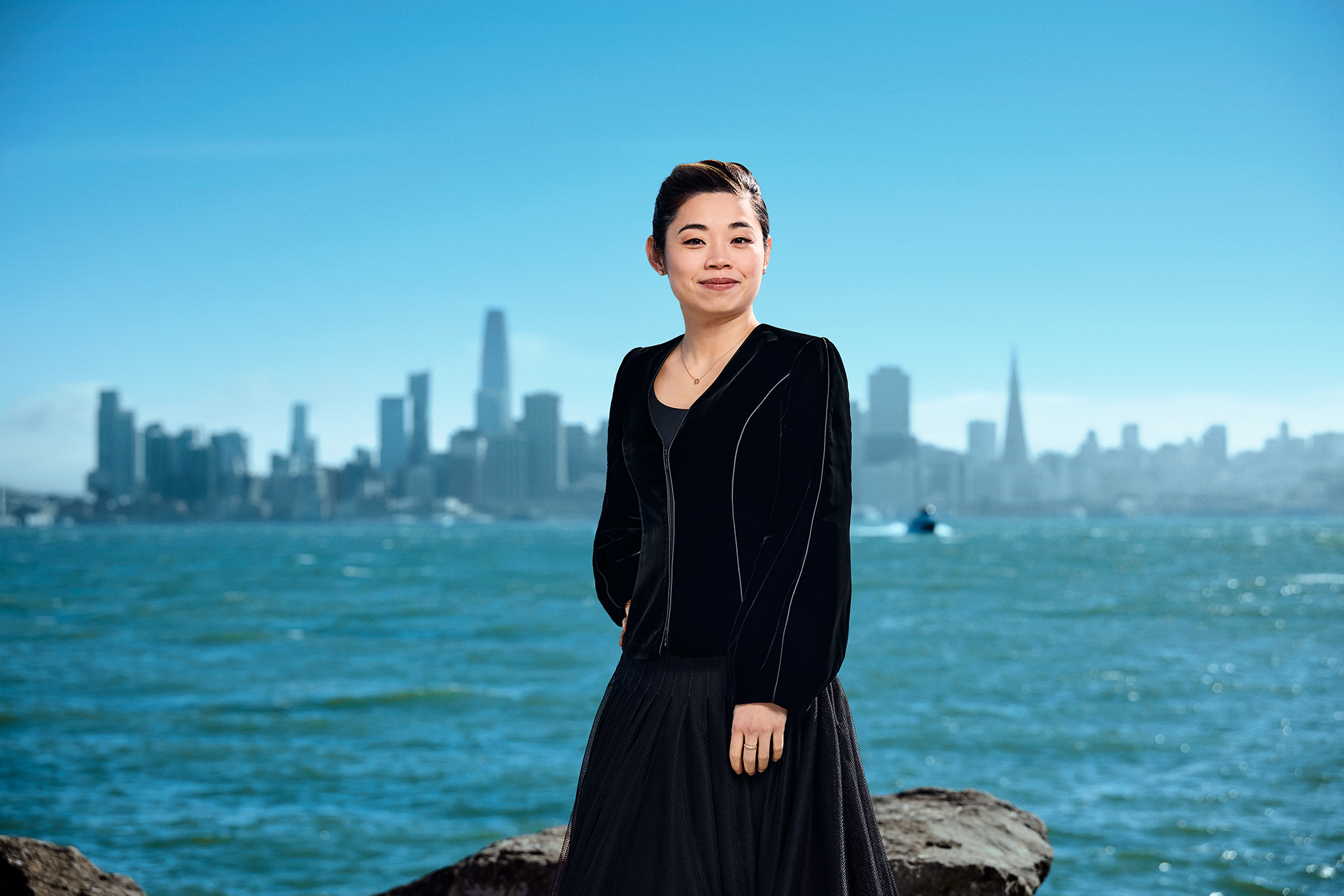
The San Francisco Symphony has appointed Elim Chan as its new music director. The 39-year-old conductor born in Hong Kong has signed a six-year contract, the Symphony announced on Thursday.
The appointment is a historic one. Chan will be the first woman to lead the San Francisco Symphony in its 115-year history. She is also the first woman to be hired as music director by one of the so-called “Big 7” symphony orchestras in the United States, encompassing New York, Boston, Cleveland, Los Angeles, Chicago, San Francisco and Philadelphia.
Chan, who recently served as principal conductor for the Antwerp Symphony Orchestra in Belgium, is lesser-known than her two predecessors in San Francisco: Michael Tilson Thomas, who led the orchestra for 25 years and died earlier this month, and Esa-Pekka Salonen, who stepped down in 2024.
But Chan is a much-talked-about rising star in the classical world, serving as principal guest conductor of the Royal Scottish National Orchestra, and guest conducting the major orchestras in New York, Los Angeles, Chicago and Boston to effusive reviews. She made her debut at the San Francisco Symphony in 2023, and has since returned twice, drawing acclaim from audiences, musicians and critics.
In an interview with KQED Thursday at Davies Symphony Hall, Chan emphasized that one of her goals in San Francisco is to change the public’s perception of the symphony.
“A big thing of mine is how to get people who have never listened to classical music, who think that they are not educated enough, or they feel they’re not comfortable enough,” Chan said. “All sorts of reasons, right? We are going to take all those reasons out. Because coming to the symphony is so cool.”
She can ‘bring out the best’
After her 2023 debut at Davies, the San Francisco Chronicle hailed Chan as “a promising podium talent, one who combines lithe physical command with a wealth of artistic resources.” Last year, after an all-Tchaikovsky program, the San Francisco Classical Voice enthused that “it’s clear by now that conductor Elim Chan can bring out the best in a top-rank orchestra.”
The Symphony is betting that it can offer Chan a sizable enough platform to propel her further upward. Already, she is slated to conduct a program of Berlioz, Debussy and Wagner at Davies on June 5 and 6. Her first full season as music director begins in 2027.
The appointment also marks a victory for San Francisco in its sometime rivalry with Los Angeles. While the Symphony’s selection process for a music director is a highly guarded one, Chan had been one of the names whispered amongst pundits as a contender in San Francisco. Chan had also conducted regularly for the L.A. Philharmonic, and was viewed as a potential successor there to Gustavo Dudamel, whose namesake fellowship she was awarded in 2017.
As a conductor, Chan’s style may best be described as outsized. Praised for her energy and rhythm, and noted for bringing precision and verve to nominally calm, flowing musical passages, Chan transcends her diminutive height. Often, she arcs forward, as if charging after the music. (Along with conducting, Chan also trains on the side with a boxing coach.)
On Thursday, Chan told KQED that the first time she witnessed Michael Tilson Thomas on the podium, he was conducting his Maverick Series, focusing on new works. She lists off new composers she’s especially excited about: Gabriela Smith, Anthony Cheung, Elizabeth Ogonek, Noriko Koide.
On Thursday night, during a reception at City Hall hosted by mayor Daniel Lurie, Chan told the crowd in her casual, charismatic way of speaking that “I love the old classics. But I also love the friggin’ new things! The wacky things!”
Chan has a track record of balancing the old and the new. She has also studied with traditionalists like Bernard Haitink, who, among other enduring lessons, instilled in Chan a respect for Anton Bruckner. (On Thursday, she said she trusts the San Francisco orchestra enough to finally tackle conducting Bruckner’s music.)
Breaking a glass ceiling — and transcending labels
For many years, an open question has persisted about when major symphony orchestras would embrace women as music directors or full-time principal conductors. Despite high-profile figures like Marin Alsop and Nathalie Stutzmann, no woman had been appointed at one of the top seven U.S. orchestras until now.
In 2014, still in her 20s, Chan became the first woman to win the esteemed Donatella Flick Conducting Competition in England, bringing her global attention. Two years later, writing for The Guardian, she called for a de-emphasis on her gender.
“I have felt there to be at times an imbalance of focus on my gender over my whole identity as a musician. I do not want to be given any special treatment because I am a woman,” she wrote. “I am proud of being a woman conductor, but I want to take the next step and go beyond any tags and be seen and valued as the same as my male colleagues.”
On the morning of her announcement, however, Chan said she was able to take a moment to realize the historic importance of the occasion.
“Before I walked into the hall to meet the musicians, I told myself, actually, yeah … it is a big deal,” Chan said.
Chan has also received attention as an Asian, making the Bay Area a natural fit; the region is home to one of the highest percentages of Asian Americans in the continental United States, and Eun Sun Kim, another Asian woman, leads the orchestra at San Francisco Opera. In the 2016 Guardian piece, Chan expressed a regard for talent over ethnic identity.
“My core priorities have always been and will always be the music and the audience, and I think audiences over the past two years have come to see me simply as Elim, rather than under the labels ‘Asian’ or ‘female conductor.’”
Chan’s first concerts with the Symphony since being hired — a program of Wagner, Berlioz and Debussy — take place June 5 and 6 at Davies Symphony Hall.