‘Aztec Stories in Modern Mexico’ Brings Vibrant Artwork to Walnut Creek
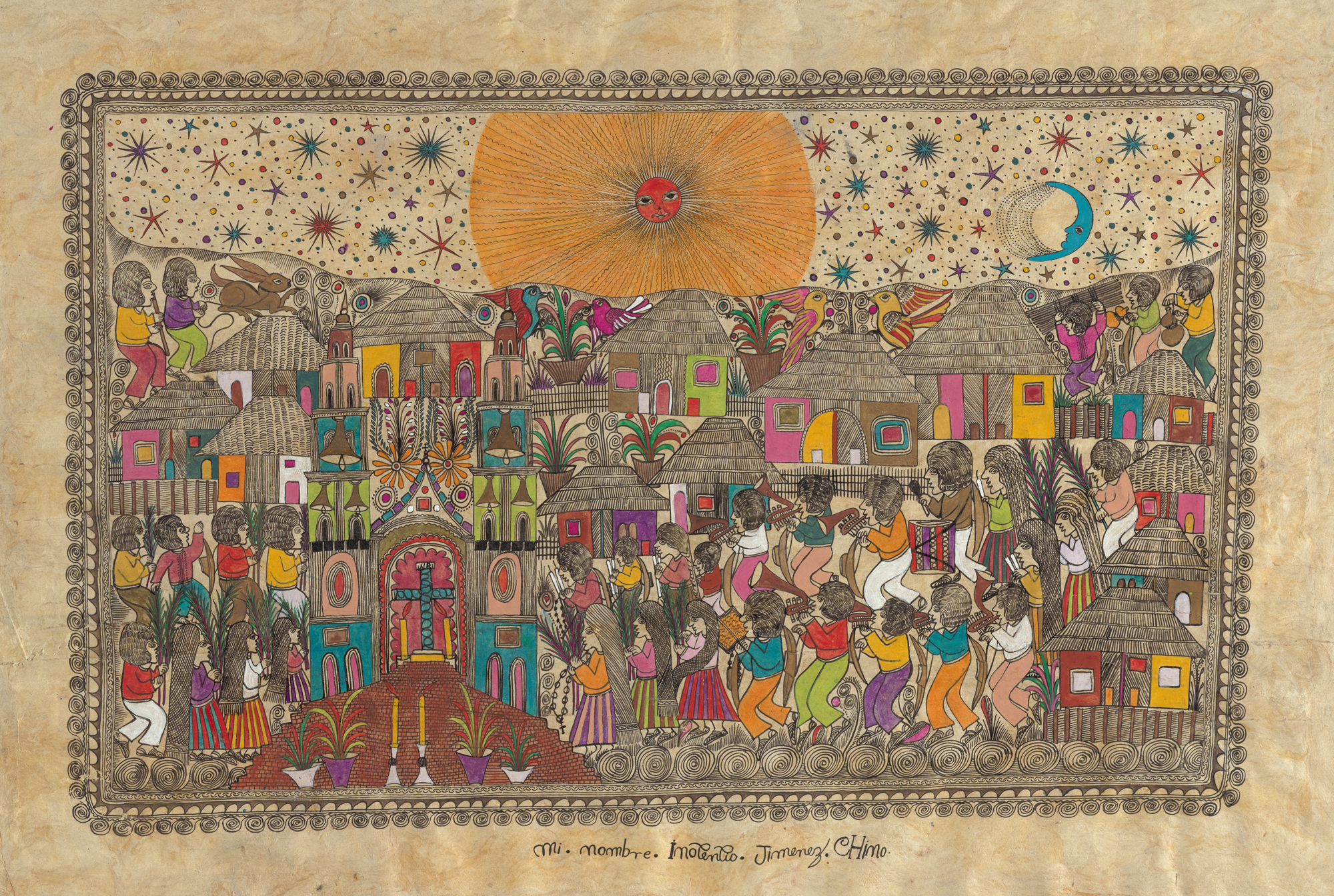
A small crowd of near-identical human figures, painted in Day-Glo colors, dance across handmade paper. The figures move in sinuous, stacked rows of flattened perspective, reminiscent of the Mesoamerican codex illustrations that date back centuries, to the Spanish conquistadors’ arrival in what is now Mexico. But this is a work from 1970 by Aztec-Nahua artist Inocencio Jiménez Chino.
Santa Cruz (Holy Cross) features people in flashy-hued bell-bottoms, smiling with big eyes and even bigger hair. They parade toward a large cross, holding candles, plant fronds and musical instruments, integrating Christian practices with ancestral rituals for crop-nourishing rain.

The painting is part of Jiménez Chino’s first-ever retrospective, currently on view at Walnut Creek’s Bedford Gallery. The show includes dozens of the artist’s exquisite, small-scale paintings and drawings, fantastic portrayals of rural life in the Mexican state of Guerrero, made over the past half century. As the exhibition’s title suggests, Aztec Stories in Modern Mexico demonstrates a line of cultural resilience dating back to pre-Columbian times, as well as Jiménez Chino’s observations of the cultural possibilities and challenges that continue through the present day.
The work began as a creative side gig for Jiménez Chino, a way to engage with expanding tourist hunger for local culture. The self-taught artist initially channeled subject matter and styles from long-standing traditions; he depicted human figures with stereotypical features (all with similarly prominent chins and noses), and adorned artwork borders with intricate geometrics that wouldn’t be out of place on Central American visual art dating back to the 1500s.
In Santa Cruz and other early paintings — 1972’s La sirena: la madre de los peces (The Mermaid: Mother of the Fish) and 1979’s Los cazadores (The Hunters) — glorious renderings of the sun make it a character itself. Jiménez Chino animates the celestial body as a sort of presiding deity, giving his sun a human face. He dedicates large portions of his compositions to its radiating, golden striations, sometimes set in skies also busy with stars.

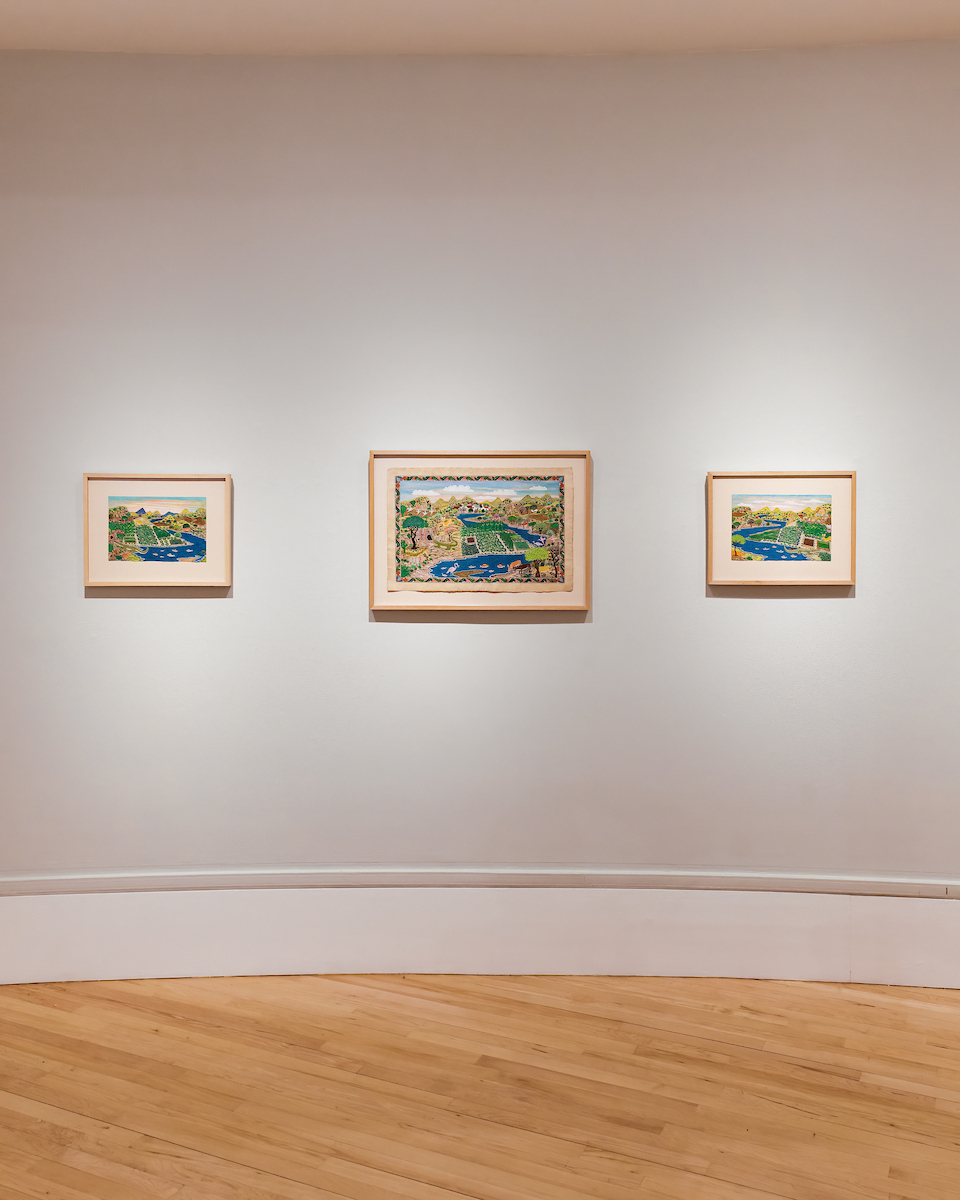
Over decades of artistic development, Jiménez Chino’s style has evolved to incorporate more varied and realistic human faces and bodies, while continuing to manifest a larger cultural endurance. Through imagery and materials, Jiménez Chino creates work that is rooted in an Aztec-Nahua culture that colonialism attempted to rub out.
There’s an unschooled quality to Jiménez Chino’s earliest renderings; they are simple, even childlike, while never defaulting to “rough” or quaint. With his cavalcade of carefully outlined figures and fine attention to both detail and overall composition, he ensures that scene after scene surges to life. In El Festival del Pueblo (The Town Festival), a painting from 1987, golden trumpets pop with tints that suggest brash, sculpted sounds emerging from those instruments.
His bright acrylic colors (trees in hallucinatory fuchsia pastels or deep, saturated greens; glowing orange and yellow clothing) are most frequently painted onto handmade “amate” paper, traditionally crafted in San Pablito Pahuatlán, in the state of Pueblo. (The material was banned in the era of Spanish colonialism). The distinct amate texture is inviting, with each sheet irregularly shaped by wavy surfaces and edges. The landscapes portrayed suggest antique maps, or portals to some mythical paradise.
Part of that feeling comes from the meticulous harmoniousness of Jiménez Chino’s creations. His compositions manage to pack in figures while maintaining spaciousness amid green hills and mountains, startling blue rivers and skies. Fecund landscapes with tidy gardens and larger-than-life animal inhabitants enliven seductively idealized settings. Even in scenes bursting with crowds and momentous events, there’s always a sense that much lies beyond what’s depicted.

Though not as immediately arresting as his more colorful painted work, three prints from a series of Jiménez Chino’s large black ink drawings are also on exhibit. These were part of an Indigenous-organized campaign comprising two dozen Nahuatl-speaking communities along the Balsas River who protested a massive proposed hydroelectric dam in the early 1990s. Their successful opposition to the project was a cultural and political victory, maintaining their territorial rights and their say over local resources. In the series, Jiménez Chino depicts busy scenes of ordinary life alongside determined mass mobilization — Vida en paz y armonía con la naturaleza (Living in peace and harmony with nature) and Protesta contra la represa (Protesting the dam), respectively.
Similarly, other scenes of woe and strife — his 2025 painting Conflicto agrario (Agrarian Conflict) regards a land dispute between neighbors — are presented as part of life’s ongoing larger tableaux. Jiménez Chino shows a people pursuing centuries-old forms of livelihood and pleasure, despite the impacts of modernity. His great skill is not in his depictions of the paradisical or of the everyday — it is in his combination of the two in one worldview.
‘Aztec Stories in Modern Mexico: An Inocencio Jiménez Chino Retrospective’ is on view through June 28, 2026 at the Bedford Gallery at the Lesher Center for the Arts (1601 Civic Dr., Walnut Creek).