upper waypoint

In ‘Is God Is,’ Black Women’s Revenge Becomes Spiritual

Save ArticleSave Article
Failed to save article

Please try again

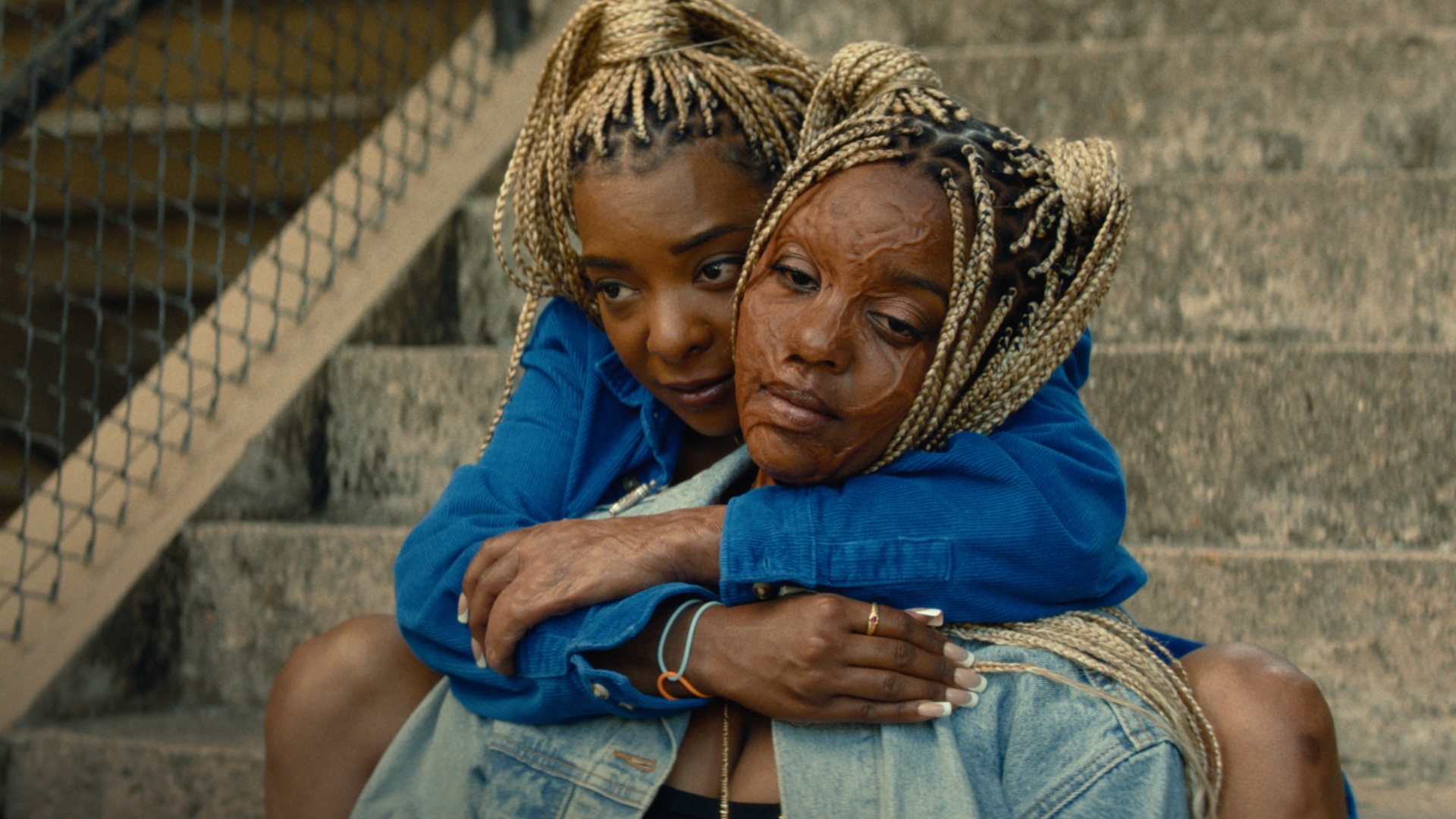
In ‘Is God Is,’ twins Anaia (Mallori Johnson) and Racine (Kara Young) get revenge on their abusive father.  (Amazon MGM Studios)

What does it mean to be born of violence?

In her debut thriller Is God Is, director Aleshea Harris explores this question through the relationship of two twins, Anaia (Mallori Johnson) and Racine (Kara Young). Their father, the Monster, (played with sinister precision by Sterling K. Brown), attempts to kill their mother (Vivica A. Fox) by setting her on fire. In the process, he physically and emotionally scars his young children, who try to save her. Their estranged, disfigured mother later summons them to kill him in revenge.

Anaia and Racine (or Naia and Cine for short) both bear marks from the damage, but in different ways. While Naia’s face is almost fully covered in visible burn wounds that draw disgust from onlookers, she’s also the softer twin — the sensitive, quiet one. Racine is only scarred on her arm, but she develops a fiery disposition, and is more prone to raw rage, roughness and violence. She even seems to revel in it at points.

As the twins attempt to make sense of their complicated past in foster homes, their mother invites them to see her for the first time in years. Through this journey to the South, we experience their deep, sometimes unspoken bond, in which they hear each other’s thoughts and questions, and answer silently, with captions on the screen. These nonverbal exchanges, combined with poetic voiceovers, foley and well-curated music cues, create a distinct sonic, visual world that’s striking and original.

In this film, which is based on Harris’ award-winning play, God is a Black woman, a Black mother. She’s damaged but also profound. In one scene, multiple Black women braid Ruby the God’s hair as she lies on her deathbed. The clinking sound of their long nails felt comforting to me, but this pairing of Black matriarchy and holiness may be controversial for some viewers, especially those not used to seeing Black women exalted in this way onscreen.

While the film engages with the divine status of Black women, it is stylistically reminiscent of Quentin Tarantino’s revenge thriller Kill Bill, and even Denis Villeneuve’s Dune series, where beauty and emotion mix with the grotesque, bizarre and unsightly. In another scene, the Monster’s mistress Divine the Healer (Erika Alexander) shows Racine and Anaia an elaborate altar dedicated to him, proving that no matter how much harm this man inflicts, he’s still loved and lusted after.

What makes the film interesting is its interrogation of patriarchal violence against Black women. At a time when we’re seeing increased coverage of Black femicide, Is God Is makes space for the unfiltered rage and pain that some Black women carry. In an early scene when Racine and Anaia visit their mother, the hair-braiders in the room pull back the covers to reveal the horror of Ruby the God’s scars on her legs, which still burn with smoke. We see the two sisters’ faces consumed with emotion, spurring their need to act.

What does it mean to be a Black woman with sadness, grief and rage in this current time? As we read more headlines about Black women murdered by their partners, where does our rage go? Is it allowed to be used in our defense? Are we allowed to act in our own self-defense? Or are we supposed to just keep it inside, where it builds into a mound of pain? These questions came to my mind as I watched the film.

Yet I wasn’t always sure if the violence I was seeing onscreen had meaning. Throughout most of the film, we mainly see glimpses of Anaia and Racine’s father, the Monster, in close shots of his lips, face and legs. By the end of the film, I had no feelings about him, except for that he seemed like a psychopath. When Racine and Anaia got their revenge, it felt empty to me because his character wasn’t developed enough for me to care. I would’ve loved to see more of a backstory for the twins’ parents, in textured, complicated flashback scenes with their daughters to build more tension.

Instead, I really leaned into the fun, soft and unexpected moments between the twins as they sat on the hood of their car, walked through a field or talked about Naia’s love life in their bedroom. Their long Dickies shorts, white tank tops and blond box braids contained vibrant cultural textures that I responded to. As I sat in the theater watching the film, I was drawn to the fiery and warm rapport between the twins, and I wanted to see them both make it out of this dangerous journey alive. Their complicated relationship is the standout element of the story.

Is God Is asks us to see the beauty and spiritual presence in Black women, who are scarred, both physically and emotionally, by men in our communities. We don’t often see that angst captured in this way, which makes this film distinct in its handling. Here, Black women draw blood.

In one scene, Cine asks Naia: “You ever wanted to scrape off your scars to see what’s underneath?” The answer to that question comes in a poetic, uplifting surprise in the film, but not before a heartbreaking climax which seems to confront whether violent revenge will also consume the person seeking it. The weight of carrying this grief, rage and pain just might consume us all.


‘Is God Is’ hits theaters May 14, 2026.

lower waypoint
next waypoint
Player sponsored by