Netflix’s ‘Reality Check’ Revisits the Brash Toxicity of ‘America's Next Top Model’
The hit modeling show made for ‘good TV’ but had devastating consequences for some contestants.
Aisha Harris, NPR
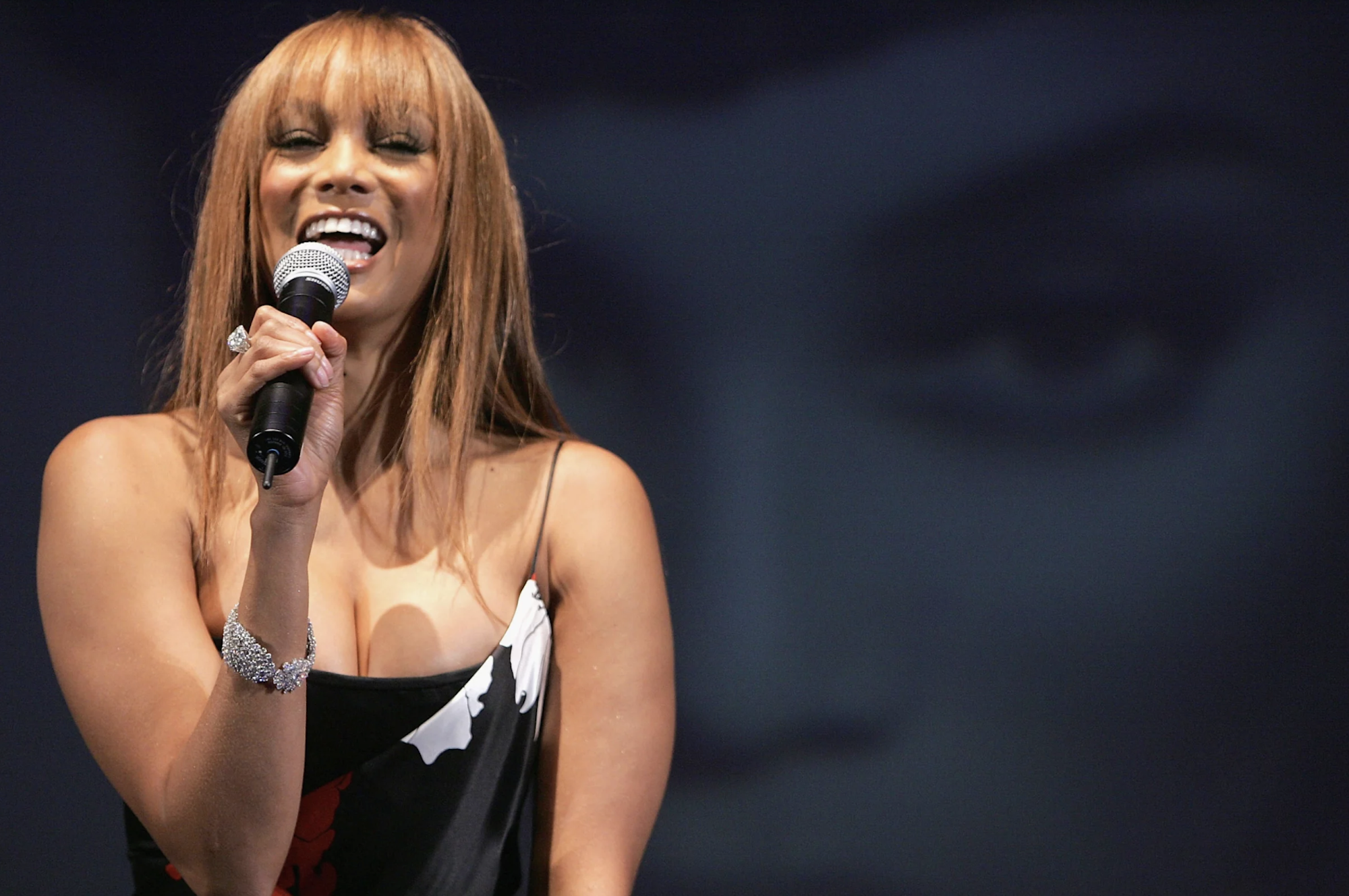
Tyra Banks on stage at an ‘America's Next Top Model’ after party in Los Angeles in 2005. (Frazer Harrison/Getty Images)
Give Tyra Banks credit where it’s due: She’s not going to pretend as if she hasn’t seen the brutal social media dissection of her twisted brainchild, America’s Next Top Model. The one-time reality TV juggernaut has found a new life on streaming, and in 2020 the supermodel-turned-media-mogul addressed blowback to the body shaming, black-, brown-, and yellowface, and unethical production choices with a smidgen of humility: “Looking back, those were some really off choices,” she tweeted. “Appreciate your honest feedback and am sending so much love and virtual hugs. ❤️”
This is the age of the accountability documentary, wherein critiques of and grievances about people and past pop culture phenomena like Britney Spears and Abercrombie & Fitch are packaged into salacious tell-alls meant to correct the record. It was obvious Banks’ empire would be placed under a director’s microscope eventually. Enter Netflix’s Reality Check: Inside America’s Next Top Model, a surprisingly candid three-part docuseries which allows her and other key players from the Top Model world to recount their experiences — good, humiliating, traumatic and everything in between.
Related Article
True to formula, the behind-the-scenes transgressions described throughout Reality Check start small but grow increasingly more absurd and infuriating with each new voice. There’s Shandi Sullivan from Cycle 2 — I guess “cycle” is the couture pronunciation of “season” — who attests to being traumatized by how producers handled an incident where she says she blacked out after a night of drinking and ended up in bed with a male model she barely knew. (She doesn’t explicitly describe what happened to her as a sexual assault, but she does take issue with the fact that producers didn’t intervene and in fact, kept filming through it all. The 2004 episode was framed and packaged rather crudely as “The Girl Who Cheated.”)
Other depressing stories are rattled off — Keenyah Hill (Cycle 4, 2005) describes speaking up about a male model’s inappropriate behavior with her in the middle of a photoshoot, and being dismissed by all the producers, including Banks; Giselle Samson (Cycle 1, 2003) recalls overhearing the judges say she’s “got a wide ass”; Cycle 6 winner Dani Evans exasperatedly details how she was pressured by Banks in 2006 to close the distinctive gap in her teeth to stay in the running, only for Banks to encourage a white contestant to widen their own several cycles later. And that’s just the models, the ones who had the least power and the greatest hunger for success. Panelist judges J. Alexander, Jay Manuel and Nigel Barker, Top Model‘s breakout stars in their own right — and who made their share of insensitive and sometimes ethically dubious contributions to the show — offer blunt, damning insights about the manipulated and highly-controlled behind-the-scenes machinations.
Smack dab in the middle of it all is Banks herself, reinforcing the perception that, as ever, she embodies a staggering wealth of inherent contradictions. Anyone who’s spent time watching Top Model or the equally wacky daytime talk show The Tyra Banks Show recognizes her bald attempts at molding herself in the image of her multimedia predecessor Oprah Winfrey — part shrewd businesswoman, part charismatic personality, part fairy godmother who can make dreams come true. Having faced racism and body discrimination in her early career in high fashion, “I wanted to show beauty is not one thing, and I wanted to fight against the fashion industry,” she says of her motivation for creating Top Model and intentionally casting women who were something other than tall, stick-skinny and white.
But Banks also knew above all else what would make for “good TV.” And revisiting the show only reiterates how often her proclaimed ethos was at odds with her practice; she presented herself as a rebel with industry sway when it was convenient to her mythmaking, only to hide behind the cover of “industry standards” when it wasn’t. This was usually framed under the guise of tough love: “I would love to change the rules, but until that happens, I think it’s all about choices, Keenyah,” Banks tells Hill in archival show footage. “You can eat a burger, and take the bread off.”
Even now, Banks’ self-perception as a benevolent disruptor persists, and she resolutely clings to it like a life preserver pummeled by wave after wave of evidence presented to the contrary. “I just wanted to change this woman’s life,” she insists, reflecting on the notorious and frequently memed 2005 moment in which she lashed out at contestant Tiffany Richardson. “We were rooting for you. We were all rooting for you!” Banks yelled at Richardson when she was seemingly unfazed by her elimination.
Related Article
It’s crucial to note Banks isn’t credited as a producer on Reality Check, which lends the series more bite and balance than might otherwise be expected in this forum. As such, she cedes most of her storytelling power to directors Mor Loushy and Daniel Sivan, who pointedly contrast her apologies and occasional abdications of responsibility with the adamant, hardened perspectives of the women and former coworkers who once looked up to her. (J. Alexander, Jay Manuel, and Nigel Barker, who each had a bitter falling out with Banks after being fired late in the show’s run, are all credited as consultants, and come off as much more sympathetic. Make of that what you will.)
Clearly, Banks views Reality Check as an opportunity to take some accountability for the damage the show left in its wake, and the extent to which the series manages to accomplish this, by giving considerable room for her critics, is remarkable. (On the other hand, near the end of the final episode of Reality Check, Banks reveals, unsurprisingly, that this “accountability” hinges on yet more self-promotion: “You have no idea what we have planned for Cycle 25” of Top Model, she says.)
Nigel Barker in Reality Check: Inside America’s Next Top Model. (Netflix)
It’s tempting to view Top Model as a product of its time for better and worse, when the reality TV ecosystem was still very much the Wild West. I was an impressionable teen watching at home when Banks first threw a bunch of aspiring models into a bare-bones New York City apartment to compete for a professional contract, and I remember how lofty and notable the show’s “inclusive” mantra seemed, because expectations lived in the gutter against a backdrop of normalized eating disorders and limited shades of makeup foundation.
Related Article
The docuseries ultimately leaves us with a truth borne out time and again: Progress isn’t linear. Of course it’s foolish to think one woman alone has the power to undo decades of deeply ingrained gatekeeping through a hit TV show. Nor is progress easily achieved through individualized symbols. Whitney Lee Thompson Forrester, a plus-sized winner of Cycle 10 in 2008, credits the show with giving her an opportunity she probably never would have gotten otherwise; meanwhile, countless other contestants were shamed for weighing too much at, maybe, 124 pounds soaking wet.
Yet as much as attitudes have shifted and as much grief as Banks has gotten, the tale of Top Model might have foreshadowed the contradictions — and blowback — to body image inclusivity. The show revealed that representing different body types and looks came with limitations and a whole lot of caveats; in 2026 we observe the so-called body positive movement has receded with the proliferation of GLP-1 drugs. The message in both cases is clear: Whether implicit or explicit, thin and white has never not been in. Surely Banks could and should have done more to fight for Dani Evans’ right to keep the gap in her teeth, and for all the others in her cohort. But the pendulum of progress always finds a way of swinging itself back before inching forward again.