Sponsor MessageBecome a KQED sponsor
upper waypoint

At BAMPFA, Theresa Hak Kyung Cha’s Eloquent Art Lives On

Save ArticleSave Article
Failed to save article

Please try again

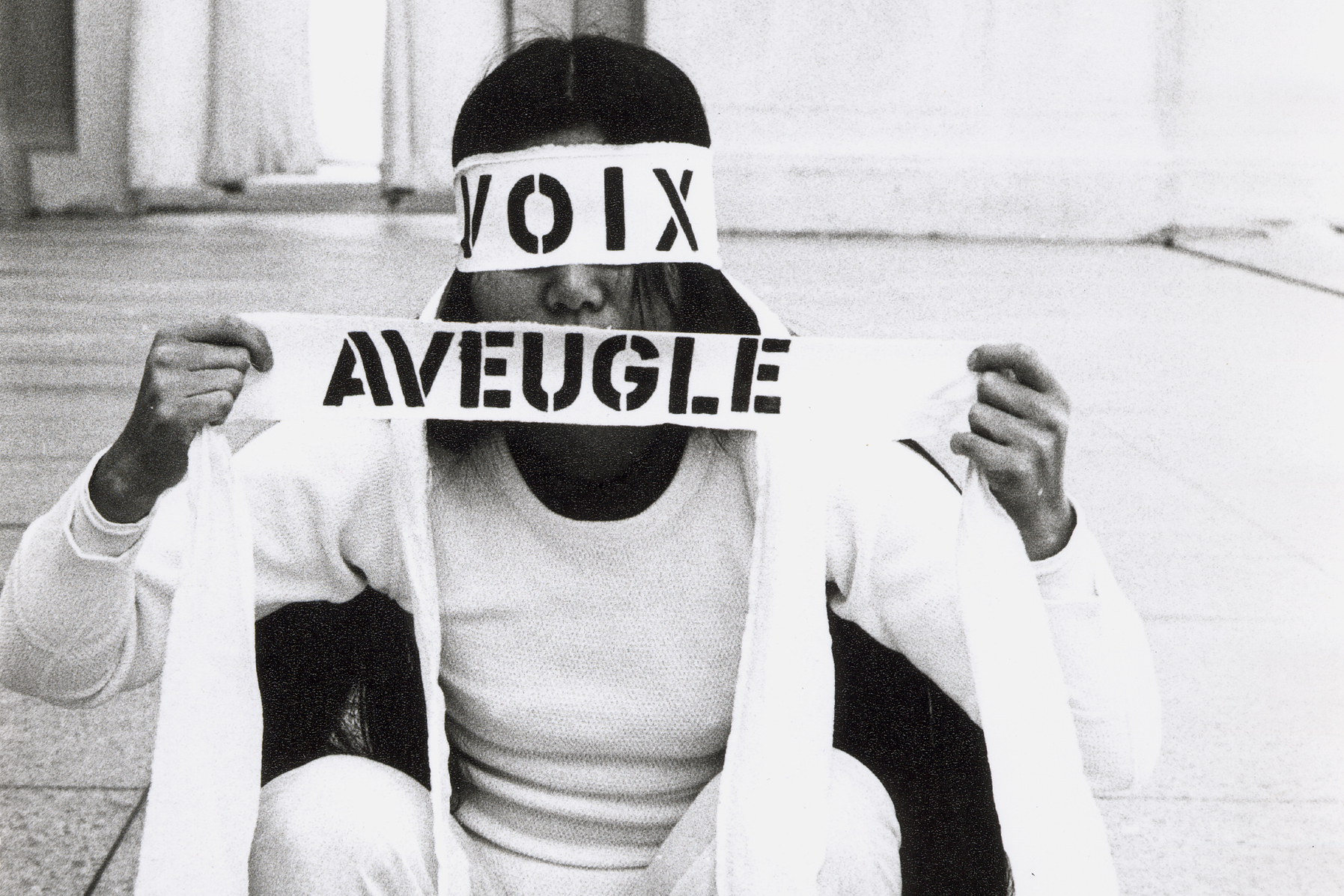
black and white image of woman squatting in white with eyes and mouth covered by 'voix' and 'aveugle'
Theresa Hak Kyung Cha, 'Aveugle Voix,' 1975; Documentation of performance rehearsal at the Greek Theatre, University of California, Berkeley. (Photo by Trip Callaghan)

There are so many words in Theresa Hak Kyung Cha: Multiple Offerings that it can be a bit daunting to form a written response of one’s own. The retrospective at the Berkeley Art Museum and Pacific Film Archive, curated by Victoria Sung with assistance from Tausif Noor, presents a decade of work by an artist who died too soon: in 1982, at the age of 31. The museum has housed her art and archives since 1992.

Cha’s practice transcended media, but words — spoken, recorded, written — are nearly always at the center. Born in Busan, South Korea in 1951, she immigrated with her family to Hawaii in 1962. They moved to San Francisco two years later. Words in Korean, English and French punctuated and inscribed her practice, which included performances, sound pieces, films, artist books and mail art.

Berkeley isn’t just the starting point for this traveling retrospective, it’s the geographical backdrop of Cha’s commitment to art. The artist spent eight years at UC Berkeley, getting bachelor’s degrees in comparative literature and art, then an MA and an MFA. She worked at the Pacific Film Archive, and as a preparator and video technician at the University Art Museum, BAMPFA’s precursor. Along the way, she showed at a mix of major Bay Area institutions and artist-run spaces: 63 Bluxome, La Mamelle, the San Francisco Art Institute, the San Francisco Museum of Modern Art, 80 Langton Street.
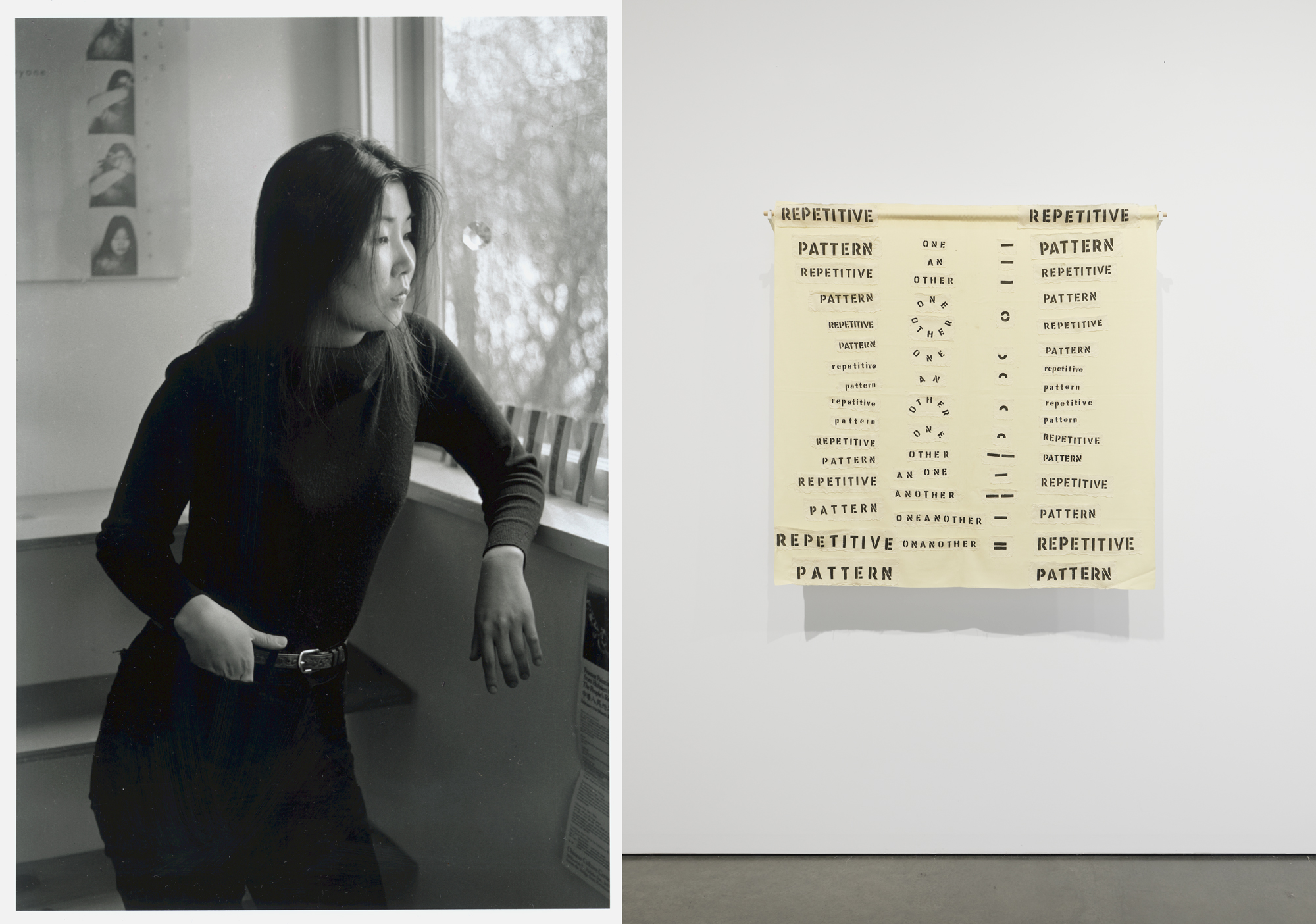
image of Asian woman in black, one hand tucked in pocket, the other leaning on window she looks out of; stenciled text piece on raw canvas
L: Theresa Hak Kyung Cha in 1979. R: Theresa Hak Kyung Cha, ‘Repetitive Pattern,’ 1975. (Photo by James H. Cha; Courtesy of BAMPFA)

“The main body of my work is with language,” she wrote in an artist statement in the late ’70s, “‘looking for the roots of the language before it is born on the tip of the tongue.’” Later in the same text, she used the phrase “multiple telling with multiple offering” to describe how she combined images, text and sound to give audiences a variety of entry points into the works.

Despite Cha’s short career, Multiple Offerings contains over 100 works, starting with early ’70s forays into ceramics and weaving, and ending with Dictée, an 1982 experimental book published by Tanam Press. Shortly after the book was published, Cha was raped and murdered in New York City, where she moved in 1980.
Sponsored

That staggering loss — of a full life and career — threatens to overshadow any posthumous reception of Cha’s work. In the beautiful catalog that accompanies BAMPFA’s exhibition, Mason Leaver-Yap cautions against solely focusing on “absence” in Cha’s work. “The repeated emphasis on its ‘ghostliness’ congeals uncomfortably to a retrospective biographical lensing,” Leaver-Yap writes. Cha had no presentiment of her own death. In the mid-’70s she began a piece of text with “i have time.”

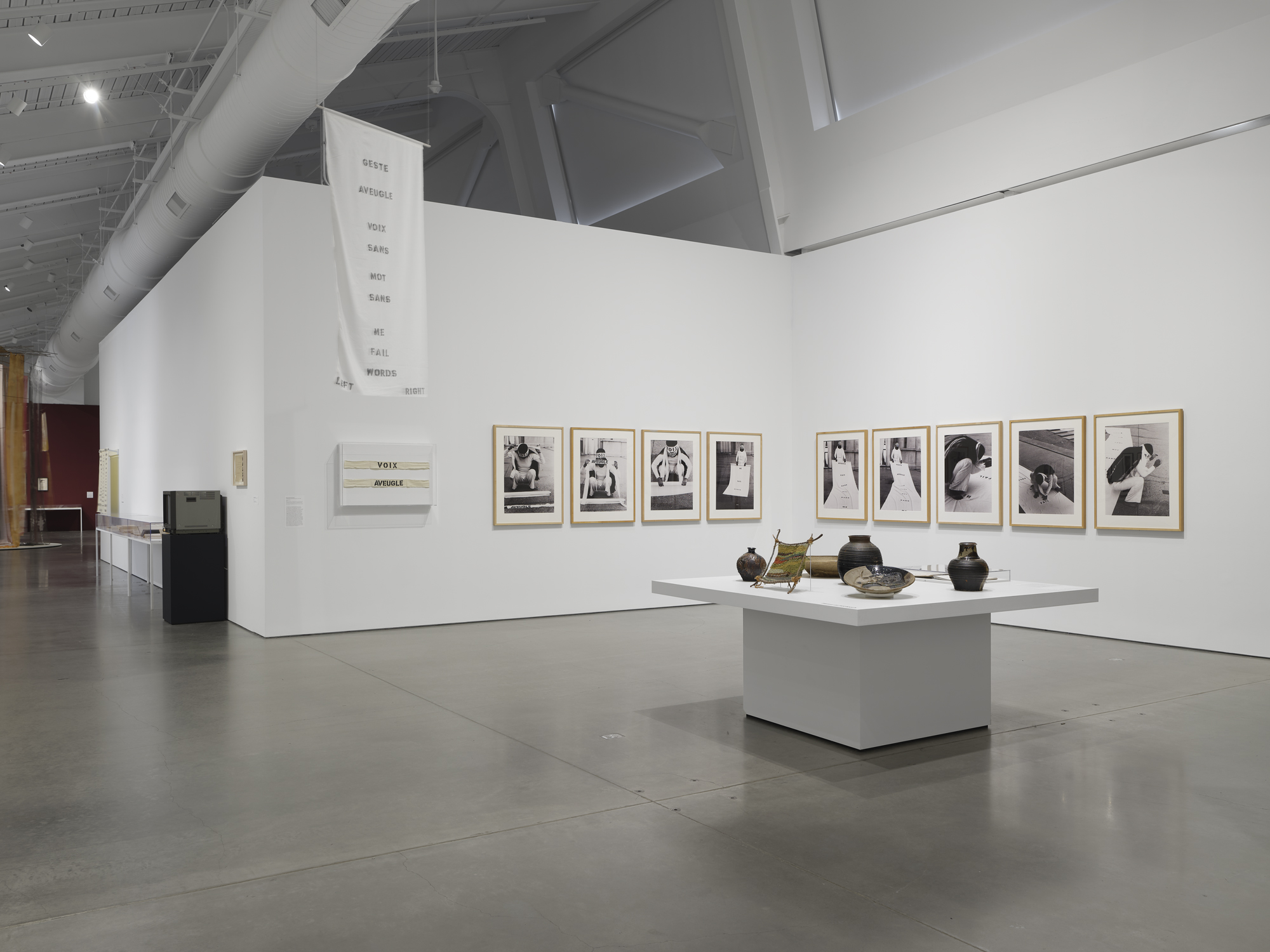
Multiple Offerings fleshes out the art historical context of Cha’s years at Berkeley with show posters, sketchbooks and the contemporaries who influenced her work. Wrapping around one corner of the first gallery, documentation of a 1975 rehearsal for Aveugle Voix (“blind voice”) shows Cha in large, warmly framed black-and-white photos, wrapping fabric around her eyes and mouth at Berkeley’s Greek Theatre. She unfurls a long white cloth with words stenciled down its center, then crouches, barefoot, head tucked into arms.

gallery view with framed black and white photographs and a table of ceramics
Installation view of ‘Theresa Hak Kyung Cha: Multiple Offerings’ at BAMPFA with ‘Aveugle Voix’ in the corner. (Courtesy of BAMPFA)

Much of Cha’s work was temporal — her body took up time and space in the moment of performance, then flattened into a series of still images, onto film or video footage. Save for her early ceramic vessels, very little of Cha’s work at BAMPFA extends beyond the thickness of a book. But Multiple Offerings is far from immaterial. Unfolding gracefully via sound and moving image, the show rewards a slower pace.

The formal spareness of Cha’s work, mainly rendered in a spectrum of black and white, belies its playfulness and generosity. She delighted in wordplay, printing text upside down and backwards, prying words apart into new formulations. A Ble Wail, a 1975 performance piece, is read as “a blue whale.” In Dictée, “afar” becomes “a far.”

Sometimes her art looked like a magic trick. In the 1974 performance Barren Cave Mute, she marked large sheets of white paper with invisible wax letters. As she held a candle to the paper, the wax melted to reveal the hidden message of the artwork’s title.

The 1976 film Permutations is made up of six one-second shots of Cha’s younger sister Bernadette, ordered and repeated by chance. Cha embedded herself in the film like a secret message, spliced between her sister’s images. In BAMPFA’s presentation, a suspended scrim catches the projection for a double-sided presentation.

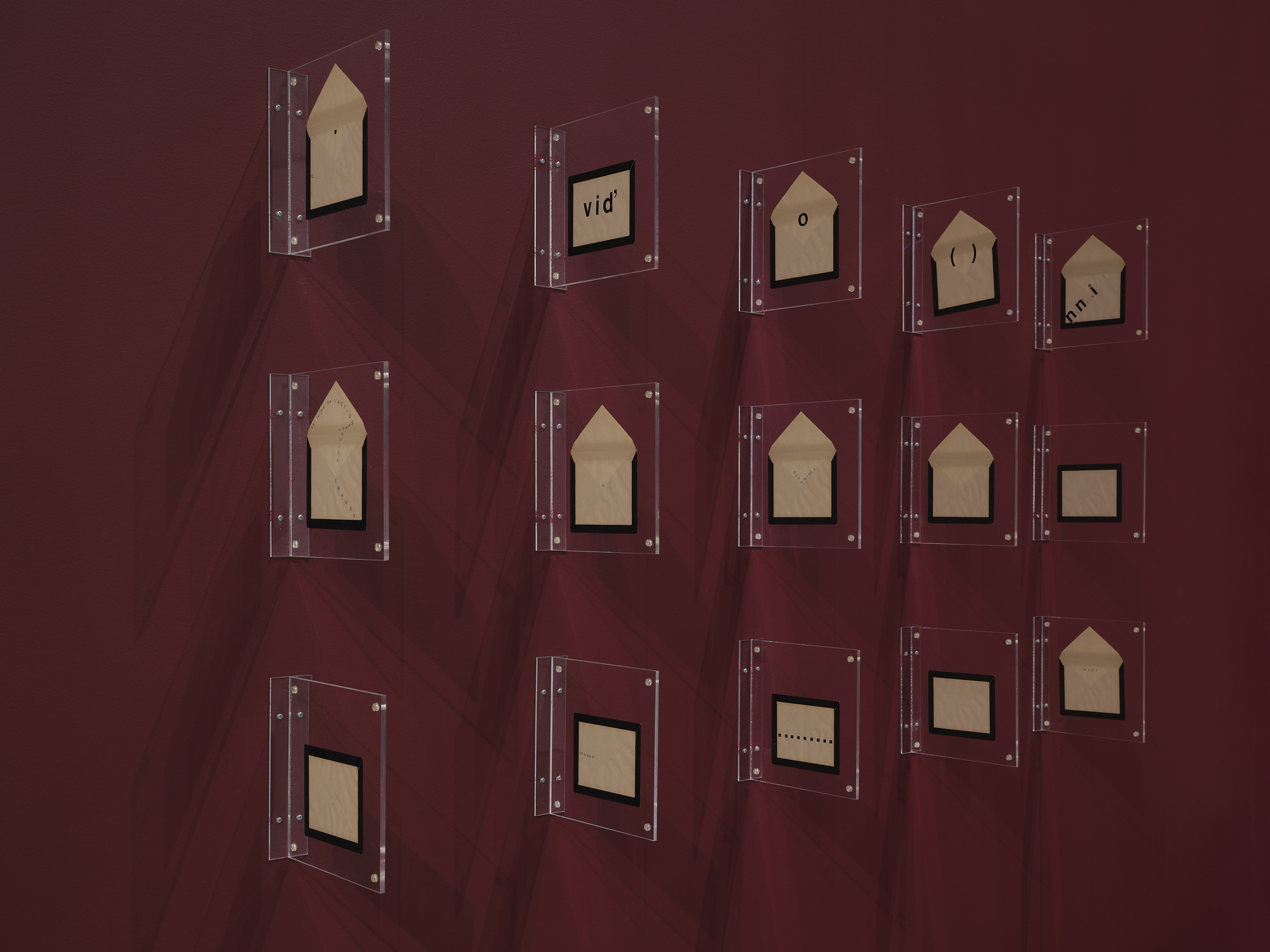
thick black edged envelopes mounted sticking out from burgundy wall
Theresa Hak Kyung Cha, ‘Faire-Part,’ 1976; Ink and press type on fifteen envelopes. (Courtesy of BAMPFA)

The exhibition moves chronologically and geographically, following Cha’s semester abroad in Paris in 1976 and her trips back to Korea in 1979 and 1980. European travel brought her into contact with Fluxus, mail art and, in Amsterdam, the conceptual artist and bookmaker Ulises Carrión. In Korea, she traveled with her brother James, shooting footage for White Dust from Mongolia, a film that remained unfinished at her death.

Scattered throughout the show are works by her antecedents and successors. A sound and textile installation by Cecila Vicuña (subject of her own stunning BAMPFA retrospective in 2018) adds vertical columns of gauzy color to the show’s restrained palette. Na Mira’s video installation Marquee, deploys some of Cha’s now-familiar tactics (reflection, text, a proxy figure) around a transistor radio tuned to the Los Angeles AM station Radio Korea.

Distance, displacement, memory, grief — Cha addressed these seemingly inexpressible things from as many angles as possible, and sometimes from every angle at once. It’s an approach, an offering, that still feels instructive, even 44 years after her death. Cha made her work with generosity, curiosity and rigor, reminding us now that no matter how difficult it is to form the words, there’s great value in trying.


Sponsored

Theresa Hak Kyung Cha: Multiple Offerings’ is on view at the Berkeley Art Museum and Pacific Film Archive (2155 Center St.) through April 19, 2026.

lower waypoint
next waypoint
Player sponsored by