Home is a complicated place for Anoushka Mirchandani. The India-born, San Francisco-based painter — currently an artist in residence at Silver Art Projects in New York City — has recently returned to the Bay Area for her first solo museum show, My Body Was A River Once, at the Institute of Contemporary Art San José. Here, Mirchandani transmutes transience and diasporic experience into four distinct bodies of work: medium- to large-scale oil-on-canvas paintings, paintings on silk organza, wooden and glass sculptures, and an audio installation.
In ICA San José Show, Landscapes Offer a Makeshift Home for Ghostly Figures
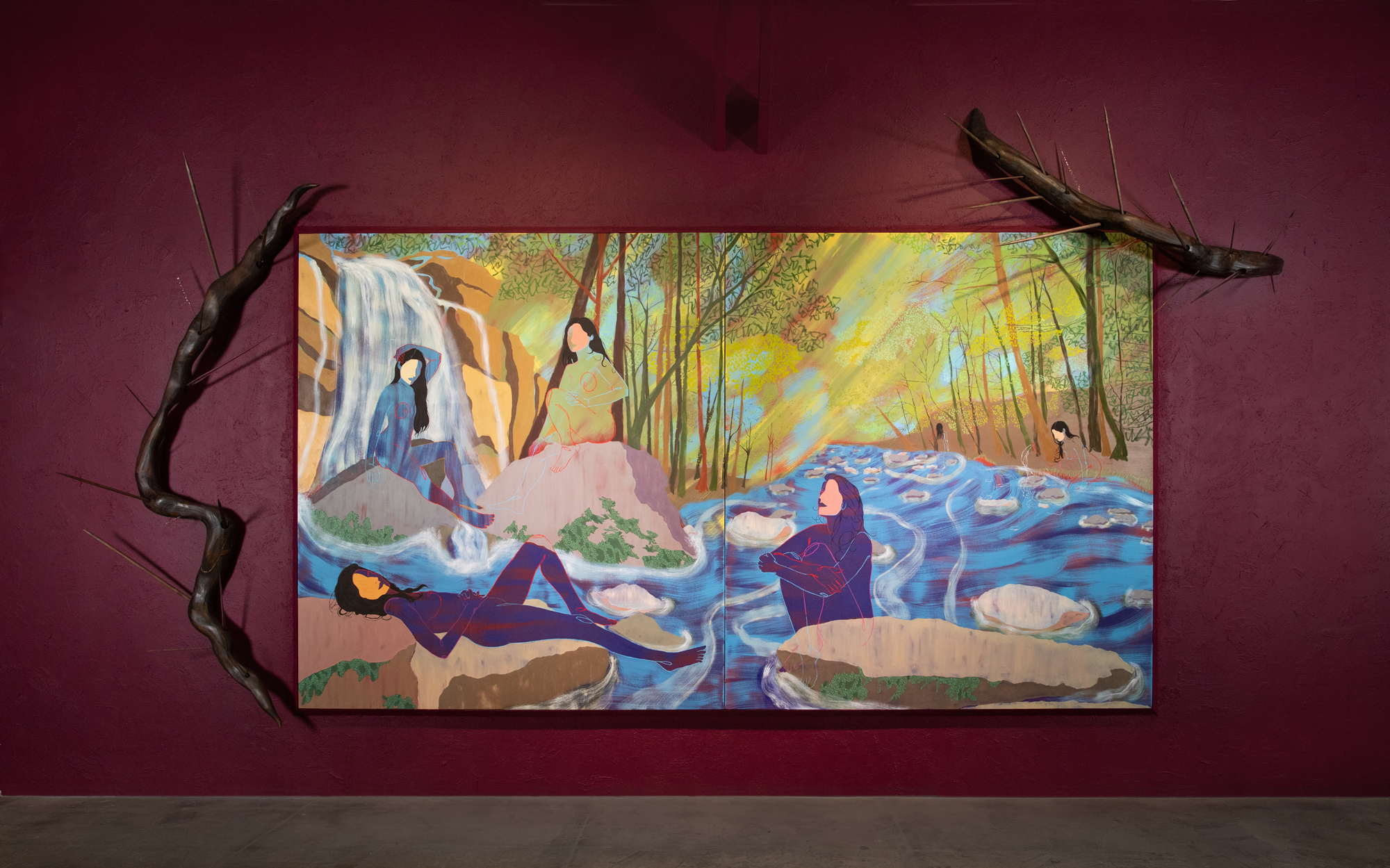
An installation view of Anoushka Mirchandani's 'All Us Come Cross the Water' in her show 'My Body Was A River Once,' at the Institute of Contemporary Art San José. (ICA San José)
Related Article
The first gallery in the exhibition features eight paintings that blend Mirchandani’s signature and spare figurative style with her recent exploration of landscape painting. Her nude female subjects wander and recline amidst foliage and bathe in pools of water, immersed in the landscape to the point of becoming indistinguishable. Body parts fade in and out of the natural surroundings. The background of the painting overtakes a figure’s form in some places, the figure breaks from its environment dramatically in others.
Often, these wanderers are solitary. In All Us Come Cross the Water, a group of women bathe together in a mountain lake — or perhaps it is a single figure, seen at different moments in time.
Mirchandani has long painted these types of figures: outlined in oil stick, blending with their environments, a play between background and foreground creating a dynamic visual and conceptual motif. Previously, the majority of her settings have been architectural — balconies, bedrooms, doorways. Here, her figures blur and meld with their surrounding landscapes more seamlessly than in past work. Set loose from a built environment they once resisted or assimilated into, their disappearance into a nature now speaks to transience.
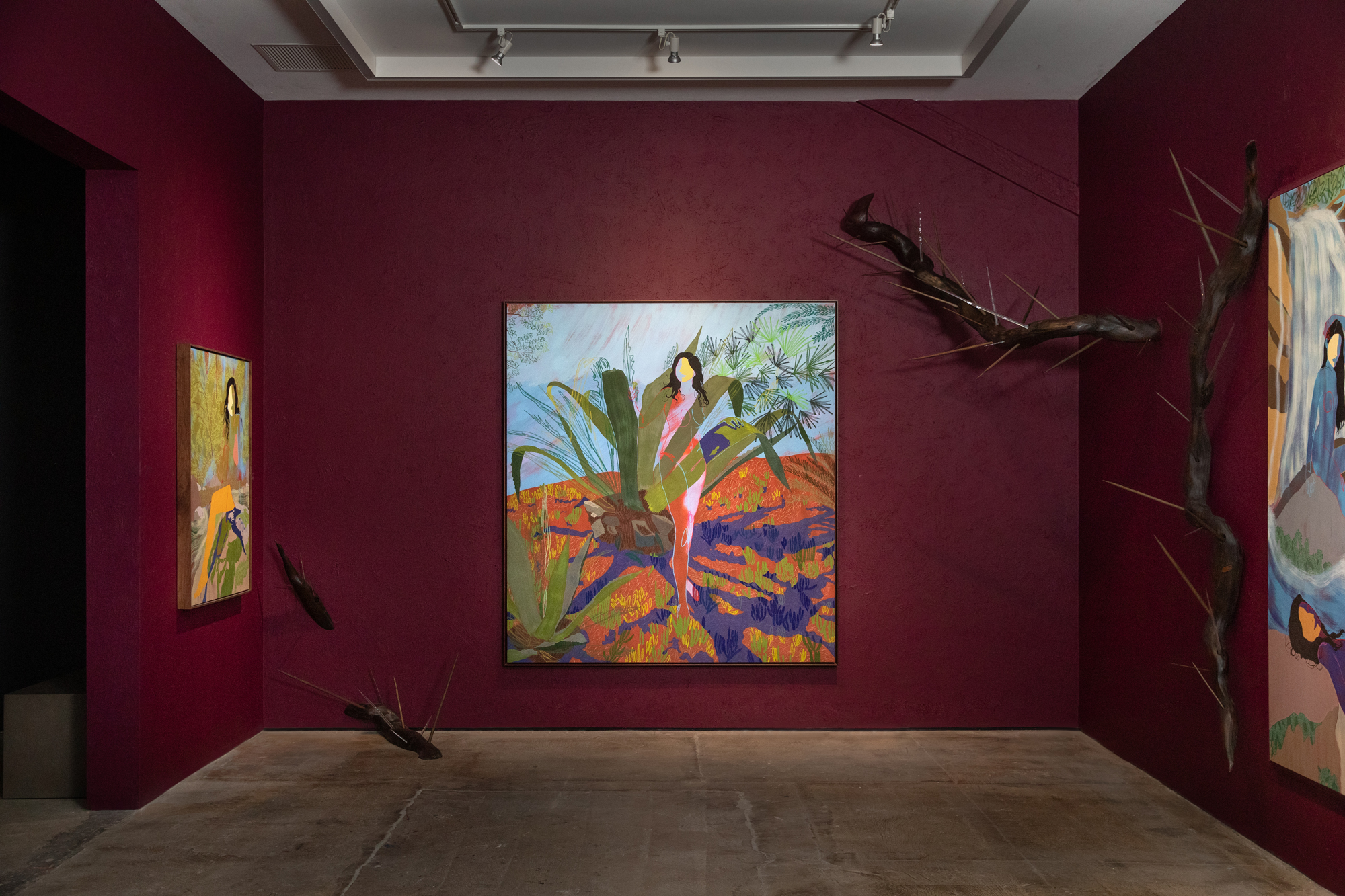
For Mirchandani, these figures reference apsaras, shapeshifting water spirits in Hindu and Buddhist mythology. Their supernatural mutability correlates to a diasporic sense of displacement and assimilation, a process of reinventing oneself in order to locate a sense of belonging.
Mirchandani’s natural settings are themselves collaged from a number of reference photos taken across the globe — India, Mount Tamalpais, New Mexico. The combined landscapes are not quite real, but not entirely imagined, either. They provide a makeshift home for Mirchandani’s ghostly characters.
“My family has a history of treating home like an anxious attachment with a lover,” the painter tells KQED. There is a sense of yearning throughout the work on view.
In each of her canvases, Mirchandani uses the same color for the underpainting, a dark red that pays homage to the natural clay of Maharashtra, the Indian state she’s from. In some places, the color bleeds through thinner parts of the overpainting; it’s a literal foundation for both the artist and her work. In her search for a sense of belonging, Mirchandani can’t quite let go of the past.
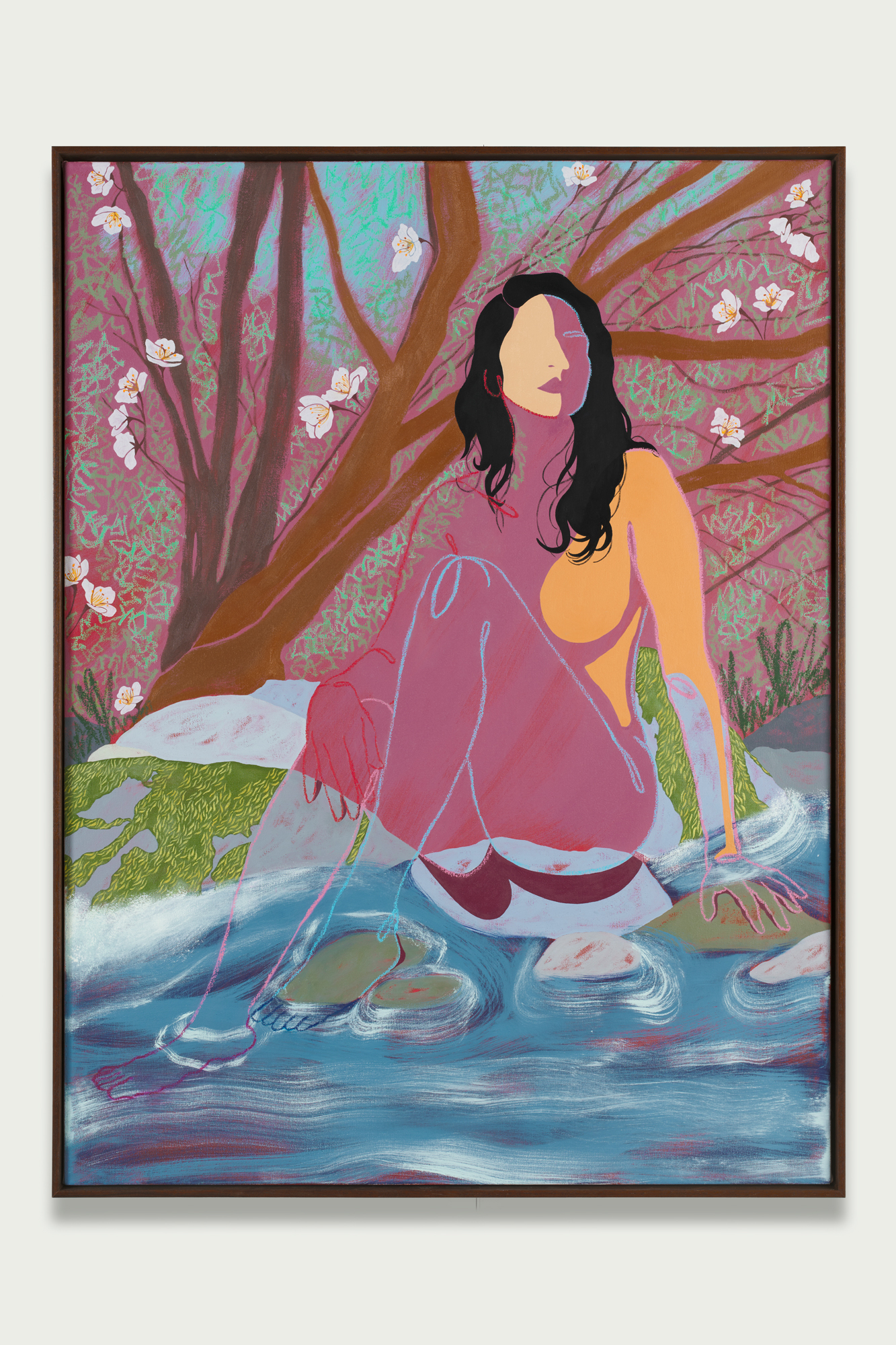
In this vein, a fraught tension between place and displacement shows up in material juxtapositions throughout the show. Wall-mounted wooden sculptures dot the exhibition’s main gallery, curving around the room’s corners and bending to frame individual paintings like the gnarled limbs of trees. Each branch bears an unexpected fruit. Several wooden and glass spines sprout from the sculptures, giving them the appearance of large cacti or strange sea urchins. The glass spines glitter brilliantly at certain angles and turn invisible at others, like drops of water.
The sculptural forms lend to the organic theme of the landscape paintings but the spikes speak of hostility, drawing the viewer in and simultaneously warning “keep your distance.” The hostile installation feels like a declaration of possession by the artist, safeguarding her story.
A group of long silk paintings hang ceiling to floor in a darkened second gallery that also includes an audio installation, both titled I Am Everywhere the Water Has Been. The silks, featuring more female bathers, function as a single, multi-panel artwork. Some panels float behind others, blurring and obscuring painted images like a view through water. The specialized audio installation, a collaboration with producer Sanaya Ardeshir, layers interviews with Mirchandani’s grandmother; field recordings from Western Ghats; and the artist’s own abstract vocalizations.
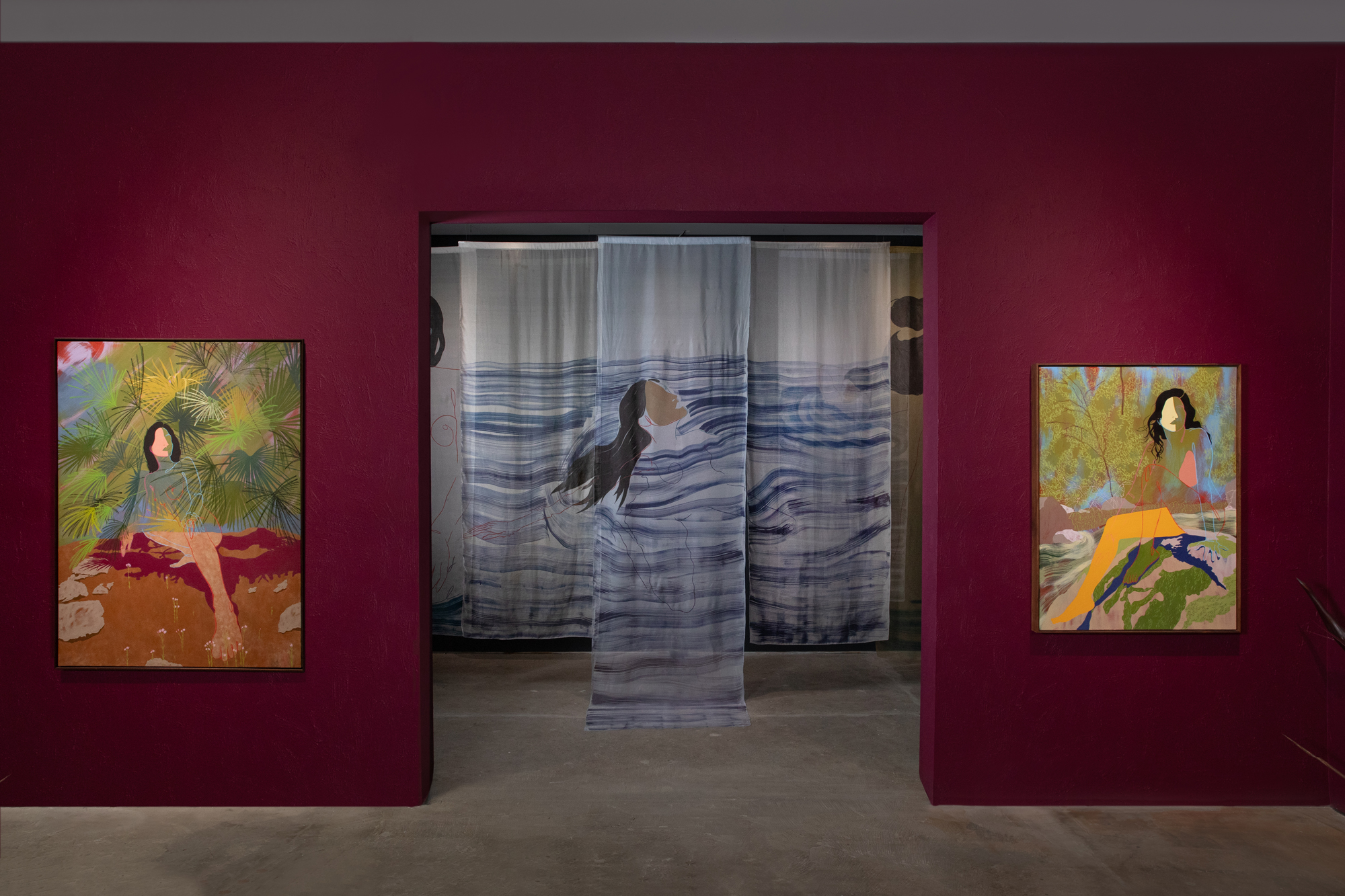
Mirchandani only recently began talking to her grandmother, who lived through the 1947 partition of India, about her experiences of migration. She has recorded and compiled the conversations into an archive that’s now starting to inform her painting practice, as well as her 2024 documentary short Landscapes of Longing. The archive itself is part reality, part fiction and part myth, and the audio installation at the ICA San José is similarly fragmented, layered intentionally to further obscure any coherent narrative.
“My archive is very fluid and amorphous,” Mirchandani says. “My family doesn’t have any heirlooms — just oral history and a few photos.”
Mirchandani’s family history is as collaged as the landscapes her figures occupy. It exists as snatches of memory and second-hand knowledge passed down through generations. So it follows that her representation of that history would feel pieced together, too.
The artist’s fragmented approach to this narrative is in some ways intentional, and in other ways symptomatic. In conveying the experience of an unsettled state of being, My Body Was A River Once also feels full of potential, on the verge of something more expansive. While the show is a bold departure into new territory for the artist, it’s clearly just the first step. I can’t wait to see where in the world Mirchandani goes next.
‘My Body Was A River Once’ is on view at the ICA San José (560 S 1st St., San José) through Aug. 23, 2026.