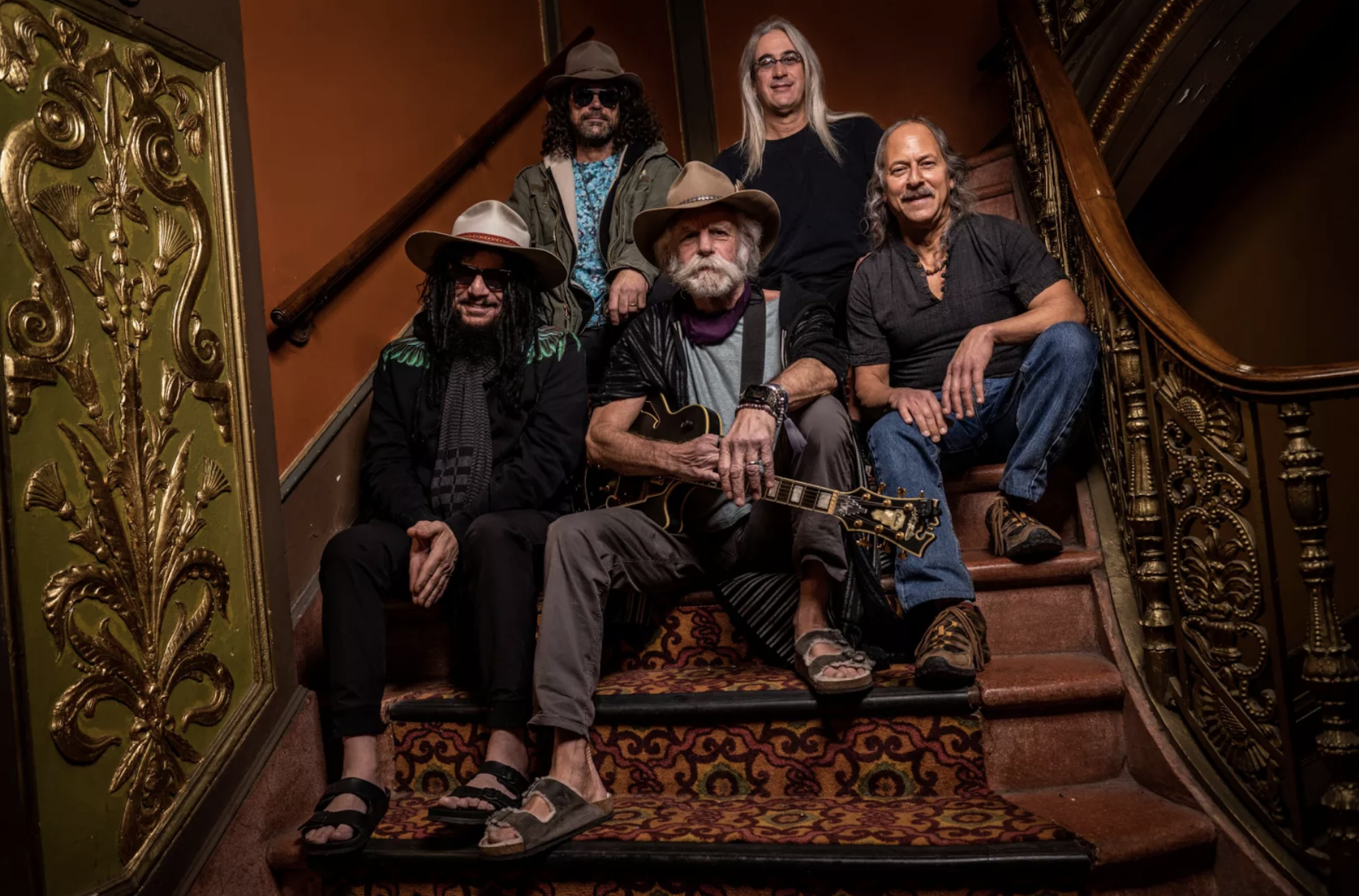
Was has long been known for what musicians call “big ears” — an exceptional knack for listening to many kinds of music with a deep appreciation. In an interview conducted just a day after the announcement of Weir’s death, he shares a few stories of his experience from the bandstand.
This interview has been edited for length and clarity.
Felix Contreras: What’s the biggest lesson you learned from Bob Weir in your time playing together?
Don Was: What I learned was to approach both music and life without fear. I’m not saying that I mastered it, but he set me on a course of obliterating self-consciousness and regret and fear about the future when you’re playing music. Just be in the present and trust your instincts, and don’t be afraid to do something that’s going to be perceived as being a mistake. The audience doesn’t mind if you make a mistake, because they know you’re trying to give them something new and original. And that was the point — to do something fresh every single night, to approach these songs like they were brand-new experiences. So every night was an adventure.
Had you listened to the Dead much before you entered their orbit as a collaborator?
I saw them play in ’72, and I dug what they were doing. I understood that they were a jazz group, essentially, an improvisation group, and they did employ some of the same rhythms and the same harmonic modes as the jazz musicians were doing — but there was something else going on, and it was a rock and roll band above all else. I dug where they were coming from, but I was not what you would call a Deadhead. I didn’t follow a tour around, and up until we started playing those songs together, I really could not have pointed out the difference between a 1978 concert and a 1994 concert. But I can now [laughs].
There were so many outlets for the Dead’s catalog. What was the specific idea behind Wolf Bros? Did Bob ever talk to you about it?
I think the most important thing to Bobby was that he wanted a group that allowed him the space to interpret the songs as a singer — and interpret them differently every night — but to fully inhabit the lyrics and stay out of the way of the story. So that was our focus initially, just to give him room to be Bobby and to sing those songs with a beginner’s mind every night. To start fresh, to inhabit the characters in the song, and to be unencumbered by notes getting in the way. So I tried very hard to support him so that however he wanted to phrase that night, he was always in the pocket.
I saw that first tour in the fall of 2018, and what stood out to me that night was, as you guys were inhabiting the songs, in the spaces where there was supposed to be a guitar solo, it was just him comping [playing supporting chords]. I was like, “Oh my God, this is the spotlight on his distinct style” — a singular style that he developed playing behind Garcia for all those years. It was like a non-solo solo.
By the way, he wasn’t the first to do that. I would say that Keith Richards began blurring the line between [lead] guitar playing and rhythm guitar playing. And maybe you could even say the same about Chuck Berry if you really listened to what he was doing at the core — he was kind of taking over the horn parts in terms of the syncopations.
Bobby certainly blurred the lines between lead guitar and rhythm guitar, but also blurred any preconception about what a rock and roll guitar player is supposed to play. He could alternate within the course of four bars from something John Lee Hooker-raw to Segovia-sophisticated. I found his improvisations every night to be incredibly colorful and vivid, and I never knew what he was going to do next. Sometimes when you play with someone for a long time, you can anticipate them. He was always a delightful surprise to play with because everything he came up with was unpredictable. And again, I don’t think there was a separation between his singing and his playing. It was all one basic instinct, and he was being himself.
You’ve worked in so many styles and genres, and done so many different collaborations. What did you get out of playing Grateful Dead music?
There’s a lot of allure to playing Grateful Dead songs. First of all, they’re beautifully written. I was actually angry when I had to learn them because they were so complicated — like “Saint of Circumstance” and “Lost Sailor,” it took me a long time to get those down. Once I internalized the songs, I realized that the things that I thought were hard, the odd bars and that kind of thing, that’s part of the beauty of it. These songs all roll off your fingers like butter, man.
They also allow you room to play differently every night. There’s all kinds of territory to explore. That doesn’t happen in every kind of song. It reminds me of Wayne Shorter: Why did he stand out? Why is he considered the great writer of our time? It’s because [the songs] were fun to play. You know, I started thinking of those songs as friends. I know it sounds goofy, but “Lost Sailor,” for example — I heard it recently, and I missed it. I missed playing it, and I missed inhabiting the song. They’re gentle on the psyche. They make you feel good. I don’t know if this will make sense to anyone but a musician, but it’s a positive experience to play those songs and to inhabit them.
Also, I could see the faces in the audience. You know, I was in my 60s when I joined Bobby’s band, and I’ve never seen an audience respond to music like that. You could see how much certain lines would mean to people by looking at their faces, and you’d get a vibe back that would actually impact the way you played. The energy exchange between the audience and the band at a Grateful Dead-related show is on another level: The audience is really a member of the band. The musicians on the stage feed off that energy that comes back at them, and it makes you choose different moments. It’s a remarkable little exchange. It’s different from anybody else.