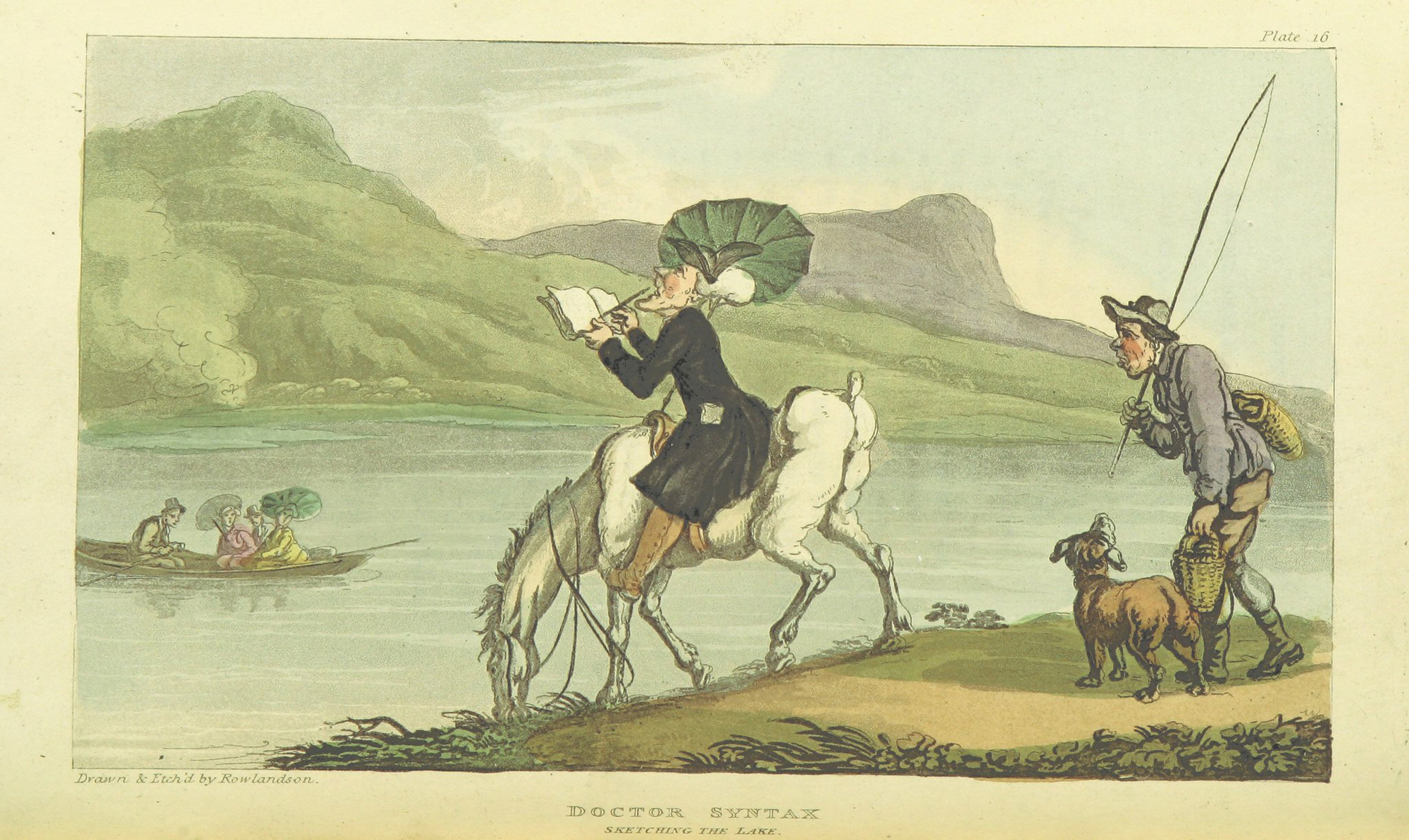
Thomas Rowlandson's illustration of 'Doctor Syntax reading his tour' from William Combe's 'The Tour of Doctor Syntax: in search of the picturesque,' 1813 edition. (Courtesy of the British Library)
The most ardent fans of Jane Austen — or Janeites as they call themselves — discuss more than their favorite film portrayals of Mr. Darcy.
As they celebrate her 250th birthday on Dec. 16, some are seeking out the deep cuts, one of which now includes a modern critical edition, published by a Bay Area high school class, of an illustrated poem that was like The White Lotus of Austen’s time.
The Tour of Doctor Syntax: In Search of the Picturesque, written by William Combe and published in 1812, was a mega bestseller. It chronicles a bumbling, unfashionable clergyman named Doctor Syntax and his efforts to earn a living during “picturesque” travels — satirizing an ideal of the time, popularized by the artist William Gilpin, that nature was meant to be experienced like a landscape painting, in the vogue of romanticism that dominated art of the era.
“It was the great comic sensation of the Regency,” said Ben Wiebracht, who teaches a class on Austen at Stanford Online High School and studied her as part of his doctoral dissertation. “There are Syntax adaptations on the stage. There was merchandise. There was even a racehorse named Doctor Syntax.”
Part of the poem’s appeal is the accompanying illustrations by Thomas Rowlandson. They help depict Syntax’s stories full of comic misunderstandings and disasters populated by thieves and con men (hence the spiritual connection to the contemporary HBO comedy set in luxury destinations around the world).
Thomas Rowlandson’s illustration of ‘Doctor Syntax sketching the lake’ from William Combe’s ‘The Tour of Doctor Syntax: in search of the picturesque,’ 1813 edition. (Courtesy of the British Library)
Austen herself refers to Doctor Syntax in a 1814 letter to her older sister Cassandra: “I have seen nobody in London yet with such a long chin as Dr. Syntax.”
While her novels are mostly domestic dramas set in drawing rooms, Austen was captivated by the world around her and was a cultural savant in her own right, explained Isobel Grundy, professor emeritus of women’s literature at the University of Alberta.
“She wasn’t entirely a country mouse. She went to London, the theater and exhibitions,” Grundy said. “I think that she felt like it’s her own kind of humor and felt a kindred spirit with that.”
Austen alludes to the picturesque in most of her novels, Wiebracht said. He cited one of the characters in Sense and Sensibility, Marianne Dashwood, who’s a disciple of Gilpin and fawns over what makes a landscape beautiful.
“You can kind of even see that happen today with a new style of music, for example. At its peak, when that music is most popular, is also when it’s most ripe for satire. And that’s the kind of treatment that we see the picturesque getting during the period when Austen was writing her novels and when Doctor Syntax shows up,” Wiebracht said.
While Austen’s novels have gained popularity over the centuries, spawning multiple film and TV adaptations and a fervent fandom, Doctor Syntax fell into obscurity after the 19th century, when the picturesque went out of fashion, according to Wiebracht.
In 2023, he and his class of high school students took on the work of producing a modern critical edition of Doctor Syntax, to bring it back to light as another entrée into Austen’s cultural milieu. Wiebracht and his students worked as designers, editors and researchers, and the result is an annotated text that explains the vernacular of the time and connections to Austen.
“I have so much respect for copy editors. It is way more work than I expected. It’s also cool just how [much] texts change over time,” said Aidan Bekendam, who was a senior at the time in Wiebracht’s class and now studies history at the University of St. Andrews.
This year, the Modern Language Association of America awarded Wiebracht and his students’ book the biennial “Prize for a Scholarly Edition,” which typically recognizes writing from major academic presses. (The students’ project is published under Pixelia Publishing, an entity co-founded by Wiebracht that’s focused on student-teacher collaborations.)
Outside of academic circles, Doctor Syntax can also be exciting to Janeites overall, who range from the skilled cosplayers to book completionists, says Erna Arnesen, membership coordinator for the Northern California chapter of the Jane Austen Society of North America. She said her reading group discussed the high school class’ book and appreciated the extensive footnotes and insight into the illustrations.
“It was just phenomenal,” Arnesen said. “We talked about the prints that we had actually seen in museums and different places where we’ve encountered or studied Jane Austen.”
Wiebracht said he will continue to teach his Austen class and will pursue similar projects that unearth more of the literature of her time — which is good news for the diehards like himself. Wiebracht has even learned the period dance moves and is known to sport waistcoats and knee breeches.
“I don’t know if I can be considered a true Jaineite yet because I don’t yet have a full suit of Regency clothing, but I’m working on it,” Wiebracht said. “My appreciation of Austen has grown.”
lower waypoint
Care about what’s happening in Bay Area arts? Stay informed with one email every other week—right to your inbox.