Sponsor MessageBecome a KQED sponsor
upper waypoint

In 2025, the Valkyries’ Inaugural Season Reminded Me of Women’s Raw Power

Save ArticleSave Article
Failed to save article

Please try again

The Golden State Valkyries cheer after scoring against the Minnesota Lynx during Game 2 of the WNBA playoffs at the SAP Center in San Jose on Sept. 17, 2025. (Beth LaBerge/KQED)

This week, as we near the end of 2025, the writers and editors of KQED Arts & Culture are reflecting on One Beautiful Thing from the year.

I

t was a particularly glorious San Francisco Pride weekend. My jeans had grass stains from a sunny afternoon at Dolores Park, and my heart was on fire from the passion and solidarity I witnessed at the Trans March. After we joined a pink, white and blue procession of gender-nonconforming people demanding dignity down Market Street, one of my best friends and I took Muni to the Chase Center and stepped into a sea of violet, lavender and lilac. I had been to professional basketball games before, but there was another level of excitement vibrating through the stadium during the first-ever Pride game of the Bay Area WNBA team’s inaugural season.

KQED Arts & Culture’s Nastia Voynovskaya courtside at Chase Center during the Valkyries’ warm-up on Aug. 19, 2025. (Tâm Vũ/KQED)

The Valkyries won against the Chicago Sky, yes, but what stood out the most to me were the moments of connection and community, large and small. Throughout the Valkyries’ inaugural season, Ballhalla — as their home court is known — became a super queer, massive celebration of women’s raw power and strength. In a year when conservative ideas about gender made a major comeback, this was the antidote I didn’t know I needed.

F

rom the players, to the creative luminaries on the jumbotron, to the fans in the stands, my first Valkyries game felt completely different from any other professional sports experience. Seated next to me was a friend of a friend, and we hit it off in a conversation that began with basketball and ended with spirituality and the deeper why of our creative practices. All around me in the extended friend group were artists, healers and teachers — queer women and nonbinary people defining their lives on their own terms, and using their talents to invite others to seek the same freedom.

I looked up at the jumbotron, which featured technicolor, nature-inspired designs by Favianna Rodriguez, an Oakland visual artist and activist whose radiant butterflies have decorated protest signs calling for climate justice and reproductive freedom all over the world. It was Rodriguez who first opened my eyes to the power of art to move hearts and shape social movements when I went to a talk of hers over a decade ago, when I was first embarking upon my journalism career. It’s a pillar that underpins most of my writing all these years later. And there she was courtside, an accomplished queer woman dedicated to liberation, being honored in a stadium of 18,064 screaming fans.

Ballhalla gets it, I thought. This is bigger than basketball.
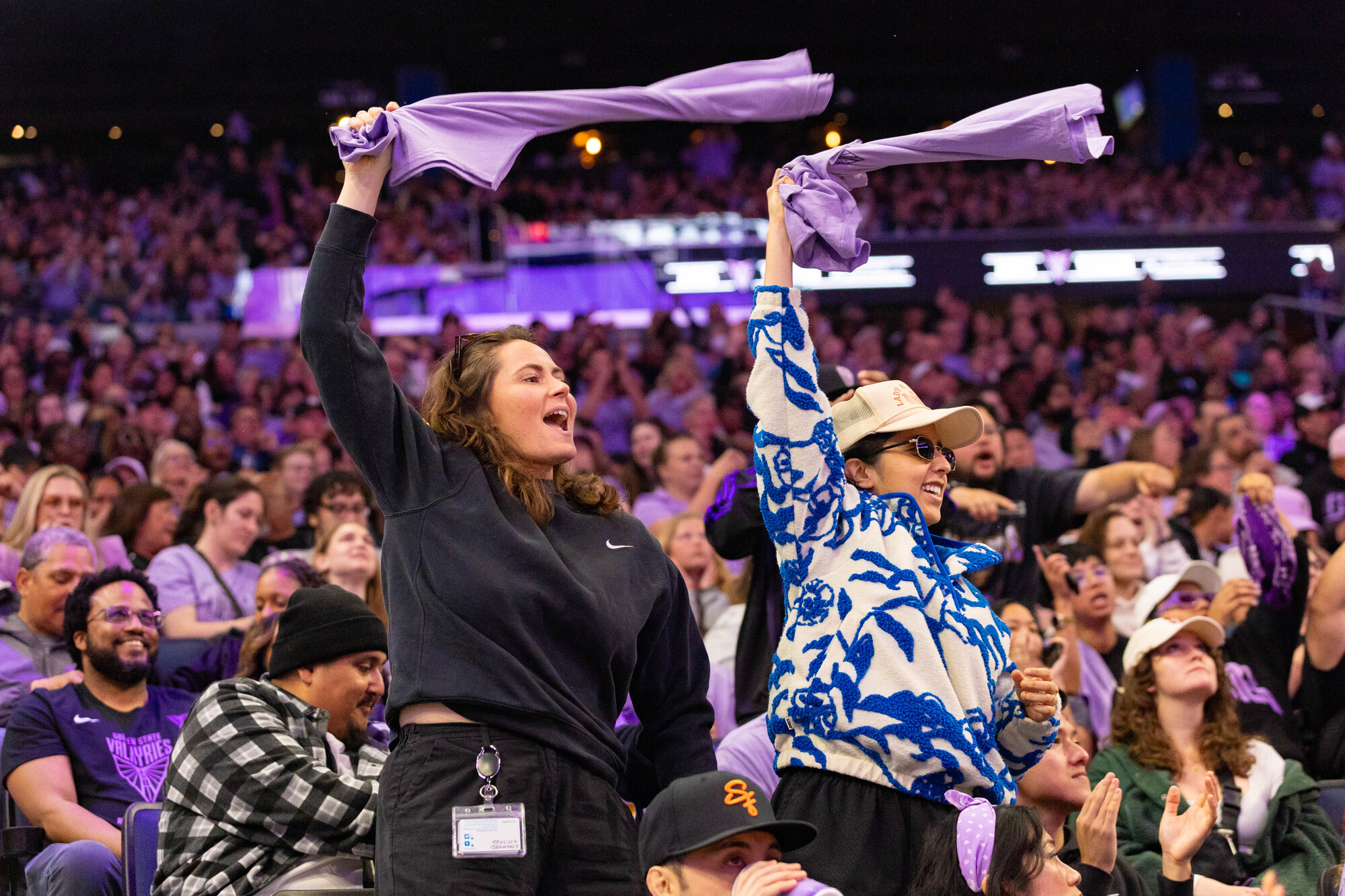
two fans whip lavender shirts over heads in crowd
Fans cheer as the Golden State Valkyries scored during their WNBA season opener against the Los Angeles Sparks at Chase Center on May 16, 2025. (Gina Castro/KQED)

Then, of course, there was the actual game, which had me and my friends gasping and screaming as the Valkyries eked out a narrow lead. In the fourth quarter, forward Kayla Thornton sunk her fourth three-pointer, long braids whipping behind her as she ran down the court, and the arena erupted with ecstatic cheers. It hit me that these 18,064 people of all genders, ethnicities and ages were here to celebrate not just the home team, but an entire culture that has grown around these fierce women.

T

hat realization felt significant on a bone-deep level, especially when I considered the ways the U.S. has backslid on women’s and trans rights in recent years. Tradwife discourse and Ozempic campaigns. The loss of abortion access after the Supreme Court toppled Roe v. Wade. The ongoing, ever-more-hostile attacks on trans people’s access to medical care. Vice President J.D. Vance’s statements that people without children should have fewer voting rights. His infamous 2024 comments deriding “childless cat ladies,” echoing a tired insult that’s been leveled at women who don’t hinge their happiness on male approval since the witch trials of the 1300s.

Whether from celebrities, social media or the highest halls of power, women and LGBTQ+ people are once again inundated with messaging about how we should shrink and contort ourselves into boxes — boxes that many of us don’t fit into as we strive to live full, empowered lives.

Valkyries player Cecilia Zandalasini shoots the basketball as fans watch in anticipation.
Game 2 of the Valkyries vs. Minnesota Lynx WNBA playoff game at the SAP Center in San Jose on Sept. 17, 2025. (Beth LaBerge/KQED)

Meanwhile, on the court, in the media and in their fight for fair pay, players like the Las Vegas Aces’ A’ja Wilson and Minnesota Lynx’s Napheesa Collier, and coaches like Valkyries’ Natalie Nakase, are unafraid to take up space. They don’t apologize for their ambition — they let it roar.

I

n 2025, the Valkyries made history: They broke attendance records by selling out the Chase Center for every game, and became the first expansion team to make it to the playoffs. The WNBA has enjoyed its largest attendance numbers since its inception, with plans to expand the league to 18 teams by 2030. It’s worth celebrating that the WNBA achieved that mainstream popularity without players sacrificing their authenticity.

Sponsored

Some of the league’s most visible personalities, the Lynx’s Court Williams and Natisha Hiedeman — aka StudBudz — are proudly masculine-of-center lesbians with a passionate following that transcends race and gender lines. Indeed, 57% of WNBA fans are men, and young boys are a growing part of that demographic. They want to see women win, too.

If the past few years have taught us anything, it’s that in 2026, women and trans people have to be prepared to defend a growing list of freedoms that we might’ve taken for granted in the past. But there’s power in the collective. The joy, solidarity and awe I’ve experienced at WNBA games reminds me that another world is possible.

lower waypoint
next waypoint